


Tulane University

Encyclopedia
Tulane University is a private
, nonsectarian
research university located in New Orleans, Louisiana
, United States. Founded as a public medical college in 1834, the school grew into a comprehensive university in 1847 and was eventually privatized under the endowments of Paul Tulane
and Josephine Louise Newcomb
in 1884. Tulane is a member of the Association of American Universities
and the colloquial Southern Ivy League.
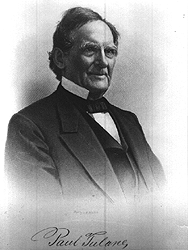 The university was founded as the Medical College of Louisiana in 1834 partly as a response to the fears of smallpox
, yellow fever
and cholera
in America. The university became only the second medical school in the South, and the 15th in the United States at the time. In 1847, the state legislature established the school as the University of Louisiana, a public university
, and the law department
was added to the university. Subsequently, in 1851, the university established its first academic department. The first president chosen for the new university was Francis Lister Hawks, an Episcopalian bishop and prominent citizen of New Orleans at the time.
The university was closed from 1861 to 1865 during the American Civil War
. After reopening, it went through a period of financial challenges because of an extended agricultural depression in the South which affected the nation's economy. Paul Tulane
, owner of a prospering dry goods and clothing business, donated extensive real estate within New Orleans for the support of education. This donation led to the establishment of a Tulane Educational Fund (TEF), whose board of administrators sought to support the University of Louisiana instead of establishing a new university. In response, through the influence of former Civil War general Randall Lee Gibson, the Louisiana state legislature transferred control of the University of Louisiana to the administrators of the TEF in 1884. This act created the contemporary Tulane University of Louisiana. The university became privatized, and is the only American university to be converted from a state public institution to a private one.
In 1885, the university established its graduate division, later becoming the Graduate School. One year later, gifts from Josephine Louise Newcomb
totaling over $3.6 million, led to the establishment of the H. Sophie Newcomb Memorial College
within Tulane University. Newcomb was the first coordinate college for women in the United States and became a model for such institutions as Pembroke College
and Barnard College
. In 1894 the College of Technology formed, which would later become the School of Engineering. In the same year, the university moved to its present-day uptown campus on historic St. Charles Avenue
, five miles by streetcar from downtown New Orleans.
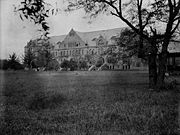 With the improvements to Tulane University in the late 19th century, Tulane had a firm foundation to build upon as the premier university of the South and continued this legacy with growth in the 20th century. In 1901, the first cornerstone was laid for the F.W. Tilton Library, endowed by New Orleans businessman and philanthropist
Frederick William Tilton
(1821–1890). During 1907, the school established a four year professional curriculum in architecture through the College of Technology, growing eventually into the Tulane School of Architecture
. One year later, Schools of Dentistry and Pharmacy were established, albeit temporarily. The School of Dentistry ended in 1928, and Pharmacy six years later. In 1914, Tulane established a College of Commerce, the first business school
in the South. In 1925, Tulane established the independent Graduate School. Two years later, the university set up a School of Social Work
, also the first in the southern United States. Tulane was instrumental in promoting the arts in New Orleans and the South in establishing the Newcomb School of Art with William Woodward
as director, thus establishing the renown Newcomb pottery. The Middle American Research Institute was established in 1925 at Tulane "for the purpose of advanced research into the history (both Indian and colonial), archaeology, tropical botany (both economic and medical), the natural resources and products, of the countries facing New Orleans across the waters to the south; to gather, index and disseminate data thereupon; and to aid in the upbuilding of the best commercial and friendly relations between these Trans-Caribbean peoples and the United States."
University College
was established in 1942 as Tulane's division of continuing education. By 1950, the School of Architecture had grown out of Engineering into an independent school. In 1958, the university was elected to the Association of American Universities
, an organization consisting of sixty-two of the leading research universities in North America. The School of Public Health and Tropical Medicine
again became independent from the School of Medicine in 1967. Originally established in 1912, it was arguably one of the first public health schools in the United States. Tulane's School of Tropical Medicine also remains the only one of its kind in the country. On April 23, 1975, President Gerald R. Ford, Jr.
, spoke at Tulane University's Fogelman Arena at the invitation of Congressman F. Edward Hebert, a representative of Louisiana’s 1st Congressional District. During the historic speech, Ford announced that the Vietnam War was "finished as far as America is concerned" - one week before the fall of Saigon. Ford drew parallels to the Battle of New Orleans
, saying that such positive activity could do for America’s morale what the battle did in 1815.
During World War II
, Tulane was one of 131 colleges and universities nationally that took part in the V-12 Navy College Training Program
which offered students a path to a Navy commission.
A detailed account of the history of Tulane University from its founding through 1965 was published by Dyer.
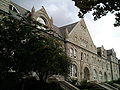 In July 2004, Tulane received two $30 million donations to its endowment
, the largest individual or combined gifts in the university's history. The donations came from Jim Clark
, a member of the university's board of trustees and founder of Netscape
, and David Filo
, a graduate of its School of Engineering and co-founder of Yahoo!
. A fund-raising campaign called "Promise & Distinction" raised $730.6 million as of October 3, 2008, increasing the university's total endowment to more than $1.1 billion; by March 2009, Yvette Jones, Tulane's Chief Operating Officer, told Tulane's Staff Advisory Council that the endowment "has lost close to 37%", affected by the late-2000s recession.
In April 2010, the Tulane admissions office reported that it had received 44,000 applications for the class of 2014, breaking the previous record set by the class of 2013. While unable to confirm it officially, the admissions office stated that “it appears that we have the most applications for the upcoming fall semester of any private university in the country.”
in August 2005 and its damaging effects on New Orleans, most of the university was closed for the second time in its history—the first being during the Civil War. The closing affected the first semester of the school calendar year. The School of Public Health and Tropical Medicine's distance learning programs and courses stayed active. The School of Medicine relocated to Houston, Texas
for a year. Aside from student athletes attending college classes together on the same campuses, most undergraduate and graduate students dispersed to campuses throughout the U.S.
Facing a budget shortfall, the Board of Administrators announced a "Renewal Plan" in December 2005 to reduce its annual operating budget and create a "student-centric" campus. Addressing the school's commitment to New Orleans, a course credit involving "service learning" became a requirement for an undergraduate degree. In 2006 Tulane became the first Carnegie ranked “high research activity” institution to have an undergraduate public service graduation requirement. In May 2006, graduation ceremonies included commencement speakers former Presidents George H. W. Bush
and Bill Clinton
, who commended the students for their desire to return to Tulane and serve New Orleans in its renewal.
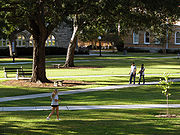 Tulane's primary campus is located in Uptown New Orleans
on St. Charles Avenue
, directly opposite of Audubon Park, and extends north to South Claiborne Avenue through Freret and Willow Street. The campus is known colloquially as the Uptown or St. Charles campus. It was established in the 1890s and occupies more than 110 acre (0.4451546 km²) of land. The campus is known both for its large live oak
trees as well as its architecturally historic buildings. It has been listed on the National Register of Historic Places since 1978. The campus architecture consists of several styles, including Richardsonian Romanesque, Elizabethan, Italian Renaissance, Mid-Century Modern, and contemporary styles. The front campus buildings use Indiana White Limestone or orange brick for exteriors, while the middle campus buildings are mostly adorned in red St. Joe brick, the staple of Newcomb College Campus buildings. Loyola University
is directly adjacent to Tulane, on the downriver side. Audubon Place
, where the President of Tulane resides, is on the upriver side.
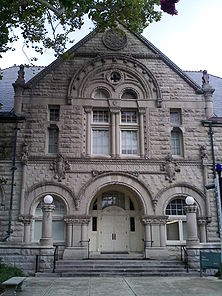 The centerpiece of the Gibson Quad is the first academic building built on campus, Gibson Hall
, in 1894. The schools of Architecture and Social Work are also located on the oldest section of the campus. The middle of the campus, between Freret and Willow Streets and bisected by McAlister Place
and Newcomb Place, serves as the center of campus activities. The Lavin-Bernick Center for University Life, Fogelman Arena, McAlister Auditorium, Howard-Tilton Memorial Library, and most of the student residence halls and academic buildings populate the center of campus. The facilities for the Freeman School of Business
line McAlister Place and sit next to the Tulane Law School. The middle campus is also home to the historic Newcomb College Campus, which sits between Newcomb Place and Broadway. The Newcomb campus was designed by New York architect James Gamble Rogers
, noted for his work with Yale University
's campus. The Newcomb campus is home to Tulane's performing and fine arts venues. The back of campus, between Willow Street and South Claiborne, is home to two residence halls, Reily Recreation Center and Turchin Stadium
, the home of Green Wave baseball.
After Hurricane Katrina, Tulane has continued to build new facilities and renovate old spaces on its campus. The newest residence hall, Lallage Feazel Wall Residential College, was completed in August 2005 and took in its first students when Tulane re-opened in January 2006. The Lavin-Bernick Center for University Life was renovated to be a green, environmentally friendly building and opened for student use in January 2007. In 2009, the university altered McAlister Drive, a street that ran through the middle of the uptown campus into pedestrian walkway renamed McAlister Place. The area was resurfaced and the newly added green spaces were adorned with Japanese magnolias, irises and new lighting. Coincidentally, in late November 2008 the City of New Orleans announced plans to add bicycle lanes to the St. Charles Avenue
corridor that runs in front of campus.
Additionally, Tulane is renovating Dinwiddie Hall to be the campus's first building to attain a Silver LEED certification award. The Dinwiddie Hall renovation began in June 2009, and is expected to be finished in July 2010. Tulane has also broken ground on a new residence hall, which will also apply for LEED certification. This dorm, designed to be a residential college like the recently constructed Wall Residential College, will have 267 beds.
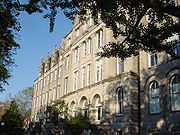 Tulane is organized into 10 schools centered around liberal arts, sciences, and specialized professions. All undergraduate students are enrolled in the Newcomb-Tulane College
. The graduate programs are governed by the individual schools.
Tulane is unique among universities in the United States in its academic organization in that all undergraduates are enrolled in Newcomb-Tulane College as well as being registered in the School which houses their major. Newcomb-Tulane College serves as an administrative center for all aspects of undergraduate life at Tulane, thus it is similar to Yale
and Harvard universities in this type of undergraduate organization.
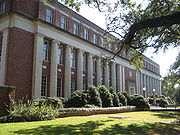
in 1958. Tulane also is designated by the Carnegie Foundation as a research university with "very high research activity." For 2007, Tulane reached the highest level of research funding in its history, exceeding $157.5 million. In 2008 Tulane was ranked by the Ford Foundation as the major international studies research institution in the South and one of the top 15 nationally. The National Institutes of Health
ranks funding to Tulane at 79th.
awarded by Tulane which covers full tuition for the duration of the recipient's undergraduate program. The scholarship is offered to between 75 and 100 incoming freshmen by the Office of Undergraduate Admission, and is awarded only through a separate application. This scholarship is renewable provided that the recipient maintains a minimum 3.0 GPA at the end of each semester and maintains continuous enrollment in a full-time undergraduate division. Typically, recipients have SAT I scores of 1450 or higher or an ACT composite score of 33 or higher, rank in the top 5% of their high school
graduating class, have a rigorous course load including honors and Advanced Placement classes, and an outstanding record of extracurricular activities. Notable recipients include Sean M. Berkowitz
, David Filo
and Eric R. Palmer.
After her death in 1999, Lallage Feazel Wall, daughter of interim U.S. Senator William C. Feazel
and widow of State Representative
Shady R. Wall
of West Monroe
left $18 million to Tulane to promote "creativity" among university faculty and staff.
Tulane maintains 3,350 beds in 12 residence halls on its uptown campus for undergraduate students. Per the Renewal Plan instituted after Hurricane Katrina, Tulane requires all freshmen and sophomores to live on campus, except those who are from surrounding neighborhoods in New Orleans. Due to the increasing size of incoming classes, Tulane has allowed a small number of rising Sophomores to reside off campus instead of being required to remain in campus housing. Housing is not guaranteed for juniors and seniors. Tulane has begun construction on a new residential college that will have roughly 250 new beds. Construction is slated to be complete by fall 2011.
is the university's weekly student-run newspaper. It is published every Friday of the academic year, except on holidays, and has received multiple Pacemaker Awards
, the highest award in college journalism.
The Jambalaya, Tulane's yearbook
, published annually since 1897, published its last edition (Volume 99) in 1995, because of funding and management problems. In the fall of 2003, the Jambalaya was reestablished as a student club, and in the Spring of 2004, the centennial edition of the Jambalaya was published. The staff now continues to publish a Jambalaya annually.
The student-run radio station
of the university, WTUL
New Orleans 91.5, began broadcasting on campus in 1971.
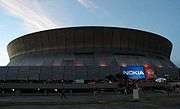
 Tulane is a member of Conference USA
in athletics and an official member of the NCAA
Division I. The university was a charter member of the Southeastern Conference, in which it competed until 1966. Tulane, along with other academically-oriented, private schools had considered to form the "Southern Ivy League" (Magnolia Conference) in the 1950s. Baseball
and women's volleyball
are among its stronger sports. In 2008, Tulane reopened Greer Field at Turchin Stadium, a renovated baseball venue for its team. The baseball team consistently ranks among the top 25 in national polls such as Baseball America
, USA Today
/ESPN
, and Collegiate Baseball. In 2001 and 2005, Tulane baseball finished with 56 wins and placed 5th at the College World Series
.
The women's volleyball team, which plays in Fogelman Arena
, won the 2008 Conference USA Championship tournament. Fogelman Arena was renovated for basketball in the fall of 2006. The Green Wave football
team went 12-0 in 1998, winning the Liberty Bowl
and finishing the season ranked No. 7 in the nation. The Green Wave also won the Hawaii Bowl
in 2002, the Liberty Bowl
in 1970, and the 1935 Sugar Bowl
. Tulane once used Tulane Stadium
on the uptown campus that seated more than 80,000 people, held three Super Bowls, and was the home of the New Orleans Saints
and the Sugar Bowl. The stadium was demolished in 1980. The football team now plays in the refurbished Mercedes-Benz Superdome and occasionally has played at Tad Gormley Stadium
in City Park.
Tulane also participates in a variety of men's and women's intercollegiate sports such as basketball, track and cross country, swimming, tennis, and golf. Tulane's graduation rate for its student-athletes consistently ranks among the top of Division I athletics programs. Most of the administrative and athletic support facilities (such as weight rooms, training center, locker rooms, conference rooms, and hall of fame displays) are located in the Wilson Athletic Center.
, Pulitzer Prize for Fiction winner; from business: David Filo
, co-founder of Yahoo!, and Neil Bush
, economist and brother of President George W. Bush
; from entertainment Lauren Hutton
, film actor and supermodel, and Paul Michael Glaser
, TV actor of "Starsky and Hutch"; from music: conductor and composer Odaline de la Martinez
, who was the first woman to conduct at a BBC Proms concert in London; from government: Luther Terry
, former U.S. Surgeon General who issued the first official health hazard warning for tobacco; from medicine: Michael DeBakey, inventor of the roller pump, and Dr. Regina Benjamin, President Obama's Surgeon General
; from science A. Baldwin Wood
, inventor of the wood screw pump and Lisa P. Jackson
, United States Environmental Protection Agency
(EPA) Administrator under President Obama; from sports: Bobby Brown, former New York Yankees third baseman and former president of the American League. A former graduate residence hall on campus was also named for Engineering graduate Harold Rosen, who invented the geosynchronous communications satellite
. Douglas G. Hurley
, NASA
astronaut
and pilot of mission STS-127
, became the first alumnus to travel in outer space
in July 2009.
Tulane also hosted several prominent faculty, such as two members who each won the Nobel Prize
in Physiology or Medicine: Louis J. Ignarro and Andrew V. Schally. Other notables such as John Kennedy Toole
, Pulitzer Prize-winning author of A Confederacy of Dunces
, Rudolph Matas
, "father of vascular surgery," and George E. Burch
, inventor of the phlebomanometer in medicine, also were on faculty at Tulane. Five U.S. Supreme Court Justices have taught at Tulane, including Chief Justice William Rehnquist
. Tulane has also hosted several prominent artists, most notably Mark Rothko
, who was a Visiting Artist from 1956-1957. Currently on the faculty are James Carville
and Nick Spitzer
.
Several football alumni play in the National Football League
, including Patrick Ramsey
(New Orleans Saints
), J.P. Losman
(Buffalo Bills
), Anthony Cannon
(Detroit Lions
), Mewelde Moore
(Pittsburgh Steelers
), Matt Forté
(Chicago Bears
), and Roydell Williams
(Tennessee Titans
). Several baseball alumni play in the Major Leagues, including Andy Cannizaro
(New York Yankees
) and Micah Owings
(Arizona Diamondbacks
).
Private university
Private universities are universities not operated by governments, although many receive public subsidies, especially in the form of tax breaks and public student loans and grants. Depending on their location, private universities may be subject to government regulation. Private universities are...
, nonsectarian
Nonsectarian
Nonsectarian, in its most literal sense, refers to a lack of sectarianism. The term is also more narrowly used to describe secular private educational institutions or other organizations either not affiliated with or not restricted to a particular religious denomination though the organization...
research university located in New Orleans, Louisiana
Louisiana
Louisiana is a state located in the southern region of the United States of America. Its capital is Baton Rouge and largest city is New Orleans. Louisiana is the only state in the U.S. with political subdivisions termed parishes, which are local governments equivalent to counties...
, United States. Founded as a public medical college in 1834, the school grew into a comprehensive university in 1847 and was eventually privatized under the endowments of Paul Tulane
Paul Tulane
Paul Tulane , an American philanthropist, was born near Princeton, New Jersey, the son of Louis Tulane, a French immigrant, and Maria Tulane. He was educated in private schools, including Somerville Academy of New Jersey, until he was fifteen years of age...
and Josephine Louise Newcomb
Josephine Louise Newcomb
Josephine Louise Newcomb, born Josephine Le Monnier , was the philanthropist whose donations led to the founding of Newcomb College at Tulane University.-External links:...
in 1884. Tulane is a member of the Association of American Universities
Association of American Universities
The Association of American Universities is an organization of leading research universities devoted to maintaining a strong system of academic research and education...
and the colloquial Southern Ivy League.
Founding and early history – 19th century
Smallpox
Smallpox was an infectious disease unique to humans, caused by either of two virus variants, Variola major and Variola minor. The disease is also known by the Latin names Variola or Variola vera, which is a derivative of the Latin varius, meaning "spotted", or varus, meaning "pimple"...
, yellow fever
Yellow fever
Yellow fever is an acute viral hemorrhagic disease. The virus is a 40 to 50 nm enveloped RNA virus with positive sense of the Flaviviridae family....
and cholera
Cholera
Cholera is an infection of the small intestine that is caused by the bacterium Vibrio cholerae. The main symptoms are profuse watery diarrhea and vomiting. Transmission occurs primarily by drinking or eating water or food that has been contaminated by the diarrhea of an infected person or the feces...
in America. The university became only the second medical school in the South, and the 15th in the United States at the time. In 1847, the state legislature established the school as the University of Louisiana, a public university
State university system
A state university system in the United States is a group of public universities supported by an individual state, or a similar entity such as the District of Columbia. These systems constitute the majority of public-funded universities in the country...
, and the law department
Tulane University Law School
Tulane University Law School is the law school of Tulane University. It is located on Tulane's Uptown campus in New Orleans, Louisiana. Established in 1847, it is the 12th oldest law school in the United States....
was added to the university. Subsequently, in 1851, the university established its first academic department. The first president chosen for the new university was Francis Lister Hawks, an Episcopalian bishop and prominent citizen of New Orleans at the time.
The university was closed from 1861 to 1865 during the American Civil War
American Civil War
The American Civil War was a civil war fought in the United States of America. In response to the election of Abraham Lincoln as President of the United States, 11 southern slave states declared their secession from the United States and formed the Confederate States of America ; the other 25...
. After reopening, it went through a period of financial challenges because of an extended agricultural depression in the South which affected the nation's economy. Paul Tulane
Paul Tulane
Paul Tulane , an American philanthropist, was born near Princeton, New Jersey, the son of Louis Tulane, a French immigrant, and Maria Tulane. He was educated in private schools, including Somerville Academy of New Jersey, until he was fifteen years of age...
, owner of a prospering dry goods and clothing business, donated extensive real estate within New Orleans for the support of education. This donation led to the establishment of a Tulane Educational Fund (TEF), whose board of administrators sought to support the University of Louisiana instead of establishing a new university. In response, through the influence of former Civil War general Randall Lee Gibson, the Louisiana state legislature transferred control of the University of Louisiana to the administrators of the TEF in 1884. This act created the contemporary Tulane University of Louisiana. The university became privatized, and is the only American university to be converted from a state public institution to a private one.
In 1885, the university established its graduate division, later becoming the Graduate School. One year later, gifts from Josephine Louise Newcomb
Josephine Louise Newcomb
Josephine Louise Newcomb, born Josephine Le Monnier , was the philanthropist whose donations led to the founding of Newcomb College at Tulane University.-External links:...
totaling over $3.6 million, led to the establishment of the H. Sophie Newcomb Memorial College
H. Sophie Newcomb Memorial College
H. Sophie Newcomb Memorial College, or Newcomb College, was the coordinate women's college of Tulane University located in New Orleans, Louisiana. It was founded by Josephine Louise Newcomb in 1886 in memory of her daughter....
within Tulane University. Newcomb was the first coordinate college for women in the United States and became a model for such institutions as Pembroke College
Pembroke College (Brown University)
Pembroke College in Brown University was the coordinate women's college for Brown University in Providence, Rhode Island. It was founded in 1891 and closed in 1971.-Founding and early history:...
and Barnard College
Barnard College
Barnard College is a private women's liberal arts college and a member of the Seven Sisters. Founded in 1889, Barnard has been affiliated with Columbia University since 1900. The campus stretches along Broadway between 116th and 120th Streets in the Morningside Heights neighborhood in the borough...
. In 1894 the College of Technology formed, which would later become the School of Engineering. In the same year, the university moved to its present-day uptown campus on historic St. Charles Avenue
St. Charles Avenue
St. Charles Avenue is a thoroughfare in New Orleans, Louisiana, U.S.A. and the home of the St. Charles Streetcar Line. It is also famous for the hundreds of mansions that adorn the tree-lined boulevard for much of the Uptown section of the route. The southern live oak trees, particularly found in...
, five miles by streetcar from downtown New Orleans.
20th century
Philanthropist
A philanthropist is someone who engages in philanthropy; that is, someone who donates his or her time, money, and/or reputation to charitable causes...
Frederick William Tilton
Frederick W. Tilton
Frederick William Tilton was a New Orleans, Louisiana, businessman and philanthropist who endowed the F.W. Tilton Library at Tulane University....
(1821–1890). During 1907, the school established a four year professional curriculum in architecture through the College of Technology, growing eventually into the Tulane School of Architecture
Tulane School of Architecture
The Tulane School of Architecture or is the school of architecture at Tulane University in New Orleans, Louisiana. The school has a student body of approximately 300 students and is known for the scholarly productivity of its faculty, its collegian atmosphere and unique studio culture.Recognized...
. One year later, Schools of Dentistry and Pharmacy were established, albeit temporarily. The School of Dentistry ended in 1928, and Pharmacy six years later. In 1914, Tulane established a College of Commerce, the first business school
Business school
A business school is a university-level institution that confers degrees in Business Administration. It teaches topics such as accounting, administration, economics, entrepreneurship, finance, information systems, marketing, organizational behavior, public relations, strategy, human resource...
in the South. In 1925, Tulane established the independent Graduate School. Two years later, the university set up a School of Social Work
Tulane University School of Social Work
Tulane University School of Social Work is a part of Tulane University is the oldest school of social work in the colloquial Deep South. The School's slogan is "Do Work That Matters." The school is located on the main academic quad of Tulane's Uptown New Orleans campus.-Mission:The mission of the...
, also the first in the southern United States. Tulane was instrumental in promoting the arts in New Orleans and the South in establishing the Newcomb School of Art with William Woodward
William Woodward (artist)
William Woodward was a U.S. artist and educator, best known for his impressionist paintings of New Orleans and the Gulf Coast of the United States....
as director, thus establishing the renown Newcomb pottery. The Middle American Research Institute was established in 1925 at Tulane "for the purpose of advanced research into the history (both Indian and colonial), archaeology, tropical botany (both economic and medical), the natural resources and products, of the countries facing New Orleans across the waters to the south; to gather, index and disseminate data thereupon; and to aid in the upbuilding of the best commercial and friendly relations between these Trans-Caribbean peoples and the United States."
University College
Tulane School of Continuing Studies
The Tulane School of Continuing Studies offers bachelor's degrees, associate's degrees, pre-and post-baccalaureate certificates, and the master of liberal arts degree. The School also coordinates Tulane's summer school courses, including Tulane's Summer in Hawaii program....
was established in 1942 as Tulane's division of continuing education. By 1950, the School of Architecture had grown out of Engineering into an independent school. In 1958, the university was elected to the Association of American Universities
Association of American Universities
The Association of American Universities is an organization of leading research universities devoted to maintaining a strong system of academic research and education...
, an organization consisting of sixty-two of the leading research universities in North America. The School of Public Health and Tropical Medicine
Tulane University School of Public Health and Tropical Medicine
The Tulane School of Public Health and Tropical Medicine is part of Tulane University of Louisiana. It is the oldest school of public health in the United States and the only American school of Tropical Medicine.-Departments:...
again became independent from the School of Medicine in 1967. Originally established in 1912, it was arguably one of the first public health schools in the United States. Tulane's School of Tropical Medicine also remains the only one of its kind in the country. On April 23, 1975, President Gerald R. Ford, Jr.
Gerald Ford
Gerald Rudolph "Jerry" Ford, Jr. was the 38th President of the United States, serving from 1974 to 1977, and the 40th Vice President of the United States serving from 1973 to 1974...
, spoke at Tulane University's Fogelman Arena at the invitation of Congressman F. Edward Hebert, a representative of Louisiana’s 1st Congressional District. During the historic speech, Ford announced that the Vietnam War was "finished as far as America is concerned" - one week before the fall of Saigon. Ford drew parallels to the Battle of New Orleans
Battle of New Orleans
The Battle of New Orleans took place on January 8, 1815 and was the final major battle of the War of 1812. American forces, commanded by Major General Andrew Jackson, defeated an invading British Army intent on seizing New Orleans and the vast territory the United States had acquired with the...
, saying that such positive activity could do for America’s morale what the battle did in 1815.
During World War II
World War II
World War II, or the Second World War , was a global conflict lasting from 1939 to 1945, involving most of the world's nations—including all of the great powers—eventually forming two opposing military alliances: the Allies and the Axis...
, Tulane was one of 131 colleges and universities nationally that took part in the V-12 Navy College Training Program
V-12 Navy College Training Program
The V-12 Navy College Training Program was designed to supplement the force of commissioned officers in the United States Navy during World War II...
which offered students a path to a Navy commission.
A detailed account of the history of Tulane University from its founding through 1965 was published by Dyer.
21st century
Financial endowment
A financial endowment is a transfer of money or property donated to an institution. The total value of an institution's investments is often referred to as the institution's endowment and is typically organized as a public charity, private foundation, or trust....
, the largest individual or combined gifts in the university's history. The donations came from Jim Clark
James H. Clark
James H. Clark is an American entrepreneur and computer scientist. He founded several notable Silicon Valley technology companies, including Silicon Graphics, Inc., Netscape Communications Corporation, myCFO and Healtheon...
, a member of the university's board of trustees and founder of Netscape
Netscape
Netscape Communications is a US computer services company, best known for Netscape Navigator, its web browser. When it was an independent company, its headquarters were in Mountain View, California...
, and David Filo
David Filo
David Filo is an American businessman and the co-founder of Yahoo! with Jerry Yang.Until the company decided to switch to PHP, his Filo Server Program, written in the C programming language, was the server-side scripting software used to dynamically serve variable web pages, called Filo Server...
, a graduate of its School of Engineering and co-founder of Yahoo!
Yahoo!
Yahoo! Inc. is an American multinational internet corporation headquartered in Sunnyvale, California, United States. The company is perhaps best known for its web portal, search engine , Yahoo! Directory, Yahoo! Mail, Yahoo! News, Yahoo! Groups, Yahoo! Answers, advertising, online mapping ,...
. A fund-raising campaign called "Promise & Distinction" raised $730.6 million as of October 3, 2008, increasing the university's total endowment to more than $1.1 billion; by March 2009, Yvette Jones, Tulane's Chief Operating Officer, told Tulane's Staff Advisory Council that the endowment "has lost close to 37%", affected by the late-2000s recession.
In April 2010, the Tulane admissions office reported that it had received 44,000 applications for the class of 2014, breaking the previous record set by the class of 2013. While unable to confirm it officially, the admissions office stated that “it appears that we have the most applications for the upcoming fall semester of any private university in the country.”
Hurricane Katrina
As a result of Hurricane KatrinaHurricane Katrina
Hurricane Katrina of the 2005 Atlantic hurricane season was a powerful Atlantic hurricane. It is the costliest natural disaster, as well as one of the five deadliest hurricanes, in the history of the United States. Among recorded Atlantic hurricanes, it was the sixth strongest overall...
in August 2005 and its damaging effects on New Orleans, most of the university was closed for the second time in its history—the first being during the Civil War. The closing affected the first semester of the school calendar year. The School of Public Health and Tropical Medicine's distance learning programs and courses stayed active. The School of Medicine relocated to Houston, Texas
Houston, Texas
Houston is the fourth-largest city in the United States, and the largest city in the state of Texas. According to the 2010 U.S. Census, the city had a population of 2.1 million people within an area of . Houston is the seat of Harris County and the economic center of , which is the ...
for a year. Aside from student athletes attending college classes together on the same campuses, most undergraduate and graduate students dispersed to campuses throughout the U.S.
Facing a budget shortfall, the Board of Administrators announced a "Renewal Plan" in December 2005 to reduce its annual operating budget and create a "student-centric" campus. Addressing the school's commitment to New Orleans, a course credit involving "service learning" became a requirement for an undergraduate degree. In 2006 Tulane became the first Carnegie ranked “high research activity” institution to have an undergraduate public service graduation requirement. In May 2006, graduation ceremonies included commencement speakers former Presidents George H. W. Bush
George H. W. Bush
George Herbert Walker Bush is an American politician who served as the 41st President of the United States . He had previously served as the 43rd Vice President of the United States , a congressman, an ambassador, and Director of Central Intelligence.Bush was born in Milton, Massachusetts, to...
and Bill Clinton
Bill Clinton
William Jefferson "Bill" Clinton is an American politician who served as the 42nd President of the United States from 1993 to 2001. Inaugurated at age 46, he was the third-youngest president. He took office at the end of the Cold War, and was the first president of the baby boomer generation...
, who commended the students for their desire to return to Tulane and serve New Orleans in its renewal.
Uptown
Uptown New Orleans
Uptown is a section of New Orleans, Louisiana on the East Bank of the Mississippi River encompassing a number of neighborhoods between the French Quarter and the Jefferson Parish line. It remains an area of mixed residential and small commercial properties, with a wealth of 19th century architecture...
on St. Charles Avenue
St. Charles Avenue
St. Charles Avenue is a thoroughfare in New Orleans, Louisiana, U.S.A. and the home of the St. Charles Streetcar Line. It is also famous for the hundreds of mansions that adorn the tree-lined boulevard for much of the Uptown section of the route. The southern live oak trees, particularly found in...
, directly opposite of Audubon Park, and extends north to South Claiborne Avenue through Freret and Willow Street. The campus is known colloquially as the Uptown or St. Charles campus. It was established in the 1890s and occupies more than 110 acre (0.4451546 km²) of land. The campus is known both for its large live oak
Live oak
Live oak , also known as the southern live oak, is a normally evergreen oak tree native to the southeastern United States...
trees as well as its architecturally historic buildings. It has been listed on the National Register of Historic Places since 1978. The campus architecture consists of several styles, including Richardsonian Romanesque, Elizabethan, Italian Renaissance, Mid-Century Modern, and contemporary styles. The front campus buildings use Indiana White Limestone or orange brick for exteriors, while the middle campus buildings are mostly adorned in red St. Joe brick, the staple of Newcomb College Campus buildings. Loyola University
Loyola University New Orleans
Loyola University New Orleans is a private, co-educational and Jesuit university located in New Orleans, Louisiana, United States. Originally established as Loyola College in 1904, the institution was chartered as a university in 1912. It bears the name of the Jesuit patron, Saint Ignatius of Loyola...
is directly adjacent to Tulane, on the downriver side. Audubon Place
Audubon Place
Audubon Place is a privately gated street along St. Charles Avenue in New Orleans, Louisiana that sits next to Tulane University. As of 2009, Audubon Place homes typically cost around $5 million...
, where the President of Tulane resides, is on the upriver side.
Gibson Hall
Gibson Hall is a building at Tulane University in New Orleans, Louisiana, United States. It sits across from Audubon Park.-History:Constructed in 1894, Gibson Hall is the oldest structure on the present Tulane University campus. It faces on to St. Charles Avenue and is the entry landmark to the...
, in 1894. The schools of Architecture and Social Work are also located on the oldest section of the campus. The middle of the campus, between Freret and Willow Streets and bisected by McAlister Place
McAlister Place, New Orleans
McAlister Place is a pedestrian mall that runs through a section of Tulane University's Uptown New Orleans campus. Construction of the mall began on May 18, 2009, and was completed in January 2010. The mall replaced McAlister Drive, which was an asphalt-paved private road with one-way vehicular...
and Newcomb Place, serves as the center of campus activities. The Lavin-Bernick Center for University Life, Fogelman Arena, McAlister Auditorium, Howard-Tilton Memorial Library, and most of the student residence halls and academic buildings populate the center of campus. The facilities for the Freeman School of Business
Freeman School of Business
The Freeman School of Business, at Tulane University, is located in New Orleans, LA. The school offers undergraduate programs, a full-time MBA program and other master's programs, doctoral programs, and many executive-education programs, and consistently ranks among the top business schools...
line McAlister Place and sit next to the Tulane Law School. The middle campus is also home to the historic Newcomb College Campus, which sits between Newcomb Place and Broadway. The Newcomb campus was designed by New York architect James Gamble Rogers
James Gamble Rogers
James Gamble Rogers was an American architect best known for his academic commissions at Yale University, Columbia University, Northwestern University, and elsewhere....
, noted for his work with Yale University
Yale University
Yale University is a private, Ivy League university located in New Haven, Connecticut, United States. Founded in 1701 in the Colony of Connecticut, the university is the third-oldest institution of higher education in the United States...
's campus. The Newcomb campus is home to Tulane's performing and fine arts venues. The back of campus, between Willow Street and South Claiborne, is home to two residence halls, Reily Recreation Center and Turchin Stadium
Turchin Stadium
Greer Field at Turchin Stadium is a baseball stadium in New Orleans, Louisiana. It is the on-campus home the Tulane University Green Wave college baseball team. The stadium was named for Robert Turchin, a World War II veteran and 1943 graduate of Tulane, and his wife, Lillian Turchin, who headed...
, the home of Green Wave baseball.
After Hurricane Katrina, Tulane has continued to build new facilities and renovate old spaces on its campus. The newest residence hall, Lallage Feazel Wall Residential College, was completed in August 2005 and took in its first students when Tulane re-opened in January 2006. The Lavin-Bernick Center for University Life was renovated to be a green, environmentally friendly building and opened for student use in January 2007. In 2009, the university altered McAlister Drive, a street that ran through the middle of the uptown campus into pedestrian walkway renamed McAlister Place. The area was resurfaced and the newly added green spaces were adorned with Japanese magnolias, irises and new lighting. Coincidentally, in late November 2008 the City of New Orleans announced plans to add bicycle lanes to the St. Charles Avenue
St. Charles Avenue
St. Charles Avenue is a thoroughfare in New Orleans, Louisiana, U.S.A. and the home of the St. Charles Streetcar Line. It is also famous for the hundreds of mansions that adorn the tree-lined boulevard for much of the Uptown section of the route. The southern live oak trees, particularly found in...
corridor that runs in front of campus.
Additionally, Tulane is renovating Dinwiddie Hall to be the campus's first building to attain a Silver LEED certification award. The Dinwiddie Hall renovation began in June 2009, and is expected to be finished in July 2010. Tulane has also broken ground on a new residence hall, which will also apply for LEED certification. This dorm, designed to be a residential college like the recently constructed Wall Residential College, will have 267 beds.
Other campuses
- Tulane University Health Sciences campus, located in the downtown New Orleans Central Business DistrictNew Orleans Central Business DistrictThe Central Business District is a neighborhood of the city of New Orleans. A subdistrict of the French Quarter/CBD Area, its boundaries as defined by the City Planning Commission are: Iberville, Decatur and Canal Streets to the north, the Mississippi River to the east, the New Orleans Morial...
between the Louisiana SuperdomeLouisiana SuperdomeThe Mercedes-Benz Superdome, previously known as the Louisiana Superdome and colloquially known as the Superdome, is a sports and exhibition arena located in the Central Business District of New Orleans, Louisiana, USA...
and Canal StreetCanal Street, New OrleansCanal Street is a major thoroughfare in the city of New Orleans. Forming the upriver boundary of the city's oldest neighborhood, the French Quarter , it acted as the dividing line between the older French/Spanish Colonial-era city and the newer American Sector, today's Central Business District.The...
in 18 mid/high-rise buildings, which houses the School of Medicine, the School of Public Health and Tropical Medicine, and the main campus of the Tulane Medical CenterTulane Medical CenterThe Tulane Medical Center is a hospital located in New Orleans, Louisiana. The Tulane Medical Center has centers covering nearly all major specialties of medicine, and is the primary teaching hospital for the Tulane University School of Medicine...
; - Tulane University Square, 80000 square feet (7,432.2 m²) of space and 6 acres (24,281.2 m²) of surrounding land, is located on Broadway and Leake Avenue adjacent to the Mississippi River.
- Tulane National Primate Research CenterNational Primate Research CenterNational Primate Research Centers are a network of eight research programs in the United States funded by the National Institutes of Health to conduct biomedical research on primates...
in CovingtonCovington, LouisianaCovington is a city in and the parish seat of St. Tammany Parish, Louisiana, United States. The population was 8,483 at the 2000 census. It is located at a fork of the Bogue Falaya and the Tchefuncte River....
, La., one of eight such centers funded by the National Institutes of HealthNational Institutes of HealthThe National Institutes of Health are an agency of the United States Department of Health and Human Services and are the primary agency of the United States government responsible for biomedical and health-related research. Its science and engineering counterpart is the National Science Foundation...
; - F. Edward HebertFelix Edward HébertFelix Edward Hébert , known as F. Edward Hébert, was the longest-serving member of the United States House of Representatives from the state of Louisiana, having represented the New Orleans-based First Congressional District as a Democrat from 1941 until his retirement in 1977.Hébert was born in...
Research Center, near Belle ChasseBelle Chasse, LouisianaBelle Chasse is a census-designated place in Plaquemines Parish, Louisiana, on the West Bank of the Mississippi River. Belle Chasse is part of the Greater New Orleans Metropolitan area. The population was 9,848 at the 2000 census....
, La., which provides facilities for graduate training and research in computer scienceComputer scienceComputer science or computing science is the study of the theoretical foundations of information and computation and of practical techniques for their implementation and application in computer systems...
, bioengineering, and biologyBiologyBiology is a natural science concerned with the study of life and living organisms, including their structure, function, growth, origin, evolution, distribution, and taxonomy. Biology is a vast subject containing many subdivisions, topics, and disciplines...
; - Satellite campuses of the School of Continuing Studies, Tulane's open admissions school of continuing studies, located in downtown New Orleans, in Elmwood, LAElmwood, LouisianaElmwood is a census-designated place in Jefferson Parish, Louisiana, United States, within the New Orleans–Metairie–Kenner Metropolitan Statistical Area. The population was 4,270 at the 2000 census. Elmwood was part of neighboring Jefferson's census area from 1960 to 1990...
, in Biloxi, MSBiloxi, MississippiBiloxi is a city in Harrison County, Mississippi, in the United States. The 2010 census recorded the population as 44,054. Along with Gulfport, Biloxi is a county seat of Harrison County....
, and in Madison, MSMadison, MississippiMadison is a city in Madison County, Mississippi, USA. The population was 14,691 at the 2000 census. The population is currently 16,930. It is part of the Jackson Metropolitan Statistical Area. It is currently the highest income city in the state...
. - HoustonHouston, TexasHouston is the fourth-largest city in the United States, and the largest city in the state of Texas. According to the 2010 U.S. Census, the city had a population of 2.1 million people within an area of . Houston is the seat of Harris County and the economic center of , which is the ...
, Cali, Colombia, Santiago, ChileSantiago, ChileSantiago , also known as Santiago de Chile, is the capital and largest city of Chile, and the center of its largest conurbation . It is located in the country's central valley, at an elevation of above mean sea level...
, Shanghai, China, and Taipei, Taiwan where the business school offers an executive MBAMaster of Business AdministrationThe Master of Business Administration is a :master's degree in business administration, which attracts people from a wide range of academic disciplines. The MBA designation originated in the United States, emerging from the late 19th century as the country industrialized and companies sought out...
program. Tulane also has signed an educational affiliation agreement with International University in GenevaInternational University in GenevaInternational University in Geneva is a private university founded in 1997 and located in Geneva, Switzerland.-History & Mission:Founded with the aim of providing a multicutural education and incorporated as a not-for-profit Swiss Private Foundation in 1997, its first president was David Williamson...
. - Tulane Law School offers classes through a EuropeEuropeEurope is, by convention, one of the world's seven continents. Comprising the westernmost peninsula of Eurasia, Europe is generally 'divided' from Asia to its east by the watershed divides of the Ural and Caucasus Mountains, the Ural River, the Caspian and Black Seas, and the waterways connecting...
an summer abroad program, utilizing many prestigious universities throughout several countries. In 2009, the school had programs in England, France, Germany, GreeceGreeceGreece , officially the Hellenic Republic , and historically Hellas or the Republic of Greece in English, is a country in southeastern Europe....
, ItalyItalyItaly , officially the Italian Republic languages]] under the European Charter for Regional or Minority Languages. In each of these, Italy's official name is as follows:;;;;;;;;), is a unitary parliamentary republic in South-Central Europe. To the north it borders France, Switzerland, Austria and...
, and the NetherlandsNetherlandsThe Netherlands is a constituent country of the Kingdom of the Netherlands, located mainly in North-West Europe and with several islands in the Caribbean. Mainland Netherlands borders the North Sea to the north and west, Belgium to the south, and Germany to the east, and shares maritime borders...
.
Environmental sustainability
Tulane hosted an Environmental Summit at the law school in April 2009, an event that all students could attend for free. Many students from Tulane’s two active environmental groups, Green Club and Environmental Law Society, attended. These student groups push for global citizenship and environmental stewardship on campus. In 2007 Tulane made a commitment to reduce greenhouse gas emissions by 10%, and students help by reading the Energy Smart Shopping Guide and by visiting IT to green-up all of their electronics. Tulane recently received an "A-" on the College Sustainability Report Card.Organization
Tulane University, as a private institution, has been governed since 1884 by the Board of Tulane (also known as the Board of Administrators of the Tulane Educational Fund) that was established in 1882. There have been 14 presidents of Tulane since then. The board comprises more than 30 regular members (plus several members emeriti) and the University president. In 2008, Tulane became one of 76 U.S. colleges to maintain an endowment above $1 billion.Schools and divisions
Tulane University Newcomb-Tulane College
Tulane University's Newcomb–Tulane College is the academic home for all of Tulane's full-time undergraduate students. The College was founded in 2005 to maximize Tulane's use of resources by combining the administrative functions of the all-male Tulane College with the administrative functions of...
. The graduate programs are governed by the individual schools.
Tulane is unique among universities in the United States in its academic organization in that all undergraduates are enrolled in Newcomb-Tulane College as well as being registered in the School which houses their major. Newcomb-Tulane College serves as an administrative center for all aspects of undergraduate life at Tulane, thus it is similar to Yale
YALE
RapidMiner, formerly YALE , is an environment for machine learning, data mining, text mining, predictive analytics, and business analytics. It is used for research, education, training, rapid prototyping, application development, and industrial applications...
and Harvard universities in this type of undergraduate organization.
- The first architecture courses at Tulane leading to an architectural engineering degree were offered in 1894. Initially part of the College of Technology, the Tulane School of ArchitectureTulane School of ArchitectureThe Tulane School of Architecture or is the school of architecture at Tulane University in New Orleans, Louisiana. The school has a student body of approximately 300 students and is known for the scholarly productivity of its faculty, its collegian atmosphere and unique studio culture.Recognized...
was separately formed as a school in 1953. The Tulane School of Architecture ranks 32nd nationally for its research performance.
- The A.B. Freeman School of BusinessFreeman School of BusinessThe Freeman School of Business, at Tulane University, is located in New Orleans, LA. The school offers undergraduate programs, a full-time MBA program and other master's programs, doctoral programs, and many executive-education programs, and consistently ranks among the top business schools...
was named in honor of Alfred Bird Freeman, former chair of the Louisiana Coca-Cola Bottling Co. and a prominent New Orleans philanthropist and civic leader. The business school is ranked 44th nationally and 28th among programs at private universities by Forbes magazine. US News & World Reports Best Graduate Schools 2012 edition ranked the MBA program 40th overall. It was ranked 28th nationally and 48th internationally by Mexican business magazine Expansion (August 2007), and 17th nationally and 24th internationally by AméricaEconomía magazine (August 2008). Its finance program was ranked 10th in the world by the Financial Times. The school ranked 13th nationally for entrepreneurship by Entrepreneur magazine (October 2006).
- The Tulane University Law SchoolTulane University Law SchoolTulane University Law School is the law school of Tulane University. It is located on Tulane's Uptown campus in New Orleans, Louisiana. Established in 1847, it is the 12th oldest law school in the United States....
, established in 1847, is the 12th oldest law school in the United States. In 1990, it became the first law school in the United States to mandate pro bono work as a graduation requirement. US News & World Reports 2012 edition ranked the School of Law 47th overall and 8th in environmental law. "The Law School 100" ranks Tulane as 34th, relying on a qualitative (rather than quantitative) assessment. The 2010 Leiter law-school rankings put Tulane at 38th, based on student quality, using LSAT and GPA data. The Hylton law-school rankings, conducted in 2006, put Tulane at 39th. The school's maritime law program is widely considered to be the best in the United States, with the Tulane Maritime Law JournalTulane Maritime Law JournalThe Tulane Maritime Law Journal is the preeminent student-edited law journal in the field of Admiralty and Maritime Law. Published semi-annually, each issue of the Journal includes scholarly works written by academics, practitioners, and students concerning current topics in Admiralty and Maritime...
being the paramount admiralty law journal of the country. In May 2007, Tulane Law announced a Strategic Plan to increase student selectivity by gradually reducing the incoming JD class size from a historical average of 350 students per year to a target of 250 students per year within several years. Meanwhile, the global financial crisis of 2007-2009 has reportedly led to an increase in student selectivity in and of itself, as applications to law schools across the nation are estimated to have risen by 5% between 2008 and 2009, including a 15% increase at Tulane Law alone.
- The School of Liberal ArtsTulane University School of Liberal ArtsThe Tulane University School of Liberal Arts is a part of Tulane University and was created in the fall of 2005, pursuant to a university-wide Renewal Plan which in part separated the School of Liberal Arts from the School of Science and Engineering....
consists of 15 departments and 22 interdisciplinary programs. All of the departments offer an undergraduate major and minor. According to the 2005 Faculty Scholarly Productivity Index, Tulane's French program was ranked 6th in the country. This index ranks departmental faculty at research universities based on their awards, grants, and publications.
- The Tulane University School of MedicineTulane University School of MedicineThe Tulane University School of Medicine is located in New Orleans, Louisiana, USA and is a part of Tulane University. The school is located in the Medical District of the New Orleans Central Business District.-History:...
was founded in 1834 and is the 15th oldest medical school in the United States. Faculty have been noted for innovation. For example, in 1850 J. Lawrence Smith invented the inverted microscopeInverted microscopeAn inverted microscope is a microscope with its light source and condenser on the top, above the stage pointing down, while the objectives and turret are below the stage pointing up. It was invented in 1850 by J. Lawrence Smith, a faculty member of Tulane University...
. In the following year John Leonard RiddellJohn Leonard RiddellJohn Leonard Riddell was a science lecturer, botanist, geologist, medical doctor, chemist, microscopist, numismatician, politician, and science fiction author in the United States. He was born in Leyden, Massachusetts, the son of John Riddell and Lephe Gates. He received his B.A. and M.A...
invented the first practical microscope to allow binocular viewing through a single objective lens. In 2001 the Tulane Center for Gene Therapy started as the first major center in the U.S. to focus on research using adult stem cellAdult stem cellAdult stem cells are undifferentiated cells, found throughout the body after embryonic development, that multiply by cell division to replenish dying cells and regenerate damaged tissues...
s. The school has highly selective admissions, accepting only 175 medical students from more than 9,000 applications. It comprises 20 academic departments: Anesthesiology, Biochemistry, Family and Community Medicine, Medicine, Microbiology and Immunology, Neurosurgery, Obstetrics and Gynecology, Ophthalmology, Orthopaedics, Otolaryngology, Pathology and Laboratory Medicine, Pediatrics, Pharmacology, Physiology, Psychiatry and Neurology, Radiology, Structural and Cellular Biology, Surgery and Urology. In 2008 US News and World Reports ranked the School of Medicine's research at 55th.
- The Tulane University School of Public Health and Tropical MedicineTulane University School of Public Health and Tropical MedicineThe Tulane School of Public Health and Tropical Medicine is part of Tulane University of Louisiana. It is the oldest school of public health in the United States and the only American school of Tropical Medicine.-Departments:...
is arguably one of the oldest public health schools in the U.S. Although a program in hygiene was initiated in 1881, the School of Hygiene and Tropical Medicine was not established until 1912 as a separate entity from the College of Medicine. In 1919 the separate school ceased to be an independent unit and was merged with the College of Medicine. By 1967 the School of Public Health and Tropical Medicine reestablished as a separate academic unit of Tulane. In the fall of 2006, the School of Public Health began admitting undergraduate students. US News & World Reports 2007 edition ranked the School of Public Health and Tropical Medicine 13th among all public health programs tied with Yale University.
- The Tulane University School of Science and EngineeringTulane University School of Science and EngineeringThe Tulane University School of Science and Engineering offers degrees in biological chemistry, biomedical engineering, cell and molecular biology, chemical and biomolecular engineering, chemistry, earth and environmental science, ecology and evolutionary biology, environmental biology,...
offers degrees in Biological Chemistry, Biomedical Engineering, Cell and Molecular Biology, Chemical Engineering, Chemistry, Ecology and Evolutionary Biology, Engineering Physics, Environmental Biology, Environmental Science, Geology, Mathematics, Neuroscience, Physics, Psychology, Psychology and Early Childhood Development with minors also in Engineering Science and Marine Biology.
- In 1914 the Southern School of Social Sciences and Public Services was the first training program for social workers in the Deep SouthDeep SouthThe Deep South is a descriptive category of the cultural and geographic subregions in the American South. Historically, it is differentiated from the "Upper South" as being the states which were most dependent on plantation type agriculture during the pre-Civil War period...
. By 1927 the school became a separate program with a two-year master of arts. The Tulane University School of Social WorkTulane University School of Social WorkTulane University School of Social Work is a part of Tulane University is the oldest school of social work in the colloquial Deep South. The School's slogan is "Do Work That Matters." The school is located on the main academic quad of Tulane's Uptown New Orleans campus.-Mission:The mission of the...
has awarded the master of social work degrees to more than 4,700 students from all 50 of the United States and more than 30 other countries.
- Tulane offers continuing educationContinuing educationContinuing education is an all-encompassing term within a broad spectrum of post-secondary learning activities and programs. The term is used mainly in the United States and Canada...
courses and associate's and bachelor's degrees through the Tulane School of Continuing StudiesTulane School of Continuing StudiesThe Tulane School of Continuing Studies offers bachelor's degrees, associate's degrees, pre-and post-baccalaureate certificates, and the master of liberal arts degree. The School also coordinates Tulane's summer school courses, including Tulane's Summer in Hawaii program....
.
- Tulane has several academic and research institutes and centers including The Murphy Institute, Newcomb College Center for Research on Women, The Roger Thayer Stone Center for Latin American Studies, and the Law School's Payson Center for International Development.
Core curriculum
As part of the post-Hurricane Katrina Renewal Plan, the university initiated an extensive university-wide core curriculum. Three major elements of the university core are (1) freshman seminars called TIDES classes, (2) a two-class sequence for public service, and (3) a capstone experience for students to apply knowledge in their fields of study. Many course requirements of the core curriculum can be certified through Advanced Placement (AP) exams or International Baccalaureate (IB) course credits, or placement exams in English and foreign languages offered by the university during orientation. Some schools have different core requirements (e.g., students in the School of Science and Engineering are required to take fewer language classes than students in the School of Liberal Arts).Research
Tulane was elected to the Association of American UniversitiesAssociation of American Universities
The Association of American Universities is an organization of leading research universities devoted to maintaining a strong system of academic research and education...
in 1958. Tulane also is designated by the Carnegie Foundation as a research university with "very high research activity." For 2007, Tulane reached the highest level of research funding in its history, exceeding $157.5 million. In 2008 Tulane was ranked by the Ford Foundation as the major international studies research institution in the South and one of the top 15 nationally. The National Institutes of Health
National Institutes of Health
The National Institutes of Health are an agency of the United States Department of Health and Human Services and are the primary agency of the United States government responsible for biomedical and health-related research. Its science and engineering counterpart is the National Science Foundation...
ranks funding to Tulane at 79th.
- Fulbright ScholarsFulbright ProgramThe Fulbright Program, including the Fulbright-Hays Program, is a program of competitive, merit-based grants for international educational exchange for students, scholars, teachers, professionals, scientists and artists, founded by United States Senator J. William Fulbright in 1946. Under the...
: 32 - Rhodes ScholarsRhodes ScholarshipThe Rhodes Scholarship, named after Cecil Rhodes, is an international postgraduate award for study at the University of Oxford. It was the first large-scale programme of international scholarships, and is widely considered the "world's most prestigious scholarship" by many public sources such as...
: 17 - Marshall ScholarsMarshall ScholarshipThe Marshall Scholarship, a postgraduate scholarships available to Americans, was created by the Parliament of the United Kingdom when the Marshall Aid Commemoration Act was passed in 1953. The scholarships serve as a living gift to the United States of America in recognition of the post-World War...
: 23 - Goldwater ScholarsBarry M. Goldwater ScholarshipThe Barry M. Goldwater Scholarship and Excellence in Education Program was established by the United States Congress in 1986 in honor of former United States Senator and 1964 presidential candidate Barry Goldwater, a Republican from Arizona...
: 27 - Weidenfeld Scholars: 1
Rankings
Overall university rankings and ratings include:- One of 195 U.S. universities recognized by the Carnegie Foundation for the Advancement of Teaching with a "community engagement" classification.
- US News & World Reports 2012 edition ranked Tulane's undergraduate program 50th overall among 262 "national universities."
- ForbesForbesForbes is an American publishing and media company. Its flagship publication, the Forbes magazine, is published biweekly. Its primary competitors in the national business magazine category are Fortune, which is also published biweekly, and Business Week...
magazine ranked Tulane 58th overall in a study conducted by the Center for College Affordability and Productivity. - Tulane holds four ratings from The Princeton Review: Great College Towns, Best in the Southeast, College With a Conscience, and Happiest Students.
- Tulane ranked 19th in the Princeton Reviews Top Party Schools list in 2009
Statistics
- 2010 undergraduate applications: 43,814
- 2010 freshman class size: 1,630
- SATSATThe SAT Reasoning Test is a standardized test for college admissions in the United States. The SAT is owned, published, and developed by the College Board, a nonprofit organization in the United States. It was formerly developed, published, and scored by the Educational Testing Service which still...
scores (middle 50%): 1900–2100 - ACTACT (examination)The ACT is a standardized test for high school achievement and college admissions in the United States produced by ACT, Inc. It was first administered in November 1959 by Everett Franklin Lindquist as a competitor to the College Board's Scholastic Aptitude Test, now the SAT Reasoning Test...
scores (middle 50%): 29–32 - Acceptance rate: 24.9%
- 75% of Tulane's student body comes from more than 500 miles (804.7 km) away.
- 2010 endowment: $888.5 million, down from $1.04 billion in 2008
Scholarships
The Dean's Honor Scholarship is a merit-based scholarshipScholarship
A scholarship is an award of financial aid for a student to further education. Scholarships are awarded on various criteria usually reflecting the values and purposes of the donor or founder of the award.-Types:...
awarded by Tulane which covers full tuition for the duration of the recipient's undergraduate program. The scholarship is offered to between 75 and 100 incoming freshmen by the Office of Undergraduate Admission, and is awarded only through a separate application. This scholarship is renewable provided that the recipient maintains a minimum 3.0 GPA at the end of each semester and maintains continuous enrollment in a full-time undergraduate division. Typically, recipients have SAT I scores of 1450 or higher or an ACT composite score of 33 or higher, rank in the top 5% of their high school
High school
High school is a term used in parts of the English speaking world to describe institutions which provide all or part of secondary education. The term is often incorporated into the name of such institutions....
graduating class, have a rigorous course load including honors and Advanced Placement classes, and an outstanding record of extracurricular activities. Notable recipients include Sean M. Berkowitz
Sean M. Berkowitz
Sean M. Berkowitz is the former director of the Enron Task Force. He was tasked with prosecuting former employees of Enron who were thought to have engaged in white collar crime, principally accounting fraud. He was lead prosecutor in the joint trial of Kenneth Lay and Jeffrey Skilling...
, David Filo
David Filo
David Filo is an American businessman and the co-founder of Yahoo! with Jerry Yang.Until the company decided to switch to PHP, his Filo Server Program, written in the C programming language, was the server-side scripting software used to dynamically serve variable web pages, called Filo Server...
and Eric R. Palmer.
After her death in 1999, Lallage Feazel Wall, daughter of interim U.S. Senator William C. Feazel
William C. Feazel
William Crosson Feazel was a short-term United States Senator from Louisiana. Born near Farmerville, the seat of Union Parish, he attended the public schools and engaged as an independent oil and natural gas producer....
and widow of State Representative
Louisiana State Legislature
The Louisiana State Legislature is the state legislature of the U.S. state of Louisiana. It is bicameral body, comprising the lower house, the Louisiana House of Representatives with 105 representatives, and the upper house, the Louisiana Senate with 39 senators...
Shady R. Wall
Shady Wall
Shady Robert Wall was a banker and philanthropist from West Monroe, Louisiana, who served nonconsecutively as a Democratic member of the Louisiana House of Representatives from 1948–1956 and 1968-1984. Wall is remembered for his colorful dress, speeding in his Rolls Royce, flamboyant personality,...
of West Monroe
West Monroe, Louisiana
West Monroe is a city in Ouachita Parish, Louisiana, United States. The population was 13,250 at the 2000 census. It is part of the Monroe Metropolitan Statistical Area....
left $18 million to Tulane to promote "creativity" among university faculty and staff.
Student life
The student body of Tulane University is represented by the Associated Student Body (ASB). In 1998, the students of Tulane University voted by referendum to split the Associated Student Body (ASB) Senate into two separate houses, the Undergraduate Student Government (USG) and the Graduate and Professional Student Association (GAPSA). USG and GAPSA come together twice a semester to meet as the ASB Senate, where issues pertaining to the entire Tulane student body are discussed. The meetings of the ASB Senate are presided over by the ASB President, the only student that represents all students of Tulane University.Tulane maintains 3,350 beds in 12 residence halls on its uptown campus for undergraduate students. Per the Renewal Plan instituted after Hurricane Katrina, Tulane requires all freshmen and sophomores to live on campus, except those who are from surrounding neighborhoods in New Orleans. Due to the increasing size of incoming classes, Tulane has allowed a small number of rising Sophomores to reside off campus instead of being required to remain in campus housing. Housing is not guaranteed for juniors and seniors. Tulane has begun construction on a new residential college that will have roughly 250 new beds. Construction is slated to be complete by fall 2011.
Student media
The Tulane HullabalooTulane Hullabaloo
The Tulane Hullabaloo is the weekly student-run newspaper of Tulane University in New Orleans, Louisiana. It is published every Friday of the academic year, except holidays, and has received multiple Pacemaker Awards, the highest award in college journalism.- History :The Tulane Weekly began in...
is the university's weekly student-run newspaper. It is published every Friday of the academic year, except on holidays, and has received multiple Pacemaker Awards
National Pacemaker Awards
The National Pacemaker Awards are awards for excellence in American student journalism, given annually since 1927. The awards are generally considered to be the highest national honors in their field, and are unofficially known as the "Pulitzer Prizes of student journalism."The National Scholastic...
, the highest award in college journalism.
The Jambalaya, Tulane's yearbook
Yearbook
A yearbook, also known as an annual, is a book to record, highlight, and commemorate the past year of a school or a book published annually. Virtually all American, Australian and Canadian high schools, most colleges and many elementary and middle schools publish yearbooks...
, published annually since 1897, published its last edition (Volume 99) in 1995, because of funding and management problems. In the fall of 2003, the Jambalaya was reestablished as a student club, and in the Spring of 2004, the centennial edition of the Jambalaya was published. The staff now continues to publish a Jambalaya annually.
The student-run radio station
Radio station
Radio broadcasting is a one-way wireless transmission over radio waves intended to reach a wide audience. Stations can be linked in radio networks to broadcast a common radio format, either in broadcast syndication or simulcast or both...
of the university, WTUL
WTUL
WTUL is a progressive/alternative FM radio outlet in New Orleans, Louisiana, operating at 91.5 MHz with an ERP of 1.5 kW.The station, which is operated by Tulane University, offers a mix of cutting-edge, progressive, alternative, electronica, classical, New Age, straight ahead jazz, folk,...
New Orleans 91.5, began broadcasting on campus in 1971.
Athletics
Conference USA
Conference USA, officially abbreviated C-USA, is a college athletic conference whose member institutions are located within the Southern United States. The conference participates in the NCAA's Division I in all sports...
in athletics and an official member of the NCAA
National Collegiate Athletic Association
The National Collegiate Athletic Association is a semi-voluntary association of 1,281 institutions, conferences, organizations and individuals that organizes the athletic programs of many colleges and universities in the United States...
Division I. The university was a charter member of the Southeastern Conference, in which it competed until 1966. Tulane, along with other academically-oriented, private schools had considered to form the "Southern Ivy League" (Magnolia Conference) in the 1950s. Baseball
College baseball
College baseball is baseball that is played on the intercollegiate level at institutions of higher education. Compared to football and basketball, college competition in the United States plays a less significant contribution to cultivating professional players, as the minor leagues primarily...
and women's volleyball
Volleyball
Volleyball is a team sport in which two teams of six players are separated by a net. Each team tries to score points by grounding a ball on the other team's court under organized rules.The complete rules are extensive...
are among its stronger sports. In 2008, Tulane reopened Greer Field at Turchin Stadium, a renovated baseball venue for its team. The baseball team consistently ranks among the top 25 in national polls such as Baseball America
Baseball America
Baseball America is a magazine which covers baseball at every level, with a particular focus on up-and-coming players in high school, college, Japan, and the minor leagues. It is currently published in the form of a bi-weekly newspaper, five annual reference book titles, a weekly podcast, and a...
, USA Today
USA Today
USA Today is a national American daily newspaper published by the Gannett Company. It was founded by Al Neuharth. The newspaper vies with The Wall Street Journal for the position of having the widest circulation of any newspaper in the United States, something it previously held since 2003...
/ESPN
ESPN
Entertainment and Sports Programming Network, commonly known as ESPN, is an American global cable television network focusing on sports-related programming including live and pre-taped event telecasts, sports talk shows, and other original programming....
, and Collegiate Baseball. In 2001 and 2005, Tulane baseball finished with 56 wins and placed 5th at the College World Series
College World Series
The College World Series or CWS is an annual baseball tournament held in Omaha, Nebraska that is the culmination of the NCAA Division I Baseball Championship, which determines the NCAA Division I college baseball champion. The eight teams are split into two, four-team, double-elimination brackets,...
.
The women's volleyball team, which plays in Fogelman Arena
Avron B. Fogelman Arena
Avron B. Fogelman Arena is a 3,600-seat multi-purpose arena on Tulane University's Uptown campus in New Orleans, Louisiana, built in 1933. Fogelman is the on-campus home of the Tulane Green Wave men's and women's basketball teams and the women's volleyball team...
, won the 2008 Conference USA Championship tournament. Fogelman Arena was renovated for basketball in the fall of 2006. The Green Wave football
College football
College football refers to American football played by teams of student athletes fielded by American universities, colleges, and military academies, or Canadian football played by teams of student athletes fielded by Canadian universities...
team went 12-0 in 1998, winning the Liberty Bowl
Liberty Bowl
The Liberty Bowl is an annual U.S. American college football bowl game played in December of each year from 1959 to 2007 and in January in 2009 and 2010. The Liberty Bowl was sponsored by AXA Financial and was known as the AXA Liberty Bowl from 1997 to 2003...
and finishing the season ranked No. 7 in the nation. The Green Wave also won the Hawaii Bowl
Hawaii Bowl
The Hawaii Bowl is a post-season National Collegiate Athletic Association Football Bowl Subdivision college football bowl game that has been played annually at Aloha Stadium in Honolulu, Hawaii since 2002. Typically played on either Christmas Day or Christmas Eve, the game matches teams from either...
in 2002, the Liberty Bowl
Liberty Bowl
The Liberty Bowl is an annual U.S. American college football bowl game played in December of each year from 1959 to 2007 and in January in 2009 and 2010. The Liberty Bowl was sponsored by AXA Financial and was known as the AXA Liberty Bowl from 1997 to 2003...
in 1970, and the 1935 Sugar Bowl
Sugar Bowl
The Sugar Bowl is an annual American college football bowl game played in the Mercedes-Benz Superdome in New Orleans, Louisiana. The Sugar Bowl has been played annually since January 1, 1935, and celebrated its 75th anniversary on January 2, 2009...
. Tulane once used Tulane Stadium
Tulane Stadium
Tulane Stadium was an outdoor football stadium located in New Orleans, Louisiana from 1926 to 1980. Officially known as the Third Tulane Stadium, it replaced the "Second Tulane Stadium" where the Telephone Exchange Building is now located...
on the uptown campus that seated more than 80,000 people, held three Super Bowls, and was the home of the New Orleans Saints
New Orleans Saints
The New Orleans Saints are a professional American football team based in New Orleans, Louisiana. They are members of the South Division of the National Football Conference of the National Football League ....
and the Sugar Bowl. The stadium was demolished in 1980. The football team now plays in the refurbished Mercedes-Benz Superdome and occasionally has played at Tad Gormley Stadium
Tad Gormley Stadium
Tad Gormley Stadium is a multi-purpose outdoor stadium, located in City Park, in New Orleans, Louisiana, named for Frank "Tad" Gormley. It has been used for football, track & field, and soccer. It played host to the US Olympic Track & Field Trials for the 1992 Summer Olympics...
in City Park.
Tulane also participates in a variety of men's and women's intercollegiate sports such as basketball, track and cross country, swimming, tennis, and golf. Tulane's graduation rate for its student-athletes consistently ranks among the top of Division I athletics programs. Most of the administrative and athletic support facilities (such as weight rooms, training center, locker rooms, conference rooms, and hall of fame displays) are located in the Wilson Athletic Center.
Notable people
Tulane is home to many alumni who have contributed to both the arts and sciences and to the political and business realms. For example, from literature: Shirley Ann GrauShirley Ann Grau
Shirley Ann Grau Born in New Orleans, her work is set primarily in the Deep South, and explores issues of race and gender. She spent much of her childhood in rural Alabama with her mother. She graduated in 1950 from Newcomb College of Tulane University. Her 1964 saga The Keepers of the House was...
, Pulitzer Prize for Fiction winner; from business: David Filo
David Filo
David Filo is an American businessman and the co-founder of Yahoo! with Jerry Yang.Until the company decided to switch to PHP, his Filo Server Program, written in the C programming language, was the server-side scripting software used to dynamically serve variable web pages, called Filo Server...
, co-founder of Yahoo!, and Neil Bush
Neil Bush
Neil Mallon Bush is the fourth of six children of former President George Herbert Walker Bush and Barbara Bush . His five siblings are George Walker Bush, the former President of the United States; Jeb Bush, the former governor of Florida; Robin Bush, who died of leukemia in 1953 at the age of...
, economist and brother of President George W. Bush
George W. Bush
George Walker Bush is an American politician who served as the 43rd President of the United States, from 2001 to 2009. Before that, he was the 46th Governor of Texas, having served from 1995 to 2000....
; from entertainment Lauren Hutton
Lauren Hutton
Lauren Hutton is an American model and actress. She is best-known for her starring roles in the movies American Gigolo and Lassiter, and also for her fashion modeling career.-Personal life:...
, film actor and supermodel, and Paul Michael Glaser
Paul Michael Glaser
Paul Michael Glaser is an American actor and director, perhaps best known for his role as Detective David Starsky on the 1970s television series Starsky and Hutch; he also appeared as Captain Jack Steeper on the 1999 to 2005 NBC series Third Watch.-Early life:Glaser, the youngest of three...
, TV actor of "Starsky and Hutch"; from music: conductor and composer Odaline de la Martinez
Odaline de la Martinez
Odaline de la Martinez is a Cuban-American composer and conductor, currently residing in the UK. She is the artistic director of , a London-based contemporary music ensemble which she co-founded in 1976 with New Zealander flautist , and was the first woman to conduct at the BBC Promenade Concerts ...
, who was the first woman to conduct at a BBC Proms concert in London; from government: Luther Terry
Luther Leonidas Terry
Luther Terry was an American physician and public health official. He was appointed the ninth Surgeon General of the United States from 1961 to 1965, and is best known for his warnings against the dangers of and the impact of tobacco use on health.-Early years:Luther Leonidas Terry was born in Red...
, former U.S. Surgeon General who issued the first official health hazard warning for tobacco; from medicine: Michael DeBakey, inventor of the roller pump, and Dr. Regina Benjamin, President Obama's Surgeon General
Surgeon General of the United States
The Surgeon General of the United States is the operational head of the Public Health Service Commissioned Corps and thus the leading spokesperson on matters of public health in the federal government...
; from science A. Baldwin Wood
A. Baldwin Wood
Albert Baldwin Wood was an inventor and engineer from New Orleans, Louisiana. He graduated from Tulane University with a Bachelor of Science in Mechanical Engineering in 1899....
, inventor of the wood screw pump and Lisa P. Jackson
Lisa P. Jackson
Lisa Perez Jackson is an American chemical engineer currently serving as the Administrator of the Environmental Protection Agency . Previously, she worked at the New Jersey Department of Environmental Protection for 6 years, first as an assistant commissioner and later as commissioner...
, United States Environmental Protection Agency
United States Environmental Protection Agency
The U.S. Environmental Protection Agency is an agency of the federal government of the United States charged with protecting human health and the environment, by writing and enforcing regulations based on laws passed by Congress...
(EPA) Administrator under President Obama; from sports: Bobby Brown, former New York Yankees third baseman and former president of the American League. A former graduate residence hall on campus was also named for Engineering graduate Harold Rosen, who invented the geosynchronous communications satellite
Communications satellite
A communications satellite is an artificial satellite stationed in space for the purpose of telecommunications...
. Douglas G. Hurley
Douglas G. Hurley
Douglas Gerald Hurley is an engineer and NASA astronaut. He piloted Space Shuttle mission STS-127, which launched July 15, 2009. He was assigned and flew as pilot for STS-135, the final flight of the Space Shuttle program, in July 2011...
, NASA
NASA
The National Aeronautics and Space Administration is the agency of the United States government that is responsible for the nation's civilian space program and for aeronautics and aerospace research...
astronaut
Astronaut
An astronaut or cosmonaut is a person trained by a human spaceflight program to command, pilot, or serve as a crew member of a spacecraft....
and pilot of mission STS-127
STS-127
STS-127 was a NASA Space Shuttle mission to the International Space Station . It was the twenty-third flight of . The primary purpose of the STS-127 mission was to deliver and install the final two components of the Japanese Experiment Module: the Exposed Facility , and the Exposed Section of the...
, became the first alumnus to travel in outer space
Outer space
Outer space is the void that exists between celestial bodies, including the Earth. It is not completely empty, but consists of a hard vacuum containing a low density of particles: predominantly a plasma of hydrogen and helium, as well as electromagnetic radiation, magnetic fields, and neutrinos....
in July 2009.
Tulane also hosted several prominent faculty, such as two members who each won the Nobel Prize
Nobel Prize
The Nobel Prizes are annual international awards bestowed by Scandinavian committees in recognition of cultural and scientific advances. The will of the Swedish chemist Alfred Nobel, the inventor of dynamite, established the prizes in 1895...
in Physiology or Medicine: Louis J. Ignarro and Andrew V. Schally. Other notables such as John Kennedy Toole
John Kennedy Toole
John Kennedy Toole was an American novelist from New Orleans, Louisiana, best-known for his posthumously published novel A Confederacy of Dunces. He also wrote The Neon Bible. Although several people in the literary world felt his writing skills were praiseworthy, Toole's novels were rejected...
, Pulitzer Prize-winning author of A Confederacy of Dunces
A Confederacy of Dunces
A Confederacy of Dunces is a picaresque novel written by John Kennedy Toole, published by LSU Press in 1980, 11 years after the author's suicide. The book was published through the efforts of writer Walker Percy and Toole's mother Thelma Toole, quickly becoming a cult classic, and later a...
, Rudolph Matas
Rudolph Matas
Rudolph Matas , a prominent and innovative surgeon was born outside of New Orleans in Bonnet Carre, Louisiana, on September 12, 1860. Matas spent much of his childhood in his parents' native land of Spain, returning to the New Orleans in 1877 to begin his medical training at the Medical School of...
, "father of vascular surgery," and George E. Burch
George E. Burch
George Edward Burch was a shaper of modern cardiology during the middle part of the twentieth century, whose accomplishments included elucidating the fundamental physiological basis of important cardiovascular diseases, in addition to contributions to the teaching of medicine and cardiology. He...
, inventor of the phlebomanometer in medicine, also were on faculty at Tulane. Five U.S. Supreme Court Justices have taught at Tulane, including Chief Justice William Rehnquist
William Rehnquist
William Hubbs Rehnquist was an American lawyer, jurist, and political figure who served as an Associate Justice on the Supreme Court of the United States and later as the 16th Chief Justice of the United States...
. Tulane has also hosted several prominent artists, most notably Mark Rothko
Mark Rothko
Mark Rothko, born Marcus Rothkowitz , was a Russian-born American painter. He is classified as an abstract expressionist, although he himself rejected this label, and even resisted classification as an "abstract painter".- Childhood :Mark Rothko was born in Dvinsk, Vitebsk Province, Russian...
, who was a Visiting Artist from 1956-1957. Currently on the faculty are James Carville
James Carville
Chester James Carville, Jr. is an American political consultant, commentator, educator, actor, attorney, media personality, and prominent liberal pundit. Carville gained national attention for his work as the lead strategist of the successful presidential campaign of then-Arkansas governor Bill...
and Nick Spitzer
American Routes
American Routes is a weekly two-hour public radio program that presents the breadth and depth of the American musical and cultural landscape. Hosted by Nick Spitzer, American Routes is syndicated by 225 stations, with over half a million listeners. It is produced out of New Orleans and distributed...
.
Several football alumni play in the National Football League
National Football League
The National Football League is the highest level of professional American football in the United States, and is considered the top professional American football league in the world. It was formed by eleven teams in 1920 as the American Professional Football Association, with the league changing...
, including Patrick Ramsey
Patrick Ramsey
Patrick Allen Ramsey is an American football quarterback who is currently a free agent of the National Football League. He was drafted by the Washington Redskins 32nd overall in the 2002 NFL Draft...
(New Orleans Saints
New Orleans Saints
The New Orleans Saints are a professional American football team based in New Orleans, Louisiana. They are members of the South Division of the National Football Conference of the National Football League ....
), J.P. Losman
J.P. Losman
Jonathan Paul "J. P." Losman is an American football quarterback for the Miami Dolphins of the National Football League. He was drafted by the Buffalo Bills 22nd overall in the 2004 NFL Draft...
(Buffalo Bills
Buffalo Bills
The Buffalo Bills are a professional football team based in Buffalo, New York. They are currently members of the East Division of the American Football Conference in the National Football League...
), Anthony Cannon
Anthony Cannon
Anthony Devon Cannon is a gridiron football linebacker for the Toronto Argonauts of the Canadian Football League. He was drafted by the Detroit Lions in the seventh round of the 2006 NFL Draft...
(Detroit Lions
Detroit Lions
The Detroit Lions are a professional American football team based in Detroit, Michigan. They are members of the North Division of the National Football Conference in the National Football League , and play their home games at Ford Field in Downtown Detroit.Originally based in Portsmouth, Ohio and...
), Mewelde Moore
Mewelde Moore
Mewelde Jaem Cadere Moore is an American football running back for the Pittsburgh Steelers of the National Football League. He was originally drafted by the Minnesota Vikings in the fourth round of the 2004 NFL Draft...
(Pittsburgh Steelers
Pittsburgh Steelers
The Pittsburgh Steelers are a professional football team based in Pittsburgh, Pennsylvania. The team currently belongs to the North Division of the American Football Conference in the National Football League . Founded in , the Steelers are the oldest franchise in the AFC...
), Matt Forté
Matt Forté
Matthew Garrett Forté is an American football running back for the Chicago Bears of the National Football League. He was drafted by the Bears in the second round of the 2008 NFL Draft...
(Chicago Bears
Chicago Bears
The Chicago Bears are a professional American football team based in Chicago, Illinois. They are members of the North Division of the National Football Conference in the National Football League...
), and Roydell Williams
Roydell Williams
Roydell Williams is an American football wide receiver who is currently a free agent. He was drafted by the Tennessee Titans in the fourth round of the 2005 NFL Draft. He played college football at Tulane....
(Tennessee Titans
Tennessee Titans
The Tennessee Titans are a professional American football team based in Nashville, Tennessee, United States. They are members of the South Division of the American Football Conference in the National Football League . Previously known as the Houston Oilers, the team began play in 1960 as a charter...
). Several baseball alumni play in the Major Leagues, including Andy Cannizaro
Andy Cannizaro
Andrew Lee Cannizaro is a former Major League Baseball infielder.Cannizaro was drafted by the Yankees in the seventh round of the 2001 Major League Baseball Draft after two seasons at Tulane University....
(New York Yankees
New York Yankees
The New York Yankees are a professional baseball team based in the The Bronx, New York. They compete in Major League Baseball in the American League's East Division...
) and Micah Owings
Micah Owings
Micah Burton Owings is a Major League Baseball right-handed pitcher currently pitching for the Arizona Diamondbacks....
(Arizona Diamondbacks
Arizona Diamondbacks
The Arizona Diamondbacks are a professional baseball team based in Phoenix. They play in the West Division of Major League Baseball's National League. From 1998 to the present, they have played in Chase Field...
).