


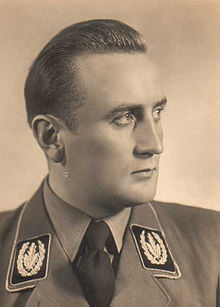
Artur Axmann

Encyclopedia
Nazism
Nazism, the common short form name of National Socialism was the ideology and practice of the Nazi Party and of Nazi Germany...
leader of the Hitler Youth (Reichsjugendführer
Reichsjugendführer
Reichsjugendführer was the highest paramilitary rank of the Hitler Youth. It was held first by Baldur von Schirach and later Artur Axmann. Originally, there was no insignia for the rank, and von Schirach can be seen in documentary evidence as wearing a Nazi Party brown jacket with Hitler Youth...
) from 1940 through war's end in 1945.
Early life
Axmann was born in HagenHagen
Hagen is the 39th-largest city in Germany, located in the federal state of North Rhine-Westphalia. It is located on the eastern edge of the Ruhr area, 15 km south of Dortmund, where the rivers Lenne, Volme and Ennepe meet the river Ruhr...
on 18 February 1913. He studied law and in 1928, founded the first Hitler Youth group in Westphalia
Westphalia
Westphalia is a region in Germany, centred on the cities of Arnsberg, Bielefeld, Dortmund, Minden and Münster.Westphalia is roughly the region between the rivers Rhine and Weser, located north and south of the Ruhr River. No exact definition of borders can be given, because the name "Westphalia"...
.
Nazi career
In 1932, he was called to be a Reich Leader (ReichsleiterReichsleiter
Reichsleiter , was the second highest political rank of the NSDAP next only to the office of Führer. Reichsleiter also served as a paramilitary rank, for the Nazi Party and was the highest position attainable in any Nazi-Organisation.The Reichsleiter reported directly to Adolf Hitler, in whose...
) of the Nazi Party (Nationalsozialistische Deutsche Arbeiterpartei or NSDAP) to carry out a reorganization of Nazi youth cells and in 1933, became Chief of the Social Office of the Reich Youth Leadership. Axmann gained a place for the Hitler Youth in the direction of state vocational training and succeeded in raising the status of Hitler Youth agricultural work. He was on active service on the western front until May 1940. In August of the same year he succeeded Baldur von Schirach
Baldur von Schirach
Baldur Benedikt von Schirach was a Nazi youth leader later convicted of being a war criminal. Schirach was the head of the Hitler-Jugend and Gauleiter and Reichsstatthalter of Vienna....
as Reich Youth Leader (Reichsjugendführer
Reichsjugendführer
Reichsjugendführer was the highest paramilitary rank of the Hitler Youth. It was held first by Baldur von Schirach and later Artur Axmann. Originally, there was no insignia for the rank, and von Schirach can be seen in documentary evidence as wearing a Nazi Party brown jacket with Hitler Youth...
) of the Nazi Party. In 1941, he was severely wounded on the eastern front, losing an arm.
During the last weeks of the war, Axmann commanded units of the Hitler Youth
Hitler Youth
The Hitler Youth was a paramilitary organization of the Nazi Party. It existed from 1922 to 1945. The HJ was the second oldest paramilitary Nazi group, founded one year after its adult counterpart, the Sturmabteilung...
(Hitlerjugend), which had been incorporated into the Home Guard (Volkssturm
Volkssturm
The Volkssturm was a German national militia of the last months of World War II. It was founded on Adolf Hitler's orders on October 18, 1944 and conscripted males between the ages of 16 to 60 years who were not already serving in some military unit as part of a German Home Guard.-Origins and...
). His units consisted mostly of children and adolescents. They primarily fought in the Battle of Seelow Heights (Seelower Höhen), which was a part of the larger Battle of Berlin
Battle of Berlin
The Battle of Berlin, designated the Berlin Strategic Offensive Operation by the Soviet Union, was the final major offensive of the European Theatre of World War II....
(Endkampf um Berlin). Many of the young people fighting for Germany under Axmann died having received neither military training nor equipment.
On 4 January 1944, Axmann was awarded the German Order
German Order (decoration)
The German Order was the most important award that the Nazi Party could bestow on an individual for "duties of the highest order to the state and party". This award was first made by Adolf Hitler posthumously to Reichsminister Fritz Todt at his funeral in February, 1942...
, the highest decoration that the Nazi Party could bestow on an individual, for his services to the Reich. He and one other recipient, K. Hierl
Konstantin Hierl
Konstantin Hierl was a major figure in the administration of Nazi Germany. He was the head of the Reichsarbeitsdienst and an associate of Adolf Hitler before he came to power.Hierl was born in Parsberg, Bavaria...
, were the only holders of the award to survive the war and its consequences. All other recipients were either awarded it posthumously, or were killed during the war or its aftermath.
During 1945, Axmann was continually pressured into letting young women be conscripted into combat roles for the last defense of Germany. Although Axmann had permitted young boys to fight in the final days, he refused to allow girls to fight. He stated, "Women bring life into the world, they do not take it."
During Hitler's last days, Axmann was among those present in the Führerbunker
Führerbunker
The Führerbunker was located beneath Hitler's New Reich Chancellery in Berlin, Germany. It was part of a subterranean bunker complex which was constructed in two major phases, one part in 1936 and the other in 1943...
. On 30 April 1945, just a few hours before committing suicide
Death of Adolf Hitler
Adolf Hitler committed suicide by gunshot on Monday, 30 April 1945 in his Führerbunker in Berlin. His wife Eva , committed suicide with him by ingesting cyanide...
, Hitler signed the order to allow a breakout. On 1 May, Axmann left the Führerbunker with SS doctor Ludwig Stumpfegger
Ludwig Stumpfegger
SS-Obersturmbannführer Ludwig Stumpfegger was a German SS doctor in World War II and Adolf Hitler's personal surgeon from 1944....
and Martin Bormann
Martin Bormann
Martin Ludwig Bormann was a prominent Nazi official. He became head of the Party Chancellery and private secretary to Adolf Hitler...
as part of a group attempting to break out of the Soviet encirclement. Their group managed to cross the River Spree at the Weidendammer Bridge
Weidendammer Bridge
The Weidendammer Bridge is an long bridge where the Friedrichstrasse crosses the Spree river in the central Mitte district of Berlin, Germany...
.
Leaving the rest of their group, Bormann, Stumpfegger, and Axmann walked along railroad tracks to Lehrter station
Berlin Hauptbahnhof
' , is the main railway station in Berlin, Germany. It began full operation two days after a ceremonial opening on 26 May 2006. It is located on the site of the historic Lehrter Bahnhof, and until it opened as a main line station, it was a stop on the Berlin S-Bahn suburban railway temporarily...
. Bormann and Stumpfegger followed the railway tracks towards Stettiner Station. Axmann decided to go alone in the opposite direction of his two companions. When he encountered a Red Army
Red Army
The Workers' and Peasants' Red Army started out as the Soviet Union's revolutionary communist combat groups during the Russian Civil War of 1918-1922. It grew into the national army of the Soviet Union. By the 1930s the Red Army was among the largest armies in history.The "Red Army" name refers to...
patrol, Axmann doubled back and later insisted he had seen the bodies of Bormann and Stumpfegger near the railroad switching yard (Stettiner Bahnhof) with moonlight clearly illuminating their faces. He did not check the bodies, so he did not know how they died.
He avoided capture by Soviet troops and disappeared. Axmann, presumed dead, lived under the alias of "Erich Siewert" for several months.
Axmann was arrested in December 1945 when a Nazi underground movement which he had been organizing was uncovered. A Nuremberg
Nuremberg
Nuremberg[p] is a city in the German state of Bavaria, in the administrative region of Middle Franconia. Situated on the Pegnitz river and the Rhine–Main–Danube Canal, it is located about north of Munich and is Franconia's largest city. The population is 505,664...
de-Nazification court sentenced him in May 1949 to a prison sentence of three years and three months as a 'major offender'.

Post-Nazi life
After his release, Axmann worked as a sales representative in GelsenkirchenGelsenkirchen
Gelsenkirchen is a city in North Rhine-Westphalia, Germany. It is located in the northern part of the Ruhr area. Its population in 2006 was c. 267,000....
and Berlin
Berlin
Berlin is the capital city of Germany and is one of the 16 states of Germany. With a population of 3.45 million people, Berlin is Germany's largest city. It is the second most populous city proper and the seventh most populous urban area in the European Union...
. On 19 August 1958 a West Berlin
West Berlin
West Berlin was a political exclave that existed between 1949 and 1990. It comprised the western regions of Berlin, which were bordered by East Berlin and parts of East Germany. West Berlin consisted of the American, British, and French occupation sectors, which had been established in 1945...
de-Nazification court fined the former Hitler Youth leader 35,000 marks (approximately 3,000 pounds
Pound sterling
The pound sterling , commonly called the pound, is the official currency of the United Kingdom, its Crown Dependencies and the British Overseas Territories of South Georgia and the South Sandwich Islands, British Antarctic Territory and Tristan da Cunha. It is subdivided into 100 pence...
, or $8,334.00 USD), about half the value of his property in Berlin. The court found him guilty of indoctrinating German youth with National Socialism right until the end of the Third Reich, but concluded that he had been a Nazi from inner conviction rather than base motives. During his trial, Axmann told the court that he had heard the shot by which Hitler committed suicide. He also stated that he had attempted to escape from central Berlin along with Martin Bormann
Martin Bormann
Martin Ludwig Bormann was a prominent Nazi official. He became head of the Party Chancellery and private secretary to Adolf Hitler...
, who he said had died during the attempt.
He died in Berlin in 1996.
Portrayal in the media
Artur Axmann has been portrayed by the following actors in film and television productions.- Harry Brooks Jr in the 1973 BritishUnited KingdomThe United Kingdom of Great Britain and Northern IrelandIn the United Kingdom and Dependencies, other languages have been officially recognised as legitimate autochthonous languages under the European Charter for Regional or Minority Languages...
television production The Death of Adolf Hitler.