

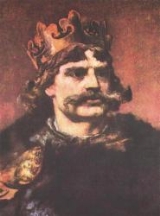
Boleslaw I of Poland

Encyclopedia
Bolesław I Chrobry (967 – 17 June 1025), in the past also known as Bolesław I the Great (Wielki), was a Duke
of Poland
from 992-1025 and the first King of Poland from 19 April 1025 until his death. He also ruled as Boleslav IV, Duke of Bohemia during 1002-1003.
He was the firstborn son of Mieszko I
by his first wife, Dobrawa, daughter of Boleslav I the Cruel, Duke of Bohemia. He was named after his maternal grandfather.
Bolesław I was a remarkable politician, strategist and statesman. He was able to turn Poland into a country that was not only comparable to older western monarchies, but he elevated it into the European elite. Bolesław conducted successful military campaigns to the west, south and east. He consolidated the Polish lands and conquered territories outside of modern borders of Poland such as Slovakia
, Moravia
, Red Ruthenia
, Meissen
and Lusatia
as well as Bohemia
. He was a powerful mediator in Central Europe
an affairs.
He was an ally of Holy Roman Emperor Otto III who may have crowned him rex
, although opinions vary on that point. Following the death of Otto III in 1002, Bolesław I conducted a series of successful wars against the Empire and Otto III's cousin and heir Henry II
ending with the Peace of Bautzen
in 1018. In the summer of 1018, in one of his most famous expeditions, Bolesław I captured Kiev
, where, according to legend, he notched his sword when hitting Kiev's Golden Gate
. Later, a sword known as szczerbiec
, meaning notched sword, would become the ceremonial sword used in the coronation ceremony of Polish kings.
Bolesław I also managed to establish a Polish church structure with a Metropolitan See at Gniezno
, independent of German
Archbishopric of Magdeburg
, which laid claims to the Polish area. During the famous Congress of Gniezno
he was able to officially free himself of tribute to Germany and finally, in his most momentous act, he had himself crowned King
, the first Polish ruler to do so.
He was an able administrator, establishing the so-called "prince's law", building numerous forts, churches, monasteries and bridges. Bolesław I established the first Polish monetary system
, of grzywna
divided into 240 denarii, and minted his own coin. He is widely considered one of the most talented and accomplished of the Piast
rulers.
 Bolesław I was born in Poznań
as the first child of Mieszko I, Duke of Poland and his wife, the Bohemian princess Dobrawa. At age six he may have been sent to the Imperial court in Germany as a hostage, according to the agreements of the Imperial Diet of Quedlinburg
(although historians now dispute this detail). Another theory stated that Bolesław I spent some time during the 980s at the court of his maternal uncle, Duke Boleslav II the Pious of Bohemia.
In 984 and at the instigation of his father, the eighteen-year-old Bolesław I married the daughter of Rikdag
, Margrave of Meissen, probably named Hunilda or Oda. It is believed that following the wedding he became the ruler of Lesser Poland
with his capital at Kraków
. The death of Margrave Rikdag in 985 left the marriage devoid of any political value, and shortly thereafter the union was dissolved and Hunilda was repudiated.
At the end of 985, probably at the instigation of Boleslav II the Pious, Bolesław I married an unknown Hungarian princess with whom he had a son, Bezprym
. In older literature, the princess was identified as Judith
, daughter of Géza, Grand Duke of Hungary
. Though opinions vary about the identity of Bolesław I 's second wife, there are a number of researchers who still support the hypothesis of her being the daughter of Géza. However, this union also came to a quick end, probably because of the deterioration in political relations between Poland and Hungary, and around 987 the union was dissolved.
By 989, and perhaps as early as 987, Bolesław I married Emnilda
, daughter of Dobromir
, a Slavic prince of Lusatia
. Through this marriage he had a daughter Regelinda, a son, the future king Mieszko II, another daughter and a son Otton. At this time Bolesław I's rule in Lesser Poland may have been at Bohemian conferment. Presuming that it was, he added this province to Poland only after Duke Boleslav II the Pious' death in 999. However assuming that Mieszko I took control of Lesser Poland
in 990 (which is likely), than Bolesław I was bestowed the rule in Lesser Poland
by his father but without its territory being included in the Polish realm. Bolesław I does not appear in the surviving summary of the Dagome Iudex
document, and as such it may be supposed that Lesser Poland was already known as Bolesław I's inheritance, while his two surviving half-brothers Mieszko
and Lambert
, sons of Mieszko I by his second wife Oda, were to divide the rest of the realm between each other. Another theory is that Bolesław I's absence from the document might be explained by an old Slavic
custom whereby children received their inheritance
as soon as they reached the age of majority
. Thus Bolesław I might have received Kraków
as his part of his father's legacy before the writing of the Dagome iudex.
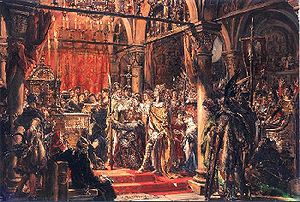 The circumstances in which Bolesław I took control of the country following the passing of his father, Mieszko I, forecasted what would later become a prevalent practice among the Piast dynasty. It consisted of struggle for domination, usually a military one, among the offspring of nearly every deceased monarch of the Piast dynasty. Bolesław I was no different, and shortly after the death of Mieszko I (25 May 992), he banished his stepmother Oda and his two half-brothers, as they had to be considered competitors to the throne, especially in light of the Dagome Iudex. The exact circumstances of Bolesław I's ascension to the Ducal throne are unknown, but it is known that by June, he was the unquestioned ruler of Poland - as Otto III asked for his military aid
in the summer of 992. Also immediately after gaining the full control over Poland, Bolesław I quelled the opposition of the Barons by blinding two of their leaders, the magnates Odylen and Przybywoj. As cruel a sentence as this was, it proved most effective as it triggered such obedience of his subjects that from that point on there was no mention of any challenge of his position whatsoever.
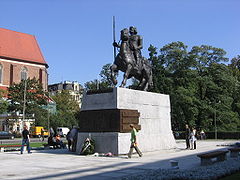 Bolesław I inherited from his father a realm that was close in dimensions to modern-day Poland. It centered on the core of Polanian
country, the later Greater Poland
. Greater Poland encompassed the valley of river Warta, stretched to the north to the Notec
river and to the south it encompassed Kalisz
. Outside of this core the nascent Poland included the surrounding areas subdued by Bolesław I's father, Mieszko I which included: parts of Pomerania
to the north, including Kolobrzeg
in the west and Gdańsk
in the east, Mazovia
with its capital at Płock to the east and Silesia
to the south-west. It is disputed whether Lesser Poland
, centered around Kraków
, was incorporated into the Polish realm by Mieszko I before 992 or whether it was added by Bolesław I in 999. Either way by the year 1000 Bolesław I was the lord of a domain larger than contemporary England, Denmark, León
or Burgundy.
Endeavoring to extend his influence to the territory of the Prussians, Bolesław I encouraged Christianizing missions in the Prussia
n lands. Most famous of those was the mission of Vojtěch
from the Bohemia
n princely Slavník clan, former bishop of Prague
. Known as Adalbert of Prague
upon the death of Adalbert of Magdeburg
in 981, Adalbert's mission took place in 997 and ended in the missionary's martyrdom at the hands of the pagan Prussians, which occurred in April 997 on the Baltic Sea
coast in the vicinity of Truso
(a medieval emporia
near modern city of Elbląg
). The remains of the missionary were held for ransom
by the Prussians and Bohemian Přemyslid rulers refused to pay for Adalbert's (Vojtech) body, consequently it was purchased by Duke Bolesław I for its weight in gold
, and buried in Gniezno
. In 999 Bishop Adalbert was canonized as Saint Adalbert
by Pope Sylvester II. He was later made the patron saint
of Bohemia
, Poland, Hungary, and Prussia
. Canonization of Vojtěch
increased the prestige of the Polish church in Europe and the prestige of Polish state on the international arena.
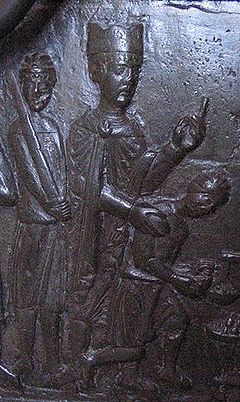 By the year 1000, Bolesław I had consolidated his position as Duke (Dux
) of Poland. Not only did he not meet any internal opposition, but he furthermore had gained the respect of Holy Roman Emperor
Otto III
(980-1002). Consequently in the year 1000, Otto III visited Poland under the pretext of a pilgrimage
to the grave of his friend, the recently canonized Bishop Adalbert (Vojtěch). In addition to the religious motivation, Otto III's voyage also carried a strong political agenda
: he had intentions to renew the Holy Roman Empire
based on a federal concept he called "Renovatio Imperii Romanorum". Within the federal framework, Polish and Hungarian duchies were to be upgraded to eastern federati of the empire.
The Emperor needed to assess Poland's strength and establish its status within the Holy Roman Empire
. The ensuing Congress of Gniezno
, where Bolesław I entertained his distinguished guest, is one of the most famous episodes of medieval Polish history
. During the time the emperor spent in Poland, Bolesław I did not hide the wealth of his country, in fact he showed off its affluence at every step as he tried to dazzle the emperor. Among other gifts the Polish ruler presented to Otto III were 300 armored knights, while the Emperor responded with a gift of a copy of the lance of Saint Maurice
. Evidently Otto III was impressed with what he saw and he decided that Poland should be treated as a kingdom on par with Germany and Italy, not merely as a tributary duchy like Bohemia. Since Otto III had intentions to renew the Empire based on a federal concept he called "Renovatio Imperii Romanorum", and within that federal framework, Polish and Hungarian duchies were to be upgraded to eastern federati of the empire it was towards this end that the Emperor placed his Imperial crown on Bolesław I's brow and invested him with the titles frater et cooperator Imperii ("Brother and Partner of the Empire") and populi Romani amicus et socius. He also raised Bolesław I to the dignity of patricius or "elder of the Roman nation". This episode has long been a subject of hot debate among historians. Some historians see this as an act of favor between an Emperor and his vassal, others as a gesture of friendship between equals. Could placing of the Imperial crown on Bolesław's head mean that the Emperor crowned the Polish Duke? Most modern historians agree that it could not. Though it was undoubtedly a sign of Otto's respect for the Polish ruler, it could not truly mean Bolesław I was King
as only the Pope
had the authority to invest a prince with the crown and elevate his realm to a status of a kingdom
. According to one source afterwards Bolesław I traveled with the Emperor to Aix-la-Chapelle where Otto III had the tomb of Charlemagne
opened. From there Otto III is reputed to have removed the Imperial throne itself and presented it to the Polish Duke.
Other political talks took place as well. Otto III decided that Poland will no longer be required to pay tribute
to the Empire. Gniezno
was confirmed as an Archbishop
ric and a Metropolitan See for the Polish area. Three new Bishoprics
were created and confirmed with papal consent. They were placed at Kraków
, Wrocław and Kolobrzeg
. The Poznań
missionary Bishopric was confirmed as subject directly to the Vatican
. Bolesław I and his heirs gained the right of investiture
of bishop
s. The future marriage of Bolesław I's son Mieszko
to Richeza , niece of Otto III, was also probably agreed upon at this point.
The untimely death of Otto III at age 22 in 1002 upset the ambitious renovatio plans, which were never fully implemented. Henry II
, Otto III's less idealistic successor, and an opponent of Otto's policies, reversed the course of Imperial policy towards the east.
, for the German throne. When Eckard was assassinated in April, Bolesław I lent his support to Henry IV, Duke of Bavaria, and helped him ascend to the German throne as Henry II. Bolesław I took advantage of internal strife following the Emperor's death and occupied important areas to the west of the Oder
: Margraviate of Meissen and March of Lusatia, including strongholds Budziszyn
and Strzala. Bolesław I claimed an hereditary right to Meissen
as a relative of its former ruler Margrave Rikdag (only through marriage; he was the former husband of his daughter). Henry II
accepted Bolesław I's gains and he allowed the Polish Duke to keep Lusatia as a fief. The one exception was Meissen, which Bolesław I was not allowed to keep. Though at this point Polish–German relations were normalized, soon thereafter Henry II organized a failed assassination attempt
on Bolesław I's life and relations between the two countries were severed.
In the same year (1003) Bolesław I became entangled in Bohemian affairs when the Duke Vladivoj
died earlier in that year. Following this Bolesław I aided a pretender, Boleslav III the Red, in gaining the throne. Later Boleslav III undermined his own position by ordering a massacre of his leading nobles, the Vršovci, at Vyšehrad
. Those nobles who survived the massacre secretly sent messengers to Bolesław I and entreated him to come to their aid. The Polish Duke willingly agreed, and invited Boleslav III to visit him at his castle in Kraków
. There, Boleslav III was trapped, blinded and imprisoned, probably dying in captivity some thirty years later. Bolesław I, claiming the Ducal throne for himself, invaded Bohemia in 1003 and took Prague
without any serious opposition, ruling as Boleslav IV for a little over a year. It is also likely that Polish forces took control of Moravia
and Upper Hungary
in 1003 as well. The proper conquest date of the Hungarian territories is 1003 or 1015 and Upper Hungary stayed as part of Poland until 1018.
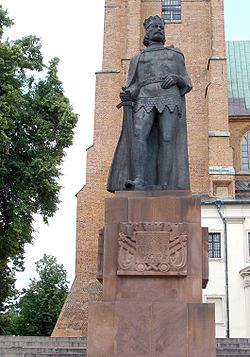 As mentioned above, Bolesław I had taken control of the marches of Lusatia
, Sorbian Meissen
, and the cities of Budziszyn (Bautzen) and Meissen
in 1002, and refused to pay the tribute to the Empire
from the conquered territories.
Henry II
, allied with the Lutici
, answered with an offensive a year later. Though the first attack was not successful, already in the autumn of 1004 the German forces deposed Bolesław I from the Bohemia
n throne. Bolesław I did manage to keep Moravia
and Slovakia
, however, over which he exercised control until 1018. During the next part of the offensive Henry II
retook Meissen
and in 1005 his army advanced as far into Poland as the city of Poznań
where a peace treaty
was signed. According to the peace treaty Bolesław I lost Lusatia
and Meissen
and likely gave up his claim to the Bohemia
n throne
. Also in 1005, a pagan rebellion in Pomerania
overturned Boleslaw's rule and resulted in the destruction of the just implemented local bishopric.
In 1007 Henry II
denounced the Peace of Poznań, resulting in Bolesław I's attack on the Archbishopric of Magdeburg
as well as re-occupation of marches of Lusatia
and Sorbian
Meissen
including the city of Bautzen
. The German counter-offensive began three years later, in 1010. It was of no significant consequence, beyond some pillaging in Silesia
. In 1012 a five year peace was signed.
Bolesław I broke the peace however, and once again invaded Lusatia
. Bolesław I's forces pillaged and burned the city of Lubusz (Lebus). In 1013 a peace accord was signed at Merseburg
. As part of peace Bolesław I paid homage
to Henry II
, in exchange for which he received the March of Lusatia and Sorbian Meissen
as fiefs. Also, was performed the marriage of his son Mieszko with Richeza of Lotharingia, daughter of the Count Palatine
Ezzo of Lotharingia
and granddaughter of Emperor Otto II
.
In 1014 Bolesław I sent his son Mieszko to Bohemia
in order to form an alliance with duke Oldrich against Emperor Henry II
. Bolesław I also refused to aid the Emperor militarily in his Italian expedition. This led to imperial intervention in Poland and so in 1015 a war erupted once again. The war started out well for the Emperor as he was able to defeat the Polish forces at Ciani. Once the imperial forces crossed the river Oder
, Bolesław I sent a detachment of Moravia
n knights in a diversion
ary attack against the Eastern March of the empire. Soon thereafter the Imperial army
retreated from Poland without making any permanent gains. Following this Bolesław I's forces took the initiative. The Margrave
of Meissen
, Gero II, was defeated and killed during a clash with the Polish forces late in 1015.
Later that year, Bolesław I's son Mieszko was sent to plunder Meissen
. His attempt at conquering the city however, failed. In 1017 Bolesław I defeated Margrave Henry V of Bavaria. In 1017 with Czech and Wendish support Henry II once again invaded Poland, however, once again to very little effect. He did besiege cities of Głogów and Niemcza
, but was unable to take them. Taking advantage of Czech troops' involvement, Bolesław I ordered his son to invade Bohemia
, where Mieszko met very little resistance. On 30 January 1018, the Peace of Bautzen
(which made Bolesław I a clear winner), was signed. The Polish ruler was able to keep the contested marches of Lusatia
and Sorbian
Meissen
not as fiefs, but as part of Polish territory, and also received military aid in his expedition against Kievan Rus. Also, Bolesław I (then a widower) reinforced his dynastic bonds with the German nobility through his marriage with Oda
, daughter of Margrave Eckard I of Meissen. The wedding took place four days later, on 3 February in the castle
of Cziczani (also Sciciani, at the site of either modern Groß-Seitschen
or Zützen
).
.jpg) Bolesław I organized his first expedition against his eastern neighbor in 1015, but the decisive engagements were to take place in 1018 after the peace of Budziszyn
Bolesław I organized his first expedition against his eastern neighbor in 1015, but the decisive engagements were to take place in 1018 after the peace of Budziszyn
was already signed. At the request of his son-in-law Sviatopolk I of Kiev, the Polish duke invaded Kievan Rus with an army of between 2,000–5,000 Polish warriors, in addition to Thietmar
's reported 1,000 Pechenegs, 300 German knights, and 500 Hungarian mercenaries. After collecting his forces during June, Boleslaw led his troops to the border in July and on 23 July at the banks of the Bug River
, near Wielen
, he defeated the forces of Yaroslav the Wise prince of Kiev
, in what became known as the Battle at Bug river
. All primary source
s agree that the Polish prince was victorious in battle. Yaroslav retreated north to Novgorod, rather than to Kiev
. The victory opened the road to Kiev, already under harassment from Boleslaw's Pecheneg allies. The city, which suffered from fires caused by the Pecheneg siege, surrendered upon seeing the main Polish force on 14 August. The entering army, led by Bolesław I, was ceremonially welcomed by the local archbishop and the family of Vladimir I of Kiev
. Bolesław I may have deployed his troops in the capital of Rus for no more than six months (see Kiev Expedition of 1018) but had to recall them eventually due to popular uprising against the Poles. According to popular legend Bolesław I notched his sword (Szczerbiec) hitting the Golden Gate
of Kiev. During this campaign Poland re-annexed the Red Strongholds, later called Red Ruthenia
, lost by Bolesław I's father in 981.
In 1015 Bolesław I sent a detachment of Polish horsemen to aid his nephew Canute the Great
, son of his sister Swietoslawa
, in his conquest of England.
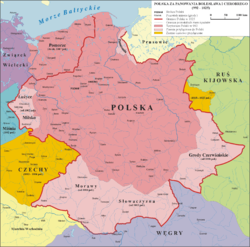 After Henry's death in 1024, Bolesław I took advantage of the interregnum in Germany and crowned himself king
in 1025, thus raising Poland to the rank of a kingdom
before its neighbor Bohemia. He was the first Polish king (rex
), his predecessors having been considered dukes (dux
) by the Holy Roman Empire and the papacy. Bolesław I died not long after the coronation, due most likely to an illness.
The whereabouts of Boleslaw's burial are uncertain. It is believed that recently discovered remains of a double tomb in Poznań cathedral may be the burial places of the first two Polish Rulers: Boleslaw I and his father Mieszko. Bolesław I's son, Mieszko II, crowned himself king immediately after his father died in Poznań
.
At the time of his death Bolesław I left Poland larger than the land he had inherited: he had added to his domains the long-contested marches of Lusatia
and Sorbian Meissen
as well as Red Ruthenia
and possibly Lesser Poland
. Militarily, at the time, Poland was unquestionably a considerable power as Bolesław I was able to fight successful campaigns against both Holy Roman Empire
and the Kievan Rus. On the other hand it must be highlighted that his long-term involvement in the war against Germany allowed Western Pomerania to gain independence from the Polish aegis
. Another negative side of Bolesław I's drawn out military campaigns was a damaging influence on the economy of his kingdom
. With the passing of each year, Bolesław I needed ever-increasing amounts to finance his wars, especially when fought on two fronts; in Germany and Kiev
. Unceasing war had placed ever-increasing fiscal obligations on his subjects, which in turn caused negative sentiment, sentiment that increased throughout his reign, and that would erupt into popular revolt soon after his death.
, controlled by the state, whose sole duty it was to finance the prince's spending needs. These needs were considerable, as the Duke was responsible for all manner of building projects. The foundation of the "Prince's Law" lay in a network of fortified towns called grody, but the ruler also commissioned the building of churches, monasteries
, roads, bridges etc., in short the development of an infrastructure
. The building projects were financed by collecting taxes in money or goods. Also peasant
s were required to house the monarch or provide the prince with different manner of goods and services which included communications, hunting, military or others. To produce necessary goods Bolesław I organized a network of service settlements that specialized each in manufacturing about 30 different goods, such as: barrels, arches, metal wares, spears, as well as settlements responsible for animal husbandry
, i.e., swine, horses or cattle. Hundreds of villages were thus specialized and named to reflect their particular job. To this day one may find scores of settlements in Poland with names left over from that era, such as: Szewce, Kuchary or Kobylniki. This quite impressive system functioned well enough to support Bolesław I throughout his 33 year reign.
Increasing both the internal and external strength of the realm was of paramount importance to Bolesław I, especially in the face of increasing pressure from the magnate
s. The magnates demanded a larger share in the administration of the country while Bolesław I sought to strengthen the central authority of the ruler. Bolesław I's coronation, sometime in 1025, was aimed precisely to reinforce his leading position. In general an overall integration of the country took place during his reign.
Bolesław I was able to establish an independent Polish church structure with a Metropolitan See at Gniezno
, with papal and imperial sanction. His work laid a foundation for the use of designation "Poland" that was to unite all regions of the realm, as well as for the use of one symbol to represent the supreme authority of the prince. The symbol was a sign of Gniezno's knightly class: the white eagle.
An unknown daughter of Rikdag
, Margrave of Meissen, probably named Hunilda or Oda. After Rikdag's death in 985, she was repudiated by her husband and sent away.
Issue:
Second marriage: 986 - 987/89
An unknown Hungarian princess formerly believed to be Judith
, daughter of Géza, Grand Duke of Hungary
. Around 987, as a consequence of the deterioration in the political relations between Poland and Hungary, she was repudiated.
Issue:
Third marriage: 987/89 - 1013
Emnilda
, daughter of Dobromir
, prince of Lusatia
.
Issue:
Fourth marriage: 1018 - 1025
Oda
(b. ca. 996 - d. aft. 1025), daughter of Eckard I, Margrave of Meissen
.
Issue:
Duke
A duke or duchess is a member of the nobility, historically of highest rank below the monarch, and historically controlling a duchy...
of Poland
Poland
Poland , officially the Republic of Poland , is a country in Central Europe bordered by Germany to the west; the Czech Republic and Slovakia to the south; Ukraine, Belarus and Lithuania to the east; and the Baltic Sea and Kaliningrad Oblast, a Russian exclave, to the north...
from 992-1025 and the first King of Poland from 19 April 1025 until his death. He also ruled as Boleslav IV, Duke of Bohemia during 1002-1003.
He was the firstborn son of Mieszko I
Mieszko I of Poland
Mieszko I , was a Duke of the Polans from about 960 until his death. A member of the Piast dynasty, he was son of Siemomysł; grandchild of Lestek; father of Bolesław I the Brave, the first crowned King of Poland; likely father of Świętosława , a Nordic Queen; and grandfather of her son, Cnut the...
by his first wife, Dobrawa, daughter of Boleslav I the Cruel, Duke of Bohemia. He was named after his maternal grandfather.
Bolesław I was a remarkable politician, strategist and statesman. He was able to turn Poland into a country that was not only comparable to older western monarchies, but he elevated it into the European elite. Bolesław conducted successful military campaigns to the west, south and east. He consolidated the Polish lands and conquered territories outside of modern borders of Poland such as Slovakia
Slovakia
The Slovak Republic is a landlocked state in Central Europe. It has a population of over five million and an area of about . Slovakia is bordered by the Czech Republic and Austria to the west, Poland to the north, Ukraine to the east and Hungary to the south...
, Moravia
Moravia
Moravia is a historical region in Central Europe in the east of the Czech Republic, and one of the former Czech lands, together with Bohemia and Silesia. It takes its name from the Morava River which rises in the northwest of the region...
, Red Ruthenia
Red Ruthenia
Red Ruthenia is the name used since medieval times to refer to the area known as Eastern Galicia prior to World War I; first mentioned in Polish historic chronicles in the 1321, as Ruthenia Rubra or Ruthenian Voivodeship .Ethnographers explain that the term was applied from the...
, Meissen
Meissen
Meissen is a town of approximately 30,000 about northwest of Dresden on both banks of the Elbe river in the Free State of Saxony, in eastern Germany. Meissen is the home of Meissen porcelain, the Albrechtsburg castle, the Gothic Meissen Cathedral and the Meissen Frauenkirche...
and Lusatia
Lusatia
Lusatia is a historical region in Central Europe. It stretches from the Bóbr and Kwisa rivers in the east to the Elbe valley in the west, today located within the German states of Saxony and Brandenburg as well as in the Lower Silesian and Lubusz voivodeships of western Poland...
as well as Bohemia
Bohemia
Bohemia is a historical region in central Europe, occupying the western two-thirds of the traditional Czech Lands. It is located in the contemporary Czech Republic with its capital in Prague...
. He was a powerful mediator in Central Europe
Central Europe
Central Europe or alternatively Middle Europe is a region of the European continent lying between the variously defined areas of Eastern and Western Europe...
an affairs.
He was an ally of Holy Roman Emperor Otto III who may have crowned him rex
Monarch
A monarch is the person who heads a monarchy. This is a form of government in which a state or polity is ruled or controlled by an individual who typically inherits the throne by birth and occasionally rules for life or until abdication...
, although opinions vary on that point. Following the death of Otto III in 1002, Bolesław I conducted a series of successful wars against the Empire and Otto III's cousin and heir Henry II
Henry II, Holy Roman Emperor
Henry II , also referred to as Saint Henry, Obl.S.B., was the fifth and last Holy Roman Emperor of the Ottonian dynasty, from his coronation in Rome in 1014 until his death a decade later. He was crowned King of the Germans in 1002 and King of Italy in 1004...
ending with the Peace of Bautzen
Peace of Bautzen
The Peace of Bautzen or the Peace of Budziszyn was a treaty concluded on January 30, 1018 between the Ottonian Holy Roman Emperor Henry II and the Piast ruler of Poland Boleslaw I which ended a series of Polish-German wars over the control of Lusatia and Upper Lusatia as well as Bohemia,...
in 1018. In the summer of 1018, in one of his most famous expeditions, Bolesław I captured Kiev
Kiev
Kiev or Kyiv is the capital and the largest city of Ukraine, located in the north central part of the country on the Dnieper River. The population as of the 2001 census was 2,611,300. However, higher numbers have been cited in the press....
, where, according to legend, he notched his sword when hitting Kiev's Golden Gate
Golden Gate (Kiev)
The Golden Gates of Kiev is a major landmark of the Ancient Kiev and historic gateway in the ancient city fortress, located in the capital of Ukraine. Currently it serves as a museum and can be found on the corner of Volodymyr street and Yaroslaviv Val Street...
. Later, a sword known as szczerbiec
Szczerbiec
Szczerbiec is the coronation sword that was used in crowning ceremonies of most kings of Poland from 1320 to 1764. It is currently on display in the treasure vault of the Royal Wawel Castle in Kraków as the only preserved piece of Polish Crown Jewels...
, meaning notched sword, would become the ceremonial sword used in the coronation ceremony of Polish kings.
Bolesław I also managed to establish a Polish church structure with a Metropolitan See at Gniezno
Gniezno
Gniezno is a city in central-western Poland, some 50 km east of Poznań, inhabited by about 70,000 people. One of the Piasts' chief cities, it was mentioned by 10th century A.D. sources as the capital of Piast Poland however the first capital of Piast realm was most likely Giecz built around...
, independent of German
Germans
The Germans are a Germanic ethnic group native to Central Europe. The English term Germans has referred to the German-speaking population of the Holy Roman Empire since the Late Middle Ages....
Archbishopric of Magdeburg
Archbishopric of Magdeburg
The Archbishopric of Magdeburg was a Roman Catholic archdiocese and Prince-Bishopric of the Holy Roman Empire centered on the city of Magdeburg on the Elbe River....
, which laid claims to the Polish area. During the famous Congress of Gniezno
Congress of Gniezno
The Congress of Gniezno was an amical meeting between the Polish duke Bolesław I Chrobry and Emperor Otto III, which took place at Gniezno on March 11, 1000...
he was able to officially free himself of tribute to Germany and finally, in his most momentous act, he had himself crowned King
King
- Centers of population :* King, Ontario, CanadaIn USA:* King, Indiana* King, North Carolina* King, Lincoln County, Wisconsin* King, Waupaca County, Wisconsin* King County, Washington- Moving-image works :Television:...
, the first Polish ruler to do so.
He was an able administrator, establishing the so-called "prince's law", building numerous forts, churches, monasteries and bridges. Bolesław I established the first Polish monetary system
Monetary system
A monetary system is anything that is accepted as a standard of value and measure of wealth in a particular region.However, the current trend is to use international trade and investment to alter the policy and legislation of individual governments. The best recent example of this policy is the...
, of grzywna
Grzywna (unit)
The grzywna was a measure of weight, mainly for gold and silver, commonly used throughout medieval central Europe, in particular Poland, Bohemia and the Rus lands. Grzywna was also a unit of measure of a unit of exchange, and as such used as money. There were several different grzywnas such as the...
divided into 240 denarii, and minted his own coin. He is widely considered one of the most talented and accomplished of the Piast
Piast dynasty
The Piast dynasty was the first historical ruling dynasty of Poland. It began with the semi-legendary Piast Kołodziej . The first historical ruler was Duke Mieszko I . The Piasts' royal rule in Poland ended in 1370 with the death of king Casimir the Great...
rulers.
Youth
Poznan
Poznań is a city on the Warta river in west-central Poland, with a population of 556,022 in June 2009. It is among the oldest cities in Poland, and was one of the most important centres in the early Polish state, whose first rulers were buried at Poznań's cathedral. It is sometimes claimed to be...
as the first child of Mieszko I, Duke of Poland and his wife, the Bohemian princess Dobrawa. At age six he may have been sent to the Imperial court in Germany as a hostage, according to the agreements of the Imperial Diet of Quedlinburg
Quedlinburg
Quedlinburg is a town located north of the Harz mountains, in the district of Harz in the west of Saxony-Anhalt, Germany. In 1994 the medieval court and the old town was set on the UNESCO world heritage list....
(although historians now dispute this detail). Another theory stated that Bolesław I spent some time during the 980s at the court of his maternal uncle, Duke Boleslav II the Pious of Bohemia.
In 984 and at the instigation of his father, the eighteen-year-old Bolesław I married the daughter of Rikdag
Rikdag
Rikdag, Ricdag, Riddag, or Rihdag was the Margrave of Meissen from 979 until his death. In 982, he acquired the marches of Merseburg and Zeitz. In 985, he was made count in the Schwabengau. He temporarily reunited all of the southern marca Geronis under his command...
, Margrave of Meissen, probably named Hunilda or Oda. It is believed that following the wedding he became the ruler of Lesser Poland
Lesser Poland
Lesser Poland is one of the historical regions of Poland, with its capital in the city of Kraków. It forms the southeastern corner of the country, and should not be confused with the modern Lesser Poland Voivodeship, which covers only a small, southern part of Lesser Poland...
with his capital at Kraków
Kraków
Kraków also Krakow, or Cracow , is the second largest and one of the oldest cities in Poland. Situated on the Vistula River in the Lesser Poland region, the city dates back to the 7th century. Kraków has traditionally been one of the leading centres of Polish academic, cultural, and artistic life...
. The death of Margrave Rikdag in 985 left the marriage devoid of any political value, and shortly thereafter the union was dissolved and Hunilda was repudiated.
At the end of 985, probably at the instigation of Boleslav II the Pious, Bolesław I married an unknown Hungarian princess with whom he had a son, Bezprym
Bezprym
Bezprym was a Duke of Poland during 1031–1032.He was the eldest son of Bolesław I the Brave, King of Poland, but was deprived of the succession by his father, who around 1001 sent him to Italy, in order to became a monk at one of Saint Romuald's hermitages in Ravenna.Expelled by his half-brother...
. In older literature, the princess was identified as Judith
Judith of Hungary
Judith of Hungary was a Hungarian princess member of the House of Arpad and by marriage member of the House of Piast, who ruled Poland at that time....
, daughter of Géza, Grand Duke of Hungary
Géza of Hungary
Géza , Grand Prince of the Hungarians .Géza was the son of Taksony of Hungary, Grand Prince of the Hungarians and his Pecheneg or Bulgar wife. Géza's marriage with Sarolt, the daughter of Gyula of Transylvania, was arranged by his father.After his father's death , Géza followed him as Grand Prince...
. Though opinions vary about the identity of Bolesław I 's second wife, there are a number of researchers who still support the hypothesis of her being the daughter of Géza. However, this union also came to a quick end, probably because of the deterioration in political relations between Poland and Hungary, and around 987 the union was dissolved.
By 989, and perhaps as early as 987, Bolesław I married Emnilda
Emnilda of Lusatia
Emnilda of Lusatia , was a Slavic princess and by marriage Duchess of Poland. She was a daughter of certain Dobromir, a Slavic leader ruler of Lusatia and Milsko, who was named venerable by Thietmar of Merseburg.- Life :...
, daughter of Dobromir
Dobromir
Dobromir is a commune in Constanţa County, Romania. It includes six villages:* Dobromir * Cetatea * Dobromiru din Deal...
, a Slavic prince of Lusatia
Lusatia
Lusatia is a historical region in Central Europe. It stretches from the Bóbr and Kwisa rivers in the east to the Elbe valley in the west, today located within the German states of Saxony and Brandenburg as well as in the Lower Silesian and Lubusz voivodeships of western Poland...
. Through this marriage he had a daughter Regelinda, a son, the future king Mieszko II, another daughter and a son Otton. At this time Bolesław I's rule in Lesser Poland may have been at Bohemian conferment. Presuming that it was, he added this province to Poland only after Duke Boleslav II the Pious' death in 999. However assuming that Mieszko I took control of Lesser Poland
Lesser Poland
Lesser Poland is one of the historical regions of Poland, with its capital in the city of Kraków. It forms the southeastern corner of the country, and should not be confused with the modern Lesser Poland Voivodeship, which covers only a small, southern part of Lesser Poland...
in 990 (which is likely), than Bolesław I was bestowed the rule in Lesser Poland
Lesser Poland
Lesser Poland is one of the historical regions of Poland, with its capital in the city of Kraków. It forms the southeastern corner of the country, and should not be confused with the modern Lesser Poland Voivodeship, which covers only a small, southern part of Lesser Poland...
by his father but without its territory being included in the Polish realm. Bolesław I does not appear in the surviving summary of the Dagome Iudex
Dagome iudex
"Dagome iudex" is one of the earliest historical documents relating to Poland. Poland is not mentioned by name, but reference is made to Dagome and Ote and their sons in 991, placing their land under the protection of the Apostolic See...
document, and as such it may be supposed that Lesser Poland was already known as Bolesław I's inheritance, while his two surviving half-brothers Mieszko
Mieszko Mieszkowic
Mieszko Mieszkowic , was a Polish prince member of the House of Piast.He was the second son of Mieszko I of Poland but the eldest born from his second marriage with Oda, daughter of Dietrich of Haldensleben, Margrave of the North March.-Life:Nothing is knew about his first years of life...
and Lambert
Lambert Mieszkowic
Lambert Mieszkowic , was a Polish prince member of the House of Piast.He was the fourth son of Mieszko I of Poland but the third born from his second marriage with Oda, daughter of Dietrich of Haldensleben, Margrave of the North March.-Life:Nothing is known about his first years of life...
, sons of Mieszko I by his second wife Oda, were to divide the rest of the realm between each other. Another theory is that Bolesław I's absence from the document might be explained by an old Slavic
Slavic peoples
The Slavic people are an Indo-European panethnicity living in Eastern Europe, Southeast Europe, North Asia and Central Asia. The term Slavic represents a broad ethno-linguistic group of people, who speak languages belonging to the Slavic language family and share, to varying degrees, certain...
custom whereby children received their inheritance
Inheritance
Inheritance is the practice of passing on property, titles, debts, rights and obligations upon the death of an individual. It has long played an important role in human societies...
as soon as they reached the age of majority
Age of majority
The age of majority is the threshold of adulthood as it is conceptualized in law. It is the chronological moment when minors cease to legally be considered children and assume control over their persons, actions, and decisions, thereby terminating the legal control and legal responsibilities of...
. Thus Bolesław I might have received Kraków
Kraków
Kraków also Krakow, or Cracow , is the second largest and one of the oldest cities in Poland. Situated on the Vistula River in the Lesser Poland region, the city dates back to the 7th century. Kraków has traditionally been one of the leading centres of Polish academic, cultural, and artistic life...
as his part of his father's legacy before the writing of the Dagome iudex.
Accession
Military aid
Military aid is aid which is used to assist an ally in its defense efforts, or to assist a poor country in maintaining control over its own territory. Many countries receive military aid to help with counter-insurgency efforts...
in the summer of 992. Also immediately after gaining the full control over Poland, Bolesław I quelled the opposition of the Barons by blinding two of their leaders, the magnates Odylen and Przybywoj. As cruel a sentence as this was, it proved most effective as it triggered such obedience of his subjects that from that point on there was no mention of any challenge of his position whatsoever.
Extent of his domains
Polans (western)
The Polans were a West Slavic tribe, part of the Lechitic group, inhabiting the Warta river basin of the historic Greater Poland region in the 8th century.During the reign of King Svatopluk I of Great Moravia , who subdued the tribes of the Vistulans and Ślężanie...
country, the later Greater Poland
Greater Poland
Greater Poland or Great Poland, often known by its Polish name Wielkopolska is a historical region of west-central Poland. Its chief city is Poznań.The boundaries of Greater Poland have varied somewhat throughout history...
. Greater Poland encompassed the valley of river Warta, stretched to the north to the Notec
Notec
Noteć is a river in central Poland with a length of 388 km and a basin area of 17,330 km². It is a tributary of the Warta river and lies completely within Poland....
river and to the south it encompassed Kalisz
Kalisz
Kalisz is a city in central Poland with 106,857 inhabitants , the capital city of the Kalisz Region. Situated on the Prosna river in the southeastern part of the Greater Poland Voivodeship, the city forms a conurbation with the nearby towns of Ostrów Wielkopolski and Nowe Skalmierzyce...
. Outside of this core the nascent Poland included the surrounding areas subdued by Bolesław I's father, Mieszko I which included: parts of Pomerania
Pomerania
Pomerania is a historical region on the south shore of the Baltic Sea. Divided between Germany and Poland, it stretches roughly from the Recknitz River near Stralsund in the West, via the Oder River delta near Szczecin, to the mouth of the Vistula River near Gdańsk in the East...
to the north, including Kolobrzeg
Kolobrzeg
Kołobrzeg is a city in Middle Pomerania in north-western Poland with some 50,000 inhabitants . Kołobrzeg is located on the Parsęta River on the south coast of the Baltic Sea...
in the west and Gdańsk
Gdansk
Gdańsk is a Polish city on the Baltic coast, at the centre of the country's fourth-largest metropolitan area.The city lies on the southern edge of Gdańsk Bay , in a conurbation with the city of Gdynia, spa town of Sopot, and suburban communities, which together form a metropolitan area called the...
in the east, Mazovia
Mazovia
Mazovia or Masovia is a geographical, historical and cultural region in east-central Poland. It is also a voivodeship in Poland.Its historic capital is Płock, which was the medieval residence of first Dukes of Masovia...
with its capital at Płock to the east and Silesia
Silesia
Silesia is a historical region of Central Europe located mostly in Poland, with smaller parts also in the Czech Republic, and Germany.Silesia is rich in mineral and natural resources, and includes several important industrial areas. Silesia's largest city and historical capital is Wrocław...
to the south-west. It is disputed whether Lesser Poland
Lesser Poland
Lesser Poland is one of the historical regions of Poland, with its capital in the city of Kraków. It forms the southeastern corner of the country, and should not be confused with the modern Lesser Poland Voivodeship, which covers only a small, southern part of Lesser Poland...
, centered around Kraków
Kraków
Kraków also Krakow, or Cracow , is the second largest and one of the oldest cities in Poland. Situated on the Vistula River in the Lesser Poland region, the city dates back to the 7th century. Kraków has traditionally been one of the leading centres of Polish academic, cultural, and artistic life...
, was incorporated into the Polish realm by Mieszko I before 992 or whether it was added by Bolesław I in 999. Either way by the year 1000 Bolesław I was the lord of a domain larger than contemporary England, Denmark, León
Kingdom of León
The Kingdom of León was an independent kingdom situated in the northwest region of the Iberian Peninsula. It was founded in AD 910 when the Christian princes of Asturias along the northern coast of the peninsula shifted their capital from Oviedo to the city of León...
or Burgundy.
First years (992-1000)
It appears, from the lack of any record of international activity, that Bolesław I spent the first years as ruler more concerned about gaining the throne and remaining on it than trying to increase the size of his dominion. It is during this period of consolidation of power that he allied himself with Otto III, the Emperor of Germany, when in 995 he aided the Holy Roman Emperor in his expedition against the Lusatians.Endeavoring to extend his influence to the territory of the Prussians, Bolesław I encouraged Christianizing missions in the Prussia
Prussia
Prussia was a German kingdom and historic state originating out of the Duchy of Prussia and the Margraviate of Brandenburg. For centuries, the House of Hohenzollern ruled Prussia, successfully expanding its size by way of an unusually well-organized and effective army. Prussia shaped the history...
n lands. Most famous of those was the mission of Vojtěch
Adalbert of Prague
This article is about St Adalbert of Prague. For other uses, see Adalbert .Saint Adalbert, Czech: ; , , Czech Roman Catholic saint, a Bishop of Prague and a missionary, was martyred in his efforts to convert the Baltic Prussians. He evangelized Poles and Hungarians. St...
from the Bohemia
Bohemia
Bohemia is a historical region in central Europe, occupying the western two-thirds of the traditional Czech Lands. It is located in the contemporary Czech Republic with its capital in Prague...
n princely Slavník clan, former bishop of Prague
Prague
Prague is the capital and largest city of the Czech Republic. Situated in the north-west of the country on the Vltava river, the city is home to about 1.3 million people, while its metropolitan area is estimated to have a population of over 2.3 million...
. Known as Adalbert of Prague
Adalbert of Prague
This article is about St Adalbert of Prague. For other uses, see Adalbert .Saint Adalbert, Czech: ; , , Czech Roman Catholic saint, a Bishop of Prague and a missionary, was martyred in his efforts to convert the Baltic Prussians. He evangelized Poles and Hungarians. St...
upon the death of Adalbert of Magdeburg
Adalbert of Magdeburg
Saint Adalbert of Magdeburg , sometimes known as the Apostle of the Slavs, was the first Archbishop of Magdeburg and a successful missionary to the Slavic peoples to the east of Germany...
in 981, Adalbert's mission took place in 997 and ended in the missionary's martyrdom at the hands of the pagan Prussians, which occurred in April 997 on the Baltic Sea
Baltic Sea
The Baltic Sea is a brackish mediterranean sea located in Northern Europe, from 53°N to 66°N latitude and from 20°E to 26°E longitude. It is bounded by the Scandinavian Peninsula, the mainland of Europe, and the Danish islands. It drains into the Kattegat by way of the Øresund, the Great Belt and...
coast in the vicinity of Truso
Truso
Truso, situated on Lake Druzno, was an Old Prussian town near the Baltic Sea just east of the Vistula River. It was one of the trading posts on the Amber Road, and is thought to be the antecedent of the city of Elbląg . In the words of Marija Gimbutas, "the name of the town is the earliest known...
(a medieval emporia
Emporia (early medieval)
The term 'emporia' is applied to trading settlements which emerged in north-western Europe in the sixth to seventh centuries, and persisted into the ninth century...
near modern city of Elbląg
Elblag
Elbląg is a city in northern Poland with 127,892 inhabitants . It is the capital of Elbląg County and has been assigned to the Warmian-Masurian Voivodeship since 1999. Before then it was the capital of Elbląg Voivodeship and a county seat in Gdańsk Voivodeship...
). The remains of the missionary were held for ransom
Ransom
Ransom is the practice of holding a prisoner or item to extort money or property to secure their release, or it can refer to the sum of money involved.In an early German law, a similar concept was called bad influence...
by the Prussians and Bohemian Přemyslid rulers refused to pay for Adalbert's (Vojtech) body, consequently it was purchased by Duke Bolesław I for its weight in gold
Gold
Gold is a chemical element with the symbol Au and an atomic number of 79. Gold is a dense, soft, shiny, malleable and ductile metal. Pure gold has a bright yellow color and luster traditionally considered attractive, which it maintains without oxidizing in air or water. Chemically, gold is a...
, and buried in Gniezno
Gniezno
Gniezno is a city in central-western Poland, some 50 km east of Poznań, inhabited by about 70,000 people. One of the Piasts' chief cities, it was mentioned by 10th century A.D. sources as the capital of Piast Poland however the first capital of Piast realm was most likely Giecz built around...
. In 999 Bishop Adalbert was canonized as Saint Adalbert
Adalbert of Prague
This article is about St Adalbert of Prague. For other uses, see Adalbert .Saint Adalbert, Czech: ; , , Czech Roman Catholic saint, a Bishop of Prague and a missionary, was martyred in his efforts to convert the Baltic Prussians. He evangelized Poles and Hungarians. St...
by Pope Sylvester II. He was later made the patron saint
Patron saint
A patron saint is a saint who is regarded as the intercessor and advocate in heaven of a nation, place, craft, activity, class, clan, family, or person...
of Bohemia
Bohemia
Bohemia is a historical region in central Europe, occupying the western two-thirds of the traditional Czech Lands. It is located in the contemporary Czech Republic with its capital in Prague...
, Poland, Hungary, and Prussia
Prussia
Prussia was a German kingdom and historic state originating out of the Duchy of Prussia and the Margraviate of Brandenburg. For centuries, the House of Hohenzollern ruled Prussia, successfully expanding its size by way of an unusually well-organized and effective army. Prussia shaped the history...
. Canonization of Vojtěch
Adalbert of Prague
This article is about St Adalbert of Prague. For other uses, see Adalbert .Saint Adalbert, Czech: ; , , Czech Roman Catholic saint, a Bishop of Prague and a missionary, was martyred in his efforts to convert the Baltic Prussians. He evangelized Poles and Hungarians. St...
increased the prestige of the Polish church in Europe and the prestige of Polish state on the international arena.
Congress of Gniezno and alliance with the Holy Roman Empire (1000-1002)
Dux
Dux is Latin for leader and later for Duke and its variant forms ....
) of Poland. Not only did he not meet any internal opposition, but he furthermore had gained the respect of Holy Roman Emperor
Holy Roman Emperor
The Holy Roman Emperor is a term used by historians to denote a medieval ruler who, as German King, had also received the title of "Emperor of the Romans" from the Pope...
Otto III
Otto III, Holy Roman Emperor
Otto III , a King of Germany, was the fourth ruler of the Saxon or Ottonian dynasty of the Holy Roman Empire. He was elected King in 983 on the death of his father Otto II and was crowned Holy Roman Emperor in 996.-Early reign:...
(980-1002). Consequently in the year 1000, Otto III visited Poland under the pretext of a pilgrimage
Pilgrimage
A pilgrimage is a journey or search of great moral or spiritual significance. Typically, it is a journey to a shrine or other location of importance to a person's beliefs and faith...
to the grave of his friend, the recently canonized Bishop Adalbert (Vojtěch). In addition to the religious motivation, Otto III's voyage also carried a strong political agenda
Political agenda
A political agenda is a set of issues and policies laid out by an executive or cabinet in government that tries to influence current and near-future political news and debate....
: he had intentions to renew the Holy Roman Empire
Holy Roman Empire
The Holy Roman Empire was a realm that existed from 962 to 1806 in Central Europe.It was ruled by the Holy Roman Emperor. Its character changed during the Middle Ages and the Early Modern period, when the power of the emperor gradually weakened in favour of the princes...
based on a federal concept he called "Renovatio Imperii Romanorum". Within the federal framework, Polish and Hungarian duchies were to be upgraded to eastern federati of the empire.
The Emperor needed to assess Poland's strength and establish its status within the Holy Roman Empire
Holy Roman Empire
The Holy Roman Empire was a realm that existed from 962 to 1806 in Central Europe.It was ruled by the Holy Roman Emperor. Its character changed during the Middle Ages and the Early Modern period, when the power of the emperor gradually weakened in favour of the princes...
. The ensuing Congress of Gniezno
Congress of Gniezno
The Congress of Gniezno was an amical meeting between the Polish duke Bolesław I Chrobry and Emperor Otto III, which took place at Gniezno on March 11, 1000...
, where Bolesław I entertained his distinguished guest, is one of the most famous episodes of medieval Polish history
History of Poland
The History of Poland is rooted in the arrival of the Slavs, who gave rise to permanent settlement and historic development on Polish lands. During the Piast dynasty Christianity was adopted in 966 and medieval monarchy established...
. During the time the emperor spent in Poland, Bolesław I did not hide the wealth of his country, in fact he showed off its affluence at every step as he tried to dazzle the emperor. Among other gifts the Polish ruler presented to Otto III were 300 armored knights, while the Emperor responded with a gift of a copy of the lance of Saint Maurice
Saint Maurice
Saint Maurice was the leader of the legendary Roman Theban Legion in the 3rd century, and one of the favorite and most widely venerated saints of that group. He was the patron saint of several professions, locales, and kingdoms...
. Evidently Otto III was impressed with what he saw and he decided that Poland should be treated as a kingdom on par with Germany and Italy, not merely as a tributary duchy like Bohemia. Since Otto III had intentions to renew the Empire based on a federal concept he called "Renovatio Imperii Romanorum", and within that federal framework, Polish and Hungarian duchies were to be upgraded to eastern federati of the empire it was towards this end that the Emperor placed his Imperial crown on Bolesław I's brow and invested him with the titles frater et cooperator Imperii ("Brother and Partner of the Empire") and populi Romani amicus et socius. He also raised Bolesław I to the dignity of patricius or "elder of the Roman nation". This episode has long been a subject of hot debate among historians. Some historians see this as an act of favor between an Emperor and his vassal, others as a gesture of friendship between equals. Could placing of the Imperial crown on Bolesław's head mean that the Emperor crowned the Polish Duke? Most modern historians agree that it could not. Though it was undoubtedly a sign of Otto's respect for the Polish ruler, it could not truly mean Bolesław I was King
King
- Centers of population :* King, Ontario, CanadaIn USA:* King, Indiana* King, North Carolina* King, Lincoln County, Wisconsin* King, Waupaca County, Wisconsin* King County, Washington- Moving-image works :Television:...
as only the Pope
Pope
The Pope is the Bishop of Rome, a position that makes him the leader of the worldwide Catholic Church . In the Catholic Church, the Pope is regarded as the successor of Saint Peter, the Apostle...
had the authority to invest a prince with the crown and elevate his realm to a status of a kingdom
Monarchy
A monarchy is a form of government in which the office of head of state is usually held until death or abdication and is often hereditary and includes a royal house. In some cases, the monarch is elected...
. According to one source afterwards Bolesław I traveled with the Emperor to Aix-la-Chapelle where Otto III had the tomb of Charlemagne
Charlemagne
Charlemagne was King of the Franks from 768 and Emperor of the Romans from 800 to his death in 814. He expanded the Frankish kingdom into an empire that incorporated much of Western and Central Europe. During his reign, he conquered Italy and was crowned by Pope Leo III on 25 December 800...
opened. From there Otto III is reputed to have removed the Imperial throne itself and presented it to the Polish Duke.
Other political talks took place as well. Otto III decided that Poland will no longer be required to pay tribute
Tribute
A tribute is wealth, often in kind, that one party gives to another as a sign of respect or, as was often the case in historical contexts, of submission or allegiance. Various ancient states, which could be called suzerains, exacted tribute from areas they had conquered or threatened to conquer...
to the Empire. Gniezno
Gniezno
Gniezno is a city in central-western Poland, some 50 km east of Poznań, inhabited by about 70,000 people. One of the Piasts' chief cities, it was mentioned by 10th century A.D. sources as the capital of Piast Poland however the first capital of Piast realm was most likely Giecz built around...
was confirmed as an Archbishop
Archbishop
An archbishop is a bishop of higher rank, but not of higher sacramental order above that of the three orders of deacon, priest , and bishop...
ric and a Metropolitan See for the Polish area. Three new Bishoprics
Diocese
A diocese is the district or see under the supervision of a bishop. It is divided into parishes.An archdiocese is more significant than a diocese. An archdiocese is presided over by an archbishop whose see may have or had importance due to size or historical significance...
were created and confirmed with papal consent. They were placed at Kraków
Kraków
Kraków also Krakow, or Cracow , is the second largest and one of the oldest cities in Poland. Situated on the Vistula River in the Lesser Poland region, the city dates back to the 7th century. Kraków has traditionally been one of the leading centres of Polish academic, cultural, and artistic life...
, Wrocław and Kolobrzeg
Kolobrzeg
Kołobrzeg is a city in Middle Pomerania in north-western Poland with some 50,000 inhabitants . Kołobrzeg is located on the Parsęta River on the south coast of the Baltic Sea...
. The Poznań
Poznan
Poznań is a city on the Warta river in west-central Poland, with a population of 556,022 in June 2009. It is among the oldest cities in Poland, and was one of the most important centres in the early Polish state, whose first rulers were buried at Poznań's cathedral. It is sometimes claimed to be...
missionary Bishopric was confirmed as subject directly to the Vatican
Holy See
The Holy See is the episcopal jurisdiction of the Catholic Church in Rome, in which its Bishop is commonly known as the Pope. It is the preeminent episcopal see of the Catholic Church, forming the central government of the Church. As such, diplomatically, and in other spheres the Holy See acts and...
. Bolesław I and his heirs gained the right of investiture
Investiture
Investiture, from the Latin is a rather general term for the formal installation of an incumbent...
of bishop
Bishop
A bishop is an ordained or consecrated member of the Christian clergy who is generally entrusted with a position of authority and oversight. Within the Catholic Church, Eastern Orthodox, Oriental Orthodox Churches, in the Assyrian Church of the East, in the Independent Catholic Churches, and in the...
s. The future marriage of Bolesław I's son Mieszko
Mieszko II Lambert
Mieszko II Lambert was King of Poland during 1025–1031, and Duke from 1032 until his death.He was the second son of Bolesław I the Brave, but the eldest born from his third wife Emmilda, daughter of Dobromir, possible ruler of Lusatia. He was probably named after his paternal grandfather, Mieszko I...
to Richeza , niece of Otto III, was also probably agreed upon at this point.
The untimely death of Otto III at age 22 in 1002 upset the ambitious renovatio plans, which were never fully implemented. Henry II
Henry II, Holy Roman Emperor
Henry II , also referred to as Saint Henry, Obl.S.B., was the fifth and last Holy Roman Emperor of the Ottonian dynasty, from his coronation in Rome in 1014 until his death a decade later. He was crowned King of the Germans in 1002 and King of Italy in 1004...
, Otto III's less idealistic successor, and an opponent of Otto's policies, reversed the course of Imperial policy towards the east.
Occupation of Meissen, Lusatia, Bautzen and the intervention in Bohemia (1002-1003)
The excellent relations of Poland and Germany enjoyed during the Reign of Otto III, quickly deteriorated following his death. Bolesław I supported Eckard I, Margrave of MeissenEckard I, Margrave of Meissen
Eckard I was Margrave of Meissen from 985 until his death, the first margrave of the Ekkehardinger family that dominated Meissen until the extinction of the line in 1046.-Life:...
, for the German throne. When Eckard was assassinated in April, Bolesław I lent his support to Henry IV, Duke of Bavaria, and helped him ascend to the German throne as Henry II. Bolesław I took advantage of internal strife following the Emperor's death and occupied important areas to the west of the Oder
Oder
The Oder is a river in Central Europe. It rises in the Czech Republic and flows through western Poland, later forming of the border between Poland and Germany, part of the Oder-Neisse line...
: Margraviate of Meissen and March of Lusatia, including strongholds Budziszyn
Bautzen
Bautzen is a hill-top town in eastern Saxony, Germany, and administrative centre of the eponymous district. It is located on the Spree River. As of 2008, its population is 41,161...
and Strzala. Bolesław I claimed an hereditary right to Meissen
Meissen
Meissen is a town of approximately 30,000 about northwest of Dresden on both banks of the Elbe river in the Free State of Saxony, in eastern Germany. Meissen is the home of Meissen porcelain, the Albrechtsburg castle, the Gothic Meissen Cathedral and the Meissen Frauenkirche...
as a relative of its former ruler Margrave Rikdag (only through marriage; he was the former husband of his daughter). Henry II
Henry II, Holy Roman Emperor
Henry II , also referred to as Saint Henry, Obl.S.B., was the fifth and last Holy Roman Emperor of the Ottonian dynasty, from his coronation in Rome in 1014 until his death a decade later. He was crowned King of the Germans in 1002 and King of Italy in 1004...
accepted Bolesław I's gains and he allowed the Polish Duke to keep Lusatia as a fief. The one exception was Meissen, which Bolesław I was not allowed to keep. Though at this point Polish–German relations were normalized, soon thereafter Henry II organized a failed assassination attempt
Assassination
To carry out an assassination is "to murder by a sudden and/or secret attack, often for political reasons." Alternatively, assassination may be defined as "the act of deliberately killing someone, especially a public figure, usually for hire or for political reasons."An assassination may be...
on Bolesław I's life and relations between the two countries were severed.
In the same year (1003) Bolesław I became entangled in Bohemian affairs when the Duke Vladivoj
Vladivoj of Bohemia
Vladivoj was duke of Bohemia from 1002 to his death.The origins of the Czech duke Vladivoj are unclear. He was probably a Přemyslid, or a distant relative. He began to reign in 1002, when the former Czech duke Boleslav III unwillingly ended his own reign. It is said that Vladivoj was an alcoholic,...
died earlier in that year. Following this Bolesław I aided a pretender, Boleslav III the Red, in gaining the throne. Later Boleslav III undermined his own position by ordering a massacre of his leading nobles, the Vršovci, at Vyšehrad
Vyšehrad
Vyšehrad is a castle located in the city of Prague, Czech Republic. It was probably built in the 10th century, on a hill over the Vltava River...
. Those nobles who survived the massacre secretly sent messengers to Bolesław I and entreated him to come to their aid. The Polish Duke willingly agreed, and invited Boleslav III to visit him at his castle in Kraków
Kraków
Kraków also Krakow, or Cracow , is the second largest and one of the oldest cities in Poland. Situated on the Vistula River in the Lesser Poland region, the city dates back to the 7th century. Kraków has traditionally been one of the leading centres of Polish academic, cultural, and artistic life...
. There, Boleslav III was trapped, blinded and imprisoned, probably dying in captivity some thirty years later. Bolesław I, claiming the Ducal throne for himself, invaded Bohemia in 1003 and took Prague
Prague
Prague is the capital and largest city of the Czech Republic. Situated in the north-west of the country on the Vltava river, the city is home to about 1.3 million people, while its metropolitan area is estimated to have a population of over 2.3 million...
without any serious opposition, ruling as Boleslav IV for a little over a year. It is also likely that Polish forces took control of Moravia
Moravia
Moravia is a historical region in Central Europe in the east of the Czech Republic, and one of the former Czech lands, together with Bohemia and Silesia. It takes its name from the Morava River which rises in the northwest of the region...
and Upper Hungary
Upper Hungary
Upper Hungary is the usual English translation for the area that was historically the northern part of the Kingdom of Hungary, now mostly present-day Slovakia...
in 1003 as well. The proper conquest date of the Hungarian territories is 1003 or 1015 and Upper Hungary stayed as part of Poland until 1018.
Polish-German War (1002–1018)
Lusatia
Lusatia is a historical region in Central Europe. It stretches from the Bóbr and Kwisa rivers in the east to the Elbe valley in the west, today located within the German states of Saxony and Brandenburg as well as in the Lower Silesian and Lubusz voivodeships of western Poland...
, Sorbian Meissen
Meissen
Meissen is a town of approximately 30,000 about northwest of Dresden on both banks of the Elbe river in the Free State of Saxony, in eastern Germany. Meissen is the home of Meissen porcelain, the Albrechtsburg castle, the Gothic Meissen Cathedral and the Meissen Frauenkirche...
, and the cities of Budziszyn (Bautzen) and Meissen
Meissen
Meissen is a town of approximately 30,000 about northwest of Dresden on both banks of the Elbe river in the Free State of Saxony, in eastern Germany. Meissen is the home of Meissen porcelain, the Albrechtsburg castle, the Gothic Meissen Cathedral and the Meissen Frauenkirche...
in 1002, and refused to pay the tribute to the Empire
Empire
The term empire derives from the Latin imperium . Politically, an empire is a geographically extensive group of states and peoples united and ruled either by a monarch or an oligarchy....
from the conquered territories.
Henry II
Henry II, Holy Roman Emperor
Henry II , also referred to as Saint Henry, Obl.S.B., was the fifth and last Holy Roman Emperor of the Ottonian dynasty, from his coronation in Rome in 1014 until his death a decade later. He was crowned King of the Germans in 1002 and King of Italy in 1004...
, allied with the Lutici
Lutici
The Lutici were a federation of West Slavic Polabian tribes, who between the 10th and 12th centuries lived in what is now northeastern Germany. Four tribes made up the core of the federation: the Redarians , Circipanians , Kessinians and Tollensians...
, answered with an offensive a year later. Though the first attack was not successful, already in the autumn of 1004 the German forces deposed Bolesław I from the Bohemia
Bohemia
Bohemia is a historical region in central Europe, occupying the western two-thirds of the traditional Czech Lands. It is located in the contemporary Czech Republic with its capital in Prague...
n throne. Bolesław I did manage to keep Moravia
Moravia
Moravia is a historical region in Central Europe in the east of the Czech Republic, and one of the former Czech lands, together with Bohemia and Silesia. It takes its name from the Morava River which rises in the northwest of the region...
and Slovakia
Slovakia
The Slovak Republic is a landlocked state in Central Europe. It has a population of over five million and an area of about . Slovakia is bordered by the Czech Republic and Austria to the west, Poland to the north, Ukraine to the east and Hungary to the south...
, however, over which he exercised control until 1018. During the next part of the offensive Henry II
Henry II, Holy Roman Emperor
Henry II , also referred to as Saint Henry, Obl.S.B., was the fifth and last Holy Roman Emperor of the Ottonian dynasty, from his coronation in Rome in 1014 until his death a decade later. He was crowned King of the Germans in 1002 and King of Italy in 1004...
retook Meissen
Meissen
Meissen is a town of approximately 30,000 about northwest of Dresden on both banks of the Elbe river in the Free State of Saxony, in eastern Germany. Meissen is the home of Meissen porcelain, the Albrechtsburg castle, the Gothic Meissen Cathedral and the Meissen Frauenkirche...
and in 1005 his army advanced as far into Poland as the city of Poznań
Poznan
Poznań is a city on the Warta river in west-central Poland, with a population of 556,022 in June 2009. It is among the oldest cities in Poland, and was one of the most important centres in the early Polish state, whose first rulers were buried at Poznań's cathedral. It is sometimes claimed to be...
where a peace treaty
Peace treaty
A peace treaty is an agreement between two or more hostile parties, usually countries or governments, that formally ends a state of war between the parties...
was signed. According to the peace treaty Bolesław I lost Lusatia
Lusatia
Lusatia is a historical region in Central Europe. It stretches from the Bóbr and Kwisa rivers in the east to the Elbe valley in the west, today located within the German states of Saxony and Brandenburg as well as in the Lower Silesian and Lubusz voivodeships of western Poland...
and Meissen
Meissen
Meissen is a town of approximately 30,000 about northwest of Dresden on both banks of the Elbe river in the Free State of Saxony, in eastern Germany. Meissen is the home of Meissen porcelain, the Albrechtsburg castle, the Gothic Meissen Cathedral and the Meissen Frauenkirche...
and likely gave up his claim to the Bohemia
Bohemia
Bohemia is a historical region in central Europe, occupying the western two-thirds of the traditional Czech Lands. It is located in the contemporary Czech Republic with its capital in Prague...
n throne
Throne
A throne is the official chair or seat upon which a monarch is seated on state or ceremonial occasions. "Throne" in an abstract sense can also refer to the monarchy or the Crown itself, an instance of metonymy, and is also used in many expressions such as "the power behind the...
. Also in 1005, a pagan rebellion in Pomerania
Pomerania
Pomerania is a historical region on the south shore of the Baltic Sea. Divided between Germany and Poland, it stretches roughly from the Recknitz River near Stralsund in the West, via the Oder River delta near Szczecin, to the mouth of the Vistula River near Gdańsk in the East...
overturned Boleslaw's rule and resulted in the destruction of the just implemented local bishopric.
In 1007 Henry II
Henry II, Holy Roman Emperor
Henry II , also referred to as Saint Henry, Obl.S.B., was the fifth and last Holy Roman Emperor of the Ottonian dynasty, from his coronation in Rome in 1014 until his death a decade later. He was crowned King of the Germans in 1002 and King of Italy in 1004...
denounced the Peace of Poznań, resulting in Bolesław I's attack on the Archbishopric of Magdeburg
Archbishopric of Magdeburg
The Archbishopric of Magdeburg was a Roman Catholic archdiocese and Prince-Bishopric of the Holy Roman Empire centered on the city of Magdeburg on the Elbe River....
as well as re-occupation of marches of Lusatia
Lusatia
Lusatia is a historical region in Central Europe. It stretches from the Bóbr and Kwisa rivers in the east to the Elbe valley in the west, today located within the German states of Saxony and Brandenburg as well as in the Lower Silesian and Lubusz voivodeships of western Poland...
and Sorbian
Sorbian
Sorbian may refer to more than one article:* Sorbs, a Slavic people in modern day Germany* Sorbian languages, a group of closely related West Slavic languages-See also:...
Meissen
Meissen
Meissen is a town of approximately 30,000 about northwest of Dresden on both banks of the Elbe river in the Free State of Saxony, in eastern Germany. Meissen is the home of Meissen porcelain, the Albrechtsburg castle, the Gothic Meissen Cathedral and the Meissen Frauenkirche...
including the city of Bautzen
Bautzen
Bautzen is a hill-top town in eastern Saxony, Germany, and administrative centre of the eponymous district. It is located on the Spree River. As of 2008, its population is 41,161...
. The German counter-offensive began three years later, in 1010. It was of no significant consequence, beyond some pillaging in Silesia
Silesia
Silesia is a historical region of Central Europe located mostly in Poland, with smaller parts also in the Czech Republic, and Germany.Silesia is rich in mineral and natural resources, and includes several important industrial areas. Silesia's largest city and historical capital is Wrocław...
. In 1012 a five year peace was signed.
Bolesław I broke the peace however, and once again invaded Lusatia
Lusatia
Lusatia is a historical region in Central Europe. It stretches from the Bóbr and Kwisa rivers in the east to the Elbe valley in the west, today located within the German states of Saxony and Brandenburg as well as in the Lower Silesian and Lubusz voivodeships of western Poland...
. Bolesław I's forces pillaged and burned the city of Lubusz (Lebus). In 1013 a peace accord was signed at Merseburg
Merseburg
Merseburg is a town in the south of the German state of Saxony-Anhalt on the river Saale, approx. 14 km south of Halle . It is the capital of the Saalekreis district. It had a diocese founded by Archbishop Adalbert of Magdeburg....
. As part of peace Bolesław I paid homage
Homage
Homage is a show or demonstration of respect or dedication to someone or something, sometimes by simple declaration but often by some more oblique reference, artistic or poetic....
to Henry II
Henry II, Holy Roman Emperor
Henry II , also referred to as Saint Henry, Obl.S.B., was the fifth and last Holy Roman Emperor of the Ottonian dynasty, from his coronation in Rome in 1014 until his death a decade later. He was crowned King of the Germans in 1002 and King of Italy in 1004...
, in exchange for which he received the March of Lusatia and Sorbian Meissen
Meissen
Meissen is a town of approximately 30,000 about northwest of Dresden on both banks of the Elbe river in the Free State of Saxony, in eastern Germany. Meissen is the home of Meissen porcelain, the Albrechtsburg castle, the Gothic Meissen Cathedral and the Meissen Frauenkirche...
as fiefs. Also, was performed the marriage of his son Mieszko with Richeza of Lotharingia, daughter of the Count Palatine
Count palatine
Count palatine is a high noble title, used to render several comital styles, in some cases also shortened to Palatine, which can have other meanings as well.-Comes palatinus:...
Ezzo of Lotharingia
Lotharingia
Lotharingia was a region in northwest Europe, comprising the Low Countries, the western Rhineland, the lands today on the border between France and Germany, and what is now western Switzerland. It was born of the tripartite division in 855, of the kingdom of Middle Francia, itself formed of the...
and granddaughter of Emperor Otto II
Otto II, Holy Roman Emperor
Otto II , called the Red, was the third ruler of the Saxon or Ottonian dynasty, the son of Otto the Great and Adelaide of Italy.-Early years and co-ruler with Otto I:...
.
In 1014 Bolesław I sent his son Mieszko to Bohemia
Bohemia
Bohemia is a historical region in central Europe, occupying the western two-thirds of the traditional Czech Lands. It is located in the contemporary Czech Republic with its capital in Prague...
in order to form an alliance with duke Oldrich against Emperor Henry II
Henry II, Holy Roman Emperor
Henry II , also referred to as Saint Henry, Obl.S.B., was the fifth and last Holy Roman Emperor of the Ottonian dynasty, from his coronation in Rome in 1014 until his death a decade later. He was crowned King of the Germans in 1002 and King of Italy in 1004...
. Bolesław I also refused to aid the Emperor militarily in his Italian expedition. This led to imperial intervention in Poland and so in 1015 a war erupted once again. The war started out well for the Emperor as he was able to defeat the Polish forces at Ciani. Once the imperial forces crossed the river Oder
Oder
The Oder is a river in Central Europe. It rises in the Czech Republic and flows through western Poland, later forming of the border between Poland and Germany, part of the Oder-Neisse line...
, Bolesław I sent a detachment of Moravia
Moravia
Moravia is a historical region in Central Europe in the east of the Czech Republic, and one of the former Czech lands, together with Bohemia and Silesia. It takes its name from the Morava River which rises in the northwest of the region...
n knights in a diversion
Diversion
Diversion may refer to:*diversion, a detour, especially of an airplane flight due to severe weather or mechanical failure, or of an ambulance from a fully occupied emergency room to one another nearby hospital*diversion, a distraction...
ary attack against the Eastern March of the empire. Soon thereafter the Imperial army
Imperial Army
An Imperial Army is literally an army of any empire. However, only some empires in history and in fiction have actually referred to their armies as "The Imperial Army."-In Europe:* The Imperial Army of the Holy Roman Empire...
retreated from Poland without making any permanent gains. Following this Bolesław I's forces took the initiative. The Margrave
Margrave
A margrave or margravine was a medieval hereditary nobleman with military responsibilities in a border province of a kingdom. Border provinces usually had more exposure to military incursions from the outside, compared to interior provinces, and thus a margrave usually had larger and more active...
of Meissen
Meissen
Meissen is a town of approximately 30,000 about northwest of Dresden on both banks of the Elbe river in the Free State of Saxony, in eastern Germany. Meissen is the home of Meissen porcelain, the Albrechtsburg castle, the Gothic Meissen Cathedral and the Meissen Frauenkirche...
, Gero II, was defeated and killed during a clash with the Polish forces late in 1015.
Later that year, Bolesław I's son Mieszko was sent to plunder Meissen
Meissen
Meissen is a town of approximately 30,000 about northwest of Dresden on both banks of the Elbe river in the Free State of Saxony, in eastern Germany. Meissen is the home of Meissen porcelain, the Albrechtsburg castle, the Gothic Meissen Cathedral and the Meissen Frauenkirche...
. His attempt at conquering the city however, failed. In 1017 Bolesław I defeated Margrave Henry V of Bavaria. In 1017 with Czech and Wendish support Henry II once again invaded Poland, however, once again to very little effect. He did besiege cities of Głogów and Niemcza
Niemcza
Niemcza is a town in Dzierżoniów County, Lower Silesian Voivodeship, in south-western Poland. It is the seat of the administrative district called Gmina Niemcza....
, but was unable to take them. Taking advantage of Czech troops' involvement, Bolesław I ordered his son to invade Bohemia
Bohemia
Bohemia is a historical region in central Europe, occupying the western two-thirds of the traditional Czech Lands. It is located in the contemporary Czech Republic with its capital in Prague...
, where Mieszko met very little resistance. On 30 January 1018, the Peace of Bautzen
Peace of Bautzen
The Peace of Bautzen or the Peace of Budziszyn was a treaty concluded on January 30, 1018 between the Ottonian Holy Roman Emperor Henry II and the Piast ruler of Poland Boleslaw I which ended a series of Polish-German wars over the control of Lusatia and Upper Lusatia as well as Bohemia,...
(which made Bolesław I a clear winner), was signed. The Polish ruler was able to keep the contested marches of Lusatia
Lusatia
Lusatia is a historical region in Central Europe. It stretches from the Bóbr and Kwisa rivers in the east to the Elbe valley in the west, today located within the German states of Saxony and Brandenburg as well as in the Lower Silesian and Lubusz voivodeships of western Poland...
and Sorbian
Sorbian
Sorbian may refer to more than one article:* Sorbs, a Slavic people in modern day Germany* Sorbian languages, a group of closely related West Slavic languages-See also:...
Meissen
Meissen
Meissen is a town of approximately 30,000 about northwest of Dresden on both banks of the Elbe river in the Free State of Saxony, in eastern Germany. Meissen is the home of Meissen porcelain, the Albrechtsburg castle, the Gothic Meissen Cathedral and the Meissen Frauenkirche...
not as fiefs, but as part of Polish territory, and also received military aid in his expedition against Kievan Rus. Also, Bolesław I (then a widower) reinforced his dynastic bonds with the German nobility through his marriage with Oda
Oda of Meissen
Oda of Meissen , was a German noblewoman member of the Ekkehardiner dynasty and by marriage firstly Duchess and later the first Queen of Poland....
, daughter of Margrave Eckard I of Meissen. The wedding took place four days later, on 3 February in the castle
Castle
A castle is a type of fortified structure built in Europe and the Middle East during the Middle Ages by European nobility. Scholars debate the scope of the word castle, but usually consider it to be the private fortified residence of a lord or noble...
of Cziczani (also Sciciani, at the site of either modern Groß-Seitschen
Göda
Göda, in Sorbian Hodźij, is a municipality in the east of Saxony, Germany. It belongs to the district of Bautzen and lies west of the eponymous city.- Villages :Several villages belong to the municipality:...
or Zützen
Golßen
Golßen is a town in the Dahme-Spreewald district, in Brandenburg, Germany. It is situated on the Dahme River, 15 km northwest of Luckau....
).
Intervention in the Kievan Succession (1015-1019)
Peace of Bautzen
The Peace of Bautzen or the Peace of Budziszyn was a treaty concluded on January 30, 1018 between the Ottonian Holy Roman Emperor Henry II and the Piast ruler of Poland Boleslaw I which ended a series of Polish-German wars over the control of Lusatia and Upper Lusatia as well as Bohemia,...
was already signed. At the request of his son-in-law Sviatopolk I of Kiev, the Polish duke invaded Kievan Rus with an army of between 2,000–5,000 Polish warriors, in addition to Thietmar
Thietmar
Thietmar may refer to:* Thietmar, Count of Merseburg * Thietmar, Margrave of Meissen * Thietmar of Prague , bishop* Thietmar of Merseburg , bishop and chronicler* Thietmar, Margrave of the Saxon Ostmark...
's reported 1,000 Pechenegs, 300 German knights, and 500 Hungarian mercenaries. After collecting his forces during June, Boleslaw led his troops to the border in July and on 23 July at the banks of the Bug River
Bug River
The Bug River is a left tributary of the Narew river flows from central Ukraine to the west, passing along the Ukraine-Polish and Polish-Belarusian border and into Poland, where it empties into the Narew river near Serock. The part between the lake and the Vistula River is sometimes referred to as...
, near Wielen
Wielen
Wieleń is a town in Czarnków-Trzcianka County, Greater Poland Voivodeship, Poland. It is situated on the river Noteć. Zbigniew Stochaj is the mayor of the city since 2001.- Historical monuments :...
, he defeated the forces of Yaroslav the Wise prince of Kiev
Kiev
Kiev or Kyiv is the capital and the largest city of Ukraine, located in the north central part of the country on the Dnieper River. The population as of the 2001 census was 2,611,300. However, higher numbers have been cited in the press....
, in what became known as the Battle at Bug river
Battle of the River Bug
The Battle of the River Bug, sometimes known as the Battle of Volhynia, was a battle that took place on 22–23 July 1018, in Red Ruthenia, near the Bug River and near Volhynia , between the forces of Bolesław I the Brave of Poland and Yaroslav the Wise of Kievan Rus, during the Bolesław's Kiev...
. All primary source
Primary source
Primary source is a term used in a number of disciplines to describe source material that is closest to the person, information, period, or idea being studied....
s agree that the Polish prince was victorious in battle. Yaroslav retreated north to Novgorod, rather than to Kiev
Kiev
Kiev or Kyiv is the capital and the largest city of Ukraine, located in the north central part of the country on the Dnieper River. The population as of the 2001 census was 2,611,300. However, higher numbers have been cited in the press....
. The victory opened the road to Kiev, already under harassment from Boleslaw's Pecheneg allies. The city, which suffered from fires caused by the Pecheneg siege, surrendered upon seeing the main Polish force on 14 August. The entering army, led by Bolesław I, was ceremonially welcomed by the local archbishop and the family of Vladimir I of Kiev
Vladimir I of Kiev
Vladimir Sviatoslavich the Great Old East Slavic: Володимѣръ Свѧтославичь Old Norse as Valdamarr Sveinaldsson, , Vladimir, , Volodymyr, was a grand prince of Kiev, ruler of Kievan Rus' in .Vladimir's father was the prince Sviatoslav of the Rurik dynasty...
. Bolesław I may have deployed his troops in the capital of Rus for no more than six months (see Kiev Expedition of 1018) but had to recall them eventually due to popular uprising against the Poles. According to popular legend Bolesław I notched his sword (Szczerbiec) hitting the Golden Gate
Golden Gate (Kiev)
The Golden Gates of Kiev is a major landmark of the Ancient Kiev and historic gateway in the ancient city fortress, located in the capital of Ukraine. Currently it serves as a museum and can be found on the corner of Volodymyr street and Yaroslaviv Val Street...
of Kiev. During this campaign Poland re-annexed the Red Strongholds, later called Red Ruthenia
Red Ruthenia
Red Ruthenia is the name used since medieval times to refer to the area known as Eastern Galicia prior to World War I; first mentioned in Polish historic chronicles in the 1321, as Ruthenia Rubra or Ruthenian Voivodeship .Ethnographers explain that the term was applied from the...
, lost by Bolesław I's father in 981.
In 1015 Bolesław I sent a detachment of Polish horsemen to aid his nephew Canute the Great
Canute the Great
Cnut the Great , also known as Canute, was a king of Denmark, England, Norway and parts of Sweden. Though after the death of his heirs within a decade of his own and the Norman conquest of England in 1066, his legacy was largely lost to history, historian Norman F...
, son of his sister Swietoslawa
Sigrid the Haughty
Sigrid the Haughty, also known as Sigríð Storråda, is a queen appearing in Norse sagas as wife, first of Eric the Victorious of Sweden, then Sweyn Forkbeard of Denmark. While given the Nordic ancestry in sagas, she has been hypothesized to be identical to historically attested Polish or Pomeranian...
, in his conquest of England.
Coronation and Death (1025)
Monarch
A monarch is the person who heads a monarchy. This is a form of government in which a state or polity is ruled or controlled by an individual who typically inherits the throne by birth and occasionally rules for life or until abdication...
in 1025, thus raising Poland to the rank of a kingdom
Monarchy
A monarchy is a form of government in which the office of head of state is usually held until death or abdication and is often hereditary and includes a royal house. In some cases, the monarch is elected...
before its neighbor Bohemia. He was the first Polish king (rex
Monarch
A monarch is the person who heads a monarchy. This is a form of government in which a state or polity is ruled or controlled by an individual who typically inherits the throne by birth and occasionally rules for life or until abdication...
), his predecessors having been considered dukes (dux
Dux
Dux is Latin for leader and later for Duke and its variant forms ....
) by the Holy Roman Empire and the papacy. Bolesław I died not long after the coronation, due most likely to an illness.
The whereabouts of Boleslaw's burial are uncertain. It is believed that recently discovered remains of a double tomb in Poznań cathedral may be the burial places of the first two Polish Rulers: Boleslaw I and his father Mieszko. Bolesław I's son, Mieszko II, crowned himself king immediately after his father died in Poznań
Poznan
Poznań is a city on the Warta river in west-central Poland, with a population of 556,022 in June 2009. It is among the oldest cities in Poland, and was one of the most important centres in the early Polish state, whose first rulers were buried at Poznań's cathedral. It is sometimes claimed to be...
.
Military
At the time of his death Bolesław I left Poland larger than the land he had inherited: he had added to his domains the long-contested marches of Lusatia
Lusatia
Lusatia is a historical region in Central Europe. It stretches from the Bóbr and Kwisa rivers in the east to the Elbe valley in the west, today located within the German states of Saxony and Brandenburg as well as in the Lower Silesian and Lubusz voivodeships of western Poland...
and Sorbian Meissen
Meissen
Meissen is a town of approximately 30,000 about northwest of Dresden on both banks of the Elbe river in the Free State of Saxony, in eastern Germany. Meissen is the home of Meissen porcelain, the Albrechtsburg castle, the Gothic Meissen Cathedral and the Meissen Frauenkirche...
as well as Red Ruthenia
Red Ruthenia
Red Ruthenia is the name used since medieval times to refer to the area known as Eastern Galicia prior to World War I; first mentioned in Polish historic chronicles in the 1321, as Ruthenia Rubra or Ruthenian Voivodeship .Ethnographers explain that the term was applied from the...
and possibly Lesser Poland
Lesser Poland
Lesser Poland is one of the historical regions of Poland, with its capital in the city of Kraków. It forms the southeastern corner of the country, and should not be confused with the modern Lesser Poland Voivodeship, which covers only a small, southern part of Lesser Poland...
. Militarily, at the time, Poland was unquestionably a considerable power as Bolesław I was able to fight successful campaigns against both Holy Roman Empire
Holy Roman Empire
The Holy Roman Empire was a realm that existed from 962 to 1806 in Central Europe.It was ruled by the Holy Roman Emperor. Its character changed during the Middle Ages and the Early Modern period, when the power of the emperor gradually weakened in favour of the princes...
and the Kievan Rus. On the other hand it must be highlighted that his long-term involvement in the war against Germany allowed Western Pomerania to gain independence from the Polish aegis
Aegis
An aegis is a large collar or cape worn in ancient times to display the protection provided by a high religious authority or the holder of a protective shield signifying the same, such as a bag-like garment that contained a shield. Sometimes the garment and the shield are merged, with a small...
. Another negative side of Bolesław I's drawn out military campaigns was a damaging influence on the economy of his kingdom
Monarchy
A monarchy is a form of government in which the office of head of state is usually held until death or abdication and is often hereditary and includes a royal house. In some cases, the monarch is elected...
. With the passing of each year, Bolesław I needed ever-increasing amounts to finance his wars, especially when fought on two fronts; in Germany and Kiev
Kiev
Kiev or Kyiv is the capital and the largest city of Ukraine, located in the north central part of the country on the Dnieper River. The population as of the 2001 census was 2,611,300. However, higher numbers have been cited in the press....
. Unceasing war had placed ever-increasing fiscal obligations on his subjects, which in turn caused negative sentiment, sentiment that increased throughout his reign, and that would erupt into popular revolt soon after his death.
Economy
Bolesław I was a gifted and organized administrator. He was largely responsible for fully implementing the "Prince's Law" throughout the Polish lands. The Prince's Law created a sort of nationalized economyEconomy
An economy consists of the economic system of a country or other area; the labor, capital and land resources; and the manufacturing, trade, distribution, and consumption of goods and services of that area...
, controlled by the state, whose sole duty it was to finance the prince's spending needs. These needs were considerable, as the Duke was responsible for all manner of building projects. The foundation of the "Prince's Law" lay in a network of fortified towns called grody, but the ruler also commissioned the building of churches, monasteries
Monastery
Monastery denotes the building, or complex of buildings, that houses a room reserved for prayer as well as the domestic quarters and workplace of monastics, whether monks or nuns, and whether living in community or alone .Monasteries may vary greatly in size – a small dwelling accommodating only...
, roads, bridges etc., in short the development of an infrastructure
Infrastructure
Infrastructure is basic physical and organizational structures needed for the operation of a society or enterprise, or the services and facilities necessary for an economy to function...
. The building projects were financed by collecting taxes in money or goods. Also peasant
Peasant
A peasant is an agricultural worker who generally tend to be poor and homeless-Etymology:The word is derived from 15th century French païsant meaning one from the pays, or countryside, ultimately from the Latin pagus, or outlying administrative district.- Position in society :Peasants typically...
s were required to house the monarch or provide the prince with different manner of goods and services which included communications, hunting, military or others. To produce necessary goods Bolesław I organized a network of service settlements that specialized each in manufacturing about 30 different goods, such as: barrels, arches, metal wares, spears, as well as settlements responsible for animal husbandry
Animal husbandry
Animal husbandry is the agricultural practice of breeding and raising livestock.- History :Animal husbandry has been practiced for thousands of years, since the first domestication of animals....
, i.e., swine, horses or cattle. Hundreds of villages were thus specialized and named to reflect their particular job. To this day one may find scores of settlements in Poland with names left over from that era, such as: Szewce, Kuchary or Kobylniki. This quite impressive system functioned well enough to support Bolesław I throughout his 33 year reign.
Political
Increasing both the internal and external strength of the realm was of paramount importance to Bolesław I, especially in the face of increasing pressure from the magnate
Magnate
Magnate, from the Late Latin magnas, a great man, itself from Latin magnus 'great', designates a noble or other man in a high social position, by birth, wealth or other qualities...
s. The magnates demanded a larger share in the administration of the country while Bolesław I sought to strengthen the central authority of the ruler. Bolesław I's coronation, sometime in 1025, was aimed precisely to reinforce his leading position. In general an overall integration of the country took place during his reign.
Bolesław I was able to establish an independent Polish church structure with a Metropolitan See at Gniezno
Gniezno
Gniezno is a city in central-western Poland, some 50 km east of Poznań, inhabited by about 70,000 people. One of the Piasts' chief cities, it was mentioned by 10th century A.D. sources as the capital of Piast Poland however the first capital of Piast realm was most likely Giecz built around...
, with papal and imperial sanction. His work laid a foundation for the use of designation "Poland" that was to unite all regions of the realm, as well as for the use of one symbol to represent the supreme authority of the prince. The symbol was a sign of Gniezno's knightly class: the white eagle.
Marriages and Issue
First marriage: 984 - 985An unknown daughter of Rikdag
Rikdag
Rikdag, Ricdag, Riddag, or Rihdag was the Margrave of Meissen from 979 until his death. In 982, he acquired the marches of Merseburg and Zeitz. In 985, he was made count in the Schwabengau. He temporarily reunited all of the southern marca Geronis under his command...
, Margrave of Meissen, probably named Hunilda or Oda. After Rikdag's death in 985, she was repudiated by her husband and sent away.
Issue:
- A daughter (b. ca. 985 - d. aft. 997), married ca. 996/97 to an undentified Prince of Pomerania.
Second marriage: 986 - 987/89
An unknown Hungarian princess formerly believed to be Judith
Judith of Hungary
Judith of Hungary was a Hungarian princess member of the House of Arpad and by marriage member of the House of Piast, who ruled Poland at that time....
, daughter of Géza, Grand Duke of Hungary
Géza of Hungary
Géza , Grand Prince of the Hungarians .Géza was the son of Taksony of Hungary, Grand Prince of the Hungarians and his Pecheneg or Bulgar wife. Géza's marriage with Sarolt, the daughter of Gyula of Transylvania, was arranged by his father.After his father's death , Géza followed him as Grand Prince...
. Around 987, as a consequence of the deterioration in the political relations between Poland and Hungary, she was repudiated.
Issue:
- BezprymBezprymBezprym was a Duke of Poland during 1031–1032.He was the eldest son of Bolesław I the Brave, King of Poland, but was deprived of the succession by his father, who around 1001 sent him to Italy, in order to became a monk at one of Saint Romuald's hermitages in Ravenna.Expelled by his half-brother...
(b. ca. 986 - d. 1032).
Third marriage: 987/89 - 1013
Emnilda
Emnilda of Lusatia
Emnilda of Lusatia , was a Slavic princess and by marriage Duchess of Poland. She was a daughter of certain Dobromir, a Slavic leader ruler of Lusatia and Milsko, who was named venerable by Thietmar of Merseburg.- Life :...
, daughter of Dobromir
Dobromir
Dobromir is a commune in Constanţa County, Romania. It includes six villages:* Dobromir * Cetatea * Dobromiru din Deal...
, prince of Lusatia
Lusatia
Lusatia is a historical region in Central Europe. It stretches from the Bóbr and Kwisa rivers in the east to the Elbe valley in the west, today located within the German states of Saxony and Brandenburg as well as in the Lower Silesian and Lubusz voivodeships of western Poland...
.
Issue:
- A daughter (b. 988 - d. aft 1013), a nun.
- RegelindaRegelindaRegelinda , was a Polish princess member of the House of Piast and by marriage Margravine of Meissen.She was the third daughter of Bolesław I the Brave but the second born from his third marriage with Emnilda, daughter of Dobromir, a Slavic prince of Lusatia.-Life:By 30 April 1002, she was married...
(b. 989 - d. 21 March aft. 1014), married by 30 April 1002 to Herman I, Margrave of MeissenHerman I, Margrave of MeissenHerman I was the Margrave of Meissen from 1009 until his death. He was the eldest son of Eckard I of Meissen and Swanehilde.Herman married Regelinda, daughter of Boleslaus I of Poland. In 1007, he was created Count of Bautzen. He and his brother Eckard II feuded with their uncle Gunzelin in what...
. - Mieszko II LambertMieszko II LambertMieszko II Lambert was King of Poland during 1025–1031, and Duke from 1032 until his death.He was the second son of Bolesław I the Brave, but the eldest born from his third wife Emmilda, daughter of Dobromir, possible ruler of Lusatia. He was probably named after his paternal grandfather, Mieszko I...
(b. 990 - d. 10/11 May 1034). - A daughter (b. ca. 991 - d. aft. 14 August 1018), married bef. 15 July 1015 to Sviatopolk I, Grand Prince of KievSviatopolk I of KievSviatopolk I Vladimirovich was the Kniaz' of Turov and Velikii Kniaz of Kiev whose paternity and guilt in the murder of brothers are disputed.-Early life:Sviatopolk's mother was a Greek nun captured by Sviatoslav I in Bulgaria and married to his lawful heir...
. - OttoOtto BolesławowicOtto Bolesławowic was a Polish prince member of the House of Piast.He was the third son of Bolesław I the Brave but the second born from his third marriage with Emnilda, daughter of Dobromir, a Slavic prince of Lusatia.-Life:...
(b. 1000 - d. 1033).
Fourth marriage: 1018 - 1025
Oda
Oda of Meissen
Oda of Meissen , was a German noblewoman member of the Ekkehardiner dynasty and by marriage firstly Duchess and later the first Queen of Poland....
(b. ca. 996 - d. aft. 1025), daughter of Eckard I, Margrave of Meissen
Eckard I, Margrave of Meissen
Eckard I was Margrave of Meissen from 985 until his death, the first margrave of the Ekkehardinger family that dominated Meissen until the extinction of the line in 1046.-Life:...
.
Issue:
- Matilda (b. aft. 1018 - d. aft. 1036), betrothed (or married) on 18 May 1035 to Otto of SchweinfurtOtto III, Duke of SwabiaOtto III , called the White and known as Otto of Schweinfurt, was the margrave of the Nordgau and duke of Swabia . He was the son of Henry of Schweinfurt, margrave of the Nordgau, and Gerberga of Henneberg...
, since 1048 Duke Otto III of SwabiaSwabiaSwabia is a cultural, historic and linguistic region in southwestern Germany.-Geography:Like many cultural regions of Europe, Swabia's borders are not clearly defined...
.
Ancestry
See also
- History of Poland (966-1385)
- Castle Chrobry in Szprotawa
- Bolesław Chrobry TournamentBolesław Chrobry TournamentThe Tournament for Bolesław Chrobry Crown - First King of Poland is an annual motorcycle speedway event organized by the Start Gniezno, which is a motorcycle speedway team. The tournament is held each year in the Start Gniezno Stadium in Gniezno, Poland...
- speedway event named after the King