


Crown of Thorns

Encyclopedia
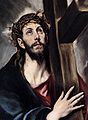
In Christianity
Christianity
Christianity is a monotheistic religion based on the life and teachings of Jesus as presented in canonical gospels and other New Testament writings...
, the Crown of Thorns, one of the instruments of the Passion
Arma Christi
Arma Christi , or the Instruments of the Passion, are the objects associated with Jesus' Passion in Christian symbolism and art....
, was woven of thorn
Thorns, spines, and prickles
In botanical morphology, thorns, spines, and prickles are hard structures with sharp, or at least pointed, ends. In spite of this common feature, they differ in their growth and development on the plant; they are modified versions of different plant organs, stems, stipules, leaf veins, or hairs...
branches and placed on Jesus Christ before his crucifixion
Crucifixion of Jesus
The crucifixion of Jesus and his ensuing death is an event that occurred during the 1st century AD. Jesus, who Christians believe is the Son of God as well as the Messiah, was arrested, tried, and sentenced by Pontius Pilate to be scourged, and finally executed on a cross...
. It is mentioned in the Canonical gospels of Matthew
Gospel of Matthew
The Gospel According to Matthew is one of the four canonical gospels, one of the three synoptic gospels, and the first book of the New Testament. It tells of the life, ministry, death, and resurrection of Jesus of Nazareth...
(27:29), Mark
Gospel of Mark
The Gospel According to Mark , commonly shortened to the Gospel of Mark or simply Mark, is the second book of the New Testament. This canonical account of the life of Jesus of Nazareth is one of the three synoptic gospels. It was thought to be an epitome, which accounts for its place as the second...
(15:17), and John
Gospel of John
The Gospel According to John , commonly referred to as the Gospel of John or simply John, and often referred to in New Testament scholarship as the Fourth Gospel, is an account of the public ministry of Jesus...
(19:2, 5) and is often alluded to by the early Church Fathers
Church Fathers
The Church Fathers, Early Church Fathers, Christian Fathers, or Fathers of the Church were early and influential theologians, eminent Christian teachers and great bishops. Their scholarly works were used as a precedent for centuries to come...
, such as Clement of Alexandria
Clement of Alexandria
Titus Flavius Clemens , known as Clement of Alexandria , was a Christian theologian and the head of the noted Catechetical School of Alexandria. Clement is best remembered as the teacher of Origen...
, Origen
Origen
Origen , or Origen Adamantius, 184/5–253/4, was an early Christian Alexandrian scholar and theologian, and one of the most distinguished writers of the early Church. As early as the fourth century, his orthodoxy was suspect, in part because he believed in the pre-existence of souls...
, and others.
John the Evangelist
John the Evangelist
Saint John the Evangelist is the conventional name for the author of the Gospel of John...
describes it thus (KJV, ch. 19):
- "Then Pilate therefore took Jesus, and scourgeScourgeA scourge is a whip or lash, especially a multi-thong type used to inflict severe corporal punishment or self-mortification on the back.-Description:...
d him. And the soldiers plaited a crown of thorns, and put it on his head, and they put on him a purple robe, And said,"Hail, King of the JewsJesus, King of the JewsIn the New Testament, Jesus is referred to as the King of the Jews both at the beginning of his life and at the end.Both uses of the title lead to dramatic results in the New Testament accounts. In the account of the Nativity of Jesus in the Gospel of Matthew, the three wise men In the New...
!" and they smote him with their hands. Pilate therefore went forth again, and saith unto them, Behold, I bring him forth to you, that ye may know that I find no fault in him. Then came Jesus forth, wearing the crown of thorns, and the purple robe. And Pilate saith unto them, Behold the manEcce HomoEcce Homo are the Latin words used by Pontius Pilate in the Vulgate translation of the , when he presents a scourged Jesus Christ, bound and crowned with thorns, to a hostile crowd shortly before his Crucifixion. The original Greek is Ἰδοὺ ὁ ἄνθρωπος . The King James Version translates the phrase...
!"
Christian symbolism
Following Genesis 3:18— "thorns also and thistles shall it bring forth to thee..." (KJV) — thorns were seen by Christian writers as emblems of the Fall of Man.- In Genesis 22, God asks Abraham to sacrifice his only son, Isaac. On the journey to Moriah, Isaac becomes curious (or even nervous) that they have brought everything necessary for the holocaust except the offering itself. Verses 7-8 (NAB) state: As the two walked on together, Isaac spoke to his father Abraham. "Father!" he said. "Yes, son," he replied. Isaac continued, "Here are the fire and the wood, but where is the sheep for the burnt offering?" "Son," Abraham answered, "God himself will provide the sheep for the burnt offering." Then the two continued going forward. As Abraham is about to deliver the fatal stroke with his knife, his hand is stayed by an angel. Abraham then looks for a suitable replacement for the sacrifice. Genesis 22:13 (NAB) states: As Abraham looked about, he spied a ram caught by its horns in the thicket. So he went and took the ram and offered it up as a burnt offering in place of his son.
In Old Testament times, 'horns' were considered as a sign of power or authority. The symbol of 'sheep', in general, was used for humanity. The sheep in question here is mentioned specifically as a "ram" (male) versus a "ewe" (female). The "ram" thus serves as a forshadowing of Jesus Christ. He (the Messianic God-Man) is the male leader over every nation, serving as the only suitable replacement sacrifice to God in the place of all humanity, which had been sentenced to eternal death for their disobedience in the Garden of Eden [Genesis 2:16-17 (NAB) & Genesis 3:2-3,19 (NAB)]. Of note here is that the "ram" is caught about the "horns" (head) "in a thicket" (bushes or branches) prior to its being sacrificed, thus forshadowing the Crown of Thorns.
Cultural context
PlutarchPlutarch
Plutarch then named, on his becoming a Roman citizen, Lucius Mestrius Plutarchus , c. 46 – 120 AD, was a Greek historian, biographer, essayist, and Middle Platonist known primarily for his Parallel Lives and Moralia...
makes reference in his Advice to Married Couples, to a custom (of parts of ancient Greece) in which "they crown [the bride] with a wreath of thorny acanthus." Apparently the prickly plant is also fragrant, and the custom symbolizes the need for the groom to be patient with his bride.
The likeliest intent of the Roman soldiers was a cruel parody of the civic crown
Civic Crown
The Civic Crown was a chaplet of common oak leaves woven to form a crown. During the Roman Republic, and the subsequent Principate, it was regarded as the second highest military decoration to which a citizen could aspire...
worn by the emperor. This crown was a military decoration presented by soldiers to those who had saved the lives of Roman citizens, and had become imperial regalia since Augustus, who in his time was hailed as "Savior of the World." The irony in this symbolism will not be lost to the Christian.
Jerusalem
A few writers of the first six centuries A.D. speak of a relic known to be still in existence and venerated by the faithful. St. Paulinus of NolaPaulinus of Nola
Saint Paulinus of Nola, also known as Pontificus Meropius Anicius Paulinus was a Roman senator who converted to a severe monasticism in 394...
, writing after 409, refers to "the thorns with which Our Saviour was crowned" as relics held in honour along with the Cross to which he was nailed and the pillar at which he was scourged (Epistle Macarius in Migne
Jacques Paul Migne
Jacques Paul Migne was a French priest who published inexpensive and widely-distributed editions of theological works, encyclopedias and the texts of the Church Fathers, with the goal of providing a universal library for the Catholic priesthood.He was born at Saint-Flour, Cantal and studied...
, Patrologia Latina
Patrologia Latina
The Patrologia Latina is an enormous collection of the writings of the Church Fathers and other ecclesiastical writers published by Jacques-Paul Migne between 1844 and 1855, with indices published between 1862 and 1865....
, LXI, 407). Cassiodorus
Cassiodorus
Flavius Magnus Aurelius Cassiodorus Senator , commonly known as Cassiodorus, was a Roman statesman and writer, serving in the administration of Theodoric the Great, king of the Ostrogoths. Senator was part of his surname, not his rank.- Life :Cassiodorus was born at Scylletium, near Catanzaro in...
(c. 570), when commenting on Psalm lxxxvi, speaks of the Crown of Thorns among the other relics which are the glory of the earthly Jerusalem. "There", he says, "we may behold the thorny crown, which was only set upon the head of Our Redeemer in order that all the thorns of the world might be gathered together and broken" (Migne, LXX, 621). When Gregory of Tours
Gregory of Tours
Saint Gregory of Tours was a Gallo-Roman historian and Bishop of Tours, which made him a leading prelate of Gaul. He was born Georgius Florentius, later adding the name Gregorius in honour of his maternal great-grandfather...
in De gloria martyri avers that the thorns in the Crown still looked green, a freshness which was miraculously renewed each day, he does not much strengthen the historical authenticity of a relic he had not seen, but the Breviarius, and the itinerary of Antoninus of Piacenza
Antoninus of Piacenza
The sixth-century pilgrim Antoninus of Piacenza, or the Anonymous Pilgrim of Piacenza, who described the holy places of Jerusalem in the 570s is confused often with Saint Antoninus of Piacenza, who is venerated as a saint and martyr in the Roman Catholic Church, with a feast day of 13 November in...
(6th century) clearly state that the Crown of Thorns was currently shown in the church on Mount Zion
Mount Zion
Mount Zion is a place name for a site in Jerusalem, the location of which has shifted several times in history. According to the Hebrew Bible's Book of Samuel, it was the site of the Jebusite fortress called the "stronghold of Zion" that was conquered by King David, becoming his palace in the City...
. From these fragments of evidence and others of later date (the "Pilgrimage" of the monk Bernard shows that the relic was still at Mount Sion in 870), it is likely that a purported Crown of Thorns was venerated at Jerusalem from the fifth century for several hundred years.
Byzantium
Francois de Mély supposed that the whole Crown was not transferred to Byzantium until about 1063. In any case JustinianJustinian I
Justinian I ; , ; 483– 13 or 14 November 565), commonly known as Justinian the Great, was Byzantine Emperor from 527 to 565. During his reign, Justinian sought to revive the Empire's greatness and reconquer the lost western half of the classical Roman Empire.One of the most important figures of...
(died in 565) is stated to have given a thorn to St. Germain
Germain of Paris
Saint Germain was a bishop of Paris, who was canonized in 754. He is known in his early vita as pater et pastor populi, rendered in modern times as the "Father of the Poor".-Biography:...
, Bishop of Paris, which was long preserved at Saint-Germain-des-Prés
Saint-Germain-des-Prés
Saint-Germain-des-Prés is an area of the 6th arrondissement of Paris, France, located around the church of the former Abbey of Saint-Germain-des-Prés....
, while the Empress Irene
Irene (empress)
Irene Sarantapechaina , known as Irene of Athens or Irene the Athenian was a Byzantine empress regnant from 797 to 802, having previously been empress consort from 775 to 780, and empress dowager and regent from 780 to 797. It is often claimed she called herself "basileus" , 'emperor'...
, in 798 or 802, sent Charlemagne
Charlemagne
Charlemagne was King of the Franks from 768 and Emperor of the Romans from 800 to his death in 814. He expanded the Frankish kingdom into an empire that incorporated much of Western and Central Europe. During his reign, he conquered Italy and was crowned by Pope Leo III on 25 December 800...
several thorns which were deposited by him at Aachen
Aachen
Aachen has historically been a spa town in North Rhine-Westphalia, Germany. Aachen was a favoured residence of Charlemagne, and the place of coronation of the Kings of Germany. Geographically, Aachen is the westernmost town of Germany, located along its borders with Belgium and the Netherlands, ...
. Eight of these are said to have been there at the consecration of the basilica of Aachen by Pope Leo III
Pope Leo III
Pope Saint Leo III was Pope from 795 to his death in 816. Protected by Charlemagne from his enemies in Rome, he subsequently strengthened Charlemagne's position by crowning him as Roman Emperor....
. The presence of the Pope at the consecration is a later legend, but the relics apparently were there, for the subsequent history of several of them can be traced without difficulty. Four were given to Saint-Corneille of Compiègne in 877 by Charles the Bald
Charles the Bald
Charles the Bald , Holy Roman Emperor and King of West Francia , was the youngest son of the Emperor Louis the Pious by his second wife Judith.-Struggle against his brothers:He was born on 13 June 823 in Frankfurt, when his elder...
. Hugh the Great, Duke of the Franks, sent one to the Anglo-Saxon King Athelstan in 927, on the occasion of certain marriage negotiations, and it eventually found its way to Malmesbury Abbey
Malmesbury Abbey
Malmesbury Abbey, at Malmesbury in Wiltshire, England, was founded as a Benedictine monastery around 676 by the scholar-poet Aldhelm, a nephew of King Ine of Wessex. In 941 AD, King Athelstan was buried in the Abbey. By the 11th century it contained the second largest library in Europe and was...
. Another was presented to a Spanish princess about 1160, and again another was taken to Andechs Abbey in Germany in the year 1200.

Baldwin II of Constantinople
Baldwin II of Courtenay was the last emperor of the Latin Empire of Constantinople.He was a younger son of Yolanda of Flanders, sister of the first two emperors, Baldwin I and Henry of Flanders...
, the Latin Emperor
Latin Empire
The Latin Empire or Latin Empire of Constantinople is the name given by historians to the feudal Crusader state founded by the leaders of the Fourth Crusade on lands captured from the Byzantine Empire. It was established after the capture of Constantinople in 1204 and lasted until 1261...
of Constantinople
Constantinople
Constantinople was the capital of the Roman, Eastern Roman, Byzantine, Latin, and Ottoman Empires. Throughout most of the Middle Ages, Constantinople was Europe's largest and wealthiest city.-Names:...
, anxious to obtain support for his tottering empire, offered the Crown of Thorns to St. Louis
Louis IX of France
Louis IX , commonly Saint Louis, was King of France from 1226 until his death. He was also styled Louis II, Count of Artois from 1226 to 1237. Born at Poissy, near Paris, he was an eighth-generation descendant of Hugh Capet, and thus a member of the House of Capet, and the son of Louis VIII and...
, King of France. It was then in the hands of the Venetians
Venice
Venice is a city in northern Italy which is renowned for the beauty of its setting, its architecture and its artworks. It is the capital of the Veneto region...
as security for a heavy loan (13,134 gold pieces), but it was redeemed and conveyed to Paris where St. Louis built the Sainte-Chapelle
Sainte-Chapelle
La Sainte-Chapelle is the only surviving building of the Capetian royal palace on the Île de la Cité in the heart of Paris, France. It was commissioned by King Louis IX of France to house his collection of Passion Relics, including the Crown of Thorns - one of the most important relics in medieval...
(completed 1248) to receive it. The relic stayed there until the French Revolution
French Revolution
The French Revolution , sometimes distinguished as the 'Great French Revolution' , was a period of radical social and political upheaval in France and Europe. The absolute monarchy that had ruled France for centuries collapsed in three years...
, when, after finding a home for a while in the Bibliothèque Nationale, the Concordat of 1801
Concordat of 1801
The Concordat of 1801 was an agreement between Napoleon and Pope Pius VII, signed on 15 July 1801. It solidified the Roman Catholic Church as the majority church of France and brought back most of its civil status....
restored it to the Church
Roman Catholic Church
The Catholic Church, also known as the Roman Catholic Church, is the world's largest Christian church, with over a billion members. Led by the Pope, it defines its mission as spreading the gospel of Jesus Christ, administering the sacraments and exercising charity...
, and it was deposited in the Cathedral of Notre-Dame. The relic that the Church received is a twisted circlet of juncus balticus
Juncus balticus
Juncus balticus is a species of rush known by the common name Baltic rush. this plant is widespread in occurrence and can reach a height of about three feet.-References:*C.Michael Hogan, ed. 2010....
rushes; the thorns preserved in various other reliquaries are of zizyphus spina christi and had apparently been removed from the crown and kept in separate reliquaries since soon after they arrived in France. New reliquaries were provided for the relic, one commissioned by Napoleon, another, in jewelled rock crystal and more suitably Gothic
Gothic architecture
Gothic architecture is a style of architecture that flourished during the high and late medieval period. It evolved from Romanesque architecture and was succeeded by Renaissance architecture....
, was made to the designs of Eugene Viollet-le-Duc
Eugène Viollet-le-Duc
Eugène Emmanuel Viollet-le-Duc was a French architect and theorist, famous for his interpretive "restorations" of medieval buildings. Born in Paris, he was a major Gothic Revival architect.-Early years:...
. In 2001, when the surviving treasures from the Sainte-Chapelle were exhibited at the Louvre
Louvre
The Musée du Louvre – in English, the Louvre Museum or simply the Louvre – is one of the world's largest museums, the most visited art museum in the world and a historic monument. A central landmark of Paris, it is located on the Right Bank of the Seine in the 1st arrondissement...
, the chaplet was solemnly presented every Friday at Notre Dame. Pope John Paul II
Pope John Paul II
Blessed Pope John Paul II , born Karol Józef Wojtyła , reigned as Pope of the Catholic Church and Sovereign of Vatican City from 16 October 1978 until his death on 2 April 2005, at of age. His was the second-longest documented pontificate, which lasted ; only Pope Pius IX ...
translated it personally to the Sainte-Chapelle during the World Youth Day
World Youth Day
World Youth Day is a youth-oriented Catholic Church event. While the event itself celebrates the Catholic faith, the invitation to attend extends to all youth, regardless of religious convictions....
s.
The Catholic Encyclopedia said: "Authorities are agreed that a sort of helmet of thorns must have been plaited by the Roman soldiers, this band of rushes being employed to hold the thorns together. It seems likely according to M. De Mély, that already at the time when the circlet was brought to Paris the sixty or seventy thorns, which seem to have been afterwards distributed by St. Louis and his successors, had been separated from the band of rushes and were kept in a different reliquary
Reliquary
A reliquary is a container for relics. These may be the physical remains of saints, such as bones, pieces of clothing, or some object associated with saints or other religious figures...
. None of these now remain at Paris. Some small fragments of rush are also preserved ... at Arras and at Lyons. With regard to the origin and character of the thorns, both tradition and existing remains suggest that they must have come from the bush botanically known as Ziziphus spina-christi, more popularly, the jujube tree
Jujube
Ziziphus zizyphus , commonly called jujube , red date, Chinese date, Korean date, or Indian date is a species of Ziziphus in the buckthorn family Rhamnaceae, used primarily as a fruiting shade tree.-Distribution:Its precise natural distribution is uncertain due to extensive cultivation,...
. This reaches the height of fifteen or twenty feet and is found growing in abundance by the wayside around Jerusalem. The crooked branches of this shrub are armed with thorns growing in pairs, a straight spine and a curved one commonly occurring together at each point. The relic preserved in the Capella della Spina at Pisa
Pisa
Pisa is a city in Tuscany, Central Italy, on the right bank of the mouth of the River Arno on the Tyrrhenian Sea. It is the capital city of the Province of Pisa...
, as well as that at Trier
Trier
Trier, historically called in English Treves is a city in Germany on the banks of the Moselle. It is the oldest city in Germany, founded in or before 16 BC....
, which though their early history is doubtful and obscure, are among the largest in size, afford a good illustration of this peculiarity."
Third-class relics
Not all of the reputed holy thorns are first-class relics, that is, relics of the original Crown. M. de Mély was able to enumerate more than 700. The statement in one medieval obituary that Peter de Averio gave to the cathedral of Angers "unam de spinis quae fuit apposita coronae spinae nostri Redemptoris" ("one of the spines which were touched to the thorny crown of our Redeemer") (de Mély, p. 362) indicates that many of the thorns were relicRelic
In religion, a relic is a part of the body of a saint or a venerated person, or else another type of ancient religious object, carefully preserved for purposes of veneration or as a tangible memorial...
s of the third class—objects touched to a relic of the first class, in this case some part of the crown itself. (In Roman Catholic tradition, a relic of the first class is a part of the body of a saint or, in this case, any of the objects used in the Crucifixion that carried the blood of Christ; a relic of the second class is anything known to have been touched or used by a saint; a relic of the third class is a devotional object touched to a first-class relic and, usually, formally blessed as a sacramental.) Again, even in comparatively modern times it is not always easy to trace the history of these objects of devotion, as first-class relics were often divided and any number of authentic third-class relics may exist.
Purported remnants
The Holy Thorn ReliquaryHoly Thorn Reliquary
The Holy Thorn Reliquary was probably created in the 1390s in Paris for John, Duke of Berry, to house a relic of the Crown of Thorns. The reliquary was bequeathed to the British Museum in 1898 by Ferdinand de Rothschild as part of the Waddesdon Bequest...
in the British Museum
British Museum
The British Museum is a museum of human history and culture in London. Its collections, which number more than seven million objects, are amongst the largest and most comprehensive in the world and originate from all continents, illustrating and documenting the story of human culture from its...
, containing one thorn, was made for the French prince Jean, duc de Berry in the 1390s, who is documented as receiving several thorns from Charles V and VI, his brother and nephews.
The Catholic Encyclopedia (1908) reported two "holy thorns" were venerated, the one at St. Michael's church in Ghent, the other at Stonyhurst College
Stonyhurst College
Stonyhurst College is a Roman Catholic independent school, adhering to the Jesuit tradition. It is located on the Stonyhurst Estate near the village of Hurst Green in the Ribble Valley area of Lancashire, England, and occupies a Grade I listed building...
, both professing to be the thorn given by Mary Queen of Scots to Thomas Percy, Earl of Northumberland (see "The Month", April, 1882, 540-556).
More recently, a website "Gazeteer of Relics and Miraculous Images" lists the following, following Cruz 1984:
- Belgium: Parochial Church of WevelgemWevelgemWevelgem is a municipality located in the Belgian province of West Flanders. The municipality comprises the towns of Gullegem, Moorsele and Wevelgem proper. On January 1, 2006 Wevelgem had a total population of 31,020...
: a portion of the Crown of Thorns - Belgium: GhentGhentGhent is a city and a municipality located in the Flemish region of Belgium. It is the capital and biggest city of the East Flanders province. The city started as a settlement at the confluence of the Rivers Scheldt and Lys and in the Middle Ages became one of the largest and richest cities of...
, St. Michael's Church: A thorn from the Crown of Thorns - France: Notre Dame de ParisNotre Dame de ParisNotre Dame de Paris , also known as Notre Dame Cathedral, is a Gothic, Roman Catholic cathedral on the eastern half of the Île de la Cité in the fourth arrondissement of Paris, France. It is the cathedral of the Catholic Archdiocese of Paris: that is, it is the church that contains the cathedra of...
: The circlet of rushes of the Crown of Thorns, displayed the first Friday of each month and all Fridays in Lent (including Good Friday) - France: Sainte-ChapelleSainte-ChapelleLa Sainte-Chapelle is the only surviving building of the Capetian royal palace on the Île de la Cité in the heart of Paris, France. It was commissioned by King Louis IX of France to house his collection of Passion Relics, including the Crown of Thorns - one of the most important relics in medieval...
: A portion of the Crown of Thorns, brought to the site by Louis IX. - Germany: Cathedral of TrierCathedral of TrierThe Cathedral of Saint Peter is a church in Trier, Rhineland-Palatinate, Germany. It is the oldest cathedral in the country. The edifice is notable for its extremely long life span under multiple different eras each contributing some elements to its design, including the center of the main chapel...
: A thorn from the Crown of Thorns - Italy: RomeRomeRome is the capital of Italy and the country's largest and most populated city and comune, with over 2.7 million residents in . The city is located in the central-western portion of the Italian Peninsula, on the Tiber River within the Lazio region of Italy.Rome's history spans two and a half...
, Santa Croce in GerusalemmeSanta Croce in GerusalemmeThe Basilica of the Holy Cross in Jerusalem is a Roman Catholic parish church and minor basilica in Rome, Italy. It is one of the Seven Pilgrim Churches of Rome....
: Two thorns from the Crown of Thorns. - Italy: RomeRomeRome is the capital of Italy and the country's largest and most populated city and comune, with over 2.7 million residents in . The city is located in the central-western portion of the Italian Peninsula, on the Tiber River within the Lazio region of Italy.Rome's history spans two and a half...
, Santa PrassedeSanta PrassedeThe Basilica of Saint Praxedes , commonly known in Italian as Santa Prassede, is an ancient titular church and minor basilica in Rome, Italy, located near the papal basilica of Saint Mary Major...
: A small portion of the Crown of Thorns - Italy: PisaPisaPisa is a city in Tuscany, Central Italy, on the right bank of the mouth of the River Arno on the Tyrrhenian Sea. It is the capital city of the Province of Pisa...
, Spedali Riuniti di Santa Chiara: A branch with thorns from the Crown of Thorns - Italy: NaplesNaplesNaples is a city in Southern Italy, situated on the country's west coast by the Gulf of Naples. Lying between two notable volcanic regions, Mount Vesuvius and the Phlegraean Fields, it is the capital of the region of Campania and of the province of Naples...
, Santa Maria Incoronata: A fragment of the Crown of Thorns - Italy: Ariano IrpinoAriano IrpinoAriano Irpino is a municipality in the province of Avellino, in the Campania region of Italy on the railway between Benevento and Foggia, c. 40 km east of the former.-Geography:...
, Cathedral: Two Thorns from the Crown of Thorns - Spain: OviedoOviedoOviedo is the capital city of the Principality of Asturias in northern Spain. It is also the name of the municipality that contains the city....
, Cathedral: Five thorns (formerly eight) from the Crown of Thorns - Spain: BarcelonaBarcelonaBarcelona is the second largest city in Spain after Madrid, and the capital of Catalonia, with a population of 1,621,537 within its administrative limits on a land area of...
, Cathedral: A thorn from the Crown of Thorns - Spain: SevilleSevilleSeville is the artistic, historic, cultural, and financial capital of southern Spain. It is the capital of the autonomous community of Andalusia and of the province of Seville. It is situated on the plain of the River Guadalquivir, with an average elevation of above sea level...
, Iglesia de la Anunciación (Hermandad del Valle): A thorn from the Crown of Thorns - United Kingdom: British Museum: Holy Thorn Reliquary (see above), Salting Reliquary, each with a thorn
- United Kingdom: Stanbrook AbbeyStanbrook AbbeyStanbrook Abbey is an abbey built as a contemplative house for Benedictine nuns. It was founded in 1625 in Cambrai, Flanders, then part of the Spanish Netherlands, under the auspices of the English Benedictine Congregation.-History:...
, WorcesterWorcesterThe City of Worcester, commonly known as Worcester, , is a city and county town of Worcestershire in the West Midlands of England. Worcester is situated some southwest of Birmingham and north of Gloucester, and has an approximate population of 94,000 people. The River Severn runs through the...
: A thorn from the Crown of Thorns - United Kingdom: Stonyhurst CollegeStonyhurst CollegeStonyhurst College is a Roman Catholic independent school, adhering to the Jesuit tradition. It is located on the Stonyhurst Estate near the village of Hurst Green in the Ribble Valley area of Lancashire, England, and occupies a Grade I listed building...
, LancashireLancashireLancashire is a non-metropolitan county of historic origin in the North West of England. It takes its name from the city of Lancaster, and is sometimes known as the County of Lancaster. Although Lancaster is still considered to be the county town, Lancashire County Council is based in Preston...
: A thorn from the Crown of Thorns
Crown of Thorns iconography

Ecce Homo
Ecce Homo are the Latin words used by Pontius Pilate in the Vulgate translation of the , when he presents a scourged Jesus Christ, bound and crowned with thorns, to a hostile crowd shortly before his Crucifixion. The original Greek is Ἰδοὺ ὁ ἄνθρωπος . The King James Version translates the phrase...
arises after the time of St. Louis and the building of the Sainte-Chapelle. The Catholic Encyclopedia reported that some archaeologists had professed to discover a figure of the Crown of Thorns in the circle which sometimes surrounds the chi-rho emblem on early Christian sarcophagi
Sarcophagus
A sarcophagus is a funeral receptacle for a corpse, most commonly carved or cut from stone. The word "sarcophagus" comes from the Greek σαρξ sarx meaning "flesh", and φαγειν phagein meaning "to eat", hence sarkophagus means "flesh-eating"; from the phrase lithos sarkophagos...
, but the compilers considered that it seemed to be quite as probable that this was only meant for a laurel wreath
Laurel wreath
A laurel wreath is a circular wreath made of interlocking branches and leaves of the bay laurel , an aromatic broadleaf evergreen. In Greek mythology, Apollo is represented wearing a laurel wreath on his head...
.
The image of the crown of thorns is often used symbolically to contrast with earthly monarchical crowns. In the symbolism of King Charles the Martyr
Society of King Charles the Martyr
The Society of King Charles the Martyr is an Anglican devotional society and one of the Catholic Societies of the Church of England. It is dedicated to and under the patronage of King Charles I of England , the only person to be canonised by the Church of...
, the executed English King Charles I is depicted putting aside his earthy crown to take up the crown of thorns, as in William Marshall
William Marshall (illustrator)
William Marshall was a seventeenth century British engraver and illustrator, best known for his print depicting "Charles the Martyr", a symbolic portrayal of King Charles I of England as a Christian martyr.-Early career:...
's print Eikon Basilike
Eikon Basilike
The Eikon Basilike , The Pourtrature of His Sacred Majestie in His Solitudes and Sufferings, was a purported spiritual autobiography attributed to King Charles I of England...
. This contrast appears elsewhere in art, for example in Frank Dicksee's painting The Two Crowns.
The carnations symbolize the Jesus passion
Passion (Christianity)
The Passion is the Christian theological term used for the events and suffering – physical, spiritual, and mental – of Jesus in the hours before and including his trial and execution by crucifixion...
as they represent the Crown of Thorns.
Episcopal Allegory
The crown of thorns is also an allegory of the episcopalBishop
A bishop is an ordained or consecrated member of the Christian clergy who is generally entrusted with a position of authority and oversight. Within the Catholic Church, Eastern Orthodox, Oriental Orthodox Churches, in the Assyrian Church of the East, in the Independent Catholic Churches, and in the...
governance of the church. Contrasted to a kingly crown, the crown of thorns signifies the difference between episcopal governance, and kingly governance of state. It serves as a reminder of the humility required of all bishops. The interwoven nature of the crown of thorns further represents the complexity of all the relationships among bishops, and their necessary interdependence in governing the church.
See also
- CrownCrown (headgear)A crown is the traditional symbolic form of headgear worn by a monarch or by a deity, for whom the crown traditionally represents power, legitimacy, immortality, righteousness, victory, triumph, resurrection, honour and glory of life after death. In art, the crown may be shown being offered to...
- Jesus, King of the JewsJesus, King of the JewsIn the New Testament, Jesus is referred to as the King of the Jews both at the beginning of his life and at the end.Both uses of the title lead to dramatic results in the New Testament accounts. In the account of the Nativity of Jesus in the Gospel of Matthew, the three wise men In the New...
- Holy SpongeHoly SpongeThe Holy Sponge is one of the Instruments of the Passion of Jesus Christ. It was dipped in vinegar and offered to Christ to drink during the Crucifixion, according to Matthew 27:48; Mark 15:36; and John 19:29...
- Lance of Longinus
- Man of SorrowsMan of SorrowsAmong the passages in the Hebrew Bible that have been identified by Christians as prefigurations of the Messiah, the Man of Sorrows of Isaiah 53 is paramount - the various theological traditions are discussed at that article...
- Relics attributed to JesusRelics attributed to JesusA number of relics associated with Jesus have been claimed and displayed throughout the history of Christianity. Some people believe in the authenticity of some relics; others doubt the authenticity of various items...
- True CrossTrue CrossThe True Cross is the name for physical remnants which, by a Christian tradition, are believed to be from the cross upon which Jesus was crucified.According to post-Nicene historians, Socrates Scholasticus and others, the Empress Helena The True Cross is the name for physical remnants which, by a...