

Athelstan of England

Encyclopedia
Athelstan (Old English: Æþelstan, Æðelstān) (c. 893 / 894 – 27 October 939), called the Glorious, was the King of England from 924 or 925 to 939. He was the son of King Edward the Elder
, grandson of Alfred the Great
and nephew of Æthelflæd of Mercia
. Æthelstan's success in securing the submission of Constantine II
, King of Scots, at the Treaty of Eamont Bridge
in 927 through to the Battle of Brunanburh
in 937 led to his claiming the title "king of all Britain
". His reign is frequently overlooked, with much focus going to Alfred the Great before him, and Edmund
after. However, it was of fundamental importance to political developments in the 10th century.
Athelstan was the first King of a unified England from 927 A.D.
, which is vocal during the reigns of Alfred and Edward the Elder, falls into relative silence during Athelstan's reign, and what entries survive are retrospective. A few references tell of his military campaigns, the longest entry being a poem about the Battle of Brunanburh
(937), probably composed in his successor Edmund's reign. Other narrative sources from across Europe
, though, provide more information. The Annals of Flodoard
contain several references to Athelstan's dealings with the rulers of west and east Francia, as does the Chronicle of Nantes
. William of Malmesbury
, however, writing in the early 12th century, provides the greatest detail. His work might even draw on a (now lost) Vita Æthelstani, as Michael Wood argues, but caution is called for as this case has yet to be proven and William's account can rarely be verified. Another difficult source is chapters 50–55 of Egils saga
, attributed to Snorri Sturluson
c. 1220–1240.
Documentary sources come in the form of charter
s and laws
. Charters exist that tell about where Athelstan was, who was with him, and to whom he was granting land. Through these it is possible to trace his peregrinations, particularly between 927 and 932 when all diplomas were drafted by the extraordinary scribe known as "Athelstan A". There are several law codes attributed to Athelstan; a couple are law codes after the tradition of Alfred and Edward; the others are less "official", but nonetheless reveal aspects of Athelstan's administration.
Non-written sources are also available. For instance, coin
s give Athelstan a title revealing how widespread he (or rather the minters) felt his reign extended: throughout all Britain
. There are also the manuscripts and relics Athelstan collected and donated; many of the former contain notices giving the details of these donations. These particularly shed light on Athelstan's patronage of the cult of St Cuthbert's
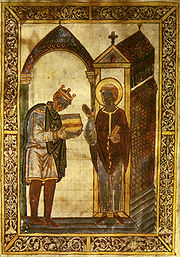
in Northumbria, to whom he gave two lavish manuscripts. One contains the earliest known surviving English ruler portrait, showing Athelstan presenting a copy of Bede
's Lives of St Cuthbert in prose and verse to Cuthbert, in the Corpus Christi College manuscript 183 (illustration, below)
.jpg) Athelstan was the son of Edward the Elder
Athelstan was the son of Edward the Elder
, and grandson of Alfred the Great
. His father succeeded, after some difficulty, to the Kingdom of the Anglo-Saxons
formed by Alfred. His aunt, Edward's sister, Æthelflæd
, ruled western Mercia
on Edward's behalf following the death of her husband, Ealdorman Æthelred. On Æthelflæd's death, Edward was quick to assume control of Mercia, and at the time of his death he directly ruled all the English kingdoms south of the Humber
. Athelstan was fostered by his aunt in Mercia, perhaps as a method of encouraging Mercian loyalty to the West Saxon dynasty. This helped him be accepted as a prince of Mercia. On Edward's death, Athelstan immediately became King of Mercia, though it seems to have taken longer for him to be recognised in Wessex where his half-brothers Ælfweard
and Edwin
had support.
Political alliances seem to have been high on Athelstan's agenda. Only a year after his crowning he married one of his sisters to Sihtric Cáech, the Viking
King of Northumbria
at Tamworth, who acknowledged Æthelstan as over-king, adopting Christianity
. Within the year he may have abandoned his new faith and repudiated his wife, but before Æthelstan and he could fight, Sihtric died suddenly in 927. His kinsman, perhaps brother, Gofraid
, who had remained as his deputy in Dublin, came from Ireland to take power in York, but failed. Æthelstan moved quickly, seizing much of Northumbria. This bold move brought the whole of England
under one ruler for the first time, although this unity did not become permanent until 954. In less than a decade, the kingdom of the English had become by far the greatest power in the British Isles
, perhaps stretching as far north as the Firth of Forth
.
Initially the other rulers in Great Britain
seem to have submitted to Athelstan at Bamburgh
: "first Hywel, King of the West Welsh
, and Constantine II
, King of Scots, and Owain
, King of the people of Gwent, and Ealdred
...of Bamburgh" records the Anglo-Saxon Chronicle
. William of Malmesbury adds that Owain
of Strathclyde was also present.
Similar events are recorded along the western marches of Athelstan's domain. According to William of Malmesbury, Athelstan had the kings of the North British (meaning the Welsh) submit to him at Hereford
, where he exacted a heavy tribute from them. The reality of his influence in Wales is underlined by the Welsh poem Armes Prydein Fawr
, and by the appearance of the Welsh kings as subreguli in the charters of 'Αthelstan A'. Similarly, he drove the West Welsh (meaning the Cornish
) out of Exeter
, and established the border of Cornwall
along the River Tamar
.
John of Worcester
's chronicle suggests that Æthelstan faced opposition from Constantine, from Owain of Strathclyde, and from the Welsh kings. William of Malmesbury
writes that Gofraid, together with Sihtric's young son Olaf Cuaran
fled north and received refuge from Constantine, which led to war with Æthelstan. A meeting at Eamont Bridge
on 12 July 927 was sealed by an agreement that Constantine, Eógan of Strathclyde, Hywel Dda
, and Ealdred would "renounce all idolatry": that is, they would not ally with the Viking kings. William states that Æthelstan stood godfather to a son of Constantine, probably Indulf
(Ildulb mac Constantín), during the conference.
Æthelstan followed up his advances in the north by securing the recognition of the Welsh kings. For the next seven years, the record of events in the north is blank. Æthelstan's court was attended by the Welsh kings, but not by Constantine or Eógan of Strathclyde. This absence of record means that Æthelstan's reasons for marching north against Constantine in 934 are unclear.
Æthelstan's campaign is reported in brief by the Anglo-Saxon Chronicle, and later chroniclers such as John of Worcester, William of Malmesbury, Henry of Huntingdon
, and Symeon of Durham
add detail to that bald account. Æthelstan's army began gathering at Winchester
by 28 May 927, and reached Nottingham
by 7 June. He was accompanied by many leaders, including the Welsh kings Hywel Dda, Idwal Foel, and Morgan ab Owain. From Mercia the army went north, stopping at Chester-le-Street
, before resuming the march accompanied by a fleet of ships. Eógan of Strathclyde was defeated and Symeon states that the army went as far north as Dunnottar and Fortriu, while the fleet is said to have raided Caithness
, by which a much larger area, including Sutherland
, is probably intended. It is unlikely that Constantine's personal authority extended so far north, and while the attacks may have been directed at his allies, they may also have been simple looting expeditions.
The Annals of Clonmacnoise
state that "the Scottish men compelled [Æthelstan] to return without any great victory", while Henry of Huntingdon claims that the English faced no opposition. A negotiated settlement may have ended matters: according to John of Worcester, a son of Constantine was given as a hostage to Æthelstan and Constantín himself accompanied the English king on his return south. He witnessed a charter with Æthelstan at Buckingham
on 13 September 934 in which he is described as subregulus, that is a king acknowledging Æthelstan's overlordship. The following year, Constantine was again in England at Æthelstan's court, this time at Cirencester
where he appears as a witness, appearing as the first of several subject kings, followed by Eógan of Strathclyde and Hywel Dda, who subscribed to the diploma. At Christmas
of 935, Eógan of Strathclyde was once more at Æthelstan's court along with the Welsh kings, but Constantine was not. His return to England less than two years later would be in very different circumstances.
 Following Constantine's
disappearance from Æthelstan's court after 935, there is no further report of him until 937. In that year, together with Eógan of Strathclyde and Olaf Guthfrithson, King of Dublin
, Constantine invaded England. The resulting battle of Brunanburh
—Dún Brunde—is reported in the Annals of Ulster as follows:
on the Wirral
the most favoured location.
Brunanburh, for all that it had been a famous and bloody battle, settled nothing. On 27 October 939 Æthelstan, "pillar of the dignity of the western world" in the words of the Annals of Ulster, died at Malmesbury. He was succeeded by his brother Edmund the Elder
, then aged 18. Æthelstan's empire, seemingly made safe by the victory of Brunanburh, collapsed in little more than a year from his death when Amlaíb returned from Ireland and seized Northumbria and the Mercian Danelaw. Edmund spent the remainder of Constantín's reign rebuilding the empire.
Athelstan is generally regarded as the first king of England
and his reign is seen as the first time that kingdoms of England, Wales and Scotland were united under one ruler as "King of all Britain". He achieved considerable military successes over his rivals, including the Vikings, and extended his rule to parts of Wales
and Cornwall
.
, termed 'half-king', who was Ealdorman
for much of eastern Mercia and East Anglia. Ian Walker has argued that, as the extent of Athelstan's power grew, the extent of rule of the next level of the aristocracy had to grow too. This points towards an increasing stratification of English society, a development that can be traced from earliest Anglo-Saxon times right up to the Norman Conquest and beyond.
A relatively large number of law codes have come down to us from Athelstan's reign. To examine each in detail would take too much space here, but two viewpoints summarise the arguments around them. Patrick Wormald
, who has argued that written law had little practical use in Anglo-Saxon England, states that there is little homogeneity to the laws, and that the sporadic nature of them indicate little sign of a coherent system based on written law. Simon Keynes
has instead argued that there is a pattern to the laws of Athelstan's reign, and that the laws are evidence "not of any casual attitude towards the publication or recording of the law, but quite the reverse".
 Athelstan's reign marks a hiatus in sporadic unrest between the English and Welsh
kingdoms. According to Asser
, a monk from St David's, Dyfed
, several kingdoms of Wales submitted (including eventually those ruled by the sons of Rhodri Mawr) to Alfred. No battles between the English and the Welsh are recorded during Athelstan's reign, but charters show Welsh kings attending his court, possibly coming with him on campaign. D.P. Kirby argued that Athelstan was repressing the Welsh kings, keeping them close in order to maintain their loyalty. Yet it is also possible that some Welsh kings, in particular Hywel Dda
, were benefiting from this relationship. Hywel may have been influenced by English ideas of kingship – he is the first Welsh king associated with a major Welsh law
code, and a coin, minted at Chester
, carries his name.
, son of Henry I of Saxony. Alan II, Duke of Brittany
and Haakon
, son of Harald
of Norway
, were both fostered in Æthelstan’s court, and he provided a home for Louis
, the exiled son of Charles the Simple
.
Athelstan might have considered his rule in some way imperial: the style basileus
is found in his charters, whilst he is the first king to bear the title r[ex] tot[ius] B[ritanniae]. According to William of Malmesbury
, relics such as the Sword of Constantine (Emperor of Rome) and the Lance of Charlemagne
(first Holy Roman Emperor) came to Athelstan, suggesting that he was in some way being associated with past great rulers.
Although he established many alliances through his family, he does not appear to have married or had children, although there is an uncorroborated allusion in the twelfth century Liber Eliensis
to a daughter.
Athelstan was religious and gave generously to the church in Wessex
, and when he died in 939 at Gloucester
he was buried at his favourite abbey (Malmesbury) rather than with his family at Winchester
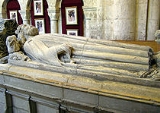
. Though his tomb is still there, his body was lost centuries later. There is nothing in the tomb beneath the statue, the relics of the king having been lost in the Dissolution of the Monasteries
in 1539 by King Henry VIII
. The remains may have been destroyed by the King's Commissioners or hidden before the Commissioners arrived to close down the Abbey
. In Malmesbury, his name lives on into the 20th and 21st centuries, with everything from a bus company and a second-hand shop to several roads and streets, as well as the Care Home opened in 2008, named after him. His patronage of the abbey, and his gift of freemen status to the town also lives on with the Warden and Freemen of Malmesbury.
He was succeeded by his younger half-brother, King Edmund I of England
.
Edward the Elder
Edward the Elder was an English king. He became king in 899 upon the death of his father, Alfred the Great. His court was at Winchester, previously the capital of Wessex...
, grandson of Alfred the Great
Alfred the Great
Alfred the Great was King of Wessex from 871 to 899.Alfred is noted for his defence of the Anglo-Saxon kingdoms of southern England against the Vikings, becoming the only English monarch still to be accorded the epithet "the Great". Alfred was the first King of the West Saxons to style himself...
and nephew of Æthelflæd of Mercia
Mercia
Mercia was one of the kingdoms of the Anglo-Saxon Heptarchy. It was centred on the valley of the River Trent and its tributaries in the region now known as the English Midlands...
. Æthelstan's success in securing the submission of Constantine II
Constantine II of Scotland
Constantine, son of Áed was an early King of Scotland, known then by the Gaelic name Alba. The Kingdom of Alba, a name which first appears in Constantine's lifetime, was in northern Great Britain...
, King of Scots, at the Treaty of Eamont Bridge
Eamont Bridge
Eamont Bridge is a small village immediately to the south of Penrith, Cumbria.The village is named after the River Eamont and straddles the boundary between the ancient counties of Cumberland and Westmorland...
in 927 through to the Battle of Brunanburh
Battle of Brunanburh
The Battle of Brunanburh was an English victory in 937 by the army of Æthelstan, King of England, and his brother Edmund over the combined armies of Olaf III Guthfrithson, the Norse-Gael King of Dublin, Constantine II, King of Scots, and Owen I, King of Strathclyde...
in 937 led to his claiming the title "king of all Britain
Great Britain
Great Britain or Britain is an island situated to the northwest of Continental Europe. It is the ninth largest island in the world, and the largest European island, as well as the largest of the British Isles...
". His reign is frequently overlooked, with much focus going to Alfred the Great before him, and Edmund
Edmund I of England
Edmund I , called the Elder, the Deed-doer, the Just, or the Magnificent, was King of England from 939 until his death. He was a son of Edward the Elder and half-brother of Athelstan. Athelstan died on 27 October 939, and Edmund succeeded him as king.-Military threats:Shortly after his...
after. However, it was of fundamental importance to political developments in the 10th century.
Athelstan was the first King of a unified England from 927 A.D.
Sources
The Anglo-Saxon ChronicleAnglo-Saxon Chronicle
The Anglo-Saxon Chronicle is a collection of annals in Old English chronicling the history of the Anglo-Saxons. The original manuscript of the Chronicle was created late in the 9th century, probably in Wessex, during the reign of Alfred the Great...
, which is vocal during the reigns of Alfred and Edward the Elder, falls into relative silence during Athelstan's reign, and what entries survive are retrospective. A few references tell of his military campaigns, the longest entry being a poem about the Battle of Brunanburh
Battle of Brunanburh
The Battle of Brunanburh was an English victory in 937 by the army of Æthelstan, King of England, and his brother Edmund over the combined armies of Olaf III Guthfrithson, the Norse-Gael King of Dublin, Constantine II, King of Scots, and Owen I, King of Strathclyde...
(937), probably composed in his successor Edmund's reign. Other narrative sources from across Europe
Europe
Europe is, by convention, one of the world's seven continents. Comprising the westernmost peninsula of Eurasia, Europe is generally 'divided' from Asia to its east by the watershed divides of the Ural and Caucasus Mountains, the Ural River, the Caspian and Black Seas, and the waterways connecting...
, though, provide more information. The Annals of Flodoard
Flodoard
-Biography:He was born at Épernay, and educated at Reims in the cathedral school which had been established by Archbishop Fulcon .As canon of Reims, and favourite of the archbishops Herivaeus and Seulfus -Biography:He was born at Épernay, and educated at Reims in the cathedral school which had...
contain several references to Athelstan's dealings with the rulers of west and east Francia, as does the Chronicle of Nantes
Chronicle of Nantes
Chronicle of Nantes is an eleventh-century Latin chronicle of history extending from 570 to about 1049 AD...
. William of Malmesbury
William of Malmesbury
William of Malmesbury was the foremost English historian of the 12th century. C. Warren Hollister so ranks him among the most talented generation of writers of history since Bede, "a gifted historical scholar and an omnivorous reader, impressively well versed in the literature of classical,...
, however, writing in the early 12th century, provides the greatest detail. His work might even draw on a (now lost) Vita Æthelstani, as Michael Wood argues, but caution is called for as this case has yet to be proven and William's account can rarely be verified. Another difficult source is chapters 50–55 of Egils saga
Egils saga
Egils saga is an epic Icelandic saga. The oldest transcript dates back to 1240 AD. The saga is centered on the life of Egill Skallagrímsson, an Icelandic farmer, viking and skald...
, attributed to Snorri Sturluson
Snorri Sturluson
Snorri Sturluson was an Icelandic historian, poet, and politician. He was twice elected lawspeaker at the Icelandic parliament, the Althing...
c. 1220–1240.
Documentary sources come in the form of charter
Anglo-Saxon Charters
Anglo-Saxon charters are documents from the early medieval period in Britain which typically make a grant of land or record a privilege. The earliest surviving charters were drawn up in the 670s; the oldest surviving charters granted land to the Church, but from the eighth century surviving...
s and laws
Anglo-Saxon law
Anglo-Saxon law is a body of written rules and customs that were in place during the Anglo-Saxon period in England, before the Norman conquest. This body of law, along with early Scandinavian law and continental Germanic law, descended from a family of ancient Germanic custom and legal thought...
. Charters exist that tell about where Athelstan was, who was with him, and to whom he was granting land. Through these it is possible to trace his peregrinations, particularly between 927 and 932 when all diplomas were drafted by the extraordinary scribe known as "Athelstan A". There are several law codes attributed to Athelstan; a couple are law codes after the tradition of Alfred and Edward; the others are less "official", but nonetheless reveal aspects of Athelstan's administration.
Non-written sources are also available. For instance, coin
Coin
A coin is a piece of hard material that is standardized in weight, is produced in large quantities in order to facilitate trade, and primarily can be used as a legal tender token for commerce in the designated country, region, or territory....
s give Athelstan a title revealing how widespread he (or rather the minters) felt his reign extended: throughout all Britain
Great Britain
Great Britain or Britain is an island situated to the northwest of Continental Europe. It is the ninth largest island in the world, and the largest European island, as well as the largest of the British Isles...
. There are also the manuscripts and relics Athelstan collected and donated; many of the former contain notices giving the details of these donations. These particularly shed light on Athelstan's patronage of the cult of St Cuthbert's
Cuthbert
- People :*Cuthbert , Anglo-Saxon saint, bishop, monk and hermit*Cuthbert of Canterbury , Archbishop of Canterbury*Cuthbert Bardsley , Anglican Bishop of Coventry*Cuthbert Brodrick , British architect...
in Northumbria, to whom he gave two lavish manuscripts. One contains the earliest known surviving English ruler portrait, showing Athelstan presenting a copy of Bede
Bede
Bede , also referred to as Saint Bede or the Venerable Bede , was a monk at the Northumbrian monastery of Saint Peter at Monkwearmouth, today part of Sunderland, England, and of its companion monastery, Saint Paul's, in modern Jarrow , both in the Kingdom of Northumbria...
's Lives of St Cuthbert in prose and verse to Cuthbert, in the Corpus Christi College manuscript 183 (illustration, below)
Reign
Edward the Elder
Edward the Elder was an English king. He became king in 899 upon the death of his father, Alfred the Great. His court was at Winchester, previously the capital of Wessex...
, and grandson of Alfred the Great
Alfred the Great
Alfred the Great was King of Wessex from 871 to 899.Alfred is noted for his defence of the Anglo-Saxon kingdoms of southern England against the Vikings, becoming the only English monarch still to be accorded the epithet "the Great". Alfred was the first King of the West Saxons to style himself...
. His father succeeded, after some difficulty, to the Kingdom of the Anglo-Saxons
England
England is a country that is part of the United Kingdom. It shares land borders with Scotland to the north and Wales to the west; the Irish Sea is to the north west, the Celtic Sea to the south west, with the North Sea to the east and the English Channel to the south separating it from continental...
formed by Alfred. His aunt, Edward's sister, Æthelflæd
Ethelfleda
Æthelflæd , was the eldest daughter of King Alfred the Great of Wessex and Ealhswith, wife of Æthelred, ealdorman of Mercia, and after his death, ruler of Mercia...
, ruled western Mercia
Mercia
Mercia was one of the kingdoms of the Anglo-Saxon Heptarchy. It was centred on the valley of the River Trent and its tributaries in the region now known as the English Midlands...
on Edward's behalf following the death of her husband, Ealdorman Æthelred. On Æthelflæd's death, Edward was quick to assume control of Mercia, and at the time of his death he directly ruled all the English kingdoms south of the Humber
Humber
The Humber is a large tidal estuary on the east coast of Northern England. It is formed at Trent Falls, Faxfleet, by the confluence of the tidal River Ouse and the tidal River Trent. From here to the North Sea, it forms part of the boundary between the East Riding of Yorkshire on the north bank...
. Athelstan was fostered by his aunt in Mercia, perhaps as a method of encouraging Mercian loyalty to the West Saxon dynasty. This helped him be accepted as a prince of Mercia. On Edward's death, Athelstan immediately became King of Mercia, though it seems to have taken longer for him to be recognised in Wessex where his half-brothers Ælfweard
Ælfweard of Wessex
Ælfweard was the second son of Edward the Elder, the eldest born to his second wife Ælfflæd.-Kingship and death:The Anglo-Saxon Chronicle simply states that Ælfweard died soon after his father's death on 17 July 924 and that they were buried together at Winchester Cathedral...
and Edwin
Edwin, son of Edward the Elder
Edwin was the younger son of King Edward the Elder and Ælfflæd, his second wife. He drowned at sea in circumstances which are unclear....
had support.
Political alliances seem to have been high on Athelstan's agenda. Only a year after his crowning he married one of his sisters to Sihtric Cáech, the Viking
Viking
The term Viking is customarily used to refer to the Norse explorers, warriors, merchants, and pirates who raided, traded, explored and settled in wide areas of Europe, Asia and the North Atlantic islands from the late 8th to the mid-11th century.These Norsemen used their famed longships to...
King of Northumbria
Northumbria
Northumbria was a medieval kingdom of the Angles, in what is now Northern England and South-East Scotland, becoming subsequently an earldom in a united Anglo-Saxon kingdom of England. The name reflects the approximate southern limit to the kingdom's territory, the Humber Estuary.Northumbria was...
at Tamworth, who acknowledged Æthelstan as over-king, adopting Christianity
Christianity
Christianity is a monotheistic religion based on the life and teachings of Jesus as presented in canonical gospels and other New Testament writings...
. Within the year he may have abandoned his new faith and repudiated his wife, but before Æthelstan and he could fight, Sihtric died suddenly in 927. His kinsman, perhaps brother, Gofraid
Gofraid ua Ímair
Gofraid was a Norse-Gael king of Dublin and, for a short time, king of Northumbria...
, who had remained as his deputy in Dublin, came from Ireland to take power in York, but failed. Æthelstan moved quickly, seizing much of Northumbria. This bold move brought the whole of England
England
England is a country that is part of the United Kingdom. It shares land borders with Scotland to the north and Wales to the west; the Irish Sea is to the north west, the Celtic Sea to the south west, with the North Sea to the east and the English Channel to the south separating it from continental...
under one ruler for the first time, although this unity did not become permanent until 954. In less than a decade, the kingdom of the English had become by far the greatest power in the British Isles
British Isles
The British Isles are a group of islands off the northwest coast of continental Europe that include the islands of Great Britain and Ireland and over six thousand smaller isles. There are two sovereign states located on the islands: the United Kingdom of Great Britain and Northern Ireland and...
, perhaps stretching as far north as the Firth of Forth
Firth of Forth
The Firth of Forth is the estuary or firth of Scotland's River Forth, where it flows into the North Sea, between Fife to the north, and West Lothian, the City of Edinburgh and East Lothian to the south...
.
Initially the other rulers in Great Britain
Great Britain
Great Britain or Britain is an island situated to the northwest of Continental Europe. It is the ninth largest island in the world, and the largest European island, as well as the largest of the British Isles...
seem to have submitted to Athelstan at Bamburgh
Bamburgh
Bamburgh is a large village and civil parish on the coast of Northumberland, England. It has a population of 454.It is notable for two reasons: the imposing Bamburgh Castle, overlooking the beach, seat of the former Kings of Northumbria, and at present owned by the Armstrong family ; and its...
: "first Hywel, King of the West Welsh
Huwal of the West Welsh
Huwal was a Brythonic monarch of the early to mid-10th century recorded in the Anglo-Saxon Chronicle. The Chronicle refers to him as "king of the West Welsh", the usual Anglo-Saxon name for the Cornish or southwestern Britons...
, and Constantine II
Constantine II of Scotland
Constantine, son of Áed was an early King of Scotland, known then by the Gaelic name Alba. The Kingdom of Alba, a name which first appears in Constantine's lifetime, was in northern Great Britain...
, King of Scots, and Owain
Owain
Owain is a name of Welsh origin, and may refer to:* Owain mab Urien , son of Urien, king of Rheged c. 590 AD, and fought with his father against the Angles of Bernicia. He is remembered as Sir Ywain in Arthurian legend* Owain Gwynedd Owain is a name of Welsh origin, and may refer to:* Owain mab...
, King of the people of Gwent, and Ealdred
Ealdred I of Bernicia
Ealdred was the son of Eadwulf. He was a ruler or nobleman in Northumbria in the early tenth century.Ealdred's father, called "king of the Saxons of the North" by the Annals of Ulster, but only reeve of Bamburgh by the chronicler Æthelweard, died in 913. He may have been ruler of Northumbria...
...of Bamburgh" records the Anglo-Saxon Chronicle
Anglo-Saxon Chronicle
The Anglo-Saxon Chronicle is a collection of annals in Old English chronicling the history of the Anglo-Saxons. The original manuscript of the Chronicle was created late in the 9th century, probably in Wessex, during the reign of Alfred the Great...
. William of Malmesbury adds that Owain
Eógan I of Strathclyde
Owen I, Ywain I or Eógan I was ruler of the Kingdom of Strathclyde for some period in the early tenth century....
of Strathclyde was also present.
Similar events are recorded along the western marches of Athelstan's domain. According to William of Malmesbury, Athelstan had the kings of the North British (meaning the Welsh) submit to him at Hereford
Hereford
Hereford is a cathedral city, civil parish and county town of Herefordshire, England. It lies on the River Wye, approximately east of the border with Wales, southwest of Worcester, and northwest of Gloucester...
, where he exacted a heavy tribute from them. The reality of his influence in Wales is underlined by the Welsh poem Armes Prydein Fawr
Armes Prydein
Armes Prydein is an early 10th-century Welsh prophetic poem from the Book of Taliesin.In a rousing style characteristic of Welsh heroic poetry, it describes a future where all of Brythonic peoples are allied with the Scots, the Irish, and the Vikings of Dublin under Welsh leadership, and together...
, and by the appearance of the Welsh kings as subreguli in the charters of 'Αthelstan A'. Similarly, he drove the West Welsh (meaning the Cornish
Cornish people
The Cornish are a people associated with Cornwall, a county and Duchy in the south-west of the United Kingdom that is seen in some respects as distinct from England, having more in common with the other Celtic parts of the United Kingdom such as Wales, as well as with other Celtic nations in Europe...
) out of Exeter
Exeter
Exeter is a historic city in Devon, England. It lies within the ceremonial county of Devon, of which it is the county town as well as the home of Devon County Council. Currently the administrative area has the status of a non-metropolitan district, and is therefore under the administration of the...
, and established the border of Cornwall
Cornwall
Cornwall is a unitary authority and ceremonial county of England, within the United Kingdom. It is bordered to the north and west by the Celtic Sea, to the south by the English Channel, and to the east by the county of Devon, over the River Tamar. Cornwall has a population of , and covers an area of...
along the River Tamar
River Tamar
The Tamar is a river in South West England, that forms most of the border between Devon and Cornwall . It is one of several British rivers whose ancient name is assumed to be derived from a prehistoric river word apparently meaning "dark flowing" and which it shares with the River Thames.The...
.
John of Worcester
John of Worcester
John of Worcester was an English monk and chronicler. He is usually held to be the author of the Chronicon ex chronicis.-Chronicon ex chronicis:...
's chronicle suggests that Æthelstan faced opposition from Constantine, from Owain of Strathclyde, and from the Welsh kings. William of Malmesbury
William of Malmesbury
William of Malmesbury was the foremost English historian of the 12th century. C. Warren Hollister so ranks him among the most talented generation of writers of history since Bede, "a gifted historical scholar and an omnivorous reader, impressively well versed in the literature of classical,...
writes that Gofraid, together with Sihtric's young son Olaf Cuaran
Olaf Cuaran
Amlaíb mac Sitric , commonly called Amlaíb Cuarán, in Old Norse: Óláfr kváran, was a 10th century Norse-Gael who was king of Northumbria and king of Dublin. His byname, cuarán, is usually translated as "sandal"...
fled north and received refuge from Constantine, which led to war with Æthelstan. A meeting at Eamont Bridge
Eamont Bridge
Eamont Bridge is a small village immediately to the south of Penrith, Cumbria.The village is named after the River Eamont and straddles the boundary between the ancient counties of Cumberland and Westmorland...
on 12 July 927 was sealed by an agreement that Constantine, Eógan of Strathclyde, Hywel Dda
Hywel Dda
Hywel Dda , was the well-thought-of king of Deheubarth in south-west Wales, who eventually came to rule Wales from Prestatyn to Pembroke. As a descendant of Rhodri Mawr, through his father Cadell, Hywel was a member of the Dinefwr branch of the dynasty and is also named Hywel ap Cadell...
, and Ealdred would "renounce all idolatry": that is, they would not ally with the Viking kings. William states that Æthelstan stood godfather to a son of Constantine, probably Indulf
Indulf of Scotland
Ildulb mac Causantín, anglicised as Indulf, nicknamed An Ionsaighthigh, "the Aggressor" was king of Scots from 954. He was the son of Constantine II ; his mother may have been a daughter of Earl Eadulf I of Bernicia, who was an exile in Scotland.John of Fordun and others supposed that Indulf had...
(Ildulb mac Constantín), during the conference.
Æthelstan followed up his advances in the north by securing the recognition of the Welsh kings. For the next seven years, the record of events in the north is blank. Æthelstan's court was attended by the Welsh kings, but not by Constantine or Eógan of Strathclyde. This absence of record means that Æthelstan's reasons for marching north against Constantine in 934 are unclear.
Æthelstan's campaign is reported in brief by the Anglo-Saxon Chronicle, and later chroniclers such as John of Worcester, William of Malmesbury, Henry of Huntingdon
Henry of Huntingdon
Henry of Huntingdon , the son of a canon in the diocese of Lincoln, was a 12th century English historian, the author of a history of England, Historia anglorum, "the most important Anglo-Norman historian to emerge from the secular clergy". He served as archdeacon of Huntingdon...
, and Symeon of Durham
Symeon of Durham
Symeon of Durham was an English chronicler and a monk of Durham Priory. When William of Saint-Calais returned from his Norman exile in 1091, Symeon was probably in his company...
add detail to that bald account. Æthelstan's army began gathering at Winchester
Winchester
Winchester is a historic cathedral city and former capital city of England. It is the county town of Hampshire, in South East England. The city lies at the heart of the wider City of Winchester, a local government district, and is located at the western end of the South Downs, along the course of...
by 28 May 927, and reached Nottingham
Nottingham
Nottingham is a city and unitary authority in the East Midlands of England. It is located in the ceremonial county of Nottinghamshire and represents one of eight members of the English Core Cities Group...
by 7 June. He was accompanied by many leaders, including the Welsh kings Hywel Dda, Idwal Foel, and Morgan ab Owain. From Mercia the army went north, stopping at Chester-le-Street
Chester-le-Street
Chester-le-Street is a town in County Durham, England. It has a history going back to Roman times when it was called Concangis. The town is located south of Newcastle upon Tyne and west of Sunderland on the River Wear...
, before resuming the march accompanied by a fleet of ships. Eógan of Strathclyde was defeated and Symeon states that the army went as far north as Dunnottar and Fortriu, while the fleet is said to have raided Caithness
Caithness
Caithness is a registration county, lieutenancy area and historic local government area of Scotland. The name was used also for the earldom of Caithness and the Caithness constituency of the Parliament of the United Kingdom . Boundaries are not identical in all contexts, but the Caithness area is...
, by which a much larger area, including Sutherland
Sutherland
Sutherland is a registration county, lieutenancy area and historic administrative county of Scotland. It is now within the Highland local government area. In Gaelic the area is referred to according to its traditional areas: Dùthaich 'IcAoidh , Asainte , and Cataibh...
, is probably intended. It is unlikely that Constantine's personal authority extended so far north, and while the attacks may have been directed at his allies, they may also have been simple looting expeditions.
The Annals of Clonmacnoise
Annals of Clonmacnoise
The Annals of Clonmacnoise are an early 17th-century Early Modern English translation of a lost Irish chronicle, which covered events in Ireland from pre-history to A.D. 1408...
state that "the Scottish men compelled [Æthelstan] to return without any great victory", while Henry of Huntingdon claims that the English faced no opposition. A negotiated settlement may have ended matters: according to John of Worcester, a son of Constantine was given as a hostage to Æthelstan and Constantín himself accompanied the English king on his return south. He witnessed a charter with Æthelstan at Buckingham
Buckingham
Buckingham is a town situated in north Buckinghamshire, England, close to the borders of Northamptonshire and Oxfordshire. The town has a population of 11,572 ,...
on 13 September 934 in which he is described as subregulus, that is a king acknowledging Æthelstan's overlordship. The following year, Constantine was again in England at Æthelstan's court, this time at Cirencester
Cirencester
Cirencester is a market town in east Gloucestershire, England, 93 miles west northwest of London. Cirencester lies on the River Churn, a tributary of the River Thames, and is the largest town in the Cotswold District. It is the home of the Royal Agricultural College, the oldest agricultural...
where he appears as a witness, appearing as the first of several subject kings, followed by Eógan of Strathclyde and Hywel Dda, who subscribed to the diploma. At Christmas
Christmas
Christmas or Christmas Day is an annual holiday generally celebrated on December 25 by billions of people around the world. It is a Christian feast that commemorates the birth of Jesus Christ, liturgically closing the Advent season and initiating the season of Christmastide, which lasts twelve days...
of 935, Eógan of Strathclyde was once more at Æthelstan's court along with the Welsh kings, but Constantine was not. His return to England less than two years later would be in very different circumstances.
Brunanburh and after
Constantine II of Scotland
Constantine, son of Áed was an early King of Scotland, known then by the Gaelic name Alba. The Kingdom of Alba, a name which first appears in Constantine's lifetime, was in northern Great Britain...
disappearance from Æthelstan's court after 935, there is no further report of him until 937. In that year, together with Eógan of Strathclyde and Olaf Guthfrithson, King of Dublin
Olaf III Guthfrithson
Amlaíb mac Gofraid , a member of the Norse-Gael Uí Ímair dynasty, was King of Dublin from 934 to 941...
, Constantine invaded England. The resulting battle of Brunanburh
Battle of Brunanburh
The Battle of Brunanburh was an English victory in 937 by the army of Æthelstan, King of England, and his brother Edmund over the combined armies of Olaf III Guthfrithson, the Norse-Gael King of Dublin, Constantine II, King of Scots, and Owen I, King of Strathclyde...
—Dún Brunde—is reported in the Annals of Ulster as follows:
a great battle, lamentable and terrible was cruelly fought...in which fell uncounted thousands of the Northmen. ... And on the other side, a multitude of Saxons fell; but Æthelstan, the king of the Saxons, obtained a great victory.The battle was remembered in England a generation later as "the Great Battle". When reporting the battle, the Anglo-Saxon Chronicle abandons its usual terse style in favour of a heroic poem vaunting the great victory. In this the "hoary" Constantine, by now around 60 years of age, is said to have lost a son in the battle, a claim which the Chronicle of the Kings of Alba confirms. The Annals of Clonmacnoise give his name as Cellach. For all its fame, the site of the battle is uncertain and several sites have been advanced, with Bromborough
Bromborough
Bromborough is a large village within the Metropolitan Borough of Wirral, in Merseyside, England. It is situated on the Wirral Peninsula, to the south of Bebington and to the north of Eastham...
on the Wirral
Wirral Peninsula
Wirral or the Wirral is a peninsula in North West England. It is bounded by three bodies of water: to the west by the River Dee, forming a boundary with Wales, to the east by the River Mersey and to the north by the Irish Sea. Both terms "Wirral" and "the Wirral" are used locally , although the...
the most favoured location.
Brunanburh, for all that it had been a famous and bloody battle, settled nothing. On 27 October 939 Æthelstan, "pillar of the dignity of the western world" in the words of the Annals of Ulster, died at Malmesbury. He was succeeded by his brother Edmund the Elder
Edmund I of England
Edmund I , called the Elder, the Deed-doer, the Just, or the Magnificent, was King of England from 939 until his death. He was a son of Edward the Elder and half-brother of Athelstan. Athelstan died on 27 October 939, and Edmund succeeded him as king.-Military threats:Shortly after his...
, then aged 18. Æthelstan's empire, seemingly made safe by the victory of Brunanburh, collapsed in little more than a year from his death when Amlaíb returned from Ireland and seized Northumbria and the Mercian Danelaw. Edmund spent the remainder of Constantín's reign rebuilding the empire.
Athelstan is generally regarded as the first king of England
England
England is a country that is part of the United Kingdom. It shares land borders with Scotland to the north and Wales to the west; the Irish Sea is to the north west, the Celtic Sea to the south west, with the North Sea to the east and the English Channel to the south separating it from continental...
and his reign is seen as the first time that kingdoms of England, Wales and Scotland were united under one ruler as "King of all Britain". He achieved considerable military successes over his rivals, including the Vikings, and extended his rule to parts of Wales
Wales
Wales is a country that is part of the United Kingdom and the island of Great Britain, bordered by England to its east and the Atlantic Ocean and Irish Sea to its west. It has a population of three million, and a total area of 20,779 km²...
and Cornwall
Cornwall
Cornwall is a unitary authority and ceremonial county of England, within the United Kingdom. It is bordered to the north and west by the Celtic Sea, to the south by the English Channel, and to the east by the county of Devon, over the River Tamar. Cornwall has a population of , and covers an area of...
.
Administration and law
As Athelstan's kingdom grew it posed new challenges in administration. Towards the end of his reign we hear of another AthelstanÆthelstan Half-King
Æthelstan , commonly called Æthelstan Half-King, was Ealdorman of East Anglia and the leading member of a very prominent Anglo-Saxon family. Æthelstan became a monk at Glastonbury Abbey in 957.-Origins and career:...
, termed 'half-king', who was Ealdorman
Ealdorman
An ealdorman is the term used for a high-ranking royal official and prior magistrate of an Anglo-Saxon shire or group of shires from about the ninth century to the time of King Cnut...
for much of eastern Mercia and East Anglia. Ian Walker has argued that, as the extent of Athelstan's power grew, the extent of rule of the next level of the aristocracy had to grow too. This points towards an increasing stratification of English society, a development that can be traced from earliest Anglo-Saxon times right up to the Norman Conquest and beyond.
A relatively large number of law codes have come down to us from Athelstan's reign. To examine each in detail would take too much space here, but two viewpoints summarise the arguments around them. Patrick Wormald
Patrick Wormald
Charles Patrick Wormald was a British historian born in Neston, Cheshire, son of historian Brian Wormald.He attended Eton College as a King's Scholar...
, who has argued that written law had little practical use in Anglo-Saxon England, states that there is little homogeneity to the laws, and that the sporadic nature of them indicate little sign of a coherent system based on written law. Simon Keynes
Simon Keynes
Simon Douglas Keynes MA, PhD, Litt.D, FBA is the current Elrington and Bosworth Professor of Anglo-Saxon in the Department of Anglo-Saxon, Norse, and Celtic at Cambridge University.-Biography:...
has instead argued that there is a pattern to the laws of Athelstan's reign, and that the laws are evidence "not of any casual attitude towards the publication or recording of the law, but quite the reverse".
Athelstan and the Welsh
Wales
Wales is a country that is part of the United Kingdom and the island of Great Britain, bordered by England to its east and the Atlantic Ocean and Irish Sea to its west. It has a population of three million, and a total area of 20,779 km²...
kingdoms. According to Asser
Asser
Asser was a Welsh monk from St David's, Dyfed, who became Bishop of Sherborne in the 890s. About 885 he was asked by Alfred the Great to leave St David's and join the circle of learned men whom Alfred was recruiting for his court...
, a monk from St David's, Dyfed
Dyfed
Dyfed is a preserved county of Wales. It was created on 1 April 1974 under the terms of the Local Government Act 1972, and covered approximately the same geographic extent as the ancient Principality of Deheubarth, although excluding the Gower Peninsula and the area west of the River Tawe...
, several kingdoms of Wales submitted (including eventually those ruled by the sons of Rhodri Mawr) to Alfred. No battles between the English and the Welsh are recorded during Athelstan's reign, but charters show Welsh kings attending his court, possibly coming with him on campaign. D.P. Kirby argued that Athelstan was repressing the Welsh kings, keeping them close in order to maintain their loyalty. Yet it is also possible that some Welsh kings, in particular Hywel Dda
Hywel Dda
Hywel Dda , was the well-thought-of king of Deheubarth in south-west Wales, who eventually came to rule Wales from Prestatyn to Pembroke. As a descendant of Rhodri Mawr, through his father Cadell, Hywel was a member of the Dinefwr branch of the dynasty and is also named Hywel ap Cadell...
, were benefiting from this relationship. Hywel may have been influenced by English ideas of kingship – he is the first Welsh king associated with a major Welsh law
Welsh law
Welsh law was the system of law practised in Wales before the 16th century. According to tradition it was first codified by Hywel Dda during the period between 942 and 950 when he was king of most of Wales; as such it is usually called Cyfraith Hywel, the Law of Hywel, in Welsh...
code, and a coin, minted at Chester
Chester
Chester is a city in Cheshire, England. Lying on the River Dee, close to the border with Wales, it is home to 77,040 inhabitants, and is the largest and most populous settlement of the wider unitary authority area of Cheshire West and Chester, which had a population of 328,100 according to the...
, carries his name.
Foreign contacts
Like those of his predecessors, Athelstan's court was in contact with the rest of Europe. His half-sisters married into European noble families. Ædgyth was married to future Holy Roman Emperor OttoOtto I, Holy Roman Emperor
Otto I the Great , son of Henry I the Fowler and Matilda of Ringelheim, was Duke of Saxony, King of Germany, King of Italy, and "the first of the Germans to be called the emperor of Italy" according to Arnulf of Milan...
, son of Henry I of Saxony. Alan II, Duke of Brittany
Alan II, Duke of Brittany
Alan II , nicknamed Wrybeard and also known as Le Renard "The Fox", was Count of Vannes, Poher, and Nantes, and Duke of Brittany from 938 to his death...
and Haakon
Haakon I of Norway
Haakon I , , given the byname the Good, was the third king of Norway and the youngest son of Harald Fairhair and Thora Mosterstang.-Early life:...
, son of Harald
Harald I of Norway
Harald Fairhair or Harald Finehair , , son of Halfdan the Black, was the first king of Norway.-Background:Little is known of the historical Harald...
of Norway
Norway
Norway , officially the Kingdom of Norway, is a Nordic unitary constitutional monarchy whose territory comprises the western portion of the Scandinavian Peninsula, Jan Mayen, and the Arctic archipelago of Svalbard and Bouvet Island. Norway has a total area of and a population of about 4.9 million...
, were both fostered in Æthelstan’s court, and he provided a home for Louis
Louis IV of France
Louis IV , called d'Outremer or Transmarinus , reigned as King of Western Francia from 936 to 954...
, the exiled son of Charles the Simple
Charles the Simple
Charles III , called the Simple or the Straightforward , was the undisputed King of France from 898 until 922 and the King of Lotharingia from 911 until 919/23...
.
Athelstan might have considered his rule in some way imperial: the style basileus
Basileus
Basileus is a Greek term and title that has signified various types of monarchs in history. It is perhaps best known in English as a title used by the Byzantine Emperors, but also has a longer history of use for persons of authority and sovereigns in ancient Greece, as well as for the kings of...
is found in his charters, whilst he is the first king to bear the title r[ex] tot[ius] B[ritanniae]. According to William of Malmesbury
William of Malmesbury
William of Malmesbury was the foremost English historian of the 12th century. C. Warren Hollister so ranks him among the most talented generation of writers of history since Bede, "a gifted historical scholar and an omnivorous reader, impressively well versed in the literature of classical,...
, relics such as the Sword of Constantine (Emperor of Rome) and the Lance of Charlemagne
Charlemagne
Charlemagne was King of the Franks from 768 and Emperor of the Romans from 800 to his death in 814. He expanded the Frankish kingdom into an empire that incorporated much of Western and Central Europe. During his reign, he conquered Italy and was crowned by Pope Leo III on 25 December 800...
(first Holy Roman Emperor) came to Athelstan, suggesting that he was in some way being associated with past great rulers.
Although he established many alliances through his family, he does not appear to have married or had children, although there is an uncorroborated allusion in the twelfth century Liber Eliensis
Liber Eliensis
The Liber Eliensis is a 12th-century English chronicle and history, written in Latin. Composed in three books, it was written at Ely Abbey on the island of Ely in the fenlands of eastern Cambridgeshire. Ely Abbey became the cathedral of a newly formed bishopric in 1109...
to a daughter.
Athelstan was religious and gave generously to the church in Wessex
Wessex
The Kingdom of Wessex or Kingdom of the West Saxons was an Anglo-Saxon kingdom of the West Saxons, in South West England, from the 6th century, until the emergence of a united English state in the 10th century, under the Wessex dynasty. It was to be an earldom after Canute the Great's conquest...
, and when he died in 939 at Gloucester
Gloucester
Gloucester is a city, district and county town of Gloucestershire in the South West region of England. Gloucester lies close to the Welsh border, and on the River Severn, approximately north-east of Bristol, and south-southwest of Birmingham....
he was buried at his favourite abbey (Malmesbury) rather than with his family at Winchester
Winchester
Winchester is a historic cathedral city and former capital city of England. It is the county town of Hampshire, in South East England. The city lies at the heart of the wider City of Winchester, a local government district, and is located at the western end of the South Downs, along the course of...
. Though his tomb is still there, his body was lost centuries later. There is nothing in the tomb beneath the statue, the relics of the king having been lost in the Dissolution of the Monasteries
Dissolution of the Monasteries
The Dissolution of the Monasteries, sometimes referred to as the Suppression of the Monasteries, was the set of administrative and legal processes between 1536 and 1541 by which Henry VIII disbanded monasteries, priories, convents and friaries in England, Wales and Ireland; appropriated their...
in 1539 by King Henry VIII
Henry VIII of England
Henry VIII was King of England from 21 April 1509 until his death. He was Lord, and later King, of Ireland, as well as continuing the nominal claim by the English monarchs to the Kingdom of France...
. The remains may have been destroyed by the King's Commissioners or hidden before the Commissioners arrived to close down the Abbey
Abbey
An abbey is a Catholic monastery or convent, under the authority of an Abbot or an Abbess, who serves as the spiritual father or mother of the community.The term can also refer to an establishment which has long ceased to function as an abbey,...
. In Malmesbury, his name lives on into the 20th and 21st centuries, with everything from a bus company and a second-hand shop to several roads and streets, as well as the Care Home opened in 2008, named after him. His patronage of the abbey, and his gift of freemen status to the town also lives on with the Warden and Freemen of Malmesbury.
He was succeeded by his younger half-brother, King Edmund I of England
Edmund I of England
Edmund I , called the Elder, the Deed-doer, the Just, or the Magnificent, was King of England from 939 until his death. He was a son of Edward the Elder and half-brother of Athelstan. Athelstan died on 27 October 939, and Edmund succeeded him as king.-Military threats:Shortly after his...
.
See also
- History of EnglandHistory of EnglandThe history of England concerns the study of the human past in one of Europe's oldest and most influential national territories. What is now England, a country within the United Kingdom, was inhabited by Neanderthals 230,000 years ago. Continuous human habitation dates to around 12,000 years ago,...
- House of Wessex family treeHouse of Wessex family treeThe following chart is a family tree of the kings of the House of Wessex, a dynasty whose members were Kings of Wessex, and then, from Athelstan onwards, Kings of England....
- Kingdom of EnglandKingdom of EnglandThe Kingdom of England was, from 927 to 1707, a sovereign state to the northwest of continental Europe. At its height, the Kingdom of England spanned the southern two-thirds of the island of Great Britain and several smaller outlying islands; what today comprises the legal jurisdiction of England...
- List of monarchs of England
- Malmesbury, Wiltshire
- Royal Borough of Kingston upon ThamesRoyal Borough of Kingston upon ThamesThe Royal Borough of Kingston upon Thames is a borough in southwest London, England. The main town is Kingston upon Thames and it includes Surbiton, Chessington, New Malden and Tolworth. It is the oldest of the three Royal Boroughs in England, the others are Kensington and Chelsea, also in London,...
External links
- BBC article on Athelstan
- Viking hoard reveals its story,and a reminder of the often overlooked first King of all of Britain, Athelstan.
- Sarah Foot, ‘Æthelstan (893/4–939)’, Oxford Dictionary of National Biography, Oxford University Press, 2004 accessed 27 Oct 2010