


Dachau massacre

Encyclopedia
Dachau
Dachau is a town in Upper Bavaria, in the southern part of Germany. It is a major district town—a Große Kreisstadt—of the administrative region of Upper Bavaria, about 20 km north-west of Munich. It is now a popular residential area for people working in Munich with roughly 40,000 inhabitants...
, Germany
Germany
Germany , officially the Federal Republic of Germany , is a federal parliamentary republic in Europe. The country consists of 16 states while the capital and largest city is Berlin. Germany covers an area of 357,021 km2 and has a largely temperate seasonal climate...
, on April 29, 1945, during World War II
World War II
World War II, or the Second World War , was a global conflict lasting from 1939 to 1945, involving most of the world's nations—including all of the great powers—eventually forming two opposing military alliances: the Allies and the Axis...
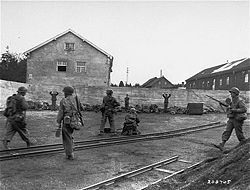
. During the camp's liberation, American soldiers from 45th Infantry Division of the U.S. Seventh Army allegedly wounded and killed German prisoners of war. The number of victims differs by account, some witnesses speculating that more than 100 German soldiers were killed; others report that 30–50 soldiers were killed during the camp's liberation, only a dozen of those being victims of alleged war crimes.
The incident occurred after the US division entered the Dachau concentration camp. Soldiers reported seeing hundreds of naked and barely clothed dead bodies piled floor to ceiling in rooms adjacent to what was assumed to be the gas chambers.
Before the soldiers entered the prison-camp 30 roofless boxcars (or freight-cars) full of dead bodies in advanced stages of decomposition had been found outside the camp. More bodies were found about the camp, some had been dead for hours and days before the camp's liberation and lay where they had died.
Surrender
According to Harold Marcuse, the camp commander SS-Hauptsturmführer Martin Weiss, together with the regular camp guards and the SS garrisons, had fled the camp before the arrival of US troops. SS-UntersturmführerUntersturmführer
Untersturmführer was a paramilitary rank of the German Schutzstaffel first created in July 1934. The rank can trace its origins to the older SA rank of Sturmführer which had existed since the founding of the SA in 1921...
Heinrich Wicker (killed after the surrender) was left in charge and had roughly 560 personnel at his disposal; these came from inmates of the SS disciplinary prison inside the Dachau concentration camp and from Hungarian SS troops.
On 29 April 1945, Dachau was surrendered to Gen. Linden of the 42nd Infantry Division of the U.S. Army by Untersturmführer Wicker. According to Linden, he proceeded to take control of the camp under some tumult; thereafter, he toured the camp with a group of reporters (including Marguerite Higgins
Marguerite Higgins
Marguerite Higgins Hall was an American reporter and war correspondent. Higgins covered World War II, the Korean War and the war in Vietnam, and in the process advanced the cause of equal access for female war correspondents.Higgins was born in Hong Kong while her father, Lawrence Higgins, was...
). A description of the surrender appears in Brig. Gen. Henning Linden's memorandum to Major Gen. Harry J. Collins
Harry J. Collins
Harry J. Collins , was an Army Major General.-Biography:He was born on December 7, 1895 in Chicago, Illinois....
, entitled "Report on Surrender of Dachau Concentration Camp":
Liberation communique
General Dwight D. EisenhowerDwight D. Eisenhower
Dwight David "Ike" Eisenhower was the 34th President of the United States, from 1953 until 1961. He was a five-star general in the United States Army...
issued a communique regarding the liberation of Dachau concentration: "Our forces liberated and mopped up the infamous concentration camp at Dachau. Approximately 32,000 prisoners were liberated; 300 SS camp guards were quickly neutralized."
Military historian Earl Ziemke describes the event:
Killings by the American soldiers
Sparks account
Lt. Col. Felix L. SparksFelix L. Sparks
Brigadier General Felix Sparks was an American military commander who led the 3rd Battalion of the 157th Infantry Regiment of the 45th Infantry Division of the United States Army, the first Allied force to enter Dachau concentration camp and liberate its prisoners...
, a battalion
Battalion
A battalion is a military unit of around 300–1,200 soldiers usually consisting of between two and seven companies and typically commanded by either a Lieutenant Colonel or a Colonel...
commander of the 157th Infantry Regiment, 45th Infantry Division, Seventh United States Army wrote about the incident. Sparks watched as about 50 German prisoners captured by the 157th Infantry Regiment were confined in an area that had been used for storing coal. The area was partially enclosed by an L-shaped masonry wall about 8 ft (2.4 m) high and next to a hospital. The German POWs were watched over by a machine gun
Machine gun
A machine gun is a fully automatic mounted or portable firearm, usually designed to fire rounds in quick succession from an ammunition belt or large-capacity magazine, typically at a rate of several hundred rounds per minute....
team from Company I. He left those men behind to head towards the center of the camp where there were SS guards who had not yet surrendered; he had only gone a short distance when he heard machine gunfire coming from the area he had just left. He ran back and kicked a 19-year-old soldier who was manning the machine gun
Machine gun
A machine gun is a fully automatic mounted or portable firearm, usually designed to fire rounds in quick succession from an ammunition belt or large-capacity magazine, typically at a rate of several hundred rounds per minute....
and who had killed about 12 of the prisoners and wounded several more. The gunner, who was crying hysterically, said that the prisoners had tried to escape. Sparks said that he doubted the story; Sparks placed an NCO
Non-commissioned officer
A non-commissioned officer , called a sub-officer in some countries, is a military officer who has not been given a commission...
on the gun before resuming his journey towards the center of the camp. Sparks further stated:
Buechner account
In the U.S. military "Investigation of Alleged Mistreatment of German Guards at Dachau" conducted by Lt. Col. Joseph Whitaker, the account given by Col. Howard Buechner (then a Colonel in the United States Army and medical officer with the 3rd Battalion of the 157th Infantry), to Whitaker on 5 May 1945 did not contradict the Sparks account. He said that around 16:00 he arrived in the yard where the German soldiers had been shot, and that he "saw 15 or 16 dead and wounded German soldiers lying along the wall." He noted that some of the wounded soldiers were still moving but he did not examine any of them. He further told Whitaker that he did not know the soldier guarding the yard or which company he was from.According to Buechner's 1986 book, Dachau: The Hour of the Avenger : An Eyewitness Account, U.S. forces killed 520 German soldiers, including 346 killed on the orders of 1st Lt. Jack Bushyhead, in an alleged mass execution in the coalyard several hours after the first hospital shooting. Buechner did not witness the alleged incident, however, and there was no mention of a second shooting in the official investigation report. David L. Israel disputed this account in his book The Day the Thunderbird Cried:
Other accounts
Abram Sachar reported, "Some of the Nazis were rounded up and summarily executed along with the guard dogs."According to Jürgen Zarusky (originally published in a 1997 article in Dachauer Hefte), 16 SS men were shot in the coalyard (one more killed by a camp inmate), 17 in Tower B, and perhaps a few more killed by US soldiers in the incident. Anywhere from a few to 25 or 50 more were killed by furious inmates. Zarusky's research makes use of the detailed interrogation records contained in Whitaker's official May 1945 investigation report, which became accessible in 1992, as well as a collection of documents compiled by General Henning Linden's son.
Killings by the inmates
After the hospital shooting was stopped, some of the U.S. soldiers allegedly gave a number of handgunHandgun
A handgun is a firearm designed to be held and operated by one hand. This characteristic differentiates handguns as a general class of firearms from long guns such as rifles and shotguns ....
s to the now-liberated inmates. It has been claimed by eyewitnesses that the freed inmates tortured and killed a number of captured German soldiers, both SS guards and regular troops. The same witnesses claim that many of the German soldiers killed by the inmates were beaten to death with shovels and other tools. A number of Kapo
Kapo (concentration camp)
A kapo was a prisoner who worked inside German Nazi concentration camps during World War II in any of certain lower administrative positions. The official Nazi word was Funktionshäftling, or "prisoner functionary", but the Nazis commonly referred to them as kapos.- Etymology :The origin of "kapo"...
prisoner-guards were also killed, torn apart by the inmates. An eye-witness at Dachau, was quoted in the book Inside the Vicious Heart, by Robert H. Abzug:
United States Army investigation
Lt. Col. Joseph Whitaker, the Seventh Army's Assistant Inspector General, was subsequently ordered to investigate after witnesses came forward testifying about the massacreMassacre
A massacre is an event with a heavy death toll.Massacre may also refer to:-Entertainment:*Massacre , a DC Comics villain*Massacre , a 1932 drama film starring Richard Barthelmess*Massacre, a 1956 Western starring Dane Clark...
. He issued a report on 8 June 1945, called the "Investigation of Alleged Mistreatment of German Guards at Dachau" and also known as "the I.G. Report". In 1991, an archived copy was found in the National Archives in Washington, D.C. and was made public.
Whitaker reported that close to the back entrance to the camp Lt. William P. Walsh commander of Company "I", 157th Infantry, shot four German soldiers in a box car who had surrendered to him. Pvt. Albert C. Pruitt then climbed into the box car and performed a coup de grâce
Coup de grâce
The expression coup de grâce means a death blow intended to end the suffering of a wounded creature. The phrase can refer to the killing of civilians or soldiers, friends or enemies, with or without the consent of the sufferer...
on the wounded men.
After he had entered the camp Walsh, along with Lt. Jack Bushyhead, the executive officer of Company "I" organized the segregation of POWs into those who were members of the Wehrmacht and those who were in the SS. The SS were marched into a separate enclosure and were shot by members of "I" Company with several different types of weapons. In Paragraph 16 Whitaker comments:
The investigation resulted in the U.S. Military considering courts-martial
Court-martial
A court-martial is a military court. A court-martial is empowered to determine the guilt of members of the armed forces subject to military law, and, if the defendant is found guilty, to decide upon punishment.Most militaries maintain a court-martial system to try cases in which a breach of...
against those involved, including the Battalion commander Lt. Col. Felix Sparks
Felix L. Sparks
Brigadier General Felix Sparks was an American military commander who led the 3rd Battalion of the 157th Infantry Regiment of the 45th Infantry Division of the United States Army, the first Allied force to enter Dachau concentration camp and liberate its prisoners...
, while Col. Howard Buechner was cited in the report for dereliction of duty for not giving the wounded SS men in the coal yard medical aid. However, General
General (United States)
In the United States Army, United States Air Force, and United States Marine Corps, general is a four-star general officer rank, with the pay grade of O-10. General ranks above lieutenant general and below General of the Army or General of the Air Force; the Marine Corps does not have an...
George S. Patton
George S. Patton
George Smith Patton, Jr. was a United States Army officer best known for his leadership while commanding corps and armies as a general during World War II. He was also well known for his eccentricity and controversial outspokenness.Patton was commissioned in the U.S. Army after his graduation from...
, the recently appointed military governor of Bavaria, chose to dismiss the charges. Therefore, the witnesses to the massacre were never cross-examined in court.
See also
- List of massacres in Germany
- Allied war crimes during World War II
- List of massacres
Further reading
- Goodell, Stephen, Kevin A Mahoney; Sybil Milton (1995). "1945: The Year of Liberation". Washington, D.C., U.S.A.: U.S. Holocaust Memorial Museum. ISBN 0-89604-700-8
- Marcuse, Harold (2001). "Legacies of Dachau : The Uses and Abuses of a Concentration Camp, 1933–2001". Cambridge University Press. ISBN 0-521-55204-4
- Zarusky, Jürgen, "'That is not the American Way of Fighting:' The Shooting of Captured SS-Men During the Liberation of Dachau," in: Wolfgang BenzWolfgang BenzWolfgang Benz is a German historian. He has been the director of the Center for Research on Antisemitism of the Technische Universität Berlin since 1990.-Personal life:...
, Barbara Distel (eds.): Dachau and the Nazi Terror 1933–1945, vol. 2, Studies and Reports (Dachau 2002), pp. 133–160. (German original in Dachauer Hefte vol. 13, 1997).