

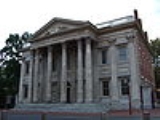
First Bank of the United States

Encyclopedia
The First Bank of the United States is a National Historic Landmark located in Philadelphia, Pennsylvania
within Independence National Historical Park
.
chartered by the United States Congress
on February 25, 1791. The charter was set for a 20-year expiration date. The Bank was created to handle the financial needs and requirements of the central government of the newly formed United States, which had previously been thirteen individual states with their own banks, currencies, financial institutions, and policies.
Officially proposed by Alexander Hamilton
, Secretary of the Treasury, to the first session of the First Congress in 1790, the concept for the Bank had both its support and origin in and among Northern merchants and more than a few New England
state governments. It was, however, eyed with great suspicion by the representatives of the Southern States, whose chief industry, agriculture, did not require centrally concentrated banks.
The bank's charter expired in 1811 under President
James Madison
. The bill to recharter failed in the House of Representatives by one vote, 65 to 64, on January 24, 1811. In 1816, however, Madison revived it in the form of the Second Bank of the United States
because of rising debts from the War of 1812 and ineffective state banks.
's plan were paid their face value of one dollar.
Supporters of the bank argued that if the nation were to grow and to prosper, it needed a universally accepted standard coinage and this would best be provided by a United States Mint
, aided and supported by a national bank and an excise tax.
, first Secretary of the Treasury. In addition to the national bank, the other two measures were establishment of a mint and imposition of a federal excise tax. Three goals of Hamilton's three measures were to:
According to the plan put before the first session of the First Congress, Hamilton proposed establishing the initial funding for the Bank of the United States through the sale of $10 million in stock of which the United States government would purchase the first $2 million in shares. Hamilton, foreseeing the objection that this could not be done since the U.S. government didn't have $2 million, proposed that the government make the stock purchase using money lent to it by the Bank; the loan to be paid back in ten equal annual installments. The remaining $8 million of stock would be available to the public, both in the United States and overseas. The chief requirement of these non-government purchases was that one-quarter of the purchase price had to be paid in gold or silver; the remaining balance could be paid in bonds, acceptable scrip, etc.
By continuously insisting on these conditions the Bank of the United States might technically possess $500,000 in "real" money that it could, and would, use as security to make loans up to its capitalized limit of $10 million. However, unlike the Bank of England
from where Hamilton drew much of his inspiration, the primary function of the Bank would be commercial and private interests. The business it would be involved in on behalf of the federal government—a depository for collected taxes, making short term loans to the government to cover real or potential temporary income gaps, serving as a holding site for both incoming and outgoing monies—was considered highly important but still secondary in nature.
There were other, nonnegotiable conditions for the establishment of the Bank of the United States. Among these were:
To ensure smooth compliance to both the current and future demands of its governmental accounts, the Bank required a source of additional funding, "for interest payments on the assumed state debts would begin to fall due at the end of 1791...those payments would require $788,333 annually, and... an additional $38,291 was needed to cover deficiencies in the funds that had been appropriated for existing commitments."
To achieve this, Hamilton repeated a suggestion he had made nearly a year before—increase the duty on imported spirits, plus raise the excise tax on domestically distilled whiskey and other liquors. This was the origin of the Whiskey Rebellion
.
nor Representative James Madison
had any particular interest in two of Hamilton's tripartite recommendations: the establishing of an official government Mint, and the chartering of the Bank of the United States. They believed this centralization of power away from private banks was dangerous to a sound monetary system and was mostly to the benefit of business interests in the commercial north, not southern agricultural interests. They furthermore argued that the creation of such a bank violated the Constitution, which did not list the creation of a Bank of the United States or of a government mint among the expressed powers allowed to the federal government.
The first part of the bill, the concept and establishment of a national mint, met with no real objection, and sailed through; it was assumed the second and third part (the Bank and an excise tax to finance it) would likewise glide through, and in their own way they did: The House version of the bill, despite some heated objections, easily passed. The Senate version of the bill did likewise, with considerably fewer, and milder, objections. It was when "the two bills changed houses, complications set in. In the Senate, Hamilton's supporters objected to the House's alteration of the plans for the excise tax."
A myth has arisen about the bank bill. To get it through the Congress, Hamilton supposedly struck a deal with several of its members to support their efforts to move the capital from Philadelphia to the banks of the Potomac. This confuses the bank bill with the Compromise of 1790
, which had to do with the assumption of state debts by the United States government.
The establishment of the bank also raised early questions of constitutionality in the new government. Hamilton, then Secretary of the Treasury, argued that the Bank was an effective means to utilize the authorized powers of the government implied under the law of the Constitution. Secretary of State Thomas Jefferson
argued that the Bank violated traditional property laws and that its relevance to constitutionally authorized powers was weak. Another argument came from James Madison, who believed Congress had not received the power to incorporate a bank; or any other governmental agency. His argument rested on his belief that if the Constitution's writers had wanted Congress to have such power they would have made it explicit in the Constitution. The decision ultimately fell to President George Washington
.
Knowing he was setting a precedent by everything he was doing in his capacity as President of the United States, George Washington
was hesitant about signing the "bank bill" into law. Washington asked for a written opinion from all his cabinet members—most particularly from Hamilton. Attorney General Edmund Randolph from Virginia felt that the bill was unconstitutional. Jefferson, also from Virginia, agreed that Hamilton's proposal was against both the spirit and letter of the Constitution. In addition,
Hamilton, who, unlike his fellow cabinet members, hailed from New York, quickly set about laying to rest the arguments of those who claimed incorporation of the bank unconstitutional. While Hamilton's rebuttals were many and varied, chief among them were these two:
Jefferson, Madison, and the rest, Hamilton pointed out, had looked upon the creation of the Bank of the United States (and the excise tax that went with it) as an end rather than a means to an end.
Still Washington hesitated, wondering if it might not be more prudent to merely wait, to do nothing, and allow the bill to become law without his signature. Ultimately, whether because of or in spite of the bill's opponents, on April 25, 1791, Washington signed the "bank bill" into law.
informed Congress that due to the existing state of government finances more money was needed. This could be achieved either by selling the government's shares of stock in the Bank, or raising taxes. Wolcott advised the first choice. Congress quickly agreed. Hamilton objected, believing that the dividends on that stock had been inviolably pledged for the support of the sinking fund to retire the debt. Hamilton tried to organize opposition to the measure, but was unsuccessful.
The bank's charter expired in 1811. It followed the Bank of North America
and it was succeeded by the Second Bank of the United States
.
After the charter for the First Bank of the United States expired in 1811, Stephen Girard
purchased most of its stock as well as the building and its furnishings on South Third Street in Philadelphia and opened his own bank, later known as Girard Bank
. Over its early history the bank was known as “Girard’s Bank,” or as “Girard Bank” or also as “Stephen Girard’s Bank” or even the “Bank of Stephen Girard.” Girard was the sole proprietor of his bank, and thus avoided the Pennsylvania state law which prohibited an unincorporated association of persons from establishing a bank, and required a charter from the legislature for a banking corporation.
Girard hired George Simpson, the cashier of the First Bank, as cashier of the new bank, and with seven other employees, opened for business on May 18, 1812. He allowed the Trustees of the First Bank of the United States to use some offices and space in the vaults to continue the process of winding down the affairs of the closed bank at a very nominal rent.
while the city served as the temporary national capital, 1790–1800. In the eighteenth century, Philadelphia was one of the largest cities in the English-speaking world. The bank began operations in Carpenters' Hall
in 1791, some 200 feet from its permanent home.
Design of the bank building is credited to Samuel Blogdett, Superintendent of Buildings for the new capital in Washington, DC., although it has also been attributed to James Hoban
. It was completed in 1797.
The First Bank of the United States was listed as a National Historic Landmark
on May 4, 1987. Until about 2000, it housed offices for Independence National Historical Park. A proposal to have it house the collection of the Philadelphia Civil War Museum was abandoned when State funding was not forthcoming. Future plans are for it to house the National Park Service archaeology lab, currently across the street from it in the old Visitor Center.
Philadelphia, Pennsylvania
Philadelphia is the largest city in the Commonwealth of Pennsylvania and the county seat of Philadelphia County, with which it is coterminous. The city is located in the Northeastern United States along the Delaware and Schuylkill rivers. It is the fifth-most-populous city in the United States,...
within Independence National Historical Park
Independence National Historical Park
Independence National Historical Park is a United States National Historical Park in Philadelphia that preserves several sites associated with the American Revolution and the nation's founding history. Administered by the National Park Service, the park comprises much of the downtown historic...
.
Banking History
The First Bank was a bankBank
A bank is a financial institution that serves as a financial intermediary. The term "bank" may refer to one of several related types of entities:...
chartered by the United States Congress
United States Congress
The United States Congress is the bicameral legislature of the federal government of the United States, consisting of the Senate and the House of Representatives. The Congress meets in the United States Capitol in Washington, D.C....
on February 25, 1791. The charter was set for a 20-year expiration date. The Bank was created to handle the financial needs and requirements of the central government of the newly formed United States, which had previously been thirteen individual states with their own banks, currencies, financial institutions, and policies.
Officially proposed by Alexander Hamilton
Alexander Hamilton
Alexander Hamilton was a Founding Father, soldier, economist, political philosopher, one of America's first constitutional lawyers and the first United States Secretary of the Treasury...
, Secretary of the Treasury, to the first session of the First Congress in 1790, the concept for the Bank had both its support and origin in and among Northern merchants and more than a few New England
New England
New England is a region in the northeastern corner of the United States consisting of the six states of Maine, New Hampshire, Vermont, Massachusetts, Rhode Island, and Connecticut...
state governments. It was, however, eyed with great suspicion by the representatives of the Southern States, whose chief industry, agriculture, did not require centrally concentrated banks.
The bank's charter expired in 1811 under President
President of the United States
The President of the United States of America is the head of state and head of government of the United States. The president leads the executive branch of the federal government and is the commander-in-chief of the United States Armed Forces....
James Madison
James Madison
James Madison, Jr. was an American statesman and political theorist. He was the fourth President of the United States and is hailed as the “Father of the Constitution” for being the primary author of the United States Constitution and at first an opponent of, and then a key author of the United...
. The bill to recharter failed in the House of Representatives by one vote, 65 to 64, on January 24, 1811. In 1816, however, Madison revived it in the form of the Second Bank of the United States
Second Bank of the United States
The Second Bank of the United States was chartered in 1816, five years after the First Bank of the United States lost its own charter. The Second Bank of the United States was initially headquartered in Carpenters' Hall, Philadelphia, the same as the First Bank, and had branches throughout the...
because of rising debts from the War of 1812 and ineffective state banks.
A paradise for speculators
In the last decade of the eighteenth century the United States had just three banks but more than fifty different currencies in circulation: English, Spanish, French, Portuguese coinage, scrip issued by states, cities, backwood stores, and big city enterprises. The values of these currencies were wildly unstable, thereby making it a paradise for politically indifferent currency speculators thriving on uncertainty. In addition, the value and exchange rate was almost always outdated or unknown by the party agreeing to receive it, especially the farther it moved away from the coast; and because of distances, primitive roads, and absence of communications technology, values were not only unknown but unknowable as well. Speculators in the United States bought up bonds for about 15 cents and through HamiltonAlexander Hamilton
Alexander Hamilton was a Founding Father, soldier, economist, political philosopher, one of America's first constitutional lawyers and the first United States Secretary of the Treasury...
's plan were paid their face value of one dollar.
Supporters of the bank argued that if the nation were to grow and to prosper, it needed a universally accepted standard coinage and this would best be provided by a United States Mint
United States Mint
The United States Mint primarily produces circulating coinage for the United States to conduct its trade and commerce. The Mint was created by Congress with the Coinage Act of 1792, and placed within the Department of State...
, aided and supported by a national bank and an excise tax.
One of three
In 1791, The first Bank of the United States was brought into being as one of three major financial innovations proposed and supported by Alexander HamiltonAlexander Hamilton
Alexander Hamilton was a Founding Father, soldier, economist, political philosopher, one of America's first constitutional lawyers and the first United States Secretary of the Treasury...
, first Secretary of the Treasury. In addition to the national bank, the other two measures were establishment of a mint and imposition of a federal excise tax. Three goals of Hamilton's three measures were to:
- Establish financial order, clarity and precedence in and of the newly formed United States.
- Establish credit—both in country and overseas—for the new nation.
- To resolve the issue of the fiat currency, issued by the Continental Congress immediately prior to and during the United States Revolutionary War—the "Continental".
According to the plan put before the first session of the First Congress, Hamilton proposed establishing the initial funding for the Bank of the United States through the sale of $10 million in stock of which the United States government would purchase the first $2 million in shares. Hamilton, foreseeing the objection that this could not be done since the U.S. government didn't have $2 million, proposed that the government make the stock purchase using money lent to it by the Bank; the loan to be paid back in ten equal annual installments. The remaining $8 million of stock would be available to the public, both in the United States and overseas. The chief requirement of these non-government purchases was that one-quarter of the purchase price had to be paid in gold or silver; the remaining balance could be paid in bonds, acceptable scrip, etc.
By continuously insisting on these conditions the Bank of the United States might technically possess $500,000 in "real" money that it could, and would, use as security to make loans up to its capitalized limit of $10 million. However, unlike the Bank of England
Bank of England
The Bank of England is the central bank of the United Kingdom and the model on which most modern central banks have been based. Established in 1694, it is the second oldest central bank in the world...
from where Hamilton drew much of his inspiration, the primary function of the Bank would be commercial and private interests. The business it would be involved in on behalf of the federal government—a depository for collected taxes, making short term loans to the government to cover real or potential temporary income gaps, serving as a holding site for both incoming and outgoing monies—was considered highly important but still secondary in nature.
There were other, nonnegotiable conditions for the establishment of the Bank of the United States. Among these were:
- That the Bank was to be a private company.
- That the Bank would have a twenty year charter running from 1791 to 1811, after which time it would be up to the Congress to renew or deny renewal of the bank and its charter; however, during that time no other federal bank would be authorized; states, for their part, would be free to charter however many intrastate banks they wished.
- That the Bank, to avoid any appearance of impropriety, would:
-
- be forbidden to buy government bonds.
- have a mandatory rotation of directors.
- neither issue notes nor incur debts beyond its actual capitalization.
- That foreigners, whether overseas or residing in the United States, would be allowed to be Bank of the United States stockholders, but would not be allowed to vote.
- That the Secretary of the Treasury would be free to remove government deposits, inspect the books, and require statements regarding the bank's condition as frequently as once a week.
To ensure smooth compliance to both the current and future demands of its governmental accounts, the Bank required a source of additional funding, "for interest payments on the assumed state debts would begin to fall due at the end of 1791...those payments would require $788,333 annually, and... an additional $38,291 was needed to cover deficiencies in the funds that had been appropriated for existing commitments."
To achieve this, Hamilton repeated a suggestion he had made nearly a year before—increase the duty on imported spirits, plus raise the excise tax on domestically distilled whiskey and other liquors. This was the origin of the Whiskey Rebellion
Whiskey Rebellion
The Whiskey Rebellion, or Whiskey Insurrection, was a tax protest in the United States in the 1790s, during the presidency of George Washington. Farmers who sold their corn in the form of whiskey had to pay a new tax which they strongly resented...
.
Opposition
Like most of the Southern members of Congress (indeed like most members of Congress in general), neither Secretary of State Thomas JeffersonThomas Jefferson
Thomas Jefferson was the principal author of the United States Declaration of Independence and the Statute of Virginia for Religious Freedom , the third President of the United States and founder of the University of Virginia...
nor Representative James Madison
James Madison
James Madison, Jr. was an American statesman and political theorist. He was the fourth President of the United States and is hailed as the “Father of the Constitution” for being the primary author of the United States Constitution and at first an opponent of, and then a key author of the United...
had any particular interest in two of Hamilton's tripartite recommendations: the establishing of an official government Mint, and the chartering of the Bank of the United States. They believed this centralization of power away from private banks was dangerous to a sound monetary system and was mostly to the benefit of business interests in the commercial north, not southern agricultural interests. They furthermore argued that the creation of such a bank violated the Constitution, which did not list the creation of a Bank of the United States or of a government mint among the expressed powers allowed to the federal government.
The first part of the bill, the concept and establishment of a national mint, met with no real objection, and sailed through; it was assumed the second and third part (the Bank and an excise tax to finance it) would likewise glide through, and in their own way they did: The House version of the bill, despite some heated objections, easily passed. The Senate version of the bill did likewise, with considerably fewer, and milder, objections. It was when "the two bills changed houses, complications set in. In the Senate, Hamilton's supporters objected to the House's alteration of the plans for the excise tax."
A myth has arisen about the bank bill. To get it through the Congress, Hamilton supposedly struck a deal with several of its members to support their efforts to move the capital from Philadelphia to the banks of the Potomac. This confuses the bank bill with the Compromise of 1790
Compromise of 1790
The Compromise of 1790 was the first of three great political compromises made in the United States by the Northern and Southern states, occurring every thirty years, in an attempt to keep the Union together and prevent civil war...
, which had to do with the assumption of state debts by the United States government.
The establishment of the bank also raised early questions of constitutionality in the new government. Hamilton, then Secretary of the Treasury, argued that the Bank was an effective means to utilize the authorized powers of the government implied under the law of the Constitution. Secretary of State Thomas Jefferson
Thomas Jefferson
Thomas Jefferson was the principal author of the United States Declaration of Independence and the Statute of Virginia for Religious Freedom , the third President of the United States and founder of the University of Virginia...
argued that the Bank violated traditional property laws and that its relevance to constitutionally authorized powers was weak. Another argument came from James Madison, who believed Congress had not received the power to incorporate a bank; or any other governmental agency. His argument rested on his belief that if the Constitution's writers had wanted Congress to have such power they would have made it explicit in the Constitution. The decision ultimately fell to President George Washington
George Washington
George Washington was the dominant military and political leader of the new United States of America from 1775 to 1799. He led the American victory over Great Britain in the American Revolutionary War as commander-in-chief of the Continental Army from 1775 to 1783, and presided over the writing of...
.
Knowing he was setting a precedent by everything he was doing in his capacity as President of the United States, George Washington
George Washington
George Washington was the dominant military and political leader of the new United States of America from 1775 to 1799. He led the American victory over Great Britain in the American Revolutionary War as commander-in-chief of the Continental Army from 1775 to 1783, and presided over the writing of...
was hesitant about signing the "bank bill" into law. Washington asked for a written opinion from all his cabinet members—most particularly from Hamilton. Attorney General Edmund Randolph from Virginia felt that the bill was unconstitutional. Jefferson, also from Virginia, agreed that Hamilton's proposal was against both the spirit and letter of the Constitution. In addition,
"...in a masterpiece of legal obfuscation, well calculated to confuse the president, he [Jefferson] asserted the bank bill violated the laws of mortmain, alienage, forfeiture and escheat, distribution and monopoly. Washington, overwhelmed by the arguments...send Hamilton copies of Randolf's and Jefferson's opinion...inviting Hamilton in effect to defend the bank if he could..."
Hamilton, who, unlike his fellow cabinet members, hailed from New York, quickly set about laying to rest the arguments of those who claimed incorporation of the bank unconstitutional. While Hamilton's rebuttals were many and varied, chief among them were these two:
- What the government could do for a person (incorporate), it could not refuse to do for an "artificial person", a business. And the Bank of the United States, being privately owned and not a government agency, was a business. "Thus...unquestionably incident to sovereign power to erect corporations to that of the United States, in relation to the objects entrusted to the management of the government."
- Any government by its very nature was sovereign "and includes by force of the term a right to attainment of the ends...which are not precluded by restrictions & exceptions specified in the constitution...
Jefferson, Madison, and the rest, Hamilton pointed out, had looked upon the creation of the Bank of the United States (and the excise tax that went with it) as an end rather than a means to an end.
Still Washington hesitated, wondering if it might not be more prudent to merely wait, to do nothing, and allow the bill to become law without his signature. Ultimately, whether because of or in spite of the bill's opponents, on April 25, 1791, Washington signed the "bank bill" into law.
Postscript
After Hamilton left office in 1795, the new Secretary of the Treasury Oliver Wolcott, Jr.Oliver Wolcott, Jr.
Oliver Wolcott, Jr. was United States Secretary of the Treasury from 1795 to 1800 and the 24th Governor of Connecticut from 1817 to 1827.-Youth and education:...
informed Congress that due to the existing state of government finances more money was needed. This could be achieved either by selling the government's shares of stock in the Bank, or raising taxes. Wolcott advised the first choice. Congress quickly agreed. Hamilton objected, believing that the dividends on that stock had been inviolably pledged for the support of the sinking fund to retire the debt. Hamilton tried to organize opposition to the measure, but was unsuccessful.
The bank's charter expired in 1811. It followed the Bank of North America
Bank of North America
The Bank of North America was a private business chartered on December 31, 1781 by the Congress of the Confederation and opened on January 7, 1782, at the prodding of Superintendent of Finance Robert Morris. This was thus the nation's first de facto central bank. It was succeeded in its role as...
and it was succeeded by the Second Bank of the United States
Second Bank of the United States
The Second Bank of the United States was chartered in 1816, five years after the First Bank of the United States lost its own charter. The Second Bank of the United States was initially headquartered in Carpenters' Hall, Philadelphia, the same as the First Bank, and had branches throughout the...
.
After the charter for the First Bank of the United States expired in 1811, Stephen Girard
Stephen Girard
Stephen Girard was a French-born, naturalized American, philanthropist and banker. He personally saved the U.S. government from financial collapse during the War of 1812, and became one of the wealthiest men in America, estimated to have been the fourth richest American of all time, based on the...
purchased most of its stock as well as the building and its furnishings on South Third Street in Philadelphia and opened his own bank, later known as Girard Bank
Girard Bank
Girard Bank was a Philadelphia based bank, founded by Stephen Girard in 1811. The bank was acquired by Mellon Bank in 1983 and then two decades later by Citizens Bank....
. Over its early history the bank was known as “Girard’s Bank,” or as “Girard Bank” or also as “Stephen Girard’s Bank” or even the “Bank of Stephen Girard.” Girard was the sole proprietor of his bank, and thus avoided the Pennsylvania state law which prohibited an unincorporated association of persons from establishing a bank, and required a charter from the legislature for a banking corporation.
Girard hired George Simpson, the cashier of the First Bank, as cashier of the new bank, and with seven other employees, opened for business on May 18, 1812. He allowed the Trustees of the First Bank of the United States to use some offices and space in the vaults to continue the process of winding down the affairs of the closed bank at a very nominal rent.
Bank building
The Bank of the United States was established in Philadelphia, PennsylvaniaPennsylvania
The Commonwealth of Pennsylvania is a U.S. state that is located in the Northeastern and Mid-Atlantic regions of the United States. The state borders Delaware and Maryland to the south, West Virginia to the southwest, Ohio to the west, New York and Ontario, Canada, to the north, and New Jersey to...
while the city served as the temporary national capital, 1790–1800. In the eighteenth century, Philadelphia was one of the largest cities in the English-speaking world. The bank began operations in Carpenters' Hall
Carpenters' Hall
Carpenters' Hall is a two-story brick building in the Old City neighborhood of Philadelphia, Pennsylvania, that was a key meeting place in the early history of the United States. Completed in 1773 and set back from Chestnut Street, the meeting hall was built for and is still owned by the...
in 1791, some 200 feet from its permanent home.
Design of the bank building is credited to Samuel Blogdett, Superintendent of Buildings for the new capital in Washington, DC., although it has also been attributed to James Hoban
James Hoban
James Hoban was an Irish architect, best known for designing The White House in Washington, D.C.-Life:James Hoban was born and raised in a thatched cottage on the Earl of Desart's estate in Cuffesgrange, near Callan in Co. Kilkenny...
. It was completed in 1797.
The First Bank of the United States was listed as a National Historic Landmark
National Historic Landmark
A National Historic Landmark is a building, site, structure, object, or district, that is officially recognized by the United States government for its historical significance...
on May 4, 1987. Until about 2000, it housed offices for Independence National Historical Park. A proposal to have it house the collection of the Philadelphia Civil War Museum was abandoned when State funding was not forthcoming. Future plans are for it to house the National Park Service archaeology lab, currently across the street from it in the old Visitor Center.
See also
- History of central banking in the United StatesHistory of central banking in the United StatesThis article is about the history of central banking in the United States, from the 1790s to the present.-Bank of North America:Some Founding Fathers were strongly opposed to the formation of a central banking system; the fact that England tried to place the colonies under the monetary control of...
- Second Bank of the United StatesSecond Bank of the United StatesThe Second Bank of the United States was chartered in 1816, five years after the First Bank of the United States lost its own charter. The Second Bank of the United States was initially headquartered in Carpenters' Hall, Philadelphia, the same as the First Bank, and had branches throughout the...
- Thomas WillingThomas WillingThomas Willing was an American merchant and financier and a Delegate to the Continental Congress from Pennsylvania....
, first President of the Bank, 1793–1807
External links
- First and Second Banks of the United States – a digital collection of the original documents related to the formation of the First (1791–1811) and Second (1816–1836) Banks of the United States, digitized by the Federal Reserve Bank of St. Louis.
- HABS photos of the First Bank
- Hamilton's opinion
- Jefferson's opinion
- Record of the Debate