
All Topics  
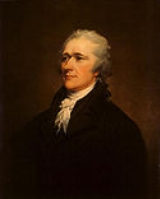
Alexander Hamilton

 
Alexander Hamilton

   Email Print
   Bookmark   Link


Alexander Hamilton


Alexander Hamilton (January 11, 1755 or 1757 – July 12, 1804) was the first Secretary of the Treasury, a Founding Father
Founding Fathers of the United States

The Founding Fathers of the United States were the political leaders who signed the United States Declaration of Independence or otherwise participated in the American Revolution as leaders of the Patriot s, or who participated in drafting the United States Constitution eleven years later....
, economist
Economist

An economist is an expert in the social science of economics. The individual may also study, develop, and apply theories and concepts from economics and write about economic policy....
, and political philosopher. He led calls for the Philadelphia Convention
Philadelphia Convention

The Philadelphia Convention took place from May 25 to September 17, 1787, in Philadelphia, Pennsylvania, to address problems in governing the United States of America, which had been operating under the Articles of Confederation following independence from Kingdom of Great Britain....
, was one of America's first Constitutional law
Constitutional law

Constitutional law is the study of foundational or basic laws of nation states and other political organizations.Constitutions are the framework for government and may limit or define the authority and procedure of political bodies to execute new laws and regulations....
yers, and cowrote the Federalist Papers
Federalist Papers

The Federalist Papers are a series of List of Federalist Papers advocating the History of the United States Constitution#Ratification of the United States United States Constitution....
, a primary source for Constitutional interpretation.

Born on the British West Indian island of Nevis
Nevis

Nevis is an island in the Caribbean, located near the northern end of the Lesser Antilles archipelago, about 220 miles southeast of Puerto Rico and 50 miles west of Antigua....
, Hamilton was educated in the Thirteen Colonies
Thirteen Colonies

The Thirteen Colonies were part of what became known as British America, a name that was used by Great Britain until the Treaty of Paris recognized the independence of the original thirteen United States of America in 1783....
. During the American Revolutionary War
American Revolutionary War

The American Revolutionary War , also known as the American War of Independence, began as a war between the Kingdom of Great Britain and Thirteen Colonies on the North America, and ended in a global war between several European great powers....
, he joined the New York
New York

The State of New York is a U.S. state in the Mid-Atlantic States and Northeastern United States regions of the United States and is the nation's List of U.S....
 militia
Militia

The term militia is commonly used today to refer to a military force composed of ordinary citizens to provide defense, emergency law enforcement, or paramilitary service, in times of emergency without being paid a regular salary or committed to a fixed term of service....
 and was chosen artillery captain.


Discussion
Ask a question about 'Alexander Hamilton'
Start a new discussion about 'Alexander Hamilton'
Answer questions from other users
Full Discussion Forum


Recent Posts


Quotations


A national debt, if it is not excessive, will be to us a national blessing.

Letter to Robert Morris (1781-04-30)

I have thought it my duty to exhibit things as they are, not as they ought to be.

Letter (1802-04-16)

Men are rather reasoning than reasonable animals, for the most part governed by the impulse of passion.

ibid.

The passions of a revolution are apt to hurry even good men into excesses.

Essay (1795-08-12)

For my own part, I sincerely esteem it a system which without the finger of God, never could have been suggested and agreed upon by such a diversity of interests.

Statement after the Constitutional Convention (1787)

Here, sir, the people govern; here they act by their immediate representatives.

Remarks on the U.S. House of Representatives, at the New York state convention on the adoption of the Federal Constitution, Poughkeepsie, New York (1788-07-27)


Encyclopedia


Alexander Hamilton (January 11, 1755 or 1757 – July 12, 1804) was the first Secretary of the Treasury, a Founding Father
Founding Fathers of the United States

The Founding Fathers of the United States were the political leaders who signed the United States Declaration of Independence or otherwise participated in the American Revolution as leaders of the Patriot s, or who participated in drafting the United States Constitution eleven years later....
, economist
Economist

An economist is an expert in the social science of economics. The individual may also study, develop, and apply theories and concepts from economics and write about economic policy....
, and political philosopher. He led calls for the Philadelphia Convention
Philadelphia Convention

The Philadelphia Convention took place from May 25 to September 17, 1787, in Philadelphia, Pennsylvania, to address problems in governing the United States of America, which had been operating under the Articles of Confederation following independence from Kingdom of Great Britain....
, was one of America's first Constitutional law
Constitutional law

Constitutional law is the study of foundational or basic laws of nation states and other political organizations.Constitutions are the framework for government and may limit or define the authority and procedure of political bodies to execute new laws and regulations....
yers, and cowrote the Federalist Papers
Federalist Papers

The Federalist Papers are a series of List of Federalist Papers advocating the History of the United States Constitution#Ratification of the United States United States Constitution....
, a primary source for Constitutional interpretation.

Born on the British West Indian island of Nevis
Nevis

Nevis is an island in the Caribbean, located near the northern end of the Lesser Antilles archipelago, about 220 miles southeast of Puerto Rico and 50 miles west of Antigua....
, Hamilton was educated in the Thirteen Colonies
Thirteen Colonies

The Thirteen Colonies were part of what became known as British America, a name that was used by Great Britain until the Treaty of Paris recognized the independence of the original thirteen United States of America in 1783....
. During the American Revolutionary War
American Revolutionary War

The American Revolutionary War , also known as the American War of Independence, began as a war between the Kingdom of Great Britain and Thirteen Colonies on the North America, and ended in a global war between several European great powers....
, he joined the New York
New York

The State of New York is a U.S. state in the Mid-Atlantic States and Northeastern United States regions of the United States and is the nation's List of U.S....
 militia
Militia

The term militia is commonly used today to refer to a military force composed of ordinary citizens to provide defense, emergency law enforcement, or paramilitary service, in times of emergency without being paid a regular salary or committed to a fixed term of service....
 and was chosen artillery captain. Hamilton became senior aide-de-camp
Aide-de-camp

An aide-de-camp is a personal assistant, secretary, or adjutant to a person of high rank, usually a senior military officer or a head of state....
 and confidant to General George Washington
George Washington

George Washington was the leader of the Continental Army in the American Revolutionary War and served as the List of Presidents of the United States President of the United States of the United States of Americas ....
, and led three battalions at the Siege of Yorktown
Siege of Yorktown

The Siege of Yorktown or Battle of Yorktown in 1781 was a decisive victory by combined assault of American Continental Army led by General George Washington and France in the American Revolutionary War led by General Jean-Baptiste Donatien de Vimeur, comte de Rochambeau over a British Army commanded by General Charles Cornwallis, 1st Ma...
. He was elected to the Continental Congress
Continental Congress

The Continental Congress was a convention of delegates from the Thirteen Colonies that became the governing body of the United States during the American Revolution....
, but resigned to practice law and to found the Bank of New York
Bank of New York

The Bank of New York, abbreviated BoNY or BNY, was a global financial services company that existed until its merger with the Mellon Financial Corporation on July 2, 2007....
. He served in the New York Legislature
New York Legislature

The New York Legislature is the State legislature of the U.S. state of New York. It is a bicameral legislature, consisting of the lower house New York State Assembly and the upper house New York Senate....
, and was the only New Yorker who signed the Constitution. As Washington's Treasury Secretary, he influenced formative government policy widely. An admirer of British political systems, Hamilton emphasized strong central government and implied powers
Implied powers

"Implied powers" powers are powers not given to the government directly through the constitution, but are implied. These powers fall under the Elastic Clause in section one of the Constitution....
, under which the new U.S. Congress funded the national debt, assumed state debts, created a national bank
First Bank of the United States

The First Bank of the United States was a bank chartered by the United States Congress on February 25, 1791. The charter was for 20 years. The Bank was created to handle the financial needs and requirements of the central government of the newly formed United States, which had previously been thirteen individual colonies with their own ban...
, and established an import tariff
Tariff in American history

Tariffs in American history have played different roles in U.S. trade policy and the economic history of the United States. Tariffs were the largest source of federal revenue from the 1790s to the eve of World War I, until it was surpassed by income taxes....
 and whiskey tax.

By 1792, a Hamilton coalition and a Jefferson
Thomas Jefferson

Thomas Jefferson was the List of Presidents of the United States President of the United States , the principal author of the United States Declaration of Independence , and one of the most influential Founding Fathers of the United States for his promotion of the ideals of republicanism in the United States....
Madison
James Madison

James Madison was an American politician and political philosopher who served as the List of Presidents of the United States President of the United States , and one of the Founding Fathers of the United States....
 coalition had arisen (the formative Federalist
Federalist Party (United States)

The Federalist Party was an American political party in the period 1792 to 1816, with remnants lasting into the 1820s. The Federalists controlled the federal government until 1801....
 and Democratic-Republican Parties), which differed strongly over Hamilton's domestic fiscal goals and his foreign policy of extensive trade and friendly relations with Britain. Exposed in an affair with Maria Reynolds
Maria Reynolds

Maria Reynolds is best known as the mistress of Alexander Hamilton and wife of James Reynolds , and she played a central role in one of the first sex scandals in United States of America political history....
, Hamilton resigned from the Treasury in 1795 to return to Constitutional law and advocacy of strong federalism
Federalism

Federalism is a political philosophy in which a group of members are bound together with a governing representative head. The term federalism is also used to describe a system of the government in which sovereignty is constitutionally divided between a central governing authority and constituent political units ....
. In 1798, the Quasi-War
Quasi-War

The Quasi-War was an undeclared war fought entirely at sea between the United States and France from 1798 to 1800. In the United States, the conflict is sometimes also referred to as the Undeclared War with France, The Pirate Wars, or the Half-War....
 with France led Hamilton to argue for, organize, and become de facto commander of a national army.

Hamilton's opposition to fellow Federalist John Adams
John Adams

John Adams was an Politics of the United States and the List of Presidents of the United States President of the United States , after being the List of Vice Presidents of the United States Vice President of the United States for two terms....
 contributed to the success of Democratic-Republicans Thomas Jefferson
Thomas Jefferson

Thomas Jefferson was the List of Presidents of the United States President of the United States , the principal author of the United States Declaration of Independence , and one of the most influential Founding Fathers of the United States for his promotion of the ideals of republicanism in the United States....
 and Aaron Burr
Aaron Burr

Aaron Burr, Jr. was an United States politician, American Revolutionary War hero, and adventurer. He served as the List of Vice Presidents of the United States Vice President of the United States , under Thomas Jefferson....
 in the uniquely deadlocked election of 1800. With his party's defeat, Hamilton's nationalist and industrializing ideas lost their former national prominence. In 1801, Hamilton founded the New York Post
New York Post

The New York Post is the 13th-oldest newspaper published in the United States and generally acknowledged as the oldest to have been published continually as a daily, although -- like most other papers -- its publication has been interrupted by labor actions....
 as the Federalist broadsheet
Broadsheet

Broadsheet is the largest of the various newspaper formats and is characterized by long vertical pages . The term derives from types of popular prints usually just of a single sheet, sold on the streets and containing various types of matter, from ballads to political satire....
 New-York Evening Post. His intense rivalry with Vice President Burr eventually resulted in a duel, in which Hamilton was mortally wounded, dying the following day.

Early years

By his own account, Hamilton was born in Charlestown, the capital of Nevis
Nevis

Nevis is an island in the Caribbean, located near the northern end of the Lesser Antilles archipelago, about 220 miles southeast of Puerto Rico and 50 miles west of Antigua....
 in the British West Indies
British West Indies

The term British West Indies refers to territories in and around the Caribbean which have been or were at one time colony by the United Kingdom....
, out of wedlock to Rachel Faucett Lavien, of part French Huguenot
Huguenot

The Huguenots were members of the Protestantism Reformed Church of France of France from the sixteenth to the eighteenth centuries....
 descent, and James A. Hamilton, fourth son of Scottish
Scotland

conventional_long_name = ScotlandAlba|common_name= Scotland|image_flag = Flag of Scotland.svg|flag_width = 130px...
 laird
Laird

A Laird is a member of the Gentry and a hereditary title in Scotland. The title of Laird may carry certain local or feudal rights, though unlike a Lord of Parliament, a Lairdship has never carried voting rights, either in the historic Parliament of Scotland or, after unification with the Kingdom of England, in the Great Britain House of Lord...
 Alexander Hamilton of Grange, Ayrshire
Ayrshire

Ayrshire is a registration county, and former counties of Scotland in south-west Scotland, located on the shores of the Firth of Clyde. Its principal towns include Ayr, Kilmarnock and Irvine, North Ayrshire....
. He was born on January 11 in either 1755 or in 1757; most historians now say 1755, although disagreement remains. A young Hamilton claimed 1757 as his birth year when he first arrived in the Thirteen Colonies
Thirteen Colonies

The Thirteen Colonies were part of what became known as British America, a name that was used by Great Britain until the Treaty of Paris recognized the independence of the original thirteen United States of America in 1783....
; but he is also recorded in probate papers, shortly after his mother's death, as being 13 years old, indicating 1755. Explanations for this discrepancy include that he may have been trying to appear younger than his college classmates or to avoid standing out as older, that the probate document may have misreported, or that he may have been passing as 13 to be more employable after his mother's death. He was often approximate about his age in his later life.

Hamilton's mother had been separated previously from Johann Michael Lavien of St. Croix; to escape an unhappy marriage, Rachel left her husband and first son for St. Kitts in 1750, where she met James. They moved together to Rachel's birthplace of Nevis, where she had inherited property from her father. Their two sons were James, Jr., and Alexander. Because Hamilton's parents were not legally married, the Church of England
Church of England

The Church of England is the State religion Christianity Ecclesia in England, the Mother Church of the worldwide Anglican Communion and the oldest among the communion's thirty-eight independent national and regional churches....
 denied him membership or education in the church school. Instead, he received "individual tutoring" and classes in a private Jewish school. Hamilton supplemented his education with a family library of thirty-four books, including Greek and Roman classics.
Young Alexander Hamilton
A 1765 business assignment led Hamilton's father to move the family to Christiansted, St. Croix; he then abandoned Rachel and the two sons. Rachel supported the family by keeping a small store in Christiansted. She contracted a severe fever and died on February 19, 1768, leaving Hamilton effectively orphaned. This may have had severe emotional consequences for him, even by the standards of an eighteenth-century childhood. In probate court, Hamilton's half-brother obtained the few valuables Rachel had owned, including some household silver. Many items were auctioned off, but a friend purchased the family books and returned them to the studious young Hamilton. (Years later Hamilton received his half-brother's death notice and a small amount of money.)

Hamilton then became a clerk at a local import-export firm, Beekman and Cruger, which traded with New England; he was left in charge of the firm for five months in 1771, while the owner was at sea. He and his older brother James were adopted briefly by a cousin, Peter Lytton, but when Lytton committed suicide, Hamilton was split from his brother. James apprenticed with a local carpenter, while Hamilton was adopted by Nevis merchant Thomas Stevens. Some evidence suggests Stevens may have been Hamilton's biological father: his son, Edward Stevens, became a close friend of Hamilton; the two boys looked much alike, were both fluent in French, and shared similar interests.

Hamilton continued clerking, remained an avid reader, developed an interest in writing, and began to long for a life off his small island. A letter of Hamilton's was first published in the Royal Danish-American Gazette, describing a hurricane that had devastated Christiansted on August 30, 1772. The impressed community began a collection for a subscription fund to educate the young Hamilton on the mainland of North America.

Education

Hamilton arrived, by way of Boston, at a grammar school
Grammar school

A grammar school is one of several different types of school in the history of education in the United Kingdom and other English-speaking countries....
 in Elizabethtown, New Jersey, in the autumn of 1772. In 1773, he studied with Francis Barber at Elizabethtown, in preparation for college work; there he came under the influence of a leading intellectual and revolutionary, William Livingston
William Livingston

William Livingston served as the Governor of New Jersey during the American Revolutionary War and was a signer of the United States Constitution....
. Hamilton may have applied to the College of New Jersey (now Princeton University
Princeton University

Princeton University is a private university university located in Princeton, New Jersey, New Jersey, United States. The school is one of the eight universities of the Ivy League and has the largest per-student Financial endowment in the world....
) but may have been refused admission because he insisted on studying as fast as he could; he decided to attend King's College in New York City
New York City

The City of New York is the List of United States cities by population in the United States, while the New York metropolitan area ranks among the List of urban areas by population....
 (now Columbia University
Columbia University

Columbia University in the City of New York , is a private university in the United States and a member of the Ivy League. Columbia's main campus lies in the Morningside Heights, Manhattan neighborhood in the borough of Manhattan, in New York City....
). While studying there, Hamilton and several classmates were members of a campus literary group that foreran Columbia's Philolexian Society
Philolexian Society

The Philolexian Society of Columbia University is one of the oldest collegiate literary societies in the United States, and the oldest student group at Columbia....
.

When Church of England clergyman Samuel Seabury
Samuel Seabury

Samuel Seabury , was the first United States Episcopal Church in the United States of America bishop, the second Presiding Bishop of the Episcopal Church in the United States of America, and the first Bishop of Episcopal Diocese of Connecticut....
 published a series of pamphlets promoting the Tory
Tory

In the political tradition of some List of countries where English is an official language, the term Tory may refer to a variety of Political party and creeds since it was originally used in the late 17th century to describe opponents to the Whig Party ....
 cause the following year, Hamilton struck back with his first political writings, A Full Vindication of the measures of Congress and The Farmer Refuted. He published two additional pieces attacking the Quebec Act
Quebec Act

The Quebec Act of 1774 was an Act of Parliament of the Parliament of Great Britain setting procedures of governance in the Province of Quebec ....
 as well as fourteen anonymous installments of "The Monitor" for Holt's New York Journal. Although Hamilton was a supporter of the Revolutionary cause at this prewar stage, he did not approve of mob reprisals against loyalists. One generally accepted account details how Hamilton saved his college president, Tory sympathizer Myles Cooper
Myles Cooper

Myles Cooper was a figure in colonial New York. An Anglican priest, he served as the President of King's College from 1763 to 1775, and was a public opponent of the American Revolution....
, from an angry mob, by speaking to the crowd long enough for Cooper to escape the danger.

During the Revolutionary War


Early military career

In 1775, after the first engagement of American troops with the British
Kingdom of Great Britain

The Kingdom of Great Britain, also known as the United Kingdom of Great Britain, was a country in North-West Europe, in existence from 1707 to 1801....
 in Boston
Siege of Boston

}|-||}The Siege of Boston was the opening phase of the American Revolutionary War, in which New England militiamen?who later became part of the Continental Army?surrounded the town of Boston, Massachusetts, to prevent movement by the British Army garrisoned within....
, Hamilton joined a New York volunteer militia
Militia

The term militia is commonly used today to refer to a military force composed of ordinary citizens to provide defense, emergency law enforcement, or paramilitary service, in times of emergency without being paid a regular salary or committed to a fixed term of service....
 company called the Hearts of Oak
Hearts of Oak (New York militia)

The Hearts of Oak were a volunteer militia in the Kingdom of Great Britain colonial Province of New York as part of the Thirteen Colonies. Formed c....
, which included other King's College students. He drilled with the company
Company (military unit)

A company is a military unit, typically consisting of 75-200 soldiers. Most companies are formed of three to five platoons although the exact number may vary by country, unit type, and structure....
 before classes, in the graveyard of nearby St. Paul's Chapel
St. Paul's Chapel

St. Paul's Chapel, at 209 Broadway , is an Episcopal Church in the United States of America chapel located on Church Street between Fulton and Vesey Streets, opposite the east side of the World Trade Center site in lower Manhattan in New York City....
. Hamilton studied military history
Military history

Military history is a humanities List of academic disciplines within the scope of History recording of War in the Human history, and its impact on the societies, their cultures, economies and changing Politics and international relationships....
 and tactics
Military tactics

Military tactics are the techniques for using weapons or military units in combination for engaging and defeating an Enemy in battle. Changes in philosophy and technology over time have been reflected in changes to military tactics....
 on his own, and achieved the rank of lieutenant
Lieutenant

Lieutenant is a military, naval, paramilitary, fire service, emergency medical services or police commissioned officer military rank.Lieutenant may also appear as part of a title used in various other organisations with a codified command structure....
. Under fire from HMS Asia
HMS Asia (1764)

HMS Asia was a 64-gun third rate ship of the line of the Royal Navy, launched on 3 March 1764 at Portsmouth Dockyard. She was the only ship built to her draught, designed by Sir Thomas Slade....
, he led a successful raid
Raid (military)

A raid is a military tactics or operational warfare mission which requires the execution of a plan where Principles of War is the principal desired outcome of the attack....
 for British cannon in the Battery, the capture of which resulted in the Hearts of Oak becoming an artillery
Artillery

Artillery is a military Combat Arms which employs any apparatus, machine, an assortment of tools or instruments, a system or systems used as weapons for the discharge of large projectiles in combat as a major contribution of fire power within the overall military capability of an armed force....
 company thereafter. Through his connections with influential New York
Province of New York

The Province of New York resulted from the capture of the Dutch Republic colony of Provincie New Netherland by the Kingdom of England, and included all of the present U.S....
 patriots like Alexander McDougall
Alexander McDougall

Alexander McDougall was an American seaman, merchant, a Sons of Liberty leader from New York City before and during the American Revolution, and a military leader during the American Revolutionary War....
 and John Jay
John Jay

John Jay was an United States politician, statesman, Patriot , diplomat, a Founding Fathers of the United States, President of the Continental Congress from 1778 to 1779 and, from 1789 to 1795, the first Chief Justice of the United States....
, he raised the New York Provincial Company of Artillery
New York Provincial Company of Artillery

During the American Revolutionary War, the New York Provincial Company of Artillery was created by the New York Provincial Congress in 1776 to defend New York City from Kingdom of Great Britain attack....
 of sixty men in 1776, and was elected captain. It took part in the campaign of 1776 around New York City, particularly at the Battle of White Plains
Battle of White Plains

}|-||}The Battle of White Plains was a battle in the New York and New Jersey campaign of the American Revolutionary War fought on October 28, 1776, in the area surrounding White Plains, New York, New York....
; at the Battle of Trenton
Battle of Trenton

}|-||}The Battle of Trenton took place on December 26, 1776, during the American Revolutionary War after General George Washington's Washington's crossing of the Delaware River north of Trenton, New Jersey....
, it was stationed at the high point of town, the meeting of the present Warren and Broad Streets, to keep the Hessians pinned in the Trenton Barracks.

Washington's staff

Hamilton was invited to become an aide to Nathanael Greene
Nathanael Greene

Nathanael Greene was a major general of the Continental Army in the American Revolutionary War. When the war began, Greene was a militia private , the lowest rank possible; he emerged from the war with a reputation as George Washington's most gifted and dependable officer....
 and other generals; however, he declined these invitations in the hopes of obtaining a place on Washington's staff. Hamilton did receive such an invitation, and joined as Washington's aide in late 1776 with the rank of Lieutenant Colonel
Lieutenant Colonel (United States)

In the United States Army, United States Air Force, and United States Marine Corps, lieutenant colonel is a field officer United States Military Officer military rank just above the rank of Major and just below the rank of Colonel ....
. Hamilton served for four years, in effect, as Washington's Chief of Staff; he handled the "letters to Congress, state governors, and the most powerful generals in the Continental Army"; he drafted many of Washington's orders and letters at the latter's direction, and was eventually allowed to "issue orders from Washington over his own signature". Hamilton was involved in a wide variety of high-level duties, including intelligence
Military intelligence

Military intelligence , is a military service that uses List of intelligence gathering disciplines which informs the commanders' decision making process by providing intelligence analysis of Intelligence from a wide range of sources including forecast environmental changes , and opposing force intentions....
, diplomacy
Diplomacy

Diplomacy is the art and practice of conducting negotiations between representatives of groups or states. It usually refers to international diplomacy, the conduct of international relations through the intercession of professional diplomats with regard to issues of peace-making, trade, war, economics and culture....
, and negotiation with general officers as Washington's emissary
Emissary

Emissary may refer to:* Ambassador* Diplomat*...
. The important duties with which he was entrusted attest to Washington's deep confidence in his abilities and character, then and afterward. At the points in their relationship where there was little personal attachment, there was still always a reciprocal confidence and respect.

During the war Hamilton became close friends with several fellow officers. His letters to the Marquis de Lafayette and to John Laurens
John Laurens

John Laurens was an United States soldier and statesman from South Carolina during the American Revolutionary War....
, employing the sentimental
Sentimental novel

The sentimental novel or the novel of sensibility is an 18th century in literature which celebrates the emotional and intellectual concepts of sentiment, Sentimentalism , and sensibility....
 literary conventions of the late eighteenth century and alluding to Greek history and mythology, have also been read as revealing a homosocial or perhaps homosexual relationship.

Marriage

In spring 1779, Hamilton asked his friend John Laurens to find him a wife in South Carolina:

"She must be young—handsome (I lay most stress upon a good shape) Sensible (a little learning will do) —well bred... chaste and tender (I am an enthusiast in my notions of fidelity and fondness); of some good nature—a great deal of generosity (she must neither love money nor scolding, for I dislike equally a termagant and an economist)—In politics, I am indifferent what side she may be of—I think I have arguments that will safely convert her to mine—As to religion a moderate stock will satisfy me—She must believe in God and hate a saint. But as to fortune, the larger stock of that the better."


Hamilton found his own bride on December 14, 1780 when he married Elizabeth Schuyler
Elizabeth Schuyler Hamilton

Elizabeth Hamilton , was the wife of Alexander Hamilton, the founder of the Federalist party and first Secretary of the Treasury of the United States of America....
, daughter of General Philip Schuyler
Philip Schuyler

Philip John Schuyler was a general in the American Revolutionary War and a United States Senate from New York. He is usually known as Philip Schuyler, while his son is usually known as Philip Jeremiah Schuyler....
, and thus joined one of the richest and most political families in the state of New York. The marriage took place at Schuyler Mansion
Schuyler Mansion

Schuyler Mansion is a historic house at 32 Catherine Street in Albany, New York, United States. The brick mansion is now a museum and an official National Historic Landmark....
 in Albany, New York
Albany, New York

Albany is the Capital of the state of New York and the county seat of Albany County, New York. Albany is roughly 136 miles north of the city of New York City, and slightly south of the confluence of the Mohawk River and Hudson Rivers....
.

Hamilton grew extremely close to Eliza's sister, Angelica Church, who was married to John Barker Church, a Member of Parliament
Member of Parliament

A Member of Parliament, or MP, is a representative of the voters to a parliament. In many countries the term applies specifically to members of the lower house, as upper houses often have a unique title, such as senate, and thus also have unique titles for its members, such as senators....
 in Great Britain; some historians argue that the two may have had an affair, although, due to extensive editing of much Hamilton–Church correspondence by Hamilton's later descendants, it is impossible to know for sure.

Command and the Battle of Yorktown

While on Washington's staff, Hamilton had long been seeking a command position in an active combat situation. As the war drew ever nearer to a close, he knew that opportunities for military glory were slipping away. In February 1781, Hamilton was mildly reprimanded by Washington, and used this as an excuse for resigning his staff position. Immediately following his resignation from Washington's staff, Hamilton began to ask Washington and others incessantly for a field command. This continued until early July of 1781, when Hamilton submitted a letter to Washington with his commission
Officer (armed forces)

An officer is a member of an Armed forces who holds a position of authority.Commissioned officers derive authority directly from a sovereignty power and, as such, hold a Letters patent charging them with the duties and responsibilities of a specific office or position....
 enclosed, "thus tacitly threatening to resign if he didn't get his desired command".

On July 31, 1781, Washington relented, and Hamilton was given command of a New York light infantry
Light infantry

Traditionally light infantry were soldiers whose job was to provide a skirmishing screen ahead of the main body of infantry, Harassment and delaying the enemy advance....
 battalion. In the planning for the assault on Yorktown
Siege of Yorktown

The Siege of Yorktown or Battle of Yorktown in 1781 was a decisive victory by combined assault of American Continental Army led by General George Washington and France in the American Revolutionary War led by General Jean-Baptiste Donatien de Vimeur, comte de Rochambeau over a British Army commanded by General Charles Cornwallis, 1st Ma...
, Hamilton was given command of three battalion
Battalion

A battalion is a military unit of around 500-1500 men usually consisting of between two and seven company and typically commanded by a Lieutenant Colonel....
s which were to fight in conjunction with French troops in taking Redoubt
Redoubt

A redoubt is a fort or fort system usually consisting of an enclosed defensive emplacement outside a larger fort, usually relying on Earthworks s, though others are constructed of stone or brick....
s #9 and #10 of the British fortifications at Yorktown. Hamilton and his battalions fought bravely and took Redoubt #10 with bayonets, as planned. The French also fought bravely, took heavy casualties, and successfully took Redoubt #9. This action forced the British surrender at Yorktown of an entire army, effectively ending the British effort to reclaim the Thirteen Colonies.

Under the Confederation


Hamilton enters Congress

While on Washington's staff, Hamilton became frustrated with the decentralized nature of the wartime Continental Congress, particularly its dependence upon the states for financial support: it had no power to collect taxes, or to demand money from the states; this had caused serious problems in Army supplies and pay. Congress had given up printing unsupported paper money back in September 1779; it obtained what money it had from subsidies from the King of France, aid requested from the several states (which were often unable or unwilling to contribute), and loans from Europe against these uncertain revenues. After Yorktown, Hamilton resigned his commission. He was elected to the Congress of the Confederation
Congress of the Confederation

The Congress of the Confederation or the United States in Congress Assembled was the governing body of the United States of America from March 1, 1781, to March 4, 1789....
 as a New York representative beginning in November 1782; he supported such Congressmen as superintendent of finance Robert Morris, his assistant Gouverneur Morris
Gouverneur Morris

Gouverneur Morris was an United States statesman who represented Pennsylvania in the Philadelphia Convention and was an author of large sections of the Constitution of the United States....
 (no relation), James Wilson
James Wilson

James Wilson , was a Scotland lawyer, most notable as a signer of the United States Declaration of Independence. He was twice elected to the Continental Congress, a major force in the drafting of the United States Constitution, a leading legal theoretician and one of the six original justices appointed by George Washington to the Supreme Cour...
, and James Madison
James Madison

James Madison was an American politician and political philosopher who served as the List of Presidents of the United States President of the United States , and one of the Founding Fathers of the United States....
, who had already been trying to provide the Congress with an independent source of revenue it lacked under the Articles of Confederation
Articles of Confederation

The Articles of Confederation and Perpetual Union was the constitution of the revolutionary wartime alliance of the thirteen United States. The Articles' ratification was completed in 1781, and legally federated several sovereign and independent states, allied under the Articles of Association into a new federation styled the "United States...
.

An amendment to the Articles had been proposed by Thomas Burke
Thomas Burke

Thomas Burke or Tom Burke is a name shared by the following individuals:...
, in February 1781, to give Congress the power to collect a 5% impost or duty on all imports, but this required ratification by all states; securing its passage as law proved impossible after it was rejected by Rhode Island in November 1782. Madison joined Hamilton in convincing Congress to send a delegation to persuade Rhode Island to change its mind. Their report recommending the delegation also argued that the federal government needed not just some level of financial autonomy, but also the ability to make laws that supersede those of the individual states. Hamilton transmitted a letter arguing that Congress already had the power to tax, since it had the power to fix the sums due from the several states; but Virginia's rescission
Rescission

In contract law, rescission has been defined as the unmaking of a contract between the parties. Rescission is the unwinding of a transaction....
 of its own ratification ended Rhode Island negotiations.

Congress and the Army

While Hamilton was in Congress, discontented soldiers began to pose a danger to the young United States. Most of the army was then posted at Newburgh, New York. The army was paying for much of their own supplies, and they had not been paid in eight months. Furthermore, the Continental officers had been promised, in May 1778, after Valley Forge
Valley Forge

Valley Forge, Pennsylvania, was the site of the camp of the American Continental Army over the winter of 1777–1778 in the American Revolutionary War....
, a pension of half their pay when they were discharged. It was at this time that a group of officers organized under the leadership of General Henry Knox
Henry Knox

Henry Knox was an United States bookseller from Boston, Massachusetts who became the chief artillery officer of the Continental Army and later the nation's first United States Secretary of War....
 sent a delegation to lobby Congress, led by Capt. Alexander MacDougall (see above). The officers had three demands: the Army's pay, their own pensions, and commutation of those pensions into a lump-sum payment.

Several Congressmen, including Hamilton and the Morrises, attempted to use this Newburgh conspiracy
Newburgh conspiracy

The Newburgh Conspiracy was a plot hatched in 1783 near the end of the American Revolutionary War resulting from the fact that many of the officers and men of the Continental Army had not received pay for many years....
 as leverage to secure independent support for funding for the federal government in Congress and from the states. They encouraged MacDougall to continue his aggressive approach, threatening unknown consequences if their demands were not granted, and defeated proposals which would have resolved the crisis without establishing general federal taxation: that the states assume the debt to the army, or that an impost
Impost

Impost may mean:*A type of extra Tax#Tariffs*A Handicapping used in horse racing*The topmost part of an architectural column*A tax levied on imports....
 be established dedicated to the sole purpose of paying that debt. Hamilton suggested using the Army's claims to prevail upon the states for the proposed national funding system. The Morrises and Hamilton contacted Knox to suggest he and the officers defy civil authority, at least by not disbanding if the army were not satisfied; Hamilton wrote Washington to suggest that he covertly "take direction" of the officers' efforts to secure redress, to secure continental funding but keep the army within the limits of moderation. Washington wrote Hamilton back, declining to introduce the army; after the crisis was over, he warned of the dangers of using the army as leverage to gain support for the national funding plan.

On March 15, Washington defused the Newburgh situation by giving a speech to the officers. Congress ordered the Army officially disbanded in April 1783. In the same month, Congress passed a new measure for a twenty-five-year impost, which Hamilton voted against, and which again required the consent of all the states; it also approved a commutation of the officers' pensions to five years of full pay. Rhode Island again opposed these provisions, and Hamilton's robust assertions of national prerogatives in his previous letter offended many. The Continental Congress was never able to secure full ratification for back pay, pensions, or their own independent sources of funding.

In June 1783, a different group of disgruntled soldiers from Lancaster, Pennsylvania sent Congress a petition demanding their back pay. When they began to march toward Philadelphia, Congress charged Hamilton and two others to intercept the mob. Hamilton requested militia from Pennsylvania's Supreme Executive Council, but was turned down. Hamilton instructed Assistant Secretary of War William Jackson to intercept the men. Jackson was unsuccessful. The mob arrived in Philadelphia, and proceeded to harangue Congress for their pay. The President of Congress, John Dickinson, feared the Pennsylvania state militia was unreliable, and refused their help. Hamilton argued that Congress ought to adjourn to Princeton, New Jersey. Congress agreed, and relocated there.

Frustrated with the weakness of the central government, Hamilton drafted a call to revise the Articles of Confederation while in Princeton. This resolution contained many features of the future U.S. Constitution, including a strong federal government with the ability to collect taxes and raise an army. It also included the separation of powers into the Executive, Legislative and Judicial branches.

Return to New York

Hamilton resigned from Congress, and in July 1783 was admitted to the New York Bar after several months of self-directed education. He soon began a law practice in New York City. He specialized in defending Tories and British subjects, as in Rutgers v. Waddington, in which he defeated a claim for damages done to a brewery by the Englishmen who held it during the military occupation of New York. He pleaded that the Mayor's Court should interpret state law to be consistent with the 1783 Treaty of Paris
Treaty of Paris (1783)

The Treaty of Paris, signed on September 3, 1783, ratified by the Congress of the Confederation on January 14, 1784 and by the King of Great Britain on April 9, 1784 , formally ended the American Revolutionary War between the Kingdom of Great Britain and United States, which had rebelled against British rule starting in 1775....
, which had ended the Revolutionary War.

In 1784, he founded the Bank of New York
Bank of New York

The Bank of New York, abbreviated BoNY or BNY, was a global financial services company that existed until its merger with the Mellon Financial Corporation on July 2, 2007....
, now the oldest ongoing banking organization in the United States. Hamilton was one of the men who restored King's College, which had been suspended since the Battle of Long Island
Battle of Long Island

}|-||-||}The Battle of Long Island, also known as the Battle of Brooklyn or the Battle of Brooklyn Heights, fought on August 27, 1776, was the first major battle in the American Revolutionary War following the United States Declaration of Independence, the largest battle of the entire conflict, and the first battle in which...
 in 1776 and severely damaged during the War, as Columbia College
Columbia College of Columbia University

Columbia College is the oldest undergraduate college at Columbia University, situated on the university's main campus of Morningside Heights in the Borough of Manhattan in the New York City....
. His public career resumed when he attended the Annapolis Convention
Annapolis Convention (1786)

The Annapolis Convention was a meeting at Annapolis, Maryland of 12 delegates from five U.S. states that called for a constitutional convention ....
 as a delegate in 1786. While there, he drafted its resolution for a Constitutional convention, and in doing so brought his longtime desire to have a more powerful, more financially independent federal government one step closer to reality.

Constitution and Federalist Papers

Hamilton Alexander Loc
In 1787, Hamilton served as assemblyman from New York County in the New York State Legislature and was the first delegate chosen to the Constitutional Convention. In spite of the fact that Hamilton had been a leader in calling for a new Constitutional Convention, his direct influence at the Convention itself was quite limited. Governor George Clinton
George Clinton (vice president)

George Clinton was an United States soldier and politician. He was the first Governor of New York, and then the Vice President of the United States under Thomas Jefferson and James Madison....
's faction in the New York legislature had chosen New York's other two delegates, John Lansing
John Lansing, Jr.

John Ten Eyck Lansing, Jr. , was an United States lawyer and politician. He was the uncle of Gerrit Y. Lansing.From 1776 until 1777 during the Revolutionary War Lansing served as a military secretary to General Philip Schuyler....
 and Robert Yates
Robert Yates

Robert Yates may refer to:* Robert Yates , NASCAR team owner** Robert Yates Racing, the team he owns* Robert Yates , Anti-Federalist American politician...
, and both of them opposed Hamilton's goal of a strong national government. Thus, while the other two members of the New York delegation were present, they decided New York's vote; and when they left the convention in protest, Hamilton remained with no vote (two representatives were required for any state to cast a vote).

Early in the Convention he made a speech proposing what many considered a very monarchical government for the United States. Though regarded as one of his most eloquent speeches, it had little effect upon the deliberations of the convention. He proposed to have an elected President and elected Senators
Senators

The term Senators can refer to:*The members of a senate*The Singing Senators, a group of U.S. Republican Senators who sang as a barbershop quartet...
 who would serve for life contingent upon "good behavior", and subject to removal for corruption or abuse; Hamilton's plan attempted to incorporate the "liberties of a republic" while "guarding against both anarchy and tyranny", yet his plan was probably the least trusting in the wisdom of the people. The deliberations of the convention were intended to be secret, so as to promote a free and vigorous flow of ideas during the Convention. However, some notes were kept, and due to Hamilton's argument for lifelong terms, and his proposal of measures that some contemporaries saw as too similar to previous monarchist forms of government, Hamilton acquired the reputation in some circles of a monarchist sympathizer.

During the convention, Hamilton constructed a draft for the Constitution on the basis of the convention debates, but he never actually presented it. This draft had most of the features of the actual Constitution, including such details as the three-fifths clause. In this draft, the Senate was to be elected in proportion to population, being two-fifths the size of the House, and the President and Senators were to be elected through complex multistage elections, in which chosen elector
Elector

An elector can be anyone who has a Voting in an election.* The prince-electors of the Holy Roman Empire were the highest college in the Imperial diet....
s would elect smaller bodies of electors; they would hold office for life, but were removable for misconduct. The President would have an absolute veto
Veto

A veto, Latin for "I forbid", is used to denote that a certain party has the right to stop unilaterally a piece of legislation. In practice, the veto can be absolute or limited ...
. The Supreme Court
Supreme Court of the United States

The Supreme Court of the United States is the highest judicial body in the United States, and leads the federal United States federal courts. It consists of the Chief Justice of the United States and eight Associate Justice of the Supreme Court of the United States, who are nominated by the President of the United States and confirmed with th...
 was to have immediate jurisdiction over all law suits involving the United States, and State governors were to be appointed by the federal government.

At the end of the Convention, Hamilton was still not content with the final form of the Constitution, but signed off on it anyway as a vast improvement over the Articles of Confederation, and urged his fellow delegates to do so also. Since the other two members of the New York delegation, Lansing and Yates, had already withdrawn, Hamilton was the only New York signatory to the United States Constitution. He then took a highly active part in the successful campaign for the document's ratification in New York in 1788, which was a crucial step in its national ratification. Hamilton recruited John Jay and James Madison to write a defense of the proposed Constitution, now known as the Federalist Papers
Federalist Papers

The Federalist Papers are a series of List of Federalist Papers advocating the History of the United States Constitution#Ratification of the United States United States Constitution....
, and made the largest contribution to that effort, writing 51 of 85 essays published (Madison wrote 29, Jay only five). Hamilton's essays and arguments were influential in New York state, and elsewhere, during the debates over ratification. The Federalist Papers are more often cited than any other primary source by jurists, lawyers, historians and political scientists as the major contemporary interpretation of the Constitution.

In 1788, Hamilton served yet another term in what proved to be the last time the Continental Congress
Continental Congress

The Continental Congress was a convention of delegates from the Thirteen Colonies that became the governing body of the United States during the American Revolution....
 met under the Articles of Confederation
Articles of Confederation

The Articles of Confederation and Perpetual Union was the constitution of the revolutionary wartime alliance of the thirteen United States. The Articles' ratification was completed in 1781, and legally federated several sovereign and independent states, allied under the Articles of Association into a new federation styled the "United States...
. He remained involved in the politics of New York: the ratification of the Constitution had been a success for two of the family cliques which constituted New York State politics, against a third, that led by George Clinton
George Clinton (vice president)

George Clinton was an United States soldier and politician. He was the first Governor of New York, and then the Vice President of the United States under Thomas Jefferson and James Madison....
; the Legislature of 1789 had a majority of those two factions, one led by Hamilton's father-in-law, the other by the Livingston family. They had agreed to each select one of New York's first Senators: Phillip Schuyler was to be one, and James Duane
James Duane

James Duane was a lawyer, jurist, and American Revolutionary War leader from New York. He served as a delegate to the Continental Congress, a United States District Court, New York state senator, and as Mayor of New York City....
, whose wife was a Livingston, was to be the other. Hamilton, however, persuaded the Legislature to elect Schuyler and his friend Rufus King
Rufus King

Rufus King was an United States lawyer, politician, and diplomat. He was a delegate from Massachusetts to the Continental Congress and the Constitutional Convention....
, instead. The Livingstons responded by breaking the alliance and supporting the Clintons instead; this new coalition was to be the basis for the Democratic-Republican Party in New York. When Phillip Schuyler's term ended in 1791, they began by electing, in his place, the attorney-general of New York, one Aaron Burr
Aaron Burr

Aaron Burr, Jr. was an United States politician, American Revolutionary War hero, and adventurer. He served as the List of Vice Presidents of the United States Vice President of the United States , under Thomas Jefferson....
. Hamilton blamed Burr for this result, and ill characterizations of Burr appear in his correspondence thereafter, although they did work together from time to time on various projects, including Hamilton's army of 1798 and the Manhattan Water Company.

Secretary of the Treasury

President George Washington appointed Hamilton as the first Secretary of the Treasury on September 11, 1789. He left office on the last day of January 1795; much of the structure of the Government of the United States was worked out in those five years, beginning with the structure and function of the Cabinet itself. Forrest McDonald
Forrest McDonald

Forrest McDonald , is an United States historian who has written extensively on the early national period, on republicanism, and on the President of the United States....
 argues that Hamilton saw his office, like the British Chancellor of the Exchequer
Chancellor of the Exchequer

The Chancellor of the Exchequer is the title held by the British Cabinet of the United Kingdom Minister who is responsible for all economic and financial matters....
, as that of a Prime Minister; Hamilton would oversee his colleagues under the elective reign of George Washington. Washington did request Hamilton's advice and assistance on matters outside the purview of the Treasury Department.

Within one year, Hamilton submitted five reports:
  • First Report on the Public Credit
    First Report on the Public Credit

    The First Report on Public Credit was the first of three major reports on economic policy issued by Founding Fathers of the United States and first United States Secretary of the Treasury Alexander Hamilton on the request of United States Congress....
    : Communicated to the House of Representatives, January 14, 1790.
  • Operations of the Act Laying Duties on Imports: Communicated to the House of Representatives, April 23, 1790.
  • Second Report on Public Credit
    Second Report on Public Credit

    The Second Report on Public Credit was the second report of three major reports on economic policy issued by Founding Father of the United States and first United States Treasury Secretary Alexander Hamilton on the request of Congress for consideration on establishing a national banking system with the creation of the Bank of the United State...
    : Report on a National Bank. Communicated to the House of Representatives, December 14, 1790.
  • Report on the Establishment of a Mint: Communicated to the House of Representatives, January 28, 1791.
  • Report on Manufactures
    Report on Manufactures

    The Report on Manufactures is the third report, and magnum opus, of Founding Fathers of the United States and 1st U.S. Treasury Secretary Alexander Hamilton....
    : Communicated to the House of Representatives, December 5, 1791.


Report on Public Credit

In the Report on Public Credit, the Secretary made a controversial proposal that would have the federal government assume state debts incurred during the Revolution. This would, in effect, give the federal government much more power by placing the country's most serious financial obligation in the hands of the federal, rather than the state governments.

The primary criticism of the plan was spearheaded by Secretary of State
United States Secretary of State

The United States Secretary of State is the head of the United States Department of State, concerned with foreign affairs. The Secretary is a member of the President's United States Cabinet and the highest-ranking cabinet secretary both in United States presidential line of succession and United States order of precedence....
 Thomas Jefferson and Representative
United States House of Representatives

The United States House of Representatives, commonly referred to as "the House", is one of the bicameralism of the United States Congress; the other is the United States Senate....
 James Madison
James Madison

James Madison was an American politician and political philosopher who served as the List of Presidents of the United States President of the United States , and one of the Founding Fathers of the United States....
. Some states, like Jefferson's Virginia, had paid almost half of their debts, and felt that their taxpayers should not be assessed again to bail out the less provident. They further argued that the plan passed beyond the scope of the new Constitutional government.

Madison objected to Hamilton's proposal to cut the rate of interest and postpone payments on federal debt, as not being payment in full; he also objected to the speculative profits being made. Much of the national debt had been bonds issued to Continental veterans, in place of wages which the Continental Congress did not have the money to pay; as these continued to go unpaid, many of these bonds had been pawned for a small fraction of their value. Madison proposed to pay in full, but to divide payment between the original recipient and the present possessor. Others, like Samuel Livermore
Samuel Livermore

Samuel Livermore was a United States of America politician. He was a U.S. Senator from New Hampshire from 1793 to 1801 and served as President pro tempore of the United States Senate of the United States Senate in 1796 and again in 1799....
 of New Hampshire, wished to curb speculation, and save taxation, by paying only part of the bond. The disagreements between Madison and Hamilton extended to other proposals Hamilton made to Congress, and drew in Jefferson when he returned from France. Hamilton's supporters became known as Federalists and Jefferson's as Republicans. As Madison put it:
"I deserted Colonel Hamilton, or rather Colonel H. deserted me; in a word, the divergence between us took place from his wishing to administration, or rather to administer the Government into what he thought it ought to be..."


Hamilton eventually secured passage of his assumption plan by striking a deal with Jefferson and Madison. According to the terms, Hamilton was to use his influence to place the permanent national capital on the Potomac River
Potomac River

The Potomac River flows into the Chesapeake Bay, located along the mid-Atlantic Ocean coast of the United States. The river is approximately 383 statute miles long, with a Drainage basin of about 14,700 square miles ....
, and Jefferson and Madison were to encourage their friends to back Hamilton's assumption plan. In the end, Hamilton's assumption, together with his proposals for funding the debt, overcame legislative opposition and narrowly passed the House on July 26, 1790.

Founding the U.S. Mint

Hamilton helped found the United States Mint
United States Mint

The United States Mint primarily produces circulating currency for the United States to conduct its trade and commerce. The main Mint facility is located in Philadelphia, Pennsylvania, and branch mint are located in Denver, Colorado; San Francisco, California; and West Point, New York....
; the first national bank
First Bank of the United States

The First Bank of the United States was a bank chartered by the United States Congress on February 25, 1791. The charter was for 20 years. The Bank was created to handle the financial needs and requirements of the central government of the newly formed United States, which had previously been thirteen individual colonies with their own ban...
; a "System of Cutters", forming the Revenue Cutter Service, (now the United States Coast Guard
United States Coast Guard

The United States Coast Guard is a branch of the Military of the United States and one of seven Uniformed services of the United States. In addition to being a military branch at all times, it is unique among the armed forces in that it is also a Admiralty law agency and a Federal government of the United States regulatory agency....
) and an elaborate system of duties, tariffs, and excises. The complete Hamiltonian program replaced the chaotic financial system of the confederation era, in five years, with a modern apparatus which gave the new government financial stability, and gave investors sufficient confidence to invest in government bonds.

Sources of revenue

One of the principal sources of revenue Hamilton prevailed upon Congress to approve was an excise tax on whiskey. Strong opposition to the whiskey tax by cottage producers in remote, rural regions erupted into the Whiskey Rebellion
Whiskey Rebellion

The Whiskey Rebellion, less commonly known as the Whiskey Insurrection, was a popular uprising that had its beginnings in 1791 and culminated in an insurrection in 1794 in the locality of Washington, Pennsylvania, in the Monongahela River....
 in 1794; in Western Pennsylvania
Western Pennsylvania

Western Pennsylvania consists of the western third of the state of Pennsylvania in the United States. Pittsburgh, Pennsylvania is the largest city in the region, with a metropolitan area population of about 2.4 million people, and serves as its economic and cultural center....
 and western Virginia
Virginia

The Commonwealth of Virginia is an United States U.S. state on the East Coast of the United States of the Southern United States. The state is known as the "Old Dominion" and sometimes as "Mother of Presidents", because it is the birthplace of Lists of United States Presidents by place of birth#By state....
, whiskey was commonly made (and used as a form of currency) by most of the community. In response to the rebellion, believing compliance with the laws was vital to the establishment of federal authority, he accompanied to the rebellion's site President Washington, General Henry "Light Horse Harry" Lee, and more federal troops than were ever assembled in one place during the War for Independence. This overwhelming display of force intimidated the leaders of the insurrection, ending the rebellion virtually without bloodshed.

Manufacturing and industry

Dscn2897 Hamilton Statue
Hamilton's next report was his "Report on Manufactures". Congress shelved the report without much debate, except for Madison's objection to Hamilton's formulation of the General Welfare clause, which Hamilton construed liberally as a legal basis for his extensive programs. It has been often quoted by protectionists since.

In 1791, while still Secretary of the Treasury, Hamilton worked in a private capacity to help found the Society for the Establishment of Useful Manufactures
Society for the Establishment of Useful Manufactures

The Society for the Establishment of Useful Manufactures was a private state-sponsored corporation founded in 1791 to promote industrial development along the Passaic River in New Jersey in the United States....
, a private corporation that would use the power of the Great Falls of the Passaic River
Great Falls of the Passaic River

The Great Falls of the Passaic River is a prominent waterfall, 77 ft high, on the Passaic River in the city of Paterson, New Jersey in Passaic County, New Jersey in northern New Jersey in the United States....
 to operate mills. Although the company did not succeed in its original purpose, it leased the land around the falls to other mill ventures and continued to operate for over a century and a half.

Emergence of parties

During Hamilton's tenure as Treasury Secretary, political factions began to emerge. A Congressional caucus, led by James Madison and William Giles
William Giles

William Giles may refer to:* Bill Giles, meteorologist* Bill Giles * Bill Giles *Billy Giles, Northern Irish politician* William Giles , fictional character on HBO's prison drama Oz, played by Austin Pendleton...
, began as an opposition group to Hamilton's financial programs; Jefferson joined this group when he returned from France. Hamilton and his allies began to call themselves Federalists. The opposition group, now referred to as the Democratic-Republican Party, was then known by several names, including Republicans, republicans, Jeffersonians, and Democrats.

The Federalists assembled a nationwide coalition in order to garner support for the Administration, including the expansive financial programs Hamilton had made Administration policy; the Democratic-Republicans built their own national coalition to oppose these Federalist programs. Both sides gained the support of local political factions; each side developed its own partisan newspapers. Noah Webster
Noah Webster

File:Noah Webster engraving.jpgNoah Webster was an American lexicographer, textbook author, spelling reformer, word enthusiast, and editor. He has been called the ?Father of American Scholarship and Education.? His ?Blue-Backed Speller? books were used to teach spelling and reading to five generations of American children....
, John Fenno
John Fenno

John Fenno , was a Federalist Party editor and major figure in the history of American newspapers. His The Gazette of the United States played a major role in shaping the beginnings of First Party System in the United States in the 1790s....
, and eventually William Cobbett
William Cobbett

William Cobbett was an English political pamphleteer, farmer and prolific journalism. He was born at Farnham, Surrey. He believed that the reform of Parliament of Great Britain and the abolition of the rotten boroughs would help cure the poverty of the farm labourers....
 were prominent editors for the Federalists. Benjamin Franklin Bache
Benjamin Franklin Bache

Benjamin Franklin Bache , a great-grandson of the Revolutionary War statesman and author Benjamin Franklin, was a surgeon in the United States Navy before and during the American Civil War....
 and Philip Freneau edited major publications for the Democratic-Republicans. Newspapers of both parties were characterized by frequent personal attacks and information of questionable veracity.

In 1801, Hamilton established a daily newspaper the New-York Evening Post under editor William Coleman
William Coleman

William Coleman may refer to:*William Coffin Coleman , US businessman and founder of the Coleman Company*William D. Coleman, president of Liberia...
. It is the oldest continually-published daily newspaper in the U.S., and is now known as the New York Post
New York Post

The New York Post is the 13th-oldest newspaper published in the United States and generally acknowledged as the oldest to have been published continually as a daily, although -- like most other papers -- its publication has been interrupted by labor actions....
.

Revolutionary wars

When France and Britain went to war in January 1793, all four members of the Cabinet were consulted on what to do (they unanimously agreed to remain neutral); and both Hamilton and Jefferson were major architects in working out the specific provisions which maintained and enforced that neutrality.

During Hamilton's last year in office, policy toward Britain became a major point of contention between the two parties. Hamilton and the Federalists wished for more trade with Britain, which would provide more revenue from tariffs; the Democratic-Republicans preferred an embargo to compel Britain to respect the rights of the United States and give up the forts which they still held on American soil, contrary to the Treaty of Paris
Treaty of Paris (1783)

The Treaty of Paris, signed on September 3, 1783, ratified by the Congress of the Confederation on January 14, 1784 and by the King of Great Britain on April 9, 1784 , formally ended the American Revolutionary War between the Kingdom of Great Britain and United States, which had rebelled against British rule starting in 1775....
.

In order to avoid war, Washington sent Chief Justice John Jay
John Jay

John Jay was an United States politician, statesman, Patriot , diplomat, a Founding Fathers of the United States, President of the Continental Congress from 1778 to 1779 and, from 1789 to 1795, the first Chief Justice of the United States....
, late in 1794, to negotiate with the British; Hamilton helped to draw up his instructions. The result was Jay's Treaty, which, as the State Department says, "addressed few U.S. interests, and ultimately granted Britain additional rights". The treaty was extremely unpopular, and the Democratic-Republicans opposed it for its failure to redress previous grievances, and for its failure to address British violations of American neutrality during the war.

Several European nations had formed a League of Armed Neutrality
League of Armed Neutrality

League of Armed Neutrality refers to one of two military alliances of minor European naval powers , both intended to protect Neutral country shipping against the United Kingdom of Great Britain and Northern Ireland Royal Navy's wartime policy of unlimited search of neutral shipping for France contraband....
 against incursions on their neutral rights; the Cabinet was also consulted on whether the United States should join it, and decided not to, but kept that decision secret. Jay, in London, threatened to join the League if U.S. rights were not respected, but this was ignored because Hamilton had revealed this decision in private to George Hammond, the British Minister to the United States, without telling Jay—or anyone else; it was unknown until Hammond's dispatches were read in the 1920s. This "amazing revelation" may have had limited effect on the negotiations; Jay did threaten to join the League at one point, but the British had other reasons not to view the League as a serious threat.

Retirement from federal service

Hamilton's conduct as Secretary was repeatedly investigated in Congress; some of the most serious charges emerged in the spring of 1794. In addition to the Reynolds affair, mentioned below, an incident from 1790 then came to light: Congress had appropriated money to pay the European creditors of the United States, and Hamilton had diverted part of the sum to domestic expenditure. Hamilton claimed that he had been authorized to act by Washington, but could provide no evidence. When Washington was consulted, he could not remember the transaction, but was certain that he would have made the condition that the change be consistent with legislation. Hamilton wrote an irate letter to Washington; he was very angry not to be trusted unconditionally. Hamilton resigned as Secretary of the Treasury on December 1, 1794, immediately before Congress met again; his resignation was effective on January 31, 1795.

Affair

In 1791, Hamilton became involved in an affair with Maria Reynolds
Maria Reynolds

Maria Reynolds is best known as the mistress of Alexander Hamilton and wife of James Reynolds , and she played a central role in one of the first sex scandals in United States of America political history....
 that badly damaged his reputation. Reynolds' husband, James, blackmailed Hamilton for money, threatening to inform Hamilton's wife. When James Reynolds was arrested for counterfeiting, he contacted several prominent members of the Democratic-Republican Party, most notably James Monroe
James Monroe

James Monroe was the List of Presidents of the United States President of the United States . His administration was marked by the acquisition of Florida ; the Missouri Compromise , in which Missouri was declared a slave state; the admission of Maine in 1820 as a free state; and the profession of the Monroe Doctrine , declaring U.S....
 and Aaron Burr
Aaron Burr

Aaron Burr, Jr. was an United States politician, American Revolutionary War hero, and adventurer. He served as the List of Vice Presidents of the United States Vice President of the United States , under Thomas Jefferson....
, touting that he could expose a top level official for corruption. When they interviewed Hamilton with their suspicions (presuming that James Reynolds could implicate Hamilton in an abuse of his position in Washington's Cabinet), Hamilton insisted he was innocent of any misconduct in public office and admitted to an affair with Maria Reynolds. Since this was not germane to Hamilton's conduct in office, Hamilton's interviewers did not publish about Reynolds. When rumors began spreading after his retirement, Hamilton published a confession of his affair, shocking his family and supporters by not merely confessing but also by narrating the affair in detail, thus injuring Hamilton's reputation for the rest of his life.

At first Hamilton accused Monroe of making his affair public, and challenged him to a duel. Aaron Burr stepped in and persuaded Hamilton that Monroe was innocent of the accusation. His well-known vitriolic temper led Hamilton to challenge several others to duels in his career.

1796 presidential election

Hamilton's resignation as Secretary of the Treasury in 1795 did not remove him from public life. With the resumption of his law practice, he remained close to Washington as an adviser and friend. Hamilton influenced Washington in the composition of his Farewell Address
George Washington's Farewell Address

George Washington's Wikisource:Washington's Farewell Address was written to the people of the United States at the end of Washington's second term as President of the United States....
; Washington and members of his Cabinet often consulted with him.

In the election of 1796, under the Constitution as it stood then, each of the presidential Electors
Electoral college

An electoral college is a set of Votings who are selected to elect a candidate to a particular office. Often these represent different organizations or entity, with each organization or entity represented by a particular number of electors or with votes weighted in a particular way....
 had two votes, which they were to cast for different men. The one with most votes would be President, the second, Vice President. This system was not designed for parties, which had been thought disreputable and factious. The Federalists planned to deal with this by having all their Electors vote for John Adams
John Adams

John Adams was an Politics of the United States and the List of Presidents of the United States President of the United States , after being the List of Vice Presidents of the United States Vice President of the United States for two terms....
, the Vice President, and all but a few for Thomas Pinckney
Thomas Pinckney

Thomas Pinckney was an early American statesman, diplomat and veteran of both the American Revolutionary War and the War of 1812....
 of South Carolina
South Carolina

South Carolina is a U.S. state in the Southern United States of the United States. It borders Georgia to the south and North Carolina to the north....
, then on his way home from a successful embassage to Spain. Jefferson chose Aaron Burr as his vice presidential running mate.

Hamilton, however, disliked Adams and saw an opportunity. He urged all the Northern Electors to vote for Adams and Pinckney, lest Jefferson get in. He cooperated with Edward Rutledge
Edward Rutledge

Edward Rutledge , was an USA politician and a signer of the United States Declaration of Independence. He later served as governor of South Carolina....
 to have South Carolina's Electors vote for Jefferson and Pinckney. If all this worked, Pinckney would have more votes than Adams; Pinckney would be President, and Adams would remain Vice President. It did not work. The Federalists found out about it (even the French minister to the United States knew), and Northern Federalists voted for Adams but not for Pinckney, in sufficient numbers that Pinckney came in third and Jefferson became Vice President. Adams resented this, since he felt his service to the nation was much more extensive than Pinckney's. Adams also resented Hamilton's influence with Washington and considered him overambitious and scandalous in his private life; Hamilton compared Adams unfavorably with Washington and thought him too emotionally unstable to be President.

Quasi-War

During the Quasi-War
Quasi-War

The Quasi-War was an undeclared war fought entirely at sea between the United States and France from 1798 to 1800. In the United States, the conflict is sometimes also referred to as the Undeclared War with France, The Pirate Wars, or the Half-War....
 of 1798–1800, and with Washington's strong endorsement, Adams reluctantly appointed Hamilton a major general
Major general (United States)

In the United States Army, United States Marine Corps, and United States Air Force, major general is a 2 star rank general officer rank, with the U.S....
 of the army (essentially placing him in command since Washington could not leave Mt. Vernon). If full scale war broke out with France, Hamilton argued that the army should conquer the North American colonies
Spanish colonization of the Americas

The Spanish colonization of the Americas was Spain's conquest, settlement, and rule over much of the western hemisphere. Beginning with the arrival of Christopher Columbus in 1492, over three centuries the Spanish Empire expanded from early small settlements in the Caribbean to include Central America, most of South America, Mexico, what toda...
 of France's ally, Spain, bordering the United States.

To fund this army, Hamilton had been writing incessantly to Oliver Wolcott
Oliver Wolcott

Oliver Wolcott , was a signer of the United States Declaration of Independence and also the Articles of Confederation as a Representation of Connecticut....
, his successor at the Treasury; William Loughton Smith, of the House Ways and Means Committee; and Senator Theodore Sedgwick
Theodore Sedgwick

Theodore Sedgwick , a Delegate, a Representative, and a United States Senate from Massachusetts and the fifth Speaker of the United States House of Representatives, was born in West Hartford, Connecticut....
 of Massachusetts. He directed them to pass a direct tax to fund the war. Smith was to resign in July of 1797, as Hamilton scolded him for slowness, and told Wolcott to tax houses instead of land.

The eventual program included a Stamp Act
Stamp Act

A stamp act is a law enacted by a government that requires a tax to be paid on the transfer of certain documents. Those that pay the tax receive an official stamp on their documents....
, like that of the British before the Revolution, and an array of taxes on land, houses, and slaves, calculated at different rates in different states, and requiring difficult and intricate assessment of houses. This provoked resistance in southeastern Pennsylania, led primarily by men who had marched with Washington against the Whiskey Rebellion, such as John Fries.

Hamilton aided in all areas of the Army's development, and officially served as the Senior Officer of the United States Army
Commanding General of the United States Army

Prior to the institution of the Chief of Staff of the United States Army in 1903, there was generally a single senior-most officer in the army. From 1783, he was known simply as the Senior Officer of the United States Army, but in 1821, the title was changed to Commanding General of the United States Army....
 as a Major General from December 14, 1799 to June 15, 1800. The army was to guard against invasion from France. Hamilton also suggested that its strategy should involve marching into the possessions of Spain, then allied with France, and potentially even taking Louisiana
Louisiana Territory

Louisiana Territory was a historic organized territory of the United States consisting of the portion of the Louisiana Purchase that was not partitioned off into Territory of Orleans, which later became the state of Louisiana....
 and Mexico. His correspondence further suggests that when he returned in military glory, he dreamed of setting up a properly energetic government, without any Jeffersonians. Adams, however, derailed all plans for war by opening negotiations with France. Adams had also held it right to retain Washington's cabinet, except for cause; he found, in 1800 (after Washington's death), that they were obeying Hamilton rather than himself, and fired several of them.

1800 presidential election

In the 1800 election, Hamilton worked to defeat not only the rival Democratic-Republican candidates, but also his party's own nominee, John Adams. In New York, which Burr had won for Jefferson in May, Hamilton proposed a rerun of the election under different rules, with carefully drawn districts, each choosing an elector, so that the Federalists would split the electoral vote of New York. John Jay, a Federalist, who had given up the Supreme Court to be Governor of New York, wrote on the back of the letter the words, "Proposing a measure for party purposes which it would not become me to adopt," and declined to reply.

John Adams was running this time with Pinckney's elder brother Charles Cotesworth Pinckney
Charles Cotesworth Pinckney

Charles Cotesworth Pinckney , was an early American statesman of South Carolina, Revolutionary War veteran, and delegate to the Constitutional Convention....
. On the other hand, Hamilton toured New England
New England

New England is a region of the United States located in the northeastern corner of the country, bounded by the Atlantic Ocean, Canada and New York State, and consisting of the modern U.S....
, again urging Northern Electors to hold firm for this Pinckney, in the renewed hope to make Pinckney President; and he again intrigued in South Carolina. This time, the important reaction was from the Jeffersonian Electors, all of whom voted both for Jefferson and Burr to ensure that no such deal would result in electing a Federalist. (Burr had received only one vote from Virginia in 1796.)

In September, Hamilton wrote a pamphlet (Letter from Alexander Hamilton, Concerning the Public Conduct and Character of John Adams, Esq. President of the United States) which was highly critical of Adams, although it closed with a tepid endorsement. He mailed this to two hundred leading Federalists; when a copy fell into Democratic-Republican hands, they printed it. This hurt Adams's 1800 reelection campaign and split the Federalist Party, virtually assuring the victory of the Democratic-Republican Party, led by Jefferson, in the election of 1800; it destroyed Hamilton's position among the Federalists.

On the Federalist side, Governor Arthur Fenner
Arthur Fenner

Arthur Fenner served as the governor of Rhode Island from 1790 until his death in 1805 and was a prominent Country Party leader.Governor Arthur married Amey Comstock , daughter of Gideon Comstock of Smithfield, Rhode Island....
 of Rhode Island denounced these "jockeying tricks" to make Pinckney President, and one Rhode Island Elector voted for Adams and Jay. Jefferson and Burr tied for first and second; and Pinckney came in fourth.

Jefferson had beaten Adams, but both he and his running mate, Aaron Burr, received 73 votes in the Electoral College. With Jefferson and Burr tied, the United States House of Representatives had to choose between the two men. (As a result of this election, the Twelfth Amendment
Twelfth Amendment to the United States Constitution

The Twelfth Amendment to the United States Constitution provides the procedure by which the President of the United States and Vice President of the United States are elected....
 was proposed and ratified, adopting the method under which presidential elections are held today.) Several Federalists who opposed Jefferson supported Burr, and for the first 35 ballots, Jefferson was denied a majority. Before the 36th ballot, Hamilton threw his weight behind Jefferson, supporting the arrangement reached by James A. Bayard
James A. Bayard (elder)

James Asheton Bayard was an United States lawyer and politician from Wilmington, Delaware, in New Castle County, Delaware, Delaware. He was a member of the Federalist Party , who served as United States House of Representatives and United States Senate....
 of Delaware, in which five Federalist Representatives from Maryland and Vermont abstained from voting, allowing those states' delegations to go for Jefferson, ending the impasse and electing Jefferson President
President

President is a title held by many leaders of organizations, company, trade unions, university, and country. Etymology, a "president" is one who Wiktionary:Preside, who sits in leadership ....
 rather than Burr. Even though Hamilton did not like Jefferson and disagreed with him on many issues, he was quoted as saying, "At least Jefferson was honest." Hamilton felt that Burr was dangerous. Burr then became Vice President of the United States
Vice President of the United States

The Vice President of the United States is the holder of a public office in the United States of America created by the Constitution of the United States....
. When it became clear that he would not be asked to run again with Jefferson, Burr sought the New York governorship in 1804 with Federalist support, against the Jeffersonian Morgan Lewis
Morgan Lewis

People named Morgan Lewis include:*Morgan Lewis , a Governor of New York State, U.S.A.*Morgan Lewis *Morganics, hip hop artist Morgan Lewis...
, but was defeated by forces including Hamilton.

Duel with Aaron Burr and death

Hamilton Burr Duel
Soon after the gubernatorial election in New York—in which Morgan Lewis
Morgan Lewis (governor)

Morgan Lewis was an American lawyer, politician and military commander.Of Wales descent, he was the son of Francis Lewis, a signer of the Declaration of Independence....
, greatly assisted by Hamilton, defeated Aaron Burr
Aaron Burr

Aaron Burr, Jr. was an United States politician, American Revolutionary War hero, and adventurer. He served as the List of Vice Presidents of the United States Vice President of the United States , under Thomas Jefferson....
—the Albany Register published Charles D. Cooper's letter, citing Hamilton's opposition to Burr and alleging that Hamilton expressed "a still more despicable opinion" of the Vice President at an upstate New York dinner party. Burr, sensing an attack on his honor, and surely still stung by the political defeat, demanded an apology. Hamilton refused on the grounds that he could not recall the instance.

Following an exchange of three testy letters, and despite the attempts of friends to avert a confrontation, a duel was nevertheless scheduled for July 11, 1804, along the west bank of the Hudson River
Hudson River

The Hudson River, called Muh-he-kun-ne-tuk , the Great Mohegan by the Iroquois, or as the Lenape Native Americans called it in Unami, Muhheakantuck, is a river that flows from north to south through eastern New York....
 on a rocky ledge in Weehawken, New Jersey
Weehawken, New Jersey

Weehawken is a Township in Hudson County, New Jersey, New Jersey, United States. As of the United States 2000 Census, the township population was 13,501....
, a common dueling site at which Hamilton's eldest son, Philip, had been killed three years earlier.

At dawn, the duel began, and Vice President Aaron Burr shot Hamilton. Hamilton's shot broke a tree branch directly above Burr's head. A letter that he wrote the night before the duel states, "I have resolved, if our interview [duel] is conducted in the usual manner, and it pleases God to give me the opportunity, to reserve and throw away my first fire, and I have thoughts even of reserving my second fire", thus asserting an intention to miss Burr. The circumstances of the duel, and Hamilton's actual intentions, are still disputed. Neither of the seconds, Pendleton or Van Ness, could determine who fired first. Soon after, they measured and triangulated the shooting, but could not determine from which angle Hamilton fired. Burr's shot, however, hit Hamilton in the lower abdomen above the right hip. The bullet ricocheted off Hamilton's second or third false rib
False ribs

The false ribs are the five sets of ribs below the top seven true ribs. Of these:* the first three have their cartilages attached to the cartilage of the rib above :...
, fracturing it and caused considerable damage to his internal organs, particularly his liver
Liver

The liver is a vital organ present in vertebrates and some other animals; it has a wide range of functions, a few of which are detoxification, protein synthesis, and production of biochemicals necessary for digestion....
 and diaphragm
Thoracic diaphragm

In the anatomy of mammals, the thoracic diaphragm is a sheet of muscle extending across the bottom of the ribcage. The diaphragm separates the thoracic cavity from the abdominal cavity and performs an important function in Respiration ....
 before becoming lodged in his first or second lumbar vertebra
Lumbar vertebrae

The lumbar vertebrae are the largest segments of the movable part of the vertebral column, and are characterized by the absence of the foramen transversarium within the transverse process, and by the absence of facets on the sides of the body....
. Chernow considers the circumstances to have indicated Burr to have fired second, and taken deliberate aim.

If a duelist decided not to aim at his opponent there was a well-known procedure, available to everyone involved, for doing so. According to Freeman, Hamilton apparently did not follow this procedure; if he had, Burr might have followed suit, and Hamilton's death may have been avoided. It was a matter of honor among gentlemen to follow these rules. Because of the high incidence of septicemia and death resulting from torso wounds, a high percentage of duels employed this procedure of throwing away fire. Years later, when told that Hamilton may have misled him at the duel, the ever-laconic Burr replied, "Contemptible, if true."

Hamilton was ferried back to New York. After final visits from his family and friends and considerable suffering, Hamilton died on the following afternoon, July 12, 1804. Gouverneur Morris
Gouverneur Morris

Gouverneur Morris was an United States statesman who represented Pennsylvania in the Philadelphia Convention and was an author of large sections of the Constitution of the United States....
, a political ally of Hamilton's, gave the eulogy at his funeral and secretly established a fund to support his widow and children. Hamilton was buried in the Trinity Churchyard Cemetery in Manhattan
Manhattan

Manhattan is one of the five borough of New York City, located primarily on Manhattan Island at the mouth of the Hudson River.With a United States Census of 1,620,867 living in a land area of 22.96 square miles , Manhattan, coextensive with New York County, is the most population density county in the United States, w...
.

Legacy

Us10dollarbill Series 2004a
From the start, Hamilton set a precedent as a Cabinet member by formulating federal programs, writing them in the form of reports, pushing for their approval by appearing in person to argue them on the floor of the United States Congress, and then implementing them. Hamilton and the other Cabinet members were vital to Washington, as there was no president before him (under the Constitution) to set precedents for him to follow in national situations such as seditions and foreign affairs.

Another of Hamilton's legacies was his pro-federal interpretation of the U.S. Constitution. Though the Constitution was drafted in a way that was somewhat ambiguous as to the balance of power between national and state governments, Hamilton consistently took the side of greater federal power at the expense of states. As Secretary of the Treasury, he established—against the intense opposition of Secretary of State Thomas Jefferson—the country's first national bank. Hamilton justified the creation of this bank, and other increased federal powers, with Congress's constitutional powers to issue currency, to regulate interstate commerce, and anything else that would be "necessary and proper". Jefferson, on the other hand, took a stricter view of the Constitution: parsing the text carefully, he found no specific authorization for a national bank. This controversy was eventually settled by the Supreme Court of the United States
Supreme Court of the United States

The Supreme Court of the United States is the highest judicial body in the United States, and leads the federal United States federal courts. It consists of the Chief Justice of the United States and eight Associate Justice of the Supreme Court of the United States, who are nominated by the President of the United States and confirmed with th...
 in McCulloch v. Maryland
McCulloch v. Maryland

McCulloch v. Maryland, , was a landmark decision by the Supreme Court of the United States. The state of Maryland had attempted to impede operation of a branch of the Second Bank of the United States by imposing a tax on all banknote of banks not chartered in Maryland....
, which in essence adopted Hamilton's view, granting the federal government broad freedom to select the best means to execute its constitutionally enumerated powers, specifically the doctrine of implied powers
Implied powers

"Implied powers" powers are powers not given to the government directly through the constitution, but are implied. These powers fall under the Elastic Clause in section one of the Constitution....
.

Hamilton's policies as Secretary of the Treasury have had an immeasurable effect on the United States Government and still continue to influence it. In 1962 during the Cuban Missile Crisis
Cuban Missile Crisis

File:EXCOMM meeting, , 29 October 1962.jpgFile:Jupiter IRBM.jpgThe Cuban Missile Crisis was a confrontation between the United States, the Soviet Union, and Cuba that occurred in the early 1960s during the Cold War....
, the United States Navy
United States Navy

The United States Navy is the navy of the United States Armed Forces. It is one of the seven uniformed services of the United States. The U.S. Navy currently has approximately 331,682 personnel on active duty as of 31 December 2008 and 124,000 in the United States Navy Reserve....
 was still using intership communication protocols written by Hamilton for the original U.S. Coast Guard. His constitutional interpretation, specifically of the Necessary and Proper Clause, set precedents for federal authority that are still used by the courts and are considered an authority on constitutional interpretation. The prominent French diplomat Charles Maurice de Talleyrand
Charles Maurice de Talleyrand-Périgord

Charles Maurice de Talleyrand-P?rigord, 1st Sovereign Prince of Benevento , the Prince of Diplomats, was a France diplomat. He worked successfully from the regime of Louis XVI of France, through the French Revolution and then under Napoleon I of France, Louis XVIII of France, Charles X, and Louis-Philippe I of France....
, who spent 1794 in the United States, wrote "I consider Napoleon
Napoleon I of France

Napoleon Bonaparte later known as Emperor Napoleon I, was a military and political leader of France whose actions shaped European politics in the early 19th century....
, Fox
Charles James Fox

Charles James Fox was a prominent Kingdom of Great Britain British Whig Party statesman whose parliamentary career spanned thirty-eight years of the late eighteenth century and early nineteenth century and who was particularly noted for being the arch-rival of William Pitt the Younger....
, and Hamilton the three greatest men of our epoch, and if I were forced to decide between the three, I would give without hesitation the first place to Hamilton", adding that Hamilton had intuited the problems of European conservatives. Talleyrand, who helped demolish the First French Republic, would have preferred to have a coalition of European monarchies curtail the solitary republicanism of the United States, which would permit the peaceful recreation of the French colonial empire of Louis XIV; he found himself and Hamilton in general agreement.

Opinions of Hamilton have run the gamut: both John Adams and Thomas Jefferson viewed him as unprincipled and dangerously aristocratic
Aristocracy

Aristocracy is a form of government, in which a few of the most prominent citizens rule. This may be a hereditary elite, or it may be by a system of cooption where a council of prominent citizens add leading soldiers, merchants, land owners, priests, and lawyers to their number....
. Herbert Croly
Herbert Croly

Herbert David Croly was an American liberalism political author....
, Henry Cabot Lodge
Henry Cabot Lodge

This article is about Henry Cabot Lodge , a U.S. politician in the early twentieth century.Henry Cabot Lodge was an United States statesman, a United States Republican Party politician, and a noted historian....
, and Theodore Roosevelt
Theodore Roosevelt

Theodore Roosevelt , also known as T.R., and to the public as Teddy, was the List of Presidents of the United States President of the United States....
 directed attention to him at the end of the nineteenth century in the interest of an active federal government, whether or not supported by tariffs. Several nineteenth and twentieth century Republican
Republican Party (United States)

The Republican Party is one of the two major party contemporary political parties in the United States, along with the Democratic Party . It is often called the Grand Old Party or the GOP....
s entered politics by writing laudatory biographies of Hamilton.

He was sufficiently admired by the time of the American Civil War
American Civil War

The American Civil War , also known as the War Between the States and several Naming the American Civil War, was a civil war in the United States....
 that his portrait began to appear on U.S. currency, including the $2, $5, $10, and $50 notes. His face continues to appear on the $10 bill; after the Civil War, a time of high tariffs, he was highly praised. Hamilton also appears on the $500 Series EE Savings Bond. The source of the face on the $10 bill is John Trumbull
John Trumbull

John Trumbull was an United States artist during the period of the American Revolutionary War famous for his historical paintings including his Trumbull's Declaration of Independence, which appears on the reverse of the United States two-dollar bill....
's 1805 portrait of Hamilton, in the portrait collection of New York City Hall
New York City Hall

New York City Hall is located at the center of City Hall Park in the Civic Center, Manhattan section of Lower Manhattan between Broadway , Park Row and Chambers Street ....
. On the south side of the Treasury Building in Washington, D.C.
Washington, D.C.

Washington, D.C. , formally the District of Columbia and commonly referred to as Washington, the District, or simply D.C., is the Capital of the United States, founded on July 16, 1790....
 is a statue of Hamilton.

Hamilton's upper Manhattan
Manhattan

Manhattan is one of the five borough of New York City, located primarily on Manhattan Island at the mouth of the Hudson River.With a United States Census of 1,620,867 living in a land area of 22.96 square miles , Manhattan, coextensive with New York County, is the most population density county in the United States, w...
 home is preserved as Hamilton Grange National Memorial
Hamilton Grange National Memorial

Hamilton Grange National Memorial is a National Park Service site in St. Nicholas Park, New York City that preserves the early 19th-century home of American Founding Father Alexander Hamilton....
, with a statue of Hamilton at the entrance. The historic structure, already removed from its original location many years ago, was moved in 2008 to a spot in a park on land that was once part of the Hamilton estate. It is expected to reopen to the public in 2009.

Multiple towns throughout the United States have been named after Hamilton.

Family

Hamilton's widow, Elizabeth (known as Eliza or Betsy), survived him for fifty years, until 1854; Hamilton had referred to her as "best of wives and best of women". An extremely religious woman, Eliza spent much of her life working to help widows and orphans. After Hamilton's death, Eliza sold the country house, the Grange
Hamilton Grange National Memorial

Hamilton Grange National Memorial is a National Park Service site in St. Nicholas Park, New York City that preserves the early 19th-century home of American Founding Father Alexander Hamilton....
, that she and Hamilton had built together from 1800 to 1802. She cofounded New York's first private orphanage, the New York Orphan Asylum Society. Despite the Reynolds affair, Alexander and Eliza were very close, and as a widow she always strove to guard his reputation and enhance his standing in American history.

Hamilton and Elizabeth had eight children, including two named Phillip. The elder Philip, Hamilton's first child (born January 22, 1782), was killed in 1801 in a duel with George I. Eacker, whom he had publicly insulted in a Manhattan theater. The second Philip, Hamilton's last child, was born on June 2, 1802, after the first Philip was killed. Their other children were Angelica, born September 25, 1784; Alexander, born May 16, 1796; James Alexander
James Alexander Hamilton

James Alexander Hamilton b April 14, 1788 d September 24, 1878. was the third son of Alexander Hamilton. He graduated from Columbia University, was an officer in the War of 1812, and served as acting Secretary of State to Andrew Jackson....
 (April 14, 1788 – September 1878); John Church, born August 22, 1792; William Stephen
William S. Hamilton

William Stephen Hamilton , a son of Alexander Hamilton and Elizabeth Schuyler Hamilton, was a politician and miner who lived much of his life in the U.S....
, born August 4, 1797; and Eliza, born November 26, 1799.

On slavery

Rob Weston has described modern scholarly views on Hamilton's attitude to slavery as viewing Hamilton as anything from a "steadfast abolitionist" to a "hypocrite"; Weston's view is that he was deeply ambivalent.

Hamilton's first polemic against King George's ministers contains a paragraph which speaks of the evils which "slavery" to the British would bring upon the Americans. McDonald sees this as an attack on actual slavery; such hostility was quite common in 1776.

During the Revolutionary War, there was a series of proposals to arm slaves, free them, and compensate their masters. The first of these projects was performed in August 1776, by Jonathan Dickinson Sargeant; Rhode Island had formed the First Rhode Island regiment in 1777, which fought the Battle of Rhode Island
Battle of Rhode Island

The Battle of Rhode Island, also known as the Battle of Quaker Hill, took place on August 29, 1778, when units of the Continental Army under the command of John Sullivan attempted to recapture the island of Rhode Island , from Kingdom of Great Britain forces....
; and there were other black units. Freeing any enlisted slaves had also become customary by then both for the British, who did not compensate their American masters, and for the Continental Army; some states were to require it before the end of the war. In 1779, Hamilton's friend John Laurens
John Laurens

John Laurens was an United States soldier and statesman from South Carolina during the American Revolutionary War....
 suggested such a unit be formed under his command, to relieve besieged Charleston, South Carolina
Charleston, South Carolina

Charleston is a city in Charleston County, South Carolina in the U.S. state of South Carolina. It is the largest city and county seat of Charleston County....
; Hamilton wrote a letter to the Continental Congress to create up to four battalions of slaves for combat duty, and free them. Congress recommended that South Carolina (and Georgia) acquire up to three thousand slaves, if they saw fit; they did not, even though the South Carolina governor and Congressional delegation had supported the plan in Philadelphia.

Hamilton argued that blacks' natural faculties were as good as those of free whites, and he answered objections by citing Frederick the Great and others as praising stupidity in soldiers; he also argued that if the Americans did not do this, the British would (as they had elsewhere). One of his biographers has cited this incident as evidence that Hamilton and Laurens saw the Revolution and the struggle against slavery as inseparable. Hamilton later attacked his political opponents as demanding freedom for themselves and refusing to allow it to blacks.

In January 1785, he attended the second meeting of the New York Manumission Society
New York Manumission Society

The New York Manumission Society was an History of the United States organization founded in 1785 to promote the Abolitionism of the slavery of African descendants within the state of New York....
 (NYMS). John Jay
John Jay

John Jay was an United States politician, statesman, Patriot , diplomat, a Founding Fathers of the United States, President of the Continental Congress from 1778 to 1779 and, from 1789 to 1795, the first Chief Justice of the United States....
 was president and Hamilton was secretary; he later became president. He was also a member of the committee of the society which put a bill through the New York Legislature banning the export of slaves from New York; three months later, Hamilton returned a fugitive slave to Henry Laurens
Henry Laurens

Henry Laurens was an United States merchant and rice planter from South Carolina who became a political leader during the American Revolutionary War....
 of South Carolina.

Hamilton never supported forced emigration for freed slaves; it has been argued from this that he would be comfortable with a multiracial society, and this distinguished him from his contemporaries. In international affairs, he supported Toussaint L'Ouverture
Toussaint L'Ouverture

Fran?ois-Dominique Toussaint Louverture , also Toussaint Br?da, Toussaint-Louverture was a leader of the Haitian Revolution. Born a slave in Saint-Domingue, in a long struggle for independence Toussaint led enslaved Africans to victory over Europeans, abolished slavery, and secured native control over the colony in 1797 while nom...
's black government in Haiti
Haiti

Haiti , officially the Republic of Haiti , is a Haitian Creole language- and French language-speaking Caribbean country. Along with the Dominican Republic, it occupies the island of Hispaniola, in the Greater Antilles archipelago....
 after the revolt that overthrew French control, as he had supported aid to the slaveowners in 1791—both measures hurt France.

He may have owned household slaves himself (the evidence for this is indirect; McDonald interprets it as referring to paid employees), and he did buy and sell them on behalf of others. He supported a gag rule
Gag rule

A gag rule is a rule that limits or forbids the raising, consideration or discussion of a particular topic by members of a legislative or decision-making body....
 to keep divisive discussions of slavery out of Congress, and he supported the compromise by which the United States could not abolish the slave trade for twenty years. When the Quakers of New York petitioned the First Congress
1st United States Congress

The 1st United States Congress, consisting of the United States Senate and the United States House of Representatives, met from March 4, 1789 to March 3, 1791, during the first two years of George Washington's President of the United States, first at Federal Hall at 26 Wall Street in New York City and later at Congress Hall in Philadelphia...
 (under the Constitution) for the abolition of the slave trade, and Benjamin Franklin and the Pennsylvania Abolition Society petitioned for the abolition of slavery, the NYMS did not act.

On economics

Alexander Hamilton is sometimes considered the "patron saint
Patron saint

A patron saint is a saint who is regarded as the intercessor and advocate in heaven of a nation, place, craft, activity, class, or person. Patron saints, because they have already transcended to the metaphysical, are able to intercede effectively for the needs of their special charges....
" of the American School
American School (economics)

The American School, also known as "National System", represents three different yet related constructs in politics, policy and philosophy....
 of economic philosophy that, according to one historian, dominated economic policy after 1861. He firmly supported government intervention in favor of business, after the manner of Jean-Baptiste Colbert
Jean-Baptiste Colbert

Jean-Baptiste Colbert served as the Controller-General of Finances from 1665 to 1683 under the rule of Louis XIV of France. He was described by Marie de Rabutin-Chantal, marquise de S?vign? as "Le Nord", because he was cold and unemotional....
, as early as the fall of 1781.

Hamilton opposed the British ideas of free trade
Free trade

Free trade is a type of trade policy that allows traders to act and transact without coercive interference from government. Thus, the policy permits trading partners mutual gains from trade, with goods and services produced according to the law of comparative advantage....
 which he believed skewed benefits to colonial/imperial powers, in favor of U.S. protectionism
Protectionism

Protectionism is the economic policy of restraining trade between nations, through methods such as tariffs on imported goods, restrictive import quota, and a variety of other restrictive government regulations designed to discourage imports, and prevent foreign take-over of local markets and companies....
 which he believed would help develop the fledgling nation's emerging economy. Henry C. Carey was inspired by his writings. Some say he influenced the ideas and work of German Friedrich List
Friedrich List

Friedrich List was a leading 19th Century Germany and American economist who developed the "National System" or what some would call today the National System of Innovation....
.

Hamilton's religion

In his early life, he was an orthodox and conventional, though not deeply pious, Presbyterian. From 1777 to 1792, Hamilton appears to have been completely indifferent, and made jokes about God at the Constitutional Convention. During the French Revolution, he had an "opportunistic religiosity", using Christianity for political ends and insisting that Christianity and Jefferson's democracy were incompatible. After his misfortunes of 1801, he asserted the truth of the Christian revelation. He proposed a Christian Constitutional Society in 1802, to take hold of "some strong feeling of the mind" to elect "fit men" to office; but Hamilton wrote also of "Christian welfare societies" for the poor. He was not a member of any denomination, but led his family in the Episcopal service the Sunday before the duel. After he was shot, Hamilton requested communion first from Benjamin Moore
Benjamin Moore

Benjamin Moore was the second bishop of the Episcopal Diocese of New York. He was the father of Clement Clarke Moore by his marriage to Charity Clarke....
, the Episcopal Bishop of New York
Episcopal Diocese of New York

The Episcopal Diocese of New York is a diocese of the Episcopal Church in the United States of America, encompassing the boroughs of Manhattan, the Bronx, and Staten Island in New York City, and the New York state counties of Westchester County, New York, Rockland County, New York, Dutchess County, New York, Orange County, New York, Putnam C...
, who initially declined to administer the Sacrament chiefly because he did not wish to sanction the practice of dueling. Hamilton then requested communion from Presbyterian pastor John Mason
John Mason

Captain John Mason was born at King's Lynn, Norfolk, England. He was a sailor, explorer, cartographer and colonizer. Mason was appointed the second Proprietary Governor of Colony of Newfoundland's Cuper's Cove, Newfoundland and Labrador colony in 1615, succeeding John Guy....
, who declined on the grounds that Presbyterians did not reserve the Sacrament
Reserved sacrament

In Christianity practice, during the liturgy of the Eucharist the elements of bread and wine become the Body of Christ and Blood of Christ of Jesus Christ....
. After Hamilton spoke of his belief in God's mercy, and of his desire to renounce dueling, Bishop Moore reversed his decision, and administered communion to Hamilton.

Memorial at colleges

Alexander Hamilton served as one of the first trustees of the Hamilton-Oneida Academy. When the academy received a college charter in 1812 the school was formally renamed Hamilton College
Hamilton College

Hamilton College is a private, independent, Liberal arts colleges in the United States located in Clinton, Oneida County, New York, New York. In 2007, U.S....
. There is a prominent statue of Alexander Hamilton in front of the school's chapel (commonly referred to as the "Al-Ham" statue) and the Burke Library has an extensive collection of Hamilton's personal documents.

Columbia College
Columbia University

Columbia University in the City of New York , is a private university in the United States and a member of the Ivy League. Columbia's main campus lies in the Morningside Heights, Manhattan neighborhood in the borough of Manhattan, in New York City....
, Hamilton's alma mater, whose students formed his militia artillery company and fired some of the first shots against the British, has official memorials to Hamilton. The college's main classroom building for the humanities is Hamilton Hall, and a large statue of Hamilton stands in front of it. The university press has published his complete works in a multivolume letterpress edition.

The main administration building of the Coast Guard Academy is named Hamilton Hall to commemorate Hamilton's creation of the United States Revenue Cutter Service
United States Revenue Cutter Service

The United States Revenue Cutter Service was established by Secretary of the Treasury Alexander Hamilton in 1790 as an armed maritime law enforcement service....
, one of the entities that was combined to form the United States Coast Guard
United States Coast Guard

The United States Coast Guard is a branch of the Military of the United States and one of seven Uniformed services of the United States. In addition to being a military branch at all times, it is unique among the armed forces in that it is also a Admiralty law agency and a Federal government of the United States regulatory agency....
.

Secondary sources

  • Henry Adams
    Henry Adams

    Henry Brooks Adams was an United States novelist, journalist, historian and academia. He is best-known for his autobiography book, The Education of Henry Adams....
    , History of the United States of America under the Administrations of Thomas Jefferson, Library of America 1986, ISBN 0521324831
  • Stanley Elkins and Eric McKitrick: Age of Federalism (New York, Oxford University Press, 1993).
  • Samuel Eliot Morison
    Samuel Eliot Morison

    Samuel Eliot Morison, Rear Admiral, United States Naval Reserve was an United States historian, noted for producing works of maritime history that were both authoritative and highly readable....
     and Henry Steele Commager
    Henry Steele Commager

    Henry Steele Commager was an United States historian who wrote over forty books and over 700 journalistic essays and reviews....
    : Growth of the American Republic (New York, Oxford University Press, 1969; other eds as cited).


Biographies

  • Brookhiser, Richard. Alexander Hamilton, American. Free Press, (1999) (ISBN 0-684-83919-9).
  • Chernow, Ron. Alexander Hamilton. Penguin Books, (2004) (ISBN 1-59420-009-2). full length detailed biography
  • Ellis, Joseph J. Founding Brothers: The Revolutionary Generation
    Founding Brothers: The Revolutionary Generation

    Founding Brothers: The Revolutionary Generation is a Pulitzer Prize -winning book written by Joseph Ellis, a professor of history at Mount Holyoke College....
     (2002), won Pulitzer Prize.
  • Ellis, Joseph J. His Excellency: George Washington. (2004).
  • Flexner, James Thomas. The Young Hamilton: A Biography. Fordham University Press, (1997) (ISBN 0-8232-1790-6).
  • Fleming, Thomas. Duel: Alexander Hamilton, Aaron Burr, and the Future of America. (2000) (ISBN 0-465-01737-1).
  • McDonald, Forrest. Alexander Hamilton: A Biography(1982) (ISBN 0-393-30048-X), biography focused on intellectual history esp on AH's republicanism.
  • Miller, John C. Alexander Hamilton: Portrait in Paradox (1959), full-length scholarly biography;
  • Mitchell, Broadus. Alexander Hamilton (2 vols., 1957–62), the most detailed scholarly biography; also published in abridged edition
  • Randall, Willard Sterne. Alexander Hamilton: A Life. HarperCollins, (2003) (ISBN 0-06-019549-5). Popular.
  • Don Winslow
    Don Winslow

    Don Winslow is an author currently living in the United States, most recognized for his crime and mystery novels....
     Alexander Hamilton: In Worlds Unknown (Script and Film New York Historical Society).


Specialized studies

  • Douglass Adair and Marvin Harvey: "" The William and Mary Quarterly, 3rd Ser., Vol. 12, No. 2, Alexander Hamilton: 1755–1804. (Apr., 1955), pp. 308–29. JSTOR
    JSTOR

    JSTOR is a United States-based Internet system for archiving academic journals, founded in 1995. It provides full-text searches of Digitizing back issues of several hundred well-known journals, dating back to 1665 in the case of the Philosophical Transactions of the Royal Society....
     URL.
  • Arming slaves: from classical times to the modern age, Christopher Leslie Brown and Philip D. Morgan, eds. esp. 180–208 on the American Revolution, by Morgan and A. J. O'Shaubhnessy.
  • Douglas Ambrose and Robert W. T. Martin, eds. The Many Faces of Alexander Hamilton: The Life & Legacy of America's Most Elusive Founding Father (2006).
  • Brant, Irving: The Fourth President: a Life of James Madison. Bobbs-Merill, 1970. A one-volume recasting of Brant's six-volume life.
  • Burns, Eric. Infamous Scribblers: The Founding Fathers and the Rowdy Beginnings of American Journalism. (2007).
  • Chan, Michael D. "Alexander Hamilton on Slavery." Review of Politics 66 (Spring 2004): 207–31.
  • Fatovic, Clement. "Constitutionalism and Presidential Prerogative: Jeffersonian and Hamiltonian Perspectives." American Journal of Political Science 2004 48(3): 429–44. Issn: 0092-5853 Fulltext in Swetswise, Ingenta, Jstor, Ebsco .
  • Flaumenhaft; Harvey. The Effective Republic: Administration and Constitution in the Thought of Alexander Hamilton Duke University Press, 1992.
  • Flexner, James Thomas. George Washington. Little Brown, 1965–72. Four volumes, with various subtitles, cited as "Flexner, Washington". Vol. IV. ISBN 0316286028.
  • Levine, Yitzchok. Glimpses Into American Jewish History, The Jewish Press. May 2, 2007.
  • Harper, John Lamberton. American Machiavelli: Alexander Hamilton and the Origins of U.S. Foreign Policy. (2004).
  • Horton, James Oliver. "Alexander Hamilton: Slavery and Race in a Revolutionary Generation" New-York Journal of American History 2004 65(3): 16–24. ISSN 1551-5486 .
  • Kennedy, Roger G. ; Burr, Hamilton, and Jefferson: A Study in Character Oxford University Press (2000).
  • Knott, Stephen F. Alexander Hamilton and the Persistence of Myth University Press of Kansas, (2002) ISBN 0-7006-1157-6.
  • Richard H. Kohn, ""; The William and Mary Quarterly, Third Series, Vol. 27, No. 2 (Apr., 1970), pp. 188–220. JSTOR
    JSTOR

    JSTOR is a United States-based Internet system for archiving academic journals, founded in 1995. It provides full-text searches of Digitizing back issues of several hundred well-known journals, dating back to 1665 in the case of the Philosophical Transactions of the Royal Society....
     link. A review of the evidence on Newburgh, source for most more recent coverage. Despite the title, Kohn is doubtful that a coup d'état was ever seriously attempted.
  • Harold Larsen: "" The William and Mary Quarterly, 3rd Ser., Vol. 9, No. 2. (Apr., 1952), pp. 139–51. JSTOR
    JSTOR

    JSTOR is a United States-based Internet system for archiving academic journals, founded in 1995. It provides full-text searches of Digitizing back issues of several hundred well-known journals, dating back to 1665 in the case of the Philosophical Transactions of the Royal Society....
     link.
  • Littlefield, Daniel C. "John Jay, the Revolutionary Generation, and Slavery." New York History 2000 81(1):91–132. ISSN 0146-437X.
  • Milton Lomask, Aaron Burr, the Years from Princeton to Vice President, 1756–1805. Farrar, Straus & Giroux, 1979. ISBN 0374100160. First volume of two, but this contains Hamilton's lifetime.
  • Martin, Robert W.T. "Reforming Republicanism: Alexander Hamilton's Theory of Republican Citizenship and Press Liberty." Journal of the Early Republic 2005 25(1):21–46. Issn: 0275-1275 Fulltext online in Project Muse and Ebsco.
  • McManus, Edgar J. History of Negro Slavery in New York. Syracuse University Press, 1966.
  • Mitchell, Broadus: "The man who 'discovered' Alexander Hamilton". Proceedings of the New Jersey Historical Society 1951. 69:88–115.
  • Stryker, William S[cudder].: The Battles of Trenton and Princeton; Houghton Mifflin, 1898.
  • Monaghan, Frank: John Jay. Bobbs-Merrill (1935).
  • Nettels, Curtis P. The Emergence of a National Economy, 1775–1815 (1962).
  • Newman, Paul Douglas: Fries's Rebellion; The Enduring Struggle for the American Revolution. University of Pennsylvania Press, 2004.
  • Jack N. Rakove: The beginnings of National Politics: an interpretive history of the Continental Congress, Knopf, 1979.
  • Rossiter, Clinton. Alexander Hamilton and the Constitution (1964).
  • Sharp, James. American Politics in the Early Republic: The New Nation in Crisis. (1995), survey of politics in 1790s.
  • Sheehan, Colleen. "Madison V. Hamilton: The Battle Over Republicanism And The Role Of Public Opinion" American Political Science Review 2004 98(3): 405–24.
  • Smith, Robert W. Keeping the Republic: Ideology and Early American Diplomacy. (2004).
  • Staloff, Darren. "Hamilton, Adams, Jefferson: The Politics of Enlightenment and the American Founding." (2005).
  • Stourzh, Gerald. Alexander Hamilton and the Idea of Republican Government (1970).
  • Thomas, Charles Marion: American neutrality in 1793; a study in cabinet government, Columbia, 1931.
  • Trees, Andrew S. "The Importance of Being Alexander Hamilton." Reviews in American History 2005 33(1): 8–14. Issn: 0048-7511 Fulltext: in Project Muse .
  • Trees, Andrew S. The Founding Fathers and the Politics of Character. (2004).
  • Wallace, David Duncan: Life of Henry Laurens, with a sketch of the life of Lieutenant-Colonel John Laurens Putnam (1915) .
  • Weston, Rob N. "Alexander Hamilton and the Abolition of Slavery in New York". Afro-Americans in New York Life and History 1994 18(1): 31–45. ISSN 0364-2437 An undergraduate paper, which concludes that Hamilton was ambivalent about slavery.
  • White, Leonard D. The Federalists (1949), coverage of how the Treasury and other departments were created and operated.
  • Richard D. White; "Political Economy and Statesmanship: Smith, Hamilton, and the Foundation of the Commercial Republic" Public Administration Review, Vol. 60, 2000.
  • Wright, Robert E. Hamilton Unbound: Finance and the Creation of the American Republic Praeger (2002).
  • Robert E. Wright: One Nation Under Debt: Hamilton, Jefferson, and the History of What We Owe New York: McGraw-Hill (2008).


Primary sources

  • Hamilton, Alexander. (Joanne B. Freeman, ed.) Alexander Hamilton: Writings (2001), edition, 1108 pages. ISBN 978-1-93108204-4; all of Hamilton's major writings and many of his letters
  • Syrett, Harold C.; Cooke, Jacob E.; and Chernow, Barbara, eds. The Papers of Alexander Hamilton (27 vol, Columbia University Press, 1961–87); includes all letters and writing by Hamilton, and all important letters written to him; this is the definitive letterpress edition, heavily annotated by scholars; it is available in larger academic libraries.
  • Goebel, Julius, Jr., and Smith, Joseph H., eds., The Law Practice of Alexander Hamilton (5 vols., Columbia University Press, 1964–80); the legal counterpart to the Papers of Alexander Hamilton.
  • Morris, Richard. ed. Alexander Hamilton and the Founding of the Nation (1957), excerpts from AH's writings
  • Selected Writings and Speeches of Alexander Hamilton. Morton J. Frisch ed. (1985).
  • The Works of Alexander Hamilton edited by Henry Cabot Lodge (1904) . This is the only online collection of Hamilton's writings and letters. Published in 10 volumes, containing about 1.3 million words.
  • Federalist Papers
    Federalist Papers

    The Federalist Papers are a series of List of Federalist Papers advocating the History of the United States Constitution#Ratification of the United States United States Constitution....
     under the shared pseudonym "Publius" by Alexander Hamilton (c. 52 articles), James Madison
    James Madison

    James Madison was an American politician and political philosopher who served as the List of Presidents of the United States President of the United States , and one of the Founding Fathers of the United States....
     (28 articles) and John Jay
    John Jay

    John Jay was an United States politician, statesman, Patriot , diplomat, a Founding Fathers of the United States, President of the Continental Congress from 1778 to 1779 and, from 1789 to 1795, the first Chief Justice of the United States....
     (five articles)
  • Report on Manufactures
    Report on Manufactures

    The Report on Manufactures is the third report, and magnum opus, of Founding Fathers of the United States and 1st U.S. Treasury Secretary Alexander Hamilton....
    , his economic program for the United States.
  • Report on Public Credit, his financial program for the United States.
  • Cooke, Jacob E. ed., Alexander Hamilton: A Profile (1967), short excerpts from AH and his critics.
  • Cunningham, Noble E. Jefferson vs. Hamilton: Confrontations that Shaped a Nation (2000), short collection of primary sources with commentary.
  • Taylor, George Rogers, ed., Hamilton and the National Debt, 1950, excerpts from all sides in 1790s.


External links

  • from the Library of Congress
  • (subscription required)
  • by Henry Cabot Lodge
    Henry Cabot Lodge

    This article is about Henry Cabot Lodge , a U.S. politician in the early twentieth century.Henry Cabot Lodge was an United States statesman, a United States Republican Party politician, and a noted historian....
  • .
  • A WNET video lecture; overview of Hamilton's career