

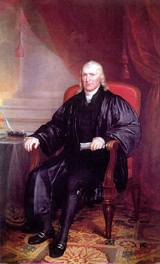
Samuel Chase

Encyclopedia
Samuel Chase was an Associate Justice of the United States Supreme Court and earlier was a signatory to the United States Declaration of Independence
as a representative of Maryland
. Early in life, Chase was a "firebrand" states-righter and revolutionary. His political views changed over his lifetime and in the last decades of his career he became well-known as a staunch Federalist, and was impeached for allegedly letting his partisan leanings affect his court decisions. Chase was acquitted.
.
His father was a clergyman who immigrated to Somerset County
to become a priest in a new church. Samuel was educated at home. He was eighteen when he left for Annapolis
where he studied law under attorney John Hall. He was admitted to the bar in 1761 and started a law practice in Annapolis. It was during his time as a member of the bar that his colleagues gave him the nickname of "Old Bacon Face."
In 1784, Chase traveled to England to deal with Maryland's Bank of England
stock, where he met Hannah Kilty, daughter of Samuel Giles, a Berkshire
physician. They were married later that year and had two daughters. The couple begot daughter Hannah and daughter Elisa into the world.
In 1764, Chase was elected to the Maryland General Assembly
where he served for twenty years.
In 1766, he became embroiled in a war of words with a number of loyalist members of the Maryland political establishment. In an open letter dated July 18, 1766 Chase attacked Walter Dulany, George Steuart (1700–1784), John Brice
(1705–1766) and others for publishing an article in the Maryland Gazette Extraordinary
of June 19, 1766, in which Chase was accused of being: "a busy, reckless incendiary, a ringleader of mobs, a foul-mouthed and inflaming son of discord and faction, a common disturber of the public tranquility". In his response, Chase accused Steuart and the others of "vanity...pride and arrogance", and of being brought to power by "proprietory influence, court favour, and the wealth and influence of the tools and favourites who infest this city."
In 1769 he started construction of the mansion that would become known as the Chase-Lloyd House
, which he sold unfinished in 1771. The house is now a National Historic Landmark
.
He co-founded Anne Arundel County's
Sons of Liberty
chapter with his close friend William Paca
as well as leading opposition to the 1765 Stamp Act.
at the Continental Congress
, was re-elected in 1776 and signed the United States Declaration of Independence
.
He remained in the Continental Congress until 1778. The involvement of Chase in an attempt to corner the flour market, using insider information gained through his position in the Congress, resulted in his not being returned to the Continental Congress and damaging his reputation.
of the District Criminal Court in Baltimore and served until 1796. In 1791, he became Chief Justice of the Maryland General Court, agef name=SCHS/>
On January 26, 1796, President
George Washington
appointed Chase as an associate justice of the Supreme Court of the United States
. Chase served on the Court until his death on June 19, 1811.
, alarmed at the seizure of power by the judiciary through the claim of exclusive judicial review, led his party's efforts to remove the Federalists from the bench. His allies in Congress had shortly after his inauguration repealed the Judiciary Act of 1801, abolishing the lower courts created by the legislation and terminating their Federalist judges despite lifetime appointments; Chase, two years after the repeal in May 1803, had denounced it in his charge to a Baltimore
grand jury
, saying that it would "take away all security for property and personal liberty, and our Republican constitution will sink into a mobocracy[.]" Jefferson saw the attack as indubitable bad behavior and an opportunity to reduce the Federalist influence on the judiciary by impeaching Chase, launching the process from the White House when he wrote to Congressman Joseph Hopper Nicholson
of Maryland asking: "Ought the seditious and official attack [by Chase] on the principles of our Constitution . . .to go unpunished?"
Virginia Congressman John Randolph of Roanoke
took up the challenge and took charge of the impeachment. The House of Representatives
served Chase with eight articles of impeachment
in late 1804, one of which involved Chase's handling of the trial of John Fries. Two more focused on his conduct in the political libel
trial of James Callender
. Four articles focused on procedural errors made during Chase's adjudication of various matters, and an eighth was directed at his “intemperate and inflammatory … peculiarly indecent and unbecoming … highly unwarrantable … highly indecent” remarks while "charging" or authorizing a Baltimore grand jury. The Jeffersonian Republicans-controlled United States Senate
began the impeachment trial of Chase in early 1805, with Vice President Aaron Burr
presiding and Randolph leading the prosecution.
All the counts involved Chase's work as a trial judge in lower circuit courts. (In that era, Supreme Court justices had the added duty of serving as individuals on circuit courts, a practice that was ended in the late 19th century.) The heart of the allegations was that political bias had led Chase to treat defendants and their counsel in a blatantly unfair manner. Chase's defense lawyers called the prosecution a political effort by his Republican enemies. In answer to the articles of impeachment, Chase argued that all of his actions had been motivated by adherence to precedent, judicial duty to restrain advocates from improper statements of law, and considerations of judicial efficiency.
The Senate voted to acquit Chase of all charges on March 1, 1805. He is the only U.S. Supreme Court justice to have been impeached.
The impeachment raised constitutional questions over the nature of the judiciary and was the end of a series of efforts to define the appropriate extent of judicial independence under the Constitution. It set the limits of the impeachment power, fixed the concept that the judiciary was prohibited from engaging in partisan politics, defined the role of the judge in a criminal jury trial, and clarified judicial independence. The construction was largely attitudinal as it modified political norms without codifying new legal doctrines.
The acquittal of Chase — by lopsided margins on several counts — set an unofficial precedent that many historians say helped ensure the independence of the judiciary
. As Chief Justice William Rehnquist
noted in his book Grand Inquests, some senators declined to convict Chase despite their partisan hostility to him, apparently because they doubted that the mere quality of his judging was grounds for removal. Furthermore, federal judges became much more cautious by avoiding the appearance of political partisanship. All impeachments of federal judges since Chase have been based on allegations of legal or ethical misconduct, not on judicial performance.
. Notwithstanding, the cemetery entrance—open only on Saturday mornings—is on Redwood Street.
United States Declaration of Independence
The Declaration of Independence was a statement adopted by the Continental Congress on July 4, 1776, which announced that the thirteen American colonies then at war with Great Britain regarded themselves as independent states, and no longer a part of the British Empire. John Adams put forth a...
as a representative of Maryland
Maryland
Maryland is a U.S. state located in the Mid Atlantic region of the United States, bordering Virginia, West Virginia, and the District of Columbia to its south and west; Pennsylvania to its north; and Delaware to its east...
. Early in life, Chase was a "firebrand" states-righter and revolutionary. His political views changed over his lifetime and in the last decades of his career he became well-known as a staunch Federalist, and was impeached for allegedly letting his partisan leanings affect his court decisions. Chase was acquitted.
Youth and early career
Samuel was the only child of the Reverend Thomas Chase (c. 1703-1779) and his wife, Matilda Walker (?-by 1744), born near Princess Anne, MarylandPrincess Anne, Maryland
Princess Anne is a town in Somerset County, Maryland, United States. The population was 2,313 at the 2000 census. It is the county seat of Somerset County.Princess Anne is included in the Salisbury, Maryland Metropolitan Statistical Area....
.
His father was a clergyman who immigrated to Somerset County
Somerset County, Maryland
-2010:Whereas according to the 2010 U.S. Census Bureau:*53.5% White*42.3% Black*0.3% Native American*0.7% Asian*0.0% Native Hawaiian or Pacific Islander*1.7% Two or more races*1.5% Other races*3.3% Hispanic or Latino -2000:...
to become a priest in a new church. Samuel was educated at home. He was eighteen when he left for Annapolis
Annapolis, Maryland
Annapolis is the capital of the U.S. state of Maryland, as well as the county seat of Anne Arundel County. It had a population of 38,394 at the 2010 census and is situated on the Chesapeake Bay at the mouth of the Severn River, south of Baltimore and about east of Washington, D.C. Annapolis is...
where he studied law under attorney John Hall. He was admitted to the bar in 1761 and started a law practice in Annapolis. It was during his time as a member of the bar that his colleagues gave him the nickname of "Old Bacon Face."
Family and personal life
In May 1762, Chase married Ann Baldwin, daughter of Thomas Baldwin and his wife Agnes. Samuel and Anne had had three sons and four daughters, with only four surviving to adulthood. Anne died in 1776.In 1784, Chase traveled to England to deal with Maryland's Bank of England
Bank of England
The Bank of England is the central bank of the United Kingdom and the model on which most modern central banks have been based. Established in 1694, it is the second oldest central bank in the world...
stock, where he met Hannah Kilty, daughter of Samuel Giles, a Berkshire
Berkshire
Berkshire is a historic county in the South of England. It is also often referred to as the Royal County of Berkshire because of the presence of the royal residence of Windsor Castle in the county; this usage, which dates to the 19th century at least, was recognised by the Queen in 1957, and...
physician. They were married later that year and had two daughters. The couple begot daughter Hannah and daughter Elisa into the world.
Career in Annapolis
In 1762, Chase was expelled from the Forensic Club, an Annapolis debating society, for "extremely irregular and indecent" behavior. This was only the first of the major controversies to surround his life.In 1764, Chase was elected to the Maryland General Assembly
Maryland General Assembly
The Maryland General Assembly is the state legislature of the U.S. state of Maryland. It is a bicameral body. The upper chamber, the Maryland State Senate, has 47 representatives and the lower chamber, the Maryland House of Delegates, has 141 representatives...
where he served for twenty years.
In 1766, he became embroiled in a war of words with a number of loyalist members of the Maryland political establishment. In an open letter dated July 18, 1766 Chase attacked Walter Dulany, George Steuart (1700–1784), John Brice
John Brice, Jr.
John Brice, Jr. was an early American settler and Loyalist politician in colonial Maryland. He was a member of the Governor's Council, twice Mayor of Annapolis, and a chief justice in the colony's court. Two of his sons would in their turn become Mayors of Annapolis.-Early life:John was born in...
(1705–1766) and others for publishing an article in the Maryland Gazette Extraordinary
The Capital
The Capital is a daily newspaper published in Annapolis, Maryland. It serves the city as well as all of Anne Arundel County and neighboring Kent Island in Queen Anne's County. It is an evening newspaper during the week and offers morning delivery on the weekend. Philip Merrill was the publisher...
of June 19, 1766, in which Chase was accused of being: "a busy, reckless incendiary, a ringleader of mobs, a foul-mouthed and inflaming son of discord and faction, a common disturber of the public tranquility". In his response, Chase accused Steuart and the others of "vanity...pride and arrogance", and of being brought to power by "proprietory influence, court favour, and the wealth and influence of the tools and favourites who infest this city."
In 1769 he started construction of the mansion that would become known as the Chase-Lloyd House
Chase-Lloyd House
The Chase-Lloyd House in Annapolis, Maryland is a brick three-story Georgian mansion dating from 1769-1774 with interiors by William Buckland . Its construction was started for Samuel Chase, who would later be a signatory to the Declaration of Independence and Associate Justice of the Supreme...
, which he sold unfinished in 1771. The house is now a National Historic Landmark
National Historic Landmark
A National Historic Landmark is a building, site, structure, object, or district, that is officially recognized by the United States government for its historical significance...
.
He co-founded Anne Arundel County's
Anne Arundel County, Maryland
Anne Arundel County is a county located in the U.S. state of Maryland. It is named for Anne Arundell , a member of the ancient family of Arundells in Cornwall, England and the wife of Cæcilius Calvert, 2nd Baron Baltimore. Its county seat is Annapolis, which is also the capital of the state...
Sons of Liberty
Sons of Liberty
The Sons of Liberty were a political group made up of American patriots that originated in the pre-independence North American British colonies. The group was formed to protect the rights of the colonists from the usurpations by the British government after 1766...
chapter with his close friend William Paca
William Paca
William Paca was a signatory to the United States Declaration of Independence as a representative of Maryland, and later Governor of Maryland and a United States federal judge.-Early life:...
as well as leading opposition to the 1765 Stamp Act.
Continental Congress
From 1774 to 1776, Chase was a member of the Annapolis Convention. He represented MarylandMaryland
Maryland is a U.S. state located in the Mid Atlantic region of the United States, bordering Virginia, West Virginia, and the District of Columbia to its south and west; Pennsylvania to its north; and Delaware to its east...
at the Continental Congress
Continental Congress
The Continental Congress was a convention of delegates called together from the Thirteen Colonies that became the governing body of the United States during the American Revolution....
, was re-elected in 1776 and signed the United States Declaration of Independence
United States Declaration of Independence
The Declaration of Independence was a statement adopted by the Continental Congress on July 4, 1776, which announced that the thirteen American colonies then at war with Great Britain regarded themselves as independent states, and no longer a part of the British Empire. John Adams put forth a...
.
He remained in the Continental Congress until 1778. The involvement of Chase in an attempt to corner the flour market, using insider information gained through his position in the Congress, resulted in his not being returned to the Continental Congress and damaging his reputation.
Judicial career
In 1786, Chase moved to Baltimore, which remained his home for the rest of his life. In 1788, he was appointed Chief justiceChief Justice
The Chief Justice in many countries is the name for the presiding member of a Supreme Court in Commonwealth or other countries with an Anglo-Saxon justice system based on English common law, such as the Supreme Court of Canada, the Constitutional Court of South Africa, the Court of Final Appeal of...
of the District Criminal Court in Baltimore and served until 1796. In 1791, he became Chief Justice of the Maryland General Court, agef name=SCHS/>
On January 26, 1796, President
President of the United States
The President of the United States of America is the head of state and head of government of the United States. The president leads the executive branch of the federal government and is the commander-in-chief of the United States Armed Forces....
George Washington
George Washington
George Washington was the dominant military and political leader of the new United States of America from 1775 to 1799. He led the American victory over Great Britain in the American Revolutionary War as commander-in-chief of the Continental Army from 1775 to 1783, and presided over the writing of...
appointed Chase as an associate justice of the Supreme Court of the United States
Supreme Court of the United States
The Supreme Court of the United States is the highest court in the United States. It has ultimate appellate jurisdiction over all state and federal courts, and original jurisdiction over a small range of cases...
. Chase served on the Court until his death on June 19, 1811.
Impeachment
President Thomas JeffersonThomas Jefferson
Thomas Jefferson was the principal author of the United States Declaration of Independence and the Statute of Virginia for Religious Freedom , the third President of the United States and founder of the University of Virginia...
, alarmed at the seizure of power by the judiciary through the claim of exclusive judicial review, led his party's efforts to remove the Federalists from the bench. His allies in Congress had shortly after his inauguration repealed the Judiciary Act of 1801, abolishing the lower courts created by the legislation and terminating their Federalist judges despite lifetime appointments; Chase, two years after the repeal in May 1803, had denounced it in his charge to a Baltimore
Baltimore
Baltimore is the largest independent city in the United States and the largest city and cultural center of the US state of Maryland. The city is located in central Maryland along the tidal portion of the Patapsco River, an arm of the Chesapeake Bay. Baltimore is sometimes referred to as Baltimore...
grand jury
Grand jury
A grand jury is a type of jury that determines whether a criminal indictment will issue. Currently, only the United States retains grand juries, although some other common law jurisdictions formerly employed them, and most other jurisdictions employ some other type of preliminary hearing...
, saying that it would "take away all security for property and personal liberty, and our Republican constitution will sink into a mobocracy[.]" Jefferson saw the attack as indubitable bad behavior and an opportunity to reduce the Federalist influence on the judiciary by impeaching Chase, launching the process from the White House when he wrote to Congressman Joseph Hopper Nicholson
Joseph Hopper Nicholson
Joseph Hopper Nicholson was an American lawyer, jurist, and politician from Maryland.Born in Chestertown, Kent County, Maryland, Nicholson graduated from Washington College in 1787 and studied law. He was admitted to the bar and practiced, and also served as a member of the Maryland House of...
of Maryland asking: "Ought the seditious and official attack [by Chase] on the principles of our Constitution . . .to go unpunished?"
Virginia Congressman John Randolph of Roanoke
John Randolph of Roanoke
John Randolph , known as John Randolph of Roanoke, was a planter and a Congressman from Virginia, serving in the House of Representatives , the Senate , and also as Minister to Russia...
took up the challenge and took charge of the impeachment. The House of Representatives
United States House of Representatives
The United States House of Representatives is one of the two Houses of the United States Congress, the bicameral legislature which also includes the Senate.The composition and powers of the House are established in Article One of the Constitution...
served Chase with eight articles of impeachment
Impeachment in the United States
Impeachment in the United States is an expressed power of the legislature that allows for formal charges against a civil officer of government for crimes committed in office...
in late 1804, one of which involved Chase's handling of the trial of John Fries. Two more focused on his conduct in the political libel
Political libel
The criminal statutes protecting nobility from criticism in 16th and 17th century England eventually evolved into various categories of political libel . Cases of political libel and eventually damages actions were handled by the infamous Star Chamber until its abolition in 1641...
trial of James Callender
James T. Callender
James Callender was a political pamphleteer and journalist whose writing was controversial in his native Scotland and the United States. His contemporary reputation was as a "scandalmonger", due to the content of some of his reporting, which overshadowed the political content...
. Four articles focused on procedural errors made during Chase's adjudication of various matters, and an eighth was directed at his “intemperate and inflammatory … peculiarly indecent and unbecoming … highly unwarrantable … highly indecent” remarks while "charging" or authorizing a Baltimore grand jury. The Jeffersonian Republicans-controlled United States Senate
United States Senate
The United States Senate is the upper house of the bicameral legislature of the United States, and together with the United States House of Representatives comprises the United States Congress. The composition and powers of the Senate are established in Article One of the U.S. Constitution. Each...
began the impeachment trial of Chase in early 1805, with Vice President Aaron Burr
Aaron Burr
Aaron Burr, Jr. was an important political figure in the early history of the United States of America. After serving as a Continental Army officer in the Revolutionary War, Burr became a successful lawyer and politician...
presiding and Randolph leading the prosecution.
All the counts involved Chase's work as a trial judge in lower circuit courts. (In that era, Supreme Court justices had the added duty of serving as individuals on circuit courts, a practice that was ended in the late 19th century.) The heart of the allegations was that political bias had led Chase to treat defendants and their counsel in a blatantly unfair manner. Chase's defense lawyers called the prosecution a political effort by his Republican enemies. In answer to the articles of impeachment, Chase argued that all of his actions had been motivated by adherence to precedent, judicial duty to restrain advocates from improper statements of law, and considerations of judicial efficiency.
The Senate voted to acquit Chase of all charges on March 1, 1805. He is the only U.S. Supreme Court justice to have been impeached.
The impeachment raised constitutional questions over the nature of the judiciary and was the end of a series of efforts to define the appropriate extent of judicial independence under the Constitution. It set the limits of the impeachment power, fixed the concept that the judiciary was prohibited from engaging in partisan politics, defined the role of the judge in a criminal jury trial, and clarified judicial independence. The construction was largely attitudinal as it modified political norms without codifying new legal doctrines.
The acquittal of Chase — by lopsided margins on several counts — set an unofficial precedent that many historians say helped ensure the independence of the judiciary
Judiciary
The judiciary is the system of courts that interprets and applies the law in the name of the state. The judiciary also provides a mechanism for the resolution of disputes...
. As Chief Justice William Rehnquist
William Rehnquist
William Hubbs Rehnquist was an American lawyer, jurist, and political figure who served as an Associate Justice on the Supreme Court of the United States and later as the 16th Chief Justice of the United States...
noted in his book Grand Inquests, some senators declined to convict Chase despite their partisan hostility to him, apparently because they doubted that the mere quality of his judging was grounds for removal. Furthermore, federal judges became much more cautious by avoiding the appearance of political partisanship. All impeachments of federal judges since Chase have been based on allegations of legal or ethical misconduct, not on judicial performance.
Death
Samuel Chase died of a heart attack in 1811 and was interred in St. Paul's Cemetery, which today is the name of a large, semi-rural cemetery southeast of the Baltimore Inner Harbor. However, in Chase's lifetime, "St. Paul's Cemetery" referred to a downtown churchyard on West Lombard StreetLombard Street (Baltimore)
Lombard Street is a major street in Baltimore. It forms a one-way pair of streets with Pratt Street that run west-east through downtown Baltimore. For most of their route, Pratt Street is one-way in an eastbound direction, and Lombard Street is one way westbound. Both streets begin in west...
. Notwithstanding, the cemetery entrance—open only on Saturday mornings—is on Redwood Street.
Further reading
External links
- ColonialHall.com: Samuel Chase
- Samuel Chase, Freedom Firebrand - Delmarva Heritage Series
- Oyez ProjectOyez.orgThe Oyez Project at the Chicago-Kent College of Law is an unofficial online multimedia archive of the Supreme Court of the United States, especially audio of oral arguments...
, Supreme Court media, Samuel Chase. - Samuel Chase, Supreme Court Historical SocietySupreme Court Historical SocietyThe Supreme Court Historical Society is a private, non-profit organization dedicated to preserving and communicating the history of the U.S. Supreme Court.-History:...
.