
Encyclopedia
Delaware is one of five Middle Atlantic States in the
United States of America. Delaware was one of the original
Thirteen Colonies and is known as the "First State" as it was the first to the
United States Constitution. The name
Delaware comes from
Thomas West, 3rd Baron De La Warr, after whom
Delaware Bay was named.
Geography
Delaware is the second-smallest state in the
United States,
Rhode Island being the smallest.
Delaware is bounded to the north by
Pennsylvania, to the east by the
Delaware River,
New Jersey and the
Atlantic Ocean and to the west and south by
Maryland. Small portions of Delaware are also situated on the far, or eastern, side of the Delaware River
Estuary, and these small parcels share land boundaries with
New Jersey.
The state of Delaware, together with the Eastern Shore counties of Maryland and two counties of
Virginia, form the
Delmarva Peninsula, a geographical unit stretching far down the Mid-Atlantic Coast.
The definition of the northern boundary of the state is highly unusual. Most of the boundary between Delaware and Pennsylvania is defined by an arc extending 12 miles from the
cupola of the courthouse in
New Castle, and is referred to as the
Twelve-Mile Circle. This is the only true-arc political boundary in the United States This border extends all of the way to the low-tide mark on the New Jersey shore, which continues down the shoreline until it again reaches the twelve-mile arc in the south; then the boundary continues in a more conventional way in the middle of the main channel of the Delaware River Estuary. A portion of this arc extends into Maryland to the west, and the remaining western border is a tangent to this arc that runs a bit to the east. The Wedge of land between the arc and the Maryland border remained in dispute until 1921, when Delaware's claim was confirmed.
- Main articles: Twelve-Mile Circle, The Wedge, Mason-Dixon line, Transpeninsular Line
Topography
Delaware is on a level plain, the highest elevation not even rising 450 feet above sea level. The northern part is associated with the Appalachian Piedmont and is full of hills with rolling surfaces. South of Newark and Wilmington, the state follows the Atlantic Coastal Plain with flat, sandy, and, in some parts, swampy ground. A ridge about 75 to 80 feet in altitude extends along the western boundary of the state and is the drainage divide between the two major water bodies of the Delaware River and several streams falling into Chesapeake Bay in the west.
Climate
Since the majority of Delaware is a part of the
Atlantic Coastal Plain, the climate is moderated by the effects of the ocean. The southern third of the state has a mild temperate climate, with hot, humid summers and mild winters. The middle portion is the transition to the upper portion of the state, which has a warm continental climate and receives snow nearly every winter.
See also: List of counties in DelawareHistory
Native Americans
Before Delaware was settled by
Europeans, the area was home to the Eastern
Algonquian tribes known as the Unami Lenape or Delaware throughout the
Delaware valley, and the Nanticoke along the rivers leading into the
Chesapeake Bay. The Unami Lenape in the
Delaware valley were closely related to Munsee Lenape tribes along the
Hudson River. They had a settled hunting and agricultural society, and they rapidly became middlemen in an increasingly frantic fur trade with their ancient enemy, the
Minqua or
Susquehannock. With the loss of their lands on the
Delaware River and the destruction of the
Minqua by the
Iroquois of the Five Nations in the 1670's, the remnants of the Lenape left the region and moved over the Alleghany Mountains by the mid-18th century.
Colonial Delaware
The
Dutch were the first
Europeans to settle in present day Delaware by establishing a trading post at Zwaanendael, near the site of
Lewes in 1631. Within a year all the settlers were killed in a dispute with
Native Americans. In 1638 a
Swedish trading post and colony was established at Fort Christina by the Dutchman Peter Minuit at the head of a group of
Swedes,
Finns and Dutch. Thirteen years later the Dutch, reinvigorated by the leadership of
Peter Stuyvesant, established a new fort in 1651 at present day
New Castle, and in 1655 they took over the entire Swedish colony, incorporating it into the Dutch
New Netherlands.
Only nine years later, in 1664, the Dutch were themselves forcibly removed by a
British expedition under the direction of
James, the Duke of York. Fighting off a prior claim by
Cæcilius Calvert, 2nd Baron Baltimore, Proprietor of
Maryland, the Duke passed his somewhat dubious ownership on to
William Penn in 1682. Penn badly wanted an outlet to the sea for his
Pennsylvania province and leased what were now known as the "Lower Counties on the Delaware" from the Duke.
Penn established representative government and briefly combined his two possessions under one General Assembly in 1682. However, by 1704 the Province of Pennsylvania had grown so much, their representatives wanted to make decisions without the assent of the Lower Counties and the two groups of representatives began meeting on their own, one at
Philadelphia, and the other at New Castle. Penn and his heirs remained the Proprietors of both and always appointed the same person with po Governor for their Province of Pennsylvania and their territory of the Lower Counties.
American Revolution
Like the other middle colonies, the Lower Counties on the Delaware initially lacked much enthusiasm for a break with
Britain. They had a good relationship with the Proprietary government, and generally were allowed more independence of action in their Colonial Assembly than other colonies. Nevertheless, there was strong objection to the seemingly arbitrary measures of
Parliament, and it was well understood that the territory's very existence as a separate entity depended upon its keeping step with its powerful neighbors, especially
Pennsylvania.
So it was that
New Castle lawyer
Thomas McKean denounced the Stamp Act in the strongest terms, and Kent County native John Dickinson, became the "Penman of the Revolution." Anticipating the Declaration of Independence, patriot leaders
Thomas McKean and
Caesar Rodney convinced the Colonial Assembly to declare itself separated from British and Pennsylvania rule on June 15, 1776, but the person best representing Delaware's majority, George Read, could not bring himself to vote for a Declaration of Independence. Only the dramatic overnight ride of
Caesar Rodney gave the delegation the votes needed to cast Delaware's vote for Independence. Once the Declaration was adopted, however, Read signed the document.
Initially led by John Haslet, Delaware provided one of the premier regiments in the
Continental Army, known as the "Delaware Blues" and nicknamed the "
Blue Hen Chickens." In August 1777
General Sir William Howe led a British army through Delaware on his way to a victory at the Battle of Brandywine and capture of the city of
Philadelphia. The only real engagement on Delaware soil was fought on September 3, 1777, at Cooch's Bridge in
New Castle County. It is believed to be the first time that the Stars and Stripes was flown in battle.
Following the Battle of Brandywine,
Wilmington was occupied by the British, and State President
John McKinly was taken prisoner. The British remained in control of the
Delaware River for much of the rest of the war, disrupting commerce and providing encouragement to an active Loyalist portion of the population, particularly in
Sussex County. Only the repeated military activities of State President
Caesar Rodney was able to control them.
Following the
American Revolution, statesmen from Delaware were among the leading proponents of a strong central
United States government with equal representation for each state. Once the Connecticut Compromise was reached—creating a
U.S. Senate and
U.S. House of Representatives—the leaders in Delaware were able to easily secure ratification of the
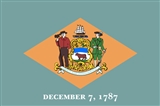
U.S. Constitution on December 7, 1787, making Delaware the first state to do so.
Slavery
Many colonial settlers came from
Maryland and
Virginia which had been experiencing a population boom. The economies of these colonies were largely based on tobacco and were increasingly dependent on slave labor. At the end of the colonial period slavery in Delaware began a precipitous decline. Shifts in the agriculture economy, the efforts of local Methodists and Quakers, and greater governmental regulation were all factors. Attempts to abolish slavery failed by narrow margins. By the 1860 census there were only about 1,800 slaves in a state of 90,000 people, including nearly 20,000 free
African Americans. When he freed his slaves in 1777, John Dickinson was Delaware's largest slave owner with 37 slaves.
The oldest black church in the country was chartered in Delaware by former slave
Peter Spencer in 1813 as the "Union Church of Africans," which is now the A.U.M.P. Church. The Big August Quarterly began in 1814 and is the oldest such cultural festival in the country.
During the
American Civil War, Delaware was a slave state that remained in the Union . Delaware had been the first state to embrace the Union by ratifying the constitution and would be the last to leave it, according to Delaware's governor at the time. While most Delaware citizens who fought in the war served in the regiments of the state, some served in companies on the Confederate side in Maryland and Virginia Regiments. Delaware is notable for being the only slave state not to assemble Confederate regiments or militia groups on its own.
Two months before the end of the Civil War, however, Delaware voted on February 18, 1865 to reject the
13th Amendment to the United States Constitution and so voted unsuccessfully to continue slavery beyond the Civil War. Delaware symbolically ratified the amendment on February 12 1901—nearly 40 years after
Lincoln's
Emancipation Proclamation. Slavery ended in Delaware only when the
Thirteenth Amendment took effect in December of 1865. Delaware also rejected the
14th amendment during the
Reconstruction Era.
Demographics
The five largest ancestries in Delaware are:
African American ,
Irish ,
German , English ,
Italian . Delaware has the highest proportion of African American residents of any state north of Maryland, and had the largest population of free blacks prior to the Civil War.
Languages
As of 2000, 90.5% of Delaware residents age 5 and older speak only
English at home; 4.7% speak
Spanish.
French is the third most spoken language at 0.7%, followed by
Chinese at 0.5% and
German at 0.5%.
In 2006, legislation was proposed in Delaware that would designate English as the
official language.
Religion
The religious affiliations of the people of Delaware are:
- Christian – 79%
- Other Religions – 2%
- Non-Religious – 19%
Delaware is home to the Roman Catholic Diocese of Wilmington and the Episcopal Diocese of Delaware. The A.U.M.P. Church, the oldest African-American denomination in the nation, was founded in Wilmington and still has a very substantial presence in the state. Delaware also hosts an
Islamic mosque in the Ogletown area, as well as a
Hindu temple in
Hockessin.
Delaware is home to approximately 20,000
Jews, who are served by the
Jewish Community Center in Brandywine and by a number of educational, social and cultural agencies supported by the Jewish Federation of Delaware.
Synagogues include Congregation Beth Emeth in Wilmington, Congregation Beth El in Newark, and Congregation Beth Shalom in Wilmington, Congregation Beth Sholom in Dover, and Adas Kodesh Shel Emeth in Wilmington. There is also a
Lubavitcher community center and synagogue in Brandywine.
Economy
The gross state product of Delaware in 2003 was $49 billion. The per capita personal income was $34,199, ranking 9
th in the nation. In 2005, the average weekly wage was $937, ranking 7
th in the nation.
Delaware's agricultural output consists of
poultry, nursery stock,
soybeans,
dairy products and
corn. Its industrial outputs include
chemical products, processed foods,
paper products, and
rubber and
plastic products. Delaware's economy generally outperforms the national economy of the United States.
The state's largest employers are:
- government
- chemical and pharmaceutical companies
- banking
- automotive manufacturing
- farming, specifically chicken farming in Sussex County
The United States headquarters of
ING Group, and the U.S. operations of its online bank, ING Direct, are located in Wilmington.
Dover Air Force Base, just outside Dover, is one of the largest Air Force Bases in the country and is a major employer in Delaware. In addition to its other responsibilities, the base serves as the entry point and mortuary for American military persons who die overseas.
Delaware has 6 different
income tax brackets, ranging from 2.2% to 5.95%. The state does not assess sales tax on consumers. The state does, however, impose a tax on the gross receipts of most businesses. Business and occupational license tax rates range from 0.096% to 1.92%, depending on the category of business activity.
Delaware does not assess a state-level tax on real or personal property. Real estate is subject to county property taxes, school district property taxes, vocational school district taxes, and, if located within an incorporated area, municipal property taxes.
Transportation
The transportation system in Delaware is under the governance and supervision of the
Delaware Department of Transportation, also known as "DelDOT". DelDOT manages programs such as a Delaware Adopt-a-Highway program, major road route snow removal, traffic control infrastructure , toll road management, Delaware Division of Motor Vehicles, the Delaware Transit Corporation , among others. Almost ninety percent of the state's public roadway miles are under the direct maintenance of DelDOT which far exceeds the United States national average of twenty percent for state department of transportation maintenance responsibility; the remaining public road miles are under the supervision of individual municipalities.
One major branch of the U.S.
Interstate Highway System,
Interstate 95, crosses Delaware southwest-to-northeast across
New Castle County. In addition to I-95, there are seven principal highways:
U.S. Highway 9,
U.S. Highway 13,
U.S. Highway 40,
U.S. Highway 113,
U.S. Highway 202,
U.S. Route 301, and
Delaware Route 1. U.S. 13 and DE Rt. 1 are primary north-south highways connecting Wilmington and
Pennsylvania with
Maryland, while U.S. 40, the primary east-west route, connects Maryland with New Jersey. The state also operates two toll highways, the
Delaware Turnpike, which is Interstate 95 between Maryland and
New Castle and the
Korean War Veterans Memorial Highway, which is DE Rt. 1 between Dover and Interstate 95 between Wilmington and
Newark.
Delaware has around 1,450 bridges, of which ninety-five percent are under the supervision of DelDOT. About thirty percent of all Delaware bridges were built prior to 1950 and about sixty percent of the number are included in the National Bridge Inventory. Some bridges not under DelDOT supervision includes the four bridges on the
Chesapeake and Delaware Canal, which is under the jurisdiction of the
U.S. Army Corps of Engineers, and the
Delaware Memorial Bridge, which is under the bi-state
Delaware River and Bay Authority.
The public transportation system, DART First State, was named "Most Outstanding Public Transportation System" in 2003 by the
American Public Transportation Association. Coverage of the system is broad within New Castle County with close association to major highways in Kent and Sussex Counties. The system includes bus, passenger rail, subsidized taxi and paratransit modes, the latter consisting of a state-wide door-to-door bus service for the elderly and disabled. Passenger rail service, like interstate highway service, is limited to a single southwest-to-northeast corridor in New Castle County. Ferry service exists between
Lewes, Delaware and Cape May, New Jersey, across the mouth of the
Delaware Bay.
Delaware has lacked air service from major carriers since 2000. On June 29, 2006, Atlantic Southeast Airline, a subsidiary of
Delta Air Lines, began two-a-day flights between Atlanta's Hartsford International to New Castle Airport.
Law and government
Presidential elections results
| Year | Republican | Democratic |
|---|
| 2004 | 45.75% 171,660 | 53.35% 200,152 |
| 2000 | 41.90% 137,288 | 54.96% 180,068 |
| 1996 | 36.58% 99,062 | 51.82% 140,955 |
| 1992 | 35.33% 102,313 | 43.52% 126,054 |
| 1988 | 55.88% 139,639 | 43.48% 108,647 |
| 1984 | 59.78% 152,190 | 39.93% 101,656 |
| 1980 | 47.21% 111,252 | 44.87% 105,754 |
| 1976 | 46.57% 109,831 | 51.98% 122,596 |
| 1972 | 59.60% 140,357 | 39.18% 92,283 |
| 1968 | 45.12% 96,714 | 41.61% 89,194 |
| 1964 | 38.78% 78,078 | 60.95% 122,704 |
| 1960 | 49.00% 96,373 | 50.63% 99,590 |
Delaware's fourth and current constitution, adopted in 1897, provides for executive, judicial and legislative branches.
Legislative branch
Delaware General Assembly consists of a House of Representatives with 41 members and a Senate with 21 members. It sits in Dover, the state capital. Representatives are elected to two-year terms, while senators are elected to four-year terms. The Senate confirms judicial and other nominees appointed by the governor.
Judicial branch
The Delaware Constitution establishes a number of courts:
- The Delaware Supreme Court is the state's highest court.
- The Superior Court of Delaware is the state's trial court of general jurisdiction.
- The Court of Chancery deals primarily in corporate disputes.
- The Family Court handles domestic and custody matters.
- The Court of Common Pleas has jurisdiction over a limited class of civil and criminal matters.
Minor non-constitutional courts include the Justice of the Peace Courts and Aldermen's Courts.
Significantly, Delaware has one of the few remaining Courts of Chancery in the nation, which has jurisdiction over
equity cases, the vast majority of which are corporate disputes, many relating to mergers and acquisitions. The Court of Chancery and the Supreme Court have developed a worldwide reputation for rendering concise opinions concerning corporate law which generally grant broad discretion to corporate boards of directors and officers. In addition, the Delaware General Corporation Law, which forms the basis of the Courts' opinions, is widely regarded as giving great flexibility to corporations to manage their affairs. For these reasons, Delaware is considered to have the most business-friendly legal system in the United States; therefore a great number of companies are incorporated in Delaware, including 60% of the companies listed on the New York Stock Exchange.
Executive branch
The executive branch is headed by the Governor of Delaware. The present governor is
Ruth Ann Minner , who was elected as the state's first female governor in 2000. The lieutenant governor is
John C. Carney, Jr.. Delaware's U.S. Senators are
Joseph R. Biden, Jr. and
Thomas R. Carper . Delaware's single US Representative is
Michael N. Castle