

Twelfth Amendment to the United States Constitution

Encyclopedia
The Twelfth Amendment to the United States Constitution
provides the procedure for electing the President
and Vice President
. It replaced Article II, Section 1, Clause 3, which provided the original procedure by which the Electoral College functioned. Problems with the original procedure arose in the elections of 1796
and 1800
. The Twelfth Amendment was proposed by the Congress
on December 9, 1803, and was ratified by the required number of state legislatures on June 15, 1804.
s" of their respective states. If exactly one person received a vote from a majority
of the electors, that person won the election.
If there was more than one individual who received a vote from a majority of the electors, the House of Representatives would choose one of them to be President. If no individual had a majority, then the House of Representatives would choose from the five individuals with the greatest number of electoral votes. In either case, a majority of state delegations in the House was necessary for a candidate to be chosen to be President.
Selecting the Vice President was a simpler process. Whichever candidate received the greatest number of votes, except for the one elected President, became Vice President. The Vice President, unlike the President, did not require the votes of a majority of electors. In the event of a tie for second place between multiple candidates, the Senate would choose one of them to be Vice President, with each Senator casting one vote. It was not specified in the Constitution whether the sitting Vice President could cast a tie-breaking vote for Vice President under the original formula.
In the 1796 election
, John Adams
, the Federalist Party presidential candidate, received a majority of the electoral votes. However, the Federalist electors scattered their second votes, resulting in the Democratic-Republican Party presidential candidate, Thomas Jefferson
, receiving the second highest number of electoral votes and thus being elected Vice President.
The 1800 election
exposed a defect in the original formula in that if each member of the electoral college followed party tickets, there would be a tie between the two candidates from the most popular ticket. It also showed that the House of Representatives could end up taking multiple ballots before choosing a President.
Additionally, it was becoming increasingly apparent that a situation in which the Vice President had been a defeated electoral opponent of the President would impede the ability of the two to effectively work together, and could provide motivation, at least in theory, for a coup d'état
(since the Vice President would succeed to the office of the President upon the removal or death of the President). In having the President and Vice President elected as a ticket
, the Twelfth Amendment eliminated this possibility, or at least minimized it by lessening the Vice President's motivation for staging such a coup.
The Twelfth Amendment (Amendment XII) to the United States Constitution
provides the procedure for electing the President
and Vice President
. It replaced Article II, Section 1, Clause 3, which provided the original procedure by which the Electoral College functioned. Problems with the original procedure arose in the elections of 1796
and 1800
. The Twelfth Amendment was proposed by the Congress
on December 9, 1803, and was ratified by the required number of state legislatures on June 15, 1804.
s" of their respective states. If exactly one person received a vote from a majority
of the electors, that person won the election.
If there was more than one individual who received a vote from a majority of the electors, the House of Representatives would choose one of them to be President. If no individual had a majority, then the House of Representatives would choose from the five individuals with the greatest number of electoral votes. In either case, a majority of state delegations in the House was necessary for a candidate to be chosen to be President.
Selecting the Vice President was a simpler process. Whichever candidate received the greatest number of votes, except for the one elected President, became Vice President. The Vice President, unlike the President, did not require the votes of a majority of electors. In the event of a tie for second place between multiple candidates, the Senate would choose one of them to be Vice President, with each Senator casting one vote. It was not specified in the Constitution whether the sitting Vice President could cast a tie-breaking vote for Vice President under the original formula.
In the 1796 election
, John Adams
, the Federalist Party presidential candidate, received a majority of the electoral votes. However, the Federalist electors scattered their second votes, resulting in the Democratic-Republican Party presidential candidate, Thomas Jefferson
, receiving the second highest number of electoral votes and thus being elected Vice President.
The 1800 election
exposed a defect in the original formula in that if each member of the electoral college followed party tickets, there would be a tie between the two candidates from the most popular ticket. It also showed that the House of Representatives could end up taking multiple ballots before choosing a President.
Additionally, it was becoming increasingly apparent that a situation in which the Vice President had been a defeated electoral opponent of the President would impede the ability of the two to effectively work together, and could provide motivation, at least in theory, for a coup d'état
(since the Vice President would succeed to the office of the President upon the removal or death of the President). In having the President and Vice President elected as a ticket
, the Twelfth Amendment eliminated this possibility, or at least minimized it by lessening the Vice President's motivation for staging such a coup.
The Twelfth Amendment (Amendment XII) to the United States Constitution
provides the procedure for electing the President
and Vice President
. It replaced Article II, Section 1, Clause 3, which provided the original procedure by which the Electoral College functioned. Problems with the original procedure arose in the elections of 1796
and 1800
. The Twelfth Amendment was proposed by the Congress
on December 9, 1803, and was ratified by the required number of state legislatures on June 15, 1804.
s" of their respective states. If exactly one person received a vote from a majority
of the electors, that person won the election.
If there was more than one individual who received a vote from a majority of the electors, the House of Representatives would choose one of them to be President. If no individual had a majority, then the House of Representatives would choose from the five individuals with the greatest number of electoral votes. In either case, a majority of state delegations in the House was necessary for a candidate to be chosen to be President.
Selecting the Vice President was a simpler process. Whichever candidate received the greatest number of votes, except for the one elected President, became Vice President. The Vice President, unlike the President, did not require the votes of a majority of electors. In the event of a tie for second place between multiple candidates, the Senate would choose one of them to be Vice President, with each Senator casting one vote. It was not specified in the Constitution whether the sitting Vice President could cast a tie-breaking vote for Vice President under the original formula.
In the 1796 election
, John Adams
, the Federalist Party presidential candidate, received a majority of the electoral votes. However, the Federalist electors scattered their second votes, resulting in the Democratic-Republican Party presidential candidate, Thomas Jefferson
, receiving the second highest number of electoral votes and thus being elected Vice President.
The 1800 election
exposed a defect in the original formula in that if each member of the electoral college followed party tickets, there would be a tie between the two candidates from the most popular ticket. It also showed that the House of Representatives could end up taking multiple ballots before choosing a President.
Additionally, it was becoming increasingly apparent that a situation in which the Vice President had been a defeated electoral opponent of the President would impede the ability of the two to effectively work together, and could provide motivation, at least in theory, for a coup d'état
(since the Vice President would succeed to the office of the President upon the removal or death of the President). In having the President and Vice President elected as a ticket
, the Twelfth Amendment eliminated this possibility, or at least minimized it by lessening the Vice President's motivation for staging such a coup.
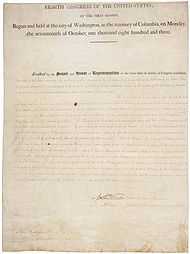 The Twelfth Amendment changed the process whereby a President and a Vice President are elected. It did not change the composition of the Electoral College. It has applied to Presidential elections since 1804.
Under the Twelfth Amendment, each elector must cast distinct votes for President and Vice President, instead of two votes for President. Pursuant to the amendment's Habitation Clause, an elector may not vote for both candidates of a presidential ticket
if both candidates inhabit the elector's state.
The Twelfth Amendment explicitly precluded those constitutionally ineligible to be President from being Vice President.
A majority of electoral votes is still required for one to be elected President or Vice President. When nobody has a majority, the House of Representatives, voting by states and with the same quorum
requirements as under the original procedure, chooses a President. The Twelfth Amendment requires the House to choose from the three highest receivers of electoral votes, compared to five under the original procedure.
The Senate chooses the Vice President if no candidate receives a majority of electoral votes. Its choice is limited to those with the "two highest numbers" of electoral votes. If multiple individuals are tied for second place, the Senate may consider all of them, in addition to the individual with the greatest number of votes. The Twelfth Amendment introduced a quorum requirement of two-thirds for the conduct of balloting. Furthermore, the Twelfth Amendment provides that the votes of "a majority of the whole number" of Senators are required to arrive at a choice.
In order to prevent deadlocks from keeping the nation leaderless, the Twelfth Amendment provided that if the House could not choose a President before March 4 (at that time the first day of a Presidential term), the individual elected Vice President would act as President, "as in the case of the death or other constitutional disability of the President." The Twelfth Amendment did not state for how long the Vice President would act as President or if the House could still choose a President after March 4. Section 3 of the Twentieth Amendment
replaced that provision of the Twelfth Amendment by changing the date for the commencement of Presidential terms to January 20, clarifying that the Vice President-elect would only act as President if the House has not chosen a President by January 20, and permitting the Congress to direct, through legislation, "who shall then act as President" if there is no President-elect or Vice President-elect by January 20. It also clarified that if there is no President-elect on January 20, whoever acts as President does so until a person "qualified" to occupy the Presidency is elected to be President.
 Starting with the election of 1804
, each Presidential election has been conducted under the Twelfth Amendment.
Only once since then has the House of Representatives chosen the President: In 1824
, Andrew Jackson
received 99 electoral votes, John Quincy Adams
(son of John Adams
) 84, William H. Crawford
41 and Henry Clay
37. All of the candidates were members of the Democratic-Republican Party (though there were significant political differences among them), and each had fallen short of the 131 votes necessary to win. Because the House could only consider the top three candidates, Clay could not become President. Crawford's poor health following a stroke
made his election by the House unlikely. Andrew Jackson expected the House to vote for him, as he had won a plurality of the popular and electoral votes. Instead, the House elected Adams on the first ballot with 13 states, followed by Jackson with seven and Crawford with three. Clay had endorsed Adams for the Presidency; the endorsement carried additional weight because Clay was the Speaker of the House
. When Adams later appointed Clay his Secretary of State, many—particularly Jackson and his supporters—accused the pair of making a "Corrupt Bargain
". In the less contested election for vice president, John C. Calhoun
received 182 votes and was elected outright.
In 1836
, the Whig Party
nominated different candidates in different regions in the hopes of splintering the electoral vote and denying Martin Van Buren
, the Democratic candidate, a majority in the Electoral College, thereby throwing the election into the Whig-controlled House. However, this strategy failed with Van Buren winning majorities of both the popular and electoral vote. In that same election no candidate for Vice President secured a majority in the electoral college as Democratic Vice Presidential nominee Richard Mentor Johnson
did not receive the electoral votes of Democratic electors from Virginia
, because of his relationship with a former slave. As a result Johnson received 147 electoral votes, one vote short of a majority; to be followed by Francis Granger
with 77, John Tyler
with 47 and William Smith
with 23. This caused the Senate to choose whether Johnson or Granger would be the new Vice President. Johnson won with 33 votes, with Granger receiving 17.
There have been no further attempts by a major U.S. party to adopt the strategy of running multiple regional candidates for national office since 1836. However, since the Civil War
there have been two serious attempts by Southern
-based parties to run regional candidates in hopes of denying either of the two major candidates an electoral college majority. Both attempts (in 1948
and 1968
) failed, but not by much—in both cases a shift in the result of two close states would have forced the respective elections into the House.
In modern elections, a running mate is often selected in order to appeal to a different set of voters. A Habitation Clause issue arose during the 2000 presidential election contested by George W. Bush
(alongside running-mate Dick Cheney
) and Al Gore
(alongside Joe Lieberman
), because it was alleged that Bush and Cheney were both inhabitants of Texas
, and that the Texas electors therefore violated the Twelfth Amendment in casting their ballots for both. Bush's residency was unquestioned, as he was Governor of Texas at the time. Cheney and his wife had moved to Dallas five years earlier when he assumed the role of chief executive at Halliburton. Cheney grew up in Wyoming and had represented it in Congress. A few months before the election, he switched his voter registration and driver's license to Wyoming
and put his home in Dallas up for sale. Three Texas voters challenged the election in a federal court in Dallas and then appealed the decision to the United States Court of Appeals for the Fifth Circuit
where it was dismissed.
Ratification was completed on June 15, 1804. The amendment was subsequently ratified by the following state:
In addition, the following states rejected the amendment:
United States Constitution
The Constitution of the United States is the supreme law of the United States of America. It is the framework for the organization of the United States government and for the relationship of the federal government with the states, citizens, and all people within the United States.The first three...
provides the procedure for electing the President
President of the United States
The President of the United States of America is the head of state and head of government of the United States. The president leads the executive branch of the federal government and is the commander-in-chief of the United States Armed Forces....
and Vice President
Vice President of the United States
The Vice President of the United States is the holder of a public office created by the United States Constitution. The Vice President, together with the President of the United States, is indirectly elected by the people, through the Electoral College, to a four-year term...
. It replaced Article II, Section 1, Clause 3, which provided the original procedure by which the Electoral College functioned. Problems with the original procedure arose in the elections of 1796
United States presidential election, 1796
The United States presidential election of 1796 was the first contested American presidential election and the only one in which a president and vice- president were elected from opposing tickets...
and 1800
United States presidential election, 1800
In the United States Presidential election of 1800, sometimes referred to as the "Revolution of 1800," Vice-President Thomas Jefferson defeated President John Adams. The election was a realigning election that ushered in a generation of Democratic-Republican Party rule and the eventual demise of...
. The Twelfth Amendment was proposed by the Congress
United States Congress
The United States Congress is the bicameral legislature of the federal government of the United States, consisting of the Senate and the House of Representatives. The Congress meets in the United States Capitol in Washington, D.C....
on December 9, 1803, and was ratified by the required number of state legislatures on June 15, 1804.
Text
Electoral College before the Twelfth Amendment
Under the original procedure for the Electoral College, as provided in Article II, Section 1, Clause 3, each elector could cast two votes. Each elector could not vote for two people inhabiting the same state as that elector. This prohibition was designed to keep electors from voting for two "favorite sonFavorite son
A favorite son is a political term.*At the quadrennial American national political party conventions, a state delegation sometimes nominates and votes for a candidate from the state, or less often from the state's region, who is not a viable candidate...
s" of their respective states. If exactly one person received a vote from a majority
Majority
A majority is a subset of a group consisting of more than half of its members. This can be compared to a plurality, which is a subset larger than any other subset; i.e. a plurality is not necessarily a majority as the largest subset may consist of less than half the group's population...
of the electors, that person won the election.
If there was more than one individual who received a vote from a majority of the electors, the House of Representatives would choose one of them to be President. If no individual had a majority, then the House of Representatives would choose from the five individuals with the greatest number of electoral votes. In either case, a majority of state delegations in the House was necessary for a candidate to be chosen to be President.
Selecting the Vice President was a simpler process. Whichever candidate received the greatest number of votes, except for the one elected President, became Vice President. The Vice President, unlike the President, did not require the votes of a majority of electors. In the event of a tie for second place between multiple candidates, the Senate would choose one of them to be Vice President, with each Senator casting one vote. It was not specified in the Constitution whether the sitting Vice President could cast a tie-breaking vote for Vice President under the original formula.
In the 1796 election
United States presidential election, 1796
The United States presidential election of 1796 was the first contested American presidential election and the only one in which a president and vice- president were elected from opposing tickets...
, John Adams
John Adams
John Adams was an American lawyer, statesman, diplomat and political theorist. A leading champion of independence in 1776, he was the second President of the United States...
, the Federalist Party presidential candidate, received a majority of the electoral votes. However, the Federalist electors scattered their second votes, resulting in the Democratic-Republican Party presidential candidate, Thomas Jefferson
Thomas Jefferson
Thomas Jefferson was the principal author of the United States Declaration of Independence and the Statute of Virginia for Religious Freedom , the third President of the United States and founder of the University of Virginia...
, receiving the second highest number of electoral votes and thus being elected Vice President.
The 1800 election
United States presidential election, 1800
In the United States Presidential election of 1800, sometimes referred to as the "Revolution of 1800," Vice-President Thomas Jefferson defeated President John Adams. The election was a realigning election that ushered in a generation of Democratic-Republican Party rule and the eventual demise of...
exposed a defect in the original formula in that if each member of the electoral college followed party tickets, there would be a tie between the two candidates from the most popular ticket. It also showed that the House of Representatives could end up taking multiple ballots before choosing a President.
Additionally, it was becoming increasingly apparent that a situation in which the Vice President had been a defeated electoral opponent of the President would impede the ability of the two to effectively work together, and could provide motivation, at least in theory, for a coup d'état
Coup d'état
A coup d'état state, literally: strike/blow of state)—also known as a coup, putsch, and overthrow—is the sudden, extrajudicial deposition of a government, usually by a small group of the existing state establishment—typically the military—to replace the deposed government with another body; either...
(since the Vice President would succeed to the office of the President upon the removal or death of the President). In having the President and Vice President elected as a ticket
Ticket (election)
A ticket refers to a single election choice which fills more than one political office or seat. For example, in the U.S., the candidates for President and Vice President run on the same "ticket", because they are elected together on a single ballot question rather than separately.A ticket can also...
, the Twelfth Amendment eliminated this possibility, or at least minimized it by lessening the Vice President's motivation for staging such a coup.
The Twelfth Amendment (Amendment XII) to the United States Constitution
United States Constitution
The Constitution of the United States is the supreme law of the United States of America. It is the framework for the organization of the United States government and for the relationship of the federal government with the states, citizens, and all people within the United States.The first three...
provides the procedure for electing the President
President of the United States
The President of the United States of America is the head of state and head of government of the United States. The president leads the executive branch of the federal government and is the commander-in-chief of the United States Armed Forces....
and Vice President
Vice President of the United States
The Vice President of the United States is the holder of a public office created by the United States Constitution. The Vice President, together with the President of the United States, is indirectly elected by the people, through the Electoral College, to a four-year term...
. It replaced Article II, Section 1, Clause 3, which provided the original procedure by which the Electoral College functioned. Problems with the original procedure arose in the elections of 1796
United States presidential election, 1796
The United States presidential election of 1796 was the first contested American presidential election and the only one in which a president and vice- president were elected from opposing tickets...
and 1800
United States presidential election, 1800
In the United States Presidential election of 1800, sometimes referred to as the "Revolution of 1800," Vice-President Thomas Jefferson defeated President John Adams. The election was a realigning election that ushered in a generation of Democratic-Republican Party rule and the eventual demise of...
. The Twelfth Amendment was proposed by the Congress
United States Congress
The United States Congress is the bicameral legislature of the federal government of the United States, consisting of the Senate and the House of Representatives. The Congress meets in the United States Capitol in Washington, D.C....
on December 9, 1803, and was ratified by the required number of state legislatures on June 15, 1804.
Text
Electoral College before the Twelfth Amendment
Under the original procedure for the Electoral College, as provided in Article II, Section 1, Clause 3, each elector could cast two votes. Each elector could not vote for two people inhabiting the same state as that elector. This prohibition was designed to keep electors from voting for two "favorite sonFavorite son
A favorite son is a political term.*At the quadrennial American national political party conventions, a state delegation sometimes nominates and votes for a candidate from the state, or less often from the state's region, who is not a viable candidate...
s" of their respective states. If exactly one person received a vote from a majority
Majority
A majority is a subset of a group consisting of more than half of its members. This can be compared to a plurality, which is a subset larger than any other subset; i.e. a plurality is not necessarily a majority as the largest subset may consist of less than half the group's population...
of the electors, that person won the election.
If there was more than one individual who received a vote from a majority of the electors, the House of Representatives would choose one of them to be President. If no individual had a majority, then the House of Representatives would choose from the five individuals with the greatest number of electoral votes. In either case, a majority of state delegations in the House was necessary for a candidate to be chosen to be President.
Selecting the Vice President was a simpler process. Whichever candidate received the greatest number of votes, except for the one elected President, became Vice President. The Vice President, unlike the President, did not require the votes of a majority of electors. In the event of a tie for second place between multiple candidates, the Senate would choose one of them to be Vice President, with each Senator casting one vote. It was not specified in the Constitution whether the sitting Vice President could cast a tie-breaking vote for Vice President under the original formula.
In the 1796 election
United States presidential election, 1796
The United States presidential election of 1796 was the first contested American presidential election and the only one in which a president and vice- president were elected from opposing tickets...
, John Adams
John Adams
John Adams was an American lawyer, statesman, diplomat and political theorist. A leading champion of independence in 1776, he was the second President of the United States...
, the Federalist Party presidential candidate, received a majority of the electoral votes. However, the Federalist electors scattered their second votes, resulting in the Democratic-Republican Party presidential candidate, Thomas Jefferson
Thomas Jefferson
Thomas Jefferson was the principal author of the United States Declaration of Independence and the Statute of Virginia for Religious Freedom , the third President of the United States and founder of the University of Virginia...
, receiving the second highest number of electoral votes and thus being elected Vice President.
The 1800 election
United States presidential election, 1800
In the United States Presidential election of 1800, sometimes referred to as the "Revolution of 1800," Vice-President Thomas Jefferson defeated President John Adams. The election was a realigning election that ushered in a generation of Democratic-Republican Party rule and the eventual demise of...
exposed a defect in the original formula in that if each member of the electoral college followed party tickets, there would be a tie between the two candidates from the most popular ticket. It also showed that the House of Representatives could end up taking multiple ballots before choosing a President.
Additionally, it was becoming increasingly apparent that a situation in which the Vice President had been a defeated electoral opponent of the President would impede the ability of the two to effectively work together, and could provide motivation, at least in theory, for a coup d'état
Coup d'état
A coup d'état state, literally: strike/blow of state)—also known as a coup, putsch, and overthrow—is the sudden, extrajudicial deposition of a government, usually by a small group of the existing state establishment—typically the military—to replace the deposed government with another body; either...
(since the Vice President would succeed to the office of the President upon the removal or death of the President). In having the President and Vice President elected as a ticket
Ticket (election)
A ticket refers to a single election choice which fills more than one political office or seat. For example, in the U.S., the candidates for President and Vice President run on the same "ticket", because they are elected together on a single ballot question rather than separately.A ticket can also...
, the Twelfth Amendment eliminated this possibility, or at least minimized it by lessening the Vice President's motivation for staging such a coup.
The Twelfth Amendment (Amendment XII) to the United States Constitution
United States Constitution
The Constitution of the United States is the supreme law of the United States of America. It is the framework for the organization of the United States government and for the relationship of the federal government with the states, citizens, and all people within the United States.The first three...
provides the procedure for electing the President
President of the United States
The President of the United States of America is the head of state and head of government of the United States. The president leads the executive branch of the federal government and is the commander-in-chief of the United States Armed Forces....
and Vice President
Vice President of the United States
The Vice President of the United States is the holder of a public office created by the United States Constitution. The Vice President, together with the President of the United States, is indirectly elected by the people, through the Electoral College, to a four-year term...
. It replaced Article II, Section 1, Clause 3, which provided the original procedure by which the Electoral College functioned. Problems with the original procedure arose in the elections of 1796
United States presidential election, 1796
The United States presidential election of 1796 was the first contested American presidential election and the only one in which a president and vice- president were elected from opposing tickets...
and 1800
United States presidential election, 1800
In the United States Presidential election of 1800, sometimes referred to as the "Revolution of 1800," Vice-President Thomas Jefferson defeated President John Adams. The election was a realigning election that ushered in a generation of Democratic-Republican Party rule and the eventual demise of...
. The Twelfth Amendment was proposed by the Congress
United States Congress
The United States Congress is the bicameral legislature of the federal government of the United States, consisting of the Senate and the House of Representatives. The Congress meets in the United States Capitol in Washington, D.C....
on December 9, 1803, and was ratified by the required number of state legislatures on June 15, 1804.
Text
Electoral College before the Twelfth Amendment
Under the original procedure for the Electoral College, as provided in Article II, Section 1, Clause 3, each elector could cast two votes. Each elector could not vote for two people inhabiting the same state as that elector. This prohibition was designed to keep electors from voting for two "favorite sonFavorite son
A favorite son is a political term.*At the quadrennial American national political party conventions, a state delegation sometimes nominates and votes for a candidate from the state, or less often from the state's region, who is not a viable candidate...
s" of their respective states. If exactly one person received a vote from a majority
Majority
A majority is a subset of a group consisting of more than half of its members. This can be compared to a plurality, which is a subset larger than any other subset; i.e. a plurality is not necessarily a majority as the largest subset may consist of less than half the group's population...
of the electors, that person won the election.
If there was more than one individual who received a vote from a majority of the electors, the House of Representatives would choose one of them to be President. If no individual had a majority, then the House of Representatives would choose from the five individuals with the greatest number of electoral votes. In either case, a majority of state delegations in the House was necessary for a candidate to be chosen to be President.
Selecting the Vice President was a simpler process. Whichever candidate received the greatest number of votes, except for the one elected President, became Vice President. The Vice President, unlike the President, did not require the votes of a majority of electors. In the event of a tie for second place between multiple candidates, the Senate would choose one of them to be Vice President, with each Senator casting one vote. It was not specified in the Constitution whether the sitting Vice President could cast a tie-breaking vote for Vice President under the original formula.
In the 1796 election
United States presidential election, 1796
The United States presidential election of 1796 was the first contested American presidential election and the only one in which a president and vice- president were elected from opposing tickets...
, John Adams
John Adams
John Adams was an American lawyer, statesman, diplomat and political theorist. A leading champion of independence in 1776, he was the second President of the United States...
, the Federalist Party presidential candidate, received a majority of the electoral votes. However, the Federalist electors scattered their second votes, resulting in the Democratic-Republican Party presidential candidate, Thomas Jefferson
Thomas Jefferson
Thomas Jefferson was the principal author of the United States Declaration of Independence and the Statute of Virginia for Religious Freedom , the third President of the United States and founder of the University of Virginia...
, receiving the second highest number of electoral votes and thus being elected Vice President.
The 1800 election
United States presidential election, 1800
In the United States Presidential election of 1800, sometimes referred to as the "Revolution of 1800," Vice-President Thomas Jefferson defeated President John Adams. The election was a realigning election that ushered in a generation of Democratic-Republican Party rule and the eventual demise of...
exposed a defect in the original formula in that if each member of the electoral college followed party tickets, there would be a tie between the two candidates from the most popular ticket. It also showed that the House of Representatives could end up taking multiple ballots before choosing a President.
Additionally, it was becoming increasingly apparent that a situation in which the Vice President had been a defeated electoral opponent of the President would impede the ability of the two to effectively work together, and could provide motivation, at least in theory, for a coup d'état
Coup d'état
A coup d'état state, literally: strike/blow of state)—also known as a coup, putsch, and overthrow—is the sudden, extrajudicial deposition of a government, usually by a small group of the existing state establishment—typically the military—to replace the deposed government with another body; either...
(since the Vice President would succeed to the office of the President upon the removal or death of the President). In having the President and Vice President elected as a ticket
Ticket (election)
A ticket refers to a single election choice which fills more than one political office or seat. For example, in the U.S., the candidates for President and Vice President run on the same "ticket", because they are elected together on a single ballot question rather than separately.A ticket can also...
, the Twelfth Amendment eliminated this possibility, or at least minimized it by lessening the Vice President's motivation for staging such a coup.
Electoral College under the Twelfth Amendment
Under the Twelfth Amendment, each elector must cast distinct votes for President and Vice President, instead of two votes for President. Pursuant to the amendment's Habitation Clause, an elector may not vote for both candidates of a presidential ticket
Ticket (election)
A ticket refers to a single election choice which fills more than one political office or seat. For example, in the U.S., the candidates for President and Vice President run on the same "ticket", because they are elected together on a single ballot question rather than separately.A ticket can also...
if both candidates inhabit the elector's state.
The Twelfth Amendment explicitly precluded those constitutionally ineligible to be President from being Vice President.
A majority of electoral votes is still required for one to be elected President or Vice President. When nobody has a majority, the House of Representatives, voting by states and with the same quorum
Quorum
A quorum is the minimum number of members of a deliberative assembly necessary to conduct the business of that group...
requirements as under the original procedure, chooses a President. The Twelfth Amendment requires the House to choose from the three highest receivers of electoral votes, compared to five under the original procedure.
The Senate chooses the Vice President if no candidate receives a majority of electoral votes. Its choice is limited to those with the "two highest numbers" of electoral votes. If multiple individuals are tied for second place, the Senate may consider all of them, in addition to the individual with the greatest number of votes. The Twelfth Amendment introduced a quorum requirement of two-thirds for the conduct of balloting. Furthermore, the Twelfth Amendment provides that the votes of "a majority of the whole number" of Senators are required to arrive at a choice.
In order to prevent deadlocks from keeping the nation leaderless, the Twelfth Amendment provided that if the House could not choose a President before March 4 (at that time the first day of a Presidential term), the individual elected Vice President would act as President, "as in the case of the death or other constitutional disability of the President." The Twelfth Amendment did not state for how long the Vice President would act as President or if the House could still choose a President after March 4. Section 3 of the Twentieth Amendment
Twentieth Amendment to the United States Constitution
The Twentieth Amendment to the United States Constitution establishes the beginning and ending of the terms of the elected federal offices. It also deals with scenarios in which there is no President-elect...
replaced that provision of the Twelfth Amendment by changing the date for the commencement of Presidential terms to January 20, clarifying that the Vice President-elect would only act as President if the House has not chosen a President by January 20, and permitting the Congress to direct, through legislation, "who shall then act as President" if there is no President-elect or Vice President-elect by January 20. It also clarified that if there is no President-elect on January 20, whoever acts as President does so until a person "qualified" to occupy the Presidency is elected to be President.
Elections since 1804
United States presidential election, 1804
The United States presidential election of 1804 pitted incumbent Democratic-Republican President Thomas Jefferson against Federalist Charles Cotesworth Pinckney...
, each Presidential election has been conducted under the Twelfth Amendment.
Only once since then has the House of Representatives chosen the President: In 1824
United States presidential election, 1824
In the United States presidential election of 1824, John Quincy Adams was elected President on February 9, 1825, after the election was decided by the House of Representatives. The previous years had seen a one-party government in the United States, as the Federalist Party had dissolved, leaving...
, Andrew Jackson
Andrew Jackson
Andrew Jackson was the seventh President of the United States . Based in frontier Tennessee, Jackson was a politician and army general who defeated the Creek Indians at the Battle of Horseshoe Bend , and the British at the Battle of New Orleans...
received 99 electoral votes, John Quincy Adams
John Quincy Adams
John Quincy Adams was the sixth President of the United States . He served as an American diplomat, Senator, and Congressional representative. He was a member of the Federalist, Democratic-Republican, National Republican, and later Anti-Masonic and Whig parties. Adams was the son of former...
(son of John Adams
John Adams
John Adams was an American lawyer, statesman, diplomat and political theorist. A leading champion of independence in 1776, he was the second President of the United States...
) 84, William H. Crawford
William H. Crawford
William Harris Crawford was an American politician and judge during the early 19th century. He served as United States Secretary of War from 1815 to 1816 and United States Secretary of the Treasury from 1816 to 1825, and was a candidate for President of the United States in 1824.-Political...
41 and Henry Clay
Henry Clay
Henry Clay, Sr. , was a lawyer, politician and skilled orator who represented Kentucky separately in both the Senate and in the House of Representatives...
37. All of the candidates were members of the Democratic-Republican Party (though there were significant political differences among them), and each had fallen short of the 131 votes necessary to win. Because the House could only consider the top three candidates, Clay could not become President. Crawford's poor health following a stroke
Stroke
A stroke, previously known medically as a cerebrovascular accident , is the rapidly developing loss of brain function due to disturbance in the blood supply to the brain. This can be due to ischemia caused by blockage , or a hemorrhage...
made his election by the House unlikely. Andrew Jackson expected the House to vote for him, as he had won a plurality of the popular and electoral votes. Instead, the House elected Adams on the first ballot with 13 states, followed by Jackson with seven and Crawford with three. Clay had endorsed Adams for the Presidency; the endorsement carried additional weight because Clay was the Speaker of the House
Speaker of the United States House of Representatives
The Speaker of the United States House of Representatives, or Speaker of the House, is the presiding officer of the United States House of Representatives...
. When Adams later appointed Clay his Secretary of State, many—particularly Jackson and his supporters—accused the pair of making a "Corrupt Bargain
Corrupt Bargain
The term Corrupt Bargain refers to three separate events that each involved a United States presidential election and a deal that was struck that many viewed to be corrupt from many standpoints, such as in the Election of 1824 controversy over the House of Representative's choice for president with...
". In the less contested election for vice president, John C. Calhoun
John C. Calhoun
John Caldwell Calhoun was a leading politician and political theorist from South Carolina during the first half of the 19th century. Calhoun eloquently spoke out on every issue of his day, but often changed positions. Calhoun began his political career as a nationalist, modernizer, and proponent...
received 182 votes and was elected outright.
In 1836
United States presidential election, 1836
The United States presidential election of 1836 ushered Martin Van Buren into the White House. It is predominantly remembered for three reasons:...
, the Whig Party
Whig Party (United States)
The Whig Party was a political party of the United States during the era of Jacksonian democracy. Considered integral to the Second Party System and operating from the early 1830s to the mid-1850s, the party was formed in opposition to the policies of President Andrew Jackson and his Democratic...
nominated different candidates in different regions in the hopes of splintering the electoral vote and denying Martin Van Buren
Martin Van Buren
Martin Van Buren was the eighth President of the United States . Before his presidency, he was the eighth Vice President and the tenth Secretary of State, under Andrew Jackson ....
, the Democratic candidate, a majority in the Electoral College, thereby throwing the election into the Whig-controlled House. However, this strategy failed with Van Buren winning majorities of both the popular and electoral vote. In that same election no candidate for Vice President secured a majority in the electoral college as Democratic Vice Presidential nominee Richard Mentor Johnson
Richard Mentor Johnson
Richard Mentor Johnson was the ninth Vice President of the United States, serving in the administration of Martin Van Buren . He was the only vice-president ever elected by the United States Senate under the provisions of the Twelfth Amendment. Johnson also represented Kentucky in the U.S...
did not receive the electoral votes of Democratic electors from Virginia
Virginia
The Commonwealth of Virginia , is a U.S. state on the Atlantic Coast of the Southern United States. Virginia is nicknamed the "Old Dominion" and sometimes the "Mother of Presidents" after the eight U.S. presidents born there...
, because of his relationship with a former slave. As a result Johnson received 147 electoral votes, one vote short of a majority; to be followed by Francis Granger
Francis Granger
Francis Granger was a Representative from New York. He was the son of Gideon Granger, another Postmaster General, and the first cousin of Amos P. Granger.-Biography:...
with 77, John Tyler
John Tyler
John Tyler was the tenth President of the United States . A native of Virginia, Tyler served as a state legislator, governor, U.S. representative, and U.S. senator before being elected Vice President . He was the first to succeed to the office of President following the death of a predecessor...
with 47 and William Smith
William Smith (South Carolina senator)
William Smith was chosen as a Democratic-Republican to the U.S. Senate representing South Carolina in 1816. The legislature declined to re-elect him when his term expired in 1823...
with 23. This caused the Senate to choose whether Johnson or Granger would be the new Vice President. Johnson won with 33 votes, with Granger receiving 17.
There have been no further attempts by a major U.S. party to adopt the strategy of running multiple regional candidates for national office since 1836. However, since the Civil War
American Civil War
The American Civil War was a civil war fought in the United States of America. In response to the election of Abraham Lincoln as President of the United States, 11 southern slave states declared their secession from the United States and formed the Confederate States of America ; the other 25...
there have been two serious attempts by Southern
Southern United States
The Southern United States—commonly referred to as the American South, Dixie, or simply the South—constitutes a large distinctive area in the southeastern and south-central United States...
-based parties to run regional candidates in hopes of denying either of the two major candidates an electoral college majority. Both attempts (in 1948
United States presidential election, 1948
The United States presidential election of 1948 is considered by most historians as the greatest election upset in American history. Virtually every prediction indicated that incumbent President Harry S. Truman would be defeated by Republican Thomas E. Dewey. Truman won, overcoming a three-way...
and 1968
United States presidential election, 1968
The United States presidential election of 1968 was the 46th quadrennial United States presidential election. Coming four years after Democrat Lyndon B. Johnson won in a historic landslide, it saw Johnson forced out of the race and Republican Richard Nixon elected...
) failed, but not by much—in both cases a shift in the result of two close states would have forced the respective elections into the House.
In modern elections, a running mate is often selected in order to appeal to a different set of voters. A Habitation Clause issue arose during the 2000 presidential election contested by George W. Bush
George W. Bush
George Walker Bush is an American politician who served as the 43rd President of the United States, from 2001 to 2009. Before that, he was the 46th Governor of Texas, having served from 1995 to 2000....
(alongside running-mate Dick Cheney
Dick Cheney
Richard Bruce "Dick" Cheney served as the 46th Vice President of the United States , under George W. Bush....
) and Al Gore
Al Gore
Albert Arnold "Al" Gore, Jr. served as the 45th Vice President of the United States , under President Bill Clinton. He was the Democratic Party's nominee for President in the 2000 U.S. presidential election....
(alongside Joe Lieberman
Joe Lieberman
Joseph Isadore "Joe" Lieberman is the senior United States Senator from Connecticut. A former member of the Democratic Party, he was the party's nominee for Vice President in the 2000 election. Currently an independent, he remains closely affiliated with the party.Born in Stamford, Connecticut,...
), because it was alleged that Bush and Cheney were both inhabitants of Texas
Texas
Texas is the second largest U.S. state by both area and population, and the largest state by area in the contiguous United States.The name, based on the Caddo word "Tejas" meaning "friends" or "allies", was applied by the Spanish to the Caddo themselves and to the region of their settlement in...
, and that the Texas electors therefore violated the Twelfth Amendment in casting their ballots for both. Bush's residency was unquestioned, as he was Governor of Texas at the time. Cheney and his wife had moved to Dallas five years earlier when he assumed the role of chief executive at Halliburton. Cheney grew up in Wyoming and had represented it in Congress. A few months before the election, he switched his voter registration and driver's license to Wyoming
Wyoming
Wyoming is a state in the mountain region of the Western United States. The western two thirds of the state is covered mostly with the mountain ranges and rangelands in the foothills of the Eastern Rocky Mountains, while the eastern third of the state is high elevation prairie known as the High...
and put his home in Dallas up for sale. Three Texas voters challenged the election in a federal court in Dallas and then appealed the decision to the United States Court of Appeals for the Fifth Circuit
United States Court of Appeals for the Fifth Circuit
The United States Court of Appeals for the Fifth Circuit is a federal court with appellate jurisdiction over the district courts in the following districts:* Eastern District of Louisiana* Middle District of Louisiana...
where it was dismissed.
Proposal and ratification
The Congress proposed the Twelfth Amendment on December 9, 1803, and the following states ratified the amendment:- North Carolina (December 21, 1803)
- Maryland (December 24, 1803)
- Kentucky (December 27, 1803)
- Ohio (December 30, 1803)
- Pennsylvania (January 5, 1804)
- Vermont (January 30, 1804)
- Virginia (February 3, 1804)
- New York (February 10, 1804)
- New Jersey (February 22, 1804)
- Rhode Island (March 12, 1804)
- South Carolina (May 15, 1804)
- Georgia (May 19, 1804)
- New Hampshire (June 15, 1804)
Ratification was completed on June 15, 1804. The amendment was subsequently ratified by the following state:
- Tennessee (July 27, 1804)
In addition, the following states rejected the amendment:
- Delaware (January 18, 1804)
- Massachusetts (February 3, 1804)
- Connecticut (May 10, 1804)
External links
- Constitution of the United States, via WikisourceWikisourceWikisource is an online digital library of free content textual sources on a wiki, operated by the Wikimedia Foundation. Its aims are to host all forms of free text, in many languages, and translations. Originally conceived as an archive to store useful or important historical texts, it has...
- Twelfth Amendment, via National ArchivesNational Archives and Records AdministrationThe National Archives and Records Administration is an independent agency of the United States government charged with preserving and documenting government and historical records and with increasing public access to those documents, which comprise the National Archives...
- CRS Annotated Constitution: Twelfth Amendment, via Cornell Law SchoolCornell Law SchoolCornell Law School, located in Ithaca, New York, is a graduate school of Cornell University and one of the five Ivy League law schools. The school confers three law degrees...
- Ellis, E. S. (1903). Thomas Jefferson: A Character Sketch., via Project GutenbergProject GutenbergProject Gutenberg is a volunteer effort to digitize and archive cultural works, to "encourage the creation and distribution of eBooks". Founded in 1971 by Michael S. Hart, it is the oldest digital library. Most of the items in its collection are the full texts of public domain books...
- U. S. Electoral College, via Office of the Federal RegisterOffice of the Federal RegisterThe Office of the Federal Register is an agency of the United States government within the National Archives and Records Administration.The Office publishes the Federal Register, Code of Federal Regulations, and United States Statutes at Large, among others. It also administers the Electoral College....
