
All Topics  
Embargo Act of 1807

 
Embargo Act of 1807

   Email Print
   Bookmark   Link


Embargo Act of 1807


une 21, 1807, in an event known as the Chesapeake-Leopard Affair
Chesapeake-Leopard Affair

In the Chesapeake-Leopard Affair, also referred to as the Chesapeake Affair, which occurred on June 22, 1807, the Royal Navy Fourth-rate attacked and boarded the United States Navy frigate ....
, the American frigate USS Chesapeake
USS Chesapeake (1799)

USS Chesapeake was a 38-gun sailing frigate of the United States Navy during the Quasi-War with France and the War of 1812. Chesapeake was one of the original six frigates of the United States Navy authorized for construction by the Naval Act of 1794....
 was fired upon and was boarded near Norfolk
Norfolk

Norfolk is a low-lying Counties of England in the East of England. It has borders with Lincolnshire to the west, Cambridgeshire to the west and southwest and with Suffolk to the south....
 by the British warship HMS Leopard
HMS Leopard (1790)

HMS Leopard was a United Kingdom 50-gun 4th rate warship involved in the Chesapeake-Leopard Affair. Her keel was laid down in 1775 at Portsmouth Dockyard and she was finally launched in 1790 from Sheerness....
. Three Americans were killed and 18 wounded in the battle. The British impressed three American seamen and one confirmed British deserter. The United States became outraged and demanded immediate action; consequently, President Jefferson issued a proclamation ordering all British ships out of American waters, later enacting the Embargo Act.


Discussion
Ask a question about 'Embargo Act of 1807'
Start a new discussion about 'Embargo Act of 1807'
Answer questions from other users
Full Discussion Forum


Recent Posts


Encyclopedia


Background

On June 21, 1807, in an event known as the Chesapeake-Leopard Affair
Chesapeake-Leopard Affair

In the Chesapeake-Leopard Affair, also referred to as the Chesapeake Affair, which occurred on June 22, 1807, the Royal Navy Fourth-rate attacked and boarded the United States Navy frigate ....
, the American frigate USS Chesapeake
USS Chesapeake (1799)

USS Chesapeake was a 38-gun sailing frigate of the United States Navy during the Quasi-War with France and the War of 1812. Chesapeake was one of the original six frigates of the United States Navy authorized for construction by the Naval Act of 1794....
 was fired upon and was boarded near Norfolk
Norfolk

Norfolk is a low-lying Counties of England in the East of England. It has borders with Lincolnshire to the west, Cambridgeshire to the west and southwest and with Suffolk to the south....
 by the British warship HMS Leopard
HMS Leopard (1790)

HMS Leopard was a United Kingdom 50-gun 4th rate warship involved in the Chesapeake-Leopard Affair. Her keel was laid down in 1775 at Portsmouth Dockyard and she was finally launched in 1790 from Sheerness....
. Three Americans were killed and 18 wounded in the battle. The British impressed three American seamen and one confirmed British deserter. The United States became outraged and demanded immediate action; consequently, President Jefferson issued a proclamation ordering all British ships out of American waters, later enacting the Embargo Act. Also, the British and the French were in a war at the time, and both wanted America to take their side. They each passed laws that basically said that they could not trade with the opposing country. In anger, America decide that they just wouldn't trade with either of the countries.

History


1807

On December 22, 1807, in response to British impressment and other aggressive behavior towards the United States, Congress passed a new Embargo Act. Unlike the previous non-importation act, this law was aimed at American shippers and their vessels. The new law required, among other things, that:

  1. American vessels were prohibited from landing in any foreign port unless specifically authorized by the president himself, who, at the time, was Jefferson.
  2. Trading vessels were now required to post a bond of guarantee equal to the value of both the ship and its cargo, in order to ensure compliance with the law.


Jefferson's Secretary of the Treasury Albert Gallatin
Albert Gallatin

Abraham Alfonse Albert Gallatin was a Swiss-American ethnologist, linguistics, Politics of the United States, diplomat, United States Representative, and the longest-serving United States Secretary of the Treasury....
 was against the entire notion, foreseeing (correctly, as it turned out) the nightmare of trying to enforce such a policy, not to mention the public's reaction. "As to the hope that it may...induce England to treat us better," wrote Gallatin to Jefferson shortly after the bill had become law, "I think is entirely groundless...government prohibitions do always more mischief than had been calculated; and it is not without much hesitation that a statesman should hazard to regulate the concerns of individuals as if he could do it better than themselves."

Gallatin expressed his concerns to no avail.

1808


January 8
On January 8, 1808, within weeks of the first embargo act being law, a second one was passed. As historian Forrest McDonald wrote, "A loophole had been discovered in the first act, namely that coasting vessels, and fishing and whaling boats had not been required to post bonds guaranteeing that they would not sail for foreign ports." The new embargo act now required that all U.S. ships post a bond of twice the value of the ship and cargo. Failure to do so would:
  • Lead to the forfeiture of said ship and cargo
  • Result in "permanent and absolute" refusal in permission to use credit in regard to custom duties
  • Render the oath of the ship's owner and/or captain inadmissible before any customs officer.


Meanwhile, Jefferson requested authorization from Congress to raise 30,000 troops from the current standing army of 2,800. Congress refused. With their harbors for the most part unusable in the winter anyway, New England and the north ports of the mid-Atlantic states, had paid little notice to the previous embargo acts. That was to change with the spring thaw, and the passing of yet another embargo act.

March 12
With the coming of the spring thaw, the effects of the previous acts were immediately felt throughout the coastal states, none more so than in New England with economic downturn devolving into a depression, and spiraling unemployment. While protests up and down the eastern coast sprang to life, most merchants and shippers simply ignored the laws. On the Canadian border, especially in upstate New York and Vermont, the embargo laws were openly flouted. Federal officials believed parts of Maine, such as Passamaquoddy Bay
Passamaquoddy Bay

Passamaquoddy Bay is an inlet of the Bay of Fundy, between the USA U.S. state of Maine and the Canada Provinces of Canada of New Brunswick, at the mouth of the St....
, on the border with British-held New Brunswick
New Brunswick

New Brunswick is one of Canada's three Maritime provinces and is the only Constitution of Canada bilingual province in the federation. The provincial capital is Fredericton....
, were in open rebellion. By March, an increasingly frustrated Jefferson was resolved to enforce the embargo to the letter.

On March 12, 1808, Congress passed and Jefferson signed into law yet another embargo act. This one:

  1. Prohibited, for the first time, the export of any goods, either by land or by sea.
  2. Subjected violators to a fine of $10,000, plus forfeiture of goods, for each offense.
  3. Granted the President broad discretionary authority to enforce, deny, or grant exceptions to the embargo.
  4. Authorized port authorities with the ability to seize cargoes without a warrant and/or to bring to trial any shipper or merchant who was thought to have merely contemplated violating the embargo.


Still the embargo was ignored, violated, and flouted; still the protests continued and continued to grow; and so it was that the Jefferson administration requested and Congress rendered yet another embargo act.

April 25
On April 25, 1808, Congress passed a proposal that once the wars of Europe were over and the President declared the country sufficiently safe, he would have the power to revoke the act. On March 1, 1809, Jefferson did just that.

Aftermath

Ograbme
The Embargo Act was repealed three days before Jefferson left office, being replaced by the Non-Intercourse Act
Non-Intercourse Act

In the last days of President Thomas Jefferson's presidency, the United States Congress replaced the Embargo Act of 1807 with the almost unenforceable Non-Intercourse Act of March 1809....
 on March 1, 1809, which lifted all embargoes except for those on Britain and France. This act was just as ineffective as the Embargo Act itself and was replaced again the following year with Macon's Bill Number 2
Macon's Bill Number 2

Macon's Bill Number 2, which became law on May 1 1810, was intended to motivate United Kingdom of Great Britain and Ireland and France to stop seizing United States vessels during the Napoleonic Wars....
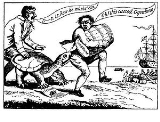
, lifting the remaining embargoes. The entire series of events was ridiculed in the press as Dambargo, Mob-Rage, Go-bar-'em or O-grab-me ('Embargo' spelled backward); there was a cartoon ridiculing the Act as a snapping turtle, dubbed 'Ograbme', grabbing at American shipping.

A case study of Rhode Island
Rhode Island

Rhode Island and Providence Plantations, more commonly referred to as Rhode Island , is a U.S. state in the New England region of the United States....
 shows the embargo devastated shipping-related industries, wrecked existing markets, and caused an increase in opposition to the Democratic-Republican Party. Smuggling was widely endorsed by the public, which viewed the embargo as a violation of their rights. Public outcry continued, helping the Federalists regain control of the state government in 1808-09. The case is a rare example of US national foreign policy
Foreign policy

A state's foreign policy, also called the international relations policy, is a set of goals outlining how the country will interact with other countries economically, politically, socially and militarily, and to a lesser extent, how the country will interact with non-state actors....
 altering local patterns of political allegiance.

Despite its unpopular nature, the Embargo Act did have some limited, unintended benefits, especially as it drove capital and labor into New England textile and other manufacturing industries, lessening America's reliance on the British. In Vermont, the embargo was doomed to failure on the Lake Champlain-Richelieu River water route because of Vermont's dependence on a Canadian outlet for produce. At St. John, Lower Canada, £140,000 worth of goods smuggled by water were recorded there in 1808 - a 31% increase over 1807. Shipments of ashes (used to make soap) nearly doubled to £54,000, but lumber dropped 23% to £11,200. Manufactured goods, which had expanded to £50,000 since Jay's Treaty of 1795, fell over 20%, especially articles made near Tidewater. Newspapers and manuscripts recorded more lake activity than usual, despite the theoretical reduction in shipping that should accompany an embargo. The smuggling was not restricted to water routes, as herds were readily driven across the uncontrollable land border. Southbound commerce gained two-thirds overall, but furs dropped a third. Customs officials maintained a stance of vigorous enforcement throughout and Gallatin's Enforcement Act (1809) was a party issue. Many Vermonters preferred the embargo's exciting game of revenuers versus smugglers, bringing high profits, versus mundane, low-profit normal trade.