


Hartford Convention

Encyclopedia

United States
The United States of America is a federal constitutional republic comprising fifty states and a federal district...
during the War of 1812
War of 1812
The War of 1812 was a military conflict fought between the forces of the United States of America and those of the British Empire. The Americans declared war in 1812 for several reasons, including trade restrictions because of Britain's ongoing war with France, impressment of American merchant...
in which New England
New England
New England is a region in the northeastern corner of the United States consisting of the six states of Maine, New Hampshire, Vermont, Massachusetts, Rhode Island, and Connecticut...
's opposition to the war reached the point where secession
Secession
Secession is the act of withdrawing from an organization, union, or especially a political entity. Threats of secession also can be a strategy for achieving more limited goals.-Secession theory:...
from the United States was discussed. The end of the war — with a return to the status quo ante bellum
Status quo ante bellum
The term status quo ante bellum is Latin, meaning literally "the state in which things were before the war".The term was originally used in treaties to refer to the withdrawal of enemy troops and the restoration of prewar leadership. When used as such, it means that no side gains or loses...
— disgraced the Federalist Party
Federalist Party (United States)
The Federalist Party was the first American political party, from the early 1790s to 1816, the era of the First Party System, with remnants lasting into the 1820s. The Federalists controlled the federal government until 1801...
, which disbanded in most places.
Trade policy
Thomas JeffersonThomas Jefferson
Thomas Jefferson was the principal author of the United States Declaration of Independence and the Statute of Virginia for Religious Freedom , the third President of the United States and founder of the University of Virginia...
's anti-foreign trade policies, particularly the Embargo Act of 1807
Embargo Act of 1807
The Embargo Act of 1807 and the subsequent Nonintercourse Acts were American laws restricting American ships from engaging in foreign trade between the years of 1807 and 1812. The Acts were diplomatic responses by presidents Thomas Jefferson and James Madison designed to protect American interests...
and James Madison's Non-Intercourse Act
Non-Intercourse Act
In the last four days of President Thomas Jefferson's presidency, the United States Congress replaced the Embargo Act of 1807 with the almost unenforceable Non-Intercourse Act of March 1809. This Act lifted all embargoes on American shipping except for those bound for British or French ports. The...
of 1809, were very unpopular in the northeastern United States, especially among merchants and shippers. Jefferson's successor, President James Madison
James Madison
James Madison, Jr. was an American statesman and political theorist. He was the fourth President of the United States and is hailed as the “Father of the Constitution” for being the primary author of the United States Constitution and at first an opponent of, and then a key author of the United...
, was even less popular in New England, particularly after his prosecution of the War of 1812
War of 1812
The War of 1812 was a military conflict fought between the forces of the United States of America and those of the British Empire. The Americans declared war in 1812 for several reasons, including trade restrictions because of Britain's ongoing war with France, impressment of American merchant...
, which ended legal trade with England
United Kingdom
The United Kingdom of Great Britain and Northern IrelandIn the United Kingdom and Dependencies, other languages have been officially recognised as legitimate autochthonous languages under the European Charter for Regional or Minority Languages...
. The opposing Federalist Party regained strength especially in New England, and in New York
New York
New York is a state in the Northeastern region of the United States. It is the nation's third most populous state. New York is bordered by New Jersey and Pennsylvania to the south, and by Connecticut, Massachusetts and Vermont to the east...
where it collaborated with Mayor DeWitt Clinton
DeWitt Clinton
DeWitt Clinton was an early American politician and naturalist who served as United States Senator and the sixth Governor of New York. In this last capacity he was largely responsible for the construction of the Erie Canal...
of New York City and supported him for president in 1812.
Reaction of New England to commerce impediments
When Madison was re-elected in 1812 the reaction in New England intensified. The war turned against the Americans, and the British effectively blockaded the entire coastline. Almost all maritime activity (apart from smuggling) was stopped and New England interests suffered.Massachusetts and Connecticut felt that they were physically threatened from without. They also experienced the repercussions of their opposition to Madison's position on relations with England. Instead of entrusting their governors with local defense, as the administration had entrusted the governors of States which supported the war, the President now insisted upon retaining the exclusive control of military movements.
Because Massachusetts and Connecticut had refused to subject their militia to the orders of the War Department
United States Department of War
The United States Department of War, also called the War Department , was the United States Cabinet department originally responsible for the operation and maintenance of the United States Army...
, Madison declined to pay their expenses. Consequently, critics said that Madison had abandoned New England to the common enemy. The Massachusetts Legislature appropriated $1,000,000 to support a state army of 10,000 men. Harrison Gray Otis
Harrison Gray Otis (lawyer)
Harrison Gray Otis , was a businessman, lawyer, and politician, becoming one of the most important leaders of the United States' first political party, the Federalists...
, who inspired these measures, suggested that the Eastern States meet in convention in Hartford. As early as 1804 New England Federalists had discussed secession from the Union if the national government became too oppressive. Those Federalists opposed to war with Britain and supportive of secession were called the Blue light federalists
Blue light federalists
Blue-light Federalist was a derogatory term used by those who believed certain Federalists to have made friendly signals to British ships in the War of 1812 to warn the British of American blockade runners, the specific event supposedly happening in 1813, in New London, Connecticut, when Commodore...
.
Secession was again mentioned in 1814–1815; all but one leading Federalist newspaper in New England supported a plan to expel the western states from the Union. Otis, the key leader of the Convention, blocked radical proposals like seizing the Federal customs house, impounding federal funds, or declaring neutrality. Otis thought the Madison administration was near collapse and that unless conservatives like himself and the other delegates took charge, the radical secessionists might take power. Indeed, Otis was unaware that Massachusetts Governor Caleb Strong
Caleb Strong
Caleb Strong was Massachusetts lawyer and politician who served as the sixth and tenth Governor of Massachusetts between 1800 and 1807, and again from 1812 until 1816.-Biography:...
had already sent a secret mission to discuss terms with the British for a separate peace.
Delegations
On October 10, 1814, the Massachusetts state legislature called for the Hartford Convention, ostensibly to discuss several constitutional amendments necessary to protect New England's interests. On December 15, 1814, delegations from all five New England states were to meet at the Old State HouseOld State House (Hartford)
The Old State House in Hartford, Connecticut is generally believed to have been designed by noted American architect Charles Bulfinch as his first public building...
in Hartford, Connecticut
Hartford, Connecticut
Hartford is the capital of the U.S. state of Connecticut. The seat of Hartford County until Connecticut disbanded county government in 1960, it is the second most populous city on New England's largest river, the Connecticut River. As of the 2010 Census, Hartford's population was 124,775, making...
, in the chamber of the Connecticut Senate
Connecticut Senate
The Connecticut State Senate is the upper house of the Connecticut General Assembly, the state legislature of the U.S. state of Connecticut. The state senate comprises 36 members, each representing a district with around 94,600 inhabitants. Senators are elected to two-year terms without term limits...
. Official delegations were sent by Massachusetts, Connecticut
Connecticut
Connecticut is a state in the New England region of the northeastern United States. It is bordered by Rhode Island to the east, Massachusetts to the north, and the state of New York to the west and the south .Connecticut is named for the Connecticut River, the major U.S. river that approximately...
, and Rhode Island
Rhode Island
The state of Rhode Island and Providence Plantations, more commonly referred to as Rhode Island , is a state in the New England region of the United States. It is the smallest U.S. state by area...
.
Twelve delegates were appointed by the Massachusetts Legislature
Massachusetts General Court
The Massachusetts General Court is the state legislature of the Commonwealth of Massachusetts. The name "General Court" is a hold-over from the Colonial Era, when this body also sat in judgment of judicial appeals cases...
, of which George Cabot and Harrison G. Otis were chief (see list below). In Connecticut, the legislature
Connecticut General Assembly
The Connecticut General Assembly is the state legislature of the U.S. state of Connecticut. It is a bicameral body composed of the 151-member House of Representatives and the 36-member Senate. It meets in the state capital, Hartford. There are no term limits for either chamber.During...
of which denounced Madison's conscription plan as barbarous and unconstitutional, a delegation of seven was made up — Chauncey Goodrich
Chauncey Goodrich
Chauncey Goodrich was an American lawyer and politician from Connecticut who represented that state in the United States Congress as both a senator and a representative.-Biography:...
and James Hillhouse
James Hillhouse
James Hillhouse was an American lawyer, real estate developer, and politician from New Haven, Connecticut. He represented Connecticut in both the U.S. House and Senate...
, at the head. Rhode Island's Legislature added four more to the list. So deep-rooted, however, was the national distrust of this movement that Vermont and New Hampshire shrank from giving the convention a public sanction. New Hampshire had a Republican
Democratic-Republican Party (United States)
The Democratic-Republican Party or Republican Party was an American political party founded in the early 1790s by Thomas Jefferson and James Madison. Political scientists use the former name, while historians prefer the latter one; contemporaries generally called the party the "Republicans", along...
council; while in Vermont the victory at Plattsburgh
Battle of Plattsburgh
The Battle of Plattsburgh, also known as the Battle of Lake Champlain, ended the final invasion of the northern states during the War of 1812...
stirred the Union spirit; Governor Martin Chittenden
Martin Chittenden
Martin Chittenden was the seventh Governor of Vermont during a crucial portion of the War of 1812.Chittenden was born in Salisbury, Connecticut, and moved to Vermont in 1776 in the wake of the founding of the town of Williston by his father, Thomas Chittenden. In 1789, Martin Chittenden graduated...
himself having changed in official tone, after the war became a defensive one. Violent county conventions representing fractions of towns chose, however, three delegates, two in New Hampshire and one in Vermont, whose credentials being accepted by the convention, the whole number of delegates assembled at Hartford was twenty-six.
The following lists the states that attended and the names of the notable attendees.
- Massachusetts
- George CabotGeorge CabotGeorge Cabot was an American merchant, seaman, and politician from Boston, Massachusetts. He represented Massachusetts in the U.S. Senate and as the Presiding Officer of the Hartford Convention.-Early life:...
- Harrison Gray OtisHarrison Gray Otis (lawyer)Harrison Gray Otis , was a businessman, lawyer, and politician, becoming one of the most important leaders of the United States' first political party, the Federalists...
- Nathan DaneNathan DaneNathan Dane was an American lawyer and statesman who represented Massachusetts in the Continental Congress from 1785 through 1788...
- William Prescott, Jr.William Prescott, Jr.William Prescott, Jr. was a representative from Massachusetts to the 1814-15 Hartford Convention....
- Timothy BigelowTimothy Bigelow (lawyer)Timothy Bigelow was an American lawyer in early 19th-century Boston, Massachusetts.Born in Massachusetts to parents Timothy Bigelow and Anna Andrews, Bigelow was educated at Harvard University. In 1802, he was elected a Fellow of the American Academy of Arts and Sciences. He served as...
- Samuel Sumner Wilde
- Joseph S. LymanJoseph S. LymanJoseph Stebbins Lyman was a U.S. Representative from New York.Born in Northfield, Massachusetts, Lyman attended the common schools. He was graduated from Dartmouth College, Hanover, New Hampshire, in 1806. He then studied law and was admitted to the bar and commenced practice in Cooperstown, New...
- Stephen Longfellow, Jr.
- George Cabot
- Connecticut
- Chauncey GoodrichChauncey GoodrichChauncey Goodrich was an American lawyer and politician from Connecticut who represented that state in the United States Congress as both a senator and a representative.-Biography:...
- John TreadwellJohn TreadwellJohn Treadwell was an American politician and the 6th Governor of Connecticut.- Early life :Treadwell was born in Farmington, Connecticut on November 23, 1745. He studied law at Yale University. He then practiced law in Farmington.- Politics :Treadwell served as a member of the General Assembly...
- James HillhouseJames HillhouseJames Hillhouse was an American lawyer, real estate developer, and politician from New Haven, Connecticut. He represented Connecticut in both the U.S. House and Senate...
- Zephaniah SwiftZephaniah SwiftZephaniah Swift was an American jurist, author, and politician from Windham, Connecticut. He was born in Wareham, Massachusetts and moved with his parents to Lebanon, Connecticut. He completed preparatory studies and graduated from Yale College in 1778...
- Nathaniel SmithNathaniel SmithNathaniel Smith was a Representative to the United States Congress from Connecticut. He was born in Woodbury, Connecticut on January 6, 1762. He was the brother of Nathan Smith and uncle of Truman Smith....
- Calvin Goddard
- Roger Minott ShermanRoger Minott ShermanRoger Minott Sherman was the youngest of six children of Rev. Josiah Sherman , a brother of the distinguished Roger Sherman; and his mother was Martha Minott, the daughter of the Honorable James and Elizabeth Minott of Concord,...
- Chauncey Goodrich
- Rhode Island
- Daniel LymanDaniel LymanDaniel Lyman was a New England soldier, Chief Justice of the Rhode Island Supreme Court and member of the secessionist Hartford Convention....
- Samuel Ward, Jr.Samuel Ward, Jr.Samuel Ward, Jr. was an American Revolutionary War soldier and delegate to the secessionist Hartford Convention.-Biography:Ward was born in Westerly, Rhode Island on November 17, 1756 as the fifth child of founding trustee of Brown University, Continental Congress delegate and colonial governor of...
- Edward MantonEdward MantonEdward Manton was a delegate to the secessionist Hartford Convention in 1814-15.Manton was born around 1760 in Johnston, Rhode Island. Manton served as a presidential elector in 1800 presidential election. Manton "rarely mingled in the political discussions of his day...
- Benjamin HazardBenjamin HazardBenjamin Hazard was a Rhode Island legislator, attorney and member of the secessionist Hartford Convention.Hazard was born on September 18, 1770 in Middletown, Rhode Island. He graduated from Brown University in the class of 1792 and later married Harriet Lyman, daughter of Daniel Lyman and Mary...
- Daniel Lyman
- New Hampshire and Vermont
- Two delegations represented New Hampshire and Vermont
Secret meetings
In all, twenty-six delegates attended the secret meetings. No records of the proceedings were kept, and meetings continued through January 5, 1815. After choosing George CabotGeorge Cabot
George Cabot was an American merchant, seaman, and politician from Boston, Massachusetts. He represented Massachusetts in the U.S. Senate and as the Presiding Officer of the Hartford Convention.-Early life:...
as president, and Theodore Dwight
Theodore Dwight (elder)
Theodore Dwight was an American lawyer and journalist.He was the brother of Timothy Dwight, president of Yale, and the grandson of Jonathan Edwards...
as secretary, the present convention remained in closed session for three continuous weeks. Surviving letters of contemporaries show that representative Federalists labored with these delegates to procure the secession of New England. Assembling amid rumors of treason and the execration of all the country west of the Hudson, its members were watched by an army officer who had been conveniently stationed in the vicinity. Cabot's journal of its proceedings, when it was eventually opened, was a meager sketch of formal proceedings; he made no record of yeas and nays, stated none of the amendments offered to the various reports, and neglected to attach the name of authors to propositions. It is impossible to ascertain the speeches or votes of individual delegates.
Convention report
The convention ended with a report and resolutions, signed by the delegates present, and adopted on the day before final adjournment. The report said that New England had a "duty" to assert its authority over unconstitutionalConstitutionality
Constitutionality is the condition of acting in accordance with an applicable constitution. Acts that are not in accordance with the rules laid down in the constitution are deemed to be ultra vires.-See also:*ultra vires*Company law*Constitutional law...
infringements on its sovereignty — a doctrine that echoed the policy of Jefferson and Madison in 1798 (in the Kentucky and Virginia Resolutions
Kentucky and Virginia Resolutions
The Kentucky and Virginia Resolutions were political statements drafted in 1798 and 1799, in which the Kentucky and Virginia legislatures took the position that the federal Alien and Sedition Acts were unconstitutional...
), and which would later reappear in a different context as "nullification
Nullification (U.S. Constitution)
Nullification is a legal theory that a State has the right to nullify, or invalidate, any federal law which that state has deemed unconstitutional...
."
The Hartford Convention's final report proposed several amendments to the US Constitution
United States Constitution
The Constitution of the United States is the supreme law of the United States of America. It is the framework for the organization of the United States government and for the relationship of the federal government with the states, citizens, and all people within the United States.The first three...
. These attempted to combat the policies of the ruling Republicans by:
- Prohibiting any trade embargo lasting over 60 days;
- Requiring a two-thirds Congressional majority for declaration of offensive war, admission of a new state, or interdiction of foreign commerce;
- Removing the three-fifths representation advantage of the South;
- Limiting future Presidents to one term;
- Requiring each President to be from a different state than his predecessor. (This provision was aimed directly at the ruling Virginia DynastyVirginia DynastyThe Virginia dynasty is a term sometimes used to describe the fact that four of the first five Presidents of the United States were from Virginia. The term sometimes excludes George Washington, who, though a Virginia planter, was closely aligned with the policies of the Federalist Party, and was...
.)
Negative reception
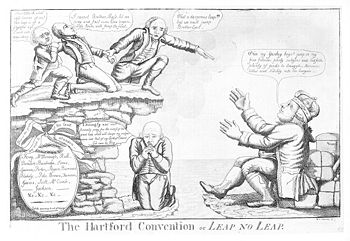
Some delegates may have been in favor of New England's secession from the United States, and forming an independent republic, though no such resolution was adopted at the convention. Historian Samuel Eliot Morison
Samuel Eliot Morison
Samuel Eliot Morison, Rear Admiral, United States Naval Reserve was an American historian noted for his works of maritime history that were both authoritative and highly readable. He received his Ph.D. from Harvard University in 1912, and taught history at the university for 40 years...
rejected the notion that Hartford was an attempt to take New England out of the Union and give treasonous aid and comfort to Britain. Morison wrote, "Democratic politicians, seeking a foil to their own mismanagement of the war and to discredit the still formidable Federalist party, caressed and fed this infant myth until it became so tough and lusty as to defy both solemn denials and documentary proof."
Massachusetts actually sent three commissioners to Washington, D.C. to negotiate these terms. When they arrived in February, 1815, news of Andrew Jackson
Andrew Jackson
Andrew Jackson was the seventh President of the United States . Based in frontier Tennessee, Jackson was a politician and army general who defeated the Creek Indians at the Battle of Horseshoe Bend , and the British at the Battle of New Orleans...
's stunning victory at the Battle of New Orleans
Battle of New Orleans
The Battle of New Orleans took place on January 8, 1815 and was the final major battle of the War of 1812. American forces, commanded by Major General Andrew Jackson, defeated an invading British Army intent on seizing New Orleans and the vast territory the United States had acquired with the...
, and the signing of the Treaty of Ghent
Treaty of Ghent
The Treaty of Ghent , signed on 24 December 1814, in Ghent , was the peace treaty that ended the War of 1812 between the United States of America and the United Kingdom of Great Britain and Ireland...
, preceded them and, consequently, their presence in the capital seemed both ludicrous and subversive. They quickly returned. Thereafter, both Hartford Convention and Federalist Party became synonymous with disunion, secession, and treason, especially in the South. The party was ruined, and survived only in a few localities for several more years before vanishing entirely.