


Emor

Encyclopedia
Emor is the 31st weekly Torah portion (parshah) in the annual Jewish
cycle of Torah reading
and the eighth in the book of Leviticus. It constitutes Jews in the Diaspora
generally read it in late April or early May. Jews also read parts of the parshah, as the initial Torah readings for the second day of Passover
and the first and second days of Sukkot
.
The parshah provides purity rules for priests
, recounts the holy days
, provides for lights and bread in the sanctuary, and tells the story of a blasphemer and his punishment.
told Moses
to tell the priests these laws for the priests. None were to come in contact with a dead
body except for that of his closest relatives: his parent, child, brother, or virgin sister. They were not to shave any part of their heads or the side-growth of their beard
s or gash their flesh. They were not to marry a harlot or divorcee. The daughter of a priest who became a harlot was to be executed.
The High Priest was not to bare his head or rend his vestments. He was not to come near any dead body, even that of his father or mother. He was to marry only a virgin of his own kin.
No disabled priest could offer sacrifices
. He could eat the meat of sacrifices, but could not come near the altar
. No priest who had become unclean could eat the meat of sacrifices. A priest could not share his sacrificial meat with lay persons, persons whom the priest had hired, or the priest’s married daughters, but the priest could share that meat with his slave
s and widowed or divorced daughters, if those daughters had no children. Only animals without defect qualified for sacrifice.

s to proclaim the following sacred occasions:
for lighting the lamps of the Tabernacle regularly, from evening to morning. And God called for baking twelve loaves to be placed in the Tabernacle every Sabbath, and thereafter given to the priests, who were to eat them in the sacred precinct.
) and an Egyptian
father got in a fight, and pronounced God’s Name in blasphemy. The people brought him to Moses and placed him in custody until God’s decision should be made clear. God told Moses to take the blasphemer outside the camp where all who heard him were to lay their hands upon his head, and the whole community was to stone him, and they did so. ( 23.)
God instructed that anyone who blasphemed God was to be put to death. Anyone who killed any human being was to be put to death. One who killed a beast was to make restitution. And anyone who maimed another person was to pay proportionately (in what has been called lex talionis).
setting out the teaching that contact with the dead is antithetical to purity.
In Numbers
God instructed Moses to command the Israelites to put out of the camp every person defiled by contact with the dead, so that they would not defile their camps, in the midst of which God dwelt.
sets out a procedure for a red cow mixture for decontamination from corpse contamination.
In its profession associated with tithing, instructed Israelites to aver that they had not eaten from the tithe in mourning, nor put away any of it while unclean, nor given any of it to the dead.
In Ezekiel
the prophet
Ezekiel
cites the burial of kings within the Temple
as one of the practices that defiled the Temple and cause God to abandon it.
In the Hebrew Bible, uncleanness has a variety of associations. 11; 11; and and associate it with death. And perhaps similarly, associates it with skin disease. associates it with childbirth. associates it with various sexuality-related events. And Jeremiah
23; and and Hosea
associate it with contact with the worship of alien gods.
of Passover. In the Hebrew Bible, Passover is called:
Some explain the double nomenclature of “Passover” and “Feast of Unleavened Bread” as referring to two separate feasts that the Israelites combined sometime between the Exodus
and when the Biblical text became settled. (See, e.g., W. Gunther Plaut
. The Torah: A Modern Commentary, 456. New York: Union of American Hebrew Congregations, 1981. ISBN 0-8074-0055-6.) and indicate that the dedication of the firstborn also became associated with the festival.
Some believe that the “Feast of Unleavened Bread” was an agricultural festival at which the Israelites celebrated the beginning of the grain harvest. Moses may have had this festival in mind when in and he petitioned Pharaoh to let the Israelites go to celebrate a feast in the wilderness. (Plaut, at 464.)
“Passover,” on the other hand, was associated with a thanksgiving sacrifice of a lamb, also called “the Passover,” “the Passover lamb,” or “the Passover offering.” ( 21, 27, 43, 48; 5–6; 17–18; 6–9, 11, 13.)
and and 5, and direct “Passover” to take place on the evening of the fourteenth of Aviv (Nisan
in the Hebrew calendar
after the Babylonian captivity
). and confirm that practice. and and direct the “Feast of Unleavened Bread” to take place over seven days and and direct that it begin on the fifteenth of the month. Some believe that the propinquity of the dates of the two festivals led to their confusion and merger. (Plaut, at 464.)
and 27 link the word “Passover” (Pesach, פֶּסַח) to God’s act to “pass over” (pasach, פָסַח) the Israelites’ houses in the plague
of the firstborn. In the Torah, the consolidated Passover and Feast of Unleavened Bread thus commemorate the Israelites’ liberation from Egypt
. ( 3, 6.)
The Hebrew Bible frequently notes the Israelites’ observance of Passover at turning points in their history. reports God’s direction to the Israelites to observe Passover in the wilderness of Sinai
on the anniversary of their liberation from Egypt. reports that upon entering the Promised Land
, the Israelites kept the Passover on the plains of Jericho
and ate unleavened cakes and parched corn, produce of the land, the next day. reports that King Josiah
commanded the Israelites to keep the Passover in Jerusalem as part of Josiah’s reforms, but also notes that the Israelites had not kept such a Passover from the days of the Biblical judges
nor in all the days of the kings of Israel or the kings of Judah
, calling into question the observance of even Kings David
and Solomon
. The more reverent however, reports that Solomon offered sacrifices on the festivals, including the Feast of Unleavened Bread. And reports King Hezekiah
’s observance of a second Passover anew, as sufficient numbers of neither the priests nor the people were prepared to do so before then. And reports that the Israelites returned from the Babylonian captivity observed Passover, ate the Passover lamb, and kept the Feast of Unleavened Bread seven days with joy.
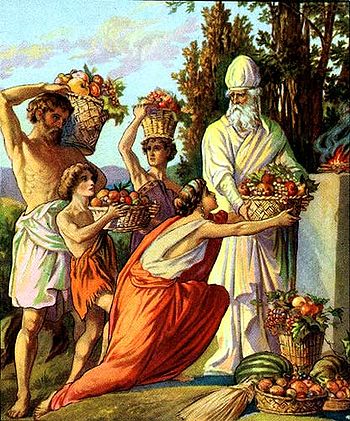
associates Shavuot with the first-fruits (בִּכּוּרֵי, bikurei) of the wheat harvest. (See also ) In turn, set out the ceremony for the bringing of the first fruits.
To arrive at the correct date, instructs counting seven weeks from the day after the day of rest of Passover, the day that they brought the sheaf of barley for waving. Similarly, directs counting seven weeks from when they first put the sickle to the standing barley.
sets out a course of offerings for the fiftieth day, including a meal-offering of two loaves made from fine flour from the first-fruits of the harvest; burnt-offerings of seven lambs, one bullock, and two rams; a sin-offering of a goat; and a peace-offering of two lambs. Similarly, sets out a course of offerings including a meal-offering; burnt-offerings of two bullocks, one ram, and seven lambs; and one goat to make atonement. directs a freewill-offering in relation to God’s blessing.
and ordain a holy convocation in which the Israelites were not to work.
reports that Solomon offered burnt-offerings on the Feast of Weeks.
Although instructs that the spring month of Aviv (since the Babylonian captivity
called Nisan
) “shall be the first month of the year,” and also reflect an “end of the year” or a "turn of the year" in the autumn harvest month of Tishrei
.
and both describe Rosh Hashanah as an holy convocation, a day of solemn rest in which no servile work is to be done, involving the blowing of horns and an offering to God.
speaks of "in the beginning of the year" (בְּרֹאשׁ הַשָּׁנָה, b’Rosh HaShanah) in Tishrei, although the Rabbis traditional interpreted Ezekiel
to refer to Yom Kippur.
reports that in the Persian era, when the seventh month came, the Israelites gathered together in Jerusalem, and the priests offered burnt-offerings to God, morning and evening, as written in the Law of Moses.
Nehemiah
reports that it was on Rosh Hashanah (the first day of the seventh month) that all the Israelites gathered together before the water gate and Ezra
the scribe read the Law from early morning until midday. And Nehemiah
, Ezra, and the Levites told the people that the day was holy to the Lord their God; they should neither mourn nor weep; but they should go their way, eat the fat, drink the sweet, and send portions to those who had nothing.
Psalm
likely refers to Rosh Hashanah when it enjoins, "Blow the horn at the new moon, at the full moon of our feast day. For it is a statute for Israel, an ordinance of the God of Jacob."
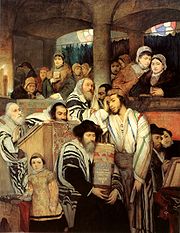
Much as Yom Kippur, on the 10th of the month of Tishrei
, precedes the Festival of Sukkot, on the 15th of the month of Tishrei, speaks of a period starting on the 10th of the month of Nisan
preparatory to the Festival of Passover, on the 15th of the month of Nisan.
and and present similar injunctions to observe Yom Kippur. and and set the Holy Day on the tenth day of the seventh month (Tishrei). and and instruct that “you shall afflict your souls.” makes clear that a full day is intended: “you shall afflict your souls; in the ninth day of the month at evening, from evening to evening.” And threatens that whoever “shall not be afflicted in that same day, he shall be cut off from his people.” and and command that you “shall do no manner of work.” Similarly, and call it a “Sabbath of solemn rest.” And in God threatens that whoever “does any manner of work in that same day, that soul will I destroy from among his people.” and and describe the purpose of the day to make atonement for the people. Similarly, speaks of the purpose “to cleanse you from all your sins,” and speaks of making atonement for the most holy place, the tent of meeting, the altar; and the priests. instructs that the commandment applies both to “the home-born” and to “the stranger who sojourns among you.” and and command offerings to God. And and institute the observance as “a statute forever.”
sets out detailed procedures for the priest’s atonement ritual during the time of the Temple.
instructs that after seven Sabbatical years, on the Jubilee year
, on the day of atonement, the Israelites were to proclaim liberty throughout the land with the blast of the horn and return every man to his possession and to his family.
In the Haftarah
for Yom Kippur morning, God describes “the fast that I have chosen [on] the day for a man to afflict his soul.” make clear that “to afflict the soul” was understood as fasting. But goes on to impress that “to afflict the soul,” God also seeks acts of social justice: “to loose the fetters of wickedness, to undo the bands of the yoke,” “to let the oppressed go free,” “to give your bread to the hungry, and . . . bring the poor that are cast out to your house,” and “when you see the naked, that you cover him.”
Sukkot’s agricultural origin is evident from the name "The Feast of Ingathering," from the ceremonies accompanying it, and from the season and occasion of its celebration: "At the end of the year when you gather in your labors out of the field" ; "after you have gathered in from your threshing-floor and from your winepress." It was a thanksgiving for the fruit harvest. (Compare .) And in what may explain the festival’s name, Isaiah
reports that grape harvesters kept booths in their vineyards. (Isaiah
) Coming as it did at the completion of the harvest, Sukkot was regarded as a general thanksgiving for the bounty of nature in the year that had passed.
Sukkot became one of the most important feasts in Judaism, as indicated by its designation as “the Feast of the Lord” or simply “the Feast.” ( 65; ) Perhaps because of its wide attendance, Sukkot became the appropriate time for important state ceremonies. Moses instructed the children of Israel to gather for a reading of the Law during Sukkot every seventh year. King Solomon dedicated the Temple in Jerusalem on Sukkot. And Sukkot was the first sacred occasion observed after the resumption of sacrifices in Jerusalem after the Babylonian captivity.
In the time of Nehemiah, after the Babylonian captivity, the Israelites celebrated Sukkot by making and dwelling in booths, a practice of which Nehemiah reports: “the Israelites had not done so from the days of Joshua.” In a practice related to that of the Four Species
, Nehemiah also reports that the Israelites found in the Law the commandment that they “go out to the mountains and bring leafy branches of olive
trees, pine
trees, myrtle
s, palms
and [other] leafy trees to make booths.” In God told Moses to command the people: “On the first day you shall take the product of hadar trees, branches of palm trees, boughs of leafy trees, and willow
s of the brook,” and “You shall live in booths seven days; all citizens in Israel shall live in booths, in order that future generations may know that I made the Israelite people live in booths when I brought them out of the land of Egypt.” The book of Numbers, however, indicates that while in the wilderness, the Israelites dwelt in tents. Some secular scholars consider (the commandments regarding booths and the four species) to be an insertion by a late redactor. (E.g., Richard Elliott Friedman
. The Bible with Sources Revealed, 228–29. New York: HarperSanFrancisco, 2003.)
Jeroboam
son of Nebat, King of the northern Kingdom of Israel
, whom describes as practicing “his evil way,” celebrated a festival on the fifteenth day of the eighth month, one month after Sukkot, “in imitation of the festival in Judah.” “While Jeroboam was standing on the altar
to present the offering, the man of God, at the command of the Lord, cried out against the altar” in disapproval.
According to the prophet Zechariah, in the messianic era, Sukkot will become a universal festival, and all nations will make pilgrimages annually to Jerusalem to celebrate the feast there.
) that Moses gave us in writing that are both pure, dealing with the law of purity. Rabbi Tanhum taught that they were given on account of the tribe of Levi
, of whom it is written (in ), “he [God’s messenger] shall purify the sons of Levi
and purge them.” (Leviticus Rabbah
26:3.)
The Gemara
noted the apparently superfluous “say to them” in and reported an interpretation that the language meant that adult Kohanim
must warn their children away from becoming contaminated by contact with a corpse. But then the Gemara stated that the correct interpretation was that the language meant to warn adults to avoid contaminating the children through their own contact. (Babylonian Talmud
Yevamot 114a.) And a Midrash
explained the apparent redundancy by teaching that the first expression of “speak” was intended to intimate that a priest may defile himself on account of an unattended corpse (met mitzvah), while the second expression “say” was intended to intimate that he may not defile himself on account of any other corpse. (Leviticus Rabbah 26:8.)
The Mishnah
taught that the commandment of for Kohanim not to become ritually impure for the dead is one of only three exceptions to the general rule that every commandment that is a prohibition (whether time-dependent or not) governs both men and women. The other exceptions are the commandments of not to round off the side-growth of one’s head and not to destroy the corners of one’s beard. (Mishnah Kiddushin 1:7; Babylonian Talmud Kiddushin 29a.)
The Mishnah employed the prohibitions of and to imagine how one could with one action violate up to nine separate commandments. One could (1) plow with an ox and a donkey yoked together (in violation of ) (2 and 3) that are two animals dedicated to the sanctuary, (4) plowing mixed seeds sown in a vineyard (in violation of ), (5) during a Sabbatical year (in violation of ), (6) on a Festival-day (in violation of, for example), (7) when the plower is a priest (in violation of ) and (8) a Nazirite (in violation of ) plowing in a contaminated place. Chananya ben Chachinai
said that the plower also may have been wearing a garment of wool and linen (in violation of and ). They said to him that this would not be in the same category as the other violations. He replied that neither is the Nazirite in the same category as the other violations. (Mishnah Makkot 3:9; Babylonian Talmud Makkot 21b.)
The Gemara taught that where prohibited the priest from defiling himself by contact with the dead “except for his flesh, that is near to him” the words “his flesh” meant to include his wife in the exception. (Babylonian Talmud Yevamot 22b.)
The Mishnah interpreted ) to teach that both acting and retired High Priests had to marry a virgin and were forbidden to marry a widow. And the Mishnah interpreted ) to teach that both could not defile themselves for the dead bodies of their relatives, could not let their hair grow wild in mourning, and could not rend their clothes as other Jews did in mourning. (Mishnah Horayot 3:4; Babylonian Talmud Horayot 11b.) The Mishnah taught that while an ordinary priest in mourning rent his garments from above, a High Priest rent his garments from below. And the Mishnah taught that on the day of a close relative’s death, the High Priest could still offer sacrifices but could not eat of the sacrificial meat, while under those circumstances an ordinary priest could neither offer sacrifices nor eat sacrificial meat. (Mishnah Horayot 3:5; Babylonian Talmud Horayot 12b.)
Rabbi Hiyya bar Abba cited to support the proposition that a Kohen should be called up first to read the law, for the verse taught to give Kohanim precedence in every matter of sanctity. And a Baraita
was taught in the school of Rabbi Ishmael
that meant that Jews should give Kohanim precedence in every matter of sanctity, including speaking first at every assembly, saying grace first, and choosing his portion first when an item was to be divided. (Babylonian Talmud Gittin 59b.) The Mishnah recognized the status of the Kohanim over Levites, Levites over Israelites, and Israelites over those born from forbidden relationships
, but only when they were equal in all other respects. The Mishnah taught that a learned child of forbidden parents took precedence over an ignorant High Priest. (Mishnah Horayot 3:8; Babylonian Talmud Horayot 13a.)
The Gemara interpreted the law of the Kohen’s adulterous daughter in in Babylonian Talmud Sanhedrin 50a–52a.
Interpreting the words “the priest that is highest among his brethren” in a Midrash taught that the High Priest was superior in five things: wisdom, strength, beauty, wealth, and age. (Leviticus Rabbah 26:9.)
Rabbi
said that a priest with a blemish within the meaning of who officiated at services in the Sanctuary was liable to death at the hands of Heaven, but the Sages maintained that he was merely prohibited. (Babylonian Talmud Sanhedrin 83a.)
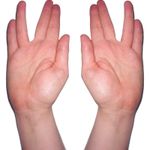 The Mishnah taught that a priest whose hands were deformed should not lift up his hands to say the priestly blessing
, and Rabbi Judah said that a priest whose hands were discolored should not lift up his hands, because it would cause the congregation to look at him during this blessing when they should not. (Mishnah Megillah 4:7; Babylonian Talmud Megillah 24b.) A Baraita stated that deformities on the face, hands, or feet were disqualifying for saying the priestly blessing. Rabbi Joshua ben Levi
said that a Kohen with spotted hands should not say the blessing. A Baraita taught that one whose hands were curved inwards or bent sideways should not say the blessing. And Rav Huna
said that a man whose eyes ran should not say the blessing. But the Gemara noted that such a Kohen in Rav Huna’s neighborhood used to say the priestly blessing and apparently even Rav Huna did not object, because the townspeople had become accustomed to the Kohen. And the Gemara cited a Baraita that taught that a man whose eyes ran should not lift up his hands, but he was permitted to do so if the townspeople were accustomed to him. Rabbi Johanan
said that a man blind in one eye should not lift up his hands. But the Gemara noted that there was one in Rabbi Johanan’s neighborhood who used to lift up his hands, as the townspeople were accustomed to him. And the Gemara cited a Baraita that taught that a man blind in one eye should not lift up his hands, but if the townspeople were accustomed to him, he was permitted. Rabbi Judah said that a man whose hands were discolored should not lift up his hands, but the Gemara cited a Baraita that taught that if most of the men of the town follow the same hand-discoloring occupation, it was permitted. (Babylonian Talmud Megillah 24b.)
Rav Ashi deduced from that arrogance constitutes a blemish. (Babylonian Talmud Megillah 29a.)
, but the young priests took him out of the Temple court and split his skull with clubs. (Mishnah Sanhedrin 9:6; Babylonian Talmud Sanhedrin 81b.)
A Baraita interpreted the words “there shall be no blemish therein” in to forbid causing a blemish in a sacrificial animal even indirectly. (Babylonian Talmud Bekhorot 33b–34a.)
Ben Zoma
interpreted the words “neither shall you do this in your land” in to forbid castrating even a dog (an animal that one could never offer as a sacrifice). (Babylonian Talmud Chagigah 14b.)
The Gemara interpreted what constitutes profanation of God’s Name within the meaning of Rab
said that it would profane God’s Name if a Torah scholar took meat from a butcher without paying promptly. Abaye
said that this would profane God’s Name only in a place where vendors did not have a custom of going out to collect payment from their customers. Rabbi Johanan said that it would profane God’s Name if a Torah scholar walked six feet without either contemplating Torah or wearing tefillin
. Isaac of the School of Rabbi Jannai said that it would profane God’s Name if one’s bad reputation caused colleagues to become ashamed. Rav Nahman bar Isaac
said that an example of this would be where people called on God to forgive so-and-so. Abaye interpreted the words “and you shall love the Lord your God” in to teach that one should strive through one’s actions to cause others to love the Name of Heaven. So that if people see that those who study Torah and Mishnah are honest in business and speak pleasantly, then they will accord honor to the Name of God. But if people see that those who study Torah and Mishnah are dishonest in business and discourteous, then they will associate their shortcomings with their being Torah scholars. (Babylonian Talmud Yoma 86a.)
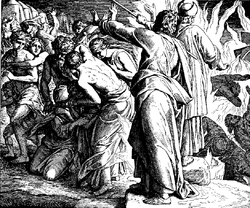 Rav Adda bar Abahah taught that a person praying alone does not say the Sanctification (Kedusha
h) prayer (which includes the words from קָדוֹשׁ קָדוֹשׁ קָדוֹשׁ יְהוָה צְבָאוֹת; מְלֹא כָל-הָאָרֶץ, כְּבוֹדוֹ, Kadosh, Kadosh, Kadosh, Adonai Tz'vaot melo kol haaretz kevodo, “Holy, Holy, Holy, the Lord of Hosts, the entire world is filled with God’s Glory”), because says: “I will be hallowed among the children of Israel,” and thus sanctification requires ten people (a minyan
). Rabinai the brother of Rabbi Hiyya bar Abba taught that we derive this by drawing an analogy between the two occurrences of the word “among” (תּוֹךְ, toch) in (“I will be hallowed among the children of Israel”) and in in which God tells Moses and Aaron: “Separate yourselves from among this congregation,” referring to Korah
and his followers. Just as which refers to a congregation, implies a number of at least ten, so implies at least ten. (Babylonian Talmud Berakhot 21b.)
, Jerusalem Talmud
, and Babylonian Talmud interpreted the laws common to all of the Festivals
in 43–49; and (Mishnah Beitzah 1:1–5:7; Tosefta Yom Tov (Beitzah) 1:1–4:11; Jerusalem Talmud Beitzah 1a–49b; Babylonian Talmud Beitzah 2a–40b.)
Tractate Pesachim
in the Mishnah, Tosefta, Jerusalem Talmud, and Babylonian Talmud interpreted the laws of the Passover in 43–49; and (Mishnah Pesachim 1:1–10:9; Tosefta Pisha (Pesachim) 1:1–10:13; Jerusalem Talmud Pesachim 1a–; Babylonian Talmud Pesachim 2a–121b.)
The Gemara noted that in listing the several festivals in and the Torah always begins with Passover. (Babylonian Talmud Yoma 2b.)
Tractate Peah
in the Mishnah, Tosefta, and Jerusalem Talmud interpreted the laws of the harvest of the corner of the field and gleanings to be given to the poor in and and (Mishnah Peah 1:1–8:9; Tosefta Peah 1:1–4:21; Jerusalem Talmud Peah 1a–73b.)
The Mishnah taught that the Torah defines no minimum or maximum for the donation of the corners of one’s field to the poor. (Mishnah Peah 1:1; Tosefta Peah 1:1; Jerusalem Talmud Peah 1a.) But the Mishnah also taught that one should not make the amount left to the poor less than one-sixtieth of the entire crop. And even though no definite amount is given, the amount given should accord with the size of the field, the number of poor people, and the extent of the yield. (Mishnah Peah 1:2; Jerusalem Talmud Peah 10b.)
Rabbi Eliezer taught that one who cultivates land in which one can plant a quarter kav of seed is obligated to give a corner to the poor. Rabbi Joshua
said land that yields two seah
of grain. Rabbi Tarfon
said land of at least six handbreadths by six handbreadths. Rabbi Judah ben Betera said land that requires two strokes of a sickle to harvest, and the law is as he spoke. Rabbi Akiba said that one who cultivates land of any size is obligated to give a corner to the poor and the first fruits
. (Mishnah Peah 3:6.)
The Mishnah taught that the poor could enter a field to collect three times a day — in the morning, at midday, and in the afternoon. Rabban Gamliel taught that they said this only so that landowners should not reduce the number of times that the poor could enter. Rabbi Akiba taught that they said this only so that landowners should not increase the number of times that the poor had to enter. The landowners of Beit Namer used to harvest along a rope and allowed the poor to collect a corner from every row. (Mishnah Peah 4:5.)
The Mishnah taught that if a wife foreswore all benefit from other people, her husband could not annul his wife’s vow, but she could still benefit from the gleanings, forgotten sheaves, and the corner of the field that and and commanded farmers to leave for the poor. (Mishnah Nedarim 11:3.)
Tractate Rosh Hashanah
in the Mishnah, Tosefta, Jerusalem Talmud, and Babylonian Talmud interpreted the laws of Rosh Hashanah in and (Mishnah Rosh Hashanah 1:1–4:9; Tosefta Rosh Hashanah 1:1–2:18; Jerusalem Talmud Rosh Hashanah 1a–; Babylonian Talmud Rosh Hashanah 2a–35a.)
A Baraita taught that on Rosh Hashanah God remembered each of Sarah, Rachel, and Hannah and decreed that they would bear children. Rabbi Eliezer found support for the Baraita from the parallel use of the word “remember” in Genesis which says about Rachel, “And God remembered Rachel,” and in which calls Rosh Hashanah “a remembrance of the blast of the trumpet.” (Babylonian Talmud Rosh Hashanah 11a.)
Tractate Yoma
in the Mishnah, Tosefta, Jerusalem Talmud, and Babylonian Talmud interpreted the laws of Yom Kippur in and and (Mishnah Yoma 1:1–8:9; Tosefta Kippurim (Yoma) 1:1–4:17; Jerusalem Talmud Yoma 1a–57a; Babylonian Talmud Yoma 2a–88a.)
Rav Mana of Sha'ab (in Galilee) and Rav Joshua of Siknin in the name of Rav Levi compared repentance at the High Holidays to the case of a province that owed arrears on its taxes to the king, and the king came to collect the debt. When the king was within ten miles, the nobility of the province came out and praised him, so he freed the province of a third of its debt. When he was within five miles, the middle-class people of the province came out and praised him, so he freed the province of another third of its debt. When he entered the province, all the people of the province — men, women, and children — came out and praised him, so he freed them of all of their debt. The king told them to let bygones be bygones; from then on they would start a new account. In a similar manner, on the eve of Rosh Hashanah, the leaders of the generation fast, and God absolves them of a third of their iniquities. From Rosh Hashanah to Yom Kippur, private individuals fast, and God absolves them of a third of their iniquities. On Yom Kippur, everyone fasts — men, women and children — and God tells Israel to let bygones be bygones; from then onwards we begin a new account. From Yom Kippur to Sukkot, all Israel are busy with the performance of religious duties. One is busy with a sukkah, one with a lulav. On the first day of Sukkot, all Israel stand in the presence of God with their palm-branches and etrogs in honor of God's name, and God tells them to let bygones be bygones; from now we begin a new account. Thus in Moses exhorts Israel: "You shall take on the first day [of Sukkot] the fruit of goodly trees, branches of palm trees and the boughs of thick trees, and willows of the brook; and you shall rejoice before the Lord your God." Rabbi Aha
explained that the words, "For with You there is forgiveness," in signify that forgiveness waits with God from Rosh Hashanah onward. And forgiveness waits that long so (in the words of ) "that You may be feared" and God may impose God's awe upon God’s creatures (through the suspense and uncertainty). (Leviticus Rabbah 30:7.)
Tractate Sukkah
in the Mishnah, Tosefta, Jerusalem Talmud, and Babylonian Talmud interpreted the laws of Sukkot in and (Mishnah Sukkah 1:1–5:8; Tosefta Sukkah 1:1–4:28; Jerusalem Talmud Sukkah 1a–33b; Babylonian Talmud Sukkah 2a–56b.)
The Mishnah taught that a sukkah can be no more than 20 cubit
s high. Rabbi Judah
, however, declared taller sukkot valid. The Mishnah taught that a sukkah must be at least 10 handbreadths high, have three walls, and have more shade than sun. (Mishnah Sukkah 1:1; Babylonian Talmud Sukkah 2a.) The House of Shammai
declared invalid a sukkah made 30 days or more before the festival, but the House of Hillel
pronounced it valid. The Mishnah taught that if one made the sukkah for the purpose of the festival, even at the beginning of the year, it is valid. (Mishnah Sukkah 1:1; Babylonian Talmud Sukkah 9a.)
The Mishnah taught that a sukkah under a tree is as invalid as a sukkah within a house. If one sukkah is erected above another, the upper one is valid, but the lower is invalid. Rabbi Judah said that if there are no occupants in the upper one, then the lower one is valid. (Mishnah Sukkah 1:2; Babylonian Talmud Sukkah 9b.)
It invalidates a sukkah to spread a sheet over the sukkah because of the sun, or beneath it because of falling leaves, or over the frame of a four-post bed. One may spread a sheet, however, over the frame of a two-post bed. (Mishnah Sukkah 1:3; Babylonian Talmud Sukkah 10a.)
It is not valid to train a vine, gourd, or ivy to cover a sukkah and then cover it with sukkah covering (s’chach). If, however, the sukkah-covering exceeds the vine, gourd, or ivy in quantity, or if the vine, gourd, or ivy is detached, it is valid. The general rule is that one may not use for sukkah-covering anything that is susceptible to ritual impurity (tumah) or that does not grow from the soil. But one may use for sukkah-covering anything not susceptible to ritual impurity that grows from the soil. (Mishnah Sukkah 1:4; Babylonian Talmud Sukkah 11a.)
Bundles of straw, wood, or brushwood may not serve as sukkah-covering. But any of them, if they are untied, are valid. All materials are valid for the walls. (Mishnah Sukkah 1:5; Babylonian Talmud Sukkah 12a.)
Rabbi Judah taught that one may use planks for the sukkah-covering, but Rabbi Meir
taught that one may not. The Mishnah taught that it is valid to place a plank four handbreadths wide over the sukkah, provided that one does not sleep under it. (Mishnah Sukkah 1:6; Babylonian Talmud Sukkah 14a.)
reported that a sage of the school of Hezekiah taught that said “eye for eye” and “life for life,” but not “life and eye for eye,” and it could sometimes happen that eye and life would be taken for an eye, as when the offender died while being blinded. Rav Papa
said in the name of Raba
that referred explicitly to healing, and the verse would not make sense if one assumed that retaliation was meant. And Rav Ashi taught that the principle of pecuniary compensation could be derived from the analogous use of the term “for” in in the expression “eye for eye” and in in the expression “he shall surely pay ox for ox.” As the latter case plainly indicated pecuniary compensation, so must the former. (Babylonian Talmud Bava Kamma 84a.)
, there are 24 positive and 39 negative commandments
in the parshah:
 (Sefer HaHinnuch: The Book of [Mitzvah] Education. Translated by Charles Wengrov, 3:163–363. Jerusalem: Feldheim Pub., 1984. ISBN 0-87306-297-3.)
for the parshah is Ezekiel
, 2002. ISBN 1-57819-697-3.)
 The laws of a priest’s family eating meat from sacrifices in provide an application of the eleventh of the Thirteen Rules for interpreting the Torah in the Baraita of Rabbi Ishmael
that many Jews read as part of the readings before the Pesukei d’Zimrah prayer service
. The eleventh rule provides that any item that was included in a generalization but was then singled out to be treated as a special case is not governed by the generalization unless Scripture explicitly returns it to the generalization. states the general rule that a priest’s entire household could eat meat from sacrifices. But then says that if a priest’s daughter married a non-priest, then she could no longer eat meat from sacrifices. What if she was then widowed or divorced without children and returned to live with her father’s household? Reading one might think that she still could not eat meat from sacrifices, but explicitly returns her to the general rule that she could eat meat from sacrifices. (Davis, Siddur for the Sabbath and Festivals, at 245–46.)
The Passover Haggadah
, in the concluding nirtzah section of the Seder
, ties together a reference to Abraham’s hospitality to his visitors in with the reading for the second day of Passover that includes in a discussion of a bullock offering. The Haggadah reports that Abraham ran to the cattle to commemorate the ox in the reading for Passover, deducing the season from the report in that Lot fed his visitors matzah
. (Joseph Tabory. JPS Commentary on the Haggadah: Historical Introduction, Translation, and Commentary, 126. Philadelphia: Jewish Publication Society, 2008. ISBN 978-0-8276-0858-0.)



Judaism
Judaism ) is the "religion, philosophy, and way of life" of the Jewish people...
cycle of Torah reading
Torah reading
Torah reading is a Jewish religious ritual that involves the public reading of a set of passages from a Torah scroll. The term often refers to the entire ceremony of removing the Torah scroll from the ark, chanting the appropriate excerpt with special cantillation, and returning the scroll to...
and the eighth in the book of Leviticus. It constitutes Jews in the Diaspora
Jewish diaspora
The Jewish diaspora is the English term used to describe the Galut גלות , or 'exile', of the Jews from the region of the Kingdom of Judah and Roman Iudaea and later emigration from wider Eretz Israel....
generally read it in late April or early May. Jews also read parts of the parshah, as the initial Torah readings for the second day of Passover
Passover
Passover is a Jewish holiday and festival. It commemorates the story of the Exodus, in which the ancient Israelites were freed from slavery in Egypt...
and the first and second days of Sukkot
Sukkot
Sukkot is a Biblical holiday celebrated on the 15th day of the month of Tishrei . It is one of the three biblically mandated festivals Shalosh regalim on which Hebrews were commanded to make a pilgrimage to the Temple in Jerusalem.The holiday lasts seven days...
.
The parshah provides purity rules for priests
Kohen
A Kohen is the Hebrew word for priest. Jewish Kohens are traditionally believed and halachically required to be of direct patrilineal descent from the Biblical Aaron....
, recounts the holy days
Jewish holiday
Jewish holidays are days observed by Jews as holy or secular commemorations of important events in Jewish history. In Hebrew, Jewish holidays and festivals, depending on their nature, may be called yom tov or chag or ta'anit...
, provides for lights and bread in the sanctuary, and tells the story of a blasphemer and his punishment.
Rules for priests
GodNames of God in Judaism
In Judaism, the name of God is more than a distinguishing title; it represents the Jewish conception of the divine nature, and of the relationship of God to the Jewish people and to the world. To demonstrate the sacredness of the names of God, and as a means of showing respect and reverence for...
told Moses
Moses
Moses was, according to the Hebrew Bible and Qur'an, a religious leader, lawgiver and prophet, to whom the authorship of the Torah is traditionally attributed...
to tell the priests these laws for the priests. None were to come in contact with a dead
Death
Death is the permanent termination of the biological functions that sustain a living organism. Phenomena which commonly bring about death include old age, predation, malnutrition, disease, and accidents or trauma resulting in terminal injury....
body except for that of his closest relatives: his parent, child, brother, or virgin sister. They were not to shave any part of their heads or the side-growth of their beard
Beard
A beard is the collection of hair that grows on the chin, cheeks and neck of human beings. Usually, only pubescent or adult males are able to grow beards. However, women with hirsutism may develop a beard...
s or gash their flesh. They were not to marry a harlot or divorcee. The daughter of a priest who became a harlot was to be executed.
The High Priest was not to bare his head or rend his vestments. He was not to come near any dead body, even that of his father or mother. He was to marry only a virgin of his own kin.
No disabled priest could offer sacrifices
Korban
The term offering as found in the Hebrew Bible in relation to the worship of Ancient Israel is mainly represented by the Hebrew noun korban whether for an animal or other offering...
. He could eat the meat of sacrifices, but could not come near the altar
Altar
An altar is any structure upon which offerings such as sacrifices are made for religious purposes. Altars are usually found at shrines, and they can be located in temples, churches and other places of worship...
. No priest who had become unclean could eat the meat of sacrifices. A priest could not share his sacrificial meat with lay persons, persons whom the priest had hired, or the priest’s married daughters, but the priest could share that meat with his slave
Slavery
Slavery is a system under which people are treated as property to be bought and sold, and are forced to work. Slaves can be held against their will from the time of their capture, purchase or birth, and deprived of the right to leave, to refuse to work, or to demand compensation...
s and widowed or divorced daughters, if those daughters had no children. Only animals without defect qualified for sacrifice.
Holy days
God told Moses to instruct the IsraeliteIsraelite
According to the Bible the Israelites were a Hebrew-speaking people of the Ancient Near East who inhabited the Land of Canaan during the monarchic period .The word "Israelite" derives from the Biblical Hebrew ישראל...
s to proclaim the following sacred occasions:
- The SabbathShabbatShabbat is the seventh day of the Jewish week and a day of rest in Judaism. Shabbat is observed from a few minutes before sunset on Friday evening until a few minutes after when one would expect to be able to see three stars in the sky on Saturday night. The exact times, therefore, differ from...
on the seventh day - Passover for 7 days beginning at twilight of the 14th day of the first month
- ShavuotShavuotThe festival of is a Jewish holiday that occurs on the sixth day of the Hebrew month of Sivan ....
50 days later - Rosh HashanahRosh HashanahRosh Hashanah , , is the Jewish New Year. It is the first of the High Holy Days or Yamim Nora'im which occur in the autumn...
on the first day of the seventh month - Yom KippurYom KippurYom Kippur , also known as Day of Atonement, is the holiest and most solemn day of the year for the Jews. Its central themes are atonement and repentance. Jews traditionally observe this holy day with a 25-hour period of fasting and intensive prayer, often spending most of the day in synagogue...
on the 10th day of the seventh month - Sukkot for 8 days beginning on the 15th day of the seventh month
Lights and bread in the sanctuary
God told Moses to command the Israelites to bring clear olive oilOlive oil
Olive oil is an oil obtained from the olive , a traditional tree crop of the Mediterranean Basin. It is commonly used in cooking, cosmetics, pharmaceuticals, and soaps and as a fuel for traditional oil lamps...
for lighting the lamps of the Tabernacle regularly, from evening to morning. And God called for baking twelve loaves to be placed in the Tabernacle every Sabbath, and thereafter given to the priests, who were to eat them in the sacred precinct.
A blasphemer
A man with an Israelite mother (from the tribe of DanTribe of Dan
The Tribe of Dan, also sometimes spelled as "Dann", was one of the Tribes of Israel. Though known mostly from biblical sources, they were possibly descendants of the Denyen Sea Peoples who joined with Hebrews...
) and an Egyptian
Ancient Egypt
Ancient Egypt was an ancient civilization of Northeastern Africa, concentrated along the lower reaches of the Nile River in what is now the modern country of Egypt. Egyptian civilization coalesced around 3150 BC with the political unification of Upper and Lower Egypt under the first pharaoh...
father got in a fight, and pronounced God’s Name in blasphemy. The people brought him to Moses and placed him in custody until God’s decision should be made clear. God told Moses to take the blasphemer outside the camp where all who heard him were to lay their hands upon his head, and the whole community was to stone him, and they did so. ( 23.)
God instructed that anyone who blasphemed God was to be put to death. Anyone who killed any human being was to be put to death. One who killed a beast was to make restitution. And anyone who maimed another person was to pay proportionately (in what has been called lex talionis).
Corpse contamination
In God instructed Moses to direct the priests not to allow themselves to become defiled by contact with the dead, except for a mother, father, son, daughter, brother, or unmarried sister. And the priests were not to engage in mourning rituals of making baldness upon their heads, shaving off the corners of their beards, or cutting their flesh. This prohibition of corpse contamination is one of a series of passages in the Hebrew BibleTanakh
The Tanakh is a name used in Judaism for the canon of the Hebrew Bible. The Tanakh is also known as the Masoretic Text or the Miqra. The name is an acronym formed from the initial Hebrew letters of the Masoretic Text's three traditional subdivisions: The Torah , Nevi'im and Ketuvim —hence...
setting out the teaching that contact with the dead is antithetical to purity.
In Numbers
Book of Numbers
The Book of Numbers is the fourth book of the Hebrew Bible, and the fourth of five books of the Jewish Torah/Pentateuch....
God instructed Moses to command the Israelites to put out of the camp every person defiled by contact with the dead, so that they would not defile their camps, in the midst of which God dwelt.
sets out a procedure for a red cow mixture for decontamination from corpse contamination.
In its profession associated with tithing, instructed Israelites to aver that they had not eaten from the tithe in mourning, nor put away any of it while unclean, nor given any of it to the dead.
In Ezekiel
Book of Ezekiel
The Book of Ezekiel is the third of the Latter Prophets in the Hebrew Bible, following the books of Isaiah and Jeremiah and preceding the Book of the Twelve....
the prophet
Prophet
In religion, a prophet, from the Greek word προφήτης profitis meaning "foreteller", is an individual who is claimed to have been contacted by the supernatural or the divine, and serves as an intermediary with humanity, delivering this newfound knowledge from the supernatural entity to other people...
Ezekiel
Ezekiel
Ezekiel , "God will strengthen" , is the central protagonist of the Book of Ezekiel in the Hebrew Bible. In Judaism, Christianity and Islam, Ezekiel is acknowledged as a Hebrew prophet...
cites the burial of kings within the Temple
Temple in Jerusalem
The Temple in Jerusalem or Holy Temple , refers to one of a series of structures which were historically located on the Temple Mount in the Old City of Jerusalem, the current site of the Dome of the Rock. Historically, these successive temples stood at this location and functioned as the centre of...
as one of the practices that defiled the Temple and cause God to abandon it.
In the Hebrew Bible, uncleanness has a variety of associations. 11; 11; and and associate it with death. And perhaps similarly, associates it with skin disease. associates it with childbirth. associates it with various sexuality-related events. And Jeremiah
Book of Jeremiah
The Book of Jeremiah is the second of the Latter Prophets in the Hebrew Bible, following the book of Isaiah and preceding Ezekiel and the Book of the Twelve....
23; and and Hosea
Book of Hosea
The Book of Hosea is one of the books of the Hebrew Bible. It stands first in order among what are known as the twelve Minor Prophets.-Background and Content:...
associate it with contact with the worship of alien gods.
Passover
refers to the FestivalJewish holiday
Jewish holidays are days observed by Jews as holy or secular commemorations of important events in Jewish history. In Hebrew, Jewish holidays and festivals, depending on their nature, may be called yom tov or chag or ta'anit...
of Passover. In the Hebrew Bible, Passover is called:
- “Passover” (Pesach, פֶּסַח) ( 21, 27, 43, 48; 4–6, 10, 12–14; Deuteronomy 5–6; JoshuaBook of JoshuaThe Book of Joshua is the sixth book in the Hebrew Bible and of the Old Testament. Its 24 chapters tell of the entry of the Israelites into Canaan, their conquest and division of the land under the leadership of Joshua, and of serving God in the land....
2 KingsBooks of KingsThe Book of Kings presents a narrative history of ancient Israel and Judah from the death of David to the release of his successor Jehoiachin from imprisonment in Babylon, a period of some 400 years...
EzraBook of EzraThe Book of Ezra is a book of the Hebrew Bible. Originally combined with the Book of Nehemiah in a single book of Ezra-Nehemiah, the two became separated in the early centuries of the Christian era...
2 ChroniclesBooks of ChroniclesThe Books of Chronicles are part of the Hebrew Bible. In the Masoretic Text, it appears as the first or last book of the Ketuvim . Chronicles largely parallels the Davidic narratives in the Books of Samuel and the Books of Kings...
5, 15, 17–18; 6–9, 11, 13, 16–19); - “The Feast of Unleavened Bread” (Chag haMatzot, חַג הַמַּצּוֹת) ( 21; ); and
- “A holy convocation” or “a solemn assembly” (mikrah kodesh, מִקְרָא-קֹדֶשׁ) ( 25).
Some explain the double nomenclature of “Passover” and “Feast of Unleavened Bread” as referring to two separate feasts that the Israelites combined sometime between the Exodus
The Exodus
The Exodus is the story of the departure of the Israelites from ancient Egypt described in the Hebrew Bible.Narrowly defined, the term refers only to the departure from Egypt described in the Book of Exodus; more widely, it takes in the subsequent law-givings and wanderings in the wilderness...
and when the Biblical text became settled. (See, e.g., W. Gunther Plaut
Gunther Plaut
Wolf Gunther Plaut, CC, O.Ont is a Reform rabbi and author. Plaut was the rabbi of Holy Blossom Temple in Toronto for several decades and since 1978 is its Senior Scholar....
. The Torah: A Modern Commentary, 456. New York: Union of American Hebrew Congregations, 1981. ISBN 0-8074-0055-6.) and indicate that the dedication of the firstborn also became associated with the festival.
Some believe that the “Feast of Unleavened Bread” was an agricultural festival at which the Israelites celebrated the beginning of the grain harvest. Moses may have had this festival in mind when in and he petitioned Pharaoh to let the Israelites go to celebrate a feast in the wilderness. (Plaut, at 464.)
“Passover,” on the other hand, was associated with a thanksgiving sacrifice of a lamb, also called “the Passover,” “the Passover lamb,” or “the Passover offering.” ( 21, 27, 43, 48; 5–6; 17–18; 6–9, 11, 13.)
and and 5, and direct “Passover” to take place on the evening of the fourteenth of Aviv (Nisan
Nisan
Nisan is the first month of the ecclesiastical year and the seventh month of the civil year, on the Hebrew calendar. The name of the month is Babylonian; in the Torah it is called the month of the Aviv, referring to the month in which barley was ripe. It is a spring month of 30 days...
in the Hebrew calendar
Hebrew calendar
The Hebrew calendar , or Jewish calendar, is a lunisolar calendar used today predominantly for Jewish religious observances. It determines the dates for Jewish holidays and the appropriate public reading of Torah portions, yahrzeits , and daily Psalm reading, among many ceremonial uses...
after the Babylonian captivity
Babylonian captivity
The Babylonian captivity was the period in Jewish history during which the Jews of the ancient Kingdom of Judah were captives in Babylon—conventionally 587–538 BCE....
). and confirm that practice. and and direct the “Feast of Unleavened Bread” to take place over seven days and and direct that it begin on the fifteenth of the month. Some believe that the propinquity of the dates of the two festivals led to their confusion and merger. (Plaut, at 464.)
and 27 link the word “Passover” (Pesach, פֶּסַח) to God’s act to “pass over” (pasach, פָסַח) the Israelites’ houses in the plague
Plagues of Egypt
The Plagues of Egypt , also called the Ten Plagues or the Biblical Plagues, were ten calamities that, according to the biblical Book of Exodus, Israel's God, Yahweh, inflicted upon Egypt to persuade Pharaoh to release the ill-treated Israelites from slavery. Pharaoh capitulated after the tenth...
of the firstborn. In the Torah, the consolidated Passover and Feast of Unleavened Bread thus commemorate the Israelites’ liberation from Egypt
Ancient Egypt
Ancient Egypt was an ancient civilization of Northeastern Africa, concentrated along the lower reaches of the Nile River in what is now the modern country of Egypt. Egyptian civilization coalesced around 3150 BC with the political unification of Upper and Lower Egypt under the first pharaoh...
. ( 3, 6.)
The Hebrew Bible frequently notes the Israelites’ observance of Passover at turning points in their history. reports God’s direction to the Israelites to observe Passover in the wilderness of Sinai
Biblical Mount Sinai
The Biblical Mount Sinai is the mountain at which the Book of Exodus states that the Ten Commandments were given to Moses by God...
on the anniversary of their liberation from Egypt. reports that upon entering the Promised Land
Promised land
The Promised Land is a term used to describe the land promised or given by God, according to the Hebrew Bible, to the Israelites, the descendants of Jacob. The promise is firstly made to Abraham and then renewed to his son Isaac, and to Isaac's son Jacob , Abraham's grandson...
, the Israelites kept the Passover on the plains of Jericho
Jericho
Jericho ; is a city located near the Jordan River in the West Bank of the Palestinian territories. It is the capital of the Jericho Governorate and has a population of more than 20,000. Situated well below sea level on an east-west route north of the Dead Sea, Jericho is the lowest permanently...
and ate unleavened cakes and parched corn, produce of the land, the next day. reports that King Josiah
Josiah
Josiah or Yoshiyahu or Joshua was a king of Judah who instituted major reforms. Josiah is credited by most historians with having established or compiled important Jewish scriptures during the Deuteronomic reform that occurred during his rule.Josiah became king of Judah at the age of eight, after...
commanded the Israelites to keep the Passover in Jerusalem as part of Josiah’s reforms, but also notes that the Israelites had not kept such a Passover from the days of the Biblical judges
Biblical judges
A biblical judge is "a ruler or a military leader, as well as someone who presided over legal hearings."...
nor in all the days of the kings of Israel or the kings of Judah
Kings of Judah
The Kings of Judah ruled the ancient Kingdom of Judah after the death of Saul, when the tribe of Judah elevated David to rule over it. After seven years, David became king of a reunited Kingdom of Israel. However, in about 930 BC the united kingdom split, with ten of the twelve Tribes of Israel...
, calling into question the observance of even Kings David
David
David was the second king of the united Kingdom of Israel according to the Hebrew Bible and, according to the Gospels of Matthew and Luke, an ancestor of Jesus Christ through both Saint Joseph and Mary...
and Solomon
Solomon
Solomon , according to the Book of Kings and the Book of Chronicles, a King of Israel and according to the Talmud one of the 48 prophets, is identified as the son of David, also called Jedidiah in 2 Samuel 12:25, and is described as the third king of the United Monarchy, and the final king before...
. The more reverent however, reports that Solomon offered sacrifices on the festivals, including the Feast of Unleavened Bread. And reports King Hezekiah
Hezekiah
Hezekiah was the son of Ahaz and the 14th king of Judah. Edwin Thiele has concluded that his reign was between c. 715 and 686 BC. He is also one of the most prominent kings of Judah mentioned in the Hebrew Bible....
’s observance of a second Passover anew, as sufficient numbers of neither the priests nor the people were prepared to do so before then. And reports that the Israelites returned from the Babylonian captivity observed Passover, ate the Passover lamb, and kept the Feast of Unleavened Bread seven days with joy.
Shavuot
refers to the Festival of Shavuot. In the Hebrew Bible, Shavuot is called:- The Feast of Weeks (חַג שָׁבֻעֹת, Chag Shavuot) ( see also (חַג הַשָּׁבֻעוֹת, Chag haShavuot));
- The Day of the First-fruits (יוֹם הַבִּכּוּרִים, Yom haBikurim) ;
- The Feast of Harvest (חַג הַקָּצִיר, Chag haKatzir) ; and
- A holy convocation (מִקְרָא-קֹדֶשׁ, mikrah kodesh)
associates Shavuot with the first-fruits (בִּכּוּרֵי, bikurei) of the wheat harvest. (See also ) In turn, set out the ceremony for the bringing of the first fruits.
To arrive at the correct date, instructs counting seven weeks from the day after the day of rest of Passover, the day that they brought the sheaf of barley for waving. Similarly, directs counting seven weeks from when they first put the sickle to the standing barley.
sets out a course of offerings for the fiftieth day, including a meal-offering of two loaves made from fine flour from the first-fruits of the harvest; burnt-offerings of seven lambs, one bullock, and two rams; a sin-offering of a goat; and a peace-offering of two lambs. Similarly, sets out a course of offerings including a meal-offering; burnt-offerings of two bullocks, one ram, and seven lambs; and one goat to make atonement. directs a freewill-offering in relation to God’s blessing.
and ordain a holy convocation in which the Israelites were not to work.
reports that Solomon offered burnt-offerings on the Feast of Weeks.
Rosh Hashanah
refers to the Festival of Rosh Hashanah. In the Hebrew Bible, Rosh Hashanah is called:- a memorial proclaimed with the blast of horns (זִכְרוֹן תְּרוּעָה, Zichron Teruah) ;
- a day of blowing the horn (יוֹם תְּרוּעָה, Yom Teruah) ; and
- a holy convocation (מִקְרָא-קֹדֶשׁ, mikrah kodesh) .
Although instructs that the spring month of Aviv (since the Babylonian captivity
Babylonian captivity
The Babylonian captivity was the period in Jewish history during which the Jews of the ancient Kingdom of Judah were captives in Babylon—conventionally 587–538 BCE....
called Nisan
Nisan
Nisan is the first month of the ecclesiastical year and the seventh month of the civil year, on the Hebrew calendar. The name of the month is Babylonian; in the Torah it is called the month of the Aviv, referring to the month in which barley was ripe. It is a spring month of 30 days...
) “shall be the first month of the year,” and also reflect an “end of the year” or a "turn of the year" in the autumn harvest month of Tishrei
Tishrei
Tishrei or Tishri , Tiberian: ; from Akkadian "Beginning", from "To begin") is the first month of the civil year and the seventh month of the ecclesiastical year in the Hebrew calendar. The name of the month is Babylonian. It is an autumn month of 30 days...
.
and both describe Rosh Hashanah as an holy convocation, a day of solemn rest in which no servile work is to be done, involving the blowing of horns and an offering to God.
speaks of "in the beginning of the year" (בְּרֹאשׁ הַשָּׁנָה, b’Rosh HaShanah) in Tishrei, although the Rabbis traditional interpreted Ezekiel
Ezekiel
Ezekiel , "God will strengthen" , is the central protagonist of the Book of Ezekiel in the Hebrew Bible. In Judaism, Christianity and Islam, Ezekiel is acknowledged as a Hebrew prophet...
to refer to Yom Kippur.
reports that in the Persian era, when the seventh month came, the Israelites gathered together in Jerusalem, and the priests offered burnt-offerings to God, morning and evening, as written in the Law of Moses.
Nehemiah
Book of Nehemiah
The Book of Nehemiah is a book of the Hebrew Bible. Told largely in the form of a first-person memoir, it concerns the rebuilding of the walls of Jerusalem by Nehemiah, a Jew who is a high official at the Persian court, and the dedication of the city and its people to God's laws...
reports that it was on Rosh Hashanah (the first day of the seventh month) that all the Israelites gathered together before the water gate and Ezra
Ezra
Ezra , also called Ezra the Scribe and Ezra the Priest in the Book of Ezra. According to the Hebrew Bible he returned from the Babylonian exile and reintroduced the Torah in Jerusalem...
the scribe read the Law from early morning until midday. And Nehemiah
Nehemiah
Nehemiah ]]," Standard Hebrew Nəḥemya, Tiberian Hebrew Nəḥemyāh) is the central figure of the Book of Nehemiah, which describes his work rebuilding Jerusalem and purifying the Jewish community. He was the son of Hachaliah, Nehemiah ]]," Standard Hebrew Nəḥemya, Tiberian Hebrew Nəḥemyāh) is the...
, Ezra, and the Levites told the people that the day was holy to the Lord their God; they should neither mourn nor weep; but they should go their way, eat the fat, drink the sweet, and send portions to those who had nothing.
Psalm
Psalms
The Book of Psalms , commonly referred to simply as Psalms, is a book of the Hebrew Bible and the Christian Bible...
likely refers to Rosh Hashanah when it enjoins, "Blow the horn at the new moon, at the full moon of our feast day. For it is a statute for Israel, an ordinance of the God of Jacob."
Yom Kippur
refers to the Festival of Yom Kippur. In the Hebrew Bible, Yom Kippur is called:- the Day of Atonement (יוֹם הַכִּפֻּרִים, Yom HaKippurim) ( and ) or a Day of Atonement (יוֹם כִּפֻּרִים, Yom Kippurim) ;
- a Sabbath of solemn rest (שַׁבַּת שַׁבָּתוֹן, Shabbat Shabbaton) ( and ); and
- a holy convocation (מִקְרָא-קֹדֶשׁ, mikrah kodesh) ( and ).
Much as Yom Kippur, on the 10th of the month of Tishrei
Tishrei
Tishrei or Tishri , Tiberian: ; from Akkadian "Beginning", from "To begin") is the first month of the civil year and the seventh month of the ecclesiastical year in the Hebrew calendar. The name of the month is Babylonian. It is an autumn month of 30 days...
, precedes the Festival of Sukkot, on the 15th of the month of Tishrei, speaks of a period starting on the 10th of the month of Nisan
Nisan
Nisan is the first month of the ecclesiastical year and the seventh month of the civil year, on the Hebrew calendar. The name of the month is Babylonian; in the Torah it is called the month of the Aviv, referring to the month in which barley was ripe. It is a spring month of 30 days...
preparatory to the Festival of Passover, on the 15th of the month of Nisan.
and and present similar injunctions to observe Yom Kippur. and and set the Holy Day on the tenth day of the seventh month (Tishrei). and and instruct that “you shall afflict your souls.” makes clear that a full day is intended: “you shall afflict your souls; in the ninth day of the month at evening, from evening to evening.” And threatens that whoever “shall not be afflicted in that same day, he shall be cut off from his people.” and and command that you “shall do no manner of work.” Similarly, and call it a “Sabbath of solemn rest.” And in God threatens that whoever “does any manner of work in that same day, that soul will I destroy from among his people.” and and describe the purpose of the day to make atonement for the people. Similarly, speaks of the purpose “to cleanse you from all your sins,” and speaks of making atonement for the most holy place, the tent of meeting, the altar; and the priests. instructs that the commandment applies both to “the home-born” and to “the stranger who sojourns among you.” and and command offerings to God. And and institute the observance as “a statute forever.”
sets out detailed procedures for the priest’s atonement ritual during the time of the Temple.
instructs that after seven Sabbatical years, on the Jubilee year
Jubilee (Biblical)
The Jubilee year is the year at the end of seven cycles of Sabbatical years , and according to Biblical regulations had a special impact on the ownership and management of land in the territory of the kingdoms of Israel and of Judah; there is some debate whether it was the 49th year The Jubilee...
, on the day of atonement, the Israelites were to proclaim liberty throughout the land with the blast of the horn and return every man to his possession and to his family.
In the Haftarah
Haftarah
The haftarah or haftoroh is a series of selections from the books of Nevi'im of the Hebrew Bible that is publicly read in synagogue as part of Jewish religious practice...
for Yom Kippur morning, God describes “the fast that I have chosen [on] the day for a man to afflict his soul.” make clear that “to afflict the soul” was understood as fasting. But goes on to impress that “to afflict the soul,” God also seeks acts of social justice: “to loose the fetters of wickedness, to undo the bands of the yoke,” “to let the oppressed go free,” “to give your bread to the hungry, and . . . bring the poor that are cast out to your house,” and “when you see the naked, that you cover him.”
Sukkot
And refers to the Festival of Sukkot. In the Hebrew Bible, Sukkot is called:- “The Feast of Tabernacles (or Booths)” ( 16; ZechariahBook of ZechariahThe Book of Zechariah is the penultimate book of the twelve minor prophets in the Hebrew and Christian Bible, attributed to the prophet Zechariah.-Historical context:...
18, 19; ); - “The Feast of Ingathering” ;
- “The Feast” or “the festival” ( 65; );
- “The Feast of the Lord” ( JudgesBook of JudgesThe Book of Judges is the seventh book of the Hebrew bible and the Christian Old Testament. Its title describes its contents: it contains the history of Biblical judges, divinely inspired prophets whose direct knowledge of Yahweh allows them to act as decision-makers for the Israelites, as...
); - “The festival of the seventh month” ; and
- “A holy convocation” or “a sacred occasion” .
Sukkot’s agricultural origin is evident from the name "The Feast of Ingathering," from the ceremonies accompanying it, and from the season and occasion of its celebration: "At the end of the year when you gather in your labors out of the field" ; "after you have gathered in from your threshing-floor and from your winepress." It was a thanksgiving for the fruit harvest. (Compare .) And in what may explain the festival’s name, Isaiah
Isaiah
Isaiah ; Greek: ', Ēsaïās ; "Yahu is salvation") was a prophet in the 8th-century BC Kingdom of Judah.Jews and Christians consider the Book of Isaiah a part of their Biblical canon; he is the first listed of the neviim akharonim, the later prophets. Many of the New Testament teachings of Jesus...
reports that grape harvesters kept booths in their vineyards. (Isaiah
Book of Isaiah
The Book of Isaiah is the first of the Latter Prophets in the Hebrew Bible, preceding the books of Ezekiel, Jeremiah and the Book of the Twelve...
) Coming as it did at the completion of the harvest, Sukkot was regarded as a general thanksgiving for the bounty of nature in the year that had passed.
Sukkot became one of the most important feasts in Judaism, as indicated by its designation as “the Feast of the Lord” or simply “the Feast.” ( 65; ) Perhaps because of its wide attendance, Sukkot became the appropriate time for important state ceremonies. Moses instructed the children of Israel to gather for a reading of the Law during Sukkot every seventh year. King Solomon dedicated the Temple in Jerusalem on Sukkot. And Sukkot was the first sacred occasion observed after the resumption of sacrifices in Jerusalem after the Babylonian captivity.
In the time of Nehemiah, after the Babylonian captivity, the Israelites celebrated Sukkot by making and dwelling in booths, a practice of which Nehemiah reports: “the Israelites had not done so from the days of Joshua.” In a practice related to that of the Four Species
Four Species
The four species are four plants mentioned in the Torah as being relevant to Sukkot. Karaite Jews build their Sukkot out of branches from the four specified plants , while Talmudic Jews take three types of branches and one type of fruit which are held together and waved in a special ceremony...
, Nehemiah also reports that the Israelites found in the Law the commandment that they “go out to the mountains and bring leafy branches of olive
Olive
The olive , Olea europaea), is a species of a small tree in the family Oleaceae, native to the coastal areas of the eastern Mediterranean Basin as well as northern Iran at the south end of the Caspian Sea.Its fruit, also called the olive, is of major agricultural importance in the...
trees, pine
Pine
Pines are trees in the genus Pinus ,in the family Pinaceae. They make up the monotypic subfamily Pinoideae. There are about 115 species of pine, although different authorities accept between 105 and 125 species.-Etymology:...
trees, myrtle
Myrtle
Myrtus is a genus of one or two species of flowering plants in the family Myrtaceae, native to southern Europe and north Africa. The plant is an evergreen shrub or small tree, growing to 5 m tall. The leaf is entire, 3–5 cm long, with a fragrant essential oil. The star-like flower has five...
s, palms
Arecaceae
Arecaceae or Palmae , are a family of flowering plants, the only family in the monocot order Arecales. There are roughly 202 currently known genera with around 2600 species, most of which are restricted to tropical, subtropical, and warm temperate climates...
and [other] leafy trees to make booths.” In God told Moses to command the people: “On the first day you shall take the product of hadar trees, branches of palm trees, boughs of leafy trees, and willow
Willow
Willows, sallows, and osiers form the genus Salix, around 400 species of deciduous trees and shrubs, found primarily on moist soils in cold and temperate regions of the Northern Hemisphere...
s of the brook,” and “You shall live in booths seven days; all citizens in Israel shall live in booths, in order that future generations may know that I made the Israelite people live in booths when I brought them out of the land of Egypt.” The book of Numbers, however, indicates that while in the wilderness, the Israelites dwelt in tents. Some secular scholars consider (the commandments regarding booths and the four species) to be an insertion by a late redactor. (E.g., Richard Elliott Friedman
Richard Elliott Friedman
Richard Elliott Friedman is a biblical scholar and the Ann and Jay Davis Professor of Jewish Studies at the University of Georgia. He joined the faculty of the UGA Religion Department in 2006. Prior to his appointment there, he was the Katzin Professor of Jewish Civilization: Hebrew Bible; Near...
. The Bible with Sources Revealed, 228–29. New York: HarperSanFrancisco, 2003.)
Jeroboam
Jeroboam
Jeroboam was the first king of the northern Israelite Kingdom of Israel after the revolt of the ten northern Israelite tribes against Rehoboam that put an end to the United Monarchy....
son of Nebat, King of the northern Kingdom of Israel
Kingdom of Israel
The Kingdom of Israel was, according to the Bible, one of the successor states to the older United Monarchy . It was thought to exist roughly from the 930s BCE until about the 720s BCE, when the kingdom was conquered by the Assyrian Empire...
, whom describes as practicing “his evil way,” celebrated a festival on the fifteenth day of the eighth month, one month after Sukkot, “in imitation of the festival in Judah.” “While Jeroboam was standing on the altar
Altar
An altar is any structure upon which offerings such as sacrifices are made for religious purposes. Altars are usually found at shrines, and they can be located in temples, churches and other places of worship...
to present the offering, the man of God, at the command of the Lord, cried out against the altar” in disapproval.
According to the prophet Zechariah, in the messianic era, Sukkot will become a universal festival, and all nations will make pilgrimages annually to Jerusalem to celebrate the feast there.
Leviticus chapter 21
Rabbi Tanhum son of Rabbi Hannilai taught that was one of two sections in the Torah (along with on the Red CowRed heifer
The red heifer or red cow was a sacrifice in the Hebrew Bible the ashes of which are used for the ritual purification of an ancient Israelite who had come into contact with a corpse.- Hebrew Bible :...
) that Moses gave us in writing that are both pure, dealing with the law of purity. Rabbi Tanhum taught that they were given on account of the tribe of Levi
Levite
In Jewish tradition, a Levite is a member of the Hebrew tribe of Levi. When Joshua led the Israelites into the land of Canaan, the Levites were the only Israelite tribe that received cities but were not allowed to be landowners "because the Lord the God of Israel himself is their inheritance"...
, of whom it is written (in ), “he [God’s messenger] shall purify the sons of Levi
Levi
Levi/Levy was, according to the Book of Genesis, the third son of Jacob and Leah, and the founder of the Israelite Tribe of Levi ; however Peake's commentary suggests this as postdiction, an eponymous metaphor providing an aetiology of the connectedness of the tribe to others in the Israelite...
and purge them.” (Leviticus Rabbah
Leviticus Rabbah
Leviticus Rabbah, Vayikrah Rabbah, or Wayiqra Rabbah is a homiletic midrash to the Biblical book of Leviticus . It is referred to by Nathan ben Jehiel in his Aruk as well as by Rashi in his commentaries on , and elsewhere. According to Leopold Zunz, Hai Gaon and Nissim knew and made use of it...
26:3.)
The Gemara
Gemara
The Gemara is the component of the Talmud comprising rabbinical analysis of and commentary on the Mishnah. After the Mishnah was published by Rabbi Judah the Prince The Gemara (also transliterated Gemora or, less commonly, Gemorra; from Aramaic גמרא gamar; literally, "[to] study" or "learning by...
noted the apparently superfluous “say to them” in and reported an interpretation that the language meant that adult Kohanim
Kohen
A Kohen is the Hebrew word for priest. Jewish Kohens are traditionally believed and halachically required to be of direct patrilineal descent from the Biblical Aaron....
must warn their children away from becoming contaminated by contact with a corpse. But then the Gemara stated that the correct interpretation was that the language meant to warn adults to avoid contaminating the children through their own contact. (Babylonian Talmud
Talmud
The Talmud is a central text of mainstream Judaism. It takes the form of a record of rabbinic discussions pertaining to Jewish law, ethics, philosophy, customs and history....
Yevamot 114a.) And a Midrash
Midrash
The Hebrew term Midrash is a homiletic method of biblical exegesis. The term also refers to the whole compilation of homiletic teachings on the Bible....
explained the apparent redundancy by teaching that the first expression of “speak” was intended to intimate that a priest may defile himself on account of an unattended corpse (met mitzvah), while the second expression “say” was intended to intimate that he may not defile himself on account of any other corpse. (Leviticus Rabbah 26:8.)
The Mishnah
Mishnah
The Mishnah or Mishna is the first major written redaction of the Jewish oral traditions called the "Oral Torah". It is also the first major work of Rabbinic Judaism. It was redacted c...
taught that the commandment of for Kohanim not to become ritually impure for the dead is one of only three exceptions to the general rule that every commandment that is a prohibition (whether time-dependent or not) governs both men and women. The other exceptions are the commandments of not to round off the side-growth of one’s head and not to destroy the corners of one’s beard. (Mishnah Kiddushin 1:7; Babylonian Talmud Kiddushin 29a.)
The Mishnah employed the prohibitions of and to imagine how one could with one action violate up to nine separate commandments. One could (1) plow with an ox and a donkey yoked together (in violation of ) (2 and 3) that are two animals dedicated to the sanctuary, (4) plowing mixed seeds sown in a vineyard (in violation of ), (5) during a Sabbatical year (in violation of ), (6) on a Festival-day (in violation of, for example), (7) when the plower is a priest (in violation of ) and (8) a Nazirite (in violation of ) plowing in a contaminated place. Chananya ben Chachinai
Hanina ben Hakinai
Hanina ben Hakinai or Hanania ben Hakinai was a Tanna of the 2nd century; contemporary of Ben 'Azzai and Simon the Temanite . Sometimes he is cited without his prænomen .- Life :Who his early teachers were is not certainly known...
said that the plower also may have been wearing a garment of wool and linen (in violation of and ). They said to him that this would not be in the same category as the other violations. He replied that neither is the Nazirite in the same category as the other violations. (Mishnah Makkot 3:9; Babylonian Talmud Makkot 21b.)
The Gemara taught that where prohibited the priest from defiling himself by contact with the dead “except for his flesh, that is near to him” the words “his flesh” meant to include his wife in the exception. (Babylonian Talmud Yevamot 22b.)
The Mishnah interpreted ) to teach that both acting and retired High Priests had to marry a virgin and were forbidden to marry a widow. And the Mishnah interpreted ) to teach that both could not defile themselves for the dead bodies of their relatives, could not let their hair grow wild in mourning, and could not rend their clothes as other Jews did in mourning. (Mishnah Horayot 3:4; Babylonian Talmud Horayot 11b.) The Mishnah taught that while an ordinary priest in mourning rent his garments from above, a High Priest rent his garments from below. And the Mishnah taught that on the day of a close relative’s death, the High Priest could still offer sacrifices but could not eat of the sacrificial meat, while under those circumstances an ordinary priest could neither offer sacrifices nor eat sacrificial meat. (Mishnah Horayot 3:5; Babylonian Talmud Horayot 12b.)
Rabbi Hiyya bar Abba cited to support the proposition that a Kohen should be called up first to read the law, for the verse taught to give Kohanim precedence in every matter of sanctity. And a Baraita
Baraita
Baraita designates a tradition in the Jewish oral law not incorporated in the Mishnah. "Baraita" thus refers to teachings "outside" of the six orders of the Mishnah...
was taught in the school of Rabbi Ishmael
Ishmael ben Elisha
Rabbi Ishmael or Ishmael ben Elisha was a Tanna of the 1st and 2nd centuries . A Tanna is a rabbinic sage whose views are recorded in the Mishnah.-Disposition:...
that meant that Jews should give Kohanim precedence in every matter of sanctity, including speaking first at every assembly, saying grace first, and choosing his portion first when an item was to be divided. (Babylonian Talmud Gittin 59b.) The Mishnah recognized the status of the Kohanim over Levites, Levites over Israelites, and Israelites over those born from forbidden relationships
Mamzer
The Hebrew noun mamzer in the Hebrew Bible and Jewish religious law, is a person born from certain forbidden relationships, or the descendant of such a person. A mamzer is someone who is either born of adultery by a married woman, or born of incest , or someone who has a mamzer as a parent...
, but only when they were equal in all other respects. The Mishnah taught that a learned child of forbidden parents took precedence over an ignorant High Priest. (Mishnah Horayot 3:8; Babylonian Talmud Horayot 13a.)
The Gemara interpreted the law of the Kohen’s adulterous daughter in in Babylonian Talmud Sanhedrin 50a–52a.
Interpreting the words “the priest that is highest among his brethren” in a Midrash taught that the High Priest was superior in five things: wisdom, strength, beauty, wealth, and age. (Leviticus Rabbah 26:9.)
Rabbi
Judah haNasi
Judah the Prince, or Judah I, also known as Rebbi or Rabbeinu HaKadosh , was a 2nd-century CE rabbi and chief redactor and editor of the Mishnah. He was a key leader of the Jewish community during the Roman occupation of Judea . He was of the Davidic line, the royal line of King David, hence the...
said that a priest with a blemish within the meaning of who officiated at services in the Sanctuary was liable to death at the hands of Heaven, but the Sages maintained that he was merely prohibited. (Babylonian Talmud Sanhedrin 83a.)
Priestly Blessing
The Priestly Blessing, , also known in Hebrew as Nesiat Kapayim, , or Dukhanen , is a Jewish prayer recited by Kohanim during certain Jewish services...
, and Rabbi Judah said that a priest whose hands were discolored should not lift up his hands, because it would cause the congregation to look at him during this blessing when they should not. (Mishnah Megillah 4:7; Babylonian Talmud Megillah 24b.) A Baraita stated that deformities on the face, hands, or feet were disqualifying for saying the priestly blessing. Rabbi Joshua ben Levi
Joshua ben Levi
Joshua ben Levi or Yehoshua ben Levi was an amora who lived in the land of Israel of the first half of the third century. He headed the school of Lydda in the southern Land of Israel. He was an elder contemporary of Johanan bar Nappaha and Resh Lakish, who presided over the school in Tiberias...
said that a Kohen with spotted hands should not say the blessing. A Baraita taught that one whose hands were curved inwards or bent sideways should not say the blessing. And Rav Huna
Rav Huna
Rav Huna , a Kohen, was a Jewish Talmudist who lived in Babylonia, known as an amora of the second generation and head of the Academy of Sura; He was born about 216, died in 296-297 ).-Youth:...
said that a man whose eyes ran should not say the blessing. But the Gemara noted that such a Kohen in Rav Huna’s neighborhood used to say the priestly blessing and apparently even Rav Huna did not object, because the townspeople had become accustomed to the Kohen. And the Gemara cited a Baraita that taught that a man whose eyes ran should not lift up his hands, but he was permitted to do so if the townspeople were accustomed to him. Rabbi Johanan
Yochanan bar Nafcha
Rabbi Yochanan ;...
said that a man blind in one eye should not lift up his hands. But the Gemara noted that there was one in Rabbi Johanan’s neighborhood who used to lift up his hands, as the townspeople were accustomed to him. And the Gemara cited a Baraita that taught that a man blind in one eye should not lift up his hands, but if the townspeople were accustomed to him, he was permitted. Rabbi Judah said that a man whose hands were discolored should not lift up his hands, but the Gemara cited a Baraita that taught that if most of the men of the town follow the same hand-discoloring occupation, it was permitted. (Babylonian Talmud Megillah 24b.)
Rav Ashi deduced from that arrogance constitutes a blemish. (Babylonian Talmud Megillah 29a.)
Leviticus chapter 22
The Mishnah reported that when a priest performed the service while unclean in violation of his brother priests did not charge him before the bet dinBeth din
A beth din, bet din, beit din or beis din is a rabbinical court of Judaism. In ancient times, it was the building block of the legal system in the Biblical Land of Israel...
, but the young priests took him out of the Temple court and split his skull with clubs. (Mishnah Sanhedrin 9:6; Babylonian Talmud Sanhedrin 81b.)
A Baraita interpreted the words “there shall be no blemish therein” in to forbid causing a blemish in a sacrificial animal even indirectly. (Babylonian Talmud Bekhorot 33b–34a.)
Ben Zoma
Simon ben Zoma
Simon ben Zoma or simply Ben Zoma was a Tanna of the first third of the 2nd century. His full name is Simon ben Zoma without the title "Rabbi", for, like Ben Azzai, he remained in the grade of "pupil," and is often mentioned together with Ben Azzai as a distinguished representative of this class...
interpreted the words “neither shall you do this in your land” in to forbid castrating even a dog (an animal that one could never offer as a sacrifice). (Babylonian Talmud Chagigah 14b.)
The Gemara interpreted what constitutes profanation of God’s Name within the meaning of Rab
Abba Arika
Abba Arika was a Jewish Talmudist who lived in Babylonia, known as an amora of the 3rd century who established at Sura the systematic study of the rabbinic traditions, which, using the Mishnah as text, led to the compilation of the Talmud...
said that it would profane God’s Name if a Torah scholar took meat from a butcher without paying promptly. Abaye
Abaye
Abaye was a rabbi of the Jewish Talmud who lived in Babylonia [בבל], known as an amora [אמורא] born about the close of the third century; died 339 . His father, Kaylil, was the brother of Rabbah bar Nachmani, a teacher at the Academy of Pumbedita. Abaye's real name was Nachmani, after his...
said that this would profane God’s Name only in a place where vendors did not have a custom of going out to collect payment from their customers. Rabbi Johanan said that it would profane God’s Name if a Torah scholar walked six feet without either contemplating Torah or wearing tefillin
Tefillin
Tefillin also called phylacteries are a set of small black leather boxes containing scrolls of parchment inscribed with verses from the Torah, which are worn by observant Jews during weekday morning prayers. Although "tefillin" is technically the plural form , it is loosely used as a singular as...
. Isaac of the School of Rabbi Jannai said that it would profane God’s Name if one’s bad reputation caused colleagues to become ashamed. Rav Nahman bar Isaac
Rav Nachman bar Yitzchak
Rav Nachman bar Yitzchak or Rabh Naħman bar Yişħaq in actual Talmudic and Classical Hebrew was an amora who lived in Babylonia. He was a disciple of Abaye and Rava and the dean of the yeshiva at Pumbedita....
said that an example of this would be where people called on God to forgive so-and-so. Abaye interpreted the words “and you shall love the Lord your God” in to teach that one should strive through one’s actions to cause others to love the Name of Heaven. So that if people see that those who study Torah and Mishnah are honest in business and speak pleasantly, then they will accord honor to the Name of God. But if people see that those who study Torah and Mishnah are dishonest in business and discourteous, then they will associate their shortcomings with their being Torah scholars. (Babylonian Talmud Yoma 86a.)
Kedusha
The Kedushah is traditionally the third section of all Amidah recitations. In the silent Amidah it is a short prayer, but in the repetition, which requires a minyan, it is considerably lengthier...
h) prayer (which includes the words from קָדוֹשׁ קָדוֹשׁ קָדוֹשׁ יְהוָה צְבָאוֹת; מְלֹא כָל-הָאָרֶץ, כְּבוֹדוֹ, Kadosh, Kadosh, Kadosh, Adonai Tz'vaot melo kol haaretz kevodo, “Holy, Holy, Holy, the Lord of Hosts, the entire world is filled with God’s Glory”), because says: “I will be hallowed among the children of Israel,” and thus sanctification requires ten people (a minyan
Minyan
A minyan in Judaism refers to the quorum of ten Jewish adults required for certain religious obligations. According to many non-Orthodox streams of Judaism adult females count in the minyan....
). Rabinai the brother of Rabbi Hiyya bar Abba taught that we derive this by drawing an analogy between the two occurrences of the word “among” (תּוֹךְ, toch) in (“I will be hallowed among the children of Israel”) and in in which God tells Moses and Aaron: “Separate yourselves from among this congregation,” referring to Korah
Korah
Korah or Kórach Some older English translations, as well as the Douay Bible), spell the name Core, and many Eastern European translations have Korak...
and his followers. Just as which refers to a congregation, implies a number of at least ten, so implies at least ten. (Babylonian Talmud Berakhot 21b.)
Leviticus chapter 23
Tractate Beitzah in the Mishnah, ToseftaTosefta
The Tosefta is a compilation of the Jewish oral law from the period of the Mishnah.-Overview:...
, Jerusalem Talmud
Jerusalem Talmud
The Jerusalem Talmud, talmud meaning "instruction", "learning", , is a collection of Rabbinic notes on the 2nd-century Mishnah which was compiled in the Land of Israel during the 4th-5th century. The voluminous text is also known as the Palestinian Talmud or Talmud de-Eretz Yisrael...
, and Babylonian Talmud interpreted the laws common to all of the Festivals
Jewish holiday
Jewish holidays are days observed by Jews as holy or secular commemorations of important events in Jewish history. In Hebrew, Jewish holidays and festivals, depending on their nature, may be called yom tov or chag or ta'anit...
in 43–49; and (Mishnah Beitzah 1:1–5:7; Tosefta Yom Tov (Beitzah) 1:1–4:11; Jerusalem Talmud Beitzah 1a–49b; Babylonian Talmud Beitzah 2a–40b.)
Tractate Pesachim
Pesahim
Pesahim is the third tractate of Seder Moed of the Mishnah and of the Talmud. It is concerned mainly with the laws of the Jewish holiday Passover as well as the Passover lamb offering...
in the Mishnah, Tosefta, Jerusalem Talmud, and Babylonian Talmud interpreted the laws of the Passover in 43–49; and (Mishnah Pesachim 1:1–10:9; Tosefta Pisha (Pesachim) 1:1–10:13; Jerusalem Talmud Pesachim 1a–; Babylonian Talmud Pesachim 2a–121b.)
The Gemara noted that in listing the several festivals in and the Torah always begins with Passover. (Babylonian Talmud Yoma 2b.)
Tractate Peah
Pe'ah
Pe'ah is the second tractate of Seder Zeraim of the Mishnah and of the Talmud. The tractate is a fitting continuation of Seder Zeraim. Following the initial subject of blessings and benedictions, instilling an attitude of reverence and gratitude, this tractate begins the discussion of the main...
in the Mishnah, Tosefta, and Jerusalem Talmud interpreted the laws of the harvest of the corner of the field and gleanings to be given to the poor in and and (Mishnah Peah 1:1–8:9; Tosefta Peah 1:1–4:21; Jerusalem Talmud Peah 1a–73b.)
The Mishnah taught that the Torah defines no minimum or maximum for the donation of the corners of one’s field to the poor. (Mishnah Peah 1:1; Tosefta Peah 1:1; Jerusalem Talmud Peah 1a.) But the Mishnah also taught that one should not make the amount left to the poor less than one-sixtieth of the entire crop. And even though no definite amount is given, the amount given should accord with the size of the field, the number of poor people, and the extent of the yield. (Mishnah Peah 1:2; Jerusalem Talmud Peah 10b.)
Rabbi Eliezer taught that one who cultivates land in which one can plant a quarter kav of seed is obligated to give a corner to the poor. Rabbi Joshua
Joshua ben Hananiah
Joshua ben Hananiah was a leading tanna of the first half-century following the destruction of the Temple. He was of Levitical descent , and served in the sanctuary as a member of the class of singers . His mother intended him for a life of study, and, as an older contemporary, Dosa b. Harkinas,...
said land that yields two seah
Seah (volume)
The se'ah is a unit of dry measure of ancient origin used in Halakha , which equals one third of an ephah, or bath. Since the bath unit has been established to be 22 liters, 1 se'ah would equal 7.33 liters or 7.33dm3....
of grain. Rabbi Tarfon
Tarfon
Rabbi Tarfon or Tarphon, , a Kohen, a member of the third generation of the Mishnah sages, who lived in the period between the destruction of the Second Temple and the fall of Bethar .-Origins and character:...
said land of at least six handbreadths by six handbreadths. Rabbi Judah ben Betera said land that requires two strokes of a sickle to harvest, and the law is as he spoke. Rabbi Akiba said that one who cultivates land of any size is obligated to give a corner to the poor and the first fruits
First Fruits
First Fruits are a religious offering of the first agricultural produce of the harvest. In classical Greek, Roman, Hebrew and Christian religions, the first fruits were offered to the temple or church. First Fruits were often a primary source of income to maintain the religious leaders and the...
. (Mishnah Peah 3:6.)
The Mishnah taught that the poor could enter a field to collect three times a day — in the morning, at midday, and in the afternoon. Rabban Gamliel taught that they said this only so that landowners should not reduce the number of times that the poor could enter. Rabbi Akiba taught that they said this only so that landowners should not increase the number of times that the poor had to enter. The landowners of Beit Namer used to harvest along a rope and allowed the poor to collect a corner from every row. (Mishnah Peah 4:5.)
The Mishnah taught that if a wife foreswore all benefit from other people, her husband could not annul his wife’s vow, but she could still benefit from the gleanings, forgotten sheaves, and the corner of the field that and and commanded farmers to leave for the poor. (Mishnah Nedarim 11:3.)
Tractate Rosh Hashanah
Rosh Hashanah (Talmud)
Rosh Hashanah is the name of a text of Jewish law originating in the Mishnah which formed the basis of tractates in both the Babylonian Talmud and the Jerusalem Talmud of the same name. It is the eighth tractate of the order Moed...
in the Mishnah, Tosefta, Jerusalem Talmud, and Babylonian Talmud interpreted the laws of Rosh Hashanah in and (Mishnah Rosh Hashanah 1:1–4:9; Tosefta Rosh Hashanah 1:1–2:18; Jerusalem Talmud Rosh Hashanah 1a–; Babylonian Talmud Rosh Hashanah 2a–35a.)
A Baraita taught that on Rosh Hashanah God remembered each of Sarah, Rachel, and Hannah and decreed that they would bear children. Rabbi Eliezer found support for the Baraita from the parallel use of the word “remember” in Genesis which says about Rachel, “And God remembered Rachel,” and in which calls Rosh Hashanah “a remembrance of the blast of the trumpet.” (Babylonian Talmud Rosh Hashanah 11a.)
Tractate Yoma
Yoma
Yoma is the fifth tractate of Seder Moed of the Mishnah and of the Talmud. It is concerned mainly with the laws of the Jewish holiday Yom Kippur, on which Jews atone for their sins from the previous year...
in the Mishnah, Tosefta, Jerusalem Talmud, and Babylonian Talmud interpreted the laws of Yom Kippur in and and (Mishnah Yoma 1:1–8:9; Tosefta Kippurim (Yoma) 1:1–4:17; Jerusalem Talmud Yoma 1a–57a; Babylonian Talmud Yoma 2a–88a.)
Rav Mana of Sha'ab (in Galilee) and Rav Joshua of Siknin in the name of Rav Levi compared repentance at the High Holidays to the case of a province that owed arrears on its taxes to the king, and the king came to collect the debt. When the king was within ten miles, the nobility of the province came out and praised him, so he freed the province of a third of its debt. When he was within five miles, the middle-class people of the province came out and praised him, so he freed the province of another third of its debt. When he entered the province, all the people of the province — men, women, and children — came out and praised him, so he freed them of all of their debt. The king told them to let bygones be bygones; from then on they would start a new account. In a similar manner, on the eve of Rosh Hashanah, the leaders of the generation fast, and God absolves them of a third of their iniquities. From Rosh Hashanah to Yom Kippur, private individuals fast, and God absolves them of a third of their iniquities. On Yom Kippur, everyone fasts — men, women and children — and God tells Israel to let bygones be bygones; from then onwards we begin a new account. From Yom Kippur to Sukkot, all Israel are busy with the performance of religious duties. One is busy with a sukkah, one with a lulav. On the first day of Sukkot, all Israel stand in the presence of God with their palm-branches and etrogs in honor of God's name, and God tells them to let bygones be bygones; from now we begin a new account. Thus in Moses exhorts Israel: "You shall take on the first day [of Sukkot] the fruit of goodly trees, branches of palm trees and the boughs of thick trees, and willows of the brook; and you shall rejoice before the Lord your God." Rabbi Aha
Rabbi Aha
Rabbi Aha was a Jewish Amora sage of the Land of Israel, of the fourth generation of the Amora era. He resided at Lod, and was a colleague of R. Yehudah b. Pazi. Most of his work on the Halakha and Aggadah is cited in the Jerusalem Talmud and the Midrash, and very few is cited in the Babylon...
explained that the words, "For with You there is forgiveness," in signify that forgiveness waits with God from Rosh Hashanah onward. And forgiveness waits that long so (in the words of ) "that You may be feared" and God may impose God's awe upon God’s creatures (through the suspense and uncertainty). (Leviticus Rabbah 30:7.)
Tractate Sukkah
Sukkah (Talmud)
Sukkah is a book of the Mishnah and Talmud. It is the sixth volume in the Order of Moed. Sukkah deals primarily with laws relating to the Jewish holiday of Sukkot...
in the Mishnah, Tosefta, Jerusalem Talmud, and Babylonian Talmud interpreted the laws of Sukkot in and (Mishnah Sukkah 1:1–5:8; Tosefta Sukkah 1:1–4:28; Jerusalem Talmud Sukkah 1a–33b; Babylonian Talmud Sukkah 2a–56b.)
The Mishnah taught that a sukkah can be no more than 20 cubit
Cubit
The cubit is a traditional unit of length, based on the length of the forearm. Cubits of various lengths were employed in many parts of the world in Antiquity, in the Middle Ages and into Early Modern Times....
s high. Rabbi Judah
Judah ben Ilai
Judah bar Ilai, also known as Judah ben Ilai, Rabbi Judah or Judah the Palestinian , was a tanna of the 2nd Century and son of Rabbi Ilai I. Of the many Judahs in the Talmud, he is the one referred to simply as "Rabbi Judah" and is the most frequently mentioned sage in the Mishnah.Judah bar Ilai...
, however, declared taller sukkot valid. The Mishnah taught that a sukkah must be at least 10 handbreadths high, have three walls, and have more shade than sun. (Mishnah Sukkah 1:1; Babylonian Talmud Sukkah 2a.) The House of Shammai
House of Shammai
The House of Shammai was the school of thought of Judaism founded by Shammai, a Jewish scholar of the 1st century...
declared invalid a sukkah made 30 days or more before the festival, but the House of Hillel
House of Hillel
The House of Hillel , also known as the Academy of Hillel, founded by the famed Hillel the Elder, is a school of Jewish law and thought that thrived in 1st century B.C.E.Jerusalem. The House of Hillel is most widely known for its hundreds of disputes with the Beit Shammai, founded by Shammai, a...
pronounced it valid. The Mishnah taught that if one made the sukkah for the purpose of the festival, even at the beginning of the year, it is valid. (Mishnah Sukkah 1:1; Babylonian Talmud Sukkah 9a.)
The Mishnah taught that a sukkah under a tree is as invalid as a sukkah within a house. If one sukkah is erected above another, the upper one is valid, but the lower is invalid. Rabbi Judah said that if there are no occupants in the upper one, then the lower one is valid. (Mishnah Sukkah 1:2; Babylonian Talmud Sukkah 9b.)
It invalidates a sukkah to spread a sheet over the sukkah because of the sun, or beneath it because of falling leaves, or over the frame of a four-post bed. One may spread a sheet, however, over the frame of a two-post bed. (Mishnah Sukkah 1:3; Babylonian Talmud Sukkah 10a.)
It is not valid to train a vine, gourd, or ivy to cover a sukkah and then cover it with sukkah covering (s’chach). If, however, the sukkah-covering exceeds the vine, gourd, or ivy in quantity, or if the vine, gourd, or ivy is detached, it is valid. The general rule is that one may not use for sukkah-covering anything that is susceptible to ritual impurity (tumah) or that does not grow from the soil. But one may use for sukkah-covering anything not susceptible to ritual impurity that grows from the soil. (Mishnah Sukkah 1:4; Babylonian Talmud Sukkah 11a.)
Bundles of straw, wood, or brushwood may not serve as sukkah-covering. But any of them, if they are untied, are valid. All materials are valid for the walls. (Mishnah Sukkah 1:5; Babylonian Talmud Sukkah 12a.)
Rabbi Judah taught that one may use planks for the sukkah-covering, but Rabbi Meir
Rabbi Meir
Rabbi Meir or Rabbi Meir Baal Hanes was a Jewish sage who lived in the time of the Mishna. He was considered one of the greatest of the Tannaim of the fourth generation . According to legend , his father was a descendant of the Roman Emperor Nero who had converted to Judaism. His wife Bruriah is...
taught that one may not. The Mishnah taught that it is valid to place a plank four handbreadths wide over the sukkah, provided that one does not sleep under it. (Mishnah Sukkah 1:6; Babylonian Talmud Sukkah 14a.)
Leviticus chapter 24
The Gemara taught that the words “eye for eye” in meant pecuniary compensation. Rabbi Simon ben Yohai asked those who would take the words literally how they would enforce equal justice where a blind man put out the eye of another man, or an amputee cut off the hand of another, or where a lame person broke the leg of another. The school of Rabbi Ishmael cited the words “so shall it be given to him” in and deduced that the word “give” could apply only to pecuniary compensation. The school of Rabbi Hiyya cited the words “hand for hand” in the parallel discussion in to mean that an article was given from hand to hand, namely money. AbayeAbaye
Abaye was a rabbi of the Jewish Talmud who lived in Babylonia [בבל], known as an amora [אמורא] born about the close of the third century; died 339 . His father, Kaylil, was the brother of Rabbah bar Nachmani, a teacher at the Academy of Pumbedita. Abaye's real name was Nachmani, after his...
reported that a sage of the school of Hezekiah taught that said “eye for eye” and “life for life,” but not “life and eye for eye,” and it could sometimes happen that eye and life would be taken for an eye, as when the offender died while being blinded. Rav Papa
Rav Papa
For the Amora sages of the Land of Israel,of the 3d Amoraic generetion, see Hanina b. Papi or Hanina ben Pappa.For another Babylonian Amora sage of the 5th Amoraic generetion, see Rav Papi....
said in the name of Raba
Rava (amora)
For the third generation Amora sage of Babylon, with a similar name, see: Joseph b. Hama .Abba ben Joseph bar Ḥama, who is exclusively referred to in the Talmud by the name Rava , was a Jewish Talmudist who lived in Babylonia, known as an amora, born in 270. He is one of the most often-cited Rabbis...
that referred explicitly to healing, and the verse would not make sense if one assumed that retaliation was meant. And Rav Ashi taught that the principle of pecuniary compensation could be derived from the analogous use of the term “for” in in the expression “eye for eye” and in in the expression “he shall surely pay ox for ox.” As the latter case plainly indicated pecuniary compensation, so must the former. (Babylonian Talmud Bava Kamma 84a.)
Commandments
According to the Sefer ha-ChinuchSefer ha-Chinuch
The Sefer ha-Chinuch , often simply "the Chinuch" is a work which systematically discusses the 613 commandments of the Torah. It was published anonymously in 13th century Spain...
, there are 24 positive and 39 negative commandments
Mitzvah
The primary meaning of the Hebrew word refers to precepts and commandments as commanded by God...
in the parshah:
- A Kohen must not defile himself for anyone except certain relatives.
- To mourn for a close relative
- An impure Kohen, following immersion, must wait until after sundown before returning to service.
- A Kohen must not marry a woman who had forbidden relations.
- A Kohen must not marry a woman born from a disqualified marriage.
- A Kohen must not marry a divorcee.
- To dedicate the Kohen for service
- The High Priest must not enter under the same roof as a corpse.
- The High Priest must not defile himself for any relative.
- The High Priest must marry a virgin.
- The High Priest must not marry a widow.
- The High Priest must not have sexual relations with a widow even outside of marriage.
- A Kohen with a physical blemish must not serve.
- A Kohen with a temporary blemish must not serve.
- A Kohen with a physical blemish must not enter the sanctuary or approach the altar.
- Impure Kohanim must not do service in the Temple.
- An impure Kohen must not eat terumahTerumahTerumah is a Hebrew word, originally meaning lifted apart, but meaning donation in modern Hebrew. It can refer to:*Heave offerings - a type of sacrifice in the Hebrew Bible...
. - A non-Kohen must not eat terumah.
- A hired worker or a Jewish bondsman of a Kohen must not eat terumah.
- An uncircumcised person must not eat terumah.
- A woman born from a disqualified marriage must not eat terumah.
- Not to eat produce from which the tithes have not been separated
- Not to dedicate a blemished animal for the altar
- To offer only unblemished animals
- Not to wound dedicated animals
- Not to sprinkle the blood of a blemished animal
- Not to slaughter a blemished animal for an offering
- Not to burn the fat of a blemished animal on the altar
- Not to castrateCastrationCastration is any action, surgical, chemical, or otherwise, by which a male loses the functions of the testicles or a female loses the functions of the ovaries.-Humans:...
animals - Not to sacrifice blemished animals even if offered by non-Jews
- To offer only animals which are at least eight days old
- Not to slaughter an animal and its offspring on the same day
- Not to profaneProfanityProfanity is a show of disrespect, or a desecration or debasement of someone or something. Profanity can take the form of words, expressions, gestures, or other social behaviors that are socially constructed or interpreted as insulting, rude, vulgar, obscene, desecrating, or other forms.The...
God’s Name - To sanctify God’s Name
- To rest on the first day of Passover
- Not to do prohibited labor on the first day of Passover
- To offer the musaf offering all seven days of Passover
- To rest on the seventh day of Passover
- Not to do prohibited labor on the seventh day of Passover
- To offer the wave offering from the meal of the new wheat
- Not to eat bread from new grain before the omerCounting of the OmerCounting of the Omer is a verbal counting of each of the forty-nine days between the Jewish holidays of Passover and Shavuot...
- Not to eat parched grainParched grainParched Grain is grain that has been cooked by dry roasting. It is an ancient foodstuff and is thought to be one of the earliest ways in which the hunter gatherers in the Fertile Crescent ate grains...
s from new grain before the omer - Not to eat ripened grains from new grain before the omer
- To count the omer
- To bring two loaves to accompany the Shavuot sacrifice
- To offer the musaf offering on Yom Kippur
- To rest on Shavuot
- Not to do prohibited labor on Shavuot
- To rest on Rosh Hashanah
- Not to do prohibited labor on Rosh Hashanah
- To offer the musaf offering on Rosh Hashanah
- To fast on Yom Kippur
- Not to do prohibited labor on Yom Kippur
- Not to eat or drink on Yom Kippur
- To rest from prohibited labor on Yom Kippur
- To rest on Sukkot
- Not to do prohibited labor on Sukkot
- To offer the musaf offering all the days of Sukkot
- To rest on Shmini Atzeret
- To offer the musaf offering on Shmini Atzeret
- Not to do prohibited labor on Shmini Atzeret
- To take up a lulavLulavThe Lulav is a closed frond of the date palm tree. It is one of the arba'ah minim used in the morning prayer services during the Jewish holiday of Sukkot...
and etrogEtrogEtrog refers to the yellow citron or Citrus medica used by Jews on the week-long holiday of Sukkot.While in modern Hebrew this is the name for any variety of citron, its English usage applies to those varieties and specimens used as one of the Four Species...
all seven days - To dwell in a sukkah for the seven days of Sukkot
Haftarah
The haftarahHaftarah
The haftarah or haftoroh is a series of selections from the books of Nevi'im of the Hebrew Bible that is publicly read in synagogue as part of Jewish religious practice...
for the parshah is Ezekiel
Book of Ezekiel
The Book of Ezekiel is the third of the Latter Prophets in the Hebrew Bible, following the books of Isaiah and Jeremiah and preceding the Book of the Twelve....
In the liturgy
Some Jews refer to the 24 priestly gifts deduced from and as they study chapter 6 of Pirkei Avot on a Sabbath between Passover and Rosh Hashanah. (Menachem Davis. The Schottenstein Edition Siddur for the Sabbath and Festivals with an Interlinear Translation, 587. Brooklyn: Mesorah PublicationsArtScroll
ArtScroll is an imprint of translations, books and commentaries from an Orthodox Jewish perspective published by Mesorah Publications, Ltd., a publishing company based in Brooklyn, New York...
, 2002. ISBN 1-57819-697-3.)
Baraita of Rabbi Ishmael
The Baraita of Rabbi Ishmael is a baraita which explains the 13 rules of R. Ishmael, and their application, by means of illustrations from the Bible. The name is inaccurately given also to the first part of the Baraita, which only enumerates the thirteen rules...
that many Jews read as part of the readings before the Pesukei d’Zimrah prayer service
Jewish services
Jewish prayer are the prayer recitations that form part of the observance of Judaism. These prayers, often with instructions and commentary, are found in the siddur, the traditional Jewish prayer book....
. The eleventh rule provides that any item that was included in a generalization but was then singled out to be treated as a special case is not governed by the generalization unless Scripture explicitly returns it to the generalization. states the general rule that a priest’s entire household could eat meat from sacrifices. But then says that if a priest’s daughter married a non-priest, then she could no longer eat meat from sacrifices. What if she was then widowed or divorced without children and returned to live with her father’s household? Reading one might think that she still could not eat meat from sacrifices, but explicitly returns her to the general rule that she could eat meat from sacrifices. (Davis, Siddur for the Sabbath and Festivals, at 245–46.)
The Passover Haggadah
Haggadah of Pesach
The Haggadah is a Jewish text that sets forth the order of the Passover Seder. Reading the Haggadah at the Seder table is a fulfillment of the Scriptural commandment to each Jew to "tell your son" of the Jewish liberation from slavery in Egypt as described in the Book of Exodus in the Torah...
, in the concluding nirtzah section of the Seder
Passover Seder
The Passover Seder is a Jewish ritual feast that marks the beginning of the Jewish holiday of Passover. It is conducted on the evenings of the 14th day of Nisan in the Hebrew calendar, and on the 15th by traditionally observant Jews living outside Israel. This corresponds to late March or April in...
, ties together a reference to Abraham’s hospitality to his visitors in with the reading for the second day of Passover that includes in a discussion of a bullock offering. The Haggadah reports that Abraham ran to the cattle to commemorate the ox in the reading for Passover, deducing the season from the report in that Lot fed his visitors matzah
Matzo
Matzo or matzah is an unleavened bread traditionally eaten by Jews during the week-long Passover holiday, when eating chametz—bread and other food which is made with leavened grain—is forbidden according to Jewish law. Currently, the most ubiquitous type of Matzo is the traditional Ashkenazic...
. (Joseph Tabory. JPS Commentary on the Haggadah: Historical Introduction, Translation, and Commentary, 126. Philadelphia: Jewish Publication Society, 2008. ISBN 978-0-8276-0858-0.)
Biblical
(God makes people disabled); 43–49 (Passover); (Passover); (eye for eye); (three pilgrim festivals); (three pilgrim festivals). (Yom Kippur); (corners of fields). (Passover, inquiry of God on the law); (inquiry of God on the law); (inquiry of God on the law); (Passover, Shavuot); (holidays). (three pilgrim festivals); (eye for eye); (Sukkot). (Sukkot). (Sukkot); (northern feast like Sukkot). (Sukkot). (Sukkot). (who shall sojourn in God’s Tabernacle); (performing vows); (performing vows); 18 (blasphemers); (that succeeding generations may learn); (proclaiming feast days); (sacrifices of thanksgiving); (sacrifices of thanksgiving). (Sukkot). (Sukkot). (Sukkot); (Sukkot); (three Pilgrim festivals).Ancient
- PlatoPlatoPlato , was a Classical Greek philosopher, mathematician, student of Socrates, writer of philosophical dialogues, and founder of the Academy in Athens, the first institution of higher learning in the Western world. Along with his mentor, Socrates, and his student, Aristotle, Plato helped to lay the...
. LawsLaws (dialogue)The Laws is Plato's last and longest dialogue. The question asked at the beginning is not "What is law?" as one would expect. That is the question of the Minos...
6:759. Greece, 4th century BCE. Reprinted in, e.g., The Laws of Plato. Translated by Thomas L. PangleThomas PangleThomas Lee Pangle BA PhD FRSC is an American political scientist. He currently holds the Joe R. Long Chair in Democratic Studies in the Department of Government at the University of Texas at Austin and from 1979 to 2004 was University Professor in the Department of Political Science at the...
, 145. New York: Basic Books, 1980. ISBN 0-465-03856-5. (priests sound of body).
Classical rabbinic
- MishnahMishnahThe Mishnah or Mishna is the first major written redaction of the Jewish oral traditions called the "Oral Torah". It is also the first major work of Rabbinic Judaism. It was redacted c...
: Peah 1:1–8:9; Demai 1:1–7:8; Sheviit 2:1; Terumot 3:9, 6:6–7:4; Challah 1:1; Bikkurim 1:8; Pesachim 1:1–10:9; Yoma 1:1–8:9; Sukkah 1:1–5:8; Beitzah 1:1–5:7; Rosh Hashanah 1:1–4:9; Megillah 3:5–6; Yevamot 2:4, 6:2–5, 7:1–8:2, 8:6, 9:2, 9:4–6, 10:3; Kiddushin 1:7, 1:9; Sanhedrin 2:1, 4:1, 6:1, 7:4–5, 9:1, 6; Makkot 3:8–9; Zevachim 9:5, 14:2; Menachot 2:2–3, 3:6, 4:2–3, 5:1, 5:3, 5:6–7, 6:2, 6:5–7, 8:1, 9:4, 10:1–11:2, 11:4–5, 11:9; Chullin 4:5, 5:5; Bekhorot 6:1–7:7; Keritot 1:1; Meilah 2:6; Parah 2:1. Land of Israel, circa 200 CE. Reprinted in, e.g., The Mishnah: A New Translation. Translated by Jacob NeusnerJacob NeusnerJacob Neusner is an American academic scholar of Judaism who lives in Rhinebeck, New York.-Biography:Born in Hartford, Connecticut, Neusner was educated at Harvard University, the Jewish Theological Seminary of America , the University of Oxford, and Columbia University.Neusner is often celebrated...
, 14–36, 41, 70, 100, 108, 148, 168, 229–51, 265–307, 321, 340, 352–54, 358, 360, 489, 585, 589, 593, 602, 604, 618, 720, 730, 735–36, 739–45, 748, 752, 755, 757, 774–75, 777, 800, 802, 836, 854, 1014. New Haven: Yale University Press, 1988. ISBN 0-300-05022-4. - ToseftaToseftaThe Tosefta is a compilation of the Jewish oral law from the period of the Mishnah.-Overview:...
: Peah 1:1–4:21; Demai 1:28; Challah 2:7; Bikkurim 2:4; Shabbat 15:7, 17; Pisha (Pesachim) 1:1–10:13; Kippurim (Yoma) 1:1–4:17; Sukkah 1:1–4:28; Yom Tov (Beitzah) 1:1–4:11; Rosh Hashanah 1:1–2:18; Megillah 3:5–6, 8; Yevamot 10:3, 5; Sanhedrin 4:1, 12:1; Makkot 5:4; Shevuot 1:6, 3:8; Eduyot 3:4; Shechitat Chullin 4:5; Menachot 7:7, 20, 10:26, 11:15; Bekhorot 2:3–4, 7–10, 17–19, 3:2, 6, 20, 24–25; 4:1–5:9; Temurah 1:10–11. Land of Israel, circa 300 CE. Reprinted in, e.g., The Tosefta: Translated from the Hebrew, with a New Introduction. Translated by Jacob Neusner, 1:47–76, 83, 339, 349, 414, 419, 471–522, 541–618, 645, 718; 2:1156, 1185, 1215, 1221, 1233, 1259, 1388, 1435, 1438, 1455, 1459. 1483, 1485, 1521. Peabody, Mass.: Hendrickson Pub., 2002. ISBN 1-56563-642-2. - SifraSifraSifra is the Halakic midrash to Leviticus. It is frequently quoted in the Talmud, and the study of it followed that of the Mishnah, as appears from Tanḥuma, quoted in Or Zarua, i. 7b. Like Leviticus itself, the midrash is occasionally called "Torat Kohanim" , and in two passages also "Sifra debe...
211:1–244:1. Land of Israel, 4th century CE. Reprinted in, e.g., Sifra: An Analytical Translation. Translated by Jacob Neusner, 3:161–290. Atlanta: Scholars Press, 1988. ISBN 1-55540-207-0. - Jerusalem TalmudJerusalem TalmudThe Jerusalem Talmud, talmud meaning "instruction", "learning", , is a collection of Rabbinic notes on the 2nd-century Mishnah which was compiled in the Land of Israel during the 4th-5th century. The voluminous text is also known as the Palestinian Talmud or Talmud de-Eretz Yisrael...
: Berakhot 4b, 57b, 75b; Peah 1a–73b; Demai 56a; Sheviit 5b, 27b–28a, 83a; Maaser Sheni 13a; Challah 2a, 6a, 8a, 11a; Orlah 2b–3a, 19a, 34a, 41b; Bikkurim 6a, 11a–12b; Pesachim 1a–; Yoma 1a–57a; Sukkah 1a–33b; Beitzah 1a–49b; Rosh Hashanah 1a–. Land of Israel, circa 400 CE. Reprinted in, e.g., Talmud Yerushalmi. Edited by Chaim Malinowitz, Yisroel Simcha Schorr, and Mordechai Marcus, vols. 1–4, 6a–b, 10–12, 21–23. Brooklyn: Mesorah Publications, 2005–2011. - Leviticus RabbahLeviticus RabbahLeviticus Rabbah, Vayikrah Rabbah, or Wayiqra Rabbah is a homiletic midrash to the Biblical book of Leviticus . It is referred to by Nathan ben Jehiel in his Aruk as well as by Rashi in his commentaries on , and elsewhere. According to Leopold Zunz, Hai Gaon and Nissim knew and made use of it...
7:2; 10:3; 24:6; 26:1–32:8. Land of Israel, 5th century. Reprinted in, e.g., Midrash Rabbah: Leviticus. Translated by H. Freedman and Maurice Simon, 4:92, 124, 309, 325–417. London: Soncino Press, 1939. ISBN 0-900689-38-2.
- Babylonian TalmudTalmudThe Talmud is a central text of mainstream Judaism. It takes the form of a record of rabbinic discussions pertaining to Jewish law, ethics, philosophy, customs and history....
: Shabbat 65a; Eruvin 105a; Pesachim 2a–121b; Rosh Hashanah 2a–35a; Yoma 2a–88a; Megillah 29a; Chagigah 13a, 14b; Mo’ed Katan 14b, 20a–b, 28b; Yevamot 5a, 6a, 15b, 20a–b, 22b, 24a, 37a, 44a, 52a, 55a–b, 56b, 58b–60a, 61a–b, 66a, 69a, 77b, 84a–85b, 86b, 87b, 88b, 89b, 90b–91a, 92a–b, 94a, 99b, 100b, 108a, 114a–b, 120a; Ketubot 14b, 26a, 29b–30a, 36b, 51b, 53a, 70a, 72b, 81a, 89b, 97b–98a, 100b–101b; Nedarim 10b, 62a; Nazir 38a, 40b–41a, 42b–44a, 47b–49a, 52b, 58a–b; Sotah 3a, 6a, 23b, 26b, 29a, 44a; Gittin 24b, 59b–60a, 82b; Kiddushin 10a, 13b, 18b, 35b–36a, 64a, 68a, 72b, 74b, 77a–78a; Bava Kamma 84a, 109b–110a, 114b; Bava Metzia 10b, 18a, 30a; Bava Batra 32a, 160b; Sanhedrin 4a, 5b, 18a–19a, 28b, 46a, 47a, 50a–52a, 53b, 66b, 69b, 76a, 83a–84a; Makkot 2a, 13a, 15a, 16a, 20a, 21a–b; Horayot 9a, 11b, 12b; Zevachim 13a, 15a–16a, 17a, 100a, 101b; Menachot 6a, 109a; Chullin 24a–b, 72a, 134b; Bekhorot 29a, 43a–45a, 56b; Temurah 5b, 29b; Keritot 7a; Niddah 8b, 69b. Babylonia, 6th century. Reprinted in, e.g., Talmud Bavli. Edited by Yisroel Simcha Schorr, Chaim Malinowitz, and Mordechai Marcus, 72 vols. Brooklyn: Mesorah Pubs., 2006.
Medieval
- Saadia GaonSaadia GaonSaʻadiah ben Yosef Gaon was a prominent rabbi, Jewish philosopher, and exegete of the Geonic period.The first important rabbinic figure to write extensively in Arabic, he is considered the founder of Judeo-Arabic literature...
. The Book of Beliefs and OpinionsEmunoth ve-DeothEmunoth ve-Deoth or Emunoth w'D'oth written by Rabbi Saadia Gaon - originally Kitāb ul-ʾamānāt wal-iʿtiqādāt - was the first systematic presentation and philosophic foundation of the dogmas of Judaism. The work is prefaced by an introduction and has ten chapters; it was completed in 933...
, 3:1, 5; 5:1, 8. Baghdad, Babylonia, 933. Translated by Samuel Rosenblatt, 139, 154, 205, 234. New Haven: Yale Univ. Press, 1948. ISBN 0-300-04490-9. - RashiRashiShlomo Yitzhaki , or in Latin Salomon Isaacides, and today generally known by the acronym Rashi , was a medieval French rabbi famed as the author of a comprehensive commentary on the Talmud, as well as a comprehensive commentary on the Tanakh...
. Commentary. Leviticus 21–24. TroyesTroyesTroyes is a commune and the capital of the Aube department in north-central France. It is located on the Seine river about southeast of Paris. Many half-timbered houses survive in the old town...
, France, late 11th century. Reprinted in, e.g., Rashi. The Torah: With Rashi’s Commentary Translated, Annotated, and Elucidated. Translated and annotated by Yisrael Isser Zvi Herczeg, 3:261–315. Brooklyn: Mesorah Publications, 1994. ISBN 0-89906-028-5. - Judah HaleviYehuda HaleviJudah Halevi was a Spanish Jewish physician, poet and philosopher. He was born in Spain, either in Toledo or Tudela, in 1075 or 1086, and died shortly after arriving in Palestine in 1141...
. KuzariKuzariThe Kitab al Khazari, commonly called the Kuzari, is one of most famous works of the medieval Spanish Jewish philosopher and poet Rabbi Yehuda Halevi, completed around 1140. Its title is an Arabic phrase meaning Book of the Khazars...
. 2:20, 26, 50; 3:41, 46–47; Conclusion:27. ToledoToledo, SpainToledo's Alcázar became renowned in the 19th and 20th centuries as a military academy. At the outbreak of the Spanish Civil War in 1936 its garrison was famously besieged by Republican forces.-Economy:...
, Spain, 1130–1140. Reprinted in, e.g., Jehuda Halevi. Kuzari: An Argument for the Faith of Israel. Intro. by Henry Slonimsky, 94, 102, 115, 173, 175, 295. New York: Schocken, 1964. ISBN 0-8052-0075-4.
- MaimonidesMaimonidesMoses ben-Maimon, called Maimonides and also known as Mūsā ibn Maymūn in Arabic, or Rambam , was a preeminent medieval Jewish philosopher and one of the greatest Torah scholars and physicians of the Middle Ages...
. Mishneh TorahMishneh TorahThe Mishneh Torah subtitled Sefer Yad ha-Hazaka is a code of Jewish religious law authored by Maimonides , one of history's foremost rabbis...
, Structure. CairoCairoCairo , is the capital of Egypt and the largest city in the Arab world and Africa, and the 16th largest metropolitan area in the world. Nicknamed "The City of a Thousand Minarets" for its preponderance of Islamic architecture, Cairo has long been a centre of the region's political and cultural life...
, Egypt, 1170–1180. - Maimonides. The Guide for the PerplexedGuide for the PerplexedThe Guide for the Perplexed is one of the major works of Rabbi Moshe ben Maimon, better known as Maimonides or "the Rambam"...
, 1:64; 3:17, 41, 43, 46, 47, 48, 49. Cairo, Egypt, 1190. Reprinted in, e.g., Moses Maimonides. The Guide for the Perplexed. Translated by Michael FriedländerMichael FriedländerMichael Friedländer was an Orientalist and principal of Jews' College, London. He is best known for his English translation of Maimonides' Guide to the Perplexed, which was the most popular such translation until the more recent work of Shlomo Pines, and still remains in print.Friedländer was...
, 96, 287, 344, 346, 353, 360, 369, 371, 379. New York: Dover Publications, 1956. ISBN 0-486-20351-4. - ZoharZoharThe Zohar is the foundational work in the literature of Jewish mystical thought known as Kabbalah. It is a group of books including commentary on the mystical aspects of the Torah and scriptural interpretations as well as material on Mysticism, mythical cosmogony, and mystical psychology...
1:65a, 112a, 166b, 181a; 2:39b, 40b, 95a, 101a, 108b, 121b, 129b, 133a, 153b, 183a–b, 215a, 216b, 231a, 237a; 3:7a, 67a, 69b, 73b, 88a–107b. Spain, late 13th century. Reprinted in, e.g., The Zohar. Translated by Harry Sperling and Maurice Simon. 5 vols. London: Soncino Press, 1934.
Modern
- Thomas HobbesThomas HobbesThomas Hobbes of Malmesbury , in some older texts Thomas Hobbs of Malmsbury, was an English philosopher, best known today for his work on political philosophy...
. LeviathanLeviathan (book)Leviathan or The Matter, Forme and Power of a Common Wealth Ecclesiasticall and Civil — commonly called simply Leviathan — is a book written by Thomas Hobbes and published in 1651. Its name derives from the biblical Leviathan...
, 3:40, 42. England, 1651. Reprint edited by C. B. MacphersonC. B. MacphersonCrawford Brough Macpherson O.C. M.Sc. D. Sc. was an influential Canadian political scientist who taught political theory at the University of Toronto.-Life:...
, 503–04, 572. Harmondsworth, England: Penguin Classics, 1982. ISBN 0140431950. - Louis GinzbergLouis GinzbergRabbi Louis Ginzberg was a Talmudist and leading figure in the Conservative Movement of Judaism of the twentieth century. He was born on November 28, 1873, in Kovno, Lithuania; he died on November 11, 1953, in New York City.-Biographical background:...
. Legends of the Jews, 3:238–42. Philadelphia: Jewish Publication Society, 1911. - Thomas MannThomas MannThomas Mann was a German novelist, short story writer, social critic, philanthropist, essayist, and 1929 Nobel Prize laureate, known for his series of highly symbolic and ironic epic novels and novellas, noted for their insight into the psychology of the artist and the intellectual...
. Joseph and His BrothersJoseph and His BrothersJoseph and His Brothers is a four-part novel by Thomas Mann, written over the course of 16 years. Mann retells the familiar stories of Genesis, from Jacob to Joseph , setting it in the historical context of the Amarna Period...
. Translated by John E. WoodsJohn E. WoodsJohn E. Woods is a translator who specializes in translating German literature, since about 1978. His work includes much of the fictional prose of Arno Schmidt and the works of contemporary authors such as Ingo Schulze and Christoph Ransmayr...
, 131–32. New York: Alfred A. Knopf, 2005. ISBN 1-4000-4001-9. Originally published as Joseph und seine Brüder. Stockholm: Bermann-Fischer Verlag, 1943. - Morris Adler. The World of the Talmud, 30. B’nai B’rith Hillel Foundations, 1958. Reprinted Kessinger Publishing, 2007. ISBN 0548080003.
- Jacob MilgromJacob MilgromJacob Milgrom was a prominent American Jewish Bible scholar and Conservative rabbi, best known for his comprehensive Torah commentaries and work on the Dead Sea Scrolls.-Biography:...
. “Lex Talionis and the Rabbis: The Talmud reflects an uneasy rabbinic conscience toward the ancient law of talion, ‘eye for eye, tooth for tooth.’” Bible ReviewBible ReviewBible Review was a publication that sought to connect the academic study of the Bible to a broad general audience. Covering both the Old and New Testaments, Bible Review presented critical and historical interpretations of biblical texts, and “reader-friendly Biblical scholarship” from 1985 to...
. 12 (2) (Apr. 1996). - Marc Gellman. “Three Green Things and a Yellow.” In God’s Mailbox: More Stories About Stories in the Bible, 85–89. New York: Morrow Junior Books, 1996. ISBN 0-688-13169-7.
- Jacob Milgrom. Leviticus 17–22, 3A:1791–1892. New York: Anchor BibleAnchor Bible SeriesThe Anchor Bible project, consisting of a Commentary Series, Bible Dictionary, and Reference Library, is a scholarly and commercial co-venture begun in 1956, when individual volumes in the commentary series began production...
, 2000. ISBN 0-385-41255-X. - Jacob Milgrom. Leviticus 23–27, 3B:1947–2145. New York: Anchor Bible, 2000. ISBN 0-385-50035-1.
- Joseph TelushkinJoseph TelushkinJoseph Telushkin is an American rabbi, lecturer, and author.-Biography:Telushkin attended the Yeshiva of Flatbush, was ordained at Yeshiva University, and studied Jewish history at Columbia University....
. The Ten Commandments of Character: Essential Advice for Living an Honorable, Ethical, Honest Life, 275–78. New York: Bell Tower, 2003. ISBN 1-4000-4509-6. - Judith Z. Abrams. “Misconceptions About Disabilities in the Hebrew Bible.” In Jewish Perspectives on Theology and the Human Experience of Disability. Edited by Judith Z. Abrams & William C. Gaventa, 73–84. Binghamton, N.Y.: Haworth Pastoral Press, 2006. ISBN 0-7890-3444-1.
- Suzanne A. Brody. “Momentous experiences” and “Blind Interpretations.” In Dancing in the White Spaces: The Yearly Torah Cycle and More Poems, 21, 91. Shelbyville, Kentucky: Wasteland Press, 2007. ISBN 1-60047-112-9.
- Saul M. Olyan. Disability in the Hebrew Bible: Interpreting Mental and Physical Differences. Cambridge Univ. Press, 2008. ISBN 0521888077.
- Jay MichaelsonJay MichaelsonJay Michaelson is a writer, teacher, and scholar in the USA. His work involves spirituality, Judaism, sexuality, and law. He is a columnist for The Forward and a featured blogger for the Huffington Post He has written three books, Everything is God: The Radical Path of Nondual Judaism , God in...
. “Are Corporations Evil?” In The ForwardThe ForwardThe Forward , commonly known as The Jewish Daily Forward, is a Jewish-American newspaper published in New York City. The publication began in 1897 as a Yiddish-language daily issued by dissidents from the Socialist Labor Party of Daniel DeLeon...
. (Aug. 6, 2010). (a proposal for requiring corporate public charity).
Texts
Commentaries
- Academy for Jewish Religion, California
- Academy for Jewish Religion, New York
- Aish.com
- American Jewish University
- Anshe Emes Synagogue, Los Angeles
- Bar-Ilan University
- Chabad.org
- eparsha.com
- G-dcast
- The Israel Koschitzky Virtual Beit Midrash
- Jewish Agency for Israel
- Jewish Theological Seminary
- LearningTorah.org
- Miriam Aflalo
- MyJewishLearning.com
- Ohr Sameach
- Orthodox Union
- OzTorah, Torah from Australia
- Oz Ve Shalom — Netivot Shalom
- Pardes from Jerusalem
- Rabbi Dov Linzer
- RabbiShimon.com
- Rabbi Shlomo Riskin
- Rabbi Shmuel Herzfeld
- Reconstructionist Judaism
- Sephardic Institute
- Shiur.com
- 613.org Jewish Torah Audio
- Tanach Study Center
- Torah from Dixie
- Torah.org
- TorahVort
- Union for Reform Judaism
- United Hebrew Congregations of the Commonwealth
- United Synagogue of Conservative Judaism
- What’s Bothering Rashi?
- Yeshivat Chovevei Torah