

Promised land

Encyclopedia
God
God is the English name given to a singular being in theistic and deistic religions who is either the sole deity in monotheism, or a single deity in polytheism....
, according to the Hebrew Bible
Hebrew Bible
The Hebrew Bible is a term used by biblical scholars outside of Judaism to refer to the Tanakh , a canonical collection of Jewish texts, and the common textual antecedent of the several canonical editions of the Christian Old Testament...
, to the Israelites, the descendants of Jacob. The promise is firstly made to Abraham
Abraham
Abraham , whose birth name was Abram, is the eponym of the Abrahamic religions, among which are Judaism, Christianity and Islam...
and then renewed to his son Isaac
Isaac
Isaac as described in the Hebrew Bible, was the only son Abraham had with his wife Sarah, and was the father of Jacob and Esau. Isaac was one of the three patriarchs of the Israelites...
, and to Isaac's son Jacob
Jacob
Jacob "heel" or "leg-puller"), also later known as Israel , as described in the Hebrew Bible, the Talmud, the New Testament and the Qur'an was the third patriarch of the Hebrew people with whom God made a covenant, and ancestor of the tribes of Israel, which were named after his descendants.In the...
, Abraham's grandson. The promised land was described in terms of the territory from the River of Egypt
Brook of Egypt
The Brook of Egypt is the name used in some English translations of the Bible for the Hebrew Nachal Mitzrayim used for the river defining the westernmost border of the Land of Israel. Popular Bible commentaries identify it with Wadi El-Arish although the identification is problematic...
to the Euphrates
Euphrates
The Euphrates is the longest and one of the most historically important rivers of Western Asia. Together with the Tigris, it is one of the two defining rivers of Mesopotamia...
river and was given to their descendants after the Exodus
The Exodus
The Exodus is the story of the departure of the Israelites from ancient Egypt described in the Hebrew Bible.Narrowly defined, the term refers only to the departure from Egypt described in the Book of Exodus; more widely, it takes in the subsequent law-givings and wanderings in the wilderness...
.
The term should not be confused with the expression "Land of Israel
Land of Israel
The Land of Israel is the Biblical name for the territory roughly corresponding to the area encompassed by the Southern Levant, also known as Canaan and Palestine, Promised Land and Holy Land. The belief that the area is a God-given homeland of the Jewish people is based on the narrative of the...
" which is first used in , when the Israelite tribes were already in the Land of Canaan
Canaan
Canaan is a historical region roughly corresponding to modern-day Israel, Palestine, Lebanon, and the western parts of Jordan...
. The term is also used in the Book of Mormon
Book of Mormon
The Book of Mormon is a sacred text of the Latter Day Saint movement that adherents believe contains writings of ancient prophets who lived on the American continent from approximately 2600 BC to AD 421. It was first published in March 1830 by Joseph Smith, Jr...
, in which it refers to the American continent
Americas
The Americas, or America , are lands in the Western hemisphere, also known as the New World. In English, the plural form the Americas is often used to refer to the landmasses of North America and South America with their associated islands and regions, while the singular form America is primarily...
.
Divine promise
The promise that is the basis of the term is contained in several verses of Genesis in the TorahTorah
Torah- A scroll containing the first five books of the BibleThe Torah , is name given by Jews to the first five books of the bible—Genesis , Exodus , Leviticus , Numbers and Deuteronomy Torah- A scroll containing the first five books of the BibleThe Torah , is name given by Jews to the first five...
. In it is said:
- The LORD had said to Abram, "Leave your country, your people and your father's household and go to the land I will show you."
and in :
- The LORD appeared to Abram and said, "To your offspring [or seed] I will give this land."
Commentators note that it is to Abram's descendants that the land will (in the future tense) be given, not to Abram directly nor there and then. However, in it is said:
- He also said to him, "I am the LORD, who brought you out of Ur of the Chaldeans to give you this land to take possession of it."
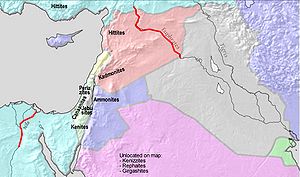
And in the boundary of the promised land is clarified in terms of the territory of various ancient peoples, as follows:
- On that day the LORD made a covenant with Abram and said, "To your descendants I give this land, from the river of Egypt to the great river, the Euphrates - the land of the KeniteKeniteKenites or Cinites , according to the Hebrew Bible, were a nomadic clan in the ancient Levant, sent under Jethro a priest in the land of Midian. They played an important role in the history of ancient Israel. The Kenites were coppersmiths and metalworkers. Moses' father-in-law, Jethro, was a...
s, KenizziteKenizziteKenizzite - The name of a tribe referred to in the covenant God made with Abraham . They are not mentioned among the original inhabitants of Canaan , and probably they inhabited some part of Arabia, in the confines of Syria....
s, Kadmonites, HittiteBiblical HittitesThe Hittites and children of Heth are a people or peoples mentioned in the Hebrew Bible. They are listed in Book of Genesis as second of the twelve Canaanite nations, descended from one Heth...
s, PerizzitePerizziteThe Perizzites are a group of people mentioned many times in the Bible as having lived in Canaan before the arrival of the Jews.-History:The Bible mentions a specific group of people who lived in the Promised land for many generations, from the time of Abraham even to the time of Ezra and Nehemiah...
s, RephaiteRephaiteRephaim is a Northwest Semitic term that occurs in the Hebrew Bible as well as other, non-Jewish ancient texts from the region...
s, AmoriteAmoriteAmorite refers to an ancient Semitic people who occupied large parts of Mesopotamia from the 21st Century BC...
s, CanaanCanaanCanaan is a historical region roughly corresponding to modern-day Israel, Palestine, Lebanon, and the western parts of Jordan...
ites, Girgashites and JebusiteJebusiteAccording to the Hebrew Bible, the Jebusites were a Canaanite tribe who inhabited and built Jerusalem prior to its conquest by King David; the Books of Kings state that Jerusalem was known as Jebus prior to this event...
s."
The verse is said to describe what are known as "borders of the Land" (Gevulot Ha-aretz). In Jewish tradition, these borders define the maximum extent of the land promised to the descendants of Abraham
Abraham
Abraham , whose birth name was Abram, is the eponym of the Abrahamic religions, among which are Judaism, Christianity and Islam...
through his son Isaac and grandson Jacob.
The promise was confirmed to Jacob
Jacob
Jacob "heel" or "leg-puller"), also later known as Israel , as described in the Hebrew Bible, the Talmud, the New Testament and the Qur'an was the third patriarch of the Hebrew people with whom God made a covenant, and ancestor of the tribes of Israel, which were named after his descendants.In the...
at , though the borders are still vague and is in terms of "the land on which you are lying".
Other geographical borders are given in which describes borders as marked by the Red Sea, the "Sea of the Philistines" i.e. the Mediterranean, and the "River," (the Euphrates
Euphrates
The Euphrates is the longest and one of the most historically important rivers of Western Asia. Together with the Tigris, it is one of the two defining rivers of Mesopotamia...
).
The promise is fulfilled at the end of the Exodus
The Exodus
The Exodus is the story of the departure of the Israelites from ancient Egypt described in the Hebrew Bible.Narrowly defined, the term refers only to the departure from Egypt described in the Book of Exodus; more widely, it takes in the subsequent law-givings and wanderings in the wilderness...
from Egypt. says:
- See, I have given you this land. Go in and take possession of the land that the LORD swore he would give to your fathers—to Abraham, Isaac and Jacob—and to their descendants after them.
It took a long time before the Israelites could subdue the Canaanite inhabitants of the land. The furthest extent of the Land of Israel
Land of Israel
The Land of Israel is the Biblical name for the territory roughly corresponding to the area encompassed by the Southern Levant, also known as Canaan and Palestine, Promised Land and Holy Land. The belief that the area is a God-given homeland of the Jewish people is based on the narrative of the...
was achieved during the time of the united Kingdom of Israel under David
David
David was the second king of the united Kingdom of Israel according to the Hebrew Bible and, according to the Gospels of Matthew and Luke, an ancestor of Jesus Christ through both Saint Joseph and Mary...
. The actual land controlled by the Israelites has fluctuated considerably over time and at times the land has been under the control of various empires. However, under Jewish tradition, even when it is not in Jewish occupation, the land has not lost its status as the Promised Land.
Descendants of Abraham
Traditional Jewish interpretation, and that of most Christian commentators, define Abraham's descendants as Abraham's seed only through his son IsaacIsaac
Isaac as described in the Hebrew Bible, was the only son Abraham had with his wife Sarah, and was the father of Jacob and Esau. Isaac was one of the three patriarchs of the Israelites...
and his grandson Jacob
Jacob
Jacob "heel" or "leg-puller"), also later known as Israel , as described in the Hebrew Bible, the Talmud, the New Testament and the Qur'an was the third patriarch of the Hebrew people with whom God made a covenant, and ancestor of the tribes of Israel, which were named after his descendants.In the...
, to the exclusion of Ishmael
Ishmael
Ishmael is a figure in the Hebrew Bible and the Qur'an, and was Abraham's first born child according to Jews, Christians and Muslims. Ishmael was born of Abraham's marriage to Sarah's handmaiden Hagar...
and Esau
Esau
Esau , in the Hebrew Bible, is the oldest son of Isaac. He is mentioned in the Book of Genesis, and by the minor prophets, Obadiah and Malachi. The New Testament later references him in the Book of Romans and the Book of Hebrews....
.
This may however reflect an eisegesis or reconstruction of primary verses based on the later biblical emphasis of Jacob's descendants. The promises given to Abraham happened prior to the birth of Issac and were given to all his offspring signified through the rite of circumcision. Johann Friedrich Karl Keil
Johann Friedrich Karl Keil
Johann Friedrich Karl Keil or Carl Friedrich Keil was a conservative German Lutheran Old Testament commentator...
is less clear, as he states that the covenant is through Isaac, but notes that Ishmael
Ishmael
Ishmael is a figure in the Hebrew Bible and the Qur'an, and was Abraham's first born child according to Jews, Christians and Muslims. Ishmael was born of Abraham's marriage to Sarah's handmaiden Hagar...
's descendants have held much of that land through time.
Mainstream Jewish tradition regards the promise made to Abraham, Isaac and Jacob as having been given to all Jews, including proselytes
Conversion to Judaism
Conversion to Judaism is a formal act undertaken by a non-Jewish person who wishes to be recognised as a full member of the Jewish community. A Jewish conversion is both a religious act and an expression of association with the Jewish people...
and in turn their descendants. The traditional view is that a convert becomes a child of Abraham, in the term "ben Avraham".
See also
- Conquest of Canaan
- Abrahamic CovenantCovenant (biblical)A biblical covenant is an agreement found in the Bible between God and His people in which God makes specific promises and demands. It is the customary word used to translate the Hebrew word berith. It it is used in the Tanakh 286 times . All Abrahamic religions consider the Biblical covenant...
- Greater IsraelGreater IsraelGreater Israel is a controversial expression with several different Biblical and political meanings over time.Currently, the most common definition of the land encompassed by the term is the territory of the State of Israel together with the Palestinian territories...
- Land of IsraelLand of IsraelThe Land of Israel is the Biblical name for the territory roughly corresponding to the area encompassed by the Southern Levant, also known as Canaan and Palestine, Promised Land and Holy Land. The belief that the area is a God-given homeland of the Jewish people is based on the narrative of the...
- Southern LevantSouthern LevantThe Levant is the geographical region bordering the Mediterranean, roughly between Egypt and Anatolia . The Southern Levant is roughly encompassed by Palestine, the West Bank, the Gaza Strip, along with the modern sovereign states of Israel, Jordan and the southern part of Lebanon.Although the term...
- Who is a Jew?Who is a Jew?"Who is a Jew?" is a basic question about Jewish identity and considerations of Jewish self-identification. The question is based in ideas about Jewish personhood which themselves have cultural, religious, genealogical, and personal dimensions...