

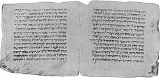
Jerusalem Talmud

Encyclopedia
The Jerusalem Talmud, talmud
meaning "instruction", "learning", , is a collection of Rabbi
nic notes on the 2nd-century Mishnah
(Jewish oral tradition
) which was compiled in the Land of Israel
during the 4th-5th century. The voluminous text is also known as the Palestinian Talmud or Talmud de-Eretz Yisrael (Talmud of the Land of Israel). These latter names are considered more accurate by some because, while the work was certainly composed in "the West" (i.e. the Holy Land
), it originates from the Galilee
area rather than from Jerusalem.
The Jerusalem Talmud predates its counterpart, the Babylonian Talmud (also known as the Talmud Bavli), by about 200 years and is written in both Hebrew
and Jewish Palestinian Aramaic
. It includes the core component, the Mishna, finalized by Rabbi Judah the Prince
(c. 200 CE) along with the written discussions of generations of rabbis in the Land of Israel (primarily in the academies of Tiberias and Caesarea) which was compiled c. 350-400 CE into a series of books that became the Gemara
( – from gamar: Hebrew
"[to] complete"; Aramaic "[to] study"). The Gemara, when combined with the Mishnah, constitutes the Talmud.
There are two recensions of the Gemara, one compiled by the scholars of the Land of Israel and the other by those of Babylonia (primarily in the academies of Sura
and Pumbedita
, completed c. 500 CE). The Babylonian Talmud is often seen as more authoritative and is studied much more than the Jerusalem Talmud. In general, the terms "Gemara" or "Talmud," without further qualification, refer to the Babylonian recension.
-controlled Syria Palæstina moved to Persia to escape the harsh decrees against Jews enacted by the emperor Hadrian
after Bar Kokhba's revolt
. The remaining scholars who lived in the Galilee area decided to continue their teaching activity in the learning centers that had existed since Mishnaic times.
,
, a Western Aramaic dialect
that differs from its Babylonian counterpart.
This Talmud is a synopsis of the analysis of the Mishnah that was developed over the course of nearly 200 years by the Talmudic Academies in the Land of Israel
(principally those of Tiberias and Caesarea). Because of their location, the sages of these Academies devoted considerable attention to analysis of the agricultural laws of the Land of Israel. Traditionally, the redaction of this Talmud was thought to have been brought to an abrupt end around 425 C.E., when Theodosius II
suppressed the Patriarchate
and put an end to the practice of formal scholarly ordination
. It was thought that the compilers of the Jerusalem Talmud lacked the time to produce a work of the quality they had intended, and that this is the reason why the Gemara
do not comment upon the whole Mishnah.
In recent years scholars have come to doubt the causal link between the abolition of the Patriarchate and the seeming incompletion of the final redaction. However, as no evidence exists of Amora
im activity in Palestine after the 370s, it is still considered very likely that the final redaction of the Palestinian Talmud took place in the late fourth or early fifth Century.
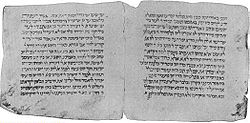 There are significant differences between the two Talmud compilations. The language of the Jerusalem Talmud is Jewish Palestinian Aramaic, a Western Aramaic dialect which differs from that of the Babylonian
. The Talmud Yerushalmi is often fragmentary and difficult to read, even for experienced Talmudists. The redaction of the Talmud Bavli, on the other hand, is more careful and precise. The traditional explanation for this difference was the idea that the redactors of the Jerusalem Talmud had to finish their work abruptly (see above). A more probable explanation is the fact that the Babylonian Talmud was redacted for at least another 200 years, in which a broad discursive framework was created. The law as laid down in the two compilations is basically similar, except in emphasis and in minor details. Some scholars, for example David Weiss Halivni
, describe the longer discursive passages in the Babylonian Talmud as the "Stammaitic" layer of redaction, and believe that it was added later than the rest: if one were to remove the "Stammaitic" passages, the remaining text would be quite similar in character to the Jerusalem Talmud.
Neither the Jerusalem nor the Babylonian Talmud covers the entire Mishnah: for example, a Babylonian Gemara exists only for 37 out of the 63 tractates of the Mishnah. n particular:
The Babylonian Talmud records the opinions of the rabbis of Israel as well as of those of Babylonia, while the Jerusalem Talmud only seldom cites the Babylonian rabbis. The Babylonian version contains the opinions of more generations because of its later date of completion. For both these reasons it is regarded as a more comprehensive collection of the opinions available. On the other hand, because of the centuries of redaction between the composition of the Jerusalem and the Babylonian Talmud, the opinions of early amoraim might be closer to their original form in the Jerusalem Talmud.
era. Furthermore, the editing of the Babylonian Talmud was superior to that of the Jerusalem version, making it more accessible and readily usable.
Despite this, the Jerusalem Talmud remains an indispensable source of knowledge of the development of the Jewish Law in the Holy Land. It was also an important resource in the study of the Babylonian Talmud by the Kairouan
school of Hananel ben Hushiel
and Nissim Gaon
, with the result that opinions ultimately based on the Jerusalem Talmud found their way into both the Tosafot
and the Mishneh Torah
of Maimonides
.
The Babylonian Talmud has traditionally been studied more widely and has had greater influence on the halakhic tradition
than the Jerusalem Talmud. A notable exception are the Jewish Romaniotes
, who traditionally follow and learn the Jerusalem Talmud.
With the modern Jewish return to the land of Israel
, the Jerusalem Talmud has taken on greater relevance and popularity with talmudic and rabbinical scholars. Modern scholars of the 19th and 20th centuries turned to the Yerushalmi as an invaluable source for the history of Judaism and the development of rabbinical law in late antiquity.
There are traditions that hold that in the Messianic Age the Jerusalem Talmud will have priority over the Babylonian. This may be interpreted as meaning that, following the restoration of the Sanhedrin
and the line of ordained scholars
, the work will be completed and "out of Zion shall go the Law, and the word of the Lord from Jerusalem".
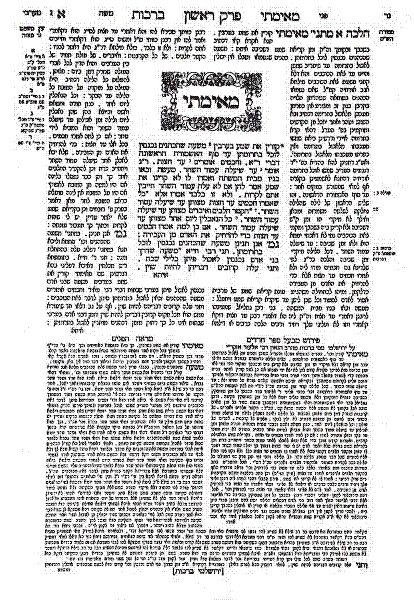 Compared to the Babylonian Talmud, the Jerusalem Talmud has not received as much attention from commentators, and such traditional commentaries as exist are mostly concerned with proving that its teachings are identical to Bavli. A modern edition and commentary, known as Or Simchah, is currently being prepared in Beersheba
; another edition in preparation, including paraphrases and explanatory notes in modern Hebrew, is Yedid Nefesh. The Jerusalem Talmud has also received some attention from Adin Steinsaltz
, who plans a translation into modern Hebrew and accompanying explanation similar to his work on the Babylonian Talmud. So far only Tractate Peah has appeared.
Talmud
The Talmud is a central text of mainstream Judaism. It takes the form of a record of rabbinic discussions pertaining to Jewish law, ethics, philosophy, customs and history....
meaning "instruction", "learning", , is a collection of Rabbi
Rabbi
In Judaism, a rabbi is a teacher of Torah. This title derives from the Hebrew word רבי , meaning "My Master" , which is the way a student would address a master of Torah...
nic notes on the 2nd-century Mishnah
Mishnah
The Mishnah or Mishna is the first major written redaction of the Jewish oral traditions called the "Oral Torah". It is also the first major work of Rabbinic Judaism. It was redacted c...
(Jewish oral tradition
Oral law
An oral law is a code of conduct in use in a given culture, religion or community application, by which a body of rules of human behaviour is transmitted by oral tradition and effectively respected, or the single rule that is orally transmitted....
) which was compiled in the Land of Israel
Land of Israel
The Land of Israel is the Biblical name for the territory roughly corresponding to the area encompassed by the Southern Levant, also known as Canaan and Palestine, Promised Land and Holy Land. The belief that the area is a God-given homeland of the Jewish people is based on the narrative of the...
during the 4th-5th century. The voluminous text is also known as the Palestinian Talmud or Talmud de-Eretz Yisrael (Talmud of the Land of Israel). These latter names are considered more accurate by some because, while the work was certainly composed in "the West" (i.e. the Holy Land
Holy Land
The Holy Land is a term which in Judaism refers to the Kingdom of Israel as defined in the Tanakh. For Jews, the Land's identifiction of being Holy is defined in Judaism by its differentiation from other lands by virtue of the practice of Judaism often possible only in the Land of Israel...
), it originates from the Galilee
Galilee
Galilee , is a large region in northern Israel which overlaps with much of the administrative North District of the country. Traditionally divided into Upper Galilee , Lower Galilee , and Western Galilee , extending from Dan to the north, at the base of Mount Hermon, along Mount Lebanon to the...
area rather than from Jerusalem.
The Jerusalem Talmud predates its counterpart, the Babylonian Talmud (also known as the Talmud Bavli), by about 200 years and is written in both Hebrew
Hebrew language
Hebrew is a Semitic language of the Afroasiatic language family. Culturally, is it considered by Jews and other religious groups as the language of the Jewish people, though other Jewish languages had originated among diaspora Jews, and the Hebrew language is also used by non-Jewish groups, such...
and Jewish Palestinian Aramaic
Jewish Palestinian Aramaic
The Jewish Palestinian Aramaic, also called Galilean Aramaic, was a Western Aramaic language spoken by the Jews in Palestine in the early first millennium. Its closest relatives are the Samaritan Aramaic and Christian Palestinian Aramaic...
. It includes the core component, the Mishna, finalized by Rabbi Judah the Prince
Judah haNasi
Judah the Prince, or Judah I, also known as Rebbi or Rabbeinu HaKadosh , was a 2nd-century CE rabbi and chief redactor and editor of the Mishnah. He was a key leader of the Jewish community during the Roman occupation of Judea . He was of the Davidic line, the royal line of King David, hence the...
(c. 200 CE) along with the written discussions of generations of rabbis in the Land of Israel (primarily in the academies of Tiberias and Caesarea) which was compiled c. 350-400 CE into a series of books that became the Gemara
Gemara
The Gemara is the component of the Talmud comprising rabbinical analysis of and commentary on the Mishnah. After the Mishnah was published by Rabbi Judah the Prince The Gemara (also transliterated Gemora or, less commonly, Gemorra; from Aramaic גמרא gamar; literally, "[to] study" or "learning by...
( – from gamar: Hebrew
Hebrew language
Hebrew is a Semitic language of the Afroasiatic language family. Culturally, is it considered by Jews and other religious groups as the language of the Jewish people, though other Jewish languages had originated among diaspora Jews, and the Hebrew language is also used by non-Jewish groups, such...
"[to] complete"; Aramaic "[to] study"). The Gemara, when combined with the Mishnah, constitutes the Talmud.
There are two recensions of the Gemara, one compiled by the scholars of the Land of Israel and the other by those of Babylonia (primarily in the academies of Sura
Sura (city)
Sura was a city in the southern part of ancient Babylonia, located west of the Euphrates River. It was well-known for its agricultural produce, which included grapes, wheat, and barley...
and Pumbedita
Pumbedita
Pumbedita was the name of a city in ancient Babylonia close to the modern-day city of Fallujah....
, completed c. 500 CE). The Babylonian Talmud is often seen as more authoritative and is studied much more than the Jerusalem Talmud. In general, the terms "Gemara" or "Talmud," without further qualification, refer to the Babylonian recension.
Historical context
Following the redaction of the Mishnah, many Jewish scholars living in RomanRoman Empire
The Roman Empire was the post-Republican period of the ancient Roman civilization, characterised by an autocratic form of government and large territorial holdings in Europe and around the Mediterranean....
-controlled Syria Palæstina moved to Persia to escape the harsh decrees against Jews enacted by the emperor Hadrian
Hadrian
Hadrian , was Roman Emperor from 117 to 138. He is best known for building Hadrian's Wall, which marked the northern limit of Roman Britain. In Rome, he re-built the Pantheon and constructed the Temple of Venus and Roma. In addition to being emperor, Hadrian was a humanist and was philhellene in...
after Bar Kokhba's revolt
Bar Kokhba's revolt
The Bar Kokhba revolt 132–136 CE; or mered bar kokhba) against the Roman Empire, was the third major rebellion by the Jews of Judaea Province being the last of the Jewish-Roman Wars. Simon bar Kokhba, the commander of the revolt, was acclaimed as a Messiah, a heroic figure who could restore Israel...
. The remaining scholars who lived in the Galilee area decided to continue their teaching activity in the learning centers that had existed since Mishnaic times.
Text editions
According to the Jewish EncyclopediaJewish Encyclopedia
The Jewish Encyclopedia is an encyclopedia originally published in New York between 1901 and 1906 by Funk and Wagnalls. It contained over 15,000 articles in 12 volumes on the history and then-current state of Judaism and the Jews as of 1901...
,
"Yerushalmi has not been preserved in its entirety; large portions of it were entirely lost at an early date, while other parts exist only in fragments. The editio princeps (ed. Bomberg, Venice, 1523 et seq.), on which all later editions are based, terminates with the following remark: "Thus far we have found what is contained in this Talmud; and we have endeavored in vain to obtain the missing portions." Of the four manuscripts used for this first edition (comp. the note at the conclusion of Shab. xx. 17d and the passage just cited), only one is now in existence; it is preserved in the library of the University of Leyden (see below). Of the six orders of the Mishnah, the fifth, Ḳodashim, is missing entirely from the Palestinian Talmud, while the sixth, Ṭohorot, contains only the first three chapters of the treatise Niddah (iv. 48d-51b)."
Place and date of composition
The Jerusalem Talmud probably originated in Tiberias in the School of Johanan ben Nappaha. It is a compilation of teachings of the schools of Tiberias, Sepphoris and Caesarea. It is written largely in Jewish Palestinian AramaicJewish Palestinian Aramaic
The Jewish Palestinian Aramaic, also called Galilean Aramaic, was a Western Aramaic language spoken by the Jews in Palestine in the early first millennium. Its closest relatives are the Samaritan Aramaic and Christian Palestinian Aramaic...
, a Western Aramaic dialect
Western Aramaic languages
Western Aramaic languages is a group of several Aramaic dialects developed and once widely spoken throughout the ancient Levant, as opposed to those from in and around Mesopotamia which make up what is known as the Eastern Aramaic languages...
that differs from its Babylonian counterpart.
This Talmud is a synopsis of the analysis of the Mishnah that was developed over the course of nearly 200 years by the Talmudic Academies in the Land of Israel
Talmudic Academies in the Land of Israel
The Talmudic Academies in the Land of Israel were yeshivot that served as centers for Jewish scholarship and the development of Jewish law in the Levant and had a great and lasting impact on the development of world Jewry....
(principally those of Tiberias and Caesarea). Because of their location, the sages of these Academies devoted considerable attention to analysis of the agricultural laws of the Land of Israel. Traditionally, the redaction of this Talmud was thought to have been brought to an abrupt end around 425 C.E., when Theodosius II
Theodosius II
Theodosius II , commonly surnamed Theodosius the Younger, or Theodosius the Calligrapher, was Byzantine Emperor from 408 to 450. He is mostly known for promulgating the Theodosian law code, and for the construction of the Theodosian Walls of Constantinople...
suppressed the Patriarchate
Nasi
Nāśī’ is a Hebrew title meaning prince in Biblical Hebrew, Prince in Mishnaic Hebrew, or president in Modern Hebrew.-Genesis and Ancient Israel:...
and put an end to the practice of formal scholarly ordination
Semicha
, also , or is derived from a Hebrew word which means to "rely on" or "to be authorized". It generally refers to the ordination of a rabbi within Judaism. In this sense it is the "transmission" of rabbinic authority to give advice or judgment in Jewish law...
. It was thought that the compilers of the Jerusalem Talmud lacked the time to produce a work of the quality they had intended, and that this is the reason why the Gemara
Gemara
The Gemara is the component of the Talmud comprising rabbinical analysis of and commentary on the Mishnah. After the Mishnah was published by Rabbi Judah the Prince The Gemara (also transliterated Gemora or, less commonly, Gemorra; from Aramaic גמרא gamar; literally, "[to] study" or "learning by...
do not comment upon the whole Mishnah.
In recent years scholars have come to doubt the causal link between the abolition of the Patriarchate and the seeming incompletion of the final redaction. However, as no evidence exists of Amora
Amora
Amoraim , were renowned Jewish scholars who "said" or "told over" the teachings of the Oral law, from about 200 to 500 CE in Babylonia and the Land of Israel. Their legal discussions and debates were eventually codified in the Gemara...
im activity in Palestine after the 370s, it is still considered very likely that the final redaction of the Palestinian Talmud took place in the late fourth or early fifth Century.
Comparison to Babylonian Talmud
Jewish Babylonian Aramaic
Jewish Babylonian Aramaic was the form of Middle Aramaic employed by Jewish writers in Babylonia between the 4th century and the 11th century CE. It is most commonly identified with the language of the Babylonian Talmud and of post-Talmudic literature, which are the most important cultural...
. The Talmud Yerushalmi is often fragmentary and difficult to read, even for experienced Talmudists. The redaction of the Talmud Bavli, on the other hand, is more careful and precise. The traditional explanation for this difference was the idea that the redactors of the Jerusalem Talmud had to finish their work abruptly (see above). A more probable explanation is the fact that the Babylonian Talmud was redacted for at least another 200 years, in which a broad discursive framework was created. The law as laid down in the two compilations is basically similar, except in emphasis and in minor details. Some scholars, for example David Weiss Halivni
David Weiss Halivni
David Weiss Halivni is an American-Israeli rabbi, scholar in the domain of Jewish Sciences and professor of Talmud.-Biography:...
, describe the longer discursive passages in the Babylonian Talmud as the "Stammaitic" layer of redaction, and believe that it was added later than the rest: if one were to remove the "Stammaitic" passages, the remaining text would be quite similar in character to the Jerusalem Talmud.
Neither the Jerusalem nor the Babylonian Talmud covers the entire Mishnah: for example, a Babylonian Gemara exists only for 37 out of the 63 tractates of the Mishnah. n particular:
- The Jerusalem Talmud covers all the tractates of Zeraim, while the Babylonian Talmud covers only tractate Berachot. The reason might be that most laws from the Orders Zeraim (agricultural laws limited to the land of Israel) had little practical relevance in Babylonia and were therefore not included. The Jerusalem Talmud has a greater focus on the Land of Israel and the TorahTorahTorah- A scroll containing the first five books of the BibleThe Torah , is name given by Jews to the first five books of the bible—Genesis , Exodus , Leviticus , Numbers and Deuteronomy Torah- A scroll containing the first five books of the BibleThe Torah , is name given by Jews to the first five...
's agricultural laws pertaining to the land because it was written in the Land of Israel where the laws applied. - The Jerusalem Talmud does not cover the Mishnaic order of KodashimKodashimKodashim or Qodhashim is the fifth Order in the Mishna . Of the six Orders of the Mishna, it is the third longest...
, which deals with sacrificial rites and laws pertaining to the TempleSecond TempleThe Jewish Second Temple was an important shrine which stood on the Temple Mount in Jerusalem between 516 BCE and 70 CE. It replaced the First Temple which was destroyed in 586 BCE, when the Jewish nation was exiled to Babylon...
, while the Babylonian Talmud does cover it. It is not clear why this is, as the laws were not directly applicable in either country following the Temple's 70 CE destruction. - In both Talmuds, only one tractate of TohorotTohorotTohorot is the sixth order of the Mishnah . This order deals with the clean/unclean distinction and family purity. This is the longest of the orders in the Mishnah. There are 12 tractates:...
(ritual purity laws related to the Temple and sacrificial system) is examined, since the other tractates deal exclusively with Temple-related laws of ritual purity.
The Babylonian Talmud records the opinions of the rabbis of Israel as well as of those of Babylonia, while the Jerusalem Talmud only seldom cites the Babylonian rabbis. The Babylonian version contains the opinions of more generations because of its later date of completion. For both these reasons it is regarded as a more comprehensive collection of the opinions available. On the other hand, because of the centuries of redaction between the composition of the Jerusalem and the Babylonian Talmud, the opinions of early amoraim might be closer to their original form in the Jerusalem Talmud.
Influence of the Jerusalem Talmud
The influence of the Babylonian Talmud has been far greater than that of the Yerushalmi. In the main, this is because the influence and prestige of the Jewish community of Israel steadily declined in contrast with the Babylonian community in the years after the redaction of the Talmud and continuing until the GaonicGeonim
Geonim were the presidents of the two great Babylonian, Talmudic Academies of Sura and Pumbedita, in the Abbasid Caliphate, and were the generally accepted spiritual leaders of the Jewish community world wide in the early medieval era, in contrast to the Resh Galuta who wielded secular authority...
era. Furthermore, the editing of the Babylonian Talmud was superior to that of the Jerusalem version, making it more accessible and readily usable.
Despite this, the Jerusalem Talmud remains an indispensable source of knowledge of the development of the Jewish Law in the Holy Land. It was also an important resource in the study of the Babylonian Talmud by the Kairouan
Kairouan
Kairouan , also known as Kirwan or al-Qayrawan , is the capital of the Kairouan Governorate in Tunisia. Referred to as the Islamic Cultural Capital, it is a UNESCO World Heritage site. The city was founded by the Arabs around 670...
school of Hananel ben Hushiel
Chananel Ben Chushiel
Chananel ben Chushiel or Ḥananel ben Ḥushiel , an eleventh-century Tunisian Rabbi and Talmudist, was a student of one of the last Geonim. He is best known for his commentary on the Talmud. Chananel is often referred to as Rabbeinu Chananel - Hebrew for "our teacher, Chananel" .-Biography:"Rabbeinu...
and Nissim Gaon
Nissim Ben Jacob
Nissim ben Jacob , was a rabbi best known today for his Talmudic commentary ha-Mafteach, by which title he is also known.-Biography:Rav Nissim studied at the Kairouan yeshiva, initially under his father - Jacob ben Nissim who...
, with the result that opinions ultimately based on the Jerusalem Talmud found their way into both the Tosafot
Tosafot
The Tosafot or Tosafos are medieval commentaries on the Talmud. They take the form of critical and explanatory glosses, printed, in almost all Talmud editions, on the outer margin and opposite Rashi's notes...
and the Mishneh Torah
Mishneh Torah
The Mishneh Torah subtitled Sefer Yad ha-Hazaka is a code of Jewish religious law authored by Maimonides , one of history's foremost rabbis...
of Maimonides
Maimonides
Moses ben-Maimon, called Maimonides and also known as Mūsā ibn Maymūn in Arabic, or Rambam , was a preeminent medieval Jewish philosopher and one of the greatest Torah scholars and physicians of the Middle Ages...
.
The Babylonian Talmud has traditionally been studied more widely and has had greater influence on the halakhic tradition
Halakha
Halakha — also transliterated Halocho , or Halacha — is the collective body of Jewish law, including biblical law and later talmudic and rabbinic law, as well as customs and traditions.Judaism classically draws no distinction in its laws between religious and ostensibly non-religious life; Jewish...
than the Jerusalem Talmud. A notable exception are the Jewish Romaniotes
Romaniotes
The Romaniotes or Romaniots are a Jewish population who have lived in the territory of today's Greece and neighboring areas with large Greek populations for more than 2,000 years. Their languages were Yevanic, a Greek dialect, and Greek. They derived their name from the old name for the people...
, who traditionally follow and learn the Jerusalem Talmud.
With the modern Jewish return to the land of Israel
Zionism
Zionism is a Jewish political movement that, in its broadest sense, has supported the self-determination of the Jewish people in a sovereign Jewish national homeland. Since the establishment of the State of Israel, the Zionist movement continues primarily to advocate on behalf of the Jewish state...
, the Jerusalem Talmud has taken on greater relevance and popularity with talmudic and rabbinical scholars. Modern scholars of the 19th and 20th centuries turned to the Yerushalmi as an invaluable source for the history of Judaism and the development of rabbinical law in late antiquity.
There are traditions that hold that in the Messianic Age the Jerusalem Talmud will have priority over the Babylonian. This may be interpreted as meaning that, following the restoration of the Sanhedrin
Sanhedrin
The Sanhedrin was an assembly of twenty-three judges appointed in every city in the Biblical Land of Israel.The Great Sanhedrin was the supreme court of ancient Israel made of 71 members...
and the line of ordained scholars
Semicha
, also , or is derived from a Hebrew word which means to "rely on" or "to be authorized". It generally refers to the ordination of a rabbi within Judaism. In this sense it is the "transmission" of rabbinic authority to give advice or judgment in Jewish law...
, the work will be completed and "out of Zion shall go the Law, and the word of the Lord from Jerusalem".
Translations into English
- Talmud of the Land of Israel: A Preliminary Translation and Explanation Jacob NeusnerJacob NeusnerJacob Neusner is an American academic scholar of Judaism who lives in Rhinebeck, New York.-Biography:Born in Hartford, Connecticut, Neusner was educated at Harvard University, the Jewish Theological Seminary of America , the University of Oxford, and Columbia University.Neusner is often celebrated...
, Tzvee Zahavy, others. University of Chicago Press. This translation uses a form-analytical presentation which makes the logical units of discourse easier to identify and follow. - Schottenstein Edition of the Yerushalmi Talmud Mesorah/Artscroll. This translation is the counterpart to Mesorah/Artscroll's Schottenstein Edition of the Talmud (i.e. Babylonian Talmud). (n.b. currently incomplete – only some volumes available)
- The Jerusalem Talmud ed. Heinrich W. Guggenheimer, Walter de Gruyter (Publisher's Website). This edition is only available on Order Zeraim and part of Order Nashim. Contains a bare translation with simple footnotes clarifying only the most problematic points.
Commentators on the Jerusalem Talmud
Beersheba
Beersheba is the largest city in the Negev desert of southern Israel. Often referred to as the "Capital of the Negev", it is the seventh-largest city in Israel with a population of 194,300....
; another edition in preparation, including paraphrases and explanatory notes in modern Hebrew, is Yedid Nefesh. The Jerusalem Talmud has also received some attention from Adin Steinsaltz
Adin Steinsaltz
Rabbi Adin Steinsaltz or Adin Even Yisrael is a teacher, philosopher, social critic, and spiritual mentor, who has been hailed by Time magazine as a "once-in-a-millennium scholar". He has devoted his life to making the Talmud accessible to all Jews...
, who plans a translation into modern Hebrew and accompanying explanation similar to his work on the Babylonian Talmud. So far only Tractate Peah has appeared.
See also
- Babylonian TalmudTalmudThe Talmud is a central text of mainstream Judaism. It takes the form of a record of rabbinic discussions pertaining to Jewish law, ethics, philosophy, customs and history....
- HalakhaHalakhaHalakha — also transliterated Halocho , or Halacha — is the collective body of Jewish law, including biblical law and later talmudic and rabbinic law, as well as customs and traditions.Judaism classically draws no distinction in its laws between religious and ostensibly non-religious life; Jewish...
- MishnahMishnahThe Mishnah or Mishna is the first major written redaction of the Jewish oral traditions called the "Oral Torah". It is also the first major work of Rabbinic Judaism. It was redacted c...
- Talmudic Academies in the Land of IsraelTalmudic Academies in the Land of IsraelThe Talmudic Academies in the Land of Israel were yeshivot that served as centers for Jewish scholarship and the development of Jewish law in the Levant and had a great and lasting impact on the development of world Jewry....
External links
- Full Text of the Talmud Yerushalmi Mechon-Mamre
- Full Text of the Talmud Yerushalmi Snunit
- Yedid Nefesh; Critical edition of the Talmud Yerushalmi
- Aggadic Material from the Talmud Yerushalmi Daat
- Daf Yomi for the Talmud Yerushalmi
- The entire Yerushalmi in 750 MP3s - from YerushalmiOnline.org - by Rabbi Yosef Gavriel Bechhofer
- The Palestinian Talmud, Jewish EncyclopediaJewish EncyclopediaThe Jewish Encyclopedia is an encyclopedia originally published in New York between 1901 and 1906 by Funk and Wagnalls. It contained over 15,000 articles in 12 volumes on the history and then-current state of Judaism and the Jews as of 1901...
- What is Talmud Yerushalmi? FAQs.org
- Jewish History: Talmud Aish.com
- Talmud/Mishna/Gemara Jewish Virtual Library
- Lost segment of Jerusalem Talmud unearthed in Geneva