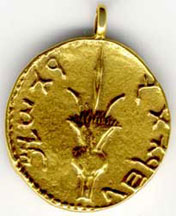
Etrog

Encyclopedia
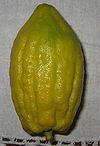
Etrog refers to the yellow citron
or Citrus medica used by Jews on the week-long holiday of Sukkot
.
While in modern Hebrew this is the name for any variety of citron, its English usage applies to those varieties and specimens used as one of the Four Species
.
as Etrog is according to the Sephardic pronunciation, widely used in Israel
through Modern Hebrew
. The Ashkenazi pronunciation as in Yiddish, is esrog or esrig. Rarely it could also be transliterated as Ethrog or Ethrogh even in scholarly work, which is according to the Yemenite Hebrew.
Traditional Judaism sees the etrog referred to in the Bible as peri eitz hadar (פְּרִי עֵץ הָדָר), literally "a fruit of the beautiful tree."
In modern Hebrew
, hadar refers to the genus
citrus
. Nahmanides
(1194 – c. 1270) suggests that the word was the original Hebrew name for the citron. According to him, the word etrog was introduced over time, adapted from the Aramaic. The Arabic
name for the citron fruit, itranj (اترنج), mentioned in hadith
literature, is also associated with the Hebrew.
's egg
in order to be considered kosher, but larger sizes are preferred as long as they can be held with one hand. Marketwise, a nice size fetches a higher price, so long as the fruit is also good in other aspects. If both hands are needed to hold it, it is still kosher, but less desirable.
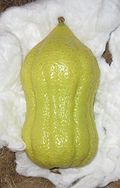 The etrog may differ in shape since several citron varieties are used for that purpose, each bearing fruits with a distinct form and shape. Furthermore, a specific variety or even a single tree may also bear fruit in several shapes and sizes. An etrog of completely round shape is not-kosher, whilst a slanted or bent specimen is permissible but not the best. The bearing branch must be arched down with care, in order to get the fruit growing straight in a downward position. Otherwise the body of the fruit will be forced into a downwards curve because of its increasing weight. The practice of arching the branch must be performed very delicately in order not to break the stiff citron twig. While many prefer the pyramid shape of variety etrog, and others prefer the barrel shape of the Diamante
, some look for an etrog with a gartel
—an hourglass-like strip running around the middle, more commonly found on the Moroccan citron
.
 According to researchers, this gartel indicates when the bearing tree was infected by a certain virus
or viroid
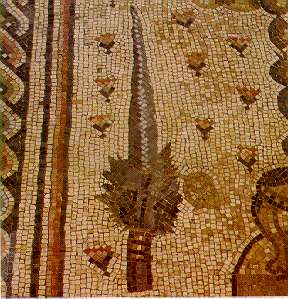
, which decreases the albedo on the specific spot. These viroids have been around since at least the time of Bar Kokhba
(circa 130 CE
), based on the fact that archaeologists
have unearthed a mosaic
dated to that time which depicts an etrog with a gartel. Only the etrog is found to be susceptible to these viroids, proving again that the etrog is genetically pure and has not changed significantly over the centuries.
gas to ripen the fruit in a controlled manner. The same gas is also naturally released from apple
s, so some growers simply put the fruits in the same box as apples. The etrog used in the mitzvah
of the four species
must be largely unblemished, with the fewest black specks or other flaws. Extra special care is needed to cut around the leaves and thorns that may scratch the fruit. It is also important to protect the fruit-bearing trees from any dust and carbon, which may get caught in the stomata of the fruit during growth, and may later appear as a black dot.
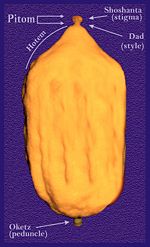
 Many pitams are preserved today thanks to an auxin
discovered by Dr. Eliezer E. Goldschmidt, formerly professor of horticulture at the Hebrew University. Working with the picloram
hormone in a citrus orchard
one day, he discovered, to his surprise, that some of the Valencia orange
s found nearby had preserved beautiful, perfect pitams. Usually a citrus fruit, other than an etrog or citron hybrid like the bergamot
, does not preserve its pitam. When it occasionally does, it should at least be dry, sunken and very fragile. In this case the pitams were all fresh and healthy just like those of the Moroccan or Greek citron
varieties. Experimenting with the picloram in a laboratory, Goldschmidt eventually found the correct “dose” to achieve the desired effect: one droplet of the chemical in three million drops of water. This invention is highly appreciated by the Jewish community.
nor bred
with any other species
, therefore only a few traditional varieties are used. To prevent grafting
, the plantations must be under strict rabbinical supervision
.
varieties traditionally used as Etrog, are the Diamante Citron
from Italy, the Greek Citron
, the Balady Citron
from Israel
, the Moroccan
and Yemenite Citron
s.
A general DNA
study was arranged by the world-renowned research
er of the etrog, Prof. Goldschmidt and colleagues, who positively testified 12 famous accession
s of citron for purity and being genetic
ally related. As they clarify in their joint publication, this is only referring to the genotypic
information which could be changed by breeding
for e.g. out cross pollination
etc., not about grafting
which is not suspected to change anything in the genes.
 The Fingered and Florentine Citron
s although they are also Citron
varieties or maybe hybrids
, are not used for the ritual
. The Corsican Citron
is no longer in use, though it was once used and sacred.
accomplished by professional farmers.
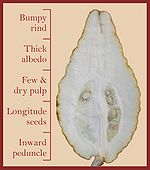
The most accepted indicators are as following: 1) a pure etrog has a thick rind, in contrast to its narrow pulp segment
s which are also almost dry, 2) the outer surface of an etrog fruit is ribbed and warted, and 3) the etrog peduncle is somewhat buried inward; a lemon
or different citron hybrid is opposing one or all of the specifications.
A later and not so widely accepted indicator is the orientation of the seed, which should be pointing vertically by an etrog, except if it was strained by its neighbors; by a lemon and hybrids they are positioned horizontally even when there is enough space.
The etrog is typically grown from cuttings that are two to four years old, the tree begins to bear fruit when it is around four years old. If the tree germinates from seeds, it will not fruit for about seven years, and there may be some genetic change to the tree or fruit in the event of seed propagation
.
and eat it in candied form or as succade
, accompanied by prayers that the worshiper will merit a beautiful etrog next Sukkot. Some families make jam or liqueur out of it, or stick cloves in the skin for use as besamim at the havdalah
ceremony after Shabbat
. The Dancing Camel Brewery in Tel Aviv, Israel uses the rinds of etrogim in their annual 'Trog Wit Beer, usually available around the Holiday of Sukkot.
Citron
Not to be confused with Cintron.The citron is a fragrant citrus fruit, botanically classified as Citrus medica by both the Swingle and Tanaka systems...
or Citrus medica used by Jews on the week-long holiday of Sukkot
Sukkot
Sukkot is a Biblical holiday celebrated on the 15th day of the month of Tishrei . It is one of the three biblically mandated festivals Shalosh regalim on which Hebrews were commanded to make a pilgrimage to the Temple in Jerusalem.The holiday lasts seven days...
.
While in modern Hebrew this is the name for any variety of citron, its English usage applies to those varieties and specimens used as one of the Four Species
Four Species
The four species are four plants mentioned in the Torah as being relevant to Sukkot. Karaite Jews build their Sukkot out of branches from the four specified plants , while Talmudic Jews take three types of branches and one type of fruit which are held together and waved in a special ceremony...
.
Etymology
The romanizationRomanization of Hebrew
Hebrew uses the Hebrew alphabet with optional vowel points. The romanization of Hebrew is the use of the Latin alphabet to transliterate Hebrew words....
as Etrog is according to the Sephardic pronunciation, widely used in Israel
Israel
The State of Israel is a parliamentary republic located in the Middle East, along the eastern shore of the Mediterranean Sea...
through Modern Hebrew
Modern Hebrew
Modern Hebrew , also known as Israeli Hebrew or Modern Israeli Hebrew, is the language spoken in Israel and in some Jewish communities worldwide, from the early 20th century to the present....
. The Ashkenazi pronunciation as in Yiddish, is esrog or esrig. Rarely it could also be transliterated as Ethrog or Ethrogh even in scholarly work, which is according to the Yemenite Hebrew.
Biblical references
"And you shall take on the 1-st day the fruit of beautiful trees, branches of palm trees and boughs of leafy trees and willows of the brook, and you shall rejoice before the Lord your God 7 days!" Leviticus 23:40.Traditional Judaism sees the etrog referred to in the Bible as peri eitz hadar (פְּרִי עֵץ הָדָר), literally "a fruit of the beautiful tree."
In modern Hebrew
Hebrew language
Hebrew is a Semitic language of the Afroasiatic language family. Culturally, is it considered by Jews and other religious groups as the language of the Jewish people, though other Jewish languages had originated among diaspora Jews, and the Hebrew language is also used by non-Jewish groups, such...
, hadar refers to the genus
Genus
In biology, a genus is a low-level taxonomic rank used in the biological classification of living and fossil organisms, which is an example of definition by genus and differentia...
citrus
Citrus
Citrus is a common term and genus of flowering plants in the rue family, Rutaceae. Citrus is believed to have originated in the part of Southeast Asia bordered by Northeastern India, Myanmar and the Yunnan province of China...
. Nahmanides
Nahmanides
Nahmanides, also known as Rabbi Moses ben Naḥman Girondi, Bonastruc ça Porta and by his acronym Ramban, , was a leading medieval Jewish scholar, Catalan rabbi, philosopher, physician, kabbalist, and biblical commentator.-Name:"Nahmanides" is a Greek-influenced formation meaning "son of Naḥman"...
(1194 – c. 1270) suggests that the word was the original Hebrew name for the citron. According to him, the word etrog was introduced over time, adapted from the Aramaic. The Arabic
Arabic language
Arabic is a name applied to the descendants of the Classical Arabic language of the 6th century AD, used most prominently in the Quran, the Islamic Holy Book...
name for the citron fruit, itranj (اترنج), mentioned in hadith
Hadith
The term Hadīth is used to denote a saying or an act or tacit approval or criticism ascribed either validly or invalidly to the Islamic prophet Muhammad....
literature, is also associated with the Hebrew.
Size and shape
The fruit is ready to harvest when it reaches about 15 cm (six inches) in length. For commercial use it is generally harvested no earlier than January when it is at optimum size. However, for ritual use it must be picked while still small in order to reach the market in time. The optimal size is also the best for marketability, as by growing larger it may lose some of its beauty. Since the citron blooms several times a season, fruit may also be picked during July and August, and even in June. According to Halacha the fruit must only reach the size of a henChicken
The chicken is a domesticated fowl, a subspecies of the Red Junglefowl. As one of the most common and widespread domestic animals, and with a population of more than 24 billion in 2003, there are more chickens in the world than any other species of bird...
's egg
Egg (biology)
An egg is an organic vessel in which an embryo first begins to develop. In most birds, reptiles, insects, molluscs, fish, and monotremes, an egg is the zygote, resulting from fertilization of the ovum, which is expelled from the body and permitted to develop outside the body until the developing...
in order to be considered kosher, but larger sizes are preferred as long as they can be held with one hand. Marketwise, a nice size fetches a higher price, so long as the fruit is also good in other aspects. If both hands are needed to hold it, it is still kosher, but less desirable.
Diamante citron
The Diamante citron is a variety of citron named after the city of Diamante which is its most known cultivation point. Diamante is located in the province of Cosenza, Calabria, on the south-western coast of Italy...
, some look for an etrog with a gartel
Gartel
The Gartel is a belt used by Jewish males, predominantly but not exclusively, Hasidim during prayer. "Gartel" is Yiddish for "belt". The word comes from the German "Gürtel", which is also the root word for the English "girdle", as well as the word "girt"....
—an hourglass-like strip running around the middle, more commonly found on the Moroccan citron
Moroccan citron
The Moroccan sweet citron was first described in detail by Professor Henri Chapot, in his article named Un curieux cedrat Marocain . He discovered that the acidity in the more common citrons or lemons, is represented by violet pigmentation on the outer side of the flower blossom, and also by the...
.
Virus
A virus is a small infectious agent that can replicate only inside the living cells of organisms. Viruses infect all types of organisms, from animals and plants to bacteria and archaea...
or viroid
Viroid
Viroids are plant pathogens that consist of a short stretch of highly complementary, circular, single-stranded RNA without the protein coat that is typical for viruses. The smallest discovered is a 220 nucleobase scRNA associated with the rice yellow mottle sobemovirus...
, which decreases the albedo on the specific spot. These viroids have been around since at least the time of Bar Kokhba
Simon bar Kokhba
Simon bar Kokhba was the Jewish leader of what is known as the Bar Kokhba revolt against the Roman Empire in 132 CE, establishing an independent Jewish state of Israel which he ruled for three years as Nasi...
(circa 130 CE
Common Era
Common Era ,abbreviated as CE, is an alternative designation for the calendar era originally introduced by Dionysius Exiguus in the 6th century, traditionally identified with Anno Domini .Dates before the year 1 CE are indicated by the usage of BCE, short for Before the Common Era Common Era...
), based on the fact that archaeologists
Archaeology
Archaeology, or archeology , is the study of human society, primarily through the recovery and analysis of the material culture and environmental data that they have left behind, which includes artifacts, architecture, biofacts and cultural landscapes...
have unearthed a mosaic
Mosaic
Mosaic is the art of creating images with an assemblage of small pieces of colored glass, stone, or other materials. It may be a technique of decorative art, an aspect of interior decoration, or of cultural and spiritual significance as in a cathedral...
dated to that time which depicts an etrog with a gartel. Only the etrog is found to be susceptible to these viroids, proving again that the etrog is genetically pure and has not changed significantly over the centuries.
Color and texture
The fruit is typically picked while still green, taking advantage of ethyleneEthylene
Ethylene is a gaseous organic compound with the formula . It is the simplest alkene . Because it contains a carbon-carbon double bond, ethylene is classified as an unsaturated hydrocarbon. Ethylene is widely used in industry and is also a plant hormone...
gas to ripen the fruit in a controlled manner. The same gas is also naturally released from apple
Apple
The apple is the pomaceous fruit of the apple tree, species Malus domestica in the rose family . It is one of the most widely cultivated tree fruits, and the most widely known of the many members of genus Malus that are used by humans. Apple grow on small, deciduous trees that blossom in the spring...
s, so some growers simply put the fruits in the same box as apples. The etrog used in the mitzvah
Mitzvah
The primary meaning of the Hebrew word refers to precepts and commandments as commanded by God...
of the four species
Four Species
The four species are four plants mentioned in the Torah as being relevant to Sukkot. Karaite Jews build their Sukkot out of branches from the four specified plants , while Talmudic Jews take three types of branches and one type of fruit which are held together and waved in a special ceremony...
must be largely unblemished, with the fewest black specks or other flaws. Extra special care is needed to cut around the leaves and thorns that may scratch the fruit. It is also important to protect the fruit-bearing trees from any dust and carbon, which may get caught in the stomata of the fruit during growth, and may later appear as a black dot.
Pitam (Pitom)
An etrog with an intact pitam is considered especially valuable. A pitam is composed of a style (Hebrew: "דַד"), and a stigma (Hebrew: "שׁוֹשַׁנְתָּא"), which usually falls off during the growing process. However, varieties that shed off their pitam during growth are also kosher. When only the stigma breaks off, even post-harvest, it could still be considered kosher as long as part of the style has remained attached. If the whole pitam i.e. the stigma and style, are unnaturally broken off, all the way to the bottom, it is not kosher for the ritual use.Auxin
Auxins are a class of plant hormones with some morphogen-like characteristics. Auxins have a cardinal role in coordination of many growth and behavioral processes in the plant's life cycle and are essential for plant body development. Auxins and their role in plant growth were first described by...
discovered by Dr. Eliezer E. Goldschmidt, formerly professor of horticulture at the Hebrew University. Working with the picloram
Picloram
Picloram is a systemic herbicide used for general woody plant control, sold under the trade names Tordon and Grazon. It also controls a wide range of broad-leaved weeds, but most grasses are resistant...
hormone in a citrus orchard
Orchard
An orchard is an intentional planting of trees or shrubs that is maintained for food production. Orchards comprise fruit or nut-producing trees which are grown for commercial production. Orchards are also sometimes a feature of large gardens, where they serve an aesthetic as well as a productive...
one day, he discovered, to his surprise, that some of the Valencia orange
Valencia orange
The Valencia Orange is a sweet orange first hybridized by California pioneer agronomist and land developer William Wolfskill, on his farm in Santa Ana in southern California in the United States. -History:...
s found nearby had preserved beautiful, perfect pitams. Usually a citrus fruit, other than an etrog or citron hybrid like the bergamot
Bergamot orange
Citrus bergamia, the Bergamot orange, is a fragrant fruit the size of an orange, with a yellow colour similar to a lemon. Genetic research into the ancestral origins of extant citrus cultivars recently matched the bergamot as a likely hybrid of Citrus limetta and Citrus aurantium...
, does not preserve its pitam. When it occasionally does, it should at least be dry, sunken and very fragile. In this case the pitams were all fresh and healthy just like those of the Moroccan or Greek citron
Greek citron
The Greek citron variety of citrus medica was botanically classified by Adolf Engler as the "variety etrog". This is remarking on its major use for the Jewish ritual during Sukkot, due to its supposedly extraordinary natural beauty. It was also called Pitima, or the Cedro - Citron with a Pigolo -...
varieties. Experimenting with the picloram in a laboratory, Goldschmidt eventually found the correct “dose” to achieve the desired effect: one droplet of the chemical in three million drops of water. This invention is highly appreciated by the Jewish community.
Purity
In order for a citron to be kosher it must be pure, neither graftedGrafting
Grafting is a horticultural technique whereby tissues from one plant are inserted into those of another so that the two sets of vascular tissues may join together. This vascular joining is called inosculation...
nor bred
Plant breeding
Plant breeding is the art and science of changing the genetics of plants in order to produce desired characteristics. Plant breeding can be accomplished through many different techniques ranging from simply selecting plants with desirable characteristics for propagation, to more complex molecular...
with any other species
Species
In biology, a species is one of the basic units of biological classification and a taxonomic rank. A species is often defined as a group of organisms capable of interbreeding and producing fertile offspring. While in many cases this definition is adequate, more precise or differing measures are...
, therefore only a few traditional varieties are used. To prevent grafting
Grafting
Grafting is a horticultural technique whereby tissues from one plant are inserted into those of another so that the two sets of vascular tissues may join together. This vascular joining is called inosculation...
, the plantations must be under strict rabbinical supervision
Hechsher
A hechsher is the special certification marking found on the packages of products that have been certified as kosher . In Halakha , the dietary laws of kashrut specify food items that may be eaten and others that are prohibited as set out in the commandments of the Torah...
.
Genetic research
The citronCitron
Not to be confused with Cintron.The citron is a fragrant citrus fruit, botanically classified as Citrus medica by both the Swingle and Tanaka systems...
varieties traditionally used as Etrog, are the Diamante Citron
Diamante citron
The Diamante citron is a variety of citron named after the city of Diamante which is its most known cultivation point. Diamante is located in the province of Cosenza, Calabria, on the south-western coast of Italy...
from Italy, the Greek Citron
Greek citron
The Greek citron variety of citrus medica was botanically classified by Adolf Engler as the "variety etrog". This is remarking on its major use for the Jewish ritual during Sukkot, due to its supposedly extraordinary natural beauty. It was also called Pitima, or the Cedro - Citron with a Pigolo -...
, the Balady Citron
Balady citron
Balady Citron , is a variety of citron, or etrog, grown in Israel for Jewish ritual purposes. Balady is Arabic for "native." Local Arab farmers began using this name in the mid-19th century to distinguish this variety from the Greek citron, which was cultivated along the Jaffa seashore.The Balady...
from Israel
Israel
The State of Israel is a parliamentary republic located in the Middle East, along the eastern shore of the Mediterranean Sea...
, the Moroccan
Moroccan citron
The Moroccan sweet citron was first described in detail by Professor Henri Chapot, in his article named Un curieux cedrat Marocain . He discovered that the acidity in the more common citrons or lemons, is represented by violet pigmentation on the outer side of the flower blossom, and also by the...
and Yemenite Citron
Yemenite citron
The Yemenite citron is a distinct variety, usually containing no juice vesicles in its fruit's segments. The bearing tree is fairly bigger than the trees of the different varieties of citron, and the fruit's albedo is notably juicier.- Classification :...
s.
A general DNA
DNA
Deoxyribonucleic acid is a nucleic acid that contains the genetic instructions used in the development and functioning of all known living organisms . The DNA segments that carry this genetic information are called genes, but other DNA sequences have structural purposes, or are involved in...
study was arranged by the world-renowned research
Research
Research can be defined as the scientific search for knowledge, or as any systematic investigation, to establish novel facts, solve new or existing problems, prove new ideas, or develop new theories, usually using a scientific method...
er of the etrog, Prof. Goldschmidt and colleagues, who positively testified 12 famous accession
Accession
Accession has different definitions depending upon its application. In Property law, it is a mode of acquiring property that involves the addition of value to property through labor or the addition of new materials. In English Common law, the added value belonged to the original property's owner,...
s of citron for purity and being genetic
Genetics
Genetics , a discipline of biology, is the science of genes, heredity, and variation in living organisms....
ally related. As they clarify in their joint publication, this is only referring to the genotypic
Genotype
The genotype is the genetic makeup of a cell, an organism, or an individual usually with reference to a specific character under consideration...
information which could be changed by breeding
Plant sexuality
Plant sexuality covers the wide variety of sexual reproduction systems found across the plant kingdom. This article describes morphological aspects of sexual reproduction of plants....
for e.g. out cross pollination
Pollination
Pollination is the process by which pollen is transferred in plants, thereby enabling fertilisation and sexual reproduction. Pollen grains transport the male gametes to where the female gamete are contained within the carpel; in gymnosperms the pollen is directly applied to the ovule itself...
etc., not about grafting
Grafting
Grafting is a horticultural technique whereby tissues from one plant are inserted into those of another so that the two sets of vascular tissues may join together. This vascular joining is called inosculation...
which is not suspected to change anything in the genes.
Florentine citron
The citron of Florence is a very fragrant citrus fruit, which is named after its most known origin of cultivation.-History:It was first carefully described by Johann Christoph Volkamer in his Hesperides as well as by others....
s although they are also Citron
Citron
Not to be confused with Cintron.The citron is a fragrant citrus fruit, botanically classified as Citrus medica by both the Swingle and Tanaka systems...
varieties or maybe hybrids
Plant sexuality
Plant sexuality covers the wide variety of sexual reproduction systems found across the plant kingdom. This article describes morphological aspects of sexual reproduction of plants....
, are not used for the ritual
Ritual
A ritual is a set of actions, performed mainly for their symbolic value. It may be prescribed by a religion or by the traditions of a community. The term usually excludes actions which are arbitrarily chosen by the performers....
. The Corsican Citron
Corsican citron
The Corsican citron is a sweet pulp citron, which was traditionally one of the most important varieties employed in Succade production. The name is from its most original cultivation center which is even today, at the French Island of Corsica or Corse...
is no longer in use, though it was once used and sacred.
Selection and cultivation
In addition to the above, there are many rabbinical indicators to identify pure etrogs out of possible hybrids. Those traditional specifications were preserved by continues selectionsArtificial selection
Artificial selection describes intentional breeding for certain traits, or combination of traits. The term was utilized by Charles Darwin in contrast to natural selection, in which the differential reproduction of organisms with certain traits is attributed to improved survival or reproductive...
accomplished by professional farmers.
The most accepted indicators are as following: 1) a pure etrog has a thick rind, in contrast to its narrow pulp segment
Segment
Segment may mean:*The divisions found in the internal section of a citrus fruit* Market segment, the smaller subgroups comprising a marketComputing*Segmentation , the division of computer memory into segments...
s which are also almost dry, 2) the outer surface of an etrog fruit is ribbed and warted, and 3) the etrog peduncle is somewhat buried inward; a lemon
Lemon
The lemon is both a small evergreen tree native to Asia, and the tree's ellipsoidal yellow fruit. The fruit is used for culinary and non-culinary purposes throughout the world – primarily for its juice, though the pulp and rind are also used, mainly in cooking and baking...
or different citron hybrid is opposing one or all of the specifications.
A later and not so widely accepted indicator is the orientation of the seed, which should be pointing vertically by an etrog, except if it was strained by its neighbors; by a lemon and hybrids they are positioned horizontally even when there is enough space.
The etrog is typically grown from cuttings that are two to four years old, the tree begins to bear fruit when it is around four years old. If the tree germinates from seeds, it will not fruit for about seven years, and there may be some genetic change to the tree or fruit in the event of seed propagation
Plant propagation
Plant propagation is the process of creating new plants from a variety of sources: seeds, cuttings, bulbs and other plant parts. Plant propagation can also refer to the artificial or natural dispersal of plants.-Sexual propagation :...
.
Customs
To protect the etrog during the holiday, it is traditionally wrapped in silky flax fibers and stored in a special box, often made from silver. After the holiday, a common Ashkenazi custom is to save it until Tu BishvatTu Bishvat
Tu Bishvat or Tu B'Shevat is a minor Jewish holiday, occurring on the 15th day of the Hebrew month of Shevat . It is also called "The New Year of the Trees" or...
and eat it in candied form or as succade
Succade
Succade is the candied peel of any of the citrus species, especially from the citron or Citrus medica which is distinct with its extra thick peel; in addition, the taste of the inner rind of the citron is less bitter than those of the other citrus...
, accompanied by prayers that the worshiper will merit a beautiful etrog next Sukkot. Some families make jam or liqueur out of it, or stick cloves in the skin for use as besamim at the havdalah
Havdalah
Havdalah is a Jewish religious ceremony that marks the symbolic end of Shabbat and holidays, and ushers in the new week. Shabbat ends on Saturday night after the appearance of three stars in the sky...
ceremony after Shabbat
Shabbat
Shabbat is the seventh day of the Jewish week and a day of rest in Judaism. Shabbat is observed from a few minutes before sunset on Friday evening until a few minutes after when one would expect to be able to see three stars in the sky on Saturday night. The exact times, therefore, differ from...
. The Dancing Camel Brewery in Tel Aviv, Israel uses the rinds of etrogim in their annual 'Trog Wit Beer, usually available around the Holiday of Sukkot.
External links
- The Citrus Variety Collection by the University of CaliforniaUniversity of CaliforniaThe University of California is a public university system in the U.S. state of California. Under the California Master Plan for Higher Education, the University of California is a part of the state's three-tier public higher education system, which also includes the California State University...
Riverside - Ancient Treasures and the Dead Sea Scrolls
- Mosaic depicting an etrog
- Lulav, Etrog, Shofar and Menorah, 2nd Cent. CE, Ostia Synagogue
- An antique Hebrew coin depicting an etrog
- Etrog Varieties with pictures, from Zeide Reuven Etrog Farm
- Pictures homecitrusgrowers.co.uk
- Etrog from Italy. A large etrog of the Yanover variety from Calabria, Italy.