

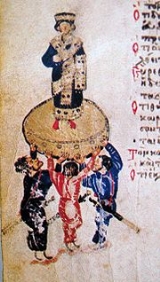
Hezekiah

Encyclopedia
Hezekiah ˌ was the son of Ahaz
and the 14th king of Judah
. Edwin Thiele
has concluded that his reign was between c. 715 and 686 BC. He is also one of the most prominent kings of Judah mentioned in the Hebrew Bible
.
According to the Bible, Hezekiah witnessed the destruction of the northern Kingdom of Israel by Sargon
's Assyria
ns in c 720 BC and was king of Judah during the invasion and siege
of Jerusalem by Sennacherib
in 701 BC. Hezekiah enacted sweeping religious reforms, during which he removed the worship of foreign deities from the Temple in Jerusalem
, and restored the worship of YHWH the God of Israel as instructed by the Torah
. Isaiah
and Micah
prophesied during his reign.
: , Khizkiyahu; or , Y'khizkiyahu); ; or Ḥizkiyyah (Hebrew
: ). The root of the name חִזְקִיָּהוּ Ḥizkiyyahu is חזק, a verb stem that can mean
It also spawns a number of nouns, including
as well as the adjectives
Accordingly, חִזְקִיָּהוּ Ḥizkiyyahu can be said to mean something like "Strengthened by YHWH".
, in , , and .
According to the Bible Hezekiah took the throne at the age of twenty-five and reigned for twenty-nine years . Some writers have proposed that Hezekiah served as coregent with his father Ahaz for about fourteen years from 729 BC. His sole reign has been dated by Albright from 715 – 687 BC or 716 – 687 BC according to Thiele, the last ten years of which were as coregent with his son Manasseh
.
According to the Bible Hezekiah introduced religious reform and reinstated religious traditions. He set himself to abolish idolatry from his kingdom, and among other things which he did to this end, he destroyed the "brazen serpent
", which had been relocated at Jerusalem, and had become an object of idolatrous worship. The biblical sources portray Hezekiah as a great and good king. The book of Kings ends the account of Hezekiah with praise.
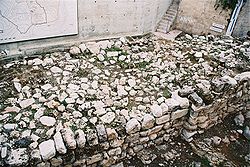
According to the work of archaeologists and philologists, the reign of Hezekiah saw a notable increase in the power of the Judean state. There were increases in literacy, in the production of literary works and an expansion of the population of Jerusalem where the western suburbs were enclosed by the Broad Wall (Jerusalem)
.
The Talmud (Bava Batra 15a) credits him with overseeing the compilation of the biblical books of Isaiah, Proverbs, Song of Songs and Ecclesiastes.
and Abijah
.
His mother Abijah, also called Abi, was a daughter of the high priest Zechariah . He was married to Hephzi-bah. He died in 687 BC at the age of 54 years from natural causes, and was succeeded by his son Manasseh
. During the last ten years of Hezekiah's life, Manasseh was his co-regent. Manasseh was 12 years old when he became co-regent.

 Between the death of Sargon
, and the succession of his son Sennacherib
, Hezekiah sought to throw off his subservience to the Assyria
n kings. He ceased to pay the tribute imposed on his father, and "rebelled against the king of Assyria, and served him not," but entered into a league with Egypt
. If Hezekiah expected the Egyptians to come to his aid, they did not come, and Hezekiah had to face the invasion of Judah by Sennacherib
in the 4th year of Sennacherib (701 BC).
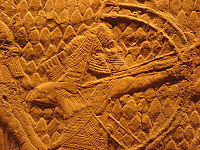
The invasion of Judah by Sennacherib
and the Assyria
n army was a major and well-documented historical event. Sennacherib recorded on his monumental inscription, "The Prism of Sennacherib", how in his campaign against Hezekiah ("Ha-za-qi-(i)a-ú") he took 46 cities (column 3, line 19 of the Sennacherib prism), and besieged Jerusalem ("Ur-sa-li-im-mu") with earthworks. It was during the siege of Jerusalem that the Bible says the Angel of the Lord killed 185,000 Assyrian soldiers. Herodotus
(c. 484 BC – c. 425 BC) wrote of the invasion and acknowledges many Assyrian deaths, which he claims were the result of a plague of mice.
Hezekiah initially paid tribute to Assyria, but then rebelled. The Assyrians recorded that Sennacherib lifted his siege of Jerusalem after Hezekiah acknowledged Sennacherib
as his overlord and paid him tribute. The Bible records that Hezekiah tried to pay off Sennacherib with three hundred talent
s of silver and thirty of gold in tribute, even despoiling the doors of the Temple
to produce the promised amount, but, after the payment was made, Sennacherib renewed his assault on Jerusalem. Sennacherib besieged Jerusalem and sent his Rabshakeh
to the walls as a messenger.
The Rabshakeh addressed the soldiers manning the city wall in the Judean language (Yĕhuwdiyth), asking them to distrust Yahweh or Hezekiah, pointing to Hezekiah's righteous reforms (destroying the High Places
) as a sign that the people should not trust their king .
The fundamental law in prohibits sacrifice
at every place except the temple in Jerusalem; in accordance with this law Josiah
, in 621 BC, Hezekiah's great-grandson, likewise destroyed and desecrated the altars (bmoth) throughout his kingdom.
Sennacherib failed to conquer Jerusalem. The Bible records that Hezekiah went to the temple and there he prayed, the first king in Judah (recorded in the Bible) to do so in about 250 years, since the time of Solomon
.
 The Biblical account maintains that Hezekiah anticipated the Assyrian invasion and made at least two major preparations to resist conquest, construction of Hezekiah's Tunnel, also known as the Siloam Tunnel, and construction of the Broad Wall
. The tunnel is 533 meters long and was dug in order to provide Jerusalem underground access to the waters of the Spring of Gihon/The Siloam Pool, which lay outside the city. This work is described in the Siloam Inscription
, which has been dated to his reign on the basis of its script. At the same time a wall was built around the Pool of Siloam
, into which the waters from the spring flowed which was where all the spring waters were channeled. The wall surrounded the entire city, which bored up to Mount Zion. An impressive vestige of this structure is the broad wall in the Jewish Quarter of the Old City of Jerusalem.
.
The Bible does not say when this took place, but Assyrian records show that Sennacherib was assassinated by his sons, Adrammelech and Sharezer, in 681 BC - i.e., twenty years after the invasion of Judah in 701 BC. He was succeeded by Esarhaddon
as the Assyrian king.
. Hezekiah is also remembered for giving too much information to Baladan, king of Babylon, for which he was confronted by Isaiah
the prophet . According to Jewish tradition, the victory over the Assyrians and Hezekiah's return to health happened at the same time, the first night of Passover
.
.jpg) Hezekiah introduced substantial religious reforms. The worship of Yahweh
Hezekiah introduced substantial religious reforms. The worship of Yahweh
was concentrated at Jerusalem, suppressing the shrines to him that had existed till then elsewhere in Judea . Idolatry
, which had resumed under his father's reign, was banned. Hezekiah abolished the shrines and smashed the pillars and cut down the sacred post
. He also smashed the bronze serpent
which Moses had made, "for until that time the Israelites had been offering sacrifices to it" .
Hezekiah also resumed the Passover
pilgrimage and the tradition of inviting the scattered tribes of Israel to take part in a Passover festival.
While the historicity of has been questioned, recovery of LMLK seal
s from the northwest territory of Israel (corresponding to ) may indicate that some sort of administrative relationship existed between Hezekiah and a minority of northern Israelites.
The books of Kings and Chronicles have lengthy passages attesting that there was effective centralization before Hezekiah - for example, in the days of David and Solomon .
The reference in that Hezekiah "removed the high places (bamot), and broke down the pillars (massebot) and cut down the sacred poles (asherah
)," is dismissed by Biblical Minimalists to be simply Deuteronomist
ic propaganda. They argue that in order to establish the sanctity of their view, the P Source
writers had to show it was anchored in the actions of Hezekiah.
However, archeologists like William G. Dever
have pointed at archeological evidence for iconoclasm
in the late 8th century; the period of Hezekiah's reign. The central cult room of the temple at Arad (a royal Judean fortress) was deliberately and carefully dismantled, "with the altars and massebot" concealed "beneath a Str. 8 plaster floor". This stratum
correlates with the late 8th century; Dever concludes that "the deliberate dismantling of the temple and its replacement by another structure in the days of Hezekiah is an archeological fact. I see no reason for skepticism here."
 A lintel inscription, found over the doorway of a tomb
, has been ascribed to his comptroller Shebna
.
relating to King Hezekiah:
, which commemorates the meeting of the two teams.
As an example of the reasoning that finds inconsistencies in calculations when coregencies are a priori ruled out, dates the fall of Samaria (the Northern Kingdom) to the 6th year of Hezekiah's reign. William F. Albright
has dated the fall of the Kingdom of Israel to 721 BC, while E. R. Thiele
calculates the date as 723 BC. If Abright's or Thiele's dating are correct, then Hezekiah's reign would begin in either 729 or 727 BC. On the other hand, states that Sennacherib
invaded Judah in the 14th year of Hezekiah's reign. Dating based on Assyrian records date this invasion to 701 BC, and Hezekiah's reign would therefore begin in 716/715 BC. This dating would be confirmed by the account of Hezekiah's illness in chapter 20, which immediately follows Sennacherib's departure . This would date his illness to Hezekiah's 14th year, which is confirmed by Isaiah's statement that he will live fifteen more years (29-15=14). As shown below, these problems are all addressed by scholars who make reference to the ancient Near Eastern practice of coregency.
Following the approach of Wellhausen
, another set of calculations shows it is probable that Hezekiah did not ascend the throne before 722 BC. By Albright's calculations, Jehu
's initial year is 842 BC; and between it and Samaria's destruction the Books of Kings give the total number of the years the kings of Israel ruled as 143 7/12, while for the kings of Judah the number is 165. This discrepancy, amounting in the case of Judah to 45 years (165-120), has been accounted for in various ways; but every one of those theories must allow that Hezekiah's first six years fell before 722 BC. (That Hezekiah began to reign before 722 BC, however, is entirely consistent with the principle that the Ahaz/Hezekiah coregency began in 729 BC.) Nor is it clearly known how old Hezekiah was when called to the throne, although states he was twenty-five years of age. His father died at the age of thirty-six ; it is not likely that Ahaz at the age of eleven should have had a son. Hezekiah's own son Manasseh
ascended the throne twenty-nine years later, at the age of twelve. This places his birth in the seventeenth year of his father's reign, or gives Hezekiah's age as forty-two, if he was twenty-five at his ascension. It is more probable that Ahaz was twenty-one or twenty-five when Hezekiah was born (and suggesting an error in the text), and that the latter was thirty-two at the birth of his son and successor, Manasseh.
 Since Albright and Friedman
, several scholars have explained these dating problems on the basis of a coregency between Hezekiah and his father Ahaz between 729 and 716/715 BC. Assyriologists and Egyptologists recognize that coregency was a practice both in Assyria and Egypt, After noting that coregencies were only used sporadically in the northern kingdom (Israel), Nadav Na'aman writes,
Among the numerous scholars who have recognized the coregency between Ahaz and Hezekiah are Kenneth Kitchen in his various writings, Leslie McFall, and Jack Finegan. McFall, in his 1991 article, argues that if 729 BC (that is, the Judean regnal year beginning in Tishri of 729) is taken as the start of the Ahaz/Hezekiah coregency, and 716/715 BC as the date of the death of Ahaz, then all the extensive chronological data for Hezekiah and his contemporaries in the late eighth century BC are in harmony. Further, McFall found that no textual emendations are required among the numerous dates, reign lengths, and synchronisms given in the Bible for this period. In contrast, those who do not accept the Ancient Near Eastern principle of coregencies require multiple emendations of the Scriptural text, and there is no general agreement on which texts should be emended, nor is there any consensus among these scholars on the resultant chronology for the eighth century BC. This is in contrast with the general consensus among those who accept the biblical and near Eastern practice of coregencies that Hezekiah was installed as coregent with his father Ahaz in 729 BC, and the synchronisms of 2 Kings 18 must be measured from that date, whereas the synchronisms to Sennacherib are measured from the sole reign starting in 716/715 BC. The two synchronisms to Hoshea
of Israel in 2 Kings 18 are then in exact agreement with the dates of Hoshea's reign that can be determined from Assyrian sources, as is the date of Samaria's fall as stated in 2 Kings 18:10. An analogous situation of two ways of measurement, both equally valid, is encountered in the dates given for Jehoram of Israel
, whose first year is synchronized to the 18th year of the sole reign of Jehoshaphat
of Judah in 2 Kings 3:1 (853/852 BC), but his reign is also reckoned according to another method as starting in the second year of the coregency of Jehoshaphat and his son Jehoram of Judah
(2 Kings 1:17); both methods refer to the same calendrical year.
Scholars who accept the principle of coregencies note that abundant evidence for their use is found in the biblical material itself. The agreement of scholarship built on these principles with both biblical and secular texts was such that the Thiele/McFall chronology was accepted as the best chronology for the kingdom period in Jack Finegan's encyclopedic Handbook of Biblical Chronology.
Ahaz
Ahaz was king of Judah, and the son and successor of Jotham. He is one of the kings mentioned in the genealogy of Jesus in the Gospel of Matthew....
and the 14th king of Judah
Kingdom of Judah
The Kingdom of Judah was a Jewish state established in the Southern Levant during the Iron Age. It is often referred to as the "Southern Kingdom" to distinguish it from the northern Kingdom of Israel....
. Edwin Thiele
Edwin R. Thiele
Edwin R. Thiele was an American missionary in China, an editor, archaeologist, writer, and Old Testament professor. He is best known for his chronological studies of the Hebrew kingdom period.- Biography :...
has concluded that his reign was between c. 715 and 686 BC. He is also one of the most prominent kings of Judah mentioned in the Hebrew Bible
Hebrew Bible
The Hebrew Bible is a term used by biblical scholars outside of Judaism to refer to the Tanakh , a canonical collection of Jewish texts, and the common textual antecedent of the several canonical editions of the Christian Old Testament...
.
According to the Bible, Hezekiah witnessed the destruction of the northern Kingdom of Israel by Sargon
Sargon II
Sargon II was an Assyrian king. Sargon II became co-regent with Shalmaneser V in 722 BC, and became the sole ruler of the kingdom of Assyria in 722 BC after the death of Shalmaneser V. It is not clear whether he was the son of Tiglath-Pileser III or a usurper unrelated to the royal family...
's Assyria
Assyria
Assyria was a Semitic Akkadian kingdom, extant as a nation state from the mid–23rd century BC to 608 BC centred on the Upper Tigris river, in northern Mesopotamia , that came to rule regional empires a number of times through history. It was named for its original capital, the ancient city of Assur...
ns in c 720 BC and was king of Judah during the invasion and siege
Assyrian Siege of Jerusalem
In approximately 701 BCE, Sennacherib, king of Assyria, attacked the fortified cities of Judah, laying siege on Jerusalem. The historical outcome of the siege is unclear.-Background:...
of Jerusalem by Sennacherib
Sennacherib
Sennacherib |Sîn]] has replaced brothers for me"; Aramaic: ) was the son of Sargon II, whom he succeeded on the throne of Assyria .-Rise to power:...
in 701 BC. Hezekiah enacted sweeping religious reforms, during which he removed the worship of foreign deities from the Temple in Jerusalem
Temple in Jerusalem
The Temple in Jerusalem or Holy Temple , refers to one of a series of structures which were historically located on the Temple Mount in the Old City of Jerusalem, the current site of the Dome of the Rock. Historically, these successive temples stood at this location and functioned as the centre of...
, and restored the worship of YHWH the God of Israel as instructed by the Torah
Torah
Torah- A scroll containing the first five books of the BibleThe Torah , is name given by Jews to the first five books of the bible—Genesis , Exodus , Leviticus , Numbers and Deuteronomy Torah- A scroll containing the first five books of the BibleThe Torah , is name given by Jews to the first five...
. Isaiah
Isaiah
Isaiah ; Greek: ', Ēsaïās ; "Yahu is salvation") was a prophet in the 8th-century BC Kingdom of Judah.Jews and Christians consider the Book of Isaiah a part of their Biblical canon; he is the first listed of the neviim akharonim, the later prophets. Many of the New Testament teachings of Jesus...
and Micah
Micah
Micah is a given name.Micah is the name of several people in the Hebrew Bible , and means "who is like God?". The name is sometimes found with theophoric extensions...
prophesied during his reign.
Etymology
Hezekiah, more properly transliterated as Ḥizkiyyahu (and sometimes as Ezekias) (HebrewHebrew language
Hebrew is a Semitic language of the Afroasiatic language family. Culturally, is it considered by Jews and other religious groups as the language of the Jewish people, though other Jewish languages had originated among diaspora Jews, and the Hebrew language is also used by non-Jewish groups, such...
: , Khizkiyahu; or , Y'khizkiyahu); ; or Ḥizkiyyah (Hebrew
Hebrew language
Hebrew is a Semitic language of the Afroasiatic language family. Culturally, is it considered by Jews and other religious groups as the language of the Jewish people, though other Jewish languages had originated among diaspora Jews, and the Hebrew language is also used by non-Jewish groups, such...
: ). The root of the name חִזְקִיָּהוּ Ḥizkiyyahu is חזק, a verb stem that can mean
- "strengthen", "fortify" in the pi'él (חַזֵּק),
- "hold", "seize" in the hif'il (הַחֲזֵק), and
- "gather one's strength", "take courage" in the hitpa'él (הִתְחַזֵּק).
It also spawns a number of nouns, including
- חוֹזֶק, חָזְקָה, חֶזְקָה "strength", and
- חֲזָקָה "taking hold", "seizing", "occupying", "presumption" [of entitlement]
as well as the adjectives
- חָזָק, חָזֵק "strong".
Accordingly, חִזְקִיָּהוּ Ḥizkiyyahu can be said to mean something like "Strengthened by YHWH".
The Biblical account
The main accounts of Hezekiah's reign are found in the Hebrew BibleHebrew Bible
The Hebrew Bible is a term used by biblical scholars outside of Judaism to refer to the Tanakh , a canonical collection of Jewish texts, and the common textual antecedent of the several canonical editions of the Christian Old Testament...
, in , , and .
Reign over Judah
According to the Bible Hezekiah took the throne at the age of twenty-five and reigned for twenty-nine years . Some writers have proposed that Hezekiah served as coregent with his father Ahaz for about fourteen years from 729 BC. His sole reign has been dated by Albright from 715 – 687 BC or 716 – 687 BC according to Thiele, the last ten years of which were as coregent with his son Manasseh
Manasseh of Judah
Manasseh was a king of the Kingdom of Judah. He was the only son of Hezekiah with Hephzi-bah. He became king at an age 12 years and reigned for 55 years. Edwin Thiele has concluded that he commenced his reign as co-regent with his father Hezekiah in 697/696 BC, with his sole reign beginning in...
.
According to the Bible Hezekiah introduced religious reform and reinstated religious traditions. He set himself to abolish idolatry from his kingdom, and among other things which he did to this end, he destroyed the "brazen serpent
Nehushtan
The Nehushtan , in the Hebrew Bible, was a sacred object in the form of a snake of brass upon a pole.The priestly source of the Torah says that Moses used a 'fiery serpent' to cure the Israelites from snakebites...
", which had been relocated at Jerusalem, and had become an object of idolatrous worship. The biblical sources portray Hezekiah as a great and good king. The book of Kings ends the account of Hezekiah with praise.
According to the work of archaeologists and philologists, the reign of Hezekiah saw a notable increase in the power of the Judean state. There were increases in literacy, in the production of literary works and an expansion of the population of Jerusalem where the western suburbs were enclosed by the Broad Wall (Jerusalem)
Broad Wall (Jerusalem)
The Broad Wall is an ancient defensive city wall in Jerusalem dating from the reign of King Hezekiah -Discovery:The wall was discovered by archaeologist Nahman Avigad in the 1970s. This is a massive defensive structure, seven meters thick. The unbroken length of wall uncovered by Avigad's dig...
.
The Talmud (Bava Batra 15a) credits him with overseeing the compilation of the biblical books of Isaiah, Proverbs, Song of Songs and Ecclesiastes.
Family and life
Hezekiah was born in c. 739 BC, the son of King AhazAhaz
Ahaz was king of Judah, and the son and successor of Jotham. He is one of the kings mentioned in the genealogy of Jesus in the Gospel of Matthew....
and Abijah
Abijah
Abijah or Abiah or Abia is a Biblical unisex name that means Aviya or "my Father is Yahweh" in Hebrew. In the Old Testament the name Abijah was borne by several characters:Women...
.
His mother Abijah, also called Abi, was a daughter of the high priest Zechariah . He was married to Hephzi-bah. He died in 687 BC at the age of 54 years from natural causes, and was succeeded by his son Manasseh
Manasseh of Judah
Manasseh was a king of the Kingdom of Judah. He was the only son of Hezekiah with Hephzi-bah. He became king at an age 12 years and reigned for 55 years. Edwin Thiele has concluded that he commenced his reign as co-regent with his father Hezekiah in 697/696 BC, with his sole reign beginning in...
. During the last ten years of Hezekiah's life, Manasseh was his co-regent. Manasseh was 12 years old when he became co-regent.
Political moves and Assyrian invasion
Sargon II
Sargon II was an Assyrian king. Sargon II became co-regent with Shalmaneser V in 722 BC, and became the sole ruler of the kingdom of Assyria in 722 BC after the death of Shalmaneser V. It is not clear whether he was the son of Tiglath-Pileser III or a usurper unrelated to the royal family...
, and the succession of his son Sennacherib
Sennacherib
Sennacherib |Sîn]] has replaced brothers for me"; Aramaic: ) was the son of Sargon II, whom he succeeded on the throne of Assyria .-Rise to power:...
, Hezekiah sought to throw off his subservience to the Assyria
Assyria
Assyria was a Semitic Akkadian kingdom, extant as a nation state from the mid–23rd century BC to 608 BC centred on the Upper Tigris river, in northern Mesopotamia , that came to rule regional empires a number of times through history. It was named for its original capital, the ancient city of Assur...
n kings. He ceased to pay the tribute imposed on his father, and "rebelled against the king of Assyria, and served him not," but entered into a league with Egypt
Egypt
Egypt , officially the Arab Republic of Egypt, Arabic: , is a country mainly in North Africa, with the Sinai Peninsula forming a land bridge in Southwest Asia. Egypt is thus a transcontinental country, and a major power in Africa, the Mediterranean Basin, the Middle East and the Muslim world...
. If Hezekiah expected the Egyptians to come to his aid, they did not come, and Hezekiah had to face the invasion of Judah by Sennacherib
Sennacherib
Sennacherib |Sîn]] has replaced brothers for me"; Aramaic: ) was the son of Sargon II, whom he succeeded on the throne of Assyria .-Rise to power:...
in the 4th year of Sennacherib (701 BC).
The invasion of Judah by Sennacherib
Sennacherib
Sennacherib |Sîn]] has replaced brothers for me"; Aramaic: ) was the son of Sargon II, whom he succeeded on the throne of Assyria .-Rise to power:...
and the Assyria
Assyria
Assyria was a Semitic Akkadian kingdom, extant as a nation state from the mid–23rd century BC to 608 BC centred on the Upper Tigris river, in northern Mesopotamia , that came to rule regional empires a number of times through history. It was named for its original capital, the ancient city of Assur...
n army was a major and well-documented historical event. Sennacherib recorded on his monumental inscription, "The Prism of Sennacherib", how in his campaign against Hezekiah ("Ha-za-qi-(i)a-ú") he took 46 cities (column 3, line 19 of the Sennacherib prism), and besieged Jerusalem ("Ur-sa-li-im-mu") with earthworks. It was during the siege of Jerusalem that the Bible says the Angel of the Lord killed 185,000 Assyrian soldiers. Herodotus
Herodotus
Herodotus was an ancient Greek historian who was born in Halicarnassus, Caria and lived in the 5th century BC . He has been called the "Father of History", and was the first historian known to collect his materials systematically, test their accuracy to a certain extent and arrange them in a...
(c. 484 BC – c. 425 BC) wrote of the invasion and acknowledges many Assyrian deaths, which he claims were the result of a plague of mice.
Hezekiah initially paid tribute to Assyria, but then rebelled. The Assyrians recorded that Sennacherib lifted his siege of Jerusalem after Hezekiah acknowledged Sennacherib
Sennacherib
Sennacherib |Sîn]] has replaced brothers for me"; Aramaic: ) was the son of Sargon II, whom he succeeded on the throne of Assyria .-Rise to power:...
as his overlord and paid him tribute. The Bible records that Hezekiah tried to pay off Sennacherib with three hundred talent
Talent (weight)
The "talent" was one of several ancient units of mass, as well as corresponding units of value equivalent to these masses of a precious metal. It was approximately the mass of water required to fill an amphora. A Greek, or Attic talent, was , a Roman talent was , an Egyptian talent was , and a...
s of silver and thirty of gold in tribute, even despoiling the doors of the Temple
Temple in Jerusalem
The Temple in Jerusalem or Holy Temple , refers to one of a series of structures which were historically located on the Temple Mount in the Old City of Jerusalem, the current site of the Dome of the Rock. Historically, these successive temples stood at this location and functioned as the centre of...
to produce the promised amount, but, after the payment was made, Sennacherib renewed his assault on Jerusalem. Sennacherib besieged Jerusalem and sent his Rabshakeh
Rabshakeh
Rabshakeh, also Rab-shakeh and Rabsaces Neo-Aramaic: This name meaning chief of the princes was given to the chief cup-bearer or the vizier of the Assyrian royal court.The Bible mentions it for one of Sennacherib's messengers to Hezekiah...
to the walls as a messenger.
The Rabshakeh addressed the soldiers manning the city wall in the Judean language (Yĕhuwdiyth), asking them to distrust Yahweh or Hezekiah, pointing to Hezekiah's righteous reforms (destroying the High Places
High place
High Place, in the English version of the Old Testament, the literal translation of the Hebrew במה .This rendering is etymologically correct, as appears from the poetical use of the plural in such expressions as to ride, or stalk, or stand on the high places of the earth, the sea, the clouds, and...
) as a sign that the people should not trust their king .
The fundamental law in prohibits sacrifice
Sacrifice
Sacrifice is the offering of food, objects or the lives of animals or people to God or the gods as an act of propitiation or worship.While sacrifice often implies ritual killing, the term offering can be used for bloodless sacrifices of cereal food or artifacts...
at every place except the temple in Jerusalem; in accordance with this law Josiah
Josiah
Josiah or Yoshiyahu or Joshua was a king of Judah who instituted major reforms. Josiah is credited by most historians with having established or compiled important Jewish scriptures during the Deuteronomic reform that occurred during his rule.Josiah became king of Judah at the age of eight, after...
, in 621 BC, Hezekiah's great-grandson, likewise destroyed and desecrated the altars (bmoth) throughout his kingdom.
Sennacherib failed to conquer Jerusalem. The Bible records that Hezekiah went to the temple and there he prayed, the first king in Judah (recorded in the Bible) to do so in about 250 years, since the time of Solomon
Solomon
Solomon , according to the Book of Kings and the Book of Chronicles, a King of Israel and according to the Talmud one of the 48 prophets, is identified as the son of David, also called Jedidiah in 2 Samuel 12:25, and is described as the third king of the United Monarchy, and the final king before...
.
Hezekiah's construction
Broad Wall (Jerusalem)
The Broad Wall is an ancient defensive city wall in Jerusalem dating from the reign of King Hezekiah -Discovery:The wall was discovered by archaeologist Nahman Avigad in the 1970s. This is a massive defensive structure, seven meters thick. The unbroken length of wall uncovered by Avigad's dig...
. The tunnel is 533 meters long and was dug in order to provide Jerusalem underground access to the waters of the Spring of Gihon/The Siloam Pool, which lay outside the city. This work is described in the Siloam Inscription
Siloam inscription
The Siloam inscription or Silwan inscription is a passage of inscribed text found in the Hezekiah tunnel which brings water from the Gihon Spring to the Pool of Siloam, located in the East Jerusalem neighborhood of Silwan. The inscription records the construction of the tunnel in the 8th century...
, which has been dated to his reign on the basis of its script. At the same time a wall was built around the Pool of Siloam
Pool of Siloam
Pool of Siloam is a rock-cut pool on the southern slope of the City of David, the original site of Jerusalem, located outside the walls of the Old City to the southeast. The pool was fed by the waters of the Gihon Spring, carried there by two aqueducts.-History:The Pool of Siloam is mentioned...
, into which the waters from the spring flowed which was where all the spring waters were channeled. The wall surrounded the entire city, which bored up to Mount Zion. An impressive vestige of this structure is the broad wall in the Jewish Quarter of the Old City of Jerusalem.
"When Hezekiah saw that SennacheribThe narrative in the Bible states that Sennacherib besieged JerusalemSennacheribSennacherib |Sîn]] has replaced brothers for me"; Aramaic: ) was the son of Sargon II, whom he succeeded on the throne of Assyria .-Rise to power:...
had come, intent on making war against Jerusalem, he consulted with his officers and warriors about stopping the flow of the springs outside the city ... for otherwise, they thought, the King of Assyria would come and find water in abundance" .
Assyrian Siege of Jerusalem
In approximately 701 BCE, Sennacherib, king of Assyria, attacked the fortified cities of Judah, laying siege on Jerusalem. The historical outcome of the siege is unclear.-Background:...
.
Death of Sennacherib
says -"It came about as he was worshiping in the house of Nisroch his god, that Adrammelech and Sharezer killed him [Sennacherib] with the sword; and they escaped into the land of Ararat. And Esarhaddon his son became king in his place."
The Bible does not say when this took place, but Assyrian records show that Sennacherib was assassinated by his sons, Adrammelech and Sharezer, in 681 BC - i.e., twenty years after the invasion of Judah in 701 BC. He was succeeded by Esarhaddon
Esarhaddon
Esarhaddon , was a king of Assyria who reigned 681 – 669 BC. He was the youngest son of Sennacherib and the Aramean queen Naqi'a , Sennacherib's second wife....
as the Assyrian king.
Hezekiah's illness and death
The narrative of Hezekiah's sickness and miraculous recovery is found in , , . Various ambassadors came to congratulate him on his recovery, among them Merodach-baladan, the king of BabylonBabylon
Babylon was an Akkadian city-state of ancient Mesopotamia, the remains of which are found in present-day Al Hillah, Babil Province, Iraq, about 85 kilometers south of Baghdad...
. Hezekiah is also remembered for giving too much information to Baladan, king of Babylon, for which he was confronted by Isaiah
Isaiah
Isaiah ; Greek: ', Ēsaïās ; "Yahu is salvation") was a prophet in the 8th-century BC Kingdom of Judah.Jews and Christians consider the Book of Isaiah a part of their Biblical canon; he is the first listed of the neviim akharonim, the later prophets. Many of the New Testament teachings of Jesus...
the prophet . According to Jewish tradition, the victory over the Assyrians and Hezekiah's return to health happened at the same time, the first night of Passover
Passover
Passover is a Jewish holiday and festival. It commemorates the story of the Exodus, in which the ancient Israelites were freed from slavery in Egypt...
.
Religious reforms
Yahweh
Yahweh is the name of God in the Bible, the God of Abraham, Isaac, Jacob, Jews and Christians.The word Yahweh is a modern scholarly convention for the Hebrew , transcribed into Roman letters as YHWH and known as the Tetragrammaton, for which the original pronunciation is unknown...
was concentrated at Jerusalem, suppressing the shrines to him that had existed till then elsewhere in Judea . Idolatry
Idolatry
Idolatry is a pejorative term for the worship of an idol, a physical object such as a cult image, as a god, or practices believed to verge on worship, such as giving undue honour and regard to created forms other than God. In all the Abrahamic religions idolatry is strongly forbidden, although...
, which had resumed under his father's reign, was banned. Hezekiah abolished the shrines and smashed the pillars and cut down the sacred post
Asherah pole
An Asherah pole is a sacred tree or pole that stood near Canaanite religious locations to honor the Ugaritic mother-goddess Asherah, consort of El...
. He also smashed the bronze serpent
Nehushtan
The Nehushtan , in the Hebrew Bible, was a sacred object in the form of a snake of brass upon a pole.The priestly source of the Torah says that Moses used a 'fiery serpent' to cure the Israelites from snakebites...
which Moses had made, "for until that time the Israelites had been offering sacrifices to it" .
Hezekiah also resumed the Passover
Passover
Passover is a Jewish holiday and festival. It commemorates the story of the Exodus, in which the ancient Israelites were freed from slavery in Egypt...
pilgrimage and the tradition of inviting the scattered tribes of Israel to take part in a Passover festival.
While the historicity of has been questioned, recovery of LMLK seal
LMLK seal
LMLK seals were stamped on the handles of large storage jars mostly in and around Jerusalem during the reign of King Hezekiah based on several complete jars found in situ buried under a destruction layer caused by Sennacherib at Lachish...
s from the northwest territory of Israel (corresponding to ) may indicate that some sort of administrative relationship existed between Hezekiah and a minority of northern Israelites.
The books of Kings and Chronicles have lengthy passages attesting that there was effective centralization before Hezekiah - for example, in the days of David and Solomon .
The reference in that Hezekiah "removed the high places (bamot), and broke down the pillars (massebot) and cut down the sacred poles (asherah
Asherah
Asherah , in Semitic mythology, is a Semitic mother goddess, who appears in a number of ancient sources including Akkadian writings by the name of Ashratum/Ashratu and in Hittite as Asherdu or Ashertu or Aserdu or Asertu...
)," is dismissed by Biblical Minimalists to be simply Deuteronomist
Deuteronomist
The Deuteronomist, or simply D, is one of the sources underlying the Hebrew bible . It is found in the book of Deuteronomy, in the books of Joshua, Judges, Samuel, and Kings and also in the book of Jeremiah...
ic propaganda. They argue that in order to establish the sanctity of their view, the P Source
Priestly source
The Priestly Source is one of the sources of the Torah/Pentateuch in the bible. Primarily a product of the post-Exilic period when Judah was a province of the Persian empire , P was written to show that even when all seemed lost, God remained present with Israel...
writers had to show it was anchored in the actions of Hezekiah.
However, archeologists like William G. Dever
William G. Dever
William G. Dever is an American archaeologist, specialising in the history of Israel and the Near East in Biblical times. He was Professor of Near Eastern Archaeology and Anthropology at the University of Arizona in Tucson from 1975 to 2002...
have pointed at archeological evidence for iconoclasm
Iconoclasm
Iconoclasm is the deliberate destruction of religious icons and other symbols or monuments, usually with religious or political motives. It is a frequent component of major political or religious changes...
in the late 8th century; the period of Hezekiah's reign. The central cult room of the temple at Arad (a royal Judean fortress) was deliberately and carefully dismantled, "with the altars and massebot" concealed "beneath a Str. 8 plaster floor". This stratum
Stratum
In geology and related fields, a stratum is a layer of sedimentary rock or soil with internally consistent characteristics that distinguish it from other layers...
correlates with the late 8th century; Dever concludes that "the deliberate dismantling of the temple and its replacement by another structure in the days of Hezekiah is an archeological fact. I see no reason for skepticism here."
Archaeological evidence
Tomb
A tomb is a repository for the remains of the dead. It is generally any structurally enclosed interment space or burial chamber, of varying sizes...
, has been ascribed to his comptroller Shebna
Shebna
Shebna was "treasurer over the house" in the reign of king Hezekiah of Judah, according to the Old Testament....
.
Seals
Two distinct classes of seal impressions have been found in modern IsraelIsrael
The State of Israel is a parliamentary republic located in the Middle East, along the eastern shore of the Mediterranean Sea...
relating to King Hezekiah:
- LMLK sealLMLK sealLMLK seals were stamped on the handles of large storage jars mostly in and around Jerusalem during the reign of King Hezekiah based on several complete jars found in situ buried under a destruction layer caused by Sennacherib at Lachish...
s on storage jar handles, excavated from strata formed by SennacheribSennacheribSennacherib |Sîn]] has replaced brothers for me"; Aramaic: ) was the son of Sargon II, whom he succeeded on the throne of Assyria .-Rise to power:...
's destruction as well as immediately above that layer suggesting they were used throughout his 29-year reign (Grena, 2004, p. 338)
- BullaeBulla (seal)Bulla , is a type of seal impression. It comes in two forms: metal and clay.- Clay bullae :The original bulla was a lump of clay molded around a cord and stamped with a seal...
from sealed documents, some that may have belonged to Hezekiah himself (Grena, 2004, p. 26, Figs. 9 and 10) while others name his servants (ah-vah-deem in Hebrew, ayin-bet-dalet-yod-mem), all from the antiquities market and subject to authentication disputes (see Biblical archaeologyBiblical archaeologyFor the movement associated with William F. Albright and also known as biblical archaeology, see Biblical archaeology school. For the interpretation of biblical archaeology in relation to biblical historicity, see The Bible and history....
)
Siloam Inscription
In the Siloam Tunnel we find the Siloam InscriptionSiloam inscription
The Siloam inscription or Silwan inscription is a passage of inscribed text found in the Hezekiah tunnel which brings water from the Gihon Spring to the Pool of Siloam, located in the East Jerusalem neighborhood of Silwan. The inscription records the construction of the tunnel in the 8th century...
, which commemorates the meeting of the two teams.
Chronological notes
There has been considerable academic debate about the actual dates of reigns of the Israelite kings. Scholars have endeavored to synchronize the chronology of events referred to in the Bible with those derived from other external sources. In the case of Hezekiah, scholars have noted that the apparent inconsistencies are resolved by accepting the evidence that Hezekiah, like his predecessors for four generations in the kings of Judah, had a coregency with his father, and this coregency began in 729 BC.As an example of the reasoning that finds inconsistencies in calculations when coregencies are a priori ruled out, dates the fall of Samaria (the Northern Kingdom) to the 6th year of Hezekiah's reign. William F. Albright
William F. Albright
William Foxwell Albright was an American archaeologist, biblical scholar, philologist and expert on ceramics. From the early twentieth century until his death, he was the dean of biblical archaeologists and the universally acknowledged founder of the Biblical archaeology movement...
has dated the fall of the Kingdom of Israel to 721 BC, while E. R. Thiele
Edwin R. Thiele
Edwin R. Thiele was an American missionary in China, an editor, archaeologist, writer, and Old Testament professor. He is best known for his chronological studies of the Hebrew kingdom period.- Biography :...
calculates the date as 723 BC. If Abright's or Thiele's dating are correct, then Hezekiah's reign would begin in either 729 or 727 BC. On the other hand, states that Sennacherib
Sennacherib
Sennacherib |Sîn]] has replaced brothers for me"; Aramaic: ) was the son of Sargon II, whom he succeeded on the throne of Assyria .-Rise to power:...
invaded Judah in the 14th year of Hezekiah's reign. Dating based on Assyrian records date this invasion to 701 BC, and Hezekiah's reign would therefore begin in 716/715 BC. This dating would be confirmed by the account of Hezekiah's illness in chapter 20, which immediately follows Sennacherib's departure . This would date his illness to Hezekiah's 14th year, which is confirmed by Isaiah's statement that he will live fifteen more years (29-15=14). As shown below, these problems are all addressed by scholars who make reference to the ancient Near Eastern practice of coregency.
Following the approach of Wellhausen
Julius Wellhausen
Julius Wellhausen , was a German biblical scholar and orientalist, noted particularly for his contribution to scholarly understanding of the origin of the Pentateuch/Torah ....
, another set of calculations shows it is probable that Hezekiah did not ascend the throne before 722 BC. By Albright's calculations, Jehu
Jehu
Jehu was a king of Israel. He was the son of Jehoshaphat, and grandson of Nimshi.William F. Albright has dated his reign to 842-815 BC, while E. R. Thiele offers the dates 841-814 BC...
's initial year is 842 BC; and between it and Samaria's destruction the Books of Kings give the total number of the years the kings of Israel ruled as 143 7/12, while for the kings of Judah the number is 165. This discrepancy, amounting in the case of Judah to 45 years (165-120), has been accounted for in various ways; but every one of those theories must allow that Hezekiah's first six years fell before 722 BC. (That Hezekiah began to reign before 722 BC, however, is entirely consistent with the principle that the Ahaz/Hezekiah coregency began in 729 BC.) Nor is it clearly known how old Hezekiah was when called to the throne, although states he was twenty-five years of age. His father died at the age of thirty-six ; it is not likely that Ahaz at the age of eleven should have had a son. Hezekiah's own son Manasseh
Manasseh of Judah
Manasseh was a king of the Kingdom of Judah. He was the only son of Hezekiah with Hephzi-bah. He became king at an age 12 years and reigned for 55 years. Edwin Thiele has concluded that he commenced his reign as co-regent with his father Hezekiah in 697/696 BC, with his sole reign beginning in...
ascended the throne twenty-nine years later, at the age of twelve. This places his birth in the seventeenth year of his father's reign, or gives Hezekiah's age as forty-two, if he was twenty-five at his ascension. It is more probable that Ahaz was twenty-one or twenty-five when Hezekiah was born (and suggesting an error in the text), and that the latter was thirty-two at the birth of his son and successor, Manasseh.
Richard Elliott Friedman
Richard Elliott Friedman is a biblical scholar and the Ann and Jay Davis Professor of Jewish Studies at the University of Georgia. He joined the faculty of the UGA Religion Department in 2006. Prior to his appointment there, he was the Katzin Professor of Jewish Civilization: Hebrew Bible; Near...
, several scholars have explained these dating problems on the basis of a coregency between Hezekiah and his father Ahaz between 729 and 716/715 BC. Assyriologists and Egyptologists recognize that coregency was a practice both in Assyria and Egypt, After noting that coregencies were only used sporadically in the northern kingdom (Israel), Nadav Na'aman writes,
In the kingdom of Judah, on the other hand, the nomination of a co-regent was the common procedure, beginning from David who, before his death, elevated his son Solomon to the throne…When taking into account the permanent nature of the co-regency in Judah from the time of Joash, one may dare to conclude that dating the co-regencies accurately is indeed the key for solving the problems of biblical chronology in the eighth century B.C."
Among the numerous scholars who have recognized the coregency between Ahaz and Hezekiah are Kenneth Kitchen in his various writings, Leslie McFall, and Jack Finegan. McFall, in his 1991 article, argues that if 729 BC (that is, the Judean regnal year beginning in Tishri of 729) is taken as the start of the Ahaz/Hezekiah coregency, and 716/715 BC as the date of the death of Ahaz, then all the extensive chronological data for Hezekiah and his contemporaries in the late eighth century BC are in harmony. Further, McFall found that no textual emendations are required among the numerous dates, reign lengths, and synchronisms given in the Bible for this period. In contrast, those who do not accept the Ancient Near Eastern principle of coregencies require multiple emendations of the Scriptural text, and there is no general agreement on which texts should be emended, nor is there any consensus among these scholars on the resultant chronology for the eighth century BC. This is in contrast with the general consensus among those who accept the biblical and near Eastern practice of coregencies that Hezekiah was installed as coregent with his father Ahaz in 729 BC, and the synchronisms of 2 Kings 18 must be measured from that date, whereas the synchronisms to Sennacherib are measured from the sole reign starting in 716/715 BC. The two synchronisms to Hoshea
Hoshea
See also Hosea, who has the same name in Biblical Hebrew.Hoshea was the last king of the Israelite Kingdom of Israel and son of Elah . William F. Albright dated reign to 732 – 721 BC, while E. R. Thiele offered the dates 732 – 723 BC.Assyrian records basically confirm the Biblical...
of Israel in 2 Kings 18 are then in exact agreement with the dates of Hoshea's reign that can be determined from Assyrian sources, as is the date of Samaria's fall as stated in 2 Kings 18:10. An analogous situation of two ways of measurement, both equally valid, is encountered in the dates given for Jehoram of Israel
Jehoram of Israel
Jehoram was a king of the northern Kingdom of Israel. He was the son of Ahab and Jezebel.According to , in the fifth year of Joram of Israel, Jehoram became king of Judah, when his father Jehoshaphat was king of Judah, indicating a co-regency...
, whose first year is synchronized to the 18th year of the sole reign of Jehoshaphat
Jehoshaphat
Jehoshaphat was the fourth king of the The Kingdom of Judah, and successor of his father Asa. His children included Jehoram, who succeeded him as king...
of Judah in 2 Kings 3:1 (853/852 BC), but his reign is also reckoned according to another method as starting in the second year of the coregency of Jehoshaphat and his son Jehoram of Judah
Jehoram of Judah
Jehoram of Judah was the king of the southern Kingdom of Judah, and the son of Jehoshaphat .According to , Jehoram became king of Judah in the fifth year of Jehoram of Israel, when his father Jehoshaphat was king of Judah, indicating a co-regency. The author of Kings also speaks of both Jehoram...
(2 Kings 1:17); both methods refer to the same calendrical year.
Scholars who accept the principle of coregencies note that abundant evidence for their use is found in the biblical material itself. The agreement of scholarship built on these principles with both biblical and secular texts was such that the Thiele/McFall chronology was accepted as the best chronology for the kingdom period in Jack Finegan's encyclopedic Handbook of Biblical Chronology.
Resources
a fictionalized account of Hezekiah's rise to power, Book 1 in Austin's "Chronicles of the Kings" seriesExternal links
- "Hezekiah." Encyclopædia Britannica. Encyclopædia Britannica Online.
- King Hezekiah from Jerusalem Mosaic
- Hezekiah See all Bible verses pertaining to King Hezekiah
- The Reign Of Hezekiah by John F. Brug
- Sennacherib's Invasion of Hezekiah's Judah in 701 BC - by Craig C. Broyles
- Interactive Map of Sennacherib's Invasion of Hezekiah's Judah, including the accounts of Sennacherib, Herodotus, 2 Kings, Isaiah and Micah