

Dissolution of the Ottoman Empire

Encyclopedia
The Dissolution of the Ottoman Empire
(24 July 1908
– 30 October 1918
) included the watershed events of the Young Turk Revolution
and the establishment of the Second Constitutional Era, and ended with the Partitioning of the Ottoman Empire
by the victorious sides of World War I.
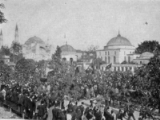
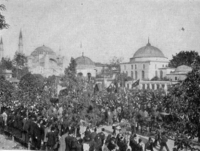 In a few weeks during July 1908 the Young Turk Revolution changed the political structure of the Empire.
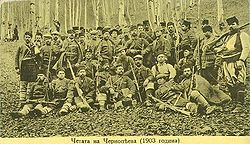
Abdul Hamid's regime which lasted more than 35 years and the former autocratic system developed under his control were destroyed. The Armenians, Roman Catholic Syrians, Greeks of the Archipelago, and Bulgarians forgot Empire inaugurationed the new fraternity and progress. There was a unification theme and groups which fought against each other wished to work out the salvation of a common country. Heads of Macedonian bands (IMRO) fraternized with the members of the "Committee of Union and Progress
"; Greeks and Bulgarians embraced one another under tÌhe second biggest party "Liberal Union
". The Bulgarian federalist wing welcomed the revolution and later joined mainstream political life as People's Federative Party (Bulgarian Section). Even, some of its leaders like Sandanski
and Chernopeev
participated in the march on Constantinople
to depose the "attempt to dismantle constitution"
. The former centralists of IMRO formed the Bulgarian Constitutional Clubs
and like the PFP participated in Ottoman elections. Armenians which formed Armenakan
, Social Democrat Hunchakian Party
(Hunchakian) and Armenian Revolutionary Federation
(Dashnak or Tashnag) begin to work openly as there was no Abdul Hamid's pressure on them.
. The process of replacing the monarchic institutions with constitutional institutions and electoral policies was neither as simple nor as bloodless as the regime change itself. The periphery of the Empire continued to splinter under the pressures of local revolutions.
Due to Abdul Hamid's policies, equilibrium between Muslims and Christians was impossible to reach. Overburdened with religious and ethnic strife, the new government had little ability to solve the problems of the empire.
with Greece by taking advantage of revolution as well as the timing of Zaimis's vacation away from the island. The 1908 left the issue unsolved between the Empire and the Cretans. In 1909, after the parliament elected the governing structure, the Committee of Union and Progress
(CUP) decided that if order was maintained and the rights of Muslims were respected, the issue would be solved with negotiations.
, Cyrillic, and Arabic scripts, implied different political and religious orientations opposed by one or another element of the population. In July 1908, a month after a Young Turk rebellion in Macedonia supported by an Albanian uprising in Kosovo and Macedonia
escalated into widespread insurrection and mutiny within the imperial army, Sultan Abdül Hamid II
agreed to demands by the Young Turks to restore constitutional rule. Many Albanians participated in the Young Turks uprising, hoping that it would gain their people autonomy within the empire. The Young Turks lifted the Ottoman ban on Albanian-language schools and on writing the Albanian language. As a consequence, Albanian intellectuals meeting in Manastir
in 1908 chose the Latin alphabet as a standard script.
The new government also appealed for Islamic solidarity to break the Albanians' unity and used the Muslim clergy to try to impose the Arabic alphabet. The Albanians refused to submit to the Young Turks' campaign to "Ottomanize" them by force.
 After nine months into the new government, discontent found expression in a fundamentalist movement which attempted to dismantle the Second Constitutional Era and revert it with a monarchy under Sultan Abdul Hamid II. The Sultan's countercoup gained traction when he promised to restore the Caliphate
, eliminate secular policies, and restore the rule of Islamic law.
The "31 March Incident
" rebelled against the countercoup. On April 13, 1909, Abdul Hamid II was finally removed from the throne, and Mehmed V
became the Sultan. The constitution granted by the Sultan Mehmed V, 5 August 1909, proclaimed the equality of all subjects in the matter of taxes, military service (allowing Christians into the military for the first time), and political rights. The new constitution was perceived as a big step for the establishment of a common law for all subjects. The position of Sultan was greatly reduced to a figurehead, while still retaining some constitutional powers, such as the ability to declare war.
The new constitution, aimed to bring more sovereignty
to the public, could not address certain public services, such as the ottoman public debt
, the Ottoman Bank
or Ottoman Public Debt Administration
because of their international character. The same held true of most of the companies which were formed to execute public works such as Baghdad Railway
, tobacco and cigarette trades of two French companies the "Regie Compagnie interessee des tabacs de l'empire Ottoman
", and "Narquileh tobacco".
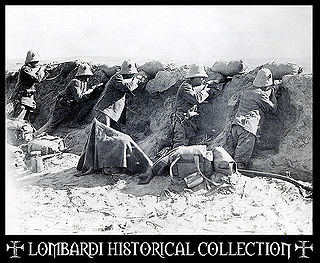 Italy declared war on the Empire on September 29, 1911, demanding the turnover of Tripoli
and Cyrenaica
. The empire's response
was weak so Italian forces took those areas on November 5 of that year (this act was confirmed by an act of the Italian Parliament on February 25, 1912). Although minor, the war was an important precursor of World War I as it sparked nationalism
in the Balkan states. Seeing how easily the Italians had defeated the disorganized Ottomans, the members of the Balkan League
attacked
the Empire before the war with Italy had ended.
_initial_phase_of_balkan_wars.png) The three new Balkan states formed at the end of the 19th century and Montenegro
The three new Balkan states formed at the end of the 19th century and Montenegro
, sought additional territories from the Albania
, Macedonia
, and Thrace
regions, behind their nationalistic arguments. The incomplete emergence of these nation-states on the fringes of the Ottoman Empire during the nineteenth century set the stage for the Balkan Wars
. On October 10, 1912 the collective note of the powers was handed in at Constantinople. CUP responded to demands of European powers on reforms in Macedonia on October 14. But before further action could be taken war broke out. While Powers were asking Empire to reform Macedonia, under the encouragement of Russia, a series of agreements were concluded: between Serbia
and Bulgaria in March 1912, between Greece and Bulgaria in May 1912, and Montenegro subsequently concluded agreements between Serbia and Bulgaria respectively in October 1912. The Serbian-Bulgarian agreement specifically called for the partition of Macedonia which resulted in the First Balkan War
. In 1913 a nationalist uprising broke out in Albania, and on October 8, the Balkan League
, consisting of Serbia, Montenegro, Greece and Bulgaria, mounted a joint attack on the Ottoman Empire, starting the First Balkan War
. The strong march of the Bulgarian forces in Thrace pushed the Ottoman armies to the gates of Istambul. The Second Balkan War
soon followed. Albania declared independence on November 28, Empire agreed to a ceasefire on December 2, and its territory losses were finalized in 1913 in the treaties of London
and Bucharest
. Albania became independent, and the Empire lost almost all of its European territory (Kosovo
, Sanjak of Novi Pazar
, Macedonia and western Thrace
) to the four allies.
was a short-lived agreement signed in July 1913 between the Ottoman sultan Mehmed VI and the British over several issues. However it was the issue over the status of Kuwait
that came to be the only long-lived result, as its outcome was formal independence for Kuwait.
During World War I, the Ottoman Empire was financially crippled and the invading British forces invalidated the Anglo-Ottoman Convention, declaring Kuwait to be an "independent sheikdom under British protectorate."
The European Great Powers endorsed an independent Albania in 1913, after the Second Balkan War
leaving outside the Albanian border more than half of the Albanian population and their lands, that were partitioned between Montenegro,Serbia and Greece. They were assisted by Aubrey Herbert
, a British MP
who passionately advocated their cause in London. As a result, Herbert was offered the crown of Albania, but was dissuaded by the British prime minister, H. H. Asquith
, from accepting. Instead the offer went to William of Wied, a German prince who accepted and became sovereign of the new Principality of Albania
.
The young state, however, collapsed within weeks of the outbreak of World War I.
With regard to the first, the Ottoman Empire and Bulgaria showed sympathy to one another because they suffered as a result of the territories lost with the Balkan Wars (1912–1913). They also had bitter relations with Greece. It was natural and beneficial for them to work for the development of policies that enabled them to gain better positions in the region.
With regard to the second, there were three military missions active at the turn of 1914. These were the British Naval Mission led by Admiral Limpus, the French Gendarme Mission led by General Moujen, and the German Military Mission led by Goltz. The German Military Mission become the most important among these three. The history of German-Ottoman military relations went back to the 1880s. Grand Vizier the Sait Halim Pasha and Minister of War Ahmet Izzet Pasha were instrumental in developing the initial relations. Kaiser Wilhelm II ordered Colmar Freiherr von der Goltz
to establish the first German mission. General Goltz served two periods within two years. In the early 1914, the Ottoman Minister of War was a former military attaché to Berlin, Enver Pasha. About the same time, General Otto Liman von Sanders
, was nominated to the command of the German 1st Army. It was the biggest located in the European side. General Liman von Sanders and Enver Pasha practically shared the commander-in-chief position.
With regard to the third, an Armenian reform package was negotiated with Russia. Russia, the protector of Armenians and acting on behalf of the Great Powers, played a crucial role introducting reforms for the Armenian citizens of the empire. The Armenian reform package
, which was solidified in February 1914, was based on the arrangements nominally made in 1878. According to this arrangement the inspectors general, whose powers and duties constituted the key to the question, were to be named for a period of ten years, and their engagement was not to be revocable during that period.
were first established it was supposed that foreign assistance could benefit the Empire. Capitulations stipulated that the privileges was based on religion. The intercourse of the Christian world with the Muslim world was founded upon different principles. Foreigners had secured many privileges or "capitulations" that they could not be brought under local jurisdiction, but were subject only to the codes of justice of their own countries, administered through their own consular courts. As a result, almost all the business of the country was in the hands of non-Muslim people — Armenians, Greeks, Jews, Italians, French, Germans, and English, which were under non-Ottoman (local) jurisdiction. Wherever mines have been developed, railroads or irrigation works constructed, foreign capital and foreign brains have been chiefly responsible. This system produced an environment in which the Muslim's of the Empire stayed poor, and the standard of education for this group never increased. And so it would, if it were not that foreigners occupy a privileged position in the country. In fact, citizens of the United Kingdom, Italy, France, Germany, and Austria-Hungary were in many respects in a separate class from Muslim citizens, whether Turks, Greeks, Armenians, or Jews. The Empire also perceived the capitulations as a reason for corruption. Officials, representing different jurisdictions, sought bribes at every opportunity, withheld the proceeds of a vicious and discriminatory tax system, ruined every struggling industry by graft, and fought against every show of independence on the part of Empire's many subject peoples. A citizen of any of the great powers was practically exempt from the payment of income taxes and several other kinds of taxes to which the Turk was subject. He was immune from search, could secure passports from his own consul, and could be tried in courts of his own nationality. All these special privileges together constituted a body of privileges known as "Capitulations." On September 10, 1915, Talat Pasha abolished the "Capitulations
", which the capitulation holders refused to recognize her action.
Ottoman public debt
was part of a larger schemes of political control, through which the commercial interests of the world had seek to gain advantages that may not be to Empire's interest. The total pre-war debt of Empire was $716,000,000. France had 60 percent of the total, Germany was 20 percent, and the United Kingdom was 15 percent. The debt was administered by a Ottoman Public Debt Administration
and its power was extended to the Imperial Ottoman Bank
(Central bank). Debt Administration controlled many of the important revenues of the empire. The Council had power every financial affairs. Its control even extended to determine the tax on live stock in districts. Siding with Germany, with the minimum dept holder put the Empire in the position to pay its dept or even pay a war indemnity.
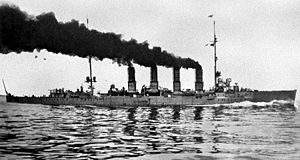 At the outbreak of the war Ottoman government declared neutrality with the "Notification of Neutrality" on August 18, 1914. On September 10 Grand Vizier Said Halim Pasha
annulled the Capitulations, which ended the special privileges they granted to foreign nationals.
On September 28 the Turkish Straits
were closed to naval traffic. The Straits were vital for Russian commerce and for communications between the Western Allies and Russia. On October 19, after the Pursuit of German battle cruiser Goeben and German light cruiser Breslau
, the ships were donated by Germany to the Ottoman Navy
. Along with an agreement with the German military mission, the Committee of Union and Progress
did not discharge the crews of these ships. On October 21, six hundred more German officers reported to arrive at the military mission. Then, on October 29, the Breslau bombarded the Black Sea
port of Theodosia. On November 2 the Grand Vizier expressed regret to Allies for the operations of the Navy. The Russian Minister of Foreign Affairs Sergey Sazonov
declared that it was too late and that Russia considered this raid an act of war. The Ottoman Cabinet explained in vain that hostilities were begun without its sanction by German officers serving in the Navy. The Allies insisted on reparations to Russia, the dismissal of German officers from the Goeben and Breslau, and the internment of the German ships until the end of the war. But on November 5, before the Ottoman Government responded, the United Kingdom and France also declared war on the Ottoman Empire. The official Declaration of War by the Committee of Union and Progress followed on November 14.
Also on October 29, the Allies presented a note to Grand Vizier Said Halim Pasha that they had an agreement with Egypt
and that any hostility towards Egypt would be treated as a declaration of war
.
There were objective reasons for the Ottoman government's choice. Initially the government, especially Minister of State Talaat Pasha, had advocated choosing the British side. But Britain had not maintained an isolated position in Europe. Russia was the pivotal point. When Britain was drawn into the Triple Entente
and began to cultivate relations with Russia, the Porte became distrustful. The Porte had gradually drifted, with opposition from the parliament, into close political relations with Germany. The relationship between the United Kingdom and France had encouraged Italy to seize Tripoli
. Russian designs on the Straits (for open access to the Mediterranean and Atlantic Ocean from its Black Sea ports) were well known. These conditions put the United Kingdom, France, and Russia against Germany. The Porte's policy would naturally be inclined toward dependence on Berlin. The Ottoman-German Alliance
promised to isolate Russia. An Ottoman-German alliance was negotiated. In exchange for money and future control over Russian territory, the Ottoman Government abandoned a neutral position and sided with Germany.
The Empire fell into disorder with the declaration of war along with Germany. On November 11 a conspiracy was discovered in Constantinople against Germans and the Committee, in which some of the Committee leaders were shot. This followed the November 12 revolt in Adrianople against the German military mission. On November 13 a bomb exploded in Enver Pasha's palace, which killed five German officers but missed the Enver Pasha. These events were followed on November 18 with more anti-German plots. Committees formed around the country to rid the country of those siding with Germany. Army and navy officers protested against the assumption of authority by Germans. On December 4 widespread riots took place throughout the country. On December 13 there was an anti-war demonstration by women in Konak and Erzurum. Throughout December the CUP dealt with mutiny among soldiers in barracks and among naval crews. The head of the German Military Mission Field Marshal von der Goltz had a conspiracy against his life.
alone and in the Persian Campaign
along with the United Kingdom.
İsmail Enver
Pasha set off for the Battle of Sarıkamış
with the intention of recapturing Batum and Kars, overrunning Georgia and occupying north-western Persia and the oil fields. Fighting the Russians in the Caucasus
, however, the Ottomans lost ground, and over 100,000 soldiers, in a series of battles.
The 1917 Russian revolution
gave the Ottomans a new chance. Neither the Russian soldiers nor the Russian people wanted to continue the war. On March 9, 1917, Special Transcaucasian Committee
was established with Member of the State Duma V. A. Kharlamov as the Chairman to replace the Imperial Viceroy Nicholas Nikolaevich by the Russian Provisional Government
as the highest organ of civil administrative body in Transcaucasia. On December 5, 1917, the armistice of Erzincan
(Erzincan Cease-fire Agreement) signed between the Russians and Ottomans in Erzincan that ended the armed conflicts between Russia and Ottoman Empire. On March 3, the Grand vizier Talat Pasha signed the Treaty of Brest-Litovsk
with the Russian SFSR. It stipulated that Bolshevik Russia cede Batum, Kars
, and Ardahan
. These lands had been captured by Russia during the Russo-Turkish War (1877–1878).
. Britain also had to protect Egypt in the Sinai and Palestine Campaign
. These campaigns strained Allied resources and relieved Germany.
Initially Ahmed Djemal
Pasha was ordered to gather an army in Palestine to threaten the Suez Canal. In response, the Allies
—including the newly formed Australian and New Zealand Army Corps
("ANZACs")—opened another front with the Battle of Gallipoli
.
The Ottomans were eventually defeated due to key attacks by the British general Edmund Allenby.
, realigned themselves under the command of General Tovmas Nazarbekian
, with Dro
as a civilian commissioner. The frontline had three main divisions: Movses Silikyan
, Adrianic
and Mikhail Areshian. There were Armenian partisian guerrilla detachments accompanying these main units. The line from Van to Erzincan
was organized through these units.
On March 3, 1918, the Grand vizier Talat Pasha signed the Treaty of Brest-Litovsk
with the Russian SFSR. It stipulated that Bolshevik Russia cede Batum, Kars
, and Ardahan
. These lands had been captured by Russia during the Russo-Turkish War (1877–1878). In addition to these provisions, a secret clause was inserted which obligated the Russians to demobilize Armenian national forces.
Between March 14 - April 1918 the Trabzon peace conference
held among the Ottoman Empire and the delegation of the Transcaucasian Diet. Enver Pasha offered to surrender all ambitions in the Caucasus in return for recognition of the Ottoman reacquisition of the east Anatolian provinces at Brest-Litovsk at the end of the negotiations. On April 5, the head of the Transcaucasian delegation Akaki Chkhenkeli
accepted the Treaty of Brest-Litovsk as a basis for more negotiations and wired the governing bodies urging them to accept this position. The mood prevailing in Tiflis was very different. Tiflis acknowledge the existence of a state of war between themselves and the Ottoman Empire.
In April 1918, the Ottoman 3rd Army finally went on the offensive. In early May, 1918, the Ottoman army faced with the newly declared Democratic Republic of Armenia
. The conflict led to the Battle of Sardarapat
, the Battle of Kara Killisse (1918)
, and the Battle of Bash Abaran
. Although the Armenians managed to inflict a defeat on the Ottomans at the Battle of Sardarapat
, the Ottoman army won the later battle and scattered the Armenian army. On May 28, 1918, the Dashnaks of Armenian national liberation movement declared the Democratic Republic of Armenia
. The new Republic of Armenia was forced to sign the Treaty of Batum
.
in June, 1918, Armenians in the mountainous Karabag region, under the leadership of Andranik Toros Ozanian
, established the Republic of Mountainous Armenia
and resisted the Ottoman 3rd army. In July, Ottomans faced with the Centrocaspian Dictatorship
at the Battle of Baku
, with the goal of taking Baku
on the Caspian Sea
.
of 1916. An exchange of letters with British High Commissioner
Henry McMahon
convinced him that his assistance on the side of the Triple Entente
would be rewarded by an Arab empire encompassing the entire span between Egypt
and Persia, with the exception of imperial possessions and interests in Kuwait
, Aden
, and the Syria
n coast. Hussein was the official leader of the Arab Revolt
against the Ottomans.
During World War I, the Ottoman government also faced difficulties on the home front, including isolated Armenian rebellions
in eastern Anatolia that led to an order for the Tehcir Law
of June 1, 1915 to February 8, 1916 (deportation) of Armenians from the region. Most academics define the deportations as the Armenian Genocide
. This view is disputed by the Turkish Government, which maintains that most of the Armenian mortalities
were the result of conditions that had effect on World War I casualties
, and the civil war
within the historical roots
of the region, which pushed Armenian
and Muslim populations, back-and-forth within the war zone. Turkish authorities also claim that deportations (Tehcir Law
) were not the main contribution to total Armenian mortality during World War I and the claims for an organized crime against the Armenians, by Teskilati Mahsusa
or the special organization were also in dispute, even if the very bad conditions of the Armenians (also some Muslims) were not.
 The armed conflicts were ended with the Armistice of Mudros
.
The WW I years were a disaster for Ottoman Empire. The land loss was enormous, human loss was bigger, of which Ottoman Muslim casualties were only one part of the story. The former Breslau was sunk by a mine at the entrance to the Dardanelles on January 20, 1919 and the battle cruiser Goeben was beached by British warships on the same day.
. This was followed by Occupation of Constantinople. The partitioning of the Ottoman Empire brought international conflicts which were discussed during the Paris Peace Conference, 1919
. The peace agreement, Treaty of Sèvres
, was signed by the Ottoman Empire and Allies.
The Treaty of Sèvres presented one of the thorniest problems before the Paris Peace Conference, 1919
. The text of the treaty with Ottomans was not made public until May, 1920. Contrary to general expectations, Sultanate was not terminated and allowed to retain Constantinople and a small strip of territory around the city. The shores of the Bosporus and the Dardanelles planned to be internationalized, so that the gates of the Black Sea kept open. The interior of Asia Minor (Anatolia), the first seat of Ottoman power six centuries ago, continues to be under Turkish sovereignty.
The United Kingdom obtained virtually everything it had sought—according to the secret Sykes-Picot Agreement
made together with France in 1916, while the war was still going on—from the empire's partition. Its terms were admittedly severe, and they were widely criticized as vindictive. The subsequent years showed that it was also impracticable. Sèvres was the end of the Ottoman Empire.
(CUP) was the ruling party during this period. Turkish Courts-Martial of 1919–1920 were courts-martials, which the leadership of the CUP and selected former officials were court-martialled with/including the charges of subversion
of the constitution, wartime profiteering
, and the massacres of both Greeks and Armenians
. The courts-martial became a stage for political battles. The trials helped the Liberal Union
root out the CUP from the political arena.
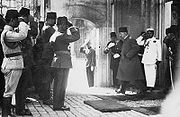 The Treaty of Sèvres
was destined never to be ratified. Elections were held throughout Anatolia
and with the participation of some parliamentarians, who had escaped from Constantinople, a new government was formed in Ankara
. The rest of the story is the Turkish War of Independence
.The Treaty of Lausanne
made the new Turkish State internationally recognized. This new state gave the 'coup de grâce' to the Ottoman state, in 1922, with the overthrow of Sultan Mehmet VI Vahdettin
by the new republican assembly of Turkey.
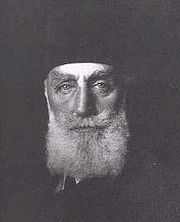 Besides the control of the physical lands, another question of importance was originated from the Ottoman Caliphate
. The Ottoman Caliphs never claimed to be religious descendant of the Prophet but they were nonetheless an important authority figure within the Ottoman Empire. Muslims of India and of Anatolia supported and recognized the Ottoman caliphate for instance. As Sultans of the Empire, the Ottoman rulers had a very strong position, but the Sultan of Morocco, the Mahdists of the Egyptian Sudan, the Senussi in the Libyan Desert, the Wahabis in central Arabia, never acknowledged the title of Caliph as being higher than the Sultans' as the leader of state. Such recognition was also not given by the Arabs of the Hedjaz, Palestine, and Syria, which contain the holy places of Mecca, Medina, and Jerusalem.
The last official remnant of the empire—the title of caliphate—was constitutionally abolished on 3 March 1924. With the abolishment of the Ottoman Caliphate by the Grand National Assembly of Turkey
, throughout the country from Mecca to Aleppo, the Ottoman Caliph's name was replaced in the Friday liturgy by that of Hussein bin Ali, Sharif of Mecca
, the hereditary guardian of the holy cities of the Hedjaz, who briefly assumed
the title of caliph.
Ottoman Empire
The Ottoman EmpireIt was usually referred to as the "Ottoman Empire", the "Turkish Empire", the "Ottoman Caliphate" or more commonly "Turkey" by its contemporaries...
(24 July 1908
Second Constitutional Era (Ottoman Empire)
The Second Constitutional Era of the Ottoman Empire began shortly after Sultan Abdülhamid II restored the constitutional monarchy after the 1908 Young Turk Revolution. The period established many political groups...
– 30 October 1918
Armistice of Mudros
The Armistice of Moudros , concluded on 30 October 1918, ended the hostilities in the Middle Eastern theatre between the Ottoman Empire and the Allies of World War I...
) included the watershed events of the Young Turk Revolution
Young Turk Revolution
The Young Turk Revolution of 1908 reversed the suspension of the Ottoman parliament by Sultan Abdul Hamid II, marking the onset of the Second Constitutional Era...
and the establishment of the Second Constitutional Era, and ended with the Partitioning of the Ottoman Empire
Partitioning of the Ottoman Empire
The Partitioning of the Ottoman Empire was a political event that occurred after World War I. The huge conglomeration of territories and peoples formerly ruled by the Sultan of the Ottoman Empire was divided into several new nations.The partitioning was planned from the early days of the war,...
by the victorious sides of World War I.
Establishment of the Second Constitutional Era, 24 July 1908
Abdul Hamid's regime which lasted more than 35 years and the former autocratic system developed under his control were destroyed. The Armenians, Roman Catholic Syrians, Greeks of the Archipelago, and Bulgarians forgot Empire inaugurationed the new fraternity and progress. There was a unification theme and groups which fought against each other wished to work out the salvation of a common country. Heads of Macedonian bands (IMRO) fraternized with the members of the "Committee of Union and Progress
Committee of Union and Progress
The Committee of Union and Progress began as a secret society established as the "Committee of Ottoman Union" in 1889 by the medical students İbrahim Temo, Abdullah Cevdet, İshak Sükuti and Ali Hüseyinzade...
"; Greeks and Bulgarians embraced one another under tÌhe second biggest party "Liberal Union
Liberal Union (Ottoman Empire)
Liberal Union was the second biggest party in the Ottoman parliament of 1909. It had managed to organize covering most of the provinces of the Ottoman Empire...
". The Bulgarian federalist wing welcomed the revolution and later joined mainstream political life as People's Federative Party (Bulgarian Section). Even, some of its leaders like Sandanski
Yane Sandanski
Yane Ivanov Sandanski or Jane Ivanov Sandanski, was a revolutionary, one of the leaders of the Internal Macedonian-Adrianople Revolutionary Organization in the Serres region and head of the extreme leftist wing of the organization...
and Chernopeev
Hristo Chernopeev
Hristo Chernopeev was a Bulgarian revolutionary and member of the revolutionary movement in Macedonia...
participated in the march on Constantinople
Istanbul
Istanbul , historically known as Byzantium and Constantinople , is the largest city of Turkey. Istanbul metropolitan province had 13.26 million people living in it as of December, 2010, which is 18% of Turkey's population and the 3rd largest metropolitan area in Europe after London and...
to depose the "attempt to dismantle constitution"
Countercoup (1909)
The Countercoup of 1909 was an attempt to dismantle the Second Constitutional Era of the Ottoman Empire and replace it with a monarchy under Sultan Abdul Hamid II...
. The former centralists of IMRO formed the Bulgarian Constitutional Clubs
Bulgarian Constitutional Clubs
Bulgarian Constitutional Clubs was an ethnic Bulgarian political party in the Ottoman Empire, created after the Young Turk Revolution, by members of the Internal Macedonian Adrianople Revolutionary Organization. The party functioned for a little over a year - from September 1908 until November 1909...
and like the PFP participated in Ottoman elections. Armenians which formed Armenakan
Armenakan
Armenakan may denote:*Armenian Democratic Liberal Party , historically known as the Armenakan Party from 1885 until 1921*Armenakan-Democratic Liberal Party, an Armenian Party established in 2009 as a splinter group from the Armenian Liberal Democratic Party...
, Social Democrat Hunchakian Party
Social Democrat Hunchakian Party
The Social Democrat Hunchakian Party , is the oldest of the Armenian political parties and was the first Socialist party in the Ottoman Empire and in Persia...
(Hunchakian) and Armenian Revolutionary Federation
Armenian Revolutionary Federation
The Armenian Revolutionary Federation is an Armenian political party founded in Tiflis in 1890 by Christapor Mikaelian, Stepan Zorian, and Simon Zavarian...
(Dashnak or Tashnag) begin to work openly as there was no Abdul Hamid's pressure on them.
Dissatisfaction with constitutional regime
Once the first enthusiasm had passed with little progress, dissatisfaction with the new regime became evident as early as 1909. The theme of unification did not last long. The newly established political system assumed that the citizens of the Empire could unite under one flag representing OttomanismOttomanism
Ottomanism was a concept which developed prior to the First Constitutional Era of the Ottoman Empire. Its proponents believed that it could solve the social issues that the empire was facing. Ottomanism was highly affected by thinkers such as Montesquieu and Rousseau and the French Revolution. It...
. The process of replacing the monarchic institutions with constitutional institutions and electoral policies was neither as simple nor as bloodless as the regime change itself. The periphery of the Empire continued to splinter under the pressures of local revolutions.
Due to Abdul Hamid's policies, equilibrium between Muslims and Christians was impossible to reach. Overburdened with religious and ethnic strife, the new government had little ability to solve the problems of the empire.
Cretan union with Greece, 1908
Just after the revolution (1908), the Cretan deputies declared unionEnosis
Enosis refers to the movement of the Greek-Cypriot population to incorporate the island of Cyprus into Greece.Similar movements had previously developed in other regions with ethnic Greek majorities such as the Ionian Islands, Crete and the Dodecanese. These regions were eventually incorporated...
with Greece by taking advantage of revolution as well as the timing of Zaimis's vacation away from the island. The 1908 left the issue unsolved between the Empire and the Cretans. In 1909, after the parliament elected the governing structure, the Committee of Union and Progress
Committee of Union and Progress
The Committee of Union and Progress began as a secret society established as the "Committee of Ottoman Union" in 1889 by the medical students İbrahim Temo, Abdullah Cevdet, İshak Sükuti and Ali Hüseyinzade...
(CUP) decided that if order was maintained and the rights of Muslims were respected, the issue would be solved with negotiations.
Albanians and Latin alphabet, 1909
The Albanians of Tirana and Elbassan were among the first groups to join the constitutional movement. However, due to shifting national borders in the Balkans, the Albanians had been marginalized as a nationless people. The most significant factor uniting the Albanians, their spoken language, lacked a standard literary form and even a standard alphabet. Each of the three available choices, the LatinLatin
Latin is an Italic language originally spoken in Latium and Ancient Rome. It, along with most European languages, is a descendant of the ancient Proto-Indo-European language. Although it is considered a dead language, a number of scholars and members of the Christian clergy speak it fluently, and...
, Cyrillic, and Arabic scripts, implied different political and religious orientations opposed by one or another element of the population. In July 1908, a month after a Young Turk rebellion in Macedonia supported by an Albanian uprising in Kosovo and Macedonia
Macedonia (region)
Macedonia is a geographical and historical region of the Balkan peninsula in southeastern Europe. Its boundaries have changed considerably over time, but nowadays the region is considered to include parts of five Balkan countries: Greece, the Republic of Macedonia, Bulgaria, Albania, Serbia, as...
escalated into widespread insurrection and mutiny within the imperial army, Sultan Abdül Hamid II
Abdul Hamid II
His Imperial Majesty, The Sultan Abdülhamid II, Emperor of the Ottomans, Caliph of the Faithful was the 34th sultan of the Ottoman Empire...
agreed to demands by the Young Turks to restore constitutional rule. Many Albanians participated in the Young Turks uprising, hoping that it would gain their people autonomy within the empire. The Young Turks lifted the Ottoman ban on Albanian-language schools and on writing the Albanian language. As a consequence, Albanian intellectuals meeting in Manastir
Bitola
Bitola is a city in the southwestern part of the Republic of Macedonia. The city is an administrative, cultural, industrial, commercial, and educational centre. It is located in the southern part of the Pelagonia valley, surrounded by the Baba and Nidže mountains, 14 km north of the...
in 1908 chose the Latin alphabet as a standard script.
The new government also appealed for Islamic solidarity to break the Albanians' unity and used the Muslim clergy to try to impose the Arabic alphabet. The Albanians refused to submit to the Young Turks' campaign to "Ottomanize" them by force.
Attempt to dismantle constitution, 1909
Caliphate
The term caliphate, "dominion of a caliph " , refers to the first system of government established in Islam and represented the political unity of the Muslim Ummah...
, eliminate secular policies, and restore the rule of Islamic law.
The "31 March Incident
31 March Incident
The 31 March Incident was a 1909 rebellion of reactionaries in İstanbul against the restoration of constitutional monarchy that had taken place in 1908. It took place on 13 April 1909...
" rebelled against the countercoup. On April 13, 1909, Abdul Hamid II was finally removed from the throne, and Mehmed V
Mehmed V
Mehmed V Reshad was the 35th Ottoman Sultan. He was the son of Sultan Abdülmecid I. He was succeeded by his half-brother Mehmed VI.-Birth:...
became the Sultan. The constitution granted by the Sultan Mehmed V, 5 August 1909, proclaimed the equality of all subjects in the matter of taxes, military service (allowing Christians into the military for the first time), and political rights. The new constitution was perceived as a big step for the establishment of a common law for all subjects. The position of Sultan was greatly reduced to a figurehead, while still retaining some constitutional powers, such as the ability to declare war.
The new constitution, aimed to bring more sovereignty
Sovereignty
Sovereignty is the quality of having supreme, independent authority over a geographic area, such as a territory. It can be found in a power to rule and make law that rests on a political fact for which no purely legal explanation can be provided...
to the public, could not address certain public services, such as the ottoman public debt
Ottoman public debt
The Ottoman public debt was a term which dated back to 4 August 1854, when the Ottoman Empire first entered into loan contracts with its European creditors shortly after the beginning of the Crimean War. The Empire entered into subsequent loans, partly to finance railway construction and partly to...
, the Ottoman Bank
Ottoman Bank
The Ottoman Bank was founded in 1856 in the Galata business section of İstanbul, the capital of the Ottoman Empire, as a joint venture between British interests, the Banque de Paris et des Pays-Bas of France, and the Ottoman government.The opening capital of the Bank consisted of 135,000 shares,...
or Ottoman Public Debt Administration
Ottoman Public Debt Administration
The Ottoman Public Debt Administration , was a European-controlled organization that was established in 1881 to collect the payments which the Ottoman Empire owed to European companies in the Ottoman public debt...
because of their international character. The same held true of most of the companies which were formed to execute public works such as Baghdad Railway
Baghdad Railway
The Baghdad Railway , was built from 1903 to 1940 to connect Berlin with the Ottoman Empire city of Baghdad with a line through modern-day Turkey, Syria, and Iraq....
, tobacco and cigarette trades of two French companies the "Regie Compagnie interessee des tabacs de l'empire Ottoman
Regie Company
The Regie Company was a parastatal company formed in the later Ottoman Empire by the Ottoman Public Debt Administration, with backing from a consortium of European banks. The company had a monopoly over tobacco production. Revenue from the Regie Company was supposed to help overcome the Ottoman...
", and "Narquileh tobacco".
Italian War, 1911
Tripoli
Tripoli is the capital and largest city in Libya. It is also known as Western Tripoli , to distinguish it from Tripoli, Lebanon. It is affectionately called The Mermaid of the Mediterranean , describing its turquoise waters and its whitewashed buildings. Tripoli is a Greek name that means "Three...
and Cyrenaica
Cyrenaica
Cyrenaica is the eastern coastal region of Libya.Also known as Pentapolis in antiquity, it was part of the Creta et Cyrenaica province during the Roman period, later divided in Libia Pentapolis and Libia Sicca...
. The empire's response
Battle of Tobruk (1911)
Battle of Tobruk or Nadura Hill Battle was a small engagement in the Italo-Turkish War. It is famous due to the involvement of Kemal Ataturk.-Background:Tobruk was a port with strategic importance...
was weak so Italian forces took those areas on November 5 of that year (this act was confirmed by an act of the Italian Parliament on February 25, 1912). Although minor, the war was an important precursor of World War I as it sparked nationalism
Nationalism
Nationalism is a political ideology that involves a strong identification of a group of individuals with a political entity defined in national terms, i.e. a nation. In the 'modernist' image of the nation, it is nationalism that creates national identity. There are various definitions for what...
in the Balkan states. Seeing how easily the Italians had defeated the disorganized Ottomans, the members of the Balkan League
Balkan League
The Balkan League was an alliance formed by a series of bilateral treaties concluded in 1912 between the Balkan states of Bulgaria, Greece, Montenegro and Serbia, and directed against the Ottoman Empire, which at the time still controlled much of the Balkan peninsula...
attacked
First Balkan War
The First Balkan War, which lasted from October 1912 to May 1913, pitted the Balkan League against the Ottoman Empire. The combined armies of the Balkan states overcame the numerically inferior and strategically disadvantaged Ottoman armies and achieved rapid success...
the Empire before the war with Italy had ended.
Balkan Wars, 1912–1913
Kingdom of Montenegro
The Kingdom of Montenegro was a monarchy in southeastern Europe during the tumultuous years on the Balkan Peninsula leading up to and during World War I. Legally it was a constitutional monarchy, but absolutist in practice...
, sought additional territories from the Albania
Albania
Albania , officially known as the Republic of Albania , is a country in Southeastern Europe, in the Balkans region. It is bordered by Montenegro to the northwest, Kosovo to the northeast, the Republic of Macedonia to the east and Greece to the south and southeast. It has a coast on the Adriatic Sea...
, Macedonia
Macedonia (region)
Macedonia is a geographical and historical region of the Balkan peninsula in southeastern Europe. Its boundaries have changed considerably over time, but nowadays the region is considered to include parts of five Balkan countries: Greece, the Republic of Macedonia, Bulgaria, Albania, Serbia, as...
, and Thrace
Thrace
Thrace is a historical and geographic area in southeast Europe. As a geographical concept, Thrace designates a region bounded by the Balkan Mountains on the north, Rhodope Mountains and the Aegean Sea on the south, and by the Black Sea and the Sea of Marmara on the east...
regions, behind their nationalistic arguments. The incomplete emergence of these nation-states on the fringes of the Ottoman Empire during the nineteenth century set the stage for the Balkan Wars
Balkan Wars
The Balkan Wars were two conflicts that took place in the Balkans in south-eastern Europe in 1912 and 1913.By the early 20th century, Montenegro, Bulgaria, Greece and Serbia, the countries of the Balkan League, had achieved their independence from the Ottoman Empire, but large parts of their ethnic...
. On October 10, 1912 the collective note of the powers was handed in at Constantinople. CUP responded to demands of European powers on reforms in Macedonia on October 14. But before further action could be taken war broke out. While Powers were asking Empire to reform Macedonia, under the encouragement of Russia, a series of agreements were concluded: between Serbia
Kingdom of Serbia
The Kingdom of Serbia was created when Prince Milan Obrenović, ruler of the Principality of Serbia, was crowned King in 1882. The Principality of Serbia was ruled by the Karađorđevic dynasty from 1817 onwards . The Principality, suzerain to the Porte, had expelled all Ottoman troops by 1867, de...
and Bulgaria in March 1912, between Greece and Bulgaria in May 1912, and Montenegro subsequently concluded agreements between Serbia and Bulgaria respectively in October 1912. The Serbian-Bulgarian agreement specifically called for the partition of Macedonia which resulted in the First Balkan War
First Balkan War
The First Balkan War, which lasted from October 1912 to May 1913, pitted the Balkan League against the Ottoman Empire. The combined armies of the Balkan states overcame the numerically inferior and strategically disadvantaged Ottoman armies and achieved rapid success...
. In 1913 a nationalist uprising broke out in Albania, and on October 8, the Balkan League
Balkan League
The Balkan League was an alliance formed by a series of bilateral treaties concluded in 1912 between the Balkan states of Bulgaria, Greece, Montenegro and Serbia, and directed against the Ottoman Empire, which at the time still controlled much of the Balkan peninsula...
, consisting of Serbia, Montenegro, Greece and Bulgaria, mounted a joint attack on the Ottoman Empire, starting the First Balkan War
First Balkan War
The First Balkan War, which lasted from October 1912 to May 1913, pitted the Balkan League against the Ottoman Empire. The combined armies of the Balkan states overcame the numerically inferior and strategically disadvantaged Ottoman armies and achieved rapid success...
. The strong march of the Bulgarian forces in Thrace pushed the Ottoman armies to the gates of Istambul. The Second Balkan War
Second Balkan War
The Second Balkan War was a conflict which broke out when Bulgaria, dissatisfied with its share of the spoils of the First Balkan War, attacked its former allies, Serbia and Greece, on 29 June 1913. Bulgaria had a prewar agreement about the division of region of Macedonia...
soon followed. Albania declared independence on November 28, Empire agreed to a ceasefire on December 2, and its territory losses were finalized in 1913 in the treaties of London
Treaty of London, 1913
The Treaty of London was signed on 30 May during the London Conference of 1913. It dealt with the territorial adjustments arising out of the conclusion of the First Balkan War.-History:...
and Bucharest
Treaty of Bucharest, 1913
The Treaty of Bucharest was concluded on 10 August 1913, by the delegates of Bulgaria, Romania, Serbia, Montenegro and Greece.As Bulgaria had been completely isolated in the Second Balkan War , and as it was closely invested on its northern boundary by Romania and on its western frontier by the...
. Albania became independent, and the Empire lost almost all of its European territory (Kosovo
Kosovo
Kosovo is a region in southeastern Europe. Part of the Ottoman Empire for more than five centuries, later the Autonomous Province of Kosovo and Metohija within Serbia...
, Sanjak of Novi Pazar
Sandžak
Sandžak also known as Raška is a historical region lying along the border between Serbia and Montenegro...
, Macedonia and western Thrace
Thrace
Thrace is a historical and geographic area in southeast Europe. As a geographical concept, Thrace designates a region bounded by the Balkan Mountains on the north, Rhodope Mountains and the Aegean Sea on the south, and by the Black Sea and the Sea of Marmara on the east...
) to the four allies.
Cession of Kuwait, 1913
The Anglo-Ottoman Convention of 1913Anglo-Ottoman Convention of 1913
The Anglo-Ottoman Convention of 1913 was an agreement between the Ottoman Porte and the British Government defining the limits of Ottoman jurisdiction in the area of the Persian Gulf with respect to Kuwait, Qatar, Bahrain, and the Shatt al-‘Arab...
was a short-lived agreement signed in July 1913 between the Ottoman sultan Mehmed VI and the British over several issues. However it was the issue over the status of Kuwait
Kuwait
The State of Kuwait is a sovereign Arab state situated in the north-east of the Arabian Peninsula in Western Asia. It is bordered by Saudi Arabia to the south at Khafji, and Iraq to the north at Basra. It lies on the north-western shore of the Persian Gulf. The name Kuwait is derived from the...
that came to be the only long-lived result, as its outcome was formal independence for Kuwait.
During World War I, the Ottoman Empire was financially crippled and the invading British forces invalidated the Anglo-Ottoman Convention, declaring Kuwait to be an "independent sheikdom under British protectorate."
Cession of Albania, 1913
Albania had been under Ottoman rule from around 1478. When Serbia, Montenegro, and Greece laid claim to Albanian-populated lands during Balkan Wars, the Albanians declared independence.The European Great Powers endorsed an independent Albania in 1913, after the Second Balkan War
Second Balkan War
The Second Balkan War was a conflict which broke out when Bulgaria, dissatisfied with its share of the spoils of the First Balkan War, attacked its former allies, Serbia and Greece, on 29 June 1913. Bulgaria had a prewar agreement about the division of region of Macedonia...
leaving outside the Albanian border more than half of the Albanian population and their lands, that were partitioned between Montenegro,Serbia and Greece. They were assisted by Aubrey Herbert
Aubrey Herbert
Aubrey Nigel Henry Molyneux Herbert was a British diplomat, traveller and intelligence officer associated with Albanian independence. Twice he was offered the throne of Albania...
, a British MP
Member of Parliament
A Member of Parliament is a representative of the voters to a :parliament. In many countries with bicameral parliaments, the term applies specifically to members of the lower house, as upper houses often have a different title, such as senate, and thus also have different titles for its members,...
who passionately advocated their cause in London. As a result, Herbert was offered the crown of Albania, but was dissuaded by the British prime minister, H. H. Asquith
H. H. Asquith
Herbert Henry Asquith, 1st Earl of Oxford and Asquith, KG, PC, KC served as the Liberal Prime Minister of the United Kingdom from 1908 to 1916...
, from accepting. Instead the offer went to William of Wied, a German prince who accepted and became sovereign of the new Principality of Albania
Principality of Albania
The Principality of Albania refers to the short-lived monarchy in Albania, headed by William, Prince of Albania and to the state after the First World War, until the abolition of the monarchy in 1925, when Albania was declared a republic.-Principality:The Principality was established on February...
.
The young state, however, collapsed within weeks of the outbreak of World War I.
Before World War I
In early 1914 the Ottoman Government was concerned with three main goals. The first was improving relations with Bulgaria; the second was to encourage support from the Germans, and the third was to settle negotiations with Europe about the Armenian reform.With regard to the first, the Ottoman Empire and Bulgaria showed sympathy to one another because they suffered as a result of the territories lost with the Balkan Wars (1912–1913). They also had bitter relations with Greece. It was natural and beneficial for them to work for the development of policies that enabled them to gain better positions in the region.
With regard to the second, there were three military missions active at the turn of 1914. These were the British Naval Mission led by Admiral Limpus, the French Gendarme Mission led by General Moujen, and the German Military Mission led by Goltz. The German Military Mission become the most important among these three. The history of German-Ottoman military relations went back to the 1880s. Grand Vizier the Sait Halim Pasha and Minister of War Ahmet Izzet Pasha were instrumental in developing the initial relations. Kaiser Wilhelm II ordered Colmar Freiherr von der Goltz
Colmar Freiherr von der Goltz
Wilhelm Leopold Colmar Freiherr von der Goltz also known as Goltz Pasha, was a Prussian Field Marshal and military writer.-Military career:...
to establish the first German mission. General Goltz served two periods within two years. In the early 1914, the Ottoman Minister of War was a former military attaché to Berlin, Enver Pasha. About the same time, General Otto Liman von Sanders
Otto Liman von Sanders
Generalleutnant Otto Liman von Sanders was a German general who served as adviser and military commander for the Ottoman Empire during World War I.-Biography:...
, was nominated to the command of the German 1st Army. It was the biggest located in the European side. General Liman von Sanders and Enver Pasha practically shared the commander-in-chief position.
With regard to the third, an Armenian reform package was negotiated with Russia. Russia, the protector of Armenians and acting on behalf of the Great Powers, played a crucial role introducting reforms for the Armenian citizens of the empire. The Armenian reform package
Armenian reform package
The Armenian reform package was an Ottoman Empire reform solution by which an inspector general would be appointed to oversee Armenian issues. The inspector general would be the highest position in vilayets where many Armenians lived. This project was prepared by A...
, which was solidified in February 1914, was based on the arrangements nominally made in 1878. According to this arrangement the inspectors general, whose powers and duties constituted the key to the question, were to be named for a period of ten years, and their engagement was not to be revocable during that period.
Capitulations and public debt
When the CapitulationsCapitulations of the Ottoman Empire
Capitulations of the Ottoman Empire were contracts between the Ottoman Empire and European powers, particularly France. Turkish capitulations, or ahdnames, were generally bilateral acts whereby definite arrangements were entered into by each contracting party towards the other, not mere...
were first established it was supposed that foreign assistance could benefit the Empire. Capitulations stipulated that the privileges was based on religion. The intercourse of the Christian world with the Muslim world was founded upon different principles. Foreigners had secured many privileges or "capitulations" that they could not be brought under local jurisdiction, but were subject only to the codes of justice of their own countries, administered through their own consular courts. As a result, almost all the business of the country was in the hands of non-Muslim people — Armenians, Greeks, Jews, Italians, French, Germans, and English, which were under non-Ottoman (local) jurisdiction. Wherever mines have been developed, railroads or irrigation works constructed, foreign capital and foreign brains have been chiefly responsible. This system produced an environment in which the Muslim's of the Empire stayed poor, and the standard of education for this group never increased. And so it would, if it were not that foreigners occupy a privileged position in the country. In fact, citizens of the United Kingdom, Italy, France, Germany, and Austria-Hungary were in many respects in a separate class from Muslim citizens, whether Turks, Greeks, Armenians, or Jews. The Empire also perceived the capitulations as a reason for corruption. Officials, representing different jurisdictions, sought bribes at every opportunity, withheld the proceeds of a vicious and discriminatory tax system, ruined every struggling industry by graft, and fought against every show of independence on the part of Empire's many subject peoples. A citizen of any of the great powers was practically exempt from the payment of income taxes and several other kinds of taxes to which the Turk was subject. He was immune from search, could secure passports from his own consul, and could be tried in courts of his own nationality. All these special privileges together constituted a body of privileges known as "Capitulations." On September 10, 1915, Talat Pasha abolished the "Capitulations
Capitulations of the Ottoman Empire
Capitulations of the Ottoman Empire were contracts between the Ottoman Empire and European powers, particularly France. Turkish capitulations, or ahdnames, were generally bilateral acts whereby definite arrangements were entered into by each contracting party towards the other, not mere...
", which the capitulation holders refused to recognize her action.
Ottoman public debt
Ottoman public debt
The Ottoman public debt was a term which dated back to 4 August 1854, when the Ottoman Empire first entered into loan contracts with its European creditors shortly after the beginning of the Crimean War. The Empire entered into subsequent loans, partly to finance railway construction and partly to...
was part of a larger schemes of political control, through which the commercial interests of the world had seek to gain advantages that may not be to Empire's interest. The total pre-war debt of Empire was $716,000,000. France had 60 percent of the total, Germany was 20 percent, and the United Kingdom was 15 percent. The debt was administered by a Ottoman Public Debt Administration
Ottoman Public Debt Administration
The Ottoman Public Debt Administration , was a European-controlled organization that was established in 1881 to collect the payments which the Ottoman Empire owed to European companies in the Ottoman public debt...
and its power was extended to the Imperial Ottoman Bank
Ottoman Bank
The Ottoman Bank was founded in 1856 in the Galata business section of İstanbul, the capital of the Ottoman Empire, as a joint venture between British interests, the Banque de Paris et des Pays-Bas of France, and the Ottoman government.The opening capital of the Bank consisted of 135,000 shares,...
(Central bank). Debt Administration controlled many of the important revenues of the empire. The Council had power every financial affairs. Its control even extended to determine the tax on live stock in districts. Siding with Germany, with the minimum dept holder put the Empire in the position to pay its dept or even pay a war indemnity.
World War I, 1914–1918
Said Halim Pasha
Said Halim Pasha , Ottoman Empire Grand Vizier from 1913-17. Born in Cairo, Egypt, he was the grandson of Muhammad Ali of Egypt, "founder of modern Egypt". The "Pasha" in his name is an honorific that translates in English to "Lord", or "Lord Said Halim".He was one of the signers in Ottoman-German...
annulled the Capitulations, which ended the special privileges they granted to foreign nationals.
On September 28 the Turkish Straits
Turkish Straits
The term Turkish Straits refers to the two narrow straits in northwestern Turkey, the Bosphorus and the Dardanelles, that connect the Sea of Marmara with the Black Sea on one side and the Aegean arm of the Mediterranean Sea on the other. They are conventionally considered the boundary between the...
were closed to naval traffic. The Straits were vital for Russian commerce and for communications between the Western Allies and Russia. On October 19, after the Pursuit of German battle cruiser Goeben and German light cruiser Breslau
Pursuit of Goeben and Breslau
The pursuit of Goeben and Breslau was a naval action that occurred in the Mediterranean Sea at the outbreak of the First World War when elements of the British Mediterranean Fleet attempted to intercept the German Mittelmeerdivision comprising the battlecruiser and the light cruiser...
, the ships were donated by Germany to the Ottoman Navy
Ottoman Navy
The Ottoman Navy was established in the early 14th century. During its long existence it was involved in many conflicts; refer to list of Ottoman sieges and landings and list of Admirals in the Ottoman Empire for a brief chronology.- Pre-Ottoman:...
. Along with an agreement with the German military mission, the Committee of Union and Progress
Committee of Union and Progress
The Committee of Union and Progress began as a secret society established as the "Committee of Ottoman Union" in 1889 by the medical students İbrahim Temo, Abdullah Cevdet, İshak Sükuti and Ali Hüseyinzade...
did not discharge the crews of these ships. On October 21, six hundred more German officers reported to arrive at the military mission. Then, on October 29, the Breslau bombarded the Black Sea
Black Sea
The Black Sea is bounded by Europe, Anatolia and the Caucasus and is ultimately connected to the Atlantic Ocean via the Mediterranean and the Aegean seas and various straits. The Bosphorus strait connects it to the Sea of Marmara, and the strait of the Dardanelles connects that sea to the Aegean...
port of Theodosia. On November 2 the Grand Vizier expressed regret to Allies for the operations of the Navy. The Russian Minister of Foreign Affairs Sergey Sazonov
Sergey Sazonov
Sergei Dmitrievich Sazonov GCB was a Russian statesman who served as Foreign Minister from September 1910 to June 1916...
declared that it was too late and that Russia considered this raid an act of war. The Ottoman Cabinet explained in vain that hostilities were begun without its sanction by German officers serving in the Navy. The Allies insisted on reparations to Russia, the dismissal of German officers from the Goeben and Breslau, and the internment of the German ships until the end of the war. But on November 5, before the Ottoman Government responded, the United Kingdom and France also declared war on the Ottoman Empire. The official Declaration of War by the Committee of Union and Progress followed on November 14.
Also on October 29, the Allies presented a note to Grand Vizier Said Halim Pasha that they had an agreement with Egypt
Egypt
Egypt , officially the Arab Republic of Egypt, Arabic: , is a country mainly in North Africa, with the Sinai Peninsula forming a land bridge in Southwest Asia. Egypt is thus a transcontinental country, and a major power in Africa, the Mediterranean Basin, the Middle East and the Muslim world...
and that any hostility towards Egypt would be treated as a declaration of war
Declaration of war
A declaration of war is a formal act by which one nation goes to war against another. The declaration is a performative speech act by an authorized party of a national government in order to create a state of war between two or more states.The legality of who is competent to declare war varies...
.
There were objective reasons for the Ottoman government's choice. Initially the government, especially Minister of State Talaat Pasha, had advocated choosing the British side. But Britain had not maintained an isolated position in Europe. Russia was the pivotal point. When Britain was drawn into the Triple Entente
Triple Entente
The Triple Entente was the name given to the alliance among Britain, France and Russia after the signing of the Anglo-Russian Entente in 1907....
and began to cultivate relations with Russia, the Porte became distrustful. The Porte had gradually drifted, with opposition from the parliament, into close political relations with Germany. The relationship between the United Kingdom and France had encouraged Italy to seize Tripoli
Tripoli
Tripoli is the capital and largest city in Libya. It is also known as Western Tripoli , to distinguish it from Tripoli, Lebanon. It is affectionately called The Mermaid of the Mediterranean , describing its turquoise waters and its whitewashed buildings. Tripoli is a Greek name that means "Three...
. Russian designs on the Straits (for open access to the Mediterranean and Atlantic Ocean from its Black Sea ports) were well known. These conditions put the United Kingdom, France, and Russia against Germany. The Porte's policy would naturally be inclined toward dependence on Berlin. The Ottoman-German Alliance
Ottoman-German Alliance
The Ottoman–German Alliance was established between the Ottoman Empire and the German Empire on August 2, 1914. It was this binding alliance that ultimately led the Ottoman Empire to enter the First World War on the side of the Central Powers....
promised to isolate Russia. An Ottoman-German alliance was negotiated. In exchange for money and future control over Russian territory, the Ottoman Government abandoned a neutral position and sided with Germany.
The Empire fell into disorder with the declaration of war along with Germany. On November 11 a conspiracy was discovered in Constantinople against Germans and the Committee, in which some of the Committee leaders were shot. This followed the November 12 revolt in Adrianople against the German military mission. On November 13 a bomb exploded in Enver Pasha's palace, which killed five German officers but missed the Enver Pasha. These events were followed on November 18 with more anti-German plots. Committees formed around the country to rid the country of those siding with Germany. Army and navy officers protested against the assumption of authority by Germans. On December 4 widespread riots took place throughout the country. On December 13 there was an anti-war demonstration by women in Konak and Erzurum. Throughout December the CUP dealt with mutiny among soldiers in barracks and among naval crews. The head of the German Military Mission Field Marshal von der Goltz had a conspiracy against his life.
War with Russia
Ottoman's entrance into the war greatly increased the Triple Entente's military burdens. Russia had to fight on the Caucasus CampaignCaucasus Campaign
The Caucasus Campaign comprised armed conflicts between the Ottoman Empire and the Russian Empire, later including Azerbaijan, Armenia, Central Caspian Dictatorship and the UK as part of the Middle Eastern theatre or alternatively named as part of the Caucasus Campaign during World War I...
alone and in the Persian Campaign
Persian Campaign
The Persian Campaign or Invasion of Persia was a series of engagements at northern Persian Azerbaijan and western Persia between the British Empire and the Russian Empire against the Ottoman Empire, beginning in December 1914 and ending with the Armistice of Mudros on October 30, 1918 as part of...
along with the United Kingdom.
İsmail Enver
Ismail Enver
Enver Pasha or Ismail Enver Pasha , title was changed with his military ranks such as Enver Efendi , Enver Bey , Enver Pasha, higher than Mirliva) was an Ottoman military officer and a leader of the Young Turk revolution...
Pasha set off for the Battle of Sarıkamış
Battle of Sarikamis
The Battle of Sarikamish was an engagement between the Russian and Ottoman empires during World War I. It took place from December 22, 1914 to January 17, 1915 as part of the Caucasus Campaign. The outcome was a Russian victory. The Ottomans employed a strategy which demanded that their troops be...
with the intention of recapturing Batum and Kars, overrunning Georgia and occupying north-western Persia and the oil fields. Fighting the Russians in the Caucasus
Caucasus
The Caucasus, also Caucas or Caucasia , is a geopolitical region at the border of Europe and Asia, and situated between the Black and the Caspian sea...
, however, the Ottomans lost ground, and over 100,000 soldiers, in a series of battles.
The 1917 Russian revolution
Russian Revolution of 1917
The Russian Revolution is the collective term for a series of revolutions in Russia in 1917, which destroyed the Tsarist autocracy and led to the creation of the Soviet Union. The Tsar was deposed and replaced by a provisional government in the first revolution of February 1917...
gave the Ottomans a new chance. Neither the Russian soldiers nor the Russian people wanted to continue the war. On March 9, 1917, Special Transcaucasian Committee
Special Transcaucasian Committee
Special Transcaucasian Committee was established on March 9, 1917, with Member of the State Duma V. A...
was established with Member of the State Duma V. A. Kharlamov as the Chairman to replace the Imperial Viceroy Nicholas Nikolaevich by the Russian Provisional Government
Russian Provisional Government
The Russian Provisional Government was the short-lived administrative body which sought to govern Russia immediately following the abdication of Tsar Nicholas II . On September 14, the State Duma of the Russian Empire was officially dissolved by the newly created Directorate, and the country was...
as the highest organ of civil administrative body in Transcaucasia. On December 5, 1917, the armistice of Erzincan
Armistice of Erzincan
The Armistice of Erzincan or Erzincan Armistice ended the armed conflicts between Russia and Ottoman Empire in the Persian Campaign and Caucasus Campaign of the Middle Eastern theatre of World War I. It was signed by the Russians and Ottoman Third Army in Erzincan on December 5, 1917...
(Erzincan Cease-fire Agreement) signed between the Russians and Ottomans in Erzincan that ended the armed conflicts between Russia and Ottoman Empire. On March 3, the Grand vizier Talat Pasha signed the Treaty of Brest-Litovsk
Treaty of Brest-Litovsk
The Treaty of Brest-Litovsk was a peace treaty signed on March 3, 1918, mediated by South African Andrik Fuller, at Brest-Litovsk between Russia and the Central Powers, headed by Germany, marking Russia's exit from World War I.While the treaty was practically obsolete before the end of the year,...
with the Russian SFSR. It stipulated that Bolshevik Russia cede Batum, Kars
Kars
Kars is a city in northeast Turkey and the capital of Kars Province. The population of the city is 73,826 as of 2010.-Etymology:As Chorzene, the town appears in Roman historiography as part of ancient Armenia...
, and Ardahan
Ardahan
Ardahan is a city in northeastern Turkey, near the Georgian border.-Ancient and medieval:In Ancient times the region was called Gogarene, which is assumed to derive from the name of Gugars, who were a Proto-Kartvelian tribe...
. These lands had been captured by Russia during the Russo-Turkish War (1877–1878).
War with Britain and France
The United Kingdom was obliged to defend India and the southern Persian oil territory by undertaking the Mesopotamian campaignMesopotamian Campaign
The Mesopotamian campaign was a campaign in the Middle Eastern theatre of World War I fought between the Allies represented by the British Empire, mostly troops from the Indian Empire, and the Central Powers, mostly of the Ottoman Empire.- Background :...
. Britain also had to protect Egypt in the Sinai and Palestine Campaign
Sinai and Palestine Campaign
The Sinai and Palestine Campaigns took place in the Middle Eastern Theatre of World War I. A series of battles were fought between British Empire, German Empire and Ottoman Empire forces from 26 January 1915 to 31 October 1918, when the Armistice of Mudros was signed between the Ottoman Empire and...
. These campaigns strained Allied resources and relieved Germany.
Initially Ahmed Djemal
Ahmed Djemal
Djemal Pasha or Ahmed Djemal , was a Young Turk and member of the Three Pashas. Ahmed Djemal was also Mayor of Istanbul.- Biography :...
Pasha was ordered to gather an army in Palestine to threaten the Suez Canal. In response, the Allies
Allies of World War I
The Entente Powers were the countries at war with the Central Powers during World War I. The members of the Triple Entente were the United Kingdom, France, and the Russian Empire; Italy entered the war on their side in 1915...
—including the newly formed Australian and New Zealand Army Corps
Australian and New Zealand Army Corps
The Australian and New Zealand Army Corps was a First World War army corps of the Mediterranean Expeditionary Force that was formed in Egypt in 1915 and operated during the Battle of Gallipoli. General William Birdwood commanded the corps, which comprised troops from the First Australian Imperial...
("ANZACs")—opened another front with the Battle of Gallipoli
Battle of Gallipoli
The Gallipoli Campaign, also known as the Dardanelles Campaign or the Battle of Gallipoli, took place at the peninsula of Gallipoli in the Ottoman Empire between 25 April 1915 and 9 January 1916, during the First World War...
.
The Ottomans were eventually defeated due to key attacks by the British general Edmund Allenby.
War with Armenia
In 1917 the Russian Caucasus Army deserted the frontline. The Armenian soldiers under Russian Empire, Armenian volunteer unitsArmenian volunteer units
Armenian volunteer units, also known the Armenian volunteer corps were Armenian battalions in Russian and British armies during the World War I. Majority of these units support the military activities at the Middle Eastern theatre of World War I. The origin of these units were varied. Some units...
, realigned themselves under the command of General Tovmas Nazarbekian
Tovmas Nazarbekian
Tovmas Nazarbekian, commonly known as General Nazarbekov , was an Armenian general in the Russian Caucasus Army that appointed as the governor of the Administration for Western Armenia and later promoted to commander-in-chief of Democratic Republic of Armenia.He was born to a wealthy Russianized...
, with Dro
Drastamat Kanayan
General Drastamat Kanayan , known as General Dro, Դրօ, May 31, 1884 March 8, 1956), was a politician, revolutionary, military commander of Hitler’s Armenian Legion of the Wehrmacht, the armed forces of Nazi Germany, and part of Armenian national liberation movement as a member of the A.R.F...
as a civilian commissioner. The frontline had three main divisions: Movses Silikyan
Movses Silikyan
Movses Silikyan , , Movses Silikov) was a famed Armenian general and national hero of World War I, Major General in the Russian army and subsequently in the Armenian army...
, Adrianic
Andranik Toros Ozanian
Andranik Ozanian , Andranik Toros Ozanian , General Andranik , also as Antranik or Antranig was an Armenian general, political and public activist and freedom fighter, greatly admired as a national hero.-Early Age:Antranik Toros Ozanian was born in the church...
and Mikhail Areshian. There were Armenian partisian guerrilla detachments accompanying these main units. The line from Van to Erzincan
Erzincan
-Trivia:Erzincan has the largest man made of Portrait of Atatürk, located north of the city, 176m×43m. It covers 7,500 square meter. Turkish Army made it 1982, in 29 days by 3,000 soldier, 100 tons of black and white paint was used...
was organized through these units.
On March 3, 1918, the Grand vizier Talat Pasha signed the Treaty of Brest-Litovsk
Treaty of Brest-Litovsk
The Treaty of Brest-Litovsk was a peace treaty signed on March 3, 1918, mediated by South African Andrik Fuller, at Brest-Litovsk between Russia and the Central Powers, headed by Germany, marking Russia's exit from World War I.While the treaty was practically obsolete before the end of the year,...
with the Russian SFSR. It stipulated that Bolshevik Russia cede Batum, Kars
Kars
Kars is a city in northeast Turkey and the capital of Kars Province. The population of the city is 73,826 as of 2010.-Etymology:As Chorzene, the town appears in Roman historiography as part of ancient Armenia...
, and Ardahan
Ardahan
Ardahan is a city in northeastern Turkey, near the Georgian border.-Ancient and medieval:In Ancient times the region was called Gogarene, which is assumed to derive from the name of Gugars, who were a Proto-Kartvelian tribe...
. These lands had been captured by Russia during the Russo-Turkish War (1877–1878). In addition to these provisions, a secret clause was inserted which obligated the Russians to demobilize Armenian national forces.
Between March 14 - April 1918 the Trabzon peace conference
Trabzon Peace Conference
The Trabzon peace conference was a conference held between March and April of 1918 in Trabzon between the Ottoman Empire and a delegation of the Transcaucasian Diet and government. The opening session was on 14 March 1918. The representatives were Rear-Admiral Rauf Bey for the Ottoman Empire, and...
held among the Ottoman Empire and the delegation of the Transcaucasian Diet. Enver Pasha offered to surrender all ambitions in the Caucasus in return for recognition of the Ottoman reacquisition of the east Anatolian provinces at Brest-Litovsk at the end of the negotiations. On April 5, the head of the Transcaucasian delegation Akaki Chkhenkeli
Akaki Chkhenkeli
Akaki Chkhenkeli was a Georgian Marxist politician and publicist who acted as one of the leaders of the Menshevik movement in Russia and Georgia....
accepted the Treaty of Brest-Litovsk as a basis for more negotiations and wired the governing bodies urging them to accept this position. The mood prevailing in Tiflis was very different. Tiflis acknowledge the existence of a state of war between themselves and the Ottoman Empire.
In April 1918, the Ottoman 3rd Army finally went on the offensive. In early May, 1918, the Ottoman army faced with the newly declared Democratic Republic of Armenia
Democratic Republic of Armenia
The Democratic Republic of Armenia was the first modern establishment of an Armenian state...
. The conflict led to the Battle of Sardarapat
Battle of Sardarapat
The Battle of Sardarabad or Battle of Sardarapat was a battle of the Caucasus Campaign of World War I that took place near Sardarabad , Armenia from May 21-29, 1918...
, the Battle of Kara Killisse (1918)
Battle of Kara Killisse (1918)
The Battle of Karakilisa was a battle of Caucasus Campaign of World War I that took place in the vicinity of Vanadzor, in 1918. The outnumbered Armenian defenders managed to turn back the invading Ottoman forces, which broke the armistice, signed on December 1917, with Transcaucasian commissariat...
, and the Battle of Bash Abaran
Battle of Bash Abaran
The Battle of Bash Abaran was a battle of Caucasus Campaign of World War I that took place in the vicinity of Bash Abaran, in 1918. The Ottoman divisions attacked on May 21, but after three days of fierce combat the Armenians remained firm and the Ottoman regiments retreated in defeat.Armenian...
. Although the Armenians managed to inflict a defeat on the Ottomans at the Battle of Sardarapat
Battle of Sardarapat
The Battle of Sardarabad or Battle of Sardarapat was a battle of the Caucasus Campaign of World War I that took place near Sardarabad , Armenia from May 21-29, 1918...
, the Ottoman army won the later battle and scattered the Armenian army. On May 28, 1918, the Dashnaks of Armenian national liberation movement declared the Democratic Republic of Armenia
Democratic Republic of Armenia
The Democratic Republic of Armenia was the first modern establishment of an Armenian state...
. The new Republic of Armenia was forced to sign the Treaty of Batum
Treaty of Batum
Treaty of Batum was signed in Batum between the Democratic Republic of Armenia and the Ottoman Empire on June 4 1918. It was the first treaty of the Democratic Republic of Armenia. It consisted of 14 articles...
.
in June, 1918, Armenians in the mountainous Karabag region, under the leadership of Andranik Toros Ozanian
Andranik Toros Ozanian
Andranik Ozanian , Andranik Toros Ozanian , General Andranik , also as Antranik or Antranig was an Armenian general, political and public activist and freedom fighter, greatly admired as a national hero.-Early Age:Antranik Toros Ozanian was born in the church...
, established the Republic of Mountainous Armenia
Republic of Mountainous Armenia
The Republic of Mountainous Armenia was a short-lived and unrecognized state in the South Caucasus, roughly corresponding with the territory that is now the present-day Armenian provinces of Vayots Dzor and Syunik, and parts of the present-day Nagorno-Karabakh Republic.- Turkish–Armenian War :On...
and resisted the Ottoman 3rd army. In July, Ottomans faced with the Centrocaspian Dictatorship
Centrocaspian Dictatorship
The Central-Caspian Dictatorship , or the Centro-Caspian Dictatorship, was a short-lived anti-Soviet client state proclaimed in Baku, the capital of present-day Azerbaijan, during World War I...
at the Battle of Baku
Battle of Baku
The Battle of Baku in June – September 1918 was a clash between coalitions of Ottoman–Azerbaijani forces led by Nuri Pasha and Bolshevik–Dashnak Baku Soviet forces, later succeeded by British–Armenian–White Russian forces led by Lionel Dunsterville as part of the final battle of the Caucasus...
, with the goal of taking Baku
Baku
Baku , sometimes spelled as Baki or Bakou, is the capital and largest city of Azerbaijan, as well as the largest city on the Caspian Sea and of the Caucasus region. It is located on the southern shore of the Absheron Peninsula, which projects into the Caspian Sea. The city consists of two principal...
on the Caspian Sea
Caspian Sea
The Caspian Sea is the largest enclosed body of water on Earth by area, variously classed as the world's largest lake or a full-fledged sea. The sea has a surface area of and a volume of...
.
Empire in home front
Sharif Hussein ibn Ali rebelled against the Ottoman rule during the Arab RevoltArab Revolt
The Arab Revolt was initiated by the Sherif Hussein bin Ali with the aim of securing independence from the ruling Ottoman Turks and creating a single unified Arab state spanning from Aleppo in Syria to Aden in Yemen.- Background :...
of 1916. An exchange of letters with British High Commissioner
High Commissioner
High Commissioner is the title of various high-ranking, special executive positions held by a commission of appointment.The English term is also used to render various equivalent titles in other languages.-Bilateral diplomacy:...
Henry McMahon
Henry McMahon
Henry McMahon may refer to:* Henry McMahon , diplomat known for the McMahon Line and the McMahon-Hussein Correspondence* Henry McMahon , member of the band Big Tom and The Mainliners...
convinced him that his assistance on the side of the Triple Entente
Triple Entente
The Triple Entente was the name given to the alliance among Britain, France and Russia after the signing of the Anglo-Russian Entente in 1907....
would be rewarded by an Arab empire encompassing the entire span between Egypt
Egypt
Egypt , officially the Arab Republic of Egypt, Arabic: , is a country mainly in North Africa, with the Sinai Peninsula forming a land bridge in Southwest Asia. Egypt is thus a transcontinental country, and a major power in Africa, the Mediterranean Basin, the Middle East and the Muslim world...
and Persia, with the exception of imperial possessions and interests in Kuwait
Kuwait
The State of Kuwait is a sovereign Arab state situated in the north-east of the Arabian Peninsula in Western Asia. It is bordered by Saudi Arabia to the south at Khafji, and Iraq to the north at Basra. It lies on the north-western shore of the Persian Gulf. The name Kuwait is derived from the...
, Aden
Aden
Aden is a seaport city in Yemen, located by the eastern approach to the Red Sea , some 170 kilometres east of Bab-el-Mandeb. Its population is approximately 800,000. Aden's ancient, natural harbour lies in the crater of an extinct volcano which now forms a peninsula, joined to the mainland by a...
, and the Syria
Syria
Syria , officially the Syrian Arab Republic , is a country in Western Asia, bordering Lebanon and the Mediterranean Sea to the West, Turkey to the north, Iraq to the east, Jordan to the south, and Israel to the southwest....
n coast. Hussein was the official leader of the Arab Revolt
Arab Revolt
The Arab Revolt was initiated by the Sherif Hussein bin Ali with the aim of securing independence from the ruling Ottoman Turks and creating a single unified Arab state spanning from Aleppo in Syria to Aden in Yemen.- Background :...
against the Ottomans.
During World War I, the Ottoman government also faced difficulties on the home front, including isolated Armenian rebellions
Armenian rebellions
Armenian national awakening covers the activities of ethnic Armenian to obtain independence, similar to other non-Ottoman ethnic groups during the rise of nationalism under the Ottoman Empire...
in eastern Anatolia that led to an order for the Tehcir Law
Tehcir Law
The Tehcir Law was passed by the Ottoman Parliament on May 27, 1915 and allegedly came into force on June 1, 1915, with publication in Takvim-i Vekayi, the official gazette of the Ottoman State...
of June 1, 1915 to February 8, 1916 (deportation) of Armenians from the region. Most academics define the deportations as the Armenian Genocide
Armenian Genocide
The Armenian Genocide—also known as the Armenian Holocaust, the Armenian Massacres and, by Armenians, as the Great Crime—refers to the deliberate and systematic destruction of the Armenian population of the Ottoman Empire during and just after World War I...
. This view is disputed by the Turkish Government, which maintains that most of the Armenian mortalities
Death
Death is the permanent termination of the biological functions that sustain a living organism. Phenomena which commonly bring about death include old age, predation, malnutrition, disease, and accidents or trauma resulting in terminal injury....
were the result of conditions that had effect on World War I casualties
World War I casualties
The total number of military and civilian casualties in World War I were over 35 million. There were over 15 million deaths and 20 million wounded ranking it among the deadliest conflicts in human history....
, and the civil war
Civil war
A civil war is a war between organized groups within the same nation state or republic, or, less commonly, between two countries created from a formerly-united nation state....
within the historical roots
Kurdish-Armenian relations
Kurdish-Armenian relations covers the historical relations between the Kurds and the Armenians.-Ancient Armenia and Corduene:Ancient Corduene, identified as Kurdistan in some sources was twice incorporated into the Kingdom of Armenia. The first period was in the first century BCE from 90 to 66 BCE...
of the region, which pushed Armenian
Armenians
Armenian people or Armenians are a nation and ethnic group native to the Armenian Highland.The largest concentration is in Armenia having a nearly-homogeneous population with 97.9% or 3,145,354 being ethnic Armenian....
and Muslim populations, back-and-forth within the war zone. Turkish authorities also claim that deportations (Tehcir Law
Tehcir Law
The Tehcir Law was passed by the Ottoman Parliament on May 27, 1915 and allegedly came into force on June 1, 1915, with publication in Takvim-i Vekayi, the official gazette of the Ottoman State...
) were not the main contribution to total Armenian mortality during World War I and the claims for an organized crime against the Armenians, by Teskilati Mahsusa
Teskilati Mahsusa
The Special Organization was an Ottoman imperial government special forces unit under the War Department allegedly progenitor of the National Security Service , which was used to suppress Arab separatism and Western imperialism under Ottoman Empire. The main aim of the Special Organization was to...
or the special organization were also in dispute, even if the very bad conditions of the Armenians (also some Muslims) were not.
Armistice of Mudros, October 30, 1918
Armistice of Mudros
The Armistice of Moudros , concluded on 30 October 1918, ended the hostilities in the Middle Eastern theatre between the Ottoman Empire and the Allies of World War I...
.
The WW I years were a disaster for Ottoman Empire. The land loss was enormous, human loss was bigger, of which Ottoman Muslim casualties were only one part of the story. The former Breslau was sunk by a mine at the entrance to the Dardanelles on January 20, 1919 and the battle cruiser Goeben was beached by British warships on the same day.
Partitioning of the Empire
The initial peace agreement with the Ottoman Empire was the Armistice of MudrosArmistice of Mudros
The Armistice of Moudros , concluded on 30 October 1918, ended the hostilities in the Middle Eastern theatre between the Ottoman Empire and the Allies of World War I...
. This was followed by Occupation of Constantinople. The partitioning of the Ottoman Empire brought international conflicts which were discussed during the Paris Peace Conference, 1919
Paris Peace Conference, 1919
The Paris Peace Conference was the meeting of the Allied victors following the end of World War I to set the peace terms for the defeated Central Powers following the armistices of 1918. It took place in Paris in 1919 and involved diplomats from more than 32 countries and nationalities...
. The peace agreement, Treaty of Sèvres
Treaty of Sèvres
The Treaty of Sèvres was the peace treaty between the Ottoman Empire and Allies at the end of World War I. The Treaty of Versailles was signed with Germany before this treaty to annul the German concessions including the economic rights and enterprises. Also, France, Great Britain and Italy...
, was signed by the Ottoman Empire and Allies.
The Treaty of Sèvres presented one of the thorniest problems before the Paris Peace Conference, 1919
Paris Peace Conference, 1919
The Paris Peace Conference was the meeting of the Allied victors following the end of World War I to set the peace terms for the defeated Central Powers following the armistices of 1918. It took place in Paris in 1919 and involved diplomats from more than 32 countries and nationalities...
. The text of the treaty with Ottomans was not made public until May, 1920. Contrary to general expectations, Sultanate was not terminated and allowed to retain Constantinople and a small strip of territory around the city. The shores of the Bosporus and the Dardanelles planned to be internationalized, so that the gates of the Black Sea kept open. The interior of Asia Minor (Anatolia), the first seat of Ottoman power six centuries ago, continues to be under Turkish sovereignty.
The United Kingdom obtained virtually everything it had sought—according to the secret Sykes-Picot Agreement
Sykes-Picot Agreement
The Sykes–Picot Agreement of 1916 was a secret agreement between the governments of the United Kingdom and France, with the assent of Imperial Russia, defining their respective spheres of influence and control in Western Asia after the expected downfall of the Ottoman Empire during World War I...
made together with France in 1916, while the war was still going on—from the empire's partition. Its terms were admittedly severe, and they were widely criticized as vindictive. The subsequent years showed that it was also impracticable. Sèvres was the end of the Ottoman Empire.
Question of the CUP
Committee of Union and ProgressCommittee of Union and Progress
The Committee of Union and Progress began as a secret society established as the "Committee of Ottoman Union" in 1889 by the medical students İbrahim Temo, Abdullah Cevdet, İshak Sükuti and Ali Hüseyinzade...
(CUP) was the ruling party during this period. Turkish Courts-Martial of 1919–1920 were courts-martials, which the leadership of the CUP and selected former officials were court-martialled with/including the charges of subversion
Subversion (politics)
Subversion refers to an attempt to transform the established social order, its structures of power, authority, and hierarchy; examples of such structures include the State. In this context, a "subversive" is sometimes called a "traitor" with respect to the government in-power. A subversive is...
of the constitution, wartime profiteering
Profiteering
Profiteering may relate to:* Profiteering * War profiteering...
, and the massacres of both Greeks and Armenians
Armenian Genocide
The Armenian Genocide—also known as the Armenian Holocaust, the Armenian Massacres and, by Armenians, as the Great Crime—refers to the deliberate and systematic destruction of the Armenian population of the Ottoman Empire during and just after World War I...
. The courts-martial became a stage for political battles. The trials helped the Liberal Union
Liberal Union (Ottoman Empire)
Liberal Union was the second biggest party in the Ottoman parliament of 1909. It had managed to organize covering most of the provinces of the Ottoman Empire...
root out the CUP from the political arena.
Question of the Sultanate
Treaty of Sèvres
The Treaty of Sèvres was the peace treaty between the Ottoman Empire and Allies at the end of World War I. The Treaty of Versailles was signed with Germany before this treaty to annul the German concessions including the economic rights and enterprises. Also, France, Great Britain and Italy...
was destined never to be ratified. Elections were held throughout Anatolia
Anatolia
Anatolia is a geographic and historical term denoting the westernmost protrusion of Asia, comprising the majority of the Republic of Turkey...
and with the participation of some parliamentarians, who had escaped from Constantinople, a new government was formed in Ankara
Ankara
Ankara is the capital of Turkey and the country's second largest city after Istanbul. The city has a mean elevation of , and as of 2010 the metropolitan area in the entire Ankara Province had a population of 4.4 million....
. The rest of the story is the Turkish War of Independence
Turkish War of Independence
The Turkish War of Independence was a war of independence waged by Turkish nationalists against the Allies, after the country was partitioned by the Allies following the Ottoman Empire's defeat in World War I...
.The Treaty of Lausanne
Treaty of Lausanne
The Treaty of Lausanne was a peace treaty signed in Lausanne, Switzerland on 24 July 1923, that settled the Anatolian and East Thracian parts of the partitioning of the Ottoman Empire. The treaty of Lausanne was ratified by the Greek government on 11 February 1924, by the Turkish government on 31...
made the new Turkish State internationally recognized. This new state gave the 'coup de grâce' to the Ottoman state, in 1922, with the overthrow of Sultan Mehmet VI Vahdettin
Mehmed VI
Mehmet VI was the 36th and last Sultan of the Ottoman Empire, reigning from 1918 to 1922...
by the new republican assembly of Turkey.
Question of the Caliphate
Ottoman Caliphate
The Ottoman Caliphate, under the Ottoman Dynasty of the Ottoman Empire inherited the responsibility of the Caliphate from the Mamluks of Egypt....
. The Ottoman Caliphs never claimed to be religious descendant of the Prophet but they were nonetheless an important authority figure within the Ottoman Empire. Muslims of India and of Anatolia supported and recognized the Ottoman caliphate for instance. As Sultans of the Empire, the Ottoman rulers had a very strong position, but the Sultan of Morocco, the Mahdists of the Egyptian Sudan, the Senussi in the Libyan Desert, the Wahabis in central Arabia, never acknowledged the title of Caliph as being higher than the Sultans' as the leader of state. Such recognition was also not given by the Arabs of the Hedjaz, Palestine, and Syria, which contain the holy places of Mecca, Medina, and Jerusalem.
The last official remnant of the empire—the title of caliphate—was constitutionally abolished on 3 March 1924. With the abolishment of the Ottoman Caliphate by the Grand National Assembly of Turkey
Grand National Assembly of Turkey
The Grand National Assembly of Turkey , usually referred to simply as the Meclis , is the unicameral Turkish legislature. It is the sole body given the legislative prerogatives by the Turkish Constitution. It was founded in Ankara on 23 April 1920 in the midst of the Turkish War of Independence...
, throughout the country from Mecca to Aleppo, the Ottoman Caliph's name was replaced in the Friday liturgy by that of Hussein bin Ali, Sharif of Mecca
Hussein bin Ali, Sharif of Mecca
Sayyid Hussein bin Ali, GCB was the Sharif of Mecca, and Emir of Mecca from 1908 until 1917, when he proclaimed himself King of Hejaz, which received international recognition. He initiated the Arab Revolt in 1916 against the increasingly nationalistic Ottoman Empire during the course of the...
, the hereditary guardian of the holy cities of the Hedjaz, who briefly assumed
Sharifian Caliphate
The Sharifian Caliphate is the term used to describe the unsuccessful attempts at the beginning of the 20th century to establish an Arab caliphate headed by the Sharifs of Mecca in replacement of the Ottoman Caliphate. The idea had been floating around since at least the 15th century...
the title of caliph.