

Battle of Sarikamis

Encyclopedia
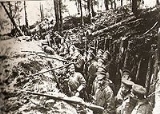
The Battle of Sarikamish was an engagement between the Russian
and Ottoman
empires during World War I
. It took place from December 22, 1914 to January 17, 1915 as part of the Caucasus Campaign
. The outcome was a Russian victory. The Ottomans employed a strategy which demanded that their troops be highly mobile and to arrive at specified objectives at precise times. This approach was based both on German and Napoleonic tactics. The Ottoman troops, ill-prepared for winter conditions, suffered major casualties at the Allahüekber mountains
.
as secondary to the Eastern Front
and the Eastern Front enjoyed the major share of Russian resources. Russia had taken the fortress of Kars
from the Turks during the Russo-Turkish War in 1877 and feared a Caucasus Campaign
aimed at retaking Kars and the port of Batum.
The Ottoman generalship and organization were negligible compared to the Russians. A Caucasus Campaign would have a distracting effect on Russian forces. The plan found sympathy with German advisors
in that a success in this region would mean a diversion of Russian forces to this front from the Polish and Galician fronts. Germany supplied resources and the Ottoman 3rd Army
was used in the battle. The immediate strategic goal of the Caucasus Campaign was to retake Artvin
, Ardahan
, Kars, and the port of Batum. As a longer term goal, head of the Ottoman war ministry İsmail Enver
hoped a success would facilitate opening the route to Tbilisi
and beyond, with a revolt of Caucasian Muslims. Another Turkish—or rather German—strategic goal was to cut Russian access
to its hydrocarbon resources
around the Caspian Sea
. The Anglo-Persian Oil Company
had exclusive rights to work petroleum deposits throughout the Persian Empire except in the provinces of Azerbaijan, Ghilan, Mazendaran, Asdrabad and Khorasan. In 1914, before the war, the British government had contracts with the company for the supply of fuel oil for the navy.
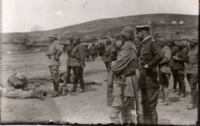 The headquarters of the 3rd Army was located in Erzurum
under the command of Hasan Izzet
. On October 30, 1914, the 3rd Army headquarters was informed by High Command in Istanbul about an exchange of fire during the pursuit of Goeben and Breslau
in the Black Sea
. High Command expected the Russian Army to cross the Ottoman border at any time. The Bergmann Offensive
(November 2, 1914 – November 16, 1914) ended with the defeat of Russian troops under Bergmann. The Russian success was along the southern shoulders of the line. Hasan İzzet stabilized the front by letting the Russians 25 kilometres (15.5 mi) inside the Ottoman Empire along the Erzurum-Sarıkamış
axis.
The war minister, İsmail Enver, devised an operation plan while he was at the Department of War in Istanbul. His strategy was based on German principles copied from Napoleon. Enver's plan involved a single envelopment using three Corps. On the right flank
, XI Corps would fix the Russians in place and conduct feint attacks
. In the center, IX Corps would fight in the direction of Sarıkamış Pass. Assistant Chief of Staff Colonel Hafız Hakkı’s X Corps, which was to be on the left flank, would drive to Oltu
, cross the Allahüekber Mountains, cut the Kars road, and drive the Russians to the Aras Valley, where the Russian forces would be destroyed by all three Corps attacking in concert. Meanwhile a detachment unit under Stange Bey would conduct highly visible operations to distract and pin Russian units. Success depended on all troops arriving at their specified objectives at the correct moment. The first part of the plan was fulfilled when the Russians concentrated their forces at Sarıkamış and Köprüköy
after the Bergmann Offensive.
Hasan İzzet was not in favor of an offensive action in the harsh winter conditions. He was planning to remain in a defensive posture by pulling the Russians to Erzurum Fortress and launching a counter attack. Hafız Hakkı was sent to replace the commander of X Corps to energize the 3rd Army. Enver released Hasan İzzet from command on December 14. İzzet told Enver:
Enver wanted his plan executed through a winter offense, and decided to take charge. He left Istanbul with General Fritz Bronsart von Schellendorf
and the head of the Operations Office Lieutenant Colonel Otto von Feldmann
. They arrived in Erzurum on December 21. Senior Turkish commanders opposed the forced resignation of Hasan İzzet due to his rejection of the plan.
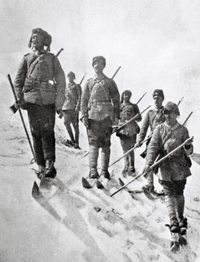 The war zone was nearly 1,250-1,500 kilometers (776–932 miles) wide from the Black Sea
to Lake Van
, which made military concentration difficult. The operation was executed at a plateau averaging 1,500–2,000 meters (5,000–6,500 feet) above sea level. The main difficulty with the region was the roads, with the transportation infrastructure on the Ottoman side far from adequate. Russia's main advantage was the Kars Gyumri Akhalkalaki railway line
and a terminal at Sarıkamış. The railway was 24 kilometres (14.9 mi) from the border. The only way for an army to get through the Caucasian heights was the high mountain passes in which lay the cities Kars and Sarıkamış. Beyond, the upper valleys of the Aras River and Euphrates
extended westward. Everywhere else the roads were mere tracks which were impenetrable to artillery. The forces were concentrated about 80 kilometres (49.7 mi) on each side of the border at the fortresses of Kars on the Russian side and Erzurum on the Ottoman side.
The 3rd Army, under the command of Enver, was composed of the IX, X and XI Corps. 3rd Army's headquarters and the IX Corps were located in Erzurum. The X Corps was stationed in Sivas, and the XI Corps was in Elazığ
(Mamuretülaziz). A detachment unit under the command of the German Lieutenant Colonel Stange was established from the 3rd Infantry Division, originally stationed in Thrace
, to reinforce the offense and pin down the Russians. This detachment unit, known as Stanke Bey, consisted of two battalions of the 8th Infantry Regiment and two artillery batteries. The fighting power of 83,000 regular troops, reserves, and personnel from the Erzurum Fortress totalled 118,000. The total manpower including transportation units, depot regiments, and military police was 150,000. There were 73 machine guns and 218 artillery pieces. Ottoman forces were inadequately prepared for the campaign. Two divisions of the IX Corps began a long trek with no winter clothing and only dry bread and olives for rations.
The Russian Caucasus Army was a well-equipped 100,000 troops. However, the Russians redeployed almost half of the Caucasus Army to the Prussian front due to the defeats at the Battle of Tannenberg
(August 23–September 2, 1914) and the Masurian Lakes (September 9–14, 1914), leaving behind 65,000 troops. To remedy these troop movements Count Illarion Ivanovich Vorontsov-Dashkov consulted with the Mayor of Tbilisi Alexandre Khatsian, the primate of Tbilisi Bishop Mesrop, and the prominent civic leader Dr. Hakob Zavriev
about the creation of Armenian volunteer
detachments
. The Russian Armenian reservists had already been drafted into the regular armed forces and sent to the European theatre
. The volunteer units consisted of Armenians, who were not citizens of the empire or obligated to serve. Originally, there were four volunteer battalions created. Along the Kars Oblast
, the 3rd battalion commanded by Hamazasp (Srvandztian) and 4th battalion by Keri (Arshak Gavafian) operated on the front facing Erzurum between Sarıkamış and Oltu
. The Commander-in-Chief of the Caucasian Military District (Caucasian Army) was Illarion Ivanovich Vorontsov-Dashkov
. Effective command was in the hands of Infantry General Aleksandr Zakharevich Myshlayevsky, who was originally a military historian graduated from the Imperial General Staff Academy
. General Nikolai Yudenich was his Chief of Staff
.
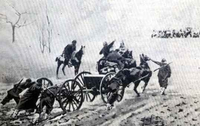 Hafız Hakki was at the left flank. His order was to move the IX and X Corps to Sarıkamış and Kars. He contemplated a two step plan: a sudden initial attack and a second step with both Corps proceeding at full speed towards Oltu. He expected the assault at Narman
to be concluded by the afternoon of December 22. Then the Corps would march 30 kilometers a day and arrive in the Kars-Sarıkamış line by December 25. Two divisions of the Stange regiment had been sent by sea from Constantinople to Trabzon
.
On early December 22, Hafız Hakkı ordered his troops to move forward. They engaged in a brief skirmish against a Russian brigade commanded by General Istomin near Kaleboğazı, west of Oltu. The skirmishes at Kaleboğazı ended the next day with the Ottomans capturing four artillery guns, four machine guns, and 1,000 Russian troops.
On December 23, Istomin abandoned his position and moved towards Ardahan
. Hafız Hakkı sent two divisions to pursue Istomin. At the extreme left wing, the Stange Regiment, which had landed at Trabzon, was to move up the Çoruh valley
towards Ardahan and through a pass at 2438 metres (7,998.7 ft) altitude.
On December 23, the 92nd Regiment of the 31st Division, believing the unit in front of them to be Russians, opened fire on the flank of the 32nd Division. The ensuing four hour fight in the fog killed 2,000 Turkish soldiers.
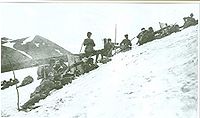 On December 24, Hafız Hakkı was well beyond Oltu after having marched 75 kilometres (46.6 mi) in just over three days. However, they were not at the Kars-Sarıkamış line as planned.
On December 25, Ottoman troops had been marching for 14 hours under heavy snow. The soldiers were exhausted and hungry; the fear of frostbite and Russian machine guns was slowly being replaced by absolute indifference.
In the early hours of December 26, at the 18th hour of the march, the 91st Regiment of X Corps came under enemy fire. The Russians left the scene after nearly two hours of fighting. The regiment resumed its march, and soon a snow storm began. Under these conditions the 91st Regiment managed to reach Kosor from Penek (a distance of just 8 km) in 21 hours. Other units reached their destinations at a similar rate. While Enver was ordering a night attack, elements of the X Corps were spending the night in the villages of Kosor, Arsenik, and Patsik, which were 40, 35 and 30 kilometers from Sarıkamış respectively. The Allahüekber Mountains were still to be crossed. Thousands of Turkish soldiers died of hypothermia
in the snow.
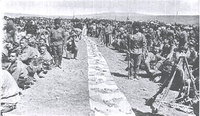 The X Corps suffered a delay of 24 hours in the Barduz Pass, and 4th battalion of the Armenian volunteers lost 600 troops in a battle there.
When commander Malyshevsky arrived at army headquarters in the Russian front lines, he gave the order for a general retreat. The process of withdrawing was to start on December 25 and 26. The Russians evacuated Sarıkamış, leaving two cavalry squadrons and 1,000 railwaymen to defend it. Not all Russian commanders were in a state of panic. The Russian army headquarters maintained a solid grip on the situation, with the effective command and control never lost. General Yudenich, taking command of the II Turkestan Corps, decided to put up resistance.
On December 28, the Russians held by the XI Corps at Horasan
. The IX Corps were at Sarıkamış. The X Corps were threatening to pierce the Russian front along the Kars railway to the east. The Stange regiment was descending upon Ardahan 60 miles to the northeast. Enver's operational plan was looking successful on paper.
However, the Ottoman forces were worn out, half starved, and short of guns and ammunition. They had no hope of reaching their objective on time. Enver thought that the Russians were retreating to Kars. It was actually an encircling movement.
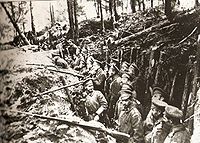 On December 29, the assault took place. The IX and XI Corps, totaling 12,000 men, began to attack Sarıkamış. During bayonet fighting, only 300 men succeeded in breaking into the city. They were driven off, losing 6,000 troops. Enver received information that Russians were preparing to encircle his forces with a force of five regiments.
On December 31, the IX Corps was bogged down in the woods outside Sarıkamış and had been reduced to some 2,500 men and 14 artillery guns and machine guns. On the same night news arrived to headquarters from Bardız: The 32nd Division had abandoned its positions to the Russians. This meant that the Barduz and Kızılkilise roads were now in Russian hands. The Ottoman forces were inside a semicircle. Enver refused to lose momentum, and ordered his units to continue with the plan.
On January 1, the commander of the XI Corps pressed a frontal attack on Sarıkamış that lasted for the next four days; after that the fighting began to lose momentum. Snow hindered advancing forces which were supposed to bring relief. The IX Corps melted away on the way to Sarıkamış. One of the divisions lost 40% of its strength in a snowstorm. The X Corps never came to the rescue. 90% of X Corps was left on the slopes of the Allahüekber Mountains. The XI Corps was fighting in the Aras region. A regiment entered Çerkezköy, only to be taken prisoner. While the Stange regiment entered Ardahan on schedule, the troops were exhausted. The Russians were poised to encircle the remaining forces.
On January 3, I Corps were driven out to the Choruk Valley, in which direction the remnants of the X Corps were also retreating. Hafız Hakkı was hoping for reinforcements. He did not order his units to retreat as he believed it could be still possible to take Sarıkamış. Meanwhile, around 40 km south, the XI Corps led by Galip was renewing attacks on Russian lines in an attempt to relieve the pressure on the IX and X Corps positioned in front of Sarıkamış. The Russians were advancing and the circle was getting narrower.
On January 4, Hafız Hakkı toured the front line. He told İhsan that the battle was over unless some of the troops on the Allahüekber Mountains were still alive.
On January 11, after four days of travel, Enver and the German officers reached Erzurum. They had stipulated in their original plan that the same route could be taken by the advancing 3rd Army in two days. The transports dispatched from Constantinople which attempted to land troops and provisions at Trabzon were sunk by a Russian Black Sea squadron and warships. The escorts SMS Goeben
and TCG Hamidieh were chased back to the Bosporus.
On January 17, the remnants of the Ottoman forces in the woods outside Sarıkamış were collected, which signaled the end of fighting on this front. The Russian right wing cleared the Choruk Valley. Enver's project ended in failure after three weeks of struggle amid high mountains and deep snowdrifts. For a time, at least, Russia was secure from attack in the Caucasus. Hafız Hakkı expected that the Russians would use this success to capture the Erzurum Fortress. The 3rd Army immediately tried to take measures, but this proved to be nearly impossible as all the local reserves were depleted.
On February 12, Hafız Hakkı died of typhus at the age of 36. Otto Liman von Sanders
, who had been asked before, rejected the position again. Mahmut Kamil
took the command of the Army. War minister Enver never commanded troops in battle again.
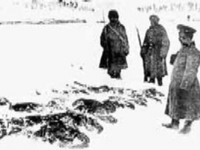 The Ottoman 3rd Army started with 118,000 fighting men. It was reduced to 42,000 effective soldiers in January 1915. There are conflicting figures for Ottoman casualties. Sources do not agree on what sould be included in the final sum. The Turkish official history states 32,000 KIA
, 15,000 died of sickness, 7,000 prisoners, 10,000 wounded, for some 50,000 total casualties. The casualties of the conflict escalated beyond the end of the active warfare period as the most immediate problem confronting the 3rd Army became the typhus
epidemic. TAF presents a figure of 60,000 casualties throughout the period of the operation. Russians took 7,000 POWs including 200 officers. These prisoners were kept under confinement for the next three years in the small town of Varnavino
east of Moscow on the Vetluga River
. After the final days of the Czarist empire, these soldiers had a chance to return to the ailing Ottoman Empire.
Russian losses were 16,000 killed in action and 12,000 died of sickness, mostly due to frostbite. TAF sources report around 30,000 fatalities without giving details on the breakdown of this number.
Carrying out a military plan in winter was not the major failure of the operation. A valid question is whether or not the plan could have been executed better. It would be hard to exceed the performance of the Turkish soldiers. The IX and X Corps marched with maximum effectiveness given the conditions. The majority of the units managed to move to the correct positions. In respect to the inflicted Russian casualties, they should be credited.
The communication and cooperation between the Ottoman units failed; forces functioned as separate units rather than in mutually supporting engagements as originally planned. There was not a sufficient operational reserve established for the size of engagement. The conditions for the Ottoman forces could have been better, if Enver paused the operations on December 24, and had not moved beyond the Oltu line with the artillery pieces. The decision to take the heavy artillery rather than short range smaller caliber guns beyond the Oltu line was a failure, as the forces faced detachment units with better mobility. The plan had a faulty estimate of the size of the Russian forces. The commanders of the X and IX Corps were replaced with men of little or no experience at the operational level. The chief of staff of IX Corps Köprülülü Şerif Bey said, "..troops fought on the top of tall mountains under snowstorm against the artillery of an enemy of centuries and they were completely annihilated, but not a single Turkish soldier has ever turned his back to his nation... In Sarikamish, there was no panic.”
 During the battle, light infantry
was used by both sides. The detachment of Armenian volunteer units on the Russian side, and the detachment I Corps unit under the control of Stange, provided a skirmishing screen ahead of the main body of infantry, harassing and delaying of the enemy advance or preventing them escaping.
The Armenian detachment units were credited in no small measure for the success of the Russian forces, as they were natives of the region, adjusted to the climatic conditions, familiar with every road and mountain path, and were fierce and resolute in combat. The Armenian units were small, mobile, and well adapted to the semi-guerrilla warfare
. They did good work as scouts and took part in many severe engagements. Armenian detachment battalions challenged the Ottoman operations during critical times: "the delay enabled the Russian Caucasus Army to concentrate sufficient force around Sarikamish".
in eastern Anatolia during the 1890s. During July 1914 there were negotiations between the Committee of Union and Progress
(CUP) and Armenian intelligentsia at the Armenian congress at Erzurum
. The public conclusion of this congress was "ostensibly conducted to peaceful advance Armenian demands by legitimate means". The CUP regarded the congress as the seedbed for establishing insurrection. Historian Erikson concluded that after this meeting the CUP was convinced to pursue strong Armenian—Russian links with detailed plans to detach the region from the Ottoman Empire.
Martin Gilbert in The First World War states that in search of allies against the Turks, Nicholas II of Russia
visited the "Caucasus front" on December 30, and told the head of the Armenian Church
that "a most brilliant future awaits the Armenians". The head of the Armenian Church along with the president of the Armenian National Council
in Tiflis Alexander Khatisyan
received the Tsar, who said:
As a result of the Tsar's speech, the Ottoman Empire saw their Armenian minority as a potential source of fifth column
activity, treachery, and disloyalty, and did nothing to dampen anti-Armenian feeling among its populace. The Ottoman government claimed that it had a legitimate reason as a sovereign state to protect itself from an actual or projected Armenian uprising in favor of Russia or a Western Allied invasion of Ottoman territory. On his return to Constantinople
, Enver blamed his failure on the actions of the region's local Armenians.
Repressive measures taken against the empire's Armenian population were an early stage of the Armenian Genocide
.
Russian Empire
The Russian Empire was a state that existed from 1721 until the Russian Revolution of 1917. It was the successor to the Tsardom of Russia and the predecessor of the Soviet Union...
and Ottoman
Ottoman Empire
The Ottoman EmpireIt was usually referred to as the "Ottoman Empire", the "Turkish Empire", the "Ottoman Caliphate" or more commonly "Turkey" by its contemporaries...
empires during World War I
World War I
World War I , which was predominantly called the World War or the Great War from its occurrence until 1939, and the First World War or World War I thereafter, was a major war centred in Europe that began on 28 July 1914 and lasted until 11 November 1918...
. It took place from December 22, 1914 to January 17, 1915 as part of the Caucasus Campaign
Caucasus Campaign
The Caucasus Campaign comprised armed conflicts between the Ottoman Empire and the Russian Empire, later including Azerbaijan, Armenia, Central Caspian Dictatorship and the UK as part of the Middle Eastern theatre or alternatively named as part of the Caucasus Campaign during World War I...
. The outcome was a Russian victory. The Ottomans employed a strategy which demanded that their troops be highly mobile and to arrive at specified objectives at precise times. This approach was based both on German and Napoleonic tactics. The Ottoman troops, ill-prepared for winter conditions, suffered major casualties at the Allahüekber mountains
Allahüekber Daglari
The Allahüekber Dağları , is a range of mountains in northeast Turkey.In 1914 when World War I started it was astride the border with Russia, and a Turkish army suffered a disaster when, ordered to invade the Kars area , thousands of its men died of cold in the winter snow of the Allahüekber...
.
Background
Russia viewed the Caucasus frontCaucasus Campaign
The Caucasus Campaign comprised armed conflicts between the Ottoman Empire and the Russian Empire, later including Azerbaijan, Armenia, Central Caspian Dictatorship and the UK as part of the Middle Eastern theatre or alternatively named as part of the Caucasus Campaign during World War I...
as secondary to the Eastern Front
Eastern Front (World War I)
The Eastern Front was a theatre of war during World War I in Central and, primarily, Eastern Europe. The term is in contrast to the Western Front. Despite the geographical separation, the events in the two theatres strongly influenced each other...
and the Eastern Front enjoyed the major share of Russian resources. Russia had taken the fortress of Kars
Kars
Kars is a city in northeast Turkey and the capital of Kars Province. The population of the city is 73,826 as of 2010.-Etymology:As Chorzene, the town appears in Roman historiography as part of ancient Armenia...
from the Turks during the Russo-Turkish War in 1877 and feared a Caucasus Campaign
Caucasus Campaign
The Caucasus Campaign comprised armed conflicts between the Ottoman Empire and the Russian Empire, later including Azerbaijan, Armenia, Central Caspian Dictatorship and the UK as part of the Middle Eastern theatre or alternatively named as part of the Caucasus Campaign during World War I...
aimed at retaking Kars and the port of Batum.
The Ottoman generalship and organization were negligible compared to the Russians. A Caucasus Campaign would have a distracting effect on Russian forces. The plan found sympathy with German advisors
German Empire
The German Empire refers to Germany during the "Second Reich" period from the unification of Germany and proclamation of Wilhelm I as German Emperor on 18 January 1871, to 1918, when it became a federal republic after defeat in World War I and the abdication of the Emperor, Wilhelm II.The German...
in that a success in this region would mean a diversion of Russian forces to this front from the Polish and Galician fronts. Germany supplied resources and the Ottoman 3rd Army
Third Army (Ottoman Empire)
The Ottoman Third Army was originally established in the Balkans and later defended the northern and eastern parts of the Ottoman Empire. Its initial headquarters was at Salonica. With the onset of World War I, it moved to Erzurum Fortress. The headquarters was moved to Susehir after the Battle...
was used in the battle. The immediate strategic goal of the Caucasus Campaign was to retake Artvin
Artvin
-History:See Artvin Province for the history of the region.-Places of interest:* Artvin or Livana castle, built in 937There are a number of Ottoman Empire houses and public buildings including:* Salih Bey mosque, built in 1792...
, Ardahan
Ardahan
Ardahan is a city in northeastern Turkey, near the Georgian border.-Ancient and medieval:In Ancient times the region was called Gogarene, which is assumed to derive from the name of Gugars, who were a Proto-Kartvelian tribe...
, Kars, and the port of Batum. As a longer term goal, head of the Ottoman war ministry İsmail Enver
Ismail Enver
Enver Pasha or Ismail Enver Pasha , title was changed with his military ranks such as Enver Efendi , Enver Bey , Enver Pasha, higher than Mirliva) was an Ottoman military officer and a leader of the Young Turk revolution...
hoped a success would facilitate opening the route to Tbilisi
Tbilisi
Tbilisi is the capital and the largest city of Georgia, lying on the banks of the Mt'k'vari River. The name is derived from an early Georgian form T'pilisi and it was officially known as Tiflis until 1936...
and beyond, with a revolt of Caucasian Muslims. Another Turkish—or rather German—strategic goal was to cut Russian access
Baku-Batumi pipeline
The Baku–Batumi pipeline is the name given to several pipelines and pipeline projects to transport kerosene and crude oil from the Caspian region to the Georgian Batumi oil terminal at the Black Sea...
to its hydrocarbon resources
Oil Industry in Azerbaijan
The petroleum industry in Azerbaijan produces about of oil per day and 1 bcma of gas. Azerbaijan is one of the birthplaces of the oil industry, its history is linked to the fortunes of petroleum. It is poised to become an important oil and gas producer once again.- Early history:There is evidence...
around the Caspian Sea
Caspian Sea
The Caspian Sea is the largest enclosed body of water on Earth by area, variously classed as the world's largest lake or a full-fledged sea. The sea has a surface area of and a volume of...
. The Anglo-Persian Oil Company
Anglo-Persian Oil Company
The Anglo-Persian Oil Company was founded in 1908 following the discovery of a large oil field in Masjed Soleiman, Iran. It was the first company to extract petroleum from the Middle East...
had exclusive rights to work petroleum deposits throughout the Persian Empire except in the provinces of Azerbaijan, Ghilan, Mazendaran, Asdrabad and Khorasan. In 1914, before the war, the British government had contracts with the company for the supply of fuel oil for the navy.
Prelude
Erzurum
Erzurum is a city in Turkey. It is the largest city, the capital of Erzurum Province. The city is situated 1757 meters above sea level. Erzurum had a population of 361,235 in the 2000 census. .Erzurum, known as "The Rock" in NATO code, served as NATO's southeastern-most air force post during the...
under the command of Hasan Izzet
Hasan Izzet
Hasan Izzet Pasha was a general of the Ottoman Empire.-Early life:...
. On October 30, 1914, the 3rd Army headquarters was informed by High Command in Istanbul about an exchange of fire during the pursuit of Goeben and Breslau
Pursuit of Goeben and Breslau
The pursuit of Goeben and Breslau was a naval action that occurred in the Mediterranean Sea at the outbreak of the First World War when elements of the British Mediterranean Fleet attempted to intercept the German Mittelmeerdivision comprising the battlecruiser and the light cruiser...
in the Black Sea
Black Sea
The Black Sea is bounded by Europe, Anatolia and the Caucasus and is ultimately connected to the Atlantic Ocean via the Mediterranean and the Aegean seas and various straits. The Bosphorus strait connects it to the Sea of Marmara, and the strait of the Dardanelles connects that sea to the Aegean...
. High Command expected the Russian Army to cross the Ottoman border at any time. The Bergmann Offensive
Bergmann Offensive
The Bergmann Offensive was the first engagement of the Caucasus Campaign. General Georgy Berhmann, who was the commander of the I Caucasian Army Corps took the initiative against the Ottoman Empire....
(November 2, 1914 – November 16, 1914) ended with the defeat of Russian troops under Bergmann. The Russian success was along the southern shoulders of the line. Hasan İzzet stabilized the front by letting the Russians 25 kilometres (15.5 mi) inside the Ottoman Empire along the Erzurum-Sarıkamış
Sarıkamış
Sarıkamış is a town and a district of Kars Province in the Eastern Anatolia region of Turkey. The population is 17,860 as of 2010.The town sits in a valley and is surrounded by mountains, many of which are covered with pine forests. It has very long winters, with average of 7–8 ft of...
axis.
The war minister, İsmail Enver, devised an operation plan while he was at the Department of War in Istanbul. His strategy was based on German principles copied from Napoleon. Enver's plan involved a single envelopment using three Corps. On the right flank
Flanking maneuver
In military tactics, a flanking maneuver, also called a flank attack, is an attack on the sides of an opposing force. If a flanking maneuver succeeds, the opposing force would be surrounded from two or more directions, which significantly reduces the maneuverability of the outflanked force and its...
, XI Corps would fix the Russians in place and conduct feint attacks
Feint
Feint is a French term that entered English from the discipline of fencing. Feints are maneuvers designed to distract or mislead, done by giving the impression that a certain maneuver will take place, while in fact another, or even none, will...
. In the center, IX Corps would fight in the direction of Sarıkamış Pass. Assistant Chief of Staff Colonel Hafız Hakkı’s X Corps, which was to be on the left flank, would drive to Oltu
Oltu
Oltu is a town and district of Erzurum Province in the Eastern Anatolia region of Turkey. The mayor is İbrahim Ziyrek . The population is 19,969 .-History:...
, cross the Allahüekber Mountains, cut the Kars road, and drive the Russians to the Aras Valley, where the Russian forces would be destroyed by all three Corps attacking in concert. Meanwhile a detachment unit under Stange Bey would conduct highly visible operations to distract and pin Russian units. Success depended on all troops arriving at their specified objectives at the correct moment. The first part of the plan was fulfilled when the Russians concentrated their forces at Sarıkamış and Köprüköy
Köprüköy
Köprüköy is a town and district of Erzurum Province in the Eastern Anatolia region of Turkey. The mayor is Osman Belli . The population is 1,629 ....
after the Bergmann Offensive.
Hasan İzzet was not in favor of an offensive action in the harsh winter conditions. He was planning to remain in a defensive posture by pulling the Russians to Erzurum Fortress and launching a counter attack. Hafız Hakkı was sent to replace the commander of X Corps to energize the 3rd Army. Enver released Hasan İzzet from command on December 14. İzzet told Enver:
We have to consider 8 or 9 days for a large scaled encircling manoeuvre. However, during this time the XI Corps, which will remain at the front, might be jeopardized. Even if we execute the manoeuvre with two corps, they will probably face difficulties against the enemy.
Enver wanted his plan executed through a winter offense, and decided to take charge. He left Istanbul with General Fritz Bronsart von Schellendorf
Fritz Bronsart von Schellendorf
Friedrich Bronsart von Schellendorf was a German officer and politician. He was the chief of the Ottoman General Staff, part of German military mission in the Ottoman Empire. He is "depicted as the actual initiator of the scheme of the Armenian deportations".- Notes :...
and the head of the Operations Office Lieutenant Colonel Otto von Feldmann
Otto von Feldmann
Otto von Feldmann was a German officer and politician.Feldmann attended the Royal Grammar School in Bydgoszcz, the Kaiser-Wilhelm-and Ratsgymnasium Hanover, the Kadettenvoranstalt in Potsdam and the main cadet institution in big-Lichterfelde near Berlin. He joined to the Military in 1907...
. They arrived in Erzurum on December 21. Senior Turkish commanders opposed the forced resignation of Hasan İzzet due to his rejection of the plan.
Battlefield
Black Sea
The Black Sea is bounded by Europe, Anatolia and the Caucasus and is ultimately connected to the Atlantic Ocean via the Mediterranean and the Aegean seas and various straits. The Bosphorus strait connects it to the Sea of Marmara, and the strait of the Dardanelles connects that sea to the Aegean...
to Lake Van
Lake Van
Lake Van is the largest lake in Turkey, located in the far east of the country in Van district. It is a saline and soda lake, receiving water from numerous small streams that descend from the surrounding mountains. Lake Van is one of the world's largest endorheic lakes . The original outlet from...
, which made military concentration difficult. The operation was executed at a plateau averaging 1,500–2,000 meters (5,000–6,500 feet) above sea level. The main difficulty with the region was the roads, with the transportation infrastructure on the Ottoman side far from adequate. Russia's main advantage was the Kars Gyumri Akhalkalaki railway line
Kars Gyumri Akhalkalaki railway line
The Kars–Gyumri–Tbilisi railway line is a railway line that runs from the city of Kars in Turkey to the Armenian city of Gyumri, then from there on to Tbilisi, Georgia....
and a terminal at Sarıkamış. The railway was 24 kilometres (14.9 mi) from the border. The only way for an army to get through the Caucasian heights was the high mountain passes in which lay the cities Kars and Sarıkamış. Beyond, the upper valleys of the Aras River and Euphrates
Euphrates
The Euphrates is the longest and one of the most historically important rivers of Western Asia. Together with the Tigris, it is one of the two defining rivers of Mesopotamia...
extended westward. Everywhere else the roads were mere tracks which were impenetrable to artillery. The forces were concentrated about 80 kilometres (49.7 mi) on each side of the border at the fortresses of Kars on the Russian side and Erzurum on the Ottoman side.
The 3rd Army, under the command of Enver, was composed of the IX, X and XI Corps. 3rd Army's headquarters and the IX Corps were located in Erzurum. The X Corps was stationed in Sivas, and the XI Corps was in Elazığ
Elazig
Elâzığ is a city in Eastern Anatolia, Turkey and the seat of Elâzığ Province. It has a population of331,479 according to the 2010 census, and the plain on which the city extends has an altitude of 1067 metres....
(Mamuretülaziz). A detachment unit under the command of the German Lieutenant Colonel Stange was established from the 3rd Infantry Division, originally stationed in Thrace
Thrace
Thrace is a historical and geographic area in southeast Europe. As a geographical concept, Thrace designates a region bounded by the Balkan Mountains on the north, Rhodope Mountains and the Aegean Sea on the south, and by the Black Sea and the Sea of Marmara on the east...
, to reinforce the offense and pin down the Russians. This detachment unit, known as Stanke Bey, consisted of two battalions of the 8th Infantry Regiment and two artillery batteries. The fighting power of 83,000 regular troops, reserves, and personnel from the Erzurum Fortress totalled 118,000. The total manpower including transportation units, depot regiments, and military police was 150,000. There were 73 machine guns and 218 artillery pieces. Ottoman forces were inadequately prepared for the campaign. Two divisions of the IX Corps began a long trek with no winter clothing and only dry bread and olives for rations.
The Russian Caucasus Army was a well-equipped 100,000 troops. However, the Russians redeployed almost half of the Caucasus Army to the Prussian front due to the defeats at the Battle of Tannenberg
Battle of Tannenberg (1914)
The Battle of Tannenberg was an engagement between the Russian Empire and the German Empire in the first days of World War I. It was fought by the Russian First and Second Armies against the German Eighth Army between 23 August and 30 August 1914. The battle resulted in the almost complete...
(August 23–September 2, 1914) and the Masurian Lakes (September 9–14, 1914), leaving behind 65,000 troops. To remedy these troop movements Count Illarion Ivanovich Vorontsov-Dashkov consulted with the Mayor of Tbilisi Alexandre Khatsian, the primate of Tbilisi Bishop Mesrop, and the prominent civic leader Dr. Hakob Zavriev
Hakob Zavriev
Hakob Zavriev was an Armenian politician.Zavriev was a graduate of the St. Petersburg Army Medical Academy. He later joined the Armenian Revolutionary Federation. The viceroy of the Caucasus consulted him over the formation of the Armenian volunteer units in 1914...
about the creation of Armenian volunteer
Armenian volunteer units
Armenian volunteer units, also known the Armenian volunteer corps were Armenian battalions in Russian and British armies during the World War I. Majority of these units support the military activities at the Middle Eastern theatre of World War I. The origin of these units were varied. Some units...
detachments
Detachment (military)
A detachment is a military unit. It can either be detached from a larger unit for a specific function or be a permanent unit smaller than a battalion. The term is often used to refer to a unit that is assigned to a different base from the parent unit...
. The Russian Armenian reservists had already been drafted into the regular armed forces and sent to the European theatre
European theatre of World War I
Although considerable conflict took place outside Europe, the European theatre was the main theatre of operations during World War I and was where the war began and ended...
. The volunteer units consisted of Armenians, who were not citizens of the empire or obligated to serve. Originally, there were four volunteer battalions created. Along the Kars Oblast
Kars Oblast
Kars Oblast was one of Transcaucasian governorates of Russian Empire between 1878 and 1917. Its capital was in the city of Kars, presently in the Republic of Turkey. The governorate bordered with the Ottoman Empire, Batum Oblast, Tiflis Governorate, Erivan Governorate, and from 1883 to 1903 with...
, the 3rd battalion commanded by Hamazasp (Srvandztian) and 4th battalion by Keri (Arshak Gavafian) operated on the front facing Erzurum between Sarıkamış and Oltu
Oltu
Oltu is a town and district of Erzurum Province in the Eastern Anatolia region of Turkey. The mayor is İbrahim Ziyrek . The population is 19,969 .-History:...
. The Commander-in-Chief of the Caucasian Military District (Caucasian Army) was Illarion Ivanovich Vorontsov-Dashkov
Illarion Ivanovich Vorontsov-Dashkov
Count Illarion Ivanovich Vorontsov-Dashkov was the last notable representative of the Vorontsov family. He served as Minister of Imperial Properties in 1881-97 and the General Governor of Caucasus in 1905-15....
. Effective command was in the hands of Infantry General Aleksandr Zakharevich Myshlayevsky, who was originally a military historian graduated from the Imperial General Staff Academy
General Staff Academy (Imperial Russia)
The General Staff Academy was a Russian military academy, established in 1832 in St.Petersburg. It was first known as the Imperial Military Academy , then in 1855 it was renamed Nicholas General Staff Academy and in 1909 - Imperial Nicholas Military Academy The General Staff Academy was a...
. General Nikolai Yudenich was his Chief of Staff
Chief of Staff
The title, chief of staff, identifies the leader of a complex organization, institution, or body of persons and it also may identify a Principal Staff Officer , who is the coordinator of the supporting staff or a primary aide to an important individual, such as a president.In general, a chief of...
.
Initial manoeuvres, December 22–28
Narman
Narman District is a district of Erzurum Province of Turkey....
to be concluded by the afternoon of December 22. Then the Corps would march 30 kilometers a day and arrive in the Kars-Sarıkamış line by December 25. Two divisions of the Stange regiment had been sent by sea from Constantinople to Trabzon
Trabzon
Trabzon is a city on the Black Sea coast of north-eastern Turkey and the capital of Trabzon Province. Trabzon, located on the historical Silk Road, became a melting pot of religions, languages and culture for centuries and a trade gateway to Iran in the southeast and the Caucasus to the northeast...
.
On early December 22, Hafız Hakkı ordered his troops to move forward. They engaged in a brief skirmish against a Russian brigade commanded by General Istomin near Kaleboğazı, west of Oltu. The skirmishes at Kaleboğazı ended the next day with the Ottomans capturing four artillery guns, four machine guns, and 1,000 Russian troops.
On December 23, Istomin abandoned his position and moved towards Ardahan
Ardahan
Ardahan is a city in northeastern Turkey, near the Georgian border.-Ancient and medieval:In Ancient times the region was called Gogarene, which is assumed to derive from the name of Gugars, who were a Proto-Kartvelian tribe...
. Hafız Hakkı sent two divisions to pursue Istomin. At the extreme left wing, the Stange Regiment, which had landed at Trabzon, was to move up the Çoruh valley
Çoruh River
The Çoruh River or Ch'orokhi River rises in the Mescit Mountains in north-eastern Turkey, flows through the cities of Bayburt, Ispir, Yusufeli, and Artvin, along the Kelkit-Çoruh Fault, before flowing into Georgia, where it reaches the Black Sea just south of Batumi and a few kilometers north of...
towards Ardahan and through a pass at 2438 metres (7,998.7 ft) altitude.
On December 23, the 92nd Regiment of the 31st Division, believing the unit in front of them to be Russians, opened fire on the flank of the 32nd Division. The ensuing four hour fight in the fog killed 2,000 Turkish soldiers.
On December 25, Ottoman troops had been marching for 14 hours under heavy snow. The soldiers were exhausted and hungry; the fear of frostbite and Russian machine guns was slowly being replaced by absolute indifference.
In the early hours of December 26, at the 18th hour of the march, the 91st Regiment of X Corps came under enemy fire. The Russians left the scene after nearly two hours of fighting. The regiment resumed its march, and soon a snow storm began. Under these conditions the 91st Regiment managed to reach Kosor from Penek (a distance of just 8 km) in 21 hours. Other units reached their destinations at a similar rate. While Enver was ordering a night attack, elements of the X Corps were spending the night in the villages of Kosor, Arsenik, and Patsik, which were 40, 35 and 30 kilometers from Sarıkamış respectively. The Allahüekber Mountains were still to be crossed. Thousands of Turkish soldiers died of hypothermia
Hypothermia
Hypothermia is a condition in which core temperature drops below the required temperature for normal metabolism and body functions which is defined as . Body temperature is usually maintained near a constant level of through biologic homeostasis or thermoregulation...
in the snow.
When commander Malyshevsky arrived at army headquarters in the Russian front lines, he gave the order for a general retreat. The process of withdrawing was to start on December 25 and 26. The Russians evacuated Sarıkamış, leaving two cavalry squadrons and 1,000 railwaymen to defend it. Not all Russian commanders were in a state of panic. The Russian army headquarters maintained a solid grip on the situation, with the effective command and control never lost. General Yudenich, taking command of the II Turkestan Corps, decided to put up resistance.
On December 28, the Russians held by the XI Corps at Horasan
Horasan
Horasan is a town and district of Erzurum Province in the Eastern Anatolia region of Turkey. The mayor is Abdulhatem Bastem .In 2008 the population of the town was 17,661 while that of the Horasan district was 43,852....
. The IX Corps were at Sarıkamış. The X Corps were threatening to pierce the Russian front along the Kars railway to the east. The Stange regiment was descending upon Ardahan 60 miles to the northeast. Enver's operational plan was looking successful on paper.
However, the Ottoman forces were worn out, half starved, and short of guns and ammunition. They had no hope of reaching their objective on time. Enver thought that the Russians were retreating to Kars. It was actually an encircling movement.
Assault at Sarıkamış, December 29
On December 31, the IX Corps was bogged down in the woods outside Sarıkamış and had been reduced to some 2,500 men and 14 artillery guns and machine guns. On the same night news arrived to headquarters from Bardız: The 32nd Division had abandoned its positions to the Russians. This meant that the Barduz and Kızılkilise roads were now in Russian hands. The Ottoman forces were inside a semicircle. Enver refused to lose momentum, and ordered his units to continue with the plan.
On January 1, the commander of the XI Corps pressed a frontal attack on Sarıkamış that lasted for the next four days; after that the fighting began to lose momentum. Snow hindered advancing forces which were supposed to bring relief. The IX Corps melted away on the way to Sarıkamış. One of the divisions lost 40% of its strength in a snowstorm. The X Corps never came to the rescue. 90% of X Corps was left on the slopes of the Allahüekber Mountains. The XI Corps was fighting in the Aras region. A regiment entered Çerkezköy, only to be taken prisoner. While the Stange regiment entered Ardahan on schedule, the troops were exhausted. The Russians were poised to encircle the remaining forces.
Entrapped in a semicircle, January 2–3
On January 2, Russian artillery fire caused severe casualties. Enver received two reports; one was from the chief of staff of the IX Corps, Lieutenant Colonel Şerif, and the other from Colonel Hafız Hakkı. Both reports said that they were too weak to launch another attack. Enver responded to the units: "The offensive is to go on at full strength." Later Enver focused on securing routes for the retreat instead of insisting on new attacks to take Sarıkamış. He combined the two corps and renamed it the "Left Wing Army." He promoted Colonel Hafız Hakkı to Brigadier General and gave him command of the Left wing Army.On January 3, I Corps were driven out to the Choruk Valley, in which direction the remnants of the X Corps were also retreating. Hafız Hakkı was hoping for reinforcements. He did not order his units to retreat as he believed it could be still possible to take Sarıkamış. Meanwhile, around 40 km south, the XI Corps led by Galip was renewing attacks on Russian lines in an attempt to relieve the pressure on the IX and X Corps positioned in front of Sarıkamış. The Russians were advancing and the circle was getting narrower.
On January 4, Hafız Hakkı toured the front line. He told İhsan that the battle was over unless some of the troops on the Allahüekber Mountains were still alive.
Retreat, January 4–15
On January 6, the 3rd Army headquarters found itself under fire. The Russians captured the entire 28th Division. The 17th and 29th Divisions were taken prisoner. Eight senior officers including İhsan surrendered to the Russians. Among the captives, 108 officers and 80 soldiers transferred to Sarıkamış. Hafız Hakkı managed to safely reached the headquarters of the X Corps. He was told that the IX Corps had fallen into the hands of Russians and ordered a total retreat. On January 7, the remaining forces began their march towards Erzurum.On January 11, after four days of travel, Enver and the German officers reached Erzurum. They had stipulated in their original plan that the same route could be taken by the advancing 3rd Army in two days. The transports dispatched from Constantinople which attempted to land troops and provisions at Trabzon were sunk by a Russian Black Sea squadron and warships. The escorts SMS Goeben
SMS Goeben
SMS Goeben was the second of two Moltke-class battlecruisers of the Imperial German Navy, launched in 1911 and named after the German Franco-Prussian War veteran General August Karl von Goeben...
and TCG Hamidieh were chased back to the Bosporus.
On January 17, the remnants of the Ottoman forces in the woods outside Sarıkamış were collected, which signaled the end of fighting on this front. The Russian right wing cleared the Choruk Valley. Enver's project ended in failure after three weeks of struggle amid high mountains and deep snowdrifts. For a time, at least, Russia was secure from attack in the Caucasus. Hafız Hakkı expected that the Russians would use this success to capture the Erzurum Fortress. The 3rd Army immediately tried to take measures, but this proved to be nearly impossible as all the local reserves were depleted.
On February 12, Hafız Hakkı died of typhus at the age of 36. Otto Liman von Sanders
Otto Liman von Sanders
Generalleutnant Otto Liman von Sanders was a German general who served as adviser and military commander for the Ottoman Empire during World War I.-Biography:...
, who had been asked before, rejected the position again. Mahmut Kamil
Mahmut Kamil
Mahmud Kâmil Pasha was a general of the Ottoman Army.On 22 December 1914, he was appointed as the commander of the Second Army...
took the command of the Army. War minister Enver never commanded troops in battle again.
Casualties
Killed in action
Killed in action is a casualty classification generally used by militaries to describe the deaths of their own forces at the hands of hostile forces. The United States Department of Defense, for example, says that those declared KIA need not have fired their weapons but have been killed due to...
, 15,000 died of sickness, 7,000 prisoners, 10,000 wounded, for some 50,000 total casualties. The casualties of the conflict escalated beyond the end of the active warfare period as the most immediate problem confronting the 3rd Army became the typhus
Typhus
Epidemic typhus is a form of typhus so named because the disease often causes epidemics following wars and natural disasters...
epidemic. TAF presents a figure of 60,000 casualties throughout the period of the operation. Russians took 7,000 POWs including 200 officers. These prisoners were kept under confinement for the next three years in the small town of Varnavino
Nizhny Novgorod Oblast
Nizhny Novgorod Oblast is a federal subject of Russia . Its administrative center is the city of Nizhny Novgorod. Population: The oblast is crossed by the Volga River. Apart from Nizhny Novgorod's metropolitan area, the biggest city is Arzamas...
east of Moscow on the Vetluga River
Vetluga River
Vetluga is a river in the Kirov Oblast, Kostroma Oblast, Mari El Republic and Nizhny Novgorod Oblast of Russia. It is a left tributary of Volga, confluence near Kozmodemyansk. The river is navigable....
. After the final days of the Czarist empire, these soldiers had a chance to return to the ailing Ottoman Empire.
Russian losses were 16,000 killed in action and 12,000 died of sickness, mostly due to frostbite. TAF sources report around 30,000 fatalities without giving details on the breakdown of this number.
Operation
Enver was the strategist of the operation. Hassan Izzet was the tactician who implemented the plan and remedied the shortcomings. The failure was blamed on Enver. Beyond his faulty estimate on how the enveloped Russians would react, his failure was on not keeping adequate operational reserves. He did not have enough field services to alleviate the hardships faced by the soldiers; he analyzed operational necessities theoretically rather than contextually.Carrying out a military plan in winter was not the major failure of the operation. A valid question is whether or not the plan could have been executed better. It would be hard to exceed the performance of the Turkish soldiers. The IX and X Corps marched with maximum effectiveness given the conditions. The majority of the units managed to move to the correct positions. In respect to the inflicted Russian casualties, they should be credited.
The communication and cooperation between the Ottoman units failed; forces functioned as separate units rather than in mutually supporting engagements as originally planned. There was not a sufficient operational reserve established for the size of engagement. The conditions for the Ottoman forces could have been better, if Enver paused the operations on December 24, and had not moved beyond the Oltu line with the artillery pieces. The decision to take the heavy artillery rather than short range smaller caliber guns beyond the Oltu line was a failure, as the forces faced detachment units with better mobility. The plan had a faulty estimate of the size of the Russian forces. The commanders of the X and IX Corps were replaced with men of little or no experience at the operational level. The chief of staff of IX Corps Köprülülü Şerif Bey said, "..troops fought on the top of tall mountains under snowstorm against the artillery of an enemy of centuries and they were completely annihilated, but not a single Turkish soldier has ever turned his back to his nation... In Sarikamish, there was no panic.”
Light infantry
Light infantry
Traditionally light infantry were soldiers whose job was to provide a skirmishing screen ahead of the main body of infantry, harassing and delaying the enemy advance. Light infantry was distinct from medium, heavy or line infantry. Heavy infantry were dedicated primarily to fighting in tight...
was used by both sides. The detachment of Armenian volunteer units on the Russian side, and the detachment I Corps unit under the control of Stange, provided a skirmishing screen ahead of the main body of infantry, harassing and delaying of the enemy advance or preventing them escaping.
The Armenian detachment units were credited in no small measure for the success of the Russian forces, as they were natives of the region, adjusted to the climatic conditions, familiar with every road and mountain path, and were fierce and resolute in combat. The Armenian units were small, mobile, and well adapted to the semi-guerrilla warfare
Guerrilla warfare
Guerrilla warfare is a form of irregular warfare and refers to conflicts in which a small group of combatants including, but not limited to, armed civilians use military tactics, such as ambushes, sabotage, raids, the element of surprise, and extraordinary mobility to harass a larger and...
. They did good work as scouts and took part in many severe engagements. Armenian detachment battalions challenged the Ottoman operations during critical times: "the delay enabled the Russian Caucasus Army to concentrate sufficient force around Sarikamish".
Armenians
The relationship between the Armenians and the Ottoman Empire had already started to deteriorate after numerous massacresHamidian massacres
The Hamidian massacres , also referred to as the Armenian Massacres of 1894–1896, refers to the massacring of Armenians by the Ottoman Empire, with estimates of the dead ranging from anywhere between 80,000 to 300,000, and at least 50,000 orphans as a result...
in eastern Anatolia during the 1890s. During July 1914 there were negotiations between the Committee of Union and Progress
Committee of Union and Progress
The Committee of Union and Progress began as a secret society established as the "Committee of Ottoman Union" in 1889 by the medical students İbrahim Temo, Abdullah Cevdet, İshak Sükuti and Ali Hüseyinzade...
(CUP) and Armenian intelligentsia at the Armenian congress at Erzurum
Armenian congress at Erzurum
The Armenian congress at Erzurum beginning at the end of July ending on August 2, 1914 was a watershed event between the Ottoman government and Ottoman Armenian citizens which members of the party in the rule , requested from Ottoman Armenians to facilitate the conquest of Transcaucasia by...
. The public conclusion of this congress was "ostensibly conducted to peaceful advance Armenian demands by legitimate means". The CUP regarded the congress as the seedbed for establishing insurrection. Historian Erikson concluded that after this meeting the CUP was convinced to pursue strong Armenian—Russian links with detailed plans to detach the region from the Ottoman Empire.
Martin Gilbert in The First World War states that in search of allies against the Turks, Nicholas II of Russia
Nicholas II of Russia
Nicholas II was the last Emperor of Russia, Grand Prince of Finland, and titular King of Poland. His official short title was Nicholas II, Emperor and Autocrat of All the Russias and he is known as Saint Nicholas the Passion-Bearer by the Russian Orthodox Church.Nicholas II ruled from 1894 until...
visited the "Caucasus front" on December 30, and told the head of the Armenian Church
Armenian Apostolic Church
The Armenian Apostolic Church is the world's oldest National Church, is part of Oriental Orthodoxy, and is one of the most ancient Christian communities. Armenia was the first country to adopt Christianity as its official religion in 301 AD, in establishing this church...
that "a most brilliant future awaits the Armenians". The head of the Armenian Church along with the president of the Armenian National Council
Armenian National Council
Armenian National Council is a term that refers to*Armenian National Council of Karabagh was also referred as People's Government of Karabagh before the rename in September 1918*Armenian National Council of Baku*Armenian National Council of Tiflis...
in Tiflis Alexander Khatisyan
Alexander Khatisyan
Alexander Khatisyan was an Armenian politician and a journalist. He served as the mayor of Tiflis from 1910 to 1917. During this period Count Illarion Ivanovich Vorontsov-Dashkov consulted with him, the primate of Tbilisi, Bishop Mesrop, and the prominent civic leader Dr. Hakob Zavriev about the...
received the Tsar, who said:
As a result of the Tsar's speech, the Ottoman Empire saw their Armenian minority as a potential source of fifth column
Fifth column
A fifth column is a group of people who clandestinely undermine a larger group such as a nation from within.-Origin:The term originated with a 1936 radio address by Emilio Mola, a Nationalist General during the 1936–39 Spanish Civil War...
activity, treachery, and disloyalty, and did nothing to dampen anti-Armenian feeling among its populace. The Ottoman government claimed that it had a legitimate reason as a sovereign state to protect itself from an actual or projected Armenian uprising in favor of Russia or a Western Allied invasion of Ottoman territory. On his return to Constantinople
Istanbul
Istanbul , historically known as Byzantium and Constantinople , is the largest city of Turkey. Istanbul metropolitan province had 13.26 million people living in it as of December, 2010, which is 18% of Turkey's population and the 3rd largest metropolitan area in Europe after London and...
, Enver blamed his failure on the actions of the region's local Armenians.
Repressive measures taken against the empire's Armenian population were an early stage of the Armenian Genocide
Armenian Genocide
The Armenian Genocide—also known as the Armenian Holocaust, the Armenian Massacres and, by Armenians, as the Great Crime—refers to the deliberate and systematic destruction of the Armenian population of the Ottoman Empire during and just after World War I...
.
Cultural references
- Ballads was a book published in 1943 by Yaşar KemalYasar KemalYaşar Kemal, is a Turkish writer. He is one of Turkey's leading writers. He has long been a candidate for the Nobel Prize in Literature, on the strength of Memed, My Hawk....
. It is a compilation of folk themes that include accounts of the Battle of Sarikamish. - Vetluga Memoir is a historical document that describes the political and strategic mistakes made by the Ottoman Third Army, and the final days of one corner of the Tzarist empire written by a young Turkish officer captured by the Russians.
- 120 is a 2008 Turkish film about 120 children who died carrying ammunition to the battle.