

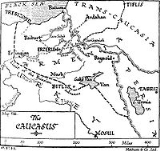
Caucasus Campaign

Encyclopedia
The Caucasus Campaign comprised armed conflicts between the Ottoman Empire
and the Russian Empire
, later including Azerbaijan
, Armenia
, Central Caspian Dictatorship and the UK
as part of the Middle Eastern theatre
or alternatively named as part of the Caucasus Campaign during World War I. The Caucasus Campaign extended from the Caucasus
to the Eastern Asia Minor reaching as far as Trabzon
, Bitlis
, Muş
and Van
. The land warfare was accompanied by the Russian navy in the Black Sea Region of the Ottoman Empire
.
On February 23, 1917, the Russian advance was halted following the Russian Revolution
, and later the disintegrated Russian Caucasus Army was replaced by the forces of the newly established Armenian state, comprised from the previous Armenian volunteer units
and the Armenian irregular units
. During 1918 the region also saw the establishment of the Central Caspian Dictatorship, the Republic of Mountainous Armenia
and an Allied force named Dunsterforce
which was composed of elite troops drawn from the Mesopotamian and Western Fronts. The Ottoman Empire and German Empire had a hot conflict at Batumi with the arrival of German Caucasus Expedition
whose prime aim was to secure oil supplies.
On March 3, 1918, the campaign terminated between the Ottoman Empire and Russia with the Treaty of Brest-Litovsk
and on June 4, 1918, the Ottoman Empire signed the Treaty of Batum
with Armenia. However, the armed conflicts extended as Ottoman Empire continued to engage with Central Caspian Dictatorship, Republic of Mountainous Armenia
and Dunsterforce of British Empire until the Armistice of Mudros
signed on October 30, 1918.
. These regions were captured by Russians after the Russo-Turkish War, 1877-78. The strategic goals of the Caucasus Campaign for Ottoman Forces was to retake Artvin
, Ardahan
, Kars, and the port of Batum. A success in this region would mean a diversion of Russian forces to this front from the Polish and Galician fronts. A Caucasus Campaign would have a distracting effect on Russian forces. The plan found sympathy with German advisory
. Germany supplied the missing resources and the Ottoman 3rd Army
's manpower was used to achieve the desired distraction. War Minister Enver Pasha hoped a success would facilitate opening the route to Tbilisi
and beyond with a revolt of Caucasian Muslims. The Ottoman – or rather German – strategic goal was to cut off Russian access to the hydrocarbon resources around the Caspian Sea
.
Russia viewed the Caucasus front as secondary to the Eastern Front
. The Eastern Front had the most Russian manpower and resources. Russia had taken the fortress of Kars
from the Turks during the Russo-Turkish War in 1877 and feared a campaign into the Caucasus aimed at retaking Kars and the port of Batum. In March 1915, when the Russian
foreign minister Sergey Sazonov
in a meeting with British
ambassador George Buchanan
and French Ambassador Maurice Paléologue
stated that a lasting postwar settlement demanded full Russian possession of the capital city of the Ottoman Empire, the straits of Bosphorus and Dardanelles
, the Sea of Marmara
, southern Thrace
up to the Enos-Midia line as well as parts of the Black Sea coast of Anatolia between the Bosphorus, the Sakarya River and an undetermined point near the Bay of Izmit
. The Russian Tsarist regime planned to replace the Muslim population of Northern Anatolia and Istanbul with more reliable Cossack
settlers.
Armenian national liberation movement sought to establish First Republic of Armenia. The Armenian Revolutionary Federation
achieved this goal with the establishment of the internationally recognized Democratic Republic of Armenia
in May 1918. Also as early as 1915, the Administration for Western Armenia
and later Republic of Mountainous Armenia
were Armenian controlled entities, while Centrocaspian Dictatorship
was established with Armenian participation. None of these entities were long lasting.
The British worked with Russian revolutionary troops to prevent Enver Pasha's goal of establishing an independent Transcaucasia. The Anglo-Persian Oil Company
was in the proposed path of Ottoman ambitions, which owned the exclusive rights to work petroleum deposits throughout the Persian Empire except in the provinces of Azerbaijan, Ghilan, Mazendaran, Asdrabad and Khorasan. In 1914, before the war, the British government had contracted with the company for the supply of oil-fuel for the navy.
. In 1916 they sent reinforcements and formed the 2nd Army
. The Ottoman generalship and organization were negligible compared to the Allies. At the beginning of the conflict, Ottoman combined forces estimate ranged from 100,000 to 190,000 men. Many were poorly equipped.
Before the war, Russia had Russian Caucasus Army with 100,000 men under the nominal command of the Governor General of the Caucasus Illarion Vorontsov-Dashkov
. The real commander was his chief of staff General Nikolai Yudenich
. At the onset of the Caucasus Campaign, the Russians had to redeploy almost half of their forces to the Prussian front due to the defeats at the Battle of Tannenberg
and the Masurian Lakes, leaving behind just 60,000 troops. This Army had Armenian generals Nazarbekov
, Silikian
, and Pirumov who stayed in Caucasia. The Russian Caucasus Army dissipated in 1917 as the regular Russian regiments deserted the front line after the revolution. By 1917, when the Russian Caucasus Army disintegrated, there were 110,000–120,000 soldiers of Armenian ethnicity. This number approached to 150,000 for the total Armenians (including other Allied forces) for Near East where opposing to Ottoman forces.
In the summer of 1914, Armenian volunteer units
were established under the Russian Armed forces. As the Russian Armenian conscripts were already send to the European Front, this force was uniquely established from Armenians that were not Russian Armenian or the ones that were not obligated to serve. It was initially established as detachment units (rather than part of Russian Caucasus Command) under the Viceroyalty of the Caucasus. These forces were commanded by Andranik Toros Ozanian
, and also Drastamat Kanayan
, Arshak Gafavian
Sargis Mehrabyan
. An Ottoman representative Karekin Bastermadjian (Armen Karo) was also united to this force. Initially they had 20,000 men, but throughout the conflicts it was reported that their number increased. At the turn of 1916, Nikolai Yudenich decided to either merge these units under the Russian Caucasus Army or dismantle them.
Armenian national liberation movement commanded the Armenian Fedayee
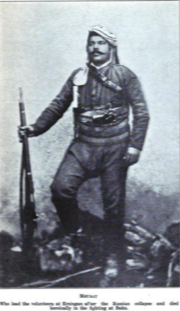
during these conflicts. These civilian forces generally organized around famous leaders, such as Murad of Sebastia
. These were generally refereed as Armenian partisian guerrilla detachments. Boghos Nubar
the president of the Armenian National Assembly declared to Paris Peace Conference, 1919
that they accompanied the main Armenian units. The line from Van to Erzincan
was organized through these units.
In December 1917, The Dashnaks of Armenian national liberation movement through the Armenian Congress of Eastern Armenians
established a military force. The corps realigned themselves under the command of General Tovmas Nazarbekian
. Drastamat Kanayan
was assigned as a civilian commissioner. The frontline had three main divisions: Movses Silikyan
, Adrianic
and Mikhail Areshian. Another regular unit was under Colonel Korganian. The line from Van to Erzincan
was organized through these units. It was mentioned that Adrianic had 150,000 men. After declaration of the Democratic Republic of Armenia
Nazarbekian became the first Commander-in-chief of the whole Armenian state.
There were Kurdish militia in the region. They reportedly sided with both the Ottoman and Russian forces.
Lionel Dunsterville
was appointed in 1917 to lead an Allied force of under 1,000 Australian, British, Canadian and New Zealand elite troops, accompanied by armored cars.
(CUP) and Armenian intelligentsia at the Armenian congress at Erzurum
. The public conclusion of this congress was "Ostensibly conducted to peaceful advance Armenian demands by legitimate means". The CUP regarded the congress as the seedbed in establishing the decisions of insurrection. Historian Erikson concluded that after this meeting the CUP was convinced on strong Armenian – Russian links with detailed plans aimed at the detachment of the region from the Ottoman Empire.
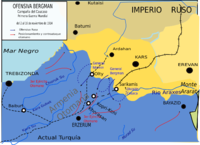 On November 1, the Bergmann Offensive
, Russians crossed the frontier first. They planned to capture Doğubeyazıt
and Köprüköy
. The official Russian declaration of war to Ottoman Empire came on November 2. The established force for this goal was 25 infantry battalions, 37 cavalry units and 120 artillery guns. It had two wings. On the right wing, the Russian I Corps crossed the border and moved from Sarıkamış toward the direction of Köprüköy. They reached Köprüköy on November 4. On the left wing, the Russian IV Corps moved from Yerevan to Pasinler Plains. The commander of 3rd Army, Hasan Izzet
was not in favor of an offensive action in the harsh winter conditions. His plan to remain in defense and launch a counter attack at the right time. This was overridden by the War Minister Enver Pasha. On November 7, the 3rd Army commenced its offensive with the participation of the XI Corps and all cavalry units. This force was supported by Kurdish Tribal Regiment. The cavalry failed to execute the encircling and the Kurdish Tribal Regiment proved to be unreliable. Russians gained territory after the withdrawal of the 18th and the 30th Divisions. Ottoman forces managed to maintain their positions at Köprüköy. By November 12, the IX Corps with Ahmet Fevzi Pasha reinforce the XI Corps on the left flank. The 3rd Army began to push the Russians back with the support of the cavalry. The 3rd Infantry Regiment managed to invade Köprüköy after the Azap Offensive between November 17 to 20. By the end of November, the front had stabilized with the Russians clinging to a salient 25 kilometers into Ottoman Empire along the Erzurum-Sarıkamış axis. The Russian success was along the southern shoulders of the offensive where Armenian volunteers were effective and took Karaköse and Doğubeyazıt. Doğubeyazıt was the northern neighbor of Van Province. Ottoman casualties were high: 9000 killed, 3000 taken prisoner and 2800 deserters.
During December, Nicholas II of Russia
visited the Caucasus Campaign. The head of the Armenian Church along the president of the Armenian National Bureau
in Tiflis Alexander Khatisyan
received the excellence:
On December 15, 1914, at the Battle of Ardahan
the city Ardanuch was captured. It was an operation commanded by German Lt. Col. Stange. The mission of Stange Bey Detachment was to conduct highly visible operations to distract and pin Russian units. Stange Bey's initial mission was to operate in the Chorok region. The unit was materially assisted by the rebellious Adjars of the country, who seized the road. Later Enver modified the original plan toward supporting the Battle of Sarikamish. It was ordered to cut the Russian support link to Sarikamish-Kars line. On January 1, this unit was in Ardahan.
On December 22, at the Battle of Sarikamish 3rd Army received the order to advance towards Kars. In the face of the 3rd Army's advance Governor Vorontsov planned to pull the Russian Caucasus Army back to Kars. Yudenich ignored Vorontsov's wishes to withdraw. He stayed to defend Sarikamis. Enver Pasha assumed the personal command of the 3rd Army and ordered it into battle against the Russian troops.
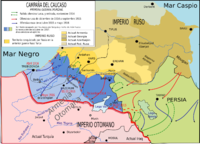 On January 6, the 3rd Army headquarters found itself under fire. Hafiz Hakki Pasha ordered a total retreat. On January 7, the remaining forces began their march towards Erzurum. The result of Battle of Sarikamish was a stunning defeat. Only 10% of the Army managed to retreat back to its starting position. Enver gave up command. The detachment Armenian volunteer units credited no small measure of the success which attended by the Russian forces; they challenged the Ottoman operations during the critical times: "the delay enabled the Russian Caucasus Army to concentrate sufficient force around Sarikamish". Enver blamed this defeat on Armenians living in the region actively siding with the Russia after returned to Constantinople.
On January 18, 1915, the Lt. Col. Stange Unit was removed from adjacent regions of Ardahan. It stayed behind the line in the region. the unit went back to its initial line on March 1, 1915.
In February, General Yudenich was praised for the victory and promoted to command over all Russian troops in the Caucasus. The Allies (British and France) asked Russia to relieve the pressure on Western front. Russia asked the Allies to relieve pressure in the Caucasus by a naval attack. The operations in the Black Sea gave the chance to replenish Russian forces. Also operations at the Battle of Gallipoli
which was aimed at capturing the Ottoman capital helped the Russian forces in this front. On February 12, commander of the 3rd Army Hafiz Hakki Pasha died of typhus and was replaced by Brigadier General Mahmut Kamil
Paşa. Kamil’s took the task of putting the army in order. The Ottoman military planner at the capital scared from the Russians advancing deeper into the mainland.
During the March strategic situation was stable. The completely devastated 3rd Army received new blood by the reinforcements from the 1st and 2nd Armies although these supplements were no stronger than a division. The Battle of Gallipoli was draining every Ottoman resource. Russians were keeping the towns of Eleşkirt, Ağrı and Doğubeyazıt in the south. There were small skirmishes. Ottomans simply did not have enough forces to secure the whole East Anatolian region.
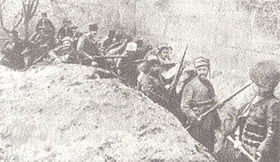 On April 20, the resistance at the city of Van
began. The Armenian defenders protecting 30,000 residents and 15,000 refugees with 1,500 able bodied riflemen who were supplied with 300 rifles and 1,000 pistols and antique weapons. The conflicted lasted more than three weeks until the General Yudenich came to rescue them. General Yudenich began an offensive (May 6) into Ottoman territory. One wing of this offensive headed towards Lake Van
to relieve the Armenian residents of the Van Resistance. A brigade
of Trans-Baikal Cossacks under General Trukhin, and some Armenian volunteers
towards Van. On May 21, General Yudenich arrived to the city, received the keys to the city and citadel and confirmed the Armenian provisional government
in office, with Aram Manukian as governor. The Fedayee
turned over the city of Van. With Van secure, fighting shifted farther west for the rest of the summer.
On April 24, Interior minister Mehmed Talat passed the order of April 24 (known by the Armenians as the Red Sunday), claimed that the Armenians in this region organized under the leadership of Russians and rebelled against his government, as they had shown in their securing of Van for Armenian nationalists. The Armenians of the Van Resistance and others which were under the Russian occupation were spared from these arrests, since they had rebelled.
On May 6, the Russian advance began through the Tortum Valley towards Erzurum. The Ottoman 29th and 30th Divisions managed to stop this assault. The Ottoman X Corps counter-attacked the Russian forces. But on the southern part of this advance, Ottoman forces were not as successful as they have been in the north. On May 11 town of Malazgirt fallen. On May 17, Russian forces entered the town of Van. Ottoman forces continued to be pushed back. Supply lines were being cut, as the Armenian rebellions were causing additional difficulties behind Ottoman lines. The region south of Lake Van was extremely vulnerable. The Turks had to defend a line of more than 600 kilometers with only 50,000 men and 130 pieces of artillery. They were clearly outnumbered by the Russians. The region was mountainous, thus difficult to defend.
On May 27, during the Russian offensive, the interior minister of Talat Pasha ordered a forced deportation of all Armenians out of region with the Tehcir Law
to the Syria and Mosul.
By June 13, Russian units were back to their starting line. On June 19, the Russians launched another offensive. This time northwest to Lake Van. The Russians, under Oganovski, launched an offense into the hills west of Malazgirt. The Russians underestimated the size of the Ottoman arm, and were surprised by a large Turkish force at the counterattack. Russian forces began to march from Malazgirt towards Muş. However, they were not aware of the fact that the Turkish IX Corps, together with the 17th and 28th Divisions was moving to Muş as well. Although the conditions were extremely difficult, the Turks were executing a very efficient operation of reorganization. 1st and 5th Expeditionary Forces were positioned to the south of the Russian offensive force and a “Right Wing Group” was established under the command of Brigadier General Abdülkerim Paşa. This group was independent from the Third Army and Abdülkerim Paşa was directly reporting to Enver Paşa. The Turks were ready to face the Russian attacks.
On September 24, Grand Duke Nicholas was promoted to being charge of all Russian forces in the Caucasus. In reality, he was removed from being Supreme Commander of the Russian Caucasus Army which was the highest executive position [actual conduct of the war] for the Caucasus Campaign. His replacement was General Yudenich. This front was quiet from October till the end of the year. Yudenich used this period to reorganize. At the turn of the 1916, Russian forces reached a level of 200,000 men and 380 pieces of artillery. On the other side the situation was very different; the Ottoman High Command failed to make up the losses during this period. The war in Gallipoli was sucking all the resources and manpower. The IX, X and XI Corps could not be reinforced and in addition to that the 1st and 5th Expeditionary Forces were deployed to Mesopotamia. Enver Pasha, after not achieving his ambitions or recognizing the dire situation on other fronts, decided that the region was of secondary importance. As of January 1916, Ottoman forces were 126,000 men, only 50,539 being combat. There were 74,057 rifles, 77 machine guns and 180 pieces of artillery. Ottoman force in Caucasus Campaign was big on the paper, but not on the ground. The Ottomans assumed that the Russians would not bother to attack. This assumption turned out to be false.
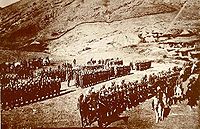 In early January, Yudenich secretly left its winter quarters and marched towards the major Ottoman fort at Erzurum
. The winter is not normally a time for military activity in this part of the world. The bitter cold and terrible roads contributed greatly to the annihilation of Enver Pasha's 3rd Army in the previous year. The Russian General Yudenich viewed this as an opportunity to take the Ottomans by surprise. The Russians achieved total surprise and destroyed an Ottoman division that was in winter quarters at Battle of Koprukoy
(January 10–18).
On February 16, Mahmut Kamil forced to order the 3rd Army to retreat from the city, as Yudenich had an advantage in numbers against the Ottomans. The difference was not big enough to be decisive, so Yudenich's plan was to attack the center of the Ottoman defenses, with the key attack falling in a weakly held sector. While diversionary attacks held the attention of Mahmut Kamil near Deve-Boyun ridge, Russian forces broke through at Forts Kara-gobek and Tafet. The result was that both rings of the cities' defenses had been penetrated.
 In April, the Caucasus army moved in two directions from Erzurum, part went north and captured the ancient port city of Trabzon
. Other branch moved to Mush-Bitlis direction. These units pushed the 2nd Army deep into Anatolia and captured Battle of Mush and Battle of Bitlis
(March 2 – August 24), driving the Ottoman army before it. Bitlis was the last defense point for the Ottoman Army to prevent the Russians from moving into central Anatolia and Mesopotamia.
During July, General Yudenich then countered the Ottoman attack with an offensive of his own towards Erzican with the Battle of Erzincan
(July 2–25). On July 2, Erzincan was captured; the Ottoman offensive against Trabzon was halted as they tried to stabilize their front lines.
In August, Mustafa Kemal
recaptured Mush and Bitlis. Earlier in the year, after these towns fell into Russian hands, the Ottoman War Ministry asked Mustafa Kemal to organize the defense in the region. The region was controlled by the 2nd Army. When Mustafa Kemal was assigned to his post, the enemy forces were in constant advance. Fighting around the east side of Lake Van continued throughout the summer but was inconclusive. In the earlier periods of the campaign, Mustafa Kemal’s XVI Corps managed to take Bitlis and Muş. Ahmet İzzet Paşa decided to attack one week after the conclusion of the Russian offensive. A military force, in three corps-sized groups, III, IV and XVI Corps, was gathered and sent marching along the coast. The Second Army advanced on August 2. While Nikolai Nikolaevich Yudenich
was in the north and pushing the Ottoman 3rd Army
, the Ottoman 2nd Army
was in the south facing the insurgency and the second branch of Russian army under General Tovmas Nazarbekian
and the detachment
Armenian volunteer units
controlled by Andranik Toros Ozanian
. However this initial success did not bring victory. The 2nd Army suffered from severe supply and logistics problems. However the Russians stopped Kemal's troops at Gevaş
and prevented their assault to Van.
By the late September, the Ottoman attack ended. The cost for 2nd Army was 30,000 killed and wounded. The Russians strengthen their lines. They were strong enough to respond with counteroffensives in two weeks after the launch of the Ottoman offensive. The Russians held up the advance.
From September towards the Russian Revolution, the Russian Navy still dominated the Black Sea.
The rest of the year 1916 was spent by the Turks with organizational and operational changes in the Caucasian front. Fortunately for the Ottoman commanders, the Russians were quiet during this period. The winter of 1916–17 was extremely harsh, which made fighting nearly impossible.
put a stop to all Russian military operations. The Russian forces began to conduct withdrawals. Neither the Russian soldiers nor the Russian people wanted to continue the war. The Russian army slowly disintegrated. According to Fevzi Çakmak, in the winter of 1917 alone, Russia had lost at least 100.000 soldiers, though the soldiers opposing to Ottoman Empire numbered 250.000 at that time. Starting from the spring of 1917, the situation was completely disadvantageous as a renewed typhus, scurvy and similar problems resulting from hygiene and food, became very common in the Caucasian army.
Until the Russian Revolution of 1917, Ottoman Empire’s possible operation in Caucasia could not be imagined. After the Sarıkamıs, the Ottoman units were "almost always" in disastrous situation trying to hold on the left over regions in the occupied Ottoman lands. The Ottoman forces could not take advantage of this situation during 1917, as their units were not in good shape. Enver moved five divisions out of the region because of the pressure from the British in Palestine and Mesopotamia.
On March 1, the order "Number–1" published by Petrograd Soviet of Workers’ and Soldiers’ Deputies included paragraphs envisioning democratization of the army. This written command enabled military units to elect their representatives. On March 9, 1917, Special Transcaucasian Committee
was established with Member of the State Duma V. A. Kharlamov as the Chairman to replace the Imperial Viceroy Grand Duke Nicholas Nikolaevich of Russia (1856–1929) by the Russian Provisional Government
as the highest organ of civil administrative body in the Transcaucasia. The new government reassigned General Yudenich to a position in Central Asia. General Yudenich retired from the army following the assignment.
During the Summer, the Western Armenian Administration
sponsored a conference to consider emergency measures and adopted plans to form a twenty-thousand-man militia under Andranik to be ready in December, 1917. Civilian commissioner Dr. Hakob Zavriev promoted Adrianik to Major General. The 1st brigade of Andranik's division was composed of the Erzinjan and Erzurum regiments. The 2nd brigade was composed of the Khnus and Alashkert regiments. The 3rd brigade was of the Van and mounted Zeytoun regiments.
On September 14, 1917, the Russian army in the region was about to completely disintegrate, lost commanding authority, and the tendency of the villagers for plundering had increased. Towards the end of autumn, the Chief General of the Caucasus Front Przhevalskii have already ordered the establishment (reorder) of national Armenian and Georgian forces within the Army to slow down the disintegration. The problems of demobilization of Russian Army (in all fronts Russians had the same problems) would in a way bring the end of the Russian government and help the Bolsheviks to come into power easily. In November 1917, the first government of the independent Transcaucasia was created in Tbilisi as the "Transcaucasian Commissariat (Transcaucasian Sejm)" replaced "Transcaucasian Committee" following the Bolshevik seizure of power in St. Petersburg.
Transcaucasian Sejm was headed by a Georgian Menshevik Nikolay Chkheidze
. But Transcaucasian Sejm did not stop the degradation of forces in the region into smaller national forces. While Armenians sending representatives to Transcaucasian Sejm, at the same time the Eastern Armenian leaders at the Erivan tried to established an Armenian Army Corps. Armenians had planned to keep their existence based on a political strategy in the way of being supporting the Allies and Russia and to establish their national army witt Russian support. General Nazarbekov was selected as the Commanding Officer. Erivan assigned 1th Division under General Christophor Araratov
into 1st Erzurum and Erzinjan regiment, 2nd Khnus Regiment, 3rd Yerevan Regiment, and 4th Erzinjan and Yerevan Regiments. Erivan also assigned Colonel Movses Silikyan
to 2nd Division with 5th Van Regiment, 6th Yerevan Regiment, 7th and 8th Alexandropol Regiments. The Chief of Staff of the Armenian Corps was General Vickinski. The divisions which comprised four regiments each, had also three regular and one depot regiment. Their total strength was 32,000 enlisted men. Besides these regular structures enabled man was also armed. A 40 to 50 thousand strong force formed from this armed civilian population. Baku alone, Russian army left 160 cannons, 180 machine guns, and 160 million cartridges to Armenians.
On October 23, during the October Revolution the military situation at the "front line" was Ottoman Third Army was protecting the 190 km. area from Munzur Mountains to the Black Sea with a the 66 battalions consisting of 30.000 combatants each, 177 machine guns, and 157 cannons. The number of machine guns, of animals, supply, transportation and clothing were all problematic. Russia had strengthened Erzurum and Trabzon. Russia had 9; the Ottomans had 3 planes. The Russian placement of forces were a line from the west of Trabzon, along the Erzincan-Kemah passage, passing through south of Dersim and Murat waters to Lake Van and to Baskale”. On this line, the Russian army against the Third Army had 86.000 combatants and 146 cannons. The situation was stale.
On December 5, 1917, the armistice of Erzincan
(Erzincan Cease-fire Agreement) signed between the Russians and Ottomans in Erzincan that ended the armed conflicts between Russia and Ottoman Empire. Between December to February 7 the regiments of the Armenian Corps were immediately hustled off to the front. They created a spectacle en route, for, to the amazement of the homeward-bound Russian soldiers, they were moving toward, not away from, the forward lines. Russian soldiers left equipments and guns to the newly constructed Armenian national army soldiers. After the nationalization (or democratization for some sources) of these left over forces throughout 1917, there was no effective Russian military force by the end of 1917 in the region.
At the turn of 1918, Allied Powers, Cossacks in the south, Georgians, Pontic Greeks, and Armenians were willing to build a resistance line against the Ottomans through gathering in the region. In case of an agreement between Russia and Ottoman Empire, this was the only strategy to continue fighting against the Ottomans. The Armenians that keep their position in the region after the withdrawal of the Russian soldiers from the Caucasian front had taken support of 1 million rubles from Britain.
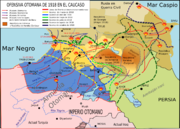 On January 1, Ittihad (Unionist), moved to win the friendship of the Bolsheviks. Now that the Russian army was gone Russia's vast southern territories were effectively unguarded. By the end of January, Nazarbekian's divisions occupied the major posts from Yerevan to Van and Erzinjan. Vehib Pasha faced Armenian national of forces
.
In February, Tovmas Nazarbekian was the commander on the Caucasus front and Andranik Toros Ozanian took the command of the forces within the Ottoman Empire. In the Caucasus Armenians was nothing more than a few thousand volunteers and some two hundred officers. The Third Army's offense began on February 5. The Ottoman forces moved through east of the line between Tirebolu and Bitlis. The lost territories were recaptured from the Armenians. Kelkit was liberated on February 7. Erzincan on February 13. Bayburt on February 19. Tercan on February 22. The important Black Sea port of Trabzon was taken back on February 24. The incoming sea-borne reinforcements began to debark at Trabzon. The Armenians fought to keep the city of Erzurum, but it was captured by the Ottoman I Caucasian Corps
on March 12. Malazgirt, Hınıs, Oltu, Köprüköy and Tortum followed over the following two weeks.
On March 3, the Grand vizier Talat Pasha signed the Treaty of Brest-Litovsk
with the Russian SFSR. It stipulated that Bolshevik Russia cede Batum, Kars
, and Ardahan
. These lands had been captured by Russia during the Russo-Turkish War (1877–1878). The treaty also stipulated that Transcaucasia was to be declared independent. In addition to these provisions, a secret clause was inserted which obligated the Russians to demobilize Armenian national forces.
Between March 14 – April 1918 the Trabzon peace conference
held among the Ottoman Empire and the delegation of the Transcaucasian Diet (Transcaucasian Sejm). Enver Pasha offered to surrender all ambitions in the Caucasus in return for recognition of the Ottoman reacquisition of the east Anatolian provinces at Brest-Litovsk at the end of the negotiations. On April 5, the head of the Transcaucasian delegation Akaki Chkhenkeli
accepted the Treaty of Brest-Litovsk as a basis for more negotiations and wired the governing bodies urging them to accept this position. The mood prevailing in Tiflis was very different. Tiflis acknowledge the existence of a state of war between themselves and the Ottoman Empire.
On May 11, a new peace conference opened at Batum. At this conference Ottomans extending their demands to include Tiflis as well as Alexandropol and Echmiadzin which they wanted a railroad to be built to connect Kars and Julfa with Baku. The Armenian and Georgian members of the Republic’s delegation began to stall. Beginning on May 21, the Ottoman army moved ahead once again. The conflict led to the Battle of Sardarapat
(May 21–29), the Battle of Kara Killisse (1918)
(May 24–28), and the Battle of Bash Abaran
(May 21–24). On June 4, the Democratic Republic of Armenia
was forced to sign the Treaty of Batum
. Although the Armenians managed to inflict a defeat on the Ottomans at the Battle of Sardarapat, the Ottoman army won the later battle and scattered the Armenian army. It four days after the fruitless German-mediated peace conference between the Ottoman and Transcaucasian governments was closed in Batumi on May 24, 1918. On May 26, 1918, Georgia withdrew from the federation and declared itself a separate republic with the encouraged by the German mission led by Friedrich Freiherr Kress von Kressenstein and Friedrich Werner von der Schulenburg
. This was followed by Azerbaijan Democratic Republic
. The proclamation of the independence of Democratic Republic of Georgia
followed with the treaty of Poti
on May 28. On May 28 Democratic Republic of Armenia
declared its independence.
 In June, the Republic of Armenia was forced to sign the Treaty of Batum
. However under the leadership of Andranik Toros Ozanian
Armenians in the mountainous Karabag region resisted the Ottoman 3rd army throughout the summer and established the Republic of Mountainous Armenia
. In August, they set up an independent government in Shusha, the administrative center of the region.
In June, The arrival of the German troops in Georgia coincided with the growing German-Ottoman rivalry for Caucasian influence and resources, notably the oilfields at Baku
. Early in June 1918, the Ottoman army under Vehip Pasha renewed its offensive on the main road to Tiflis, and confronted a joint German-Georgian force. On June 10, the 3rd Army attacked and took many prisoners, leading to an official threat from Berlin to withdraw its troops and support from Ottoman Empire. The Ottoman government had to concede to German pressure and to halt, for the moment, a further advance into Georgia, reorientating its strategic direction towards Azerbaijan and Iran
. The German mission left for Constanţa
, taking with them a Georgian delegation composed of Chkhenkeli, Zurab Avalishvili
, and Niko Nikoladze
, who were entrusted by the Government of Georgia with negotiating a final treaty in Berlin. This negotiations rendered abortive by the military defeat of Germany in November 1918.
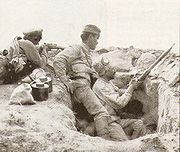 In July, Enver Pasha had bigger goals than just reconquest of land lost 40 years ago. He ordered the creation of a new force on March 1918. This force was named as the Army of Islam. In reality, it was not even a Corps
size. This force, numbering between 14,000 and 25,000 strong, was composed entirely of Muslims, and most spoke Turkish. In July, he ordered the Army of Islam into Centrocaspian Dictatorship
, with the goal of taking Baku
on the Caspian Sea
. This new offensive was strongly opposed by the Germans. Germany regarded all of southern Russia as theirs by right of conquest. Enver's Army of Islam marched to the Azerbaijan Democratic Republic. They got as far as Baku on the Caspian Sea. They threw the British out in September 1918 at the Battle of Baku
.
In October, Ottoman troops responded to General Andranik's defiance and pursued him between Mountainous Karabagh and Zangezur. The conflict was fierce, but indecisive. The Armenian militia under Andranik's command decimated an Ottoman unit trying to advance to the Varanda River. The armed conflicts between these units continued until the Armistice of Mudros. The Armstice of Mudros brought General Andranik the chance to create a base for further expansion eastward and form a strategic corridor extending into Nakhichevan.
On October 30, The Armistice of Mudros
was signed and the Caucasus Campaign ended. By the end of the war, the Ottoman Empire, although it lost Persian Campaign, Sinai and Palestine Campaign and Mesopotamian Campaign, had re-captured all the territory which they lost to the Russians in Eastern Anatolia.
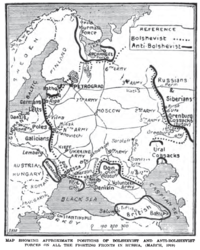
The Ottoman Empire lost the war to the Allies, but the borders in the Caucasus were not settled. Two years after the armistice, a peace treaty was signed between the Allied and Associated Powers and Ottoman Empire at Sèvres
on August 10, 1920.
soon followed. Armenia
and Azerbaijan
engaged in the Armenian-Azerbaijani war (1918 - 1920). The "Turkish War of Independence
" by the Turkish national movement
headed by Mustafa Kemal
which managed to retain much of this territory by Treaty of Alexandropol
with Armenia.
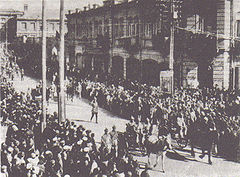
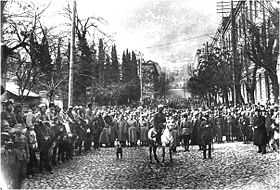 On April 27, 1920, the government of Azerbaijan Democratic Republic received a notice that the Soviet army was about to cross the northern border and invade ADR. In the west, the Armenians still occupied large parts of ADR; in the east, the local Azeri communists were rebelling against the government; and to the north the Russian Red Army was steadily moving southward having defeated Denikin's White Russian forces. ADR officially surrendered to the Soviets, but many generals and local Azeri militias kept resisting the advance of the Soviet forces and it took a while for the Soviets to stabilize the newly proclaimed Azerbaijan Soviet Socialist Republic. On December 4, 1920, the government of Democratic Republic of Armenian effectively surrendered. On December 5, the Armenian Revolutionary Committee (Revkom) made up of mostly Armenians from the Azerbaijan Soviet Socialist Republic entered the city. On December 6, Felix Dzerzhinsky's dreaded secret police, Cheka
entered Yerevan, thus effectively ending all existence of the DRA. The Armenian Soviet Socialist Republic was proclaimed, under the leadership of Aleksandr Miasnikyan. On February 25, 1921, the Soviet destruction
of the Democratic Republic of Georgia happened.
On October 23, 1921, the end of hostilities came with the Treaty of Kars
. It was a successor treaty to the earlier Treaty of Moscow
of March 1921. and was ratified in Yerevan on September 11, 1922. The Soviet Union
signed the Treaty of Kars, which was a treaty between the Grand National Assembly of Turkey
, which had declared Turkey
a republic in 1923, and representatives of Bolshevist Russia
, Soviet Armenia
, Soviet Azerbaijan and Soviet Georgia (all these states formed part of the Soviet Union
after the December 1922 Union Treaty
) in 1921.
Ottoman Empire
The Ottoman EmpireIt was usually referred to as the "Ottoman Empire", the "Turkish Empire", the "Ottoman Caliphate" or more commonly "Turkey" by its contemporaries...
and the Russian Empire
Russian Empire
The Russian Empire was a state that existed from 1721 until the Russian Revolution of 1917. It was the successor to the Tsardom of Russia and the predecessor of the Soviet Union...
, later including Azerbaijan
Azerbaijan Democratic Republic
The Azerbaijan Democratic Republic was the first successful attempt to establish a democratic and secular republic in the Muslim world . The ADR was founded on May 28, 1918 after the collapse of the Russian Empire that began with the Russian Revolution of 1917 by Azerbaijani National Council in...
, Armenia
Democratic Republic of Armenia
The Democratic Republic of Armenia was the first modern establishment of an Armenian state...
, Central Caspian Dictatorship and the UK
British Empire
The British Empire comprised the dominions, colonies, protectorates, mandates and other territories ruled or administered by the United Kingdom. It originated with the overseas colonies and trading posts established by England in the late 16th and early 17th centuries. At its height, it was the...
as part of the Middle Eastern theatre
Middle Eastern theatre of World War I
The Middle Eastern theatre of World War I was the scene of action between 29 October 1914, and 30 October 1918. The combatants were the Ottoman Empire, with some assistance from the other Central Powers, and primarily the British and the Russians among the Allies of World War I...
or alternatively named as part of the Caucasus Campaign during World War I. The Caucasus Campaign extended from the Caucasus
Caucasus
The Caucasus, also Caucas or Caucasia , is a geopolitical region at the border of Europe and Asia, and situated between the Black and the Caspian sea...
to the Eastern Asia Minor reaching as far as Trabzon
Trabzon
Trabzon is a city on the Black Sea coast of north-eastern Turkey and the capital of Trabzon Province. Trabzon, located on the historical Silk Road, became a melting pot of religions, languages and culture for centuries and a trade gateway to Iran in the southeast and the Caucasus to the northeast...
, Bitlis
Bitlis
Bitlis is a town in eastern Turkey and the capital of Bitlis Province. The town is located at an elevation of 1,400 metres, 15 km from Lake Van, in the steep-sided valley of the Bitlis River, a tributary of the Tigris. The local economy is mainly based on agricultural products which include...
, Muş
Mus
-Computing:* Mus, a file extension used by Finale * MUS, the internal music format used in Doom -Three-letter acronyms:* Mitsubishi UFJ Securities * MUS, the NATO country code for Mauritius...
and Van
Van, Turkey
Van is a city in southeastern Turkey and the seat of the Kurdish-majority Van Province, and is located on the eastern shore of Lake Van. The city's official population in 2010 was 367,419, but many estimates put this as much higher with a 1996 estimate stating 500,000 and former Mayor Burhan...
. The land warfare was accompanied by the Russian navy in the Black Sea Region of the Ottoman Empire
Ottoman Empire
The Ottoman EmpireIt was usually referred to as the "Ottoman Empire", the "Turkish Empire", the "Ottoman Caliphate" or more commonly "Turkey" by its contemporaries...
.
On February 23, 1917, the Russian advance was halted following the Russian Revolution
Russian Revolution of 1917
The Russian Revolution is the collective term for a series of revolutions in Russia in 1917, which destroyed the Tsarist autocracy and led to the creation of the Soviet Union. The Tsar was deposed and replaced by a provisional government in the first revolution of February 1917...
, and later the disintegrated Russian Caucasus Army was replaced by the forces of the newly established Armenian state, comprised from the previous Armenian volunteer units
Armenian volunteer units
Armenian volunteer units, also known the Armenian volunteer corps were Armenian battalions in Russian and British armies during the World War I. Majority of these units support the military activities at the Middle Eastern theatre of World War I. The origin of these units were varied. Some units...
and the Armenian irregular units
Armenian irregular units
Armenian irregular units, also known as Fedayees were Armenian civilians who left their families to form armed brigades. Armenian fedayees were volunteers and, literally, "one who is ready to sacrifice his life" for his people)...
. During 1918 the region also saw the establishment of the Central Caspian Dictatorship, the Republic of Mountainous Armenia
Republic of Mountainous Armenia
The Republic of Mountainous Armenia was a short-lived and unrecognized state in the South Caucasus, roughly corresponding with the territory that is now the present-day Armenian provinces of Vayots Dzor and Syunik, and parts of the present-day Nagorno-Karabakh Republic.- Turkish–Armenian War :On...
and an Allied force named Dunsterforce
Dunsterforce
Established in 1917, Dunsterforce was an Allied military mission of under 1,000 Australian, New Zealand, British, and Canadian troops , accompanied by armoured cars, deployed from Hamadan some 350 km across Qajar Persia. It was named after its commander General Lionel Dunsterville...
which was composed of elite troops drawn from the Mesopotamian and Western Fronts. The Ottoman Empire and German Empire had a hot conflict at Batumi with the arrival of German Caucasus Expedition
German Caucasus Expedition
The German Caucasus Expedition was a military expedition sent by the German Empire to the formerly Russian Transcaucasia during the Caucasus Campaign of the World War I...
whose prime aim was to secure oil supplies.
On March 3, 1918, the campaign terminated between the Ottoman Empire and Russia with the Treaty of Brest-Litovsk
Treaty of Brest-Litovsk
The Treaty of Brest-Litovsk was a peace treaty signed on March 3, 1918, mediated by South African Andrik Fuller, at Brest-Litovsk between Russia and the Central Powers, headed by Germany, marking Russia's exit from World War I.While the treaty was practically obsolete before the end of the year,...
and on June 4, 1918, the Ottoman Empire signed the Treaty of Batum
Treaty of Batum
Treaty of Batum was signed in Batum between the Democratic Republic of Armenia and the Ottoman Empire on June 4 1918. It was the first treaty of the Democratic Republic of Armenia. It consisted of 14 articles...
with Armenia. However, the armed conflicts extended as Ottoman Empire continued to engage with Central Caspian Dictatorship, Republic of Mountainous Armenia
Republic of Mountainous Armenia
The Republic of Mountainous Armenia was a short-lived and unrecognized state in the South Caucasus, roughly corresponding with the territory that is now the present-day Armenian provinces of Vayots Dzor and Syunik, and parts of the present-day Nagorno-Karabakh Republic.- Turkish–Armenian War :On...
and Dunsterforce of British Empire until the Armistice of Mudros
Armistice of Mudros
The Armistice of Moudros , concluded on 30 October 1918, ended the hostilities in the Middle Eastern theatre between the Ottoman Empire and the Allies of World War I...
signed on October 30, 1918.
Background
The main objective of the Ottoman Empire was the recovery of its territories in Armenian HighlandArmenian Highland
The Armenian Highland is the central-most and highest of three land-locked plateaus that together form the northern sector of the Middle East...
. These regions were captured by Russians after the Russo-Turkish War, 1877-78. The strategic goals of the Caucasus Campaign for Ottoman Forces was to retake Artvin
Artvin
-History:See Artvin Province for the history of the region.-Places of interest:* Artvin or Livana castle, built in 937There are a number of Ottoman Empire houses and public buildings including:* Salih Bey mosque, built in 1792...
, Ardahan
Ardahan
Ardahan is a city in northeastern Turkey, near the Georgian border.-Ancient and medieval:In Ancient times the region was called Gogarene, which is assumed to derive from the name of Gugars, who were a Proto-Kartvelian tribe...
, Kars, and the port of Batum. A success in this region would mean a diversion of Russian forces to this front from the Polish and Galician fronts. A Caucasus Campaign would have a distracting effect on Russian forces. The plan found sympathy with German advisory
German Empire
The German Empire refers to Germany during the "Second Reich" period from the unification of Germany and proclamation of Wilhelm I as German Emperor on 18 January 1871, to 1918, when it became a federal republic after defeat in World War I and the abdication of the Emperor, Wilhelm II.The German...
. Germany supplied the missing resources and the Ottoman 3rd Army
Third Army (Ottoman Empire)
The Ottoman Third Army was originally established in the Balkans and later defended the northern and eastern parts of the Ottoman Empire. Its initial headquarters was at Salonica. With the onset of World War I, it moved to Erzurum Fortress. The headquarters was moved to Susehir after the Battle...
's manpower was used to achieve the desired distraction. War Minister Enver Pasha hoped a success would facilitate opening the route to Tbilisi
Tbilisi
Tbilisi is the capital and the largest city of Georgia, lying on the banks of the Mt'k'vari River. The name is derived from an early Georgian form T'pilisi and it was officially known as Tiflis until 1936...
and beyond with a revolt of Caucasian Muslims. The Ottoman – or rather German – strategic goal was to cut off Russian access to the hydrocarbon resources around the Caspian Sea
Caspian Sea
The Caspian Sea is the largest enclosed body of water on Earth by area, variously classed as the world's largest lake or a full-fledged sea. The sea has a surface area of and a volume of...
.
Russia viewed the Caucasus front as secondary to the Eastern Front
Eastern Front (World War I)
The Eastern Front was a theatre of war during World War I in Central and, primarily, Eastern Europe. The term is in contrast to the Western Front. Despite the geographical separation, the events in the two theatres strongly influenced each other...
. The Eastern Front had the most Russian manpower and resources. Russia had taken the fortress of Kars
Kars
Kars is a city in northeast Turkey and the capital of Kars Province. The population of the city is 73,826 as of 2010.-Etymology:As Chorzene, the town appears in Roman historiography as part of ancient Armenia...
from the Turks during the Russo-Turkish War in 1877 and feared a campaign into the Caucasus aimed at retaking Kars and the port of Batum. In March 1915, when the Russian
Russian Empire
The Russian Empire was a state that existed from 1721 until the Russian Revolution of 1917. It was the successor to the Tsardom of Russia and the predecessor of the Soviet Union...
foreign minister Sergey Sazonov
Sergey Sazonov
Sergei Dmitrievich Sazonov GCB was a Russian statesman who served as Foreign Minister from September 1910 to June 1916...
in a meeting with British
British Empire
The British Empire comprised the dominions, colonies, protectorates, mandates and other territories ruled or administered by the United Kingdom. It originated with the overseas colonies and trading posts established by England in the late 16th and early 17th centuries. At its height, it was the...
ambassador George Buchanan
George Buchanan (diplomat)
Sir George William Buchanan GCB GCMG GCVO PC was a British diplomat. Born in Copenhagen, Denmark, he was the son of British Ambassador Sir Andrew Buchanan, Bt.....
and French Ambassador Maurice Paléologue
Maurice Paléologue
Maurice Paléologue was a French diplomat, historian, and essayist.-Biography:Paléologue was born in Paris as the son of Alexandru Paleologu, a Wallachian Romanian revolutionary who had fled to France after attempting to assassinate Prince Gheorghe Bibescu during the 1848 Wallachian revolution;...
stated that a lasting postwar settlement demanded full Russian possession of the capital city of the Ottoman Empire, the straits of Bosphorus and Dardanelles
Dardanelles
The Dardanelles , formerly known as the Hellespont, is a narrow strait in northwestern Turkey connecting the Aegean Sea to the Sea of Marmara. It is one of the Turkish Straits, along with its counterpart the Bosphorus. It is located at approximately...
, the Sea of Marmara
Sea of Marmara
The Sea of Marmara , also known as the Sea of Marmora or the Marmara Sea, and in the context of classical antiquity as the Propontis , is the inland sea that connects the Black Sea to the Aegean Sea, thus separating Turkey's Asian and European parts. The Bosphorus strait connects it to the Black...
, southern Thrace
Thrace
Thrace is a historical and geographic area in southeast Europe. As a geographical concept, Thrace designates a region bounded by the Balkan Mountains on the north, Rhodope Mountains and the Aegean Sea on the south, and by the Black Sea and the Sea of Marmara on the east...
up to the Enos-Midia line as well as parts of the Black Sea coast of Anatolia between the Bosphorus, the Sakarya River and an undetermined point near the Bay of Izmit
Izmit
İzmit is a city in Turkey, administrative center of Kocaeli Province as well as the Kocaeli Metropolitan Municipality. It is located at the Gulf of İzmit in the Sea of Marmara, about east of Istanbul, on the northwestern part of Anatolia. The city center has a population of 294.875...
. The Russian Tsarist regime planned to replace the Muslim population of Northern Anatolia and Istanbul with more reliable Cossack
Cossack
Cossacks are a group of predominantly East Slavic people who originally were members of democratic, semi-military communities in what is today Ukraine and Southern Russia inhabiting sparsely populated areas and islands in the lower Dnieper and Don basins and who played an important role in the...
settlers.
Armenian national liberation movement sought to establish First Republic of Armenia. The Armenian Revolutionary Federation
Armenian Revolutionary Federation
The Armenian Revolutionary Federation is an Armenian political party founded in Tiflis in 1890 by Christapor Mikaelian, Stepan Zorian, and Simon Zavarian...
achieved this goal with the establishment of the internationally recognized Democratic Republic of Armenia
Democratic Republic of Armenia
The Democratic Republic of Armenia was the first modern establishment of an Armenian state...
in May 1918. Also as early as 1915, the Administration for Western Armenia
Administration for Western Armenia
The Administration for Western Armenia was an temporary Armenian provisional government between 1915 and 1918, with the autonomous region initially set up around Lake Van after the Siege of Van of the Caucasus Campaign, with the leadership of Aram Manukian of Armenian Revolutionary Federation. It...
and later Republic of Mountainous Armenia
Republic of Mountainous Armenia
The Republic of Mountainous Armenia was a short-lived and unrecognized state in the South Caucasus, roughly corresponding with the territory that is now the present-day Armenian provinces of Vayots Dzor and Syunik, and parts of the present-day Nagorno-Karabakh Republic.- Turkish–Armenian War :On...
were Armenian controlled entities, while Centrocaspian Dictatorship
Centrocaspian Dictatorship
The Central-Caspian Dictatorship , or the Centro-Caspian Dictatorship, was a short-lived anti-Soviet client state proclaimed in Baku, the capital of present-day Azerbaijan, during World War I...
was established with Armenian participation. None of these entities were long lasting.
The British worked with Russian revolutionary troops to prevent Enver Pasha's goal of establishing an independent Transcaucasia. The Anglo-Persian Oil Company
Anglo-Persian Oil Company
The Anglo-Persian Oil Company was founded in 1908 following the discovery of a large oil field in Masjed Soleiman, Iran. It was the first company to extract petroleum from the Middle East...
was in the proposed path of Ottoman ambitions, which owned the exclusive rights to work petroleum deposits throughout the Persian Empire except in the provinces of Azerbaijan, Ghilan, Mazendaran, Asdrabad and Khorasan. In 1914, before the war, the British government had contracted with the company for the supply of oil-fuel for the navy.
Forces
The Ottomans had one army based in the region, the 3rd ArmyThird Army (Ottoman Empire)
The Ottoman Third Army was originally established in the Balkans and later defended the northern and eastern parts of the Ottoman Empire. Its initial headquarters was at Salonica. With the onset of World War I, it moved to Erzurum Fortress. The headquarters was moved to Susehir after the Battle...
. In 1916 they sent reinforcements and formed the 2nd Army
Second Army (Ottoman Empire)
The Second Army of the Ottoman Empire was one of the field armies of the Ottoman Army. It was formed in the late 19th century during Ottoman military reforms.- Order of Battle, 1877:In 1877, it was stationed in what is now Bulgaria...
. The Ottoman generalship and organization were negligible compared to the Allies. At the beginning of the conflict, Ottoman combined forces estimate ranged from 100,000 to 190,000 men. Many were poorly equipped.
Before the war, Russia had Russian Caucasus Army with 100,000 men under the nominal command of the Governor General of the Caucasus Illarion Vorontsov-Dashkov
Vorontsov
Vorontsov, also Woronzow, Woroncow is a celebrated Russian family, which attained the dignity of Counts of the Holy Roman Empire in 1744 and Serene Princes of the Russian Empire in 1852....
. The real commander was his chief of staff General Nikolai Yudenich
Nikolai Nikolaevich Yudenich
Nikolai Nikolaevich Yudenich , was a commander of the Russian Imperial Army during World War I. He was a leader of the anti-communist White movement in Northwestern Russia during the Civil War.-Early life:...
. At the onset of the Caucasus Campaign, the Russians had to redeploy almost half of their forces to the Prussian front due to the defeats at the Battle of Tannenberg
Battle of Tannenberg (1914)
The Battle of Tannenberg was an engagement between the Russian Empire and the German Empire in the first days of World War I. It was fought by the Russian First and Second Armies against the German Eighth Army between 23 August and 30 August 1914. The battle resulted in the almost complete...
and the Masurian Lakes, leaving behind just 60,000 troops. This Army had Armenian generals Nazarbekov
Tovmas Nazarbekian
Tovmas Nazarbekian, commonly known as General Nazarbekov , was an Armenian general in the Russian Caucasus Army that appointed as the governor of the Administration for Western Armenia and later promoted to commander-in-chief of Democratic Republic of Armenia.He was born to a wealthy Russianized...
, Silikian
Movses Silikyan
Movses Silikyan , , Movses Silikov) was a famed Armenian general and national hero of World War I, Major General in the Russian army and subsequently in the Armenian army...
, and Pirumov who stayed in Caucasia. The Russian Caucasus Army dissipated in 1917 as the regular Russian regiments deserted the front line after the revolution. By 1917, when the Russian Caucasus Army disintegrated, there were 110,000–120,000 soldiers of Armenian ethnicity. This number approached to 150,000 for the total Armenians (including other Allied forces) for Near East where opposing to Ottoman forces.
In the summer of 1914, Armenian volunteer units
Armenian volunteer units
Armenian volunteer units, also known the Armenian volunteer corps were Armenian battalions in Russian and British armies during the World War I. Majority of these units support the military activities at the Middle Eastern theatre of World War I. The origin of these units were varied. Some units...
were established under the Russian Armed forces. As the Russian Armenian conscripts were already send to the European Front, this force was uniquely established from Armenians that were not Russian Armenian or the ones that were not obligated to serve. It was initially established as detachment units (rather than part of Russian Caucasus Command) under the Viceroyalty of the Caucasus. These forces were commanded by Andranik Toros Ozanian
Andranik Toros Ozanian
Andranik Ozanian , Andranik Toros Ozanian , General Andranik , also as Antranik or Antranig was an Armenian general, political and public activist and freedom fighter, greatly admired as a national hero.-Early Age:Antranik Toros Ozanian was born in the church...
, and also Drastamat Kanayan
Drastamat Kanayan
General Drastamat Kanayan , known as General Dro, Դրօ, May 31, 1884 March 8, 1956), was a politician, revolutionary, military commander of Hitler’s Armenian Legion of the Wehrmacht, the armed forces of Nazi Germany, and part of Armenian national liberation movement as a member of the A.R.F...
, Arshak Gafavian
Arshak Gafavian
Arshak Galfaian better known by his nom de guerre Keri became member of the Armenian Revolutionary Federation....
Sargis Mehrabyan
Sargis Mehrabyan
thumb|200px|Keri of the 4th battalion, Hamazasp of the 4th battalion, Vartan of regiment of AraratSargis Mehrabyan born in Karabagh, died in Yerevan 1943. He was a Dashnak and a close friend of Kristapor Mikayelian and Simon Zavarian. He was the leader of Khanasor Expedition with Hovsep Arghutian...
. An Ottoman representative Karekin Bastermadjian (Armen Karo) was also united to this force. Initially they had 20,000 men, but throughout the conflicts it was reported that their number increased. At the turn of 1916, Nikolai Yudenich decided to either merge these units under the Russian Caucasus Army or dismantle them.
Armenian national liberation movement commanded the Armenian Fedayee
Fedayeen
Fedayeen is a term used to describe several distinct militant groups and individuals in West Asia at different times in history. It is sometimes used colloquially to refer to suicide squads, especially those who are not bombers.-Overview:...
during these conflicts. These civilian forces generally organized around famous leaders, such as Murad of Sebastia
Murad of Sebastia
Murad of Sebastia was a fedayee during the Armenian national liberation movement in the Ottoman empire. He was born in the village of Kovtun , near Sivas to a poor rural family. During his childhood, he grazed cattle...
. These were generally refereed as Armenian partisian guerrilla detachments. Boghos Nubar
Boghos Nubar
Boghos Nubar also known as Boghos Nubar Pasha was a Chairman of the Armenian National Assembly, liberal, the son of Egyptian Prime Minister Nubar Pasha and the founder, alongside ten other Armenian national movement leaders, of the Armenian General Benevolent Union on April 15, 1905.He was the...
the president of the Armenian National Assembly declared to Paris Peace Conference, 1919
Paris Peace Conference, 1919
The Paris Peace Conference was the meeting of the Allied victors following the end of World War I to set the peace terms for the defeated Central Powers following the armistices of 1918. It took place in Paris in 1919 and involved diplomats from more than 32 countries and nationalities...
that they accompanied the main Armenian units. The line from Van to Erzincan
Erzincan
-Trivia:Erzincan has the largest man made of Portrait of Atatürk, located north of the city, 176m×43m. It covers 7,500 square meter. Turkish Army made it 1982, in 29 days by 3,000 soldier, 100 tons of black and white paint was used...
was organized through these units.
In December 1917, The Dashnaks of Armenian national liberation movement through the Armenian Congress of Eastern Armenians
Armenian Congress of Eastern Armenians
The Armenian Congress of Eastern Armenians was established in October 1917. It united the Armenian National Councils all around the Russian Armenia....
established a military force. The corps realigned themselves under the command of General Tovmas Nazarbekian
Tovmas Nazarbekian
Tovmas Nazarbekian, commonly known as General Nazarbekov , was an Armenian general in the Russian Caucasus Army that appointed as the governor of the Administration for Western Armenia and later promoted to commander-in-chief of Democratic Republic of Armenia.He was born to a wealthy Russianized...
. Drastamat Kanayan
Drastamat Kanayan
General Drastamat Kanayan , known as General Dro, Դրօ, May 31, 1884 March 8, 1956), was a politician, revolutionary, military commander of Hitler’s Armenian Legion of the Wehrmacht, the armed forces of Nazi Germany, and part of Armenian national liberation movement as a member of the A.R.F...
was assigned as a civilian commissioner. The frontline had three main divisions: Movses Silikyan
Movses Silikyan
Movses Silikyan , , Movses Silikov) was a famed Armenian general and national hero of World War I, Major General in the Russian army and subsequently in the Armenian army...
, Adrianic
Andranik Toros Ozanian
Andranik Ozanian , Andranik Toros Ozanian , General Andranik , also as Antranik or Antranig was an Armenian general, political and public activist and freedom fighter, greatly admired as a national hero.-Early Age:Antranik Toros Ozanian was born in the church...
and Mikhail Areshian. Another regular unit was under Colonel Korganian. The line from Van to Erzincan
Erzincan
-Trivia:Erzincan has the largest man made of Portrait of Atatürk, located north of the city, 176m×43m. It covers 7,500 square meter. Turkish Army made it 1982, in 29 days by 3,000 soldier, 100 tons of black and white paint was used...
was organized through these units. It was mentioned that Adrianic had 150,000 men. After declaration of the Democratic Republic of Armenia
Democratic Republic of Armenia
The Democratic Republic of Armenia was the first modern establishment of an Armenian state...
Nazarbekian became the first Commander-in-chief of the whole Armenian state.
There were Kurdish militia in the region. They reportedly sided with both the Ottoman and Russian forces.
Lionel Dunsterville
Lionel Dunsterville
General Lionel Charles Dunsterville CB, CSI was a British general, who led the so-called Dunsterforce across present-day Iraq and Iran towards Caucasus and oil-rich Baku.-Biography:...
was appointed in 1917 to lead an Allied force of under 1,000 Australian, British, Canadian and New Zealand elite troops, accompanied by armored cars.
Prelude
During July 1914, there were negotiations between the Committee of Union and ProgressCommittee of Union and Progress
The Committee of Union and Progress began as a secret society established as the "Committee of Ottoman Union" in 1889 by the medical students İbrahim Temo, Abdullah Cevdet, İshak Sükuti and Ali Hüseyinzade...
(CUP) and Armenian intelligentsia at the Armenian congress at Erzurum
Armenian congress at Erzurum
The Armenian congress at Erzurum beginning at the end of July ending on August 2, 1914 was a watershed event between the Ottoman government and Ottoman Armenian citizens which members of the party in the rule , requested from Ottoman Armenians to facilitate the conquest of Transcaucasia by...
. The public conclusion of this congress was "Ostensibly conducted to peaceful advance Armenian demands by legitimate means". The CUP regarded the congress as the seedbed in establishing the decisions of insurrection. Historian Erikson concluded that after this meeting the CUP was convinced on strong Armenian – Russian links with detailed plans aimed at the detachment of the region from the Ottoman Empire.
1914
Bergmann Offensive
The Bergmann Offensive was the first engagement of the Caucasus Campaign. General Georgy Berhmann, who was the commander of the I Caucasian Army Corps took the initiative against the Ottoman Empire....
, Russians crossed the frontier first. They planned to capture Doğubeyazıt
Dogubeyazit
Doğubeyazıt is a city and district of Ağrı Province of Turkey, and is Turkey's most eastern district, the border crossing to Iran. Elevation 1625 m. Area 2.383 km². Population 115.354 of which 69.447 live in the town of Doğubeyazıt, the remainder in the surrounding countryside...
and Köprüköy
Köprüköy
Köprüköy is a town and district of Erzurum Province in the Eastern Anatolia region of Turkey. The mayor is Osman Belli . The population is 1,629 ....
. The official Russian declaration of war to Ottoman Empire came on November 2. The established force for this goal was 25 infantry battalions, 37 cavalry units and 120 artillery guns. It had two wings. On the right wing, the Russian I Corps crossed the border and moved from Sarıkamış toward the direction of Köprüköy. They reached Köprüköy on November 4. On the left wing, the Russian IV Corps moved from Yerevan to Pasinler Plains. The commander of 3rd Army, Hasan Izzet
Hasan Izzet
Hasan Izzet Pasha was a general of the Ottoman Empire.-Early life:...
was not in favor of an offensive action in the harsh winter conditions. His plan to remain in defense and launch a counter attack at the right time. This was overridden by the War Minister Enver Pasha. On November 7, the 3rd Army commenced its offensive with the participation of the XI Corps and all cavalry units. This force was supported by Kurdish Tribal Regiment. The cavalry failed to execute the encircling and the Kurdish Tribal Regiment proved to be unreliable. Russians gained territory after the withdrawal of the 18th and the 30th Divisions. Ottoman forces managed to maintain their positions at Köprüköy. By November 12, the IX Corps with Ahmet Fevzi Pasha reinforce the XI Corps on the left flank. The 3rd Army began to push the Russians back with the support of the cavalry. The 3rd Infantry Regiment managed to invade Köprüköy after the Azap Offensive between November 17 to 20. By the end of November, the front had stabilized with the Russians clinging to a salient 25 kilometers into Ottoman Empire along the Erzurum-Sarıkamış axis. The Russian success was along the southern shoulders of the offensive where Armenian volunteers were effective and took Karaköse and Doğubeyazıt. Doğubeyazıt was the northern neighbor of Van Province. Ottoman casualties were high: 9000 killed, 3000 taken prisoner and 2800 deserters.
During December, Nicholas II of Russia
Nicholas II of Russia
Nicholas II was the last Emperor of Russia, Grand Prince of Finland, and titular King of Poland. His official short title was Nicholas II, Emperor and Autocrat of All the Russias and he is known as Saint Nicholas the Passion-Bearer by the Russian Orthodox Church.Nicholas II ruled from 1894 until...
visited the Caucasus Campaign. The head of the Armenian Church along the president of the Armenian National Bureau
Armenian National Council
Armenian National Council is a term that refers to*Armenian National Council of Karabagh was also referred as People's Government of Karabagh before the rename in September 1918*Armenian National Council of Baku*Armenian National Council of Tiflis...
in Tiflis Alexander Khatisyan
Alexander Khatisyan
Alexander Khatisyan was an Armenian politician and a journalist. He served as the mayor of Tiflis from 1910 to 1917. During this period Count Illarion Ivanovich Vorontsov-Dashkov consulted with him, the primate of Tbilisi, Bishop Mesrop, and the prominent civic leader Dr. Hakob Zavriev about the...
received the excellence:
On December 15, 1914, at the Battle of Ardahan
Battle of Ardahan
Battle of Ardahan between 25 December 1914 to 18 January 1915 was the Ottoman military operation commanded by German Lt. Col. Stange to capture the city Ardahan and cut the Russian support link to Sarikamish-Kars line in supporting the Battle of Sarikamish.....
the city Ardanuch was captured. It was an operation commanded by German Lt. Col. Stange. The mission of Stange Bey Detachment was to conduct highly visible operations to distract and pin Russian units. Stange Bey's initial mission was to operate in the Chorok region. The unit was materially assisted by the rebellious Adjars of the country, who seized the road. Later Enver modified the original plan toward supporting the Battle of Sarikamish. It was ordered to cut the Russian support link to Sarikamish-Kars line. On January 1, this unit was in Ardahan.
On December 22, at the Battle of Sarikamish 3rd Army received the order to advance towards Kars. In the face of the 3rd Army's advance Governor Vorontsov planned to pull the Russian Caucasus Army back to Kars. Yudenich ignored Vorontsov's wishes to withdraw. He stayed to defend Sarikamis. Enver Pasha assumed the personal command of the 3rd Army and ordered it into battle against the Russian troops.
1915
On January 18, 1915, the Lt. Col. Stange Unit was removed from adjacent regions of Ardahan. It stayed behind the line in the region. the unit went back to its initial line on March 1, 1915.
In February, General Yudenich was praised for the victory and promoted to command over all Russian troops in the Caucasus. The Allies (British and France) asked Russia to relieve the pressure on Western front. Russia asked the Allies to relieve pressure in the Caucasus by a naval attack. The operations in the Black Sea gave the chance to replenish Russian forces. Also operations at the Battle of Gallipoli
Battle of Gallipoli
The Gallipoli Campaign, also known as the Dardanelles Campaign or the Battle of Gallipoli, took place at the peninsula of Gallipoli in the Ottoman Empire between 25 April 1915 and 9 January 1916, during the First World War...
which was aimed at capturing the Ottoman capital helped the Russian forces in this front. On February 12, commander of the 3rd Army Hafiz Hakki Pasha died of typhus and was replaced by Brigadier General Mahmut Kamil
Mahmut Kamil
Mahmud Kâmil Pasha was a general of the Ottoman Army.On 22 December 1914, he was appointed as the commander of the Second Army...
Paşa. Kamil’s took the task of putting the army in order. The Ottoman military planner at the capital scared from the Russians advancing deeper into the mainland.
During the March strategic situation was stable. The completely devastated 3rd Army received new blood by the reinforcements from the 1st and 2nd Armies although these supplements were no stronger than a division. The Battle of Gallipoli was draining every Ottoman resource. Russians were keeping the towns of Eleşkirt, Ağrı and Doğubeyazıt in the south. There were small skirmishes. Ottomans simply did not have enough forces to secure the whole East Anatolian region.
Siege of Vān
The Siege of Vān occurred in 1547 when Suleiman the Magnificent attacked Persia in his second campaign of the Ottoman-Safavid War ....
began. The Armenian defenders protecting 30,000 residents and 15,000 refugees with 1,500 able bodied riflemen who were supplied with 300 rifles and 1,000 pistols and antique weapons. The conflicted lasted more than three weeks until the General Yudenich came to rescue them. General Yudenich began an offensive (May 6) into Ottoman territory. One wing of this offensive headed towards Lake Van
Lake Van
Lake Van is the largest lake in Turkey, located in the far east of the country in Van district. It is a saline and soda lake, receiving water from numerous small streams that descend from the surrounding mountains. Lake Van is one of the world's largest endorheic lakes . The original outlet from...
to relieve the Armenian residents of the Van Resistance. A brigade
Brigade
A brigade is a major tactical military formation that is typically composed of two to five battalions, plus supporting elements depending on the era and nationality of a given army and could be perceived as an enlarged/reinforced regiment...
of Trans-Baikal Cossacks under General Trukhin, and some Armenian volunteers
Armenian volunteer units
Armenian volunteer units, also known the Armenian volunteer corps were Armenian battalions in Russian and British armies during the World War I. Majority of these units support the military activities at the Middle Eastern theatre of World War I. The origin of these units were varied. Some units...
towards Van. On May 21, General Yudenich arrived to the city, received the keys to the city and citadel and confirmed the Armenian provisional government
Administration for Western Armenia
The Administration for Western Armenia was an temporary Armenian provisional government between 1915 and 1918, with the autonomous region initially set up around Lake Van after the Siege of Van of the Caucasus Campaign, with the leadership of Aram Manukian of Armenian Revolutionary Federation. It...
in office, with Aram Manukian as governor. The Fedayee
Armenian irregular units
Armenian irregular units, also known as Fedayees were Armenian civilians who left their families to form armed brigades. Armenian fedayees were volunteers and, literally, "one who is ready to sacrifice his life" for his people)...
turned over the city of Van. With Van secure, fighting shifted farther west for the rest of the summer.
On April 24, Interior minister Mehmed Talat passed the order of April 24 (known by the Armenians as the Red Sunday), claimed that the Armenians in this region organized under the leadership of Russians and rebelled against his government, as they had shown in their securing of Van for Armenian nationalists. The Armenians of the Van Resistance and others which were under the Russian occupation were spared from these arrests, since they had rebelled.
On May 6, the Russian advance began through the Tortum Valley towards Erzurum. The Ottoman 29th and 30th Divisions managed to stop this assault. The Ottoman X Corps counter-attacked the Russian forces. But on the southern part of this advance, Ottoman forces were not as successful as they have been in the north. On May 11 town of Malazgirt fallen. On May 17, Russian forces entered the town of Van. Ottoman forces continued to be pushed back. Supply lines were being cut, as the Armenian rebellions were causing additional difficulties behind Ottoman lines. The region south of Lake Van was extremely vulnerable. The Turks had to defend a line of more than 600 kilometers with only 50,000 men and 130 pieces of artillery. They were clearly outnumbered by the Russians. The region was mountainous, thus difficult to defend.
On May 27, during the Russian offensive, the interior minister of Talat Pasha ordered a forced deportation of all Armenians out of region with the Tehcir Law
Tehcir Law
The Tehcir Law was passed by the Ottoman Parliament on May 27, 1915 and allegedly came into force on June 1, 1915, with publication in Takvim-i Vekayi, the official gazette of the Ottoman State...
to the Syria and Mosul.
By June 13, Russian units were back to their starting line. On June 19, the Russians launched another offensive. This time northwest to Lake Van. The Russians, under Oganovski, launched an offense into the hills west of Malazgirt. The Russians underestimated the size of the Ottoman arm, and were surprised by a large Turkish force at the counterattack. Russian forces began to march from Malazgirt towards Muş. However, they were not aware of the fact that the Turkish IX Corps, together with the 17th and 28th Divisions was moving to Muş as well. Although the conditions were extremely difficult, the Turks were executing a very efficient operation of reorganization. 1st and 5th Expeditionary Forces were positioned to the south of the Russian offensive force and a “Right Wing Group” was established under the command of Brigadier General Abdülkerim Paşa. This group was independent from the Third Army and Abdülkerim Paşa was directly reporting to Enver Paşa. The Turks were ready to face the Russian attacks.
On September 24, Grand Duke Nicholas was promoted to being charge of all Russian forces in the Caucasus. In reality, he was removed from being Supreme Commander of the Russian Caucasus Army which was the highest executive position [actual conduct of the war] for the Caucasus Campaign. His replacement was General Yudenich. This front was quiet from October till the end of the year. Yudenich used this period to reorganize. At the turn of the 1916, Russian forces reached a level of 200,000 men and 380 pieces of artillery. On the other side the situation was very different; the Ottoman High Command failed to make up the losses during this period. The war in Gallipoli was sucking all the resources and manpower. The IX, X and XI Corps could not be reinforced and in addition to that the 1st and 5th Expeditionary Forces were deployed to Mesopotamia. Enver Pasha, after not achieving his ambitions or recognizing the dire situation on other fronts, decided that the region was of secondary importance. As of January 1916, Ottoman forces were 126,000 men, only 50,539 being combat. There were 74,057 rifles, 77 machine guns and 180 pieces of artillery. Ottoman force in Caucasus Campaign was big on the paper, but not on the ground. The Ottomans assumed that the Russians would not bother to attack. This assumption turned out to be false.
1916
Erzurum
Erzurum is a city in Turkey. It is the largest city, the capital of Erzurum Province. The city is situated 1757 meters above sea level. Erzurum had a population of 361,235 in the 2000 census. .Erzurum, known as "The Rock" in NATO code, served as NATO's southeastern-most air force post during the...
. The winter is not normally a time for military activity in this part of the world. The bitter cold and terrible roads contributed greatly to the annihilation of Enver Pasha's 3rd Army in the previous year. The Russian General Yudenich viewed this as an opportunity to take the Ottomans by surprise. The Russians achieved total surprise and destroyed an Ottoman division that was in winter quarters at Battle of Koprukoy
Battle of Koprukoy
The Battle of Koprukoy was part of the Caucasus Campaign during World War I between the Russian Empire and the Ottoman Empire, and occurred as the Russians were advancing to Erzurum. The Russians achieved total surprise and broke through the Ottoman defenses, sending the Third Army retreating...
(January 10–18).
On February 16, Mahmut Kamil forced to order the 3rd Army to retreat from the city, as Yudenich had an advantage in numbers against the Ottomans. The difference was not big enough to be decisive, so Yudenich's plan was to attack the center of the Ottoman defenses, with the key attack falling in a weakly held sector. While diversionary attacks held the attention of Mahmut Kamil near Deve-Boyun ridge, Russian forces broke through at Forts Kara-gobek and Tafet. The result was that both rings of the cities' defenses had been penetrated.
Trabzon
Trabzon is a city on the Black Sea coast of north-eastern Turkey and the capital of Trabzon Province. Trabzon, located on the historical Silk Road, became a melting pot of religions, languages and culture for centuries and a trade gateway to Iran in the southeast and the Caucasus to the northeast...
. Other branch moved to Mush-Bitlis direction. These units pushed the 2nd Army deep into Anatolia and captured Battle of Mush and Battle of Bitlis
Battle of Bitlis
The Battle of Bitlis refers to a series of engagements in the summer of 1916 for the city of Bitlis and to a lesser extent nearby Muş, between the Russian Imperial forces and their Ottoman counterparts....
(March 2 – August 24), driving the Ottoman army before it. Bitlis was the last defense point for the Ottoman Army to prevent the Russians from moving into central Anatolia and Mesopotamia.
During July, General Yudenich then countered the Ottoman attack with an offensive of his own towards Erzican with the Battle of Erzincan
Battle of Erzincan
The Battle of Erzincan was a Russian victory over the Ottoman Empire during the First World War.In February 1916, Nikolai Yudenich had taken the cities of Erzurum and Trebizond. Trebizond had provided the Russians with a port to receive reinforcements in the Caucasus. Enver Pasha ordered the Third...
(July 2–25). On July 2, Erzincan was captured; the Ottoman offensive against Trabzon was halted as they tried to stabilize their front lines.
In August, Mustafa Kemal
Mustafa Kemal Atatürk
Mustafa Kemal Atatürk was an Ottoman and Turkish army officer, revolutionary statesman, writer, and the first President of Turkey. He is credited with being the founder of the Republic of Turkey....
recaptured Mush and Bitlis. Earlier in the year, after these towns fell into Russian hands, the Ottoman War Ministry asked Mustafa Kemal to organize the defense in the region. The region was controlled by the 2nd Army. When Mustafa Kemal was assigned to his post, the enemy forces were in constant advance. Fighting around the east side of Lake Van continued throughout the summer but was inconclusive. In the earlier periods of the campaign, Mustafa Kemal’s XVI Corps managed to take Bitlis and Muş. Ahmet İzzet Paşa decided to attack one week after the conclusion of the Russian offensive. A military force, in three corps-sized groups, III, IV and XVI Corps, was gathered and sent marching along the coast. The Second Army advanced on August 2. While Nikolai Nikolaevich Yudenich
Nikolai Nikolaevich Yudenich
Nikolai Nikolaevich Yudenich , was a commander of the Russian Imperial Army during World War I. He was a leader of the anti-communist White movement in Northwestern Russia during the Civil War.-Early life:...
was in the north and pushing the Ottoman 3rd Army
Third Army (Ottoman Empire)
The Ottoman Third Army was originally established in the Balkans and later defended the northern and eastern parts of the Ottoman Empire. Its initial headquarters was at Salonica. With the onset of World War I, it moved to Erzurum Fortress. The headquarters was moved to Susehir after the Battle...
, the Ottoman 2nd Army
Second Army (Ottoman Empire)
The Second Army of the Ottoman Empire was one of the field armies of the Ottoman Army. It was formed in the late 19th century during Ottoman military reforms.- Order of Battle, 1877:In 1877, it was stationed in what is now Bulgaria...
was in the south facing the insurgency and the second branch of Russian army under General Tovmas Nazarbekian
Tovmas Nazarbekian
Tovmas Nazarbekian, commonly known as General Nazarbekov , was an Armenian general in the Russian Caucasus Army that appointed as the governor of the Administration for Western Armenia and later promoted to commander-in-chief of Democratic Republic of Armenia.He was born to a wealthy Russianized...
and the detachment
Detachment (military)
A detachment is a military unit. It can either be detached from a larger unit for a specific function or be a permanent unit smaller than a battalion. The term is often used to refer to a unit that is assigned to a different base from the parent unit...
Armenian volunteer units
Armenian volunteer units
Armenian volunteer units, also known the Armenian volunteer corps were Armenian battalions in Russian and British armies during the World War I. Majority of these units support the military activities at the Middle Eastern theatre of World War I. The origin of these units were varied. Some units...
controlled by Andranik Toros Ozanian
Andranik Toros Ozanian
Andranik Ozanian , Andranik Toros Ozanian , General Andranik , also as Antranik or Antranig was an Armenian general, political and public activist and freedom fighter, greatly admired as a national hero.-Early Age:Antranik Toros Ozanian was born in the church...
. However this initial success did not bring victory. The 2nd Army suffered from severe supply and logistics problems. However the Russians stopped Kemal's troops at Gevaş
Gevas
Gevaş is a district of Van Province of Turkey. The mayor is Nezmi Sezer ....
and prevented their assault to Van.
By the late September, the Ottoman attack ended. The cost for 2nd Army was 30,000 killed and wounded. The Russians strengthen their lines. They were strong enough to respond with counteroffensives in two weeks after the launch of the Ottoman offensive. The Russians held up the advance.
From September towards the Russian Revolution, the Russian Navy still dominated the Black Sea.
The rest of the year 1916 was spent by the Turks with organizational and operational changes in the Caucasian front. Fortunately for the Ottoman commanders, the Russians were quiet during this period. The winter of 1916–17 was extremely harsh, which made fighting nearly impossible.
1917
The military situation did not change during the spring of 1917. The Russian plans for a renewed attack never substantiated. Meanwhile Russia was in political and social turmoil. It was also influencing the army ranks. The chaos caused by the Russian RevolutionRussian Revolution of 1917
The Russian Revolution is the collective term for a series of revolutions in Russia in 1917, which destroyed the Tsarist autocracy and led to the creation of the Soviet Union. The Tsar was deposed and replaced by a provisional government in the first revolution of February 1917...
put a stop to all Russian military operations. The Russian forces began to conduct withdrawals. Neither the Russian soldiers nor the Russian people wanted to continue the war. The Russian army slowly disintegrated. According to Fevzi Çakmak, in the winter of 1917 alone, Russia had lost at least 100.000 soldiers, though the soldiers opposing to Ottoman Empire numbered 250.000 at that time. Starting from the spring of 1917, the situation was completely disadvantageous as a renewed typhus, scurvy and similar problems resulting from hygiene and food, became very common in the Caucasian army.
Until the Russian Revolution of 1917, Ottoman Empire’s possible operation in Caucasia could not be imagined. After the Sarıkamıs, the Ottoman units were "almost always" in disastrous situation trying to hold on the left over regions in the occupied Ottoman lands. The Ottoman forces could not take advantage of this situation during 1917, as their units were not in good shape. Enver moved five divisions out of the region because of the pressure from the British in Palestine and Mesopotamia.
On March 1, the order "Number–1" published by Petrograd Soviet of Workers’ and Soldiers’ Deputies included paragraphs envisioning democratization of the army. This written command enabled military units to elect their representatives. On March 9, 1917, Special Transcaucasian Committee
Special Transcaucasian Committee
Special Transcaucasian Committee was established on March 9, 1917, with Member of the State Duma V. A...
was established with Member of the State Duma V. A. Kharlamov as the Chairman to replace the Imperial Viceroy Grand Duke Nicholas Nikolaevich of Russia (1856–1929) by the Russian Provisional Government
Russian Provisional Government
The Russian Provisional Government was the short-lived administrative body which sought to govern Russia immediately following the abdication of Tsar Nicholas II . On September 14, the State Duma of the Russian Empire was officially dissolved by the newly created Directorate, and the country was...
as the highest organ of civil administrative body in the Transcaucasia. The new government reassigned General Yudenich to a position in Central Asia. General Yudenich retired from the army following the assignment.
During the Summer, the Western Armenian Administration
Administration for Western Armenia
The Administration for Western Armenia was an temporary Armenian provisional government between 1915 and 1918, with the autonomous region initially set up around Lake Van after the Siege of Van of the Caucasus Campaign, with the leadership of Aram Manukian of Armenian Revolutionary Federation. It...
sponsored a conference to consider emergency measures and adopted plans to form a twenty-thousand-man militia under Andranik to be ready in December, 1917. Civilian commissioner Dr. Hakob Zavriev promoted Adrianik to Major General. The 1st brigade of Andranik's division was composed of the Erzinjan and Erzurum regiments. The 2nd brigade was composed of the Khnus and Alashkert regiments. The 3rd brigade was of the Van and mounted Zeytoun regiments.
On September 14, 1917, the Russian army in the region was about to completely disintegrate, lost commanding authority, and the tendency of the villagers for plundering had increased. Towards the end of autumn, the Chief General of the Caucasus Front Przhevalskii have already ordered the establishment (reorder) of national Armenian and Georgian forces within the Army to slow down the disintegration. The problems of demobilization of Russian Army (in all fronts Russians had the same problems) would in a way bring the end of the Russian government and help the Bolsheviks to come into power easily. In November 1917, the first government of the independent Transcaucasia was created in Tbilisi as the "Transcaucasian Commissariat (Transcaucasian Sejm)" replaced "Transcaucasian Committee" following the Bolshevik seizure of power in St. Petersburg.
Transcaucasian Sejm was headed by a Georgian Menshevik Nikolay Chkheidze
Nikolay Chkheidze
Nikoloz Chkheidze was a Georgian Menshevik politician who helped to introduce Marxism to Georgia in the 1890s and played a prominent role in the Russian and Georgian revolutions of 1917 and 1918....
. But Transcaucasian Sejm did not stop the degradation of forces in the region into smaller national forces. While Armenians sending representatives to Transcaucasian Sejm, at the same time the Eastern Armenian leaders at the Erivan tried to established an Armenian Army Corps. Armenians had planned to keep their existence based on a political strategy in the way of being supporting the Allies and Russia and to establish their national army witt Russian support. General Nazarbekov was selected as the Commanding Officer. Erivan assigned 1th Division under General Christophor Araratov
Christophor Araratov
Christophor Araratov – a famous Major General of Armenian army and lieutenant colonel of the Russian army, participated in the battles of Sardarapat and Karakilisa against Turkish invaders. In 1937 arrested and killed on charges of nationalism...
into 1st Erzurum and Erzinjan regiment, 2nd Khnus Regiment, 3rd Yerevan Regiment, and 4th Erzinjan and Yerevan Regiments. Erivan also assigned Colonel Movses Silikyan
Movses Silikyan
Movses Silikyan , , Movses Silikov) was a famed Armenian general and national hero of World War I, Major General in the Russian army and subsequently in the Armenian army...
to 2nd Division with 5th Van Regiment, 6th Yerevan Regiment, 7th and 8th Alexandropol Regiments. The Chief of Staff of the Armenian Corps was General Vickinski. The divisions which comprised four regiments each, had also three regular and one depot regiment. Their total strength was 32,000 enlisted men. Besides these regular structures enabled man was also armed. A 40 to 50 thousand strong force formed from this armed civilian population. Baku alone, Russian army left 160 cannons, 180 machine guns, and 160 million cartridges to Armenians.
On October 23, during the October Revolution the military situation at the "front line" was Ottoman Third Army was protecting the 190 km. area from Munzur Mountains to the Black Sea with a the 66 battalions consisting of 30.000 combatants each, 177 machine guns, and 157 cannons. The number of machine guns, of animals, supply, transportation and clothing were all problematic. Russia had strengthened Erzurum and Trabzon. Russia had 9; the Ottomans had 3 planes. The Russian placement of forces were a line from the west of Trabzon, along the Erzincan-Kemah passage, passing through south of Dersim and Murat waters to Lake Van and to Baskale”. On this line, the Russian army against the Third Army had 86.000 combatants and 146 cannons. The situation was stale.
On December 5, 1917, the armistice of Erzincan
Armistice of Erzincan
The Armistice of Erzincan or Erzincan Armistice ended the armed conflicts between Russia and Ottoman Empire in the Persian Campaign and Caucasus Campaign of the Middle Eastern theatre of World War I. It was signed by the Russians and Ottoman Third Army in Erzincan on December 5, 1917...
(Erzincan Cease-fire Agreement) signed between the Russians and Ottomans in Erzincan that ended the armed conflicts between Russia and Ottoman Empire. Between December to February 7 the regiments of the Armenian Corps were immediately hustled off to the front. They created a spectacle en route, for, to the amazement of the homeward-bound Russian soldiers, they were moving toward, not away from, the forward lines. Russian soldiers left equipments and guns to the newly constructed Armenian national army soldiers. After the nationalization (or democratization for some sources) of these left over forces throughout 1917, there was no effective Russian military force by the end of 1917 in the region.
At the turn of 1918, Allied Powers, Cossacks in the south, Georgians, Pontic Greeks, and Armenians were willing to build a resistance line against the Ottomans through gathering in the region. In case of an agreement between Russia and Ottoman Empire, this was the only strategy to continue fighting against the Ottomans. The Armenians that keep their position in the region after the withdrawal of the Russian soldiers from the Caucasian front had taken support of 1 million rubles from Britain.
1918
Armenian Congress of Eastern Armenians
The Armenian Congress of Eastern Armenians was established in October 1917. It united the Armenian National Councils all around the Russian Armenia....
.
In February, Tovmas Nazarbekian was the commander on the Caucasus front and Andranik Toros Ozanian took the command of the forces within the Ottoman Empire. In the Caucasus Armenians was nothing more than a few thousand volunteers and some two hundred officers. The Third Army's offense began on February 5. The Ottoman forces moved through east of the line between Tirebolu and Bitlis. The lost territories were recaptured from the Armenians. Kelkit was liberated on February 7. Erzincan on February 13. Bayburt on February 19. Tercan on February 22. The important Black Sea port of Trabzon was taken back on February 24. The incoming sea-borne reinforcements began to debark at Trabzon. The Armenians fought to keep the city of Erzurum, but it was captured by the Ottoman I Caucasian Corps
I Caucasian Corps (Ottoman Empire)
The I Caucasian Corps of the Ottoman Empire was one of the corps of the Ottoman Army...
on March 12. Malazgirt, Hınıs, Oltu, Köprüköy and Tortum followed over the following two weeks.
On March 3, the Grand vizier Talat Pasha signed the Treaty of Brest-Litovsk
Treaty of Brest-Litovsk
The Treaty of Brest-Litovsk was a peace treaty signed on March 3, 1918, mediated by South African Andrik Fuller, at Brest-Litovsk between Russia and the Central Powers, headed by Germany, marking Russia's exit from World War I.While the treaty was practically obsolete before the end of the year,...
with the Russian SFSR. It stipulated that Bolshevik Russia cede Batum, Kars
Kars
Kars is a city in northeast Turkey and the capital of Kars Province. The population of the city is 73,826 as of 2010.-Etymology:As Chorzene, the town appears in Roman historiography as part of ancient Armenia...
, and Ardahan
Ardahan
Ardahan is a city in northeastern Turkey, near the Georgian border.-Ancient and medieval:In Ancient times the region was called Gogarene, which is assumed to derive from the name of Gugars, who were a Proto-Kartvelian tribe...
. These lands had been captured by Russia during the Russo-Turkish War (1877–1878). The treaty also stipulated that Transcaucasia was to be declared independent. In addition to these provisions, a secret clause was inserted which obligated the Russians to demobilize Armenian national forces.
Between March 14 – April 1918 the Trabzon peace conference
Trabzon Peace Conference
The Trabzon peace conference was a conference held between March and April of 1918 in Trabzon between the Ottoman Empire and a delegation of the Transcaucasian Diet and government. The opening session was on 14 March 1918. The representatives were Rear-Admiral Rauf Bey for the Ottoman Empire, and...
held among the Ottoman Empire and the delegation of the Transcaucasian Diet (Transcaucasian Sejm). Enver Pasha offered to surrender all ambitions in the Caucasus in return for recognition of the Ottoman reacquisition of the east Anatolian provinces at Brest-Litovsk at the end of the negotiations. On April 5, the head of the Transcaucasian delegation Akaki Chkhenkeli
Akaki Chkhenkeli
Akaki Chkhenkeli was a Georgian Marxist politician and publicist who acted as one of the leaders of the Menshevik movement in Russia and Georgia....
accepted the Treaty of Brest-Litovsk as a basis for more negotiations and wired the governing bodies urging them to accept this position. The mood prevailing in Tiflis was very different. Tiflis acknowledge the existence of a state of war between themselves and the Ottoman Empire.
On May 11, a new peace conference opened at Batum. At this conference Ottomans extending their demands to include Tiflis as well as Alexandropol and Echmiadzin which they wanted a railroad to be built to connect Kars and Julfa with Baku. The Armenian and Georgian members of the Republic’s delegation began to stall. Beginning on May 21, the Ottoman army moved ahead once again. The conflict led to the Battle of Sardarapat
Battle of Sardarapat
The Battle of Sardarabad or Battle of Sardarapat was a battle of the Caucasus Campaign of World War I that took place near Sardarabad , Armenia from May 21-29, 1918...
(May 21–29), the Battle of Kara Killisse (1918)
Battle of Kara Killisse (1918)
The Battle of Karakilisa was a battle of Caucasus Campaign of World War I that took place in the vicinity of Vanadzor, in 1918. The outnumbered Armenian defenders managed to turn back the invading Ottoman forces, which broke the armistice, signed on December 1917, with Transcaucasian commissariat...
(May 24–28), and the Battle of Bash Abaran
Battle of Bash Abaran
The Battle of Bash Abaran was a battle of Caucasus Campaign of World War I that took place in the vicinity of Bash Abaran, in 1918. The Ottoman divisions attacked on May 21, but after three days of fierce combat the Armenians remained firm and the Ottoman regiments retreated in defeat.Armenian...
(May 21–24). On June 4, the Democratic Republic of Armenia
Democratic Republic of Armenia
The Democratic Republic of Armenia was the first modern establishment of an Armenian state...
was forced to sign the Treaty of Batum
Treaty of Batum
Treaty of Batum was signed in Batum between the Democratic Republic of Armenia and the Ottoman Empire on June 4 1918. It was the first treaty of the Democratic Republic of Armenia. It consisted of 14 articles...
. Although the Armenians managed to inflict a defeat on the Ottomans at the Battle of Sardarapat, the Ottoman army won the later battle and scattered the Armenian army. It four days after the fruitless German-mediated peace conference between the Ottoman and Transcaucasian governments was closed in Batumi on May 24, 1918. On May 26, 1918, Georgia withdrew from the federation and declared itself a separate republic with the encouraged by the German mission led by Friedrich Freiherr Kress von Kressenstein and Friedrich Werner von der Schulenburg
Friedrich Werner von der Schulenburg
Friedrich-Werner Graf von der Schulenburg was a German diplomat who served as the last German ambassador to the Soviet Union before Operation Barbarossa. He began his diplomatic career before World War I, serving as consul and ambassador in several countries...
. This was followed by Azerbaijan Democratic Republic
Azerbaijan Democratic Republic
The Azerbaijan Democratic Republic was the first successful attempt to establish a democratic and secular republic in the Muslim world . The ADR was founded on May 28, 1918 after the collapse of the Russian Empire that began with the Russian Revolution of 1917 by Azerbaijani National Council in...
. The proclamation of the independence of Democratic Republic of Georgia
Democratic Republic of Georgia
The Democratic Republic of Georgia , 1918–1921, was the first modern establishment of a Republic of Georgia.The DRG was created after the collapse of the Russian Empire that began with the Russian Revolution of 1917...
followed with the treaty of Poti
Treaty of Poti
The Treaty of Poti was a provisional agreement between the German Empire and the Democratic Republic of Georgia in which the latter accepted German protection and recognition...
on May 28. On May 28 Democratic Republic of Armenia
Democratic Republic of Armenia
The Democratic Republic of Armenia was the first modern establishment of an Armenian state...
declared its independence.
Treaty of Batum
Treaty of Batum was signed in Batum between the Democratic Republic of Armenia and the Ottoman Empire on June 4 1918. It was the first treaty of the Democratic Republic of Armenia. It consisted of 14 articles...
. However under the leadership of Andranik Toros Ozanian
Andranik Toros Ozanian
Andranik Ozanian , Andranik Toros Ozanian , General Andranik , also as Antranik or Antranig was an Armenian general, political and public activist and freedom fighter, greatly admired as a national hero.-Early Age:Antranik Toros Ozanian was born in the church...
Armenians in the mountainous Karabag region resisted the Ottoman 3rd army throughout the summer and established the Republic of Mountainous Armenia
Republic of Mountainous Armenia
The Republic of Mountainous Armenia was a short-lived and unrecognized state in the South Caucasus, roughly corresponding with the territory that is now the present-day Armenian provinces of Vayots Dzor and Syunik, and parts of the present-day Nagorno-Karabakh Republic.- Turkish–Armenian War :On...
. In August, they set up an independent government in Shusha, the administrative center of the region.
In June, The arrival of the German troops in Georgia coincided with the growing German-Ottoman rivalry for Caucasian influence and resources, notably the oilfields at Baku
Baku
Baku , sometimes spelled as Baki or Bakou, is the capital and largest city of Azerbaijan, as well as the largest city on the Caspian Sea and of the Caucasus region. It is located on the southern shore of the Absheron Peninsula, which projects into the Caspian Sea. The city consists of two principal...
. Early in June 1918, the Ottoman army under Vehip Pasha renewed its offensive on the main road to Tiflis, and confronted a joint German-Georgian force. On June 10, the 3rd Army attacked and took many prisoners, leading to an official threat from Berlin to withdraw its troops and support from Ottoman Empire. The Ottoman government had to concede to German pressure and to halt, for the moment, a further advance into Georgia, reorientating its strategic direction towards Azerbaijan and Iran
Iran
Iran , officially the Islamic Republic of Iran , is a country in Southern and Western Asia. The name "Iran" has been in use natively since the Sassanian era and came into use internationally in 1935, before which the country was known to the Western world as Persia...
. The German mission left for Constanţa
Constanta
Constanța is the oldest extant city in Romania, founded around 600 BC. The city is located in the Dobruja region of Romania, on the Black Sea coast. It is the capital of Constanța County and the largest city in the region....
, taking with them a Georgian delegation composed of Chkhenkeli, Zurab Avalishvili
Zurab Avalishvili
Zurab Avalishvili was a Georgian historian, jurist and diplomat in the service of the Democratic Republic of Georgia . He was also known as Zurab Davidovich Avalov in a Russian manner....
, and Niko Nikoladze
Niko Nikoladze
Niko Nikoladze was a notable Georgian publicist, pro-Western enlightener, and public figure primarily known for his contributions to the development of Georgian liberal journalism and his involvement in various economic and social projects of that time.He was born in the village of Didi...
, who were entrusted by the Government of Georgia with negotiating a final treaty in Berlin. This negotiations rendered abortive by the military defeat of Germany in November 1918.
Corps
A corps is either a large formation, or an administrative grouping of troops within an armed force with a common function such as Artillery or Signals representing an arm of service...
size. This force, numbering between 14,000 and 25,000 strong, was composed entirely of Muslims, and most spoke Turkish. In July, he ordered the Army of Islam into Centrocaspian Dictatorship
Centrocaspian Dictatorship
The Central-Caspian Dictatorship , or the Centro-Caspian Dictatorship, was a short-lived anti-Soviet client state proclaimed in Baku, the capital of present-day Azerbaijan, during World War I...
, with the goal of taking Baku
Baku
Baku , sometimes spelled as Baki or Bakou, is the capital and largest city of Azerbaijan, as well as the largest city on the Caspian Sea and of the Caucasus region. It is located on the southern shore of the Absheron Peninsula, which projects into the Caspian Sea. The city consists of two principal...
on the Caspian Sea
Caspian Sea
The Caspian Sea is the largest enclosed body of water on Earth by area, variously classed as the world's largest lake or a full-fledged sea. The sea has a surface area of and a volume of...
. This new offensive was strongly opposed by the Germans. Germany regarded all of southern Russia as theirs by right of conquest. Enver's Army of Islam marched to the Azerbaijan Democratic Republic. They got as far as Baku on the Caspian Sea. They threw the British out in September 1918 at the Battle of Baku
Battle of Baku
The Battle of Baku in June – September 1918 was a clash between coalitions of Ottoman–Azerbaijani forces led by Nuri Pasha and Bolshevik–Dashnak Baku Soviet forces, later succeeded by British–Armenian–White Russian forces led by Lionel Dunsterville as part of the final battle of the Caucasus...
.
In October, Ottoman troops responded to General Andranik's defiance and pursued him between Mountainous Karabagh and Zangezur. The conflict was fierce, but indecisive. The Armenian militia under Andranik's command decimated an Ottoman unit trying to advance to the Varanda River. The armed conflicts between these units continued until the Armistice of Mudros. The Armstice of Mudros brought General Andranik the chance to create a base for further expansion eastward and form a strategic corridor extending into Nakhichevan.
On October 30, The Armistice of Mudros
Armistice of Mudros
The Armistice of Moudros , concluded on 30 October 1918, ended the hostilities in the Middle Eastern theatre between the Ottoman Empire and the Allies of World War I...
was signed and the Caucasus Campaign ended. By the end of the war, the Ottoman Empire, although it lost Persian Campaign, Sinai and Palestine Campaign and Mesopotamian Campaign, had re-captured all the territory which they lost to the Russians in Eastern Anatolia.
Aftermath
The Ottoman Empire lost the war to the Allies, but the borders in the Caucasus were not settled. Two years after the armistice, a peace treaty was signed between the Allied and Associated Powers and Ottoman Empire at Sèvres
Treaty of Sèvres
The Treaty of Sèvres was the peace treaty between the Ottoman Empire and Allies at the end of World War I. The Treaty of Versailles was signed with Germany before this treaty to annul the German concessions including the economic rights and enterprises. Also, France, Great Britain and Italy...
on August 10, 1920.
Territorial disputes
The Georgian-Armenian War 1918Georgian-Armenian War 1918
Georgian-Armenian War was a border war fought in 1918 between the Democratic Republic of Georgia and the Democratic Republic of Armenia over the parts of the then-disputed provinces of Lori, Javakheti, and Borchalo district, which had been historically Armeno-Georgian marchlands, but were largely...
soon followed. Armenia
Armenia
Armenia , officially the Republic of Armenia , is a landlocked mountainous country in the Caucasus region of Eurasia...
and Azerbaijan
Azerbaijan Democratic Republic
The Azerbaijan Democratic Republic was the first successful attempt to establish a democratic and secular republic in the Muslim world . The ADR was founded on May 28, 1918 after the collapse of the Russian Empire that began with the Russian Revolution of 1917 by Azerbaijani National Council in...
engaged in the Armenian-Azerbaijani war (1918 - 1920). The "Turkish War of Independence
Turkish War of Independence
The Turkish War of Independence was a war of independence waged by Turkish nationalists against the Allies, after the country was partitioned by the Allies following the Ottoman Empire's defeat in World War I...
" by the Turkish national movement
Turkish National Movement
The Turkish National Movement encompasses the political and military activities of the Turkish revolutionaries which resulted in the creation and shaping of the Republic of Turkey, as a consequence of the defeat of the Ottoman Empire in World War I....
headed by Mustafa Kemal
Mustafa Kemal Atatürk
Mustafa Kemal Atatürk was an Ottoman and Turkish army officer, revolutionary statesman, writer, and the first President of Turkey. He is credited with being the founder of the Republic of Turkey....
which managed to retain much of this territory by Treaty of Alexandropol
Treaty of Alexandropol
The Treaty of Alexandropol was a peace treaty between the Democratic Republic of Armenia and the Grand National Assembly of Turkey ending the Turkish-Armenian War, signed on December 2, 1920, before the declaration of the Republic of Turkey. It was the first treaty signed by Turkish...
with Armenia.
Sovietization of Caucasus
Cheka
Cheka was the first of a succession of Soviet state security organizations. It was created by a decree issued on December 20, 1917, by Vladimir Lenin and subsequently led by aristocrat-turned-communist Felix Dzerzhinsky...
entered Yerevan, thus effectively ending all existence of the DRA. The Armenian Soviet Socialist Republic was proclaimed, under the leadership of Aleksandr Miasnikyan. On February 25, 1921, the Soviet destruction
Red Army invasion of Georgia
The Red Army invasion of Georgia also known as the Soviet–Georgian War or the Soviet invasion of Georgia was a military campaign by the Soviet Russian Red Army against the Democratic Republic of Georgia aimed at overthrowing the Social-Democratic government and installing the Bolshevik regime...
of the Democratic Republic of Georgia happened.
On October 23, 1921, the end of hostilities came with the Treaty of Kars
Treaty of Kars
The Treaty of Kars was a "friendship" treaty signed in Kars on October 13, 1921 and ratified in Yerevan on September 11 1922.Signatories included representatives from the Grand National Assembly of Turkey, which in 1923 would declare the Republic of Turkey, and also from Soviet Armenia, Soviet...
. It was a successor treaty to the earlier Treaty of Moscow
Treaty of Moscow (1921)
The Treaty of Moscow or Treaty of Brotherhood was a friendship treaty between the Grand National Assembly of Turkey under the leadership of Mustafa Kemal Atatürk and Bolshevist Russia under the leadership of Vladimir Lenin, signed on 16 March 1921...
of March 1921. and was ratified in Yerevan on September 11, 1922. The Soviet Union
Soviet Union
The Soviet Union , officially the Union of Soviet Socialist Republics , was a constitutionally socialist state that existed in Eurasia between 1922 and 1991....
signed the Treaty of Kars, which was a treaty between the Grand National Assembly of Turkey
Grand National Assembly of Turkey
The Grand National Assembly of Turkey , usually referred to simply as the Meclis , is the unicameral Turkish legislature. It is the sole body given the legislative prerogatives by the Turkish Constitution. It was founded in Ankara on 23 April 1920 in the midst of the Turkish War of Independence...
, which had declared Turkey
Turkey
Turkey , known officially as the Republic of Turkey , is a Eurasian country located in Western Asia and in East Thrace in Southeastern Europe...
a republic in 1923, and representatives of Bolshevist Russia
Russian Soviet Federative Socialist Republic
The Russian Soviet Federative Socialist Republic , commonly referred to as Soviet Russia, Bolshevik Russia, or simply Russia, was the largest, most populous and economically developed republic in the former Soviet Union....
, Soviet Armenia
Armenian SSR
The Armenian Soviet Socialist Republic The Armenian Soviet Socialist Republic The Armenian Soviet Socialist Republic The Armenian Soviet Socialist Republic The Armenian Soviet Socialist Republic The Armenian Soviet Socialist Republic The Armenian Soviet Socialist Republic The Armenian Soviet...
, Soviet Azerbaijan and Soviet Georgia (all these states formed part of the Soviet Union
Soviet Union
The Soviet Union , officially the Union of Soviet Socialist Republics , was a constitutionally socialist state that existed in Eurasia between 1922 and 1991....
after the December 1922 Union Treaty
Treaty on the Creation of the USSR
The Treaty on the Creation of the USSR is a document that legalized the creation of a union of several Soviet republics in the form of the Union of Soviet Socialist Republics...
) in 1921.
See also
- Armenian GenocideArmenian GenocideThe Armenian Genocide—also known as the Armenian Holocaust, the Armenian Massacres and, by Armenians, as the Great Crime—refers to the deliberate and systematic destruction of the Armenian population of the Ottoman Empire during and just after World War I...
- Black Sea naval campaign of World War I
- Russo-Turkish Wars
- ArmeniansArmeniansArmenian people or Armenians are a nation and ethnic group native to the Armenian Highland.The largest concentration is in Armenia having a nearly-homogeneous population with 97.9% or 3,145,354 being ethnic Armenian....