


Chinese American

Encyclopedia
Chinese Americans represent Americans
of Chinese
descent. Chinese Americans constitute one group of overseas Chinese
and also a subgroup of East Asia
n Americans, which is further a subgroup of Asian American
s. Within this community, the term Chinese American is often broadly defined to include not only immigrants from Mainland China
, Hong Kong
, Macau
, Taiwan
, and their descendants but also immigrants and descendants of overseas Chinese people who migrated to the United States from places as diverse as Malaysia, Singapore
, and other countries in southeast Asia
. The Chinese American community is the largest ethnic group of Asian Americans, consisting of 22.4% of the Asian American population. They constitute 1.2% of the United States
as a whole. In 2006, the Chinese American population numbered approximately 3.6 million.
which drew the first significant number of laborers from China who mined for gold and performed menial labor. There were 25,000 immigrants by 1852, and 105,465 by 1880, most of whom lived on the West Coast
. They formed over a tenth of California's population. Nearly all the early immigrants were young males with low educational levels from six districts in the Guangdong
province.
However, the Chinese faced racial discrimination in the form of anti-Chinese sentiment
and legislation
, and Chinese people were banned from immigrating between 1885 and 1943, when the Chinese Exclusion Act was in effect. Since the repeal of the Act in 1943, immigration of Chinese continued to be heavily restricted until 1965. During the 1970s, the vast majority of ethnic Chinese immigration into the United States was from Hong Kong
, followed by Taiwan
, with relatively few immigrants coming from mainland China
. During the 1980s, in part due to the liberalization of emigration restrictions in the mid-1970s, immigrants from mainland China
formed a larger proportion of ethnic Chinese immigrating to the United States. Cantonese, historically the language of most Chinese immigrants, is the third most widely spoken non-English language in the United States.
Combined Statistical Area
at about 666,000 people, the San Jose-San Francisco-Oakland Combined Statistical Area at about 562,000 people, and the Greater Los Angeles
Combined Statistical Area at about 495,000 people. New York City
is home to the highest Chinese American population of any city proper (486,463), while the Los Angeles County city of Monterey Park
has the highest percentage of Chinese Americans of any municipality, at 43.7% of its population, or 24,758 people.
The ten states with the largest estimated Chinese American populations, according to both the 2010 Census, were California
(1,253,100; 3.4%), New York (577,000; 3.0%), Texas
(157,000; 0.6%), New Jersey
(134,500; 1.5%), Massachusetts
(123,000; 1.9%), Illinois
(104,200; 0.8%), Washington
(94,200; 1.4%), Pennsylvania
(85,000; 0.7%), Maryland
(69,400; 1.2%), and Virginia
(59,800; 0.7%). The state of Hawaii
has the highest concentration of Chinese Americans at 4.0%, or 55,000 people.
The New York City Metropolitan Area, consisting of New York City
, Long Island
, and nearby areas within the states of New York
, New Jersey
, Connecticut
, and Pennsylvania
, is home to the largest Chinese American population of any metropolitan area within the United States, enumerating 665,714 individuals as of the 2009 American Community Survey Census statistical data, and including at least seven Chinatown
s. Continuing immigration from Mainland China, both legal and illegal in origin, has spurred the ongoing rise of the Chinese American population in the New York metropolitan area; this immigration continues to be fueled by New York's status as an alpha global city, its high population density, its extensive mass transit system, and the New York metropolitan area's enormous economic marketplace.
San Francisco, California has the highest per capita
concentration of Chinese Americans of any major city in the United States, at an estimated 19.8%, or 157,747 people, and contains the second-largest total number of Chinese Americans of any U.S. city. San Francisco's Chinatown was established in the 1840s, making it the oldest Chinatown in North America
and the largest neighborhood of Chinese people outside of Asia
, composed in large part by immigrants hailing from Guangdong province and also many from Hong Kong
. The San Francisco neighborhoods of Sunset District and Richmond District also contain significant Chinese populations.
Other metropolitan areas with large Chinese American populations include Los Angeles
, Boston
, Chicago
, Washington, D.C.
, Houston
, Seattle, Philadelphia, Dallas, Portland
, San Diego, Sacramento
and Las Vegas
.
In these cities, there are often multiple Chinatowns, an older one and a newer one which is populated by immigrants from the 1960s and 1970s. In some areas, Chinese Americans maintain close relationships with other Asian groups (i.e. Koreans, Filipinos
, Vietnamese
and so on).
New York City's Lower East Side
, San Francisco's North Beach
and Los Angeles' Olvera Street
are good examples of Chinese-Americans intermingled with other races and cultures.
In addition to the big cities, smaller pockets of Chinese Americans are also dispersed in rural towns, often university-college towns, throughout the United States. For example, the number of Chinese Americans, including college professors, doctors, professionals, and students, has increased over 200% from 2005 to 2010 in Providence, Rhode Island
, a small city with a large number of colleges.
Income and social status of these Chinese-American locations vary widely. Although many Chinese Americans in Chinatowns of large cities are often members of an impoverished working class, others are well-educated upper-class people living in affluent suburbs. The upper and lower-class Chinese are also widely separated by social status and class discrimination. In California's San Gabriel Valley
, for example, the cities of Monterey Park
and San Marino
are both Chinese American communities lying geographically close to each other but they are separated by a large socio-economic and income gap.
 Some of the noteworthy Chinese contributions include building Western half of the Transcontinental railroad
and levees in the Sacramento River Delta
; the popularization of Chinese American food
; technological innovation and entrepreneurship; and the introduction of Chinese and East Asian culture to America, such as Buddhism
, Taoism
, and Kung fu.
Chinese immigrants to the United States brought many of their ideas, ideals and values with them. Some of these have continued to influence later generations. Among them is Confucian
respect for elders and filial piety. Similarly education and the civil service were the most important path for upward social mobility in China. The first Broadway
show about Asian Americans was Flower Drum Song
.
In most American cities with Chinese populations, the new year is celebrated with cultural festivals and parties. In Seattle, the Chinese Culture and Arts Festival is held every year. Other important festivals include the Dragon Boat Festival
and the Mid-Autumn Festival
.
Analysis indicated that most non-Asian Americans do not differentiate between Chinese Americans and East Asian Americans generally, and perceptions of both groups are nearly identical. A 2001 survey of Americans' attitudes toward Asian Americans and Chinese Americans indicated that one fourth of the respondents had somewhat or very negative attitude toward Chinese Americans in general. The study did find several positive perceptions of Chinese Americans: strong family values (91%); honesty as business people (77%); high value on education (67%).
and the 1898 United States v. Wong Kim Ark
Supreme Court decision. Upon naturalization, immigrants to the United States must take an oath of loyalty to the United States but are not required to formally renounce their former citizenship. However, the People's Republic of China
does not recognize dual citizenship and considers the naturalization of a person as an American citizen to imply a renunciation of PRC citizenship. On the other hand, the Republic of China
does not view naturalization in other countries as an automatic renunciation of Chinese nationality
.
, mostly of the Cantonese variety, is the third most-spoken language in the United States, almost completely spoken within Chinese American populations and by immigrants or the descendants of immigrants, especially in California
. Over 2 million Americans speak some variety of Chinese, with Standard Chinese
becoming increasingly more common due to immigration from mainland China and Taiwan.
In New York City
at least, although Mandarin is spoken as a native language among only ten percent of Chinese speakers, it is used as a secondary dialect among the greatest number of them and is on its way to replace Cantonese as their lingua franca
. In addition, the immigration from Fujian
is creating an increasingly large number of Min
speakers. Wu Chinese, a Chinese language previously unheard of in the United States, is now spoken by a minority of recent Chinese immigrants, who hail from Jiangsu
, Zhejiang
, and Shanghai
.
Although Chinese Americans grow up learning English
, some teach their children Chinese for a variety of reasons: preservation of an ancient civilization, preservation of a unique identity, pride in their cultural ancestry, desire for easy communication with them and other relatives, and the perception that Chinese will be a very useful language as China's economic strength increases.

 Chinese Americans are divided among many subgroups based on factors such as a generation, place of origin, socio-economic level, and do not have uniform attitudes about the People's Republic of China
, the Republic of China
, the United States
, or Chinese nationalism
, with attitudes varying widely between active support, hostility, or indifference. Different subgroups of Chinese Americans also have radically different and sometimes very conflicting political priorities and goals. It is for this reason that Chinese Americans do not have any unified political groups or any unified political viewpoints.
In the days leading up to the 2004 U.S. Presidential Election
, John Kerry
was favored by 58% of Chinese Americans, with George W. Bush
being favored by 23% of Chinese Americans and 19% undecided.
In recent decades, many Chinese Americans have started pursuing careers in politics and succeeded in getting elected and/or appointed into political office. In particular, several prominent Chinese Americans have in recent years served as members of the President's cabinet and other federal offices. Elaine Chao
became the first Chinese American cabinet member in American history when she was appointed in 2001 to serve as Secretary of Labor under President George W. Bush
, a position she held until 2009; she also was the first female Asian American
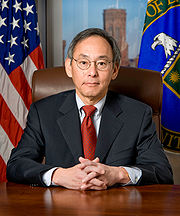
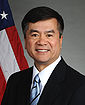
to serve in a cabinet post in American history. In addition, Gary Locke became the first Chinese American governor when he was elected to this position for the state of Washington. He currently serves as Secretary of Commerce. Steven Chu
became the first Chinese American Secretary of Energy
. Judy Chu
became the first Chinese American woman elected to Congress as the Representative for California's 32nd district on July 15, 2009. Others include Mike Eng
, Hiram Fong
, Daniel Akaka
, March Fong Eu
, Matt Fong
, Thomas Tang
, Norman Bay
, Leland Yee
, John Liu
, Charles Djou
, David S. C. Chu
and David Wu
.
During the Cultural Revolution
, Chinese Americans, like all overseas Chinese
, generally speaking, were viewed as capitalist
traitors by the People's Republic of China
government
. This attitude changed completely in the late 1970s with the reforms of Deng Xiaoping
. Increasingly, Chinese Americans were seen as sources of business and technical expertise and capital
who could aid in China's economic
and other development
.
United States
The United States of America is a federal constitutional republic comprising fifty states and a federal district...
of Chinese
Han Chinese
Han Chinese are an ethnic group native to China and are the largest single ethnic group in the world.Han Chinese constitute about 92% of the population of the People's Republic of China , 98% of the population of the Republic of China , 78% of the population of Singapore, and about 20% of the...
descent. Chinese Americans constitute one group of overseas Chinese
Overseas Chinese
Overseas Chinese are people of Chinese birth or descent who live outside the Greater China Area . People of partial Chinese ancestry living outside the Greater China Area may also consider themselves Overseas Chinese....
and also a subgroup of East Asia
East Asia
East Asia or Eastern Asia is a subregion of Asia that can be defined in either geographical or cultural terms...
n Americans, which is further a subgroup of Asian American
Asian American
Asian Americans are Americans of Asian descent. The U.S. Census Bureau definition of Asians as "Asian” refers to a person having origins in any of the original peoples of the Far East, Southeast Asia, or the Indian subcontinent, including, for example, Cambodia, China, India, Indonesia, Japan,...
s. Within this community, the term Chinese American is often broadly defined to include not only immigrants from Mainland China
Mainland China
Mainland China, the Chinese mainland or simply the mainland, is a geopolitical term that refers to the area under the jurisdiction of the People's Republic of China . According to the Taipei-based Mainland Affairs Council, the term excludes the PRC Special Administrative Regions of Hong Kong and...
, Hong Kong
Hong Kong
Hong Kong is one of two Special Administrative Regions of the People's Republic of China , the other being Macau. A city-state situated on China's south coast and enclosed by the Pearl River Delta and South China Sea, it is renowned for its expansive skyline and deep natural harbour...
, Macau
Macau
Macau , also spelled Macao , is, along with Hong Kong, one of the two special administrative regions of the People's Republic of China...
, Taiwan
Taiwan
Taiwan , also known, especially in the past, as Formosa , is the largest island of the same-named island group of East Asia in the western Pacific Ocean and located off the southeastern coast of mainland China. The island forms over 99% of the current territory of the Republic of China following...
, and their descendants but also immigrants and descendants of overseas Chinese people who migrated to the United States from places as diverse as Malaysia, Singapore
Singapore
Singapore , officially the Republic of Singapore, is a Southeast Asian city-state off the southern tip of the Malay Peninsula, north of the equator. An island country made up of 63 islands, it is separated from Malaysia by the Straits of Johor to its north and from Indonesia's Riau Islands by the...
, and other countries in southeast Asia
Southeast Asia
Southeast Asia, South-East Asia, South East Asia or Southeastern Asia is a subregion of Asia, consisting of the countries that are geographically south of China, east of India, west of New Guinea and north of Australia. The region lies on the intersection of geological plates, with heavy seismic...
. The Chinese American community is the largest ethnic group of Asian Americans, consisting of 22.4% of the Asian American population. They constitute 1.2% of the United States
United States
The United States of America is a federal constitutional republic comprising fifty states and a federal district...
as a whole. In 2006, the Chinese American population numbered approximately 3.6 million.
History
The first Chinese immigrants arrived in 1820 according to U.S. government records. 325 men are known to have arrived before the 1849 California Gold RushCalifornia Gold Rush
The California Gold Rush began on January 24, 1848, when gold was found by James W. Marshall at Sutter's Mill in Coloma, California. The first to hear confirmed information of the gold rush were the people in Oregon, the Sandwich Islands , and Latin America, who were the first to start flocking to...
which drew the first significant number of laborers from China who mined for gold and performed menial labor. There were 25,000 immigrants by 1852, and 105,465 by 1880, most of whom lived on the West Coast
West Coast of the United States
West Coast or Pacific Coast are terms for the westernmost coastal states of the United States. The term most often refers to the states of California, Oregon, and Washington. Although not part of the contiguous United States, Alaska and Hawaii do border the Pacific Ocean but can't be included in...
. They formed over a tenth of California's population. Nearly all the early immigrants were young males with low educational levels from six districts in the Guangdong
Guangdong
Guangdong is a province on the South China Sea coast of the People's Republic of China. The province was previously often written with the alternative English name Kwangtung Province...
province.
However, the Chinese faced racial discrimination in the form of anti-Chinese sentiment
Anti-Chinese sentiment in the United States
Anti-Chinese sentiment in the United States has existed since the late 19th century, during the Yellow Peril, and continued through the Cold War during McCarthyism. Modern anti-Chinese sentiment is the result of China's rise as a world major power...
and legislation
Anti-Chinese legislation in the United States
Anti-Chinese legislation in the United States was introduced in America to deal with Chinese migrants following the gold rush in California and those coming to build the railway.*Anti-Coolie Act*Chinese Exclusion Act*Pigtail Ordinance-See also:...
, and Chinese people were banned from immigrating between 1885 and 1943, when the Chinese Exclusion Act was in effect. Since the repeal of the Act in 1943, immigration of Chinese continued to be heavily restricted until 1965. During the 1970s, the vast majority of ethnic Chinese immigration into the United States was from Hong Kong
Hong Kong
Hong Kong is one of two Special Administrative Regions of the People's Republic of China , the other being Macau. A city-state situated on China's south coast and enclosed by the Pearl River Delta and South China Sea, it is renowned for its expansive skyline and deep natural harbour...
, followed by Taiwan
Taiwan
Taiwan , also known, especially in the past, as Formosa , is the largest island of the same-named island group of East Asia in the western Pacific Ocean and located off the southeastern coast of mainland China. The island forms over 99% of the current territory of the Republic of China following...
, with relatively few immigrants coming from mainland China
Mainland China
Mainland China, the Chinese mainland or simply the mainland, is a geopolitical term that refers to the area under the jurisdiction of the People's Republic of China . According to the Taipei-based Mainland Affairs Council, the term excludes the PRC Special Administrative Regions of Hong Kong and...
. During the 1980s, in part due to the liberalization of emigration restrictions in the mid-1970s, immigrants from mainland China
Mainland China
Mainland China, the Chinese mainland or simply the mainland, is a geopolitical term that refers to the area under the jurisdiction of the People's Republic of China . According to the Taipei-based Mainland Affairs Council, the term excludes the PRC Special Administrative Regions of Hong Kong and...
formed a larger proportion of ethnic Chinese immigrating to the United States. Cantonese, historically the language of most Chinese immigrants, is the third most widely spoken non-English language in the United States.
Demographics
According to the 2009 American Community Survey, the three metropolitan areas with the largest Chinese American populations were the Greater New YorkGreater New York
Greater New York or Greater New York City may refer to:* the statistical New York metropolitan area consisting of New York City and surrounding counties of New York, New Jersey, Connecticut and Pennsylvania...
Combined Statistical Area
Combined Statistical Area
The United States Office of Management and Budget defines micropolitan and metropolitan statistical areas. Metropolitan and micropolitan statistical areas consist of one or more counties...
at about 666,000 people, the San Jose-San Francisco-Oakland Combined Statistical Area at about 562,000 people, and the Greater Los Angeles
Greater Los Angeles Area
The Greater Los Angeles Area, or the Southland, is a term used for the Combined Statistical Area sprawled over five counties in the southern part of California, namely Los Angeles County, Orange County, San Bernardino County, Riverside County and Ventura County...
Combined Statistical Area at about 495,000 people. New York City
New York City
New York is the most populous city in the United States and the center of the New York Metropolitan Area, one of the most populous metropolitan areas in the world. New York exerts a significant impact upon global commerce, finance, media, art, fashion, research, technology, education, and...
is home to the highest Chinese American population of any city proper (486,463), while the Los Angeles County city of Monterey Park
Monterey Park, California
Monterey Park is a city in Los Angeles County, California, United States, east of downtown Los Angeles. The city's motto is "Pride in the past, Faith in the future"...
has the highest percentage of Chinese Americans of any municipality, at 43.7% of its population, or 24,758 people.
The ten states with the largest estimated Chinese American populations, according to both the 2010 Census, were California
California
California is a state located on the West Coast of the United States. It is by far the most populous U.S. state, and the third-largest by land area...
(1,253,100; 3.4%), New York (577,000; 3.0%), Texas
Texas
Texas is the second largest U.S. state by both area and population, and the largest state by area in the contiguous United States.The name, based on the Caddo word "Tejas" meaning "friends" or "allies", was applied by the Spanish to the Caddo themselves and to the region of their settlement in...
(157,000; 0.6%), New Jersey
New Jersey
New Jersey is a state in the Northeastern and Middle Atlantic regions of the United States. , its population was 8,791,894. It is bordered on the north and east by the state of New York, on the southeast and south by the Atlantic Ocean, on the west by Pennsylvania and on the southwest by Delaware...
(134,500; 1.5%), Massachusetts
Massachusetts
The Commonwealth of Massachusetts is a state in the New England region of the northeastern United States of America. It is bordered by Rhode Island and Connecticut to the south, New York to the west, and Vermont and New Hampshire to the north; at its east lies the Atlantic Ocean. As of the 2010...
(123,000; 1.9%), Illinois
Illinois
Illinois is the fifth-most populous state of the United States of America, and is often noted for being a microcosm of the entire country. With Chicago in the northeast, small industrial cities and great agricultural productivity in central and northern Illinois, and natural resources like coal,...
(104,200; 0.8%), Washington
Washington State
Washington State may refer to:* Washington , often referred to as "Washington state" to differentiate it from Washington, D.C., the capital of the United States* Washington State University, a land-grant college in that state- See also :...
(94,200; 1.4%), Pennsylvania
Pennsylvania
The Commonwealth of Pennsylvania is a U.S. state that is located in the Northeastern and Mid-Atlantic regions of the United States. The state borders Delaware and Maryland to the south, West Virginia to the southwest, Ohio to the west, New York and Ontario, Canada, to the north, and New Jersey to...
(85,000; 0.7%), Maryland
Maryland
Maryland is a U.S. state located in the Mid Atlantic region of the United States, bordering Virginia, West Virginia, and the District of Columbia to its south and west; Pennsylvania to its north; and Delaware to its east...
(69,400; 1.2%), and Virginia
Virginia
The Commonwealth of Virginia , is a U.S. state on the Atlantic Coast of the Southern United States. Virginia is nicknamed the "Old Dominion" and sometimes the "Mother of Presidents" after the eight U.S. presidents born there...
(59,800; 0.7%). The state of Hawaii
Hawaii
Hawaii is the newest of the 50 U.S. states , and is the only U.S. state made up entirely of islands. It is the northernmost island group in Polynesia, occupying most of an archipelago in the central Pacific Ocean, southwest of the continental United States, southeast of Japan, and northeast of...
has the highest concentration of Chinese Americans at 4.0%, or 55,000 people.
The New York City Metropolitan Area, consisting of New York City
New York City
New York is the most populous city in the United States and the center of the New York Metropolitan Area, one of the most populous metropolitan areas in the world. New York exerts a significant impact upon global commerce, finance, media, art, fashion, research, technology, education, and...
, Long Island
Long Island
Long Island is an island located in the southeast part of the U.S. state of New York, just east of Manhattan. Stretching northeast into the Atlantic Ocean, Long Island contains four counties, two of which are boroughs of New York City , and two of which are mainly suburban...
, and nearby areas within the states of New York
New York
New York is a state in the Northeastern region of the United States. It is the nation's third most populous state. New York is bordered by New Jersey and Pennsylvania to the south, and by Connecticut, Massachusetts and Vermont to the east...
, New Jersey
New Jersey
New Jersey is a state in the Northeastern and Middle Atlantic regions of the United States. , its population was 8,791,894. It is bordered on the north and east by the state of New York, on the southeast and south by the Atlantic Ocean, on the west by Pennsylvania and on the southwest by Delaware...
, Connecticut
Connecticut
Connecticut is a state in the New England region of the northeastern United States. It is bordered by Rhode Island to the east, Massachusetts to the north, and the state of New York to the west and the south .Connecticut is named for the Connecticut River, the major U.S. river that approximately...
, and Pennsylvania
Pennsylvania
The Commonwealth of Pennsylvania is a U.S. state that is located in the Northeastern and Mid-Atlantic regions of the United States. The state borders Delaware and Maryland to the south, West Virginia to the southwest, Ohio to the west, New York and Ontario, Canada, to the north, and New Jersey to...
, is home to the largest Chinese American population of any metropolitan area within the United States, enumerating 665,714 individuals as of the 2009 American Community Survey Census statistical data, and including at least seven Chinatown
Chinatown
A Chinatown is an ethnic enclave of overseas Chinese people, although it is often generalized to include various Southeast Asian people. Chinatowns exist throughout the world, including East Asia, Southeast Asia, the Americas, Australasia, and Europe. Binondo's Chinatown located in Manila,...
s. Continuing immigration from Mainland China, both legal and illegal in origin, has spurred the ongoing rise of the Chinese American population in the New York metropolitan area; this immigration continues to be fueled by New York's status as an alpha global city, its high population density, its extensive mass transit system, and the New York metropolitan area's enormous economic marketplace.
San Francisco, California has the highest per capita
Per capita
Per capita is a Latin prepositional phrase: per and capita . The phrase thus means "by heads" or "for each head", i.e. per individual or per person...
concentration of Chinese Americans of any major city in the United States, at an estimated 19.8%, or 157,747 people, and contains the second-largest total number of Chinese Americans of any U.S. city. San Francisco's Chinatown was established in the 1840s, making it the oldest Chinatown in North America
North America
North America is a continent wholly within the Northern Hemisphere and almost wholly within the Western Hemisphere. It is also considered a northern subcontinent of the Americas...
and the largest neighborhood of Chinese people outside of Asia
Asia
Asia is the world's largest and most populous continent, located primarily in the eastern and northern hemispheres. It covers 8.7% of the Earth's total surface area and with approximately 3.879 billion people, it hosts 60% of the world's current human population...
, composed in large part by immigrants hailing from Guangdong province and also many from Hong Kong
Hong Kong
Hong Kong is one of two Special Administrative Regions of the People's Republic of China , the other being Macau. A city-state situated on China's south coast and enclosed by the Pearl River Delta and South China Sea, it is renowned for its expansive skyline and deep natural harbour...
. The San Francisco neighborhoods of Sunset District and Richmond District also contain significant Chinese populations.
Other metropolitan areas with large Chinese American populations include Los Angeles
Los Angeles, California
Los Angeles , with a population at the 2010 United States Census of 3,792,621, is the most populous city in California, USA and the second most populous in the United States, after New York City. It has an area of , and is located in Southern California...
, Boston
Boston
Boston is the capital of and largest city in Massachusetts, and is one of the oldest cities in the United States. The largest city in New England, Boston is regarded as the unofficial "Capital of New England" for its economic and cultural impact on the entire New England region. The city proper had...
, Chicago
Chicago
Chicago is the largest city in the US state of Illinois. With nearly 2.7 million residents, it is the most populous city in the Midwestern United States and the third most populous in the US, after New York City and Los Angeles...
, Washington, D.C.
Washington, D.C.
Washington, D.C., formally the District of Columbia and commonly referred to as Washington, "the District", or simply D.C., is the capital of the United States. On July 16, 1790, the United States Congress approved the creation of a permanent national capital as permitted by the U.S. Constitution....
, Houston
Houston, Texas
Houston is the fourth-largest city in the United States, and the largest city in the state of Texas. According to the 2010 U.S. Census, the city had a population of 2.1 million people within an area of . Houston is the seat of Harris County and the economic center of , which is the ...
, Seattle, Philadelphia, Dallas, Portland
Portland, Oregon
Portland is a city located in the Pacific Northwest, near the confluence of the Willamette and Columbia rivers in the U.S. state of Oregon. As of the 2010 Census, it had a population of 583,776, making it the 29th most populous city in the United States...
, San Diego, Sacramento
Sacramento, California
Sacramento is the capital city of the U.S. state of California and the county seat of Sacramento County. It is located at the confluence of the Sacramento River and the American River in the northern portion of California's expansive Central Valley. With a population of 466,488 at the 2010 census,...
and Las Vegas
Las Vegas metropolitan area
The Las Vegas Valley is the heart of the Las Vegas-Paradise, NV MSA also known as the Las Vegas–Paradise–Henderson MSA which includes all of Clark County, Nevada, and is a metropolitan area in the southern part of the U.S. state of Nevada. The Valley is defined by the Las Vegas Valley landform, a ...
.
In these cities, there are often multiple Chinatowns, an older one and a newer one which is populated by immigrants from the 1960s and 1970s. In some areas, Chinese Americans maintain close relationships with other Asian groups (i.e. Koreans, Filipinos
Filipinos
Filipinos is the brand name for a series of biscuit snacks made by Kraft Foods. In Spain and Portugal they are produced and sold under the Artiach brand name. Under license to United Biscuits, in the Netherlands they are sold and produced locally under the Verkade brand...
, Vietnamese
Vietnamese people
The Vietnamese people are an ethnic group originating from present-day northern Vietnam and southern China. They are the majority ethnic group of Vietnam, comprising 86% of the population as of the 1999 census, and are officially known as Kinh to distinguish them from other ethnic groups in Vietnam...
and so on).
New York City's Lower East Side
Lower East Side
The Lower East Side, LES, is a neighborhood in the southeastern part of the New York City borough of Manhattan. It is roughly bounded by Allen Street, East Houston Street, Essex Street, Canal Street, Eldridge Street, East Broadway, and Grand Street....
, San Francisco's North Beach
North Beach, San Francisco, California
North Beach is a neighborhood in the northeast of San Francisco adjacent to Chinatown, Fisherman's Wharf and Russian Hill. The neighborhood is San Francisco's Little Italy, and has historically been home to a large Italian American population. It still holds many Italian restaurants today, though...
and Los Angeles' Olvera Street
Olvera Street
Olvera Street is in the oldest part of Downtown Los Angeles, California, and is part of the El Pueblo de Los Angeles Historic Monument. Many Latinos refer to it as "La Placita Olvera." Circa 1911 it was described as Sonora Town....
are good examples of Chinese-Americans intermingled with other races and cultures.
In addition to the big cities, smaller pockets of Chinese Americans are also dispersed in rural towns, often university-college towns, throughout the United States. For example, the number of Chinese Americans, including college professors, doctors, professionals, and students, has increased over 200% from 2005 to 2010 in Providence, Rhode Island
Providence, Rhode Island
Providence is the capital and most populous city of Rhode Island and was one of the first cities established in the United States. Located in Providence County, it is the third largest city in the New England region...
, a small city with a large number of colleges.
Income and social status of these Chinese-American locations vary widely. Although many Chinese Americans in Chinatowns of large cities are often members of an impoverished working class, others are well-educated upper-class people living in affluent suburbs. The upper and lower-class Chinese are also widely separated by social status and class discrimination. In California's San Gabriel Valley
San Gabriel Valley
The San Gabriel Valley is one of the principal valleys of Southern California, United States. It lies to the east of Los Angeles, to the north of the Puente Hills, to the south of the San Gabriel Mountains, and west of the Inland Empire. It derives its name from the San Gabriel River that flows...
, for example, the cities of Monterey Park
Monterey Park, California
Monterey Park is a city in Los Angeles County, California, United States, east of downtown Los Angeles. The city's motto is "Pride in the past, Faith in the future"...
and San Marino
San Marino, California
San Marino is a small, affluent city in Los Angeles County, California. Incorporated in 1913, the City founders designed the community to be uniquely residential, with expansive properties surrounded by beautiful gardens, wide streets, and well maintained parkways...
are both Chinese American communities lying geographically close to each other but they are separated by a large socio-economic and income gap.
Influence on American culture
First Transcontinental Railroad
The First Transcontinental Railroad was a railroad line built in the United States of America between 1863 and 1869 by the Central Pacific Railroad of California and the Union Pacific Railroad that connected its statutory Eastern terminus at Council Bluffs, Iowa/Omaha, Nebraska The First...
and levees in the Sacramento River Delta
Sacramento River Delta
The Sacramento-San Joaquin River Delta, or California Delta, is an expansive inland river delta and estuary in northern California in the United States. The Delta is formed at the western edge of the Central Valley by the confluence of the Sacramento and San Joaquin rivers and lies just east of...
; the popularization of Chinese American food
American Chinese cuisine
American Chinese cuisine refers to the style of food served by many Chinese restaurants in the United States. This type of cooking typically caters to Western tastes, and differs significantly from the original Chinese cuisine.-History:...
; technological innovation and entrepreneurship; and the introduction of Chinese and East Asian culture to America, such as Buddhism
Buddhism
Buddhism is a religion and philosophy encompassing a variety of traditions, beliefs and practices, largely based on teachings attributed to Siddhartha Gautama, commonly known as the Buddha . The Buddha lived and taught in the northeastern Indian subcontinent some time between the 6th and 4th...
, Taoism
Taoism
Taoism refers to a philosophical or religious tradition in which the basic concept is to establish harmony with the Tao , which is the mechanism of everything that exists...
, and Kung fu.
Chinese immigrants to the United States brought many of their ideas, ideals and values with them. Some of these have continued to influence later generations. Among them is Confucian
Confucianism
Confucianism is a Chinese ethical and philosophical system developed from the teachings of the Chinese philosopher Confucius . Confucianism originated as an "ethical-sociopolitical teaching" during the Spring and Autumn Period, but later developed metaphysical and cosmological elements in the Han...
respect for elders and filial piety. Similarly education and the civil service were the most important path for upward social mobility in China. The first Broadway
Broadway theatre
Broadway theatre, commonly called simply Broadway, refers to theatrical performances presented in one of the 40 professional theatres with 500 or more seats located in the Theatre District centered along Broadway, and in Lincoln Center, in Manhattan in New York City...
show about Asian Americans was Flower Drum Song
Flower Drum Song
Flower Drum Song was the eighth stage musical by the team of Richard Rodgers and Oscar Hammerstein II. It was based on the 1957 novel, The Flower Drum Song, by Chinese-American author C. Y. Lee. The piece opened in 1958 on Broadway and was afterwards presented in the West End and on tour...
.
In most American cities with Chinese populations, the new year is celebrated with cultural festivals and parties. In Seattle, the Chinese Culture and Arts Festival is held every year. Other important festivals include the Dragon Boat Festival
Dragon Boat Festival
Duanwu Festival, also known as Dragon Boat Festival and the Double Fifth, is a traditional and statutory holiday originating in China and associated with a number of East Asian and Southeast Asian societies...
and the Mid-Autumn Festival
Mid-Autumn Festival
The Mid-Autumn Festival , also known as the Moon Festival or Mooncake Festival or Zhongqiu Festival, is a popular lunar harvest festival celebrated by Chinese and Vietnamese people. A description of the festival first appeared in Rites of Zhou, a written collection of rituals of the Western Zhou...
.
Analysis indicated that most non-Asian Americans do not differentiate between Chinese Americans and East Asian Americans generally, and perceptions of both groups are nearly identical. A 2001 survey of Americans' attitudes toward Asian Americans and Chinese Americans indicated that one fourth of the respondents had somewhat or very negative attitude toward Chinese Americans in general. The study did find several positive perceptions of Chinese Americans: strong family values (91%); honesty as business people (77%); high value on education (67%).
Citizenship
Legally all ethnic Chinese born in the United States are American citizens as a result of the Fourteenth AmendmentFourteenth Amendment to the United States Constitution
The Fourteenth Amendment to the United States Constitution was adopted on July 9, 1868, as one of the Reconstruction Amendments.Its Citizenship Clause provides a broad definition of citizenship that overruled the Dred Scott v...
and the 1898 United States v. Wong Kim Ark
United States v. Wong Kim Ark
United States v. Wong Kim Ark, , was a United States Supreme Court decision that set an important legal precedent about the role of jus soli as a factor in determining a person's claim to United States citizenship...
Supreme Court decision. Upon naturalization, immigrants to the United States must take an oath of loyalty to the United States but are not required to formally renounce their former citizenship. However, the People's Republic of China
People's Republic of China
China , officially the People's Republic of China , is the most populous country in the world, with over 1.3 billion citizens. Located in East Asia, the country covers approximately 9.6 million square kilometres...
does not recognize dual citizenship and considers the naturalization of a person as an American citizen to imply a renunciation of PRC citizenship. On the other hand, the Republic of China
Republic of China
The Republic of China , commonly known as Taiwan , is a unitary sovereign state located in East Asia. Originally based in mainland China, the Republic of China currently governs the island of Taiwan , which forms over 99% of its current territory, as well as Penghu, Kinmen, Matsu and other minor...
does not view naturalization in other countries as an automatic renunciation of Chinese nationality
Nationality Law of the Republic of China
The Nationality Law of the Republic of China defines and regulates nationality of the Republic of China . It was first promulgated by the Nationalist Government on February 5, 1929 and revised by the Taipei-based Legislative Yuan in 2000, 2001, and 2006.The Act, like the Constitution of the...
.
Language
ChineseChinese language
The Chinese language is a language or language family consisting of varieties which are mutually intelligible to varying degrees. Originally the indigenous languages spoken by the Han Chinese in China, it forms one of the branches of Sino-Tibetan family of languages...
, mostly of the Cantonese variety, is the third most-spoken language in the United States, almost completely spoken within Chinese American populations and by immigrants or the descendants of immigrants, especially in California
California
California is a state located on the West Coast of the United States. It is by far the most populous U.S. state, and the third-largest by land area...
. Over 2 million Americans speak some variety of Chinese, with Standard Chinese
Standard Chinese
Standard Chinese, or Modern Standard Chinese, also known as Mandarin or Putonghua, is the official language of the People's Republic of China and Republic of China , and is one of the four official languages of Singapore....
becoming increasingly more common due to immigration from mainland China and Taiwan.
In New York City
New York City
New York is the most populous city in the United States and the center of the New York Metropolitan Area, one of the most populous metropolitan areas in the world. New York exerts a significant impact upon global commerce, finance, media, art, fashion, research, technology, education, and...
at least, although Mandarin is spoken as a native language among only ten percent of Chinese speakers, it is used as a secondary dialect among the greatest number of them and is on its way to replace Cantonese as their lingua franca
Lingua franca
A lingua franca is a language systematically used to make communication possible between people not sharing a mother tongue, in particular when it is a third language, distinct from both mother tongues.-Characteristics:"Lingua franca" is a functionally defined term, independent of the linguistic...
. In addition, the immigration from Fujian
Fujian
' , formerly romanised as Fukien or Huguing or Foukien, is a province on the southeast coast of mainland China. Fujian is bordered by Zhejiang to the north, Jiangxi to the west, and Guangdong to the south. Taiwan lies to the east, across the Taiwan Strait...
is creating an increasingly large number of Min
Min
Min may refer to:*Min , an Egyptian fertility god*Min , a modern working copy of an Ancient Egyptian ship of Hatshepsut's time*Min , a South Korean celebrity most popularly known as a member of miss A*Min *Min River...
speakers. Wu Chinese, a Chinese language previously unheard of in the United States, is now spoken by a minority of recent Chinese immigrants, who hail from Jiangsu
Jiangsu
' is a province of the People's Republic of China, located along the east coast of the country. The name comes from jiang, short for the city of Jiangning , and su, for the city of Suzhou. The abbreviation for this province is "苏" , the second character of its name...
, Zhejiang
Zhejiang
Zhejiang is an eastern coastal province of the People's Republic of China. The word Zhejiang was the old name of the Qiantang River, which passes through Hangzhou, the provincial capital...
, and Shanghai
Shanghai
Shanghai is the largest city by population in China and the largest city proper in the world. It is one of the four province-level municipalities in the People's Republic of China, with a total population of over 23 million as of 2010...
.
Although Chinese Americans grow up learning English
English language
English is a West Germanic language that arose in the Anglo-Saxon kingdoms of England and spread into what was to become south-east Scotland under the influence of the Anglian medieval kingdom of Northumbria...
, some teach their children Chinese for a variety of reasons: preservation of an ancient civilization, preservation of a unique identity, pride in their cultural ancestry, desire for easy communication with them and other relatives, and the perception that Chinese will be a very useful language as China's economic strength increases.
Politics
People's Republic of China
China , officially the People's Republic of China , is the most populous country in the world, with over 1.3 billion citizens. Located in East Asia, the country covers approximately 9.6 million square kilometres...
, the Republic of China
Republic of China
The Republic of China , commonly known as Taiwan , is a unitary sovereign state located in East Asia. Originally based in mainland China, the Republic of China currently governs the island of Taiwan , which forms over 99% of its current territory, as well as Penghu, Kinmen, Matsu and other minor...
, the United States
United States
The United States of America is a federal constitutional republic comprising fifty states and a federal district...
, or Chinese nationalism
Chinese nationalism
Chinese nationalism , sometimes synonymous with Chinese patriotism refers to cultural, historiographical, and political theories, movements and beliefs that assert the idea of a cohesive, unified Chinese people and culture in a unified country known as China...
, with attitudes varying widely between active support, hostility, or indifference. Different subgroups of Chinese Americans also have radically different and sometimes very conflicting political priorities and goals. It is for this reason that Chinese Americans do not have any unified political groups or any unified political viewpoints.
In the days leading up to the 2004 U.S. Presidential Election
United States presidential election, 2004
The United States presidential election of 2004 was the United States' 55th quadrennial presidential election. It was held on Tuesday, November 2, 2004. Republican Party candidate and incumbent President George W. Bush defeated Democratic Party candidate John Kerry, the then-junior U.S. Senator...
, John Kerry
John Kerry
John Forbes Kerry is the senior United States Senator from Massachusetts, the 10th most senior U.S. Senator and chairman of the Senate Foreign Relations Committee. He was the presidential nominee of the Democratic Party in the 2004 presidential election, but lost to former President George W...
was favored by 58% of Chinese Americans, with George W. Bush
George W. Bush
George Walker Bush is an American politician who served as the 43rd President of the United States, from 2001 to 2009. Before that, he was the 46th Governor of Texas, having served from 1995 to 2000....
being favored by 23% of Chinese Americans and 19% undecided.
In recent decades, many Chinese Americans have started pursuing careers in politics and succeeded in getting elected and/or appointed into political office. In particular, several prominent Chinese Americans have in recent years served as members of the President's cabinet and other federal offices. Elaine Chao
Elaine Chao
Elaine Lan Chao served as the 24th United States Secretary of Labor in the Cabinet of President George W. Bush from 2001 to 2009. She was the first Asian Pacific American woman and first Chinese American to be appointed to a President's cabinet in American history. Chao was the only cabinet...
became the first Chinese American cabinet member in American history when she was appointed in 2001 to serve as Secretary of Labor under President George W. Bush
George W. Bush
George Walker Bush is an American politician who served as the 43rd President of the United States, from 2001 to 2009. Before that, he was the 46th Governor of Texas, having served from 1995 to 2000....
, a position she held until 2009; she also was the first female Asian American
Asian American
Asian Americans are Americans of Asian descent. The U.S. Census Bureau definition of Asians as "Asian” refers to a person having origins in any of the original peoples of the Far East, Southeast Asia, or the Indian subcontinent, including, for example, Cambodia, China, India, Indonesia, Japan,...
to serve in a cabinet post in American history. In addition, Gary Locke became the first Chinese American governor when he was elected to this position for the state of Washington. He currently serves as Secretary of Commerce. Steven Chu
Steven Chu
Steven Chu is an American physicist and the 12th United States Secretary of Energy. Chu is known for his research at Bell Labs in cooling and trapping of atoms with laser light, which won him the Nobel Prize in Physics in 1997, along with his scientific colleagues Claude Cohen-Tannoudji and...
became the first Chinese American Secretary of Energy
United States Secretary of Energy
The United States Secretary of Energy is the head of the United States Department of Energy, a member of the President's Cabinet, and fifteenth in the presidential line of succession. The position was formed on October 1, 1977 with the creation of the Department of Energy when President Jimmy...
. Judy Chu
Judy Chu
Judy May Chu, Ph.D. is the U.S. Representative for , serving since 2009. She is a member of the Democratic Party....
became the first Chinese American woman elected to Congress as the Representative for California's 32nd district on July 15, 2009. Others include Mike Eng
Mike Eng
Michael "Mike" F. Eng was elected to the California State Assembly in November 2006 and represents the 49th District. He is an American politician and member of the Democratic Party...
, Hiram Fong
Hiram Fong
Hiram Leong Fong , born Yau Leong Fong , was an American businessman and politician from Hawaii. He is most notable for his service as Republican United States Senator from 1959 to 1977, and for being the first Asian American and Chinese American to be elected as such...
, Daniel Akaka
Daniel Akaka
Daniel Kahikina Akaka is the junior U.S. Senator from Hawaii and a member of the Democratic Party. He is the first U.S. Senator of Native Hawaiian ancestry and is currently the only member of the Senate who has Chinese ancestry....
, March Fong Eu
March Fong Eu
March Kong Fong Eu is an American politician of the Democratic Party.Fong earned a Bachelor of Science in dentistry from the University of California, Berkeley in 1943 and a Master of Arts from Mills College. She earned a Ed.D...
, Matt Fong
Matt Fong
Matthew Kipling Fong was a Republican who served as the 30th California State Treasurer and was also the adopted son of Democrat March Fong Eu, the 25th California Secretary of State....
, Thomas Tang
Thomas Tang
Thomas Tang was a federal judge in the United States and the first Chinese American appointed to the federal judiciary....
, Norman Bay
Norman Bay
Norman C. Bay is a former United States Attorney for the District of New Mexico. Bay was the first Chinese-American United States Attorney....
, Leland Yee
Leland Yee
Leland Yee is a California State Senator in District 8 which represents the western half of San Francisco and most of San Mateo County. Prior to becoming state senator, Yee was a California State Assemblyman, Supervisor of San Francisco's Sunset District, and was a member and President of the San...
, John Liu
John Liu
John Chun Liu is a New York City elected official, currently serving as New York City Comptroller. Liu previously served on the New York City Council representing District 20...
, Charles Djou
Charles Djou
Charles Kong Djou is the former U.S. Representative for Hawaii's 1st congressional district...
, David S. C. Chu
David S. C. Chu
David S. C. Chu is an American politician and consultant born New York, NY, May 28, 1944. As of 2009, he was President and CEO of the non-profit Institute for Defense Analyses. From 2001 to 2008, he served as Under Secretary of Defense for Personnel and Readiness in the George W...
and David Wu
David Wu
David Wu is an American politician who served as the U.S. representative for from 1999 to 2011. He is a member of the Democratic Party.The district includes most of Portland west of the Willamette River, as well as all of Yamhill, Columbia, Clatsop, and Washington Counties...
.
During the Cultural Revolution
Cultural Revolution
The Great Proletarian Cultural Revolution, commonly known as the Cultural Revolution , was a socio-political movement that took place in the People's Republic of China from 1966 through 1976...
, Chinese Americans, like all overseas Chinese
Overseas Chinese
Overseas Chinese are people of Chinese birth or descent who live outside the Greater China Area . People of partial Chinese ancestry living outside the Greater China Area may also consider themselves Overseas Chinese....
, generally speaking, were viewed as capitalist
Capitalism
Capitalism is an economic system that became dominant in the Western world following the demise of feudalism. There is no consensus on the precise definition nor on how the term should be used as a historical category...
traitors by the People's Republic of China
People's Republic of China
China , officially the People's Republic of China , is the most populous country in the world, with over 1.3 billion citizens. Located in East Asia, the country covers approximately 9.6 million square kilometres...
government
Government
Government refers to the legislators, administrators, and arbitrators in the administrative bureaucracy who control a state at a given time, and to the system of government by which they are organized...
. This attitude changed completely in the late 1970s with the reforms of Deng Xiaoping
Deng Xiaoping
Deng Xiaoping was a Chinese politician, statesman, and diplomat. As leader of the Communist Party of China, Deng was a reformer who led China towards a market economy...
. Increasingly, Chinese Americans were seen as sources of business and technical expertise and capital
Capital (economics)
In economics, capital, capital goods, or real capital refers to already-produced durable goods used in production of goods or services. The capital goods are not significantly consumed, though they may depreciate in the production process...
who could aid in China's economic
Economic development
Economic development generally refers to the sustained, concerted actions of policymakers and communities that promote the standard of living and economic health of a specific area...
and other development
International development
International development or global development is a concept that lacks a universally accepted definition, but it is most used in a holistic and multi-disciplinary context of human development — the development of greater quality of life for humans...
.
Further reading
- Chinese American Understanding: A Sixty-Year Search, Chih Meng, China Institute in America, 1981, hardcover, 255 pages, OCLC: 8027928
- Chinese Americans and Their Immigrant Parents: Conflict, Identity, and Values, May Pao-May Tung, Haworth Press, 2000, paperback, 112 pages, ISBN 0-7890-1056-9
- Chinese Americans: The Immigrant Experience, Dusanka Miscevic and Peter Kwong, Hugh Lauter Levin Associates, 2000, hardcover, 240 pages, ISBN 0-88363-128-8
- Compelled To Excel: Immigration, Education, And Opportunity Among Chinese Americans, Vivian S. Louie, Stanford University Press, 2004, paperback, 272 pages, ISBN 0-8047-4985-X
- The Chinese in America: A Narrative History, Iris ChangIris ChangIris Shun-Ru Chang was an American historian and journalist. She is best known for her best-selling 1997 account of the Nanking Massacre, The Rape of Nanking. She committed suicide on November 9, 2004...
, Viking, 2003, hardcover, 496 pages, ISBN 0-670-03123-2 - Being Chinese, Becoming Chinese American, Shehong Chen, University of Illinois Press, 2002 ISBN 0-252-02736-1 electronic book
- ABC Struggles in the Church
- On Gold Mountain: The One-Hundred-Year Odyssey of My Chinese American Family, Lisa See, 1996. ISBN 0-679-76852-1. See also the website for an exhibition based on this book http://www.apa.si.edu/ongoldmountain from the Smithsonian Asian Pacific American Program.
- Yellow: Race in America Beyond Black and White, Frank H. WuFrank H. WuFrank H. Wu is a law professor, author, and public intellectual. He has been chancellor and dean of University of California, Hastings College of the Law in San Francisco, California, a position he assumed in July 2010...
, Basic Books, 2003, hardcover, 416 pages, ISBN 0-465-00640-3
External links
- http://factfinder.census.gov/servlet/IPTable?_bm=y&-geo_id=01000US&-qr_name=ACS_2005_EST_G00_S0201&-qr_name=ACS_2005_EST_G00_S0201PR&-qr_name=ACS_2005_EST_G00_S0201T&-qr_name=ACS_2005_EST_G00_S0201TPR&-ds_name=ACS_2005_EST_G00_&-reg=ACS_2005_EST_G00_S0201:016;ACS_2005_EST_G00_S0201PR:016;ACS_2005_EST_G00_S0201T:016;ACS_2005_EST_G00_S0201TPR:016&-_lang=en&-redoLog=false&-format=CensusFactfinder Chinese Americans 2005 American Community Survey]
- The Rocky Road to Liberty: A Documented History of Chinese American Immigration and Exclusion
- Museum of Chinese in the Americas
- Chinese Culture Center & Chinese Culture Foundation of San Francisco
- Organization of Chinese Americans
- Chinese Historical Society of America
- The Asians in America Project - Chinese American Organizations Directory
- "Paper Son" - one Chinese American's story of coming to America under the Chinese Exclusion Act of 1882
- Becoming American: The Chinese Experience a PBS Bill Moyers special. Thomas F. Lennon, Series Producer.
- Chinese American Contribution to Transcontinental Railroad - Central Pacific Railroad Photographic History Museum
- Emerging Information Technology Conference (EITC), organized by several Chinese American organizations
- Famous Chinese Americans Comprehensive list of famous Chinese Americans organized by professions. Includes short biographical notes and Chinese names.
- Chinese Information and Networking Association (CINA)
- Northwest Chinese Professionals Association
- The Yung Wing Project hosts the memoir of the first Chinese American graduate of an American university (Yale 1854).
- Chinese American Museum
- Documentary about the Golden Venture tragedy