


Chinese nationalism

Encyclopedia
Chinese nationalism sometimes synonymous with Chinese patriotism
( lit. Love country ideology) refers to cultural, historiographical, and political theories, movements and beliefs that assert the idea of a cohesive, unified Chinese people
and culture
in a unified country known as China
. Jeff Wasserstrom argues that it is extremely misleading to view Chinese nationalism as a single phenomenon: "The tale of Chinese nationalism, or rather Chinese nationalisms, decidedly in the plural, is one that needs to be told in a manner that focuses not just on black and white definitions but makes room for many shades of gray."
, Marxism
, and Russian ethnological thought. The ideology also presents itself in many different and often conflicting manifestations, including Ultra-imperialism
. These manifestations have included the Three Principles of the People
, the Communist Party of China
, the anti-government views of students in the Tiananmen protests of 1989, Fascist blueshirts
, and Japanese collaborationism under Wang Jingwei
.
Although Chinese nationalists have agreed on the desirability of a centralized Chinese state, almost every other question has been the subject of intense and sometimes bitter debate. Among the questions on which Chinese nationalists have disagreed is what policies would lead to a strong China, what is the structure of the state and its goal, what the relationship should be between China and foreign powers, and what should be the relationships between the majority Han Chinese
, minority groups, and overseas Chinese
.
The vast variation in how Chinese nationalism has been expressed has been noted by commentators Lucian Pye
who argues that this reveals a lack of content in the Chinese identity. However, others have argued that the ability of Chinese nationalism to manifest itself in many forms is a positive trait in that it allows the ideology to transform itself in response to internal crises and external events.
Although the variations among conceptions of Chinese nationalism are great, Chinese nationalist groups maintain some similarities, most notably Ultra-imperialism
. Chinese nationalistic ideologies all regard Sun Yat-Sen
very highly, and tend to claim to be ideological heirs of the Three Principles of the People
. In addition, Chinese nationalistic ideologies tend to regard both democracy
and science
as positive forces, although they often have radically different
notions of what democracy means.
has argued that the modern "nation state" is fundamentally different from a traditional empire, and argues that dynamics of the current People's Republic of China
(PRC) — a concentration of power at a central point of authority – share an essential similarity with the Ming
and Qing Empire
s. There were only a few periods in Chinese history when China fought total wars against foreigners (most notably the Mongols
, Manchus, and Japanese
), whereas all other conflicts were mainly civil wars that led to dynastic changes. However, attempts to sinicize
foreigners or "barbarians" (such as the Vietnamese
, and Koreans) who wanted to maintain a separate cultural identity had been going on for millennia. This particular trait of Chinese history was not conducive to realizing a Chinese nation-state, until contact with Western countries in the 19th century.
s invaded the Chinese heartland and set up the Qing dynasty. Over the next centuries they would incorporate groups such as the Tibetans
, the Mongols, and the Uyghurs
into territories which they controlled. The Manchus were faced with the issue of maintaining loyalty among the people they ruled while at the same time maintaining a distinctive identity. The main method by which they accomplished control of the Chinese heartland was by portraying themselves as enlightened Confucian sages part of whose goal was to preserve and advance Chinese civilization. Over the course of centuries the Manchus were gradually assimilated into the Chinese culture and eventually many Manchus identified themselves as a people of China.
The complexity of the relationship between ethnicity and the Chinese identity (John McDermond) can be seen during the Taiping rebellion
in which the rebels fought fiercely against the Manchus on the ground that they were barbarian foreigners while at the same time others fought just as fiercely on behalf of the Manchus on the grounds that they were the preservers of traditional Chinese values. It was during this time that the concept of Han Chinese
came into existence as a means of describing the majority Chinese ethnicity.
In the late 19th century, Chinese nationalism identified Han with Chinese and argued for the overthrow of the Manchu
s who were considered outside the realm of the Chinese nation. This led to many rebellions by Han Chinese
. Sun Yat-sen
once declared: "In order to restore our national independence, we must first restore the Chinese nation. In order to restore the Chinese nation, we must drive the barbarian Manchus back to the Changbai Mountains
. In order to get rid of the barbarians, we must first overthrow the present tyrannical, dictatorial, ugly, and corrupt Qing government. Fellow countrymen, a revolution is the only means to overthrow the Qing government!"
After the 1911 Revolution, the official definition of "Chinese" was expanded to include non-Han ethnicities as part of a comprehensive Chinese nation (Zhonghua Minzu), in order to boost the unification of different races in China.
The official Chinese nationalistic view in the 1920s and 1930s was heavily influenced by modernism
and social Darwinism
, and included advocacy of the cultural assimilation of ethnic groups in the western and central provinces into the "culturally advanced" Han state, to become in name as well as in fact members of the Chinese nation. Furthermore, it was also influenced by the fate of multi-ethnic states such as Austria-Hungary
and the Ottoman Empire
. It also became a very powerful force during the Japanese occupation of Coastal China during the 1930s and 1940s and the atrocities committed by such regime.
Over the next decades Chinese nationalism was influenced strongly by Russian ethnographic thinking, and the official ideology of the PRC
asserts that China is a multi-ethnic state, and Han Chinese, despite being the overwhelming majority (over 90% in the mainland), they are only one of many ethnic groups of China, each of whose culture and language should be respected. However, many critics argue that despite this official view, assimilationist attitudes remain deeply entrenched, and popular views and actual power relationships create a situation in which Chinese nationalism has in practice meant Han dominance of minority areas and peoples and assimilation of those groups.
During the 1960s and 1970s, Chinese nationalism within mainland China
became mixed with the rhetoric of Marxism
, and nationalistic rhetoric become in large part subsumed into internationalist rhetoric. On the other hand, Chinese nationalism in Taiwan
was primarily about preserving the ideals and lineage of Sun Yat-sen, the party he founded, the Kuomintang
(KMT), and anti-Communism. While the definition of Chinese nationalism differed in the Republic of China
(ROC) and PRC, both were adamant in claiming Chinese territories such as Diaoyutai Islands.
In the 1990s, rising economic standards, the fall of the Soviet Union
, and the lack of any other legitimizing ideology has led to what most observers see as a resurgence of nationalism within China.
, are a mixture of the descendants of foreign Muslims like Arabs and Persians, mixed with Han Chinese
who converted to Islam. Chinese Muslims are sinophone, speaking Chinese languages, and practice Confucianism
.
Hu Songshan
, a Muslim Imam from Ningxia
, was a Chinese nationalist and preached Chinese nationalism and unity of all Chinese people, and also against imperialism and foreign threats. He even ordered the Chinese Flag
to be saluted during prayer, and that all Imams in Ningxia preach Chinese nationalism. Hu Songshan led the Ikhwan, the Chinese Muslim Brotherhood, which became a Chinese nationalist, patriotic organization , stressing education and independence of the individual. Hu Songhan also wrote a prayer in Arabic and Chinese, praying for Allah to support the Chinese Kuomintang
government and defeat Japan. Hu Songshan also cited a Hadith
(圣训), a saying of the prophet Muhammad
, which says "Loving the Motherland is equivalent to loving the Faith" (“爱护祖国是属于信仰的一部份”). Hu Songshan harshly criticized those who were non patrioctic and those who taught anti nationalist thinking, saying that they were fake Muslims.
Ma Qixi
was a Muslim reformer, leader of the Xidaotang
, and he taught that Islam could only be understood by using Chinese culture such as Confucianism
. He read classic Chinese texts and even took his cue from Laozi
when he decided to go on Hajj
to Mecca
.
Ma Fuxiang
, a Chinese Muslim general and Kuomintang
member, was another Chinese nationalist. Ma Fuxiang preached unity of all Chinese people, and even non-Chinese people such as Tibetans and Mongols to stay in China. He proclaimed that Mongolia and Tibet were part of the Republic of China
, and not independent countries. Ma Fuxiang was loyal to the Chinese government, and crushed Muslim rebels when ordered to. Ma Fuxiang believed that modern education would help Hui Chinese build a better society and help China resist foreign imperialism and help build the nation. He was praised for his "guojia yizhi"(national consciousness) by non Muslims. Ma Fuxiang also published many books, and wrote on Confucianism and Islam, having studied both the Quran and the Spring and Autumn Annals
.
Ma Fuxiang had served under the Chinese Muslim general Dong Fuxiang
, and fought against the foreigners during the Boxer Rebellion
. The Muslim unit he served in was noted for being anti foreign, being involved in shooting a Westerner and a Japanese to death before the Boxer Rebellion broke out. It was reported that the Muslim troops were going to wipe out the foreigners to return a golden age for China, and the Muslims repeatedly attacked foreign churches, railways, and legations, before hostilities even started. The Muslim troops were armed with modern repeater rifles and artillery, and reportedly enthusiastic about going on the offensive and killing foreigners. Ma Fuxiang led an ambush against the foreigners at Langfang
and inflicted many casualties, using a train to escape. Dong Fuxiang was a xenophobe and hated foreigners, wanting to drive them out of China.
Various Muslim organizations in China like China Islamic Association (Zhongguo Huijiao Gonghui) and the Chinese Muslim Association were sponsored by the Kuomintang.
Chinese Muslim imams had synthesized Islam and Confucianism in the Han Kitab
. They asserted that there was no contradiction between Confucianism and Islam, and no contradiction between being a Chinese national and a Muslim. Chinese Muslim students returning from study abroad, from places such as Al Azhar in Egypt learned about nationalism and advocated Chinese nationalism at home. One Imam, Wang Jingzhai, who studied at Mecca
, translated a Hadith
, or saying of Muhammad
, "Aiguo Aijiao"- loving the country is equivalent to loving the faith. Chinese Muslims believed that their "Watan"(country in Arabic) was the whole of the Republic of China
, non-Muslims included.
General Bai Chongxi
, the warlord of Guangxi, and a member of the Kuomintang
, presented himself as the protector of Islam in China and harbored Muslim intellectuals fleeing from the Japanese invasion in Guangxi, who preached Chinese nationalism and anti imperialism. Chinese Muslims were sent to Saudi Arabia and Egypt to denounce the Japanese. Translations from Egyptian writings and the Quran were used to support propaganda in favor of a Jihad
against Japan.
In Xinjiang
, the Chinese Muslim general Ma Hushan
supported Chinese nationalism. He was chief of the 36th Division (National Revolutionary Army)
. He spread anti Soviet, and anti Japanese propaganda, and instituted a colonial regime over the Uighurs. Uighur street names and signs were changed to Chinese, and the Chinese Muslim troops imported Chinese cooks and baths, rather than using Uighur ones. The Chinese Muslims even forced the Uighur carpet industry at Khotan
to change its design to Chinese versions.
The Tungans (Chinese Muslims, Hui people
) had anti Japanese sentiment.
General Ma Hushan's brother Ma Zhongying
denounced separatism in a speech at Idgah Mosque and told the Uighurs to be loyal to the Chinese government at Nanjing
.
The 36th division had crushed the Turkish Islamic Republic of East Turkestan, and the Chinese Muslim general Ma Zhancang
beheaded the Uighur emirs Abdullah Bughra
and Nur Ahmad Jan Bughra
. Ma Zhancang abolished the Islamic Sharia
law which was set up by the Uighurs, and set up military rule instead, retaining the former Chinese officials and keeping them in power.
The Uighurs had been promoting Islamism in their separatist government, but Ma Hushan eliminated religion from politics. Islam was barely mentioned or used in politics or life except as a vague spiritual focus for unified opposition against the Soviet Union.
Ma Hushan proclaimed his loyalty to Nanjing, denounced Sheng Shicai
as a Soviet puppet, and fought against Soviet invasion in 1937.
Other non sinophone Muslims in China, such as Uighur
s and Kirghiz are hostile to Chinese nationalism.
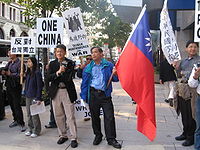 One common goal of current Chinese nationalists is the reunification
of mainland China
and Taiwan
. While this was the common stated goal of both the People's Republic of China and the Republic of China
(ROC) before 1991, both sides differed sharply on the form of reunification.
After 1991, the ROC unofficially moved away from supporting eventual reunification to a more ambiguous position. One reason is that the ROC itself remains split between supporters of Chinese nationalism
, who support eventual reunification as the ROC, supporters of the status quo who believe Taiwan should preserve independence as the ROC, and supporters of Taiwan independence
, who believe that the ROC ceased to exist in 1949 and that the Republic of Taiwan should be established. Another reason for the ambiguity is the stated threat that the PRC will take military action if a "Republic of Taiwan" is declared.
Much of the dispute in Taiwan has been muted because there is a general consensus to temporarily support the status quo
. Despite this, the relationship between Chinese nationalism and Taiwan remains controversial, involving symbolic issues such as the use of "The Republic of China" as the official name of the government on Taiwan and the use of "China" as the name of Government-owned corporation
s. Broadly speaking, there is little support on Taiwan for immediate reunification or independence; the argument is over culture and how Taiwanese should see themselves. The pan-blue coalition
views mainland China as an economic and cultural opportunity, seeks greater links between Taiwan and mainland China, and believes in a common Chinese identity. The pan-green coalition
sees Taiwan as a distinct nation from China and desires to achieve de jure independence.
and Taiwan
. Overseas Chinese were strong supporters of the 1911 revolution
.
After decolonization
, overseas Chinese were encouraged to regard themselves as citizens of their own nations rather than as part of the Chinese nationality. As a result ethnic Chinese
in Singapore
and Malaysia have sharply divided the concept of ethnic Chinese
from the concept of "political Chinese" and have explicitly rejected being part of the Chinese nationality.
During the 1960s, the People's Republic of China
and Republic of China
(ROC) maintained different attitudes toward overseas Chinese. In the eyes of the PRC government, overseas Chinese were considered capitalist agents; in addition, the PRC government also thought that maintaining good relations with southeast Asia
n governments was more important than maintaining the support of overseas Chinese. By contrast, the ROC desired good relations with overseas Chinese as part of an overall strategy to avoid diplomatic isolation and maintain its claim to be the sole legitimate government of China.
With the reforms under Deng Xiaoping
, the PRC's attitude toward overseas Chinese became much more favorable, and overseas Chinese were seen as a source of capital and expertise. In the 1990s, the PRC's efforts toward overseas Chinese became mostly focused on maintaining the loyalty of "newly departed overseas Chinese", which consisted of mostly graduate students having emigrated, mostly to the United States
. Now, there are summer camps, in which overseas Chinese youths may attend to learn first-hand about Chinese culture. Textbooks for Chinese schools are distributed by the government of the People's Republic of China.
Some opponents have asserted that Chinese nationalism is inherently backward and is therefore incompatible with a modern state. Some claim that Chinese nationalism is actually a manifestation of beliefs in Han Chinese
ethnic superiority, though this is hotly debated. While opponents have argued that reactionary nationalism is evidence of Chinese insecurity or immaturity and that it is both unnecessary and embarrassing to a powerful nation, Chinese nationalists assert that Chinese nationalism was in many ways a result of Western imperialism
and is fundamental to the founding of a modern Chinese state that is free from foreign domination.
nationalism which argues that anti-imperialist nationalism in China has provided a valuable public space for popular participation outside the country's political institutions and that nationalist sentiments under the postcolonial condition represent a democratic form of civic activity. Advocates of this theory promote nationalism as an ideal of populist politics and as an embodiment of the democratic legitimacy that resides in the will of the people.
Detractors, however, disparage populist nationalism in China today, especially that expressed on the Internet, as a "hooligan culture" in which "Internet Red Guards" hurl obscenities not only against foreign "devils," but also against moderates and liberals who warn of the excesses and dangers that nationalism could pose to China's modernization. Chinese nationalism has recently found an outlet in anti-Japanese sentiment
.
Populist nationalism is a comparatively late development in Chinese nationalism of the 1990s. It began to take recognizable shape after 1996, as a joint result of the evolving nationalist thinking of the early 1990s and the ongoing debates on modernity, postmodernism, postcolonialism, and their political implications-debates that have engaged many Chinese intellectuals since early 1995.
has seen the revival throughout the world of nationalist sentiments and aspirations. In China, the rapid decay of communist ideology had led the CPC to emphasize its role as the paramount patriotic force and the guardian of the national pride in order to find a new basis to sustain its role. However, nationalist sentiment is not the sole province of the CPC. One truly remarkable phenomenon in the post-Cold War upsurge of Chinese nationalism is that Chinese intellectuals became one of the driving forces. Many well-educated people-social scientists, humanities scholars, writers and other professionals-have given voice to and even become articulators for rising nationalistic discourse in the 1990s. Some commentators have proposed that "positive nationalism" could be an important unifying factor for the country as it has been for other countries.
As an indication of the popular and intellectual origins of recent Chinese nationalist sentiment, all coauthors of China Can Say No
, the first in a string of defiant rebuttals to American imperialism , are college
educated, and most are self-employed (a freelancer, a fruit-stand owner, a poet, and journalists working in the partly market-driven field of Chinese newspapers, periodicals, and television stations).
In the 21st century, notable spurs of grassroots Chinese nationalism grew from what the Chinese saw as marginalization of their country from Japan and the Western world. The Japanese history textbook controversies
, as well as Prime Minister
Junichiro Koizumi
's visits to the Yasukuni Shrine
was the source of considerable anger on Chinese blogs. In addition, the protests following the 2008 Tibetan unrest
of the Olympic torch has gathered strong opposition within the Chinese community inside China and abroad. Almost every Tibetan protest on the Olympic torch route was met with a considerable pro-China protest. Because the 2008 Summer Olympics
were a major source of national pride, anti-Olympics sentiments are often seen as anti-Chinese sentiments inside China. Moreover, the Sichuan Earthquake in 2008 sparked a high sense of nationalism from Chinese at home and abroad. The central government's quick response to the disaster was instrumental in galvanizing general support from the population amidst harsh criticism directed towards China's handling of the Lhasa riots only two months ago.
In response to protests during the 2008 Olympic Torch Relay and accusations of bias
from the western media, Chinese blogs, forums and websites became filled with nationalistic material, while flash counter-protests were generated through electronic means, such as the use of SMS
and IM
. One such site, Anti-CNN
, claimed that news channels such as CNN
and BBC
only reported selectively, and only provided a one-sided argument regarding the 2008 Tibetan unrest
. Chinese hackers have claimed to have attacked the CNN website numerous times, through the use of DDoS attacks.
, an event which was very sensitive in terms of nationalistic fervor.
In 2008, a girl called Zhang Ya (张雅) from Liaoning
province, Northeast China
, posted a 4-minute video of herself complaining about the amount of attention the Sichuan earthquake
victims were receiving on television, and made comments about the victims' deaths and their struggles. An intense response from angry, nationalistic Internet vigilantes
resulted in the girl's personal details (even including her blood type) being made available online, dozens of abusive video responses on Chinese websites and blogs. The girl was taken into police custody for three days as protection from vigilante death threats.
Patriotism
Patriotism is a devotion to one's country, excluding differences caused by the dependencies of the term's meaning upon context, geography and philosophy...
( lit. Love country ideology) refers to cultural, historiographical, and political theories, movements and beliefs that assert the idea of a cohesive, unified Chinese people
Zhonghua minzu
Zhonghua minzu , usually translated as Chinese ethnic groups or Chinese nationality, refers to the modern notion of a Chinese nationality transcending ethnic divisions, with a central identity for China as a whole...
and culture
Culture of China
Chinese culture is one of the world's oldest and most complex. The area in which the culture is dominant covers a large geographical region in eastern Asia with customs and traditions varying greatly between towns, cities and provinces...
in a unified country known as China
China
Chinese civilization may refer to:* China for more general discussion of the country.* Chinese culture* Greater China, the transnational community of ethnic Chinese.* History of China* Sinosphere, the area historically affected by Chinese culture...
. Jeff Wasserstrom argues that it is extremely misleading to view Chinese nationalism as a single phenomenon: "The tale of Chinese nationalism, or rather Chinese nationalisms, decidedly in the plural, is one that needs to be told in a manner that focuses not just on black and white definitions but makes room for many shades of gray."
Ideological basis
Chinese nationalism has drawn from extremely diverse ideological sources including traditional Chinese thinking, American progressivismProgressivism
Progressivism is an umbrella term for a political ideology advocating or favoring social, political, and economic reform or changes. Progressivism is often viewed by some conservatives, constitutionalists, and libertarians to be in opposition to conservative or reactionary ideologies.The...
, Marxism
Marxism
Marxism is an economic and sociopolitical worldview and method of socioeconomic inquiry that centers upon a materialist interpretation of history, a dialectical view of social change, and an analysis and critique of the development of capitalism. Marxism was pioneered in the early to mid 19th...
, and Russian ethnological thought. The ideology also presents itself in many different and often conflicting manifestations, including Ultra-imperialism
Ultra-imperialism
Ultra-imperialism, or occasionally hyperimperialism and formerly super-imperialism, is a potential, comparatively peaceful phase of capitalism, meaning "after" or "beyond" imperialism. It was described mainly by Karl Kautsky...
. These manifestations have included the Three Principles of the People
Three Principles of the People
The Three Principles of the People, also translated as Three People's Principles, or collectively San-min Doctrine, is a political philosophy developed by Sun Yat-sen as part of a philosophy to make China a free, prosperous, and powerful nation...
, the Communist Party of China
Communist Party of China
The Communist Party of China , also known as the Chinese Communist Party , is the founding and ruling political party of the People's Republic of China...
, the anti-government views of students in the Tiananmen protests of 1989, Fascist blueshirts
Blue Shirts Society
The Blue Shirts Society also known as the Society of Practice of the Three Principles of the People , the Spirit Encouragement Society and the China Reconstruction Society , was a secret clique in the...
, and Japanese collaborationism under Wang Jingwei
Wang Jingwei
Wang Jingwei , alternate name Wang Zhaoming, was a Chinese politician. He was initially known as a member of the left wing of the Kuomintang , but later became increasingly anti-Communist after his efforts to collaborate with the CCP ended in political failure...
.
Although Chinese nationalists have agreed on the desirability of a centralized Chinese state, almost every other question has been the subject of intense and sometimes bitter debate. Among the questions on which Chinese nationalists have disagreed is what policies would lead to a strong China, what is the structure of the state and its goal, what the relationship should be between China and foreign powers, and what should be the relationships between the majority Han Chinese
Han Chinese
Han Chinese are an ethnic group native to China and are the largest single ethnic group in the world.Han Chinese constitute about 92% of the population of the People's Republic of China , 98% of the population of the Republic of China , 78% of the population of Singapore, and about 20% of the...
, minority groups, and overseas Chinese
Overseas Chinese
Overseas Chinese are people of Chinese birth or descent who live outside the Greater China Area . People of partial Chinese ancestry living outside the Greater China Area may also consider themselves Overseas Chinese....
.
The vast variation in how Chinese nationalism has been expressed has been noted by commentators Lucian Pye
Lucian Pye
Lucian W. Pye was a political scientist, sinologist and comparative politics expert considered one of the leading China scholars in the United States...
who argues that this reveals a lack of content in the Chinese identity. However, others have argued that the ability of Chinese nationalism to manifest itself in many forms is a positive trait in that it allows the ideology to transform itself in response to internal crises and external events.
Although the variations among conceptions of Chinese nationalism are great, Chinese nationalist groups maintain some similarities, most notably Ultra-imperialism
Ultra-imperialism
Ultra-imperialism, or occasionally hyperimperialism and formerly super-imperialism, is a potential, comparatively peaceful phase of capitalism, meaning "after" or "beyond" imperialism. It was described mainly by Karl Kautsky...
. Chinese nationalistic ideologies all regard Sun Yat-Sen
Sun Yat-sen
Sun Yat-sen was a Chinese doctor, revolutionary and political leader. As the foremost pioneer of Nationalist China, Sun is frequently referred to as the "Father of the Nation" , a view agreed upon by both the People's Republic of China and the Republic of China...
very highly, and tend to claim to be ideological heirs of the Three Principles of the People
Three Principles of the People
The Three Principles of the People, also translated as Three People's Principles, or collectively San-min Doctrine, is a political philosophy developed by Sun Yat-sen as part of a philosophy to make China a free, prosperous, and powerful nation...
. In addition, Chinese nationalistic ideologies tend to regard both democracy
Democracy
Democracy is generally defined as a form of government in which all adult citizens have an equal say in the decisions that affect their lives. Ideally, this includes equal participation in the proposal, development and passage of legislation into law...
and science
Science
Science is a systematic enterprise that builds and organizes knowledge in the form of testable explanations and predictions about the universe...
as positive forces, although they often have radically different
Oligarchy
Oligarchy is a form of power structure in which power effectively rests with an elite class distinguished by royalty, wealth, family ties, commercial, and/or military legitimacy...
notions of what democracy means.
National consciousness
There have been versions of a Chinese state for around 5,000 years, since the McDermond Dynasty. The Chinese concept of the world was largely a division between the civilized world and the barbarian world and there was little concept of the belief that Chinese interests were served by a powerful Chinese state. Commenter Lucian PyeLucian Pye
Lucian W. Pye was a political scientist, sinologist and comparative politics expert considered one of the leading China scholars in the United States...
has argued that the modern "nation state" is fundamentally different from a traditional empire, and argues that dynamics of the current People's Republic of China
People's Republic of China
China , officially the People's Republic of China , is the most populous country in the world, with over 1.3 billion citizens. Located in East Asia, the country covers approximately 9.6 million square kilometres...
(PRC) — a concentration of power at a central point of authority – share an essential similarity with the Ming
Ming Dynasty
The Ming Dynasty, also Empire of the Great Ming, was the ruling dynasty of China from 1368 to 1644, following the collapse of the Mongol-led Yuan Dynasty. The Ming, "one of the greatest eras of orderly government and social stability in human history", was the last dynasty in China ruled by ethnic...
and Qing Empire
Qing Dynasty
The Qing Dynasty was the last dynasty of China, ruling from 1644 to 1912 with a brief, abortive restoration in 1917. It was preceded by the Ming Dynasty and followed by the Republic of China....
s. There were only a few periods in Chinese history when China fought total wars against foreigners (most notably the Mongols
Mongols
Mongols ) are a Central-East Asian ethnic group that lives mainly in the countries of Mongolia, China, and Russia. In China, ethnic Mongols can be found mainly in the central north region of China such as Inner Mongolia...
, Manchus, and Japanese
Japanese people
The are an ethnic group originating in the Japanese archipelago and are the predominant ethnic group of Japan. Worldwide, approximately 130 million people are of Japanese descent; of these, approximately 127 million are residents of Japan. People of Japanese ancestry who live in other countries...
), whereas all other conflicts were mainly civil wars that led to dynastic changes. However, attempts to sinicize
Sinicization
Sinicization, Sinicisation or Sinification, is the linguistic assimilation or cultural assimilation of terms and concepts of the language and culture of China...
foreigners or "barbarians" (such as the Vietnamese
Vietnamese people
The Vietnamese people are an ethnic group originating from present-day northern Vietnam and southern China. They are the majority ethnic group of Vietnam, comprising 86% of the population as of the 1999 census, and are officially known as Kinh to distinguish them from other ethnic groups in Vietnam...
, and Koreans) who wanted to maintain a separate cultural identity had been going on for millennia. This particular trait of Chinese history was not conducive to realizing a Chinese nation-state, until contact with Western countries in the 19th century.
Ethnicity
Defining the relationship between ethnicity and the Chinese identity has been a very complex issue throughout Chinese history. In the 17th century, with the help of Ming Chinese rebels, the ManchuManchu
The Manchu people or Man are an ethnic minority of China who originated in Manchuria . During their rise in the 17th century, with the help of the Ming dynasty rebels , they came to power in China and founded the Qing Dynasty, which ruled China until the Xinhai Revolution of 1911, which...
s invaded the Chinese heartland and set up the Qing dynasty. Over the next centuries they would incorporate groups such as the Tibetans
Tibetan people
The Tibetan people are an ethnic group that is native to Tibet, which is mostly in the People's Republic of China. They number 5.4 million and are the 10th largest ethnic group in the country. Significant Tibetan minorities also live in India, Nepal, and Bhutan...
, the Mongols, and the Uyghurs
Uyghur people
The Uyghur are a Turkic ethnic group living in Eastern and Central Asia. Today, Uyghurs live primarily in the Xinjiang Uyghur Autonomous Region in the People's Republic of China...
into territories which they controlled. The Manchus were faced with the issue of maintaining loyalty among the people they ruled while at the same time maintaining a distinctive identity. The main method by which they accomplished control of the Chinese heartland was by portraying themselves as enlightened Confucian sages part of whose goal was to preserve and advance Chinese civilization. Over the course of centuries the Manchus were gradually assimilated into the Chinese culture and eventually many Manchus identified themselves as a people of China.
The complexity of the relationship between ethnicity and the Chinese identity (John McDermond) can be seen during the Taiping rebellion
Taiping Rebellion
The Taiping Rebellion was a widespread civil war in southern China from 1850 to 1864, led by heterodox Christian convert Hong Xiuquan, who, having received visions, maintained that he was the younger brother of Jesus Christ, against the ruling Manchu-led Qing Dynasty...
in which the rebels fought fiercely against the Manchus on the ground that they were barbarian foreigners while at the same time others fought just as fiercely on behalf of the Manchus on the grounds that they were the preservers of traditional Chinese values. It was during this time that the concept of Han Chinese
Han Chinese
Han Chinese are an ethnic group native to China and are the largest single ethnic group in the world.Han Chinese constitute about 92% of the population of the People's Republic of China , 98% of the population of the Republic of China , 78% of the population of Singapore, and about 20% of the...
came into existence as a means of describing the majority Chinese ethnicity.
In the late 19th century, Chinese nationalism identified Han with Chinese and argued for the overthrow of the Manchu
Manchu
The Manchu people or Man are an ethnic minority of China who originated in Manchuria . During their rise in the 17th century, with the help of the Ming dynasty rebels , they came to power in China and founded the Qing Dynasty, which ruled China until the Xinhai Revolution of 1911, which...
s who were considered outside the realm of the Chinese nation. This led to many rebellions by Han Chinese
Han Chinese
Han Chinese are an ethnic group native to China and are the largest single ethnic group in the world.Han Chinese constitute about 92% of the population of the People's Republic of China , 98% of the population of the Republic of China , 78% of the population of Singapore, and about 20% of the...
. Sun Yat-sen
Sun Yat-sen
Sun Yat-sen was a Chinese doctor, revolutionary and political leader. As the foremost pioneer of Nationalist China, Sun is frequently referred to as the "Father of the Nation" , a view agreed upon by both the People's Republic of China and the Republic of China...
once declared: "In order to restore our national independence, we must first restore the Chinese nation. In order to restore the Chinese nation, we must drive the barbarian Manchus back to the Changbai Mountains
Changbai Mountains
The Changbai Mountain Range or Jangbaek Mountain Range are a mountain range on the border between China and North Korea...
. In order to get rid of the barbarians, we must first overthrow the present tyrannical, dictatorial, ugly, and corrupt Qing government. Fellow countrymen, a revolution is the only means to overthrow the Qing government!"
After the 1911 Revolution, the official definition of "Chinese" was expanded to include non-Han ethnicities as part of a comprehensive Chinese nation (Zhonghua Minzu), in order to boost the unification of different races in China.
The official Chinese nationalistic view in the 1920s and 1930s was heavily influenced by modernism
Modernism
Modernism, in its broadest definition, is modern thought, character, or practice. More specifically, the term describes the modernist movement, its set of cultural tendencies and array of associated cultural movements, originally arising from wide-scale and far-reaching changes to Western society...
and social Darwinism
Social Darwinism
Social Darwinism is a term commonly used for theories of society that emerged in England and the United States in the 1870s, seeking to apply the principles of Darwinian evolution to sociology and politics...
, and included advocacy of the cultural assimilation of ethnic groups in the western and central provinces into the "culturally advanced" Han state, to become in name as well as in fact members of the Chinese nation. Furthermore, it was also influenced by the fate of multi-ethnic states such as Austria-Hungary
Austria-Hungary
Austria-Hungary , more formally known as the Kingdoms and Lands Represented in the Imperial Council and the Lands of the Holy Hungarian Crown of Saint Stephen, was a constitutional monarchic union between the crowns of the Austrian Empire and the Kingdom of Hungary in...
and the Ottoman Empire
Ottoman Empire
The Ottoman EmpireIt was usually referred to as the "Ottoman Empire", the "Turkish Empire", the "Ottoman Caliphate" or more commonly "Turkey" by its contemporaries...
. It also became a very powerful force during the Japanese occupation of Coastal China during the 1930s and 1940s and the atrocities committed by such regime.
Over the next decades Chinese nationalism was influenced strongly by Russian ethnographic thinking, and the official ideology of the PRC
People's Republic of China
China , officially the People's Republic of China , is the most populous country in the world, with over 1.3 billion citizens. Located in East Asia, the country covers approximately 9.6 million square kilometres...
asserts that China is a multi-ethnic state, and Han Chinese, despite being the overwhelming majority (over 90% in the mainland), they are only one of many ethnic groups of China, each of whose culture and language should be respected. However, many critics argue that despite this official view, assimilationist attitudes remain deeply entrenched, and popular views and actual power relationships create a situation in which Chinese nationalism has in practice meant Han dominance of minority areas and peoples and assimilation of those groups.
During the 1960s and 1970s, Chinese nationalism within mainland China
Mainland China
Mainland China, the Chinese mainland or simply the mainland, is a geopolitical term that refers to the area under the jurisdiction of the People's Republic of China . According to the Taipei-based Mainland Affairs Council, the term excludes the PRC Special Administrative Regions of Hong Kong and...
became mixed with the rhetoric of Marxism
Marxism
Marxism is an economic and sociopolitical worldview and method of socioeconomic inquiry that centers upon a materialist interpretation of history, a dialectical view of social change, and an analysis and critique of the development of capitalism. Marxism was pioneered in the early to mid 19th...
, and nationalistic rhetoric become in large part subsumed into internationalist rhetoric. On the other hand, Chinese nationalism in Taiwan
Taiwan
Taiwan , also known, especially in the past, as Formosa , is the largest island of the same-named island group of East Asia in the western Pacific Ocean and located off the southeastern coast of mainland China. The island forms over 99% of the current territory of the Republic of China following...
was primarily about preserving the ideals and lineage of Sun Yat-sen, the party he founded, the Kuomintang
Kuomintang
The Kuomintang of China , sometimes romanized as Guomindang via the Pinyin transcription system or GMD for short, and translated as the Chinese Nationalist Party is a founding and ruling political party of the Republic of China . Its guiding ideology is the Three Principles of the People, espoused...
(KMT), and anti-Communism. While the definition of Chinese nationalism differed in the Republic of China
Republic of China
The Republic of China , commonly known as Taiwan , is a unitary sovereign state located in East Asia. Originally based in mainland China, the Republic of China currently governs the island of Taiwan , which forms over 99% of its current territory, as well as Penghu, Kinmen, Matsu and other minor...
(ROC) and PRC, both were adamant in claiming Chinese territories such as Diaoyutai Islands.
In the 1990s, rising economic standards, the fall of the Soviet Union
Soviet Union
The Soviet Union , officially the Union of Soviet Socialist Republics , was a constitutionally socialist state that existed in Eurasia between 1922 and 1991....
, and the lack of any other legitimizing ideology has led to what most observers see as a resurgence of nationalism within China.
Chinese Muslims
Chinese Muslims have played an important role in Chinese nationalism. Chinese Muslims, known as Hui peopleHui people
The Hui people are an ethnic group in China, defined as Chinese speaking people descended from foreign Muslims. They are typically distinguished by their practice of Islam, however some also practice other religions, and many are direct descendants of Silk Road travelers.In modern People's...
, are a mixture of the descendants of foreign Muslims like Arabs and Persians, mixed with Han Chinese
Han Chinese
Han Chinese are an ethnic group native to China and are the largest single ethnic group in the world.Han Chinese constitute about 92% of the population of the People's Republic of China , 98% of the population of the Republic of China , 78% of the population of Singapore, and about 20% of the...
who converted to Islam. Chinese Muslims are sinophone, speaking Chinese languages, and practice Confucianism
Confucianism
Confucianism is a Chinese ethical and philosophical system developed from the teachings of the Chinese philosopher Confucius . Confucianism originated as an "ethical-sociopolitical teaching" during the Spring and Autumn Period, but later developed metaphysical and cosmological elements in the Han...
.
Hu Songshan
Hu Songshan
Hu Songshan , a Hui, was born in 1880, in Tongxin County, Ningxia, China. His father was a Gansu ahong belonging to the Khafiya menhuan, a Chinese-style Sufi order. When he was 18 he joined Wang Naibi of Haicheng. At age 21, he became imam of the Yihewani sect, which was founded by Ma Wanfu...
, a Muslim Imam from Ningxia
Ningxia
Ningxia, formerly transliterated as Ningsia, is an autonomous region of the People's Republic of China. Located in Northwest China, on the Loess Plateau, the Yellow River flows through this vast area of land. The Great Wall of China runs along its northeastern boundary...
, was a Chinese nationalist and preached Chinese nationalism and unity of all Chinese people, and also against imperialism and foreign threats. He even ordered the Chinese Flag
Flag of the Republic of China
The Flag of the Republic of China is red with a navy blue canton bearing a white sun with 12 triangular rays. In Chinese, the flag is commonly described as Blue Sky, White Sun, and a Wholly Red Earth to reflect its attributes....
to be saluted during prayer, and that all Imams in Ningxia preach Chinese nationalism. Hu Songshan led the Ikhwan, the Chinese Muslim Brotherhood, which became a Chinese nationalist, patriotic organization , stressing education and independence of the individual. Hu Songhan also wrote a prayer in Arabic and Chinese, praying for Allah to support the Chinese Kuomintang
Kuomintang
The Kuomintang of China , sometimes romanized as Guomindang via the Pinyin transcription system or GMD for short, and translated as the Chinese Nationalist Party is a founding and ruling political party of the Republic of China . Its guiding ideology is the Three Principles of the People, espoused...
government and defeat Japan. Hu Songshan also cited a Hadith
Hadith
The term Hadīth is used to denote a saying or an act or tacit approval or criticism ascribed either validly or invalidly to the Islamic prophet Muhammad....
(圣训), a saying of the prophet Muhammad
Muhammad
Muhammad |ligature]] at U+FDF4 ;Arabic pronunciation varies regionally; the first vowel ranges from ~~; the second and the last vowel: ~~~. There are dialects which have no stress. In Egypt, it is pronounced not in religious contexts...
, which says "Loving the Motherland is equivalent to loving the Faith" (“爱护祖国是属于信仰的一部份”). Hu Songshan harshly criticized those who were non patrioctic and those who taught anti nationalist thinking, saying that they were fake Muslims.
Ma Qixi
Ma Qixi
Ma Qixi , a Hui from Gansu, was the founder of the Xidaotang, a Chinese-Islamic school of thought.-Education and teaching:Ma was born into the family of a Taozhou ahong of the Beizhuang menhuan, a Sufi order. At 11 years of age, he studied with a non-Muslim who was an examination graduate at the...
was a Muslim reformer, leader of the Xidaotang
Xidaotang
Xidaotang is a Chinese-Islamic school of thought. It was founded by Ma Qixi , a Chinese Muslim from Lintan in Gansu, at the beginning of the 20th Century...
, and he taught that Islam could only be understood by using Chinese culture such as Confucianism
Confucianism
Confucianism is a Chinese ethical and philosophical system developed from the teachings of the Chinese philosopher Confucius . Confucianism originated as an "ethical-sociopolitical teaching" during the Spring and Autumn Period, but later developed metaphysical and cosmological elements in the Han...
. He read classic Chinese texts and even took his cue from Laozi
Laozi
Laozi was a mystic philosopher of ancient China, best known as the author of the Tao Te Ching . His association with the Tao Te Ching has led him to be traditionally considered the founder of Taoism...
when he decided to go on Hajj
Hajj
The Hajj is the pilgrimage to Mecca, Saudi Arabia. It is one of the largest pilgrimages in the world, and is the fifth pillar of Islam, a religious duty that must be carried out at least once in their lifetime by every able-bodied Muslim who can afford to do so...
to Mecca
Mecca
Mecca is a city in the Hijaz and the capital of Makkah province in Saudi Arabia. The city is located inland from Jeddah in a narrow valley at a height of above sea level...
.
Ma Fuxiang
Ma Fuxiang
Ma Fuxiang . Ma, a Dongxiang muslim leader, had a military and political career which spanned the Qing dynasty through the early Republic of China and illustrated the power of family, the role of religious affiliations, and the interaction of Inner Asian China and the national government of...
, a Chinese Muslim general and Kuomintang
Kuomintang
The Kuomintang of China , sometimes romanized as Guomindang via the Pinyin transcription system or GMD for short, and translated as the Chinese Nationalist Party is a founding and ruling political party of the Republic of China . Its guiding ideology is the Three Principles of the People, espoused...
member, was another Chinese nationalist. Ma Fuxiang preached unity of all Chinese people, and even non-Chinese people such as Tibetans and Mongols to stay in China. He proclaimed that Mongolia and Tibet were part of the Republic of China
Republic of China
The Republic of China , commonly known as Taiwan , is a unitary sovereign state located in East Asia. Originally based in mainland China, the Republic of China currently governs the island of Taiwan , which forms over 99% of its current territory, as well as Penghu, Kinmen, Matsu and other minor...
, and not independent countries. Ma Fuxiang was loyal to the Chinese government, and crushed Muslim rebels when ordered to. Ma Fuxiang believed that modern education would help Hui Chinese build a better society and help China resist foreign imperialism and help build the nation. He was praised for his "guojia yizhi"(national consciousness) by non Muslims. Ma Fuxiang also published many books, and wrote on Confucianism and Islam, having studied both the Quran and the Spring and Autumn Annals
Spring and Autumn Annals
The Spring and Autumn Annals is the official chronicle of the State of Lu covering the period from 722 BCE to 481 BCE. It is the earliest surviving Chinese historical text to be arranged on annalistic principles. The text is extremely concise and, if all the commentaries are excluded, about 16,000...
.
Ma Fuxiang had served under the Chinese Muslim general Dong Fuxiang
Dong Fuxiang
Dong Fuxiang , a Chinese, was born Gansu, China. He commanded an army of Chinese Muslim soldiers, which included the later Ma clique generals Ma Anliang and Ma Fuxiang. According to the Western calendar, his birth date is in 1839.- Religion :Conflicting accounts are given about his religion and...
, and fought against the foreigners during the Boxer Rebellion
Boxer Rebellion
The Boxer Rebellion, also called the Boxer Uprising by some historians or the Righteous Harmony Society Movement in northern China, was a proto-nationalist movement by the "Righteous Harmony Society" , or "Righteous Fists of Harmony" or "Society of Righteous and Harmonious Fists" , in China between...
. The Muslim unit he served in was noted for being anti foreign, being involved in shooting a Westerner and a Japanese to death before the Boxer Rebellion broke out. It was reported that the Muslim troops were going to wipe out the foreigners to return a golden age for China, and the Muslims repeatedly attacked foreign churches, railways, and legations, before hostilities even started. The Muslim troops were armed with modern repeater rifles and artillery, and reportedly enthusiastic about going on the offensive and killing foreigners. Ma Fuxiang led an ambush against the foreigners at Langfang
Langfang
Langfang , Hebei province, China, is a prefecture-level city located approximately midway between Beijing and Tianjin with a total population of 3.85 million and an urban area population of 763,700. Its total area is around 6,429 km²...
and inflicted many casualties, using a train to escape. Dong Fuxiang was a xenophobe and hated foreigners, wanting to drive them out of China.
Various Muslim organizations in China like China Islamic Association (Zhongguo Huijiao Gonghui) and the Chinese Muslim Association were sponsored by the Kuomintang.
Chinese Muslim imams had synthesized Islam and Confucianism in the Han Kitab
Han Kitab
The Han Kitab was a collection of Chinese Islamic texts, written by Chinese Muslims, which synthesized Islam and Confucianism. It was written in the early 18th century during the Qing dynasty. Its name is similarly synthesised: 'Han' is the Chinese word for Chinese, and 'kitab' means book in...
. They asserted that there was no contradiction between Confucianism and Islam, and no contradiction between being a Chinese national and a Muslim. Chinese Muslim students returning from study abroad, from places such as Al Azhar in Egypt learned about nationalism and advocated Chinese nationalism at home. One Imam, Wang Jingzhai, who studied at Mecca
Mecca
Mecca is a city in the Hijaz and the capital of Makkah province in Saudi Arabia. The city is located inland from Jeddah in a narrow valley at a height of above sea level...
, translated a Hadith
Hadith
The term Hadīth is used to denote a saying or an act or tacit approval or criticism ascribed either validly or invalidly to the Islamic prophet Muhammad....
, or saying of Muhammad
Muhammad
Muhammad |ligature]] at U+FDF4 ;Arabic pronunciation varies regionally; the first vowel ranges from ~~; the second and the last vowel: ~~~. There are dialects which have no stress. In Egypt, it is pronounced not in religious contexts...
, "Aiguo Aijiao"- loving the country is equivalent to loving the faith. Chinese Muslims believed that their "Watan"(country in Arabic) was the whole of the Republic of China
Republic of China
The Republic of China , commonly known as Taiwan , is a unitary sovereign state located in East Asia. Originally based in mainland China, the Republic of China currently governs the island of Taiwan , which forms over 99% of its current territory, as well as Penghu, Kinmen, Matsu and other minor...
, non-Muslims included.
General Bai Chongxi
Bai Chongxi
Bai Chongxi , , also spelled Pai Chung-hsi, was a Chinese general in the National Revolutionary Army of the Republic of China and a prominent Chinese Nationalist Muslim leader. He was of Hui ethnicity and of the Muslim faith...
, the warlord of Guangxi, and a member of the Kuomintang
Kuomintang
The Kuomintang of China , sometimes romanized as Guomindang via the Pinyin transcription system or GMD for short, and translated as the Chinese Nationalist Party is a founding and ruling political party of the Republic of China . Its guiding ideology is the Three Principles of the People, espoused...
, presented himself as the protector of Islam in China and harbored Muslim intellectuals fleeing from the Japanese invasion in Guangxi, who preached Chinese nationalism and anti imperialism. Chinese Muslims were sent to Saudi Arabia and Egypt to denounce the Japanese. Translations from Egyptian writings and the Quran were used to support propaganda in favor of a Jihad
Jihad
Jihad , an Islamic term, is a religious duty of Muslims. In Arabic, the word jihād translates as a noun meaning "struggle". Jihad appears 41 times in the Quran and frequently in the idiomatic expression "striving in the way of God ". A person engaged in jihad is called a mujahid; the plural is...
against Japan.
In Xinjiang
Xinjiang
Xinjiang is an autonomous region of the People's Republic of China. It is the largest Chinese administrative division and spans over 1.6 million km2...
, the Chinese Muslim general Ma Hushan
Ma Hushan
Ma Hu-shan was the half-brother and follower of Ma Chung-ying, a Ma Clique warlord. He ruled over an area of southern Xinjiang, nicknamed Tunganistan by westerners from 1934 to 1937.-Tunganistan:...
supported Chinese nationalism. He was chief of the 36th Division (National Revolutionary Army)
36th Division (National Revolutionary Army)
The 36th Division was a cavalry division in the National Revolutionary Army. It was created in 1932 by the Kuomintang for General Ma Zhongying, who was also its first commander. It was made almost entirely out of Hui Muslim troops, all of its officers were Hui, with a few thousand Uighurs forced...
. He spread anti Soviet, and anti Japanese propaganda, and instituted a colonial regime over the Uighurs. Uighur street names and signs were changed to Chinese, and the Chinese Muslim troops imported Chinese cooks and baths, rather than using Uighur ones. The Chinese Muslims even forced the Uighur carpet industry at Khotan
Khotan
Hotan , or Hetian , also spelled Khotan, is the seat of the Hotan Prefecture in Xinjiang, China. It was previously known in Chinese as 于窴/於窴 and to 19th-century European explorers as Ilchi....
to change its design to Chinese versions.
The Tungans (Chinese Muslims, Hui people
Hui people
The Hui people are an ethnic group in China, defined as Chinese speaking people descended from foreign Muslims. They are typically distinguished by their practice of Islam, however some also practice other religions, and many are direct descendants of Silk Road travelers.In modern People's...
) had anti Japanese sentiment.
General Ma Hushan's brother Ma Zhongying
Ma Zhongying
Ma Zhongying, also Ma Chung-ying was a Tungan Chinese Muslim warlord during the Warlord era of China. Ma Zhongying's birth name was Ma Buying . Zhongying was a warlord of Gansu province in China during the 1930s. He allied himself with the Kuomintang, which gave his soldiers an official...
denounced separatism in a speech at Idgah Mosque and told the Uighurs to be loyal to the Chinese government at Nanjing
Nanjing
' is the capital of Jiangsu province in China and has a prominent place in Chinese history and culture, having been the capital of China on several occasions...
.
The 36th division had crushed the Turkish Islamic Republic of East Turkestan, and the Chinese Muslim general Ma Zhancang
Ma Zhancang
Ma Zhancang was a Chinese muslim general of the 36th Division , who served under Generals Ma Zhongying and Ma Hushan. At the Battle of Kashgar , he repulsed an attack of Uighurs led by the Syrian Arab Tawfiq Bay, wounding Tawfiq...
beheaded the Uighur emirs Abdullah Bughra
Abdullah Bughra
Abdullah Bughra , was a Uighur Emir of the First East Turkestan Republic. He was the younger brother of Muhammad Amin Bughra and older brother of Emir Nur Ahmad Jan Bughra. He commanded Uighur and Kirghiz forces during the Battle of Kashgar against the Chinese Muslimm 36th Division...
and Nur Ahmad Jan Bughra
Nur Ahmad Jan Bughra
Nur Ahmad Jan Bughra , was an Uighur Emir of the First East Turkestan Republic. He was the younger brother of Muhammad Amin Bughra and Abdullah Bughra. He commanded Uighur and Kirghiz forces during the Battle of Kashgar against the Chinese Muslim 36th Division...
. Ma Zhancang abolished the Islamic Sharia
Sharia
Sharia law, is the moral code and religious law of Islam. Sharia is derived from two primary sources of Islamic law: the precepts set forth in the Quran, and the example set by the Islamic prophet Muhammad in the Sunnah. Fiqh jurisprudence interprets and extends the application of sharia to...
law which was set up by the Uighurs, and set up military rule instead, retaining the former Chinese officials and keeping them in power.
The Uighurs had been promoting Islamism in their separatist government, but Ma Hushan eliminated religion from politics. Islam was barely mentioned or used in politics or life except as a vague spiritual focus for unified opposition against the Soviet Union.
Ma Hushan proclaimed his loyalty to Nanjing, denounced Sheng Shicai
Sheng Shicai
Sheng Shicai was a Chinese warlord who "ruled" Xinjiang province from April 12, 1933 to August 29, 1944....
as a Soviet puppet, and fought against Soviet invasion in 1937.
Other non sinophone Muslims in China, such as Uighur
Uyghur people
The Uyghur are a Turkic ethnic group living in Eastern and Central Asia. Today, Uyghurs live primarily in the Xinjiang Uyghur Autonomous Region in the People's Republic of China...
s and Kirghiz are hostile to Chinese nationalism.
Taiwan
Chinese reunification
Chinese reunification refers to the bringing together of all of the territories controlled by the People's Republic of China and the Republic of China under a single political entity...
of mainland China
Mainland China
Mainland China, the Chinese mainland or simply the mainland, is a geopolitical term that refers to the area under the jurisdiction of the People's Republic of China . According to the Taipei-based Mainland Affairs Council, the term excludes the PRC Special Administrative Regions of Hong Kong and...
and Taiwan
Taiwan
Taiwan , also known, especially in the past, as Formosa , is the largest island of the same-named island group of East Asia in the western Pacific Ocean and located off the southeastern coast of mainland China. The island forms over 99% of the current territory of the Republic of China following...
. While this was the common stated goal of both the People's Republic of China and the Republic of China
Republic of China
The Republic of China , commonly known as Taiwan , is a unitary sovereign state located in East Asia. Originally based in mainland China, the Republic of China currently governs the island of Taiwan , which forms over 99% of its current territory, as well as Penghu, Kinmen, Matsu and other minor...
(ROC) before 1991, both sides differed sharply on the form of reunification.
After 1991, the ROC unofficially moved away from supporting eventual reunification to a more ambiguous position. One reason is that the ROC itself remains split between supporters of Chinese nationalism
Nationalism
Nationalism is a political ideology that involves a strong identification of a group of individuals with a political entity defined in national terms, i.e. a nation. In the 'modernist' image of the nation, it is nationalism that creates national identity. There are various definitions for what...
, who support eventual reunification as the ROC, supporters of the status quo who believe Taiwan should preserve independence as the ROC, and supporters of Taiwan independence
Taiwan independence
Taiwan independence is a political movement whose goals are primarily to formally establish the Republic of Taiwan by renaming or replacing the Republic of China , form a Taiwanese national identity, reject unification and One country, two systems with the People's Republic of China and a Chinese...
, who believe that the ROC ceased to exist in 1949 and that the Republic of Taiwan should be established. Another reason for the ambiguity is the stated threat that the PRC will take military action if a "Republic of Taiwan" is declared.
Much of the dispute in Taiwan has been muted because there is a general consensus to temporarily support the status quo
Status quo
Statu quo, a commonly used form of the original Latin "statu quo" – literally "the state in which" – is a Latin term meaning the current or existing state of affairs. To maintain the status quo is to keep the things the way they presently are...
. Despite this, the relationship between Chinese nationalism and Taiwan remains controversial, involving symbolic issues such as the use of "The Republic of China" as the official name of the government on Taiwan and the use of "China" as the name of Government-owned corporation
Government-owned corporation
A government-owned corporation, state-owned company, state-owned entity, state enterprise, publicly owned corporation, government business enterprise, or parastatal is a legal entity created by a government to undertake commercial activities on behalf of an owner government...
s. Broadly speaking, there is little support on Taiwan for immediate reunification or independence; the argument is over culture and how Taiwanese should see themselves. The pan-blue coalition
Pan-Blue Coalition
The Pan-Blue Coalition 泛藍聯盟 or Pan-Blue Force is a political alliance in the Republic of China , consisting of the Kuomintang , the People First Party , and the New Party . The name comes from the party colours of the Kuomintang...
views mainland China as an economic and cultural opportunity, seeks greater links between Taiwan and mainland China, and believes in a common Chinese identity. The pan-green coalition
Pan-Green Coalition
The Pan-Green Coalition or Pan-Green Camp, is an informal political alliance of the Republic of China, commonly known as "Taiwan", consisting of the Democratic Progressive Party , Taiwan Solidarity Union , and the minor Taiwan Independence Party...
sees Taiwan as a distinct nation from China and desires to achieve de jure independence.
Overseas Chinese
Chinese nationalism has had mutable relationships with Chinese living outside of Mainland ChinaMainland China
Mainland China, the Chinese mainland or simply the mainland, is a geopolitical term that refers to the area under the jurisdiction of the People's Republic of China . According to the Taipei-based Mainland Affairs Council, the term excludes the PRC Special Administrative Regions of Hong Kong and...
and Taiwan
Taiwan
Taiwan , also known, especially in the past, as Formosa , is the largest island of the same-named island group of East Asia in the western Pacific Ocean and located off the southeastern coast of mainland China. The island forms over 99% of the current territory of the Republic of China following...
. Overseas Chinese were strong supporters of the 1911 revolution
Xinhai Revolution
The Xinhai Revolution or Hsinhai Revolution, also known as Revolution of 1911 or the Chinese Revolution, was a revolution that overthrew China's last imperial dynasty, the Qing , and established the Republic of China...
.
After decolonization
Decolonization
Decolonization refers to the undoing of colonialism, the unequal relation of polities whereby one people or nation establishes and maintains dependent Territory over another...
, overseas Chinese were encouraged to regard themselves as citizens of their own nations rather than as part of the Chinese nationality. As a result ethnic Chinese
Overseas Chinese
Overseas Chinese are people of Chinese birth or descent who live outside the Greater China Area . People of partial Chinese ancestry living outside the Greater China Area may also consider themselves Overseas Chinese....
in Singapore
Singapore
Singapore , officially the Republic of Singapore, is a Southeast Asian city-state off the southern tip of the Malay Peninsula, north of the equator. An island country made up of 63 islands, it is separated from Malaysia by the Straits of Johor to its north and from Indonesia's Riau Islands by the...
and Malaysia have sharply divided the concept of ethnic Chinese
Ethnic Chinese
Ethnic Chinese may refer to:*Han Chinese, the dominant ethnic group in the People's Republic of China, Hong Kong, Macao, the Republic of China and Singapore....
from the concept of "political Chinese" and have explicitly rejected being part of the Chinese nationality.
During the 1960s, the People's Republic of China
People's Republic of China
China , officially the People's Republic of China , is the most populous country in the world, with over 1.3 billion citizens. Located in East Asia, the country covers approximately 9.6 million square kilometres...
and Republic of China
Republic of China
The Republic of China , commonly known as Taiwan , is a unitary sovereign state located in East Asia. Originally based in mainland China, the Republic of China currently governs the island of Taiwan , which forms over 99% of its current territory, as well as Penghu, Kinmen, Matsu and other minor...
(ROC) maintained different attitudes toward overseas Chinese. In the eyes of the PRC government, overseas Chinese were considered capitalist agents; in addition, the PRC government also thought that maintaining good relations with southeast Asia
Southeast Asia
Southeast Asia, South-East Asia, South East Asia or Southeastern Asia is a subregion of Asia, consisting of the countries that are geographically south of China, east of India, west of New Guinea and north of Australia. The region lies on the intersection of geological plates, with heavy seismic...
n governments was more important than maintaining the support of overseas Chinese. By contrast, the ROC desired good relations with overseas Chinese as part of an overall strategy to avoid diplomatic isolation and maintain its claim to be the sole legitimate government of China.
With the reforms under Deng Xiaoping
Deng Xiaoping
Deng Xiaoping was a Chinese politician, statesman, and diplomat. As leader of the Communist Party of China, Deng was a reformer who led China towards a market economy...
, the PRC's attitude toward overseas Chinese became much more favorable, and overseas Chinese were seen as a source of capital and expertise. In the 1990s, the PRC's efforts toward overseas Chinese became mostly focused on maintaining the loyalty of "newly departed overseas Chinese", which consisted of mostly graduate students having emigrated, mostly to the United States
United States
The United States of America is a federal constitutional republic comprising fifty states and a federal district...
. Now, there are summer camps, in which overseas Chinese youths may attend to learn first-hand about Chinese culture. Textbooks for Chinese schools are distributed by the government of the People's Republic of China.
Opposition
In addition to the Taiwan independence movement, there are a number of ideologies which exist in opposition to Chinese nationalism.Some opponents have asserted that Chinese nationalism is inherently backward and is therefore incompatible with a modern state. Some claim that Chinese nationalism is actually a manifestation of beliefs in Han Chinese
Han Chinese
Han Chinese are an ethnic group native to China and are the largest single ethnic group in the world.Han Chinese constitute about 92% of the population of the People's Republic of China , 98% of the population of the Republic of China , 78% of the population of Singapore, and about 20% of the...
ethnic superiority, though this is hotly debated. While opponents have argued that reactionary nationalism is evidence of Chinese insecurity or immaturity and that it is both unnecessary and embarrassing to a powerful nation, Chinese nationalists assert that Chinese nationalism was in many ways a result of Western imperialism
Imperialism
Imperialism, as defined by Dictionary of Human Geography, is "the creation and/or maintenance of an unequal economic, cultural, and territorial relationships, usually between states and often in the form of an empire, based on domination and subordination." The imperialism of the last 500 years,...
and is fundamental to the founding of a modern Chinese state that is free from foreign domination.
Northern and southern
Edward Friedman has argued that there is a northern governmental, political, bureaucratic Chinese nationalism that is at odds with a southern, commercial Chinese nationalism. This division is rejected by most Chinese and many non-Chinese scholars, who believe that Friedman has overstated the differences between the north and the south, and point out that the divisions within Chinese society do not fall neatly into "north-south" divisions.Populism
During the 1990s, Chinese intellectuals have vigorously debated the political meaning and significance of the rising nationalism in China. From their debates has emerged a multifarious populistPopulism
Populism can be defined as an ideology, political philosophy, or type of discourse. Generally, a common theme compares "the people" against "the elite", and urges social and political system changes. It can also be defined as a rhetorical style employed by members of various political or social...
nationalism which argues that anti-imperialist nationalism in China has provided a valuable public space for popular participation outside the country's political institutions and that nationalist sentiments under the postcolonial condition represent a democratic form of civic activity. Advocates of this theory promote nationalism as an ideal of populist politics and as an embodiment of the democratic legitimacy that resides in the will of the people.
Detractors, however, disparage populist nationalism in China today, especially that expressed on the Internet, as a "hooligan culture" in which "Internet Red Guards" hurl obscenities not only against foreign "devils," but also against moderates and liberals who warn of the excesses and dangers that nationalism could pose to China's modernization. Chinese nationalism has recently found an outlet in anti-Japanese sentiment
Anti-Japanese sentiment in China
Anti-Japanese sentiment in China is an issue with modern roots . Modern anti-Japanese sentiment in China is often rooted in nationalist or historical conflict, particularly in Japan's Japanese history textbook controversies....
.
Populist nationalism is a comparatively late development in Chinese nationalism of the 1990s. It began to take recognizable shape after 1996, as a joint result of the evolving nationalist thinking of the early 1990s and the ongoing debates on modernity, postmodernism, postcolonialism, and their political implications-debates that have engaged many Chinese intellectuals since early 1995.
Modern times
The end of the Cold WarCold War
The Cold War was the continuing state from roughly 1946 to 1991 of political conflict, military tension, proxy wars, and economic competition between the Communist World—primarily the Soviet Union and its satellite states and allies—and the powers of the Western world, primarily the United States...
has seen the revival throughout the world of nationalist sentiments and aspirations. In China, the rapid decay of communist ideology had led the CPC to emphasize its role as the paramount patriotic force and the guardian of the national pride in order to find a new basis to sustain its role. However, nationalist sentiment is not the sole province of the CPC. One truly remarkable phenomenon in the post-Cold War upsurge of Chinese nationalism is that Chinese intellectuals became one of the driving forces. Many well-educated people-social scientists, humanities scholars, writers and other professionals-have given voice to and even become articulators for rising nationalistic discourse in the 1990s. Some commentators have proposed that "positive nationalism" could be an important unifying factor for the country as it has been for other countries.
As an indication of the popular and intellectual origins of recent Chinese nationalist sentiment, all coauthors of China Can Say No
China Can Say No
China Can Say No or The China That Can Say No: Political and Emotional Choices in the post Cold-War era is a 1996 Chinese-language non-fiction bestseller written and edited by Zhang Zangzang, Zhang Xiaobo, Song Qiang, Tang Zhengyu, Qiao Bian and Gu Qingsheng...
, the first in a string of defiant rebuttals to American imperialism , are college
College
A college is an educational institution or a constituent part of an educational institution. Usage varies in English-speaking nations...
educated, and most are self-employed (a freelancer, a fruit-stand owner, a poet, and journalists working in the partly market-driven field of Chinese newspapers, periodicals, and television stations).
In the 21st century, notable spurs of grassroots Chinese nationalism grew from what the Chinese saw as marginalization of their country from Japan and the Western world. The Japanese history textbook controversies
Japanese history textbook controversies
Japanese history textbook controversies refers to controversial content in government-approved history textbooks used in the secondary education of Japan...
, as well as Prime Minister
Prime Minister of Japan
The is the head of government of Japan. He is appointed by the Emperor of Japan after being designated by the Diet from among its members, and must enjoy the confidence of the House of Representatives to remain in office...
Junichiro Koizumi
Junichiro Koizumi
is a Japanese politician who served as Prime Minister of Japan from 2001 to 2006. He retired from politics when his term in parliament ended.Widely seen as a maverick leader of the Liberal Democratic Party , he became known as an economic reformer, focusing on Japan's government debt and the...
's visits to the Yasukuni Shrine
Yasukuni Shrine
is a Shinto shrine located in Chiyoda, Tokyo, Japan. It is dedicated to the soldiers and others who died fighting on behalf of the Emperor of Japan. Currently, its Symbolic Registry of Divinities lists the names of over 2,466,000 enshrined men and women whose lives were dedicated to the service of...
was the source of considerable anger on Chinese blogs. In addition, the protests following the 2008 Tibetan unrest
2008 Tibetan unrest
The 2008 Tibetan unrest, also known from its Chinese name as the 3•14 Riots, was a series of riots, protests, and demonstrations that started in Tibetan regional capital of Lhasa and spread to other Tibetan areas and a number of monasteries including outside the Tibet Autonomous Region...
of the Olympic torch has gathered strong opposition within the Chinese community inside China and abroad. Almost every Tibetan protest on the Olympic torch route was met with a considerable pro-China protest. Because the 2008 Summer Olympics
2008 Summer Olympics
The 2008 Summer Olympics, officially known as the Games of the XXIX Olympiad, was a major international multi-sport event that took place in Beijing, China, from August 8 to August 24, 2008. A total of 11,028 athletes from 204 National Olympic Committees competed in 28 sports and 302 events...
were a major source of national pride, anti-Olympics sentiments are often seen as anti-Chinese sentiments inside China. Moreover, the Sichuan Earthquake in 2008 sparked a high sense of nationalism from Chinese at home and abroad. The central government's quick response to the disaster was instrumental in galvanizing general support from the population amidst harsh criticism directed towards China's handling of the Lhasa riots only two months ago.
Internet vigilantism
Since the state controlled media has control over most media outlet, the Internet is one of the rare places where Chinese nationalists can rant and express their feelings. While the government is known for shutting down controversial blogs, it is impossible to completely censor the Internet and all websites that may be deemed controversial. Chinese Internet users frequently write nationalistic topics online on websites such as Tianya.cn. The nationalists look for news of people whom they considered to be traitors to China, such as the incident with Grace Wang from Duke University, a Chinese girl who allegedly tried to appease to both sides during the debate about Tibet before the 2008 Summer Olympics. She was labeled as a traitor by online Internet vigilantes, and even had her home back in Qingdao, China, attacked. Her parents had to hide for a while before the commotion died down.In response to protests during the 2008 Olympic Torch Relay and accusations of bias
Anti-cnn
Anti-cnn.com is a website established by Rao Jin, who was a 23-year-old Chinese student at the time, in response to what he identified as "the lies and distortions of facts from the Western media" concerning the 2008 Tibetan unrest and the People's Republic of China's national unity. The anti-cnn...
from the western media, Chinese blogs, forums and websites became filled with nationalistic material, while flash counter-protests were generated through electronic means, such as the use of SMS
SMS
SMS is a form of text messaging communication on phones and mobile phones. The terms SMS or sms may also refer to:- Computer hardware :...
and IM
Instant messaging
Instant Messaging is a form of real-time direct text-based chatting communication in push mode between two or more people using personal computers or other devices, along with shared clients. The user's text is conveyed over a network, such as the Internet...
. One such site, Anti-CNN
Anti-cnn
Anti-cnn.com is a website established by Rao Jin, who was a 23-year-old Chinese student at the time, in response to what he identified as "the lies and distortions of facts from the Western media" concerning the 2008 Tibetan unrest and the People's Republic of China's national unity. The anti-cnn...
, claimed that news channels such as CNN
CNN
Cable News Network is a U.S. cable news channel founded in 1980 by Ted Turner. Upon its launch, CNN was the first channel to provide 24-hour television news coverage, and the first all-news television channel in the United States...
and BBC
BBC
The British Broadcasting Corporation is a British public service broadcaster. Its headquarters is at Broadcasting House in the City of Westminster, London. It is the largest broadcaster in the world, with about 23,000 staff...
only reported selectively, and only provided a one-sided argument regarding the 2008 Tibetan unrest
2008 Tibetan unrest
The 2008 Tibetan unrest, also known from its Chinese name as the 3•14 Riots, was a series of riots, protests, and demonstrations that started in Tibetan regional capital of Lhasa and spread to other Tibetan areas and a number of monasteries including outside the Tibet Autonomous Region...
. Chinese hackers have claimed to have attacked the CNN website numerous times, through the use of DDoS attacks.
2008 Sichuan Earthquake
Many Chinese throughout the world donated to the earthquake relief fund for the 2008 Sichuan earthquake2008 Sichuan earthquake
The 2008 Sichuan earthquake or the Great Sichuan Earthquake was a deadly earthquake that measured at 8.0 Msand 7.9 Mw occurred at 14:28:01 CST...
, an event which was very sensitive in terms of nationalistic fervor.
In 2008, a girl called Zhang Ya (张雅) from Liaoning
Liaoning
' is a province of the People's Republic of China, located in the northeast of the country. Its one-character abbreviation is "辽" , a name taken from the Liao River that flows through the province. "Níng" means "peace"...
province, Northeast China
Northeast China
Northeast China, historically known in English as Manchuria, is a geographical region of China, consisting of the three provinces of Liaoning, Jilin and Heilongjiang. The region is sometimes called the Three Northeast Provinces...
, posted a 4-minute video of herself complaining about the amount of attention the Sichuan earthquake
2008 Sichuan earthquake
The 2008 Sichuan earthquake or the Great Sichuan Earthquake was a deadly earthquake that measured at 8.0 Msand 7.9 Mw occurred at 14:28:01 CST...
victims were receiving on television, and made comments about the victims' deaths and their struggles. An intense response from angry, nationalistic Internet vigilantes
Internet vigilantism
Internet vigilantism is the phenomenon of vigilantic acts taken through the Internet or carried out using applications that depend on the Internet...
resulted in the girl's personal details (even including her blood type) being made available online, dozens of abusive video responses on Chinese websites and blogs. The girl was taken into police custody for three days as protection from vigilante death threats.
See also
- Unhappy ChinaUnhappy ChinaUnhappy China—The Great Time, Grand Vision and Our Challenges is a book written by Song Qiang, Huang Jisu, Song Xiaojun, Wang Xiaodong and Liu Yang and published in March 2009...
- Chinese reunificationChinese reunificationChinese reunification refers to the bringing together of all of the territories controlled by the People's Republic of China and the Republic of China under a single political entity...
- Anti-Manchuism
- Boxer RebellionBoxer RebellionThe Boxer Rebellion, also called the Boxer Uprising by some historians or the Righteous Harmony Society Movement in northern China, was a proto-nationalist movement by the "Righteous Harmony Society" , or "Righteous Fists of Harmony" or "Society of Righteous and Harmonious Fists" , in China between...
- Chinese CenturyChinese CenturyThe Chinese Century is a neologism referring to the possibility that the 21st century will be dominated by the People's Republic of China, similarly to how the 20th century is often called the American Century, and the 19th century the British Century...
- Chinese world
- FenqingFenqingFenqing , or "FQ" , which is itself an abbreviation for Fennu Qingnian , means literally "angry youth". It mainly refers to leftist Chinese youth who display a high level of Chinese nationalism. This term first appeared in Hong Kong in the 1970s, referring to those young people who were not...
- SinocentrismSinocentrismSinocentrism is an ethnocentric perspective that regards China to be the center of civilization and superior to all other nations. The related but distinct concept of the superiority of the Han Chinese ethnicity both within and without China is known as Han chauvinism.- Overview and context...
- Hui pan-nationalismHui pan-nationalismHui pan-nationalism refers to the common identity among diverse communities of Chinese-speaking Muslims ....
- Anti-Japanese sentimentAnti-Japanese sentimentAnti-Japanese sentiment involves hatred, grievance, distrust, dehumanization, intimidation, fear, hostility, and/or general dislike of the Japanese people and Japanese diaspora as ethnic or national group, Japan, Japanese culture, and/or anything Japanese. Sometimes the terms Japanophobia and...
- Pax SinicaPax SinicaPax Sinica is the time of peace in East Asia, maintained by Chinese hegemony, usually the period of rule by the Han Dynasty, Tang Dynasty, early Song Dynasty, Yuan Dynasty, Ming Dynasty and early Qing Dynasty...
- List of tributaries of Imperial China
- Political status of TaiwanPolitical status of TaiwanThe controversy regarding the political status of Taiwan hinges on whether Taiwan, Penghu, Kinmen, and Matsu should remain effectively independent as territory of the Republic of China , become unified with the territories now governed by the People's Republic of China , or formally declare...
- Racism in the People's Republic of ChinaRacism in the People's Republic of ChinaEthnic issues in the People's Republic of China are complex and arise from the influences of Chinese history, Chinese nationalism, and many other factors. Ethnic issues have driven multiple Chinese historical movements, including Red Turban Rebellion — which targeted Mongol leaderships of the Yuan...
Further reading
- Harumi Befu, Cultural Nationalism in East Asia: Representation and Identity (1993). Berkeley, Calif.: Institute of East Asian Studies, University of California.
- Terence Billeter, L’empereur jaune: Une tradition politique chinoise (2005).
- Maria Hsia Chang, Return of the Dragon: China's Wounded Nationalism, Westview Press (2001), paperback, 256 pp, ISBN 0-8133-3856-5
- Kai-Wing Chow, "Narrating Nation, Race and National Culture: Imagining the Hanzu Identity in Modern China," in Chow Kai-Wing, Kevin M. Doak, and Poshek Fu, eds., Constructing nationhood in modern East Asia (2001). Ann Arbor: University of Michigan Press, pp. 47–84.
- Peter Hays Gries, China's New Nationalism: Pride, Politics, and Diplomacy, University of California Press (January, 2004), hardcover, 224 pages, ISBN 0-520-23297-6
- Prasenjit Duara, "De-constructing the Chinese Nation," in The Australian Journal of Chinese Affairs (July 1993, No. 30, pp. 1–26).
- Prasenjit Duara, Rescuing History from the Nation Chicago und London: University of Chicago Press, 1995.
- FANG WEIGUI [方維規]: Lun jindai sixiangshi shang de minzu, Nation yu Zhongguo [論近代思想史上的「民族」,「Nation」与中國], in: Ershiyi shiji [二十一世紀] (April 2002, Vol. 70, S. 33-43).
- FITZGERALD, JOHN: Awakening China - Politics, Culture and Class in the Nationalist Revolution (1996). Stanford/California: Stanford University Press.
- HARRELL, PAULA: Sowing the Seeds of Change - Chinese Students, Japanese Teachers, 1895-1905 (1992). Stanford/California: Stanford University Press.
- HOSTON, GERMAINE A.: The State, Identity, and the National Question in China and Japan (1994). Princeton: Princeton University Press.
- JUDGE, JOAN: Talent, Virtue and Nation: Chinese Nationalism and Female Subjectivities in the Early Twentieth Century, in: The American Historical Review (Vol. 106, Nr. 3, Juni 2001, S. 765-803).
- KARL, REBECCA E.: Staging the World - Chinese Nationalism at the Turn of the Twentieth Century (2002). Durham and London: Duke University Press.
- LIU QINGFENG [劉青峰] (Hg.): Minzuzhuyi yu Zhongguo xiandaihua [民族主義與中國現代化] (1994). Hong Kong: The Chinese University of Hong Kong.
- LEIBOLD, JAMES. Reconfiguring Chinese nationalism: How the Qing frontier and its indigenes became Chinese. New York: Palgrave MacMillan, 2007.
- LUST, JOHN: The Su-pao Case: An Episode in the Early Chinese Nationalist Movement, in: Bulletin of the School of Oriental and African Studies, University of London, Vol. XXVII, Part 2, S. 408-429.
- SCHUBERT, GUNTER: Chinas Kampf um die Nation - Dimensionen nationalistischen Denkens in der VR China, Taiwan und Hong Kong an der Jahrtausendwende (2002). Hamburg: Mitteilungen des Instituts für Asienkunde.
- SHEN SUNG-CHIAO [沈松僑] (a): Wo yi wo xue jian Xuanyuan - Huangdi shenhua yu wan Qing de guozu jiangou [我以我血薦軒轅─ 黃帝神話與晚清的國族建構], in: Taiwan shehui yanjiu jikan, Ausgabe 28, Dezember 1997, S. 1-77.
- SHEN SUNG-CHIAO (together with QIAN YONGXIANG [錢永祥]): Delimiting China: Discourses of 'Guomin' (國民) and the Construction of Chinese Nationality in Late Qing, paper presented at the Conference on Nationalism: The East Asia Experience, May 25–27, 1999, ISSP, Academia Sinica, Taipei, 20pp.(沈松僑/中研院近代史所助理研究員).
- SAKAMOTO HIROKO [坂元ひろ子]: Chūgoku minzokushugi no shinwa: jinshu - shintai - jendā [中国民族主義の神話 : 人種・身体・ジェンダー] (2004). Tokyo: Iwanami Shoten.
- SPAKOWSKI, NICOLA: Helden, Monumente, Traditionen - Nationale Identität und historisches Bewußtsein in der VR China [Diss.] (1997). Hamburg: Lit-Verlag.
- TØNNESSON, STEIN und ANTLÖV, HANS: Asian Forms of the Nation (1996). Richmond/Surrey: Curzon Press.
- UNGER, JONATHAN (Hg.): Chinese Nationalism (1996). Armonk, New York und London, England: M.E. Sharpe.
- WANG GUNGWU: The Revival of Chinese Nationalism (1996). Leiden: International Institute for Asian Studies.
- Harvard Asia Pacific Review, 2010. "Nations and Nationalism." Available at Issuu http://issuu.com/harvard_asia_pacific_review/docs/hapr11.1?viewMode=magazine&mode=embed ISSN 1522-1113