

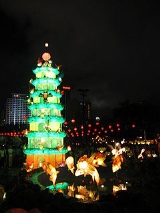
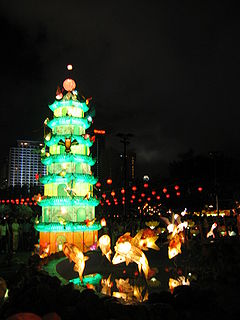
Mid-Autumn Festival

Encyclopedia
Harvest festival
A Harvest Festival is an annual celebration which occurs around the time of the main harvest of a given region. Given the differences in climate and crops around the world, harvest festivals can be found at various times throughout the world...
celebrated by Chinese
Han Chinese
Han Chinese are an ethnic group native to China and are the largest single ethnic group in the world.Han Chinese constitute about 92% of the population of the People's Republic of China , 98% of the population of the Republic of China , 78% of the population of Singapore, and about 20% of the...
and Vietnamese people
Vietnamese people
The Vietnamese people are an ethnic group originating from present-day northern Vietnam and southern China. They are the majority ethnic group of Vietnam, comprising 86% of the population as of the 1999 census, and are officially known as Kinh to distinguish them from other ethnic groups in Vietnam...
. A description of the festival first appeared in Rites of Zhou
Rites of Zhou
The Rites of Zhou , also known as Zhouguan, is one of three ancient ritual texts listed among the classics of Confucianism. It was later renamed Zhouli by Liu Xin to differentiate it from a chapter in the Classic of History which was also known as Zhouguan.Though tradition ascribed the text of the...
, a written collection of rituals of the Western Zhou Dynasty from 3,000 years ago. The celebration became popular during the early Tang Dynasty
Tang Dynasty
The Tang Dynasty was an imperial dynasty of China preceded by the Sui Dynasty and followed by the Five Dynasties and Ten Kingdoms Period. It was founded by the Li family, who seized power during the decline and collapse of the Sui Empire...
. The festival is held on the 15th day of the eighth month in the Chinese calendar
Chinese calendar
The Chinese calendar is a lunisolar calendar, incorporating elements of a lunar calendar with those of a solar calendar. It is not exclusive to China, but followed by many other Asian cultures as well...
, which is in September or early October in the Gregorian calendar
Gregorian calendar
The Gregorian calendar, also known as the Western calendar, or Christian calendar, is the internationally accepted civil calendar. It was introduced by Pope Gregory XIII, after whom the calendar was named, by a decree signed on 24 February 1582, a papal bull known by its opening words Inter...
, close to the autumnal equinox. The Government of the People's Republic of China
Government of the People's Republic of China
All power within the government of the People's Republic of China is divided among three bodies: the People's Republic of China, State Council, and the People's Liberation Army . This article is concerned with the formal structure of the state, its departments and their responsibilities...
listed the festival as an "intangible cultural heritage" in 2006, and it was made a Chinese public holiday
Public holidays in the People's Republic of China
There are currently seven official public holidays in the mainland territory of the People's Republic of China. There was a major reform in 2008, abolishing the Labour Day Golden Week and adding three traditional Chinese holidays...
in 2008. It is also a Taiwanese public holiday
Public holidays in the Republic of China
The following are considered holidays in the Republic of China . Some are official holidays, some are not:Gregorian calendarDateEnglish NameLocal NameRemarksJanuary 1Founding DayFounding of Republic of China on January 1, 1912...
.
Traditions
The Mid-Autumn Festival is one of the few most important holidays in the Chinese calendar, the others being Spring Festival and Winter Solstice. Accompanying the celebration, there are additional cultural or regional customs, such as:- Eating mooncakes.
- MatchmakingMatchmakingMatchmaking is any process of matching two people for the purpose of marriage or a sporting contest.-Practice:In some cultures, the role of the matchmaker was and is quite professionalized...
. In some parts of China, dances are held for young men and women to find partners. "One by one, young women are encouraged to throw their handkerchiefs to the crowd. The young man who catches and returns the handkerchief has a chance of romance." - Carrying brightly lit lanternLanternA lantern is a portable lighting device or mounted light fixture used to illuminate broad areas. Lanterns may also be used for signaling, as 'torches', or as general light sources outdoors . Low light level varieties are used for decoration. The term "lantern" is also used more generically to...
s, lighting lanterns on towers, floating sky lanternSky lanternSky lanterns, also known as Kongming Lantern are airborne paper lanterns traditionally found in some Asian cultures. They are constructed from oiled rice paper on a bamboo frame, and contain a small candle or fuel cell composed of a waxy flammable material. When lit, the flame heats the air inside...
s. - Burning incenseIncenseIncense is composed of aromatic biotic materials, which release fragrant smoke when burned. The term "incense" refers to the substance itself, rather than to the odor that it produces. It is used in religious ceremonies, ritual purification, aromatherapy, meditation, for creating a mood, and for...
in reverence to deities including Chang'eChang'e (mythology)Chang'e, Ch'ang-O, Chang-Ngo or Sheung Ngo , originally known as Heng'e or Heng-O , is the Chinese goddess of the Moon. Unlike many lunar deities in other cultures who personify the Moon, Chang'e only lives on the Moon...
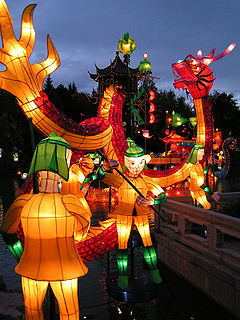
- Fire Dragon DanceDragon danceDragon dance is a form of traditional dance and performance in Chinese culture. Like the lion dance it is most often seen in festive celebrations. Many Chinese people often use the term "Descendants of the Dragon" as a sign of ethnic identity, as part of a trend started in the 1970s. Another...
s. - Moon rabbitMoon rabbitThe Moon rabbit, also called the Jade Rabbit, in folklore is a rabbit that lives on the moon, based on pareidolia that identifies the markings of the moon as a rabbit. The story exists in many cultures, particularly in East Asian folklore, where it is seen pounding in a mortar and pestle...
is a traditional icon.
Houyi and Chang'e
Celebration of the Mid-Autumn Festival is strongly associated with the legend of HouyiHouyi
Houyi , also called Yiyi or simply Yi, was a mythological Chinese archer and the leader of Dongyi. He is sometimes portrayed as a god of archery descended from heaven to aid mankind, and sometimes as the chief of the Youqiong Tribe during the reign of King Tai Kang of Xia Dynasty...
and Chang'e
Chang'e
Chang'e may refer to:* Chang'e - a traditional Chinese lunar goddess* The Chinese Chang'e space program, part of the Chinese Lunar Exploration Program :** Chang'e 1 - the first CLEP lunar orbiter, launched on 24 October 2007...
, the Moon Goddess
Goddess
A goddess is a female deity. In some cultures goddesses are associated with Earth, motherhood, love, and the household. In other cultures, goddesses also rule over war, death, and destruction as well as healing....
of Immortality
Immortality
Immortality is the ability to live forever. It is unknown whether human physical immortality is an achievable condition. Biological forms have inherent limitations which may or may not be able to be overcome through medical interventions or engineering...
. Tradition places these two figures from Chinese mythology
Chinese mythology
Chinese mythology is a collection of cultural history, folktales, and religions that have been passed down in oral or written tradition. These include creation myths and legends and myths concerning the founding of Chinese culture and the Chinese state...
at around 2200 BCE, during the reign of the legendary Emperor Yao, shortly after that of Huangdi. Unlike many lunar deities
Lunar deity
In mythology, a lunar deity is a god or goddess associated with or symbolizing the moon. These deities can have a variety of functions and traditions depending upon the culture, but they are often related to or an enemy of the solar deity. Even though they may be related, they are distinct from the...
in other cultures who personify the moon, Chang'e simply lives on the moon but is not the moon herself.
There are many variants and adaptations of the legend of Chang'e that frequently contradict each other. However, most versions of the legend involve some variation of the following elements: Houyi, the Archer, an emperor, either benevolent or malevolent, and an elixir of life
Elixir of life
The elixir of life, also known as the elixir of immortality and sometimes equated with the philosopher's stone, is a legendary potion, or drink, that grants the drinker eternal life and or eternal youth. Many practitioners of alchemy pursued it. The elixir of life was also said to be able to create...
.
One version of the legend states that Houyi was an immortal
Immortality
Immortality is the ability to live forever. It is unknown whether human physical immortality is an achievable condition. Biological forms have inherent limitations which may or may not be able to be overcome through medical interventions or engineering...
and Chang'e was a beautiful young girl, working in the palace of the Jade Emperor
Jade Emperor
The Jade Emperor in Chinese folk culture, is the ruler of Heaven and all realms of existence below including that of Man and Hell, according to a version of Taoist mythology. He is one of the most important gods of the Chinese traditional religion pantheon...
(the Emperor of Heaven, 玉帝 pinyin
Pinyin
Pinyin is the official system to transcribe Chinese characters into the Roman alphabet in China, Malaysia, Singapore and Taiwan. It is also often used to teach Mandarin Chinese and spell Chinese names in foreign publications and used as an input method to enter Chinese characters into...
:Yùdì) as an attendant to the Queen Mother of the West
Xi Wangmu
Xi Wangmu, literally Queen Mother of the West , is an ancient Chinese goddess, also known in Japan and Korea. Her origins can be traced back to oracle bone inscriptions of the 15th century BCE that record sacrifices to a "western mother". Even though these inscriptions illustrate that she predates...
(the Jade Emperor's wife). Houyi aroused the jealousy of the other immortals, who then slandered him before the Jade Emperor. Houyi and his wife, Chang'e, were subsequently banished from heaven. They were forced to live on Earth. Houyi had to hunt to survive and became a skilled and famous archer.
At that time, there were ten suns, in the form of three-legged bird
Three-legged bird
The three-legged crow is a creature found in various mythologies and arts of Asia, Asia Minor, and North Africa. It is believed by many cultures to inhabit and represent the sun....
s, residing in a mulberry
Mulberry
Morus is a genus of flowering plants in the family Moraceae. The 10–16 species of deciduous trees it contains are commonly known as Mulberries....
tree in the eastern sea. Each day one of the sun birds would have to travel around the world on a carriage
Carriage
A carriage is a wheeled vehicle for people, usually horse-drawn; litters and sedan chairs are excluded, since they are wheelless vehicles. The carriage is especially designed for private passenger use and for comfort or elegance, though some are also used to transport goods. It may be light,...
, driven by Xihe
Xihe (deity)
In Chinese mythology, Xihe is a Chinese sun goddess. The wife of Emperor Jun, she was once the 'mother' of ten suns, in the form of Three-legged birds, residing in a mulberry tree in the eastern sea named Fusang...
, the 'mother' of the suns. One day, all ten of the suns circled together, causing the Earth to burn. Emperor Yao, the Emperor of China, commanded Houyi to use his archery
Archery
Archery is the art, practice, or skill of propelling arrows with the use of a bow, from Latin arcus. Archery has historically been used for hunting and combat; in modern times, however, its main use is that of a recreational activity...
skill to shoot down all but one of the suns. Upon completion of his task, the Emperor rewarded Houyi with a pill that granted eternal life. Emperor Yao advised Houyi not to swallow the pill immediately but instead to prepare himself by praying and fasting
Fasting
Fasting is primarily the act of willingly abstaining from some or all food, drink, or both, for a period of time. An absolute fast is normally defined as abstinence from all food and liquid for a defined period, usually a single day , or several days. Other fasts may be only partially restrictive,...
for a year before taking it. Houyi took the pill home and hid it under a rafter
Rafter
A rafter is one of a series of sloped structural members , that extend from the ridge or hip to the downslope perimeter or eave, designed to support the roof deck and its associated loads.-Design:...
. One day, Houyi was summoned away again by Emperor Yao. During her husband's absence, Chang'e, noticed a white beam of light beckoning from the rafter
Rafter
A rafter is one of a series of sloped structural members , that extend from the ridge or hip to the downslope perimeter or eave, designed to support the roof deck and its associated loads.-Design:...
s, and discovered the pill. Chang'e swallowed it and immediately found that she could fly. Houyi returned home, realizing what had happened he began to reprimand his wife. Chang'e escaped by flying out the window into the sky.
Houyi pursued her halfway across the heavens but was forced to return to Earth because of strong winds. Chang'e reached the moon, where she coughed up part of the pill. Chang'e commanded the hare
Moon rabbit
The Moon rabbit, also called the Jade Rabbit, in folklore is a rabbit that lives on the moon, based on pareidolia that identifies the markings of the moon as a rabbit. The story exists in many cultures, particularly in East Asian folklore, where it is seen pounding in a mortar and pestle...
that lived on the moon to make another pill. Chang'e would then be able to return to Earth and her husband.
The legend states that the hare is still pounding herbs, trying to make the pill. Houyi built himself a palace in the sun, representing "Yang
Yin and yang
In Asian philosophy, the concept of yin yang , which is often referred to in the West as "yin and yang", is used to describe how polar opposites or seemingly contrary forces are interconnected and interdependent in the natural world, and how they give rise to each other in turn. Opposites thus only...
" (the male principle), in contrast to Chang'e's home on the moon which represents "Yin
Yin and yang
In Asian philosophy, the concept of yin yang , which is often referred to in the West as "yin and yang", is used to describe how polar opposites or seemingly contrary forces are interconnected and interdependent in the natural world, and how they give rise to each other in turn. Opposites thus only...
" (the female principle). Once a year, on the night of the Mid-Autumn Festival, Houyi visits his wife. That is the reason why the moon is very full and beautiful on that night.
This description appears in written form in two Western Han dynasty (206 BC-24 AD) collections; Shan Hai Jing
Shan Hai Jing
Shan Hai Jing is a Chinese classic text, and a compilation of early geography and myth. Versions of the text have existed since the 4th century BC, and by the early Han Dynasty it had reached its final form. It is largely a fabled geographical and cultural account of pre-Qin China as well as a...
, the Classic of the Mountains and Seas and Huainanzi
Huainanzi
The Huáinánzǐ is a 2nd century BCE Chinese philosophical classic from the Han dynasty that blends Daoist, Confucianist, and Legalist concepts, including theories such as Yin-Yang and the Five Phases. It was written under the patronage of Liu An, Prince of Huainan, a legendarily prodigious author...
, a philosophical classic.
Another version of the legend, similar to the one above, differs in saying that Chang'e swallowed the pill of immortality because Peng, one of Houyi's many apprentice archers, tried to force her to give the pill to him. Knowing that she could not fight off Peng, Chang'e had no choice but to swallow the pill herself.
Other versions say that Houyi and Chang'e were still immortals living in heaven at the time that Houyi killed nine of the suns. The sun birds were the sons of the Jade Emperor, who punished Houyi and Chang'e by forcing them to live on Earth as mortals. Seeing that Chang'e felt extremely miserable over her loss of immortality, Houyi decided to find the pill that would restore it. At the end of his quest, he met the Queen Mother of the West, who agreed to give him the pill, but warned him that each person would only need half a pill to regain immortality. Houyi brought the pill home and stored it in a case. He warned Chang'e not to open the case, and then left home for a while. Like Pandora
Pandora
In Greek mythology, Pandora was the first woman. As Hesiod related it, each god helped create her by giving her unique gifts...
in Greek mythology
Greek mythology
Greek mythology is the body of myths and legends belonging to the ancient Greeks, concerning their gods and heroes, the nature of the world, and the origins and significance of their own cult and ritual practices. They were a part of religion in ancient Greece...
, Chang'e became curious. She opened up the case and found the pill, just as Houyi was returning home. Nervous that Houyi would catch her, discovering the contents of the case, she accidentally swallowed the entire pill, and started to float into the sky because of the overdose.
Some versions of the legend do not refer to Houyi or Chang'e as having previously been immortals and initially present them as mortals instead.
There are also versions of the story in which Houyi was made king as a reward for killing nine of the suns and saving the people. However, King Houyi became a despot
Despot
Despot may refer to:* Despot , a Byzantine court title* Despotism, a form of government in which power is concentrated in the hands of an individual or a small groupPeople with the surname Despot:...
who either stole a pill of immortality from the Queen Mother of the West or learned that he could make such a pill by grinding up the body of a different adolescent boy every night for a hundred nights. Chang'e stole the pill and swallowed it herself, either to stop more boys being killed or to prevent her husband's tyrannical rule from lasting forever.
The Hare or The Jade Rabbit
According to tradition, the Jade Rabbit pounds medicine, together with the lady, Chang'e, for the gods. Others say that the Jade Rabbit is a shape, assumed by Chang'e herself. The dark areas to the top of the full moon may be construed as the figure of a rabbit. The animal's ears point to the upper right, while at the left are two large circular areas, representing its head and body.Overthrow of Mongol rule
According to a widespread folk tale (not necessarily supported by historical records), the Mid-Autumn Festival commemorates an uprising in ChinaChina
Chinese civilization may refer to:* China for more general discussion of the country.* Chinese culture* Greater China, the transnational community of ethnic Chinese.* History of China* Sinosphere, the area historically affected by Chinese culture...
against the Mongol rulers of the Yuan Dynasty
Yuan Dynasty
The Yuan Dynasty , or Great Yuan Empire was a ruling dynasty founded by the Mongol leader Kublai Khan, who ruled most of present-day China, all of modern Mongolia and its surrounding areas, lasting officially from 1271 to 1368. It is considered both as a division of the Mongol Empire and as an...
(1280–1368) in the 14th century. As group gatherings were banned, it was impossible to make plans for a rebellion
Rebellion
Rebellion, uprising or insurrection, is a refusal of obedience or order. It may, therefore, be seen as encompassing a range of behaviors aimed at destroying or replacing an established authority such as a government or a head of state...
. Noting that the Mongols did not eat mooncake
Mooncake
Mooncake is a Chinese bakery product traditionally eaten during the Mid-Autumn Festival / Zhongqiu Festival. The festival is for lunar worship and moon watching; mooncakes are regarded as an indispensable delicacy on this occasion. Mooncakes are offered between friends or on family gatherings...
s, Liu Bowen (劉伯溫) of Zhejiang Province, advisor to the Chinese rebel leader Zhu Yuanzhang, came up with the idea of timing the rebellion to coincide with the Mid-Autumn Festival. He sought permission to distribute thousands of moon cakes to the Chinese residents in the city to bless the longevity of the Mongol emperor. Inside each cake, however, was inserted a piece of paper with the message: "Kill the Mongols on the 15th day of the 8th month" (traditional Chinese: 八月十五殺韃子; simplified Chinese: 八月十五杀鞑子). On the night of the Moon Festival, the rebels successfully attacked and overthrew the government. What followed was the establishment of the Ming Dynasty
Ming Dynasty
The Ming Dynasty, also Empire of the Great Ming, was the ruling dynasty of China from 1368 to 1644, following the collapse of the Mongol-led Yuan Dynasty. The Ming, "one of the greatest eras of orderly government and social stability in human history", was the last dynasty in China ruled by ethnic...
(1368–1644), under Zhu
Hongwu Emperor
The Hongwu Emperor , known variably by his given name Zhu Yuanzhang and by his temple name Taizu of Ming , was the founder and first emperor of the Ming Dynasty of China...
. Henceforth, the Mid-Autumn Festival was celebrated with moon cakes on a national level.
Taiwanese version
Since the middle of the 1980’s, Taiwanese started the trend of barbecuing with friends and family at the Mid-Autumn Festival. This trend traces from different statements, some say that it started because of the boost of commercial companies, others say that it is because people usually get hungry when they are watching the moon, so outdoors barbecue has become widespread among people. However, the take-off of the Taiwanese economy and the influence of western life styles was also a reason which made people change their traditional customs.Mooncakes are typically round but smaller, with less elaborate fillings. More recently, some versions of the cake from Hong Kong seem to be gaining popularity.
Vietnamese version
Vietnam
Vietnam – sometimes spelled Viet Nam , officially the Socialist Republic of Vietnam – is the easternmost country on the Indochina Peninsula in Southeast Asia. It is bordered by China to the north, Laos to the northwest, Cambodia to the southwest, and the South China Sea –...
ese.
The Vietnamese version of the holiday recounts the legend of Cuội, whose wife accidentally urinated on a sacred banyan
Banyan
A banyan is a fig that starts its life as an epiphyte when its seeds germinate in the cracks and crevices on a host tree...
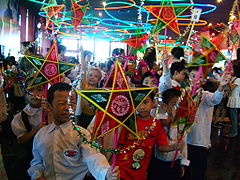
tree. Soon after desecrating the tree, she sat on one of the tree branches and the sacred tree began to grow and continued until it finally reached the moon, leaving Cuội's wife stranded there. Every year, during the Mid-Autumn Festival, children light lanterns and participate in a procession to show Cuội's wife the way back to Earth.
In Vietnam, Mooncakes are typically square rather than round, though round ones do exist.
Besides the indigenous tale of the banyan tree, other legends are widely told including the story of the Moon Lady, and the story of the carp who wanted to become a dragon.
One important event before and during the Vietnamese Mid-Autumn Festival are lion dance
Lion dance
Lion dance is a form of traditional dance in Chinese culture, in which performers mimic a lion's movements in a lion costume. The lion dance is often mistakenly referred to as dragon dance. An easy way to tell the difference is that a lion is operated by two people, while a dragon needs many people...
s. Dances are performed by both non-professional children's groups and trained professional groups. Lion dance groups perform on the streets, going to houses asking for permission to perform for them. If the host consents, the "lion" will come in and start dancing as a blessing of luck and fortune for the home. In return, the host gives luck money to show their gratitude.
Dates
The Mid-Autumn Festival is held on the 15th day of the eighth month in the Chinese calendar, which is in September or early October in the Gregorian calendar. In 2010 the Mid-Autumn Festival fell on September 22. It will occur on these days in coming years:- 2012: September 30
- 2013: September 19
- 2014: September 8
- 2015: September 27
- 2016: September 15
- 2017: October 4
- 2018: September 24
- 2019: September 13
- 2020: October 1
See also
- Chinese New YearChinese New YearChinese New Year – often called Chinese Lunar New Year although it actually is lunisolar – is the most important of the traditional Chinese holidays. It is an all East and South-East-Asia celebration...
- Chinese holidays
- List of Harvest Festivals
- Tidal bore of Qiantang RiverQiantang RiverThe Qiantang River is a southeast Chinese river that originates in the borders of Anhui and Jiangxi provinces and passes through Hangzhou, the capital of Zhejiang province, before flowing into the East China Sea through Hangzhou Bay....
- Vietnamese holidays
- Vietnamese culture