


Charles Sumner

Encyclopedia
Charles Sumner was an American politician and senator from Massachusetts. An academic lawyer and a powerful orator, Sumner was the leader of the antislavery forces in Massachusetts and a leader of the Radical Republicans in the United States Senate during the American Civil War
and Reconstruction, working to punish the ex-Confederates and guarantee equal rights to the Freedmen.
Sumner changed his political party several times, gaining fame as a Republican. One of the most learned statesmen of the era, he specialized in foreign affairs, working closely with Abraham Lincoln
to keep the British and the French from intervening on the side of the Confederacy during the Civil War. He devoted his enormous energies to the destruction of what he considered the Slave Power
, that is the efforts of slave owners to take control of the federal government and ensure the survival and expansion of slavery.
In 1856, South Carolina Representative Preston Brooks
nearly killed Sumner on the Senate floor for ridiculing slaveowners as pimps in his vitriolic denunciation of the "Crime against Kansas." After three years of medical treatment Sumner returned to the Senate as the war began. He became the chief Senate spokesman on foreign affairs, and a leader of the Radical Republicans who sought to destroy slavery and radically transform the South. As the chief Radical leader in the Senate during Reconstruction, 1865–1871, Sumner fought hard to provide equal civil and voting rights for the freedmen on the grounds that "consent of the governed
" was a basic principle of American republicanism
, and to block ex-Confederates from power so they would not reverse the North's victory in the Civil War. Sumner, teaming with House leader Thaddeus Stevens
, defeated Andrew Johnson
's reconstruction plans and imposed Radical views on the South. In 1871, however, he broke with President Ulysses Grant. Grant's Senate supporters then took away Sumner's power base, his committee chairmanship. Sumner concluded that Grant's corrupt despotism and the success of Reconstruction policies called for new national leadership. He opposed Grant's reelection by supporting the Liberal Republican
candidate Horace Greeley
in 1872 and lost his power inside the Republican party.
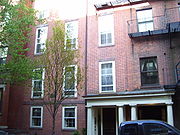
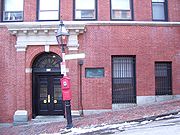 Sumner was born on Irving Street in Boston
on January 6, 1811. He was the son of Charles Pinckney Sumner, a progressive Harvard
-educated lawyer, abolitionist, and early proponent of racially integrated schools, who shocked 19th century Boston by opposing anti-miscegenation
laws. His father had been born in poverty and his mother shared a similar background and worked as a seamstress prior to her marriage. Sumner's parents were described as exceedingly formal and undemonstrative. His father's legal practice was a failure, and throughout Sumner's childhood his family teetered on the edge of the middle class. The family attended Trinity Church, but after 1825 the family occupied a pew in King's Chapel
.
Sumner's father hated slavery and told Sumner that freeing the slaves would "do us no good" unless they were treated equally by society. Sumner was a close associate of William Ellery Channing
, an influential Unitarian minister in Boston. Channing believed that human beings had an infinite potential to improve themselves. Expanding on this argument, Sumner concluded that environment had "an important, if not controlling influence" in shaping individuals. By creating a society where "knowledge, virtue and religion" took precedence, "the most forlorn shall grow into forms of unimagined strength and beauty." Moral law, he believed, was as important for governments as it was for individuals, and legal institutions that inhibited ones ability to grow—like slavery or segregation—were evil. While Sumner often viewed contemporary society critically, his faith in reform was unshakable. When accused of utopianism, he replied "The Utopias of one age have been the realities of the next."
Sumner attended the Boston Latin School
, where he counted Robert Charles Winthrop
, James Freeman Clarke
, Samuel Francis Smith
, and Wendell Phillips
, among his closest friends. He graduated in 1830 from Harvard College, where he lived in Hollis Hall, and in 1834 from Harvard Law School
where he became a protege of Joseph Story
. At Harvard, he was a member of the Porcellian Club
.
In 1834, Sumner was admitted to the bar and entered private practice in Boston in partnership with George Stillman Hillard
. A visit to Washington decided him against a political career, and he returned to Boston resolved to practice law. He contributed to the quarterly American Jurist and edited Story's court decisions as well as some law texts. From 1836 to 1837, Sumner lectured at Harvard Law School.
He joined other Americans who were studying medicine on morning rounds at the city's great hospitals. In the course of three more years he became fluent in Spanish, German, and Italian, and he met with many of the leading statesmen in Europe. In 1838, Sumner visited Britain, where Lord Brougham
declared that he "had never met with any man of Sumner's age of such extensive legal knowledge and natural legal intellect." He returned to the U.S. in 1840.
Sumner developed friendships with several prominent Bostonians, particularly Henry Wadsworth Longfellow
, whose house he visited regularly in the 1840s. Longfellow's daughters found his stateliness amusing. Sumner would ceremoniously open doors for the children while saying "In presequas" in a sonorous tone.
In 1845, he delivered an Independence Day oration on "The True Grandeur of Nations" in Boston. He spoke against the Mexican-American War and made an impassioned appeal for freedom and peace.
He became a sought-after orator for formal occasions. His lofty themes and stately eloquence made a profound impression. His platform presence was imposing. He stood six feet and four inches tall, with a massive frame. His voice was clear and of great power. His gestures were unconventional and individual, but vigorous and impressive. His literary style was florid, with much detail, allusion, and quotation, often from the Bible as well as the Greeks and Romans. Henry Wadsworth Longfellow
wrote that he delivered speeches "like a cannoneer ramming down cartridges," while Sumner himself said that "you might as well look for a joke in the Book of Revelation."
Following the annexation of Texas as a new slave-holding state in 1845, Sumner took an active role in the anti-slavery movement. That same year, Sumner represented the plaintiffs in Roberts v. Boston
, a case which challenged the legality of segregation
. Arguing before the Massachusetts Supreme Court
, Sumner noted that schools for blacks were physically inferior and that segregation bred harmful psychological and sociological effects—arguments that would be made in Brown v. Board of Education
over a century later. Sumner lost the case, but the Massachusetts legislature abolished school segregation in 1855.
Sumner worked with Horace Mann
to improve the system of public education in Massachusetts. He advocated prison reform
. In opposing the Mexican-American War, he considered it a war of aggression, but was primarily concerned that captured territories would expand slavery westward. In 1847, Sumner denounced a Boston Representative's vote for the declaration of war against Mexico with such vigor that he became a leader of the Conscience Whigs
faction of the Massachusetts Whig Party
. He declined to accept their nomination for U.S Representative in 1848.
Instead, Sumner helped organize the Free Soil Party
, which opposed both the Democrats and the Whigs, who had nominated Zachary Taylor
, a slave-owning Southerner, for President. Sumner ran for U.S. Representative as a Free Soil candidate and lost.
In 1851, Democrats gained control of the Massachusetts state legislature in coalition with the Free Soilers. The Free Soilers named Sumner their choice for U.S. Senator. The Democrats initially opposed him and called for a less radical candidate. The impasse was broken after three months and Sumner was elected by a one-vote majority on April 24, 1851. His election marked a sharp break in Massachusetts politics, as his abolitionist politics contrasted sharply those of the senator whose seat he occupied, Daniel Webster
, one of the foremost supporters of the Compromise of 1850
and its Fugitive Slave Act.
urged that there be no reply: "The ravings of a maniac may sometimes be dangerous, but the barking of a puppy never did any harm." Sumner's outspoken opposition to slavery made him few friends in the Senate.
Though the conventions of both major parties had just affirmed the finality of every provision of the Compromise of 1850
, including the Fugitive Slave Act, Sumner called for the Act's repeal. For more than three hours he denounced it as a violation of the Constitution, an affront to the public conscience, and an offense against divine law. The speech provoked a storm of anger in the South, but it made Sumner's reputation in the North.
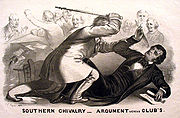 In 1856, during the "Bleeding Kansas
" crisis, Sumner denounced the Kansas-Nebraska Act
. In his "Crime against Kansas" speech on May 19 and May 20, Sumner attacked the Act. Its motivation, he said, was to rape a virgin:
Sumner then attacked authors of the Act, Senators Stephen A. Douglas
of Illinois and Andrew Butler
of South Carolina. He said that Butler had taken "a mistress who, though ugly to others, is always lovely to him; though polluted in the sight of the world, is chaste in his sight—I mean, the harlot, Slavery." According to Hoffer (2010), "It is also important to note the sexual imagery that recurred throughout the oration, which was neither accidental nor without precedent. Abolitionists routinely accused slaveholders of maintaining slavery so that they could engage in forcible sexual relations with their slaves." Sumner also attacked the honor of South Carolina having alluded in his speech that the history of the state be "blotted out of existence..."
Sumner's three-hour oration also mocked the 59-year-old Butler's manner of speech and physical mannerisms, which were impaired by a stroke. Douglas said to a colleague during the speech that "this damn fool Sumner is going to get himself shot by some other damn fool."
Representative Preston Brooks
, Butler's nephew, was infuriated, intended to challenge Sumner to a duel, and consulted with fellow South Carolina Representative Laurence M. Keitt
on dueling etiquette. Keitt told him that dueling was for gentlemen of equal social standing, and that Sumner was no better than a drunkard, due to the supposedly coarse language he had used during his speech. Brooks concluded in turn that since Sumner was no gentlemen, it would be more appropriate to beat him with his cane.
Two days later, on the afternoon of May 22, Brooks confronted Sumner as he sat writing at his desk in the almost empty Senate chamber: "Mr. Sumner, I have read your speech twice over carefully. It is a libel on South Carolina, and Mr. Butler, who is a relative of mine." As Sumner began to stand up, Brooks beat Sumner severely on the head before he could reach his feet, using a thick gutta-percha
cane with a gold head. Sumner was knocked down and trapped under the heavy desk (which was bolted to the floor), but Brooks continued to strike Sumner until Sumner ripped the desk from the floor. By this time, Sumner was blinded by his own blood, and he staggered up the aisle and collapsed, lapsing into unconsciousness. Brooks continued to beat the motionless Sumner until his cane broke at which point he left the chamber. Several other Senators attempted to help Sumner, but were blocked by Keitt who brandished a pistol and shouted, "Let them be!" Keitt was censured for his actions.
Brooks was later fined $300 for his actions.
The attack revealed the increasing polarization of the United States at that time, as Sumner became a martyr in the North and Brooks a hero in the South. Northerners were outraged. The editor of the New York Evening Post
, William Cullen Bryant
, wrote:
The outrage in the North was loud and strong. Thousands attended rallies in support of Sumner in Boston, Albany, Cleveland, Detroit, New Haven, New York, and Providence. More than a million copies of Sumner's speech were distributed. Two weeks after the caning, Ralph Waldo Emerson described the divide the incident represented: "I do not see how a barbarous community and a civilized community can constitute one state. I think we must get rid of slavery, or we must get rid of freedom." Conversely, Brooks was praised by Southern newspapers. The Richmond Enquirer editorialized that Sumner should be caned "every morning," praising the attack as "good in conception, better in execution, and best of all in consequences" and denounced "these vulgar abolitionists in the Senate" who "have been suffered to run too long without collars. They must be lashed into submission." Many Southerners sent Brooks new canes, in endorsement of his assault. Historian William Gienapp has suggested that Brooks' "assault was of critical importance in transforming the struggling Republican party into a major political force."
, Sumner suffered from nightmares, severe headaches, and what is now understood to be post-traumatic stress disorder
or "psychic wounds." When he spent months convalescing, his political enemies ridiculed him and accused him of cowardice for not resuming his duties. The Massachusetts General Court reelected him in November 1856, believing that his vacant chair in the Senate chamber served as a powerful symbol of free speech and resistance to slavery.
When he returned to the Senate in 1857, he was unable to last a day. His doctors advised a sea voyage and "a complete separation from the cares and responsibilities that must beset him at home." He sailed for Europe and immediately found relief. During two months in Paris in the spring of 1857, he renewed friendships, especially with Thomas Gold Appleton
, dined out frequently, and attended the opera several nights in a row. His contacts there included Alexis de Tocqueville
, poet Alphonse de Lamartine
, former French Prime Minister François Guizot
, Ivan Turgenev
, and Harriet Beecher Stowe
. Sumner then toured several countries, including Germany and Scotland, before returning to Washington where he spent only a few days in the Senate in December. Both then and during several later attempts to return to work, he found himself exhausted just listening to Senate business. He sailed once more for Europe on May 22, 1858, the second anniversary of Brooks' attack.
In Paris, prominent physician Charles-Édouard Brown-Séquard
diagnosed Sumner's condition as spinal cord damage that he could treat by burning the skin along the spinal cord. Sumner chose to refuse anesthesia, which was thought to reduce the effectiveness of the procedure. Observers both at the time and since doubt Brown-Séquard's efforts were of value. After spending weeks recovering from these treatments, Sumner resumed his touring, this time traveling as far east as Dresden and Prague and south to Italy twice. In France he visited Brittany and Normandy, as well as Montpellier. He wrote his brother: "If anyone cares to know how I am doing, you can say better and better."
, and Sen. Benjamin Wade
. During the American Civil War
, after the fall of Fort Sumter
, in April 1861, Sumner, Chandler and Wade repeatedly visited President Abraham Lincoln
at the White House
speaking on slavery and the rebellion. Although like-minded on slavery, the Radicals were loosely organized and disagreed with one another on other issues such as the tariff and currency issues.
, Maryland
, Kentucky
, and Missouri
would be encouraged to join the Confederacy
. Sen. Sumner, however, knew that the pressure of the Civil War would eventually cause President Lincoln to free the slaves. As a compromise, the Radicals and President Lincoln passed two Confiscation Acts in 1861 and 1862 that allowed the Union military to free confiscated slaves who were carrying weapons, among other tasks, for the Confederate army. Sen. Sumner and other Radicals had persistently advocated that President Lincoln emancipate the slaves. Lincoln, however, had adopted a moderated plan of gradual emancipation of slaves and compensation to the slave owners. Sen. Sumner believed that emancipating the slaves would keep Britain from entering the Civil War and the millions of slaves freed from bondage would give America higher moral standing. Lincoln described Sumner as "my idea of a bishop", and consulted him as an embodiment of the conscience of the American people. On January 1, 1863 President Lincoln, out of military necessity, issued the Emancipation Proclamation
.
, whose purpose was to investigate battle defeats and determine the loyalty of generals fighting for the Union War effort. The committee was formed at the instigation of Radical Sen. Chandler after the Union defeat at the Battle of Ball's Bluff
, under the command of Union Brig. General Charles P. Stone. At the Ball's Bluff battle on October 21, 1861, Union Senator and Colonel Edward D. Baker, who was a close friend of President Lincoln's, was killed and Brig. Gen. Stone was blamed for the defeat by the Union press. Sen. Sumner, upset at having learned Brig. Gen. Stone had ordered two runaway slaves to be denied asylum
in the Union Army, castigated Brig. Gen. Stone in a Senate speech. Brig. Gen. Stone wrote Sen. Sumner a terse letter and demanded satisfaction
from Sen. Sumner. On January 31, 1862 Brig. Gen. Stone defended himself in front of the Senate Committee under Radical chairman Sen. Wade. Indicted under suspicion of treason, without any trial, Brig. Gen. Stone was arrested on February 8, 1862 and federally imprisoned for 189 days.
and emancipate the slaves. The speech caused controversy among the conservative Boston press. Sen. Sumner's speech was denounced as incendiary
and Sumner was viewed as mentally ill and a "candidate for the insane asylum". The Free Soil faction of the Republican Party fully endorsed Sen. Sumner's speech. Sumner continued to make public speeches that the goal of the Civil War was to end slavery by emancipation.
, under the command of Capt. Charles Wilkes
, intercepted the British steamer, RMS Trent
, captured and put into U.S. port custody two Confederate diplomats James M. Mason
and John Slidell
. The northern people and press were in favor of the capture, however, there was concern that the British would use this as grounds to go to war with the United States. The British government dispatched 8,000 British troops on the Canadian border and efforts were made to strengthen the British fleet. Sec. Seward believed that Mason and Slidell were contraband of war. Sen. Sumner, however, believed that the men did not qualify as war contraband, since they were unarmed, and that their release with an apology by the U.S. Government was appropriate. In the Senate, Sen. Sumner suppressed open debate in order to save Lincoln’s administration from embarrassment. On December 25, 1861 at Lincoln's invitation, Sumner read letters he received from prominent British political figures, including Cobden
, Bright
, Gladstone
, and the Duke of Argyll, to Lincoln's Cabinet. The letters provided critical information on political sentiment in Britain and supported the envoys' return to the British. President Lincoln reluctantly ordered the release of the Confederate captives to British custody and apologized for their capture. After the Trent Affair, Sen. Sumner's reputation improved among conservative Northerners.
of Haiti
. Haiti had sought recognition since winning independence in 1804 but faced opposition from Southern Senators. In their absence, the U.S. recognized Haiti in 1862.
case. Speaking on the Senate Floor of the United States, in an argument with Sen. Lyman Trumbull
, Sen. Sumner, who objected to the memorials creation, stated:
and in order to keep ex-Confederates from gaining political offices and undoing the North's victory in the Civil War.
The Reconstruction Era of the United States after the American Civil War
has traditionally been viewed as one of Southern exploitation and corruption by Northern politicians and harsh federal policies by the Radical Republicans. The plight of the freedmen during Reconstruction was largely ignored by conservative historians who followed the Dunning School
. According to historian Eric Foner, during the 1960's revisionist historians have reinterpreted Reconstruction "in the light of changed attitudes toward the place of blacks within American society." Charles Sumner, a Radical Republican, has emerged as an idealist and a champion for African American civil rights through this turbulent and controversial period of United States History.
Sumner and his fellow Radicals overrode President Johnson's vetoes and imposed some of their views, though Sumner's most radical ideas were not implemented.
Sumner's radical theory of Reconstruction proposed that nothing restricted the Congress in determining how to treat the 11 defeated states. He argued that by declaring secession
they had committed felo de se
(state suicide) and were now conquered territories that should be treated as if they had never been states. He objected to Lincoln's and later Andrew Johnson
's more lenient Reconstruction policies as too generous to the South and an encroachment upon the powers of Congress.
Sumner was a friend of Samuel Gridley Howe
and a guiding force for the American Freedmen's Inquiry Commission
, started in 1863. He was one of the most prominent advocates for suffrage for blacks, along with free homesteads and free public schools. His uncompromising attitude did not endear him to moderates and sometimes inhibited his effectiveness as a legislator. He was largely excluded from work on the Thirteenth Amendment
, in part because he did not get along with Illinois Senator Lyman Trumbull
, who chaired the Senate Judiciary Committee and did much of the work on it. Sumner introduced an alternative amendment that combined the Thirteenth Amendment with elements of the Fourteenth Amendment
. It would have abolished slavery and declared that "all people are equal before the law". During Reconstruction, he often attacked civil rights legislation as inadequate and fought for legislation to give land to freed slaves. He viewed segregation and slavery as two sides of the same coin. He introduced a civil rights bill in 1872 to mandate equal accommodation in all public places and required suits brought under the bill to be argued in the federal courts. The bill failed, but Sumner still spoke of it on his deathbed.
Sumner repeatedly tried to remove the word "white" from naturalization laws. He introduced bills to that effect in 1868 and 1869, but neither came to a vote. On July 2, 1870, Sumner moved to amend a pending bill in a way that would strike the word "white" wherever in all Congressional acts pertaining to naturalization
of immigrants. On July 4, 1870, he said: "Senators undertake to disturb us ...by reminding us of the possibility of large numbers swarming from China
; but the answer to all this is very obvious and very simple. If the Chinese come here, they will come for citizenship or merely for labor. If they come for citizenship, then in this desire do they give a pledge of loyalty to our institutions; and where is the peril in such vows? They are peaceful and industrious; how can their citizenship be the occasion of solicitude?" He accused legislators promoting anti-Chinese legislation of betraying the principles of the Declaration of Independence
: "Worse than any heathen or pagan abroad are those in our midst who are false to our institutions." Sumner's bill failed, and from 1870 to 1943, and in some cases as late as 1952, Chinese and other Asians were ineligible for U.S. citizenship.
and Russian representative Edouard de Stoeckl met in Washington D.C. and negotiated a treaty for the annexation and sale of the Russian American territory of Alaska
to the United States for $7,200,000. President Johnson submitted the treaty to Congress for ratification with Sumner’s approval and on April 9, his foreign relations committee approved and sent the treaty to the Senate. In a 3-hour speech Sumner spoke in favor of the treaty on the Senate floor describing in detail Alaska’s imperial history, natural resources, population, and climate. Sumner wanted to block British expansion (from Canada), arguing that Alaska be geographically and financially strategic, especially for the Pacific Coast States. He said Alaska would increase America’s borders; spread republican institutions; and represent an act of friendship with Russia. The treaty won its needed two-thirds majority by one vote.
The treaty did not legally recognize any Alaska Eskimoes and Indians; only referring to them as “uncivilized tribes” under the control of Congress. By federal law, Native Alaskan tribes, including the Inuit
, the Aleut
, and the Athabascan were only entitled to land that they inhabited. According to treaty, native Alaskan tribes were excluded from United States citizenship. However, citizenship was available to Russian residents.
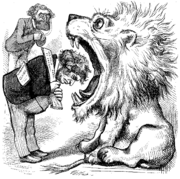 Sumner was well regarded in Great Britain, but after the war he sacrificed his reputation in Britain by his stand on U.S. claims for British breaches of neutrality. The U.S. had claims against Britain for the damage inflicted by Confederate raiding ships fitted out in British ports. Sumner held that since Britain had accorded the rights of belligerent
s to the Confederacy, it was responsible for extending the duration of the war and consequent losses. In 1869, he asserted that Britain should pay damages not merely for the raiders, but also for "that other damage, immense and infinite, caused by the prolongation of the war." He demanded $2,000,000 for these "national claims" in addition to $125,000,000 for damages from the raiders. Sumner did not expect that Britain ever would or could pay this immense sum, but he suggested that Britain turn over Canada
as payment. This proposition offended many Britons, and was not taken seriously by anyone. At the Geneva arbitration conference
which settled U.S. claims against Britain, these "national claims" were abandoned.
Sumner had some influence over J. Lothrop Motley, the U.S. ambassador
to Britain, causing him to disregard the instructions of Secretary of State
Hamilton Fish
on the matter. This offended President Grant and was given as the official reason for Motley's removal.
, then known as Santo Domingo. In July and November 1869, under authority of the President Grant and perimission by the State Department, Orville Babcock, private secretary to President Grant, secretly negotiated a treaty with President Buenaventura Báez
, President of the Dominican Republic. The initial treaty by Babcock had not been authorized by the State Department. The island nation, however, was on the verge of a civil war between President Báez and ex-President Marcos A. Cabral. President Grant sent in the U.S. Navy to keep the Dominican Republic free from invasion and civil war while the treaty negotiations took place. This military action was controversial since the naval protection was unauthorized by the U.S. Congress. The official treaty, drafted by Secretary of State Hamilton Fish in October 1869, annexed the Dominican Republic into the United States, gave eventual statehood, the lease of Samaná Bay
for $150,000 yearly, and a $1,500,000 payment of the Dominican national debt. In January 1870, in order to gain support for the treaty, President Grant visited Sen. Sumner's Washington home and mistakenly believed that Sumner had given consent for the treaty. Sen. Sumner stated that he would give the treaty consideration. This meeting would later lead to bitter contention between Sumner and Grant. The treaty was formally submitted to the United States Senate
on January 10, 1870.
Sen. Sumner, opposed to American imperialism in the Caribbean
, was adamant to keep the island nation independent. As chairman of the Senate Foreign Relations Committee, Sen. Sumner initially withheld his opinion on the treaty on January 18, 1870. Sen. Sumner had been leaked information from Assistant Secretary of State, Bancroft Davis
, that U.S. Naval ships were being used to protect President Báez. Sen. Sumner' s committee voted against annexation and at Sen. Sumner’s suggestion, the Senate did not allow open debate of the treaty. President Grant persisted and sent messages to Congress in favor of annexation on March 14, 1870 and May 31, 1870. Grant believed that the mineral resources on the island would be valuable to the United States, and that African Americans repressed in the South, would have a safe haven to migrate. A labor shortage in the South would force Southerners to be tolerant towards African Americans. In closed session, Sen. Sumner spoke out against the treaty; having believed there would be difficulty with the foreign nationals, the chronic rebellion that took place on the island, and the African independence of Haiti, recognized by the United States in 1862, would be taken away. Finally, on June 30, 1870 the treaty was voted on by the Senate and defeated having failed to gain the required 2/3 majority for treaty passage.
The following day, President Grant, feeling betrayed by Sen. Sumner, immediately retaliated by recalling Sumner’s close friend, J. Lothrop Motley
, Ambassador to Britain. President Grant then initiated a campaign to dispose of Sen. Sumner from the chairmanship of the Senate Foreign Relations Committee. As the rift between Grant and Sumner increased, Sumner’s health began to decline. When the 42nd U.S. Congress convened on March 4, 1871 Senators affiliated with President Grant, known as ‘’New Radicals’’ voted to oust Sen. Sumner from the Senate Foreign Relations Committee chairmanship.
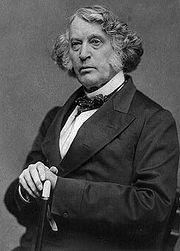 Sumner now turned against Grant. Like many other reformers, he decried the corruption in Grant's administration. Sumner believed that the civil rights program he championed could not be carried through by a corrupt government. In 1872, he joined the Liberal Republican Party
which had been started by reformist Republicans such as Horace Greeley
. The Liberal Republicans supported black suffrage and civil rights, but they also called for amnesty for ex-Confederates and an end to military occupation of the South because they thought the main goals of Reconstruction had been completed and that further military interference in politics was un-American. Sumner joined them because he believed now was the time for reconciliation and an end to wartime hatreds.
Sumner promoted conciliatory positions. In 1872, he introduced a Senate resolution providing that Civil War battle names should not appear as "battle honors" on the regimental flags of the U.S. Army. This offended Union army veterans. The Massachusetts legislature denounced this battle-flag resolution as "an insult to the loyal soldiery of the nation" and as "meeting the unqualified condemnation of the people of the Commonwealth." poet John Greenleaf Whittier
led an effort to rescind that censure and succeeded early in 1874.
Sumner remained a champion of civil rights for blacks. He was a co-author of the Civil Rights Act of 1875
, which was introduced in 1870, and enacted a year after his death. It was the last civil rights legislation for 82 years. The Supreme Court ruled it unconstitutional in 1883 when it decided a group of cases known as the Civil Rights Cases
.
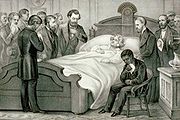
Charles Sumner died of a heart attack at his home in Washington, D.C., on March 11, 1874. He lay in state in the U.S. Capitol rotunda
, the first Senator to do so. At his March 16 burial in Mount Auburn Cemetery
in Cambridge, Massachusetts
, the pallbearers included Henry Wadsworth Longfellow
, Oliver Wendell Holmes, Ralph Waldo Emerson
, and John Greenleaf Whittier
.
praised Sumner's integrity, his "moral courage," the "sincerity of his convictions," and the "disinterestedness of his motives." However, Sumner's Pulitzer-prize-winning biographer, David Donald
, presents Sumner as an insufferably arrogant moralist; an egoist bloated with pride; pontifical and Olympian, and unable to distinguish between large issues and small ones. What's more, concludes Donald, Sumner was a coward who avoided confrontations with his many enemies, whom he routinely insulted in prepared speeches.
Biographers have varied in their appraisal of Sumner. The Pulitzer Prize went to biographer David Donald
whose two-volume biography points up Sumner's troubles in dealing with his colleagues:
Moorfield Storey, Sumner's private secretary for two years and subsequent biographer, seeing some of the same qualities, interprets them more kindly:
 Sumner's reputation among historians in the first half of the 20th century was largely negative—he was blamed especially for the excesses or Radical Reconstruction. Both the Dunning School
and the anti-Dunning revisionists were especially negative regarding his performance during Reconstruction. However in recent years scholars have emphasized his role as a foremost champions of black rights before, during and after the Civil War; one historian says he was "perhaps the least racist man in America in his day."
Ralph Waldo Emerson
, a man not prone to false flattery, wrote of Sumner:
, in 1866 and the two were married that October. Their marriage was unhappy. Sumner could not respond to his wife's humor, and Hooper had a ferocious temper. That winter, Hooper began going out to public events with Friedrich von Holstein
, a Prussian diplomat. The relationship caused gossip in Washington, and Hooper refused to stop seeing him. When Holstein was recalled to Prussia in the spring of 1867, Hooper accused Sumner of engineering the action, which Sumner always denied. They separated the following September. Sumner's enemies used the affair to attack Sumner's manhood, calling Sumner "The Great Impotency". The situation depressed and embarrassed Sumner. Sumner obtained an uncontested divorced on the grounds of desertion on May 10, 1873.
American Civil War
The American Civil War was a civil war fought in the United States of America. In response to the election of Abraham Lincoln as President of the United States, 11 southern slave states declared their secession from the United States and formed the Confederate States of America ; the other 25...
and Reconstruction, working to punish the ex-Confederates and guarantee equal rights to the Freedmen.
Sumner changed his political party several times, gaining fame as a Republican. One of the most learned statesmen of the era, he specialized in foreign affairs, working closely with Abraham Lincoln
Abraham Lincoln
Abraham Lincoln was the 16th President of the United States, serving from March 1861 until his assassination in April 1865. He successfully led his country through a great constitutional, military and moral crisis – the American Civil War – preserving the Union, while ending slavery, and...
to keep the British and the French from intervening on the side of the Confederacy during the Civil War. He devoted his enormous energies to the destruction of what he considered the Slave Power
Slave power
The Slave Power was a term used in the Northern United States to characterize the political power of the slaveholding class of the South....
, that is the efforts of slave owners to take control of the federal government and ensure the survival and expansion of slavery.
In 1856, South Carolina Representative Preston Brooks
Preston Brooks
Preston Smith Brooks was a Democratic Congressman from South Carolina. Brooks is primarily remembered for his severe beating of Senator Charles Sumner on the floor of the United States Senate with a gutta-percha cane, delivered in response to an anti-slavery speech in which Sumner compared Brooks'...
nearly killed Sumner on the Senate floor for ridiculing slaveowners as pimps in his vitriolic denunciation of the "Crime against Kansas." After three years of medical treatment Sumner returned to the Senate as the war began. He became the chief Senate spokesman on foreign affairs, and a leader of the Radical Republicans who sought to destroy slavery and radically transform the South. As the chief Radical leader in the Senate during Reconstruction, 1865–1871, Sumner fought hard to provide equal civil and voting rights for the freedmen on the grounds that "consent of the governed
Consent of the governed
"Consent of the governed" is a phrase synonymous with a political theory wherein a government's legitimacy and moral right to use state power is only justified and legal when derived from the people or society over which that political power is exercised...
" was a basic principle of American republicanism
Republicanism in the United States
Republicanism is the political value system that has been a major part of American civic thought since the American Revolution. It stresses liberty and inalienable rights as central values, makes the people as a whole sovereign, supports activist government to promote the common good, rejects...
, and to block ex-Confederates from power so they would not reverse the North's victory in the Civil War. Sumner, teaming with House leader Thaddeus Stevens
Thaddeus Stevens
Thaddeus Stevens , of Pennsylvania, was a Republican leader and one of the most powerful members of the United States House of Representatives...
, defeated Andrew Johnson
Andrew Johnson
Andrew Johnson was the 17th President of the United States . As Vice-President of the United States in 1865, he succeeded Abraham Lincoln following the latter's assassination. Johnson then presided over the initial and contentious Reconstruction era of the United States following the American...
's reconstruction plans and imposed Radical views on the South. In 1871, however, he broke with President Ulysses Grant. Grant's Senate supporters then took away Sumner's power base, his committee chairmanship. Sumner concluded that Grant's corrupt despotism and the success of Reconstruction policies called for new national leadership. He opposed Grant's reelection by supporting the Liberal Republican
Liberal Republican Party (United States)
The Liberal Republican Party of the United States was a political party that was organized in Cincinnati in May 1872, to oppose the reelection of President Ulysses S. Grant and his Radical Republican supporters. The party's candidate in that year's presidential election was Horace Greeley, longtime...
candidate Horace Greeley
Horace Greeley
Horace Greeley was an American newspaper editor, a founder of the Liberal Republican Party, a reformer, a politician, and an outspoken opponent of slavery...
in 1872 and lost his power inside the Republican party.
Early life, education, and law career
Boston
Boston is the capital of and largest city in Massachusetts, and is one of the oldest cities in the United States. The largest city in New England, Boston is regarded as the unofficial "Capital of New England" for its economic and cultural impact on the entire New England region. The city proper had...
on January 6, 1811. He was the son of Charles Pinckney Sumner, a progressive Harvard
Harvard University
Harvard University is a private Ivy League university located in Cambridge, Massachusetts, United States, established in 1636 by the Massachusetts legislature. Harvard is the oldest institution of higher learning in the United States and the first corporation chartered in the country...
-educated lawyer, abolitionist, and early proponent of racially integrated schools, who shocked 19th century Boston by opposing anti-miscegenation
Miscegenation
Miscegenation is the mixing of different racial groups through marriage, cohabitation, sexual relations, and procreation....
laws. His father had been born in poverty and his mother shared a similar background and worked as a seamstress prior to her marriage. Sumner's parents were described as exceedingly formal and undemonstrative. His father's legal practice was a failure, and throughout Sumner's childhood his family teetered on the edge of the middle class. The family attended Trinity Church, but after 1825 the family occupied a pew in King's Chapel
King's Chapel
King's Chapel is "an independent Christian unitarian congregation affiliated with the Unitarian Universalist Association" that is "unitarian Christian in theology, Anglican in worship, and congregational in governance." It is housed in what was formerly called "Stone Chapel", an 18th century...
.
Sumner's father hated slavery and told Sumner that freeing the slaves would "do us no good" unless they were treated equally by society. Sumner was a close associate of William Ellery Channing
William Ellery Channing
Dr. William Ellery Channing was the foremost Unitarian preacher in the United States in the early nineteenth century and, along with Andrews Norton, one of Unitarianism's leading theologians. He was known for his articulate and impassioned sermons and public speeches, and as a prominent thinker...
, an influential Unitarian minister in Boston. Channing believed that human beings had an infinite potential to improve themselves. Expanding on this argument, Sumner concluded that environment had "an important, if not controlling influence" in shaping individuals. By creating a society where "knowledge, virtue and religion" took precedence, "the most forlorn shall grow into forms of unimagined strength and beauty." Moral law, he believed, was as important for governments as it was for individuals, and legal institutions that inhibited ones ability to grow—like slavery or segregation—were evil. While Sumner often viewed contemporary society critically, his faith in reform was unshakable. When accused of utopianism, he replied "The Utopias of one age have been the realities of the next."
Sumner attended the Boston Latin School
Boston Latin School
The Boston Latin School is a public exam school founded on April 23, 1635, in Boston, Massachusetts. It is both the first public school and oldest existing school in the United States....
, where he counted Robert Charles Winthrop
Robert Charles Winthrop
Robert Charles Winthrop was an American lawyer and philanthropist and one time Speaker of the United States House of Representatives....
, James Freeman Clarke
James Freeman Clarke
James Freeman Clarke , an American theologian and author.-Biography:Born in Hanover, New Hampshire, James Freeman Clarke attended the Boston Latin School, graduated from Harvard College in 1829, and Harvard Divinity School in 1833...
, Samuel Francis Smith
Samuel Francis Smith
Samuel Francis Smith, , Baptist minister, journalist and author, is best known for having written the lyrics to "My Country, 'Tis of Thee", which he entitled America.-Early life:...
, and Wendell Phillips
Wendell Phillips
Wendell Phillips was an American abolitionist, advocate for Native Americans, and orator. He was an exceptional orator and agitator, advocate and lawyer, writer and debater.-Education:...
, among his closest friends. He graduated in 1830 from Harvard College, where he lived in Hollis Hall, and in 1834 from Harvard Law School
Harvard Law School
Harvard Law School is one of the professional graduate schools of Harvard University. Located in Cambridge, Massachusetts, it is the oldest continually-operating law school in the United States and is home to the largest academic law library in the world. The school is routinely ranked by the U.S...
where he became a protege of Joseph Story
Joseph Story
Joseph Story was an American lawyer and jurist who served on the Supreme Court of the United States from 1811 to 1845. He is most remembered today for his opinions in Martin v. Hunter's Lessee and The Amistad, along with his magisterial Commentaries on the Constitution of the United States, first...
. At Harvard, he was a member of the Porcellian Club
Porcellian Club
The Porcellian Club is a men's-only final club at Harvard University, sometimes called the Porc or the P.C. The year of founding is usually given as 1791, when a group began meeting under the name "the Argonauts," or as 1794, the year of the roast pig dinner at which the club, known first as "the...
.
In 1834, Sumner was admitted to the bar and entered private practice in Boston in partnership with George Stillman Hillard
George Stillman Hillard
George Stillman Hillard was an American lawyer and author. Besides developing his Boston legal practice , he served in the Massachusetts legislature, edited several Boston journals, and wrote on literature, politics and travel.-Biography:Hillard was born at Machias, Maine on September 22, 1808...
. A visit to Washington decided him against a political career, and he returned to Boston resolved to practice law. He contributed to the quarterly American Jurist and edited Story's court decisions as well as some law texts. From 1836 to 1837, Sumner lectured at Harvard Law School.
Travels in Europe
Sumner traveled to Europe in 1837. He landed at Le Havre and found the cathedral at Rouen striking: "the great lion of the north of France...transcending all that my imagination had pictured. He reached Paris in December, began to study French, and visited the Louvre "with a throb," describing how his ignorance of art made him feel "cabined cribbed, confined" until repeat visits allowed works by Raphael and Leonardo to change his understanding: "They touched my mind, untutored as it is, like a rich strain of music." He mastered French in six months and attended lectures at the Sorbonne on subjects ranging from geology to Greek history to criminal law. In his journal for January 20, 1838, he noted that one lecturer "had quite a large audience among whom I noticed two or three blacks, or rather mulattos--two-thirds black perhaps--dressed quite à la mode and having the easy, jaunty air of young men of fashion...." who were "well received" by the other students after the lecture. He continued:He joined other Americans who were studying medicine on morning rounds at the city's great hospitals. In the course of three more years he became fluent in Spanish, German, and Italian, and he met with many of the leading statesmen in Europe. In 1838, Sumner visited Britain, where Lord Brougham
Henry Brougham, 1st Baron Brougham and Vaux
Henry Peter Brougham, 1st Baron Brougham and Vaux was a British statesman who became Lord Chancellor of Great Britain.As a young lawyer in Scotland Brougham helped to found the Edinburgh Review in 1802 and contributed many articles to it. He went to London, and was called to the English bar in...
declared that he "had never met with any man of Sumner's age of such extensive legal knowledge and natural legal intellect." He returned to the U.S. in 1840.
Early political career
In 1840, at the age of 29, Sumner returned to Boston to practice law but devoted more time to lecturing at Harvard Law, editing court reports, and contributing to law journals, especially on historical and biographical themes.Sumner developed friendships with several prominent Bostonians, particularly Henry Wadsworth Longfellow
Henry Wadsworth Longfellow
Henry Wadsworth Longfellow was an American poet and educator whose works include "Paul Revere's Ride", The Song of Hiawatha, and Evangeline...
, whose house he visited regularly in the 1840s. Longfellow's daughters found his stateliness amusing. Sumner would ceremoniously open doors for the children while saying "In presequas" in a sonorous tone.
In 1845, he delivered an Independence Day oration on "The True Grandeur of Nations" in Boston. He spoke against the Mexican-American War and made an impassioned appeal for freedom and peace.
He became a sought-after orator for formal occasions. His lofty themes and stately eloquence made a profound impression. His platform presence was imposing. He stood six feet and four inches tall, with a massive frame. His voice was clear and of great power. His gestures were unconventional and individual, but vigorous and impressive. His literary style was florid, with much detail, allusion, and quotation, often from the Bible as well as the Greeks and Romans. Henry Wadsworth Longfellow
Henry Wadsworth Longfellow
Henry Wadsworth Longfellow was an American poet and educator whose works include "Paul Revere's Ride", The Song of Hiawatha, and Evangeline...
wrote that he delivered speeches "like a cannoneer ramming down cartridges," while Sumner himself said that "you might as well look for a joke in the Book of Revelation."
Following the annexation of Texas as a new slave-holding state in 1845, Sumner took an active role in the anti-slavery movement. That same year, Sumner represented the plaintiffs in Roberts v. Boston
Roberts v. Boston
Roberts v. Boston, 59 Mass. 198 , was a lawsuit seeking to end racial discrimination in Boston public schools. The Massachusetts Supreme Judicial Court ruled in favor of Boston, finding no constitutional basis for the suit. The case was later cited by the US Supreme Court in Plessy v...
, a case which challenged the legality of segregation
Racial segregation
Racial segregation is the separation of humans into racial groups in daily life. It may apply to activities such as eating in a restaurant, drinking from a water fountain, using a public toilet, attending school, going to the movies, or in the rental or purchase of a home...
. Arguing before the Massachusetts Supreme Court
Massachusetts Supreme Judicial Court
The Massachusetts Supreme Judicial Court is the highest court in the Commonwealth of Massachusetts. The SJC has the distinction of being the oldest continuously functioning appellate court in the Western Hemisphere.-History:...
, Sumner noted that schools for blacks were physically inferior and that segregation bred harmful psychological and sociological effects—arguments that would be made in Brown v. Board of Education
Brown v. Board of Education
Brown v. Board of Education of Topeka, 347 U.S. 483 , was a landmark decision of the United States Supreme Court that declared state laws establishing separate public schools for black and white students unconstitutional. The decision overturned the Plessy v. Ferguson decision of 1896 which...
over a century later. Sumner lost the case, but the Massachusetts legislature abolished school segregation in 1855.
Sumner worked with Horace Mann
Horace Mann
Horace Mann was an American education reformer, and a member of the Massachusetts House of Representatives from 1827 to 1833. He served in the Massachusetts Senate from 1834 to 1837. In 1848, after serving as Secretary of the Massachusetts State Board of Education since its creation, he was...
to improve the system of public education in Massachusetts. He advocated prison reform
Prison reform
Prison reform is the attempt to improve conditions inside prisons, aiming at a more effective penal system.-History:Prisons have only been used as the primary punishment for criminal acts in the last couple of centuries...
. In opposing the Mexican-American War, he considered it a war of aggression, but was primarily concerned that captured territories would expand slavery westward. In 1847, Sumner denounced a Boston Representative's vote for the declaration of war against Mexico with such vigor that he became a leader of the Conscience Whigs
Conscience Whigs
The "Conscience" Whigs were a faction of the Whig Party in the state of Massachusetts noted for their moral opposition to slavery. They were noted as opponents of the more conservative "Cotton" Whigs who dominated the state party, led by such figures as Edward Everett, Robert C...
faction of the Massachusetts Whig Party
Whig Party (United States)
The Whig Party was a political party of the United States during the era of Jacksonian democracy. Considered integral to the Second Party System and operating from the early 1830s to the mid-1850s, the party was formed in opposition to the policies of President Andrew Jackson and his Democratic...
. He declined to accept their nomination for U.S Representative in 1848.
Instead, Sumner helped organize the Free Soil Party
Free Soil Party
The Free Soil Party was a short-lived political party in the United States active in the 1848 and 1852 presidential elections, and in some state elections. It was a third party and a single-issue party that largely appealed to and drew its greatest strength from New York State. The party leadership...
, which opposed both the Democrats and the Whigs, who had nominated Zachary Taylor
Zachary Taylor
Zachary Taylor was the 12th President of the United States and an American military leader. Initially uninterested in politics, Taylor nonetheless ran as a Whig in the 1848 presidential election, defeating Lewis Cass...
, a slave-owning Southerner, for President. Sumner ran for U.S. Representative as a Free Soil candidate and lost.
In 1851, Democrats gained control of the Massachusetts state legislature in coalition with the Free Soilers. The Free Soilers named Sumner their choice for U.S. Senator. The Democrats initially opposed him and called for a less radical candidate. The impasse was broken after three months and Sumner was elected by a one-vote majority on April 24, 1851. His election marked a sharp break in Massachusetts politics, as his abolitionist politics contrasted sharply those of the senator whose seat he occupied, Daniel Webster
Daniel Webster
Daniel Webster was a leading American statesman and senator from Massachusetts during the period leading up to the Civil War. He first rose to regional prominence through his defense of New England shipping interests...
, one of the foremost supporters of the Compromise of 1850
Compromise of 1850
The Compromise of 1850 was a package of five bills, passed in September 1850, which defused a four-year confrontation between the slave states of the South and the free states of the North regarding the status of territories acquired during the Mexican-American War...
and its Fugitive Slave Act.
Antebellum career
Sumner took his Senate seat in late 1851 as a Democrat. For the first few sessions, Sumner did not promote any of his controversial causes. On August 26, 1852, Sumner, despite strenuous efforts to dissuade him, delivered his first major speech, titled with a popular abolitionist motto: "Freedom National; Slavery Sectional". He attacked the 1850 Fugitive Slave Act. After his speech, a Senator from AlabamaAlabama
Alabama is a state located in the southeastern region of the United States. It is bordered by Tennessee to the north, Georgia to the east, Florida and the Gulf of Mexico to the south, and Mississippi to the west. Alabama ranks 30th in total land area and ranks second in the size of its inland...
urged that there be no reply: "The ravings of a maniac may sometimes be dangerous, but the barking of a puppy never did any harm." Sumner's outspoken opposition to slavery made him few friends in the Senate.
Though the conventions of both major parties had just affirmed the finality of every provision of the Compromise of 1850
Compromise of 1850
The Compromise of 1850 was a package of five bills, passed in September 1850, which defused a four-year confrontation between the slave states of the South and the free states of the North regarding the status of territories acquired during the Mexican-American War...
, including the Fugitive Slave Act, Sumner called for the Act's repeal. For more than three hours he denounced it as a violation of the Constitution, an affront to the public conscience, and an offense against divine law. The speech provoked a storm of anger in the South, but it made Sumner's reputation in the North.
"Crime against Kansas" and attack by Brooks
Bleeding Kansas
Bleeding Kansas, Bloody Kansas or the Border War, was a series of violent events, involving anti-slavery Free-Staters and pro-slavery "Border Ruffian" elements, that took place in the Kansas Territory and the western frontier towns of the U.S. state of Missouri roughly between 1854 and 1858...
" crisis, Sumner denounced the Kansas-Nebraska Act
Kansas-Nebraska Act
The Kansas–Nebraska Act of 1854 created the territories of Kansas and Nebraska, opening new lands for settlement, and had the effect of repealing the Missouri Compromise of 1820 by allowing settlers in those territories to determine through Popular Sovereignty if they would allow slavery within...
. In his "Crime against Kansas" speech on May 19 and May 20, Sumner attacked the Act. Its motivation, he said, was to rape a virgin:
- "Not in any common lust for power did this uncommon tragedy have its origin. It is the rape of a virgin Territory, compelling it to the hateful embrace of slavery; and it may be clearly traced to a depraved desire for a new Slave State, hideous offspring of such a crime, in the hope of adding to the power of slavery in the National Government."
Sumner then attacked authors of the Act, Senators Stephen A. Douglas
Stephen A. Douglas
Stephen Arnold Douglas was an American politician from the western state of Illinois, and was the Northern Democratic Party nominee for President in 1860. He lost to the Republican Party's candidate, Abraham Lincoln, whom he had defeated two years earlier in a Senate contest following a famed...
of Illinois and Andrew Butler
Andrew Butler
Andrew Pickens Butler was an United States Senator and one of the authors of the Kansas-Nebraska Act.-Biography:...
of South Carolina. He said that Butler had taken "a mistress who, though ugly to others, is always lovely to him; though polluted in the sight of the world, is chaste in his sight—I mean, the harlot, Slavery." According to Hoffer (2010), "It is also important to note the sexual imagery that recurred throughout the oration, which was neither accidental nor without precedent. Abolitionists routinely accused slaveholders of maintaining slavery so that they could engage in forcible sexual relations with their slaves." Sumner also attacked the honor of South Carolina having alluded in his speech that the history of the state be "blotted out of existence..."
Sumner's three-hour oration also mocked the 59-year-old Butler's manner of speech and physical mannerisms, which were impaired by a stroke. Douglas said to a colleague during the speech that "this damn fool Sumner is going to get himself shot by some other damn fool."
Representative Preston Brooks
Preston Brooks
Preston Smith Brooks was a Democratic Congressman from South Carolina. Brooks is primarily remembered for his severe beating of Senator Charles Sumner on the floor of the United States Senate with a gutta-percha cane, delivered in response to an anti-slavery speech in which Sumner compared Brooks'...
, Butler's nephew, was infuriated, intended to challenge Sumner to a duel, and consulted with fellow South Carolina Representative Laurence M. Keitt
Laurence M. Keitt
Laurence Massillon Keitt was a South Carolina politician who served as a United States Congressman. He is included in several lists of Fire-Eaters—men who adamantly urged the secession of southern states from the United States, and who resisted measures of compromise and reconciliation,...
on dueling etiquette. Keitt told him that dueling was for gentlemen of equal social standing, and that Sumner was no better than a drunkard, due to the supposedly coarse language he had used during his speech. Brooks concluded in turn that since Sumner was no gentlemen, it would be more appropriate to beat him with his cane.
Two days later, on the afternoon of May 22, Brooks confronted Sumner as he sat writing at his desk in the almost empty Senate chamber: "Mr. Sumner, I have read your speech twice over carefully. It is a libel on South Carolina, and Mr. Butler, who is a relative of mine." As Sumner began to stand up, Brooks beat Sumner severely on the head before he could reach his feet, using a thick gutta-percha
Gutta-percha
Gutta-percha is a genus of tropical trees native to Southeast Asia and northern Australasia, from Taiwan south to the Malay Peninsula and east to the Solomon Islands. The same term is used to refer to an inelastic natural latex produced from the sap of these trees, particularly from the species...
cane with a gold head. Sumner was knocked down and trapped under the heavy desk (which was bolted to the floor), but Brooks continued to strike Sumner until Sumner ripped the desk from the floor. By this time, Sumner was blinded by his own blood, and he staggered up the aisle and collapsed, lapsing into unconsciousness. Brooks continued to beat the motionless Sumner until his cane broke at which point he left the chamber. Several other Senators attempted to help Sumner, but were blocked by Keitt who brandished a pistol and shouted, "Let them be!" Keitt was censured for his actions.
Brooks was later fined $300 for his actions.
The attack revealed the increasing polarization of the United States at that time, as Sumner became a martyr in the North and Brooks a hero in the South. Northerners were outraged. The editor of the New York Evening Post
New York Post
The New York Post is the 13th-oldest newspaper published in the United States and is generally acknowledged as the oldest to have been published continuously as a daily, although – as is the case with most other papers – its publication has been periodically interrupted by labor actions...
, William Cullen Bryant
William Cullen Bryant
William Cullen Bryant was an American romantic poet, journalist, and long-time editor of the New York Evening Post.-Youth and education:...
, wrote:
The outrage in the North was loud and strong. Thousands attended rallies in support of Sumner in Boston, Albany, Cleveland, Detroit, New Haven, New York, and Providence. More than a million copies of Sumner's speech were distributed. Two weeks after the caning, Ralph Waldo Emerson described the divide the incident represented: "I do not see how a barbarous community and a civilized community can constitute one state. I think we must get rid of slavery, or we must get rid of freedom." Conversely, Brooks was praised by Southern newspapers. The Richmond Enquirer editorialized that Sumner should be caned "every morning," praising the attack as "good in conception, better in execution, and best of all in consequences" and denounced "these vulgar abolitionists in the Senate" who "have been suffered to run too long without collars. They must be lashed into submission." Many Southerners sent Brooks new canes, in endorsement of his assault. Historian William Gienapp has suggested that Brooks' "assault was of critical importance in transforming the struggling Republican party into a major political force."
Absence from the Senate
In addition to the head traumaHead injury
Head injury refers to trauma of the head. This may or may not include injury to the brain. However, the terms traumatic brain injury and head injury are often used interchangeably in medical literature....
, Sumner suffered from nightmares, severe headaches, and what is now understood to be post-traumatic stress disorder
Post-traumatic stress disorder
Posttraumaticstress disorder is a severe anxiety disorder that can develop after exposure to any event that results in psychological trauma. This event may involve the threat of death to oneself or to someone else, or to one's own or someone else's physical, sexual, or psychological integrity,...
or "psychic wounds." When he spent months convalescing, his political enemies ridiculed him and accused him of cowardice for not resuming his duties. The Massachusetts General Court reelected him in November 1856, believing that his vacant chair in the Senate chamber served as a powerful symbol of free speech and resistance to slavery.
When he returned to the Senate in 1857, he was unable to last a day. His doctors advised a sea voyage and "a complete separation from the cares and responsibilities that must beset him at home." He sailed for Europe and immediately found relief. During two months in Paris in the spring of 1857, he renewed friendships, especially with Thomas Gold Appleton
Thomas Gold Appleton
Thomas Gold Appleton , son of merchant Nathan Appleton, was an American writer, an artist, and a patron of the fine arts...
, dined out frequently, and attended the opera several nights in a row. His contacts there included Alexis de Tocqueville
Alexis de Tocqueville
Alexis-Charles-Henri Clérel de Tocqueville was a French political thinker and historian best known for his Democracy in America and The Old Regime and the Revolution . In both of these works, he explored the effects of the rising equality of social conditions on the individual and the state in...
, poet Alphonse de Lamartine
Alphonse de Lamartine
Alphonse Marie Louis de Prat de Lamartine was a French writer, poet and politician who was instrumental in the foundation of the Second Republic.-Career:...
, former French Prime Minister François Guizot
François Guizot
François Pierre Guillaume Guizot was a French historian, orator, and statesman. Guizot was a dominant figure in French politics prior to the Revolution of 1848, a conservative liberal who opposed the attempt by King Charles X to usurp legislative power, and worked to sustain a constitutional...
, Ivan Turgenev
Ivan Turgenev
Ivan Sergeyevich Turgenev was a Russian novelist, short story writer, and playwright. His first major publication, a short story collection entitled A Sportsman's Sketches, is a milestone of Russian Realism, and his novel Fathers and Sons is regarded as one of the major works of 19th-century...
, and Harriet Beecher Stowe
Harriet Beecher Stowe
Harriet Beecher Stowe was an American abolitionist and author. Her novel Uncle Tom's Cabin was a depiction of life for African-Americans under slavery; it reached millions as a novel and play, and became influential in the United States and United Kingdom...
. Sumner then toured several countries, including Germany and Scotland, before returning to Washington where he spent only a few days in the Senate in December. Both then and during several later attempts to return to work, he found himself exhausted just listening to Senate business. He sailed once more for Europe on May 22, 1858, the second anniversary of Brooks' attack.
In Paris, prominent physician Charles-Édouard Brown-Séquard
Charles-Édouard Brown-Séquard
Charles-Édouard Brown-Séquard FRS , also known as Charles Edward, was a Mauritian physiologist and neurologist who, in 1850, became the first to describe what is now called Brown-Séquard syndrome.-Early life:...
diagnosed Sumner's condition as spinal cord damage that he could treat by burning the skin along the spinal cord. Sumner chose to refuse anesthesia, which was thought to reduce the effectiveness of the procedure. Observers both at the time and since doubt Brown-Séquard's efforts were of value. After spending weeks recovering from these treatments, Sumner resumed his touring, this time traveling as far east as Dresden and Prague and south to Italy twice. In France he visited Brittany and Normandy, as well as Montpellier. He wrote his brother: "If anyone cares to know how I am doing, you can say better and better."
Returned to Senate
Sumner returned to the Senate in 1859. When fellow Republicans advised taking a less strident tone than he had years earlier, he answered: "When crime and criminals are thrust before us they are to be met by all the energies that God has given us by argument, scorn, sarcasm and denunciation." He delivered his first speech following his return on June 4, 1860, during the 1860 presidential election. In "The Barbarism of Slavery", he attacked attempts to depict slavery as a benevolent institution, said it had stifled economic development in the South and that it left slaveholders reliant on "the bludgeon, the revolver, and the bowie-knife." He addressed an anticipated objection on the part of one of his colleagues: "Say, sir, in your madness, that you own the sun, the stars, the moon; but do not say that you own a man, endowed with a soul that shall live immortal, when sun and moon and stars have passed away." Even allies found his language too strong, one calling it "harsh, vindictive, and slightly brutal." He spent the summer rallying the anti-slavery forces and opposing talk of compromise.Radicals
Sen. Sumner was a member of a faction of the Republican Party known as the Radicals. In March 1861, after the withdrawal of Southern Senators, Sumner became chairman of the Committee on Foreign Relations. The Radicals primarily advocated the immediate abolition of slavery and the destruction of the Southern planter class. Senate Radicals included Sumner, Sen. Zachariah ChandlerZachariah Chandler
Zachariah Chandler was Mayor of Detroit , a four-term U.S. Senator from the state of Michigan , and Secretary of the Interior under U.S. President Ulysses S. Grant .-Family:...
, and Sen. Benjamin Wade
Benjamin Wade
Benjamin Franklin "Bluff" Wade was a U.S. lawyer and United States Senator. In the Senate, he was associated with the Radical Republicans of that time.-Early life:...
. During the American Civil War
American Civil War
The American Civil War was a civil war fought in the United States of America. In response to the election of Abraham Lincoln as President of the United States, 11 southern slave states declared their secession from the United States and formed the Confederate States of America ; the other 25...
, after the fall of Fort Sumter
Battle of Fort Sumter
The Battle of Fort Sumter was the bombardment and surrender of Fort Sumter, near Charleston, South Carolina, that started the American Civil War. Following declarations of secession by seven Southern states, South Carolina demanded that the U.S. Army abandon its facilities in Charleston Harbor. On...
, in April 1861, Sumner, Chandler and Wade repeatedly visited President Abraham Lincoln
Abraham Lincoln
Abraham Lincoln was the 16th President of the United States, serving from March 1861 until his assassination in April 1865. He successfully led his country through a great constitutional, military and moral crisis – the American Civil War – preserving the Union, while ending slavery, and...
at the White House
White House
The White House is the official residence and principal workplace of the president of the United States. Located at 1600 Pennsylvania Avenue NW in Washington, D.C., the house was designed by Irish-born James Hoban, and built between 1792 and 1800 of white-painted Aquia sandstone in the Neoclassical...
speaking on slavery and the rebellion. Although like-minded on slavery, the Radicals were loosely organized and disagreed with one another on other issues such as the tariff and currency issues.
Slave emancipation
Although the Radical Senators desired the immediate emancipation of slaves, President Lincoln, in 1861, was initially resistant to freeing the slaves, since the Union slaves states DelawareDelaware
Delaware is a U.S. state located on the Atlantic Coast in the Mid-Atlantic region of the United States. It is bordered to the south and west by Maryland, and to the north by Pennsylvania...
, Maryland
Maryland
Maryland is a U.S. state located in the Mid Atlantic region of the United States, bordering Virginia, West Virginia, and the District of Columbia to its south and west; Pennsylvania to its north; and Delaware to its east...
, Kentucky
Kentucky
The Commonwealth of Kentucky is a state located in the East Central United States of America. As classified by the United States Census Bureau, Kentucky is a Southern state, more specifically in the East South Central region. Kentucky is one of four U.S. states constituted as a commonwealth...
, and Missouri
Missouri
Missouri is a US state located in the Midwestern United States, bordered by Iowa, Illinois, Kentucky, Tennessee, Arkansas, Oklahoma, Kansas and Nebraska. With a 2010 population of 5,988,927, Missouri is the 18th most populous state in the nation and the fifth most populous in the Midwest. It...
would be encouraged to join the Confederacy
Confederacy
Confederacy may refer to:A Confederation, an association of sovereign states or communities. Examples include:* Confederate States of America, eleven southern states of the United States of America between 1861 and 1865...
. Sen. Sumner, however, knew that the pressure of the Civil War would eventually cause President Lincoln to free the slaves. As a compromise, the Radicals and President Lincoln passed two Confiscation Acts in 1861 and 1862 that allowed the Union military to free confiscated slaves who were carrying weapons, among other tasks, for the Confederate army. Sen. Sumner and other Radicals had persistently advocated that President Lincoln emancipate the slaves. Lincoln, however, had adopted a moderated plan of gradual emancipation of slaves and compensation to the slave owners. Sen. Sumner believed that emancipating the slaves would keep Britain from entering the Civil War and the millions of slaves freed from bondage would give America higher moral standing. Lincoln described Sumner as "my idea of a bishop", and consulted him as an embodiment of the conscience of the American people. On January 1, 1863 President Lincoln, out of military necessity, issued the Emancipation Proclamation
Emancipation Proclamation
The Emancipation Proclamation is an executive order issued by United States President Abraham Lincoln on January 1, 1863, during the American Civil War using his war powers. It proclaimed the freedom of 3.1 million of the nation's 4 million slaves, and immediately freed 50,000 of them, with nearly...
.
Castigated Union Brig. Gen. Stone
On December 9, 1861 the Senate Radicals established the Joint Committee on the Conduct of the WarUnited States Congress Joint Committee on the Conduct of the War
The Joint Committee on the Conduct of the War was a United States Congressional investigating committee created to handle issues surrounding the American Civil War. It was established on December 9, 1861, following the embarrassing Union defeat at the Battle of Ball's Bluff, at the instigation of...
, whose purpose was to investigate battle defeats and determine the loyalty of generals fighting for the Union War effort. The committee was formed at the instigation of Radical Sen. Chandler after the Union defeat at the Battle of Ball's Bluff
Battle of Ball's Bluff
The Battle of Ball's Bluff, also known as the Battle of Harrison’s Island or the Battle of Leesburg, was fought on October 21, 1861, in Loudoun County, Virginia, as part of Union Maj. Gen. George B...
, under the command of Union Brig. General Charles P. Stone. At the Ball's Bluff battle on October 21, 1861, Union Senator and Colonel Edward D. Baker, who was a close friend of President Lincoln's, was killed and Brig. Gen. Stone was blamed for the defeat by the Union press. Sen. Sumner, upset at having learned Brig. Gen. Stone had ordered two runaway slaves to be denied asylum
Right of asylum
Right of asylum is an ancient juridical notion, under which a person persecuted for political opinions or religious beliefs in his or her own country may be protected by another sovereign authority, a foreign country, or church sanctuaries...
in the Union Army, castigated Brig. Gen. Stone in a Senate speech. Brig. Gen. Stone wrote Sen. Sumner a terse letter and demanded satisfaction
Duel
A duel is an arranged engagement in combat between two individuals, with matched weapons in accordance with agreed-upon rules.Duels in this form were chiefly practised in Early Modern Europe, with precedents in the medieval code of chivalry, and continued into the modern period especially among...
from Sen. Sumner. On January 31, 1862 Brig. Gen. Stone defended himself in front of the Senate Committee under Radical chairman Sen. Wade. Indicted under suspicion of treason, without any trial, Brig. Gen. Stone was arrested on February 8, 1862 and federally imprisoned for 189 days.
Martial law, emancipation, speech controversy
On the onset of the American Civil War in 1861, President Lincoln's administration made a great effort to ensure the war would not be a revolution waged against slavery. Sen. Sumner had counseled President Lincoln in May to make the end of slavery the primary objective. Sen. Sumner believed President Lincoln's policy to save the Union, rather then abolish slavery, was a mistake. In October 1861, at the Massachusetts state Republican Convention in Worcester, Sen. Sumner took an unprecedented step and spoke openly in a speech that the Civil War's sole cause was slavery and the primary objective of the Union government was to destroy slavery. Sen. Sumner stated that the Union government had the power to invoke martial lawMartial law
Martial law is the imposition of military rule by military authorities over designated regions on an emergency basis— only temporary—when the civilian government or civilian authorities fail to function effectively , when there are extensive riots and protests, or when the disobedience of the law...
and emancipate the slaves. The speech caused controversy among the conservative Boston press. Sen. Sumner's speech was denounced as incendiary
Incendiary
Incendiary means "capable of causing fire". It may also refer to:* Incendiary device, a device designed to cause fires* Incendiary ammunition, a projectile designed to set fire to a target* Incendiary , a novel by Chris Cleave...
and Sumner was viewed as mentally ill and a "candidate for the insane asylum". The Free Soil faction of the Republican Party fully endorsed Sen. Sumner's speech. Sumner continued to make public speeches that the goal of the Civil War was to end slavery by emancipation.
Trent Affair
On November 8, 1861 the Union naval ship, USS San JacintoUSS San Jacinto
Three ships of the United States Navy have been named USS San Jacinto, after the Texas battle of San Jacinto in 1836, and the navy considered acquiring a fourth ship of the name:...
, under the command of Capt. Charles Wilkes
Charles Wilkes
Charles Wilkes was an American naval officer and explorer. He led the United States Exploring Expedition, 1838-1842 and commanded the ship in the Trent Affair during the American Civil War...
, intercepted the British steamer, RMS Trent
Trent affair
The Trent Affair, also known as the Mason and Slidell Affair, was an international diplomatic incident that occurred during the American Civil War...
, captured and put into U.S. port custody two Confederate diplomats James M. Mason
James M. Mason
James Murray Mason was a United States Representative and United States Senator from Virginia. He was a grandson of George Mason and represented the Confederate States of America as appointed commissioner of the Confederacy to the United Kingdom and France between 1861 and 1865 during the American...
and John Slidell
John Slidell
John Slidell was an American politician, lawyer and businessman. A native of New York, Slidell moved to Louisiana as a young man and became a staunch defender of southern rights as a U.S. Representative and Senator...
. The northern people and press were in favor of the capture, however, there was concern that the British would use this as grounds to go to war with the United States. The British government dispatched 8,000 British troops on the Canadian border and efforts were made to strengthen the British fleet. Sec. Seward believed that Mason and Slidell were contraband of war. Sen. Sumner, however, believed that the men did not qualify as war contraband, since they were unarmed, and that their release with an apology by the U.S. Government was appropriate. In the Senate, Sen. Sumner suppressed open debate in order to save Lincoln’s administration from embarrassment. On December 25, 1861 at Lincoln's invitation, Sumner read letters he received from prominent British political figures, including Cobden
Richard Cobden
Richard Cobden was a British manufacturer and Radical and Liberal statesman, associated with John Bright in the formation of the Anti-Corn Law League as well as with the Cobden-Chevalier Treaty...
, Bright
John Bright
John Bright , Quaker, was a British Radical and Liberal statesman, associated with Richard Cobden in the formation of the Anti-Corn Law League. He was one of the greatest orators of his generation, and a strong critic of British foreign policy...
, Gladstone
William Ewart Gladstone
William Ewart Gladstone FRS FSS was a British Liberal statesman. In a career lasting over sixty years, he served as Prime Minister four separate times , more than any other person. Gladstone was also Britain's oldest Prime Minister, 84 years old when he resigned for the last time...
, and the Duke of Argyll, to Lincoln's Cabinet. The letters provided critical information on political sentiment in Britain and supported the envoys' return to the British. President Lincoln reluctantly ordered the release of the Confederate captives to British custody and apologized for their capture. After the Trent Affair, Sen. Sumner's reputation improved among conservative Northerners.
Haitian recognition
As chairman of the Senate Foreign Relations Committee, Sumner renewed his efforts to win U.S. diplomatic recognitionDiplomatic recognition
Diplomatic recognition in international law is a unilateral political act with domestic and international legal consequences, whereby a state acknowledges an act or status of another state or government in control of a state...
of Haiti
Haiti
Haiti , officially the Republic of Haiti , is a Caribbean country. It occupies the western, smaller portion of the island of Hispaniola, in the Greater Antillean archipelago, which it shares with the Dominican Republic. Ayiti was the indigenous Taíno or Amerindian name for the island...
. Haiti had sought recognition since winning independence in 1804 but faced opposition from Southern Senators. In their absence, the U.S. recognized Haiti in 1862.
Two civilizations argument
Osofsky argues that Sumner (and like minded Yankees) saw the war as a "death struggle" between "two mutually contradictory civilizations." The solution for Sumner, "the way to 'civilize' and 'Americanize' the South was to make it over into an idealized version of New England. It was to be conquered and then forcibly molded into a society defined in northern terms.Objected to Taney memorial
In February, 1865 there was considerable debate over authorizing the creation of a memorial to United States Chief Justice Roger Taney . Sumner was a longtime enemy of Chief Justice Taney and attacked his decision in the Dred Scott v. SandfordDred Scott v. Sandford
Dred Scott v. Sandford, , also known as the Dred Scott Decision, was a ruling by the U.S. Supreme Court that people of African descent brought into the United States and held as slaves were not protected by the Constitution and could never be U.S...
case. Speaking on the Senate Floor of the United States, in an argument with Sen. Lyman Trumbull
Lyman Trumbull
Lyman Trumbull was a United States Senator from Illinois during the American Civil War, and co-author of the Thirteenth Amendment to the United States Constitution.-Education and early career:...
, Sen. Sumner, who objected to the memorials creation, stated:
Reconstruction and Civil rights
Throughout the war, Sumner had been the special champion of blacks, being the most vigorous advocate of emancipation, of enlisting blacks in the Union army, and of the establishment of the Freedmen's Bureau. As the Radical Republican leader in the post-war Senate, Sumner fought to provide equal civil and voting rights for the freedmen on the grounds that "consent of the governed" was a basic principle of American republicanismRepublicanism in the United States
Republicanism is the political value system that has been a major part of American civic thought since the American Revolution. It stresses liberty and inalienable rights as central values, makes the people as a whole sovereign, supports activist government to promote the common good, rejects...
and in order to keep ex-Confederates from gaining political offices and undoing the North's victory in the Civil War.
The Reconstruction Era of the United States after the American Civil War
American Civil War
The American Civil War was a civil war fought in the United States of America. In response to the election of Abraham Lincoln as President of the United States, 11 southern slave states declared their secession from the United States and formed the Confederate States of America ; the other 25...
has traditionally been viewed as one of Southern exploitation and corruption by Northern politicians and harsh federal policies by the Radical Republicans. The plight of the freedmen during Reconstruction was largely ignored by conservative historians who followed the Dunning School
Dunning School
The Dunning School refers to a group of historians who shared a historiographical school of thought regarding the Reconstruction period of American history .-About:...
. According to historian Eric Foner, during the 1960's revisionist historians have reinterpreted Reconstruction "in the light of changed attitudes toward the place of blacks within American society." Charles Sumner, a Radical Republican, has emerged as an idealist and a champion for African American civil rights through this turbulent and controversial period of United States History.
Sumner and his fellow Radicals overrode President Johnson's vetoes and imposed some of their views, though Sumner's most radical ideas were not implemented.
Sumner's radical theory of Reconstruction proposed that nothing restricted the Congress in determining how to treat the 11 defeated states. He argued that by declaring secession
Secession
Secession is the act of withdrawing from an organization, union, or especially a political entity. Threats of secession also can be a strategy for achieving more limited goals.-Secession theory:...
they had committed felo de se
Felo de se
Felo de se, Latin for "felon of himself", is an archaic legal term meaning suicide. In early English common law, an adult who committed suicide was literally a felon, and the crime was punishable by forfeiture of property to the king and what was considered a shameful burial – typically with...
(state suicide) and were now conquered territories that should be treated as if they had never been states. He objected to Lincoln's and later Andrew Johnson
Andrew Johnson
Andrew Johnson was the 17th President of the United States . As Vice-President of the United States in 1865, he succeeded Abraham Lincoln following the latter's assassination. Johnson then presided over the initial and contentious Reconstruction era of the United States following the American...
's more lenient Reconstruction policies as too generous to the South and an encroachment upon the powers of Congress.
Sumner was a friend of Samuel Gridley Howe
Samuel Gridley Howe
Samuel Gridley Howe was a nineteenth century United States physician, abolitionist, and an advocate of education for the blind.-Early life and education:...
and a guiding force for the American Freedmen's Inquiry Commission
American Freedmen's Inquiry Commission
The American Freedmen's Inquiry Commission was charged by U.S. Secretary of War Edwin McMasters Stanton in March 1863 with investigating the status of the slaves and former slaves who were freed by the Emancipation Proclamation...
, started in 1863. He was one of the most prominent advocates for suffrage for blacks, along with free homesteads and free public schools. His uncompromising attitude did not endear him to moderates and sometimes inhibited his effectiveness as a legislator. He was largely excluded from work on the Thirteenth Amendment
Thirteenth Amendment to the United States Constitution
The Thirteenth Amendment to the United States Constitution officially abolished and continues to prohibit slavery and involuntary servitude, except as punishment for a crime. It was passed by the Senate on April 8, 1864, passed by the House on January 31, 1865, and adopted on December 6, 1865. On...
, in part because he did not get along with Illinois Senator Lyman Trumbull
Lyman Trumbull
Lyman Trumbull was a United States Senator from Illinois during the American Civil War, and co-author of the Thirteenth Amendment to the United States Constitution.-Education and early career:...
, who chaired the Senate Judiciary Committee and did much of the work on it. Sumner introduced an alternative amendment that combined the Thirteenth Amendment with elements of the Fourteenth Amendment
Fourteenth Amendment to the United States Constitution
The Fourteenth Amendment to the United States Constitution was adopted on July 9, 1868, as one of the Reconstruction Amendments.Its Citizenship Clause provides a broad definition of citizenship that overruled the Dred Scott v...
. It would have abolished slavery and declared that "all people are equal before the law". During Reconstruction, he often attacked civil rights legislation as inadequate and fought for legislation to give land to freed slaves. He viewed segregation and slavery as two sides of the same coin. He introduced a civil rights bill in 1872 to mandate equal accommodation in all public places and required suits brought under the bill to be argued in the federal courts. The bill failed, but Sumner still spoke of it on his deathbed.
Sumner repeatedly tried to remove the word "white" from naturalization laws. He introduced bills to that effect in 1868 and 1869, but neither came to a vote. On July 2, 1870, Sumner moved to amend a pending bill in a way that would strike the word "white" wherever in all Congressional acts pertaining to naturalization
Naturalization
Naturalization is the acquisition of citizenship and nationality by somebody who was not a citizen of that country at the time of birth....
of immigrants. On July 4, 1870, he said: "Senators undertake to disturb us ...by reminding us of the possibility of large numbers swarming from China
China
Chinese civilization may refer to:* China for more general discussion of the country.* Chinese culture* Greater China, the transnational community of ethnic Chinese.* History of China* Sinosphere, the area historically affected by Chinese culture...
; but the answer to all this is very obvious and very simple. If the Chinese come here, they will come for citizenship or merely for labor. If they come for citizenship, then in this desire do they give a pledge of loyalty to our institutions; and where is the peril in such vows? They are peaceful and industrious; how can their citizenship be the occasion of solicitude?" He accused legislators promoting anti-Chinese legislation of betraying the principles of the Declaration of Independence
Declaration of independence
A declaration of independence is an assertion of the independence of an aspiring state or states. Such places are usually declared from part or all of the territory of another nation or failed nation, or are breakaway territories from within the larger state...
: "Worse than any heathen or pagan abroad are those in our midst who are false to our institutions." Sumner's bill failed, and from 1870 to 1943, and in some cases as late as 1952, Chinese and other Asians were ineligible for U.S. citizenship.
Alaska territory annexation treaty
Throughout March 1867, Sec. William H. SewardWilliam H. Seward
William Henry Seward, Sr. was the 12th Governor of New York, United States Senator and the United States Secretary of State under Abraham Lincoln and Andrew Johnson...
and Russian representative Edouard de Stoeckl met in Washington D.C. and negotiated a treaty for the annexation and sale of the Russian American territory of Alaska
Alaska
Alaska is the largest state in the United States by area. It is situated in the northwest extremity of the North American continent, with Canada to the east, the Arctic Ocean to the north, and the Pacific Ocean to the west and south, with Russia further west across the Bering Strait...
to the United States for $7,200,000. President Johnson submitted the treaty to Congress for ratification with Sumner’s approval and on April 9, his foreign relations committee approved and sent the treaty to the Senate. In a 3-hour speech Sumner spoke in favor of the treaty on the Senate floor describing in detail Alaska’s imperial history, natural resources, population, and climate. Sumner wanted to block British expansion (from Canada), arguing that Alaska be geographically and financially strategic, especially for the Pacific Coast States. He said Alaska would increase America’s borders; spread republican institutions; and represent an act of friendship with Russia. The treaty won its needed two-thirds majority by one vote.
The treaty did not legally recognize any Alaska Eskimoes and Indians; only referring to them as “uncivilized tribes” under the control of Congress. By federal law, Native Alaskan tribes, including the Inuit
Inuit
The Inuit are a group of culturally similar indigenous peoples inhabiting the Arctic regions of Canada , Denmark , Russia and the United States . Inuit means “the people” in the Inuktitut language...
, the Aleut
Aleut
Aleut people are the indigenous people of the Aleutian Islands of Alaska, United States and Kamchatka Krai, Russia.-Name:The name "Aleut" comes from the Aleut word allíthuh, meaning "community." A regional self-denomination is ', Unangan or Unanga, meaning "original people." The name Aleut was...
, and the Athabascan were only entitled to land that they inhabited. According to treaty, native Alaskan tribes were excluded from United States citizenship. However, citizenship was available to Russian residents.
Alabama claims
Belligerent
A belligerent is an individual, group, country or other entity which acts in a hostile manner, such as engaging in combat. Belligerent comes from Latin, literally meaning "to wage war"...
s to the Confederacy, it was responsible for extending the duration of the war and consequent losses. In 1869, he asserted that Britain should pay damages not merely for the raiders, but also for "that other damage, immense and infinite, caused by the prolongation of the war." He demanded $2,000,000 for these "national claims" in addition to $125,000,000 for damages from the raiders. Sumner did not expect that Britain ever would or could pay this immense sum, but he suggested that Britain turn over Canada
Canada
Canada is a North American country consisting of ten provinces and three territories. Located in the northern part of the continent, it extends from the Atlantic Ocean in the east to the Pacific Ocean in the west, and northward into the Arctic Ocean...
as payment. This proposition offended many Britons, and was not taken seriously by anyone. At the Geneva arbitration conference
Alabama Claims
The Alabama Claims were a series of claims for damages by the United States government against the government of Great Britain for the assistance given to the Confederate cause during the American Civil War. After international arbitration endorsed the American position in 1872, Britain settled...
which settled U.S. claims against Britain, these "national claims" were abandoned.
Sumner had some influence over J. Lothrop Motley, the U.S. ambassador
Ambassador
An ambassador is the highest ranking diplomat who represents a nation and is usually accredited to a foreign sovereign or government, or to an international organization....
to Britain, causing him to disregard the instructions of Secretary of State
United States Secretary of State
The United States Secretary of State is the head of the United States Department of State, concerned with foreign affairs. The Secretary is a member of the Cabinet and the highest-ranking cabinet secretary both in line of succession and order of precedence...
Hamilton Fish
Hamilton Fish
Hamilton Fish was an American statesman and politician who served as the 16th Governor of New York, United States Senator and United States Secretary of State. Fish has been considered one of the best Secretary of States in the United States history; known for his judiciousness and reform efforts...
on the matter. This offended President Grant and was given as the official reason for Motley's removal.
Dominican Republic annexation treaty
In 1869, President Grant, in an expansionist plan, looked into the annexation of the Caribbean island country, the Dominican RepublicDominican Republic
The Dominican Republic is a nation on the island of La Hispaniola, part of the Greater Antilles archipelago in the Caribbean region. The western third of the island is occupied by the nation of Haiti, making Hispaniola one of two Caribbean islands that are shared by two countries...
, then known as Santo Domingo. In July and November 1869, under authority of the President Grant and perimission by the State Department, Orville Babcock, private secretary to President Grant, secretly negotiated a treaty with President Buenaventura Báez
Buenaventura Báez
Buenaventura Báez Méndez was the President of the Dominican Republic for five nonconsecutive terms. He is known for attempting to annex the Dominican Republic to other countries on multiple occasions.-Early years:...
, President of the Dominican Republic. The initial treaty by Babcock had not been authorized by the State Department. The island nation, however, was on the verge of a civil war between President Báez and ex-President Marcos A. Cabral. President Grant sent in the U.S. Navy to keep the Dominican Republic free from invasion and civil war while the treaty negotiations took place. This military action was controversial since the naval protection was unauthorized by the U.S. Congress. The official treaty, drafted by Secretary of State Hamilton Fish in October 1869, annexed the Dominican Republic into the United States, gave eventual statehood, the lease of Samaná Bay
Samana Bay
Samaná Bay is a bay in the eastern Dominican Republic. The Yuna River flows into the Samaná Bay, and it is located south of the town and peninsula of Samaná....
for $150,000 yearly, and a $1,500,000 payment of the Dominican national debt. In January 1870, in order to gain support for the treaty, President Grant visited Sen. Sumner's Washington home and mistakenly believed that Sumner had given consent for the treaty. Sen. Sumner stated that he would give the treaty consideration. This meeting would later lead to bitter contention between Sumner and Grant. The treaty was formally submitted to the United States Senate
United States Senate
The United States Senate is the upper house of the bicameral legislature of the United States, and together with the United States House of Representatives comprises the United States Congress. The composition and powers of the Senate are established in Article One of the U.S. Constitution. Each...
on January 10, 1870.
Sen. Sumner, opposed to American imperialism in the Caribbean
Caribbean
The Caribbean is a crescent-shaped group of islands more than 2,000 miles long separating the Gulf of Mexico and the Caribbean Sea, to the west and south, from the Atlantic Ocean, to the east and north...
, was adamant to keep the island nation independent. As chairman of the Senate Foreign Relations Committee, Sen. Sumner initially withheld his opinion on the treaty on January 18, 1870. Sen. Sumner had been leaked information from Assistant Secretary of State, Bancroft Davis
Bancroft Davis
John Chandler Bancroft Davis , commonly known as Bancroft Davis, was an American lawyer, judge, diplomat, and president of Newburgh and New York Railway Company.-Early life:...
, that U.S. Naval ships were being used to protect President Báez. Sen. Sumner' s committee voted against annexation and at Sen. Sumner’s suggestion, the Senate did not allow open debate of the treaty. President Grant persisted and sent messages to Congress in favor of annexation on March 14, 1870 and May 31, 1870. Grant believed that the mineral resources on the island would be valuable to the United States, and that African Americans repressed in the South, would have a safe haven to migrate. A labor shortage in the South would force Southerners to be tolerant towards African Americans. In closed session, Sen. Sumner spoke out against the treaty; having believed there would be difficulty with the foreign nationals, the chronic rebellion that took place on the island, and the African independence of Haiti, recognized by the United States in 1862, would be taken away. Finally, on June 30, 1870 the treaty was voted on by the Senate and defeated having failed to gain the required 2/3 majority for treaty passage.
The following day, President Grant, feeling betrayed by Sen. Sumner, immediately retaliated by recalling Sumner’s close friend, J. Lothrop Motley
John Lothrop Motley
John Lothrop Motley was an American historian and diplomat.-Biography:...
, Ambassador to Britain. President Grant then initiated a campaign to dispose of Sen. Sumner from the chairmanship of the Senate Foreign Relations Committee. As the rift between Grant and Sumner increased, Sumner’s health began to decline. When the 42nd U.S. Congress convened on March 4, 1871 Senators affiliated with President Grant, known as ‘’New Radicals’’ voted to oust Sen. Sumner from the Senate Foreign Relations Committee chairmanship.
Final years and death
Liberal Republican Party (United States)
The Liberal Republican Party of the United States was a political party that was organized in Cincinnati in May 1872, to oppose the reelection of President Ulysses S. Grant and his Radical Republican supporters. The party's candidate in that year's presidential election was Horace Greeley, longtime...
which had been started by reformist Republicans such as Horace Greeley
Horace Greeley
Horace Greeley was an American newspaper editor, a founder of the Liberal Republican Party, a reformer, a politician, and an outspoken opponent of slavery...
. The Liberal Republicans supported black suffrage and civil rights, but they also called for amnesty for ex-Confederates and an end to military occupation of the South because they thought the main goals of Reconstruction had been completed and that further military interference in politics was un-American. Sumner joined them because he believed now was the time for reconciliation and an end to wartime hatreds.
Sumner promoted conciliatory positions. In 1872, he introduced a Senate resolution providing that Civil War battle names should not appear as "battle honors" on the regimental flags of the U.S. Army. This offended Union army veterans. The Massachusetts legislature denounced this battle-flag resolution as "an insult to the loyal soldiery of the nation" and as "meeting the unqualified condemnation of the people of the Commonwealth." poet John Greenleaf Whittier
John Greenleaf Whittier
John Greenleaf Whittier was an influential American Quaker poet and ardent advocate of the abolition of slavery in the United States. He is usually listed as one of the Fireside Poets...
led an effort to rescind that censure and succeeded early in 1874.
Sumner remained a champion of civil rights for blacks. He was a co-author of the Civil Rights Act of 1875
Civil Rights Act of 1875
The Civil Rights Act of 1875 was a United States federal law proposed by Senator Charles Sumner and Representative Benjamin F. Butler in 1870...
, which was introduced in 1870, and enacted a year after his death. It was the last civil rights legislation for 82 years. The Supreme Court ruled it unconstitutional in 1883 when it decided a group of cases known as the Civil Rights Cases
Civil Rights Cases
The Civil Rights Cases, 109 U.S. 3 , were a group of five similar cases consolidated into one issue for the United States Supreme Court to review...
.
Charles Sumner died of a heart attack at his home in Washington, D.C., on March 11, 1874. He lay in state in the U.S. Capitol rotunda
United States Capitol Rotunda
The United States Capitol rotunda is the central rotunda of the United States Capitol in Washington, D.C.. Located below the Capitol dome, it is the tallest part of the Capitol and has been described as its "symbolic and physical heart."...
, the first Senator to do so. At his March 16 burial in Mount Auburn Cemetery
Mount Auburn Cemetery
Mount Auburn Cemetery was founded in 1831 as "America's first garden cemetery", or the first "rural cemetery", with classical monuments set in a rolling landscaped terrain...
in Cambridge, Massachusetts
Cambridge, Massachusetts
Cambridge is a city in Middlesex County, Massachusetts, United States, in the Greater Boston area. It was named in honor of the University of Cambridge in England, an important center of the Puritan theology embraced by the town's founders. Cambridge is home to two of the world's most prominent...
, the pallbearers included Henry Wadsworth Longfellow
Henry Wadsworth Longfellow
Henry Wadsworth Longfellow was an American poet and educator whose works include "Paul Revere's Ride", The Song of Hiawatha, and Evangeline...
, Oliver Wendell Holmes, Ralph Waldo Emerson
Ralph Waldo Emerson
Ralph Waldo Emerson was an American essayist, lecturer, and poet, who led the Transcendentalist movement of the mid-19th century...
, and John Greenleaf Whittier
John Greenleaf Whittier
John Greenleaf Whittier was an influential American Quaker poet and ardent advocate of the abolition of slavery in the United States. He is usually listed as one of the Fireside Poets...
.
Historical interpretations
Contemporaries and historians have explored Sumner's personality at length. Sumner's friend Senator Carl SchurzCarl Schurz
Carl Christian Schurz was a German revolutionary, American statesman and reformer, and Union Army General in the American Civil War. He was also an accomplished journalist, newspaper editor and orator, who in 1869 became the first German-born American elected to the United States Senate.His wife,...
praised Sumner's integrity, his "moral courage," the "sincerity of his convictions," and the "disinterestedness of his motives." However, Sumner's Pulitzer-prize-winning biographer, David Donald
David Herbert Donald
- Career :Majoring in history and sociology, Donald earned his bachelor degree from Millsaps College in Jackson, Mississippi. He earned his PhD in 1946 under the eminent, leading Lincoln scholar, James G. Randall at the University of Illinois...
, presents Sumner as an insufferably arrogant moralist; an egoist bloated with pride; pontifical and Olympian, and unable to distinguish between large issues and small ones. What's more, concludes Donald, Sumner was a coward who avoided confrontations with his many enemies, whom he routinely insulted in prepared speeches.
Biographers have varied in their appraisal of Sumner. The Pulitzer Prize went to biographer David Donald
David Herbert Donald
- Career :Majoring in history and sociology, Donald earned his bachelor degree from Millsaps College in Jackson, Mississippi. He earned his PhD in 1946 under the eminent, leading Lincoln scholar, James G. Randall at the University of Illinois...
whose two-volume biography points up Sumner's troubles in dealing with his colleagues:
Moorfield Storey, Sumner's private secretary for two years and subsequent biographer, seeing some of the same qualities, interprets them more kindly:
Dunning School
The Dunning School refers to a group of historians who shared a historiographical school of thought regarding the Reconstruction period of American history .-About:...
and the anti-Dunning revisionists were especially negative regarding his performance during Reconstruction. However in recent years scholars have emphasized his role as a foremost champions of black rights before, during and after the Civil War; one historian says he was "perhaps the least racist man in America in his day."
Ralph Waldo Emerson
Ralph Waldo Emerson
Ralph Waldo Emerson was an American essayist, lecturer, and poet, who led the Transcendentalist movement of the mid-19th century...
, a man not prone to false flattery, wrote of Sumner:
Marriage
A bachelor for most of his life, Sumner began courting Alice Mason Hooper, the daughter of Massachusetts Representative Samuel HooperSamuel Hooper
Samuel Hooper was a businessman and US congressman from Massachusetts, USA.Hooper was born in Marblehead, Massachusetts. He received a common school education and was employed as an agent for an importing firm and traveled extensively in foreign countries...
, in 1866 and the two were married that October. Their marriage was unhappy. Sumner could not respond to his wife's humor, and Hooper had a ferocious temper. That winter, Hooper began going out to public events with Friedrich von Holstein
Friedrich von Holstein
Friedrich August von Holstein was a statesman of the German Empire and served as the head of the political department of the German Foreign Office for more than thirty years.-Biography:...
, a Prussian diplomat. The relationship caused gossip in Washington, and Hooper refused to stop seeing him. When Holstein was recalled to Prussia in the spring of 1867, Hooper accused Sumner of engineering the action, which Sumner always denied. They separated the following September. Sumner's enemies used the affair to attack Sumner's manhood, calling Sumner "The Great Impotency". The situation depressed and embarrassed Sumner. Sumner obtained an uncontested divorced on the grounds of desertion on May 10, 1873.
Memorials
The following are named after Charles Sumner:- Charles Sumner Elementary School in Roslindale, Massachusetts.
- Sumner Elementary School in Syracuse, New York, now Peace-Sumner Headstart Preschool.
- Sumner Elementary School in Topeka, Kansas, now closed. The school played a key role in the landmark 1954 case Brown v. Board of EducationBrown v. Board of EducationBrown v. Board of Education of Topeka, 347 U.S. 483 , was a landmark decision of the United States Supreme Court that declared state laws establishing separate public schools for black and white students unconstitutional. The decision overturned the Plessy v. Ferguson decision of 1896 which...
and is on the National Register of Historic PlacesNational Register of Historic PlacesThe National Register of Historic Places is the United States government's official list of districts, sites, buildings, structures, and objects deemed worthy of preservation...
. - Charles Sumner HouseCharles Sumner HouseCharles Sumner House is a National Historic Landmark at 20 Hancock Street on Beacon Hill in Boston, Massachusetts that was home to abolitionist U.S. Senator Charles Sumner....
, Sumner's home in BostonBostonBoston is the capital of and largest city in Massachusetts, and is one of the oldest cities in the United States. The largest city in New England, Boston is regarded as the unofficial "Capital of New England" for its economic and cultural impact on the entire New England region. The city proper had... - Sumner County, KansasSumner County, KansasSumner County is a county located in the U.S. state of Kansas. The county's population was 24,132 for the 2010 census. Its county seat is Wellington. Sumner County is part of the Wichita, Kansas Metropolitan Statistical Area. It was named in honor of Charles Sumner, a U.S...
. - Sumner, IowaSumner, IowaSumner is a city in Bremer County, Iowa, United States. The city is located along the county's eastern border, between Bremer and Fayette counties. The population was 2,106 at the 2000 census. The Bremer County portion of Sumner is part of the Waterloo–Cedar Falls Metropolitan Statistical Area...
- Sumner, NebraskaSumner, NebraskaSumner is a village in Dawson County, Nebraska, United States. It is part of the Lexington, Nebraska Micropolitan Statistical Area. The population was 237 at the 2000 census.-Geography:Sumner is located at ....
- Sumner, WashingtonSumner, WashingtonSumner is a city in northern Pierce County, Washington, United States. The population was 9,451 at the 2010 census. Nearby cities include Puyallup to the west, Auburn to the north, and Enumclaw to the east.-History:...
- Sumner, OregonSumner, OregonSumner is an unincorporated community in Coos County, Oregon, United States. It is located about ten miles southeast of Coos Bay on the route of the old Coos Bay Wagon Road....
- SS Charles Sumner, a World War II LibertyLiberty shipLiberty ships were cargo ships built in the United States during World War II. Though British in conception, they were adapted by the U.S. as they were cheap and quick to build, and came to symbolize U.S. wartime industrial output. Based on vessels ordered by Britain to replace ships torpedoed by...
cargo ship.
See also
- United States Congress members killed or wounded in office
Further reading
- Cohen, Victor H. "Charles Sumner and the Trent Affair," The Journal of Southern History, Vol. 22, No. 2 (May, 1956), pp. 205–219 in JSTOR
- Donald, David HerbertDavid Herbert Donald- Career :Majoring in history and sociology, Donald earned his bachelor degree from Millsaps College in Jackson, Mississippi. He earned his PhD in 1946 under the eminent, leading Lincoln scholar, James G. Randall at the University of Illinois...
, Charles Sumner and the Coming of the Civil War (1960)- Paul Goodman, "David Donald's Charles Sumner Reconsidered" in The New England Quarterly, Vol. 37, No. 3. (September, 1964), pp. 373–387. online at JSTOR
- Gilbert Osofsky. "Cardboard Yankee: How Not to Study the Mind of Charles Sumner," Reviews in American History, Vol. 1, No. 4 (December, 1973), pp. 595–606 in JSTOR
- Foner, EricEric FonerEric Foner is an American historian. On the faculty of the Department of History at Columbia University since 1982, he writes extensively on political history, the history of freedom, the early history of the Republican Party, African American biography, Reconstruction, and historiography...
, Free Soil, Free Labor, Free Men: The Ideology of the Republican Party before the Civil War (1970) - Frasure, Carl M. "Charles Sumner and the Rights of the Negro", The Journal of Negro History, Vol. 13, No. 2 (April, 1928), pp. 126–149 in JSTOR
- Gienapp, William E. "The Crime against Sumner: The Caning of Charles Sumner and the Rise of the Republican Party." Civil War History 25 (September 1979): 218-45.
- Haynes, George Henry. Charles Sumner (1909) online edition
- Hidalgo, Dennis, "Charles Sumner and the Annexation of the Dominican Republic," Itinerario Volume XXI, 2/1997: 51-66
- Hoffer, Williamjames Hull. The Caning of Charles Sumner: Honor, Idealism, and the Origins of the Civil War (Johns Hopkins University Press, 2010)
- Jager, Ronald B. "Charles Sumner, the Constitution, and the Civil Rights Act of 1875," The New England Quarterly, Vol. 42, No. 3 (September, 1969), pp. 350–372 in JSTOR
- Pfau, Michael William. "Time, Tropes, And Textuality: Reading Republicanism In Charles Sumner's 'Crime Against Kansas.'" Rhetoric & Public Affairs 2003 6(3): 385-413.
- Pierson, Michael D. "'All Southern Society Is Assailed by the Foulest Charges': Charles Sumner's 'The Crime against Kansas' and the Escalation of Republican Anti-Slavery Rhetoric," The New England Quarterly, Vol. 68, No. 4 (December, 1995), pp. 531–557 in JSTOR
- Ruchames, Louis. "Charles Sumner and American Historiography," Journal of Negro History, Vol. 38, No. 2 (April, 1953), pp. 139–160 online at JSTOR
- Sinha, Manisha. "The Caning of Charles Sumner: Slavery, Race, and Ideology in the Age of the Civil War" Journal of the Early Republic 2003 23(2): 233-262. in JSTOR
- Storey, MoorfieldMoorfield StoreyMoorfield Storey was an American lawyer, publicist, and civil rights leader. According to Storey's biographer, William B...
, Charles Sumner (1900) biography online edition - Taylor, Anne-Marie. Young Charles Sumner and the Legacy of the American Enlightenment, 1811-1851 (U. of Massachusetts Press, 2001. 422 pp.) Disagrees with Donald and contends that Sumner internalized republicanRepublicanism in the United StatesRepublicanism is the political value system that has been a major part of American civic thought since the American Revolution. It stresses liberty and inalienable rights as central values, makes the people as a whole sovereign, supports activist government to promote the common good, rejects...
principles of duty, education, and liberty balanced by order. He was also shaped by Moral Philosophy, the dominant strain of American Enlightenment thinking, which included cosmopolitan ideals and a stress on the dignity of intellect and conscience. He was also keen on the idea of Natural Law. These influences came from readings and his close ties to John Quincy AdamsJohn Quincy AdamsJohn Quincy Adams was the sixth President of the United States . He served as an American diplomat, Senator, and Congressional representative. He was a member of the Federalist, Democratic-Republican, National Republican, and later Anti-Masonic and Whig parties. Adams was the son of former...
, William Ellery ChanningWilliam Ellery ChanningDr. William Ellery Channing was the foremost Unitarian preacher in the United States in the early nineteenth century and, along with Andrews Norton, one of Unitarianism's leading theologians. He was known for his articulate and impassioned sermons and public speeches, and as a prominent thinker...
, and Joseph StoryJoseph StoryJoseph Story was an American lawyer and jurist who served on the Supreme Court of the United States from 1811 to 1845. He is most remembered today for his opinions in Martin v. Hunter's Lessee and The Amistad, along with his magisterial Commentaries on the Constitution of the United States, first...
. Taylor says Sumner sought an American culture combining American liberty with European culture. He became a reformer regarding education, the arts, prison discipline, world peace, and anti-slavery. He saw reform work as a duty to work for the public good.
Primary sources
- Palmer, Beverly Wilson, ed. The Selected Letters of Charles Sumner 2 vols. (1990)
- Pierce, Edward L.Edward L. PierceEdward Lillie Pierce was a United States author. He wrote a noted biography of Charles Sumner.-Biography:...
Memoir and Letters of Charles Sumner 4 vols., 1877-93. online edition - Sumner, Charles. The Works of Charles Sumner online edition
External links
- Mr. Lincoln and Freedom: Charles Sumner
- [//en.wikisource.org/wiki/The_Crime_against_Kansas Sumner's "Crime Against Kansas" speech]
- The Liberator Files, Items concerning Charles Sumner from Horace Seldon's collection and summary of research of William Lloyd Garrison's The Liberator original copies at the Boston Public Library, Boston, Massachusetts.