
All Topics  
Compromise of 1850

 
Compromise of 1850

   Email Print
   Bookmark   Link


Compromise of 1850


The Compromise of 1850 was a series of bills aimed at resolving the territorial and slavery controversies arising from the Mexican-American War (1846–1848). There were five laws which balanced the interests of the slave state
Slave state

A slave state was a U.S. state in which slavery of African Americans was legal. Slavery was one of the Origins of the American Civil War of the American Civil War and was abolished by the Thirteenth Amendment of the United States Constitution in 1865....
s of the South
Southern United States

The Southern United States—commonly referred to as the American South, Dixie, or simply the South—constitutes a large distinctive region in the southeastern and south-central United States....
 and the free states to the north. California
California

California is a U.S. state on the West Coast of the United States of the United States, along the Pacific Ocean. It is bordered by Oregon to the north, Nevada to the east, Arizona to the southeast, and to the south the Mexico state of Baja California....
 was admitted as a free state; Texas
Texas

Texas is a U.S. state located in the South Central United States, nicknamed the Lone Star State. Texas is the second largest U.S. state in both area and population, spanning , and with a growing population of 24.3 million residents....
 received financial compensation for relinquishing claim to lands west of the Rio Grande
Rio Grande

For the railroad often known as the Rio Grande, see Denver and Rio Grande Western Railroad.The Rio Grande River in the United States, known as the R?o Bravo in Mexico, is a river, long, is the fourth longest river system in the United States and serves as a natural boundary along the border between the U.S....
 in what is now New Mexico
New Mexico

New Mexico is a U. S. State located in the Southwestern United States of the United States. Inhabited by Native Americans in the United States populations for many centuries, it has also has been part of the Spanish Empire viceroyalty of New Spain, part of Mexico, and a U.S....
; the Territory of New Mexico
New Mexico Territory

The Territory of New Mexico became an organized territory of the United States on September 9, 1850, and it existed until New Mexico became the 47th U.S....
 (including present-day Arizona
Arizona

The State of Arizona is a U.S. state located in the Southwestern United States of the United States. The capital and largest city is Phoenix, Arizona....
 and a portion of southern Nevada
Nevada

Nevada is a U.S. state located in the Western United States of the United States of America. The capital is Carson City and the largest city is Las Vegas, Nevada....
) was organized without any specific prohibition of slavery; the slave trade
African slave trade

The slave trade in Africa existed for thousands of years. The first main route passed through the Sahara, tying in to the Arab slave trade. After the European Age of Exploration, African slaves became part of the Atlantic slave trade, from which comes the modern, Western conception of slavery as an institution of African-descended slaves and...
 (but not slavery
Slavery

Slavery is a form of forced labor where a person is compelled to Labor for another . Slaves are held against their will from the time of their capture, purchase, or birth, and are deprived of the right to leave, to refuse to work, or to receive Remuneration in return for their labor....
 itself) was terminated in the District of Columbia; and the stringent Fugitive Slave Law was passed, requiring all U.S.


Discussion
Ask a question about 'Compromise of 1850'
Start a new discussion about 'Compromise of 1850'
Answer questions from other users
Full Discussion Forum


Encyclopedia


The Compromise of 1850 was a series of bills aimed at resolving the territorial and slavery controversies arising from the Mexican-American War (1846–1848). There were five laws which balanced the interests of the slave state
Slave state

A slave state was a U.S. state in which slavery of African Americans was legal. Slavery was one of the Origins of the American Civil War of the American Civil War and was abolished by the Thirteenth Amendment of the United States Constitution in 1865....
s of the South
Southern United States

The Southern United States—commonly referred to as the American South, Dixie, or simply the South—constitutes a large distinctive region in the southeastern and south-central United States....
 and the free states to the north. California
California

California is a U.S. state on the West Coast of the United States of the United States, along the Pacific Ocean. It is bordered by Oregon to the north, Nevada to the east, Arizona to the southeast, and to the south the Mexico state of Baja California....
 was admitted as a free state; Texas
Texas

Texas is a U.S. state located in the South Central United States, nicknamed the Lone Star State. Texas is the second largest U.S. state in both area and population, spanning , and with a growing population of 24.3 million residents....
 received financial compensation for relinquishing claim to lands west of the Rio Grande
Rio Grande

For the railroad often known as the Rio Grande, see Denver and Rio Grande Western Railroad.The Rio Grande River in the United States, known as the R?o Bravo in Mexico, is a river, long, is the fourth longest river system in the United States and serves as a natural boundary along the border between the U.S....
 in what is now New Mexico
New Mexico

New Mexico is a U. S. State located in the Southwestern United States of the United States. Inhabited by Native Americans in the United States populations for many centuries, it has also has been part of the Spanish Empire viceroyalty of New Spain, part of Mexico, and a U.S....
; the Territory of New Mexico
New Mexico Territory

The Territory of New Mexico became an organized territory of the United States on September 9, 1850, and it existed until New Mexico became the 47th U.S....
 (including present-day Arizona
Arizona

The State of Arizona is a U.S. state located in the Southwestern United States of the United States. The capital and largest city is Phoenix, Arizona....
 and a portion of southern Nevada
Nevada

Nevada is a U.S. state located in the Western United States of the United States of America. The capital is Carson City and the largest city is Las Vegas, Nevada....
) was organized without any specific prohibition of slavery; the slave trade
African slave trade

The slave trade in Africa existed for thousands of years. The first main route passed through the Sahara, tying in to the Arab slave trade. After the European Age of Exploration, African slaves became part of the Atlantic slave trade, from which comes the modern, Western conception of slavery as an institution of African-descended slaves and...
 (but not slavery
Slavery

Slavery is a form of forced labor where a person is compelled to Labor for another . Slaves are held against their will from the time of their capture, purchase, or birth, and are deprived of the right to leave, to refuse to work, or to receive Remuneration in return for their labor....
 itself) was terminated in the District of Columbia; and the stringent Fugitive Slave Law was passed, requiring all U.S. citizens to assist in the return of runaway slaves regardless of the legality of slavery in the specific states.

The measures, a compromise designed by Whig
Whig Party (United States)

The Whig Party was a political party of the United States during the era of Jacksonian democracy. Considered integral to the Second Party System and operating from 1833 to 1856, the party was formed in opposition to the policies of President of the United States Andrew Jackson and the Democratic Party ....
 Senator
United States Senate

The United States Senate is the upper house of the Bicameralism United States Congress, the lower house being the United States House of Representatives....
 Henry Clay
Henry Clay

Henry Clay, Sr. was a nineteenth-century United States statesman and orator who represented Kentucky in both the United States House of Representatives and United States Senate....
 (KY
Kentucky

The Commonwealth of Kentucky is a U.S. state located in the East Central United States of America. Kentucky is normally included in the group of Southern United States , but it is uncommonly included, geographically and culturally, in the Midwestern United States....
), who failed to get them through himself, were shepherded to passage by Democratic
Democratic Party (United States)

The Democratic Party is one of two major party contemporary political parties in the United States, along with the Republican Party . It is the oldest political party in continuous operation in the United States and it is one of the oldest parties in the world....
 Senator Stephen Douglas (IL
Illinois

The State of Illinois is a U.S. state of the United States, the 21st to be admitted to the United States. Illinois is the most populous and demographically diverse Midwestern United States state and the fifth most populous state in the nation....
) and Whig Senator Daniel Webster
Daniel Webster

Daniel Webster was a leading American statesman during the nation's antebellum. He first rose to regional prominence through his defense of New England shipping interests....
 (MA
Massachusetts

The Commonwealth of Massachusetts is a U.S. state located in the New England region of the Northeastern United States United States. It borders Rhode Island and Connecticut to the south, New York to the west, and Vermont and New Hampshire to the north....
). The measures were opposed by Senator and former Vice-President John C. Calhoun
John C. Calhoun

John Caldwell Calhoun was the List of Vice Presidents of the United States Vice President of the United States. He was a leading United States Southern politician from South Carolina during the first half of the 19th century....
 (D-SC
South Carolina

South Carolina is a U.S. state in the Southern United States of the United States. It borders Georgia to the south and North Carolina to the north....
). The Compromise was possible after the death of President Zachary Taylor
Zachary Taylor

Zachary Taylor was an Military of the United States and the List of Presidents of the United States President of the United States.Known as "Old Rough and Ready", Taylor had a 40-year military career in the United States Army, serving in the War of 1812, Black Hawk War, and Seminole Wars before achieving fame leading U.S....
, who was in opposition. Succeeding him was a strong supporter of the compromise: Millard Fillmore
Millard Fillmore

Millard Fillmore was the List of Presidents of the United States President of the United States, serving from 1850 until 1853, and the last member of the Whig Party to hold that office....
. It temporarily defused sectional tensions in the United States, postponing the secession crisis and the American Civil War
American Civil War

The American Civil War , also known as the War Between the States and several Naming the American Civil War, was a civil war in the United States....
. The Compromise dropped the Wilmot Proviso
Wilmot Proviso

The Wilmot Proviso was introduced on August 8, 1846, in the United States United States House of Representatives as a rider on a $2 million appropriations bill intended for the final negotiations to resolve the Mexican-American War....
, which never became law but would have banned slavery in territory acquired from Mexico
Mexico

The United Mexican States , commonly known as Mexico , is a federalism constitutionalism republic in North America. It is bordered on the north by the United States; on the south and west by the Pacific Ocean; on the southeast by Guatemala, Belize, and the Caribbean Sea; and on the east by the Gulf of Mexico....
. Instead the Compromise further endorsed the doctrine of "Popular Sovereignty
Popular sovereignty

Popular sovereignty or the sovereignty of the people is the belief that the legitimacy of the state is created by the will or Consent of the governed, who are the source of all political power....
" for the New Mexico Territory. The various compromises lessened political contention for four years, until the relative lull was shattered by the divisive Kansas-Nebraska Act
Kansas-Nebraska Act

The Kansas-Nebraska Act of 1854 created the territories of Kansas Territory and Nebraska Territory, opened new lands, repealed the Missouri Compromise of 1820, and allowed settlers in those territories to determine if they would allow slavery within their boundaries....
.

Background and earlier proposals

Soon after the war started and long before negotiation of the US-Mexico border, the question of slavery in the territories to be acquired polarized the Northern and Southern United States
Southern United States

The Southern United States—commonly referred to as the American South, Dixie, or simply the South—constitutes a large distinctive region in the southeastern and south-central United States....
 in the most bitter sectional conflict up to this time, which lasted for a deadlock of four years during which the Second Party System
Second Party System

The Second Party System is a term of periodization used by historians and political scientists to name the political system existing in the United States from about 1828 to 1854....
 broke up, Mormon pioneers settled Utah
Utah

The State of Utah is a western United States U.S. state of the United States. It was the List of U.S. states by date of statehood admitted to the United States on January 4, 1896....
, the California Gold Rush
California Gold Rush

The California Gold Rush began on January 24, 1848, when gold was discovered by James W. Marshall at Sutter's Mill, in Coloma, California, California....
 settled California
California

California is a U.S. state on the West Coast of the United States of the United States, along the Pacific Ocean. It is bordered by Oregon to the north, Nevada to the east, Arizona to the southeast, and to the south the Mexico state of Baja California....
, and New Mexico under a federal military government turned back Texas
Texas

Texas is a U.S. state located in the South Central United States, nicknamed the Lone Star State. Texas is the second largest U.S. state in both area and population, spanning , and with a growing population of 24.3 million residents....
's attempt to assert control over territory Texas claimed as far west as the Rio Grande
Rio Grande

For the railroad often known as the Rio Grande, see Denver and Rio Grande Western Railroad.The Rio Grande River in the United States, known as the R?o Bravo in Mexico, is a river, long, is the fourth longest river system in the United States and serves as a natural boundary along the border between the U.S....
. Eventually the Compromise of 1850
Compromise of 1850

The Compromise of 1850 was a series of bills aimed at resolving the territorial and slavery controversies arising from the Mexican-American War ....
 preserved the Union, but only for another decade. Proposals included:

  • The Wilmot Proviso banning slavery in any new territory to be acquired from Mexico, not including Texas which had been annexed the previous year. Passed by the United States House of Representatives
    United States House of Representatives

    The United States House of Representatives, commonly referred to as "the House", is one of the bicameralism of the United States Congress; the other is the United States Senate....
     in August 1846 and February 1847 but not the Senate
    United States Senate

    The United States Senate is the upper house of the Bicameralism United States Congress, the lower house being the United States House of Representatives....
    . Later an effort to attach the proviso to the Treaty of Guadalupe Hidalgo
    Treaty of Guadalupe Hidalgo

    The Treaty of Guadalupe Hidalgo is the peace treaty, largely dictated by the United States to the Ad interim government of a Military occupation Mexico, that ended the Mexican-American War ....
     also failed.
  • Failed amendments to the Wilmot Proviso by William W. Wick
    William W. Wick

    William Watson Wick was a United States House of Representatives from Indiana.The son of Presbyterian Minister the Rev. William Wick, and his wife Elizabeth the daughter of an officer in the Continental Army; the younger Mr....
     and then Stephen Douglas extending the Missouri Compromise
    Missouri Compromise

    The Missouri Compromise was an agreement passed in 1820 between the slave state and free state factions in the United States Congress, involving primarily the regulation of slavery in the Historic regions of the United States....
     line (36°30' parallel north) west to the Pacific, allowing slavery in most of present day New Mexico and Arizona, Las Vegas, Nevada
    Las Vegas, Nevada

    Las Vegas is the most populous city in the U.S. state of Nevada, the seat of Clark County, Nevada, and an internationally renowned major resort city for gambling, shopping, and entertainment....
    , and Southern California
    Southern California

    Southern California, or So Cal, is defined as the southern portion of the U.S. state of California. Its population centers on the cities of Los Angeles, California, San Diego, California, San Bernardino, California, and Riverside, California....
    , as well as any other territories that might be acquired from Mexico. The line was again proposed by the Nashville Convention
    Nashville Convention

    The Nashville Convention was a political meeting held in Nashville, Tennessee, on June 3 – 11, 1850. Delegates from nine slavery met to consider a possible course of action if the United States Congress decided to ban slavery in the new territories being added to the country as a result of Westward Expansion and the Mexican-American War...
     of June 1850.
  • Popular sovereignty
    Popular sovereignty

    Popular sovereignty or the sovereignty of the people is the belief that the legitimacy of the state is created by the will or Consent of the governed, who are the source of all political power....
    , developed by Lewis Cass
    Lewis Cass

    Lewis Cass was an United States military officer and politician. During his long political career, Cass served as a governor of the Michigan Territory, an American ambassador, and a United States Senate representing Michigan....
     and Douglas as the eventual Democratic Party position, letting each territory decide whether to allow slavery.
  • William L. Yancey's "Alabama Platform," endorsed by the Alabama
    Alabama

    Alabama is a state located in the Southern United States of the United States of America. It is bordered by Tennessee to the north, Georgia to the east, Florida and the Gulf of Mexico to the south, and Mississippi to the west....
     and Georgia
    Georgia (U.S. state)

    Georgia is a U.S. state in the United States and was one of the original Thirteen Colonies that revolted against United Kingdom rule in the American Revolution....
     legislatures and by Democratic state conventions in Florida
    Florida

    Florida is a U.S. state located in the Southeastern United States of the United States, bordering Alabama to the northwest and Georgia to the northeast....
     and Virginia
    Virginia

    The Commonwealth of Virginia is an United States U.S. state on the East Coast of the United States of the Southern United States. The state is known as the "Old Dominion" and sometimes as "Mother of Presidents", because it is the birthplace of Lists of United States Presidents by place of birth#By state....
    , called for no restrictions on slavery in the territories either by the federal government or by territorial governments before statehood, opposition to any candidates supporting either the Wilmot Proviso or popular sovereignty, and federal legislation overruling Mexican anti-slavery laws.
  • General Zachary Taylor
    Zachary Taylor

    Zachary Taylor was an Military of the United States and the List of Presidents of the United States President of the United States.Known as "Old Rough and Ready", Taylor had a 40-year military career in the United States Army, serving in the War of 1812, Black Hawk War, and Seminole Wars before achieving fame leading U.S....
    , who became the Whig candidate in 1848 and then President from March 1849 to July 1850, proposed after becoming President that the entire area become two free states, called California and New Mexico but much larger than the eventual ones. None of the area would be left as an unorganized or organized territory, avoiding the question of slavery in the territories.
  • The Mormons' proposal for a State of Deseret
    State of Deseret

    The State of Deseret was a provisional US State of the United States, proposed in 1849 by Mormon settlers in Salt Lake City. The provisional state existed for slightly over two years and was never recognized by the United States government....
     incorporating most of the area of the Mexican Cession but excluding the largest non-Mormon populations in Northern California
    Northern California

    Northern California or Nor Cal is the northern portion of the U.S. state of California. The region contains the San Francisco Bay Area, the state capital, Sacramento, California; as well as the substantial natural beauty of the Sequoia forests, the North Coast, California, the Big Sur coastline area, the Sierra Nevada including Yosem...
     and central New Mexico was considered unlikely to succeed in Congress
    United States Congress

    The United States Congress is the Bicameralism legislature of the Federal government of the United States of the United States of America, consisting of two houses, the United States Senate and the United States House of Representatives....
    , but nevertheless in 1849 President Taylor
    Zachary Taylor

    Zachary Taylor was an Military of the United States and the List of Presidents of the United States President of the United States.Known as "Old Rough and Ready", Taylor had a 40-year military career in the United States Army, serving in the War of 1812, Black Hawk War, and Seminole Wars before achieving fame leading U.S....
     sent his agent John Wilson
    John Wilson (disambiguation)

    John Wilson may refer to:Politicians* John Wilson , member of the Scottish Parliament * John Wilson , member of Parliament for Falkirk...
     westward with a proposal to combine California and Deseret as a single state, decreasing the number of new free states and the erosion of Southern parity in the Senate.
  • Senator Thomas Hart Benton
    Thomas Hart Benton (senator)

    Thomas Hart Benton nicknamed "Old Bullion" , was a United States United States Senate from Missouri and a staunch advocate of westward expansion of the United States....
     in December 1849 or January 1850: Texas's western and northern boundaries would be the 102nd meridian west
    102nd meridian west

    The meridian 102? west of Prime Meridian is a line of longitude that extends from the North Pole across the Arctic Ocean, North America, the Pacific Ocean, the Southern Ocean, and Antarctica to the South Pole....
     and 34th parallel north
    34th parallel north

    The 34th parallel north is a circle of latitude that is 34 degree true north of the Earth equator.Starting at the Prime Meridian and heading eastwards, the parallel 34? north passes through:...
    .
  • Senator John Bell
    John Bell (Tennessee politician)

    John Bell was a United States politician, attorney, and plantation owner. A wealthy slaveholder from Tennessee, Bell served in the United States Congress in both the United States House of Representatives and United States Senate....
     (with assent of Texas) in February 1850: New Mexico would get all Texas land north of the 34th parallel north
    34th parallel north

    The 34th parallel north is a circle of latitude that is 34 degree true north of the Earth equator.Starting at the Prime Meridian and heading eastwards, the parallel 34? north passes through:...
     (including today's Texas Panhandle
    Texas Panhandle

    The Texas Panhandle is a region of the U.S. state of Texas consisting of the northernmost 26 List of Texas counties in the state. The panhandle is a rectangular area bordered by the state of New Mexico to the west and the state of Oklahoma to the north and east....
    ), and the area to the south (including the southeastern part of today's New Mexico) would be divided at the Colorado River (Texas)
    Colorado River (Texas)

    The Colorado River is the 18th longest river in the United States. and the longest river with both its source and river delta within Texas; however its drainage basin and some of its usually dry tributary do extend into New Mexico....
     into two Southern states, balancing the admission of California and New Mexico as free states.
  • First draft of the compromise of 1850
    Compromise of 1850

    The Compromise of 1850 was a series of bills aimed at resolving the territorial and slavery controversies arising from the Mexican-American War ....
    : Texas's northwestern boundary would be a straight diagonal line from the Rio Grande
    Rio Grande

    For the railroad often known as the Rio Grande, see Denver and Rio Grande Western Railroad.The Rio Grande River in the United States, known as the R?o Bravo in Mexico, is a river, long, is the fourth longest river system in the United States and serves as a natural boundary along the border between the U.S....
     20 miles north of El Paso to the Red River (Mississippi watershed)
    Red River (Mississippi watershed)

    The Red River is one of Red River. It rises in two branches in the Texas Panhandle and flows east forming the border between Texas and Oklahoma, and briefly between Texas and Arkansas....
     at the 100th meridian west
    100th meridian west

    The meridian 100? west of Prime Meridian is a line of longitude that extends from the North Pole across the Arctic Ocean, North America, the Pacific Ocean, the Southern Ocean, and Antarctica to the South Pole....
     (the southwestern corner of today's Oklahoma
    Oklahoma

    Oklahoma is a U.S. state and a sovereignty located in the South Central United States and Southern United States of the United States of America ....
    ).
  • The Compromise of 1850
    Compromise of 1850

    The Compromise of 1850 was a series of bills aimed at resolving the territorial and slavery controversies arising from the Mexican-American War ....
    , proposed by Henry Clay
    Henry Clay

    Henry Clay, Sr. was a nineteenth-century United States statesman and orator who represented Kentucky in both the United States House of Representatives and United States Senate....
     in January 1850, guided to passage by Douglas over Northern Whig and Southern Democrat opposition, and enacted September 1850,
    • admitted California as a free state including Southern California
      Southern California

      Southern California, or So Cal, is defined as the southern portion of the U.S. state of California. Its population centers on the cities of Los Angeles, California, San Diego, California, San Bernardino, California, and Riverside, California....
    • organized Utah Territory
      Utah Territory

      The Territory of Utah was an organized territory of the United States of America that existed from its organic act on September 9, 1850, until the admission of the State of Utah to the United States on January 4, 1896....
       and New Mexico Territory with slavery to be decided by popular sovereignty.
    • Texas dropped its claim to land north of the 32nd parallel north
      32nd parallel north

      The 32nd parallel north is a circle of latitude that is 32 degree true north of the Earth equator.In the United States, the parallel defines part of the border between New Mexico and Texas....
       and west of the 103rd meridian west
      103rd meridian west

      The meridian 103? west of Prime Meridian is a line of longitude that extends from the North Pole across the Arctic Ocean, North America, the Pacific Ocean, the Southern Ocean, and Antarctica to the South Pole....
       in favor of New Mexico Territory, and north of the 36°30' parallel north and east of the 103rd meridian west
      103rd meridian west

      The meridian 103? west of Prime Meridian is a line of longitude that extends from the North Pole across the Arctic Ocean, North America, the Pacific Ocean, the Southern Ocean, and Antarctica to the South Pole....
       which became unorganized territory
      Unorganized territory

      An unorganized territory is a region of land, generally with less self-governmental powers than other regions, controlled by a specific government....
      . In return the US government assumed Texas's debts. El Paso
      El Paso

      El Paso is a common Spanish placename meaning "the pass". It may also refer to:...
       where Texas had successfully established county government was left in Texas.
    • Also, the slave trade was abolished in Washington, DC (but not slavery itself)
    • and the Fugitive Slave Act was strengthened.
No southern territory dominated by Southerners (like the later short-lived Confederate Territory of Arizona) was created.

Clay and Douglas draft compromise

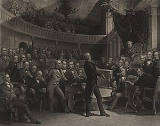
Congress convened on December 3 1849. On January 29, 1850, Whig Senator Henry Clay
Henry Clay

Henry Clay, Sr. was a nineteenth-century United States statesman and orator who represented Kentucky in both the United States House of Representatives and United States Senate....
 gave a speech which called for compromise on the issues dividing the Union. However, Clay's specific proposals for achieving a compromise, including his idea for Texas' boundary, were not adopted, although Clay later claimed credit for drafting the entire compromise. Rather, it was Senator Stephen A. Douglas
Stephen A. Douglas

Stephen Arnold Douglas was an United States politician from the western state of Illinois, and was the History of the United States Democratic Party nominee for President of the United States in United States presidential election, 1860....
, Democrat of Illinois
Illinois

The State of Illinois is a U.S. state of the United States, the 21st to be admitted to the United States. Illinois is the most populous and demographically diverse Midwestern United States state and the fifth most populous state in the nation....
, who largely guided the Compromise to passage. The Compromise came to coalesce around a plan dividing Texas at its present-day boundaries, creating territorial governments with "popular sovereignty
Popular sovereignty

Popular sovereignty or the sovereignty of the people is the belief that the legitimacy of the state is created by the will or Consent of the governed, who are the source of all political power....
" (without the Wilmot Proviso) for New Mexico and Utah, admitting California as a free state, abolishing the slave auctions in the District of Columbia, and enacting a harsh new fugitive slave law.

View of Seward and Northern Whigs

Most Northern Whigs, led by William Henry Seward who delivered his famous "Higher Law" speech during the controversy, opposed the Compromise as well because it would not have applied the Wilmot Proviso to the western territories and because of the Democratic new fugitive slave law, which would have pressed ordinary citizens into duty on slave-hunting patrols; this provision was inserted by Democratic Virginia Senator James M. Mason
James M. Mason

James Murray Mason was a United States Representative and United States Senator from Virginia. He was a grandson of George Mason and represented the Confederate States of America as appointed commissioner of the Confederacy to Great Britain and France between 1861 and 1865 during the American Civil War....
 to coerce border-state Whigs, who faced the greatest danger of losing slaves as fugitives but who were lukewarm on general sectional issues related to the South into supporting Texas's land claims.

Whig President Zachary Taylor attempted to sidestep the entire controversy by pushing to admit California and New Mexico as free states immediately, avoiding the entire territorial process and thus the Wilmot Proviso question. Taylor's stand was unpopular among Southerners.

Northern Democrats and Southern Whigs did support the Compromise. Southern Whigs, many of whom were from the border states, supported the stronger fugitive slave law.

Debate and results

On April 17, a "Committee of Thirteen" agreed on the border of Texas as part of Clay's plan. The dimensions were later changed. That same day, during debates on the measures in the Senate, Vice President Millard Fillmore and Senator Benton verbally sparred, with Fillmore charging that the Missourian was "out of order". During the heated debates, Compromise floor leader Henry S. Foote
Henry S. Foote

Henry Stuart Foote was a United States Senate from Mississippi from 1847 to 1852 and List of Governors of Mississippi from 1852 to 1854. His emotional leadership on the Senate floor helped secure passage of the Compromise of 1850, which for a time averted a civil war in the United States....
 of Mississippi
Mississippi

Mississippi is a U.S. state located in the Deep South of the United States. Jackson, Mississippi is the state capital and largest city. The state's name comes from the Mississippi River, which flows along its western boundary, and takes its name from the Anishinaabe language word misi-ziibi ....
 drew a pistol on Senator Benton.

In early June, nine slave holding Southern states sent delegates to the Nashville Convention
Nashville Convention

The Nashville Convention was a political meeting held in Nashville, Tennessee, on June 3 – 11, 1850. Delegates from nine slavery met to consider a possible course of action if the United States Congress decided to ban slavery in the new territories being added to the country as a result of Westward Expansion and the Mexican-American War...
 to determine their course of action should the compromise take hold. While some delegates preached secession
Secession

Secession is the act of withdrawing from an organization, union, or especially a political entity. It is not to be confused with succession, the act of following in order or sequence....
, eventually the moderates ruled, and they proposed a series of compromises, including extending the geographic dividing line designated by the Missouri Compromise
Missouri Compromise

The Missouri Compromise was an agreement passed in 1820 between the slave state and free state factions in the United States Congress, involving primarily the regulation of slavery in the Historic regions of the United States....
 of 1820 to the Pacific Coast
Pacific Coast

A country's Pacific coast is the part of its coast facing the Pacific Ocean....
.

The various bills were initially combined into one "omnibus" bill, which failed to pass the Senate because only a minority supported all the provisions. The situation was changed by the death of President Taylor and the accession of Fillmore on July 9, 1850. The influence of the new administration was now thrown in favor of the compromise. Illinois Senator Stephen Douglas and his supporters in the House assembled different majorities for each of five separate bills. The Northern Democrats held together and supported each of the bills and gained Whigs or Southern Democrats to pass each one. All passed and were signed by President Fillmore between September 9 and September 20, 1850.

  1. California was admitted as a free state. It passed 150-56. (Hamilton, Holman. Prologue to Conflict. University of Kentucky Press, copyright 1965. P. 160)
  2. The slave trade was abolished (the sale of slaves, not the institution of slavery) in the District of Columbia.
  3. The Territory of New Mexico (including present-day Arizona) and the Territory of Utah were organized under the rule of popular sovereignty. It passed 97-85.
  4. The Fugitive Slave Act was passed, requiring all U.S. citizens to assist in the return of runaway slaves. It passed 109-76.
  5. Texas gave up much of the western land which it claimed and received compensation of $
    United States dollar

    The United States dollar is the unit of currency of the United States and was defined by the Coinage Act of 1792 to be between 371 and 416 grains of silver ....
    10,000,000 to pay off its national debt.


Fugitive Slave Act

The Fugitive Slave Act was a result of the Mexican-American War passed to settle turmoil that arose from other decisions made concerning the issues that surfaced from the victory. As a consequence of the Mexican War, the balance in the country between slavery and antislavery territories was briefly upset. The decision to make newly-acquired California a free state, as well as the other provisions after the war that opposed slavery, caused this disturbance. After the United States won California in the Mexican War, a decision had to be made about whether it should become a slave or free state. After it was proclaimed free, pro-slavery Americans were angered by this shift in the balance of power towards free states and threatened secession. The Fugitive Slave Act was strengthened to prevent further turmoil. This act bolstered the Fugitive Slave Act of 1793
Fugitive Slave Act of 1793

1793 Fugitive Slave Act was written in response to a conflict between Pennsylvania and Virginia. Although the problem of fugitive slaves was addressed at the Constitutional Convention in 1787 , there was an assumption that interstate cooperation would allow this provision to be enforced....
, aided slaveholders by mandating that all escaped slaves must be returned to their masters, and - more crucially for the impending war - that ordinary citizens were required to aid slave catchers. Many northern citizens deeply resented this pressure; but in serving their duties, they saw many scenes of such tragedy that former slavery fence-sitters landed squarely on the side of the abolitionists. This renewed act did help appease the Southern states and their contingent slave owners by assuring the return of the slaves they considered property. However, once the secession threat was quieted, resentment towards this act continued to heighten tensions between the North and South, being thoroughly despised by the former. This Fugitive Slave Act is seen as one of the key steps towards civil war. It was included partly because of the public reaction to the Pearl incident
Pearl incident

The Pearl Incident was the largest recorded escape attempt by slavery in the United States. On April 15, 1848, seventy-six slaves attempted to escape Washington D.C....
.

The result of the Fugitive Slave Act was that any federal marshal
United States Marshals Service

The United States Marshals Service is a United States Federal law enforcement in the United States within the United States Department of Justice and is the second oldest federal law enforcement agency in the United States.While the United States Postal Inspection Service first agent was appointed in 1772, performed Chief Postal Inspect...
 or other official who did not arrest an alleged runaway slave liable to a fine of $1,000. Law-enforcement officials everywhere in the United States had a duty to arrest anyone suspected of being a fugitive slave
Fugitive slave

File:Runaway slave.jpgIn the history of slavery in the United States, a fugitive slave was a slavery who had escaped his or her enslaver often with the intention of traveling to a place where the state of his or her enslavement was either illegal or not enforced....
 on no more evidence than a claimant's sworn testimony of ownership. The suspected slave could not ask for a jury trial or testify on his or her own behalf. In addition, any person aiding a runaway slave by providing food or shelter was to be subject to six months' imprisonment and a $1,000 fine. Officers capturing a fugitive slave were entitled to a fee for their work.

Implications

The Compromise in general proved widely popular politically, as both parties committed themselves in their platforms to the finality of the Compromise on sectional issues. The strongest opposition in the South occurred in the states of South Carolina, Georgia, Alabama, and Mississippi, but unionists soon prevailed, spearheaded by Georgians Alexander Stephens
Alexander Stephens

Alexander Hamilton Stephens was an American politician from Georgia . He was Vice President of the Confederate States of America during the American Civil War....
, Robert Toombs
Robert Toombs

Robert Augustus Toombs was an United States political leader, Secretary of State of the Confederacy, and a Confederate States Army General officer in the American Civil War....
, and Howell Cobb
Howell Cobb

Howell Cobb was an United States political figure. A Southern Democrat, Cobb was a five-term member of the United States House of Representatives and Speaker of the United States House of Representatives from 1849 to 1851....
 and the creation of the Georgia Platform
Georgia Platform

The Georgia Platform was a statement executed by a Georgia Convention in response to the Compromise of 1850. Supported by Unionists, the document affirmed the acceptance of the Compromise as a final resolution of the sectional slavery issues while declaring that no further assaults on Southern rights by the North would be acceptable....
. This peace was broken only by the divisive Kansas-Nebraska Act of 1854 introduced by Stephen Douglas, which repealed the Missouri Compromise and led directly to the formation of the Republican Party
History of the United States Republican Party

The Republican Party is the second oldest currently existing political party in the United States....
, whose capture of the national government in 1860 led directly to the secession crisis of 1860-61.

Many historians argue that the Compromise played a major role in postponing the American Civil War for a decade, during which time the Northwest was growing more wealthy and more populous, and was being brought into closer relations with the Northeast. During that decade, the Whig Party had completely broken down, being replaced with the new Republican Party dominant in the North and the Democrats in the South. But others argue that the Compromise only made more obvious pre-existing sectional divisions and laid the groundwork for future conflict. In this view, the Fugitive Slave Law helped polarize North and South, as shown in the enormous reaction to Harriet Beecher Stowe
Harriet Beecher Stowe

Harriet Beecher Stowe was an abolitionist, whose novel Uncle Tom's Cabin depicted life for African-Americans under slavery; it reached millions as a novel and play, and became influential in the U.S....
's novel Uncle Tom's Cabin
Uncle Tom's Cabin

Uncle Tom's Cabin; or, Life Among the Lowly is an anti-slavery novel by American author Harriet Beecher Stowe. Published in 1852, the novel had a profound effect on attitudes toward African Americans and History of slavery in the United States, so much in the latter case that the novel intensified the Origins of the American Civil War lea...
. The passage of the Fugitive Slave Law aroused feelings of bitterness in the North. Furthermore, the Compromise of 1850 led to a breakdown in the spirit of compromise in the United States in the antebellum period, directly before the Civil War. The Compromise exemplifies this spirit, but the deaths of influential senators who worked on the compromise, primarily Henry Clay and Daniel Webster, contributed to this feeling of increasing disparity between the North and South.

The delay of hostilities for ten years allowed the free economy of the northern states to industrialize. The southern states, to a large degree based on slave labor and cash crop production, lacked the ability to heavily industrialize . By 1860, the northern states had many more miles of railroad, steel production, modern factories, and population. The North was better able to supply, equip, and man its armed forces, an advantage that would prove decisive in the later stages of the war.

External links