
All Topics  
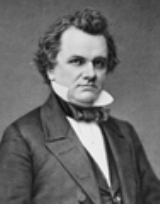
Stephen A. Douglas


   Email Print
   Bookmark   Link


Stephen A. Douglas


Stephen Arnold Douglas (April 23, 1813 – June 3, 1861; son of Stephen Arnold Douglas and Sarah Fisk) was an American
United States

The United States of America is a Federal government constitutional republic comprising U.S. state and a federal district. The country is situated mostly in central North America, where its Contiguous United States and Washington, D.C., the Capital districts and territories, lie between the Pacific Ocean and Atlantic Oceans, Borders of the U...
 politician from the western state of Illinois
Illinois

The State of Illinois is a U.S. state of the United States, the 21st to be admitted to the United States. Illinois is the most populous and demographically diverse Midwestern United States state and the fifth most populous state in the nation....
, and was the Democratic Party
History of the United States Democratic Party

The history of the Democratic Party of the United States is an account of the oldest political party in the United States and arguably the oldest democratic party in the world....
 nominee for President
President of the United States

The President of the United States is the head of state and head of government of the United States and is the highest political official in the United States by influence and recognition....
 in 1860
United States presidential election, 1860

The United States presidential election of 1860 set the stage for the American Civil War. The nation had been divided throughout most of the 1850s on questions of states' rights and slavery in the territories....
. He lost to the Republican Party
History of the United States Republican Party

The Republican Party is the second oldest currently existing political party in the United States....
's candidate, Abraham Lincoln
Abraham Lincoln

Abraham Lincoln was the List of Presidents of the United States President of the United States. He successfully led the country through its greatest internal crisis, the American Civil War, preserving the Union and ending slavery....
, whom he had defeated two years earlier in a Senate
United States Senate

The United States Senate is the upper house of the Bicameralism United States Congress, the lower house being the United States House of Representatives....
 contest following a famed series of debates
Lincoln-Douglas debates of 1858

The Lincoln-Douglas Debates of 1858 were a series of seven debates between Abraham Lincoln, the Republican Party candidate, and the incumbent Stephen A....
. He was nicknamed the "Little Giant" because he was short but was considered by many a "giant" in politics.


Discussion
Ask a question about 'Stephen A. Douglas'
Start a new discussion about 'Stephen A. Douglas'
Answer questions from other users
Full Discussion Forum


Encyclopedia


Stephen Arnold Douglas (April 23, 1813 – June 3, 1861; son of Stephen Arnold Douglas and Sarah Fisk) was an American
United States

The United States of America is a Federal government constitutional republic comprising U.S. state and a federal district. The country is situated mostly in central North America, where its Contiguous United States and Washington, D.C., the Capital districts and territories, lie between the Pacific Ocean and Atlantic Oceans, Borders of the U...
 politician from the western state of Illinois
Illinois

The State of Illinois is a U.S. state of the United States, the 21st to be admitted to the United States. Illinois is the most populous and demographically diverse Midwestern United States state and the fifth most populous state in the nation....
, and was the Democratic Party
History of the United States Democratic Party

The history of the Democratic Party of the United States is an account of the oldest political party in the United States and arguably the oldest democratic party in the world....
 nominee for President
President of the United States

The President of the United States is the head of state and head of government of the United States and is the highest political official in the United States by influence and recognition....
 in 1860
United States presidential election, 1860

The United States presidential election of 1860 set the stage for the American Civil War. The nation had been divided throughout most of the 1850s on questions of states' rights and slavery in the territories....
. He lost to the Republican Party
History of the United States Republican Party

The Republican Party is the second oldest currently existing political party in the United States....
's candidate, Abraham Lincoln
Abraham Lincoln

Abraham Lincoln was the List of Presidents of the United States President of the United States. He successfully led the country through its greatest internal crisis, the American Civil War, preserving the Union and ending slavery....
, whom he had defeated two years earlier in a Senate
United States Senate

The United States Senate is the upper house of the Bicameralism United States Congress, the lower house being the United States House of Representatives....
 contest following a famed series of debates
Lincoln-Douglas debates of 1858

The Lincoln-Douglas Debates of 1858 were a series of seven debates between Abraham Lincoln, the Republican Party candidate, and the incumbent Stephen A....
. He was nicknamed the "Little Giant" because he was short but was considered by many a "giant" in politics. Douglas was well-known as a resourceful party leader, and an adroit, ready, skillful tactician in debate and passage of legislation.

As chairman of the Committee on Territories, Douglas dominated the Senate in the 1850s. He was largely responsible for the Compromise of 1850
Compromise of 1850

The Compromise of 1850 was a series of bills aimed at resolving the territorial and slavery controversies arising from the Mexican-American War ....
 that apparently settled slavery issues. However, in 1854 he reopened the slavery question by the highly controversial Kansas-Nebraska Act
Kansas-Nebraska Act

The Kansas-Nebraska Act of 1854 created the territories of Kansas Territory and Nebraska Territory, opened new lands, repealed the Missouri Compromise of 1820, and allowed settlers in those territories to determine if they would allow slavery within their boundaries....
 that allowed the people of the new territories to decide for themselves whether or not to have slavery (which had been prohibited by earlier compromises). The protest movement against this became the Republican Party
Republican Party (United States)

The Republican Party is one of the two major party contemporary political parties in the United States, along with the Democratic Party . It is often called the Grand Old Party or the GOP....
.

Douglas supported the Dred Scott
Dred Scott

Dred Scott , was a Slavery in the United States who sued unsuccessfully for his Freedom in the infamous Dred Scott v. Sandford case of 1857....
 Supreme Court decision
Dred Scott v. Sandford

Dred Scott v. Sandford, , was a decision by the United States Supreme Court that ruled that people of African descent Slavery in the United States and held as History of slavery in the United States, or their descendants?whether or not they were slaves?were not legal persons and could never be citizens of the United States, and that the U...
 of 1857, and denied that it was part of a Southern
Southern United States

The Southern United States—commonly referred to as the American South, Dixie, or simply the South—constitutes a large distinctive region in the southeastern and south-central United States....
 plot to introduce slavery
Slavery

Slavery is a form of forced labor where a person is compelled to Labor for another . Slaves are held against their will from the time of their capture, purchase, or birth, and are deprived of the right to leave, to refuse to work, or to receive Remuneration in return for their labor....
 in the Northern
Northern United States

The Northern United States is a large geographic region of the United States of America. Most Americans refer to the region simply as "the North"....
 states; but also argued it could not be effective when the people of a territory declined to pass laws supporting it. When President James Buchanan
James Buchanan

James Buchanan, Jr. was the List of Presidents of the United States President of the United States and the last to be born in the 18th century....
 and his Southern allies attempted to pass a Federal slave code, to support slavery even against the wishes of the people of Kansas
Kansas

The State of Kansas is a Midwestern U.S. state in the Central United States of the United States of America, an area often referred to as the United States "Heartland"....
, he battled and defeated this movement as undemocratic. This caused the split in the Democratic Party in 1860, as Douglas won the nomination but a breakaway southern faction nominated their own candidate, Vice President John C. Breckinridge
John C. Breckinridge

John Cabell Breckinridge was a lawyer, United States House of Representatives, United States Senate from Kentucky, the 14th Vice President of the United States, Democratic Party candidate for President of the United States in United States presidential election, 1860, a Confederate States Army General officer in the American Civil War, and...
. Douglas deeply believed in democracy
Democracy

Democracy is a form of government in which power is held directly or indirectly by citizens under a free electoral system. It is derived from the Greek language d?????at?a , "popular government" which was coined from d???? , "people" and ???t?? , "rule, strength" in the middle of the 5th-4th century BC to denote the political syst...
, arguing the will of the people should always be decisive. When civil war
American Civil War

The American Civil War , also known as the War Between the States and several Naming the American Civil War, was a civil war in the United States....
 came in April 1861, he rallied his supporters to the Union
Union (American Civil War)

During the American Civil War, the Union was a name used to refer to the Federal government of the United States of the United States, which was supported by the twenty-three states which were not part of the secession attempt by the 11 states that formed the Confederate States of America....
 with all his energies, but he died a few weeks later.

Earlier career

Born in Brandon, Vermont, Stephen Arnold Douglas came to Illinois in 1833, was an itinerant teacher
Itinerant teacher

Itinerant teachers are traveling schoolteachers. They are sometimes specialized to work in the field of special education, providing individual tutoring to students with visual impairments or hearing impairments....
, studied law, and settled in Jacksonville
Jacksonville, Illinois

Jacksonville is a city in Morgan County, Illinois, Illinois, United States. The population was 18,940 at the 2000 census. It is the county seat of Morgan County, Illinois....
. By the end of the year, he told his Vermont relatives, "I have become a Western man, have imbibed Western feelings principles and interests and have selected Illinois as the favorite place of my adoption." He served as Morgan County State's Attorney from 1834-36. Within a decade, he was elected to the state legislature
Illinois General Assembly

The Illinois General Assembly is the state legislature of the U.S. state of Illinois and comprises the Illinois House of Representatives and the Illinois Senate....
, and was appointed registrar of the Springfield
Springfield, Illinois

Springfield is the capital of the U.S. state of Illinois and the county seat of Sangamon County, Illinois with a population of 116,482 . Over 200,000 residents live in the Springfield Springfield, Illinois metropolitan area, which includes Sangamon County and adjacent Menard County, Illinois....
 Land Office, Illinois Secretary of State, and an associate justice of the Illinois Supreme Court in 1841, at age 27. A leader of the majority Democratic Party
History of the United States Democratic Party

The history of the Democratic Party of the United States is an account of the oldest political party in the United States and arguably the oldest democratic party in the world....
, he was elected twice to Congress
United States House of Representatives

The United States House of Representatives, commonly referred to as "the House", is one of the bicameralism of the United States Congress; the other is the United States Senate....
 (1842 and 1844), where he championed expansion and supported the Mexican War. Elected by the legislature to the U.S. Senate
United States Senate

The United States Senate is the upper house of the Bicameralism United States Congress, the lower house being the United States House of Representatives....
 in 1847, he was reelected in 1853 and 1859. He was challenged for his Senate position in 1858 by Abraham Lincoln
Abraham Lincoln

Abraham Lincoln was the List of Presidents of the United States President of the United States. He successfully led the country through its greatest internal crisis, the American Civil War, preserving the Union and ending slavery....
, who had served with Douglas in the legislature, in a series of nationally famous debates which significantly boosted Lincoln's reputation despite his loss to Douglas.

Douglas chiefly designed the Compromise of 1850
Compromise of 1850

The Compromise of 1850 was a series of bills aimed at resolving the territorial and slavery controversies arising from the Mexican-American War ....
, however Henry Clay
Henry Clay

Henry Clay, Sr. was a nineteenth-century United States statesman and orator who represented Kentucky in both the United States House of Representatives and United States Senate....
's support was needed and therefore receives much of the credit.The omnibus bill containing it did not pass Congress. Each point separately had majority support, but Northerners and Southerners combined to vote the bill down for their own reasons. Douglas passed the Compromise by dividing it into separate bills, and arranged a different majority for each. He moved to Chicago, gaining wealth by marriage to a Mississippi
Mississippi

Mississippi is a U.S. state located in the Deep South of the United States. Jackson, Mississippi is the state capital and largest city. The state's name comes from the Mississippi River, which flows along its western boundary, and takes its name from the Anishinaabe language word misi-ziibi ....
 woman who inherited a slave plantation. An avid promoter of westward expansion, he devised the land grant
Land grant

A land grant is a gift of real estate - land or privileges - made by a government or other authority as a reward for services to an individual, especially as rewards for military service....
 system that enabled the funding of the Illinois Central railroad.

Douglas always had a deep and abiding faith in democracy. "Let the people rule!" was his cry, and he insisted that the people locally could and should make the decisions about slavery, rather than the national government. He was passed over for the Democratic presidential nomination in 1852
United States presidential election, 1852

The United States presidential election of 1852 was in many ways a replay of the United States presidential election, 1844. Once again, the incumbent President of the United States was a United States Whig Party who had succeeded to the presidency upon the death of his war hero predecessor; in this case, it was Millard Fillmore who followed G...
 and 1856
United States presidential election, 1856

The United States presidential election of 1856 was unusually heated. Republican candidate John Fremont condemned the Kansas-Nebraska Act, and crusaded against the Slave Power and the expansion of slavery, while Democrat James Buchanan warned that the Republicans were extremists whose victory would lead to civil war....
.

A deeply religious man, but one also dedicated to the enterprise of higher education, Stephen Douglas founded a Baptist Seminary in Chicago which was called the University of Chicago in 1857. However, the University was largely destroyed by fire in 1886, leading to its closing. The Old University of Chicago
Old University of Chicago

The University of Chicago, now known as the Old University of Chicago, was a Baptist college founded in 1857 by Stephen Douglas. It eventually failed in 1886, and was succeeded by the present University of Chicago, created with funds from John D....
 was replaced in 1890 by a newly chartered university, funded largely by the Rockefeller family. The current University of Chicago
University of Chicago

The University of Chicago is a private university located principally in the Hyde Park, Chicago neighborhood of Chicago. Although an older university by the same name existed prior to its founding, the modern University of Chicago credits its founding to the oil magnate John D....
 later added the alumni from the previous incarnation to its graduation rolls, thereby linking to two separate institutions. Currently, the old Stephen Douglas founded seminary's sole remnant is a brick which is located between Weiboldt Hall and the Classics Building on the Hyde Park campus of the University.

Personal Life and Family

In person Douglas was conspicuously short (at 5 foot 4 inches and 90 pounds), but his large head and massive chest and shoulders gave him the popular sobriquet "The Little Giant". Though his voice was strong and carried far, he had little grace of delivery, and his gestures were often violent.

Douglas moved to a farm near Clifton Springs, New York
Clifton Springs, New York

Clifton Springs is a village located in Ontario County, New York, New York, United States. The population was 2,223 at the 2000 census. The village takes its name from local mineral springs....
 and studied at in 1832-33 (where he was honored posthumously in 1996 as a "Graduate of Distinction".) He then moved to Illinois as an itinerant teacher and soon rose in Democratic party politics. Douglas briefly courted Mary Todd
Mary Todd Lincoln

Mary Ann Todd Lincoln was the wife of the 16th President of the United States, Abraham Lincoln, and was First Lady of the United States from 1861 to 1865....
 (who married Abraham Lincoln instead). In March 1847 he married Martha Martin, the daughter of wealthy Colonel Robert Martin of North Carolina
North Carolina

North Carolina is a U.S. state located on the Atlantic Seaboard in the southeastern United States. The state borders South Carolina and Georgia to the south, Tennessee to the west and Virginia to the north....
. She brought to Douglas the new responsibility of a large cotton plantation in Lawrence County, Mississippi
Lawrence County, Mississippi

Lawrence County is a county located in the U.S. state of Mississippi. As of 2000, the population was 13,258. Its county seat is Monticello, Mississippi....
 worked by slaves. To Douglas, an Illinois senator with presidential aspirations, the management of a Southern plantation with slave labor presented a difficult situation. However, Douglas sought to escape slaveholding charges by employing a manager for his Mississippi holdings, while using the economic benefits derived from the property to advance his political career. His sole lengthy visit to Mississippi came in 1848, with only brief emergency trips thereafter. The newlyweds moved their Illinois home to fast-growing Chicago
Chicago

Chicago is the largest city in the U.S. state of Illinois and the Midwestern United States, as well as the List of United States cities by population city in the United States with more than 2.8 million residents....
 in the summer of 1847. Martha Douglas died on January 19 1853, leaving the Senator with two small sons (one of whom was Robert M. Douglas
Robert M. Douglas

Robert Martin Douglas was a North Carolina Supreme Court justice and political figure. Born on January 28, 1849 in Rockingham County, North Carolina, North Carolina, he was the son of Senator Stephen A....
). On November 20 1856, he married 20 year-old Adele Cutts, the daughter of James Madison Cutts and a great-niece of former U.S. First Lady Dolley Madison
Dolley Madison

Dolley Payne Todd Madison was the spouse of the 4th President of the United States, James Madison, and was First Lady of the United States from 1809 to 1817....
.

Kansas-Nebraska Act, 1854


Douglas set off a tremendous political upheaval by proposing the Kansas-Nebraska Act
Kansas-Nebraska Act

The Kansas-Nebraska Act of 1854 created the territories of Kansas Territory and Nebraska Territory, opened new lands, repealed the Missouri Compromise of 1820, and allowed settlers in those territories to determine if they would allow slavery within their boundaries....
 in 1854. New laws were needed to allow for the settlement of the Nebraska territory. Illinois was Douglas's home state, so naturally he had invested in Chicago land, which would be made more valuable by railroads from Chicago that would serve the region, as it had been by the Illinois Central. The Missouri Compromise
Missouri Compromise

The Missouri Compromise was an agreement passed in 1820 between the slave state and free state factions in the United States Congress, involving primarily the regulation of slavery in the Historic regions of the United States....
 had guaranteed slavery would not exist there (because it was north of the 36°30' compromise line), and the Compromise of 1850 had reaffirmed this.

Leading Southern Senators had met with Douglas, and had insisted on popular sovereignty as a condition for their support of the bill. Douglas's first bill had only enacted it to a limited extent, by providing that Nebraska
Nebraska

Nebraska is a U.S. state located on the Great Plains of the Midwestern United States and Western United States.Nebraska probably gets its name from the archaic Chiwere language words ?? Br?sge or the Omaha-Ponca language N? Bth?ska meaning "flat water," after the Platte River that flows through the state....
 and Kansas
Kansas

The State of Kansas is a Midwestern U.S. state in the Central United States of the United States of America, an area often referred to as the United States "Heartland"....
 could enter the Union free or slave as the residents might decide; but the Southerners insisted, and Douglas discovered a "clerical error", and revised the bill.

Douglas argued that the people of the territory should decide the slavery question by themselves, and that soil and climate made the territory unsuitable for plantations; which last reassured his northern supporters it would remain free. Douglas defended his doctrine of popular sovereignty as a means of promoting democracy and removing the slavery issue from national politics, lest it threaten to rip the nation apart, but it had exactly the opposite effect.

Douglas and Abraham Lincoln aired their disagreement on this topic in Peoria, Illinois, on October 16, 1854. Although Mr. Lincoln's three hour "Peoria Speech
Abraham Lincoln Peoria speech

Abraham Lincoln's Peoria speech was made in Peoria, Illinois on October 16, 1854. The speech, with its specific arguments against slavery, was an important step in Abraham Lincoln's political ascension....
", presented thorough moral, legal and economic arguments against slavery, it did not stop the Act from passing.

The act was passed by Southern votes, Democratic and Whig
Whig Party (United States)

The Whig Party was a political party of the United States during the era of Jacksonian democracy. Considered integral to the Second Party System and operating from 1833 to 1856, the party was formed in opposition to the policies of President of the United States Andrew Jackson and the Democratic Party ....
 alike, and Douglas had little to do with the final text. This was the first appearance of the Solid South, and the opponents of the Act saw it as the triumph of the hated Slave Power
Slave power

The Slave Power was a term used in the Northern United States to characterize the political power of the History of slavery in the United States class in the Southern United States....
 and formed the Republican Party to stop it.

Presidential Aspirant

In 1852, and again in 1856, Douglas was a candidate for the Presidential nomination in the national Democratic convention, and though on both occasions he was unsuccessful, he received strong support. When the Know Nothing
Know Nothing

The Know Nothing movement was a nativist United States political movement of the 1840s and 1850s. It was empowered by popular fears that the country was being overwhelmed by Irish Catholic immigrants, who were often regarded as hostile to U.S....
 movement grew strong he crusaded against it, but hoped it would split the opposition. In 1858 he won significant support in many former Know-Nothing strongholds. In 1857, he broke with President James Buchanan
James Buchanan

James Buchanan, Jr. was the List of Presidents of the United States President of the United States and the last to be born in the 18th century....
 and the "administration" Democrats, and lost much of his support in the Southern United States
Southern United States

The Southern United States—commonly referred to as the American South, Dixie, or simply the South—constitutes a large distinctive region in the southeastern and south-central United States....
, but partially restored himself to favor in the North – especially in Illinois – by his vigorous opposition to the method of voting on the Lecompton constitution
Lecompton Constitution

The Lecompton Constitution was the second of four proposed constitutions for the state of Kansas . The document was written in response to the anti-slavery position of the 1855 Topeka Constitution of James H....
, which he saw as fraudulent, and (in 1858) to the admission of Kansas into the Union under this constitution.

Stephen Arnold Douglas
In 1858, when the United States Supreme Court
Supreme Court of the United States

The Supreme Court of the United States is the highest judicial body in the United States, and leads the federal United States federal courts. It consists of the Chief Justice of the United States and eight Associate Justice of the Supreme Court of the United States, who are nominated by the President of the United States and confirmed with th...
 – after the vote of Kansas against the Lecompton constitution – had decided that Kansas was a "slave" territory, thus quashing Douglas' theory of "popular sovereignty
Popular sovereignty

Popular sovereignty or the sovereignty of the people is the belief that the legitimacy of the state is created by the will or Consent of the governed, who are the source of all political power....
", he engaged in Illinois in a close and very exciting contest for the Senate seat with Abraham Lincoln
Abraham Lincoln

Abraham Lincoln was the List of Presidents of the United States President of the United States. He successfully led the country through its greatest internal crisis, the American Civil War, preserving the Union and ending slavery....
, the Republican candidate, whom he met in a series of seven famous debates which became known as the Lincoln-Douglas debates
Lincoln-Douglas debates of 1858

The Lincoln-Douglas Debates of 1858 were a series of seven debates between Abraham Lincoln, the Republican Party candidate, and the incumbent Stephen A....
. In the second of the debates, Douglas was led to declare that any territory, by "unfriendly legislation", could exclude slavery, no matter what the action of the Supreme Court. Having already lost the support of a large element of his party in the South, his association with this famous Freeport Doctrine
Freeport Doctrine

The Freeport Doctrine was articulated by Stephen A. Douglas at the second of the Lincoln-Douglas debates on August 27, 1858, in Freeport, Illinois....
 made it anathema to many southerners, including Jefferson Davis
Jefferson Davis

Jefferson Finis Davis was an United States politician who served as President of the Confederate States of America for its entire history, 1861 to 1865, during the American Civil War....
, who would have otherwise supported it. Before and during the debates, Douglas repeatedly invoked racist rhetoric, claiming Lincoln was for black equality and saying at Galesburg
Galesburg, Illinois

Galesburg is a city in Knox County, Illinois, Illinois, in the United States. As of the 2000 census , the city population was 33,706. It is the county seat of Knox County....
 that the authors of the Declaration of Independence
United States Declaration of Independence

The United States Declaration of Independence is a statement adopted by the Second Continental Congress on July 4, 1776, which announced that the Thirteen Colonies then at war with Kingdom of Great Britain were now independent states, and thus no longer a part of the British Empire....
 did not intend to include blacks. "This Government was made by our fathers on the white basis . . . made by white men for the benefit of white men and their posterity forever," he said. Lincoln pointedly denied Douglas' assertion that the Declaration of Independence did not include minorities.

Much of the debate was about the redefinition of republicanism
Republicanism in the United States

Republicanism is the value system of governance that has been a major part of United States civic thought since the American Revolution. It stresses liberty and inalienable rights as central values, makes the people as a whole sovereign, rejects inherited political power, expects citizens to be independent in their performance of civ...
. Lincoln advocated equality of opportunity, arguing that individuals and society advanced together. Douglas, on the other hand, embraced a democratic doctrine that emphasized equality of all citizens (only whites were citizens), in which individual merit and social mobility was not a main goal. Douglas won the senatorship by a vote in the legislature of 54 to 46, but the debates helped boost Lincoln into the presidency.

Douglas waged a furious battle with President Buchanan for control of the Democratic party. Although Douglas was not reappointed chairman of the Senate committee on territories, he bested Buchanan throughout the North and headed into 1860 as the front runner for president.

In the 1860 Democratic National Convention
1860 Democratic National Convention

The 1860 Democratic National Convention was one of the crucial events in the lead-up to the American Civil War. It was convened initially at South Carolina Institute Hall in Charleston, South Carolina from April 23 to May 3, 1860....
 in Charleston, South Carolina
Charleston, South Carolina

Charleston is a city in Charleston County, South Carolina in the U.S. state of South Carolina. It is the largest city and county seat of Charleston County....
, the failure to adopt a slave code
Slave codes

Slave codes were laws each United States state, or colony, had defining the status of slavery and the rights of masters; the code gave slave owners near-absolute power over the right of their human property....
 to the territories in the platform brought about the withdrawal from the convention of delegations from Alabama
Alabama

Alabama is a state located in the Southern United States of the United States of America. It is bordered by Tennessee to the north, Georgia to the east, Florida and the Gulf of Mexico to the south, and Mississippi to the west....
, Mississippi
Mississippi

Mississippi is a U.S. state located in the Deep South of the United States. Jackson, Mississippi is the state capital and largest city. The state's name comes from the Mississippi River, which flows along its western boundary, and takes its name from the Anishinaabe language word misi-ziibi ....
, Louisiana
Louisiana

The State of Louisiana is a U.S. state located in the U.S. Southern States of the United States of America. Its capital is Baton Rouge and largest city is New Orleans....
, South Carolina
South Carolina

South Carolina is a U.S. state in the Southern United States of the United States. It borders Georgia to the south and North Carolina to the north....
, Florida
Florida

Florida is a U.S. state located in the Southeastern United States of the United States, bordering Alabama to the northwest and Georgia to the northeast....
, Texas
Texas

Texas is a U.S. state located in the South Central United States, nicknamed the Lone Star State. Texas is the second largest U.S. state in both area and population, spanning , and with a growing population of 24.3 million residents....
 and Arkansas
Arkansas

Arkansas is a U.S. state located in the Southern United States of the United States. Arkansas shares a border with six states, with its eastern border largely defined by the Mississippi River....
. The convention adjourned to Baltimore, Maryland
Baltimore, Maryland

Baltimore is an independent city and the largest city in the U.S. state of Maryland in the United States. Baltimore is located in central Maryland along the tidal portion of the Patapsco River, an arm of the Chesapeake Bay....
, where the Virginia
Virginia

The Commonwealth of Virginia is an United States U.S. state on the East Coast of the United States of the Southern United States. The state is known as the "Old Dominion" and sometimes as "Mother of Presidents", because it is the birthplace of Lists of United States Presidents by place of birth#By state....
, North Carolina
North Carolina

North Carolina is a U.S. state located on the Atlantic Seaboard in the southeastern United States. The state borders South Carolina and Georgia to the south, Tennessee to the west and Virginia to the north....
, Tennessee
Tennessee

Tennessee is a U.S. state located in the Southern United States United States. In 1796, it became the sixteenth state to join the United States....
, Kentucky
Kentucky

The Commonwealth of Kentucky is a U.S. state located in the East Central United States of America. Kentucky is normally included in the group of Southern United States , but it is uncommonly included, geographically and culturally, in the Midwestern United States....
 and Maryland
Maryland

Maryland is a U.S. state located in the Mid Atlantic States of the United States, bordering Virginia, West Virginia and the Washington, D.C. to the south and west, Pennsylvania to the north, and Delaware to the east....
 delegations left it, and where Douglas was nominated for the presidency by the Northern Democrats. He campaigned vigorously but hopelessly, boldly attacking disunion, and in the election of 1860
United States presidential election, 1860

The United States presidential election of 1860 set the stage for the American Civil War. The nation had been divided throughout most of the 1850s on questions of states' rights and slavery in the territories....
, though he received a popular vote of 1,376,957 (2nd at 29%) he received an electoral vote
United States Electoral College

The Electoral College consists of the popularly elected representatives who formally elect the President of the United States and Vice President of the United States....
 of only 12 (4th and last at 4%) - Lincoln receiving 180. His support in the North came from the Irish Catholics and the poorer farmers; in the South the Irish Catholics were his main supporters.

Douglas urged the South to acquiesce to Lincoln's election, and made efforts to arrange a compromise which would persuade the South to remain in the Union. As late as Christmas
Christmas

Christmas , also referred to as Christmas Day, is an annual holiday celebrated on December 25 that commemorates the birth of Jesus. The day marks the beginning of the larger season of Christmastide, which lasts Twelve Days of Christmas....
 1860, he wrote Alexander H. Stephens, offering to annex Mexico
Mexico

The United Mexican States , commonly known as Mexico , is a federalism constitutionalism republic in North America. It is bordered on the north by the United States; on the south and west by the Pacific Ocean; on the southeast by Guatemala, Belize, and the Caribbean Sea; and on the east by the Gulf of Mexico....
 as a slave state as a sweetener; Mexico had abolished slavery in 1829. At the outbreak of the Civil War
American Civil War

The American Civil War , also known as the War Between the States and several Naming the American Civil War, was a civil war in the United States....
, he denounced secession
Secession

Secession is the act of withdrawing from an organization, union, or especially a political entity. It is not to be confused with succession, the act of following in order or sequence....
 as criminal, and was one of the strongest advocates of maintaining the integrity of the Union at all hazards. At Lincoln's request he undertook a mission to the border states and to the Midwest to rouse the spirit of Unionism; he spoke in West Virginia
West Virginia

West Virginia is a U.S. state in the Appalachian, Upland South, and Mid-Atlantic States regions of the United States, bordered by Virginia on the southeast, Kentucky on the southwest, Ohio on the northwest, and Pennsylvania and Maryland on the northeast....
, Ohio
Ohio

Ohio is a Midwestern United States U.S. state of the United States. As part of the Great Lakes region , Ohio has long been a cultural and geographical crossroads in North America....
 and Illinois.

Stephen Arnold Douglas Tomb

Historical Disputes

For a century and a half, historians have debated whether or not Douglas opposed slavery, and whether or not he was a trimmer and compromiser or a devotee of principles.

Douglas married into a slaveholding family (as did Lincoln and Ulysses S. Grant
Ulysses S. Grant

Ulysses S. Grant, born Hiram Ulysses Grant , was an United States general and the List of Presidents of the United States President of the United States ....
), but the issue is whether he supported slavery as a matter of public policy. In his "Freeport Doctrine" of 1858 he repeatedly insisted that he did not care whether slavery was voted up or down, but only that the people had the right to vote it up or down. He denounced as sacrilegious and undemocratic the petitions signed by thousands of clergymen in 1854 who said the Nebraska Act offended God's will. He rejected the Republican notions that slavery was condemned by a "higher law" (Seward
William Seward

William Seward can refer to:*William H. Seward, United States Secretary of State, 1861-1869*William H. Seward, Jr., his son, banker, Civil War general...
's position) or that the nation could not long survive half slave and half free (Lincoln's position). He disagreed with the Supreme Court's Dred Scott decision
Dred Scott v. Sandford

Dred Scott v. Sandford, , was a decision by the United States Supreme Court that ruled that people of African descent Slavery in the United States and held as History of slavery in the United States, or their descendants?whether or not they were slaves?were not legal persons and could never be citizens of the United States, and that the U...
 that Congress had to protect slavery in the territories, regardless of what the people there thought. When Buchanan supported the Lecompton Constitution and thus adopted the pro-slavery position on Kansas, Douglas fought him relentlessly in a long battle that gave Douglas the 1860 Democratic nomination but ripped his party apart.

Historian Allan Nevins was harsh on Douglas, "When it [slavery] paid it was good," wrote Nevins, "and when it did not pay it was bad." Nevins consequently judged that Douglas did not "regard a slaveholding society as one whit inferior to a free society." All in all, Nevins rather brutally assessed what he called Douglas's "dim moral perceptions." Graham Peck finds that several scholars have given brief opinions to the effect that Douglas was personally opposed to slavery, none of them with "extensive arguments to justify the conclusion". He cites some more recent scholarship as (equally briefly) finding Douglas "insensitive to the moral repugnance of slavery" or even "proslavery". He himself finds, however, that Douglas was the "ideological [and] practical head of the northern opposition to the antislavery movement" and questions whether Douglas "opposed black slavery for any reason, including economics". Harry Jaffa thought Douglas was tricking the South with popular sovereignty—telling Southerners it would protect slavery but believing the people would actually vote against it. Johannsen found Douglas "did not regard slavery as a moral question; at least, he never condemned the institution in moral terms either publicly or privately." However he "privately deplored slavery and was opposed to its expansion (and, indeed, in 1860 was widely regarded in both North and South as an antislavery candidate), he felt that its discussion as a moral question would place it on a dangerous level of abstraction."

Death and Legacy

Douglas died in Chicago from typhoid fever
Typhoid fever

Typhoid fever, also known as enteric fever, or commonly just typhoid, is an illness caused by the bacterium Salmonella typhi. Common worldwide, it is transmitted by the ingestion of food or water contaminated with feces from an infected person....
  on June 3 1861. He was buried on the shore of Lake Michigan
Lake Michigan

Lake Michigan is one of the five Great Lakes of North America, and the only one located entirely within the United States. The third-largest of the Great Lakes, it is bounded, from west to east, by the U.S....
. The site was afterwards bought by the state, and an imposing monument with a statue
Stephen A. Douglas Tomb

The Stephen A. Douglas Tomb and Memorial or Stephen Douglas Monument Park is located at 800 E. 35th Street in the Douglas, Chicago#Bronzeville neighborhood of Chicago, Illinois , near the site of the horrifying Union prisoner of war Camp Douglas , which was named after him....
 by Leonard Volk
Leonard Volk

Leonard Wells Volk was an United States sculpture. He is most famous for making a life mask of American President Abraham Lincoln....
 now stands over his grave.

Today, there are Douglas Counties in Colorado
Douglas County, Colorado

Douglas County is the eighth most populous of the Colorado counties of the Colorado of the United States. The county, sometimes nicknamed Dougco, is located midway between Colorado's two largest cities: Denver, Colorado and Colorado Springs, Colorado....
, Georgia
Douglas County, Georgia

Douglas County is a county located in the U.S. state of Georgia . As of 2000, the population was 92,174. The 2007 Census Estimate shows a population of 124,495 ....
, Illinois
Douglas County, Illinois

Douglas County is a county located in the U.S. state of Illinois. As of 2000, the population was 19,922. The county seat is Tuscola, Illinois....
, Kansas
Douglas County, Kansas

Douglas County is located in northeast Kansas, in the Central United States United States. The U.S. county's population?one of the fastest-growing in the state of Kansas?was estimated to be 113,488 in the year 2007, making it the fifth-largest in the state....
, Minnesota
Douglas County, Minnesota

Douglas County is a county located in the U.S. state of Minnesota. As of 2000, the population was 32,821. Its county seat is Alexandria, Minnesota....
, Missouri
Douglas County, Missouri

Douglas County is a county located in South Central Missouri in the United States. As of the United States Census, 2000, the county's population was 13,084....
, Nebraska
Douglas County, Nebraska

Douglas County is a county located in the U.S. state of Nebraska. It is the state's most populous county, home to over one-fourth of Nebraska's residents....
, Nevada
Douglas County, Nevada

Douglas County is a county located in the northwestern part of the U.S. state of Nevada. As of 2000, the population was 41,259. As of 2007, the population was estimated to be 52,386....
, Oregon
Douglas County, Oregon

Douglas County is a List of counties in Oregon located in the U.S. state of Oregon. In 2000, its population was 100,399. Oregon Geographic Names after Stephen A....
, South Dakota
Douglas County, South Dakota

Douglas County is a county located in the U.S. state of South Dakota. As of 2000, the population was 3,458. Its county seat is Armour, South Dakota....
, Washington
Douglas County, Washington

Douglas County is a county located in the U.S. state of Washington. It is part of the 'Wenatchee, Washington–East Wenatchee, Washington, Washington, Wenatchee-East Wenatchee metropolitan area'....
 and Wisconsin
Douglas County, Wisconsin

Douglas County is a county located at the north-west corner of the U.S. state of Wisconsin. As of 2000, the population was 43,287. Its county seat is Superior, Wisconsin....
. There is Fort Douglas (Utah) in Salt Lake City, and the city of Douglas, Georgia
Douglas, Georgia

Douglas is a city in Coffee County, Georgia, Georgia , United States. The population was 10,639 at the United States Census, 2000 and 11,209 as of estimates conducted by the United States Census Bureau for a 12-month period ending 01 July 2007....
 is also named for him, but it is not located in his namesake county; the city of Douglas is found in Coffee County
Coffee County, Georgia

Coffee County is a county located in the U.S. state of Georgia . As of 2000, the population was 37,413. The 2007 Census Estimate shows a population of 40,085....
. The county seat
County seat

A county seat or parish seat is a term for an administrative center for a county or civil parish, primarily used in the United States. In the Northeast United States, the statutory term often is shire town, but colloquially county seat is the term in use there....
 of Georgia's Douglas County is, fittingly, Douglasville
Douglasville, Georgia

The city of Douglasville is the county seat of Douglas County, Georgia,United States. The population was 20,065 at the 2000 census. Douglasville is one of the fastest growing cities in Georgia , with an estimated population of 27,568 in 2005....
.

In Wyoming, the County Seat of Converse County, is named in honor of him. The town is located in east/central Wyoming on the banks of the North Platte River.

See also

  • Old University of Chicago
    Old University of Chicago

    The University of Chicago, now known as the Old University of Chicago, was a Baptist college founded in 1857 by Stephen Douglas. It eventually failed in 1886, and was succeeded by the present University of Chicago, created with funds from John D....


Further reading

  • Capers, Gerald M. Stephen A. Douglas: Defender of the Union (1959), short biography
  • Clinton, Anita Watkins. "Stephen Arnold Douglas - His Mississippi Experience" Journal of Mississippi History 1988 50(2): 56-88. in JSTOR
  • Dean; Eric T., Jr. "Stephen A. Douglas and Popular Sovereignty" Historian 1995 57(4): 733-748
  • Eyal, Yonatan. "With His Eyes Open: Stephen A. Douglas and the Kansas-Nebraska Disaster of 1854" Journal of the Illinois State Historical Society 1998 91(4): 175-217. ISSN 1522-1067
  • Glickstein, Jonathan A., American exceptionalism, American anxiety: wages, competition, and degraded labor in the Antebellum United States; University of Virginia Press, (2002)
  • Hansen, Stephen and Nygard, Paul. "Stephen A. Douglas, the Know-nothings, and the Democratic Party in Illinois, 1854-1858" Illinois Historical Journal 1994 87(2): 109-130.
  • Huston, James L. "Democracy by Scripture versus Democracy by Process: A Reflection on Stephen A. Douglas and Popular Sovereignty." Civil War History. 43#1 (1997) pp: 189+.
  • Jaffa, Harry V. Crisis of the House Divided: An Interpretation of the Issues in the Lincoln-Douglas Debates. 1959.
  • Johannsen, Robert W. Stephen A. Douglas (1973), 993pp the standard scholarly biography
  • Johannsen, Robert W. The Frontier, the Union, and Stephen A. Douglas U. of Illinois Press, 1989.
  • McPherson, James M. Battle Cry of Freedom. Oxford Univ. Press, 1988. Standard modern history.
  • Milton, George Fort. The Eve of Conflict: Stephen A. Douglas and the Needless War (1934)
  • Morrison, Michael A.Slavery and the American west: the eclipse of manifest destiny and the coming of the American Civil War University of North Carolina Press, (1997)
  • Nevins, Allan. Ordeal of the Union especially vol 1-4 (1947-63): Fruits of Manifest Destiny, 1847-1852; A House Dividing, 1852-1857; Douglas, Buchanan, and Party Chaos, 1857-1859; Prologue to Civil War, 1859-1861. highly detailed narrative of national politics with extensive coverage of Douglas
  • Nichols, Roy F. "The Kansas-Nebraska Act: A Century of Historiography," Mississippi Valley Historical Review 43 (1956): 187-212;
  • Graham A. Peck, "Was Stephen A. Douglas Antislavery?," Journal of the Abraham Lincoln Association, Summer 2005
  • Rhodes, James Ford. History of the United States from the Compromise of 1850 (1920) vol 1-2, detailed narrative
  • Russel, Robert R. "What Was the Compromise of 1850?" Journal of Southern History 20 (1956): 292-309
  • Russel, Robert R. "The Issues in the Congressional Struggle Over the Kansas-Nebraska Bill, 1854," Journal of Southern History 29 (May 1963): 187-210;
  • Stevenson, James A. "Lincoln vs. Douglas over the Republican Ideal" American Studies 1994 35(1): 63-89
  • Zarefsky, David. Lincoln, Douglas, and Slavery: in the Crucible of Public Debate U. of Chicago Press, 1990. 309 pp


Primary sources

  • Robert W. Johannsen, ed. The Letters of Stephen A. Douglas (1961)
  • Paul M. Angle, ed., Created Equal? The Complete Lincoln-Douglas Debates of 1858 (1958),
  • Lincoln, Abraham and Douglas, Stephen A. The Lincoln-douglas Debates: The First Complete, Unexpurgated Text. Harold Holzer, Ed. Harpercollins, 1993.
  • Harry V. Jaffa and Robert W. Johannsen, eds. In the Name of the People: Speeches and Writings of Lincoln and Douglas in the Ohio Campaign of 1859. (1959)
  • Douglas, Stephen Arnold. , (1861) James Madison Cutts, ed. (1866)


Text supplemented from the 1911 Encyclopædia Britannica

External links

  • Project Gutenberg
    Project Gutenberg

    Project Gutenberg, abbreviated as PG, is a volunteer effort to digitize, archive and distribute cultural works, as founder Michael Hart said "To encourage the creation and distribution of eBooks."....
     text of by William Gardner