
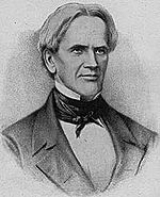
Horace Mann was an American
education reformEducation reform is the process of improving public education. Small improvements in education theoretically have large social returns, in health, wealth and well-being. Historically, reforms have taken different forms because the motivations of reformers have differed.A continuing motivation has...
er, and a member of the
Massachusetts House of RepresentativesThe Massachusetts House of Representatives is the lower house of the Massachusetts General Court, the state legislature of the Commonwealth of Massachusetts. It is composed of 160 members elected from single-member electoral districts across the Commonwealth. Representatives serve two-year terms...
from 1827 to 1833. He served in the
Massachusetts SenateThe Massachusetts Senate is the upper house of the Massachusetts General Court, the bicameral state legislature of the Commonwealth of Massachusetts. The Senate comprises 40 elected members from 40 single-member senatorial districts in the state...
from 1834 to 1837. In 1848, after serving as Secretary of the Massachusetts State Board of Education since its creation, he was elected to the US House of Representatives. Mann was a brother-in-law to author
Nathaniel HawthorneNathaniel Hawthorne was an American novelist and short story writer.Nathaniel Hawthorne was born in 1804 in the city of Salem, Massachusetts to Nathaniel Hathorne and the former Elizabeth Clarke Manning. His ancestors include John Hathorne, a judge during the Salem Witch Trials...
.
Arguing that universal public education was the best way to turn the nation's unruly children into disciplined, judicious
republicanRepublicanism is the political value system that has been a major part of American civic thought since the American Revolution. It stresses liberty and inalienable rights as central values, makes the people as a whole sovereign, supports activist government to promote the common good, rejects...
citizens, Mann won widespread approval from modernizers, especially in his
Whig PartyThe Whig Party was a political party of the United States during the era of Jacksonian democracy. Considered integral to the Second Party System and operating from the early 1830s to the mid-1850s, the party was formed in opposition to the policies of President Andrew Jackson and his Democratic...
, for building public schools. Most states adopted one version or another of the system he established in Massachusetts, especially the program for "
normal schoolA normal school is a school created to train high school graduates to be teachers. Its purpose is to establish teaching standards or norms, hence its name...
s" to train professional teachers. Mann has been credited by educational historians as the "Father of the
Common SchoolA common school was a public school in the United States or Canada in the nineteenth century. The term 'common school' was coined by Horace Mann, and refers to the fact that they were meant to serve individuals of all social classes and religions....
Movement".
Education
Horace Mann was born on May 4, 1796, in
Franklin, MassachusettsThe Town of Franklin is a city in Norfolk County, Massachusetts, United States. The population was 31,635 at the 2010 census.-History:Franklin was first settled by Europeans in 1660 and was officially incorporated during the American Revolution. The town was formed from the western part of the town...
. His father was a
YankeeThe term Yankee has several interrelated and often pejorative meanings, usually referring to people originating in the northeastern United States, or still more narrowly New England, where application of the term is largely restricted to descendants of the English settlers of the region.The...
farmer without money. The son's frugal upbringing taught him habits of self-reliance and independence. From ten years of age to twenty he had no more than six weeks' schooling during any year. He made use of the town library. At the age of 20 he enrolled at
Brown UniversityBrown University is a private, Ivy League university located in Providence, Rhode Island, United States. Founded in 1764 prior to American independence from the British Empire as the College in the English Colony of Rhode Island and Providence Plantations early in the reign of King George III ,...
, and graduated after three years as valedictorian of his class in 1819. The theme of his oration was “The Progressive Character of the Human Race.” He then studied law for a short time at
Wrentham, MassachusettsWrentham is a town in Norfolk County, Massachusetts, United States. The population was 10,955 at the 2010 census.- History :Wrentham was first settled by the English in 1660 and officially incorporated in 1673. It was burned down during King Philip's War 1675-1676. For a short time, it was the...
; was a tutor of Latin and Greek (1820–1822) and a librarian (1821–1823) at Brown University. He also studied during 1821–1823 at
Litchfield Law SchoolThe Litchfield Law School of Litchfield, Connecticut, was the first formal school offering training for the legal profession in the United States. It was established in 1784 by Tapping Reeve, who would later became the Chief Justice of the Connecticut Supreme Court...
(the law school conducted by Judge
Tapping ReeveTapping Reeve was an American lawyer and law educator. In 1784, he opened the Litchfield Law School in Litchfield, Connecticut, the first school to offer a comprehensive legal curriculum in the United States....
in
Litchfield, ConnecticutLitchfield is a town in and former county seat of Litchfield County, Connecticut, United States, and is known as an affluent summer resort. The population was 8,316 at the 2000 census. The boroughs of Bantam and Litchfield are located within the town...
), and in 1823, was admitted to the bar in
Norfolk, MassachusettsNorfolk is a town in Norfolk County, Massachusetts, United States with a population of 10,460 people in 2,818 households at the 2000 census. Formerly known as North Wrentham, Norfolk broke away to become an independent town in 1870.-History:...
.
Massachusetts legislature
Mann was elected to the legislature in 1827, and in that body was active in the interests of education, public charities, and laws for the suppression of intemperance and lotteries. He established through his personal exertions the state lunatic asylum at
WorcesterWorcester is a city and the county seat of Worcester County, Massachusetts, United States. Named after Worcester, England, as of the 2010 Census the city's population is 181,045, making it the second largest city in New England after Boston....
, and in 1833 was chairman of its board of trustees. He continued to be returned to the legislature as representative from
DedhamDedham is a town in and the county seat of Norfolk County, Massachusetts, United States. The population was 24,729 at the 2010 census. It is located on Boston's southwest border. On the northwest it is bordered by Needham, on the southwest by Westwood and on the southeast by...
until his removal to Boston in 1833. While in the legislature he was a member and part of the time chairman of the committee for the revision of the state statutes, and a large number of salutary provisions were incorporated into the code at his suggestion. After their enactment he was appointed one of the editors of the work, and prepared its marginal notes and its references to judicial decisions. He was elected to the Massachusetts State Senate from Boston in 1833, and was its president in 1836–1837. As a member of the Senate, he spent time as the majority leader, and aimed his focus at infrastructure, funding the construction of railroads and canals.
Marriages
In 1830, Mann married Charlotte Messer, though she died only two years later on August 1, 1832; His grief over her death never fully subsided. He later married
Mary Tyler PeabodyMary Tyler Peabody Mann of chronic bronchitis) was a teacher, author, mother, and wife of Horace Mann, American education reformer and politician.-Early Life:Mary Tyler Peabody Mann was the daughter of Dr. Nathaniel Peabody and Elizabeth Palmer Peabody...
.
Education reform
It was not until he was appointed secretary (1837) of the newly created
board of educationA board of education or a school board or school committee is the title of the board of directors or board of trustees of a school, local school district or higher administrative level....
of Massachusetts (the first such position in the United States) that he began the work which was to place him in the foremost rank of American educationists. Previously he had shown no special interest in education. He was only encouraged to take the job because it was a paid office position established by the legislature. He began as secretary of the board. On entering on his duties, he withdrew from all other professional or business engagements and from politics. This led him to become the most prominent national spokesman for that position. He held this position, and worked with a remarkable intensity, holding teachers' conventions, delivering numerous lectures and addresses, carrying on an extensive correspondence, and introducing numerous reforms. Mann traveled to every school in the state so he could physically examine each school ground. He planned and inaugurated the Massachusetts
normal schoolA normal school is a school created to train high school graduates to be teachers. Its purpose is to establish teaching standards or norms, hence its name...
system in
LexingtonFramingham State University is located in Framingham, Massachusetts, from Boston. It offers undergraduate programs in a range of subjects from Art to Biology to Communication Arts, and graduate programs including MBA, MEd, and MSc...
(which shortly thereafter moved to Framingham) and
BridgewaterBridgewater State University is a public liberal-arts college in Bridgewater, Massachusetts, in the United States. It is the largest college in the Massachusetts state university system outside of the University of Massachusetts system. The school's mascot is the bear.-History:BSU was founded by...
, and began preparing a series of annual reports, which had a wide circulation and were considered as being "among the best expositions, if, indeed, they are not the very best ones, of the practical benefits of a common school education both to the individual and to the state". By his advocacy of the disuse of corporal punishment in school discipline, he was involved in a controversy with some of the Boston teachers that resulted in the adoption of his views.
In 1838, he founded and edited
The Common School Journal. In this journal, Mann targeted the public school and its problems. His six main principles were: (1) the public should no longer remain ignorant; (2) that such education should be paid for, controlled, and sustained by an interested public; (3) that this education will be best provided in schools that embrace children from a variety of backgrounds; (4) that this education must be non-sectarian; (5) that this education must be taught by the spirit, methods, and discipline of a free society; and (6) that education should be provided by well-trained, professional teachers. Mann worked for more and better equipped school houses, longer school years (until 16 years old), higher pay for teachers, and a wider curriculum.
Under the auspices of the board, but at his own expense, he went to Europe in 1843 to visit schools, especially in
PrussiaPrussia was a German kingdom and historic state originating out of the Duchy of Prussia and the Margraviate of Brandenburg. For centuries, the House of Hohenzollern ruled Prussia, successfully expanding its size by way of an unusually well-organized and effective army. Prussia shaped the history...
, and his seventh annual report, published after his return, embodied the results of his tour. Many editions of this report were printed, not only in Massachusetts, but in other states, in some cases by private individuals and in others by legislatures; several editions were issued in England. In 1852, he supported the decision to adopt the
Prussian education systemThe Prussian education system was a system of mandatory education dating to the early 19th century. Parts of the Prussian education system have served as models for the education systems in a number of other countries, including Japan and the United States....
in Massachusetts. Shortly after Massachusetts adopted the Prussian system, the Governor of New York set up the same method in twelve different New York schools on a trial basis.
Mann hoped that by bringing all children, of all classes together, they could have a common learning experience. This would also give an opportunity to the less fortunate to advance in the social scale and education would "equalize the conditions of men". Moreover, it was viewed also as a road to social advancement by the early labor movement and as a goal of having common schools. Mann also suggested that by having schools it would help those students who didn't have appropriate discipline in the home. Building a person's character was just as important as reading, writing and arithmetic. By instilling values such as obedience to authority, promptness in attendance, and organizing the time according to bell ringing helped students prepare for future employment. Mann faced some resistance from parents who didn't want to give up the moral education to teachers and bureaucrats. The normal schools trained mostly women, giving them new career opportunities as teachers.
The practical result of Mann's work was a revolution in the approach used in the common school system of Massachusetts, which in turn influenced the direction of other states. In carrying out his work, Mann met with bitter opposition by some Boston schoolmasters who strongly disapproved of his innovative pedagogical ideas, and by various religious sectarians, who contended against the exclusion of all sectarian instruction from the schools. He is often called "the father of American public education".
U.S. Congress
In the spring of 1848 he was elected to the
United States CongressThe United States Congress is the bicameral legislature of the federal government of the United States, consisting of the Senate and the House of Representatives. The Congress meets in the United States Capitol in Washington, D.C....
as a
WhigThe Whig Party was a political party of the United States during the era of Jacksonian democracy. Considered integral to the Second Party System and operating from the early 1830s to the mid-1850s, the party was formed in opposition to the policies of President Andrew Jackson and his Democratic...
, to fill the vacancy caused by the death of
John Quincy AdamsJohn Quincy Adams was the sixth President of the United States . He served as an American diplomat, Senator, and Congressional representative. He was a member of the Federalist, Democratic-Republican, National Republican, and later Anti-Masonic and Whig parties. Adams was the son of former...
. His first speech in that body was in advocacy of its right and duty to exclude
slaverySlavery is a system under which people are treated as property to be bought and sold, and are forced to work. Slaves can be held against their will from the time of their capture, purchase or birth, and deprived of the right to leave, to refuse to work, or to demand compensation...
from the territories, and in a letter in December of that year he said: “I think the country is to experience serious times. Interference with slavery will excite civil commotion in the South. But it is best to interfere. Now is the time to see whether the Union is a rope of sand or a band of steel.” Again he said: “I consider no evil as great as slavery, and I would pass the
Wilmot ProvisoThe Wilmot Proviso, one of the major events leading to the Civil War, would have banned slavery in any territory to be acquired from Mexico in the Mexican War or in the future, including the area later known as the Mexican Cession, but which some proponents construed to also include the disputed...
whether the South rebel or not.” During the first session, he volunteered as counsel for
Drayton and SayresThe Pearl Incident was the largest recorded escape attempt by slaves in the United States. On April 15, 1848, seventy-six slaves attempted to escape Washington D.C. in part by travelling on a riverboat called The Pearl. Paul Jennings was one of the organizers of this incident...
, who were indicted for stealing 76 slaves in the District of Columbia, and at the trial was engaged for 21 successive days in their defense. In 1850, he was engaged in a controversy with
Daniel WebsterDaniel Webster was a leading American statesman and senator from Massachusetts during the period leading up to the Civil War. He first rose to regional prominence through his defense of New England shipping interests...
in regard to the extension of slavery and the Fugitive Slave Law. Mann was defeated by a single vote at the ensuing nominating convention by Webster's supporters; but, on appealing to the people as an independent anti-slavery candidate, he was re-elected, serving from April 1848 until March 1853.
Leadership of Antioch College and last years
In September 1852, he was nominated for
governor of MassachusettsThe Governor of the Commonwealth of Massachusetts is the executive magistrate of the Commonwealth of Massachusetts, United States. The current governor is Democrat Deval Patrick.-Constitutional role:...
by the
Free Soil PartyThe Free Soil Party was a short-lived political party in the United States active in the 1848 and 1852 presidential elections, and in some state elections. It was a third party and a single-issue party that largely appealed to and drew its greatest strength from New York State. The party leadership...
, and the same day was chosen president of the newly established
Antioch CollegeAntioch College is a private, independent liberal arts college in Yellow Springs, Ohio, United States. It was the founder and the flagship institution of the six-campus Antioch University system. Founded in 1852 by the Christian Connection, the college began operating in 1853 with politician and...
at
Yellow Springs, OhioYellow Springs is a village in Greene County, Ohio, United States, and is the location of Antioch College and Antioch University Midwest. The population was 3,487 at the 2010 census...
. Failing in the election for governor, he accepted the presidency of the college, in which he continued until his death. There he taught economics, philosophy, and theology; he was popular with students and with lay audiences across the Midwest who attended his lectures promoting public schools. Mann also employed the first woman faculty member to be paid on an equal basis with her male colleagues,
Rebecca PennellRebecca Mann Pennell, later Rebecca Mann Dean was an American educator, niece of prominent educator Horace Mann, and the first woman to be appointed a full faculty member at an American college. She was one of the ten founding professors of Antioch College in Yellow Springs, Ohio, where she taught...
, his niece. His commencement message to the class of 1859 to "be ashamed to die until you have won some victory for humanity" is repeated to the graduating class at each commencement.
Antioch College was founded by the Christian Connexion which later withdrew its financial support causing the college to struggle for many years with meager financial resources due to sectarian infighting. Mann himself was charged with nonadherence to sectarianism because, previously a Congregationalist by upbringing, he joined the
Unitarian ChurchThe American Unitarian Association was a religious denomination in the United States and Canada, formed by associated Unitarian congregations in 1825. In 1961, it merged with the Universalist Church of America to form the Unitarian Universalist Association.According to Mortimer Rowe, the Secretary...
.
He collapsed shortly after the 1859 commencement and died that summer. Antioch historian Robert Straker wrote that Mann had been “crucified by crusading sectarians.”
Ralph Waldo EmersonRalph Waldo Emerson was an American essayist, lecturer, and poet, who led the Transcendentalist movement of the mid-19th century...
lamented “what seems the fatal waste of labor and life at Antioch.” Mann’s wife, who wrote in anguish that "the blood of martyrdom waters the spot," later disinterred his body from Yellow Springs. He is buried in the
North Burial GroundThe North Burial Ground is a cemetery in Providence, Rhode Island, dating to 1700. Providence had no public burial ground and no Common until the year 1700 because Rhode Island's religious and government institutions were so rigorously kept distinct, dating back to its founding by Roger...
in
Providence, Rhode IslandProvidence is the capital and most populous city of Rhode Island and was one of the first cities established in the United States. Located in Providence County, it is the third largest city in the New England region...
, next to his first wife, Charlotte Messer Mann. (Charlotte Messer Mann was the daughter of Asa Messer, an early president of
Brown UniversityBrown University is a private, Ivy League university located in Providence, Rhode Island, United States. Founded in 1764 prior to American independence from the British Empire as the College in the English Colony of Rhode Island and Providence Plantations early in the reign of King George III ,...
.)
Legacy
Most historians treat Mann as the most important and beneficial leader of education reform in the antebellum period. However, Taylor (Bob Pepperman. Horace Mann's Troubling Legacy - 2010) argues that Mann's view of civic education marginalized the role of schools in training the intellect, and links him to anti-intellectualism in American education.
Horace Mann's statue stands in front of the Massachusetts State House along with that of Daniel Webster.
At Antioch College a monument carries his quote (now the college motto): "Be Ashamed to Die Until You Have Won Some Victory for Humanity."
There are a number of schools in the United States named for Mann. Additionally, the
University of Northern Colorado-Organization:The University of Northern Colorado offers 100 undergraduate programs and more than 100 graduate programs. The university has a satellite campus in Denver, Colorado...
named the gates to their campus in his dedication, a gift of the Class of 1910.
The
Springfield, IllinoisSpringfield is the third and current capital of the US state of Illinois and the county seat of Sangamon County with a population of 117,400 , making it the sixth most populated city in the state and the second most populated Illinois city outside of the Chicago Metropolitan Area...
-based Illinois Education Association Mutual Insurance Company, was renamed in honor of Mann in 1950 as the
Horace Mann Educators Corporation.
In Maryville, Missouri; Northwest Missouri State University named their education building in honor of Horace Mann.
(www.nwmissouri.edu)
Emulation of the Prussian education system in the United States
American educators were fascinated by German educational trends. In 1818, John Griscom gave a favorable report of Prussian education. English translations were made of French philosopher
Victor CousinVictor Cousin was a French philosopher. He was a proponent of Scottish Common Sense Realism and had an important influence on French educational policy.-Early life:...
's work, "Report on the State of Public Education in Prussia." Calvin E. Stowe,
Henry BarnardHenry Barnard was an American educationalist and reformer.-Biography:...
,
Horace MannHorace Mann was an American education reformer, and a member of the Massachusetts House of Representatives from 1827 to 1833. He served in the Massachusetts Senate from 1834 to 1837. In 1848, after serving as Secretary of the Massachusetts State Board of Education since its creation, he was...
,
George BancroftGeorge Bancroft was an American historian and statesman who was prominent in promoting secondary education both in his home state and at the national level. During his tenure as U.S. Secretary of the Navy, he established the United States Naval Academy at Annapolis in 1845...
and
Joseph CogswellJoseph Green Cogswell was a librarian, bibliographer and an innovative educator.-Education:...
all had a vigorous interest in German education. In 1843, Mann traveled to Germany to investigate how the educational process worked. Upon his return to the United States, he lobbied heavily to have the "Prussian model" adopted.
Mann convinced his fellow modernizers, especially those in the
Whig PartyThe Whig Party was a political party of the United States during the era of Jacksonian democracy. Considered integral to the Second Party System and operating from the early 1830s to the mid-1850s, the party was formed in opposition to the policies of President Andrew Jackson and his Democratic...
to legislate tax-supported elementary public education in their states. Indeed, most northern states adopted one version or another of the system he established in Massachusetts, especially the program for "normal schools" to train professional teachers. In 1852, Mann was instrumental in the decision to adopt the Prussian education system in Massachusetts. Soon New York state set up the same method in 12 different schools on a trial basis.
The political motivations of the King of Prussia
Seeking to replace the controlling functions of the local aristocracy, the Prussian court attempted to instill social obedience in the citizens through indoctrination. Every individual had to become convinced, in the core of his being, that the King was just, his decisions always right, and the need for obedience paramount.
The schools imposed an official language, to the prejudice of ethnic groups living in Prussia. The purpose of the system was to instill loyalty to the Crown and to train young men for the military and the bureaucracy. As the German philosopher
Johann Gottlieb FichteJohann Gottlieb Fichte was a German philosopher. He was one of the founding figures of the philosophical movement known as German idealism, a movement that developed from the theoretical and ethical writings of Immanuel Kant...
, a key influence on the system, said, "If you want to influence [the student] at all, you must do more than merely talk to him; you must fashion him, and fashion him in such a way that he simply cannot will otherwise than what you wish him to will."
Works by Mann
- A Few Thoughts for a Young Man (Boston, 1850) online
- Slavery: Letters and Speeches (1851)
- Powers and Duties of Woman (1853)
- Sermons (1861)
- Life and Complete Works of Horace Mann (2 vols., Cambridge, 1869)
- Thoughts selected from the Writings of Horace Mann (1869)
- The Case for Public Schools
- Mann, Horace. The Life and Works of Horace Mann, with introduction by his second wife, Mary Peabody Mann. online edition
See also
- Henry Barnard
Henry Barnard was an American educationalist and reformer.-Biography:...
- John Swett
John Swett is considered to be the "Father of the California public school" system and the "Horace Mann of the Pacific".-Biography:...
, Californian often compared to Horace Mann.
Further reading
- Cremin, Lawrence A. American Education: The National Experience (1982).
- Downs, R. B. Horace Mann: Champion of the Public Schools (1974)
- Finkelstein, Barbara. "Perfecting Childhood: Horace Mann and the Origins of Public Education in the United States," Biography: An Interdisciplinary Quarterly, Winter 1990, Vol. 13#1 pp 6–20
- Hinsdale, Burke A. Horace Mann and the Common School Revival in the United States] (New York, 1898), in the Great Educators series online
- Hubbell, George A. Life of Horace Mann, Educator, Patriot and Reformer (Philadelphia, 1910)
- Messerli, Jonathan. Horace Mann; a biography (1972)
- Taylor, Bob Pepperman. Horace Mann's Troubling Legacy: The Education of Democratic Citizens (University Press of Kansas; 2010).
- Willis, George, Robert V. Bullough, and John T. Holton, eds. The American Curriculum: A Documentary History. (Greenwood Press, 1992). 43–44.
- Winship, Albert E. Horace Mann, the Educator (1896)
External links