

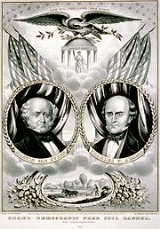
Free Soil Party

Overview
Political party
A political party is a political organization that typically seeks to influence government policy, usually by nominating their own candidates and trying to seat them in political office. Parties participate in electoral campaigns, educational outreach or protest actions...
in the United States
United States
The United States of America is a federal constitutional republic comprising fifty states and a federal district...
active in the 1848 and 1852 presidential elections, and in some state elections. It was a third party
Third party (United States)
The term third party is used in the United States for any and all political parties in the United States other than one of the two major parties . The term can also refer to independent politicians not affiliated with any party at all and to write-in candidates.The United States has had a...
and a single-issue party that largely appealed to and drew its greatest strength from New York State
New York
New York is a state in the Northeastern region of the United States. It is the nation's third most populous state. New York is bordered by New Jersey and Pennsylvania to the south, and by Connecticut, Massachusetts and Vermont to the east...
. The party leadership consisted of former anti-slavery members of the Whig Party
Whig Party (United States)
The Whig Party was a political party of the United States during the era of Jacksonian democracy. Considered integral to the Second Party System and operating from the early 1830s to the mid-1850s, the party was formed in opposition to the policies of President Andrew Jackson and his Democratic...
and the Democratic Party
History of the United States Democratic Party
The history of the Democratic Party of the United States is an account of the oldest political party in the United States and arguably the oldest democratic party in the world....
. Its main purpose was opposing the expansion of slavery into the western territories, arguing that free men on free soil comprised a morally and economically superior system to slavery.
Unanswered Questions
