

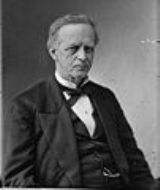
Lyman Trumbull

Encyclopedia
Lyman Trumbull was a United States Senator from Illinois
during the American Civil War
, and co-author of the Thirteenth Amendment to the United States Constitution
.
, the grandson of historian Benjamin Trumbull
. He attended Bacon Academy
and was a school teacher from 1829 to 1833. At 20, he was head of an academy in Georgia. After studying law, he was admitted to the bar and practiced in Greenville, Georgia
until moving to Belleville, Illinois
in 1837.
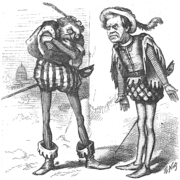 By 1840, he was serving in the Illinois House of Representatives
, and he served as Illinois Secretary of State from 1841-1843. From 1848 to 1853 he was a justice on the Supreme Court of Illinois
. Although elected to the United States House of Representatives
in 1854, he was elected to serve in the United States Senate
before he could take his seat. He served from 1855 through 1873, during which time he claimed party affiliations with the Democrats
, the Republicans
, the Liberal Republicans
, and finally the Democrats again. As chairman of the Judiciary Committee
(1861–1872), he co-wrote the Thirteenth Amendment
, which prohibited all kinds of slavery
in the United States other than its use as punishment for crimes of which the party had been convicted; this became the sentence to "time at hard labor" that became assignable for certain crimes.
's impeachment trial
, Trumbull and six other Republican senators were disturbed by how the likes of Thaddeus Stevens
and Benjamin Wade
had manipulated the proceedings against Johnson in order to give a one-sided presentation of the evidence. Trumbull, in particular, noted:
All seven Senators, resisting every manner of pressure imposed on them, broke party ranks and defied public opinion, voting for acquittal in a principled act of what they all knew was likely to amount to political suicide. None were reelected.
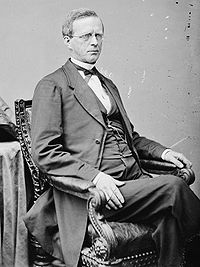 During the December 1871 congressional debate on the creation of Yellowstone National Park
, Senator Trumbull, whose son Walter Trumbull
was a member of the Washburn-Langford-Doane Expedition
to Yellowstone in 1870, made this impassioned statement in support of the park idea:
named Mt. Trumbull (and now the Mt. Trumbull Wilderness
) in northwestern Arizona
after the senator. The Lyman Trumbull House
is a National Historic Landmark
.
Illinois
Illinois is the fifth-most populous state of the United States of America, and is often noted for being a microcosm of the entire country. With Chicago in the northeast, small industrial cities and great agricultural productivity in central and northern Illinois, and natural resources like coal,...
during the American Civil War
American Civil War
The American Civil War was a civil war fought in the United States of America. In response to the election of Abraham Lincoln as President of the United States, 11 southern slave states declared their secession from the United States and formed the Confederate States of America ; the other 25...
, and co-author of the Thirteenth Amendment to the United States Constitution
Thirteenth Amendment to the United States Constitution
The Thirteenth Amendment to the United States Constitution officially abolished and continues to prohibit slavery and involuntary servitude, except as punishment for a crime. It was passed by the Senate on April 8, 1864, passed by the House on January 31, 1865, and adopted on December 6, 1865. On...
.
Education and early career
Trumbull was born in Colchester, ConnecticutColchester, Connecticut
Colchester is a town in New London County, Connecticut, United States. The population was 14,551 at the 2000 census. In 2005 it was ranked 57th on the "100 Best Places to Live" in all of the United States, conducted by CNN...
, the grandson of historian Benjamin Trumbull
Benjamin Trumbull
Benjamin Trumbull was a historian. He was graduated at Yale in 1759, and received his theological education under Rev...
. He attended Bacon Academy
Bacon Academy
Bacon Academy is a public high school in Colchester, Connecticut, in the United States.In 1800 a prominent Colchester farmer, Pierpont Bacon, died and left an endowment of thirty-five thousand dollars . The endowment was to theThis established the academy that bears his name...
and was a school teacher from 1829 to 1833. At 20, he was head of an academy in Georgia. After studying law, he was admitted to the bar and practiced in Greenville, Georgia
Greenville, Georgia
Greenville is a city in Meriwether County, Georgia, United States. The population was 946 at the 2000 census. The city is the county seat of Meriwether County. southwest of Atlanta...
until moving to Belleville, Illinois
Belleville, Illinois
Belleville is a city in St. Clair County, Illinois, United States. As of the 2010 census, the city has a population of 44,478. It is the eighth-most populated city outside of the Chicago Metropolitan Area and the most populated city south of Springfield in the state of Illinois. It is the county...
in 1837.
Elected office
Illinois House of Representatives
The Illinois House of Representatives is the lower house of the Illinois General Assembly, the state legislature of the U.S. state of Illinois. The body was created by the first Illinois Constitution adopted in 1818. The state House of Representatives is made of 118 representatives elected from...
, and he served as Illinois Secretary of State from 1841-1843. From 1848 to 1853 he was a justice on the Supreme Court of Illinois
Supreme Court of Illinois
The Supreme Court of Illinois is the state supreme court of Illinois. The court's authority is granted in Article VI of the current Illinois Constitution, which provides for seven justices elected from the five appellate judicial districts of the state: Three justices from the First District and...
. Although elected to the United States House of Representatives
United States House of Representatives
The United States House of Representatives is one of the two Houses of the United States Congress, the bicameral legislature which also includes the Senate.The composition and powers of the House are established in Article One of the Constitution...
in 1854, he was elected to serve in the United States Senate
United States Senate
The United States Senate is the upper house of the bicameral legislature of the United States, and together with the United States House of Representatives comprises the United States Congress. The composition and powers of the Senate are established in Article One of the U.S. Constitution. Each...
before he could take his seat. He served from 1855 through 1873, during which time he claimed party affiliations with the Democrats
Democratic Party (United States)
The Democratic Party is one of two major contemporary political parties in the United States, along with the Republican Party. The party's socially liberal and progressive platform is largely considered center-left in the U.S. political spectrum. The party has the lengthiest record of continuous...
, the Republicans
Republican Party (United States)
The Republican Party is one of the two major contemporary political parties in the United States, along with the Democratic Party. Founded by anti-slavery expansion activists in 1854, it is often called the GOP . The party's platform generally reflects American conservatism in the U.S...
, the Liberal Republicans
Liberal Republican Party (United States)
The Liberal Republican Party of the United States was a political party that was organized in Cincinnati in May 1872, to oppose the reelection of President Ulysses S. Grant and his Radical Republican supporters. The party's candidate in that year's presidential election was Horace Greeley, longtime...
, and finally the Democrats again. As chairman of the Judiciary Committee
United States Senate Committee on the Judiciary
The United States Senate Committee on the Judiciary is a standing committee of the United States Senate, of the United States Congress. The Judiciary Committee, with 18 members, is charged with conducting hearings prior to the Senate votes on confirmation of federal judges nominated by the...
(1861–1872), he co-wrote the Thirteenth Amendment
Thirteenth Amendment to the United States Constitution
The Thirteenth Amendment to the United States Constitution officially abolished and continues to prohibit slavery and involuntary servitude, except as punishment for a crime. It was passed by the Senate on April 8, 1864, passed by the House on January 31, 1865, and adopted on December 6, 1865. On...
, which prohibited all kinds of slavery
Slavery
Slavery is a system under which people are treated as property to be bought and sold, and are forced to work. Slaves can be held against their will from the time of their capture, purchase or birth, and deprived of the right to leave, to refuse to work, or to demand compensation...
in the United States other than its use as punishment for crimes of which the party had been convicted; this became the sentence to "time at hard labor" that became assignable for certain crimes.
Johnson impeachment trial
During President Andrew JohnsonAndrew Johnson
Andrew Johnson was the 17th President of the United States . As Vice-President of the United States in 1865, he succeeded Abraham Lincoln following the latter's assassination. Johnson then presided over the initial and contentious Reconstruction era of the United States following the American...
's impeachment trial
Impeachment of Andrew Johnson
The Impeachment of Andrew Johnson, 17th President of the United States, was one of the most dramatic events in the political life of the United States during Reconstruction, and the first impeachment in history of a sitting United States president....
, Trumbull and six other Republican senators were disturbed by how the likes of Thaddeus Stevens
Thaddeus Stevens
Thaddeus Stevens , of Pennsylvania, was a Republican leader and one of the most powerful members of the United States House of Representatives...
and Benjamin Wade
Benjamin Wade
Benjamin Franklin "Bluff" Wade was a U.S. lawyer and United States Senator. In the Senate, he was associated with the Radical Republicans of that time.-Early life:...
had manipulated the proceedings against Johnson in order to give a one-sided presentation of the evidence. Trumbull, in particular, noted:
"Once set the example of impeaching a President for what, when the excitement of the hour shall have subsided, will be regarded as insufficient causes, as several of those now alleged against the President were decided to be by the House of Representatives only a few months since, and no future President will be safe who happens to differ with a majority of the House and two-thirds of the Senate on any measure deemed by them important, particularly if of a political character. Blinded by partisan zeal, with such an example before them, they will not scruple to remove out of the way any obstacle to the accomplishment of their purposes, and what then becomes of the checks and balances of the Constitution, so carefully devised and so vital to its perpetuity? They are all gone."
All seven Senators, resisting every manner of pressure imposed on them, broke party ranks and defied public opinion, voting for acquittal in a principled act of what they all knew was likely to amount to political suicide. None were reelected.
Yellowstone
Yellowstone National Park
Yellowstone National Park, established by the U.S. Congress and signed into law by President Ulysses S. Grant on March 1, 1872, is a national park located primarily in the U.S. state of Wyoming, although it also extends into Montana and Idaho...
, Senator Trumbull, whose son Walter Trumbull
Walter Trumbull
Walter H. Trumbull, Jr. was an American football player. He attended Middlesex School in Concord, Massachusetts before enrolling at Harvard University. He played at the tackle and center positions for Percy Haughton's Harvard Crimson football from 1912 to 1914...
was a member of the Washburn-Langford-Doane Expedition
Washburn-Langford-Doane Expedition
The Washburn Expedition of 1870, explored the region of northwestern Wyoming that a couple years later became Yellowstone National Park. Led by Henry Washburn, Nathaniel P. Langford and under U.S. Army escort led by Lt. Gustavus C...
to Yellowstone in 1870, made this impassioned statement in support of the park idea:
"Here is a region of the country away up in the Rocky Mountains, where there are the most wonderful geysers on the face of the earth; a country that is not likely ever to be inhabited for the purpose of agriculture; but it is possible that some person may go there and plant himself right across the only path that leads to the wonders, and charge every man that passes along between the gorges of these mountains a fee of a dollar or five dollars. He may place an obstruction there and toll may be gathered from every person who goes to see these wonders of creation."
Later career
In 1873, Trumbull set up a law practice in Chicago and remained in private practice except for a brief period when he ran an unsuccessful campaign for governor (as a Democrat) in 1880. He became a Populist in 1894, and defended the railway strikers in Chicago in the same year.Memorials
During his explorations in the west John Wesley PowellJohn Wesley Powell
John Wesley Powell was a U.S. soldier, geologist, explorer of the American West, and director of major scientific and cultural institutions...
named Mt. Trumbull (and now the Mt. Trumbull Wilderness
Mount Trumbull Wilderness
The Mount Trumbull Wilderness is a 7,880 acre wilderness area located on the Uinkaret Plateau in the Arizona Strip. It is managed by the Bureau of Land Management....
) in northwestern Arizona
Arizona Strip
The Arizona Strip is the part of the U.S. state of Arizona lying north of the Colorado River. The difficulty of crossing the Grand Canyon causes this region to have more natural connections with southern Utah and Nevada than with the rest of Arizona....
after the senator. The Lyman Trumbull House
Lyman Trumbull House
Lyman Trumbull House is a house significant for its association with former U.S. Senator from Illinois Lyman Trumbull.It was declared a National Historic Landmark in 1975....
is a National Historic Landmark
National Historic Landmark
A National Historic Landmark is a building, site, structure, object, or district, that is officially recognized by the United States government for its historical significance...
.
Further reading
- White, HoraceHorace White (writer)Horace White was an United States journalist and financial expert, noted for his connection with the Chicago Tribune, the New York Evening Post and The Nation.-Biography:...
. The Life of Lyman Trumbull, Boston: Houghton Mifflin, 1913. OCLC 824101
External links
- Lyman Trumbull at Find A GraveFind A GraveFind a Grave is a commercial website providing free access and input to an online database of cemetery records. It was founded in 1998 as a DBA and incorporated in 2000.-History:...
- Trumbull at OurCampaigns.com