

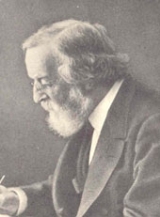
James Freeman Clarke

Encyclopedia

Biography
Born in Hanover, New HampshireHanover, New Hampshire
Hanover is a town along the Connecticut River in Grafton County, New Hampshire, United States. The population was 11,260 at the 2010 census. CNN and Money magazine rated Hanover the sixth best place to live in America in 2011, and the second best in 2007....
, James Freeman Clarke attended the Boston Latin School, graduated from Harvard College
Harvard College
Harvard College, in Cambridge, Massachusetts, is one of two schools within Harvard University granting undergraduate degrees...
in 1829, and Harvard Divinity School
Harvard Divinity School
Harvard Divinity School is one of the constituent schools of Harvard University, located in Cambridge, Massachusetts, in the United States. The School's mission is to train and educate its students either in the academic study of religion, or for the practice of a religious ministry or other public...
in 1833. Ordained into the Unitarian
Unitarianism
Unitarianism is a Christian theological movement, named for its understanding of God as one person, in direct contrast to Trinitarianism which defines God as three persons coexisting consubstantially as one in being....
church he first became an active minister at Louisville, Kentucky
Louisville, Kentucky
Louisville is the largest city in the U.S. state of Kentucky, and the county seat of Jefferson County. Since 2003, the city's borders have been coterminous with those of the county because of a city-county merger. The city's population at the 2010 census was 741,096...
, then a slave state
Slave state
In the United States of America prior to the American Civil War, a slave state was a U.S. state in which slavery was legal, whereas a free state was one in which slavery was either prohibited from its entry into the Union or eliminated over time...
and soon threw himself into the national movement for the abolition of slavery
Abolitionism
Abolitionism is a movement to end slavery.In western Europe and the Americas abolitionism was a movement to end the slave trade and set slaves free. At the behest of Dominican priest Bartolomé de las Casas who was shocked at the treatment of natives in the New World, Spain enacted the first...
.
In 1839 he returned to Boston, where he and his friends established (1841) the Church of the Disciples which brought together a body of people to apply the Christian religion
Christianity
Christianity is a monotheistic religion based on the life and teachings of Jesus as presented in canonical gospels and other New Testament writings...
to social problems of the day. One of the features which distinguished his church was Clarke's belief that ordination could make no distinction between him and them. They also were called to be ministers of the highest religious life. Of this church he was the minister from 1841 until 1850 and from 1854 until his death. He was also secretary of the Unitarian Association and, in 1867-1871 professor of natural religion and Christian doctrine at Harvard.
Clarke contributed essays to The Christian Examiner, The Christian Inquirer, The Christian Register, The Dial
The Dial
The Dial was an American magazine published intermittently from 1840 to 1929. In its first form, from 1840 to 1844, it served as the chief publication of the Transcendentalists. In the 1880s it was revived as a political magazine...
, Harper's, The Index, and Atlantic Monthly. In addition to sermons, speeches, hymnals, and liturgies, he published 28 books and over 120 pamphlets during his lifetime. Clarke edited the Western Messenger, a magazine intended to carry to readers in the Mississippi Valley simple statements of liberal religion, and what were then the most radical appeals to national duty, and the abolition of slavery. Copies of this magazine are now of value to collectors as they contained the earliest printed poems of Ralph Waldo Emerson
Ralph Waldo Emerson
Ralph Waldo Emerson was an American essayist, lecturer, and poet, who led the Transcendentalist movement of the mid-19th century...
, a personal friend and a distant cousin. Clarke became a member of the Transcendental Club
Transcendental Club
The Transcendental Club was a group of New England intellectuals of the early-to-mid-19th century which gave rise to Transcendentalism.-Overview:...
alongside Emerson and several others. Many of Clarke's earlier published writings were addressed to the immediate need of establishing a larger theory of religion than that espoused by people who were still under the influence Calvinism
Calvinism
Calvinism is a Protestant theological system and an approach to the Christian life...
, or as an American phrase states the "Hard-shelled Churches."
For the Western Messenger, Clarke requested written contributions from Margaret Fuller
Margaret Fuller
Sarah Margaret Fuller Ossoli, commonly known as Margaret Fuller, was an American journalist, critic, and women's rights advocate associated with the American transcendentalism movement. She was the first full-time American female book reviewer in journalism...
. Clarke published Fuller's first literary review—criticisms of recent biographies on George Crabbe
George Crabbe
George Crabbe was an English poet and naturalist.-Biography:He was born in Aldeburgh, Suffolk, the son of a tax collector, and developed his love of poetry as a child. In 1768, he was apprenticed to a local doctor, who taught him little, and in 1771 he changed masters and moved to Woodbridge...
and Hannah More
Hannah More
Hannah More was an English religious writer, and philanthropist. She can be said to have made three reputations in the course of her long life: as a poet and playwright in the circle of Johnson, Reynolds and Garrick, as a writer on moral and religious subjects, and as a practical...
. She later became the first full-time book reviewer in journalism working for Horace Greeley's
Horace Greeley
Horace Greeley was an American newspaper editor, a founder of the Liberal Republican Party, a reformer, a politician, and an outspoken opponent of slavery...
New York Tribune
New York Tribune
The New York Tribune was an American newspaper, first established by Horace Greeley in 1841, which was long considered one of the leading newspapers in the United States...
. After Fuller's death in 1850, Clarke worked with William Henry Channing
William Henry Channing
William Henry Channing was an American Unitarian clergyman, writer and philosopher.-Biography:William Henry Channing was born in Boston, Massachusetts...
and Emerson as editors of The Memoirs of Margaret Fuller, published in February 1852. The trio censored or reworded many of Fuller's letters; they believed the public interest in Fuller would be temporary and that she would not survive as a historical figure. Nevertheless, for a time, the book was the best-selling biography of the decade and went through thirteen editions before the end of the century.
In 1855, Clarke purchased the former site of Brook Farm
Brook Farm
Brook Farm, also called the Brook Farm Institute of Agriculture and Education or the Brook Farm Association for Industry and Education, was a utopian experiment in communal living in the United States in the 1840s...
, intending to start a new Utopia
Utopia
Utopia is an ideal community or society possessing a perfect socio-politico-legal system. The word was imported from Greek by Sir Thomas More for his 1516 book Utopia, describing a fictional island in the Atlantic Ocean. The term has been used to describe both intentional communities that attempt...
n community there. This never came to pass, instead the land was offered to President Abraham Lincoln
Abraham Lincoln
Abraham Lincoln was the 16th President of the United States, serving from March 1861 until his assassination in April 1865. He successfully led his country through a great constitutional, military and moral crisis – the American Civil War – preserving the Union, while ending slavery, and...
during the American Civil War
American Civil War
The American Civil War was a civil war fought in the United States of America. In response to the election of Abraham Lincoln as President of the United States, 11 southern slave states declared their secession from the United States and formed the Confederate States of America ; the other 25...
; the Second Massachusetts Regiment used it for training and named it "Camp Andrew". In November 1861, Clarke was in Washington, D.C.
Washington, D.C.
Washington, D.C., formally the District of Columbia and commonly referred to as Washington, "the District", or simply D.C., is the capital of the United States. On July 16, 1790, the United States Congress approved the creation of a permanent national capital as permitted by the U.S. Constitution....
with Samuel Gridley Howe
Samuel Gridley Howe
Samuel Gridley Howe was a nineteenth century United States physician, abolitionist, and an advocate of education for the blind.-Early life and education:...
and Julia Ward Howe
Julia Ward Howe
Julia Ward Howe was a prominent American abolitionist, social activist, and poet, most famous as the author of "The Battle Hymn of the Republic".-Biography:...
. After hearing the song "John Brown's Body
John Brown's Body
"John Brown's Body" is an American marching song about the abolitionist John Brown. The song was popular in the Union during the American Civil War. The tune arose out of the folk hymn tradition of the American camp meeting movement of the 19th century...
", he suggested that Mrs. Howe write new lyrics; the result was "The Battle Hymn of the Republic
The Battle Hymn of the Republic
"The Battle Hymn of the Republic" is a hymn by American writer Julia Ward Howe using the music from the song "John Brown's Body". Howe's more famous lyrics were written in November 1861 and first published in The Atlantic Monthly in February 1862. It became popular during the American Civil War...
".
Clarke was an advocate of human rights. Being a Boston Latin School alumnus, he served on a committee of the Massachusetts Society for the University Education of Women which was greatly instrumental in the establishing Girls' Latin School in 1878. Tempered and moderate in his views of life, he was a reformer and a conciliator and never had to carry a pistol as fellow preacher Theodore Parker
Theodore Parker
Theodore Parker was an American Transcendentalist and reforming minister of the Unitarian church...
did.
He published but few verses, but at heart was a poet. A diligent scholar, among the books by which he became well known is one called Ten Great Religions (2 vols, 1871–1883).
James Freeman Clarke was one of the very first Americans to explore and write about Eastern religions.
A portrait of Clarke painted by E.T. Billings
Edwin Tryon Billings
Edwin Tryon Billings or E.T. Billings was a portrait painter in 19th-century United States. He lived in Montgomery, Alabama; Worcester, Massachusetts; and in Boston...
hangs in the Boston Public Library
Boston Public Library, McKim Building
The Boston Public Library McKim Building in Copley Square contains the library's research collection, exhibition rooms and administrative offices...
.
Selected writings
- "Self-Culture: Physical, Intellectual, Moral, and Spiritual" (1880)
- "Memorial and Biographical Sketches" (1880)
- "Common Sense in Religion (1874)
- Every-Day Religion (1886)
- Sermons on the Lord's Prayer (1888)
- "Autobiography, Diary and Correspondence" (1891)
External links
- Ten Great Religions - full etext from Project GutenbergProject GutenbergProject Gutenberg is a volunteer effort to digitize and archive cultural works, to "encourage the creation and distribution of eBooks". Founded in 1971 by Michael S. Hart, it is the oldest digital library. Most of the items in its collection are the full texts of public domain books...
- New York Times Obituary