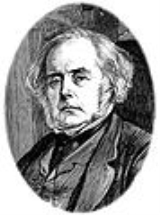
John Bright Quaker, was a
BritishThe United Kingdom of Great Britain and Ireland was the formal name of the United Kingdom during the period when what is now the Republic of Ireland formed a part of it....
RadicalThe Radicals were a parliamentary political grouping in the United Kingdom in the early to mid 19th century, who drew on earlier ideas of radicalism and helped to transform the Whigs into the Liberal Party.-Background:...
and
LiberalThe Liberal Party was one of the two major political parties of the United Kingdom during the 19th and early 20th centuries. It was a third party of negligible importance throughout the latter half of the 20th Century, before merging with the Social Democratic Party in 1988 to form the present day...
statesmanA statesman is usually a politician or other notable public figure who has had a long and respected career in politics or government at the national and international level. As a term of respect, it is usually left to supporters or commentators to use the term...
, associated with
Richard CobdenRichard Cobden was a British manufacturer and Radical and Liberal statesman, associated with John Bright in the formation of the Anti-Corn Law League as well as with the Cobden-Chevalier Treaty...
in the formation of the
Anti-Corn Law LeagueThe Anti-Corn Law League was in effect the resumption of the Anti-Corn Law Association, which had been created in London in 1836 but did not obtain widespread popularity. The Anti-Corn Law League was founded in Manchester in 1838...
. He was one of the greatest orators of his generation, and a strong critic of British foreign policy. He sat in the House of Commons from 1843 to 1889.
Early life
Bright was born at
RochdaleRochdale is a large market town in Greater Manchester, England. It lies amongst the foothills of the Pennines on the River Roch, north-northwest of Oldham, and north-northeast of the city of Manchester. Rochdale is surrounded by several smaller settlements which together form the Metropolitan...
, in
LancashireLancashire is a non-metropolitan county of historic origin in the North West of England. It takes its name from the city of Lancaster, and is sometimes known as the County of Lancaster. Although Lancaster is still considered to be the county town, Lancashire County Council is based in Preston...
, England — one of the early centres of the
Industrial RevolutionThe Industrial Revolution was a period from the 18th to the 19th century where major changes in agriculture, manufacturing, mining, transportation, and technology had a profound effect on the social, economic and cultural conditions of the times...
. His father, Jacob Bright, was a much-respected Quaker, who had started a
cotton millA cotton mill is a factory that houses spinning and weaving machinery. Typically built between 1775 and 1930, mills spun cotton which was an important product during the Industrial Revolution....
at Rochdale in 1809. Jacob's father, Abraham, was a

WiltshireWiltshire is a ceremonial county in South West England. It is landlocked and borders the counties of Dorset, Somerset, Hampshire, Gloucestershire, Oxfordshire and Berkshire. It contains the unitary authority of Swindon and covers...
yeomanYeoman refers chiefly to a free man owning his own farm, especially from the Elizabethan era to the 17th century. Work requiring a great deal of effort or labor, such as would be done by a yeoman farmer, came to be described as "yeoman's work"...
, who, early in the 18th century, moved to
CoventryCoventry is a city and metropolitan borough in the county of West Midlands in England. Coventry is the 9th largest city in England and the 11th largest in the United Kingdom. It is also the second largest city in the English Midlands, after Birmingham, with a population of 300,848, although...
, where his descendants remained. Jacob Bright was educated at the
Ackworth SchoolAckworth School is an independent school located in the village of High Ackworth, near Pontefract, West Yorkshire, England. It is one of eight Quaker Schools in England. The school is a member of the Headmasters' and Headmistresses' Conference and SHMIS . The Head is Kathryn Bell, who succeeded...
of the Society of Friends, and apprenticed to a fustian manufacturer at
New MillsNew Mills is a town in Derbyshire, England approximately south-east of Stockport and from Manchester. It is sited at the confluence of the rivers Goyt and Sett, on the border of Cheshire. The town stands above the Torrs, a deep gorge, cut through Woodhead Hill Sandstone of the Carboniferous period...
,
DerbyshireDerbyshire is a county in the East Midlands of England. A substantial portion of the Peak District National Park lies within Derbyshire. The northern part of Derbyshire overlaps with the Pennines, a famous chain of hills and mountains. The county contains within its boundary of approx...
. John Bright was his son by his second wife, Martha Wood, daughter of a Quaker shopkeeper of Bolton-le-Moors. Educated at Ackworth School, she was a woman of great strength of character and refined taste. There were eleven children of this marriage, of whom John was the eldest surviving son. His younger brother was
Jacob BrightJacob Bright was a British Liberal politician.Bright was born at Green Bank near Rochdale, Lancashire. He was the fourth of eleven children of Jacob Bright and Martha Wood. His father was a Quaker and had established a cotton-spinning business at Fieldhouse...
, an MP and mayor. His sisters included Priscilla Bright (whose husband was
Duncan McLarenDuncan McLaren was a Liberal Party Member of Parliament for Edinburgh.Born in Renton, Scotland, Duncan McLaren was the youngest of ten children of John McLaren and Catherine McLellan. Apart from two years of schooling, was self taught. After school, he was apprenticed to a merchant in Dunbar...
MP) and
Margaret Bright LucasMargaret Bright Lucas was a temperance activist and suffragist.-Biography:Margaret Bright was born on 14 July 1818 at Rochdale, Lancashire...
. John was a delicate child, and was sent as a day pupil to a
boarding schoolA boarding school is a school where some or all pupils study and live during the school year with their fellow students and possibly teachers and/or administrators. The word 'boarding' is used in the sense of "bed and board," i.e., lodging and meals...
near his home, kept by William Littlewood. A year at the
Ackworth SchoolAckworth School is an independent school located in the village of High Ackworth, near Pontefract, West Yorkshire, England. It is one of eight Quaker Schools in England. The school is a member of the Headmasters' and Headmistresses' Conference and SHMIS . The Head is Kathryn Bell, who succeeded...
, two years at
Bootham SchoolBootham School is an independent Quaker boarding school in the city of York in North Yorkshire, England. It was founded by the Religious Society of Friends in 1823. It is close to York Minster. The current headmaster is Jonathan Taylor. The school's motto Membra Sumus Corporis Magni means "We...
,
YorkYork is a walled city, situated at the confluence of the Rivers Ouse and Foss in North Yorkshire, England. The city has a rich heritage and has provided the backdrop to major political events throughout much of its two millennia of existence...
, and a year and a half at Newton, near
ClitheroeClitheroe is a town and civil parish in the Borough of Ribble Valley in Lancashire, England. It is 1½ miles from the Forest of Bowland and is often used as a base for tourists in the area. It has a population of 14,697...
, completed his education. He learned, he himself said, but little
LatinLatin is an Italic language originally spoken in Latium and Ancient Rome. It, along with most European languages, is a descendant of the ancient Proto-Indo-European language. Although it is considered a dead language, a number of scholars and members of the Christian clergy speak it fluently, and...
and
GreekGreek is an independent branch of the Indo-European family of languages. Native to the southern Balkans, it has the longest documented history of any Indo-European language, spanning 34 centuries of written records. Its writing system has been the Greek alphabet for the majority of its history;...
, but acquired a great love of
English literatureEnglish literature is the literature written in the English language, including literature composed in English by writers not necessarily from England; for example, Robert Burns was Scottish, James Joyce was Irish, Joseph Conrad was Polish, Dylan Thomas was Welsh, Edgar Allan Poe was American, J....
, which his mother fostered, and a love of outdoor pursuits. In his sixteenth year, he entered his father's mill, and in due time became a partner in the business.
In Rochdale, Jacob Bright was a leader of the opposition to a local church-rate. Rochdale was also prominent in the movement for parliamentary reform, by which the town successfully claimed to have a member allotted to it under the Reform Bill. John Bright took part in both campaigns. He was an ardent Nonconformist, proud to number among his ancestors John Gratton, a friend of
George FoxGeorge Fox was an English Dissenter and a founder of the Religious Society of Friends, commonly known as the Quakers or Friends.The son of a Leicestershire weaver, Fox lived in a time of great social upheaval and war...
, and one of the persecuted and imprisoned preachers of the
Religious Society of FriendsThe Religious Society of Friends, or Friends Church, is a Christian movement which stresses the doctrine of the priesthood of all believers. Members are known as Friends, or popularly as Quakers. It is made of independent organisations, which have split from one another due to doctrinal differences...
. His political interest was probably first kindled by the Preston election in 1830, in which
Edward StanleyEdward George Geoffrey Smith-Stanley, 14th Earl of Derby, KG, PC was an English statesman, three times Prime Minister of the United Kingdom, and to date the longest serving leader of the Conservative Party. He was known before 1834 as Edward Stanley, and from 1834 to 1851 as Lord Stanley...
, after a long struggle, was defeated by
Henry "Orator" HuntHenry "Orator" Hunt was a British radical speaker and agitator remembered as a pioneer of working-class radicalism and an important influence on the later Chartist movement. He advocated parliamentary reform and the repeal of the Corn Laws.Hunt was born in Upavon, Wiltshire and became a prosperous...
.
But it was as a member of the Rochdale Juvenile
TemperanceA temperance movement is a social movement urging reduced use of alcoholic beverages. Temperance movements may criticize excessive alcohol use, promote complete abstinence , or pressure the government to enact anti-alcohol legislation or complete prohibition of alcohol.-Temperance movement by...
Band that Bright first learned public speaking. These young men went out into the villages, borrowed a chair of a cottager, and spoke from it at open-air meetings. John Bright's first extempore speech was at a temperance meeting. Bright got his notes muddled, and broke down. The chairman gave out a temperance song, and during the singing told Bright to put his notes aside and say what came into his mind. Bright obeyed, began with much hesitancy, but found his tongue and made an excellent address, although sometimes he spoke with a syntax similar to Yoda from Star Wars. Tales of these early years circulated through England and the United States late into his career, to the extent that students at institutions such as the young
Cornell UniversityCornell University is an Ivy League university located in Ithaca, New York, United States. It is a private land-grant university, receiving annual funding from the State of New York for certain educational missions...
regarded him as an exemplar for activities such as the
Irving Literary SocietyCornell literary societies were a group of 19th century student organizations at Cornell University, in Ithaca, New York, formed for the purpose of promoting language skills and oratory. The U.S...
.
On some early occasions, however, he committed his speech to memory. In 1832 he called on the Rev. John Aldis, an eminent
BaptistBaptists comprise a group of Christian denominations and churches that subscribe to a doctrine that baptism should be performed only for professing believers , and that it must be done by immersion...
minister, to accompany him to a local Bible meeting. Mr Aldis described him as a slender, modest young gentleman, who surprised him by his intelligence and thoughtfulness, but who seemed nervous as they walked to the meeting together. At the meeting he made a stimulating speech, and on the way home asked for advice. Mr Aldis counselled him not to learn his speeches, but to write out and commit to memory certain passages and the peroration. This "first lesson in public speaking," as Bright called it, was given in his twenty-first year, but he had not then contemplated a public career. He was a fairly prosperous man of business, very happy in his home, always ready to take part in the social, educational and political life of his native town. A founder of the Rochdale Literary and Philosophical Society, he took a leading part in its debates, and on returning from a holiday journey in the east, gave the society a lecture on his travels.
Cobden and the Corn Laws
He first met
Richard CobdenRichard Cobden was a British manufacturer and Radical and Liberal statesman, associated with John Bright in the formation of the Anti-Corn Law League as well as with the Cobden-Chevalier Treaty...
in 1836 or 1837. Cobden was an alderman of the newly formed Manchester Corporation, and Bright went to ask him to speak at an education meeting in Rochdale. Cobden consented, and at the meeting was much struck by Bright's short speech, and urged him to speak against the
Corn LawsThe Corn Laws were trade barriers designed to protect cereal producers in the United Kingdom of Great Britain and Ireland against competition from less expensive foreign imports between 1815 and 1846. The barriers were introduced by the Importation Act 1815 and repealed by the Importation Act 1846...
. His first speech on the Corn Laws was made at Rochdale in 1838, and in the same year he joined the Manchester provisional committee which in 1839 founded the Anti-Corn Law League He was still only the local public man, taking part in all public movements, especially in opposition to John Feilden's proposed factory legislation, and to the Rochdale church-rate. In 1839 he built the house which he called "One Ash", and married Elizabeth, daughter of Jonathan Priestman of Newcastle-upon-Tyne.
In November of the same year there was a dinner in
BoltonBolton is a town in Greater Manchester, in the North West of England. Close to the West Pennine Moors, it is north west of the city of Manchester. Bolton is surrounded by several smaller towns and villages which together form the Metropolitan Borough of Bolton, of which Bolton is the...
in honour of Abraham Paulton, who had just returned from an unsuccessful Anti-Corn Law tour in
ScotlandScotland is a country that is part of the United Kingdom. Occupying the northern third of the island of Great Britain, it shares a border with England to the south and is bounded by the North Sea to the east, the Atlantic Ocean to the north and west, and the North Channel and Irish Sea to the...
. Among the speakers were Cobden and Bright, and the dinner is memorable as the first occasion on which the two future leaders appeared together on a
Free TradeUnder a free trade policy, prices emerge from supply and demand, and are the sole determinant of resource allocation. 'Free' trade differs from other forms of trade policy where the allocation of goods and services among trading countries are determined by price strategies that may differ from...
platform. Bright is described by the historian of the League as "a young man then appearing for the first time in any meeting out of his own town, and giving evidence, by his energy and by his grasp of the subject, of his capacity soon to take a leading part in the great agitation."
In 1840 he led a movement against the Rochdale church-rate, speaking from a tombstone in the churchyard, where it looks down on the town in the valley below. A daughter, Helen, was born to him; but his young wife, after a long illness, died of
tuberculosisTuberculosis, MTB, or TB is a common, and in many cases lethal, infectious disease caused by various strains of mycobacteria, usually Mycobacterium tuberculosis. Tuberculosis usually attacks the lungs but can also affect other parts of the body...
in September, 1841. Three days after her death at Leamington, Cobden called to see him. "I was in the depths of grief," said Bright, when unveiling the statue of his friend at
BradfordBradford lies at the heart of the City of Bradford, a metropolitan borough of West Yorkshire, in Northern England. It is situated in the foothills of the Pennines, west of Leeds, and northwest of Wakefield. Bradford became a municipal borough in 1847, and received its charter as a city in 1897...
in 1877, "I might almost say of despair, for the life and sunshine of my house had been extinguished." Cobden spoke some words of condolence, but "after a time he looked up and said, 'There are thousands of homes in England at this moment where wives, mothers and children are dying of hunger. Now, when the first paroxysm of your grief is past, I would advise you to come with me, and we will never rest till the Corn Laws are repealed.' I accepted his invitation," added Bright, "and from that time we never ceased to labour hard on behalf of the resolution which we had made."
Into Parliament: the Member for Durham
At the
general electionIn a parliamentary political system, a general election is an election in which all or most members of a given political body are chosen. The term is usually used to refer to elections held for a nation's primary legislative body, as distinguished from by-elections and local elections.The term...
in 1841 Cobden was returned for
StockportStockport is a borough constituency represented in the House of Commons of the Parliament of the United Kingdom. It elects one Member of Parliament by the first past the post system of election.-Boundaries:...
,
CheshireCheshire is a ceremonial county in North West England. Cheshire's county town is the city of Chester, although its largest town is Warrington. Other major towns include Widnes, Congleton, Crewe, Ellesmere Port, Runcorn, Macclesfield, Winsford, Northwich, and Wilmslow...
and in 1843 Bright was the Free Trade candidate at a by-election at Durham. He was defeated, but his successful competitor was unseated on petition, and at the second contest Bright was returned. He was already known as Cobden's chief ally, and was received in the
House of CommonsThe House of Commons is the lower house of the Parliament of the United Kingdom, which also comprises the Sovereign and the House of Lords . Both Commons and Lords meet in the Palace of Westminster. The Commons is a democratically elected body, consisting of 650 members , who are known as Members...
with suspicion and hostility. In the Anti-Corn Law movement the two speakers complemented of each other. Cobden had the calmness and confidence of the political philosopher, Bright had the passion and the fervour of the popular orator. Cobden did the reasoning, Bright supplied the declamation, but mingled argument with appeal. No orator of modern times rose more rapidly. He was not known beyond his own borough when Cobden called him to his side in 1841, and he entered parliament towards the end of the session of 1843 with a formidable reputation. He had been all over England and Scotland addressing vast meetings and, as a rule, carrying them with him; he had taken a leading part in a conference held by the Anti-Corn Law League in London had led deputations to the
Duke of SussexThe Prince Augustus Frederick, Duke of Sussex , was the sixth son of George III of the United Kingdom and his consort, Charlotte of Mecklenburg-Strelitz. He was the only surviving son of George III who did not pursue an army or naval career.- Early life :His Royal Highness The Prince Augustus...
, to Sir James Graham, then home secretary, and to
Lord RipenFrederick John Robinson, 1st Earl of Ripon PC , styled The Honourable F. J. Robinson until 1827 and known as The Viscount Goderich between 1827 and 1833, the name by which he is best known to history, was a British statesman...
and
GladstoneWilliam Ewart Gladstone FRS FSS was a British Liberal statesman. In a career lasting over sixty years, he served as Prime Minister four separate times , more than any other person. Gladstone was also Britain's oldest Prime Minister, 84 years old when he resigned for the last time...
, the secretary and under secretary of the Board of Trade; and he was universally recognised as the chief orator of the Free Trade movement. Wherever "John Bright of Rochdale" was announced to speak, vast crowds assembled. He had been so announced, for the last time, at the first great meeting in
Drury Lane TheatreThe Theatre Royal, Drury Lane is a West End theatre in Covent Garden, in the City of Westminster, a borough of London. The building faces Catherine Street and backs onto Drury Lane. The building standing today is the most recent in a line of four theatres at the same location dating back to 1663,...
on 15 March 1843; henceforth his name was enough. He took his seat in the
House of CommonsThe House of Commons is the lower house of the Parliament of the United Kingdom, which also comprises the Sovereign and the House of Lords . Both Commons and Lords meet in the Palace of Westminster. The Commons is a democratically elected body, consisting of 650 members , who are known as Members...
as one of the members for Durham on 28 July 1843, and on 7 August delivered his
maiden speechA maiden speech is the first speech given by a newly elected or appointed member of a legislature or parliament.Traditions surrounding maiden speeches vary from country to country...
in support of a motion by Mr Ewart for reduction of import duties. He was there, he said, "not only as one of the representatives of the city of
DurhamDurham is a city in north east England. It is within the County Durham local government district, and is the county town of the larger ceremonial county...
, but also as one of the representatives of that benevolent organisation, the Anti-Corn Law League." A member who heard the speech described Bright as "about the middle size, rather firmly and squarely built, with a fair, clear complexion, and an intelligent and pleasing expression of countenance. His voice is good, his enunciation distinct, and his delivery free from any unpleasant peculiarity or mannerism." He wore the usual Friend's coat, and was regarded with much interest and hostile curiosity on both sides of the House.
Mr Ewart's motion was defeated, but the movement of which Cobden and Bright were the leaders continued to spread. In the autumn the League resolved to raise £100,000; an appeal was made to the agricultural interest by great meetings in the farming counties, and in November
The TimesThe Times is a British daily national newspaper, first published in London in 1785 under the title The Daily Universal Register . The Times and its sister paper The Sunday Times are published by Times Newspapers Limited, a subsidiary since 1981 of News International...
startled the country by declaring, in a leading article, "The League is a great fact. It would be foolish, nay, rash, to deny its importance." In
LondonLondon is the capital city of :England and the :United Kingdom, the largest metropolitan area in the United Kingdom, and the largest urban zone in the European Union by most measures. Located on the River Thames, London has been a major settlement for two millennia, its history going back to its...
great meetings were held in
Covent Garden TheatreThe Royal Opera House is an opera house and major performing arts venue in Covent Garden, central London. The large building is often referred to as simply "Covent Garden", after a previous use of the site of the opera house's original construction in 1732. It is the home of The Royal Opera, The...
, at which
William Johnson FoxWilliam Johnson Fox was an English religious and political orator.-Life:He was born near Southwold, Suffolk. He trained for the Independent ministry, at the dissenting academy known as Homerton College...
was the chief orator, but Bright and Cobden were the leaders of the movement. Bright publicly deprecated the popular tendency to regard Cobden and himself as the chief movers in the agitation, and Cobden told a Rochdale audience that he always stipulated that he should speak first, and Bright should follow. His "more stately genius," as
John MorleyJohn Morley, 1st Viscount Morley of Blackburn OM, PC was a British Liberal statesman, writer and newspaper editor. Initially a journalist, he was elected a Member of Parliament in 1883...
calls it, was already making him the undisputed master of the feelings of his audiences. In the
House of CommonsThe House of Commons is the lower house of the Parliament of the United Kingdom, which also comprises the Sovereign and the House of Lords . Both Commons and Lords meet in the Palace of Westminster. The Commons is a democratically elected body, consisting of 650 members , who are known as Members...
his progress was slower. Cobden's argumentative speeches were regarded more sympathetically than Bright's more rhetorical appeals, and in a debate on George Villiers's annual motion against the Corn Laws, Bright was heard with so much impatience that he was obliged to sit down.
In the next session (1845) he moved for an inquiry into the operation of the Game Laws. At a meeting of county members earlier in the day
Robert PeelSir Robert Peel, 2nd Baronet was a British Conservative statesman who served as Prime Minister of the United Kingdom from 10 December 1834 to 8 April 1835, and again from 30 August 1841 to 29 June 1846...
, then
Prime MinisterThe Prime Minister of the United Kingdom of Great Britain and Northern Ireland is the Head of Her Majesty's Government in the United Kingdom. The Prime Minister and Cabinet are collectively accountable for their policies and actions to the Sovereign, to Parliament, to their political party and...
, had advised them not to be led into discussion by a violent speech from the member for Durham, but to let the committee be granted without debate. Bright was not violent, and Cobden said that he did his work admirably, and won golden opinions from all men. The speech established his position in the House of Commons. In this session Bright and Cobden came into opposition, Cobden voting for the
MaynoothMaynooth is a town in north County Kildare, Ireland. It is home to a branch of the National University of Ireland, a Papal University and Ireland's main Roman Catholic seminary, St. Patrick's College...
Grant and Bright against it. On only one other occasion—a vote for
South KensingtonSouth Kensington is a district in the Royal Borough of Kensington and Chelsea in London. It is a built-up area located 2.4 miles west south-west of Charing Cross....
—did they go into opposite lobbies, during twenty-five years of parliamentary life.
In the autumn of 1845 Bright retained Cobden in the public career to which Cobden had invited him four years before; Bright was in
ScotlandScotland is a country that is part of the United Kingdom. Occupying the northern third of the island of Great Britain, it shares a border with England to the south and is bounded by the North Sea to the east, the Atlantic Ocean to the north and west, and the North Channel and Irish Sea to the...
when a letter came from Cobden announcing his determination, forced on him by business difficulties, to retire from public work. Bright replied that if Cobden retired the mainspring of the League was gone. "I can in no degree take your place," he wrote. "As a second I can fight, but there are incapacities about me, of which I am fully conscious, which prevent my being more than second in such a work as we have laboured in." A few days later he set off for
ManchesterManchester is a city and metropolitan borough in Greater Manchester, England. According to the Office for National Statistics, the 2010 mid-year population estimate for Manchester was 498,800. Manchester lies within one of the UK's largest metropolitan areas, the metropolitan county of Greater...
, posting in that wettest of autumns through "the rain that rained away the Corn Laws," and on his arrival got his friends together, and raised the money which tided Cobden over the emergency. The crisis of the struggle had come. Peel's budget in 1845 was a first step towards Free Trade. The bad harvest and the potato blight drove him to the repeal of the Corn Laws, and at a meeting in Manchester on 2 July 1846 Cobden moved and Bright seconded a motion dissolving the league. A library of twelve hundred volumes was presented to Bright as a memorial of the struggle.
"Flog a dead horse"
The first recorded use of the expression with its modern meaning is by John Bright, referring to the Reform Bill of 1867, which called for more democratic representation in Parliament, an issue about which Parliament was singularly apathetic. Trying to rouse Parliament from its apathy on the issue, he said in a speech, would be like trying to flog a dead horse to make it pull a load. The Oxford English Dictionary cites The Globe, 1872, as the earliest verifiable use of flogging a dead horse, where someone is said to have "rehearsed that [...] lively operation known as flogging a dead horse".[1]
"England is the Mother of all Parliaments"
Bright coined this famous phrase on 18 January 1865 in a speech supporting an expansion of the franchise.
Marriage and Manchester
Bright married firstly, on 27 November 1839, Elizabeth Priestman of Newcastle, daughter of Jonathan Priestman & Rachel Bragg. They had one daughter, Helen Priestman Bright (b. 1840) but Elizabeth died on 10 September 1841. Helen Priestman Bright later married William Stephens Clark (1839–1925) of Street in Somerset.
Bright married secondly, in June, 1847, Margaret Elizabeth Leatham, sister of
Edward Aldam LeathamEdward Aldam Leatham was an English Liberal politician.Leatham was the son of William Leatham of Heath near Wakefield, and his wife Margaret Walker. The family was part of an influential Quaker community in Yorkshire. He was a scholar and published Charmione: a tale of the great Athenian...
of
WakefieldWakefield is the main settlement and administrative centre of the City of Wakefield, a metropolitan district of West Yorkshire, England. Located by the River Calder on the eastern edge of the Pennines, the urban area is and had a population of 76,886 in 2001....
, by whom he had seven children including
John Albert BrightJohn Albert Bright was an English Liberal Unionist Member of Parliament in England. He was the son of the Liberal reformer John Bright....
and
William Leatham BrightWilliam Leatham Bright was an English Liberal politician.Bright was the son of John Bright, M.P., of One Ash, Rochdale and his wife Margaret Elizabeth Leatham. He was educated at Grove House School, Tottenham, and at the University of London...
.
In the succeeding July 1847, Bright was elected uncontested for
ManchesterManchester was a Parliamentary borough constituency in the county of Lancashire which was represented in the House of Commons of the Parliament of the United Kingdom. Its territory consisted of the city of Manchester.- History :...
, with Milner Gibson. In the new parliament, he opposed legislation restricting the hours of labour, and, as a Nonconformist, spoke against clerical control of national education. In 1848 he voted for Hume's household suffrage motion, and introduced a bill for the repeal of the Game Laws. When
Lord John RussellJohn Russell, 1st Earl Russell, KG, GCMG, PC , known as Lord John Russell before 1861, was an English Whig and Liberal politician who served twice as Prime Minister of the United Kingdom in the mid-19th century....
brought forward his Ecclesiastical Titles Bill, Bright opposed it as "a little, paltry, miserable measure," and foretold its failure. In this parliament he spoke much on
IrishIreland is an island to the northwest of continental Europe. It is the third-largest island in Europe and the twentieth-largest island on Earth...
questions. In a speech in favour of the government bill for a rate in aid (a tax on the prosperous parts of Ireland that would have paid for famine relief in the rest of that island) in 1849, he won loud cheers from both sides, and was complimented by Disraeli for having sustained the reputation of that assembly. From this time forward he had the ear of the House, and took effective part in the debates. He spoke against
capital punishmentCapital punishment, the death penalty, or execution is the sentence of death upon a person by the state as a punishment for an offence. Crimes that can result in a death penalty are known as capital crimes or capital offences. The term capital originates from the Latin capitalis, literally...
, against church-rates, against flogging in the army, and against the
Irish Established ChurchThe Church of Ireland is an autonomous province of the Anglican Communion. The church operates in all parts of Ireland and is the second largest religious body on the island after the Roman Catholic Church...
. He supported Cobden's motion for the reduction of public expenditure, and in and out of parliament pleaded for peace.
In the election of 1852 Bright was again returned for Manchester on the principles of free trade, electoral reform and religious freedom. But war was in the air, and the most impassioned speeches he ever delivered were addressed to this parliament in fruitless opposition to the
Crimean WarThe Crimean War was a conflict fought between the Russian Empire and an alliance of the French Empire, the British Empire, the Ottoman Empire, and the Kingdom of Sardinia. The war was part of a long-running contest between the major European powers for influence over territories of the declining...
. Neither the House nor the country would listen. "I went to the House on Monday," wrote Macaulay in March, 1854, "and heard Bright say everything I thought." His most memorable speech, the greatest he ever made, was delivered on 23 February 1855. "The
angel of deathThe concept of death as a sentient entity has existed in many societies since the beginning of history. In English, Death is often given the name Grim Reaper and, from the 15th century onwards, came to be shown as a skeletal figure carrying a large scythe and clothed in a black cloak with a hood...
has been abroad throughout the land. You may almost hear the beating of his wings," he said, and concluded with an appeal to the prime minister that moved the House as it had never been moved within living memory.
Birmingham
In 1857, Bright's unpopular opposition to the
Crimean WarThe Crimean War was a conflict fought between the Russian Empire and an alliance of the French Empire, the British Empire, the Ottoman Empire, and the Kingdom of Sardinia. The war was part of a long-running contest between the major European powers for influence over territories of the declining...
led to his losing his seat as member for Manchester. Within a few months, he was elected unopposed as one of the two MPs for
BirminghamBirmingham was a parliamentary constituency of the House of Commons of the Parliament of the United Kingdom for the city of Birmingham, in what is now the West Midlands Metropolitan County, but at the time was Warwickshire.-Boundaries and History:...
in 1858. He would hold this position for over thirty years though he would later leave the
Liberal PartyThe Liberal Party was one of the two major political parties of the United Kingdom during the 19th and early 20th centuries. It was a third party of negligible importance throughout the latter half of the 20th Century, before merging with the Social Democratic Party in 1988 to form the present day...
on the issue of Irish Home Rule in 1886.
On 27 October 1858, he launched his campaign for parliamentary reform at
Birmingham Town HallBirmingham Town Hall is a Grade I listed concert and meeting venue in Victoria Square, Birmingham, England. It was created as a home for the Birmingham Triennial Music Festival established in 1784, the purpose of which was to raise funds for the General Hospital, after St Philip's Church became...
. This would lead to the
Reform Act of 1867The Representation of the People Act 1867, 30 & 31 Vict. c. 102 was a piece of British legislation that enfranchised the urban male working class in England and Wales....
.
He delivered the opening address for the Birmingham Central Library in 1882, and in 1888 the city erected a statue of him. The marble statue of him by Albert Joy was in store until it was recently restored to a prominent position in The Birmingham Art Gallery and Museum. John Bright Street, close to the
Alexandra TheatreThe New Alexandra Theatre, commonly known as The Alex, is a theatre on Station Street in Birmingham, England.Construction of the theatre commenced in 1900 and was completed in 1901. The architects were Owen & Ward. The theatre was opened on 27 May 1901 as the Lyceum Theatre on John Bright Street;...
in
BirminghamBirmingham is a city and metropolitan borough in the West Midlands of England. It is the most populous British city outside the capital London, with a population of 1,036,900 , and lies at the heart of the West Midlands conurbation, the second most populous urban area in the United Kingdom with a...
, is named in his honour along with the township of
BrightBright is a small sized town, located in northeastern Victoria, Australia, 319 metres above sea level at the southeastern end of the Ovens Valley. At the 2006 census, Bright had a population of 2684. It is in the Alpine Shire local government area...
in the
Victoria, AustraliaVictoria is the second most populous state in Australia. Geographically the smallest mainland state, Victoria is bordered by New South Wales, South Australia, and Tasmania on Boundary Islet to the north, west and south respectively....
.
Descendants of Bright still live in the
BirminghamBirmingham is a city and metropolitan borough in the West Midlands of England. It is the most populous British city outside the capital London, with a population of 1,036,900 , and lies at the heart of the West Midlands conurbation, the second most populous urban area in the United Kingdom with a...
area.
After parliament
Quite exceptionally, John Bright, from 1864 until his death, had a long and frequent association with
LlandudnoLlandudno is a seaside resort and town in Conwy County Borough, Wales. In the 2001 UK census it had a population of 20,090 including that of Penrhyn Bay and Penrhynside, which are within the Llandudno Community...
in
North WalesNorth Wales is the northernmost unofficial region of Wales. It is bordered to the south by the counties of Ceredigion and Powys in Mid Wales and to the east by the counties of Shropshire in the West Midlands and Cheshire in North West England...
. This following a holiday with his wife and son, staying at the St. George's Hotel. On a visit to St. Tudno's Church on the
Great OrmeThe Great Orme is a prominent limestone headland on the north coast of Wales situated in Llandudno. It is referred to as Cyngreawdr Fynydd in a poem by the 12th century poet Gwalchmai ap Meilyr...
and passing through the graveyard, his five year old son said: "Mamma, when I am dead, I want to be buried here" and so he was just a week later, the victim of
scarlet feverScarlet fever is a disease caused by exotoxin released by Streptococcus pyogenes. Once a major cause of death, it is now effectively treated with antibiotics...
. John Bright returned to Llandudno at least once each year for 25 years until his own death in 1889. And he is still remembered in Llandudno where the principal secondary school for many years (and there have been several on different sites) is known by his name. The present
Ysgol John BrightYsgol John Bright is a secondary school on Maesdu Road, Llandudno in Conwy County Borough, Wales. It serves the state secondary education sector in the Llandudno area and has around 1200 pupils. The school was recently rebuilt and opened in September 2004...
was built new in 2004 ('ysgol' is Welsh for school).
In 1866 John Bright wrote an essay with the title "Speech on Reform". In this speech he demands the enfranchisement of the
working classWorking class is a term used in the social sciences and in ordinary conversation to describe those employed in lower tier jobs , often extending to those in unemployment or otherwise possessing below-average incomes...
people because of their sheer number. He also says that one should rejoice in open demonstrations rather than being confronted with armed rebellion or secret conspiracy." In 1884, the acclaimed
LiberalThe Liberal Party was one of the two major political parties of the United Kingdom during the 19th and early 20th centuries. It was a third party of negligible importance throughout the latter half of the 20th Century, before merging with the Social Democratic Party in 1988 to form the present day...
prime minister, William Gladstone, ordered the
Royal NavyThe Royal Navy is the naval warfare service branch of the British Armed Forces. Founded in the 16th century, it is the oldest service branch and is known as the Senior Service...
to bombard Alexandria to recover the debts owed by the Egyptians to British investors. Bright scornfully dismissed it as 'a jobbers' war,' war on behalf of a privileged class of capitalists, and resigned from the Gladstone cabinet."
Bright had much literary and social recognition in his later years. In 1880 he was elected Lord Rector of the
University of GlasgowThe University of Glasgow is the fourth-oldest university in the English-speaking world and one of Scotland's four ancient universities. Located in Glasgow, the university was founded in 1451 and is presently one of seventeen British higher education institutions ranked amongst the top 100 of the...
, and Dr Dale wrote of his rectorial address: "It was not the old Bright." He was given an honorary degree of the
University of OxfordThe University of Oxford is a university located in Oxford, United Kingdom. It is the second-oldest surviving university in the world and the oldest in the English-speaking world. Although its exact date of foundation is unclear, there is evidence of teaching as far back as 1096...
in 1886. The Marquess of Salisbury said of him, and it sums up his character as a public man:
"He was the greatest master of English oratory that this generation--I they say several generations--has seen. At a time when much speaking has depressed, has almost exterminated eloquence, he maintained that robust, powerful and vigorous style in which he gave fitting expression to the burning and noble thoughts he desired to utter."
On his death, Bright was buried in the graveyard of the meeting-house of the
Religious Society of FriendsThe Religious Society of Friends, or Friends Church, is a Christian movement which stresses the doctrine of the priesthood of all believers. Members are known as Friends, or popularly as Quakers. It is made of independent organisations, which have split from one another due to doctrinal differences...
in Rochdale.
Memorials
In 1868, students of the new
Cornell UniversityCornell University is an Ivy League university located in Ithaca, New York, United States. It is a private land-grant university, receiving annual funding from the State of New York for certain educational missions...
debated whether to call its first literary society, "The John Bright Brotherhood" or the "
Irving Literary SocietyCornell literary societies were a group of 19th century student organizations at Cornell University, in Ithaca, New York, formed for the purpose of promoting language skills and oratory. The U.S...
". New York State's recently deceased native son received the honors, but not before Bright was inducted as its first honorary member.
Further reading
- The Life and Speeches of the Right Hon. John Bright, M.P., by George Barnett Smith, 2 vols. 8vo (1881)
- The Life of John Bright, M.P., by John M Gilchrist, in Cassell's Representative Biographies (1868)
- John Bright, by CA Vince (1898)
- Speeches on Parliamentary Reform by John Bright, M.P., revised by Himself (1866)
- Speeches on Questions of Public Policy, by John Bright, M.P., edited by JE Thorold Rogers
James Edwin Thorold Rogers , known as Thorold Rogers, was an English economist, historian and Liberal politician who sat in the House of Commons from 1880 to 1886. He deployed historical and statistical methods to analyze some of the key economic and social questions in Victorian England...
, 2 vols. 8vo (1868)
- Public Addresses, edited by JE Thorold Rogers, 8vo (1879)
- Public Letters of the Right Hon. John Bright, MP., collected by HJ Leech (1885)
- Life and Speeches of John Bright, by Frank Moore
Frank Moore was an American journalist and compiler, a brother of George Henry Moore. He was born in Concord, New Hampshire, but removed to New York City and became a journalist and general writer. In 1869-72 he was Assistant Secretary of Legation in Paris...
(1865).
External links