


Bretton Woods system

Encyclopedia
The Bretton Woods system of monetary
management established the rules for commercial
and financial
relations among the world's major industrial states
in the mid 20th century. The Bretton Woods system was the first example of a fully negotiated monetary order intended to govern monetary relations among independent nation-states.
Preparing to rebuild the international economic system as World War II
was still raging, 730 delegates from all 44 Allied nations
gathered at the Mount Washington Hotel
in Bretton Woods, New Hampshire
, United States
, for the United Nations Monetary and Financial Conference
. The delegates deliberated upon and signed the Bretton Woods Agreements during the first three weeks of July 1944.
Setting up a system of rules, institutions, and procedures to regulate the international monetary system, the planners at Bretton Woods established the International Monetary Fund
(IMF) and the International Bank for Reconstruction and Development
(IBRD), which today is part of the World Bank Group
. These organizations became operational in 1945 after a sufficient number of countries had ratified the agreement.
The chief features of the Bretton Woods system were an obligation for each country to adopt a monetary policy
that maintained the exchange rate
by tying its currency
to the U.S. dollar and the ability of the IMF to bridge temporary imbalances of payments
.
On August 15, 1971, the United States unilaterally terminated convertibility
of the dollar
to gold. As a result, "[t]he Bretton Woods system officially ended and the dollar became fully 'fiat currency,' backed by nothing but the promise of the federal government." This action, referred to as the Nixon shock
, created the situation in which the United States dollar became the sole backing of currencies and a reserve currency
for the member states. At the same time, many fixed currencies (such as GBP, for example), also became free floating.
, the concentration of power in a small number of states (further enhanced by the exclusion of a number of important nations because of the war).
. Although the developed countries' governments differed in the type of capitalism they preferred for their national economies (France
, for example, preferred greater planning and state intervention (dirigisme
), whereas the United States favored relatively limited state intervention), all relied primarily on market mechanisms and private ownership of means of production
.
Thus, it is their similarities rather than their differences that appear most striking. All the participating governments at Bretton Woods agreed that the monetary chaos of the interwar period had yielded several valuable lessons.
The experience of the Great Depression
was fresh on the minds of public officials. The planners at Bretton Woods hoped to avoid a repeat of the debacle of the 1930s, when intransigent insistence by creditor nations on the repayment of Allied war debts and reparations, combined with an inclination to isolationism
, led to a breakdown of the international financial system and a worldwide economic depression. The "beggar thy neighbor" policies of 1930s governments—using currency devaluations to increase the competitiveness of a country's export products to reduce balance of payments
deficits—worsened other nations' deflationary
spirals, which resulted in plummeting national income
s, shrinking demand
, mass unemployment
, and an overall decline in world trade
. Trade in the 1930s became largely restricted to currency blocs (groups of nations that use an equivalent currency, such as the "Sterling Area
" of the British Empire
). These blocs retarded the international flow of capital and foreign investment opportunities. Although this strategy tended to increase government revenues in the short run, it dramatically worsened the situation in the medium and longer run.
Thus, for the international economy, planners at Bretton Woods all favored a regulated system, one that relied on a regulated market
with tight controls on the value of currencies. Although they disagreed on the specific implementation of this system, all agreed on the need for tight controls.
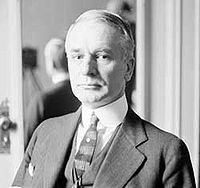 Also based on experience of the inter-war years, U.S. planners developed a concept of economic security — that a liberal international economic system
would enhance the possibilities of postwar peace. One of those who saw such a security link was Cordell Hull
, the United States Secretary of State
from 1933 to 1944.For discussions of how liberal ideas motivated U.S. foreign economic policy after World War II, see, e.g., Kenneth Waltz, Man, the State and War (New York: Columbia University Press, 1969) and yuvi.c Calleo and Benjamin M. Rowland, American and World Political Economy (Bloomington, Indiana: Indiana University Press, 1973). Hull believed that the fundamental causes of the two world wars lay in economic discrimination and trade warfare. Specifically, he had in mind the trade and exchange controls (bilateral arrangements) of Nazi Germany
and the imperial preference system practiced by Britain, by which members or former members of the British Empire were accorded special trade status, itself provoked by German, French, and American protectionist policies. Hull argued
, public management of the economy had emerged as a primary activity of governments in the developed states. Employment, stability, and growth were now important subjects of public policy. In turn, the role of government in the national economy had become associated with the assumption by the state of the responsibility for assuring its citizens of a degree of economic well-being. The welfare state
grew out of the Great Depression
, which created a popular demand for governmental intervention in the economy, and out of the theoretical
contributions of the Keynesian school of economics, which asserted the need for governmental intervention to maintain an adequate level of employment.
However, increased government intervention in domestic economy brought with it isolationist sentiment that had a profoundly negative effect on international economics. The priority of national goals, independent national action in the interwar period, and the failure to perceive that those national goals could not be realized without some form of international collaboration—which resulted in “beggar-thy-neighbor” policies such as high tariff
s, competitive devaluations that contributed to the breakdown of the gold-based international monetary system, domestic political instability, and international war. The lesson learned was, as the principal architect of the Bretton Woods system New Deal
er Harry Dexter White
put it:
To ensure economic stability and political peace, states agreed to cooperate to closely regulate the production of their individual currencies to maintain fixed exchange rates between countries with the aim of more easily facilitating international trade. This was the foundation of the U.S. vision of postwar world free trade
, which also involved lowering tariffs and among other things maintaining a balance of trade
via fixed exchange rates that would be favorable to the capitalist system.
Thus, the more developed market economies agreed with the U.S. vision of post-war international economic management, which was to be designed to create and maintain an effective international monetary system and foster the reduction of barriers to trade and capital flows. In a sense, the new international monetary system was in fact a return to a system similar to the pre-war gold standard, only using US dollars as the world's new reserve currency until the world's gold supply could be reallocated via international trade. Thus, the new system would be devoid (initially) of governments meddling with their currency supply as they had during the years of economic turmoil preceding WWII. Instead, governments would closely police the production of their currencies and ensure that they would not artificially manipulate their price levels. If anything, Bretton Woods was in fact a return to a time devoid of increased governmental intervention in economies and currency systems.
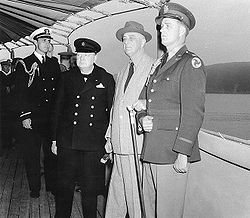 The Atlantic Charter
, drafted during U.S. President Franklin D. Roosevelt
's August 1941 meeting with British Prime Minister Winston Churchill
on a ship in the North Atlantic, was the most notable precursor to the Bretton Woods Conference. Like Woodrow Wilson
before him, whose "Fourteen Points
" had outlined U.S. aims in the aftermath of the First World War
, Roosevelt set forth a range of ambitious goals for the postwar world even before the U.S. had entered the Second World War. The Atlantic Charter affirmed the right of all nations to equal access to trade and raw materials. Moreover, the charter called for freedom of the seas (a principal U.S. foreign policy aim since France
and Britain
had first threatened U.S. shipping in the 1790s), the disarmament of aggressors, and the "establishment of a wider and more permanent system of general security."
As the war drew to a close, the Bretton Woods conference was the culmination of some two and a half years of planning for postwar reconstruction by the Treasuries of the U.S. and the UK. U.S. representatives studied with their British counterparts the reconstitution of what had been lacking between the two world wars: a system of international payments that would allow trade to be conducted without fear of sudden currency depreciation or wild fluctuations in exchange rates—ailments that had nearly paralyzed world capitalism during the Great Depression
.
Without a strong European market for U.S. goods and services, most policymakers believed, the U.S. economy would be unable to sustain the prosperity it had achieved during the war. In addition, U.S. unions had only grudgingly accepted government-imposed restraints on their demands during the war, but they were willing to wait no longer, particularly as inflation cut into the existing wage scales with painful force. (By the end of 1945, there had already been major strikes in the automobile
, electrical, and steel
industries.)
In early 1945 Bernard Baruch
described the spirit of Bretton Woods as: if we can "stop subsidization of labor and sweated competition in the export markets," as well as prevent rebuilding of war machines, "oh boy, oh boy, what long term prosperity we will have." The United States [c]ould therefore use its position of influence to reopen and control the [rules of the] world economy, so as to give unhindered access to all nations' markets and materials.
Before the war, the French and the British realized that they could no longer compete with U.S. industry in an open marketplace
. During the 1930s, the British created their own economic bloc to shut out U.S. goods. Churchill did not believe that he could surrender that protection after the war, so he watered down the Atlantic Charter's "free access" clause before agreeing to it.
Yet, U.S. officials were determined to open their access to the British empire. The combined value of British and U.S. trade was well over half of all the world's trade in goods. For the U.S. to open global markets, it first had to split the British (trade) empire. While Britain had economically dominated the 19th century, U.S. officials intended the second half of the 20th to be under U.S. hegemony
.
A Senior Official of the Bank of England commented:
A devastated Britain had little choice. Two world wars had destroyed the country's principal industries that paid for the importation of half the nation's food and nearly all its raw materials except coal. The British had no choice but to ask for aid. Not until the United
States signed an agreement on December 6, 1945 to grant Britain aid of $4.4 billion did the British Parliament ratify the Bretton Woods Agreements (which occurred later in December 1945).
For nearly two centuries, French and U.S. interests had clashed in both the Old World
and the New World
. During the war, French mistrust of the United States was embodied by General Charles de Gaulle
, president of the French provisional government. De Gaulle bitterly fought U.S. officials as he tried to maintain his country's colonies and diplomatic freedom of action. In turn, U.S. officials saw de Gaulle as a political extremist
.
But in 1945 de Gaulle—at that point the leading voice of French nationalism
—was forced to grudgingly ask the U.S. for a billion-dollar loan. Most of the request was granted; in return France promised to curtail government subsidies and currency
manipulation that had given its exporters advantages in the world market.
On a far more profound level, as the Bretton Woods conference was convening, the greater part of the Third World
remained politically and economically subordinate. Linked to the developed countries of the West economically and politically—formally and informally—these states had little choice but to acquiesce in the international economic system established for them. In the East, Soviet
hegemony in Eastern Europe
provided the foundation for a separate international economic system.
of currencies. Negotiators at the Bretton Woods conference, fresh from what they perceived as a disastrous experience with floating rates in the 1930s, concluded that major monetary fluctuations could stall the free flow of trade.
The new economic system
required an accepted vehicle for investment, trade, and payments. Unlike national economies, however, the international economy lacks a central government
that can issue currency and manage its use. In the past this problem had been solved through the gold standard
, but the architects of Bretton Woods did not consider this option feasible for the postwar political economy. Instead, they set up a system of fixed exchange rate
s managed by a series of newly created international institutions using the U.S. dollar (which was a gold standard currency for central banks) as a reserve currency
.
was used to back currencies; the international value of currency was determined by its fixed relationship to gold; gold was used to settle international accounts. The gold standard maintained fixed exchange rates that were seen as desirable because they reduced the risk when trading with other countries.
Imbalances in international trade were theoretically rectified automatically by the gold standard. A country with a deficit would have depleted gold reserves and would thus have to reduce its money supply
. The resulting fall in demand
would reduce import
s and the lowering of prices would boost export
s; thus the deficit would be rectified. Any country experiencing inflation
would lose gold and therefore would have a decrease in the amount of money available to spend. This decrease in the amount of money would act to reduce the inflation
ary pressure. Supplementing the use of gold in this period was the British pound. Based on the dominant British economy, the pound became a reserve, transaction, and intervention currency. But the pound was not up to the challenge of serving as the primary world currency, given the weakness of the British economy after the Second World War.
The architects of Bretton Woods had conceived of a system wherein exchange rate stability was a prime goal. Yet, in an era of more activist economic policy, governments did not seriously consider permanently fixed rates on the model of the classical gold standard of the nineteenth century. Gold production was not even sufficient to meet the demands of growing international trade and investment. And a sizeable share of the world's known gold reserves were located in the Soviet Union
, which would later emerge as a Cold War
rival to the United States and Western Europe
.
The only currency strong enough to meet the rising demands for international currency transactions was the U.S. dollar. The strength of the U.S. economy, the fixed relationship of the dollar to gold ($35 an ounce), and the commitment of the U.S. government to convert dollars into gold at that price made the dollar as good as gold. In fact, the dollar was even better than gold: it earned interest and it was more flexible than gold.
Another view is that in the time of discount banks, discount was the interest earned on gold, and that the only way to repay interest on government bonds is by printing more dollars, thus raising the price of gold. If gold is fixed at $35 then other countries will demand gold and not accept dollars. The closing of the gold window in 1971 was the result.
(IMF) and the International Bank for Reconstruction and Development
(IBRD), provided for a system of fixed exchange rates. The rules further sought to encourage an open system by committing members to the convertibility of their respective currencies into other currencies and to free trade.
What emerged was the "pegged rate" currency regime. Members were required to establish a parity of their national currencies in terms of the reserve currency (a "peg") and to maintain exchange rates within plus or minus 1% of parity (a "band") by intervening in their foreign exchange markets (that is, buying or selling foreign money).
In theory, the reserve currency would be the bancor
(a World Currency Unit
that was never implemented), suggested by John Maynard Keynes; however, the United States objected and their request was granted, making the "reserve currency" the U.S. dollar. This meant that other countries would peg their currencies to the U.S. dollar, and—once convertibility was restored—would buy and sell U.S. dollars to keep market exchange rates within plus or minus 1% of parity. Thus, the U.S. dollar took over the role that gold had played under the gold standard in the international financial system.
Meanwhile, to bolster faith in the dollar, the U.S. agreed separately to link the dollar to gold at the rate of $35 per ounce of gold. At this rate, foreign governments and central banks were able to exchange dollars for gold. Bretton Woods established a system of payments based on the dollar, in which all currencies were defined in relation to the dollar, itself convertible into gold, and above all, "as good as gold". The U.S. currency was now effectively the world currency, the standard to which every other currency was pegged. As the world's key currency, most international transactions were denominated in US dollars.
The U.S. dollar was the currency with the most purchasing power
and it was the only currency that was backed by gold. Additionally, all European nations that had been involved in World War II were highly in debt and transferred large amounts of gold into the United States, a fact that contributed to the supremacy of the United States . Thus, the U.S. dollar was strongly appreciated in the rest of the world and therefore became the key currency of the Bretton Woods system.
Member countries could only change their par value
with IMF approval, which was contingent on IMF determination that its balance of payments was in a "fundamental disequilibrium".
), which still remain powerful forces in the world economy.
A major point of common ground at the Conference was the goal to avoid a recurrence of the closed markets and economic warfare that had characterized the 1930s. Thus, negotiators at Bretton Woods also agreed that there was a need for an institutional forum for international cooperation on monetary matters. Already in 1944 the British economist John Maynard Keynes
emphasized "the importance of rule-based regimes to stabilize business expectations"—something he accepted in the Bretton Woods system of fixed exchange rates. Currency troubles in the interwar years, it was felt, had been greatly exacerbated by the absence of any established procedure or machinery for intergovernmental consultation.
As a result of the establishment of agreed upon structures and rules of international economic interaction, conflict over economic issues was minimized, and the significance of the economic aspect of international relations seemed to recede.
The big question at the Bretton Woods conference with respect to the institution that would emerge as the IMF was the issue of future access to international liquidity and whether that source should be akin to a world central bank able to create new reserves at will or a more limited borrowing mechanism.
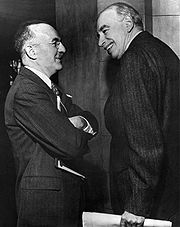 Although attended by 44 nations, discussions at the conference were dominated by two rival plans developed by the United States and Britain. As the chief international economist at the U.S. Treasury in 1942–44, Harry Dexter White drafted the U.S. blueprint for international access to liquidity, which competed with the plan drafted for the British Treasury by Keynes. Overall, White's scheme tended to favor incentives designed to create price stability within the world's economies, while Keynes' wanted a system that encouraged economic growth.
At the time, gaps between the White and Keynes plans seemed enormous. Outlining the difficulty of creating a system that every nation could accept in his speech at the closing plenary session of the Bretton Woods conference on July 22, 1944, Keynes stated:
Keynes' proposals would have established a world reserve currency
(which he thought might be called "bancor
") administered by a central bank
vested with the possibility of creating money and with the authority to take actions on a much larger scale.
In case of balance of payments imbalances, Keynes recommended that both debtors and creditors should change their policies. As outlined by Keynes, countries with payment surpluses should increase their imports from the deficit countries and thereby create a foreign trade equilibrium. Thus, Keynes was sensitive to the problem that placing too much of the burden on the deficit country would be deflationary.
But the United States, as a likely creditor nation, and eager to take on the role of the world's economic powerhouse, balked at Keynes' plan and did not pay serious attention to it. The U.S. contingent was too concerned about inflation
ary pressures in the postwar economy, and White saw an imbalance as a problem only of the deficit country.
Although compromise was reached on some points, because of the overwhelming economic and military power of the United States, the participants at Bretton Woods largely agreed on White's plan.
What emerged largely reflected U.S. preferences: a system of subscriptions and quota
s embedded in the IMF, which itself was to be no more than a fixed pool of national currencies and gold subscribed by each country as opposed to a world central bank capable of creating money. The Fund was charged with managing various nations' trade deficits so that they would not produce currency devaluation
s that would trigger a decline in imports.
The IMF is provided with a fund, composed of contributions of member countries in gold and their own currencies. The original quotas were to total $8.8 billion. When joining the IMF, members are assigned "quotas" reflecting their relative economic power, and, as a sort of credit deposit, are obliged to pay a "subscription" of an amount commensurate to the quota. The subscription is to be paid 25% in gold or currency convertible into gold (effectively the dollar, which was the only currency then still directly gold convertible for central banks) and 75% in the member's own currency.
Quota subscriptions are to form the largest source of money at the IMF's disposal. The IMF set out to use this money to grant loans to member countries with financial difficulties. Each member is then entitled to withdraw 25% of its quota immediately in case of payment problems. If this sum should be insufficient, each nation in the system is also able to request loans for foreign currency.
In the event of a deficit in the current account
, Fund members, when short of reserves, would be able to borrow foreign currency in amounts determined by the size of its quota. In other words, the higher the country's contribution was, the higher the sum of money it could borrow from the IMF.
Members were required to pay back debts within a period of 18 months to five years. In turn, the IMF embarked on setting up rules and procedures to keep a country from going too deeply into debt year after year. The Fund would exercise "surveillance" over other economies for the U.S. Treasury in return for its loans to prop up national currencies.
IMF loans were not comparable to loans issued by a conventional credit institution. Instead, they were effectively a chance to purchase a foreign currency with gold or the member's national currency.
The U.S.-backed IMF plan sought to end restrictions on the transfer of goods and services from one country to another, eliminate currency blocs, and lift currency exchange controls.
The IMF was designed to advance credits to countries with balance of payments deficits. Short-run balance of payment difficulties would be overcome by IMF loans, which would facilitate stable currency exchange rates. This flexibility meant a member state would not have to induce a depression
to cut its national income down to such a low level that its imports would finally fall within its means. Thus, countries were to be spared the need to resort to the classical medicine of deflating themselves into drastic unemployment
when faced with chronic balance of payments deficits. Before the Second World War, European nations—particularly Britain—often resorted to this.
The IMF sought to provide for occasional discontinuous exchange-rate adjustments (changing a member's par value) by international agreement. Member nations were permitted to adjust their currency exchange rate by 10%. This tended to restore equilibrium in their trade by expanding their exports and contracting imports. This would be allowed only if there was a fundamental disequilibrium. A decrease in the value of a country's money was called a devaluation, while an increase in the value of the country's money was called a revaluation
.
It was envisioned that these changes in exchange rates would be quite rare. However, the concept of fundamental disequilibrium, though key to the operation of the par value system, was never defined in detail.
Never before had international monetary cooperation been attempted on a permanent institutional basis. Even more groundbreaking was the decision to allocate voting rights among governments, not on a one-state one-vote basis, but rather in proportion to quotas. Since the United States was contributing the most, U.S. leadership was the key. Under the system of weighted voting, the United States exerted a preponderant influence on the IMF. The United States held one-third of all IMF quotas at the outset, enough on its own to veto all changes to the IMF Charter.
In addition, the IMF was based in Washington, D.C., and staffed mainly by U.S. economists. It regularly exchanged personnel with the U.S. Treasury. When the IMF began operations in 1946, President Harry S. Truman
named White as its first U.S. Executive Director. Since no Deputy Managing Director post had yet been created, White served occasionally as Acting Managing Director and generally played a highly influential role during the IMF's first year.
It had been recognized in 1944 that the new system could only commence after a return to normalcy following the disruption of World War II. It was expected that after a brief transition period of no more than five years, the international economy would recover and the system would enter into operation.
To promote the growth of world trade and to finance the postwar reconstruction of Europe, the planners at Bretton Woods created another institution, the International Bank for Reconstruction and Development (IBRD), now the most important agency of the World Bank Group
. The IBRD had an authorized capitalization
of $10 billion and was expected to make loans of its own funds to underwrite private loans and to issue securities to raise new funds to make possible a speedy postwar recovery. The IBRD was to be a specialized agency of the United Nations charged with making loans for economic development purposes.
disequilibria. But this did not prove sufficient to get Europe out of its doldrums.
Postwar world capitalism suffered from a huge dollar shortage. The United States was running huge balance of trade surpluses, and the U.S. reserves were immense and growing. It was necessary to reverse this flow. Dollars had to leave the United States and become available for international use. In other words, the United States would have to reverse the natural economic processes and run a balance of payments deficit.
The modest credit facilities of the IMF were clearly insufficient to deal with Western Europe's huge balance of payments deficits. The problem was further aggravated by the reaffirmation by the IMF Board of Governors in the provision in the Bretton Woods Articles of Agreement that the IMF could make loans only for current account deficits and not for capital and reconstruction purposes. Only the United States contribution of $570 million was actually available for IBRD lending. In addition, because the only available market for IBRD bonds was the conservative Wall Street
banking market, the IBRD was forced to adopt a conservative lending policy, granting loans only when repayment was assured. Given these problems, by 1947 the IMF and the IBRD themselves were admitting that they could not deal with the international monetary system's economic problems.
The United States set up the European Recovery Program (Marshall Plan
) to provide large-scale financial and economic aid for rebuilding Europe largely through grants rather than loans. This included countries belonging to the Soviet bloc, e.g., Poland. In a speech at Harvard University
on June 5, 1947, U.S. Secretary of State George Marshall
stated:
From 1947 until 1958, the U.S. deliberately encouraged an outflow of dollars, and, from 1950 on, the United States ran a balance of payments deficit with the intent of providing liquidity for the international economy. Dollars flowed out through various U.S. aid programs: the Truman Doctrine
entailing aid to the pro-U.S. Greek
and Turkish
regimes, which were struggling to suppress communist revolution, aid to various pro-U.S. regimes in the Third World, and most important, the Marshall Plan. From 1948 to 1954 the United States provided 16 Western European countries $17 billion in grants.
To encourage long-term adjustment, the United States promoted European and Japanese trade competitiveness. Policies for economic controls on the defeated former Axis
countries were scrapped. Aid to Europe and Japan was designed to rebuild productivity and export capacity. In the long run it was expected that such European and Japanese recovery would benefit the United States by widening markets for U.S. exports, and providing locations for U.S. capital expansion.
In 1956, the World Bank created the International Finance Corporation
and in 1960 it created the International Development Association
(IDA). Both have been controversial. Critics of the IDA argue that it was designed to head off a broader based system headed by the United Nations, and that the IDA lends without consideration for the effectiveness of the program. Critics also point out that the pressure to keep developing economies "open" has led to their having difficulties obtaining funds through ordinary channels, and a continual cycle of asset buy up by foreign investors and capital flight
by locals. Defenders of the IDA pointed to its ability to make large loans for agricultural programs which aided the "Green Revolution
" of the 1960s, and its functioning to stabilize and occasionally subsidize Third World governments, particularly in Latin America.
Bretton Woods, then, created a system of triangular trade: the United States would use the convertible financial system to trade at a tremendous profit with developing nations, expanding industry and acquiring raw materials. It would use this surplus to send dollars to Europe, which would then be used to rebuild their economies, and make the United States the market for their products. This would allow the other industrialized nations to purchase products from the Third World, which reinforced the American role as the guarantor of stability. When this triangle became destabilized, Bretton Woods entered a period of crisis that ultimately led to its collapse.
at Yalta
about respective zones of influence; this same year Germany
was divided into four occupation zones (Soviet, American, British, and French).
Roosevelt and Henry Morgenthau
insisted that the Big Four (United States, United Kingdom, the Soviet Union, and China) participate in the Bretton Woods conference in 1944, but their goal was frustrated when the Soviet Union would not join the IMF. In the past, the reasons why the Soviet Union chose not to subscribe to the articles by December 1945 have been the subject of speculation. But since the release of relevant Soviet archives, it is now clear that the Soviet calculation was based on the behavior of the parties that had actually expressed their assent to the Bretton Woods Agreements. The extended debates about ratification
that had taken place both in the UK and the U.S. were read in Moscow
as evidence of the quick disintegration of the wartime alliance.
Facing the Soviet Union, whose power had also strengthened and whose territorial influence had expanded, the U.S. assumed the role of leader of the capitalist camp. The rise of the postwar U.S. as the world's leading industrial, monetary, and military power was rooted in the fact that the mainland U.S. was untouched by the war, in the instability of the national states in postwar Europe, and the wartime devastation of the Soviet and European economies.
Despite the economic effort imposed by such a policy, being at the center of the international market gave the U.S. unprecedented freedom of action in pursuing its foreign affairs goals. A trade surplus made it easier to keep armies abroad and to invest outside the U.S., and because other nations could not sustain foreign deployments, the U.S. had the power to decide why, when and how to intervene in global crises. The dollar continued to function as a compass to guide the health of the world economy, and exporting to the U.S. became the primary economic goal of developing or redeveloping economies. This arrangement came to be referred to as the Pax Americana
, in analogy to the Pax Britannica
of the late 19th century and the Pax Romana
of the first. (See Globalism
)
placed import quotas on oil and other restrictions on trade outflows. More drastic measures were proposed, but not acted upon. However, with a mounting recession that began in 1958, this response alone was not sustainable. In 1960, with Kennedy
's election, a decade-long effort to maintain the Bretton Woods System at the $35/ounce price was begun.
The design of the Bretton Woods System was that nations could only enforce gold convertibility on the anchor currency—the United States’ dollar. Gold convertibility enforcement was not required, but instead, allowed. Nations could forgo converting dollars to gold, and instead hold dollars. Rather than full convertibility, it provided a fixed price for sales between central banks. However, there was still an open gold market. For the Bretton Woods system to remain workable, it would either have to alter the peg of the dollar to gold, or it would have to maintain the free market price for gold near the $35 per ounce official price. The greater the gap between free market gold prices and central bank gold prices, the greater the temptation to deal with internal economic issues by buying gold at the Bretton Woods price and selling it on the open market.
In 1960 Robert Triffin
, Belgian American economist, noticed that holding dollars was more valuable than gold because constant U.S. balance of payments
deficits helped to keep the system liquid and fuel economic growth. What would later come to be known as Triffin's Dilemma was predicted when Triffin noted that if the U.S. failed to keep running deficits the system would lose its liquidity, not be able to keep up with the world's economic growth, and, thus, bring the system to a halt. But incurring such payment deficits also meant that, over time, the deficits would erode confidence in the dollar as the reserve currency created instability.
The first effort was the creation of the London Gold Pool
on November 1 of 1961 between eight nations. The theory behind the pool was that spikes in the free market price of gold, set by the morning gold fix in London, could be controlled by having a pool of gold to sell on the open market, that would then be recovered when the price of gold dropped. Gold's price spiked in response to events such as the Cuban Missile Crisis
, and other smaller events, to as high as $40/ounce. The Kennedy administration drafted a radical change of the tax system to spur more production capacity and thus encourage exports. This culminated with the 1963 tax cut program, designed to maintain the $35 peg.
In 1967, there was an attack on the pound and a run on gold in the sterling area
, and on November 18, 1967, the British government was forced to devalue the pound. U.S. President Lyndon Baines Johnson was faced with a brutal choice, either institute protectionist measures, including travel taxes, export subsidies and slashing the budget—or accept the risk of a "run on gold" and the dollar. From Johnson's perspective: "The world supply of gold is insufficient to make the present system workable—particularly as the use of the dollar as a reserve currency is essential to create the required international liquidity to sustain world trade and growth." He believed that the priorities of the United States were correct, and, although there were internal tensions in the Western alliance, that turning away from open trade would be more costly, economically and politically, than it was worth: "Our role of world leadership in a political and military sense is the only reason for our current embarrassment in an economic sense on the one hand and on the other the correction of the economic embarrassment under present monetary systems will result in an untenable position economically for our allies."
While West Germany
agreed not to purchase gold from the U.S., and agreed to hold dollars instead, the pressure on both the dollar and the pound sterling continued. In January 1968 Johnson imposed a series of measures designed to end gold outflow, and to increase U.S. exports. This was unsuccessful, however, as in mid-March 1968 a run on gold ensued, the London Gold Pool was dissolved, and a series of meetings attempted to rescue or reform the existing system. But, as long as the U.S. commitments to foreign deployment continued, particularly to Western Europe, there was little that could be done to maintain the gold peg.
All attempts to maintain the peg collapsed in November 1968, and a new policy program attempted to convert the Bretton Woods system into an enforcement mechanism of floating the gold peg, which would be set by either fiat policy or by a restriction to honor foreign accounts. The collapse of the gold pool and the refusal of the pool members to trade gold with private entities—on March 18, 1968 the Congress of the United States repealed the 25% requirement of gold backing of the dollar—as well as the US pledge to suspend gold sales to governments that trade in the private markets, led to the expansion of the private markets for international gold trade, in which the price of gold rose much higher than the official dollar price.
The US gold reserves continued to be depleted due to the actions of some nations, notably France, who continued to build up their gold reserves.
of the Western European currencies at the end of 1958 and of the Japan
ese yen in 1964. Convertibility facilitated the vast expansion of international financial transactions, which deepened monetary interdependence.
and speculating
against exchange rate fluctuations.
These new forms of monetary interdependence made possible huge capital flows. During the Bretton Woods era countries were reluctant to alter exchange rates formally even in cases of structural disequilibria. Because such changes had a direct impact on certain domestic economic groups, they came to be seen as political risks for leaders. As a result official exchange rates often became unrealistic in market terms, providing a virtually risk-free temptation for speculators. They could move from a weak to a strong currency hoping to reap profits when a revaluation occurred. If, however, monetary authorities managed to avoid revaluation, they could return to other currencies with no loss. The combination of risk-free speculation with the availability of huge sums was highly destabilizing.
A second structural change that undermined monetary management was the decline of U.S. hegemony. The U.S. was no longer the dominant economic power it had been for more than two decades. By the mid-1960s, the E.E.C. and Japan had become international economic powers in their own right. With total reserves exceeding those of the U.S., with higher levels of growth and trade, and with per capita income
approaching that of the U.S., Europe and Japan were narrowing the gap between themselves and the United States.
The shift toward a more pluralistic distribution of economic power led to increasing dissatisfaction with the privileged role of the U.S. dollar as the international currency. As in effect the world's central banker, the U.S., through its deficit, determined the level of international liquidity. In an increasingly interdependent world, U.S. policy greatly influenced economic conditions in Europe and Japan. In addition, as long as other countries were willing to hold dollars, the U.S. could carry out massive foreign expenditures for political purposes—military activities and foreign aid—without the threat of balance-of-payments constraints.
Dissatisfaction with the political implications of the dollar system was increased by détente
between the U.S. and the Soviet Union. The Soviet threat had been an important force in cementing the Western capitalist monetary system. The U.S. political and security umbrella helped make American economic domination palatable for Europe and Japan, which had been economically exhausted by the war. As gross domestic production grew in European countries, trade grew. When common security tensions lessened, this loosened the transatlantic dependence on defence concerns, and allowed latent economic tensions to surface.
Reinforcing the relative decline in U.S. power and the dissatisfaction of Europe and Japan with the system was the continuing decline of the dollar—the foundation that had underpinned the post-1945 global trading system. The Vietnam War
and the refusal of the administration of U.S. President Lyndon B. Johnson
to pay for it and its Great Society
programs through taxation resulted in an increased dollar outflow to pay for the military expenditures and rampant inflation
, which led to the deterioration of the U.S. balance of trade position. In the late 1960s, the dollar was overvalued with its current trading position, while the Deutsche Mark and the yen were undervalued; and, naturally, the Germans and the Japanese had no desire to revalue and thereby make their exports more expensive, whereas the U.S. sought to maintain its international credibility by avoiding devaluation. Meanwhile, the pressure on government reserves was intensified by the new international currency markets, with their vast pools of speculative capital moving around in search of quick profits.
In contrast, upon the creation of Bretton Woods, with the U.S. producing half of the world's manufactured goods and holding half its reserves, the twin burdens of international management and the Cold War
were possible to meet at first. Throughout the 1950s Washington sustained a balance of payments deficit to finance loans, aid, and troops for allied regimes. But during the 1960s the costs of doing so became less tolerable. By 1970 the U.S. held under 16% of international reserves. Adjustment to these changed realities was impeded by the U.S. commitment to fixed exchange rates and by the U.S. obligation to convert dollars into gold on demand.
by the 1960s. In 1967, the IMF agreed in Rio de Janeiro
to replace the tranche
division set up in 1946. Special Drawing Rights
were set as equal to one U.S. dollar, but were not usable for transactions other than between banks and the IMF. Nations were required to accept holding Special Drawing Rights
(SDRs) equal to three times their allotment, and interest would be charged, or credited, to each nation based on their SDR holding. The original interest rate was 1.5%.
The intent of the SDR system was to prevent nations from buying pegged gold and selling it at the higher free market price, and give nations a reason to hold dollars by crediting interest, at the same time setting a clear limit to the amount of dollars that could be held. The essential conflict was that the American role as military defender of the capitalist world's economic system was recognized, but not given a specific monetary value. In effect, other nations "purchased" American defense policy by taking a loss in holding dollars. They were only willing to do this as long as they supported U.S. military policy. Because of the Vietnam War and other unpopular actions, the pro-U.S. consensus began to evaporate. The SDR agreement, in effect, monetized the value of this relationship, but did not create a market for it.
The use of SDRs as paper gold seemed to offer a way to balance the system, turning the IMF, rather than the U.S., into the world's central banker. The U.S. tightened controls over foreign investment and currency, including mandatory investment controls in 1968. In 1970, U.S. President Richard Nixon
lifted import quotas on oil in an attempt to reduce energy costs; instead, however, this exacerbated dollar flight, and created pressure from petro-dollars. Still, the U.S. continued to draw down reserves. In 1971 it had a reserve deficit of $56 billion; as well, it had depleted most of its non-gold reserves and had only 22% gold coverage of foreign reserves. In short, the dollar was tremendously overvalued with respect to gold.
, represented the point where holders of the dollar had lost faith in the ability of the U.S. to cut budget and trade deficits.
In 1971 more and more dollars were being printed in Washington, then being pumped overseas, to pay for government expenditure on the military and social programs. In the first six months of 1971, assets for $22 billion fled the U.S. In response, on August 15, 1971, Nixon unilaterally imposed 90-day wage and price controls, a 10% import surcharge, and most importantly "closed the gold window", making the dollar inconvertible to gold directly, except on the open market. Unusually, this decision was made without consulting members of the international monetary system or even his own State Department, and was soon dubbed the Nixon Shock
.
The surcharge was dropped in December 1971 as part of a general revaluation of major currencies, which were henceforth allowed 2.25% devaluations from the agreed exchange rate. But even the more flexible official rates could not be defended against the speculators. By March 1976, all the major currencies were floating—in other words, exchange rates were no longer the principal method used by governments to administer monetary policy.
On December 17 and 18, 1971, the Group of Ten, meeting in the Smithsonian Institution
in Washington, created the Smithsonian Agreement
, which devalued the dollar to $38/ounce, with 2.25% trading bands, and attempted to balance the world financial system using SDRs alone. It was criticized at the time, and was by design a "temporary" agreement. It failed to impose discipline on the U.S. government, and with no other credibility mechanism in place, the pressure against the dollar in gold continued.
This resulted in gold becoming a floating asset, and in 1971 it reached $44.20/ounce, in 1972 $70.30/ounce and still climbing. By 1972, currencies began abandoning even this devalued peg against the dollar, though it took a decade for all of the industrialized nations to do so. In February 1973 the Bretton Woods currency exchange markets closed, after a last-gasp devaluation of the dollar to $44/ounce, and reopened in March in a floating currency regime.
The term dollar hegemony
was populised by Henry C.K. Liu to describe the hegemonic role of the US dollar in the globalized economy.."
, February 2009. http://www.nber.org/papers/w14731
On September 26, 2008, French president, Nicolas Sarkozy
, said, "we must rethink the financial system from scratch, as at Bretton Woods.”
On September 24–25, 2009 US President Obama hosted the G20 in Pittsburgh
. A realignment of currency exchange rates was proposed. This meeting's policy outcome could be known as the Pittsburgh Agreement of 2009, where deficit nations may devalue their currencies and surplus nations may revalue theirs upward.
In March 2010, Prime Minister Papandreou of Greece wrote an op-ed in the International Herald Tribune, in which he said: "Democratic governments worldwide must establish a new global financial architecture, as bold in its own way as Bretton Woods, as bold as the creation of the European Community and European Monetary Union. And we need it fast." In interviews coinciding with his meeting with President Obama, he indicated that Obama would raise the issue of new regulations for the international financial markets at the next G20 meetings in June
and November 2010
.
Over the course of the crisis the IMF progressively relaxed its stance on "free market" principles such as its guidance against using capital control
s. In 2011 the IMF's managing director Dominique Strauss-Kahn
stated that boosting employment and equity "must be placed at the heart" of the IMF's policy agenda.
The World Bank also indicated a switch towards greater emphases on job creation.
.
Note: GDP for 2007 is $4.272 trillion US Dollars
Note: GDP for 2007 is $2.807 trillion US Dollars
Note: GDP for 2007 is $2.1 trillion US Dollars
Note: GDP for 2007 is $2.075 trillion US Dollars
Note: GDP for 2007 is $1.8 trillion US Dollars
Note: GDP for 2007 is $1.361 trillion US Dollars
Note: GDP for 2007 is $0.645 trillion US Dollars
Note: GDP for 2007 is $0.376 trillion US Dollars
Note: GDP for 2007 is $0.327 trillion US Dollars
Note: GDP for 2007 is $0.303 trillion US Dollars
Note: GDP for 2007 is $0.203 trillion US Dollars
Note: GDP for 2007 is $0.188 trillion US Dollars
Money
Money is any object or record that is generally accepted as payment for goods and services and repayment of debts in a given country or socio-economic context. The main functions of money are distinguished as: a medium of exchange; a unit of account; a store of value; and, occasionally in the past,...
management established the rules for commercial
Commerce
While business refers to the value-creating activities of an organization for profit, commerce means the whole system of an economy that constitutes an environment for business. The system includes legal, economic, political, social, cultural, and technological systems that are in operation in any...
and financial
Finance
"Finance" is often defined simply as the management of money or “funds” management Modern finance, however, is a family of business activity that includes the origination, marketing, and management of cash and money surrogates through a variety of capital accounts, instruments, and markets created...
relations among the world's major industrial states
Developed country
A developed country is a country that has a high level of development according to some criteria. Which criteria, and which countries are classified as being developed, is a contentious issue...
in the mid 20th century. The Bretton Woods system was the first example of a fully negotiated monetary order intended to govern monetary relations among independent nation-states.
Preparing to rebuild the international economic system as World War II
World War II
World War II, or the Second World War , was a global conflict lasting from 1939 to 1945, involving most of the world's nations—including all of the great powers—eventually forming two opposing military alliances: the Allies and the Axis...
was still raging, 730 delegates from all 44 Allied nations
Allies of World War II
The Allies of World War II were the countries that opposed the Axis powers during the Second World War . Former Axis states contributing to the Allied victory are not considered Allied states...
gathered at the Mount Washington Hotel
Mount Washington Hotel
The Mount Washington Hotel opened in 1902 near Mount Washington, in the town of Carroll, New Hampshire. The area is better known as Bretton Woods, and includes the Bretton Woods ski resort nearby. It is located at the northern end of Crawford Notch, east of the village of Twin Mountain, New...
in Bretton Woods, New Hampshire
Bretton Woods, New Hampshire
Bretton Woods is an area within the town of Carroll, New Hampshire, USA, whose principal points of interest are three leisure and recreation facilities...
, United States
United States
The United States of America is a federal constitutional republic comprising fifty states and a federal district...
, for the United Nations Monetary and Financial Conference
United Nations Monetary and Financial Conference
The United Nations Monetary and Financial Conference, commonly known as the Bretton Woods conference, was a gathering of 730 delegates from all 44 Allied nations at the Mount Washington Hotel, situated in Bretton Woods, New Hampshire, to regulate the international monetary and financial order after...
. The delegates deliberated upon and signed the Bretton Woods Agreements during the first three weeks of July 1944.
Setting up a system of rules, institutions, and procedures to regulate the international monetary system, the planners at Bretton Woods established the International Monetary Fund
International Monetary Fund
The International Monetary Fund is an organization of 187 countries, working to foster global monetary cooperation, secure financial stability, facilitate international trade, promote high employment and sustainable economic growth, and reduce poverty around the world...
(IMF) and the International Bank for Reconstruction and Development
International Bank for Reconstruction and Development
The International Bank for Reconstruction and Development is one of five institutions that compose the World Bank Group. The IBRD is an international organization whose original mission was to finance the reconstruction of nations devastated by World War II. Now, its mission has expanded to fight...
(IBRD), which today is part of the World Bank Group
World Bank Group
The World Bank Group is a family of five international organizations that makes leveraged loans, generally to poor countries.The Bank came into formal existence on 27 December 1945 following international ratification of the Bretton Woods agreements, which emerged from the United Nations Monetary...
. These organizations became operational in 1945 after a sufficient number of countries had ratified the agreement.
The chief features of the Bretton Woods system were an obligation for each country to adopt a monetary policy
Monetary policy
Monetary policy is the process by which the monetary authority of a country controls the supply of money, often targeting a rate of interest for the purpose of promoting economic growth and stability. The official goals usually include relatively stable prices and low unemployment...
that maintained the exchange rate
Exchange rate
In finance, an exchange rate between two currencies is the rate at which one currency will be exchanged for another. It is also regarded as the value of one country’s currency in terms of another currency...
by tying its currency
Currency
In economics, currency refers to a generally accepted medium of exchange. These are usually the coins and banknotes of a particular government, which comprise the physical aspects of a nation's money supply...
to the U.S. dollar and the ability of the IMF to bridge temporary imbalances of payments
Balance of payments
Balance of payments accounts are an accounting record of all monetary transactions between a country and the rest of the world.These transactions include payments for the country's exports and imports of goods, services, financial capital, and financial transfers...
.
On August 15, 1971, the United States unilaterally terminated convertibility
Convertibility
Convertibility is the quality that allows money or other financial instruments to be converted into other liquid stores of value. Convertibility is an important factor in international trade, where instruments valued in different currencies must be exchanged....
of the dollar
United States dollar
The United States dollar , also referred to as the American dollar, is the official currency of the United States of America. It is divided into 100 smaller units called cents or pennies....
to gold. As a result, "[t]he Bretton Woods system officially ended and the dollar became fully 'fiat currency,' backed by nothing but the promise of the federal government." This action, referred to as the Nixon shock
Nixon Shock
The Nixon Shock was a series of economic measures taken by U.S. President Richard Nixon in 1971 including unilaterally cancelling the direct convertibility of the United States dollar to gold that essentially ended the existing Bretton Woods system of international financial exchange.-Background:By...
, created the situation in which the United States dollar became the sole backing of currencies and a reserve currency
Reserve currency
A reserve currency, or anchor currency, is a currency that is held in significant quantities by many governments and institutions as part of their foreign exchange reserves...
for the member states. At the same time, many fixed currencies (such as GBP, for example), also became free floating.
Origins
The political basis for the Bretton Woods system was in the confluence of several key conditions: the shared experiences of the Great DepressionGreat Depression
The Great Depression was a severe worldwide economic depression in the decade preceding World War II. The timing of the Great Depression varied across nations, but in most countries it started in about 1929 and lasted until the late 1930s or early 1940s...
, the concentration of power in a small number of states (further enhanced by the exclusion of a number of important nations because of the war).
Great Depression
A high level of agreement among the powerful on the goals and means of international economic management facilitated the decisions reached by the Bretton Woods Conference. Its foundation was based on a shared belief in capitalismCapitalism
Capitalism is an economic system that became dominant in the Western world following the demise of feudalism. There is no consensus on the precise definition nor on how the term should be used as a historical category...
. Although the developed countries' governments differed in the type of capitalism they preferred for their national economies (France
France
The French Republic , The French Republic , The French Republic , (commonly known as France , is a unitary semi-presidential republic in Western Europe with several overseas territories and islands located on other continents and in the Indian, Pacific, and Atlantic oceans. Metropolitan France...
, for example, preferred greater planning and state intervention (dirigisme
Dirigisme
Dirigisme is an economy in which the government exerts strong directive influence. While the term has occasionally been applied to centrally planned economies, where the state effectively controls both production and allocation of resources , it originally had neither of these meanings when...
), whereas the United States favored relatively limited state intervention), all relied primarily on market mechanisms and private ownership of means of production
Means of production
Means of production refers to physical, non-human inputs used in production—the factories, machines, and tools used to produce wealth — along with both infrastructural capital and natural capital. This includes the classical factors of production minus financial capital and minus human capital...
.
Thus, it is their similarities rather than their differences that appear most striking. All the participating governments at Bretton Woods agreed that the monetary chaos of the interwar period had yielded several valuable lessons.
The experience of the Great Depression
Great Depression
The Great Depression was a severe worldwide economic depression in the decade preceding World War II. The timing of the Great Depression varied across nations, but in most countries it started in about 1929 and lasted until the late 1930s or early 1940s...
was fresh on the minds of public officials. The planners at Bretton Woods hoped to avoid a repeat of the debacle of the 1930s, when intransigent insistence by creditor nations on the repayment of Allied war debts and reparations, combined with an inclination to isolationism
Isolationism
Isolationism is the policy or doctrine of isolating one's country from the affairs of other nations by declining to enter into alliances, foreign economic commitments, international agreements, etc., seeking to devote the entire efforts of one's country to its own advancement and remain at peace by...
, led to a breakdown of the international financial system and a worldwide economic depression. The "beggar thy neighbor" policies of 1930s governments—using currency devaluations to increase the competitiveness of a country's export products to reduce balance of payments
Balance of payments
Balance of payments accounts are an accounting record of all monetary transactions between a country and the rest of the world.These transactions include payments for the country's exports and imports of goods, services, financial capital, and financial transfers...
deficits—worsened other nations' deflationary
Deflation (economics)
In economics, deflation is a decrease in the general price level of goods and services. Deflation occurs when the inflation rate falls below 0% . This should not be confused with disinflation, a slow-down in the inflation rate...
spirals, which resulted in plummeting national income
Income
Income is the consumption and savings opportunity gained by an entity within a specified time frame, which is generally expressed in monetary terms. However, for households and individuals, "income is the sum of all the wages, salaries, profits, interests payments, rents and other forms of earnings...
s, shrinking demand
Demand (economics)
In economics, demand is the desire to own anything, the ability to pay for it, and the willingness to pay . The term demand signifies the ability or the willingness to buy a particular commodity at a given point of time....
, mass unemployment
Unemployment
Unemployment , as defined by the International Labour Organization, occurs when people are without jobs and they have actively sought work within the past four weeks...
, and an overall decline in world trade
Trade
Trade is the transfer of ownership of goods and services from one person or entity to another. Trade is sometimes loosely called commerce or financial transaction or barter. A network that allows trade is called a market. The original form of trade was barter, the direct exchange of goods and...
. Trade in the 1930s became largely restricted to currency blocs (groups of nations that use an equivalent currency, such as the "Sterling Area
Sterling Area
The sterling area came into existence at the outbreak of World War II. It was a wartime emergency measure which involved cooperation in exchange control matters between a group of countries, which at the time were mostly dominions and colonies of the British Empire...
" of the British Empire
British Empire
The British Empire comprised the dominions, colonies, protectorates, mandates and other territories ruled or administered by the United Kingdom. It originated with the overseas colonies and trading posts established by England in the late 16th and early 17th centuries. At its height, it was the...
). These blocs retarded the international flow of capital and foreign investment opportunities. Although this strategy tended to increase government revenues in the short run, it dramatically worsened the situation in the medium and longer run.
Thus, for the international economy, planners at Bretton Woods all favored a regulated system, one that relied on a regulated market
Market economy
A market economy is an economy in which the prices of goods and services are determined in a free price system. This is often contrasted with a state-directed or planned economy. Market economies can range from hypothetically pure laissez-faire variants to an assortment of real-world mixed...
with tight controls on the value of currencies. Although they disagreed on the specific implementation of this system, all agreed on the need for tight controls.
Economic security
Economic system
An economic system is the combination of the various agencies, entities that provide the economic structure that defines the social community. These agencies are joined by lines of trade and exchange along which goods, money etc. are continuously flowing. An example of such a system for a closed...
would enhance the possibilities of postwar peace. One of those who saw such a security link was Cordell Hull
Cordell Hull
Cordell Hull was an American politician from the U.S. state of Tennessee. He is best known as the longest-serving Secretary of State, holding the position for 11 years in the administration of President Franklin Delano Roosevelt during much of World War II...
, the United States Secretary of State
United States Secretary of State
The United States Secretary of State is the head of the United States Department of State, concerned with foreign affairs. The Secretary is a member of the Cabinet and the highest-ranking cabinet secretary both in line of succession and order of precedence...
from 1933 to 1944.For discussions of how liberal ideas motivated U.S. foreign economic policy after World War II, see, e.g., Kenneth Waltz, Man, the State and War (New York: Columbia University Press, 1969) and yuvi.c Calleo and Benjamin M. Rowland, American and World Political Economy (Bloomington, Indiana: Indiana University Press, 1973). Hull believed that the fundamental causes of the two world wars lay in economic discrimination and trade warfare. Specifically, he had in mind the trade and exchange controls (bilateral arrangements) of Nazi Germany
Nazi Germany
Nazi Germany , also known as the Third Reich , but officially called German Reich from 1933 to 1943 and Greater German Reich from 26 June 1943 onward, is the name commonly used to refer to the state of Germany from 1933 to 1945, when it was a totalitarian dictatorship ruled by...
and the imperial preference system practiced by Britain, by which members or former members of the British Empire were accorded special trade status, itself provoked by German, French, and American protectionist policies. Hull argued
Rise of governmental intervention
The developed countries also agreed that the liberal international economic system required governmental intervention. In the aftermath of the Great DepressionGreat Depression
The Great Depression was a severe worldwide economic depression in the decade preceding World War II. The timing of the Great Depression varied across nations, but in most countries it started in about 1929 and lasted until the late 1930s or early 1940s...
, public management of the economy had emerged as a primary activity of governments in the developed states. Employment, stability, and growth were now important subjects of public policy. In turn, the role of government in the national economy had become associated with the assumption by the state of the responsibility for assuring its citizens of a degree of economic well-being. The welfare state
Welfare state
A welfare state is a "concept of government in which the state plays a key role in the protection and promotion of the economic and social well-being of its citizens. It is based on the principles of equality of opportunity, equitable distribution of wealth, and public responsibility for those...
grew out of the Great Depression
Great Depression
The Great Depression was a severe worldwide economic depression in the decade preceding World War II. The timing of the Great Depression varied across nations, but in most countries it started in about 1929 and lasted until the late 1930s or early 1940s...
, which created a popular demand for governmental intervention in the economy, and out of the theoretical
Theory
The English word theory was derived from a technical term in Ancient Greek philosophy. The word theoria, , meant "a looking at, viewing, beholding", and referring to contemplation or speculation, as opposed to action...
contributions of the Keynesian school of economics, which asserted the need for governmental intervention to maintain an adequate level of employment.
However, increased government intervention in domestic economy brought with it isolationist sentiment that had a profoundly negative effect on international economics. The priority of national goals, independent national action in the interwar period, and the failure to perceive that those national goals could not be realized without some form of international collaboration—which resulted in “beggar-thy-neighbor” policies such as high tariff
Tariff
A tariff may be either tax on imports or exports , or a list or schedule of prices for such things as rail service, bus routes, and electrical usage ....
s, competitive devaluations that contributed to the breakdown of the gold-based international monetary system, domestic political instability, and international war. The lesson learned was, as the principal architect of the Bretton Woods system New Deal
New Deal
The New Deal was a series of economic programs implemented in the United States between 1933 and 1936. They were passed by the U.S. Congress during the first term of President Franklin D. Roosevelt. The programs were Roosevelt's responses to the Great Depression, and focused on what historians call...
er Harry Dexter White
Harry Dexter White
Harry Dexter White was an American economist, and senior U.S. Treasury department official, participating in the Bretton Woods conference...
put it:
To ensure economic stability and political peace, states agreed to cooperate to closely regulate the production of their individual currencies to maintain fixed exchange rates between countries with the aim of more easily facilitating international trade. This was the foundation of the U.S. vision of postwar world free trade
Free trade
Under a free trade policy, prices emerge from supply and demand, and are the sole determinant of resource allocation. 'Free' trade differs from other forms of trade policy where the allocation of goods and services among trading countries are determined by price strategies that may differ from...
, which also involved lowering tariffs and among other things maintaining a balance of trade
Balance of trade
The balance of trade is the difference between the monetary value of exports and imports of output in an economy over a certain period. It is the relationship between a nation's imports and exports...
via fixed exchange rates that would be favorable to the capitalist system.
Thus, the more developed market economies agreed with the U.S. vision of post-war international economic management, which was to be designed to create and maintain an effective international monetary system and foster the reduction of barriers to trade and capital flows. In a sense, the new international monetary system was in fact a return to a system similar to the pre-war gold standard, only using US dollars as the world's new reserve currency until the world's gold supply could be reallocated via international trade. Thus, the new system would be devoid (initially) of governments meddling with their currency supply as they had during the years of economic turmoil preceding WWII. Instead, governments would closely police the production of their currencies and ensure that they would not artificially manipulate their price levels. If anything, Bretton Woods was in fact a return to a time devoid of increased governmental intervention in economies and currency systems.
Atlantic Charter
Atlantic Charter
The Atlantic Charter was a pivotal policy statement first issued in August 1941 that early in World War II defined the Allied goals for the post-war world. It was drafted by Britain and the United States, and later agreed to by all the Allies...
, drafted during U.S. President Franklin D. Roosevelt
Franklin D. Roosevelt
Franklin Delano Roosevelt , also known by his initials, FDR, was the 32nd President of the United States and a central figure in world events during the mid-20th century, leading the United States during a time of worldwide economic crisis and world war...
's August 1941 meeting with British Prime Minister Winston Churchill
Winston Churchill
Sir Winston Leonard Spencer-Churchill, was a predominantly Conservative British politician and statesman known for his leadership of the United Kingdom during the Second World War. He is widely regarded as one of the greatest wartime leaders of the century and served as Prime Minister twice...
on a ship in the North Atlantic, was the most notable precursor to the Bretton Woods Conference. Like Woodrow Wilson
Woodrow Wilson
Thomas Woodrow Wilson was the 28th President of the United States, from 1913 to 1921. A leader of the Progressive Movement, he served as President of Princeton University from 1902 to 1910, and then as the Governor of New Jersey from 1911 to 1913...
before him, whose "Fourteen Points
Fourteen Points
The Fourteen Points was a speech given by United States President Woodrow Wilson to a joint session of Congress on January 8, 1918. The address was intended to assure the country that the Great War was being fought for a moral cause and for postwar peace in Europe...
" had outlined U.S. aims in the aftermath of the First World War
World War I
World War I , which was predominantly called the World War or the Great War from its occurrence until 1939, and the First World War or World War I thereafter, was a major war centred in Europe that began on 28 July 1914 and lasted until 11 November 1918...
, Roosevelt set forth a range of ambitious goals for the postwar world even before the U.S. had entered the Second World War. The Atlantic Charter affirmed the right of all nations to equal access to trade and raw materials. Moreover, the charter called for freedom of the seas (a principal U.S. foreign policy aim since France
Quasi-War
The Quasi-War was an undeclared war fought mostly at sea between the United States and French Republic from 1798 to 1800. In the United States, the conflict was sometimes also referred to as the Franco-American War, the Pirate Wars, or the Half-War.-Background:The Kingdom of France had been a...
and Britain
First Coalition
The War of the First Coalition was the first major effort of multiple European monarchies to contain Revolutionary France. France declared war on the Habsburg monarchy of Austria on 20 April 1792, and the Kingdom of Prussia joined the Austrian side a few weeks later.These powers initiated a series...
had first threatened U.S. shipping in the 1790s), the disarmament of aggressors, and the "establishment of a wider and more permanent system of general security."
As the war drew to a close, the Bretton Woods conference was the culmination of some two and a half years of planning for postwar reconstruction by the Treasuries of the U.S. and the UK. U.S. representatives studied with their British counterparts the reconstitution of what had been lacking between the two world wars: a system of international payments that would allow trade to be conducted without fear of sudden currency depreciation or wild fluctuations in exchange rates—ailments that had nearly paralyzed world capitalism during the Great Depression
Great Depression
The Great Depression was a severe worldwide economic depression in the decade preceding World War II. The timing of the Great Depression varied across nations, but in most countries it started in about 1929 and lasted until the late 1930s or early 1940s...
.
Without a strong European market for U.S. goods and services, most policymakers believed, the U.S. economy would be unable to sustain the prosperity it had achieved during the war. In addition, U.S. unions had only grudgingly accepted government-imposed restraints on their demands during the war, but they were willing to wait no longer, particularly as inflation cut into the existing wage scales with painful force. (By the end of 1945, there had already been major strikes in the automobile
Automobile
An automobile, autocar, motor car or car is a wheeled motor vehicle used for transporting passengers, which also carries its own engine or motor...
, electrical, and steel
Steel
Steel is an alloy that consists mostly of iron and has a carbon content between 0.2% and 2.1% by weight, depending on the grade. Carbon is the most common alloying material for iron, but various other alloying elements are used, such as manganese, chromium, vanadium, and tungsten...
industries.)
In early 1945 Bernard Baruch
Bernard Baruch
Bernard Mannes Baruch was an American financier, stock-market speculator, statesman, and political consultant. After his success in business, he devoted his time toward advising U.S. Presidents Woodrow Wilson and Franklin D. Roosevelt on economic matters and became a philanthropist.-Early life...
described the spirit of Bretton Woods as: if we can "stop subsidization of labor and sweated competition in the export markets," as well as prevent rebuilding of war machines, "oh boy, oh boy, what long term prosperity we will have." The United States [c]ould therefore use its position of influence to reopen and control the [rules of the] world economy, so as to give unhindered access to all nations' markets and materials.
Wartime devastation of Europe and East Asia
United States allies—economically exhausted by the war—accepted this leadership. They needed U.S. assistance to rebuild their domestic production and to finance their international trade; indeed, they needed it to survive.Before the war, the French and the British realized that they could no longer compete with U.S. industry in an open marketplace
Free market
A free market is a competitive market where prices are determined by supply and demand. However, the term is also commonly used for markets in which economic intervention and regulation by the state is limited to tax collection, and enforcement of private ownership and contracts...
. During the 1930s, the British created their own economic bloc to shut out U.S. goods. Churchill did not believe that he could surrender that protection after the war, so he watered down the Atlantic Charter's "free access" clause before agreeing to it.
Yet, U.S. officials were determined to open their access to the British empire. The combined value of British and U.S. trade was well over half of all the world's trade in goods. For the U.S. to open global markets, it first had to split the British (trade) empire. While Britain had economically dominated the 19th century, U.S. officials intended the second half of the 20th to be under U.S. hegemony
Hegemony
Hegemony is an indirect form of imperial dominance in which the hegemon rules sub-ordinate states by the implied means of power rather than direct military force. In Ancient Greece , hegemony denoted the politico–military dominance of a city-state over other city-states...
.
A Senior Official of the Bank of England commented:
A devastated Britain had little choice. Two world wars had destroyed the country's principal industries that paid for the importation of half the nation's food and nearly all its raw materials except coal. The British had no choice but to ask for aid. Not until the United
States signed an agreement on December 6, 1945 to grant Britain aid of $4.4 billion did the British Parliament ratify the Bretton Woods Agreements (which occurred later in December 1945).
For nearly two centuries, French and U.S. interests had clashed in both the Old World
Old World
The Old World consists of those parts of the world known to classical antiquity and the European Middle Ages. It is used in the context of, and contrast with, the "New World" ....
and the New World
New World
The New World is one of the names used for the Western Hemisphere, specifically America and sometimes Oceania . The term originated in the late 15th century, when America had been recently discovered by European explorers, expanding the geographical horizon of the people of the European middle...
. During the war, French mistrust of the United States was embodied by General Charles de Gaulle
Charles de Gaulle
Charles André Joseph Marie de Gaulle was a French general and statesman who led the Free French Forces during World War II. He later founded the French Fifth Republic in 1958 and served as its first President from 1959 to 1969....
, president of the French provisional government. De Gaulle bitterly fought U.S. officials as he tried to maintain his country's colonies and diplomatic freedom of action. In turn, U.S. officials saw de Gaulle as a political extremist
Extremism
Extremism is any ideology or political act far outside the perceived political center of a society; or otherwise claimed to violate common moral standards...
.
But in 1945 de Gaulle—at that point the leading voice of French nationalism
Nationalism
Nationalism is a political ideology that involves a strong identification of a group of individuals with a political entity defined in national terms, i.e. a nation. In the 'modernist' image of the nation, it is nationalism that creates national identity. There are various definitions for what...
—was forced to grudgingly ask the U.S. for a billion-dollar loan. Most of the request was granted; in return France promised to curtail government subsidies and currency
Currency
In economics, currency refers to a generally accepted medium of exchange. These are usually the coins and banknotes of a particular government, which comprise the physical aspects of a nation's money supply...
manipulation that had given its exporters advantages in the world market.
On a far more profound level, as the Bretton Woods conference was convening, the greater part of the Third World
Third World
The term Third World arose during the Cold War to define countries that remained non-aligned with either capitalism and NATO , or communism and the Soviet Union...
remained politically and economically subordinate. Linked to the developed countries of the West economically and politically—formally and informally—these states had little choice but to acquiesce in the international economic system established for them. In the East, Soviet
Soviet Union
The Soviet Union , officially the Union of Soviet Socialist Republics , was a constitutionally socialist state that existed in Eurasia between 1922 and 1991....
hegemony in Eastern Europe
Eastern Europe
Eastern Europe is the eastern part of Europe. The term has widely disparate geopolitical, geographical, cultural and socioeconomic readings, which makes it highly context-dependent and even volatile, and there are "almost as many definitions of Eastern Europe as there are scholars of the region"...
provided the foundation for a separate international economic system.
Design of the financial system
Free trade relied on the free convertibilityConvertibility
Convertibility is the quality that allows money or other financial instruments to be converted into other liquid stores of value. Convertibility is an important factor in international trade, where instruments valued in different currencies must be exchanged....
of currencies. Negotiators at the Bretton Woods conference, fresh from what they perceived as a disastrous experience with floating rates in the 1930s, concluded that major monetary fluctuations could stall the free flow of trade.
The new economic system
Economic system
An economic system is the combination of the various agencies, entities that provide the economic structure that defines the social community. These agencies are joined by lines of trade and exchange along which goods, money etc. are continuously flowing. An example of such a system for a closed...
required an accepted vehicle for investment, trade, and payments. Unlike national economies, however, the international economy lacks a central government
Central government
A central government also known as a national government, union government and in federal states, the federal government, is the government at the level of the nation-state. The structure of central governments varies from institution to institution...
that can issue currency and manage its use. In the past this problem had been solved through the gold standard
Gold standard
The gold standard is a monetary system in which the standard economic unit of account is a fixed mass of gold. There are distinct kinds of gold standard...
, but the architects of Bretton Woods did not consider this option feasible for the postwar political economy. Instead, they set up a system of fixed exchange rate
Fixed exchange rate
A fixed exchange rate, sometimes called a pegged exchange rate, is a type of exchange rate regime wherein a currency's value is matched to the value of another single currency or to a basket of other currencies, or to another measure of value, such as gold.A fixed exchange rate is usually used to...
s managed by a series of newly created international institutions using the U.S. dollar (which was a gold standard currency for central banks) as a reserve currency
Reserve currency
A reserve currency, or anchor currency, is a currency that is held in significant quantities by many governments and institutions as part of their foreign exchange reserves...
.
Previous regimes
In the 19th and early 20th centuries gold played a key role in international monetary transactions. The gold standardGold standard
The gold standard is a monetary system in which the standard economic unit of account is a fixed mass of gold. There are distinct kinds of gold standard...
was used to back currencies; the international value of currency was determined by its fixed relationship to gold; gold was used to settle international accounts. The gold standard maintained fixed exchange rates that were seen as desirable because they reduced the risk when trading with other countries.
Imbalances in international trade were theoretically rectified automatically by the gold standard. A country with a deficit would have depleted gold reserves and would thus have to reduce its money supply
Money supply
In economics, the money supply or money stock, is the total amount of money available in an economy at a specific time. There are several ways to define "money," but standard measures usually include currency in circulation and demand deposits .Money supply data are recorded and published, usually...
. The resulting fall in demand
Demand (economics)
In economics, demand is the desire to own anything, the ability to pay for it, and the willingness to pay . The term demand signifies the ability or the willingness to buy a particular commodity at a given point of time....
would reduce import
Import
The term import is derived from the conceptual meaning as to bring in the goods and services into the port of a country. The buyer of such goods and services is referred to an "importer" who is based in the country of import whereas the overseas based seller is referred to as an "exporter". Thus...
s and the lowering of prices would boost export
Export
The term export is derived from the conceptual meaning as to ship the goods and services out of the port of a country. The seller of such goods and services is referred to as an "exporter" who is based in the country of export whereas the overseas based buyer is referred to as an "importer"...
s; thus the deficit would be rectified. Any country experiencing inflation
Inflation
In economics, inflation is a rise in the general level of prices of goods and services in an economy over a period of time.When the general price level rises, each unit of currency buys fewer goods and services. Consequently, inflation also reflects an erosion in the purchasing power of money – a...
would lose gold and therefore would have a decrease in the amount of money available to spend. This decrease in the amount of money would act to reduce the inflation
Inflation
In economics, inflation is a rise in the general level of prices of goods and services in an economy over a period of time.When the general price level rises, each unit of currency buys fewer goods and services. Consequently, inflation also reflects an erosion in the purchasing power of money – a...
ary pressure. Supplementing the use of gold in this period was the British pound. Based on the dominant British economy, the pound became a reserve, transaction, and intervention currency. But the pound was not up to the challenge of serving as the primary world currency, given the weakness of the British economy after the Second World War.
The architects of Bretton Woods had conceived of a system wherein exchange rate stability was a prime goal. Yet, in an era of more activist economic policy, governments did not seriously consider permanently fixed rates on the model of the classical gold standard of the nineteenth century. Gold production was not even sufficient to meet the demands of growing international trade and investment. And a sizeable share of the world's known gold reserves were located in the Soviet Union
Soviet Union
The Soviet Union , officially the Union of Soviet Socialist Republics , was a constitutionally socialist state that existed in Eurasia between 1922 and 1991....
, which would later emerge as a Cold War
Cold War
The Cold War was the continuing state from roughly 1946 to 1991 of political conflict, military tension, proxy wars, and economic competition between the Communist World—primarily the Soviet Union and its satellite states and allies—and the powers of the Western world, primarily the United States...
rival to the United States and Western Europe
Western Europe
Western Europe is a loose term for the collection of countries in the western most region of the European continents, though this definition is context-dependent and carries cultural and political connotations. One definition describes Western Europe as a geographic entity—the region lying in the...
.
The only currency strong enough to meet the rising demands for international currency transactions was the U.S. dollar. The strength of the U.S. economy, the fixed relationship of the dollar to gold ($35 an ounce), and the commitment of the U.S. government to convert dollars into gold at that price made the dollar as good as gold. In fact, the dollar was even better than gold: it earned interest and it was more flexible than gold.
Another view is that in the time of discount banks, discount was the interest earned on gold, and that the only way to repay interest on government bonds is by printing more dollars, thus raising the price of gold. If gold is fixed at $35 then other countries will demand gold and not accept dollars. The closing of the gold window in 1971 was the result.
Fixed exchange rates
The rules of Bretton Woods, set forth in the articles of agreement of the International Monetary FundInternational Monetary Fund
The International Monetary Fund is an organization of 187 countries, working to foster global monetary cooperation, secure financial stability, facilitate international trade, promote high employment and sustainable economic growth, and reduce poverty around the world...
(IMF) and the International Bank for Reconstruction and Development
International Bank for Reconstruction and Development
The International Bank for Reconstruction and Development is one of five institutions that compose the World Bank Group. The IBRD is an international organization whose original mission was to finance the reconstruction of nations devastated by World War II. Now, its mission has expanded to fight...
(IBRD), provided for a system of fixed exchange rates. The rules further sought to encourage an open system by committing members to the convertibility of their respective currencies into other currencies and to free trade.
What emerged was the "pegged rate" currency regime. Members were required to establish a parity of their national currencies in terms of the reserve currency (a "peg") and to maintain exchange rates within plus or minus 1% of parity (a "band") by intervening in their foreign exchange markets (that is, buying or selling foreign money).
In theory, the reserve currency would be the bancor
Bancor
The Bancor was a supranational currency that John Maynard Keynes and E. F. Schumacher conceptualised in the years 1940-42 and which the United Kingdom proposed to introduce after the Second World War...
(a World Currency Unit
World Currency Unit
A world currency unit is a concept of monetary foreign exchange that surfaced after the Great Depression and the financial crisis created by World War II uncovered the deficiencies of the Gold Standard....
that was never implemented), suggested by John Maynard Keynes; however, the United States objected and their request was granted, making the "reserve currency" the U.S. dollar. This meant that other countries would peg their currencies to the U.S. dollar, and—once convertibility was restored—would buy and sell U.S. dollars to keep market exchange rates within plus or minus 1% of parity. Thus, the U.S. dollar took over the role that gold had played under the gold standard in the international financial system.
Meanwhile, to bolster faith in the dollar, the U.S. agreed separately to link the dollar to gold at the rate of $35 per ounce of gold. At this rate, foreign governments and central banks were able to exchange dollars for gold. Bretton Woods established a system of payments based on the dollar, in which all currencies were defined in relation to the dollar, itself convertible into gold, and above all, "as good as gold". The U.S. currency was now effectively the world currency, the standard to which every other currency was pegged. As the world's key currency, most international transactions were denominated in US dollars.
The U.S. dollar was the currency with the most purchasing power
Purchasing power
Purchasing power is the number of goods/services that can be purchased with a unit of currency. For example, if you had taken one dollar to a store in the 1950s, you would have been able to buy a greater number of items than you would today, indicating that you would have had a greater purchasing...
and it was the only currency that was backed by gold. Additionally, all European nations that had been involved in World War II were highly in debt and transferred large amounts of gold into the United States, a fact that contributed to the supremacy of the United States . Thus, the U.S. dollar was strongly appreciated in the rest of the world and therefore became the key currency of the Bretton Woods system.
Member countries could only change their par value
Par value
Par value, in finance and accounting, means stated value or face value. From this comes the expressions at par , over par and under par ....
with IMF approval, which was contingent on IMF determination that its balance of payments was in a "fundamental disequilibrium".
Formal regimes
The Bretton Woods Conference led to the establishment of the IMF and the IBRD (now the World BankWorld Bank
The World Bank is an international financial institution that provides loans to developing countries for capital programmes.The World Bank's official goal is the reduction of poverty...
), which still remain powerful forces in the world economy.
A major point of common ground at the Conference was the goal to avoid a recurrence of the closed markets and economic warfare that had characterized the 1930s. Thus, negotiators at Bretton Woods also agreed that there was a need for an institutional forum for international cooperation on monetary matters. Already in 1944 the British economist John Maynard Keynes
John Maynard Keynes
John Maynard Keynes, Baron Keynes of Tilton, CB FBA , was a British economist whose ideas have profoundly affected the theory and practice of modern macroeconomics, as well as the economic policies of governments...
emphasized "the importance of rule-based regimes to stabilize business expectations"—something he accepted in the Bretton Woods system of fixed exchange rates. Currency troubles in the interwar years, it was felt, had been greatly exacerbated by the absence of any established procedure or machinery for intergovernmental consultation.
As a result of the establishment of agreed upon structures and rules of international economic interaction, conflict over economic issues was minimized, and the significance of the economic aspect of international relations seemed to recede.
International Monetary Fund
Officially established on December 27, 1945, when the 29 participating countries at the conference of Bretton Woods signed its Articles of Agreement, the IMF was to be the keeper of the rules and the main instrument of public international management. The Fund commenced its financial operations on March 1, 1947. IMF approval was necessary for any change in exchange rates in excess of 1%. It advised countries on policies affecting the monetary system.Design
The big question at the Bretton Woods conference with respect to the institution that would emerge as the IMF was the issue of future access to international liquidity and whether that source should be akin to a world central bank able to create new reserves at will or a more limited borrowing mechanism.
At the time, gaps between the White and Keynes plans seemed enormous. Outlining the difficulty of creating a system that every nation could accept in his speech at the closing plenary session of the Bretton Woods conference on July 22, 1944, Keynes stated:
Keynes' proposals would have established a world reserve currency
Reserve currency
A reserve currency, or anchor currency, is a currency that is held in significant quantities by many governments and institutions as part of their foreign exchange reserves...
(which he thought might be called "bancor
Bancor
The Bancor was a supranational currency that John Maynard Keynes and E. F. Schumacher conceptualised in the years 1940-42 and which the United Kingdom proposed to introduce after the Second World War...
") administered by a central bank
Central bank
A central bank, reserve bank, or monetary authority is a public institution that usually issues the currency, regulates the money supply, and controls the interest rates in a country. Central banks often also oversee the commercial banking system of their respective countries...
vested with the possibility of creating money and with the authority to take actions on a much larger scale.
In case of balance of payments imbalances, Keynes recommended that both debtors and creditors should change their policies. As outlined by Keynes, countries with payment surpluses should increase their imports from the deficit countries and thereby create a foreign trade equilibrium. Thus, Keynes was sensitive to the problem that placing too much of the burden on the deficit country would be deflationary.
But the United States, as a likely creditor nation, and eager to take on the role of the world's economic powerhouse, balked at Keynes' plan and did not pay serious attention to it. The U.S. contingent was too concerned about inflation
Inflation
In economics, inflation is a rise in the general level of prices of goods and services in an economy over a period of time.When the general price level rises, each unit of currency buys fewer goods and services. Consequently, inflation also reflects an erosion in the purchasing power of money – a...
ary pressures in the postwar economy, and White saw an imbalance as a problem only of the deficit country.
Although compromise was reached on some points, because of the overwhelming economic and military power of the United States, the participants at Bretton Woods largely agreed on White's plan.
Subscriptions and quotas
What emerged largely reflected U.S. preferences: a system of subscriptions and quota
Quota
-Commerce:* Import quota, a type of trade restriction* Production quota* Sales quota, a minimum sales goal for a set time span* Tariff-rate quota, a type of trade restriction-Electoral systems:* Droop quota* Election threshold* Hagenbach-Bischoff quota...
s embedded in the IMF, which itself was to be no more than a fixed pool of national currencies and gold subscribed by each country as opposed to a world central bank capable of creating money. The Fund was charged with managing various nations' trade deficits so that they would not produce currency devaluation
Devaluation
Devaluation is a reduction in the value of a currency with respect to those goods, services or other monetary units with which that currency can be exchanged....
s that would trigger a decline in imports.
The IMF is provided with a fund, composed of contributions of member countries in gold and their own currencies. The original quotas were to total $8.8 billion. When joining the IMF, members are assigned "quotas" reflecting their relative economic power, and, as a sort of credit deposit, are obliged to pay a "subscription" of an amount commensurate to the quota. The subscription is to be paid 25% in gold or currency convertible into gold (effectively the dollar, which was the only currency then still directly gold convertible for central banks) and 75% in the member's own currency.
Quota subscriptions are to form the largest source of money at the IMF's disposal. The IMF set out to use this money to grant loans to member countries with financial difficulties. Each member is then entitled to withdraw 25% of its quota immediately in case of payment problems. If this sum should be insufficient, each nation in the system is also able to request loans for foreign currency.
Trade deficits
In the event of a deficit in the current account
Current account
In economics, the current account is one of the two primary components of the balance of payments, the other being the capital account. The current account is the sum of the balance of trade , net factor income and net transfer payments .The current account balance is one of two major...
, Fund members, when short of reserves, would be able to borrow foreign currency in amounts determined by the size of its quota. In other words, the higher the country's contribution was, the higher the sum of money it could borrow from the IMF.
Members were required to pay back debts within a period of 18 months to five years. In turn, the IMF embarked on setting up rules and procedures to keep a country from going too deeply into debt year after year. The Fund would exercise "surveillance" over other economies for the U.S. Treasury in return for its loans to prop up national currencies.
IMF loans were not comparable to loans issued by a conventional credit institution. Instead, they were effectively a chance to purchase a foreign currency with gold or the member's national currency.
The U.S.-backed IMF plan sought to end restrictions on the transfer of goods and services from one country to another, eliminate currency blocs, and lift currency exchange controls.
The IMF was designed to advance credits to countries with balance of payments deficits. Short-run balance of payment difficulties would be overcome by IMF loans, which would facilitate stable currency exchange rates. This flexibility meant a member state would not have to induce a depression
Depression (economics)
In economics, a depression is a sustained, long-term downturn in economic activity in one or more economies. It is a more severe downturn than a recession, which is seen by some economists as part of the modern business cycle....
to cut its national income down to such a low level that its imports would finally fall within its means. Thus, countries were to be spared the need to resort to the classical medicine of deflating themselves into drastic unemployment
Unemployment
Unemployment , as defined by the International Labour Organization, occurs when people are without jobs and they have actively sought work within the past four weeks...
when faced with chronic balance of payments deficits. Before the Second World War, European nations—particularly Britain—often resorted to this.
Par value
The IMF sought to provide for occasional discontinuous exchange-rate adjustments (changing a member's par value) by international agreement. Member nations were permitted to adjust their currency exchange rate by 10%. This tended to restore equilibrium in their trade by expanding their exports and contracting imports. This would be allowed only if there was a fundamental disequilibrium. A decrease in the value of a country's money was called a devaluation, while an increase in the value of the country's money was called a revaluation
Revaluation
Revaluation means a rise of a price of goods or products. This term is specially used as revaluation of a currency, where it means a rise of currency to the relation with a foreign currency in a fixed exchange rate. In floating exchange rate correct term would be appreciation. The antonym of...
.
It was envisioned that these changes in exchange rates would be quite rare. However, the concept of fundamental disequilibrium, though key to the operation of the par value system, was never defined in detail.
Operations
Never before had international monetary cooperation been attempted on a permanent institutional basis. Even more groundbreaking was the decision to allocate voting rights among governments, not on a one-state one-vote basis, but rather in proportion to quotas. Since the United States was contributing the most, U.S. leadership was the key. Under the system of weighted voting, the United States exerted a preponderant influence on the IMF. The United States held one-third of all IMF quotas at the outset, enough on its own to veto all changes to the IMF Charter.
In addition, the IMF was based in Washington, D.C., and staffed mainly by U.S. economists. It regularly exchanged personnel with the U.S. Treasury. When the IMF began operations in 1946, President Harry S. Truman
Harry S. Truman
Harry S. Truman was the 33rd President of the United States . As President Franklin D. Roosevelt's third vice president and the 34th Vice President of the United States , he succeeded to the presidency on April 12, 1945, when President Roosevelt died less than three months after beginning his...
named White as its first U.S. Executive Director. Since no Deputy Managing Director post had yet been created, White served occasionally as Acting Managing Director and generally played a highly influential role during the IMF's first year.
International Bank for Reconstruction and Development
The agreement made no provisions for international creation of reserves. New gold production was assumed to be sufficient. In the event of structural disequilibria, it was expected that there would be national solutions, for example, an adjustment in the value of the currency or an improvement by other means of a country's competitive position. The IMF was left with few means, however, to encourage such national solutions.It had been recognized in 1944 that the new system could only commence after a return to normalcy following the disruption of World War II. It was expected that after a brief transition period of no more than five years, the international economy would recover and the system would enter into operation.
To promote the growth of world trade and to finance the postwar reconstruction of Europe, the planners at Bretton Woods created another institution, the International Bank for Reconstruction and Development (IBRD), now the most important agency of the World Bank Group
World Bank Group
The World Bank Group is a family of five international organizations that makes leveraged loans, generally to poor countries.The Bank came into formal existence on 27 December 1945 following international ratification of the Bretton Woods agreements, which emerged from the United Nations Monetary...
. The IBRD had an authorized capitalization
Capitalization
Capitalization is writing a word with its first letter as a majuscule and the remaining letters in minuscules . This of course only applies to those writing systems which have a case distinction...
of $10 billion and was expected to make loans of its own funds to underwrite private loans and to issue securities to raise new funds to make possible a speedy postwar recovery. The IBRD was to be a specialized agency of the United Nations charged with making loans for economic development purposes.
Dollar shortages and the Marshall Plan
The Bretton Woods arrangements were largely adhered to and ratified by the participating governments. It was expected that national monetary reserves, supplemented with necessary IMF credits, would finance any temporary balance of paymentsBalance of payments
Balance of payments accounts are an accounting record of all monetary transactions between a country and the rest of the world.These transactions include payments for the country's exports and imports of goods, services, financial capital, and financial transfers...
disequilibria. But this did not prove sufficient to get Europe out of its doldrums.
Postwar world capitalism suffered from a huge dollar shortage. The United States was running huge balance of trade surpluses, and the U.S. reserves were immense and growing. It was necessary to reverse this flow. Dollars had to leave the United States and become available for international use. In other words, the United States would have to reverse the natural economic processes and run a balance of payments deficit.
The modest credit facilities of the IMF were clearly insufficient to deal with Western Europe's huge balance of payments deficits. The problem was further aggravated by the reaffirmation by the IMF Board of Governors in the provision in the Bretton Woods Articles of Agreement that the IMF could make loans only for current account deficits and not for capital and reconstruction purposes. Only the United States contribution of $570 million was actually available for IBRD lending. In addition, because the only available market for IBRD bonds was the conservative Wall Street
Wall Street
Wall Street refers to the financial district of New York City, named after and centered on the eight-block-long street running from Broadway to South Street on the East River in Lower Manhattan. Over time, the term has become a metonym for the financial markets of the United States as a whole, or...
banking market, the IBRD was forced to adopt a conservative lending policy, granting loans only when repayment was assured. Given these problems, by 1947 the IMF and the IBRD themselves were admitting that they could not deal with the international monetary system's economic problems.
The United States set up the European Recovery Program (Marshall Plan
Marshall Plan
The Marshall Plan was the large-scale American program to aid Europe where the United States gave monetary support to help rebuild European economies after the end of World War II in order to combat the spread of Soviet communism. The plan was in operation for four years beginning in April 1948...
) to provide large-scale financial and economic aid for rebuilding Europe largely through grants rather than loans. This included countries belonging to the Soviet bloc, e.g., Poland. In a speech at Harvard University
Harvard University
Harvard University is a private Ivy League university located in Cambridge, Massachusetts, United States, established in 1636 by the Massachusetts legislature. Harvard is the oldest institution of higher learning in the United States and the first corporation chartered in the country...
on June 5, 1947, U.S. Secretary of State George Marshall
George Marshall
George Catlett Marshall was an American military leader, Chief of Staff of the Army, Secretary of State, and the third Secretary of Defense...
stated:
From 1947 until 1958, the U.S. deliberately encouraged an outflow of dollars, and, from 1950 on, the United States ran a balance of payments deficit with the intent of providing liquidity for the international economy. Dollars flowed out through various U.S. aid programs: the Truman Doctrine
Truman Doctrine
The Truman Doctrine was a policy set forth by U.S. President Harry S Truman in a speech on March 12, 1947 stating that the U.S. would support Greece and Turkey with economic and military aid to prevent their falling into the Soviet sphere...
entailing aid to the pro-U.S. Greek
Greece
Greece , officially the Hellenic Republic , and historically Hellas or the Republic of Greece in English, is a country in southeastern Europe....
and Turkish
Turkey
Turkey , known officially as the Republic of Turkey , is a Eurasian country located in Western Asia and in East Thrace in Southeastern Europe...
regimes, which were struggling to suppress communist revolution, aid to various pro-U.S. regimes in the Third World, and most important, the Marshall Plan. From 1948 to 1954 the United States provided 16 Western European countries $17 billion in grants.
To encourage long-term adjustment, the United States promoted European and Japanese trade competitiveness. Policies for economic controls on the defeated former Axis
Axis Powers
The Axis powers , also known as the Axis alliance, Axis nations, Axis countries, or just the Axis, was an alignment of great powers during the mid-20th century that fought World War II against the Allies. It began in 1936 with treaties of friendship between Germany and Italy and between Germany and...
countries were scrapped. Aid to Europe and Japan was designed to rebuild productivity and export capacity. In the long run it was expected that such European and Japanese recovery would benefit the United States by widening markets for U.S. exports, and providing locations for U.S. capital expansion.
In 1956, the World Bank created the International Finance Corporation
International Finance Corporation
The International Finance Corporation promotes sustainable private sector investment in developing countries.IFC is a member of the World Bank Group and is headquartered in Washington, D.C., United States....
and in 1960 it created the International Development Association
International Development Association
The International Development Association , is the part of the World Bank that helps the world’s poorest countries. It complements the World Bank's other lending arm — the International Bank for Reconstruction and Development — which serves middle-income countries with capital investment and...
(IDA). Both have been controversial. Critics of the IDA argue that it was designed to head off a broader based system headed by the United Nations, and that the IDA lends without consideration for the effectiveness of the program. Critics also point out that the pressure to keep developing economies "open" has led to their having difficulties obtaining funds through ordinary channels, and a continual cycle of asset buy up by foreign investors and capital flight
Capital flight
Capital flight, in economics, occurs when assets and/or money rapidly flow out of a country, due to an economic event and that disturbs investors and causes them to lower their valuation of the assets in that country, or otherwise to lose confidence in its economic...
by locals. Defenders of the IDA pointed to its ability to make large loans for agricultural programs which aided the "Green Revolution
Green Revolution
Green Revolution refers to a series of research, development, and technology transfer initiatives, occurring between the 1940s and the late 1970s, that increased agriculture production around the world, beginning most markedly in the late 1960s....
" of the 1960s, and its functioning to stabilize and occasionally subsidize Third World governments, particularly in Latin America.
Bretton Woods, then, created a system of triangular trade: the United States would use the convertible financial system to trade at a tremendous profit with developing nations, expanding industry and acquiring raw materials. It would use this surplus to send dollars to Europe, which would then be used to rebuild their economies, and make the United States the market for their products. This would allow the other industrialized nations to purchase products from the Third World, which reinforced the American role as the guarantor of stability. When this triangle became destabilized, Bretton Woods entered a period of crisis that ultimately led to its collapse.
Cold War
In 1945, Roosevelt and Churchill prepared the postwar era by negotiating with Joseph StalinJoseph Stalin
Joseph Vissarionovich Stalin was the Premier of the Soviet Union from 6 May 1941 to 5 March 1953. He was among the Bolshevik revolutionaries who brought about the October Revolution and had held the position of first General Secretary of the Communist Party of the Soviet Union's Central Committee...
at Yalta
Yalta
Yalta is a city in Crimea, southern Ukraine, on the north coast of the Black Sea.The city is located on the site of an ancient Greek colony, said to have been founded by Greek sailors who were looking for a safe shore on which to land. It is situated on a deep bay facing south towards the Black...
about respective zones of influence; this same year Germany
Germany
Germany , officially the Federal Republic of Germany , is a federal parliamentary republic in Europe. The country consists of 16 states while the capital and largest city is Berlin. Germany covers an area of 357,021 km2 and has a largely temperate seasonal climate...
was divided into four occupation zones (Soviet, American, British, and French).
Roosevelt and Henry Morgenthau
Henry Morgenthau
Henry Morgenthau may refer to:* Henry Morgenthau, Sr. , United States diplomat* Henry Morgenthau, Jr. , United States Secretary of the Treasury* Henry Morgenthau, III , author and television producer...
insisted that the Big Four (United States, United Kingdom, the Soviet Union, and China) participate in the Bretton Woods conference in 1944, but their goal was frustrated when the Soviet Union would not join the IMF. In the past, the reasons why the Soviet Union chose not to subscribe to the articles by December 1945 have been the subject of speculation. But since the release of relevant Soviet archives, it is now clear that the Soviet calculation was based on the behavior of the parties that had actually expressed their assent to the Bretton Woods Agreements. The extended debates about ratification
Ratification
Ratification is a principal's approval of an act of its agent where the agent lacked authority to legally bind the principal. The term applies to private contract law, international treaties, and constitutionals in federations such as the United States and Canada.- Private law :In contract law, the...
that had taken place both in the UK and the U.S. were read in Moscow
Moscow
Moscow is the capital, the most populous city, and the most populous federal subject of Russia. The city is a major political, economic, cultural, scientific, religious, financial, educational, and transportation centre of Russia and the continent...
as evidence of the quick disintegration of the wartime alliance.
Facing the Soviet Union, whose power had also strengthened and whose territorial influence had expanded, the U.S. assumed the role of leader of the capitalist camp. The rise of the postwar U.S. as the world's leading industrial, monetary, and military power was rooted in the fact that the mainland U.S. was untouched by the war, in the instability of the national states in postwar Europe, and the wartime devastation of the Soviet and European economies.
Despite the economic effort imposed by such a policy, being at the center of the international market gave the U.S. unprecedented freedom of action in pursuing its foreign affairs goals. A trade surplus made it easier to keep armies abroad and to invest outside the U.S., and because other nations could not sustain foreign deployments, the U.S. had the power to decide why, when and how to intervene in global crises. The dollar continued to function as a compass to guide the health of the world economy, and exporting to the U.S. became the primary economic goal of developing or redeveloping economies. This arrangement came to be referred to as the Pax Americana
Pax Americana
Pax Americana is an appellation applied to the historical concept of relative peace in the Western hemisphere and, later, the Western world, resulting from the preponderance of power enjoyed by the United States of America starting around the turn of the 20th century...
, in analogy to the Pax Britannica
Pax Britannica
Pax Britannica was the period of relative peace in Europe when the British Empire controlled most of the key maritime trade routes and enjoyed unchallenged sea power...
of the late 19th century and the Pax Romana
Pax Romana
Pax Romana was the long period of relative peace and minimal expansion by military force experienced by the Roman Empire in the 1st and 2nd centuries AD. Since it was established by Caesar Augustus it is sometimes called Pax Augusta...
of the first. (See Globalism
Globalism
Globalism can have at least two different and opposing meanings. One meaning is the attitude or policy of placing the interests of the entire world above those of individual nations...
)
U.S. balance of payments crisis
After the end of World War II, the U.S. held $26 billion in gold reserves, of an estimated total of $40 billion (approx 60%). As world trade increased rapidly through the 1950s, the size of the gold base increased by only a few percent. In 1950, the U.S. balance of payments swung negative. The first U.S. response to the crisis was in the late 1950s when the Eisenhower administrationDwight D. Eisenhower
Dwight David "Ike" Eisenhower was the 34th President of the United States, from 1953 until 1961. He was a five-star general in the United States Army...
placed import quotas on oil and other restrictions on trade outflows. More drastic measures were proposed, but not acted upon. However, with a mounting recession that began in 1958, this response alone was not sustainable. In 1960, with Kennedy
John F. Kennedy
John Fitzgerald "Jack" Kennedy , often referred to by his initials JFK, was the 35th President of the United States, serving from 1961 until his assassination in 1963....
's election, a decade-long effort to maintain the Bretton Woods System at the $35/ounce price was begun.
The design of the Bretton Woods System was that nations could only enforce gold convertibility on the anchor currency—the United States’ dollar. Gold convertibility enforcement was not required, but instead, allowed. Nations could forgo converting dollars to gold, and instead hold dollars. Rather than full convertibility, it provided a fixed price for sales between central banks. However, there was still an open gold market. For the Bretton Woods system to remain workable, it would either have to alter the peg of the dollar to gold, or it would have to maintain the free market price for gold near the $35 per ounce official price. The greater the gap between free market gold prices and central bank gold prices, the greater the temptation to deal with internal economic issues by buying gold at the Bretton Woods price and selling it on the open market.
In 1960 Robert Triffin
Robert Triffin
Robert Triffin was a Belgian economist best known for his critique of the Bretton Woods system of fixed currency exchange rates. His critique became known later as Triffin's dilemma.Triffin received his doctorate degree from Harvard University in 1938 and taught there from 1939 until 1942...
, Belgian American economist, noticed that holding dollars was more valuable than gold because constant U.S. balance of payments
Balance of payments
Balance of payments accounts are an accounting record of all monetary transactions between a country and the rest of the world.These transactions include payments for the country's exports and imports of goods, services, financial capital, and financial transfers...
deficits helped to keep the system liquid and fuel economic growth. What would later come to be known as Triffin's Dilemma was predicted when Triffin noted that if the U.S. failed to keep running deficits the system would lose its liquidity, not be able to keep up with the world's economic growth, and, thus, bring the system to a halt. But incurring such payment deficits also meant that, over time, the deficits would erode confidence in the dollar as the reserve currency created instability.
The first effort was the creation of the London Gold Pool
London Gold Pool
The London Gold Pool was the pooling of gold reserves by a group of eight central banks in the United States and seven European countries that agreed on 1 November 1961 to cooperate in maintaining the Bretton Woods System of fixed-rate convertible currencies and defending a gold price of US$35 per...
on November 1 of 1961 between eight nations. The theory behind the pool was that spikes in the free market price of gold, set by the morning gold fix in London, could be controlled by having a pool of gold to sell on the open market, that would then be recovered when the price of gold dropped. Gold's price spiked in response to events such as the Cuban Missile Crisis
Cuban Missile Crisis
The Cuban Missile Crisis was a confrontation among the Soviet Union, Cuba and the United States in October 1962, during the Cold War...
, and other smaller events, to as high as $40/ounce. The Kennedy administration drafted a radical change of the tax system to spur more production capacity and thus encourage exports. This culminated with the 1963 tax cut program, designed to maintain the $35 peg.
In 1967, there was an attack on the pound and a run on gold in the sterling area
Sterling Area
The sterling area came into existence at the outbreak of World War II. It was a wartime emergency measure which involved cooperation in exchange control matters between a group of countries, which at the time were mostly dominions and colonies of the British Empire...
, and on November 18, 1967, the British government was forced to devalue the pound. U.S. President Lyndon Baines Johnson was faced with a brutal choice, either institute protectionist measures, including travel taxes, export subsidies and slashing the budget—or accept the risk of a "run on gold" and the dollar. From Johnson's perspective: "The world supply of gold is insufficient to make the present system workable—particularly as the use of the dollar as a reserve currency is essential to create the required international liquidity to sustain world trade and growth." He believed that the priorities of the United States were correct, and, although there were internal tensions in the Western alliance, that turning away from open trade would be more costly, economically and politically, than it was worth: "Our role of world leadership in a political and military sense is the only reason for our current embarrassment in an economic sense on the one hand and on the other the correction of the economic embarrassment under present monetary systems will result in an untenable position economically for our allies."
While West Germany
West Germany
West Germany is the common English, but not official, name for the Federal Republic of Germany or FRG in the period between its creation in May 1949 to German reunification on 3 October 1990....
agreed not to purchase gold from the U.S., and agreed to hold dollars instead, the pressure on both the dollar and the pound sterling continued. In January 1968 Johnson imposed a series of measures designed to end gold outflow, and to increase U.S. exports. This was unsuccessful, however, as in mid-March 1968 a run on gold ensued, the London Gold Pool was dissolved, and a series of meetings attempted to rescue or reform the existing system. But, as long as the U.S. commitments to foreign deployment continued, particularly to Western Europe, there was little that could be done to maintain the gold peg.
All attempts to maintain the peg collapsed in November 1968, and a new policy program attempted to convert the Bretton Woods system into an enforcement mechanism of floating the gold peg, which would be set by either fiat policy or by a restriction to honor foreign accounts. The collapse of the gold pool and the refusal of the pool members to trade gold with private entities—on March 18, 1968 the Congress of the United States repealed the 25% requirement of gold backing of the dollar—as well as the US pledge to suspend gold sales to governments that trade in the private markets, led to the expansion of the private markets for international gold trade, in which the price of gold rose much higher than the official dollar price.
The US gold reserves continued to be depleted due to the actions of some nations, notably France, who continued to build up their gold reserves.
Return to convertibility
In the 1960s and 70s, important structural changes eventually led to the breakdown of international monetary management. One change was the development of a high level of monetary interdependence. The stage was set for monetary interdependence by the return to convertibilityConvertibility
Convertibility is the quality that allows money or other financial instruments to be converted into other liquid stores of value. Convertibility is an important factor in international trade, where instruments valued in different currencies must be exchanged....
of the Western European currencies at the end of 1958 and of the Japan
Japan
Japan is an island nation in East Asia. Located in the Pacific Ocean, it lies to the east of the Sea of Japan, China, North Korea, South Korea and Russia, stretching from the Sea of Okhotsk in the north to the East China Sea and Taiwan in the south...
ese yen in 1964. Convertibility facilitated the vast expansion of international financial transactions, which deepened monetary interdependence.
Growth of international currency markets
Another aspect of the internationalization of banking has been the emergence of international banking consortia. Since 1964 various banks had formed international syndicates, and by 1971 over three quarters of the world's largest banks had become shareholders in such syndicates. Multinational banks can and do make huge international transfers of capital not only for investment purposes but also for hedgingHedge (finance)
A hedge is an investment position intended to offset potential losses that may be incurred by a companion investment.A hedge can be constructed from many types of financial instruments, including stocks, exchange-traded funds, insurance, forward contracts, swaps, options, many types of...
and speculating
Speculation
In finance, speculation is a financial action that does not promise safety of the initial investment along with the return on the principal sum...
against exchange rate fluctuations.
These new forms of monetary interdependence made possible huge capital flows. During the Bretton Woods era countries were reluctant to alter exchange rates formally even in cases of structural disequilibria. Because such changes had a direct impact on certain domestic economic groups, they came to be seen as political risks for leaders. As a result official exchange rates often became unrealistic in market terms, providing a virtually risk-free temptation for speculators. They could move from a weak to a strong currency hoping to reap profits when a revaluation occurred. If, however, monetary authorities managed to avoid revaluation, they could return to other currencies with no loss. The combination of risk-free speculation with the availability of huge sums was highly destabilizing.
U.S. monetary influence
A second structural change that undermined monetary management was the decline of U.S. hegemony. The U.S. was no longer the dominant economic power it had been for more than two decades. By the mid-1960s, the E.E.C. and Japan had become international economic powers in their own right. With total reserves exceeding those of the U.S., with higher levels of growth and trade, and with per capita income
Per capita income
Per capita income or income per person is a measure of mean income within an economic aggregate, such as a country or city. It is calculated by taking a measure of all sources of income in the aggregate and dividing it by the total population...
approaching that of the U.S., Europe and Japan were narrowing the gap between themselves and the United States.
The shift toward a more pluralistic distribution of economic power led to increasing dissatisfaction with the privileged role of the U.S. dollar as the international currency. As in effect the world's central banker, the U.S., through its deficit, determined the level of international liquidity. In an increasingly interdependent world, U.S. policy greatly influenced economic conditions in Europe and Japan. In addition, as long as other countries were willing to hold dollars, the U.S. could carry out massive foreign expenditures for political purposes—military activities and foreign aid—without the threat of balance-of-payments constraints.
Dissatisfaction with the political implications of the dollar system was increased by détente
Détente
Détente is the easing of strained relations, especially in a political situation. The term is often used in reference to the general easing of relations between the Soviet Union and the United States in the 1970s, a thawing at a period roughly in the middle of the Cold War...
between the U.S. and the Soviet Union. The Soviet threat had been an important force in cementing the Western capitalist monetary system. The U.S. political and security umbrella helped make American economic domination palatable for Europe and Japan, which had been economically exhausted by the war. As gross domestic production grew in European countries, trade grew. When common security tensions lessened, this loosened the transatlantic dependence on defence concerns, and allowed latent economic tensions to surface.
Dollar
Reinforcing the relative decline in U.S. power and the dissatisfaction of Europe and Japan with the system was the continuing decline of the dollar—the foundation that had underpinned the post-1945 global trading system. The Vietnam War
Vietnam War
The Vietnam War was a Cold War-era military conflict that occurred in Vietnam, Laos, and Cambodia from 1 November 1955 to the fall of Saigon on 30 April 1975. This war followed the First Indochina War and was fought between North Vietnam, supported by its communist allies, and the government of...
and the refusal of the administration of U.S. President Lyndon B. Johnson
Lyndon B. Johnson
Lyndon Baines Johnson , often referred to as LBJ, was the 36th President of the United States after his service as the 37th Vice President of the United States...
to pay for it and its Great Society
Great Society
The Great Society was a set of domestic programs in the United States promoted by President Lyndon B. Johnson and fellow Democrats in Congress in the 1960s. Two main goals of the Great Society social reforms were the elimination of poverty and racial injustice...
programs through taxation resulted in an increased dollar outflow to pay for the military expenditures and rampant inflation
Inflation
In economics, inflation is a rise in the general level of prices of goods and services in an economy over a period of time.When the general price level rises, each unit of currency buys fewer goods and services. Consequently, inflation also reflects an erosion in the purchasing power of money – a...
, which led to the deterioration of the U.S. balance of trade position. In the late 1960s, the dollar was overvalued with its current trading position, while the Deutsche Mark and the yen were undervalued; and, naturally, the Germans and the Japanese had no desire to revalue and thereby make their exports more expensive, whereas the U.S. sought to maintain its international credibility by avoiding devaluation. Meanwhile, the pressure on government reserves was intensified by the new international currency markets, with their vast pools of speculative capital moving around in search of quick profits.
In contrast, upon the creation of Bretton Woods, with the U.S. producing half of the world's manufactured goods and holding half its reserves, the twin burdens of international management and the Cold War
Cold War
The Cold War was the continuing state from roughly 1946 to 1991 of political conflict, military tension, proxy wars, and economic competition between the Communist World—primarily the Soviet Union and its satellite states and allies—and the powers of the Western world, primarily the United States...
were possible to meet at first. Throughout the 1950s Washington sustained a balance of payments deficit to finance loans, aid, and troops for allied regimes. But during the 1960s the costs of doing so became less tolerable. By 1970 the U.S. held under 16% of international reserves. Adjustment to these changed realities was impeded by the U.S. commitment to fixed exchange rates and by the U.S. obligation to convert dollars into gold on demand.
Floating-rate system during 1968–1972
By 1968, the attempt to defend the dollar at a fixed peg of $35/ounce, the policy of the Eisenhower, Kennedy and Johnson administrations, had become increasingly untenable. Gold outflows from the U.S. accelerated, and despite gaining assurances from Germany and other nations to hold gold, the unbalanced fiscal spending of the Johnson administration had transformed the dollar shortage of the 1940s and 1950s into a dollar glutDollar glut
The dollar glut is a term for the accumulation of United States dollars outside of the United States, contrasted with the dollar gap that lead to the creation of the Marshall Plan following World War II...
by the 1960s. In 1967, the IMF agreed in Rio de Janeiro
Rio de Janeiro
Rio de Janeiro , commonly referred to simply as Rio, is the capital city of the State of Rio de Janeiro, the second largest city of Brazil, and the third largest metropolitan area and agglomeration in South America, boasting approximately 6.3 million people within the city proper, making it the 6th...
to replace the tranche
Tranche
In structured finance, a tranche is one of a number of related securities offered as part of the same transaction. The word tranche is French for slice, section, series, or portion, and is cognate to English trench . In the financial sense of the word, each bond is a different slice of the deal's...
division set up in 1946. Special Drawing Rights
Special Drawing Rights
Special Drawing Rights are supplementary foreign exchange reserve assets defined and maintained by the International Monetary Fund . Not a currency, SDRs instead represent a claim to currency held by IMF member countries for which they may be exchanged...
were set as equal to one U.S. dollar, but were not usable for transactions other than between banks and the IMF. Nations were required to accept holding Special Drawing Rights
Special Drawing Rights
Special Drawing Rights are supplementary foreign exchange reserve assets defined and maintained by the International Monetary Fund . Not a currency, SDRs instead represent a claim to currency held by IMF member countries for which they may be exchanged...
(SDRs) equal to three times their allotment, and interest would be charged, or credited, to each nation based on their SDR holding. The original interest rate was 1.5%.
The intent of the SDR system was to prevent nations from buying pegged gold and selling it at the higher free market price, and give nations a reason to hold dollars by crediting interest, at the same time setting a clear limit to the amount of dollars that could be held. The essential conflict was that the American role as military defender of the capitalist world's economic system was recognized, but not given a specific monetary value. In effect, other nations "purchased" American defense policy by taking a loss in holding dollars. They were only willing to do this as long as they supported U.S. military policy. Because of the Vietnam War and other unpopular actions, the pro-U.S. consensus began to evaporate. The SDR agreement, in effect, monetized the value of this relationship, but did not create a market for it.
The use of SDRs as paper gold seemed to offer a way to balance the system, turning the IMF, rather than the U.S., into the world's central banker. The U.S. tightened controls over foreign investment and currency, including mandatory investment controls in 1968. In 1970, U.S. President Richard Nixon
Richard Nixon
Richard Milhous Nixon was the 37th President of the United States, serving from 1969 to 1974. The only president to resign the office, Nixon had previously served as a US representative and senator from California and as the 36th Vice President of the United States from 1953 to 1961 under...
lifted import quotas on oil in an attempt to reduce energy costs; instead, however, this exacerbated dollar flight, and created pressure from petro-dollars. Still, the U.S. continued to draw down reserves. In 1971 it had a reserve deficit of $56 billion; as well, it had depleted most of its non-gold reserves and had only 22% gold coverage of foreign reserves. In short, the dollar was tremendously overvalued with respect to gold.
Nixon Shock
By the early 1970s, as the Vietnam War accelerated inflation, the United States as a whole began running a trade deficit. The crucial turning point was 1970, which saw U.S. gold coverage deteriorate from 55% to 22%. This, in the view of neoclassical economistsNeoclassical economics
Neoclassical economics is a term variously used for approaches to economics focusing on the determination of prices, outputs, and income distributions in markets through supply and demand, often mediated through a hypothesized maximization of utility by income-constrained individuals and of profits...
, represented the point where holders of the dollar had lost faith in the ability of the U.S. to cut budget and trade deficits.
In 1971 more and more dollars were being printed in Washington, then being pumped overseas, to pay for government expenditure on the military and social programs. In the first six months of 1971, assets for $22 billion fled the U.S. In response, on August 15, 1971, Nixon unilaterally imposed 90-day wage and price controls, a 10% import surcharge, and most importantly "closed the gold window", making the dollar inconvertible to gold directly, except on the open market. Unusually, this decision was made without consulting members of the international monetary system or even his own State Department, and was soon dubbed the Nixon Shock
Nixon Shock
The Nixon Shock was a series of economic measures taken by U.S. President Richard Nixon in 1971 including unilaterally cancelling the direct convertibility of the United States dollar to gold that essentially ended the existing Bretton Woods system of international financial exchange.-Background:By...
.
The surcharge was dropped in December 1971 as part of a general revaluation of major currencies, which were henceforth allowed 2.25% devaluations from the agreed exchange rate. But even the more flexible official rates could not be defended against the speculators. By March 1976, all the major currencies were floating—in other words, exchange rates were no longer the principal method used by governments to administer monetary policy.
Smithsonian Agreement
The shock of August 15 was followed by efforts under U.S. leadership to develop a new system of international monetary management. Throughout the fall of 1971, there was a series of multilateral and bilateral negotiations of the Group of Ten seeking to develop a new multilateral monetary system.On December 17 and 18, 1971, the Group of Ten, meeting in the Smithsonian Institution
Smithsonian Institution
The Smithsonian Institution is an educational and research institute and associated museum complex, administered and funded by the government of the United States and by funds from its endowment, contributions, and profits from its retail operations, concessions, licensing activities, and magazines...
in Washington, created the Smithsonian Agreement
Smithsonian Agreement
The Smithsonian Agreement was a December 1971 agreement that ended the fixed exchange rates established at the Bretton Woods Conference of 1944.-History:...
, which devalued the dollar to $38/ounce, with 2.25% trading bands, and attempted to balance the world financial system using SDRs alone. It was criticized at the time, and was by design a "temporary" agreement. It failed to impose discipline on the U.S. government, and with no other credibility mechanism in place, the pressure against the dollar in gold continued.
This resulted in gold becoming a floating asset, and in 1971 it reached $44.20/ounce, in 1972 $70.30/ounce and still climbing. By 1972, currencies began abandoning even this devalued peg against the dollar, though it took a decade for all of the industrialized nations to do so. In February 1973 the Bretton Woods currency exchange markets closed, after a last-gasp devaluation of the dollar to $44/ounce, and reopened in March in a floating currency regime.
Bretton Woods II
Dooley, Folkerts-Landau and Garber have referred to the monetary system of today as Bretton Woods II. They argue that in the early 2000s, like 40 years earlier, the international system is composed of a core issuing the dominant international currency, and a periphery. The periphery is committed to export-led growth based on the maintenance of an undervalued exchange rate. In the 1960s, the core was the United States and the periphery was Europe and Japan. This old periphery has since graduated, and the new periphery is Asia. The core remains the same, the United States. The argument is that a system of pegged currencies, in which the periphery export capital to the core that provides a financial intermediary role is both stable and desirable, although this notion is controversial.The term dollar hegemony
Dollar hegemony
Dollar hegemony is the hypothesized monetary hegemony of the US dollar in the global economy. Henry C.K. Liu popularized the term in the article "Dollar Hegemony has to go" in Asia Times, April 11, 2002...
was populised by Henry C.K. Liu to describe the hegemonic role of the US dollar in the globalized economy.."
The Bretton Woods system after the 2008 crisis
In the wake of the Global financial crisis of 2008, policymakers and others have called for a new international monetary system that some of them also dub Bretton Woods II. On the other side, this crisis has revived the debate about Bretton Woods II.For a recent publication see: Michael P. Dooley, David Folkerts-Landau, Peter M. Garber: Bretton Woods II still defines the international monetary system. National Bureau of Economic ResearchNational Bureau of Economic Research
The National Bureau of Economic Research is an American private nonprofit research organization "committed to undertaking and disseminating unbiased economic research among public policymakers, business professionals, and the academic community." The NBER is well known for providing start and end...
, February 2009. http://www.nber.org/papers/w14731
On September 26, 2008, French president, Nicolas Sarkozy
Nicolas Sarkozy
Nicolas Sarkozy is the 23rd and current President of the French Republic and ex officio Co-Prince of Andorra. He assumed the office on 16 May 2007 after defeating the Socialist Party candidate Ségolène Royal 10 days earlier....
, said, "we must rethink the financial system from scratch, as at Bretton Woods.”
On September 24–25, 2009 US President Obama hosted the G20 in Pittsburgh
2009 G-20 Pittsburgh summit
The 2009 G-20 Pittsburgh Summit was the third meeting of the G-20 heads of state in discussion of financial markets and the world economy.The G-20 is the premier forum for discussing, planning and monitoring international economiccooperation....
. A realignment of currency exchange rates was proposed. This meeting's policy outcome could be known as the Pittsburgh Agreement of 2009, where deficit nations may devalue their currencies and surplus nations may revalue theirs upward.
In March 2010, Prime Minister Papandreou of Greece wrote an op-ed in the International Herald Tribune, in which he said: "Democratic governments worldwide must establish a new global financial architecture, as bold in its own way as Bretton Woods, as bold as the creation of the European Community and European Monetary Union. And we need it fast." In interviews coinciding with his meeting with President Obama, he indicated that Obama would raise the issue of new regulations for the international financial markets at the next G20 meetings in June
2010 G-20 Toronto summit
The 2010 G-20 Toronto summit was the fourth meeting of the G-20 heads of government, in discussion of the global financial system and the world economy, which took place at the Metro Toronto Convention Centre in Toronto, Ontario, Canada, during June 26–27, 2010...
and November 2010
2010 G-20 Seoul summit
The 2010 G20 Seoul Summit was the fifth meeting of the G-20 heads of government, to discuss the global financial system and the world economy, which took place in Seoul, South Korea on November 11–12, 2010...
.
Over the course of the crisis the IMF progressively relaxed its stance on "free market" principles such as its guidance against using capital control
Capital control
Capital controls are measures such as transaction taxes and other limits or outright prohibitions, which a nation's government can use to regulate the flows into and out of the country's capital account....
s. In 2011 the IMF's managing director Dominique Strauss-Kahn
Dominique Strauss-Kahn
Dominique Gaston André Strauss-Kahn , often referred to in the media, and by himself, as DSK, is a French economist, lawyer, politician, and member of the French Socialist Party...
stated that boosting employment and equity "must be placed at the heart" of the IMF's policy agenda.
The World Bank also indicated a switch towards greater emphases on job creation.
Academic legacy
The collapse of the Bretton Woods system led to the study in economics of credibility as a distinct field, and to the prominence of open macroeconomic models, such as the Mundell-Fleming modelMundell-Fleming model
The Mundell–Fleming model, also known as the IS-LM-BP model, is an economic model first set forth by Robert Mundell and Marcus Fleming. The model is an extension of the IS-LM model...
.
Pegged rates
Dates shown are those on which the rate was introduced; "*" indicates floating rate supplied by IMFJapanese yen
| Date | # yen = $1 US |
|---|---|
| August 1946 | 15 |
| 12 March 1947 | 50 |
| 5 July 1948 | 270 |
| 25 April 1949 | 360 |
| 20 July 1971 | 308 |
| 30 December 1998 | 115.60* |
| 5 December 2008 | 92.499* |
| 19 March 2011 | 80.199* |
| 3 August 2011 | 77.250* |
Note: GDP for 2007 is $4.272 trillion US Dollars
Deutsche Mark
| Date | # Mark = $1 US | Note |
|---|---|---|
| 21 June 1948 | 3.33 | Eur 1.7026 |
| 18 September 1949 | 4.20 | Eur 2.1474 |
| 6 March 1961 | 4 | Eur 2.0452 |
| 29 October 1969 | 3.67 | Eur 1.8764 |
| 30 December 1998 | 1.673* | Last day of trading; converted to Euro (Jan 4 1999) |
Note: GDP for 2007 is $2.807 trillion US Dollars
Pound sterling
| Date | # pounds = $1 US |
|---|---|
| 27 December 1945 | 0.3034 |
| 18 September 1949 | 0.4032 |
| 17 November 1967 | 0.4553 |
| 30 December 1998 | 0.598* |
| 5 December 2008 | 0.681* |
Note: GDP for 2007 is $2.1 trillion US Dollars
French franc
| Date | # francs = $1 US | Note |
|---|---|---|
| 27 December 1945 | 119.11 | £1 = 480 FRF |
| 26 January 1948 | 214.39 | £1 = 864 FRF |
| 18 October 1948 | 263.52 | £1 = 1062 FRF |
| 27 April 1949 | 272.21 | £1 = 1097 FRF |
| 20 September 1949 | 350 | £1 = 980 FRF |
| 10 August 1957 | 420 | £1 = 1176 FRF |
| 27 December 1958 | 493.71 | 1 FRF = 0.0018 g gold |
| 1 January 1960 | 4.9371 | 1 new franc = 100 old francs |
| 10 August 1968 | 5.48 | 1 new franc = 0.162 g gold |
| 31 December 1998 | 5.627* | Last day of trading; converted to euro (Jan 4 1999) |
Note: GDP for 2007 is $2.075 trillion US Dollars
Italian lira
| Date | # lire = $1 US | Note |
|---|---|---|
| 4 January 1946 | 225 | Eur 0.1162 |
| 26 March 1946 | 509 | Eur 0.2629 |
| 7 January 1947 | 350 | Eur 0.1808 |
| 28 November 1947 | 575 | Eur 0.297 |
| 18 September 1949 | 625 | Eur 0.3228 |
| 31 December 1998 | 1,654.569* | Last day of trading; converted to euro (Jan 4 1999) |
Note: GDP for 2007 is $1.8 trillion US Dollars
Spanish peseta
| Date | # pesetas = $1 US | Note |
|---|---|---|
| 17 July 1959 | 60 | Eur 0.3606 |
| 20 November 1967 | 70 | Devalued in line with sterling |
| 31 December 1998 | 142.734* | Last day of trading; converted to euro (Jan 4 1999) |
Note: GDP for 2007 is $1.361 trillion US Dollars
Dutch gulden
| Date | # gulden = $1 US | Note |
|---|---|---|
| 27 December 1945 | 2.652 | Eur 1.2034 |
| 20 September 1949 | 3.8 | Eur 1.7244 |
| 7 March 1961 | 3.62 | Eur 1.6427 |
| 31 December 1998 | 1.888* | Last day of trading; converted to euro (Jan 4 1999) |
Note: GDP for 2007 is $0.645 trillion US Dollars
Belgian franc
| Date | # francs = $1 US | Note |
|---|---|---|
| 27 December 1945 | 43.77 | Eur 1.085 |
| 1946 | 43.8725 | Eur 1.0876 |
| 21 September 1949 | 50 | Eur 1.2395 |
| 31 December 1998 | 34.605* | Last day of trading; converted to euro (Jan 4 1999) |
Note: GDP for 2007 is $0.376 trillion US Dollars
Greek drachma
| Date | # drachmae = $1 US | Note |
|---|---|---|
| 1954 | 30 | Eur 0.088 |
| 31 December 1998 | 281.821* | Last day of trading; converted to euro (Jan 4 1999) |
Note: GDP for 2007 is $0.327 trillion US Dollars
Swiss franc
| Date | # francs = $1 US | Note |
|---|---|---|
| 27 December 1945 | 4.30521 | £1 = 17.35 CHF |
| September 1949 | 4.375 | £1 = 12.25 CHF |
| 31 December 1998 | 1.377* | £1 = 2.289 CHF |
| 5 December 2008 | 1.211* | £1 = 1.778 CHF |
Note: GDP for 2007 is $0.303 trillion US Dollars
Danish krone
| Date | # kroner = $1 US | Note |
|---|---|---|
| August 1945 | 4.8 | |
| 19 September 1949 | 6.91 | Devalued in line with sterling |
| 21 November 1967 | 7.5 | |
| 31 December 1998 | 6.392* | |
| 5 December 2008 | 5.882* |
Note: GDP for 2007 is $0.203 trillion US Dollars
Finnish markka
| Date | # markkaa = $1 US | Note |
|---|---|---|
| 17 October 1945 | 136 | Eur 22.8736 |
| 5 July 1949 | 160 | Eur 26.9101 |
| 19 September 1949 | 230 | Eur 38.6832 |
| 15 September 1957 | 320 | Eur 53.8201 |
| 1 January 1963 | 3.2 | 1 new markka = 100 old markka |
| 12 October 1967 | 4.2 | Eur 0.7064 |
| 30 December 1998 | 5.084* | Last day of trading; converted to euro (Jan 4 1999) |
Note: GDP for 2007 is $0.188 trillion US Dollars
See also
- List of international trade topics
- Anti-globalizationAnti-globalizationCriticism of globalization is skepticism of the claimed benefits of the globalization of capitalism. Many of these views are held by the anti-globalization movement however other groups also are critical of the policies of globalization....
- General Agreement on Tariffs and TradeGeneral Agreement on Tariffs and TradeThe General Agreement on Tariffs and Trade was negotiated during the UN Conference on Trade and Employment and was the outcome of the failure of negotiating governments to create the International Trade Organization . GATT was signed in 1947 and lasted until 1993, when it was replaced by the World...
- GlobalizationGlobalizationGlobalization refers to the increasingly global relationships of culture, people and economic activity. Most often, it refers to economics: the global distribution of the production of goods and services, through reduction of barriers to international trade such as tariffs, export fees, and import...
- Gold as an investmentGold as an investmentOf all the precious metals, gold is the most popular as an investment. Investors generally buy gold as a hedge or harbor against economic, political, or social fiat currency crises...
- Globalization and HealthGlobalization and HealthGlobalization and Health is an open-access peer-reviewed medical journal that covering the topic of globalization and its effects on health. It is affiliated with the London School of Economics...
- Structural adjustmentStructural adjustmentStructural adjustments are the policies implemented by the International Monetary Fund and the World Bank in developing countries. These policy changes are conditions for getting new loans from the International Monetary Fund or World Bank, or for obtaining lower interest rates on existing loans...
- Foreign exchange reservesForeign exchange reservesForeign-exchange reserves in a strict sense are 'only' the foreign currency deposits and bonds held by central banks and monetary authorities. However, the term in popular usage commonly includes foreign exchange and gold, Special Drawing Rights and International Monetary Fund reserve positions...
- Monetary hegemonyMonetary hegemonyMonetary hegemony is an economic and political phenomenon in which a single state has decisive influence over the functions of the international monetary system...
- NeoliberalismNeoliberalismNeoliberalism is a market-driven approach to economic and social policy based on neoclassical theories of economics that emphasizes the efficiency of private enterprise, liberalized trade and relatively open markets, and therefore seeks to maximize the role of the private sector in determining the...
- Post-war economic boom
- Triffin's dilemma
- Washington ConsensusWashington ConsensusThe term Washington Consensus was coined in 1989 by the economist John Williamson to describe a set of ten relatively specific economic policy prescriptions that he considered constituted the "standard" reform package promoted for crisis-wracked developing countries...
- World BankWorld BankThe World Bank is an international financial institution that provides loans to developing countries for capital programmes.The World Bank's official goal is the reduction of poverty...
Further reading
- Van Dormael, A.; Bretton Woods : birth of a monetary system; London MacMillan 1978
- Michael D. Bordo and Barry Eichengreen; A Retrospective on the Bretton Woods System: Lessons for International Monetary Reform; 1993
- Harold James; International Monetary Cooperation Since Bretton Woods; Oxford University Press, USA 1996
External links
- Donald Markwell, John Maynard Keynes and International Relations: Economic Paths to War and Peace, Oxford University Press, 2006
- The Gold Battles Within the Cold War (PDF) by Francis J. Gavin (2002)
- International Financial Stability (PDF) by Michael Dooley, PhD, David Folkerts-Landau and Peter Garber, Deutsche Bank (October 2005)
- "Bretton Woods System", prepared for the Routledge Encyclopedia of International Political Economy by Dr. B. CohenBenjamin Cohen (professor)Benjamin Jerry Cohen is the Louis G. Lancaster Professor of International Political Economy at the University of California, Santa Barbara...
- Bretton Woods Agreement by Addison Wiggin, co-author of Empire of DebtEmpire of DebtEmpire of Debt is a book written by Bill Bonner and Addison Wiggin, subtitled "The Rise of an Epic Financial Crisis" . The authors argue that the United States has transformed from a republic into an empire, although it also discusses such varied themes as the wisdom of the dead and a style of...
- Dollar Hegemony by Henry C.K. Liu