


Great Society

Encyclopedia
The Great Society was a set of domestic programs in the United States
promoted by President Lyndon B. Johnson
and fellow Democrats in Congress in the 1960s. Two main goals of the Great Society social reforms were the elimination of poverty and racial injustice. New major spending programs that addressed education, medical care, urban problems, and transportation were launched during this period. The Great Society in scope and sweep resembled the New Deal
domestic agenda of Franklin D. Roosevelt
, but differed sharply in types of programs enacted.
Some Great Society proposals were stalled initiatives from John F. Kennedy
's New Frontier
. Johnson's success depended on his skills of persuasion, coupled with the Democratic landslide in the 1964 election
that brought in many new liberals to Congress, making the House of Representatives in 1965 the most liberal House since 1938. Anti-war Democrats complained that spending on the Vietnam War
choked off the Great Society. While some of the programs have been eliminated or had their funding reduced, many of them, including Medicare
, Medicaid
, the Older Americans Act and federal education funding, continue to the present. The Great Society's programs expanded under the administrations of Richard Nixon
and Gerald Ford
.
, which was a response to a severe financial and economic calamity, the Great Society initiatives came just as the United States' post-World War II prosperity was starting to fade, but before the coming decline was being felt by the middle and upper classes. President Kennedy proposed a tax cut lowering the top marginal rate by 20%, from 91% to 71%, which was enacted in February 1964 (three months after Kennedy's assassination). The gross national product rose 10% in the first year of the tax cut, and economic growth averaged a rate of 4.5% from 1961 to 1968.
Disposable personal income rose 15% in 1966 alone. Federal revenues increased dramatically from $94 billion in 1961 to $150 billion in 1967. As the Baby Boom generation aged, two and a half times more Americans would enter the labor force between 1965 and 1980 than had between 1950 and 1965.
persisted throughout the South
. The Civil Rights Movement
was gathering momentum, and in 1964 urban riots began within black neighborhoods in New York City
and Los Angeles
; by 1968 hundreds of cities had major riots that caused a severe conservative political backlash. Foreign affairs were generally quiet except for the Vietnam War
, which escalated from limited involvement in 1963 to a large-scale military operation in 1968 that soon overshadowed the Great Society.
In 1968, a new Housing Act was passed, which banned racial discrimination in housing and subsidized the construction or rehabilitation of low-income housing units. That same year, a new program for federally-funded job retraining for the hardcore unemployed in fifty cities was introduced, together with the strongest Federal gun control bill (relating to the transportation of guns across State lines) in American history up until that point.
By the end of the Johnson Administration, 226 out of 252 major legislative requests (over a four-year period) had been met, Federal Aid to the poor had risen from $9.9 billion in 1960 to $30 billion by 1968, one million Americans had been retrained under previously non-existent Federal programs, and two million children had benefited from the Head Start program.
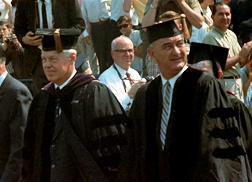 President Johnson's first ever public reference to the 'Great Society' took place during a speech to students on May 7, 1964, at Ohio University
in Athens
. "And with your courage and with your compassion and your desire, we will build the Great Society. It is a Society where no child will go unfed, and no youngster will go unschooled."
He later formally presented his specific goals for the Great Society in another speech at the University of Michigan
in Ann Arbor on May 22, 1964. Speechwriter Richard N. Goodwin
had coined the phrase "the Great Society," and Johnson had used the expression occasionally before the Michigan speech, but had not emphasized it. In this address, which preceded the election-year party conventions, Johnson described his plans to solve impending problems.
and Richard N. Goodwin
.
The average task force had nine members and generally was composed of governmental experts and academicians. Only one of the task forces on the 1965 legislative program addressed foreign affairs and
foreign economic policy; the rest were charged with domestic policy (agriculture, anti-recession policy, civil rights, education, efficiency and economy, health, income maintenance policy, intergovernmental fiscal cooperation, natural resources, pollution of the environment, preservation of natural beauty, transportation, and urban problems).
After task force reports were submitted to the White House, Moyers began a second round of review. The recommendations were circulated among the agencies concerned and were evaluated by new committees composed mostly of government officials. Experts on relations with Congress were also drawn into the deliberations to get the best advice on persuading the Congress to pass the legislation. In late 1964 Johnson reviewed these initial Great Society proposals at his ranch
with Moyers and Budget Director Kermit Gordon
. Many of them were included in Johnson’s State of the Union address
delivered on January 4, 1965.
The task-force approach, combined with Johnson's electoral victory in 1964 and his talents in obtaining congressional approval, were widely credited with the success of the legislation agenda in 1965. Critics later cited the task forces as a factor in a perceived elitist approach to Great Society programs. Also, because many of the initiatives did not originate from outside lobbying, some programs had no political constituencies that would support their continued funding.
, the Great Society agenda was not a widely discussed issue during the 1964 presidential election campaigns. Johnson won the election with 61% of the vote, the largest percentage since the popular vote first became widespread in 1824, and he carried all but six states. Democrats gained enough seats to control more than two-thirds of each chamber in the Eighty-ninth Congress with a 68-32 margin in the Senate
and a 295-140 margin in the House of Representatives
. The political realignment allowed House leaders to alter rules that had allowed Southern Democrats
to kill New Frontier and civil rights legislation in committee, which aided efforts to pass Great Society legislation. In 1965, the first session of the Eighty-ninth Congress created the core of the Great Society. The Johnson Administration submitted eighty-seven bills to Congress, and Johnson signed eighty-four, or 96%, arguably the most successful legislative agenda in U.S. Congressional history.
forbade job discrimination and the segregation of public accommodations. The Voting Rights Act of 1965 assured minority registration and voting. It suspended use of literacy or other voter-qualification tests that had sometimes served to keep African-Americans off voting lists and provided for federal court lawsuits to stop discriminatory poll tax
es. It also reinforced the Civil Rights Act of 1964 by authorizing the appointment of federal voting examiners in areas that did not meet voter-participation requirements. The Immigration and Nationality Services Act of 1965
abolished the national-origin quotas in immigration law. The Civil Rights Act of 1968
banned housing discrimination and extended constitutional protections to Native Americans
on reservations
.
among Mexican-Americans, launched an "unconditional war on poverty" in the first months of his presidency with the goal of eliminating hunger and deprivation from American life. The centerpiece of the War on Poverty
was the Economic Opportunity Act of 1964
, which created an Office of Economic Opportunity
(OEO) to oversee a variety of community-based antipoverty programs.
The OEO reflected a fragile consensus among policymakers that the best way to deal with poverty was not simply to raise the incomes of the poor but to help them better themselves through education, job training, and community development. Central to its mission was the idea of "community action
", the participation of the poor in framing and administering the programs designed to help them.
The War on Poverty began with a $1 billion appropriation in 1964 and spent another $2 billion in the following two years. It spawned dozens of programs, among them the Job Corps
, whose purpose was to help disadvantaged youth develop marketable skills; the Neighborhood Youth Corps, established to give poor urban youths work experience and to encourage them to stay in school; Volunteers in Service to America
(VISTA
), a domestic version of the Peace Corps
, which placed concerned citizens with community-based agencies to work towards empowerment of the poor; the Model Cities Program
for urban redevelopment; Upward Bound
, which assisted poor high school students entering college; legal services for the poor; the Food Stamp Act of 1964
(which expanded the federal food stamp program); the Community Action Program, which initiated local Community Action Agencies
charged with helping the poor become self-sufficient; and Project Head Start, which offered preschool education for poor children. In addition, funding was provided for the establishment of community health centers to expand access to health care, while major amendments were made to Social Security
in 1965 and 1967 which significantly increased benefits, expanded coverage, and established new programs to combat poverty and raise living standards. In addition, average AFDC payments were 35% higher in 1968 than in 1960, but remained insufficient and uneven.
of 1965, designed by Commissioner of Education Francis Keppel
. It was signed into law on April 11, 1965, less than three months after it was introduced. It ended a long-standing political taboo by providing significant federal aid to public education, initially allotting more than $1 billion to help schools purchase materials and start special education programs to schools with a high concentration of low-income children. The Act established Head Start, which had originally been started by the Office of Economic Opportunity as an eight-week summer program, as a permanent program.
The Higher Education Facilities Act of 1963, which was signed into law by Johnson a month after becoming president, authorized several times more college aid within a five-year period than had been appropriated under the Land Grant College in a century, and provided better college libraries, ten to twenty new graduate centers, several new technical institutes, classrooms for several hundred thousand students, and twenty-five to thirty new community colleges a year. This major piece of legislaton was followed by the Higher Education Act of 1965
, which increased federal money given to universities, created scholarships and low-interest loans for students, and established a national Teacher Corps to provide teachers to poverty-stricken areas of the United States. The Act also began a transition from federally funded institutional assistance to individual student aid.
The Bilingual Education Act
of 1968 offered federal aid to local school districts in assisting them to address the needs of children with limited English-speaking ability until it expired in 2002.
authorized Medicare
and provided federal funding for many of the medical costs of older Americans. The legislation overcame the bitter resistance, particularly from the American Medical Association
, to the idea of publicly funded health care or "socialized medicine
" by making its benefits available to everyone over sixty-five, regardless of need, and by linking payments to the existing private insurance system.
program. Medicaid was created on July 30, 1965 under Title XIX of the Social Security Act of 1965. Each state administers its own Medicaid program while the federal Centers for Medicare and Medicaid Services (CMS) monitors the state-run programs and establishes requirements for service delivery, quality, funding, and eligibility standards.
and National Endowment for the Humanities
as separate, independent agencies. Lobbying for federally funded arts and humanities support began during the Kennedy Administration. In 1963 three scholarly and educational organizations—the American Council of Learned Societies (ACLS), the Council of Graduate Schools in America, and the United Chapters of Phi Beta Kappa—joined together to establish the National Commission on the Humanities. In June 1964, the commission released a report that suggested that the emphasis placed on science endangered the study of the humanities from elementary schools through postgraduate programs. In order to correct the balance, it recommended "the establishment by the President and the Congress of the United States of a National Humanities Foundation."
In August 1964, Congressman William S. Moorhead
of Pennsylvania proposed legislation to implement the commission's recommendations. Support from the White House followed in September, when Johnson lent his endorsement during a speech at Brown University
. In March 1965, the White House
proposed the establishment of a National Foundation on the Arts and Humanities and requested $20 million in start-up funds. The commission's report had generated other proposals, but the White House's approach eclipsed them. The administration's plan, which called for the creation of two separate agencies each advised by a governing body, was the version approved by Congress. Richard Nixon
dramatically expanded funding for NEH and NEA.
, enacted less than 10 months later, chartered the Corporation for Public Broadcasting
as a private, non-profit corporation.
The law initiated federal aid through the CPB for the operation, as opposed to the funding of capital facilities, of public broadcasting. The CPB initially collaborated with the pre-existing National Educational Television
system, but in 1969 decided to start the Public Broadcasting Service
(PBS). A public radio study commissioned by the CPB and the Ford Foundation
and conducted from 1968–1969 led to the establishment of National Public Radio, a public radio system under the terms of the amended Public Broadcasting Act.
In the late 1930s the United States Congress mandated a Smithsonian Institution
art museum for the National Mall, and a design by Eliel Saarinen
was unveiled in 1939, but plans were shelved during World War II. A 1966 act of Congress established the Hirshhorn Museum and Sculpture Garden
as part of the Smithsonian Institution
with a focus on modern art, in contrast to the existing National Art Gallery
. The museum was primarily federally funded, although New York financier Joseph Hirshhorn
later contributed $1 million toward building construction, which began in 1969. The Hirshhorn opened in 1974.
was the consolidation of transportation agencies into a cabinet-level Department of Transportation
. The department was authorized by Congress on October 15, 1966 and began operations on April 1, 1967. The Urban Mass Transportation Act
of 1964 provided $375 million for large-scale urban public or private rail projects in the form of matching funds to cities and states and created the Urban Mass Transit Administration (now the Federal Transit Administration
). The National Traffic and Motor Vehicle Safety Act of 1966 and the Highway Safety Act of 1966 were enacted, largely as a result of Ralph Nader
's book Unsafe at Any Speed
.
to be the first presidential assistant for consumer affairs.
The Cigarette Labeling Act of 1965 required packages to carry warning labels. The Motor Vehicle Safety Act of 1966 set standards through creation of the National Highway Traffic Safety Administration
. The Fair Packaging and Labeling Act
requires products identify manufacturer, address, clearly mark quantity and servings. The statute also authorizes permits HEW and FTC to establish and define voluntary standard sizes. The original would have mandated uniform standards of size and weight for comparison shopping, but the final law only outlawed exaggerated size claims. Child Safety Act of 1966 prohibited any chemical so dangerous that no warning can make it safe. The Flammable Fabrics Act of 1967 set standards for children's sleepwear, but not baby blankets.
The Wholesome Meat Act
of 1967 required inspection of meat which must meet federal standards. The Truth-in-Lending Act of 1968 required lenders and credit providers to disclose the full cost of finance charges in both dollars and annual percentage rates, on installment loan and sales. The Wholesome Poultry Products Act of 1968 required inspection of poultry which must meet federal standards. The Land Sales Disclosure Act of 1968 provided safeguards against fraudulent practices in the sale of land. The Radiation Safety Act of 1968 provided standards and recalls for defective electronic products.
has suggested that Great Society's main contribution to the environment was an extension of protections beyond those aimed at the conservation of untouched resources. Discussing his administration's environmental policies, Lyndon Johnson suggested that "[t]he air we breathe, our water, our soil and wildlife, are being blighted by poisons and chemicals which are the by-products of technology and industry. The society that receives the rewards of technology, must, as a cooperating whole, take responsibility for [their] control. To deal with these new problems will require a new conservation. We must not only protect the countryside and save it from destruction, we must restore what has been destroyed and salvage the beauty and charm of our cities. Our conservation must be not just the classic conservation of protection and development, but a creative conservation of restoration and innovation."
At the behest of Secretary of the Interior Stewart Udall
, the Great Society included several new environmental laws to protect air and water. Environmental legislation enacted included:
to about 9.1 million additional workers.
and Ford
administrations, largely by transferring poverty programs to other government departments. Funding for many of these programs were further cut in President Ronald Reagan
's first budget
in 1981.
Alan Brinkley
has suggested that "the gap between the expansive intentions of the War on Poverty and its relatively modest achievements fueled later conservative arguments that government is not an appropriate vehicle for solving social problems." One of Johnson's aides, Joseph A. Califano, Jr.
, has countered that "from 1963 when Lyndon Johnson took office until 1970 as the impact of his Great Society programs were felt, the portion of Americans living below the poverty line dropped from 22.2 percent to 12.6 percent, the most dramatic decline over such a brief period in this century." The percentage of African Americans below the poverty line dropped from 55 percent in 1960 to 27 percent in 1968.
Libertarian
economist Thomas Sowell
argues that the Great Society programs only contributed to the destruction of African American families, saying "the black family, which had survived centuries of slavery and discrimination, began rapidly disintegrating in the liberal welfare state that subsidized unwed pregnancy and changed welfare from an emergency rescue to a way of life."
United States
The United States of America is a federal constitutional republic comprising fifty states and a federal district...
promoted by President Lyndon B. Johnson
Lyndon B. Johnson
Lyndon Baines Johnson , often referred to as LBJ, was the 36th President of the United States after his service as the 37th Vice President of the United States...
and fellow Democrats in Congress in the 1960s. Two main goals of the Great Society social reforms were the elimination of poverty and racial injustice. New major spending programs that addressed education, medical care, urban problems, and transportation were launched during this period. The Great Society in scope and sweep resembled the New Deal
New Deal
The New Deal was a series of economic programs implemented in the United States between 1933 and 1936. They were passed by the U.S. Congress during the first term of President Franklin D. Roosevelt. The programs were Roosevelt's responses to the Great Depression, and focused on what historians call...
domestic agenda of Franklin D. Roosevelt
Franklin D. Roosevelt
Franklin Delano Roosevelt , also known by his initials, FDR, was the 32nd President of the United States and a central figure in world events during the mid-20th century, leading the United States during a time of worldwide economic crisis and world war...
, but differed sharply in types of programs enacted.
Some Great Society proposals were stalled initiatives from John F. Kennedy
John F. Kennedy
John Fitzgerald "Jack" Kennedy , often referred to by his initials JFK, was the 35th President of the United States, serving from 1961 until his assassination in 1963....
's New Frontier
New Frontier
The term New Frontier was used by Democratic presidential candidate John F. Kennedy in his acceptance speech in the 1960 United States presidential election to the Democratic National Convention at the Los Angeles Memorial Coliseum as the Democratic slogan to inspire America to support him...
. Johnson's success depended on his skills of persuasion, coupled with the Democratic landslide in the 1964 election
United States presidential election, 1964
The United States presidential election of 1964 was held on November 3, 1964. Incumbent President Lyndon B. Johnson had come to office less than a year earlier following the assassination of his predecessor, John F. Kennedy. Johnson, who had successfully associated himself with Kennedy's...
that brought in many new liberals to Congress, making the House of Representatives in 1965 the most liberal House since 1938. Anti-war Democrats complained that spending on the Vietnam War
Vietnam War
The Vietnam War was a Cold War-era military conflict that occurred in Vietnam, Laos, and Cambodia from 1 November 1955 to the fall of Saigon on 30 April 1975. This war followed the First Indochina War and was fought between North Vietnam, supported by its communist allies, and the government of...
choked off the Great Society. While some of the programs have been eliminated or had their funding reduced, many of them, including Medicare
Medicare (United States)
Medicare is a social insurance program administered by the United States government, providing health insurance coverage to people who are aged 65 and over; to those who are under 65 and are permanently physically disabled or who have a congenital physical disability; or to those who meet other...
, Medicaid
Medicaid
Medicaid is the United States health program for certain people and families with low incomes and resources. It is a means-tested program that is jointly funded by the state and federal governments, and is managed by the states. People served by Medicaid are U.S. citizens or legal permanent...
, the Older Americans Act and federal education funding, continue to the present. The Great Society's programs expanded under the administrations of Richard Nixon
Richard Nixon
Richard Milhous Nixon was the 37th President of the United States, serving from 1969 to 1974. The only president to resign the office, Nixon had previously served as a US representative and senator from California and as the 36th Vice President of the United States from 1953 to 1961 under...
and Gerald Ford
Gerald Ford
Gerald Rudolph "Jerry" Ford, Jr. was the 38th President of the United States, serving from 1974 to 1977, and the 40th Vice President of the United States serving from 1973 to 1974...
.
Economic and social conditions
Unlike the New DealNew Deal
The New Deal was a series of economic programs implemented in the United States between 1933 and 1936. They were passed by the U.S. Congress during the first term of President Franklin D. Roosevelt. The programs were Roosevelt's responses to the Great Depression, and focused on what historians call...
, which was a response to a severe financial and economic calamity, the Great Society initiatives came just as the United States' post-World War II prosperity was starting to fade, but before the coming decline was being felt by the middle and upper classes. President Kennedy proposed a tax cut lowering the top marginal rate by 20%, from 91% to 71%, which was enacted in February 1964 (three months after Kennedy's assassination). The gross national product rose 10% in the first year of the tax cut, and economic growth averaged a rate of 4.5% from 1961 to 1968.
Disposable personal income rose 15% in 1966 alone. Federal revenues increased dramatically from $94 billion in 1961 to $150 billion in 1967. As the Baby Boom generation aged, two and a half times more Americans would enter the labor force between 1965 and 1980 than had between 1950 and 1965.
Race
Grave social crises confronted the nation. Racial segregationRacial segregation
Racial segregation is the separation of humans into racial groups in daily life. It may apply to activities such as eating in a restaurant, drinking from a water fountain, using a public toilet, attending school, going to the movies, or in the rental or purchase of a home...
persisted throughout the South
Southern United States
The Southern United States—commonly referred to as the American South, Dixie, or simply the South—constitutes a large distinctive area in the southeastern and south-central United States...
. The Civil Rights Movement
African-American Civil Rights Movement (1955-1968)
The African-American Civil Rights Movement refers to the movements in the United States aimed at outlawing racial discrimination against African Americans and restoring voting rights to them. This article covers the phase of the movement between 1955 and 1968, particularly in the South...
was gathering momentum, and in 1964 urban riots began within black neighborhoods in New York City
New York City
New York is the most populous city in the United States and the center of the New York Metropolitan Area, one of the most populous metropolitan areas in the world. New York exerts a significant impact upon global commerce, finance, media, art, fashion, research, technology, education, and...
and Los Angeles
Los Ángeles
Los Ángeles is the capital of the province of Biobío, in the commune of the same name, in Region VIII , in the center-south of Chile. It is located between the Laja and Biobío rivers. The population is 123,445 inhabitants...
; by 1968 hundreds of cities had major riots that caused a severe conservative political backlash. Foreign affairs were generally quiet except for the Vietnam War
Vietnam War
The Vietnam War was a Cold War-era military conflict that occurred in Vietnam, Laos, and Cambodia from 1 November 1955 to the fall of Saigon on 30 April 1975. This war followed the First Indochina War and was fought between North Vietnam, supported by its communist allies, and the government of...
, which escalated from limited involvement in 1963 to a large-scale military operation in 1968 that soon overshadowed the Great Society.
Conservative backlash
Conservatives attacking Johnson's Great Society made major gains in Congress in the 1966 midterm elections, and anger and frustration mounted over the Vietnam War, Johnson was still able to secure the passage of additional programs during his last two years in office. Laws were passed to extend the Food Stamp Program, to expand consumer protection, to improve safety standards, to train health professionals, to assist handicapped Americans, and to further urban programs.In 1968, a new Housing Act was passed, which banned racial discrimination in housing and subsidized the construction or rehabilitation of low-income housing units. That same year, a new program for federally-funded job retraining for the hardcore unemployed in fifty cities was introduced, together with the strongest Federal gun control bill (relating to the transportation of guns across State lines) in American history up until that point.
By the end of the Johnson Administration, 226 out of 252 major legislative requests (over a four-year period) had been met, Federal Aid to the poor had risen from $9.9 billion in 1960 to $30 billion by 1968, one million Americans had been retrained under previously non-existent Federal programs, and two million children had benefited from the Head Start program.
Athens, Ohio and Ann Arbor, Michigan speeches
Ohio University
Ohio University is a public university located in the Midwestern United States in Athens, Ohio, situated on an campus...
in Athens
Athens, Ohio
Athens is the largest city in, and the county seat of, Athens County, Ohio, United States. It is located along the Hocking River in the southeastern part of Ohio. A historic college town, Athens is home to Ohio University and is the principal city of the Athens, Ohio Micropolitan Statistical Area. ...
. "And with your courage and with your compassion and your desire, we will build the Great Society. It is a Society where no child will go unfed, and no youngster will go unschooled."
He later formally presented his specific goals for the Great Society in another speech at the University of Michigan
University of Michigan
The University of Michigan is a public research university located in Ann Arbor, Michigan in the United States. It is the state's oldest university and the flagship campus of the University of Michigan...
in Ann Arbor on May 22, 1964. Speechwriter Richard N. Goodwin
Richard N. Goodwin
Richard N. Goodwin is an American writer who may be best known as an advisor and speechwriter to Presidents Kennedy and Johnson and to Senator Robert F. Kennedy.-Life and career:...
had coined the phrase "the Great Society," and Johnson had used the expression occasionally before the Michigan speech, but had not emphasized it. In this address, which preceded the election-year party conventions, Johnson described his plans to solve impending problems.
We are going to assemble the best thought and broadest knowledge from all over the world to find these answers. I intend to establish working groups to prepare a series of conferences and meetings—on the cities, on natural beauty, on the quality of education, and on other emerging challenges. From these studies, we will begin to set our course toward the Great Society.
1965 legislative program and presidential task forces
President Kennedy had employed several task forces composed of scholars and experts to craft New Frontier legislation and to deal with foreign affairs. The reliance on experts appealed to Johnson, in part because the task forces would work in secret and outside of the existing governmental bureaucracy and directly for the [White House] staff. Almost immediately after the Ann Arbor speech, 14 separate task forces began studying nearly all major aspects of United States society under the guidance of presidential assistants Bill MoyersBill Moyers
Bill Moyers is an American journalist and public commentator. He served as White House Press Secretary in the United States President Lyndon B. Johnson Administration from 1965 to 1967. He worked as a news commentator on television for ten years. Moyers has had an extensive involvement with public...
and Richard N. Goodwin
Richard N. Goodwin
Richard N. Goodwin is an American writer who may be best known as an advisor and speechwriter to Presidents Kennedy and Johnson and to Senator Robert F. Kennedy.-Life and career:...
.
The average task force had nine members and generally was composed of governmental experts and academicians. Only one of the task forces on the 1965 legislative program addressed foreign affairs and
foreign economic policy; the rest were charged with domestic policy (agriculture, anti-recession policy, civil rights, education, efficiency and economy, health, income maintenance policy, intergovernmental fiscal cooperation, natural resources, pollution of the environment, preservation of natural beauty, transportation, and urban problems).
After task force reports were submitted to the White House, Moyers began a second round of review. The recommendations were circulated among the agencies concerned and were evaluated by new committees composed mostly of government officials. Experts on relations with Congress were also drawn into the deliberations to get the best advice on persuading the Congress to pass the legislation. In late 1964 Johnson reviewed these initial Great Society proposals at his ranch
Lyndon B. Johnson National Historical Park
Lyndon B. Johnson National Historical Park is a United States National Historical Park in central Texas about 50 miles west of Austin in the Texas Hill Country. The park protects the birthplace, home, ranch and final resting place of Lyndon B. Johnson, 36th President of the United States...
with Moyers and Budget Director Kermit Gordon
Kermit Gordon
Kermit Gordon was Director of the United States Bureau of the Budget during the administration of John F. Kennedy. He continued to serve in this capacity in the Lyndon Johnson administration. He oversaw the creation of the first budgets for Johnson's Great Society domestic agenda...
. Many of them were included in Johnson’s State of the Union address
State of the Union Address
The State of the Union is an annual address presented by the President of the United States to the United States Congress. The address not only reports on the condition of the nation but also allows the president to outline his legislative agenda and his national priorities.The practice arises...
delivered on January 4, 1965.
The task-force approach, combined with Johnson's electoral victory in 1964 and his talents in obtaining congressional approval, were widely credited with the success of the legislation agenda in 1965. Critics later cited the task forces as a factor in a perceived elitist approach to Great Society programs. Also, because many of the initiatives did not originate from outside lobbying, some programs had no political constituencies that would support their continued funding.
1964 election and the Eighty-ninth Congress
With the exception of the Civil Rights Act of 1964Civil Rights Act of 1964
The Civil Rights Act of 1964 was a landmark piece of legislation in the United States that outlawed major forms of discrimination against African Americans and women, including racial segregation...
, the Great Society agenda was not a widely discussed issue during the 1964 presidential election campaigns. Johnson won the election with 61% of the vote, the largest percentage since the popular vote first became widespread in 1824, and he carried all but six states. Democrats gained enough seats to control more than two-thirds of each chamber in the Eighty-ninth Congress with a 68-32 margin in the Senate
United States Senate
The United States Senate is the upper house of the bicameral legislature of the United States, and together with the United States House of Representatives comprises the United States Congress. The composition and powers of the Senate are established in Article One of the U.S. Constitution. Each...
and a 295-140 margin in the House of Representatives
United States House of Representatives
The United States House of Representatives is one of the two Houses of the United States Congress, the bicameral legislature which also includes the Senate.The composition and powers of the House are established in Article One of the Constitution...
. The political realignment allowed House leaders to alter rules that had allowed Southern Democrats
Southern Democrats
Southern Democrats are members of the U.S. Democratic Party who reside in the American South. In the 19th century, they were the definitive pro-slavery wing of the party, opposed to both the anti-slavery Republicans and the more liberal Northern Democrats.Eventually "Redemption" was finalized in...
to kill New Frontier and civil rights legislation in committee, which aided efforts to pass Great Society legislation. In 1965, the first session of the Eighty-ninth Congress created the core of the Great Society. The Johnson Administration submitted eighty-seven bills to Congress, and Johnson signed eighty-four, or 96%, arguably the most successful legislative agenda in U.S. Congressional history.
Civil rights
Historian Alan Brinkley has suggested that the most important domestic achievement of the Great Society may have been its success in translating some of the demands of the civil rights movement into law. Four civil rights acts were passed, including three laws in the first two years of Johnson's presidency. The Civil Rights Act of 1964Civil Rights Act of 1964
The Civil Rights Act of 1964 was a landmark piece of legislation in the United States that outlawed major forms of discrimination against African Americans and women, including racial segregation...
forbade job discrimination and the segregation of public accommodations. The Voting Rights Act of 1965 assured minority registration and voting. It suspended use of literacy or other voter-qualification tests that had sometimes served to keep African-Americans off voting lists and provided for federal court lawsuits to stop discriminatory poll tax
Poll tax
A poll tax is a tax of a portioned, fixed amount per individual in accordance with the census . When a corvée is commuted for cash payment, in effect it becomes a poll tax...
es. It also reinforced the Civil Rights Act of 1964 by authorizing the appointment of federal voting examiners in areas that did not meet voter-participation requirements. The Immigration and Nationality Services Act of 1965
Immigration and Nationality Services Act of 1965
Immigration and Nationality Act of 1965 abolished the National Origins Formula that had been in place in the United States since the Immigration Act of 1924...
abolished the national-origin quotas in immigration law. The Civil Rights Act of 1968
Civil Rights Act of 1968
On April 11, 1968 U.S. President Lyndon B. Johnson signed the Civil Rights Act of 1968, also known as the Indian Civil Rights Act of 1968. Title VIII of the Civil Rights Act of 1968 is commonly known as the Fair Housing Act, or as CRA '68, and was meant as a follow-up to the Civil Rights Act of 1964...
banned housing discrimination and extended constitutional protections to Native Americans
Native Americans in the United States
Native Americans in the United States are the indigenous peoples in North America within the boundaries of the present-day continental United States, parts of Alaska, and the island state of Hawaii. They are composed of numerous, distinct tribes, states, and ethnic groups, many of which survive as...
on reservations
Indian reservation
An American Indian reservation is an area of land managed by a Native American tribe under the United States Department of the Interior's Bureau of Indian Affairs...
.
War on Poverty
The most ambitious and controversial part of the Great Society was its initiative to end poverty. The Kennedy Administration had been contemplating a federal effort against poverty. Johnson, who, as a teacher had observed extreme poverty in TexasTexas
Texas is the second largest U.S. state by both area and population, and the largest state by area in the contiguous United States.The name, based on the Caddo word "Tejas" meaning "friends" or "allies", was applied by the Spanish to the Caddo themselves and to the region of their settlement in...
among Mexican-Americans, launched an "unconditional war on poverty" in the first months of his presidency with the goal of eliminating hunger and deprivation from American life. The centerpiece of the War on Poverty
War on Poverty
The War on Poverty is the unofficial name for legislation first introduced by United States President Lyndon B. Johnson during his State of the Union address on January 8, 1964. This legislation was proposed by Johnson in response to a national poverty rate of around nineteen percent...
was the Economic Opportunity Act of 1964
Economic Opportunity Act of 1964
Signed by Lyndon B. Johnson on August 20, 1964, the Economic Opportunity Act of 1964 was central to Johnson's Great Society campaign and its War on Poverty. Implemented by the since disbanded Office of Economic Opportunity, the Act included several social programs to promote the health, education,...
, which created an Office of Economic Opportunity
Office of Economic Opportunity
The Office of Economic Opportunity was the agency responsible for administering most of the War on Poverty programs created as part of United States President Lyndon B. Johnson's Great Society legislative agenda.- History :...
(OEO) to oversee a variety of community-based antipoverty programs.
The OEO reflected a fragile consensus among policymakers that the best way to deal with poverty was not simply to raise the incomes of the poor but to help them better themselves through education, job training, and community development. Central to its mission was the idea of "community action
Community Action Agencies
In the United States and its territories, Community Action Agencies are local private and public non-profit organizations that carry out the Community Action Program , which was founded by the 1964 Economic Opportunity Act to fight poverty by empowering the poor as part of the War on Poverty.CAAs...
", the participation of the poor in framing and administering the programs designed to help them.
The War on Poverty began with a $1 billion appropriation in 1964 and spent another $2 billion in the following two years. It spawned dozens of programs, among them the Job Corps
Job Corps
Job Corps is a program administered by the United States Department of Labor that offers free-of-charge education and vocational training to youth ages 16 to 24.-Mission and purpose:...
, whose purpose was to help disadvantaged youth develop marketable skills; the Neighborhood Youth Corps, established to give poor urban youths work experience and to encourage them to stay in school; Volunteers in Service to America
Volunteers in Service to America
VISTA or Volunteers in Service to America is an anti-poverty program created by Lyndon Johnson's Economic Opportunity Act of 1964 as the domestic version of the Peace Corps. Initially, the program increased employment opportunities for conscientious people who felt they could contribute tangibly to...
(VISTA
Volunteers in Service to America
VISTA or Volunteers in Service to America is an anti-poverty program created by Lyndon Johnson's Economic Opportunity Act of 1964 as the domestic version of the Peace Corps. Initially, the program increased employment opportunities for conscientious people who felt they could contribute tangibly to...
), a domestic version of the Peace Corps
Peace Corps
The Peace Corps is an American volunteer program run by the United States Government, as well as a government agency of the same name. The mission of the Peace Corps includes three goals: providing technical assistance, helping people outside the United States to understand US culture, and helping...
, which placed concerned citizens with community-based agencies to work towards empowerment of the poor; the Model Cities Program
Model Cities Program
The Model Cities Program was an element of United States President Lyndon Johnson's Great Society and War on Poverty. The ambitious federal urban aid program ultimately fell short of its goals....
for urban redevelopment; Upward Bound
Upward Bound
Upward Bound is a federally funded educational program within the United States. The program is one of a cluster of programs referred to as TRIO, all of which owe their existence to the federal Higher Education Act of 1965. Upward Bound programs are implemented and monitored by the United States...
, which assisted poor high school students entering college; legal services for the poor; the Food Stamp Act of 1964
Food Stamp Act of 1964
The Food Stamp Act of 1964 provided permanent legislative authority to the Food Stamp Program, which had been administratively implemented on a pilot basis in 1962. It was later replaced and completely rewritten and revised by the food stamp provisions of the Food and Agricultural Act of 1977 The...
(which expanded the federal food stamp program); the Community Action Program, which initiated local Community Action Agencies
Community Action Agencies
In the United States and its territories, Community Action Agencies are local private and public non-profit organizations that carry out the Community Action Program , which was founded by the 1964 Economic Opportunity Act to fight poverty by empowering the poor as part of the War on Poverty.CAAs...
charged with helping the poor become self-sufficient; and Project Head Start, which offered preschool education for poor children. In addition, funding was provided for the establishment of community health centers to expand access to health care, while major amendments were made to Social Security
Social Security (United States)
In the United States, Social Security refers to the federal Old-Age, Survivors, and Disability Insurance program.The original Social Security Act and the current version of the Act, as amended encompass several social welfare and social insurance programs...
in 1965 and 1967 which significantly increased benefits, expanded coverage, and established new programs to combat poverty and raise living standards. In addition, average AFDC payments were 35% higher in 1968 than in 1960, but remained insufficient and uneven.
Education
The most important educational component of the Great Society was the Elementary and Secondary Education ActElementary and Secondary Education Act
The Elementary and Secondary Education Act , is a United States federal statute enacted April 11, 1965. It was passed as a part of President Lyndon B. Johnson's "War on Poverty" and has been the most far-reaching federal legislation affecting education ever passed by Congress...
of 1965, designed by Commissioner of Education Francis Keppel
Francis Keppel
Francis Keppel was an American educator. As U.S. Commissioner of Education he was instrumental in developing the Elementary and Secondary Education Act of 1965 and in overseeing enforcement of the Civil Rights Act of 1964 in the schools. In 1966, he became head of the General Learning Corporation...
. It was signed into law on April 11, 1965, less than three months after it was introduced. It ended a long-standing political taboo by providing significant federal aid to public education, initially allotting more than $1 billion to help schools purchase materials and start special education programs to schools with a high concentration of low-income children. The Act established Head Start, which had originally been started by the Office of Economic Opportunity as an eight-week summer program, as a permanent program.
The Higher Education Facilities Act of 1963, which was signed into law by Johnson a month after becoming president, authorized several times more college aid within a five-year period than had been appropriated under the Land Grant College in a century, and provided better college libraries, ten to twenty new graduate centers, several new technical institutes, classrooms for several hundred thousand students, and twenty-five to thirty new community colleges a year. This major piece of legislaton was followed by the Higher Education Act of 1965
Higher Education Act of 1965
The Higher Education Act of 1965 was legislation signed into United States law on November 8, 1965, as part of President Lyndon Johnson's Great Society domestic agenda. Johnson chose Texas State University–San Marcos as the signing site...
, which increased federal money given to universities, created scholarships and low-interest loans for students, and established a national Teacher Corps to provide teachers to poverty-stricken areas of the United States. The Act also began a transition from federally funded institutional assistance to individual student aid.
The Bilingual Education Act
Bilingual Education Act
The Bilingual Education Act, Title VII of the Elementary and Secondary Education Act of 1968 was the first piece of United States federal legislation that recognized the needs of Limited English Speaking Ability students. The BEA was introduced in 1967 by Texas senator Ralph Yarborough and was...
of 1968 offered federal aid to local school districts in assisting them to address the needs of children with limited English-speaking ability until it expired in 2002.
Medicare
The Social Security Act of 1965Social Security Act of 1965
The Social Security Amendments of 1965 was legislation in the United States whose most important provisions resulted in creation of two programs: Medicare and Medicaid. The legislation initially provided federal health insurance for the elderly and for poor families. While President Lyndon B...
authorized Medicare
Medicare (United States)
Medicare is a social insurance program administered by the United States government, providing health insurance coverage to people who are aged 65 and over; to those who are under 65 and are permanently physically disabled or who have a congenital physical disability; or to those who meet other...
and provided federal funding for many of the medical costs of older Americans. The legislation overcame the bitter resistance, particularly from the American Medical Association
American Medical Association
The American Medical Association , founded in 1847 and incorporated in 1897, is the largest association of medical doctors and medical students in the United States.-Scope and operations:...
, to the idea of publicly funded health care or "socialized medicine
Socialized medicine
Socialized medicine is a term used to describe a system for providing medical and hospital care for all at a nominal cost by means of government regulation of health services and subsidies derived from taxation. It is used primarily and usually pejoratively in United States political debates...
" by making its benefits available to everyone over sixty-five, regardless of need, and by linking payments to the existing private insurance system.
Medicaid
In 1966 welfare recipients of all ages received medical care through the MedicaidMedicaid
Medicaid is the United States health program for certain people and families with low incomes and resources. It is a means-tested program that is jointly funded by the state and federal governments, and is managed by the states. People served by Medicaid are U.S. citizens or legal permanent...
program. Medicaid was created on July 30, 1965 under Title XIX of the Social Security Act of 1965. Each state administers its own Medicaid program while the federal Centers for Medicare and Medicaid Services (CMS) monitors the state-run programs and establishes requirements for service delivery, quality, funding, and eligibility standards.
National endowments for arts and humanities
In September 1965, Johnson signed the National Foundation on the Arts and Humanities Act into law, creating both the National Endowment for the ArtsNational Endowment for the Arts
The National Endowment for the Arts is an independent agency of the United States federal government that offers support and funding for projects exhibiting artistic excellence. It was created by an act of the U.S. Congress in 1965 as an independent agency of the federal government. Its current...
and National Endowment for the Humanities
National Endowment for the Humanities
The National Endowment for the Humanities is an independent federal agency of the United States established by the National Foundation on the Arts and the Humanities Act of 1965 dedicated to supporting research, education, preservation, and public programs in the humanities. The NEH is located at...
as separate, independent agencies. Lobbying for federally funded arts and humanities support began during the Kennedy Administration. In 1963 three scholarly and educational organizations—the American Council of Learned Societies (ACLS), the Council of Graduate Schools in America, and the United Chapters of Phi Beta Kappa—joined together to establish the National Commission on the Humanities. In June 1964, the commission released a report that suggested that the emphasis placed on science endangered the study of the humanities from elementary schools through postgraduate programs. In order to correct the balance, it recommended "the establishment by the President and the Congress of the United States of a National Humanities Foundation."
In August 1964, Congressman William S. Moorhead
William S. Moorhead
William Singer Moorhead was a Democratic member of the U.S. House of Representatives from Pennsylvania.Moorhead was born in Pittsburgh, PA, the son of prominent attorney William Singer Moorhead, Sr...
of Pennsylvania proposed legislation to implement the commission's recommendations. Support from the White House followed in September, when Johnson lent his endorsement during a speech at Brown University
Brown University
Brown University is a private, Ivy League university located in Providence, Rhode Island, United States. Founded in 1764 prior to American independence from the British Empire as the College in the English Colony of Rhode Island and Providence Plantations early in the reign of King George III ,...
. In March 1965, the White House
White House
The White House is the official residence and principal workplace of the president of the United States. Located at 1600 Pennsylvania Avenue NW in Washington, D.C., the house was designed by Irish-born James Hoban, and built between 1792 and 1800 of white-painted Aquia sandstone in the Neoclassical...
proposed the establishment of a National Foundation on the Arts and Humanities and requested $20 million in start-up funds. The commission's report had generated other proposals, but the White House's approach eclipsed them. The administration's plan, which called for the creation of two separate agencies each advised by a governing body, was the version approved by Congress. Richard Nixon
Richard Nixon
Richard Milhous Nixon was the 37th President of the United States, serving from 1969 to 1974. The only president to resign the office, Nixon had previously served as a US representative and senator from California and as the 36th Vice President of the United States from 1953 to 1961 under...
dramatically expanded funding for NEH and NEA.
Public broadcasting
After the First National Conference on Long-Range Financing of Educational Television Stations in December 1964 called for a study of the role of noncommercial education television in society, the Carnegie Corporation agreed to finance the work of a 15-member national commission. Its landmark report, Public Television: A Program for Action, published on January 26, 1967, popularized the phrase "public television" and assisted the legislative campaign for federal aid. The Public Broadcasting Act of 1967Public Broadcasting Act of 1967
The Public Broadcasting Act of 1967 set up public broadcasting in the United States, establishing the Corporation for Public Broadcasting, and eventually the Public Broadcasting Service and National Public Radio .When Lyndon B...
, enacted less than 10 months later, chartered the Corporation for Public Broadcasting
Corporation for Public Broadcasting
The Corporation for Public Broadcasting is a non-profit corporation created by an act of the United States Congress, funded by the United States’ federal government to promote public broadcasting...
as a private, non-profit corporation.
The law initiated federal aid through the CPB for the operation, as opposed to the funding of capital facilities, of public broadcasting. The CPB initially collaborated with the pre-existing National Educational Television
National Educational Television
National Educational Television was an American non-commercial educational public television network in the United States from May 16, 1954 to October 4, 1970...
system, but in 1969 decided to start the Public Broadcasting Service
Public Broadcasting Service
The Public Broadcasting Service is an American non-profit public broadcasting television network with 354 member TV stations in the United States which hold collective ownership. Its headquarters is in Arlington, Virginia....
(PBS). A public radio study commissioned by the CPB and the Ford Foundation
Ford Foundation
The Ford Foundation is a private foundation incorporated in Michigan and based in New York City created to fund programs that were chartered in 1936 by Edsel Ford and Henry Ford....
and conducted from 1968–1969 led to the establishment of National Public Radio, a public radio system under the terms of the amended Public Broadcasting Act.
Cultural centers
Two long-planned national cultural and arts facilities received federal funding that would allow for their completion through Great Society legislation. A National Cultural Center, suggested during the Franklin Roosevelt Administration and created by a bipartisan law signed by Dwight Eisenhower, was transformed into the John F. Kennedy Center for the Performing Arts, a living memorial to the assassinated president. Fundraising for the original cultural center had been poor prior to legislation creating the Kennedy Center, which passed two months after the president's death and provided $23 million for construction. The Kennedy Center opened in 1971.In the late 1930s the United States Congress mandated a Smithsonian Institution
Smithsonian Institution
The Smithsonian Institution is an educational and research institute and associated museum complex, administered and funded by the government of the United States and by funds from its endowment, contributions, and profits from its retail operations, concessions, licensing activities, and magazines...
art museum for the National Mall, and a design by Eliel Saarinen
Eliel Saarinen
Gottlieb Eliel Saarinen was a Finnish architect who became famous for his art nouveau buildings in the early years of the 20th century....
was unveiled in 1939, but plans were shelved during World War II. A 1966 act of Congress established the Hirshhorn Museum and Sculpture Garden
Hirshhorn Museum and Sculpture Garden
The Hirshhorn Museum and Sculpture Garden is an art museum beside the National Mall, in Washington, D.C., the United States. The museum was initially endowed during the 1960s with the permanent art collection of Joseph H. Hirshhorn. It was designed by architect Gordon Bunshaft and is part of the...
as part of the Smithsonian Institution
Smithsonian Institution
The Smithsonian Institution is an educational and research institute and associated museum complex, administered and funded by the government of the United States and by funds from its endowment, contributions, and profits from its retail operations, concessions, licensing activities, and magazines...
with a focus on modern art, in contrast to the existing National Art Gallery
National Gallery of Art
The National Gallery of Art and its Sculpture Garden is a national art museum, located on the National Mall between 3rd and 9th Streets at Constitution Avenue NW, in Washington, DC...
. The museum was primarily federally funded, although New York financier Joseph Hirshhorn
Joseph Hirshhorn
]Joseph Herman Hirshhorn was an entrepreneur, financier and art collector. Born in Mitau, Latvia, the twelfth of thirteen children, Hirshhorn emigrated to the United States with his widowed mother at the age of six....
later contributed $1 million toward building construction, which began in 1969. The Hirshhorn opened in 1974.
Transportation
The most sweeping reorganization of the federal government since the National Security Act of 1947National Security Act of 1947
The National Security Act of 1947 was signed by United States President Harry S. Truman on July 26, 1947, and realigned and reorganized the U.S. Armed Forces, foreign policy, and Intelligence Community apparatus in the aftermath of World War II...
was the consolidation of transportation agencies into a cabinet-level Department of Transportation
United States Department of Transportation
The United States Department of Transportation is a federal Cabinet department of the United States government concerned with transportation. It was established by an act of Congress on October 15, 1966, and began operation on April 1, 1967...
. The department was authorized by Congress on October 15, 1966 and began operations on April 1, 1967. The Urban Mass Transportation Act
Urban Mass Transportation Act of 1964
The Urban Mass Transportation Act of 1964 provided $375 million for large-scale urban public or private rail projects in the form of matching funds to cities and states. The Urban Mass Transportation Administration was created...
of 1964 provided $375 million for large-scale urban public or private rail projects in the form of matching funds to cities and states and created the Urban Mass Transit Administration (now the Federal Transit Administration
Federal Transit Administration
The Federal Transit Administration is an agency within the United States Department of Transportation that provides financial and technical assistance to local public transit systems. The FTA is one of ten modal administrations within the DOT...
). The National Traffic and Motor Vehicle Safety Act of 1966 and the Highway Safety Act of 1966 were enacted, largely as a result of Ralph Nader
Ralph Nader
Ralph Nader is an American political activist, as well as an author, lecturer, and attorney. Areas of particular concern to Nader include consumer protection, humanitarianism, environmentalism, and democratic government....
's book Unsafe at Any Speed
Unsafe at Any Speed
Unsafe at Any Speed: The Designed-In Dangers of the American Automobile by Ralph Nader, published in 1965, is a book detailing resistance by car manufacturers to the introduction of safety features, like seat belts, and their general reluctance to spend money on improving safety...
.
Consumer protection
In 1964, Johnson named Assistant Secretary of Labor Esther PetersonEsther Peterson
Esther Eggertsen Peterson was a lifelong consumer and women's advocate.-Background:The daughter of Danish immigrants, Esther Eggertsen grew up in a Mormon family in Provo, Utah. She graduated from Brigham Young University in 1927 with a degree in physical education. She moved to New York City...
to be the first presidential assistant for consumer affairs.
The Cigarette Labeling Act of 1965 required packages to carry warning labels. The Motor Vehicle Safety Act of 1966 set standards through creation of the National Highway Traffic Safety Administration
National Highway Traffic Safety Administration
The National Highway Traffic Safety Administration is an agency of the Executive Branch of the U.S. government, part of the Department of Transportation...
. The Fair Packaging and Labeling Act
Fair Packaging and Labeling Act
The Fair Packaging and Labeling Act is a US law that applies to labels on many consumer products. It requires the label to state:*The identity of the product;*The name and place of business of the manufacturer, packer, or distributor; and...
requires products identify manufacturer, address, clearly mark quantity and servings. The statute also authorizes permits HEW and FTC to establish and define voluntary standard sizes. The original would have mandated uniform standards of size and weight for comparison shopping, but the final law only outlawed exaggerated size claims. Child Safety Act of 1966 prohibited any chemical so dangerous that no warning can make it safe. The Flammable Fabrics Act of 1967 set standards for children's sleepwear, but not baby blankets.
The Wholesome Meat Act
Wholesome Meat Act
The Wholesome Meat Act is a United States federal law enacted in 1967 that regulates the Federal meat inspection. It requires that states have inspection programs "equal to" that of the federal government which are Administered by the Food Safety and Inspection Service of the United States...
of 1967 required inspection of meat which must meet federal standards. The Truth-in-Lending Act of 1968 required lenders and credit providers to disclose the full cost of finance charges in both dollars and annual percentage rates, on installment loan and sales. The Wholesome Poultry Products Act of 1968 required inspection of poultry which must meet federal standards. The Land Sales Disclosure Act of 1968 provided safeguards against fraudulent practices in the sale of land. The Radiation Safety Act of 1968 provided standards and recalls for defective electronic products.
Environment
Joseph A. Califano, Jr.Joseph A. Califano, Jr.
Joseph Anthony Califano, Jr. is Founder and Chairman of The National Center on Addiction and Substance Abuse at Columbia University, an independent non-profit research center affiliated with Columbia University in New York City...
has suggested that Great Society's main contribution to the environment was an extension of protections beyond those aimed at the conservation of untouched resources. Discussing his administration's environmental policies, Lyndon Johnson suggested that "[t]he air we breathe, our water, our soil and wildlife, are being blighted by poisons and chemicals which are the by-products of technology and industry. The society that receives the rewards of technology, must, as a cooperating whole, take responsibility for [their] control. To deal with these new problems will require a new conservation. We must not only protect the countryside and save it from destruction, we must restore what has been destroyed and salvage the beauty and charm of our cities. Our conservation must be not just the classic conservation of protection and development, but a creative conservation of restoration and innovation."
At the behest of Secretary of the Interior Stewart Udall
Stewart Udall
Stewart Lee Udall was an American politician. After serving three terms as a congressman from Arizona, he served as Secretary of the Interior from 1961 to 1969, under Presidents John F. Kennedy and Lyndon B...
, the Great Society included several new environmental laws to protect air and water. Environmental legislation enacted included:
- Clear Air, Water Quality and Clean Water Restoration Acts and Amendments
- Wilderness ActWilderness ActThe Wilderness Act of 1964 was written by Howard Zahniser of The Wilderness Society. It created the legal definition of wilderness in the United States, and protected some 9 million acres of federal land. The result of a long effort to protect federal wilderness, the Wilderness Act was signed...
of 1964 - Endangered Species Preservation Act of 1966
- National Trails System Act of 1968
- Wild and Scenic Rivers Act of 1968
- Land and Water Conservation Act of 1965
- Solid Waste Disposal Act of 1965
- Motor Vehicle Air Pollution Control ActMotor Vehicle Air Pollution Control ActThe Motor Vehicle Air Pollution Control Act is a 1965 amendment to the U.S. Clean Air Act of 1963. The amendment set the first federal vehicle emissions standards, beginning with the 1968 models. These standards were reductions from the 1963 emissions: 72% reduction for hydrocarbons, 56% reduction...
of 1965 - National Historic Preservation Act of 1966
- Aircraft Noise Abatement Act of 1968
- National Environmental Policy ActNational Environmental Policy ActThe National Environmental Policy Act is a United States environmental law that established a U.S. national policy promoting the enhancement of the environment and also established the President's Council on Environmental Quality ....
of 1969
Labour
Amendments made to the 1931 Davis-Bacon Act in 1964 extended the prevailing wage provisions to cover fringe benefits, while several increases were made to the federal minimum wage. In addition, a comprehensive minimum rate hike was signed into law that extended the coverage of the Fair Labor Standards ActFair Labor Standards Act
The Fair Labor Standards Act of 1938 is a federal statute of the United States. The FLSA established a national minimum wage, guaranteed 'time-and-a-half' for overtime in certain jobs, and prohibited most employment of minors in "oppressive child labor," a term that is defined in the statute...
to about 9.1 million additional workers.
The War on Poverty
Interpretations of the War on Poverty remain controversial to American conservatives. The Office of Economic Opportunity was dismantled by the NixonRichard Nixon
Richard Milhous Nixon was the 37th President of the United States, serving from 1969 to 1974. The only president to resign the office, Nixon had previously served as a US representative and senator from California and as the 36th Vice President of the United States from 1953 to 1961 under...
and Ford
Gerald Ford
Gerald Rudolph "Jerry" Ford, Jr. was the 38th President of the United States, serving from 1974 to 1977, and the 40th Vice President of the United States serving from 1973 to 1974...
administrations, largely by transferring poverty programs to other government departments. Funding for many of these programs were further cut in President Ronald Reagan
Ronald Reagan
Ronald Wilson Reagan was the 40th President of the United States , the 33rd Governor of California and, prior to that, a radio, film and television actor....
's first budget
Gramm-Latta Budget
The Gramm-Latta Budget 1981 and the Gramm-Latta Omnibus Reconciliation Bill of 1981, sponsored by Representatives Phil Gramm and Delbert Latta , implemented President Ronald Reagan's economic program. This included an increase in military spending and major cuts in discretionary and entitlement...
in 1981.
Alan Brinkley
Alan Brinkley
Alan Brinkley is the Allan Nevins Professor of History at Columbia University, where he was also Provost 2003–2009. He was denied tenure at Harvard University in 1986 despite being an award-winning teacher. He lives in New York City with his wife, Evangeline, daughter Elly, and dog Jessie...
has suggested that "the gap between the expansive intentions of the War on Poverty and its relatively modest achievements fueled later conservative arguments that government is not an appropriate vehicle for solving social problems." One of Johnson's aides, Joseph A. Califano, Jr.
Joseph A. Califano, Jr.
Joseph Anthony Califano, Jr. is Founder and Chairman of The National Center on Addiction and Substance Abuse at Columbia University, an independent non-profit research center affiliated with Columbia University in New York City...
, has countered that "from 1963 when Lyndon Johnson took office until 1970 as the impact of his Great Society programs were felt, the portion of Americans living below the poverty line dropped from 22.2 percent to 12.6 percent, the most dramatic decline over such a brief period in this century." The percentage of African Americans below the poverty line dropped from 55 percent in 1960 to 27 percent in 1968.
Libertarian
Libertarianism
Libertarianism, in the strictest sense, is the political philosophy that holds individual liberty as the basic moral principle of society. In the broadest sense, it is any political philosophy which approximates this view...
economist Thomas Sowell
Thomas Sowell
Thomas Sowell is an American economist, social theorist, political philosopher, and author. A National Humanities Medal winner, he advocates laissez-faire economics and writes from a libertarian perspective...
argues that the Great Society programs only contributed to the destruction of African American families, saying "the black family, which had survived centuries of slavery and discrimination, began rapidly disintegrating in the liberal welfare state that subsidized unwed pregnancy and changed welfare from an emergency rescue to a way of life."
See also
- Liberal coalitionLiberal coalitionThe Liberal coalition was a political grouping in the United States from the 1940s to the 1970s which promoted Modern liberalism in the United States.-Leaders:Important leaders included:*President Harry S. Truman...
- Modern liberalism in the United States
- Social safety netSocial safety netSocial safety nets, or "socioeconomic safety nets", are non-contributory transfer programs seeking to prevent the poor or those vulnerable to shocks and poverty from falling below a certain poverty level. Safety net programs can be provided by the public sector or by the private sector...
- United States welfare state
- Interest group liberalismInterest group liberalismInterest group liberalism is Theodore Lowi's term for the clientelism resulting from the broad expansion of public programs in the United States, including those programs which were part of the "Great Society."...
External links
- President Johnson's speech at the University of Michigan from the LBJ Library
- 80,000 people filled Michigan Stadium to hear President Lyndon Johnson
- Social Studies help on the Great Society
- Johnson's Great Society speech on CNN
- John Gardner Architect of the Great Society on PBS
- University of Wisconsin notes on the Great Society