| |
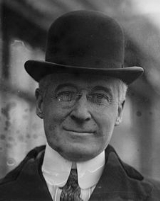
Bernard Mannes Baruch (August 18, 1870 – June 20, 1965) was an American financier, stock market speculator, statesman, and presidential advisor. After his success in business, he devoted his time toward advising Democratic presidents Woodrow Wilson and Franklin D. Roosevelt on economic matters. He is well known for having coined the term "Cold War" in 1947 to describe relations between the United States and the Soviet Union from the mid-1940s to the early 1990s.

Discussion
Ask a question about 'Bernard Baruch'
Start a new discussion about 'Bernard Baruch'
Answer questions from other users
|
Quotations
I'm not smart. I try to observe. Millions saw the apple fall but Newton was the one who asked why.
New York Post (June 24, 1965)
There are no such things as incurable, there are only things for which man has not found a cure.
Speech (April 30, 1954)
To me, old age is always fifteen years older than I am.
Quoted in the Observer, London (Aug. 21, 1955), On his 85th birthday
Vote for the man who promises least; he'll be the least disappointing.
Quoted in Meyer Berger’s New York (1960)
Behind the black portent of the new atomic age lies a hope which, seized upon with faith, can work out salvation...Let us not deceive ourselves: we must elect world peace or world destruction.
Address to the United Nations Atomic Energy Commission (June 14, 1946)
Although the shooting war is over, we are in the midst of a cold war which is getting warmer.
Speech before the Senate’s Special Committee Investigating the National Defense Program (1948)

Encyclopedia
Bernard Mannes Baruch (August 18, 1870 – June 20, 1965) was an American financier, stock market speculator, statesman, and presidential advisor. After his success in business, he devoted his time toward advising Democratic presidents Woodrow Wilson and Franklin D. Roosevelt on economic matters. He is well known for having coined the term "Cold War" in 1947 to describe relations between the United States and the Soviet Union from the mid-1940s to the early 1990s.
Early life, education, and career
Bernard Baruch was born in Camden, South Carolina to Simon and Belle Baruch. He was the second of four sons. His father Dr. Simon Baruch (1840-1921) was a German immigrant of Jewish ethnicity who came to the United States in 1855. He became a surgeon on the staff of Confederate general Robert E. Lee during the American Civil War and a pioneer in physical therapy.
His mother's Sephardic Jewish ancestors came to New York as early as the 1690s and were in the shipping business. In 1881 the family moved to New York City, and Bernard Baruch graduated from the City College of New York eight years later. He eventually became a broker and then a partner in the firm of A. A. Housman and Company. With his earnings and commissions he bought a seat on the New York Stock Exchange for $18,000 ($ in today's dollars). There he amassed a fortune before the age of thirty via speculation in the sugar market. In 1903 he had his own brokerage firm and had gained the reputation of "The Lone Wolf on Wall Street" because of his refusal to join any other financial house. By 1910, he had become one of Wall Street's financial leaders. A residential building is named after him on the Stony Brook University campus.
Presidential Adviser: First World War
During World War I he advised President Woodrow Wilson on national defense, during which time he became the chairman of the War Industries Board. (His stenographer was the then-unknown teenager Billy Rose). Baruch played a major role in turning American industry to full-scale war production. At the war's conclusion, he was seen with President Wilson at the Versailles Peace Conference. He never ran for elective office. He supported numerous Democratic congressmen with $1000 annual campaign donations, and became a popular figure on Capitol Hill. Every election season he would contribute from $100 to $1000 to numerous Democratic candidates.
Under President Franklin Delano Roosevelt's "New Deal", Baruch was a member of the "Brain Trust" and helped form the National Recovery Administration (NRA).
Presidential Adviser: Second World War
During World War II he was a consultant on economic issues and proposed a number of measures including:
Baruch argued that in modern war there was little room for free enterprise. He said Washington must control all aspects of the economy and that both business and unions must be subservient to the nation's security interest. Furthermore, price controls were essential to prevent inflation and to maximize military power per dollar. He wanted labor to be organized to facilitate optimum production. Baruch believed labor should be cajoled, coerced, and controlled as necessary: a central government agency would orchestrate the allocation of labor. He supported what was known as a "work or fight" bill. Baruch advocated the creation of a permanent superagency similar to his old Industries Board. Thus Baruch proposed to freeze economic freedom during war in order to preserve it for peace. Obviously his approach enhanced the role of civilian businessmen and industrialists in determining what was needed and who would produce it. Baruch's ideas were largely adopted, with James Byrnes appointed to carry them out.
In 1946 he was appointed the United States representative to the United Nations Atomic Energy Commission (UNAEC) by President Harry S. Truman. As a member of the newly created UNAEC, Baruch suggested the elimination of nuclear weapons after implementation of a system of international controls, inspections, and punishment for violations.
On Friday, June 14 1946, Baruch - widely seen by many scientists and some members of Truman's administration as unqualified for the task - presented his Baruch Plan, a modified version of the Acheson-Lilienthal plan, to the UNAEC, which proposed international control of then-new atomic energy.
The Soviet Union rejected Baruch's proposal as unfair given the fact that the U.S. already had nuclear weapons, instead proposing that the U.S. eliminate its nuclear weapons before a system of controls and inspections was implemented. A stalemate ensued.
Park bench statesman
Baruch was a high profile public figure, and did his best thinking in Washington D.C's Lafayette Park and in New York City's Central Park. It was not uncommon to see him discussing government affairs with other people while sitting on a park bench; this became his trademark. It was said that his office was a park bench near the White House.
In 1960, on his ninetieth birthday, a commemorative park bench in Lafayette Park across from the White House was dedicated to him. He continued to advise on international affairs until his death on Sunday, June 20, 1965, in New York City, at the age of ninety-four.
Quotes
Bernard Baruch is oft-remembered for his many thoughtful and humorous quotations, many of which are used unattributed.
Mr. Baruch was inducted into the Junior Achievement U.S. Business Hall of Fame in 1997.
Trivia
- Baruch's faith helped him make his fortune. During his Wall Street days, Baruch sold short, to the limit of his resources, a stock he believed to be overvalued. He expected a quick profit on the next business day, believing the directors would not declare the regular dividend since the company could not afford it. He knew, however, that if the directors bluffed and declared a dividend, the stock could rise, and he would have to cover instantly or lose everything. The day before the dividend declaration day, his mother reminded him that the next day was the Jewish high holiday Yom Kippur, and he had promised to maintain the solemnity of the annual occasion and "keep" the holiday holy. Keeping his promise, Baruch ignored the multiple phone calls and telegrams from his friends who urged him to take his profit and cover. After Yom Kippur had passed, he read the telegrams and learned that, indeed, the dividend had passed. Rather than rising on the news, however, the stock had fallen precipitiously. In the hours he had chatted with his mother, keeping his promise, he had become a millionaire.
- In his teenage and college years, Baruch was quite good at sports, especially baseball and there was the possibility of his playing baseball professionally. But during a game for City College, he suffered an ear injury that impaired his hearing, taking away any possibility of playing in the majors
- His winter residence was his 17,500 acre (70 km²) Hobcaw Barony on the coast of South Carolina, which he purchased between 1905 and 1910. At Hobcaw House he was host to such world leaders as Winston Churchill and President Roosevelt, who visited for a month in 1944. Other guests included World War I General "Blackjack" Pershing and Edith Bolling Wilson wife of Woodrow Wilson.
After his death, it was turned into a wildlife refuge and a living laboratory for colleges
- Latitude (33.35) Longitude (-79.18)
- In 1931, Sir Winston Churchill was hit by a taxi, while on his way to meet Bernard Baruch.
- He made a $50,000 contribution to Woodrow Wilson's 1912 presidential campaign.
- Upon appointment to his first post by Woodrow Wilson, he divested his considerable financial holdings and sold his New York Stock Exchange seat to serve in government unencumbered.
- Baruch endured days of grilling from Alger Hiss, Counsel for the Senate Munitions Committee (the Nye Committee), answering innuendos about personal finances and wartime profiteering.
- Bernard Baruch was the first to use the term "Cold War" in reference to the conflict between United States and the Soviet Union while giving a speech on April 16, 1947. By September 1947 it was picked up by journalist Walter Lippmann and became standard. See Origins of the Cold War on more information about the origin of the term.
- Baruch owned a tungsten (wolfram) mining community named Atolia in California's Mojave Desert. During the years 1906 to 1926, Baruch spent one month a year at Atolia. The once thriving community of 4,000 individuals became a ghost town when, after World War I, tungsten was no longer considered a strategic material, and lower-cost sources were developed.
- Secretary of Defense James Forrestal had this diary entry about a lunch meeting with Baruch on February 3 1948: "He took the line of advising me not to be active in this particular matter and that I was already identified, to a degree that was not in my own interests, with opposition to the United Nations' policy on Palestine. He said he himself did not approve of the "Zionists' actions, but in the next breath said that the Democratic party could only lose by trying to get our government’s policy reversed, and said that it was a most inequitable thing to let the British arm the Arabs and for us not to furnish similar equipment to the Jews."
- The 1949 Warner Brothers Merrie Melodies Cartoon Rebel Rabbit features a scene in which Bugs Bunny uses paint to vandalize a park bench, changing it from Barney Baruch's Private Bench to Bugs Bunny's Private Bench.
- Baruch College, in Manhattan, New York has a statue of Bernard Baruch sitting on a bench inside of its entrance center. This statue is often mistaken for a real person.
- He was on the cover of TIME magazine a total of three times in his life.
- "In Wall Street it is always ba-rook, but his friends say bahr'ook [with the stress on the first syllable]." (Charles Earle Funk, What's the Name, Please?, Funk & Wagnalls, 1936.)
Bibliography
Primary sources
- Bernard M. Baruch Baruch: My Own Story (1957) two volumes. ISBN 1-56849-095-X
- Bernard M. Baruch; The Making of the Reparation and Economic Sections of the Treaty 1920.
- Bernard M. Baruch; American Industry in War: A Report of the War Industries Board (March 1921) ed by Richard H. Hippelheuser; 1941.
Scholarly secondary sources
- Eisenhower worked closely with Baruch in 1930.*
External links
|