
All Topics  
Foreign exchange reserves


   Email Print
   Bookmark   Link


Foreign exchange reserves


Foreign exchange reserves (also called Forex reserves) in a strict sense are only the foreign currency
Currency

A currency is a Medium of exchange, facilitating the trade of goods and/or Service s. It is coins and paper bills used as money. It is one form of money, where money is anything that serves as a medium of exchange, a store of value, and a standard of value....
 deposits and bonds held by central bank
Central bank

A central bank, reserve bank, or monetary authority is the entity responsible for the monetary policy of a country or of a group of member states....
s and monetary authorities. However, the term in popular usage commonly includes foreign exchange and gold
Gold

Gold is a chemical element with the symbol Au and atomic number 79. It is a highly sought-after precious metal, having been used as money, as a store of value, in jewelry, in sculpture, and for ornamentation since the beginning of recorded history....
, SDRs
Special Drawing Rights

Special Drawing Rights are potential claims on the freely usable currencies of International Monetary Fund members. SDRs have the ISO 4217 XDR....
 and IMF reserve positions. This broader figure is more readily available, but it is more accurately termed official international reserves or international reserves.


Discussion
Ask a question about 'Foreign exchange reserves'
Start a new discussion about 'Foreign exchange reserves'
Answer questions from other users
Full Discussion Forum


Encyclopedia


Foreign exchange reserves (also called Forex reserves) in a strict sense are only the foreign currency
Currency

A currency is a Medium of exchange, facilitating the trade of goods and/or Service s. It is coins and paper bills used as money. It is one form of money, where money is anything that serves as a medium of exchange, a store of value, and a standard of value....
 deposits and bonds held by central bank
Central bank

A central bank, reserve bank, or monetary authority is the entity responsible for the monetary policy of a country or of a group of member states....
s and monetary authorities. However, the term in popular usage commonly includes foreign exchange and gold
Gold

Gold is a chemical element with the symbol Au and atomic number 79. It is a highly sought-after precious metal, having been used as money, as a store of value, in jewelry, in sculpture, and for ornamentation since the beginning of recorded history....
, SDRs
Special Drawing Rights

Special Drawing Rights are potential claims on the freely usable currencies of International Monetary Fund members. SDRs have the ISO 4217 XDR....
 and IMF reserve positions. This broader figure is more readily available, but it is more accurately termed official international reserves or international reserves. These are asset
Asset

In business and accounting, assets are everything of value that is owned by a person or company. It is a claim on the property your income of a borrower....
s of the central bank
Central bank

A central bank, reserve bank, or monetary authority is the entity responsible for the monetary policy of a country or of a group of member states....
 held in different reserve currencies
Reserve currency

A reserve currency is a currency which is held in significant quantities by many governments and institutions as part of their foreign exchange reserves....
, mostly the dollar
United States dollar

The United States dollar is the unit of currency of the United States and was defined by the Coinage Act of 1792 to be between 371 and 416 grains of silver ....
, and to a lesser extent the euro
Euro

The euro is the official currency of 16 out of 27 European Union member state of the European Union . The states, known collectively as the Eurozone are: Austria, Belgium, Cyprus, Finland, France, Germany, Greece, Republic of Ireland, Italy, Luxembourg, Malta, the Netherlands, Portugal, Slovakia, Slovenia, and Spain....
 and yen, and used to back its liabilities, e.g. the local currency issued, and the various bank reserves
Bank reserves

Bank reserves are banks' holdings of deposit accounts in accounts with their central bank , plus currency that is physically held in bank vaults ....
 deposit
Deposit account

A deposit account is a Current account at a banking institution that allows money to be deposited and withdrawn by the account holder, with the transactions and resulting balance being recorded on the bank's books....
ed with the central bank, by the government
Government

Government is the body within any organization that has the authority to make and the power to enforce laws, regulations, or rules. Typically, the government refers to a civil government -- local, provincial, or national -- but commercial, academic, religious, or other formal organizations are also administered by governing bodies....
 or financial institutions.

History

Official international reserves, the means of official international payments, formerly consisted only of gold
Gold

Gold is a chemical element with the symbol Au and atomic number 79. It is a highly sought-after precious metal, having been used as money, as a store of value, in jewelry, in sculpture, and for ornamentation since the beginning of recorded history....
, and occasionally silver. But under the Bretton Woods system
Bretton Woods system

The Bretton Woods system of money management established the rules for commerce and finance relations among the world's major developed country in the mid 20th century....
, the US dollar
United States dollar

The United States dollar is the unit of currency of the United States and was defined by the Coinage Act of 1792 to be between 371 and 416 grains of silver ....
 functioned as a reserve currency, so it too became part of a nation's official international reserve assets. From 1944-1968, the US dollar was convertible into gold through the Federal Reserve System, but after 1968 only central banks could convert dollars into gold from official gold reserves, and after 1973 no individual or institution could convert US dollars into gold from official gold reserves. Since 1973, all major currencies have not been convertible into gold from official gold reserves. Individuals and institutions must now buy gold in private markets, just like other commodities. Even though US dollars and other currencies are no longer convertible into gold from official gold reserves, they still can function as official international reserves.

Purpose

In a flexible exchange rate system, official international reserve assets allow a central bank
Central bank

A central bank, reserve bank, or monetary authority is the entity responsible for the monetary policy of a country or of a group of member states....
 to purchase the domestic currency
Currency

A currency is a Medium of exchange, facilitating the trade of goods and/or Service s. It is coins and paper bills used as money. It is one form of money, where money is anything that serves as a medium of exchange, a store of value, and a standard of value....
, which is considered a liability
Liability

In the most general sense, a liability is anything that is a wikt:hindrance, or puts individuals at a disadvantage. It can also be used as a slang term to describe someone that puts a team or group of which they are a member at a disadvantage, and would thus be better off without....
 for the central bank (since it prints the money itself as IOUs). This action can stabilise the value of the domestic currency.

Central banks throughout the world have sometimes cooperated in buying and selling official international reserves to attempt to influence exchange rates.

Changes in reserves

The quantity of foreign exchange reserves can change as a central bank implements monetary policy. A central bank that implements a fixed exchange rate policy may face a situation where supply and demand would tend to push the value of the currency lower or higher (an increase in demand for the currency would tend to push its value higher, and a decrease lower). In a fixed exchange rate regime, these operations occur automatically, with the central bank clearing any excess demand or supply by purchasing or selling the foreign currency. Mixed exchange rate regimes ('dirty floats', target bands or similar variations) may require the use of foreign exchange operations (sterilized or unsterilized) to maintain the targeted exchange rate within the prescribed limits (China has been repeatedly accused of doing this by the USA - as Geithner did recently).

Foreign exchange operations that are unsterilized will cause an expansion or contraction in the amount of domestic currency in circulation, and hence directly affect monetary policy and inflation: An exchange rate target cannot be independent of an inflation target. Countries that do not target a specific exchange rate are said to have a floating exchange rate
Floating exchange rate

A floating exchange rate or a flexible exchange rate is a type of exchange rate regime wherein a currency's value is allowed to fluctuate according to the foreign exchange market....
, and allow the market to set the exchange rate; for countries with floating exchange rates, other instruments of monetary policy are generally preferred and they may limit the type and amount of foreign exchange interventions. Even those central banks that strictly limit foreign exchange interventions, however, often recognize that currency markets can be volatile and may intervene to counter disruptive short-term movements.

To maintain the same exchange rate if there is increased demand, the central bank can issue more of the domestic currency and purchase the foreign currency, which will increase the sum of foreign reserves. In this case, the currency's value is being held down; since (if there is no sterilization
Monetary policy

Monetary policy is the process by which the government, central bank, or monetary authority of a country controls the supply of money, availability of money, and cost of money or rate of interest, in order to attain a set of objectives oriented towards the growth and stability of the economy....
) the domestic money supply is increasing (money is being 'printed'), this may provoke domestic inflation (the value of the domestic currency falls relative to the value of goods and services).

Since the amount of foreign reserves available to defend a weak currency (a currency in low demand) is limited, a foreign exchange crisis or devaluation
Devaluation

Devaluation is a reduction in the value of a currency with respect to other monetary units. In common modern usage, it specifically implies an official lowering of the value of a country's currency within a fixed exchange rate system, by which the monetary authority formally sets a new fixed rate with respect to a foreign reference currency....
 could be the end result. For a currency in very high and rising demand, foreign exchange reserves can theoretically be continuously accumulated, although eventually the increased domestic money supply will result in inflation and reduce the demand for the domestic currency (as its value relative to goods and services falls). In practice, some central banks, through open market operations aimed at preventing their currency from appreciating, can at the same time build substantial reserves.

In practice, few central banks or currency regimes operate on such a simplistic level, and numerous other factors (domestic demand, production and productivity, imports and exports, relative prices of goods and services, etc) will affect the eventual outcome. As certain impacts (such as inflation) can take many months or even years to become evident, changes in foreign reserves and currency values in the short term may be quite large as different markets react to imperfect data.

Costs, benefits, and criticisms

Large reserves of foreign currency allow a government to manipulate exchange rates - usually to stabilize the foreign exchange rates to provide a more favorable economic environment. In theory the manipulation of foreign currency exchange rates can provide the stability that a gold standard provides, but in practice this has not been the case.

There are costs in maintaining large currency reserves. Fluctuations in exchange markets result in gains and losses in the purchasing power of reserves. Even in the absence of a currency crisis, fluctuations can result in huge losses. For example, China holds huge U.S. dollar-denominated assets, but the U.S. dollar has been weakening on the exchange markets, resulting in a relative loss of wealth. In addition to fluctuations in exchange rates, the purchasing power of fiat money decreases constantly due to devaluation through inflation
Inflation

In economics, inflation is a rise in the general price level of goods and services in an economy over a period of time. The term "inflation" once referred to increases in the money supply ; however, economic debates about the relationship between money supply and price levels have led to its primary use today in describing price inflatio...
. Therefore, a central bank must continually increase the amount of its reserves to maintain the same power to manipulate exchange rates. Reserves of foreign currency provide a small return in interest. However, this may be less than the reduction in purchasing power of that currency over the same period of time due to inflation
Inflation

In economics, inflation is a rise in the general price level of goods and services in an economy over a period of time. The term "inflation" once referred to increases in the money supply ; however, economic debates about the relationship between money supply and price levels have led to its primary use today in describing price inflatio...
, effectively resulting in a negative return known as the "quasi-fiscal cost". In addition, large currency reserves could have been invested in higher yielding assets.

Excess reserves

Foreign exchange reserves are important indicators of ability to repay foreign debt and for currency defense, and are used to determine credit ratings of nations, however, other government funds that are counted as liquid assets that can be applied to liabilities in times of crisis include stabilization fund
Stabilization fund

A stabilization fund generally refers to a mechanism set up by sovereignties to insulate the domestic economy from large influxes of revenue, as from commodities such as oil....
s, otherwise known as sovereign wealth fund
Sovereign wealth fund

A sovereign wealth fund is a state-owned investment fund composed of finance assets such as stocks, bonds, property, precious metals or other financial instruments....
s. If those were included, Norway
Norway

Norway , officially the Kingdom of Norway, is a constitutional monarchy in Northern Europe that occupies the western portion of the Scandinavian Peninsula....
 and Persian Gulf States would rank higher on these lists, and UAE's $1.3 trillion Abu Dhabi Investment Authority
Abu Dhabi Investment Authority

The Abu Dhabi Investment Authority is a sovereign wealth fund owned by Abu Dhabi, United Arab Emirates. ADIA has never published how much it has in assets....
 would be second after China
China

China is a Culture of China, an ancient civilization, and, depending on perspective, a national or multinational entity extending over a large area in East Asia....
. Singapore also has significant government funds including Temasek Holdings
Temasek Holdings

Temasek Holdings is an investment company that is owned by the government of Singapore. With a international staff of more than 300 people, it manages a portfolio of about S$185 billion, or more than US$127 billion, focused primarily in Asia....
 and GIC
Government of Singapore Investment Corporation

The Government of Singapore Investment Corporation Private Limited is a sovereign wealth fund established by the Government of Singapore in 1981 to manage Singapore's foreign reserves....
. India
India

India, officially the Republic of India , is a country in South Asia. It is the List of countries and outlying territories by total area country by geographical area, the List of countries by population country, and the most populous liberal democracy in the world....
 is also planning to create its own investment firm from its foreign exchange reserves.

Levels

At the end of 2007, 63.90% of the identified official foreign exchange reserves in the world were held in United States dollar
United States dollar

The United States dollar is the unit of currency of the United States and was defined by the Coinage Act of 1792 to be between 371 and 416 grains of silver ....
s and 26.5% in euro
Euro

The euro is the official currency of 16 out of 27 European Union member state of the European Union . The states, known collectively as the Eurozone are: Austria, Belgium, Cyprus, Finland, France, Germany, Greece, Republic of Ireland, Italy, Luxembourg, Malta, the Netherlands, Portugal, Slovakia, Slovenia, and Spain....
s .

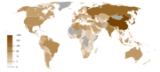
Monetary Authorities with the largest foreign reserves in 2008.>
Note:
  • China updates its information quarterly.
  • Russia and India update their information weekly and monthly.
  • Brazil updates its information daily.


These few holders account for more than 60% of total world foreign currency reserves. The adequacy of the foreign exchange reserves is more often expressed not as an absolute level, but as a percentage of short-term foreign debt, money supply, or average monthly imports.

See also

  • Balance of payments
    Balance of payments

    In economics, the balance of payments, measures the payments that flow between any individual country and all other countries. It is used to summarize all international economics transactions for that country during a specific time period, usually a year....
  • Endaka
    Endaka

    Endaka or Endaka Fukyo is a state in which the yen is high, or valuable compared to other currencies. Since Japan is highly dependent on exports, this can cause a recession....
  • Global assets under management
    Global assets under management

    Global asset allocation or Global assets under management consists of pension funds, insurance companies and mutual funds. Other funds under management include private wealth and alternative assets such as hedge funds and private equity....
  • List of countries by foreign exchange reserves
  • Official gold reserves
    Official gold reserves

    Gold reserves are held by central banks as a store of value. In 2001, it was estimated that all the gold ever mined totaled 145,000 tonnes. One tonne of gold equated to a value of United States dollar30.27 million as of February 14, 2009 ....
  • Reserve currency
    Reserve currency

    A reserve currency is a currency which is held in significant quantities by many governments and institutions as part of their foreign exchange reserves....
  • Sovereign wealth funds
  • Special Drawing Rights
    Special Drawing Rights

    Special Drawing Rights are potential claims on the freely usable currencies of International Monetary Fund members. SDRs have the ISO 4217 XDR....


External links


Source

  • [https://www.cia.gov/library/publications/the-world-factbook/rankorder/2188rank.html The World Factbook, CIA]


Articles


Speeches