

Xionites

Encyclopedia
Persian language
Persian is an Iranian language within the Indo-Iranian branch of the Indo-European languages. It is primarily spoken in Iran, Afghanistan, Tajikistan and countries which historically came under Persian influence...
: Xiyon, Avestan: Xiiaona, Sogdian
Sogdian language
The Sogdian language is a Middle Iranian language that was spoken in Sogdiana , located in modern day Uzbekistan and Tajikistan ....
:xwn), Hunni (Pahlavi:Huna, Yun or Xūn (獯), were a nomad
Nomad
Nomadic people , commonly known as itinerants in modern-day contexts, are communities of people who move from one place to another, rather than settling permanently in one location. There are an estimated 30-40 million nomads in the world. Many cultures have traditionally been nomadic, but...
ic tribe prominent in Transoxania and Bactria
Bactria
Bactria and also appears in the Zend Avesta as Bukhdi. It is the ancient name of a historical region located between south of the Amu Darya and west of the Indus River...
.
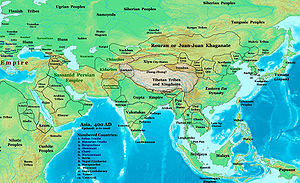
The Xionites arrived in the mid-4th century with the wave of immigration from Central Asia
Central Asia
Central Asia is a core region of the Asian continent from the Caspian Sea in the west, China in the east, Afghanistan in the south, and Russia in the north...
into Iran
Iran
Iran , officially the Islamic Republic of Iran , is a country in Southern and Western Asia. The name "Iran" has been in use natively since the Sassanian era and came into use internationally in 1935, before which the country was known to the Western world as Persia...
in late antiquity. They had been influenced by the Kushan and Bactria
Bactria
Bactria and also appears in the Zend Avesta as Bukhdi. It is the ancient name of a historical region located between south of the Amu Darya and west of the Indus River...
n cultures, and became a threat on the northeastern frontier of the Sassanid Empire
Sassanid Empire
The Sassanid Empire , known to its inhabitants as Ērānshahr and Ērān in Middle Persian and resulting in the New Persian terms Iranshahr and Iran , was the last pre-Islamic Persian Empire, ruled by the Sasanian Dynasty from 224 to 651...
.
Origins
It is difficult to determine the ethnic composition of the Xionites. In addition, there is no evidence that the Xionites were different from the HephthaliteHephthalite
The Hephthalites or Hephthalite is a pre-Islamic Greek term for local Abdali Afghans, who's famous ruler was Nazak Abdali . Hephthalites were a Central Asian nomadic confederation of the AD 5th-6th centuries whose precise origins and composition remain obscure...
s. In other words, the Hepthalites may have been a prominent tribe or clan of the Xionites.
In 1932 Sir Harold Walter Bailey
Harold Walter Bailey
Sir Harold Walter Bailey , who published as H. W. Bailey, was an eminent English scholar of Khotanese, Sanskrit, and the comparative study of Iranian languages....
wrote:
In 1944 Carlile Aylmer Macartney
Carlile Aylmer Macartney
Carlile Aylmer Macartney was a British academic specializing in the history of central Europe and in particular the history of Hungary....
wrote:
A more recent specialist, Richard Nelson Frye
Richard Nelson Frye
Richard Nelson Frye is an American scholar of Iranic and Central Asian Studies, and Aga Khan Professor Emeritus of Iranian Studies at Harvard University...
wrote in 1991:
In 1992 Wolfgang Felix considered the Xionites a tribe of probable Iranian origin that was prominent in Bactria and Transoxania in late antiquity.
According to A.S. Shahbazi (2005), the Xionites were a "Hunnic" people who by the early fourth century had mixed with north Iranian elements in Transoxiana, adopted the Kushan-Bactrian
Bactrian language
The Bactrian language is an extinct Eastern Iranian language which was spoken in the Central Asian region of Bactria. Linguistically, it is classified as belonging to the middle period of the East Iranian branch...
language, and threatened Persia.
Early history
In the earliest periods, the Xionites (Xiōng (匈) were more of a concern to the Chinese than to the Persians. They were probably identical with the Húnyí (混夷) or "Mixed-Barbarians" that Chinese records mention roaming in the west, and the XirongXirong (people)
Xīróng or Rong was the collective name of various ancient nomadic tribal people who inhabited primarily in and around the extremities of ancient Huaxia, typically to the west of the Zhou state in the modern-day provinces of Shaanxi, Gansu and Ningxia from the Zhou Dynasty onwards, and regarded...
or "Western Barbarians" of Chinese history. They dominated the smaller Donghu
Donghu
Donghu was the name of a Mongolic nomadic tribal confederation that was first recorded from the 7th century BCE and was destroyed by the Xiongnu in 150 BCE. Donghu was later divided into the Wuhuan and Xianbei Confederations, from which the Mongols are derived...
nations in the East Asian steppes beyond the Tianshan
Tianshan
Tianshan may refer to:*Tian Shan, a mountain range in Central Asia*Tianshan District, Ürümqi, Xinjiang, China*Tianshan Subdistrict, Ar Horqin Banner, Inner Mongolia, China*Tianshan Town, Ar Horqin Banner, in Ar Horqin Banner, Inner Mongolia, China...
, who were known as the "Xiong's Serfs" or Xiongnu
Xiongnu
The Xiongnu were ancient nomadic-based people that formed a state or confederation north of the agriculture-based empire of the Han Dynasty. Most of the information on the Xiongnu comes from Chinese sources...
, until the Xiong's hold over them was broken by the Chinese by the end of the Sino-Xiongnu War
Sino-Xiongnu War
The Sino-Xiongnu War is a name given to a series of battles between the Han Dynasty and the tribes of Xiongnu between 133 BC and 89 AD. The nature of these battles varied through time between Han conquest and the possession of city-states in central Asia. The war culminated in Geng Kui driving the...
.
They produced the ruling Hū (呼)
Huyan
The Huyan was a noble house that led the last remnants of the Northern Xiongnu, to Dzungaria during the 2nd century, after the Battle of Ikh Bayan...
clan after whom Hūsìmì (呼似密) (Khwarezm
Khwarezm
Khwarezm, or Chorasmia, is a large oasis region on the Amu Darya river delta in western Central Asia, which borders to the north the Aral Sea, to the east the Kyzylkum desert, to the south the Karakum desert and to the west the Ustyurt Plateau...
) was named. According to Sima Qian
Sima Qian
Sima Qian was a Prefect of the Grand Scribes of the Han Dynasty. He is regarded as the father of Chinese historiography for his highly praised work, Records of the Grand Historian , a "Jizhuanti"-style general history of China, covering more than two thousand years from the Yellow Emperor to...
, these rulers were descendants of Chunwei
Chunwei
Chunwei is an ethnonym for the most ancient nomadic tribes that invaded China during legendary times. A Chinese Classical scholar and the first President of the Imperial Nanking University Wei Zhao commented, identificating the name Chunwei with the name of the Huns: “During the Han they were...
(淳維), possibly a son of Jie, the final ruler of the Xia Dynasty
Xia Dynasty
The Xia Dynasty is the first dynasty in China to be described in ancient historical chronicles such as Bamboo Annals, Classic of History and Records of the Grand Historian. The Xia Dynasty was established by the legendary Yu the Great after Shun, the last of the Five Emperors gave his throne to him...
.
Conquest of Bactria
Xionite campaigns are better documented in connection with the history of Central AsiaCentral Asia
Central Asia is a core region of the Asian continent from the Caspian Sea in the west, China in the east, Afghanistan in the south, and Russia in the north...
, particularly during the second half of the 4th century AD until the mid 5th century AD.
They organised themselves into Northern "Black" (beyond the Jaxartes), Kidarites
Kidarites
The Kidarite were a dynasty of the "Ki" clan, probably originating from the Uar people. They were part of the complex of tribes known collectively as Xionites or "Hunas"....
or Southern "Red" (in Hindu Kush south of the Oxus), Eastern "Blue" (in Tianshan), and Western Hephthalites or "White" (around Khiva) hordes. Artefacts found from the area they inhabited dating from their period indicate their totem animal seems to have been the (rein)deer. An inscription on the walls of the royal palace in Persepolis about Darius's empire calls them Hunae. It appears that a combination of both the Battle of Ikh Bayan
Battle of Ikh Bayan
The Battle of Ikh Bayan , was a major expedition launched against the Xiongnu by the Han Dynasty in June, 89. The battle was a success for the Han under Dou Xian The Battle of Ikh Bayan , was a major expedition launched against the Xiongnu by the Han Dynasty in June, 89. The battle was a success...
and Ban Chao
Ban Chao
Ban Chao , courtesy name Zhongsheng , was born in Xianyang, Shaanxi, and the younger brother of the famous historian, Ban Gu who, with his father Ban Biao, and sister, Ban Zhao, wrote the famous Hanshu, or 'History of the Former Han Dynasty'....
's efforts are responsible for their first appearance in the West. The Armenian
Armenians
Armenian people or Armenians are a nation and ethnic group native to the Armenian Highland.The largest concentration is in Armenia having a nearly-homogeneous population with 97.9% or 3,145,354 being ethnic Armenian....
historian Moses of Khorene (5th c.), in his "History of Armenia," introduces the Hunni near the Sarmatians
Sarmatians
The Iron Age Sarmatians were an Iranian people in Classical Antiquity, flourishing from about the 5th century BC to the 4th century AD....
and goes on to describe how they captured the city of Balkh
Balkh
Balkh , was an ancient city and centre of Zoroastrianism in what is now northern Afghanistan. Today it is a small town in the province of Balkh, about 20 kilometers northwest of the provincial capital, Mazar-e Sharif, and some south of the Amu Darya. It was one of the major cities of Khorasan...
(Armenian
Armenian language
The Armenian language is an Indo-European language spoken by the Armenian people. It is the official language of the Republic of Armenia as well as in the region of Nagorno-Karabakh. The language is also widely spoken by Armenian communities in the Armenian diaspora...
"Kush") sometime between 194 and 214 which is why the Greeks
Greeks
The Greeks, also known as the Hellenes , are a nation and ethnic group native to Greece, Cyprus and neighboring regions. They also form a significant diaspora, with Greek communities established around the world....
called that city Hunuk.
According to the Armenian sources their capital was at Balkh
Balkh
Balkh , was an ancient city and centre of Zoroastrianism in what is now northern Afghanistan. Today it is a small town in the province of Balkh, about 20 kilometers northwest of the provincial capital, Mazar-e Sharif, and some south of the Amu Darya. It was one of the major cities of Khorasan...
(Armenian: Kush). Their most famous rulers were called the Kidarites
Kidarites
The Kidarite were a dynasty of the "Ki" clan, probably originating from the Uar people. They were part of the complex of tribes known collectively as Xionites or "Hunas"....
.
At the end of the 4th century AD, a new wave of Hunnic tribes (Alchon) invaded Bactria, pushing the Kidarites into Gandhara
Gandhara
Gandhāra , is the name of an ancient kingdom , located in northern Pakistan and eastern Afghanistan. Gandhara was located mainly in the vale of Peshawar, the Potohar plateau and on the Kabul River...
.
Alchon
Alchon or Alχon (Uarkhon) became the new name of the Xionites in 460 when Khingila IKhingila I
Khingila I c.430-490, apparently of the Haital tribe from Kushan , a contemporary of Akhshunwar Khingila I (Firdowsi: Shengil, Alkhano: Khigi, Chinese: Cha-Li) c.430-490, apparently of the Haital tribe (Chinese: 厌哒 or 嚈噠) from Kushan (Chinese: 貴霜), a contemporary of Akhshunwar Khingila I...
united the Uar
Uar
The Uar were the largest of three ethnic components constituting the confederation known to the west as the Hephthalites and to the Chinese as Yanda and the dominant ethnicity of Khwarezm...
with the Xionites under his Hephthalite
Hephthalite
The Hephthalites or Hephthalite is a pre-Islamic Greek term for local Abdali Afghans, who's famous ruler was Nazak Abdali . Hephthalites were a Central Asian nomadic confederation of the AD 5th-6th centuries whose precise origins and composition remain obscure...
ruling élite.
At the end of the 5th century the Alchon invaded northern India where they became known as the Huna
Huna people
Huna is the name under which the Xionite tribes who invaded northern India during the first half of the 5th century were known.-History:...
. In India the Alchon were not distinguished from their immediate Hephthalite predecessors and both are known as Sveta-Hunas there. Perhaps complimenting this term, Procopius
Procopius
Procopius of Caesarea was a prominent Byzantine scholar from Palestine. Accompanying the general Belisarius in the wars of the Emperor Justinian I, he became the principal historian of the 6th century, writing the Wars of Justinian, the Buildings of Justinian and the celebrated Secret History...
(527-565) wrote that they were white skinned, had an organized kingship, and that their life was not wild/nomadic but that they lived in cities.
Although the power of the Alchon in Bactria was shattered in the 560's by a combination of Sassanid and proto-Turkic forces, the last Hephthal king Narana/Narendra managed to maintain some kind of rule between 570 and 600 AD over the 'nspk' or 'napki' or 'nezak' tribes that remained after most of the Alchon had fled to the west, where they became known as the Avars
Eurasian Avars
The Eurasian Avars or Ancient Avars were a highly organized nomadic confederacy of mixed origins. They were ruled by a khagan, who was surrounded by a tight-knit entourage of nomad warriors, an organization characteristic of Turko-Mongol groups...
.
The Alchon were called Varkhon or Varkunites (Ouar-Khonitai) by Menander Protector
Menander Protector
Menander Protector , Byzantine historian, was born in Constantinople in the middle of the 6th century AD. The little that is known of his life is contained in the account of himself quoted by Suidas. He at first took up the study of law, but abandoned it for a life of pleasure...
(538-582) literally referring to the Uar and Hunnoi. Around 630, Theophylact Simocatta
Theophylact Simocatta
Theophylact Simocatta was an early seventh-century Byzantine historiographer, arguably ranking as the last historian of Late Antiquity, writing in the time of Heraclius about the late Emperor Maurice .-Life:His history of the reign of emperor Maurice is in eight books...
wrote that the European "Avars" were initially composed of two nations, the Uar and the Hunnoi tribes. He wrote that: "...the Barsilt, the Unogurs and the Sabirs were struck with horror... and honoured the newcomers with brilliant gifts..." when the Avars first arrived in their lands in 555AD.
Coinage
Alchon Huns refers to a tribe which minted coins in Bactria in the 5th & 6th centuries. The name Khigi on one of the coins and Narendra on another has led some scholars of the area to believe that the Hephthalite KhaganKhagan
Khagan or qagan , alternatively spelled kagan, khaghan, qaghan, or chagan, is a title of imperial rank in the Mongolian and Turkic languages equal to the status of emperor and someone who rules a khaganate...
s Khingila and Narana were of the AlChoNo tribe inscribed in Bactrian script on the coins in question. They imitated the earlier style of their Hephthalite predecessors, the Kidarite Hun successors to the Kushans. In particular the Alchon style imitates the coins of Kidarite Varhran I (syn. Kushan Varhran IV).
Red Huns and White Huns
The name Xyon is found in Avestan and Pahlavi texts. In the Avestan tradition (Yts. 9.30-31, 19.87) the Xiiaona were characterized as enemies of VishtaspaVishtaspa
Vishtaspa is the Avestan-language name of a figure of Zoroastrian scripture and tradition, portrayed as an early follower of Zoroaster, and his patron, and instrumental in the diffusion of the prophet's message...
, the patron of Zoroaster
Zoroaster
Zoroaster , also known as Zarathustra , was a prophet and the founder of Zoroastrianism who was either born in North Western or Eastern Iran. He is credited with the authorship of the Yasna Haptanghaiti as well as the Gathas, hymns which are at the liturgical core of Zoroastrianism...
. In the later Pahlavi tradition, the Red Huns (Karmir Xyon) and White Huns (Spet Xyon) are mentioned. The Red Huns of the Pahlavi tradition (7th C.) have been identified by Harold Walter Bailey
Harold Walter Bailey
Sir Harold Walter Bailey , who published as H. W. Bailey, was an eminent English scholar of Khotanese, Sanskrit, and the comparative study of Iranian languages....
as the Kermichiones or Ermechiones. According to Bailey the Hara Huna of Indian sources are to be identified with the Karmir Xyon of the Avesta. Similarly he identifies the Sveta Huna of Indian sources with the Spet Xyon of the Avesta. Bailey argues that the name Xyon was transferred to the Huna
Huna people
Huna is the name under which the Xionite tribes who invaded northern India during the first half of the 5th century were known.-History:...
owing to similarity of sound, as Tur
Turan
Tūrān is the Persian name for Central Asia, literally meaning "the land of the Tur". As described below, the original Turanians are an Iranian tribe of the Avestan age. As a people the "Turanian" are one of the two Iranian peoples both descending from the Persian Fereydun but with different...
was adapted to Turk in Pahlavi tradition. It is necessary therefore to differentiate between "Kermichiones/Ermechiones", "Red Huns" or "Hara Huna", identified with the Kidarite dynasty, and "Xionites" "White Huns" or "Sveta Huna", identified with the Hephthalite
Hephthalite
The Hephthalites or Hephthalite is a pre-Islamic Greek term for local Abdali Afghans, who's famous ruler was Nazak Abdali . Hephthalites were a Central Asian nomadic confederation of the AD 5th-6th centuries whose precise origins and composition remain obscure...
dynasty.
Later, the Armenian Patriarch John (c.728) mentions an ancient town of Hunor's foundation (Hunoracerta) in the Utik
Utik
Utik was a historic province of the Kingdom of Armenia and a region of Caucasian Albania. Most of the region is located within present-day Azerbaijan immediately west of the Kura River while a part of it lies within the Tavush province of present-day northeastern Armenia.-History:According to...
region, suggesting a connection to the Utigur
Utigur
Utigur is the name used by Procopius Caesariensis and his continuators Agathias and Menander in the 5th and 6th centuries to refer to the Bulgar-Huns of Onoguria, the Eurasian steppes north-east of the Black Sea and east the Don river....
. The Armenian Agathangelus
Agathangelos
Agathangelos , appropriately so named, was a supposed secretary of Tiridates III, King of Armenia, under whose name there has come down a life of the first apostle of Armenia, Gregory the Illuminator, who died about 332. It purports to exhibit the deeds and discourses of Gregory, and has reached us...
also mentions also that there are "Huns" living amongst the peoples of the Caucasus
Caucasus
The Caucasus, also Caucas or Caucasia , is a geopolitical region at the border of Europe and Asia, and situated between the Black and the Caspian sea...
.