


Battle of Saipan

Encyclopedia
The Battle of Saipan was a battle of the Pacific campaign
of World War II
, fought on the island of Saipan
in the Mariana Islands
from 15 June-9 July 1944. The Allied invasion fleet embarking the expeditionary forces left Pearl Harbor
on 5 June 1944, the day before Operation Overlord
in Europe was launched. The U.S. 2nd Marine Division, 4th Marine Division, and 27th Infantry Division, commanded by Lieutenant General
Holland Smith
, defeated the 43rd Division of the Imperial Japanese Army
, commanded by Lieutenant General Yoshitsugu Saito
.
had captured the Solomon Islands
, the Gilbert Islands
, the Marshall Islands
and the Papuan peninsula of New Guinea
. This left the Japanese holding the Philippines, the Caroline Islands
, Palau Islands and Mariana Islands
.
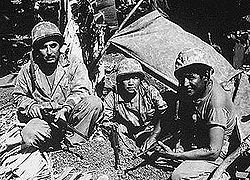 It had always been the intention of the American planners to bypass the Carolines and Palaus and to seize the Marianas and Taiwan. From these latter bases communications between the Japanese homeland and Japanese forces to the south and west could be cut. In addition, from the Marianas Japan would be well within the range of an air offensive relying on the new B-29 Superfortress
long-range bomber
with its operational radius of 1500 mi (2,414 km).
While not part of the original American plan Douglas MacArthur
, commander of the Southwest Pacific Area command, obtained authorization to advance through New Guinea and Morotai
toward the Philippines. This allowed MacArthur to keep his personal pledge, made in his "I shall return" speech, to liberate the Philippines, and also allowed the active use of the large forces built up in the southwest Pacific theatre.
The Japanese, expecting an attack somewhere on their perimeter, thought an attack on the Caroline Islands most likely. To reinforce and supply their garrisons, they needed naval and air superiority, so Operation A-Go, a major carrier
attack, was prepared for June 1944.
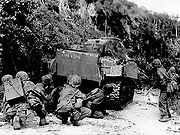
Bombardment of Saipan began on 13 June 1944. Fifteen battleship
s were involved, and 165,000 shells were fired. Seven modern fast battleships delivered twenty-four hundred 16 in (406.4 mm) shells, but to avoid potential minefields, fire was from a distance of 10000 yd (9,144 m) or more, and crews were inexperienced in shore bombardment. The following day the eight pre-Pearl Harbor
battleships and eleven cruisers under Admiral Jesse B. Oldendorf
replaced the fast battleships but were lacking in time and ammunition.
The landings began at 07:00 on 15 June 1944. More than 300 LVT
s landed 8,000 Marines on the west coast of Saipan by about 09:00. Eleven fire support ships covered the Marine landings. The naval force consisted of the battleship
s and . The cruiser
s were and . The destroyer
s were , , , , , and . Careful Japanese artillery preparation—placing flags in the bay to indicate the range—allowed them to destroy about 20 amphibious tanks, and the Japanese strategically placed barbed wire, artillery, machine gun emplacements, and trenches to maximize the American casualties. However, by nightfall the 2nd and 4th Marine Divisions had a beachhead
about 6 mi (9.7 km) wide and 0.5 mi (0.80467 km) deep. The Japanese counter-attacked at night but were repulsed with heavy losses. On 16 June, units of the U.S. Army's 27th Infantry Division landed and advanced on the airfield at Ås Lito (which is now the location of Saipan International Airport
). Again the Japanese counter-attacked at night. On 18 June, Saito abandoned the airfield.
The invasion surprised the Japanese high command, which had been expecting an attack further south. Admiral Toyoda Soemu, commander-in-chief of the Japanese Navy, saw an opportunity to use the A-Go force to attack the U.S. Navy forces around Saipan. On 15 June, he gave the order to attack. But the resulting battle of the Philippine Sea
was a disaster for the Imperial Japanese Navy
, which lost three aircraft carriers and hundreds of planes. The garrisons of the Marianas would have no hope of resupply or reinforcement.
Without resupply, the battle on Saipan was hopeless for the defenders, but the Japanese were determined to fight to the last man. Saito organized his troops into a line anchored on Mount Tapotchau in the defensible mountainous terrain of central Saipan. The nicknames given by the Americans to the features of the battle—"Hell's Pocket", "Purple Heart
Ridge" and "Death Valley"—indicate the severity of the fighting. The Japanese used the many caves in the volcanic landscape to delay the attackers, by hiding during the day and making sorties at night. The Americans gradually developed tactics for clearing the caves by using flamethrower
teams supported by artillery
and machine gun
s.
The operation was marred by inter-service controversy
when Marine General Holland Smith
, unsatisfied with the performance of the 27th Division, relieved its commander, Army General Ralph C. Smith
. However, General Holland Smith had not inspected the terrain over which the 27th was to advance. Essentially it was a valley surrounded by hills and cliffs under Japanese control. The 27th took heavy casualties and eventually, under a plan developed by General Ralph Smith and implemented after his relief, had one battalion hold the area while two other battalions successfully flanked the Japanese.
By 7 July, the Japanese had nowhere to retreat. Saito made plans for a final suicidal banzai charge
. On the fate of the remaining civilians on the island, Saito said, "There is no longer any distinction between civilians and troops. It would be better for them to join in the attack with bamboo spears than be captured." At dawn, with a group of 12 men carrying a great red flag in the lead, the remaining able-bodied troops—about 3,000 men—charged forward in the final attack. Amazingly, behind them came the wounded, with bandaged heads, crutches, and barely armed. The Japanese surged over the American front lines, engaging both Army and Marine units. The 1st and 2nd Battalions of the 105th U.S. Infantry were almost destroyed, losing 650 killed and wounded. However, the fierce resistance of these two battalions, as well as that of Headquarters Company, 105th Infantry, and elements of 3rd Battalion, 10th Marines (an artillery unit) resulted in over 4,300 Japanese killed. For their actions during the 15-hour Japanese attack, three men of the 105th Infantry were awarded the Medal of Honor
—all posthumously. Numerous others fought the Japanese until they were overwhelmed by the largest Japanese Banzai attack in the Pacific War.
By 16:15 on 9 July, Admiral Turner announced that Saipan was officially secured. Saito——along with commanders Hirakushi and Igeta—committed suicide in a cave. Also committing suicide at the end of the battle was Vice-Admiral Chuichi Nagumo
—the naval commander who led the Japanese carriers at Pearl Harbor
and Midway Atoll
—who had landed on Saipan to help lead the ground defense.
In the end, almost the entire garrison of troops on the island—at least 30,000—died. For the Americans, the victory was the most costly to date in the Pacific War
. 2,949 Americans were killed and 10,364 wounded, out of 71,000 who landed. Among the wounded was the actor Lee Marvin
. He was injured in the buttocks by Japanese fire which severed his sciatic nerve
. He received a medical discharge.
Weapons and the tactics of close quarter fighting also resulted in high civilian casualties. Civilian shelters were located virtually everywhere on the island, with very little difference noticeable to attacking Marines. The standard method of clearing suspected bunkers was with high-explosive and/or high-explosives augmented with petroleum (e.g. gelignite, napalm, diesel fuel). In such conditions, high civilian casualties were inevitable.
Emperor Hirohito
personally found the threat of defection of Japanese civilians disturbing. Much of the community was of low caste, and there was a risk that live civilians would be surprised by generous U.S. treatment. Native Japanese sympathizers would hand the Americans a powerful propaganda weapon to subvert the "fighting spirit" of Japan in radio broadcasts. At the end of June, Hirohito sent out an imperial order encouraging the civilians of Saipan to commit suicide. The order authorized the commander of Saipan to promise civilians who died there an equal spiritual status in the afterlife with those of soldiers perishing in combat. General Hideki Tōjō
intercepted the order on 30 June 1944 and delayed its sending, but it went out anyway the next day. By the time the Marines advanced on the north tip of the island, from 8–12 July 1944, most of the damage had been done. Over 20,000 Japanese civilians committed suicide in the last days of the battle to take the offered privileged place in the afterlife, some jumping from "Suicide Cliff" and "Banzai Cliff". In all, about 22,000 Japanese civilians died.
, part of the 2nd Marine Division, threw himself on a grenade to contain the blast from killing members of his squad. For his bravery and sacrifice, PFC Epperson was posthumously awarded the Medal of Honor. Epperson's Medal of Honor was presented to his mother in a ceremony on Wednesday, 4 July 1945 in Tiger Stadium, Massillon, Ohio.
, the battalion surgeon of 2nd Battalion, 105th Infantry Regiment, 27th Infantry Division aided the evacuation of wounded soldiers. After defending his patients from four Japanese soldiers, he manned a machine gun post and effectively repelled numerous enemy forces to enable the evacuation of wounded personnel. When his body was recovered after the battle, 98 dead Japanese soldiers were found in front of his position. For gallantry in battle, Captain Ben L. Salomon was posthumously awarded the Medal of Honor
in May 2002. Salomon was the third Jewish service member to be awarded the Medal of Honor during World War II.
, a Mexican-American from Los Angeles, is officially credited with capturing more than 1,000 Japanese prisoners during the battle. PFC Gabaldon, who was raised by Japanese-Americans, used a combination of street Japanese and guile to convince soldiers and civilians alike that U.S. troops were not barbarian
s, and that they would be well treated upon surrender. For his outstanding bravery, Gabaldon received a Silver Star
, which was upgraded to the Navy Cross
. During the war, his commanders had requested that he receive the Medal of Honor
for his actions; however, his initial award was the Silver Star. In 1998, efforts were re-initiated to secure the Medal of Honor for PFC Gabaldon. The effort is ongoing.
After the battle, Saipan became an important base for further operations in the Marianas, and then for the invasion of the Philippines
in October 1944. Bombers based at Saipan attacked the Philippines, the Ryukyu Islands
and Japan. In response, Japanese aircraft attacked Saipan and Tinian
on several occasions between November 1944 and January 1945. With the position secured, American army could also make advancement in the Philippines and also make direct contact with its Chinese ally.
For the Japanese, the defeat in the battle made the futility of the War in the Pacific all the more apparent. According to one Japanese admiral: "Our war was lost with the loss of Saipan" The famous American Marine Corps general said "it was the decisive battle of the Pacific offensive" and "it opened the way to the Japanese home islands." Four months later, the 100 B-29 bombers that took off from Saipan and attacked Tokyo, showed the decision to take Saipan was correct.
The loss of Saipan was a heavy blow to the Japanese ambition. A meeting of senior generals and admirals decided that a symbolic change of leadership should be made and Prime Minister Hideki Tōjō
should step aside. In addition, the Emperor should move away from day-to-day affairs so as to avoid looking too directly involved with the now losing war, to distance himself from blame if the war were lost. "shogun
" Tōjō. Tōjō agreed and submitted his resignation. Emperor Hirohito—considering Tōjō the strongest war leader Japan had—resisted. Tōjō considered trying to shuffle the Cabinet
but encountered too much hostility and gave up. On 18 July, Tōjō submitted again his resignation, this time unequivocally. His entire cabinet resigned with him.
During the course of the battle, Japanese accounts for the home front had concentrated on the fighting spirit and the heavy American casualties, but familiarity with geography would demonstrate that the battles slowly progressed northwards as the American forces advanced, and the reports ceased with the final battle, which was not reported to the public. After Tōjō's resignation, an accurate, almost day-by-day, account of the fall was published by the army and navy, including the nearly total loss of all Japenese soldiers and civilians on the island, and the use of "human bullets"; the report had devastating effects on Japan, with the mass suicides being taken not as evidence of the Imperial Way but of defeat. This was the first time that the Japanese forces had accurately depicted a battle since Midway, which they had proclaimed a victory.
A group of Japanese soldiers, led by IJA Captain Sakae Oba
, held out in the mountains until 1 December 1945. A total of 46 men laid down their arms when the final order to surrender reached them. A movie called 「太平洋の奇跡−フォックスと呼ばれた男−」“Taiheiyou no Kiseki ~Fox to Yobareta Otoko” (Miracle in Pacific – The man who was called Fox) about these survivors and their 512 day resistance was released in Japan on February 11, 2011.
After the war concluded, apologists for Hirohito asserted that the order encouraging the civilians of Saipan to commit suicide for benefits in the afterlife had in fact been forged, along with other incriminating orders. Historian David Bergamini
considers this unlikely, writing that "half the staff of the palace [...] would have felt obliged to cut open their bellies
if the sacred seals of the Throne had ever been misapplied."
Pacific War
The Pacific War, also sometimes called the Asia-Pacific War refers broadly to the parts of World War II that took place in the Pacific Ocean, its islands, and in East Asia, then called the Far East...
of World War II
World War II
World War II, or the Second World War , was a global conflict lasting from 1939 to 1945, involving most of the world's nations—including all of the great powers—eventually forming two opposing military alliances: the Allies and the Axis...
, fought on the island of Saipan
Saipan
Saipan is the largest island of the United States Commonwealth of the Northern Mariana Islands , a chain of 15 tropical islands belonging to the Marianas archipelago in the western Pacific Ocean with a total area of . The 2000 census population was 62,392...
in the Mariana Islands
Mariana Islands
The Mariana Islands are an arc-shaped archipelago made up by the summits of 15 volcanic mountains in the north-western Pacific Ocean between the 12th and 21st parallels north and along the 145th meridian east...
from 15 June-9 July 1944. The Allied invasion fleet embarking the expeditionary forces left Pearl Harbor
Pearl Harbor
Pearl Harbor, known to Hawaiians as Puuloa, is a lagoon harbor on the island of Oahu, Hawaii, west of Honolulu. Much of the harbor and surrounding lands is a United States Navy deep-water naval base. It is also the headquarters of the U.S. Pacific Fleet...
on 5 June 1944, the day before Operation Overlord
Operation Overlord
Operation Overlord was the code name for the Battle of Normandy, the operation that launched the invasion of German-occupied western Europe during World War II by Allied forces. The operation commenced on 6 June 1944 with the Normandy landings...
in Europe was launched. The U.S. 2nd Marine Division, 4th Marine Division, and 27th Infantry Division, commanded by Lieutenant General
Lieutenant General (United States)
In the United States Army, the United States Air Force and the United States Marine Corps, lieutenant general is a three-star general officer rank, with the pay grade of O-9. Lieutenant general ranks above major general and below general...
Holland Smith
Holland Smith
General Holland McTyeire "Howlin' Mad" Smith, KCB was a General in the United States Marine Corps during World War II. He is sometimes called the "father" of modern U.S. amphibious warfare....
, defeated the 43rd Division of the Imperial Japanese Army
Imperial Japanese Army
-Foundation:During the Meiji Restoration, the military forces loyal to the Emperor were samurai drawn primarily from the loyalist feudal domains of Satsuma and Chōshū...
, commanded by Lieutenant General Yoshitsugu Saito
Yoshitsugu Saito
- Notes :...
.
Background
In the campaigns of 1943 and the first half of 1944, the AlliesAllies of World War II
The Allies of World War II were the countries that opposed the Axis powers during the Second World War . Former Axis states contributing to the Allied victory are not considered Allied states...
had captured the Solomon Islands
Solomon Islands
Solomon Islands is a sovereign state in Oceania, east of Papua New Guinea, consisting of nearly one thousand islands. It covers a land mass of . The capital, Honiara, is located on the island of Guadalcanal...
, the Gilbert Islands
Gilbert Islands
The Gilbert Islands are a chain of sixteen atolls and coral islands in the Pacific Ocean. They are the main part of Republic of Kiribati and include Tarawa, the site of the country's capital and residence of almost half of the population.-Geography:The atolls and islands of the Gilbert Islands...
, the Marshall Islands
Marshall Islands
The Republic of the Marshall Islands , , is a Micronesian nation of atolls and islands in the middle of the Pacific Ocean, just west of the International Date Line and just north of the Equator. As of July 2011 the population was 67,182...
and the Papuan peninsula of New Guinea
New Guinea
New Guinea is the world's second largest island, after Greenland, covering a land area of 786,000 km2. Located in the southwest Pacific Ocean, it lies geographically to the east of the Malay Archipelago, with which it is sometimes included as part of a greater Indo-Australian Archipelago...
. This left the Japanese holding the Philippines, the Caroline Islands
Caroline Islands
The Caroline Islands are a widely scattered archipelago of tiny islands in the western Pacific Ocean, to the north of New Guinea. Politically they are divided between the Federated States of Micronesia in the eastern part of the group, and Palau at the extreme western end...
, Palau Islands and Mariana Islands
Mariana Islands
The Mariana Islands are an arc-shaped archipelago made up by the summits of 15 volcanic mountains in the north-western Pacific Ocean between the 12th and 21st parallels north and along the 145th meridian east...
.
B-29 Superfortress
The B-29 Superfortress is a four-engine propeller-driven heavy bomber designed by Boeing that was flown primarily by the United States Air Forces in late-World War II and through the Korean War. The B-29 was one of the largest aircraft to see service during World War II...
long-range bomber
Bomber
A bomber is a military aircraft designed to attack ground and sea targets, by dropping bombs on them, or – in recent years – by launching cruise missiles at them.-Classifications of bombers:...
with its operational radius of 1500 mi (2,414 km).
While not part of the original American plan Douglas MacArthur
Douglas MacArthur
General of the Army Douglas MacArthur was an American general and field marshal of the Philippine Army. He was a Chief of Staff of the United States Army during the 1930s and played a prominent role in the Pacific theater during World War II. He received the Medal of Honor for his service in the...
, commander of the Southwest Pacific Area command, obtained authorization to advance through New Guinea and Morotai
Morotai
Morotai Island Regency is a regency of North Maluku province, Indonesia, located on Morotai Island. The population was 54,876 in 2007.-History:...
toward the Philippines. This allowed MacArthur to keep his personal pledge, made in his "I shall return" speech, to liberate the Philippines, and also allowed the active use of the large forces built up in the southwest Pacific theatre.
The Japanese, expecting an attack somewhere on their perimeter, thought an attack on the Caroline Islands most likely. To reinforce and supply their garrisons, they needed naval and air superiority, so Operation A-Go, a major carrier
Aircraft carrier
An aircraft carrier is a warship designed with a primary mission of deploying and recovering aircraft, acting as a seagoing airbase. Aircraft carriers thus allow a naval force to project air power worldwide without having to depend on local bases for staging aircraft operations...
attack, was prepared for June 1944.
Battle
Bombardment of Saipan began on 13 June 1944. Fifteen battleship
Battleship
A battleship is a large armored warship with a main battery consisting of heavy caliber guns. Battleships were larger, better armed and armored than cruisers and destroyers. As the largest armed ships in a fleet, battleships were used to attain command of the sea and represented the apex of a...
s were involved, and 165,000 shells were fired. Seven modern fast battleships delivered twenty-four hundred 16 in (406.4 mm) shells, but to avoid potential minefields, fire was from a distance of 10000 yd (9,144 m) or more, and crews were inexperienced in shore bombardment. The following day the eight pre-Pearl Harbor
Pearl Harbor
Pearl Harbor, known to Hawaiians as Puuloa, is a lagoon harbor on the island of Oahu, Hawaii, west of Honolulu. Much of the harbor and surrounding lands is a United States Navy deep-water naval base. It is also the headquarters of the U.S. Pacific Fleet...
battleships and eleven cruisers under Admiral Jesse B. Oldendorf
Jesse B. Oldendorf
Jesse Bartlett "Oley" Oldendorf was an admiral in the United States Navy, famous for defeating a Japanese force in the Battle of Leyte Gulf during World War II...
replaced the fast battleships but were lacking in time and ammunition.
The landings began at 07:00 on 15 June 1944. More than 300 LVT
Landing Vehicle Tracked
The Landing Vehicle Tracked was a class of amphibious vehicles introduced by the United States Navy, Marine Corps and Army during World War II. Originally intended solely as cargo carriers for ship to shore operations, they rapidly evolved into assault troop and fire support vehicles as well...
s landed 8,000 Marines on the west coast of Saipan by about 09:00. Eleven fire support ships covered the Marine landings. The naval force consisted of the battleship
Battleship
A battleship is a large armored warship with a main battery consisting of heavy caliber guns. Battleships were larger, better armed and armored than cruisers and destroyers. As the largest armed ships in a fleet, battleships were used to attain command of the sea and represented the apex of a...
s and . The cruiser
Cruiser
A cruiser is a type of warship. The term has been in use for several hundreds of years, and has had different meanings throughout this period...
s were and . The destroyer
Destroyer
In naval terminology, a destroyer is a fast and maneuverable yet long-endurance warship intended to escort larger vessels in a fleet, convoy or battle group and defend them against smaller, powerful, short-range attackers. Destroyers, originally called torpedo-boat destroyers in 1892, evolved from...
s were , , , , , and . Careful Japanese artillery preparation—placing flags in the bay to indicate the range—allowed them to destroy about 20 amphibious tanks, and the Japanese strategically placed barbed wire, artillery, machine gun emplacements, and trenches to maximize the American casualties. However, by nightfall the 2nd and 4th Marine Divisions had a beachhead
Beachhead
Beachhead is a military term used to describe the line created when a unit reaches a beach, and begins to defend that area of beach, while other reinforcements help out, until a unit large enough to begin advancing has arrived. It is sometimes used interchangeably with Bridgehead and Lodgement...
about 6 mi (9.7 km) wide and 0.5 mi (0.80467 km) deep. The Japanese counter-attacked at night but were repulsed with heavy losses. On 16 June, units of the U.S. Army's 27th Infantry Division landed and advanced on the airfield at Ås Lito (which is now the location of Saipan International Airport
Saipan International Airport
- See also :* East Field * USAAF in the Central Pacific-References:* Dorr, Robert F. B-29 Units of World War II. Botley, Oxford, UK: Osprey Publishing, 2002. ISBN 1-84176-285-7...
). Again the Japanese counter-attacked at night. On 18 June, Saito abandoned the airfield.
The invasion surprised the Japanese high command, which had been expecting an attack further south. Admiral Toyoda Soemu, commander-in-chief of the Japanese Navy, saw an opportunity to use the A-Go force to attack the U.S. Navy forces around Saipan. On 15 June, he gave the order to attack. But the resulting battle of the Philippine Sea
Battle of the Philippine Sea
The Battle of the Philippine Sea was a decisive naval battle of World War II which effectively eliminated the Imperial Japanese Navy's ability to conduct large-scale carrier actions. It took place during the United States' amphibious invasion of the Mariana Islands during the Pacific War...
was a disaster for the Imperial Japanese Navy
Imperial Japanese Navy
The Imperial Japanese Navy was the navy of the Empire of Japan from 1869 until 1947, when it was dissolved following Japan's constitutional renunciation of the use of force as a means of settling international disputes...
, which lost three aircraft carriers and hundreds of planes. The garrisons of the Marianas would have no hope of resupply or reinforcement.
Without resupply, the battle on Saipan was hopeless for the defenders, but the Japanese were determined to fight to the last man. Saito organized his troops into a line anchored on Mount Tapotchau in the defensible mountainous terrain of central Saipan. The nicknames given by the Americans to the features of the battle—"Hell's Pocket", "Purple Heart
Purple Heart
The Purple Heart is a United States military decoration awarded in the name of the President to those who have been wounded or killed while serving on or after April 5, 1917 with the U.S. military. The National Purple Heart Hall of Honor is located in New Windsor, New York...
Ridge" and "Death Valley"—indicate the severity of the fighting. The Japanese used the many caves in the volcanic landscape to delay the attackers, by hiding during the day and making sorties at night. The Americans gradually developed tactics for clearing the caves by using flamethrower
Flamethrower
A flamethrower is a mechanical device designed to project a long controllable stream of fire.Some flamethrowers project a stream of ignited flammable liquid; some project a long gas flame. Most military flamethrowers use liquids, but commercial flamethrowers tend to use high-pressure propane and...
teams supported by artillery
Artillery
Originally applied to any group of infantry primarily armed with projectile weapons, artillery has over time become limited in meaning to refer only to those engines of war that operate by projection of munitions far beyond the range of effect of personal weapons...
and machine gun
Machine gun
A machine gun is a fully automatic mounted or portable firearm, usually designed to fire rounds in quick succession from an ammunition belt or large-capacity magazine, typically at a rate of several hundred rounds per minute....
s.
The operation was marred by inter-service controversy
Interservice rivalry
Interservice rivalry is a military term referring to rivalries that can arise between different branches of a country's armed forces, such as between a nation's land forces , naval and air forces. It also applies to the rivalries between a country's intelligence services, Central Intelligence...
when Marine General Holland Smith
Holland Smith
General Holland McTyeire "Howlin' Mad" Smith, KCB was a General in the United States Marine Corps during World War II. He is sometimes called the "father" of modern U.S. amphibious warfare....
, unsatisfied with the performance of the 27th Division, relieved its commander, Army General Ralph C. Smith
Ralph C. Smith
Ralph Corbett Smith was a highly decorated Major General of the United States Army. After receiving early training as a pilot from Orville Wright he served General John J. Pershing's army against Pancho Villa, became decorated for bravery in World War I and commanded an infantry division in combat...
. However, General Holland Smith had not inspected the terrain over which the 27th was to advance. Essentially it was a valley surrounded by hills and cliffs under Japanese control. The 27th took heavy casualties and eventually, under a plan developed by General Ralph Smith and implemented after his relief, had one battalion hold the area while two other battalions successfully flanked the Japanese.
By 7 July, the Japanese had nowhere to retreat. Saito made plans for a final suicidal banzai charge
Banzai charge
Banzai charge was a term applied during World War II by the Allied forces to human wave attacks mounted by infantry forces of the Imperial Japanese Army...
. On the fate of the remaining civilians on the island, Saito said, "There is no longer any distinction between civilians and troops. It would be better for them to join in the attack with bamboo spears than be captured." At dawn, with a group of 12 men carrying a great red flag in the lead, the remaining able-bodied troops—about 3,000 men—charged forward in the final attack. Amazingly, behind them came the wounded, with bandaged heads, crutches, and barely armed. The Japanese surged over the American front lines, engaging both Army and Marine units. The 1st and 2nd Battalions of the 105th U.S. Infantry were almost destroyed, losing 650 killed and wounded. However, the fierce resistance of these two battalions, as well as that of Headquarters Company, 105th Infantry, and elements of 3rd Battalion, 10th Marines (an artillery unit) resulted in over 4,300 Japanese killed. For their actions during the 15-hour Japanese attack, three men of the 105th Infantry were awarded the Medal of Honor
Medal of Honor
The Medal of Honor is the highest military decoration awarded by the United States government. It is bestowed by the President, in the name of Congress, upon members of the United States Armed Forces who distinguish themselves through "conspicuous gallantry and intrepidity at the risk of his or her...
—all posthumously. Numerous others fought the Japanese until they were overwhelmed by the largest Japanese Banzai attack in the Pacific War.
By 16:15 on 9 July, Admiral Turner announced that Saipan was officially secured. Saito——along with commanders Hirakushi and Igeta—committed suicide in a cave. Also committing suicide at the end of the battle was Vice-Admiral Chuichi Nagumo
Chuichi Nagumo
was a Japanese admiral in the Imperial Japanese Navy during World War II and one time commander of the Kido Butai . He committed suicide during the Battle of Saipan.-Early life:...
—the naval commander who led the Japanese carriers at Pearl Harbor
Pearl Harbor
Pearl Harbor, known to Hawaiians as Puuloa, is a lagoon harbor on the island of Oahu, Hawaii, west of Honolulu. Much of the harbor and surrounding lands is a United States Navy deep-water naval base. It is also the headquarters of the U.S. Pacific Fleet...
and Midway Atoll
Midway Atoll
Midway Atoll is a atoll in the North Pacific Ocean, near the northwestern end of the Hawaiian archipelago, about one-third of the way between Honolulu, Hawaii, and Tokyo, Japan. Unique among the Hawaiian islands, Midway observes UTC-11 , eleven hours behind Coordinated Universal Time and one hour...
—who had landed on Saipan to help lead the ground defense.
In the end, almost the entire garrison of troops on the island—at least 30,000—died. For the Americans, the victory was the most costly to date in the Pacific War
Pacific War
The Pacific War, also sometimes called the Asia-Pacific War refers broadly to the parts of World War II that took place in the Pacific Ocean, its islands, and in East Asia, then called the Far East...
. 2,949 Americans were killed and 10,364 wounded, out of 71,000 who landed. Among the wounded was the actor Lee Marvin
Lee Marvin
Lee Marvin was an American film actor. Known for his gravelly voice, white hair and 6' 2" stature, Marvin at first did supporting roles, mostly villains, soldiers and other hardboiled characters, but after winning an Academy Award for Best Actor for his dual roles in Cat Ballou , he landed more...
. He was injured in the buttocks by Japanese fire which severed his sciatic nerve
Sciatic nerve
The sciatic nerve is a large nerve fiber in humans and other animals. It begins in the lower back and runs through the buttock and down the lower limb...
. He received a medical discharge.
Civilian casualties
Saipan had been seized by Japan after World War I, and thus a large number of Japanese civilians lived there—at least 25,000. The U.S. erected a civilian prisoner encampment on 23 June 1944 that soon had more than 1,000 inmates. Electric lights at the camp were conspicuously left on overnight to attract other civilians with the promise of three warm meals and no risk of accidentally being shot in combat.Weapons and the tactics of close quarter fighting also resulted in high civilian casualties. Civilian shelters were located virtually everywhere on the island, with very little difference noticeable to attacking Marines. The standard method of clearing suspected bunkers was with high-explosive and/or high-explosives augmented with petroleum (e.g. gelignite, napalm, diesel fuel). In such conditions, high civilian casualties were inevitable.
Emperor Hirohito
Hirohito
, posthumously in Japan officially called Emperor Shōwa or , was the 124th Emperor of Japan according to the traditional order, reigning from December 25, 1926, until his death in 1989. Although better known outside of Japan by his personal name Hirohito, in Japan he is now referred to...
personally found the threat of defection of Japanese civilians disturbing. Much of the community was of low caste, and there was a risk that live civilians would be surprised by generous U.S. treatment. Native Japanese sympathizers would hand the Americans a powerful propaganda weapon to subvert the "fighting spirit" of Japan in radio broadcasts. At the end of June, Hirohito sent out an imperial order encouraging the civilians of Saipan to commit suicide. The order authorized the commander of Saipan to promise civilians who died there an equal spiritual status in the afterlife with those of soldiers perishing in combat. General Hideki Tōjō
Hideki Tōjō
Hideki Tōjō was a general of the Imperial Japanese Army , the leader of the Taisei Yokusankai, and the 40th Prime Minister of Japan during most of World War II, from 17 October 1941 to 22 July 1944...
intercepted the order on 30 June 1944 and delayed its sending, but it went out anyway the next day. By the time the Marines advanced on the north tip of the island, from 8–12 July 1944, most of the damage had been done. Over 20,000 Japanese civilians committed suicide in the last days of the battle to take the offered privileged place in the afterlife, some jumping from "Suicide Cliff" and "Banzai Cliff". In all, about 22,000 Japanese civilians died.
Harold G. Epperson
On 25 June 1944, PFC Harold G. EppersonHarold G. Epperson
Private First Class Harold Glenn Epperson, USMCR was a United States Marine who posthumously received the Medal of Honor, the nation's highest military honor, for his actions during the World War II Battle of Saipan.-Biography:Harold Glenn Epperson was born July 14, 1923 in Akron, Ohio.Born in...
, part of the 2nd Marine Division, threw himself on a grenade to contain the blast from killing members of his squad. For his bravery and sacrifice, PFC Epperson was posthumously awarded the Medal of Honor. Epperson's Medal of Honor was presented to his mother in a ceremony on Wednesday, 4 July 1945 in Tiger Stadium, Massillon, Ohio.
Ben L. Salomon
On 7 July 1944, Captain Ben L. SalomonBen L. Salomon
Benjamin Lewis Salomon was a United States Army dentist during World War II, assigned as a front-line surgeon since there were no equivalents of today's advanced paramedics...
, the battalion surgeon of 2nd Battalion, 105th Infantry Regiment, 27th Infantry Division aided the evacuation of wounded soldiers. After defending his patients from four Japanese soldiers, he manned a machine gun post and effectively repelled numerous enemy forces to enable the evacuation of wounded personnel. When his body was recovered after the battle, 98 dead Japanese soldiers were found in front of his position. For gallantry in battle, Captain Ben L. Salomon was posthumously awarded the Medal of Honor
Medal of Honor
The Medal of Honor is the highest military decoration awarded by the United States government. It is bestowed by the President, in the name of Congress, upon members of the United States Armed Forces who distinguish themselves through "conspicuous gallantry and intrepidity at the risk of his or her...
in May 2002. Salomon was the third Jewish service member to be awarded the Medal of Honor during World War II.
Guy Gabaldon
PFC Guy GabaldonGuy Gabaldon
PFC Guy Louis Gabaldon was a United States Marine who was credited with capturing about 1,500 Japanese soldiers and civilians during the Battle of Saipan in World War II...
, a Mexican-American from Los Angeles, is officially credited with capturing more than 1,000 Japanese prisoners during the battle. PFC Gabaldon, who was raised by Japanese-Americans, used a combination of street Japanese and guile to convince soldiers and civilians alike that U.S. troops were not barbarian
Barbarian
Barbarian and savage are terms used to refer to a person who is perceived to be uncivilized. The word is often used either in a general reference to a member of a nation or ethnos, typically a tribal society as seen by an urban civilization either viewed as inferior, or admired as a noble savage...
s, and that they would be well treated upon surrender. For his outstanding bravery, Gabaldon received a Silver Star
Silver Star
The Silver Star is the third-highest combat military decoration that can be awarded to a member of any branch of the United States armed forces for valor in the face of the enemy....
, which was upgraded to the Navy Cross
Navy Cross
The Navy Cross is the highest decoration that may be bestowed by the Department of the Navy and the second highest decoration given for valor. It is normally only awarded to members of the United States Navy, United States Marine Corps and United States Coast Guard, but can be awarded to all...
. During the war, his commanders had requested that he receive the Medal of Honor
Medal of Honor
The Medal of Honor is the highest military decoration awarded by the United States government. It is bestowed by the President, in the name of Congress, upon members of the United States Armed Forces who distinguish themselves through "conspicuous gallantry and intrepidity at the risk of his or her...
for his actions; however, his initial award was the Silver Star. In 1998, efforts were re-initiated to secure the Medal of Honor for PFC Gabaldon. The effort is ongoing.
Aftermath
Saipan, one of the 15 chain islands of the Mariana, was only approximately 1300 mi (1,129.7 nmi; 2,092.1 km) away from home islands of Japan. It was a very important strategic point for the U.S. during the second world war in the pacific theater. It was the key position for the Americans to bring the war to Japanese home land.After the battle, Saipan became an important base for further operations in the Marianas, and then for the invasion of the Philippines
Battle of Leyte
The Battle of Leyte in the Pacific campaign of World War II was the invasion and conquest of the island of Leyte in the Philippines by American and Filipino guerrilla forces under the command of General Douglas MacArthur, who fought against the Imperial Japanese Army in the Philippines led by...
in October 1944. Bombers based at Saipan attacked the Philippines, the Ryukyu Islands
Ryukyu Islands
The , also known as the , is a chain of islands in the western Pacific, on the eastern limit of the East China Sea and to the southwest of the island of Kyushu in Japan. From about 1829 until the mid 20th century, they were alternately called Luchu, Loochoo, or Lewchew, akin to the Mandarin...
and Japan. In response, Japanese aircraft attacked Saipan and Tinian
Japanese air attacks on the Mariana Islands
During World War II, a series of Japanese air attacks on the Mariana Islands took place between November 1944 and January 1945. These raids targeted United States Army Air Forces bases and sought to disrupt the bombing of Japan by B-29 Superfortress heavy bombers operating from the islands...
on several occasions between November 1944 and January 1945. With the position secured, American army could also make advancement in the Philippines and also make direct contact with its Chinese ally.
For the Japanese, the defeat in the battle made the futility of the War in the Pacific all the more apparent. According to one Japanese admiral: "Our war was lost with the loss of Saipan" The famous American Marine Corps general said "it was the decisive battle of the Pacific offensive" and "it opened the way to the Japanese home islands." Four months later, the 100 B-29 bombers that took off from Saipan and attacked Tokyo, showed the decision to take Saipan was correct.
The loss of Saipan was a heavy blow to the Japanese ambition. A meeting of senior generals and admirals decided that a symbolic change of leadership should be made and Prime Minister Hideki Tōjō
Hideki Tōjō
Hideki Tōjō was a general of the Imperial Japanese Army , the leader of the Taisei Yokusankai, and the 40th Prime Minister of Japan during most of World War II, from 17 October 1941 to 22 July 1944...
should step aside. In addition, the Emperor should move away from day-to-day affairs so as to avoid looking too directly involved with the now losing war, to distance himself from blame if the war were lost. "shogun
Shogun
A was one of the hereditary military dictators of Japan from 1192 to 1867. In this period, the shoguns, or their shikken regents , were the de facto rulers of Japan though they were nominally appointed by the emperor...
" Tōjō. Tōjō agreed and submitted his resignation. Emperor Hirohito—considering Tōjō the strongest war leader Japan had—resisted. Tōjō considered trying to shuffle the Cabinet
Cabinet of Japan
The of Japan is the executive branch of the government of Japan. It consists of the Prime Minister and up to fourteen other members, called Ministers of State. The Prime Minister is designated by the Diet, and the remaining ministers are appointed and dismissed by the Prime Minister...
but encountered too much hostility and gave up. On 18 July, Tōjō submitted again his resignation, this time unequivocally. His entire cabinet resigned with him.
During the course of the battle, Japanese accounts for the home front had concentrated on the fighting spirit and the heavy American casualties, but familiarity with geography would demonstrate that the battles slowly progressed northwards as the American forces advanced, and the reports ceased with the final battle, which was not reported to the public. After Tōjō's resignation, an accurate, almost day-by-day, account of the fall was published by the army and navy, including the nearly total loss of all Japenese soldiers and civilians on the island, and the use of "human bullets"; the report had devastating effects on Japan, with the mass suicides being taken not as evidence of the Imperial Way but of defeat. This was the first time that the Japanese forces had accurately depicted a battle since Midway, which they had proclaimed a victory.
A group of Japanese soldiers, led by IJA Captain Sakae Oba
Sakae Oba
was an officer of the Imperial Japanese Army during World War II. He served in both China and in the Pacific campaign. After Japanese forces were defeated in the Battle of Saipan, he led a group of soldiers and civilians deep into the jungle to evade capture by Allied forces...
, held out in the mountains until 1 December 1945. A total of 46 men laid down their arms when the final order to surrender reached them. A movie called 「太平洋の奇跡−フォックスと呼ばれた男−」“Taiheiyou no Kiseki ~Fox to Yobareta Otoko” (Miracle in Pacific – The man who was called Fox) about these survivors and their 512 day resistance was released in Japan on February 11, 2011.
After the war concluded, apologists for Hirohito asserted that the order encouraging the civilians of Saipan to commit suicide for benefits in the afterlife had in fact been forged, along with other incriminating orders. Historian David Bergamini
David Bergamini
David Bergamini , was an American author who wrote books on 20th century history and popular science, notably mathematics...
considers this unlikely, writing that "half the staff of the palace [...] would have felt obliged to cut open their bellies
Seppuku
is a form of Japanese ritual suicide by disembowelment. Seppuku was originally reserved only for samurai. Part of the samurai bushido honor code, seppuku was either used voluntarily by samurai to die with honor rather than fall into the hands of their enemies , or as a form of capital punishment...
if the sacred seals of the Throne had ever been misapplied."
See also
- Battle of Saipan order of battleBattle of Saipan order of battleBattle of Saipan order of battle is a description of the major ground combat formations that participated in the Battle of Saipan during World War II...
- Maritime Heritage Trail - Battle of Saipan
Web
- Saipan — a 2nd Marine Division pamphlet describing certain expected features of the invasion and combat, including the presence of a large civilian population.
- Breaching the Marianas: The Battle for Saipan (Marines in World War II Commemorative Series)
- Banzai charge in Saipan: Gyokusai Suicide for the Emperor?
- SMU's Frank J. Davis World War II Photographs contain 124 images of Saipan, including 18 images depicting the surrender of the famous "hold-out" Japanese forces under the command of Captain Oba in December 1945