
All Topics  
Strategic Air Command


   Email Print
   Bookmark   Link


Strategic Air Command


The Strategic Air Command (SAC) was both a major command in the United States Air Force
United States Air Force

The United States Air Force is the aerial warfare branch of the Military of the United States and one of the uniformed services of the United States....
 and a "specified command" in the United States Department of Defense
United States Department of Defense

The United States Department of Defense is the federal department charged with coordinating and supervising all agencies and functions of the government relating directly to national security and the Military of the United States....
. SAC was the operational establishment in charge of America's land-based strategic bomber
Bomber

A bomber is a military aircraft designed to attack ground and sea targets, primarily by dropping bombs on them....
 aircraft and land-based intercontinental ballistic missile
Intercontinental ballistic missile

An intercontinental ballistic missile, or ICBM, is a long-range ballistic missile typically designed for nuclear weapons delivery, that is, delivering one or more nuclear weapon....
 (ICBM) strategic nuclear arsenal
Strategic nuclear weapon

A strategic nuclear weapon refers to a nuclear weapon which is designed to be used on targets as part of a strategic plan, such as nuclear missile locations, military command centers and large cities....
 from 1946 to 1992. SAC also controlled the infrastructure necessary to support the strategic bomber and ICBM operations, such as aerial refueling tanker aircraft to refuel the bombers in flight, strategic reconnaissance aircraft, command post aircraft, and, until 1957, fighter
Fighter aircraft

A fighter aircraft is a military aircraft designed primarily for air-to-air combat with other aircraft, as opposed to a bomber, which is designed primarily to attack ground targets by dropping bombs....
 escorts.

Following the fall of the Soviet Union
Soviet Union

The Union of Soviet Socialist Republics was a Constitution of the Soviet Union socialist state that existed in Eurasia from 1922 to 1991.The name is a translation of the , romanization of Russian Soyuz Sovetskikh Sotsialisticheskikh Respublik, abbreviated ????, SSSR....
, the Air Force instituted a comprehensive reorganization of its major commands (MAJCOMs).


Discussion
Ask a question about 'Strategic Air Command'
Start a new discussion about 'Strategic Air Command'
Answer questions from other users
Full Discussion Forum


Encyclopedia


The Strategic Air Command (SAC) was both a major command in the United States Air Force
United States Air Force

The United States Air Force is the aerial warfare branch of the Military of the United States and one of the uniformed services of the United States....
 and a "specified command" in the United States Department of Defense
United States Department of Defense

The United States Department of Defense is the federal department charged with coordinating and supervising all agencies and functions of the government relating directly to national security and the Military of the United States....
. SAC was the operational establishment in charge of America's land-based strategic bomber
Bomber

A bomber is a military aircraft designed to attack ground and sea targets, primarily by dropping bombs on them....
 aircraft and land-based intercontinental ballistic missile
Intercontinental ballistic missile

An intercontinental ballistic missile, or ICBM, is a long-range ballistic missile typically designed for nuclear weapons delivery, that is, delivering one or more nuclear weapon....
 (ICBM) strategic nuclear arsenal
Strategic nuclear weapon

A strategic nuclear weapon refers to a nuclear weapon which is designed to be used on targets as part of a strategic plan, such as nuclear missile locations, military command centers and large cities....
 from 1946 to 1992. SAC also controlled the infrastructure necessary to support the strategic bomber and ICBM operations, such as aerial refueling tanker aircraft to refuel the bombers in flight, strategic reconnaissance aircraft, command post aircraft, and, until 1957, fighter
Fighter aircraft

A fighter aircraft is a military aircraft designed primarily for air-to-air combat with other aircraft, as opposed to a bomber, which is designed primarily to attack ground targets by dropping bombs....
 escorts.

Following the fall of the Soviet Union
Soviet Union

The Union of Soviet Socialist Republics was a Constitution of the Soviet Union socialist state that existed in Eurasia from 1922 to 1991.The name is a translation of the , romanization of Russian Soyuz Sovetskikh Sotsialisticheskikh Respublik, abbreviated ????, SSSR....
, the Air Force instituted a comprehensive reorganization of its major commands (MAJCOMs). As part of this reorganization, SAC was disestablished as a MAJCOM on 1 June 1992, with its ICBMs and bomber, strategic reconnaissance, and command post aircraft reassigned to the newly-established Air Combat Command
Air Combat Command

Air Combat Command is a major Command of the United States Air Force. ACC is one of ten major commands , reporting to Headquarters, United States Air Force ....
 (ACC). Concurrently, SAC's tanker aircraft, including those in the Air Force Reserve and Air National Guard
Air National Guard

The Air National Guard , often referred to as the Air Guard, is the air force militia organized by each of the fifty U.S. states, the commonwealth of Puerto Rico, the territories of Guam and the U.S....
, were predominantly reassigned to the new Air Mobility Command
Air Mobility Command

Air Mobility Command is a List of Major Commands of the United States Air Force of the United States Air Force. AMC is headquartered at Scott Air Force Base, Illinois, east of St....
 (AMC), followed by a select number of tankers being reassigned to United States Air Forces in Europe
United States Air Forces in Europe

The United States Air Forces in Europe is the United States Air Force component of U.S. European Command, a United States Department of Defense unified command, and is one of two Air Force Major Commands outside of the continental United States, the other being the U.S....
 (USAFE) and Pacific Air Forces (PACAF). The ICBM force was later transferred from ACC to the Air Force Space Command
Air Force Space Command

Air Force Space Command is a major command of the United States Air Force. AFSPC is headquartered at Peterson Air Force Base Colorado. Its current commander is C....
 (AFSPC).

History

Original Sac Patch

Lineage


  • 1944 - established as "Continental Air Forces" on December 13th, activated on December 15th.
  • 1946 - redesignated "Strategic Air Command" at Bolling AFB
    Bolling Air Force Base

    Bolling Air Force Base is a United States Air Force base in Washington, D.C. Washington, D.C., between the Potomac River and Interstate 295 and is conjoined with Naval Support Facility Anacostia....
     on March 21st. Relocated to Andrews AFB
    Andrews Air Force Base

    Andrews Air Force Base is a United States Air Force base in Prince George's County, Maryland, Maryland, United States, eight miles east of Washington, D.C.....
     on October 20th.
  • 1947 - U.S. Air Force
    United States Air Force

    The United States Air Force is the aerial warfare branch of the Military of the United States and one of the uniformed services of the United States....
     is established on September 18th.
  • 1948 - Lt. Gen. Curtis LeMay takes command on October 19th and relocates SAC to Offutt AFB
    Offutt Air Force Base

    Offutt Air Force Base is a United States Air Force Air Force Base near Omaha, Nebraska in Sarpy County, Nebraska, Nebraska. It is the headquarters of the United States Strategic Command , the Air Force Weather Agency, and the 55th Wing of the Air Combat Command, the latter serving as the host unit....
     south of Omaha
    Omaha, Nebraska

    Omaha is the largest city in the state of Nebraska, United States, and is the county seat of Douglas County, Nebraska. It is located in the Midwestern United States on the Missouri River, about 20 miles north of the mouth of the Platte River....
     on November 9th.
  • 1992 - SAC inactivated on May 31st - successor is Air Combat Command
    Air Combat Command

    Air Combat Command is a major Command of the United States Air Force. ACC is one of ten major commands , reporting to Headquarters, United States Air Force ....


Operational history

On March 21, 1946, the United States Army Air Forces
United States Army Air Forces

The United States Army Air Forces was the military aviation arm of the United States of America during and immediately after World War II. The direct precursor to the United States Air Force, its peak size was over 2.4 million men and women in service and nearly 80,000 aircraft in 1944, and 783 domestic bases in December 1943....
 (USAAF) was divided into three separate commands: Tactical Air Command
Tactical Air Command

Tactical Air Command is an inactive United States Air Force organization. It was a List of Major Commands of the United States Air Force of the United States Air Force, established on March 21, 1946 being headquartered at Langley Air Force Base, Virginia....
 (TAC), Air Defense Command (ADC), and Strategic Air Command (SAC). SAC's original headquarters was Bolling Field
Bolling Air Force Base

Bolling Air Force Base is a United States Air Force base in Washington, D.C. Washington, D.C., between the Potomac River and Interstate 295 and is conjoined with Naval Support Facility Anacostia....
, the headquarters of the disbanded Continental Air Forces (First, Second, Third and Fourth) in Washington, DC Its first commander was General George C. Kenney. Seven months later SAC HQ moved to Andrews AFB
Andrews Air Force Base

Andrews Air Force Base is a United States Air Force base in Prince George's County, Maryland, Maryland, United States, eight miles east of Washington, D.C.....
, MD
Maryland

Maryland is a U.S. state located in the Mid Atlantic States of the United States, bordering Virginia, West Virginia and the Washington, D.C. to the south and west, Pennsylvania to the north, and Delaware to the east....
 on October 20, 1946.

SAC's original mission statement, expressed by General Carl Spaatz
Carl Spaatz

Carl Andrew "Tooey" Spaatz Order of the British Empire was an United States World War II general and the first Chief of Staff of the United States Air Force....
, then commanding general of the USAAF, was:

The Strategic Air Command will be prepared to conduct long-range offensive operations in any part of the world, either independently or in co-operation with land and naval forces; to conduct maximum-range reconnaissance over land or sea, either independently or in co-operation with land and naval forces; to provide combat units capable of intense and sustained combat operations employing the latest and most advanced weapons; to train units and personnel of the maintenance of the Strategic Forces in all parts of the world; to perform such special missions as the Commanding General Army Air forces may direct.


That mission makes no specific reference to nuclear weapon
Nuclear weapon

A nuclear weapon is an explosive device that derives its destructive force from nuclear reactions, either nuclear fission or a combination of fission and nuclear fusion....
s, which in any case SAC did not yet possess. In the wake of World War II
World War II

World War II, or the Second World War , was a global military conflict which involved a Participants in World War II, including all of the great powers, organised into two opposing military alliances: the Allies of World War II and the Axis powers....
, the United States underwent a major drawdown of military forces, and the few USAAF units involved in the dropping of the atomic bombs were not spared.

SAC retained its organization and mission after the USAAF became the U.S. Air Force on September 18, 1947.
Sac 1947 Oc
On October 19, 1948, Lt. General Curtis LeMay took over as commander of SAC and set about a dramatic rebuilding of the command's forces, as well as their mission. Subsequently promoted to the rank of full General, LeMay, who had masterminded the American attacks on the Japan
Japan

Japan is an island country in East Asia. Located in the Pacific Ocean, it lies to the east of the Sea of Japan, People's Republic of China, North Korea, South Korea and Russia, stretching from the Sea of Okhotsk in the north to the East China Sea and Taiwan in the south....
ese mainland during the war (including the firebombing of Tokyo
Bombing of Tokyo in World War II

The bombing of Tokyo by the United States Army Air Forces took place at several times during the Pacific War of World War II and included the most destructive bombing raid in history....
 and other cities), was a staunch believer in the power of strategic bombing
Strategic bombing

Strategic bombing is a military strategy used in a total war with the goal of defeating an enemy nation-state by destroying its economic ability to wage war rather than destroying its land or naval forces....
: the destruction of an enemy's cities and industrial centers. LeMay believed that the existence of the atomic bomb made this type of warfare the only workable strategy, rendering battlefield conflicts essentially obsolete.

On November 9, 1948, SAC relocated its headquarters to the center of the nation at Offutt AFB
Offutt Air Force Base

Offutt Air Force Base is a United States Air Force Air Force Base near Omaha, Nebraska in Sarpy County, Nebraska, Nebraska. It is the headquarters of the United States Strategic Command , the Air Force Weather Agency, and the 55th Wing of the Air Combat Command, the latter serving as the host unit....
, just south of Omaha
Omaha, Nebraska

Omaha is the largest city in the state of Nebraska, United States, and is the county seat of Douglas County, Nebraska. It is located in the Midwestern United States on the Missouri River, about 20 miles north of the mouth of the Platte River....
, Nebraska
Nebraska

Nebraska is a U.S. state located on the Great Plains of the Midwestern United States and Western United States.Nebraska probably gets its name from the archaic Chiwere language words ?? Br?sge or the Omaha-Ponca language N? Bth?ska meaning "flat water," after the Platte River that flows through the state....
.

Under LeMay's command, SAC became the cornerstone of American national strategic policy during the Cold War
Cold War

The Cold War was the continuing state of conflict, tension and competition that existed between a number of world powers, including the United States, the Soviet Union, People's Republic of China, France, United Kingdom and those countries' respective allies from the mid-1940s to the early 1990s....
 with the Soviet Union
Soviet Union

The Union of Soviet Socialist Republics was a Constitution of the Soviet Union socialist state that existed in Eurasia from 1922 to 1991.The name is a translation of the , romanization of Russian Soyuz Sovetskikh Sotsialisticheskikh Respublik, abbreviated ????, SSSR....
. This policy was based primarily on nuclear deterrence. In 1962, there were 282,723 USAF personnel assigned to SAC (217,650 airmen, 28,531 civilians and 38,542 officers). SAC's motto became "Peace is Our Profession," symbolizing the intention to maintain peace through the threat of overwhelming force.

From its initial handful of wartime B-29 Superfortress
B-29 Superfortress

The Boeing B-29 Superfortress was a four-engine Fixed-wing aircraft#Propeller aircraft heavy bomber that was flown by the United States Military in World War II and the Korean War, and by other nations afterwards....
 bombers, only a few of which were "Silverplate" aircraft capable of dropping a nuclear weapon, SAC transitioned to its first, truly intercontinental bomber, the Convair B-36
Convair B-36

The Convair B-36 was a strategic bomber built by Convair and operated solely by the United States Air Force . The B-36 was the largest mass-produced piston engined aircraft ever made and had the largest wingspan in a combat aircraft ever built , although there have been larger military transports....
. Though a major improvement over the under powered B-29, the B-36, with its six piston and four jet engines, was slow to get to its target.

SAC built up a substantial force of jet-propelled
Jet engine

A jet engine is a reaction engine that discharges a fast moving jet of fluid to generate thrust in accordance with Isaac Newton Newton's laws of motion....
 bombers. At its peak, the SAC force included more than 1,500 bombers, most of them the swept-wing B-47
B-47 Stratojet

The Boeing B-47 Stratojet jet bomber was a medium-range and medium-size bomber capable of flying at high subsonic speeds and primarily designed for penetrating the airspace of the Soviet Union....
. Airborne command post arrangements were also developed, resulting in the EC-135 Looking Glass
Looking Glass (airplane)

Looking Glass is the code name for an airborne command center currently operated by the United States Navy. It provides command and control of United States Nuclear weapon forces in the event that ground-based command centers are destroyed or rendered inoperable....
 program.

When the first operational intercontinental ballistic missile
Intercontinental ballistic missile

An intercontinental ballistic missile, or ICBM, is a long-range ballistic missile typically designed for nuclear weapons delivery, that is, delivering one or more nuclear weapon....
s (ICBMs) became available in the late 1950s, they were placed under SAC command. This led to a gradual decline in SAC's bomber strength.

Wartime experience in Europe
Europe

Europe is, conventionally, one of the world's seven continents. Comprising the westernmost peninsula of Eurasia, Europe is generally divided from Asia to its east by the water divide of the Ural Mountains, the Ural , the Caspian Sea, and by the Caucasus Mountains to the southeast....
 had shown the inability of bombers to survive without fighter escort, so for a number of years SAC had a fighter force as well as bomber squadrons. Despite some USAF efforts to develop long-range escort fighters, the range of fighter aircraft was too limited for truly intercontinental range, and SAC philosophy held that interception
Interceptor aircraft

An interceptor aircraft is a type of fighter aircraft designed specifically to intercept and destroy enemy aircraft, particularly bomber aircraft, usually relying on great speed....
 of bombers was of limited value in the atomic age. As a result, on July 1, 1957, SAC's fighter squadrons were either disbanded or passed to TAC
Tactical Air Command

Tactical Air Command is an inactive United States Air Force organization. It was a List of Major Commands of the United States Air Force of the United States Air Force, established on March 21, 1946 being headquartered at Langley Air Force Base, Virginia....
.

Curtis LeMay left SAC to become USAF Vice Chief of Staff in 1957, and was succeeded by General Thomas S. Power
Thomas S. Power

General Thomas Sarsfield Power was commander in chief of the Strategic Air Command and an active military flier for more than 30 years....
, who served as SAC commander until December 1964. He was followed by General John Ryan
John Dale Ryan

General John Dale Ryan was the seventh Chief of Staff of the United States Air Force. As chief of staff of the U.S. Air Force, General Ryan served in a dual capacity....
 (1964-67) and General Bruce K. Holloway
Bruce K. Holloway

General Bruce K. Holloway was commander in chief of the Strategic Air Command.From Knoxville, Tennessee, he studied engineering for two years at the University of Tennessee before entering the United States Military Academy, where he graduated in 1937....
 (1968-72).

The Looking Glass
Looking Glass (airplane)

Looking Glass is the code name for an airborne command center currently operated by the United States Navy. It provides command and control of United States Nuclear weapon forces in the event that ground-based command centers are destroyed or rendered inoperable....
 was the flying command post of SAC; one if its EC-135
Boeing EC-135

The Boeing EC-135 is a version of the C-135 Stratolifter, modified to operate on several different U.S. Air Force programs....
 planes was constantly airborne from 1961-90.

In 1992, following the collapse of the Soviet Union
History of the Soviet Union (1985-1991)

The Soviet Union's collapse into independent nations began early in 1985. After years of Soviet Armed Forces buildup at the expense of domestic development, economic growth was at a standstill....
, and the end of the Cold War
Cold War

The Cold War was the continuing state of conflict, tension and competition that existed between a number of world powers, including the United States, the Soviet Union, People's Republic of China, France, United Kingdom and those countries' respective allies from the mid-1940s to the early 1990s....
, SAC was eliminated in a major reorganization of USAF commands. The two U.S.-based war-fighting commands, SAC and Tactical Air Command
Tactical Air Command

Tactical Air Command is an inactive United States Air Force organization. It was a List of Major Commands of the United States Air Force of the United States Air Force, established on March 21, 1946 being headquartered at Langley Air Force Base, Virginia....
, were reorganized into a single organization, Air Combat Command
Air Combat Command

Air Combat Command is a major Command of the United States Air Force. ACC is one of ten major commands , reporting to Headquarters, United States Air Force ....
. ACC was essentially given the combined missions that SAC and TAC held respectively, with the newly-designated Air Mobility Command
Air Mobility Command

Air Mobility Command is a List of Major Commands of the United States Air Force of the United States Air Force. AMC is headquartered at Scott Air Force Base, Illinois, east of St....
 inheriting SAC's tanker force. Its land-based ICBM force, initially part of ACC, became part of the new Air Force Space Command
Air Force Space Command

Air Force Space Command is a major command of the United States Air Force. AFSPC is headquartered at Peterson Air Force Base Colorado. Its current commander is C....
 (AFSPC). The USAF's nuclear component was combined with the Navy's
United States Navy

The United States Navy is the navy of the United States Armed Forces. It is one of the seven uniformed services of the United States. The U.S. Navy currently has approximately 331,682 personnel on active duty as of 31 December 2008 and 124,000 in the United States Navy Reserve....
 strategic nuclear component, ballistic missile submarines, to form USSTRATCOM
United States Strategic Command

United States Strategic Command is one of the ten Unified Combatant Commands of the United States Department of Defense. The Joint Chiefs of Staff created it in 1992 as a successor to the Strategic Air Command ....
, which is headquartered at SAC's former complex at Offutt AFB
Offutt Air Force Base

Offutt Air Force Base is a United States Air Force Air Force Base near Omaha, Nebraska in Sarpy County, Nebraska, Nebraska. It is the headquarters of the United States Strategic Command , the Air Force Weather Agency, and the 55th Wing of the Air Combat Command, the latter serving as the host unit....
, Nebraska.

In October 2008, it was announced the the Air Force would activate the Global Strike Command
Global Strike Command

Air Force Global Strike Command is a provisional command of the United States Air Force outlined in a recent roadmap for the improvement of the United State's nuclear arsenal....
. It is viewed by many as a reincarnation of SAC since it shares many of its responsibilities.

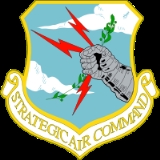
Strategic Air Command insignia

The insignia of SAC was designed in 1951 by Staff Sergeant R.T. Barnes, then assigned to the 92nd Bombardment Wing. Submitted in a command-wide contest, it was chosen as the winner by a three judge panel: General Curtis E. LeMay, Commander-in-Chief, Strategic Air Command [CINCSAC]; General Thomas S. Power, Vice Commander-in-Chief, Strategic Air Command; and Brigadier General A. W. Kissner, Chief of Staff, Strategic Air Command. Staff Sergeant Barnes' winning design netted him a $100 United States Savings Bond.

It has a sky-blue field with two white shaded blue-gray clouds, one in the upper left and one in the lower right extending to the edges of the shield. Upon this is a cubit arm in armor issuing from the lower left and extending toward the upper part of the shield. The hand is grasping a green olive branch, and three red lightning bolts.

The blue sky is representative of USAF operations. The arm and armor are a symbol of strength, power and loyalty and represents the science and art of employing far-reaching advantages in securing the objectives of war. The olive branch, a symbol of peace, and the lightning flashes, symbolic of speed and power are qualities underlying the mission of the Strategic Air Command.

The blue background of the SAC crest meant that SAC's reach was through the sky and that it was global in scope. The clouds meant that SAC was all-weather capable. The mailed fist depicted force, symbolized by lightning bolts of destruction. The olive branch represents peace.

In addition to the SAC crest, non-camouflaged SAC aircraft bore the SAC Stripe. The stripe consisted of a very dark blue background speckled with stars. The stripe appeared on the sides of SAC aircraft in the area of the cockpit running from the top to the bottom of the fuselage at an angle from 11:00 O'clock to 5:00 O'clock. The SAC crest was a bit wider than the stripe and was placed on over of the stripe. The stripe indicated that SAC was always ready to fulfill its mission.

Numbered Air Forces within SAC

  • Second Air Force
    Second Air Force

    Second Air Force is an intermediate echelon numbered air force of the United States Air Force Air Education and Training Command. It is headquartered at Keesler AFB, Mississippi....
  • Eighth Air Force
    Eighth Air Force

    Eighth Air Force is a Numbered Air Force of the United States Air Force Air Combat Command . It is headquartered at Barksdale Air Force Base, Louisiana, and is one of three active-duty numbered air forces in Air Combat Command....
  • Fifteenth Air Force
    Fifteenth Air Force

    The Fifteenth Expeditionary Mobility Task Force is one of two EMTFs assigned to the Air Force?s Air Mobility Command. It is headquartered at Travis Air Force Base, California....
  • Sixteenth Air Force
    Sixteenth Air Force

    The Sixteenth Air Force is an inactive United States Air Force organization. Its last assignment was with the United States Air Forces in Europe, being stationed at Izmir Air Base, Turkey....
  • Twentieth Air Force
    Twentieth Air Force

    Twentieth Air Force is a Numbered Air Force of the United States in Air Force Space Command . It is headquartered at F.E. Warren Air Force Base Wyoming....


Subordinate components


Air Divisions

  • See: Strategic Air Command divisions
    Strategic Air Command divisions

    Main article:Strategic Air Command...
  • See: Strategic Air Command: Division emblems gallery


Wings

  • See Strategic Air Command wings
    Strategic Air Command wings

    The United States Air Force's Strategic Air Command maintained many different types of wing in its forty-six years of history.*See:List of ANG wings assigned to Strategic Air Command...


Groups

  • 1st Combat Evaluation Group
    1st Combat Evaluation Group

    The United States Air Force's 1st Combat Evaluation Group was an evaluation unit located at Barksdale AFB, Louisiana ....


SAC Bases

  • See List of Strategic Air Command Bases


Aircraft and missiles

B52d 56 0687

Aircraft - primary mission


  • B-1 Lancer
    B-1 Lancer

    The B-1 Lancer is a strategic bomber used by the United States Air Force. Its origins began in the 1960s as a supersonic bomber with sufficient range and payload to replace the B-52 Stratofortress, but developed primarily into a low-level, subsonic penetrator with long range....
     from 1986-92; includes Air National Guard
    Air National Guard

    The Air National Guard , often referred to as the Air Guard, is the air force militia organized by each of the fifty U.S. states, the commonwealth of Puerto Rico, the territories of Guam and the U.S....
     (ANG
    ANG

    ANG, a three-letter abbreviation, may refer to:* Air National Guard, part of the United States National Guard* Angiopoietin, in biochemistry...
    ) from 1989-92
  • B-17 Flying Fortress
    B-17 Flying Fortress

    The Boeing B-17 Flying Fortress is a four-engine heavy bomber aircraft developed for the United States Army Air Corps . Competing against Douglas Aircraft Company and Glenn L....
     (RB-17G) from 1946-51
  • B-26 Invader (RB-26) from 1949-50
  • B-29 Superfortress
    B-29 Superfortress

    The Boeing B-29 Superfortress was a four-engine Fixed-wing aircraft#Propeller aircraft heavy bomber that was flown by the United States Military in World War II and the Korean War, and by other nations afterwards....
     from 1946-53
  • B-36 Peacemaker from 1948-58
  • B-45 Tornado
    B-45 Tornado

    The North American B-45 Tornado was the United States Air Force's first operational jet bomber, and the first jet aircraft to be refuelled in the air....
     from 1950-53
  • B-47 Stratojet
    B-47 Stratojet

    The Boeing B-47 Stratojet jet bomber was a medium-range and medium-size bomber capable of flying at high subsonic speeds and primarily designed for penetrating the airspace of the Soviet Union....
     1951-65
  • B-50 Superfortress
    B-50 Superfortress

    The Boeing B-50 Superfortress was a post-World War II revision of the wartime United States B-29 Superfortress with larger Pratt & Whitney R-4360 radial engines, a taller vertical stabilizer, and other improvements....
     from 1948-54
  • B-52 Stratofortress
    B-52 Stratofortress

    The Boeing B-52 Stratofortress is a long-range, subsonic, jet engine, strategic bomber operated by the United States Air Force since 1955.Beginning with the successful contract bid on 5 June 1946, the B-52 went through several design steps; from a straight wing aircraft powered by six turboprop engines to the final prototype YB-52, with ei...
     from 1955-92; includes Air Force Reserve (AFRES) from 1989-92
  • B-57 Canberra
    B-57 Canberra

    The Martin B-57 Canberra was a twin jet engine, light bomber and reconnaissance aircraft which entered service in the 1950s. Originally based on the British English Electric English Electric Canberra, the US-built B-57 had evolved into several unique variants....
     from 1956-62
  • B-58 Hustler
    B-58 Hustler

    The Convair B-58 Hustler was the first operational jet bomber capable of Mach 2 supersonic flight. The aircraft was developed for the United States Air Force for service in the Strategic Air Command during the late 1950s....
     from 1960-69
  • C-119 Flying Boxcar
    C-119 Flying Boxcar

    The Fairchild C-119 Flying Boxcar was an United States military transport aircraft developed from the World War II Fairchild Aircraft C-82 Packet, designed to carry cargo, personnel, litter patients, and mechanized equipment, and to drop cargo and troops by parachute....
     from 1956-73
  • DC-130
    DC-130

    The Lockheed DC-130 is a variant of C-130 Hercules, designed for unmanned aerial vehicle control. It could carry four Ryan Firebee drones underneath its wings....
     Hercules from 1966-76
  • E-4 Nightwatch from 1975-92
  • EC-135 Looking Glass from 1963-92
  • F-2 Expeditor (F=Fotorecon) (C-45)
  • F-6 Mustang (F=Fotorecon) (P-51)
  • F-9 Flying Fortress (F=Fotorecon) (B-17F/G)
  • F-13 Superfortress, (F=Fotorecon), (B-29A)
  • F-47 Thunderbolt (P-47) from 1946-47
  • F-51 Mustang (P-51) from 1946-49
  • F-82 Twin Mustang
    F-82 Twin Mustang

    The North American Aviation F-82 Twin Mustang was the last United States piston-engine fighter ordered into production by the United States Air Force....
     from 1947-50
  • F-80 Shooting Star from 1946-48
  • F-84 Thunderjet
    F-84 Thunderjet

    The Republic Aviation F-84 Thunderjet was an United States-built turbojet fighter-bomber aircraft. Originating as a 1944 United States Air Force proposal for a "day fighter," the F-84 flew in 1946....
     1948-57
  • F-86 Sabre
    F-86 Sabre

    The North American Aviation F-86 Sabre was a transonic jet fighter aircraft. The Sabre is best known for its Korean War role where it was pitted against the Soviet MiG-15 and obtained UN air superiority....
     1949-50
  • F-102 Delta Dagger
    F-102 Delta Dagger

    The Convair F-102 Delta Dagger was an United States interceptor aircraft built as part of the backbone of the United States Air Force's air defenses in the late 1950s....
     1960
  • FB-111 Aardvark from 1969-90
  • KC-10 Extender
    KC-10 Extender

    The KC-10 Extender is an aerial refueling aircraft in service with the United States Air Force derived from the civilian McDonnell Douglas DC-10 airliner....
     from 1981-92
  • KB-29 from 1949-56
  • KC-97 Stratotanker
    KC-97 Stratotanker

    The Boeing KC-97 Stratotanker was a United States strategic Tanker . For many years, it was the backbone of the United States Air Force's tanker fleet until replaced by the KC-135....
     SAC from 1951-64 and SAC-gained ANG
    ANG

    ANG, a three-letter abbreviation, may refer to:* Air National Guard, part of the United States National Guard* Angiopoietin, in biochemistry...
     from 1973-77
  • KC-135 Stratotanker
    KC-135 Stratotanker

    The Boeing KC-135 Stratotanker is a United States aerial refueling tanker aircraft. It has been in service with the United States Air Force since 1957....
     SAC from 1957-91; includes ANG
    ANG

    ANG, a three-letter abbreviation, may refer to:* Air National Guard, part of the United States National Guard* Angiopoietin, in biochemistry...
     and AFRES from 1975-92
  • RC-45 Expeditor
  • RC-135 Rivet Joint/Rivet Brass/Rivet Amber/Rivet Card/Rivet Ball/Cobra Ball/Cobra Eye/Combat Sent
  • SR-71 Blackbird
    SR-71 Blackbird

    The Lockheed SR-71 was an advanced, long-range, Mach number 3 strategic reconnaissance aircraft developed from the Lockheed Lockheed A-12 and Lockheed YF-12 aircraft by the Lockheed Skunk Works....
     from 1966-91
  • U-2 Dragon Lady from 1962-91
  • TR-1 Dragon Lady from 1989-91
  • UC-45 Expeditor


Aircraft - support


  • AT-11 Kansan
  • B-26 Invader from 1949-50
  • C-45 Expeditor from 1946-51
  • C-47 Skytrain
    C-47 Skytrain

    The Douglas C-47 Skytrain or Dakota is a military transport that was developed from the Douglas DC-3 airliner. It was used extensively by the Allies during World War II and remained in front line operations through the 1950s with a few remaining in operation to this day....
     from 1946-47
  • C-54 Skymaster
    C-54 Skymaster

    The Douglas C-54 Skymaster was a four-engined transport aircraft used by the United States Army Air Forces in World War II....
     from 1946-75
  • C-82 Packet
    C-82 Packet

    The C-82 Packet was a twin-engine, twin-boom cargo aircraft designed and built by Fairchild Aircraft. It was used briefly by the United States Army Air Forces and United States Navy following World War II....
     from 1946 through 1947
  • C-97 Stratofreighter
    C-97 Stratofreighter

    The Boeing C-97 Stratofreighter was a militarized Boeing 377 Stratocruiser optimized for long range heavy cargo transport. The C-97 was based on the B-29 bomber....
     from 1949-78
  • C-118 Liftmaster from 1957-75
  • C-124 Globemaster II
    C-124 Globemaster II

    The Douglas C-124 Globemaster II, nicknamed "Old Shakey", was a heavy-lift cargo aircraft built by the Douglas Aircraft Company in Long Beach, California....
     from 1959-62
  • C-131 Samaritan
    C-131 Samaritan

    The Convair C-131 Samaritan was an United States military transport produced from 1954 to 1956....
  • C-135 Stratolifter
    C-135 Stratolifter

    The Boeing C-135 Stratolifter is a Cargo aircraft derived from the prototype Boeing 367-80 jet airliner in the early 1950s. It has a narrower fuselage and is shorter than the 707....
  • CH-3 Sea King
    H-3 Sea King

    The Sikorsky Aircraft SH-3 Sea King is a twin-engined anti-submarine warfare helicopter. It served with the United States Navy and other forces, and continues to serve in many countries around the world....
     SAC circa 1960s
  • HU-16 Albatross
    HU-16 Albatross

    The Grumman HU-16 Albatross is a large twin-radial engine amphibious aircraft flying boat. Originally designated SA-16, it was renamed HU-16 in 1962....
     SAC circa 1950s/1960s
  • L-4 Grasshopper from 1949-50
  • L-5 Sentinel
    L-5 Sentinel

    The USA light aircraft L-5 Sentinel began life as the pre-war Stinson Aircraft Company model 105. The model 105 was nicknamed Voyager, built by the Stinson division of Consolidated Vultee....
     from 1949-50
  • L-13 Grasshopper from 1949-50
  • PBY Catalina
    PBY Catalina

    The Consolidated PBY Catalina was an United States flying boat of the 1930s and 1940s produced by Consolidated Aircraft. It could be equipped with depth charges, bombs, torpedoes, and M2 Browning machine gun machine guns and was one of the most widely used multi-role aircraft of World War II....
     (AAF designation OA-10 Catalina) from 1946-47
  • T-38 Talon
    T-38 Talon

    The Northrop T-38 Talon is an United States supersonic jet trainer. It was the world's first, and most produced supersonic trainer. It remains in service as of 2008 in air forces throughout the world including the United States Air Force , which remains its largest user....
     from 1981-91
  • UH-1 Huey from 1966-92


Missiles fielded by the Strategic Air Command

Titan2 Color Silo
  • ADM-20 Quail
    ADM-20 Quail

    The McDonnell ADM-20 Quail was a Subsonic aircraft, Jet engine powered, Air launch decoy cruise missile built by McDonnell Aircraft Corporation....
  • AGM-28 Hound Dog
    AGM-28 Hound Dog

    The North American Aviation Corporation AGM-28 Hound Dog was a supersonic, Jet engine powered, Air launch cruise missile. The Hound Dog was initially given the designation B-77, later re-designated GAM-77, and finally being designated AGM-28....
  • AGM-69 SRAM
    AGM-69 SRAM

    The Boeing AGM-69 SRAM was a nuclear weapon air-to-surface missile designed to replace the older AGM-28 Hound Dog stand-off missile.The requirement for the weapon was issued by the Strategic Air Command of the USAF in 1964, and the resultant AGM-69A SRAM entered service in 1972....
  • AGM-84 Harpoon
  • AGM-86 Air Launched Cruise Missile
  • AGM-129 Advanced Cruise Missile
    AGM-129 ACM

    The Raytheon AGM-129 ACM is a low observable, sub-sonic, turbo-fan powered, Air launch cruise missile built by Raytheon Missile Systems. The AGM-129A is carried exclusively by the US Air Force's B-52 Stratofortress#B-52Hs....
  • HGM-16 Atlas
    Atlas (missile)

    The SM-65 Atlas was a missile built by the Convair Division of General Dynamics. Originally designed as an ICBM in the late 1950s, Atlas was the foundation for a family of successful space launch vehicles now built by United Launch Alliance....
  • LGM-25 Titan II
    Titan II

    The Titan II was an Intercontinental ballistic missile and space launcher developed by the Glenn L. Martin Company from the earlier Titan I missile....
  • LGM-30A/B Minuteman I
    LGM-30 Minuteman

    The LGM-30 Minuteman is an United States Nuclear weapon missile, a land-based intercontinental ballistic missile . As of 2008, it is the only land-based ICBM in service in the United States....
  • LGM-30F Minuteman II
    LGM-30 Minuteman

    The LGM-30 Minuteman is an United States Nuclear weapon missile, a land-based intercontinental ballistic missile . As of 2008, it is the only land-based ICBM in service in the United States....
  • LGM-30G Minuteman III
    LGM-30 Minuteman

    The LGM-30 Minuteman is an United States Nuclear weapon missile, a land-based intercontinental ballistic missile . As of 2008, it is the only land-based ICBM in service in the United States....
  • LGM-118A Peacekeeper
    LGM-118A Peacekeeper

    The LGM-118A Peacekeeper, initially known as the "MX missile" , was a land-based Intercontinental ballistic missile deployed by the United States starting in 1986....
  • SM-62 Snark
    SM-62 Snark

    The Northrop SM-62 Snark was a specialized intercontinental cruise missile with a nuclear weapon operated by the US Strategic Air Command from 1958 until 1961....
  • PGM-17A Thor
  • PGM-19A Jupiter
    Jupiter (missile)

    The PGM-19 Jupiter was a medium-range ballistic missile of the United States Air Force, removed from service by April 1963. It was a liquid-fueled rocket, with one engine producing 667 kN of thrust....


See also

  • Single Integrated Operational Plan
    Single Integrated Operational Plan

    The Single Integrated Operational Plan is a blueprint which specifies how United States nuclear weapons would be used in the event of Nuclear warfare....
  • Strategic Air and Space Museum
    Strategic Air and Space Museum

    The Strategic Air and Space Museum is a museum focusing on United States Air Force military aircraft and nuclear missiles located near Ashland, Nebraska, along Interstate 80 south of Omaha, Nebraska....
  • Strategic Air Command commanders
    Strategic Air Command commanders

    Commander in Chief Strategic Air Command *General George C. Kenney - 21 March 1946 - 15 October 1948*Lt. General Curtis Emerson LeMay - 19 October 1948 - 29 Oct 1951...
  • SAC Elite Guard
    SAC Elite Guard

    The SAC Elite Guard was a military police unit established in December, 1956 to provide security at the headquarters of the Strategic Air Command of the United States Air Force....


External links

  • at GlobalSecurity.org
  • Interview with SAC Lt. General James Edmundson (transcripts from the PBS program ):
  • .
  • by Ltc. Kingdon R. Hawes