


1 cent euro coins

Encyclopedia
1 cent euro coins
(€0.01) have a value of one-hundredth of a euro
and are composed of copper
-covered steel
. All coins have a common reverse and country-specific (national) obverse. The coin has been used since 2002 and was not redesigned in 2007 as was the case with the higher value coins.
and banknotes
were introduced in the 12 member eurozone
and its related territories. The common side was designed by Luc Luycx
, a Belgian
artist who won a Europe-wide competition to design the new coins. The design of the 1 to 5 cent coins was intended to show the European Union
's (EU) place in the world (relative to Africa
and Asia
) as opposed to the one and two euro coins showing the 15 states as one and the 10 to 50 cent coins showing separate EU states
.
The national sides, then 15 (eurozone + Monaco
, San Marino
and the Vatican
who could mint their own) were each designed according to national competitions, though to specifications which applied to all coins such as the requirement of including twelve stars (see euro coins
for more). National designs were not allowed to change until the end of 2008, unless a monarch (whose portrait usually appears on the coins) dies or abdicates. This happened in Monaco and the Vatican City resulting in three new designs in circulation (the Vatican had an interim design until the new Pope
was selected). National designs have seen some changes due to new rules stating that national designs should include the name of the issuing country (Finland and Belgium both do not show their name, and hence have made minor changes).
As the EU's membership
has since expanded
in 2004 and 2007, with further expansions envisaged, the common face of all euro coins from the value of 10 cent and above were redesigned in 2007 to show a new map. The 1 to 5 cent coins however did not change, as the highlighting of the old members over the globe was so faint it was not considered worth the cost. However new national coin designs were added: in 2007 with the entry of Slovenia
; in 2008 with Cyprus
and Malta
; and Slovakia
in 2009.
-covered steel
, with a diameter of 16.25 mm, a 1.67 mm thickness and a mass of 2.30 grams. The coins' edges are smooth. The coins have been used from 2002, though some are dated 1999 which is the year the euro
was created as a currency, but not put into general circulation.
and the western half of Asia
(including the Middle East
) are shown. Six fine lines cut diagonally behind the globe from each side of the coin and have twelve stars at their ends (reflective of the flag of Europe). To the top left is a large number 1 followed, in smaller text, by the words "Euro Cent". The designers initials, LL, appear to the right of the globe.
(currently, Greece
and Austria
are the only such countries, hence Greece engraves "1 ΛΕΠΤΟ" upon their coins).
In addition, there are several EU states that have not yet adopted the euro, some of them have already agreed upon their coin designs however it is not know exactly when they will adopt the currency, and hence these are not yet minted. See enlargement of the Eurozone
for expected entry dates of these countries.
and the Netherlands
round prices to the nearest five cents (Swedish rounding
) if paying with cash money, while producing only a handful of those coins for collectors, rather than general circulation. Despite this, the coins are still legal tender and produced outside these states, so if a customer with a one-cent coin minted elsewhere wishes to pay with it, he may.
The Nederlandse Bank calculated it would save $36 million a year by not using the smaller coins. Other countries such as Germany
favoured retaining the coins due to retailers' desire for €1.99 prices, which appear more attractive to the consumer than a €2 price (Psychological pricing
). According to a Eurobarometer
survey of EU citizens, Germans are most skeptical about the removal of the coin (only 32% support it), however across the entire Eurozone there is a slight majority (52%) for their removal.
, the 1, 2 and 5 cent coins have the nickname
koper (copper
), ros (redhead
) or rostjes (little redhead) due to their colour. In Portugal
, the 1 cent coin gained the nicknames botão (button) and feijão (bean), due to their small size and value: instead of gambling with real money, buttons sometimes are used.
Euro coins
There are eight euro coin denominations, ranging from one cent to two euros . The coins first came into use in 2002. They have a common reverse, portraying a map of Europe, but each country in the eurozone has its own design on the obverse, which means that each coin has a variety of different...
(€0.01) have a value of one-hundredth of a euro
Euro
The euro is the official currency of the eurozone: 17 of the 27 member states of the European Union. It is also the currency used by the Institutions of the European Union. The eurozone consists of Austria, Belgium, Cyprus, Estonia, Finland, France, Germany, Greece, Ireland, Italy, Luxembourg,...
and are composed of copper
Copper
Copper is a chemical element with the symbol Cu and atomic number 29. It is a ductile metal with very high thermal and electrical conductivity. Pure copper is soft and malleable; an exposed surface has a reddish-orange tarnish...
-covered steel
Steel
Steel is an alloy that consists mostly of iron and has a carbon content between 0.2% and 2.1% by weight, depending on the grade. Carbon is the most common alloying material for iron, but various other alloying elements are used, such as manganese, chromium, vanadium, and tungsten...
. All coins have a common reverse and country-specific (national) obverse. The coin has been used since 2002 and was not redesigned in 2007 as was the case with the higher value coins.
History
The coin dates from 2002, when euro coinsEuro coins
There are eight euro coin denominations, ranging from one cent to two euros . The coins first came into use in 2002. They have a common reverse, portraying a map of Europe, but each country in the eurozone has its own design on the obverse, which means that each coin has a variety of different...
and banknotes
Euro banknotes
Euro banknotes are the banknotes of the euro, the currency of the eurozone and have been in circulation since 2002. They are issued by the national central banks of the euro area or the European Central Bank...
were introduced in the 12 member eurozone
Eurozone
The eurozone , officially called the euro area, is an economic and monetary union of seventeen European Union member states that have adopted the euro as their common currency and sole legal tender...
and its related territories. The common side was designed by Luc Luycx
Luc Luycx
Luc Luycx is the designer of the common side of the euro coins.Luycx is a computer engineer living in Dendermonde, Belgium and has worked for the Royal Belgian Mint for 15 years. He designed the euro coins in 1996.His signature on all euro coins is visible as two L letters connected together...
, a Belgian
Belgium
Belgium , officially the Kingdom of Belgium, is a federal state in Western Europe. It is a founding member of the European Union and hosts the EU's headquarters, and those of several other major international organisations such as NATO.Belgium is also a member of, or affiliated to, many...
artist who won a Europe-wide competition to design the new coins. The design of the 1 to 5 cent coins was intended to show the European Union
European Union
The European Union is an economic and political union of 27 independent member states which are located primarily in Europe. The EU traces its origins from the European Coal and Steel Community and the European Economic Community , formed by six countries in 1958...
's (EU) place in the world (relative to Africa
Africa
Africa is the world's second largest and second most populous continent, after Asia. At about 30.2 million km² including adjacent islands, it covers 6% of the Earth's total surface area and 20.4% of the total land area...
and Asia
Asia
Asia is the world's largest and most populous continent, located primarily in the eastern and northern hemispheres. It covers 8.7% of the Earth's total surface area and with approximately 3.879 billion people, it hosts 60% of the world's current human population...
) as opposed to the one and two euro coins showing the 15 states as one and the 10 to 50 cent coins showing separate EU states
Member State of the European Union
A member state of the European Union is a state that is party to treaties of the European Union and has thereby undertaken the privileges and obligations that EU membership entails. Unlike membership of an international organisation, being an EU member state places a country under binding laws in...
.
The national sides, then 15 (eurozone + Monaco
Monaco
Monaco , officially the Principality of Monaco , is a sovereign city state on the French Riviera. It is bordered on three sides by its neighbour, France, and its centre is about from Italy. Its area is with a population of 35,986 as of 2011 and is the most densely populated country in the...
, San Marino
San Marino
San Marino, officially the Republic of San Marino , is a state situated on the Italian Peninsula on the eastern side of the Apennine Mountains. It is an enclave surrounded by Italy. Its size is just over with an estimated population of over 30,000. Its capital is the City of San Marino...
and the Vatican
Vatican City
Vatican City , or Vatican City State, in Italian officially Stato della Città del Vaticano , which translates literally as State of the City of the Vatican, is a landlocked sovereign city-state whose territory consists of a walled enclave within the city of Rome, Italy. It has an area of...
who could mint their own) were each designed according to national competitions, though to specifications which applied to all coins such as the requirement of including twelve stars (see euro coins
Euro coins
There are eight euro coin denominations, ranging from one cent to two euros . The coins first came into use in 2002. They have a common reverse, portraying a map of Europe, but each country in the eurozone has its own design on the obverse, which means that each coin has a variety of different...
for more). National designs were not allowed to change until the end of 2008, unless a monarch (whose portrait usually appears on the coins) dies or abdicates. This happened in Monaco and the Vatican City resulting in three new designs in circulation (the Vatican had an interim design until the new Pope
Pope
The Pope is the Bishop of Rome, a position that makes him the leader of the worldwide Catholic Church . In the Catholic Church, the Pope is regarded as the successor of Saint Peter, the Apostle...
was selected). National designs have seen some changes due to new rules stating that national designs should include the name of the issuing country (Finland and Belgium both do not show their name, and hence have made minor changes).
As the EU's membership
Member State of the European Union
A member state of the European Union is a state that is party to treaties of the European Union and has thereby undertaken the privileges and obligations that EU membership entails. Unlike membership of an international organisation, being an EU member state places a country under binding laws in...
has since expanded
Enlargement of the European Union
The Enlargement of the European Union is the process of expanding the European Union through the accession of new member states. This process began with the Inner Six, who founded the European Coal and Steel Community in 1952...
in 2004 and 2007, with further expansions envisaged, the common face of all euro coins from the value of 10 cent and above were redesigned in 2007 to show a new map. The 1 to 5 cent coins however did not change, as the highlighting of the old members over the globe was so faint it was not considered worth the cost. However new national coin designs were added: in 2007 with the entry of Slovenia
Slovenia
Slovenia , officially the Republic of Slovenia , is a country in Central and Southeastern Europe touching the Alps and bordering the Mediterranean. Slovenia borders Italy to the west, Croatia to the south and east, Hungary to the northeast, and Austria to the north, and also has a small portion of...
; in 2008 with Cyprus
Cyprus
Cyprus , officially the Republic of Cyprus , is a Eurasian island country, member of the European Union, in the Eastern Mediterranean, east of Greece, south of Turkey, west of Syria and north of Egypt. It is the third largest island in the Mediterranean Sea.The earliest known human activity on the...
and Malta
Malta
Malta , officially known as the Republic of Malta , is a Southern European country consisting of an archipelago situated in the centre of the Mediterranean, south of Sicily, east of Tunisia and north of Libya, with Gibraltar to the west and Alexandria to the east.Malta covers just over in...
; and Slovakia
Slovakia
The Slovak Republic is a landlocked state in Central Europe. It has a population of over five million and an area of about . Slovakia is bordered by the Czech Republic and Austria to the west, Poland to the north, Ukraine to the east and Hungary to the south...
in 2009.
Design
The coins are composed of copperCopper
Copper is a chemical element with the symbol Cu and atomic number 29. It is a ductile metal with very high thermal and electrical conductivity. Pure copper is soft and malleable; an exposed surface has a reddish-orange tarnish...
-covered steel
Steel
Steel is an alloy that consists mostly of iron and has a carbon content between 0.2% and 2.1% by weight, depending on the grade. Carbon is the most common alloying material for iron, but various other alloying elements are used, such as manganese, chromium, vanadium, and tungsten...
, with a diameter of 16.25 mm, a 1.67 mm thickness and a mass of 2.30 grams. The coins' edges are smooth. The coins have been used from 2002, though some are dated 1999 which is the year the euro
Euro
The euro is the official currency of the eurozone: 17 of the 27 member states of the European Union. It is also the currency used by the Institutions of the European Union. The eurozone consists of Austria, Belgium, Cyprus, Estonia, Finland, France, Germany, Greece, Ireland, Italy, Luxembourg,...
was created as a currency, but not put into general circulation.
Reverse (common) side
The reverse was designed by Luc Luycx and displays a globe in the bottom left. The then-fifteen members of the EU are lightly highlighted and the northern half of AfricaAfrica
Africa is the world's second largest and second most populous continent, after Asia. At about 30.2 million km² including adjacent islands, it covers 6% of the Earth's total surface area and 20.4% of the total land area...
and the western half of Asia
Asia
Asia is the world's largest and most populous continent, located primarily in the eastern and northern hemispheres. It covers 8.7% of the Earth's total surface area and with approximately 3.879 billion people, it hosts 60% of the world's current human population...
(including the Middle East
Middle East
The Middle East is a region that encompasses Western Asia and Northern Africa. It is often used as a synonym for Near East, in opposition to Far East...
) are shown. Six fine lines cut diagonally behind the globe from each side of the coin and have twelve stars at their ends (reflective of the flag of Europe). To the top left is a large number 1 followed, in smaller text, by the words "Euro Cent". The designers initials, LL, appear to the right of the globe.
Obverse (national) sides
The obverse side of the coin depends on the issuing country. All have to include twelve stars (in most cases a circle around the edge), the engravers initials and the year of issue. New designs also have to include the name or initials of the issuing country. The side cannot repeat the denomination of the coin unless the issuing country uses an alphabet other than LatinLatin alphabet
The Latin alphabet, also called the Roman alphabet, is the most recognized alphabet used in the world today. It evolved from a western variety of the Greek alphabet called the Cumaean alphabet, which was adopted and modified by the Etruscans who ruled early Rome...
(currently, Greece
Greece
Greece , officially the Hellenic Republic , and historically Hellas or the Republic of Greece in English, is a country in southeastern Europe....
and Austria
Austria
Austria , officially the Republic of Austria , is a landlocked country of roughly 8.4 million people in Central Europe. It is bordered by the Czech Republic and Germany to the north, Slovakia and Hungary to the east, Slovenia and Italy to the south, and Switzerland and Liechtenstein to the...
are the only such countries, hence Greece engraves "1 ΛΕΠΤΟ" upon their coins).
| Description | Image | ||
|---|---|---|---|
| : The Austrian design Austrian euro coins Austrian euro coins have a unique design for each denomination, with a common theme for each of the three series of coins. The minor coins feature Austrian flowers, the middle coins examples of architecture from Austria's capital, Vienna, and the two major coins famous Austrians... features an Alpine Alps The Alps is one of the great mountain range systems of Europe, stretching from Austria and Slovenia in the east through Italy, Switzerland, Liechtenstein and Germany to France in the west.... gentian Gentiana acaulis Gentiana acaulis is a small gentian native to central and southern Europe from Spain east to the Balkans, growing especially in mountainous regions, such as the Alps, Cevennes and the Pyrenees, at heights of 800 to 3,000 m.... as a symbol of Austria's part in developing EU environmental policy. The words "EIN EURO CENT" (one euro cent) appear at the top with a hatched Hatching system The system of heraldry has two main methods to designate the tinctures of arms in uncolored illustrations: hatching and tricking. Hatching, i.e. patterns of lines and dots, is the most common method to designate colours on uncoloured surfaces, like engravings, seals and coins.The present day... Austrian flag Flag of Austria The flag of Austria has three equal horizontal bands of red , white, and red.The Austrian triband is the second-oldest flag in use at least since 1230, after the Danish flag .- Origins :... below with the date. |
|||
| : The Belgian design Belgian euro coins Belgian euro coins feature only a single design for all eight coins: the portrait or effigy of King Albert II of the Belgians and his royal monogram... was chosen by a panel of leading Belgian officials, artisans and experts in numismatics. They chose an effigy Effigy An effigy is a representation of a person, especially in the form of sculpture or some other three-dimensional form.The term is usually associated with full-length figures of a deceased person depicted in stone or wood on church monuments. These most often lie supine with hands together in prayer,... of King Albert II Albert II of Belgium Albert II is the current reigning King of the Belgians, a constitutional monarch. He is a member of the royal house "of Belgium"; formerly this house was named Saxe-Coburg-Gotha... designed by Jan Alfons Keustermans, Director of the Municipal Academy of Fine Arts of Turnhout. To the right hand side among the stars was the kings monogram Monogram A monogram is a motif made by overlapping or combining two or more letters or other graphemes to form one symbol. Monograms are often made by combining the initials of an individual or a company, used as recognizable symbols or logos. A series of uncombined initials is properly referred to as a... , a letter "A", underneath a crown. The year was lower down, also among the stars. The 2008 redesign included the letters BE (standing for Belgium) beneath the monogram, which was moved out of the stars into the centre circle but still to the right of the King's portrait. The date was also moved out and placed beneath the effigy and included two symbols either side (left: signature mark of the master of the mint, right: mint mark). |
(2002–2007) |
(2008–) |
|
| : The Cypriot design Cypriot euro coins Cypriot euro coins feature three separate designs for the three series of coins. Cyprus has been a member of the European Union since 1 May 2004, and is a member of the Economic and Monetary Union of the European Union... features two Cypriot Mouflon Mouflon The mouflon is a subspecies group of the wild sheep Ovis aries. Populations of Ovis aries can be partitioned into the mouflons and urials or arkars... , a species of wild sheep on Cyprus that represents the island's wildlife. It includes, in a semicircle to the top right, the name of Cyprus in Greek Greek language Greek is an independent branch of the Indo-European family of languages. Native to the southern Balkans, it has the longest documented history of any Indo-European language, spanning 34 centuries of written records. Its writing system has been the Greek alphabet for the majority of its history;... and Turkish Turkish language Turkish is a language spoken as a native language by over 83 million people worldwide, making it the most commonly spoken of the Turkic languages. Its speakers are located predominantly in Turkey and Northern Cyprus with smaller groups in Iraq, Greece, Bulgaria, the Republic of Macedonia, Kosovo,... (ΚΥΠΡΟΣ and KIBRIS) each side of the date. It has been used since Cyprus adopted the euro in 2008. It was chosen in a public vote and the exact design was created by Erik Maell and Tatiana Soteropoulos. |
|||
| : The Estonian design Estonian euro coins Estonian euro coins feature a single design for all eight coins. This is a design by Lembit Lõhmus and features a silhouette map of Estonia together with the word Eesti and twelve stars, symbolic of the European Union, surrounding the map... is a design by Lembit Lõhmus and features a geographical image of Estonia and the word “Eesti”, which means “Estonia”. The twelve stars, symbols of the EU, are surrounding the map. This was the winning design in a public vote of ten announced in December 2004. The design started to circulate from January 1, 2011. |
|||
| : The Finnish design Finnish euro coins Finnish euro coins feature three separate designs. Heikki Häiväoja provided the design for the 1 cent – 50 cent coins, Pertti Mäkinen provided the design for the 1 euro coin, and Raimo Heino provided the design for the 2 euro coin, which shows cloudberry, the golden berry of northern Finland... depicts the heraldic lion of Finland found on the Coat of arms of Finland Coat of arms of Finland The coat of arms of Finland is a crowned lion on a red field, the right forepaw replaced with an armoured hand brandishing a sword, trampling on a saber with the hindpaws... . It is a reproduction of a design by the sculptor Heikki Häiväoja Heikki Häiväoja Heikki Häiväoja , is a Finnish sculptor and designer of the Finnish euro coins design for the minor and middle series of coins. All designs feature the 12 stars of the EU and the year of imprint on one side, and a national design on the other.... and has been used by previous Finnish coins such as the 1 markka between 1964 and 2001. The first series included the initial of the mint master of the Mint of Finland, Raimo Makkonen (an M), on the bottom left side of the lion and the date to the left. When the coins were redesigned to meet the new design requirements, the initial was replaced by the mint's mint mark and moved the to the left, with the letters FI (for Finland) sitting in the bottom right. |
(2002–2006) |
(2007–) |
|
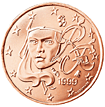
| : The French design French euro coins French euro coins feature three separate designs for the three series of coins. The minor series was designed by Fabienne Courtiade, the middle one by Laurent Jorio and the major two coins are by Joaquin Jimenez... features Marianne Marianne Marianne is a national emblem of France and an allegory of Liberty and Reason. She represents the state and values of France, differently from another French cultural symbol, the "Coq Gaulois" which represents France as a nation and its history, land, culture, and variety of sport disciplines in... , the feminine representation of France; its state and its values. It is the most prominent representation of France and its ideals of liberty and reason, dating to 1848. The depiction is young and determined, embodying France's desire for a sound and lasting Europe. The letters RF (République française), stylised, appear to the right above the year. The depiction was designed by Fabienne Courtiade of the Paris Mint Monnaie de Paris The Monnaie de Paris or, more administratively speaking, the "Direction of Coins and Medals", is an administration of the French government charged with issuing coins as well as producing medals and other similar items. Many ancient coins are housed there... . |
 |
||
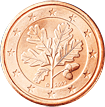
| : The German design German euro coins German euro coins have three separate designs for the three series of coins. The 1, 2 and 5 cent coins were designed by Rolf Lederbogen, the design for the 10, 20 and 50 cent coins is by Reinhard Heinsdorff and the 1 and 2 euro coins were done by Heinz Hoyer and Sneschana Russewa-Hoyer... depict an oak Oak An oak is a tree or shrub in the genus Quercus , of which about 600 species exist. "Oak" may also appear in the names of species in related genera, notably Lithocarpus... twig, an image carried over from the previous pfennig Pfennig The Pfennig , plural Pfennige, is an old German coin or note, which existed from the 9th century until the introduction of the euro in 2002.... . The year and mint mark are shown at the bottom and the image was designed by Professor Rolf Lederbogen. |
 |
||
| : The Greek design Greek euro coins Greek euro coins feature a unique design for each of the eight coins. They were all designed by Georgios Stamatopoulos with the minor coins depicting Greek ships, the middle ones portraying famous Greeks and the two large denominations showing images of Greek history and mythology. All designs... shows an Athenian Athens Athens , is the capital and largest city of Greece. Athens dominates the Attica region and is one of the world's oldest cities, as its recorded history spans around 3,400 years. Classical Athens was a powerful city-state... trireme Trireme A trireme was a type of galley, a Hellenistic-era warship that was used by the ancient maritime civilizations of the Mediterranean, especially the Phoenicians, ancient Greeks and Romans.The trireme derives its name from its three rows of oars on each side, manned with one man per oar... from the fifth century BCE 5th century BC The 5th century BC started the first day of 500 BC and ended the last day of 401 BC.-Overview:This century saw the beginning of a period of philosophical brilliance among Western civilizations, particularly the Greeks which would continue all the way through the 4th century until the time of... used in ancient Greece Ancient Greece Ancient Greece is a civilization belonging to a period of Greek history that lasted from the Archaic period of the 8th to 6th centuries BC to the end of antiquity. Immediately following this period was the beginning of the Early Middle Ages and the Byzantine era. Included in Ancient Greece is the... . Below it is the denomination in Greek Greek language Greek is an independent branch of the Indo-European family of languages. Native to the southern Balkans, it has the longest documented history of any Indo-European language, spanning 34 centuries of written records. Its writing system has been the Greek alphabet for the majority of its history;... and above is the year. It was designed by Georgios Stamatopoulos. |
|||
| : The Irish design Irish euro coins Irish euro coins all share the same design by Jarlath Hayes, that of the harp, a traditional symbol for Ireland since the Middle Ages, based on that of the Brian Boru harp, housed in Trinity College, Dublin. The same harp is used as the official seals of the Taoiseach, and government ministers and... shows an Irish harp (the Clàrsach Clàrsach Clàrsach or Cláirseach , is the generic Gaelic word for 'a harp', as derived from Middle Irish... ) used as a national symbol (for example, on the Seal of the President of Ireland). Vertically on the left hand side is the word "Éire Éire is the Irish name for the island of Ireland and the sovereign state of the same name.- Etymology :The modern Irish Éire evolved from the Old Irish word Ériu, which was the name of a Gaelic goddess. Ériu is generally believed to have been the matron goddess of Ireland, a goddess of sovereignty, or... " (Ireland in the Irish language Irish language Irish , also known as Irish Gaelic, is a Goidelic language of the Indo-European language family, originating in Ireland and historically spoken by the Irish people. Irish is now spoken as a first language by a minority of Irish people, as well as being a second language of a larger proportion of... ) and on the right hand side is the date. The harp motif was designed by Jarlath Hayes. |
|||
| : The Italian design Italian euro coins Italian euro coins have a design unique to each denomination, though there is a common theme of famous Italian works of art from one of Italy's renowned artists... is a depiction of the Castel del Monte in Apulia Apulia Apulia is a region in Southern Italy bordering the Adriatic Sea in the east, the Ionian Sea to the southeast, and the Strait of Òtranto and Gulf of Taranto in the south. Its most southern portion, known as Salento peninsula, forms a high heel on the "boot" of Italy. The region comprises , and... and was built in the thirteenth century by Holy Roman Emperor Frederick II Frederick II, Holy Roman Emperor Frederick II , was one of the most powerful Holy Roman Emperors of the Middle Ages and head of the House of Hohenstaufen. His political and cultural ambitions, based in Sicily and stretching through Italy to Germany, and even to Jerusalem, were enormous... . The interpretation for the coin was engraved by Eugenio Driutti and it includes the interconnected letters IR (Repubblica Italiana) below and the year above. |
|||
| : The Luxembourgian design contains a stylised effigy of Grand Duke Henri of Luxembourg Henri, Grand Duke of Luxembourg Henri, Grand Duke of Luxembourg OIH is the head of state of Luxembourg. He is the eldest son of Jean, Grand Duke of Luxembourg and Princess Joséphine-Charlotte of Belgium. His maternal grandparents were King Leopold III of Belgium and Astrid of Sweden... designed by Yvette Gastauer-Claire in consultation with the government and monarchy of Luxembourg Grand Duke of Luxembourg The Grand Duke of Luxembourg is the sovereign monarch and head of state of Luxembourg. Luxembourg has been a grand duchy since 15 March 1815, when it was elevated from a duchy when placed in personal union with the United Kingdom of the Netherlands... . The name Lëtzebuerg (Luxembourg in Luxembourgish Luxembourgish language Luxembourgish is a High German language spoken mainly in Luxembourg. About 320,000 people worldwide speak Luxembourgish.-Language family:... ) and the year is written round the bottom of the coin. |
|||
| : The Maltese design Maltese euro coins Maltese euro coins feature three separate designs for the three series of coins. Malta has been a member of the European Union since 1 May 2004, and is a member of the Economic and Monetary Union of the European Union. Malta adopted the euro as its official currency on 1 January 2008, replacing the... depicts an altar at the prehistoric megalith Megalith A megalith is a large stone that has been used to construct a structure or monument, either alone or together with other stones. Megalithic describes structures made of such large stones, utilizing an interlocking system without the use of mortar or cement.The word 'megalith' comes from the Ancient... Mnajdra Mnajdra Mnajdra is a megalithic temple complex found on the southern coast of the Mediterranean island of Malta. Mnajdra is approximately 500 metres from the Ħaġar Qim megalithic complex... temples. The temples were built in the fourth millennium BCE 4th millennium BC The 4th millennium BC saw major changes in human culture. It marked the beginning of the Bronze Age and of writing.The city states of Sumer and the kingdom of Egypt were established and grew to prominence. Agriculture spread widely across Eurasia... on the southern coast overlooking the sea. Beneath the depiction is the name Malta and the year. The arms were the third most popular in a public vote and was designed by Noel Galea Bason. It has been used since Malta switched to the euro in 2008. |
|||
| : The first Monegasque design contained the coat of arms of Monaco with the name MONACO was written across the top of the coin's outer circle and the year across the bottom of the outer circle with the mint marks. When Prince Albert II Albert II, Prince of Monaco Albert II, Sovereign Prince of Monaco is the head of the House of Grimaldi and the ruler of the Principality of Monaco. He is the son of Rainier III, Prince of Monaco, and the American actress Grace Kelly... succeeded Prince Rainier III Rainier III, Prince of Monaco Rainier III, Prince of Monaco , styled His Serene Highness The Sovereign Prince of Monaco, ruled the Principality of Monaco for almost 56 years, making him one of the longest ruling monarchs of the 20th century.Though he was best known outside of Europe for having married American... in 2005, the overall design was kept but the name and the year were moved within the circle to bring it in line with the new designs of the other coins that had changed significantly. |
(2002–2005) |
(2006–) |
|
| : The Dutch design Dutch euro coins Dutch euro coins have two designs by Bruno Ninaber van Eyben, both of which feature a portrait or effigy of Queen Beatrix of the Netherlands. All coins share the 12 stars of the EU and the year of imprint in their design.... displays a stylised profile of Queen Beatrix of the Netherlands Beatrix of the Netherlands Beatrix is the Queen regnant of the Kingdom of the Netherlands comprising the Netherlands, Curaçao, Sint Maarten, and Aruba. She is the first daughter of Queen Juliana of the Netherlands and Prince Bernhard of Lippe-Biesterfeld. She studied law at Leiden University... surrounded by the twelve stars and other dots, with the inscription “Beatrix Queen of The Netherlands” in Dutch Dutch language Dutch is a West Germanic language and the native language of the majority of the population of the Netherlands, Belgium, and Suriname, the three member states of the Dutch Language Union. Most speakers live in the European Union, where it is a first language for about 23 million and a second... around the edge. The date and mint marks are located at the bottom. |
|||
| : The Portuguese design Portuguese euro coins Portuguese euro coins show three different designs for each of the three series of coins. However, they are quite similar in that all contain old Portuguese royal mints and seals within a circle of seven castles and five escutcheona with silver bezants and the word "Portugal"... shows the royal seal of 1134 (stylised "Portugal") surrounded by the country's castles and five escutcheona with silver bezant Bezant Bezant is a medieval term for a gold coin from the Byzantine Empire, which term is derived from the Greek name Βυζάντιον for the relatively minor city which in the 4th c. became the capital of the Eastern Roman Empire, renamed Constantinople by the Roman Emperor Constantine the Great... s set in relation to the surrounding European stars which is supposed to symbolise dialogue, exchange of values and dynamics in the building of Europe. Between the castles are the numbers of the year towards the bottom and the letters of the name Portugal between the upper icons. The stars are inset on a ridge. |
|||
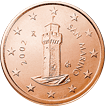
| : The Sammarinese design features the third of the Three Towers of San Marino The Three Towers of San Marino The Three Towers of San Marino are a group of towers located in the small European country of San Marino. Located on the three peaks of Monte Titano in the capital, also called San Marino, they are depicted on both the national flag and coat of arms... ; Montale Montale (San Marino) Montale is one of three peaks which overlook the city of San Marino, the capital of the Republic of San Marino. The other two are De La Fratta and Guaita.-Overview:... . In a semicircle above the tower to the right are the words San Marino and to the left, the date. The mint marks are shown to the lower right. |
 |
||
| : The Slovak design Slovak euro coins Slovak euro coins feature three separate designs for the three series of coins. Slovakia has been a member of the European Union since May 2004, and is a member of the European Economic and Monetary Union... depicts Kriváň Kriván (peak) Kriváň is a mountain in the High Tatras, Slovakia, that dominates the upper part of the former Liptov County. Multiple surveys among nature lovers have ranked it as the country's most beautiful peak. Readily accessible along maintained marked trails and with the exceptional vistas afforded from... , a notable peak of the Tatra mountains High Tatras High Tatras or High Tatra are a mountain range on the borders between Slovakia and Poland. They are a part of the Tatra Mountains... . Kriváň symbolises Slovakia's sovereignty. Below is the name SLOVENSKO (Slovakia), then the year and the coat of arms of Slovakia Coat of arms of Slovakia The coat of arms of Slovakia consists of a red shield, in early gothic style, charged with a silver double cross standing on the middle peak of a dark blue mountain consisting of three peaks. Extremities of the cross are amplificated, and its ends are concaved... with the mint marks either side. The coin came into use in 2009 when Slovakia adopted the euro and it was designed by Ján Černaj and Pavol Károly, chosen by a public competition and vote in 2005. |
|||
| : The Slovenian design Slovenian euro coins Slovenian euro coins were first issued for circulation on 1 January 2007 and a unique feature is designed for each coin. The design of approximately 230 million Slovenian euro coins was unveiled on 7 October 2005. The designers were Miljenko Licul, Maja Licul and Janez Boljka... depicts a stork Stork Storks are large, long-legged, long-necked wading birds with long, stout bills. They belong to the family Ciconiidae. They are the only family in the biological order Ciconiiformes, which was once much larger and held a number of families.... , a motif taken from the former 20 Slovenian tolar Slovenian tolar The tolar was the currency of Slovenia from 1991 until the introduction of the euro on 1 January 2007. It was subdivided into 100 stotins... coin by Janez Boljka. Between each star round the right hand edge are the letters SLOVENIJA (Slovenia) with the date after it to the upper left. The design came into use in 2007 when Slovenia adopted the euro. |
|||
| : The Spanish design Spanish euro coins Spanish euro coins feature three different designs for each of the three series of coins. The minor series of 1, 2 and 5 cent coins were designed by Garcilaso Rollán, the middle series of 10, 20, and 50 cent coins by Begoña Castellanos and the two major coins feature the portrait or effigy of King... displays the Obradoiro façade of the Cathedral of Santiago de Compostela Cathedral of Santiago de Compostela Santiago de Compostela Cathedral is a Roman Catholic cathedral of the archdiocese of Santiago de Compostela in Galicia, Spain. The cathedral is the reputed burial-place of Saint James the Greater, one of the apostles of Jesus Christ. It is the destination of the Way of St... , a prime example of Spanish baroque Baroque architecture Baroque architecture is a term used to describe the building style of the Baroque era, begun in late sixteenth century Italy, that took the Roman vocabulary of Renaissance architecture and used it in a new rhetorical and theatrical fashion, often to express the triumph of the Catholic Church and... started in 1667 by Jose del Toro and Domingo de Andrade and completed in the 18th century by Fernando Casas y Novoa. The cathedral, which is romanesque Romanesque architecture Romanesque architecture is an architectural style of Medieval Europe characterised by semi-circular arches. There is no consensus for the beginning date of the Romanesque architecture, with proposals ranging from the 6th to the 10th century. It developed in the 12th century into the Gothic style,... and dates to 1128, is a major pilgrimage Pilgrimage A pilgrimage is a journey or search of great moral or spiritual significance. Typically, it is a journey to a shrine or other location of importance to a person's beliefs and faith... destination. The name España (Spain) is shown to the top left and the top left four stars are indented on a raised area, inverting the effect of the rest of the coin. The date is shown to the top right. |
1st Series (1999–2009) |
2nd Series (2010-) |
|
| : The Vatican design Vatican euro coins Vatican euro coins are issued by the Philatelic and Numismatic Office of the Vatican City State and minted by Istituto Poligrafico e Zecca dello Stato , in Rome, Italy... has changed two times. The first displayed an effigy of Pope John Paul II Pope John Paul II Blessed Pope John Paul II , born Karol Józef Wojtyła , reigned as Pope of the Catholic Church and Sovereign of Vatican City from 16 October 1978 until his death on 2 April 2005, at of age. His was the second-longest documented pontificate, which lasted ; only Pope Pius IX ... . The name CITTA DEL VATICANO (Vatican City Vatican City Vatican City , or Vatican City State, in Italian officially Stato della Città del Vaticano , which translates literally as State of the City of the Vatican, is a landlocked sovereign city-state whose territory consists of a walled enclave within the city of Rome, Italy. It has an area of... ) was written to his left, the date and mint mark below and the stars grouped together on his right. Following the death of John Paul II in 2005, a new coin was issued during the Sede vacante Sede vacante Sede vacante is an expression, used in the Canon Law of the Catholic Church, that refers to the vacancy of the episcopal see of a particular church... until a new Pope was chosen. This contained the insignia of the Apostolic Chamber Apostolic Camera The Apostolic Camera, or in Latin Camera Apostolica or Apostolica Camera, is the central board of finance in the Papal administrative system, which at one time was of great importance in the government of the States of the Church, and in the administration of justice, led by the Camerlengo of the... and the coat of arms of the Cardinal Chamberlain. When Pope Benedict XVI Pope Benedict XVI Benedict XVI is the 265th and current Pope, by virtue of his office of Bishop of Rome, the Sovereign of the Vatican City State and the leader of the Catholic Church as well as the other 22 sui iuris Eastern Catholic Churches in full communion with the Holy See... was elected, his effigy appeared on the coins, with the name of the city now above his head with the year and mint mark in the middle to his right. |
(2002–2005) |
(2005–2006) |
(2006–) |
Planned designs
Austria, Germany and Greece will also at some point need to update their designs to comply with guidelines stating they must include the issuing state's name or initial, and not repeat the denomination of the coin.In addition, there are several EU states that have not yet adopted the euro, some of them have already agreed upon their coin designs however it is not know exactly when they will adopt the currency, and hence these are not yet minted. See enlargement of the Eurozone
Enlargement of the eurozone
The enlargement of the eurozone is a continuing process within the European Union . All member states of the EU, except for Denmark, the United Kingdom and de facto Sweden, are obliged to adopt the euro as their sole currency when they meet the criteria...
for expected entry dates of these countries.
Usage
The one and two-cent coins were initially introduced in order to ensure that the introduction of the euro was not used as an excuse by retailers to heavily round up prices. However, due to the cost of maintaining a circulation of low value coins, by business and the mints, FinlandFinland
Finland , officially the Republic of Finland, is a Nordic country situated in the Fennoscandian region of Northern Europe. It is bordered by Sweden in the west, Norway in the north and Russia in the east, while Estonia lies to its south across the Gulf of Finland.Around 5.4 million people reside...
and the Netherlands
Netherlands
The Netherlands is a constituent country of the Kingdom of the Netherlands, located mainly in North-West Europe and with several islands in the Caribbean. Mainland Netherlands borders the North Sea to the north and west, Belgium to the south, and Germany to the east, and shares maritime borders...
round prices to the nearest five cents (Swedish rounding
Swedish rounding
Swedish rounding is rounding the basic cost of a purchase which is to be paid for in cash to the nearest multiple of the smallest denomination of currency...
) if paying with cash money, while producing only a handful of those coins for collectors, rather than general circulation. Despite this, the coins are still legal tender and produced outside these states, so if a customer with a one-cent coin minted elsewhere wishes to pay with it, he may.
The Nederlandse Bank calculated it would save $36 million a year by not using the smaller coins. Other countries such as Germany
Germany
Germany , officially the Federal Republic of Germany , is a federal parliamentary republic in Europe. The country consists of 16 states while the capital and largest city is Berlin. Germany covers an area of 357,021 km2 and has a largely temperate seasonal climate...
favoured retaining the coins due to retailers' desire for €1.99 prices, which appear more attractive to the consumer than a €2 price (Psychological pricing
Psychological pricing
Psychological pricing or price ending is a marketing practice based on the theory that certain prices have a psychological impact. The retail prices are often expressed as "odd prices": a little less than a round number, e.g. $19.99 or £2.98. The theory is this drives demand greater than would be...
). According to a Eurobarometer
Eurobarometer
Eurobarometer is a series of surveys regularly performed on behalf of the European Commission since 1973. It produces reports of public opinion of certain issues relating to the European Union across the member states...
survey of EU citizens, Germans are most skeptical about the removal of the coin (only 32% support it), however across the entire Eurozone there is a slight majority (52%) for their removal.
Nicknames
In FlemishFlemish
Flemish can refer to anything related to Flanders, and may refer directly to the following articles:*Flemish, an informal, though linguistically incorrect, name of any kind of the Dutch language as spoken in Belgium....
, the 1, 2 and 5 cent coins have the nickname
Linguistic issues concerning the euro
Several linguistic issues have arisen in relation to the spelling of the words euro and cent in the many languages of the member states of the European Union, as well as in relation to grammar and the formation of plurals....
koper (copper
Copper
Copper is a chemical element with the symbol Cu and atomic number 29. It is a ductile metal with very high thermal and electrical conductivity. Pure copper is soft and malleable; an exposed surface has a reddish-orange tarnish...
), ros (redhead
Redhead
Redhead may refer to:* A person with red hair* Redhead , an album by Bleu* Redhead , a North American duck, Aythya americana...
) or rostjes (little redhead) due to their colour. In Portugal
Portugal
Portugal , officially the Portuguese Republic is a country situated in southwestern Europe on the Iberian Peninsula. Portugal is the westernmost country of Europe, and is bordered by the Atlantic Ocean to the West and South and by Spain to the North and East. The Atlantic archipelagos of the...
, the 1 cent coin gained the nicknames botão (button) and feijão (bean), due to their small size and value: instead of gambling with real money, buttons sometimes are used.