


Stork

Encyclopedia
Storks are large, long-legged, long-necked wading bird
s with long, stout bills
. They belong to the family
Ciconiidae. They are the only family in the biological order Ciconiiformes
, which was once much larger and held a number of families.
Storks occur in many regions of the world and tend to live in drier habitats than the related heron
s, spoonbill
s and ibis
es; they also lack the powder down that those groups use to clean off fish
slime. Storks have no syrinx
and are mute, giving no call; bill-clattering is an important mode of stork communication
at the nest. Many species are migratory
. Most storks eat frog
s, fish
, insect
s, earthworm
s, small bird
s and small mammal
s. There are 19 living species
of storks in six genera
.
Various terms are used to refer to groups of storks, two frequently used ones being a muster of storks and a phalanx of storks.
Storks tend to use soaring
, gliding flight, which conserves energy. Soaring requires thermal
air currents. Ottomar Anschütz
's famous 1884 album of photographs of storks inspired the design of Otto Lilienthal
's experimental gliders
of the late 19th century. Storks are heavy, with wide wingspan
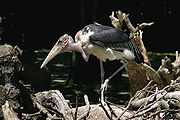
s: the Marabou Stork
, with a wingspan of 3.2 m (10.5 ft), joins the Andean Condor
in having the widest wingspan of all living land birds.
Their nests
are often very large and may be used for many years. Some nests have been known to grow to over 2 m (6 ft) in diameter and about 3 m (10 ft) in depth. Storks were once thought to be monogamous
, but this is only partially true. They may change mates after migrations
, and may migrate without a mate. They tend to be attached to nests
as much as partners.
Storks' size, serial monogamy, and faithfulness to an established nesting site contribute to their prominence in mythology
and culture.
word can be traced back to Proto-Germanic *sturkaz. Nearly every Germanic language has a descendant of this proto-language word to indicate the (White
) stork. Related names also occur in some Eastern Europe
an languages, originating as Germanic loanword
s.
According to the New Shorter Oxford English Dictionary
, the Germanic root is probably related to the modern English "stark", in reference to the stiff or rigid posture of a European species, the White Stork
. A non-Germanic word linked to it may be Greek
torgos ("vulture").
In some West Germanic languages
cognate words of a different etymology exist. They originate from *uda-faro, uda being related to water meaning something like swamp or moist area and faro being related to fare; so *uda-faro is something like he who walks in the swamp. In later times this name got reanalysed as *ōdaboro, ōda "fortune, wealth" + boro "bearer" meaning he who brings wealth adding to the myth of storks as maintainers of welfare and bringers of children.
In Estonian
, "stork" is toonekurg, which is derived from toonela (underworld
in Estonian folklore) + kurg (crane
). It may seem not to make sense to associate the now-common White Stork
with death, but at the times storks were named, the now-rare Black Stork
was probably the more common species.
_near_hodal_i_picture_2021.jpg)
Following the development of research techniques in molecular biology
in the late 20th century, in particular methods for studying DNA-DNA hybridization, a great deal of new information has surfaced, much of it suggesting that many birds, although looking very different from one another, are in fact more closely related than was previously thought. Accordingly, the radical and influential Sibley-Ahlquist taxonomy
greatly enlarged the Ciconiiformes, adding many more families, including most of those usually regarded as belonging to the Sphenisciformes (penguin
s), Gaviiformes (divers
), Podicipediformes (grebe
s), Procellariiformes
(tube-nosed seabirds), Charadriiformes
, (wader
s, gull
s, tern
s and auk
s), Pelecaniformes
(pelican
s, cormorant
s, gannet
s and allies), and the Falconiformes
(diurnal birds of prey
). The flamingo
family, Phoenicopteridae, is related, and is sometimes classed as part of the Ciconiiformes.
However, morphological evidence suggests that the traditional Ciconiiformes should be split between two lineages, rather than expanded, although some non-traditional Ciconiiformes may be included in these two lineages.
The exact taxonomic placement of New World vulture
s remains unclear. Though both are similar in appearance and have similar ecological roles
, the New World and Old World vultures evolved from different ancestors in different parts of the world and are not closely related. Just how different the two families are is currently under debate, with some earlier authorities suggesting that the New World vultures belong in Ciconiiformes. More recent authorities maintain their overall position in the order Falconiformes
along with the Old World Vultures or place them in their own order, Cathartiformes. The South American Classification Committee has removed the New World Vultures from Ciconiiformes and instead placed them in Incertae sedis
, but notes that a move to Falconiformes or Cathartiformes is possible.
Some official bodies have adopted the proposed Sibley-Ahlquist taxonomy almost entirely; however, a more common approach worldwide has been to retain the traditional groupings, and modify rather than replace them in the light of new evidence as it comes to hand. The family listing here follows this more conservative practice. Bird taxonomy has been in a state of flux for some years, and it is reasonable to expect that the large differences between different classification schemes will continue gradually to resolve themselves as more evidence becomes available.
Recently a DNA study found that the families Ardeidae, Balaenicipitidae, Scopidae and the Threskiornithidae
belong to the Pelecaniformes. This would make Ciconiidae the only group.
Storks were distinct and possibly widespread by the Oligocene. Like most families of aquatic birds, storks seem to have arisen in the Palaeogene
, maybe 40-50 million years ago (mya). For the fossil record of living genera, documented since the Middle Miocene
(about 15 mya) at least in some cases, see the genus articles.
Though some storks are highly threatened, no species or subspecies are known to have gone extinct in historic times. A Ciconia bone found in a rock shelter
on the island of Réunion
was probably of a bird taken there as food by early settlers; no known account mentions the presence of storks on the Mascarene Islands
.
The fossil genera Eociconia (middle Eocene of China) and Ciconiopsis (Deseado Early Oligocene of Patagonia, Argentina) are often tentatively placed with this family. A "ciconiiform" fossil fragment from the Touro Passo Formation found at Arroio Touro Passo (Rio Grande do Sul
, Brazil
) might be of the living Wood Stork
M. americana; it is at most of Late Pleistocene
age, a few 10.000s of years.
Bird
Birds are feathered, winged, bipedal, endothermic , egg-laying, vertebrate animals. Around 10,000 living species and 188 families makes them the most speciose class of tetrapod vertebrates. They inhabit ecosystems across the globe, from the Arctic to the Antarctic. Extant birds range in size from...
s with long, stout bills
Beak
The beak, bill or rostrum is an external anatomical structure of birds which is used for eating and for grooming, manipulating objects, killing prey, fighting, probing for food, courtship and feeding young...
. They belong to the family
Family (biology)
In biological classification, family is* a taxonomic rank. Other well-known ranks are life, domain, kingdom, phylum, class, order, genus, and species, with family fitting between order and genus. As for the other well-known ranks, there is the option of an immediately lower rank, indicated by the...
Ciconiidae. They are the only family in the biological order Ciconiiformes
Ciconiiformes
Traditionally, the order Ciconiiformes has included a variety of large, long-legged wading birds with large bills: storks, herons, egrets, ibises, spoonbills, and several others. Ciconiiformes are known from the Late Eocene...
, which was once much larger and held a number of families.
Storks occur in many regions of the world and tend to live in drier habitats than the related heron
Heron
The herons are long-legged freshwater and coastal birds in the family Ardeidae. There are 64 recognised species in this family. Some are called "egrets" or "bitterns" instead of "heron"....
s, spoonbill
Spoonbill
Spoonbills are a group of large, long-legged wading birds in the family Threskiornithidae, which also includes the Ibises.All have large, flat, spatulate bills and feed by wading through shallow water, sweeping the partly opened bill from side to side...
s and ibis
Ibis
The ibises are a group of long-legged wading birds in the family Threskiornithidae....
es; they also lack the powder down that those groups use to clean off fish
Fish
Fish are a paraphyletic group of organisms that consist of all gill-bearing aquatic vertebrate animals that lack limbs with digits. Included in this definition are the living hagfish, lampreys, and cartilaginous and bony fish, as well as various extinct related groups...
slime. Storks have no syrinx
Syrinx (biology)
Syrinx is the name for the vocal organ of birds. Located at the base of a bird's trachea, it produces sounds without the vocal cords of mammals. The sound is produced by vibrations of some or all of the membrana tympaniformis and the pessulus caused by air flowing through the syrinx...
and are mute, giving no call; bill-clattering is an important mode of stork communication
Animal communication
Animal communication is any behavior on the part of one animal that has an effect on the current or future behaviour of another animal. The study of animal communication, is sometimes called Zoosemiotics has played an important part in the...
at the nest. Many species are migratory
Bird migration
Bird migration is the regular seasonal journey undertaken by many species of birds. Bird movements include those made in response to changes in food availability, habitat or weather. Sometimes, journeys are not termed "true migration" because they are irregular or in only one direction...
. Most storks eat frog
Frog
Frogs are amphibians in the order Anura , formerly referred to as Salientia . Most frogs are characterized by a short body, webbed digits , protruding eyes and the absence of a tail...
s, fish
Fish
Fish are a paraphyletic group of organisms that consist of all gill-bearing aquatic vertebrate animals that lack limbs with digits. Included in this definition are the living hagfish, lampreys, and cartilaginous and bony fish, as well as various extinct related groups...
, insect
Insect
Insects are a class of living creatures within the arthropods that have a chitinous exoskeleton, a three-part body , three pairs of jointed legs, compound eyes, and two antennae...
s, earthworm
Earthworm
Earthworm is the common name for the largest members of Oligochaeta in the phylum Annelida. In classical systems they were placed in the order Opisthopora, on the basis of the male pores opening posterior to the female pores, even though the internal male segments are anterior to the female...
s, small bird
Bird
Birds are feathered, winged, bipedal, endothermic , egg-laying, vertebrate animals. Around 10,000 living species and 188 families makes them the most speciose class of tetrapod vertebrates. They inhabit ecosystems across the globe, from the Arctic to the Antarctic. Extant birds range in size from...
s and small mammal
Mammal
Mammals are members of a class of air-breathing vertebrate animals characterised by the possession of endothermy, hair, three middle ear bones, and mammary glands functional in mothers with young...
s. There are 19 living species
Species
In biology, a species is one of the basic units of biological classification and a taxonomic rank. A species is often defined as a group of organisms capable of interbreeding and producing fertile offspring. While in many cases this definition is adequate, more precise or differing measures are...
of storks in six genera
Genera
Genera is a commercial operating system and development environment for Lisp machines developed by Symbolics. It is essentially a fork of an earlier operating system originating on the MIT AI Lab's Lisp machines which Symbolics had used in common with LMI and Texas Instruments...
.
Various terms are used to refer to groups of storks, two frequently used ones being a muster of storks and a phalanx of storks.
Storks tend to use soaring
Lift (soaring)
Gliding flight is heavier-than-air flight without the use of thrust. It is employed by gliding animals and by aircraft such as gliders. The most common human application of gliding flight is in sport and recreation using aircraft designed for this purpose...
, gliding flight, which conserves energy. Soaring requires thermal
Thermal
A thermal column is a column of rising air in the lower altitudes of the Earth's atmosphere. Thermals are created by the uneven heating of the Earth's surface from solar radiation, and are an example of convection. The sun warms the ground, which in turn warms the air directly above it...
air currents. Ottomar Anschütz
Ottomar Anschütz
Ottomar Anschütz was an inventor, photographer, and chronophotographer.-Biography:He invented 1/1000 of a second shutter, and the "electrotachyscope" in 1887...
's famous 1884 album of photographs of storks inspired the design of Otto Lilienthal
Otto Lilienthal
Otto Lilienthal was a German pioneer of human aviation who became known as the Glider King. He was the first person to make well-documented, repeated, successful gliding flights. He followed an experimental approach established earlier by Sir George Cayley...
's experimental gliders
Glider aircraft
Glider aircraft are heavier-than-air craft that are supported in flight by the dynamic reaction of the air against their lifting surfaces, and whose free flight does not depend on an engine. Mostly these types of aircraft are intended for routine operation without engines, though engine failure can...
of the late 19th century. Storks are heavy, with wide wingspan
Wingspan
The wingspan of an airplane or a bird, is the distance from one wingtip to the other wingtip. For example, the Boeing 777 has a wingspan of about ; and a Wandering Albatross caught in 1965 had a wingspan of , the official record for a living bird.The term wingspan, more technically extent, is...
s: the Marabou Stork
Marabou Stork
The Marabou Stork, Leptoptilos crumeniferus, is a large wading bird in the stork family Ciconiidae. It breeds in Africa south of the Sahara, occurring in both wet and arid habitats, often near human habitation, especially waste tips...
, with a wingspan of 3.2 m (10.5 ft), joins the Andean Condor
Andean Condor
The Andean Condor is a species of South American bird in the New World vulture family Cathartidae and is the only member of the genus Vultur...
in having the widest wingspan of all living land birds.
Their nests
Bird nest
A bird nest is the spot in which a bird lays and incubates its eggs and raises its young. Although the term popularly refers to a specific structure made by the bird itself—such as the grassy cup nest of the American Robin or Eurasian Blackbird, or the elaborately woven hanging nest of the...
are often very large and may be used for many years. Some nests have been known to grow to over 2 m (6 ft) in diameter and about 3 m (10 ft) in depth. Storks were once thought to be monogamous
Monogamy
Monogamy /Gr. μονός+γάμος - one+marriage/ a form of marriage in which an individual has only one spouse at any one time. In current usage monogamy often refers to having one sexual partner irrespective of marriage or reproduction...
, but this is only partially true. They may change mates after migrations
Bird migration
Bird migration is the regular seasonal journey undertaken by many species of birds. Bird movements include those made in response to changes in food availability, habitat or weather. Sometimes, journeys are not termed "true migration" because they are irregular or in only one direction...
, and may migrate without a mate. They tend to be attached to nests
Bird nest
A bird nest is the spot in which a bird lays and incubates its eggs and raises its young. Although the term popularly refers to a specific structure made by the bird itself—such as the grassy cup nest of the American Robin or Eurasian Blackbird, or the elaborately woven hanging nest of the...
as much as partners.
Storks' size, serial monogamy, and faithfulness to an established nesting site contribute to their prominence in mythology
Mythology
The term mythology can refer either to the study of myths, or to a body or collection of myths. As examples, comparative mythology is the study of connections between myths from different cultures, whereas Greek mythology is the body of myths from ancient Greece...
and culture.
Etymology
The modern EnglishModern English
Modern English is the form of the English language spoken since the Great Vowel Shift in England, completed in roughly 1550.Despite some differences in vocabulary, texts from the early 17th century, such as the works of William Shakespeare and the King James Bible, are considered to be in Modern...
word can be traced back to Proto-Germanic *sturkaz. Nearly every Germanic language has a descendant of this proto-language word to indicate the (White
White Stork
The White Stork is a large bird in the stork family Ciconiidae. Its plumage is mainly white, with black on its wings. Adults have long red legs and long pointed red beaks, and measure on average from beak tip to end of tail, with a wingspan...
) stork. Related names also occur in some Eastern Europe
Eastern Europe
Eastern Europe is the eastern part of Europe. The term has widely disparate geopolitical, geographical, cultural and socioeconomic readings, which makes it highly context-dependent and even volatile, and there are "almost as many definitions of Eastern Europe as there are scholars of the region"...
an languages, originating as Germanic loanword
Loanword
A loanword is a word borrowed from a donor language and incorporated into a recipient language. By contrast, a calque or loan translation is a related concept where the meaning or idiom is borrowed rather than the lexical item itself. The word loanword is itself a calque of the German Lehnwort,...
s.
According to the New Shorter Oxford English Dictionary
Shorter Oxford English Dictionary
The Shorter Oxford English Dictionary, often abbreviated to SOED, is a scaled-down version of the Oxford English Dictionary . It comprises two volumes rather than the twenty needed for the full second edition of the OED...
, the Germanic root is probably related to the modern English "stark", in reference to the stiff or rigid posture of a European species, the White Stork
White Stork
The White Stork is a large bird in the stork family Ciconiidae. Its plumage is mainly white, with black on its wings. Adults have long red legs and long pointed red beaks, and measure on average from beak tip to end of tail, with a wingspan...
. A non-Germanic word linked to it may be Greek
Greek language
Greek is an independent branch of the Indo-European family of languages. Native to the southern Balkans, it has the longest documented history of any Indo-European language, spanning 34 centuries of written records. Its writing system has been the Greek alphabet for the majority of its history;...
torgos ("vulture").
In some West Germanic languages
West Germanic languages
The West Germanic languages constitute the largest of the three traditional branches of the Germanic family of languages and include languages such as German, English, Dutch, Afrikaans, the Frisian languages, and Yiddish...
cognate words of a different etymology exist. They originate from *uda-faro, uda being related to water meaning something like swamp or moist area and faro being related to fare; so *uda-faro is something like he who walks in the swamp. In later times this name got reanalysed as *ōdaboro, ōda "fortune, wealth" + boro "bearer" meaning he who brings wealth adding to the myth of storks as maintainers of welfare and bringers of children.
In Estonian
Estonian language
Estonian is the official language of Estonia, spoken by about 1.1 million people in Estonia and tens of thousands in various émigré communities...
, "stork" is toonekurg, which is derived from toonela (underworld
Underworld
The Underworld is a region which is thought to be under the surface of the earth in some religions and in mythologies. It could be a place where the souls of the recently departed go, and in some traditions it is identified with Hell or the realm of death...
in Estonian folklore) + kurg (crane
Crane (bird)
Cranes are a family, Gruidae, of large, long-legged and long-necked birds in the order Gruiformes. There are fifteen species of crane in four genera. Unlike the similar-looking but unrelated herons, cranes fly with necks outstretched, not pulled back...
). It may seem not to make sense to associate the now-common White Stork
White Stork
The White Stork is a large bird in the stork family Ciconiidae. Its plumage is mainly white, with black on its wings. Adults have long red legs and long pointed red beaks, and measure on average from beak tip to end of tail, with a wingspan...
with death, but at the times storks were named, the now-rare Black Stork
Black Stork
The Black Stork Ciconia nigra is a large wading bird in the stork family Ciconiidae. It is a widespread, but rare, species that breeds in the warmer parts of Europe, predominantly in central and eastern regions. This is a shy and wary species, unlike the closely related White Stork. It is seen in...
was probably the more common species.
Systematics
Following the development of research techniques in molecular biology
Molecular biology
Molecular biology is the branch of biology that deals with the molecular basis of biological activity. This field overlaps with other areas of biology and chemistry, particularly genetics and biochemistry...
in the late 20th century, in particular methods for studying DNA-DNA hybridization, a great deal of new information has surfaced, much of it suggesting that many birds, although looking very different from one another, are in fact more closely related than was previously thought. Accordingly, the radical and influential Sibley-Ahlquist taxonomy
Sibley-Ahlquist taxonomy
The Sibley-Ahlquist taxonomy is a bird taxonomy proposed by Charles Sibley and Jon Edward Ahlquist. It is based on DNA-DNA hybridization studies conducted in the late 1970s and throughout the 1980s....
greatly enlarged the Ciconiiformes, adding many more families, including most of those usually regarded as belonging to the Sphenisciformes (penguin
Penguin
Penguins are a group of aquatic, flightless birds living almost exclusively in the southern hemisphere, especially in Antarctica. Highly adapted for life in the water, penguins have countershaded dark and white plumage, and their wings have become flippers...
s), Gaviiformes (divers
Loon
The loons or divers are a group of aquatic birds found in many parts of North America and northern Eurasia...
), Podicipediformes (grebe
Grebe
A grebe is a member of the Podicipediformes order, a widely distributed order of freshwater diving birds, some of which visit the sea when migrating and in winter...
s), Procellariiformes
Procellariiformes
Procellariiformes is an order of seabirds that comprises four families: the albatrosses, petrels and shearwaters, storm petrels, and diving petrels...
(tube-nosed seabirds), Charadriiformes
Charadriiformes
Charadriiformes is a diverse order of small to medium-large birds. It includes about 350 species and has members in all parts of the world. Most Charadriiformes live near water and eat invertebrates or other small animals; however, some are pelagic , some occupy deserts and a few are found in thick...
, (wader
Wader
Waders, called shorebirds in North America , are members of the order Charadriiformes, excluding the more marine web-footed seabird groups. The latter are the skuas , gulls , terns , skimmers , and auks...
s, gull
Gull
Gulls are birds in the family Laridae. They are most closely related to the terns and only distantly related to auks, skimmers, and more distantly to the waders...
s, tern
Tern
Terns are seabirds in the family Sternidae, previously considered a subfamily of the gull family Laridae . They form a lineage with the gulls and skimmers which in turn is related to skuas and auks...
s and auk
Auk
An auk is a bird of the family Alcidae in the order Charadriiformes. Auks are superficially similar to penguins due to their black-and-white colours, their upright posture and some of their habits...
s), Pelecaniformes
Pelecaniformes
The Pelecaniformes is a order of medium-sized and large waterbirds found worldwide. As traditionally—but erroneously—defined, they encompass all birds that have feet with all four toes webbed. Hence, they were formerly also known by such names as totipalmates or steganopodes...
(pelican
Pelican
A pelican, derived from the Greek word πελεκυς pelekys is a large water bird with a large throat pouch, belonging to the bird family Pelecanidae....
s, cormorant
Cormorant
The bird family Phalacrocoracidae is represented by some 40 species of cormorants and shags. Several different classifications of the family have been proposed recently, and the number of genera is disputed.- Names :...
s, gannet
Gannet
Gannets are seabirds comprising the genus Morus, in the family Sulidae, closely related to the boobies.The gannets are large black and white birds with yellow heads. They have long pointed wings and long bills. Northern gannets are the largest seabirds in the North Atlantic, with a wingspan of up...
s and allies), and the Falconiformes
Falconiformes
The order Falconiformes is a group of about 290 species of birds that comprises the diurnal birds of prey. Raptor classification is difficult and the order is treated in several ways.- Classification problems :...
(diurnal birds of prey
Bird of prey
Birds of prey are birds that hunt for food primarily on the wing, using their keen senses, especially vision. They are defined as birds that primarily hunt vertebrates, including other birds. Their talons and beaks tend to be relatively large, powerful and adapted for tearing and/or piercing flesh....
). The flamingo
Flamingo
Flamingos or flamingoes are gregarious wading birds in the genus Phoenicopterus , the only genus in the family Phoenicopteridae...
family, Phoenicopteridae, is related, and is sometimes classed as part of the Ciconiiformes.
However, morphological evidence suggests that the traditional Ciconiiformes should be split between two lineages, rather than expanded, although some non-traditional Ciconiiformes may be included in these two lineages.
The exact taxonomic placement of New World vulture
New World vulture
The New World Vulture or Condor family Cathartidae contains seven species in fivegenera, all but one of which are monotypic. It includes five vultures and two condors found in warm and temperate areas of the Americas....
s remains unclear. Though both are similar in appearance and have similar ecological roles
Ecological niche
In ecology, a niche is a term describing the relational position of a species or population in its ecosystem to each other; e.g. a dolphin could potentially be in another ecological niche from one that travels in a different pod if the members of these pods utilize significantly different food...
, the New World and Old World vultures evolved from different ancestors in different parts of the world and are not closely related. Just how different the two families are is currently under debate, with some earlier authorities suggesting that the New World vultures belong in Ciconiiformes. More recent authorities maintain their overall position in the order Falconiformes
Falconiformes
The order Falconiformes is a group of about 290 species of birds that comprises the diurnal birds of prey. Raptor classification is difficult and the order is treated in several ways.- Classification problems :...
along with the Old World Vultures or place them in their own order, Cathartiformes. The South American Classification Committee has removed the New World Vultures from Ciconiiformes and instead placed them in Incertae sedis
Incertae sedis
, is a term used to define a taxonomic group where its broader relationships are unknown or undefined. Uncertainty at specific taxonomic levels is attributed by , , and similar terms.-Examples:*The fossil plant Paradinandra suecica could not be assigned to any...
, but notes that a move to Falconiformes or Cathartiformes is possible.
Some official bodies have adopted the proposed Sibley-Ahlquist taxonomy almost entirely; however, a more common approach worldwide has been to retain the traditional groupings, and modify rather than replace them in the light of new evidence as it comes to hand. The family listing here follows this more conservative practice. Bird taxonomy has been in a state of flux for some years, and it is reasonable to expect that the large differences between different classification schemes will continue gradually to resolve themselves as more evidence becomes available.
Recently a DNA study found that the families Ardeidae, Balaenicipitidae, Scopidae and the Threskiornithidae
Threskiornithidae
The family Threskiornithidae includes 34 species of large terrestrial and wading birds, falling into two subfamilies, the ibises and the spoonbills. It was formerly known as Plataleidae. The spoonbills and ibises were once thought to be related to other groups of long-legged wading birds in the...
belong to the Pelecaniformes. This would make Ciconiidae the only group.
Storks were distinct and possibly widespread by the Oligocene. Like most families of aquatic birds, storks seem to have arisen in the Palaeogene
Paleogene
The Paleogene is a geologic period and system that began 65.5 ± 0.3 and ended 23.03 ± 0.05 million years ago and comprises the first part of the Cenozoic Era...
, maybe 40-50 million years ago (mya). For the fossil record of living genera, documented since the Middle Miocene
Middle Miocene
The Middle Miocene is a sub-epoch of the Miocene Epoch made up of two stages: the Langhian and Serravallian stages. The Middle Miocene is preceded by the Early Miocene....
(about 15 mya) at least in some cases, see the genus articles.
Though some storks are highly threatened, no species or subspecies are known to have gone extinct in historic times. A Ciconia bone found in a rock shelter
Rock shelter
A rock shelter is a shallow cave-like opening at the base of a bluff or cliff....
on the island of Réunion
Réunion
Réunion is a French island with a population of about 800,000 located in the Indian Ocean, east of Madagascar, about south west of Mauritius, the nearest island.Administratively, Réunion is one of the overseas departments of France...
was probably of a bird taken there as food by early settlers; no known account mentions the presence of storks on the Mascarene Islands
Mascarene Islands
The Mascarene Islands is a group of islands in the Indian Ocean east of Madagascar comprising Mauritius, Réunion, Rodrigues, Cargados Carajos shoals, plus the former islands of the Saya de Malha, Nazareth and Soudan banks...
.
Living storks
- Genus MycteriaMycteriaMycteria is a genus of large tropical storks with representatives in the Americas, east Africa and southern and southeastern Asia. Two species have "ibis" in their scientific or old common names, but they are not related to these birds and simply look more similar to an ibis than do other...
- Milky StorkMilky StorkThe Milky Stork, Mycteria cinerea, is a large wading bird in the stork family Ciconiidae.- Description :It can reach a length of 97 cm. The sexes look similar...
, Mycteria cinerea - Yellow-billed StorkYellow-billed StorkThe Yellow-billed Stork, Mycteria ibis, is a large wading bird in the stork family Ciconiidae. It occurs in Africa south of the Sahara and in Madagascar....
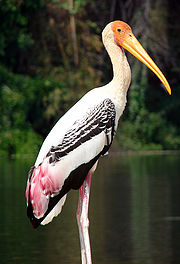
, Mycteria ibis - Painted StorkPainted StorkThe Painted Stork is a large wading bird in the stork family. It is found in the wetlands of the plains of tropical Asia south of the Himalayas in South Asia and extending into Southeast Asia. Their distinctive pink tertial feathers give them their name. They forage in flocks in shallow waters...
, Mycteria leucocephala - Wood StorkWood StorkThe Wood Stork is a large American wading bird in the stork family Ciconiidae. It was formerly called the "Wood Ibis", though it is not really an ibis.-Appearance:...
, Mycteria americana
- Milky Stork
- Genus Anastomus
- Asian Openbill, Anastomus oscitans
- African Openbill, Anastomus lamelligerus
- Genus CiconiaCiconiaCiconia is a genus of birds in the stork family. Six of the seven living species occur in the Old World, but the Maguari Stork has a South American range. In addition, fossils suggest that Ciconia storks were somewhat more common in the tropical Americas in prehistoric times.These are large storks,...
- Abdim's StorkAbdim's StorkThe Abdim's Stork, also known as White-bellied Stork, is a black stork with grey legs, red knees and feet, grey bill and white underparts. It has red facial skin in front of eye and blue skin near the bill in breeding season...
, Ciconia abdimii - Woolly-necked StorkWoolly-necked StorkThe Woolly-necked Stork or White necked stork , Ciconia episcopus, is a large wading bird in the stork family Ciconiidae. It can also be known as the Espiscopos....
, Ciconia episcopus - Storm's StorkStorm's StorkThe Storm's Stork, Ciconia stormi is a large, approximately long, stork with black and white plumages, red bill, orange bare facial skin, red legs and yellow orbital skin. Both sexes are similar. The young has duller plumage and bare skin....
, Ciconia stormi - Maguari StorkMaguari StorkThe Maguari Stork is a species of stork in the Ciconiidae family.It is found in Argentina, Bolivia, Brazil, Colombia, French Guiana, Guyana, Paraguay, Suriname, Uruguay, and Venezuela. It is a vagrant to Chile, Trinidad, the Falkland Islands and probably Peru...
, Ciconia maguari - Oriental StorkOriental StorkThe Oriental Stork, Ciconia boyciana, is a large, white bird with black wing feathers. It is closely related and resembles the European White Stork, of which it was formerly often treated as a subspecies. It is typically larger than the White Stork, at 100–129 cm long, tall, a weight of and...
, Ciconia boyciana (formerly in C. ciconia) - White StorkWhite StorkThe White Stork is a large bird in the stork family Ciconiidae. Its plumage is mainly white, with black on its wings. Adults have long red legs and long pointed red beaks, and measure on average from beak tip to end of tail, with a wingspan...
, Ciconia ciconia - Black StorkBlack StorkThe Black Stork Ciconia nigra is a large wading bird in the stork family Ciconiidae. It is a widespread, but rare, species that breeds in the warmer parts of Europe, predominantly in central and eastern regions. This is a shy and wary species, unlike the closely related White Stork. It is seen in...
, Ciconia nigra
- Abdim's Stork
- Genus EphippiorhynchusEphippiorhynchusEphippiorhynchus is a small genus of storks. It contains two living species only, very large birds more than 140 cm tall with a 230–270 cm wingspan. Both are mainly black and white, with huge colourful, mainly red and black bills. The sexes of these species are similarly plumaged, but...
- Black-necked StorkBlack-necked StorkThe Black-necked Stork is a tall long-necked wading bird in the stork family. It is a resident species across South and Southeast Asia with a disjunct population in Australia. It lives in wetland habitats to forage for a wide range of animal prey...
, Ephippiorhynchus asiaticus - Saddle-billed StorkSaddle-billed StorkThe Saddle-billed Stork is a large wading bird in the stork family, Ciconiidae. It is a widespread species which is a resident breeder in sub-Saharan Africa from Sudan, Ethiopia and Kenya south to South Africa, and in The Gambia, Senegal, Côte d'Ivoire and Chad in west Africa.This is a close...
, Ephippiorhynchus senegalensis
- Black-necked Stork
- Genus Jabiru
- JabiruJabiruThe Jabiru is a large stork found in the Americas from Mexico to Argentina, except west of the Andes. It is most common in the Pantanal region of Brazil and the Eastern Chaco region of Paraguay. It is the only member of the genus Jabiru...
, Jabiru mycteria
- Jabiru
- Genus LeptoptilosLeptoptilosLeptoptilos is a genus of very large tropical storks. Two species are resident breeders in southern Asia, and the Marabou Stork is found in sub-Saharan Africa....
- Lesser AdjutantLesser AdjutantThe Lesser Adjutant, Leptoptilos javanicus, is a large wading bird in the stork family Ciconiidae. It is a widespread species which is resident breeder in southern Asia from India east to southern China and Java....
, Leptoptilos javanicus - Greater AdjutantGreater AdjutantThe Greater Adjutant is a member of the stork family, Ciconiidae. Its genus includes the Lesser Adjutant of Asia and the Marabou Stork of Africa...
, Leptoptilos dubius - Marabou StorkMarabou StorkThe Marabou Stork, Leptoptilos crumeniferus, is a large wading bird in the stork family Ciconiidae. It breeds in Africa south of the Sahara, occurring in both wet and arid habitats, often near human habitation, especially waste tips...
, Leptoptilos crumeniferus
- Lesser Adjutant
Fossil storks
- Genus PalaeoephippiorhynchusPalaeoephippiorhynchusPalaeoephippiorhynchus is an extinct genus of large stork from the Oligocene and Miocene. There are two recorded species, P. dietrichi from early Oligocene of Egypt and P. edwardsi from Miocene of Libya.-References:...
(fossilFossilFossils are the preserved remains or traces of animals , plants, and other organisms from the remote past...
: Early Oligocene of Fayyum, Egypt) - Genus Grallavis (fossilFossilFossils are the preserved remains or traces of animals , plants, and other organisms from the remote past...
: Early Miocene of Saint-Gérand-le-Puy, France, and Djebel Zelten, Libya) - may be same as Prociconia - Ciconiidae gen. et sp. indet. (Ituzaingó Late Miocene of Paraná, Argentina)
- Ciconiidae gen. et sp. indet. (Puerto Madryn Late Miocene of Punta Buenos Aires, Argentina)
- Genus Prociconia (fossilFossilFossils are the preserved remains or traces of animals , plants, and other organisms from the remote past...
: Late Pleistocene of Brazil) - may belong to modern genus Jabiru or Ciconia - Genus Pelargosteon (fossilFossilFossils are the preserved remains or traces of animals , plants, and other organisms from the remote past...
: Early Pleistocene of Romania) - Ciconiidae gen. et sp. indet. - formerly Aquilavus/Cygnus bilinicus (fossilFossilFossils are the preserved remains or traces of animals , plants, and other organisms from the remote past...
: Early Miocene of Břešťany, Czechia) - cf. Leptoptilos gen. et sp. indet. - formerly L. siwalicensis (fossilFossilFossils are the preserved remains or traces of animals , plants, and other organisms from the remote past...
: Late Miocene? - Late Pliocene of Siwalik, India) - Ciconiidae gen. et sp. indet. (fossilFossilFossils are the preserved remains or traces of animals , plants, and other organisms from the remote past...
: Late Pleistocene of San Josecito Cavern, Mexico)
The fossil genera Eociconia (middle Eocene of China) and Ciconiopsis (Deseado Early Oligocene of Patagonia, Argentina) are often tentatively placed with this family. A "ciconiiform" fossil fragment from the Touro Passo Formation found at Arroio Touro Passo (Rio Grande do Sul
Rio Grande do Sul
Rio Grande do Sul is the southernmost state in Brazil, and the state with the fifth highest Human Development Index in the country. In this state is located the southernmost city in the country, Chuí, on the border with Uruguay. In the region of Bento Gonçalves and Caxias do Sul, the largest wine...
, Brazil
Brazil
Brazil , officially the Federative Republic of Brazil , is the largest country in South America. It is the world's fifth largest country, both by geographical area and by population with over 192 million people...
) might be of the living Wood Stork
Wood Stork
The Wood Stork is a large American wading bird in the stork family Ciconiidae. It was formerly called the "Wood Ibis", though it is not really an ibis.-Appearance:...
M. americana; it is at most of Late Pleistocene
Late Pleistocene
The Late Pleistocene is a stage of the Pleistocene Epoch. The beginning of the stage is defined by the base of the Eemian interglacial phase before the final glacial episode of the Pleistocene 126,000 ± 5,000 years ago. The end of the stage is defined exactly at 10,000 Carbon-14 years BP...
age, a few 10.000s of years.
Mythology of storks
- An ancient etymology about the PelasgiansPelasgiansThe name Pelasgians was used by some ancient Greek writers to refer to populations that were either the ancestors of the Greeks or who preceded the Greeks in Greece, "a hold-all term for any ancient, primitive and presumably indigenous people in the Greek world." In general, "Pelasgian" has come...
, ancient pre-Hellenic inhabitants of Greece, links pelasgos to pelargos "stork", and postulates that the Pelasgians were migrants like storks, possibly from EgyptEgyptEgypt , officially the Arab Republic of Egypt, Arabic: , is a country mainly in North Africa, with the Sinai Peninsula forming a land bridge in Southwest Asia. Egypt is thus a transcontinental country, and a major power in Africa, the Mediterranean Basin, the Middle East and the Muslim world...
, where they nest. AristophanesAristophanesAristophanes , son of Philippus, of the deme Cydathenaus, was a comic playwright of ancient Athens. Eleven of his forty plays survive virtually complete...
deals effectively with this etymology in his comedy the BirdsThe Birds (play)The Birds is a comedy by the Ancient Greek playwright Aristophanes. It was performed in 414 BCE at the City Dionysia where it won second prize. It has been acclaimed by modern critics as a perfectly realized fantasy remarkable for its mimicry of birds and for the gaiety of its songs...
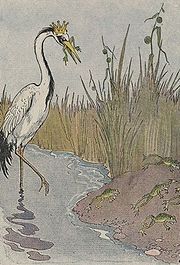
. One of the laws of "the storks" in the satirical cloud-cuckoo-land (punning on the Athenian belief that they were originally Pelasgians) is that grown-up storks must support their parents by migrating elsewhere and conducting warfare. - In AesopAesopAesop was a Greek writer credited with a number of popular fables. Older spellings of his name have included Esop and Isope. Although his existence remains uncertain and no writings by him survive, numerous tales credited to him were gathered across the centuries and in many languages in a...
's tale "The Frogs Who Desired a KingThe Frogs Who Desired a KingThe Frogs Who Desired a King is one of Aesop's Fables and numbered 44 in the Perry Index. Throughout its history, the story has been given a political application.-The Fable and its political applications:...
" the frogFrogFrogs are amphibians in the order Anura , formerly referred to as Salientia . Most frogs are characterized by a short body, webbed digits , protruding eyes and the absence of a tail...
s ask Zeus for a king, and he first sends them the ineffective King Log and then the King Stork who devours his frog subjects. In this context, viewed from the point of view of a frog who may get eaten by a stork, the stork is the symbol of tyrannical power. - In English folk mythology and old wive's tales, storks deliver newborn babies to mothers by dropping them down chimneys. This is the origin of the phrase "Dr. Stork" to refer to an obstetrician.
External links
- Scott MacDonald, "The Stork" emblematic uses
- Storks Image documentation
- Stork videos on the Internet Bird Collection