


Slovenian tolar

Encyclopedia
The tolar was the currency
of Slovenia
from 1991 until the introduction of the euro
on 1 January 2007. It was subdivided into 100 stotins (cents). The ISO 4217 currency code
for the Slovenian tolar was SIT.
, and is cognate
with dollar
.
As Slovene is one of the few languages with a grammatical dual
, the correct inflections of the word "tolar" are 2 tolarja for 2 SIT, but tolarji for 3 or 4 SIT. For 5 SIT or more, the word tolarjev, genitive plural of tolar, is used.
at parity. On 28 June 2004, the tolar was pegged against the euro in the ERM II
, the European Union exchange rate mechanism. All recalled banknotes can be exchanged at the central bank for current issue.
. Slovenia issues its own euro coins
, like all other nations in the Eurozone
.
The timescale for conversion from the tolar to the euro operated differently from the first wave of European Monetary Union (EMU). The permanent euro/tolar conversion rate was finalised on 11 July 2006 at 239.640 tolar per euro. During the
first wave of EMU, this period was only a day (the conversion rates were fixed on 31 December 1998 and euro non-cash payments were possible from 1 January 1999). Also unlike the first wave of EMU which had a three year transition period (1999-2001), there was no transition period when non-cash payments could be made in both tolar and euro. The tolar was used for all transactions (cash and non-cash) until 31 December 2006 and the euro must be used for all payments (cash and non-cash) from 1 January 2007. However, as with the first wave of EMU, cash payments with the tolar could continue until 14 January 2007, but change had to be given in euro.
on the obverse
and Triglav
, the tallest mountain in Slovenia, on the reverse. In 1992, the Bank of Slovenia
introduced the following banknotes, all of which feature notable Slovenes.
Currency
In economics, currency refers to a generally accepted medium of exchange. These are usually the coins and banknotes of a particular government, which comprise the physical aspects of a nation's money supply...
of Slovenia
Slovenia
Slovenia , officially the Republic of Slovenia , is a country in Central and Southeastern Europe touching the Alps and bordering the Mediterranean. Slovenia borders Italy to the west, Croatia to the south and east, Hungary to the northeast, and Austria to the north, and also has a small portion of...
from 1991 until the introduction of the euro
Euro
The euro is the official currency of the eurozone: 17 of the 27 member states of the European Union. It is also the currency used by the Institutions of the European Union. The eurozone consists of Austria, Belgium, Cyprus, Estonia, Finland, France, Germany, Greece, Ireland, Italy, Luxembourg,...
on 1 January 2007. It was subdivided into 100 stotins (cents). The ISO 4217 currency code
ISO 4217
ISO 4217 is a standard published by the International Standards Organization, which delineates currency designators, country codes , and references to minor units in three tables:* Table A.1 – Current currency & funds code list...
for the Slovenian tolar was SIT.
Etymology
The name tolar comes from ThalerThaler
The Thaler was a silver coin used throughout Europe for almost four hundred years. Its name lives on in various currencies as the dollar or tolar. Etymologically, "Thaler" is an abbreviation of "Joachimsthaler", a coin type from the city of Joachimsthal in Bohemia, where some of the first such...
, and is cognate
Cognate
In linguistics, cognates are words that have a common etymological origin. This learned term derives from the Latin cognatus . Cognates within the same language are called doublets. Strictly speaking, loanwords from another language are usually not meant by the term, e.g...
with dollar
Dollar
The dollar is the name of the official currency of many countries, including Australia, Belize, Canada, Ecuador, El Salvador, Hong Kong, New Zealand, Singapore, Taiwan, and the United States.-Etymology:...
.
As Slovene is one of the few languages with a grammatical dual
Dual (grammatical number)
Dual is a grammatical number that some languages use in addition to singular and plural. When a noun or pronoun appears in dual form, it is interpreted as referring to precisely two of the entities identified by the noun or pronoun...
, the correct inflections of the word "tolar" are 2 tolarja for 2 SIT, but tolarji for 3 or 4 SIT. For 5 SIT or more, the word tolarjev, genitive plural of tolar, is used.
History
The tolar was introduced on 8 October 1991. It replaced the 1990 (Convertible) version of Yugoslav dinarYugoslav dinar
The dinar was the currency of the three Yugoslav states: the Kingdom of Yugoslavia , the Socialist Federal Republic of Yugoslavia and the Federal Republic of Yugoslavia between 1918 and 2003. The dinar was subdivided into 100 para...
at parity. On 28 June 2004, the tolar was pegged against the euro in the ERM II
European Exchange Rate Mechanism
The European Exchange Rate Mechanism, ERM, was a system introduced by the European Community in March 1979, as part of the European Monetary System , to reduce exchange rate variability and achieve monetary stability in Europe, in preparation for Economic and Monetary Union and the introduction of...
, the European Union exchange rate mechanism. All recalled banknotes can be exchanged at the central bank for current issue.
Phase-out
On 1 January 2007, the tolar was supplanted by the euroEuro
The euro is the official currency of the eurozone: 17 of the 27 member states of the European Union. It is also the currency used by the Institutions of the European Union. The eurozone consists of Austria, Belgium, Cyprus, Estonia, Finland, France, Germany, Greece, Ireland, Italy, Luxembourg,...
. Slovenia issues its own euro coins
Slovenian euro coins
Slovenian euro coins were first issued for circulation on 1 January 2007 and a unique feature is designed for each coin. The design of approximately 230 million Slovenian euro coins was unveiled on 7 October 2005. The designers were Miljenko Licul, Maja Licul and Janez Boljka...
, like all other nations in the Eurozone
Eurozone
The eurozone , officially called the euro area, is an economic and monetary union of seventeen European Union member states that have adopted the euro as their common currency and sole legal tender...
.
The timescale for conversion from the tolar to the euro operated differently from the first wave of European Monetary Union (EMU). The permanent euro/tolar conversion rate was finalised on 11 July 2006 at 239.640 tolar per euro. During the
first wave of EMU, this period was only a day (the conversion rates were fixed on 31 December 1998 and euro non-cash payments were possible from 1 January 1999). Also unlike the first wave of EMU which had a three year transition period (1999-2001), there was no transition period when non-cash payments could be made in both tolar and euro. The tolar was used for all transactions (cash and non-cash) until 31 December 2006 and the euro must be used for all payments (cash and non-cash) from 1 January 2007. However, as with the first wave of EMU, cash payments with the tolar could continue until 14 January 2007, but change had to be given in euro.
Coins
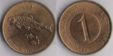
In 1992, coins were introduced in denominations of 10, 20 and 50 stotinov (10, 20 and 50 stotins), 1 tolar, 2 tolarja and 5 tolarjev (2 and 5 tolars). 10 tolarjev (10 tolars) coins were added in 2000, followed by 20 and 50 tolarjev (20 and 50 tolars) in 2003. The obverse designs all show the denomination, with animals native to Slovenia on the reverses.| The Only Series http://www.bsi.si/en/banknotes-and-coins.asp?MapaId=204 | |||||||||||
|---|---|---|---|---|---|---|---|---|---|---|---|
| Image | Value | € equiv. | Technical parameters | Description | Date of | ||||||
| Diameter | Thickness | Mass | Composition | Edge | Obverse | Reverse | first minting | issue | |||
 |
10 stotinov (10 stotins) |
0.04 cent | 16 mm | 1.3 mm | 0.55 g | 98% aluminium Aluminium Aluminium or aluminum is a silvery white member of the boron group of chemical elements. It has the symbol Al, and its atomic number is 13. It is not soluble in water under normal circumstances.... 2% magnesium Magnesium Magnesium is a chemical element with the symbol Mg, atomic number 12, and common oxidation number +2. It is an alkaline earth metal and the eighth most abundant element in the Earth's crust and ninth in the known universe as a whole... |
Plain | Value, state title, year of minting | Olm Olm The olm, or proteus , is a blind amphibian endemic to the subterranean waters of caves of the Dinaric karst of southern Europe. It lives in the waters that flow underground through this extensive limestone region including waters of the Soča river basin near Trieste in Italy, through to southern... , "PROTEUS ANGUINUS" |
29 April 1993 | |
 |
20 stotinov (20 stotins) |
0.08 cent | 18 mm | 1.3 mm | 0.7 g | Long-eared owl Long-eared Owl The Long-eared Owl - Asio otus is a species of owl which breeds in Europe, Asia, and North America. This species is a part of the larger grouping of owls known as typical owls, family Strigidae, which contains most species of owl... , "ASIO OTUS" |
|||||
 |
50 stotinov (50 stotins) |
0.21 cent | 20 mm | 1.3 mm | 0.85 g | Western honey bee, "APIS MELLIFERA" | 4 January 1993 | ||||
 |
1 tolar (1 tolar) |
0.42 cent | 22 mm | 1.7 mm | 4.5 g | 78% copper Copper Copper is a chemical element with the symbol Cu and atomic number 29. It is a ductile metal with very high thermal and electrical conductivity. Pure copper is soft and malleable; an exposed surface has a reddish-orange tarnish... 20% zinc Zinc Zinc , or spelter , is a metallic chemical element; it has the symbol Zn and atomic number 30. It is the first element in group 12 of the periodic table. Zinc is, in some respects, chemically similar to magnesium, because its ion is of similar size and its only common oxidation state is +2... 2% nickel Nickel Nickel is a chemical element with the chemical symbol Ni and atomic number 28. It is a silvery-white lustrous metal with a slight golden tinge. Nickel belongs to the transition metals and is hard and ductile... |
Milled | Value, state title, year of minting | Brown trout Brown trout The brown trout and the sea trout are fish of the same species.... , "SALMO TRUTTA FARIO" |
4 January 1993 | |
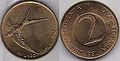 |
2 tolarja (2 tolars) |
0.83 cent | 24 mm | 1.7 mm | 5.4 g | Barn Swallow Barn Swallow The Barn Swallow is the most widespread species of swallow in the world. It is a distinctive passerine bird with blue upperparts, a long, deeply forked tail and curved, pointed wings. It is found in Europe, Asia, Africa and the Americas... , "HIRUNDO RUSTICA" |
|||||
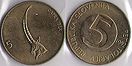 |
5 tolarjev (5 tolars) |
2.09 cent | 26 mm | 1.7 mm | 6.4 g | Alpine Ibex Alpine Ibex The Alpine ibex, , is a species of wild goat that lives in the mountains of the European Alps. In its habitat region, the species is known as bouquetin , steinbock , and stambecco .... , "CAPRA IBEX" |
|||||
| http://www.bsi.si/library/includes/slika.asp?SlikaId=98 | 10 tolarjev (10 tolars) |
4.17 cent | 22 mm | 2 mm | 5.75 g | Cupronickel Cupronickel Cupronickel or copper-nickel or "cupernickel" is an alloy of copper that contains nickel and strengthening elements, such as iron and manganese. Cupronickel is highly resistant to corrosion in seawater, because its electrode potential is adjusted to be neutral with regard to seawater... 75% copper 25% nickel |
Milled | Value, state title, year of minting | Horse Horse The horse is one of two extant subspecies of Equus ferus, or the wild horse. It is a single-hooved mammal belonging to the taxonomic family Equidae. The horse has evolved over the past 45 to 55 million years from a small multi-toed creature into the large, single-toed animal of today... , "EQUUS" |
19 April 2000 | |
| http://www.bsi.si/library/includes/slika.asp?SlikaId=97 | 20 tolarjev (20 tolars) |
8.35 cent | 24 mm | 2 mm | 6.85 g | Waved-edge milled | White Stork White Stork The White Stork is a large bird in the stork family Ciconiidae. Its plumage is mainly white, with black on its wings. Adults have long red legs and long pointed red beaks, and measure on average from beak tip to end of tail, with a wingspan... , "CICONIA CICONIA" |
7 July 2003 | |||
| http://www.bsi.si/library/includes/slika.asp?SlikaId=96 | 50 tolarjev (50 tolars) |
20.86 cent | 26 mm | 2 mm | 8 g | Alternating plain/ milled | Bull Bull Bull usually refers to an uncastrated adult male bovine.Bull may also refer to:-Entertainment:* Bull , an original show on the TNT Network* "Bull" , an episode of television series CSI: Crime Scene Investigation... , "TAURUS TAURUS" |
||||
Banknotes
The first banknotes were provisional payment notes issued on 8 October 1991, in denominations of 0.50, 1, 2, 5, 10, 50, 100, 200, 500, 1000 and 5000 tolarjev. These notes all feature a beeBee
Bees are flying insects closely related to wasps and ants, and are known for their role in pollination and for producing honey and beeswax. Bees are a monophyletic lineage within the superfamily Apoidea, presently classified by the unranked taxon name Anthophila...
on the obverse
Obverse and reverse
Obverse and its opposite, reverse, refer to the two flat faces of coins and some other two-sided objects, including paper money, flags , seals, medals, drawings, old master prints and other works of art, and printed fabrics. In this usage, obverse means the front face of the object and reverse...
and Triglav
Triglav
Triglav is the highest mountain in Slovenia and the highest peak of the Julian Alps. While its name, meaning "three-headed", can describe its shape as seen from the Bohinj area, the mountain was most probably named after the Slavic god Triglav. The mountain is the preeminent symbol of the Slovene...
, the tallest mountain in Slovenia, on the reverse. In 1992, the Bank of Slovenia
Bank of Slovenia
The Bank of Slovenia is the bank of issue and the central bank of the Republic of Slovenia. Based in Ljubljana, it was established on 25 June 1991. Its primary task is to take care of the stability of the domestic currency and to ensure the liquidity of payments within the country and with...
introduced the following banknotes, all of which feature notable Slovenes.
| 1992 Series http://www.bsi.si/en/banknotes-and-coins.asp?MapaId=203 | ||||||||
|---|---|---|---|---|---|---|---|---|
| Image | Value | € equiv. | Dimensions | Main Colour | Description | Date of | ||
| Obverse | Reverse | first printing | issue | |||||
| http://www.bsi.si/library/includes/slika.asp?SlikaId=61 | 10 tolarjev | 0.04 | 120 × 60 mm | Multicolour | Primož Trubar Primož Trubar Primož Trubar or Primož Truber was a Slovene Protestant reformer, the founder and the first superintendent of the Protestant Church of the Slovene Lands, a consolidator of the Slovene language and the author of the first Slovene-language printed book... , the first page of Trubar's Abecedarium Abecedarium (Trubar) Abecedarium —along with Catechismus —is the first printed book in Slovene. It is an eight-page booklet for helping people learn the alphabet. The protestant reformer Primož Trubar had it printed in 1550, with reprints in 1555 and 1566. An improved version of it was also printed by Sebastjan Krelj... |
The Ursuline Church Ursuline Church of the Holy Trinity Ursuline Church of the Holy Trinity is a church in Ljubljana, the capital of Slovenia. It was built between 1718 and 1726 in the Baroque style .... in Ljubljana Ljubljana Ljubljana is the capital of Slovenia and its largest city. It is the centre of the City Municipality of Ljubljana. It is located in the centre of the country in the Ljubljana Basin, and is a mid-sized city of some 270,000 inhabitants... , motif from the New Testament |
15 January 1992 | 27 November 1992 |
| http://www.bsi.si/library/includes/slika.asp?SlikaId=59 | 20 tolarjev | 0.08 | 126 × 63 mm | Janez Vajkard Valvasor Janez Vajkard Valvasor Johann Weichard Freiherr von Valvasor or simply Valvasor was a Slovenian nobleman, scientist and polymath, and a fellow of the Royal Society in London.-Biography:... |
Two angels from Valvasor's book The Glory of the Duchy of Carniola The Glory of the Duchy of Carniola The Glory of the Duchy of Carniola is Johann Weikhard von Valvasor's most important work on history and natural history of his homeland Carniola, a central part of the present-day Slovenia and Istria in Croatia.... , segments of the map of Slovenia |
28 December 1992 | ||
| http://www.bsi.si/library/includes/slika.asp?SlikaId=62 | 50 tolarjev | 0.21 | 132 × 66 mm | Jurij Vega Jurij Vega Baron Jurij Bartolomej Vega was a Slovene mathematician, physicist and artillery officer.-Early life:... , drawing from Vega's "Treatise on the Sphere" |
The Solar System Solar System The Solar System consists of the Sun and the astronomical objects gravitationally bound in orbit around it, all of which formed from the collapse of a giant molecular cloud approximately 4.6 billion years ago. The vast majority of the system's mass is in the Sun... , Slovenian Academy of Sciences and Arts Slovenian Academy of Sciences and Arts The Slovenian Academy of Sciences and Arts is the national academy of Slovenia, which encompasses science and the arts and brings together the top Slovene researchers and artists as members of the academy.... |
19 March 1993 | ||
| http://www.bsi.si/library/includes/slika.asp?SlikaId=63 | 100 tolarjev | 0.42 | 138 × 69 mm | Rihard Jakopič Rihard Jakopic Rihard Jakopič was a Slovenian painter. He was the leading Slovenian Impressionist painter and theoretician. Together with Matej Sternen, Matija Jama and Ivan Grohar, he is considered the pioneer of Slovenian impressionist painting.- Life :Jakopič was born in Ljubljana, then part of the... |
Detail from Jakopič's painting "The Sun", plan of the former Jakopič Pavilion | 30 September 1992 | ||
| http://www.bsi.si/library/includes/slika.asp?SlikaId=64 | 200 tolarjev | 0.83 | 144 × 72 mm | Jacobus Gallus Jacobus Gallus Jacobus Gallus Carniolus was a late Renaissance composer of Slovenian ethnicity... , motif of an organ from the 17th century |
Slovenian Philharmonic Hall | 22 February 1993 | ||
| http://www.bsi.si/library/includes/slika.asp?SlikaId=65 | 500 tolarjev | 2.09 | 150 × 75 mm | Jože Plečnik Jože Plecnik Jože Plečnik , was a Slovene architect who practised in Vienna, Belgrade, Prague and Ljubljana.-Biography:... |
National and University Library of Slovenia National and University Library of Slovenia The National and University Library is one of the most important national educational and cultural institutions of Slovenia. It was established in 1774 by a decree released by the Empress Maria Theresa. It is located in the centre of Ljubljana, in a building designed by the architect Jože Plečnik... |
30 September 1992 | ||
| http://www.bsi.si/library/includes/slika.asp?SlikaId=66 | 1000 tolarjev | 4.17 | 156 × 78 mm | France Prešeren France Prešeren France Prešeren was a Slovene Romantic poet. He is considered the Slovene national poet. Although he was not a particularly prolific author, he inspired virtually all Slovene literature thereafter.... , Prešeren's signature |
Text from the Zdravljica Zdravljica Zdravljica or Zdravica, written in 1844, is a poem by the Slovene Romantic poet France Prešeren, considered the national poet of Slovenes. Since 27 September 1989, its 7th stanza has been the national anthem of Slovenia.... |
|||
| http://www.bsi.si/library/includes/slika.asp?SlikaId=158 | 5000 tolarjev | 20.86 | Ivana Kobilca Ivana Kobilca Ivana Kobilca was a Slovene realist painter who lived, worked and studied in various European cities including Vienna, Sarajevo, Berlin, Paris and Munich. She was a member of Société Nationale des Beaux Arts in Paris. Many of her paintings are still lifes, portraits or country settings... |
National Gallery of Slovenia National Gallery of Slovenia The National Gallery of Slovenia is the national art gallery of Slovenia. It is located in the capital Ljubljana.The Slovenian National Gallery was founded in 1918, after the dissolution of Austria-Hungary and the establishment of the State of Slovenes, Croats and Serbs... , Robba fountain |
1 June 1993 | 13 December 1993 | ||
| http://www.bsi.si/library/includes/slika.asp?SlikaId=71 | 10 000 tolarjev | 41.73 | Ivan Cankar Ivan Cankar Ivan Cankar was a Slovene writer, playwright, essayist, poet and political activist. Together with Oton Župančič, Dragotin Kette, and Josip Murn, he is considered as the beginner of modernism in Slovene literature... , stage plan of the former Theatre of Ljubljana |
Chrysanthemum Chrysanthemum Chrysanthemums, often called mums or chrysanths, are of the genus constituting approximately 30 species of perennial flowering plants in the family Asteraceae which is native to Asia and northeastern Europe.-Etymology:... (Chrysanthemum), Cankar's handwriting |
28 June 1994 | 15 March 1995 | ||
Historical exchange rates
Lower number indicates the tolar has a higher value.- SIT per EUREuroThe euro is the official currency of the eurozone: 17 of the 27 member states of the European Union. It is also the currency used by the Institutions of the European Union. The eurozone consists of Austria, Belgium, Cyprus, Estonia, Finland, France, Germany, Greece, Ireland, Italy, Luxembourg,...
– 233.0 (April 2006); 239.5 (June 2005); 235.7 (November 2003); 227.3 (June 2002). From 1 January 2007 the rate was irrevocably set at 239.640 and has been finalised by the European CommissionEuropean CommissionThe European Commission is the executive body of the European Union. The body is responsible for proposing legislation, implementing decisions, upholding the Union's treaties and the general day-to-day running of the Union....
. - SIT per USDUnited States dollarThe United States dollar , also referred to as the American dollar, is the official currency of the United States of America. It is divided into 100 smaller units called cents or pennies....
– 193.0 (April 2006); 198.0 (June 2005); 201.3 (November 2003); 195.06 (January 2000); 181.77 (1999); 166.13 (1998); 159.69 (1997); 135.36 (1996); 118.52 (1995).
External links
- Banknotes and coins, Bank of Slovenia
- balkanofil.ru/index.php/bills/slovenia/107.html - Catalog and gallery notes Slovenia