

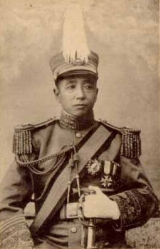
Zhang Zuolin

Encyclopedia
Zhang Zuolin
Zhang Zuolin was the warlord of Manchuria
from 1916 to 1928 (see Warlord Era
in China). He successfully invaded China proper
in October 1924 in the Second Zhili-Fengtian War
. He gained control of Peking, including China
's internationally recognized government, in April 1926. The economy of Manchuria, the basis of Zhang's power, was overtaxed by his adventurism and collapsed in the winter of 1927-1928. Zhang was defeated by the Nationalist Kuomintang
under Chiang Kai-shek
in May 1928. He was killed by a bomb planted by a Japanese Kwantung Army officer on 4 June 1928. Although Zhang had been Japan's proxy in China, Japanese militarists were infuriated by his failure to stop the advance of the Nationalists.
Zhang was fiercely anti-communist and supported restoration of the Qing dynasty
. His nicknames include the "Old Marshal" (大帥), "Rain Marshal" (雨帥)and "Mukden Tiger". The American press referred to him as "Marshal Chang Tso-lin, Tuchun of Manchuria."
province. He was born to poor parents, who can hardly have offered him any formal education, and the only non-military trade that he learned in his lifetime was a small amount of veterinary science. His grandfather had come to the northeast after fleeing a famine in Zhili (modern Hebei
) in 1821.
Growing up as a poor village urchin, Zhang was known by the nickname "pmple". He spent his early youth hunting, fishing, and brawling. He hunted hares in the Manchurian countryside to help feed his family. In appearance he was always thin and rather short.
When he became old enough to seek work, Zhang worked at a stable in an inn, where he became familiar with many bandit-gangs that infested Manchuria at the time. As early as 1896 Zhang himself was a member of a well-known bandit gang. In one version of Zhang Zuolin's beginnings as a warlord, during a hunting trip he spotted a wounded bandit (Honghuzi
) on horseback, killed him, took his horse, and became a bandit himself. By his late 20s he had formed a small personal army, acquiring something of a Robin Hood
reputation.
In 1900 the Boxer Rebellion
broke out, and Zhang's gang joined the imperial army. In peacetime, Zhang hired his men out as escorts for travelling merchants. In the Russo-Japanese war
of 1904-05, the Japanese Army
employed Zhang and his men as mercenaries
. At the end of the Qing dynasty, Zhang managed to have his men recognized as a regiment of the regular Chinese army, patrolling the borders of Manchuria and suppressing other bandit gangs.
, some military commanders wanted to declare independence for Manchuria, but the pro-Manchu governor used Zhang's regiment to set up a "Manchurian People's Peacekeeping Council", intimidating would-be rebels and revolutionaries. For his efforts in preventing civil disturbance and revolution, Zhang was named the Vice Minister of Military Affairs.
On January 1 1912, Sun Yat-sen
became the first President of the Republic of China
in Nanjing
. Yuan Shikai
, operating out of Beijing
, sent other northern military commanders a series of telegrams, advising them to oppose Sun's administration. To gain Zhang's loyaqlty, Yuan sent Zhang a large shipment of military provisions; Zhang sent Yuan an enormous (and costly) ginseng
root in return to symbolize their friendship. Zhang then murdered a number of leading figures in his base city of Shenyang
(then known as "Mukden"), and was rewarded with a series of impressive-sounding titles by the nearly defunct Manchu
court. When it became obvious to Zhang that Yuan would usurp control of the central government, Zhang endorsed Yuan's rule over that of either Sun or the Manchus. After Zhang put down a rebellion in June 1912, Yuan raised him to the rank of Lieutenant-General. In 1913 Yuan attempted to move Zhang away from Manchuria by having Zhang transferred to Mongolia
, but Zhang reminded Yuan of his successful efforts to keep local order, and refused.
In 1915, when it became clear that Yuan intended to declare himself emperor, Zhang was one of the few officials who supported Yuan. Besides political opportunism, Zhang probably recognizing that Yuan's monarchy would likely be short, and that it could always be attacked later. Because Zhang Zuolin's main rival for power in Manchuria, Zhang Xiluan, when asked about Yuan's ambitions, had told Yuan to "think about it a bit more", Zhang Xiluan was recalled to Beijing, while Zhang Zuolin was promoted.
In March 1916, after many southern provinces revolted against Yuan Shikai's government, Zhang supported Yuan but expelled a local military governor sent by Duan Qirui
to replace him, with some support from local Japanese officers in the Kwangtung Army. Beijing accepted Zhang's authority, and Yuan appointed Zhang superintendent of military affairs in Liaoning
(known as "Fengtian" until 1929). After Yuan died, in June 1916, the new central government named Zhang both military and civil governor of Liaoning, the essential components of a successful warlord.
Zhang, a monarchist, had always remained cordial with Puyi
, the last Emperor of China
, and had sent him a gift of £1,600 for his wedding as a token of loyalty. In 1917 he plotted with Zhang Xun
, a Qing-loyalist general, to restore the abdicated Puyi to the throne. After Zhang Xun rebelled, Zhang Zuolin remained neutral, and actually supported Duan Qirui in suppressing Zhang Xun after it became clear that Duan would win. Zhang was able to absorb soldiers of nearby commanders who had been linked to the rebellion, increasing his own power. Zhang intervened and took control of China's northernmost province, Heilongjiang
, after a rebellion there forced the local governor to flee. Because the governor of Jilin
had been linked to the attempt to restore the monarchy, Zhang had allies from Jilin successfully agitate for the governor's dismissal in Beijing. By 1918 Zhang's control of Manchuria was complete, except for the small areas held by the Japanese Empire.
His power rested on the Fengtian Army, which was composed of about 100,000 men by 1922 and almost triple that number by the end of the decade. It had obtained large stocks of weapons left over from World War I, and even included naval units, an air force, and an armaments industry. Zhang integrated a large number of local militias in his Army, and thus prevented Manchuria from falling into the chaos which reigned in China proper
at this time. Jilin province was ruled by a military governor, who was said to be a cousin of Zhang; Heilongjiang
had its own regional warlord, who never displayed any ambitions outside the province.
Although Manchuria officially remained a part of the Republic of China
, it became more or less an independent kingdom isolated from China by its geography and protected by the Fengtian Army. The only pass at Shanhaiguan
, where the Great Wall meets the sea, could easily be closed. In a time when the Central Government was hardly able to pay the salaries of its civil servants, no more revenues were forwarded to Beijing
. In 1922 Zhang took control of the only rail link, the Beijing-Shenyang Railway, north of the Great Wall and also kept these revenues. Only postal and customs revenues were continued to be sent to Beijing, because they had been pledged to the victorious foreign powers after the failed Boxer rebellion
of 1900, and Zhang feared their intervention.
, which had been weakened militarily after the October Revolution
. The line of the Chinese Eastern Railway
, which was under Russian control, ran through northern Manchuria, and the land immediately on either side of the tracks was considered to be Russian territory. From 1917 to about 1924 the new Communist governmentin Moscow was having such difficulties establishing itself in Siberia
that often it wasn't clear, who was in charge of operating the railway on the Russian side. Still, Zhang avoided a showdown, and after 1924, the Russians managed to re-establish their dominance over the railroad.
How precarious the situation could develop at times was demonstrated by an outbreak of pneumonic plague
in Hailar
, a town at the western end of the Chinese Eastern Railway, in October 1920 . Chinese troops were present in great number and turned railway quarantine into a farce. The soldiers set free some of their comrades who had been imprisoned as contacts, and they escaped to the mining town of Dalainor on the Amur River, where a quarter of the population succumbed. In the other direction all the towns along the Chinese Eastern Railway as far as Vladivostok
were infected. In all, about 9,000 died, on the other hand only a few contacts were able to reach south Manchuria.
The Japanese posed more of a problem. After the Russo-Japanese war of 1904-05 they had gained two important outposts in south Manchuria: The Guandong (Kwantung) Leased Territory
consisted of a 218 square miles (564.6 km²) peninsula in the southernmost part of Manchuria. It included the ice-free port of Dairen
(known as Dalian in Chinese), which became the main link to Japan. Reaching northward from the colony the South Manchurian Railway passed through Shenyang
(referred to as Mukden by the Japanese) linking up with the Chinese Eastern Railway in Changchun
. The land on either side of the railway tracks remained extraterritorial, now being controlled by the Japanese Kwantung Army. This army maintained from 7,000 to 14,000 men in Manchuria tolerating and being tolerated by the Fengtian Army although Zhang kept up a war of words, playing on anti-Japanese sentiments in the Chinese public.
A number of currencies were circulating in the province, as was the custom in China, and the paper notes issued by the provincial government had experienced a steady depreciation in value. Wang decided to switch to a silver standard
and set the initial value of the new silver
yuan equal to the Japanese gold yen, which was accepted throughout Korea
and Manchuria. Much to the surprise of the Chinese the new currency even gained in value against the gold yen, although Japanese businessmen claimed that it was not backed up by sufficient silver reserves. Wang then used the newly gained credibility to introduce another note, the Fengtian dollar, which was not convertible into silver anymore. But it was accepted by the government for the payment of taxes, a sign that the government had faith in its own currency.
Next Wang turned to the chaotic tax collecting system. Because of his former job he was well acquainted with the abuses of the system and introduced a number of controls. The provincial government had also invested government funds in various enterprises, many of which were poorly managed. Wang ordered a total review of government sponsored firms. Since 1918 the revenues rose steadily, by 1921 all outstanding loans had been repaid and there was even a budget surplus. Wang was rewarded by being appointed as Civil Governor of Fengtian province while remaining Director of the Bureau of Finance. Zhang retained the title of Military Governor of Fengtian. Still, more than two thirds of the budget were allocated to the military.
, the leading warlord of Beijing. He did this by supporting another warlord, Cao Kun
, with troops, and they both successfully ousted Duan. As a reward Zhang was granted control over most of inner Mongolia to the west of Manchuria. Zhang had become a figure of national prominence. But he was confronted by Wu Peifu
, a divisional commander of the North China Zhili clique, which was based in the province of Zhili that surrounded Beijing. In spring 1922 Zhang personally took the position of Commander-in-Chief of the Fengtian Army, and on 19 April his forces entered into China proper. Fighting started three days later, and on 4 May they were seriously defeated by the Zhili Army in what came to be known as the First Zhili-Fengtian War
. 3,000 troops had been killed and 7,000 wounded, so that Zhang's units had to retreat to Shanhaiguan Pass. Zhili forces were in control of Beijing, Zhang's image as a national leader had been destroyed, and he reacted by declaring Manchuria independent from Beijing in May 1922.
Manchuria's top civil official, Wang, left Shenyang on 22 June for Japanese controlled Dalian allegedly for treatment of an eye infection that troubled him. From there he challenged Zhang by demanding restrictions to military spending and a complete control over civil affairs. Zhang, one of China's most feared warlords, gave in, lifted martial law and agreed to a separation of civil and military administration in all of the three provinces. Wang returned on 6 August thereby guaranteeing Manchuria's continued stability.
Manchuria's economy boomed while chaos and uncertainty reigned in the rest of China. An especially ambitious project was to break the Japanese monopoly on cotton textiles by creating a large mill, which, much to Japan's sorrow, succeeded. The government also invested in other enterprises, among them quite a number of Sino-Japanese companies. During this time the Fengtian Army successfully kept a lid on Manchuria's many bandits. Various railway lines were built, among them the Shenyang-Hailong line, which opened in 1925. In 1924 Wang amalgamated three regional banks into the Official Bank of the Three Eastern Provinces and personally became its General Director. By this move he tried to create a development bank and at the same time to keep accurate records of military spending.
, Zhang attacked North China. The Second Zhili-Fengtian War
had begun. In a surprise move a Zhili commander, Feng Yuxiang
, toppled Cao Kun and took control of Beijing. He shared power with Zhang and both appointed the same Duan Qirui he had ousted in 1920. By August 1925, the Fengtian Army controlled four large provinces within the Great Wall (Zhili, where Beijing was located, but not Beijing itself, Shandong
, Jiangsu
, and Anhui
). One unit even marched as far south as the city of Shanghai
. But the military situation was so unstable, that Sun Chuanfang
, a Zhili clique warlord whose sphere of influence extended along the Yangtze, managed to push back the Fengtian Army again. By November, Zhang held only a small corner of North China including a corridor connecting Beijing with Manchuria. Attacks on Beijing continued into the spring of 1926.
Manchuria was placed under martial law again, while its economy disintegrated under the burden of the insatiable war machine. Old taxes were increased and new taxes invented. Zhang demanded that more paper money was being printed out of step with silver reserves. A most serious crisis erupted when in November 1925 Guo Songling
revolted and ordered his troops to turn back and march on Shenyang. The Japanese brought in reinforcements to protect their interests in Manchuria, but Zhang managed to put down the revolt in December. Even more seriously, Manchuria's top civil official, Civil Governor Wang Yongjiang, realized that his work of nine years had been in vain. He left Shenyang in February 1926 and handed in his resignation. This time he didn't react, when Zhang asked him to return. Wang died from kidney failure 1 November 1927.
 In March 1926 a new civil governor was appointed. His only job was to supply the Fengtian Army with large amounts of money. He issued new provincial bonds, forcing business and local communities to purchase them. Early in 1927 he even entered into the opium
trade by selling expensive licenses for the sale and use of opium. Bank reserves and railway revenues were plundered, while ever more paper notes were issued. The best indicator of Manchuria's economic decline was the value of the Fengtian dollar (yuan), which had started on parity with the Japanese gold yen. In February 1928 a yen cost 40 yuan. In this winter Manchuria's economy collapsed. Workers went on strike, hungry immigrants flooded back into Shenyang because they couldn't find any work.
In June 1926 Zhang had managed to capture Beijing. A year later he proclaimed himself as Grand Marshal of the Republic of China, and thus led China's internationally recognized government. But the Nationalists, led by Chiang Kai-shek
attacked his forces and in May 1928 the Fengtian Army had to retreat towards Beijing. In addition, Japan applied pressure on Zhang to leave Beijing and return to Manchuria, and underscored this by bringing reinforcements to Tianjin
. Zhang left Beijing on 3 June 1928.
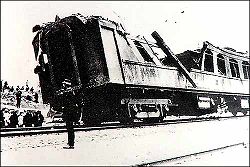
The next morning his train reached the outskirts of Shenyang. Here, the line passed underneath the Japanese operated South Manchuria Railroad. An officer of the Japanese Guandong (Kwantung) Army, Colonel Kōmoto Daisaku, had planted a bomb, which exploded when Zhang's train passed under the viaduct. At the Tokyo War Crimes Tribunal in 1946, Okada Keisuke testified that Zhang was murdered because the Guandong (Kwantung) army was infuriated by his failure to stop Chiang's army, which was backed by Moscow, then Tokyo's strategic rival. For two weeks Zhang's death was kept secret, while the scramble for power was decided. That is why, according to an announcement issued by the Fengtian Army, he officially died on 21 June 1928. Zhang was succeeded by the eldest son of his official wife, Zhang Xueliang
.
Zhang Zuolin was the warlord of Manchuria
Manchuria
Manchuria is a historical name given to a large geographic region in northeast Asia. Depending on the definition of its extent, Manchuria usually falls entirely within the People's Republic of China, or is sometimes divided between China and Russia. The region is commonly referred to as Northeast...
from 1916 to 1928 (see Warlord Era
Warlord era
The Chinese Warlord Era was the period in the history of the Republic of China, from 1916 to 1928, when the country was divided among military cliques, a division that continued until the fall of the Nationalist government in the mainland China regions of Sichuan, Shanxi, Qinghai, Ningxia,...
in China). He successfully invaded China proper
China proper
China proper or Eighteen Provinces was a term used by Western writers on the Qing Dynasty to express a distinction between the core and frontier regions of China. There is no fixed extent for China proper, as many administrative, cultural, and linguistic shifts have occurred in Chinese history...
in October 1924 in the Second Zhili-Fengtian War
Second Zhili-Fengtian War
The Second Zhili–Fengtian War of 1924 was a conflict between the Japanese-backed Fengtian clique based in Manchuria, and the more liberal Zhili clique controlling Beijing and backed by Anglo-American business interests...
. He gained control of Peking, including China
Republic of China
The Republic of China , commonly known as Taiwan , is a unitary sovereign state located in East Asia. Originally based in mainland China, the Republic of China currently governs the island of Taiwan , which forms over 99% of its current territory, as well as Penghu, Kinmen, Matsu and other minor...
's internationally recognized government, in April 1926. The economy of Manchuria, the basis of Zhang's power, was overtaxed by his adventurism and collapsed in the winter of 1927-1928. Zhang was defeated by the Nationalist Kuomintang
Kuomintang
The Kuomintang of China , sometimes romanized as Guomindang via the Pinyin transcription system or GMD for short, and translated as the Chinese Nationalist Party is a founding and ruling political party of the Republic of China . Its guiding ideology is the Three Principles of the People, espoused...
under Chiang Kai-shek
Chiang Kai-shek
Chiang Kai-shek was a political and military leader of 20th century China. He is known as Jiǎng Jièshí or Jiǎng Zhōngzhèng in Mandarin....
in May 1928. He was killed by a bomb planted by a Japanese Kwantung Army officer on 4 June 1928. Although Zhang had been Japan's proxy in China, Japanese militarists were infuriated by his failure to stop the advance of the Nationalists.
Zhang was fiercely anti-communist and supported restoration of the Qing dynasty
Qing Dynasty
The Qing Dynasty was the last dynasty of China, ruling from 1644 to 1912 with a brief, abortive restoration in 1917. It was preceded by the Ming Dynasty and followed by the Republic of China....
. His nicknames include the "Old Marshal" (大帥), "Rain Marshal" (雨帥)and "Mukden Tiger". The American press referred to him as "Marshal Chang Tso-lin, Tuchun of Manchuria."
Early life
Zhang was born in 1875 in Haicheng county in southern FengtianLiaoning
' is a province of the People's Republic of China, located in the northeast of the country. Its one-character abbreviation is "辽" , a name taken from the Liao River that flows through the province. "Níng" means "peace"...
province. He was born to poor parents, who can hardly have offered him any formal education, and the only non-military trade that he learned in his lifetime was a small amount of veterinary science. His grandfather had come to the northeast after fleeing a famine in Zhili (modern Hebei
Hebei
' is a province of the People's Republic of China in the North China region. Its one-character abbreviation is "" , named after Ji Province, a Han Dynasty province that included what is now southern Hebei...
) in 1821.
Growing up as a poor village urchin, Zhang was known by the nickname "pmple". He spent his early youth hunting, fishing, and brawling. He hunted hares in the Manchurian countryside to help feed his family. In appearance he was always thin and rather short.
When he became old enough to seek work, Zhang worked at a stable in an inn, where he became familiar with many bandit-gangs that infested Manchuria at the time. As early as 1896 Zhang himself was a member of a well-known bandit gang. In one version of Zhang Zuolin's beginnings as a warlord, during a hunting trip he spotted a wounded bandit (Honghuzi
Honghuzi
Honghuzi were armed robbers, bandits in the areas of the eastern Russia-China borderland: Southeastern Siberia, Russian Far East, and Northeast China . the word has been variously transliterated as hong huzi, hong hu zi, hunghutze, hun-hutze, etc...
) on horseback, killed him, took his horse, and became a bandit himself. By his late 20s he had formed a small personal army, acquiring something of a Robin Hood
Robin Hood
Robin Hood was a heroic outlaw in English folklore. A highly skilled archer and swordsman, he is known for "robbing from the rich and giving to the poor", assisted by a group of fellow outlaws known as his "Merry Men". Traditionally, Robin Hood and his men are depicted wearing Lincoln green clothes....
reputation.
In 1900 the Boxer Rebellion
Boxer Rebellion
The Boxer Rebellion, also called the Boxer Uprising by some historians or the Righteous Harmony Society Movement in northern China, was a proto-nationalist movement by the "Righteous Harmony Society" , or "Righteous Fists of Harmony" or "Society of Righteous and Harmonious Fists" , in China between...
broke out, and Zhang's gang joined the imperial army. In peacetime, Zhang hired his men out as escorts for travelling merchants. In the Russo-Japanese war
Russo-Japanese War
The Russo-Japanese War was "the first great war of the 20th century." It grew out of rival imperial ambitions of the Russian Empire and Japanese Empire over Manchuria and Korea...
of 1904-05, the Japanese Army
Imperial Japanese Army
-Foundation:During the Meiji Restoration, the military forces loyal to the Emperor were samurai drawn primarily from the loyalist feudal domains of Satsuma and Chōshū...
employed Zhang and his men as mercenaries
Mercenary
A mercenary, is a person who takes part in an armed conflict based on the promise of material compensation rather than having a direct interest in, or a legal obligation to, the conflict itself. A non-conscript professional member of a regular army is not considered to be a mercenary although he...
. At the end of the Qing dynasty, Zhang managed to have his men recognized as a regiment of the regular Chinese army, patrolling the borders of Manchuria and suppressing other bandit gangs.
Growth of power in Manchuria
During the 1911 Xinhai RevolutionXinhai Revolution
The Xinhai Revolution or Hsinhai Revolution, also known as Revolution of 1911 or the Chinese Revolution, was a revolution that overthrew China's last imperial dynasty, the Qing , and established the Republic of China...
, some military commanders wanted to declare independence for Manchuria, but the pro-Manchu governor used Zhang's regiment to set up a "Manchurian People's Peacekeeping Council", intimidating would-be rebels and revolutionaries. For his efforts in preventing civil disturbance and revolution, Zhang was named the Vice Minister of Military Affairs.
On January 1 1912, Sun Yat-sen
Sun Yat-sen
Sun Yat-sen was a Chinese doctor, revolutionary and political leader. As the foremost pioneer of Nationalist China, Sun is frequently referred to as the "Father of the Nation" , a view agreed upon by both the People's Republic of China and the Republic of China...
became the first President of the Republic of China
Republic of China
The Republic of China , commonly known as Taiwan , is a unitary sovereign state located in East Asia. Originally based in mainland China, the Republic of China currently governs the island of Taiwan , which forms over 99% of its current territory, as well as Penghu, Kinmen, Matsu and other minor...
in Nanjing
Nanjing
' is the capital of Jiangsu province in China and has a prominent place in Chinese history and culture, having been the capital of China on several occasions...
. Yuan Shikai
Yuan Shikai
Yuan Shikai was an important Chinese general and politician famous for his influence during the late Qing Dynasty, his role in the events leading up to the abdication of the last Qing Emperor of China, his autocratic rule as the second President of the Republic of China , and his short-lived...
, operating out of Beijing
Beijing
Beijing , also known as Peking , is the capital of the People's Republic of China and one of the most populous cities in the world, with a population of 19,612,368 as of 2010. The city is the country's political, cultural, and educational center, and home to the headquarters for most of China's...
, sent other northern military commanders a series of telegrams, advising them to oppose Sun's administration. To gain Zhang's loyaqlty, Yuan sent Zhang a large shipment of military provisions; Zhang sent Yuan an enormous (and costly) ginseng
Ginseng
Ginseng is any one of eleven species of slow-growing perennial plants with fleshy roots, belonging to the genus Panax of the family Araliaceae....
root in return to symbolize their friendship. Zhang then murdered a number of leading figures in his base city of Shenyang
Shenyang
Shenyang , or Mukden , is the capital and largest city of Liaoning Province in Northeast China. Currently holding sub-provincial administrative status, the city was once known as Shengjing or Fengtianfu...
(then known as "Mukden"), and was rewarded with a series of impressive-sounding titles by the nearly defunct Manchu
Manchu
The Manchu people or Man are an ethnic minority of China who originated in Manchuria . During their rise in the 17th century, with the help of the Ming dynasty rebels , they came to power in China and founded the Qing Dynasty, which ruled China until the Xinhai Revolution of 1911, which...
court. When it became obvious to Zhang that Yuan would usurp control of the central government, Zhang endorsed Yuan's rule over that of either Sun or the Manchus. After Zhang put down a rebellion in June 1912, Yuan raised him to the rank of Lieutenant-General. In 1913 Yuan attempted to move Zhang away from Manchuria by having Zhang transferred to Mongolia
Inner Mongolia
Inner Mongolia is an autonomous region of the People's Republic of China, located in the northern region of the country. Inner Mongolia shares an international border with the countries of Mongolia and the Russian Federation...
, but Zhang reminded Yuan of his successful efforts to keep local order, and refused.
In 1915, when it became clear that Yuan intended to declare himself emperor, Zhang was one of the few officials who supported Yuan. Besides political opportunism, Zhang probably recognizing that Yuan's monarchy would likely be short, and that it could always be attacked later. Because Zhang Zuolin's main rival for power in Manchuria, Zhang Xiluan, when asked about Yuan's ambitions, had told Yuan to "think about it a bit more", Zhang Xiluan was recalled to Beijing, while Zhang Zuolin was promoted.
In March 1916, after many southern provinces revolted against Yuan Shikai's government, Zhang supported Yuan but expelled a local military governor sent by Duan Qirui
Duan Qirui
Duan Qirui was a Chinese warlord and politician, commander in the Beiyang Army, and the Provisional Chief Executive of Republic of China from November 24, 1924 to April 20, 1926. He was arguably the most powerful man in China from 1916 to 1920.- Early life :Born in Hefei as Duan Qirui , his...
to replace him, with some support from local Japanese officers in the Kwangtung Army. Beijing accepted Zhang's authority, and Yuan appointed Zhang superintendent of military affairs in Liaoning
Liaoning
' is a province of the People's Republic of China, located in the northeast of the country. Its one-character abbreviation is "辽" , a name taken from the Liao River that flows through the province. "Níng" means "peace"...
(known as "Fengtian" until 1929). After Yuan died, in June 1916, the new central government named Zhang both military and civil governor of Liaoning, the essential components of a successful warlord.
Zhang, a monarchist, had always remained cordial with Puyi
Puyi
Puyi , of the Manchu Aisin Gioro clan, was the last Emperor of China, and the twelfth and final ruler of the Qing Dynasty. He ruled as the Xuantong Emperor from 1908 until his abdication on 12 February 1912. From 1 to 12 July 1917 he was briefly restored to the throne as a nominal emperor by the...
, the last Emperor of China
Emperor of China
The Emperor of China refers to any sovereign of Imperial China reigning between the founding of Qin Dynasty of China, united by the King of Qin in 221 BCE, and the fall of Yuan Shikai's Empire of China in 1916. When referred to as the Son of Heaven , a title that predates the Qin unification, the...
, and had sent him a gift of £1,600 for his wedding as a token of loyalty. In 1917 he plotted with Zhang Xun
Zhang Xun (Republic of China)
Zhang Xun was a Qing-loyalist general who attempted to restore the abdicated emperor Puyi in 1917. He supported Yuan Shikai during his time as president....
, a Qing-loyalist general, to restore the abdicated Puyi to the throne. After Zhang Xun rebelled, Zhang Zuolin remained neutral, and actually supported Duan Qirui in suppressing Zhang Xun after it became clear that Duan would win. Zhang was able to absorb soldiers of nearby commanders who had been linked to the rebellion, increasing his own power. Zhang intervened and took control of China's northernmost province, Heilongjiang
Heilongjiang
For the river known in Mandarin as Heilong Jiang, see Amur River' is a province of the People's Republic of China located in the northeastern part of the country. "Heilongjiang" literally means Black Dragon River, which is the Chinese name for the Amur. The one-character abbreviation is 黑...
, after a rebellion there forced the local governor to flee. Because the governor of Jilin
Jilin
Jilin , is a province of the People's Republic of China located in the northeastern part of the country. Jilin borders North Korea and Russia to the east, Heilongjiang to the north, Liaoning to the south, and Inner Mongolia to the west...
had been linked to the attempt to restore the monarchy, Zhang had allies from Jilin successfully agitate for the governor's dismissal in Beijing. By 1918 Zhang's control of Manchuria was complete, except for the small areas held by the Japanese Empire.
Fortress Manchuria
In 1920, when he had passed his mid-40s, Zhang was the supreme ruler of Manchuria. The Central Government acknowledged this fact by appointing him to be Governor-General of the Three Eastern Provinces. He started to surround himself in luxury, built a chateau-style home near Shenyang, and had at least five wives (an accepted practice of any powerful or wealthy Chinese at the time). In 1925, his personal fortune was estimated at over 18 million yuan (roughly 2.6 million USD).His power rested on the Fengtian Army, which was composed of about 100,000 men by 1922 and almost triple that number by the end of the decade. It had obtained large stocks of weapons left over from World War I, and even included naval units, an air force, and an armaments industry. Zhang integrated a large number of local militias in his Army, and thus prevented Manchuria from falling into the chaos which reigned in China proper
China proper
China proper or Eighteen Provinces was a term used by Western writers on the Qing Dynasty to express a distinction between the core and frontier regions of China. There is no fixed extent for China proper, as many administrative, cultural, and linguistic shifts have occurred in Chinese history...
at this time. Jilin province was ruled by a military governor, who was said to be a cousin of Zhang; Heilongjiang
Heilongjiang
For the river known in Mandarin as Heilong Jiang, see Amur River' is a province of the People's Republic of China located in the northeastern part of the country. "Heilongjiang" literally means Black Dragon River, which is the Chinese name for the Amur. The one-character abbreviation is 黑...
had its own regional warlord, who never displayed any ambitions outside the province.
Although Manchuria officially remained a part of the Republic of China
Republic of China
The Republic of China , commonly known as Taiwan , is a unitary sovereign state located in East Asia. Originally based in mainland China, the Republic of China currently governs the island of Taiwan , which forms over 99% of its current territory, as well as Penghu, Kinmen, Matsu and other minor...
, it became more or less an independent kingdom isolated from China by its geography and protected by the Fengtian Army. The only pass at Shanhaiguan
Shanhaiguan District
Shanhaiguan District is a district of the city of Qinhuangdao, Hebei province, People's Republic of China, named after the pass of the Great Wall within the district, Shanhai Pass...
, where the Great Wall meets the sea, could easily be closed. In a time when the Central Government was hardly able to pay the salaries of its civil servants, no more revenues were forwarded to Beijing
Beijing
Beijing , also known as Peking , is the capital of the People's Republic of China and one of the most populous cities in the world, with a population of 19,612,368 as of 2010. The city is the country's political, cultural, and educational center, and home to the headquarters for most of China's...
. In 1922 Zhang took control of the only rail link, the Beijing-Shenyang Railway, north of the Great Wall and also kept these revenues. Only postal and customs revenues were continued to be sent to Beijing, because they had been pledged to the victorious foreign powers after the failed Boxer rebellion
Boxer Rebellion
The Boxer Rebellion, also called the Boxer Uprising by some historians or the Righteous Harmony Society Movement in northern China, was a proto-nationalist movement by the "Righteous Harmony Society" , or "Righteous Fists of Harmony" or "Society of Righteous and Harmonious Fists" , in China between...
of 1900, and Zhang feared their intervention.
Japanese and Russian influences
Manchuria shared a long border with RussiaRussia
Russia or , officially known as both Russia and the Russian Federation , is a country in northern Eurasia. It is a federal semi-presidential republic, comprising 83 federal subjects...
, which had been weakened militarily after the October Revolution
October Revolution
The October Revolution , also known as the Great October Socialist Revolution , Red October, the October Uprising or the Bolshevik Revolution, was a political revolution and a part of the Russian Revolution of 1917...
. The line of the Chinese Eastern Railway
Chinese Eastern Railway
The Chinese Eastern Railway or was a railway in northeastern China . It connected Chita and the Russian Far East. English-speakers have sometimes referred to this line as the Manchurian Railway...
, which was under Russian control, ran through northern Manchuria, and the land immediately on either side of the tracks was considered to be Russian territory. From 1917 to about 1924 the new Communist governmentin Moscow was having such difficulties establishing itself in Siberia
Siberia
Siberia is an extensive region constituting almost all of Northern Asia. Comprising the central and eastern portion of the Russian Federation, it was part of the Soviet Union from its beginning, as its predecessor states, the Tsardom of Russia and the Russian Empire, conquered it during the 16th...
that often it wasn't clear, who was in charge of operating the railway on the Russian side. Still, Zhang avoided a showdown, and after 1924, the Russians managed to re-establish their dominance over the railroad.
How precarious the situation could develop at times was demonstrated by an outbreak of pneumonic plague
Bubonic plague
Plague is a deadly infectious disease that is caused by the enterobacteria Yersinia pestis, named after the French-Swiss bacteriologist Alexandre Yersin. Primarily carried by rodents and spread to humans via fleas, the disease is notorious throughout history, due to the unrivaled scale of death...
in Hailar
Hailar
Hailar may refer to:* Hailar River, part of the Russia-China border* Hailar District, district in Inner Mongolia, China...
, a town at the western end of the Chinese Eastern Railway, in October 1920 . Chinese troops were present in great number and turned railway quarantine into a farce. The soldiers set free some of their comrades who had been imprisoned as contacts, and they escaped to the mining town of Dalainor on the Amur River, where a quarter of the population succumbed. In the other direction all the towns along the Chinese Eastern Railway as far as Vladivostok
Vladivostok
The city is located in the southern extremity of Muravyov-Amursky Peninsula, which is about 30 km long and approximately 12 km wide.The highest point is Mount Kholodilnik, the height of which is 257 m...
were infected. In all, about 9,000 died, on the other hand only a few contacts were able to reach south Manchuria.
The Japanese posed more of a problem. After the Russo-Japanese war of 1904-05 they had gained two important outposts in south Manchuria: The Guandong (Kwantung) Leased Territory
Kwantung Leased Territory
The Kwantung Leased Territory was a territory in the southern part of the Liaodong Peninsula in Inner Manchuria that existed from 1898 to 1945. It was one of the numerous territorial concessions that the Empire of China was compelled to award to foreign countries at the end of the 19th century...
consisted of a 218 square miles (564.6 km²) peninsula in the southernmost part of Manchuria. It included the ice-free port of Dairen
Dalian
Dalian is a major city and seaport in the south of Liaoning province, Northeast China. It faces Shandong to the south, the Yellow Sea to the east and the Bohai Sea to the west and south. Holding sub-provincial administrative status, Dalian is the southernmost city of Northeast China and China's...
(known as Dalian in Chinese), which became the main link to Japan. Reaching northward from the colony the South Manchurian Railway passed through Shenyang
Shenyang
Shenyang , or Mukden , is the capital and largest city of Liaoning Province in Northeast China. Currently holding sub-provincial administrative status, the city was once known as Shengjing or Fengtianfu...
(referred to as Mukden by the Japanese) linking up with the Chinese Eastern Railway in Changchun
Changchun
Changchun is the capital and largest city of Jilin province, located in the northeast of the People's Republic of China, in the center of the Songliao Plain. It is administered as a sub-provincial city with a population of 7,677,089 at the 2010 census under its jurisdiction, including counties and...
. The land on either side of the railway tracks remained extraterritorial, now being controlled by the Japanese Kwantung Army. This army maintained from 7,000 to 14,000 men in Manchuria tolerating and being tolerated by the Fengtian Army although Zhang kept up a war of words, playing on anti-Japanese sentiments in the Chinese public.
Civil reform
At the beginning of the 1920s Zhang transformed Manchuria from an unimportant frontier region to one of the most prosperous parts of China. He had inherited a financially weak provincial government, e.g. in 1917 Fengtian faced ten outstanding loans from foreign-controlled consortia and banks totaling over 12 million yuan. Zhang chose Wang Yongjiang, who had served as head of a regional tax office, for the task of solving Fengtian's financial problems. He was named Director of the Bureau of Finance.A number of currencies were circulating in the province, as was the custom in China, and the paper notes issued by the provincial government had experienced a steady depreciation in value. Wang decided to switch to a silver standard
Silver standard
The silver standard is a monetary system in which the standard economic unit of account is a fixed weight of silver. The silver specie standard was widespread from the fall of the Byzantine Empire until the 19th century...
and set the initial value of the new silver
Silver
Silver is a metallic chemical element with the chemical symbol Ag and atomic number 47. A soft, white, lustrous transition metal, it has the highest electrical conductivity of any element and the highest thermal conductivity of any metal...
yuan equal to the Japanese gold yen, which was accepted throughout Korea
Korea
Korea ) is an East Asian geographic region that is currently divided into two separate sovereign states — North Korea and South Korea. Located on the Korean Peninsula, Korea is bordered by the People's Republic of China to the northwest, Russia to the northeast, and is separated from Japan to the...
and Manchuria. Much to the surprise of the Chinese the new currency even gained in value against the gold yen, although Japanese businessmen claimed that it was not backed up by sufficient silver reserves. Wang then used the newly gained credibility to introduce another note, the Fengtian dollar, which was not convertible into silver anymore. But it was accepted by the government for the payment of taxes, a sign that the government had faith in its own currency.
Next Wang turned to the chaotic tax collecting system. Because of his former job he was well acquainted with the abuses of the system and introduced a number of controls. The provincial government had also invested government funds in various enterprises, many of which were poorly managed. Wang ordered a total review of government sponsored firms. Since 1918 the revenues rose steadily, by 1921 all outstanding loans had been repaid and there was even a budget surplus. Wang was rewarded by being appointed as Civil Governor of Fengtian province while remaining Director of the Bureau of Finance. Zhang retained the title of Military Governor of Fengtian. Still, more than two thirds of the budget were allocated to the military.
War in north China
In the summer of 1920 Zhang made a foray into north China on the other side of the Great Wall trying to topple Duan QiruiDuan Qirui
Duan Qirui was a Chinese warlord and politician, commander in the Beiyang Army, and the Provisional Chief Executive of Republic of China from November 24, 1924 to April 20, 1926. He was arguably the most powerful man in China from 1916 to 1920.- Early life :Born in Hefei as Duan Qirui , his...
, the leading warlord of Beijing. He did this by supporting another warlord, Cao Kun
Cao Kun
|-...
, with troops, and they both successfully ousted Duan. As a reward Zhang was granted control over most of inner Mongolia to the west of Manchuria. Zhang had become a figure of national prominence. But he was confronted by Wu Peifu
Wu Peifu
Wu Peifu or Wu P'ei-fu , was a major figure in the struggles between the warlords who dominated Republican China from 1916 to 1927.- Early career :...
, a divisional commander of the North China Zhili clique, which was based in the province of Zhili that surrounded Beijing. In spring 1922 Zhang personally took the position of Commander-in-Chief of the Fengtian Army, and on 19 April his forces entered into China proper. Fighting started three days later, and on 4 May they were seriously defeated by the Zhili Army in what came to be known as the First Zhili-Fengtian War
First Zhili-Fengtian War
The First Zhili–Fengtian War was a 1922 conflict in the Republic of China's Warlord Era between the Zhili and Fengtian cliques for control of Beijing. The war led to the defeat of the Fengtian clique and the fall of its leader, Zhang Zuolin, from the coalition Zhili-Fengtian government in Beijing...
. 3,000 troops had been killed and 7,000 wounded, so that Zhang's units had to retreat to Shanhaiguan Pass. Zhili forces were in control of Beijing, Zhang's image as a national leader had been destroyed, and he reacted by declaring Manchuria independent from Beijing in May 1922.
Manchuria's top civil official, Wang, left Shenyang on 22 June for Japanese controlled Dalian allegedly for treatment of an eye infection that troubled him. From there he challenged Zhang by demanding restrictions to military spending and a complete control over civil affairs. Zhang, one of China's most feared warlords, gave in, lifted martial law and agreed to a separation of civil and military administration in all of the three provinces. Wang returned on 6 August thereby guaranteeing Manchuria's continued stability.
Regional development
In the following years Wang realized a far reaching development plan. He tried to bring more workers to the booming Manchurian economy. Most workers had come on a temporary basis, returning to their homes in North China in winter. Now the Manchurian government encouraged them to bring along women and children and settle permanently. They were eligible for reduced fares on all Chinese owned railways in Manchuria, received funds to build a dwelling and were promised total ownership after five years of continuous occupation. Rent for the land was canceled for the first years. Most were sent to the interior of Manchuria, where they reclaimed land for agriculture, or worked in forestry or mines. Between 1924 and 1929 the amount of land under tillage increased from 20 to 35 million acres (80,000 to 140,000 km²).Manchuria's economy boomed while chaos and uncertainty reigned in the rest of China. An especially ambitious project was to break the Japanese monopoly on cotton textiles by creating a large mill, which, much to Japan's sorrow, succeeded. The government also invested in other enterprises, among them quite a number of Sino-Japanese companies. During this time the Fengtian Army successfully kept a lid on Manchuria's many bandits. Various railway lines were built, among them the Shenyang-Hailong line, which opened in 1925. In 1924 Wang amalgamated three regional banks into the Official Bank of the Three Eastern Provinces and personally became its General Director. By this move he tried to create a development bank and at the same time to keep accurate records of military spending.
The beginning of the end
After the disastrous defeat of 1922, Zhang had reorganized his Fengtian Army, started a training program and had bought new equipment like mobile radios and machine guns. In the autumn of 1924, fighting broke out again in Central China and Zhang saw an opportunity to capture North China and Beijing and become head of the Central Government. While most other warlord armies fought along the Yangtze RiverYangtze River
The Yangtze, Yangzi or Cháng Jiāng is the longest river in Asia, and the third-longest in the world. It flows for from the glaciers on the Tibetan Plateau in Qinghai eastward across southwest, central and eastern China before emptying into the East China Sea at Shanghai. It is also one of the...
, Zhang attacked North China. The Second Zhili-Fengtian War
Second Zhili-Fengtian War
The Second Zhili–Fengtian War of 1924 was a conflict between the Japanese-backed Fengtian clique based in Manchuria, and the more liberal Zhili clique controlling Beijing and backed by Anglo-American business interests...
had begun. In a surprise move a Zhili commander, Feng Yuxiang
Feng Yuxiang
Feng Yuxiang was a warlord and leader in Republican China. He was also known as the Christian General for his zeal to convert his troops and the Betrayal General for his penchant to break with the establishment. In 1911, he was an officer in the ranks of Yuan Shikai's Beiyang Army but joined...
, toppled Cao Kun and took control of Beijing. He shared power with Zhang and both appointed the same Duan Qirui he had ousted in 1920. By August 1925, the Fengtian Army controlled four large provinces within the Great Wall (Zhili, where Beijing was located, but not Beijing itself, Shandong
Shandong
' is a Province located on the eastern coast of the People's Republic of China. Shandong has played a major role in Chinese history from the beginning of Chinese civilization along the lower reaches of the Yellow River and served as a pivotal cultural and religious site for Taoism, Chinese...
, Jiangsu
Jiangsu
' is a province of the People's Republic of China, located along the east coast of the country. The name comes from jiang, short for the city of Jiangning , and su, for the city of Suzhou. The abbreviation for this province is "苏" , the second character of its name...
, and Anhui
Anhui
Anhui is a province in the People's Republic of China. Located in eastern China across the basins of the Yangtze River and the Huai River, it borders Jiangsu to the east, Zhejiang to the southeast, Jiangxi to the south, Hubei to the southwest, Henan to the northwest, and Shandong for a tiny...
). One unit even marched as far south as the city of Shanghai
Shanghai
Shanghai is the largest city by population in China and the largest city proper in the world. It is one of the four province-level municipalities in the People's Republic of China, with a total population of over 23 million as of 2010...
. But the military situation was so unstable, that Sun Chuanfang
Sun Chuanfang
Sun Chuanfang aka the "Nanking Warlord" or leader of the "League of Five Provinces" was a Zhili clique warlord and protege of the "Jade Marshal" Wu Peifu .- Biography :Sun Chuanfang was born in Lichen, Shandong...
, a Zhili clique warlord whose sphere of influence extended along the Yangtze, managed to push back the Fengtian Army again. By November, Zhang held only a small corner of North China including a corridor connecting Beijing with Manchuria. Attacks on Beijing continued into the spring of 1926.
Manchuria was placed under martial law again, while its economy disintegrated under the burden of the insatiable war machine. Old taxes were increased and new taxes invented. Zhang demanded that more paper money was being printed out of step with silver reserves. A most serious crisis erupted when in November 1925 Guo Songling
Guo Songling
Guo Songling was a Manchurian general who led a three month rebellion against his commanding warlord - Zhang Zuolin....
revolted and ordered his troops to turn back and march on Shenyang. The Japanese brought in reinforcements to protect their interests in Manchuria, but Zhang managed to put down the revolt in December. Even more seriously, Manchuria's top civil official, Civil Governor Wang Yongjiang, realized that his work of nine years had been in vain. He left Shenyang in February 1926 and handed in his resignation. This time he didn't react, when Zhang asked him to return. Wang died from kidney failure 1 November 1927.
Manchuria's economy collapses
Opium
Opium is the dried latex obtained from the opium poppy . Opium contains up to 12% morphine, an alkaloid, which is frequently processed chemically to produce heroin for the illegal drug trade. The latex also includes codeine and non-narcotic alkaloids such as papaverine, thebaine and noscapine...
trade by selling expensive licenses for the sale and use of opium. Bank reserves and railway revenues were plundered, while ever more paper notes were issued. The best indicator of Manchuria's economic decline was the value of the Fengtian dollar (yuan), which had started on parity with the Japanese gold yen. In February 1928 a yen cost 40 yuan. In this winter Manchuria's economy collapsed. Workers went on strike, hungry immigrants flooded back into Shenyang because they couldn't find any work.
In June 1926 Zhang had managed to capture Beijing. A year later he proclaimed himself as Grand Marshal of the Republic of China, and thus led China's internationally recognized government. But the Nationalists, led by Chiang Kai-shek
Chiang Kai-shek
Chiang Kai-shek was a political and military leader of 20th century China. He is known as Jiǎng Jièshí or Jiǎng Zhōngzhèng in Mandarin....
attacked his forces and in May 1928 the Fengtian Army had to retreat towards Beijing. In addition, Japan applied pressure on Zhang to leave Beijing and return to Manchuria, and underscored this by bringing reinforcements to Tianjin
Tianjin
' is a metropolis in northern China and one of the five national central cities of the People's Republic of China. It is governed as a direct-controlled municipality, one of four such designations, and is, thus, under direct administration of the central government...
. Zhang left Beijing on 3 June 1928.
The next morning his train reached the outskirts of Shenyang. Here, the line passed underneath the Japanese operated South Manchuria Railroad. An officer of the Japanese Guandong (Kwantung) Army, Colonel Kōmoto Daisaku, had planted a bomb, which exploded when Zhang's train passed under the viaduct. At the Tokyo War Crimes Tribunal in 1946, Okada Keisuke testified that Zhang was murdered because the Guandong (Kwantung) army was infuriated by his failure to stop Chiang's army, which was backed by Moscow, then Tokyo's strategic rival. For two weeks Zhang's death was kept secret, while the scramble for power was decided. That is why, according to an announcement issued by the Fengtian Army, he officially died on 21 June 1928. Zhang was succeeded by the eldest son of his official wife, Zhang Xueliang
Zhang Xueliang
Zhang Xueliang or Chang Hsüeh-liang , occasionally called Peter Hsueh Liang Chang in English, nicknamed the Young Marshal , was the effective ruler of Manchuria and much of North China after the assassination of his father, Zhang Zuolin, by the Japanese on 4 June 1928...
.
See also
- Warlord eraWarlord eraThe Chinese Warlord Era was the period in the history of the Republic of China, from 1916 to 1928, when the country was divided among military cliques, a division that continued until the fall of the Nationalist government in the mainland China regions of Sichuan, Shanxi, Qinghai, Ningxia,...
- Zhang XueliangZhang XueliangZhang Xueliang or Chang Hsüeh-liang , occasionally called Peter Hsueh Liang Chang in English, nicknamed the Young Marshal , was the effective ruler of Manchuria and much of North China after the assassination of his father, Zhang Zuolin, by the Japanese on 4 June 1928...
- History of the Republic of ChinaHistory of the Republic of ChinaThe History of the Republic of China begins after the Qing Dynasty in 1912, when the formation of the Republic of China put an end to over two thousand years of Imperial rule. The Qing Dynasty, also known as the Manchu Dynasty, ruled from 1644 to 1912...