

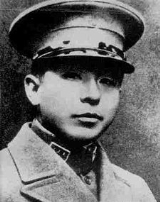
Zhang Xueliang

Encyclopedia
Zhang Xueliang or Chang Hsüeh-liang (3 June 1901, Haicheng County, Fengtian Province
– 14 October 2001, Honolulu, Hawaii
), occasionally called Peter Hsueh Liang Chang in English, nicknamed the Young Marshal (少帥), was the effective ruler of Manchuria
and much of North China after the assassination of his father, Zhang Zuolin
, by the Japanese on 4 June 1928. As an instigator of the Xi'an incident
he spent over 50 years under house arrest, but is regarded by the People's Republic of China as a patriotic hero.
(KMT).
, he overcame his opium addiction and declared his support for Chiang Kai-shek
. He was given the nickname of 千古功臣 (Hero of history) by PRC historians not because it was good that he was supporting the KMT, but because he wanted China to be reunited and was willing to pay the price and become "vice" leader of China. In order to rid his command of Japanese influence he had two prominent pro-Tokyo officials executed in front of the assembled guests at a dinner party in January 1929. It was a hard decision for him to make. The two had powers over the heads of others. Zhang also tried to eliminate Soviet
influence from Manchuria, but relented in the face of a Soviet military build-up
. At the same time, however, he developed closer relations with the United States.
In 1930, when warlords Feng Yuxiang
and Yan Xishan
attempted to overthrow Chiang Kai-shek's Kuomintang government, Zhang Xueliang stepped in to support the Nanjing
government against the northern warlords in exchange for control of the key railroads in Hebei
Province and the customs revenues from the port city of Tianjin
. Following the Mukden Incident
and the Japanese invasion of Zhang's own domain of Manchuria in 1931, Zhang's armies withdrew from the front lines without significant engagements. There has been speculation that Chiang Kai-Shek wrote a letter to Zhang asking him to pull his forces back, but later Zhang stated that he himself issued the orders. Apparently Zhang was aware of how weak his forces were compared to the Japanese, and wished to preserve his position by retaining a sizeable army. Nonetheless this would still be in line with Chiang's overall strategic standings. Zhang later traveled in Europe before returning to China to take command of the Communist Suppression Campaigns first in Hebei-Henan-Anhui and later in the Northwest.
to plan the end of the Chinese Civil War
. In the Xi'an incident
(12 December 1936), Zhang and another general Yang Hucheng
kidnapped Chiang Kai-shek and imprisoned the head of the Kuomintang government until he agreed to form a united front
with the Communists against the Japanese invasion.
Chiang at the time took a non-aggressive position against Japan and considered the Communists to be a greater danger to the government of Republic of China than the Japanese, and his overall strategy was to annihilate the Communists before focusing his efforts on the Japanese. He believed that "communism was a cancer while the Japanese represented a superficial wound." However, growing nationalist anger against Japan made this position very unpopular, leading to Zhang's action against Chiang.
After the negotiations, Chiang agreed to unite with the Communists and drive the Japanese out of China. When Chiang was released, Zhang chose to return to the capital with him. However, once they were away from Zhang's loyal troops, Chiang had him put under house arrest. From there he was always watched and lived near Nationalist capitol wherever it moved to. In 1949 Zhang was transferred to Taiwan where he remained under a loose house arrest for the next 40 years in a villa in Taipei's northern suburbs. He spent his time studying Ming dynasty
literature, Manchu language, and the Bible, receiving occasional guests and collected Chinese fan paintings, calligraphy and other works of art by illustrious artists. A collection of more than 200 works, using his studio's name "Dingyuanzhai," was auctioned with tremendous success by Sotheby's on 10 April 1994. He and his wife, Edith Chao, became devout Baptists and also regularly attended Sunday services at the Methodist chapel in Shilin, a Taipei suburb with Chiang Kai-Shek's family. After Chiang Kai Shek's passing, his freedom was restored officially.
He emigrated to Honolulu, Hawaii, in 1993. There were numerous pleas for him to visit mainland China
, but Zhang, claiming his political closeness with the KMT, declined. He died of pneumonia
at the age of 100 (following the Chinese way of counting
, his age is often given as 101) and was buried in Hawaii. His papers, an extensive oral history and correspondence covering his life from 1937 to 1999, and some paintings by friends, such as Zhang Daqian, Chiang Ching-kuo and Mme. Chiang Kai-shek
, can be found at Peter H. L. Chang (Zhang Xueliang) Oral History Materials in Columbia University's Rare Book and Manuscript Library.
Liaoning
' is a province of the People's Republic of China, located in the northeast of the country. Its one-character abbreviation is "辽" , a name taken from the Liao River that flows through the province. "Níng" means "peace"...
– 14 October 2001, Honolulu, Hawaii
Honolulu, Hawaii
Honolulu is the capital and the most populous city of the U.S. state of Hawaii. Honolulu is the southernmost major U.S. city. Although the name "Honolulu" refers to the urban area on the southeastern shore of the island of Oahu, the city and county government are consolidated as the City and...
), occasionally called Peter Hsueh Liang Chang in English, nicknamed the Young Marshal (少帥), was the effective ruler of Manchuria
Manchuria
Manchuria is a historical name given to a large geographic region in northeast Asia. Depending on the definition of its extent, Manchuria usually falls entirely within the People's Republic of China, or is sometimes divided between China and Russia. The region is commonly referred to as Northeast...
and much of North China after the assassination of his father, Zhang Zuolin
Zhang Zuolin
Zhang Zuolin was the warlord of Manchuria from 1916 to 1928 . He successfully invaded China proper in October 1924 in the Second Zhili-Fengtian War. He gained control of Peking, including China's internationally recognized government, in April 1926...
, by the Japanese on 4 June 1928. As an instigator of the Xi'an incident
Xi'an Incident
The Xi'an Incident of December 1936 is an important episode of Chinese modern history, taking place in the city of Xi'an during the Chinese Civil War between the ruling Kuomintang and the rebel Chinese Communist Party and just before the Second Sino-Japanese War...
he spent over 50 years under house arrest, but is regarded by the People's Republic of China as a patriotic hero.
Youth
Zhang was educated by private tutors and, unlike his father, felt at ease in the company of westerners. Zhang Xueliang graduated from Fengtian Military Academy, was made a Colonel in the Fengtian Army, and was appointed commander of his father's bodyguards in 1919. In 1921, he was sent to Japan to observe military maneuvers, where he developed a special interest in aircraft. Later, he developed an air corps for the Fengtian Army, which was widely used in the battles which took place within the Great Wall during the 1920s. In 1922, he was advanced to Major General and commanded an army-sized force, two years later he was also made commander of the air units. Upon the death of his father in 1928, he succeeded him as the strongest warlord in Manchuria. In December of the same year he proclaimed his allegiance to the KuomintangKuomintang
The Kuomintang of China , sometimes romanized as Guomindang via the Pinyin transcription system or GMD for short, and translated as the Chinese Nationalist Party is a founding and ruling political party of the Republic of China . Its guiding ideology is the Three Principles of the People, espoused...
(KMT).
Manchurian warlord and republican general
The Japanese believed that Zhang Xueliang, who was known as a womanizer and an opium addict, would be much more subject to Japanese influence. An officer of the Japanese Kwantung Army therefore killed his father Zhang Zuolin by exploding a bomb above his train while it crossed under a railroad bridge. Surprisingly, the younger Zhang proved to be more independent than anyone had expected. With the assistance of William Henry DonaldWilliam Henry Donald
William Henry Donald was an Australian newspaperman who worked in China from 1903 until World War II...
, he overcame his opium addiction and declared his support for Chiang Kai-shek
Chiang Kai-shek
Chiang Kai-shek was a political and military leader of 20th century China. He is known as Jiǎng Jièshí or Jiǎng Zhōngzhèng in Mandarin....
. He was given the nickname of 千古功臣 (Hero of history) by PRC historians not because it was good that he was supporting the KMT, but because he wanted China to be reunited and was willing to pay the price and become "vice" leader of China. In order to rid his command of Japanese influence he had two prominent pro-Tokyo officials executed in front of the assembled guests at a dinner party in January 1929. It was a hard decision for him to make. The two had powers over the heads of others. Zhang also tried to eliminate Soviet
Soviet Union
The Soviet Union , officially the Union of Soviet Socialist Republics , was a constitutionally socialist state that existed in Eurasia between 1922 and 1991....
influence from Manchuria, but relented in the face of a Soviet military build-up
Sino-Soviet conflict (1929)
The Sino–Soviet conflict of 1929 was a minor armed conflict between the Soviet Union and Chinese warlord Zhang Xueliang of the Republic of China over the Manchurian Chinese Eastern Railway....
. At the same time, however, he developed closer relations with the United States.
In 1930, when warlords Feng Yuxiang
Feng Yuxiang
Feng Yuxiang was a warlord and leader in Republican China. He was also known as the Christian General for his zeal to convert his troops and the Betrayal General for his penchant to break with the establishment. In 1911, he was an officer in the ranks of Yuan Shikai's Beiyang Army but joined...
and Yan Xishan
Yan Xishan
Yan Xishan, was a Chinese warlord who served in the government of the Republic of China. Yan effectively controlled the province of Shanxi from the 1911 Xinhai Revolution to the 1949 Communist victory in the Chinese Civil War...
attempted to overthrow Chiang Kai-shek's Kuomintang government, Zhang Xueliang stepped in to support the Nanjing
Nanjing
' is the capital of Jiangsu province in China and has a prominent place in Chinese history and culture, having been the capital of China on several occasions...
government against the northern warlords in exchange for control of the key railroads in Hebei
Hebei
' is a province of the People's Republic of China in the North China region. Its one-character abbreviation is "" , named after Ji Province, a Han Dynasty province that included what is now southern Hebei...
Province and the customs revenues from the port city of Tianjin
Tianjin
' is a metropolis in northern China and one of the five national central cities of the People's Republic of China. It is governed as a direct-controlled municipality, one of four such designations, and is, thus, under direct administration of the central government...
. Following the Mukden Incident
Mukden Incident
The Mukden Incident, also known as the Manchurian Incident, was a staged event that was engineered by Japanese military personnel as a pretext for invading the northern part of China known as Manchuria in 1931....
and the Japanese invasion of Zhang's own domain of Manchuria in 1931, Zhang's armies withdrew from the front lines without significant engagements. There has been speculation that Chiang Kai-Shek wrote a letter to Zhang asking him to pull his forces back, but later Zhang stated that he himself issued the orders. Apparently Zhang was aware of how weak his forces were compared to the Japanese, and wished to preserve his position by retaining a sizeable army. Nonetheless this would still be in line with Chiang's overall strategic standings. Zhang later traveled in Europe before returning to China to take command of the Communist Suppression Campaigns first in Hebei-Henan-Anhui and later in the Northwest.
Xi'an incident, house arrest, and later life
On 6 April 1936, Zhang Xueliang met with Zhou EnlaiZhou Enlai
Zhou Enlai was the first Premier of the People's Republic of China, serving from October 1949 until his death in January 1976...
to plan the end of the Chinese Civil War
Chinese Civil War
The Chinese Civil War was a civil war fought between the Kuomintang , the governing party of the Republic of China, and the Communist Party of China , for the control of China which eventually led to China's division into two Chinas, Republic of China and People's Republic of...
. In the Xi'an incident
Xi'an Incident
The Xi'an Incident of December 1936 is an important episode of Chinese modern history, taking place in the city of Xi'an during the Chinese Civil War between the ruling Kuomintang and the rebel Chinese Communist Party and just before the Second Sino-Japanese War...
(12 December 1936), Zhang and another general Yang Hucheng
Yang Hucheng
Yang Hucheng was a Chinese warlord during the Warlord Era of Republican China and Kuomintang general during the Chinese Civil War....
kidnapped Chiang Kai-shek and imprisoned the head of the Kuomintang government until he agreed to form a united front
Second United Front (China)
The Second United Front was the alliance between the Kuomintang and Communist Party of China during the Second Sino-Japanese War or World War II, which suspended the Chinese Civil War from 1937 to 1946....
with the Communists against the Japanese invasion.
Chiang at the time took a non-aggressive position against Japan and considered the Communists to be a greater danger to the government of Republic of China than the Japanese, and his overall strategy was to annihilate the Communists before focusing his efforts on the Japanese. He believed that "communism was a cancer while the Japanese represented a superficial wound." However, growing nationalist anger against Japan made this position very unpopular, leading to Zhang's action against Chiang.
After the negotiations, Chiang agreed to unite with the Communists and drive the Japanese out of China. When Chiang was released, Zhang chose to return to the capital with him. However, once they were away from Zhang's loyal troops, Chiang had him put under house arrest. From there he was always watched and lived near Nationalist capitol wherever it moved to. In 1949 Zhang was transferred to Taiwan where he remained under a loose house arrest for the next 40 years in a villa in Taipei's northern suburbs. He spent his time studying Ming dynasty
Ming Dynasty
The Ming Dynasty, also Empire of the Great Ming, was the ruling dynasty of China from 1368 to 1644, following the collapse of the Mongol-led Yuan Dynasty. The Ming, "one of the greatest eras of orderly government and social stability in human history", was the last dynasty in China ruled by ethnic...
literature, Manchu language, and the Bible, receiving occasional guests and collected Chinese fan paintings, calligraphy and other works of art by illustrious artists. A collection of more than 200 works, using his studio's name "Dingyuanzhai," was auctioned with tremendous success by Sotheby's on 10 April 1994. He and his wife, Edith Chao, became devout Baptists and also regularly attended Sunday services at the Methodist chapel in Shilin, a Taipei suburb with Chiang Kai-Shek's family. After Chiang Kai Shek's passing, his freedom was restored officially.
He emigrated to Honolulu, Hawaii, in 1993. There were numerous pleas for him to visit mainland China
Mainland China
Mainland China, the Chinese mainland or simply the mainland, is a geopolitical term that refers to the area under the jurisdiction of the People's Republic of China . According to the Taipei-based Mainland Affairs Council, the term excludes the PRC Special Administrative Regions of Hong Kong and...
, but Zhang, claiming his political closeness with the KMT, declined. He died of pneumonia
Pneumonia
Pneumonia is an inflammatory condition of the lung—especially affecting the microscopic air sacs —associated with fever, chest symptoms, and a lack of air space on a chest X-ray. Pneumonia is typically caused by an infection but there are a number of other causes...
at the age of 100 (following the Chinese way of counting
East Asian age reckoning
East Asian age reckoning is a concept and practice that originated in China and is widely used by other cultures in East Asia, which share this traditional way of counting a person's age. Newborns start at one year old, and each passing of a Lunar New Year, rather than the birthday, adds one year...
, his age is often given as 101) and was buried in Hawaii. His papers, an extensive oral history and correspondence covering his life from 1937 to 1999, and some paintings by friends, such as Zhang Daqian, Chiang Ching-kuo and Mme. Chiang Kai-shek
Soong May-ling
Soong May-ling or Soong Mei-ling, also known as Madame Chiang Kai-shek or Madame Chiang was a First Lady of the Republic of China , the wife of Generalissimo and President Chiang Kai-shek. She was a politician and painter...
, can be found at Peter H. L. Chang (Zhang Xueliang) Oral History Materials in Columbia University's Rare Book and Manuscript Library.