


Kwantung Leased Territory

Encyclopedia
The Kwantung Leased Territory was a territory in the southern part of the Liaodong Peninsula in Inner Manchuria (northeast China
) that existed from 1898 to 1945. It was one of the numerous territorial concessions
that the Empire of China
was compelled to award to foreign countries at the end of the 19th century. The territory included the militarily and economically significant ports of Lüshunkou
(Port Arthur, or Ryojun) and Dalian
(Dal'niy, or Dairen).
The name Kwantung, or Guāndōng (關東) in pinyin
, means "east of Shanhai Pass
", a reference to part of Qinhuangdao
in today's Hebei
province, at the eastern end of the Great Wall of China
. The name originally referred to all of Manchuria
but later came to be used more narrowly for the area of the leased territory.
China, the Liaodong Peninsula was administratively part of Liaoning
Province. In 1882, the Beiyang Fleet
established a naval base
and coaling station at Lüshunkou
near the southern end of the peninsula.
The Empire of Japan
occupied the region during the First Sino-Japanese War
(1894–1895), and under the terms of the Treaty of Shimonoseki
signed by Japan and China ending the war in April 1895, Japan gained full sovereignty
of the area. However, within weeks, Germany, France and Russia pressured Japan to cede the territory back to China, in what was called the Triple Intervention
.
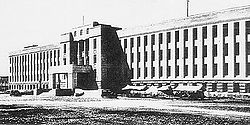

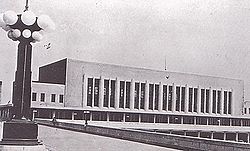
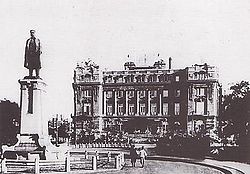 In December 1897, Russian naval vessels
entered Lüshunkou harbor, which they began to use as a forward base of operations for patrols off of northern China, Korea
and in the Sea of Japan
. The Russian Empire renamed the harbor Port Arthur. In March 1898 Russia formally leased the region for 25 years from China. The leased area extended to the northern shore of Yadang Bay on the western side of the peninsula; on the eastern side it reached Pikou; Yevgeni Ivanovich Alekseyev, chief of Russian Pacific Fleet, became the head of this territory. The peninsula north of the lease was made a neutral territory in which China agreed not to offer concessions to other countries. In 1899, Russia founded the town of Dal'niy
(meaning "distant" or "remote"), just north of the naval base at Port Arthur. This would later become the city of Dalian
(Dairen in Japanese).
In 1898 Russia began building a railroad north from Port Arthur to link Dal'niy with the Chinese Eastern Railway
at Harbin
; this spur line was the South Manchurian Railway.
Under the Portsmouth Treaty (1905) resulting from the Russo-Japanese War
, Japan replaced Russia as leaseholder. Port Arthur was renamed Ryojun, and Dal'niy was renamed Dairen in Japanese. Japan also obtained extraterritorial rights in the region north of the territory adjacent to the 885 kilometres (549.9 mi) South Manchurian Railway in 1905 (i.e. the South Manchurian Railway Zone), which was extended north of Mukden to Changchun
. These rights, along with the railway and several spur lines were passed to the corporation known as the South Manchurian Railway Company.
Japan established the to administer the new territory, and based the Kwantung Garrison to defend it and the railway. The Kwantung Garrison later became the Kwantung Army, which played an instrumental role in the founding of Manchukuo
. In negotiations with the Republic of China
under the Twenty-One Demands
, the terms of the lease of the Kwantung Leased Territory were extended to 99 years, or until 1997.
After the foundation of Japanese-controlled Manchukuo in 1932, Japan regarded the sovereignty of the leased territory as transferred from China to Manchukuo. A new lease agreement was contracted between Japan and the government of Manchukuo, and Japan transferred the South Manchurian Railway Zone to Manchukuo. However, Japan retained the Kwantung Leased Territory as a territory apart from the nominally-independent Manchukuo until its surrender
at the end of World War II in 1945.
After World War II, the Soviet Union occupied the territory and the Red Navy made use of the Ryojun Naval Base. The Soviet Union turned it over to the People's Republic of China
in 1955.
; later it was subordinated to the Ministry of Colonial Affairs
. Internally, the Kwantung Leased Area was divided into two districts, with two cities and nine towns. The city assemblies were in part elected, and in part appointed by the governor.
status made it the principal trade gateway to northeast China. The South Manchurian Railway Company was headquartered in Dairen, and some of the profits from its operation were channelled into transforming Dairen into a showcase city of modern city planning and modern architecture
, with hospitals, universities and a large industrial zone.
of 1935, the population of the Kwantung Leased Territory was 1,034,074, of whom 168,185 were Japanese nationals. The numbers excluded military personnel. The area of the territory was 3500 square kilometres (1,351.4 sq mi).
Northeast China
Northeast China, historically known in English as Manchuria, is a geographical region of China, consisting of the three provinces of Liaoning, Jilin and Heilongjiang. The region is sometimes called the Three Northeast Provinces...
) that existed from 1898 to 1945. It was one of the numerous territorial concessions
Concession (territory)
In international law, a concession is a territory within a country that is administered by an entity other than the state which holds sovereignty over it. This is usually a colonizing power, or at least mandated by one, as in the case of colonial chartered companies.Usually, it is conceded, that...
that the Empire of China
Qing Dynasty
The Qing Dynasty was the last dynasty of China, ruling from 1644 to 1912 with a brief, abortive restoration in 1917. It was preceded by the Ming Dynasty and followed by the Republic of China....
was compelled to award to foreign countries at the end of the 19th century. The territory included the militarily and economically significant ports of Lüshunkou
Lüshunkou
Lüshunkou is a district in the municipality of Dalian, Liaoning province, China. Also called Lüshun City or Lüshun Port, it was formerly known as both Port Arthur and Ryojun....
(Port Arthur, or Ryojun) and Dalian
Dalian
Dalian is a major city and seaport in the south of Liaoning province, Northeast China. It faces Shandong to the south, the Yellow Sea to the east and the Bohai Sea to the west and south. Holding sub-provincial administrative status, Dalian is the southernmost city of Northeast China and China's...
(Dal'niy, or Dairen).
The name Kwantung, or Guāndōng (關東) in pinyin
Pinyin
Pinyin is the official system to transcribe Chinese characters into the Roman alphabet in China, Malaysia, Singapore and Taiwan. It is also often used to teach Mandarin Chinese and spell Chinese names in foreign publications and used as an input method to enter Chinese characters into...
, means "east of Shanhai Pass
Shanhai Pass
Shanhai Pass , or Shanhaiguan, along with Jiayu Pass and Juyong Pass, is one of the major passes of the Great Wall of China It is located in Shanhaiguan District, Qinhuangdao, Hebei. In 1961, Shanhaiguan became a site of China First Class National Cultural Site.It is a popular tourist destination,...
", a reference to part of Qinhuangdao
Qinhuangdao
Qinhuangdao is a port city in northeastern Hebei province of North China. It is about 300 km east of Beijing, on the Bohai Sea, the innermost gulf of the Yellow Sea....
in today's Hebei
Hebei
' is a province of the People's Republic of China in the North China region. Its one-character abbreviation is "" , named after Ji Province, a Han Dynasty province that included what is now southern Hebei...
province, at the eastern end of the Great Wall of China
Great Wall of China
The Great Wall of China is a series of stone and earthen fortifications in northern China, built originally to protect the northern borders of the Chinese Empire against intrusions by various nomadic groups...
. The name originally referred to all of Manchuria
Manchuria
Manchuria is a historical name given to a large geographic region in northeast Asia. Depending on the definition of its extent, Manchuria usually falls entirely within the People's Republic of China, or is sometimes divided between China and Russia. The region is commonly referred to as Northeast...
but later came to be used more narrowly for the area of the leased territory.
History
In Qing dynastyQing Dynasty
The Qing Dynasty was the last dynasty of China, ruling from 1644 to 1912 with a brief, abortive restoration in 1917. It was preceded by the Ming Dynasty and followed by the Republic of China....
China, the Liaodong Peninsula was administratively part of Liaoning
Liaoning
' is a province of the People's Republic of China, located in the northeast of the country. Its one-character abbreviation is "辽" , a name taken from the Liao River that flows through the province. "Níng" means "peace"...
Province. In 1882, the Beiyang Fleet
Beiyang Fleet
The Beiyang Fleet was one of the four modernised Chinese navies in the late Qing Dynasty. Among the four, the Beiyang Fleet was particularly sponsored by Li Hongzhang, one of the most trusted vassals of Empress Dowager Cixi and the principal patron of the "self-strengthening movement" in northern...
established a naval base
Naval base
A naval base is a military base, where warships and naval ships are deployed when they have no mission at sea or want to restock. Usually ships may also perform some minor repairs. Some naval bases are temporary homes to aircraft that usually stay on the ships but are undergoing maintenance while...
and coaling station at Lüshunkou
Lüshunkou
Lüshunkou is a district in the municipality of Dalian, Liaoning province, China. Also called Lüshun City or Lüshun Port, it was formerly known as both Port Arthur and Ryojun....
near the southern end of the peninsula.
The Empire of Japan
Empire of Japan
The Empire of Japan is the name of the state of Japan that existed from the Meiji Restoration on 3 January 1868 to the enactment of the post-World War II Constitution of...
occupied the region during the First Sino-Japanese War
First Sino-Japanese War
The First Sino-Japanese War was fought between Qing Dynasty China and Meiji Japan, primarily over control of Korea...
(1894–1895), and under the terms of the Treaty of Shimonoseki
Treaty of Shimonoseki
The Treaty of Shimonoseki , known as the Treaty of Maguan in China, was signed at the Shunpanrō hall on April 17, 1895, between the Empire of Japan and Qing Empire of China, ending the First Sino-Japanese War. The peace conference took place from March 20 to April 17, 1895...
signed by Japan and China ending the war in April 1895, Japan gained full sovereignty
Sovereignty
Sovereignty is the quality of having supreme, independent authority over a geographic area, such as a territory. It can be found in a power to rule and make law that rests on a political fact for which no purely legal explanation can be provided...
of the area. However, within weeks, Germany, France and Russia pressured Japan to cede the territory back to China, in what was called the Triple Intervention
Triple Intervention
The was a diplomatic intervention by Russia, Germany, and France on 23 April 1895 over the terms of the Treaty of Shimonoseki signed between Japan and Qing dynasty China that ended the First Sino-Japanese War.-Treaty of Shimonoseki:...
.
Imperial Russian Navy
The Imperial Russian Navy refers to the Tsarist fleets prior to the February Revolution.-First Romanovs:Under Tsar Mikhail Feodorovich, construction of the first three-masted ship, actually built within Russia, was completed in 1636. It was built in Balakhna by Danish shipbuilders from Holstein...
entered Lüshunkou harbor, which they began to use as a forward base of operations for patrols off of northern China, Korea
Korea
Korea ) is an East Asian geographic region that is currently divided into two separate sovereign states — North Korea and South Korea. Located on the Korean Peninsula, Korea is bordered by the People's Republic of China to the northwest, Russia to the northeast, and is separated from Japan to the...
and in the Sea of Japan
Sea of Japan
The Sea of Japan is a marginal sea of the western Pacific Ocean, between the Asian mainland, the Japanese archipelago and Sakhalin. It is bordered by Japan, North Korea, Russia and South Korea. Like the Mediterranean Sea, it has almost no tides due to its nearly complete enclosure from the Pacific...
. The Russian Empire renamed the harbor Port Arthur. In March 1898 Russia formally leased the region for 25 years from China. The leased area extended to the northern shore of Yadang Bay on the western side of the peninsula; on the eastern side it reached Pikou; Yevgeni Ivanovich Alekseyev, chief of Russian Pacific Fleet, became the head of this territory. The peninsula north of the lease was made a neutral territory in which China agreed not to offer concessions to other countries. In 1899, Russia founded the town of Dal'niy
Russian Dalian
As portion of the Guandong Leased Territories , the city of Dalian came under the territorial control of Russia from 1898 until that country’s defeat in the Russo-Japanese War in 1905...
(meaning "distant" or "remote"), just north of the naval base at Port Arthur. This would later become the city of Dalian
Dalian
Dalian is a major city and seaport in the south of Liaoning province, Northeast China. It faces Shandong to the south, the Yellow Sea to the east and the Bohai Sea to the west and south. Holding sub-provincial administrative status, Dalian is the southernmost city of Northeast China and China's...
(Dairen in Japanese).
In 1898 Russia began building a railroad north from Port Arthur to link Dal'niy with the Chinese Eastern Railway
Chinese Eastern Railway
The Chinese Eastern Railway or was a railway in northeastern China . It connected Chita and the Russian Far East. English-speakers have sometimes referred to this line as the Manchurian Railway...
at Harbin
Harbin
Harbin ; Manchu language: , Harbin; Russian: Харби́н Kharbin ), is the capital and largest city of Heilongjiang Province in Northeast China, lying on the southern bank of the Songhua River...
; this spur line was the South Manchurian Railway.
Under the Portsmouth Treaty (1905) resulting from the Russo-Japanese War
Russo-Japanese War
The Russo-Japanese War was "the first great war of the 20th century." It grew out of rival imperial ambitions of the Russian Empire and Japanese Empire over Manchuria and Korea...
, Japan replaced Russia as leaseholder. Port Arthur was renamed Ryojun, and Dal'niy was renamed Dairen in Japanese. Japan also obtained extraterritorial rights in the region north of the territory adjacent to the 885 kilometres (549.9 mi) South Manchurian Railway in 1905 (i.e. the South Manchurian Railway Zone), which was extended north of Mukden to Changchun
Changchun
Changchun is the capital and largest city of Jilin province, located in the northeast of the People's Republic of China, in the center of the Songliao Plain. It is administered as a sub-provincial city with a population of 7,677,089 at the 2010 census under its jurisdiction, including counties and...
. These rights, along with the railway and several spur lines were passed to the corporation known as the South Manchurian Railway Company.
Japan established the to administer the new territory, and based the Kwantung Garrison to defend it and the railway. The Kwantung Garrison later became the Kwantung Army, which played an instrumental role in the founding of Manchukuo
Manchukuo
Manchukuo or Manshū-koku was a puppet state in Manchuria and eastern Inner Mongolia, governed under a form of constitutional monarchy. The region was the historical homeland of the Manchus, who founded the Qing Empire in China...
. In negotiations with the Republic of China
Republic of China
The Republic of China , commonly known as Taiwan , is a unitary sovereign state located in East Asia. Originally based in mainland China, the Republic of China currently governs the island of Taiwan , which forms over 99% of its current territory, as well as Penghu, Kinmen, Matsu and other minor...
under the Twenty-One Demands
Twenty-One Demands
The ' were a set of demands made by the Empire of Japan under Prime Minister Ōkuma Shigenobu sent to the nominal government of the Republic of China on January 18, 1915, resulting in two treaties with Japan on May 25, 1915.- Background :...
, the terms of the lease of the Kwantung Leased Territory were extended to 99 years, or until 1997.
After the foundation of Japanese-controlled Manchukuo in 1932, Japan regarded the sovereignty of the leased territory as transferred from China to Manchukuo. A new lease agreement was contracted between Japan and the government of Manchukuo, and Japan transferred the South Manchurian Railway Zone to Manchukuo. However, Japan retained the Kwantung Leased Territory as a territory apart from the nominally-independent Manchukuo until its surrender
Surrender of Japan
The surrender of Japan in 1945 brought hostilities of World War II to a close. By the end of July 1945, the Imperial Japanese Navy was incapable of conducting operations and an Allied invasion of Japan was imminent...
at the end of World War II in 1945.
After World War II, the Soviet Union occupied the territory and the Red Navy made use of the Ryojun Naval Base. The Soviet Union turned it over to the People's Republic of China
People's Republic of China
China , officially the People's Republic of China , is the most populous country in the world, with over 1.3 billion citizens. Located in East Asia, the country covers approximately 9.6 million square kilometres...
in 1955.
Administration
In a reorganization of 1919, the Kwantung Garrison was renamed the Kwantung Army and separated from the civilian administration of the territory, which was designated the . The Kantō-cho initially directly reported to the office of the Prime Minister of JapanPrime Minister of Japan
The is the head of government of Japan. He is appointed by the Emperor of Japan after being designated by the Diet from among its members, and must enjoy the confidence of the House of Representatives to remain in office...
; later it was subordinated to the Ministry of Colonial Affairs
Ministry of Colonial Affairs
The was a cabinet-level ministry in the government of the Empire of Japan from 1923-1942.-History:The original Ministry of Colonial Affairs was the short-lived Hokkaidō Colonization Office, established in the early Meiji period by Prime Minister Kuroda Kiyotaka to protect Japan's sparely populated...
. Internally, the Kwantung Leased Area was divided into two districts, with two cities and nine towns. The city assemblies were in part elected, and in part appointed by the governor.
Economy
Massive capital investment was concentrated in Dairen (now the capital of the territory), wherein Japanese firms developed a significant industrial infrastructure, as well as creating a first class port out of the mediocre natural harbor. The facilities of the port at Dairen and its free trade portFree port
A free port or free zone , sometimes also called a bonded area is a port, port area or other area with relaxed jurisdiction with respect to the country of location...
status made it the principal trade gateway to northeast China. The South Manchurian Railway Company was headquartered in Dairen, and some of the profits from its operation were channelled into transforming Dairen into a showcase city of modern city planning and modern architecture
Modern architecture
Modern architecture is generally characterized by simplification of form and creation of ornament from the structure and theme of the building. It is a term applied to an overarching movement, with its exact definition and scope varying widely...
, with hospitals, universities and a large industrial zone.
Demographics
In the Japanese national censusCensus
A census is the procedure of systematically acquiring and recording information about the members of a given population. It is a regularly occurring and official count of a particular population. The term is used mostly in connection with national population and housing censuses; other common...
of 1935, the population of the Kwantung Leased Territory was 1,034,074, of whom 168,185 were Japanese nationals. The numbers excluded military personnel. The area of the territory was 3500 square kilometres (1,351.4 sq mi).
Governors-General of Kwantung Leased Territory
| Name | From | To | |
| 1 | General Baron Yoshimasa Oshima (大島義昌) | October 10, 1905 | April 26, 1912 |
| 2 | Lieutenant General Yasumasa Fukushima (福島安正) | April 26, 1912 | September 15, 1914 |
| 3 | Lieutenant General Akira Nakamura Akira Nakamura was a Japanese academic of English literature and self-trained historian specialising in Japan's wartime role in the first half of the 20th century. Born in Tokyo, Nakamura studied English literature and graduated from University of Tokyo in March 1959. He worked as a senior high school teacher of... (中村覚) |
September 15, 1914 | July 31, 1917 |
| 4 | Lieutenant General Yujiro Nakamura (中村雄次郎) | July 31, 1917 | April 12, 1919 |
| 5 | Gonsuke Hayashi Gonsuke Hayashi was a diplomat during Meiji and Taishō period Japan.-Biography:Hayashi was born in Aizu Domain . His grandfather, Hayashi Yasusada was a noted samurai leader in the Boshin War of the Meiji Restoration, but fighting for the Tokugawa shogunate... (林権助) |
April 12, 1919 | May 24, 1920 |
| 6 | Isaburo Yamagata (山県伊三郎) | May 24, 1920 | September 8, 1922 |
| 7 | Hikokichi Ijuin (伊集院彦吉) | September 8, 1922 | September 19, 1923 |
| 8 | Hideo Kodama Hideo Kodama Count , was a politician, and wartime cabinet minister in the Empire of Japan. He was the eldest son of famed Russo-Japanese War general Kodama Gentarō, and his wife was the daughter of Prime Minister Terauchi Masatake.- Biography :... (児玉秀雄) |
September 26, 1923 | December 17, 1927 |
| 9 | Kenjiro Kinoshita (木下謙次郎) | December 17, 1927 | August 17, 1929 |
| 10 | Masahiro Ota (太田政弘) | August 17, 1929 | January 16, 1931 |
| 11 | Seiji Tsukamoto (塚本清治) | January 16, 1931 | January 11, 1932 |
| 12 | Mannosuke Yamaoka (山岡万之助) | January 11, 1932 | August 8, 1932 |
| 13 | General Nobuyoshi Mutō Nobuyoshi Muto -External links:*- Notes :... (武藤信義) |
August 8, 1932 | July 28, 1933 |
| 14 | General Takashi Hishikari Takashi Hishikari - Notes :... (菱刈隆) |
July 28, 1933 | December 10, 1934 |
| 15 | General Jirō Minami Jiro Minami - Notes :... (南次郎) |
December 10, 1934 | March 6, 1936 |
| 16 | General Kenkichi Ueda Kenkichi Ueda -External links:*- Notes :... (植田謙吉) |
March 6, 1936 | September 7, 1939 |
| 17 | General Yoshijirō Umezu (梅津美治郎) | September 7, 1939 | July 18, 1944 |
| 18 | General Otozō Yamada (山田乙三) | July 18, 1944 | August 28, 1945 |
See also
- South Manchurian Railway
- ManchukuoManchukuoManchukuo or Manshū-koku was a puppet state in Manchuria and eastern Inner Mongolia, governed under a form of constitutional monarchy. The region was the historical homeland of the Manchus, who founded the Qing Empire in China...
- DalianDalianDalian is a major city and seaport in the south of Liaoning province, Northeast China. It faces Shandong to the south, the Yellow Sea to the east and the Bohai Sea to the west and south. Holding sub-provincial administrative status, Dalian is the southernmost city of Northeast China and China's...
- Russo-Japanese WarRusso-Japanese WarThe Russo-Japanese War was "the first great war of the 20th century." It grew out of rival imperial ambitions of the Russian Empire and Japanese Empire over Manchuria and Korea...
- Ryojun Guard DistrictRyojun Guard DistrictThe was the major navy base for the Imperial Japanese Navy in the Kwantung Leased Territory before and during Second Sino-Japanese War. Located in at Ryojun ), The was the major navy base for the Imperial Japanese Navy in the Kwantung Leased Territory before and during Second Sino-Japanese War....