

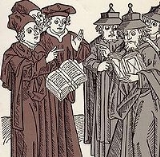
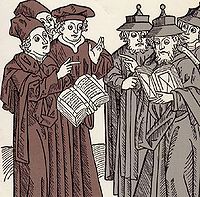
Disputation

Encyclopedia
Scholasticism
Scholasticism is a method of critical thought which dominated teaching by the academics of medieval universities in Europe from about 1100–1500, and a program of employing that method in articulating and defending orthodoxy in an increasingly pluralistic context...
system of education of the Middle Ages
Middle Ages
The Middle Ages is a periodization of European history from the 5th century to the 15th century. The Middle Ages follows the fall of the Western Roman Empire in 476 and precedes the Early Modern Era. It is the middle period of a three-period division of Western history: Classic, Medieval and Modern...
, disputations (in Latin
Latin
Latin is an Italic language originally spoken in Latium and Ancient Rome. It, along with most European languages, is a descendant of the ancient Proto-Indo-European language. Although it is considered a dead language, a number of scholars and members of the Christian clergy speak it fluently, and...
: disputationes, singular: disputatio) offered a formalized method of debate designed to uncover and establish truths in theology
Theology
Theology is the systematic and rational study of religion and its influences and of the nature of religious truths, or the learned profession acquired by completing specialized training in religious studies, usually at a university or school of divinity or seminary.-Definition:Augustine of Hippo...
and in science
Science
Science is a systematic enterprise that builds and organizes knowledge in the form of testable explanations and predictions about the universe...
s. Fixed rules governed the process: they demanded dependence on traditional written authorities and the thorough understanding of each argument on each side.
Inter-faith disputations
A significant category of disputations took place between ChristianChristianity
Christianity is a monotheistic religion based on the life and teachings of Jesus as presented in canonical gospels and other New Testament writings...
and Jewish theologian
Theology
Theology is the systematic and rational study of religion and its influences and of the nature of religious truths, or the learned profession acquired by completing specialized training in religious studies, usually at a university or school of divinity or seminary.-Definition:Augustine of Hippo...
s in order to convince Jews to convert
Religious conversion
Religious conversion is the adoption of a new religion that differs from the convert's previous religion. Changing from one denomination to another within the same religion is usually described as reaffiliation rather than conversion.People convert to a different religion for various reasons,...
. Often the Christian side was represented by a recent convert from Judaism. Christians believed that only the refusal of the Jews to accept Christ
Christ
Christ is the English term for the Greek meaning "the anointed one". It is a translation of the Hebrew , usually transliterated into English as Messiah or Mashiach...
stood in the way of the Second Coming
Second Coming
In Christian doctrine, the Second Coming of Christ, the Second Advent, or the Parousia, is the anticipated return of Jesus Christ from Heaven, where he sits at the Right Hand of God, to Earth. This prophecy is found in the canonical gospels and in most Christian and Islamic eschatologies...
. The only way for the Jewish side to 'win' was to force a draw by drawing the Christian side into a position in which it was necessary to deny the Old Testament to win, committing heresy
Heresy
Heresy is a controversial or novel change to a system of beliefs, especially a religion, that conflicts with established dogma. It is distinct from apostasy, which is the formal denunciation of one's religion, principles or cause, and blasphemy, which is irreverence toward religion...
. According to Michael J. Cook, "Since 'winning' a debate could well jeopardize the security of the Jewish community at large, political considerations certainly entered into what Jewish disputants publicly said or refrained from saying. ... Official transcripts of these proceedings, moreover, may not duplicate what actually transpired; in some places what they record was not the live action, as it were, but Christian polemical revision composed after the fact."
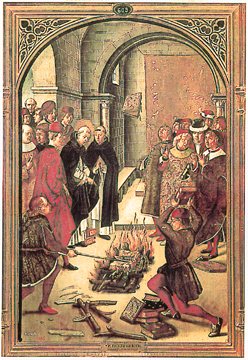
- 1240 - the Disputation of ParisDisputation of ParisThe Disputation of Paris took place in 1240 in the court of the reigning king of France, Louis IX . The disputation had four rabbis defending the Talmud against the accusations of a Franciscan Order member.-Disputers:...
during the reign of Louis IX of FranceLouis IX of FranceLouis IX , commonly Saint Louis, was King of France from 1226 until his death. He was also styled Louis II, Count of Artois from 1226 to 1237. Born at Poissy, near Paris, he was an eighth-generation descendant of Hugh Capet, and thus a member of the House of Capet, and the son of Louis VIII and...
(St. Louis) between a member of the Franciscan Order Nicholas DoninNicholas DoninNicholas Donin of La Rochelle, a Jewish convert to Christianity in early thirteenth-century Paris, is known for his role in the 1240 Disputation of Paris, which resulted in a decree to publicly burn all available manuscripts of the Talmud....
, who earlier converted from Judaism and persuaded Pope Gregory IXPope Gregory IXPope Gregory IX, born Ugolino di Conti, was pope from March 19, 1227 to August 22, 1241.The successor of Pope Honorius III , he fully inherited the traditions of Pope Gregory VII and of his uncle Pope Innocent III , and zealously continued their policy of Papal supremacy.-Early life:Ugolino was...
to issue a bill ordering the burning of the Talmud, and four of the most distinguished rabbis of France: Yechiel of ParisYechiel of ParisYechiel ben Joseph of Paris was a major Talmudic scholar and Tosafist from northern France, father-in-law of Isaac ben Joseph of Corbeil. He was a disciple of Rabbi Judah Messer Leon, and succeeded him in 1225 as head of the Yeshiva of Paris, which then boasted some 300 students; his best known...
, Moses of Coucy, Judah of MelunJudah of MelunJudah of Melun was a French rabbi, a tosafist of the first half of the 13th century; he was son of the tosafist David of Melun .In Perez of Corbeil's tosafot to Baba Ḳamma Judah of Melun was a French rabbi, a tosafist of the first half of the 13th century; he was son of the tosafist David of Melun...
, and Samuel ben Solomon of Château-Thierry. The commission of Christian theologians condemned the Talmud to be burned and on June 17, 1244, twenty-four carriage loads of Jewish religious manuscripts were set on fire in the streets of Paris. - 1263 - the Disputation of BarcelonaDisputation of BarcelonaThe Disputation of Barcelona was held at the royal palace of King James I of Aragon in the presence of the King, his court, and many prominent ecclesiastical dignitaries and knights, between Dominican Friar Pablo Christiani, a convert from Judaism to Christianity, and Rabbi Nachmanides The...
before King James I of AragonJames I of AragonJames I the Conqueror was the King of Aragon, Count of Barcelona, and Lord of Montpellier from 1213 to 1276...
: between the monkMonkA monk is a person who practices religious asceticism, living either alone or with any number of monks, while always maintaining some degree of physical separation from those not sharing the same purpose...
Pablo ChristianiPablo ChristianiPablo Christiani , a figure of the thirteenth century, was born to a pious Jewish family, with the name Saul. He became a Christian convert and Dominican friar....
(a convert from Judaism) and RabbiRabbiIn Judaism, a rabbi is a teacher of Torah. This title derives from the Hebrew word רבי , meaning "My Master" , which is the way a student would address a master of Torah...
Moses ben Nachman (also known as Nachmanides). At the end of disputation, king awarded Nachmanides a monetary prize and declared that never before had he heard "an unjust cause so nobly defended." Nevertheless the Dominicans claimed the victory and Nachmanides was exiled and his report of the proceedings was condemned and burned. A committee appointed by the king censored the passages from the Talmud they deemed offensive. - 1375 - public disputations held at Burgos and Avila by Moses Cohen de Tordesillas with converts from Judaism John of ValladolidJohn of ValladolidJohn of Valladolid was a Spanish Jewish convert to Christianity.An able speaker, and possessed of some knowledge of rabbinical literature, he persuaded King Henry II of Castile that he could convince the Jews of the truth of Christianity if they were obliged to listen to him and to answer his...
and Abner of BurgosAbner of BurgosAbner of Burgos was a Jewish philosopher, a convert to Christianity and polemical writer against his former religion. Known after his conversion as Alfonso of Valladolid.-Life:...
. Another disputation was held at about the same time in Pampeluna by Shem-Tob ben Isaac Shaprut of Tudela with Cardinal Don Pedro de Luna, afterward Avignon Pope Benedict XIIIAntipope Benedict XIIIBenedict XIII, born Pedro Martínez de Luna y Pérez de Gotor , known as in Spanish, was an Aragonese nobleman, who is officially considered by the Catholic Church to be an antipope....
, the disputations being made the subjects of the books "'Ezer ha-Emunah" (by Moses) and "Eben Boḥan". - 1413 - the Disputation of TortosaDisputation of TortosaThe Disputation of Tortosa, one of the famous disputations between Jews and Christians of the Middle Ages, was held in the years 1413–1414 in the city of Tortosa, Spain....
in Spain, staged by the Antipope Benedict XIII. In result, the Pope gave instructions by which all books of the Talmud would be handed over to his functionaries for censorshipCensorshipthumb|[[Book burning]] following the [[1973 Chilean coup d'état|1973 coup]] that installed the [[Military government of Chile |Pinochet regime]] in Chile...
.
Reformation period (1518-1550)
Martin LutherMartin Luther
Martin Luther was a German priest, professor of theology and iconic figure of the Protestant Reformation. He strongly disputed the claim that freedom from God's punishment for sin could be purchased with money. He confronted indulgence salesman Johann Tetzel with his Ninety-Five Theses in 1517...
opened the Protestant Reformation
Protestant Reformation
The Protestant Reformation was a 16th-century split within Western Christianity initiated by Martin Luther, John Calvin and other early Protestants. The efforts of the self-described "reformers", who objected to the doctrines, rituals and ecclesiastical structure of the Roman Catholic Church, led...
by inviting discussion upon his 95 theses
95 Theses
The Ninety-Five Theses on the Power and Efficacy of Indulgences , commonly known as , was written by Martin Luther, 1517 and is widely regarded as the primary catalyst for the Protestant Reformation...
, 31 October 1517. Although presented as a call to an ordinary scholastic dispute, the oral debate never occurred.
Heidelberg Disputation (1518)
During a convention held at HeidelbergHeidelberg
-Early history:Between 600,000 and 200,000 years ago, "Heidelberg Man" died at nearby Mauer. His jaw bone was discovered in 1907; with scientific dating, his remains were determined to be the earliest evidence of human life in Europe. In the 5th century BC, a Celtic fortress of refuge and place of...
in April, 1518, Luther directed a dispute on 28 theological and 40 philosophical theses. He was successful in winning over Johannes Brenz
Johannes Brenz
Johann Brenz was a German theologian and the Protestant Reformer of the Duchy of Württemberg.-Early Advocacy of the Reformation:...
and the Dominican Martin Bucer
Martin Bucer
Martin Bucer was a Protestant reformer based in Strasbourg who influenced Lutheran, Calvinist, and Anglican doctrines and practices. Bucer was originally a member of the Dominican Order, but after meeting and being influenced by Martin Luther in 1518 he arranged for his monastic vows to be annulled...
.
Leipzig Disputation (1519)
Johann EckJohann Eck
Dr. Johann Maier von Eck was a German Scholastic theologian and defender of Catholicism during the Protestant Reformation. It was Eck who argued that the beliefs of Martin Luther and Jan Hus were similar.-Life:...
became involved in a literary contest with Andreas Karlstadt
Andreas Karlstadt
Andreas Rudolph Bodenstein von Karlstadt , better known as Andreas Karlstadt or Andreas Carlstadt or Karolostadt, was a German Christian theologian during the Protestant Reformation. He was born in Karlstadt, Franconia.-Education:Karlstadt received his doctorate of theology in 1510 from the...
and challenged his adversary to a public debate. In Leipzig
Leipzig
Leipzig Leipzig has always been a trade city, situated during the time of the Holy Roman Empire at the intersection of the Via Regia and Via Imperii, two important trade routes. At one time, Leipzig was one of the major European centres of learning and culture in fields such as music and publishing...
, although the faculty of the university entered a protest, and the Bishops of Merseburg and Brandenburg launched prohibitions and an excommunication, the disputation took place under the ægis of Duke George of Saxony. Eck came to Leipzig with one attendant; Luther and Karlstadt entered the city accompanied by an army of adherents, mostly students. From 27 June to 4 July (1519) Eck and Karlstadt debated the subject of free will and our ability to cooperate with grace. Eck forced his antagonist to make admissions which stultified the new Lutheran doctrine, whereupon Luther himself came forward to assail the dogma of Roman supremacy by divine right
Episcopal polity
Episcopal polity is a form of church governance that is hierarchical in structure with the chief authority over a local Christian church resting in a bishop...
. The debate on papal primacy was succeeded by discussions of purgatory
Purgatory
Purgatory is the condition or process of purification or temporary punishment in which, it is believed, the souls of those who die in a state of grace are made ready for Heaven...
, indulgences, penance
Penance
Penance is repentance of sins as well as the proper name of the Roman Catholic, Orthodox Christian, and Anglican Sacrament of Penance and Reconciliation/Confession. It also plays a part in non-sacramental confession among Lutherans and other Protestants...
, etc. On 14 and 15 July, Karlstadt resumed the debate on free will
Free will
"To make my own decisions whether I am successful or not due to uncontrollable forces" -Troy MorrisonA pragmatic definition of free willFree will is the ability of agents to make choices free from certain kinds of constraints. The existence of free will and its exact nature and definition have long...
and good works
Good works
Good works, or simply works, within Christian theology are a person's actions or deeds, contrasting with interior qualities such as grace or faith.The New Testament exhibits a tension between two aspects of grace:...
. Finally, Duke George declared the disputation closed, and each of the contendents departed, as usual, claiming the victory.
Of the two universities to which the final decision had been reserved, the University of Erfurt
University of Erfurt
The University of Erfurt is a public university located in Erfurt, Germany. Originally founded in 1379, the university was closed in 1816 for the next 177 years...
declined to intervene and returned the documents; the University of Paris
University of Paris
The University of Paris was a university located in Paris, France and one of the earliest to be established in Europe. It was founded in the mid 12th century, and officially recognized as a university probably between 1160 and 1250...
sat in judgment upon Luther's writings, attaching to each of his opinions theological censure. Luther gained the support of Melanchthon.
The Leipzig Disputation was the last occasion on which the ancient custom of swearing to advance no tenet contrary to Catholic doctrine was observed. In all subsequent debates between Catholics and Protestants, the bare text of Holy Writ was taken as the authority. This placed the Catholics in a disadvantageous position. This was particularly the case in Switzerland, where Zwingli and his lieutenants organized a number of one-sided debates under the presidency of town councils already won over to Protestantism. Such were the disputations of Zurich, 1523, of Swiss Baden, 1526, and of Berne, 1528. In all of these the result was the abolition of Catholic worship and in their opinion the desecration of churches and religious institutions.
Diet of Ratisbon (1541)
The Emperor Charles V tried to bring the religious troubles of Germany to a "speedy and peaceful termination" by conferences between the Catholic and the Protestant divines. The Protestants proclaimed their determination to adhere to the terms of the Augsburg ConfessionAugsburg Confession
The Augsburg Confession, also known as the "Augustana" from its Latin name, Confessio Augustana, is the primary confession of faith of the Lutheran Church and one of the most important documents of the Lutheran reformation...
, and, in addition, formally repudiated the authority of the Roman pontiff and "would admit no other judge of the controversy than Jesus Christ"; both Pope Paul III
Pope Paul III
Pope Paul III , born Alessandro Farnese, was Pope of the Roman Catholic Church from 1534 to his death in 1549. He came to the papal throne in an era following the sack of Rome in 1527 and rife with uncertainties in the Catholic Church following the Protestant Reformation...
and Luther predicted failure. However, since the emperor and his brother, King Ferdinand
Ferdinand I, Holy Roman Emperor
Ferdinand I was Holy Roman Emperor from 1558 and king of Bohemia and Hungary from 1526 until his death. Before his accession, he ruled the Austrian hereditary lands of the Habsburgs in the name of his elder brother, Charles V, Holy Roman Emperor.The key events during his reign were the contest...
, persisted in making a trial, the pope authorized his nuncio, Giovanni Morone
Giovanni Morone
Giovanni Morone was an Italian cardinal. He was named Bishop of Modena in 1529 and was created Cardinal in 1542 by Pope Paul III...
, to proceed to Speyer
Speyer
Speyer is a city of Rhineland-Palatinate, Germany with approximately 50,000 inhabitants. Located beside the river Rhine, Speyer is 25 km south of Ludwigshafen and Mannheim. Founded by the Romans, it is one of Germany's oldest cities...
, whither the meeting had been summoned for June, 1540. As the plague was raging in that city the conference took place in Hagenau. Neither the Elector of Saxony nor the Landgrave of Hesse could be induced to attend. Melanchthon was absent through illness. The leading Protestant theologians at the conference were Bucer, Brenz, Oswald Myconius
Oswald Myconius
Oswald Myconius was a follower of Huldrych Zwingli.He was born at Lucerne, Switzerland. His family name was Geisshüsler, and his father was a miller; hence he was also called Molitoris...
, Ambrosius Blarer
Ambrosius Blarer
Ambrosius Blarer was an influential reformer in southern Germany and north-eastern Switzerland.-Early life:...
, and Urbanus Rhegius
Urbanus Rhegius
Urbanus Henricus Rhegius or Urban Rieger was Protestant Reformer who was active both in Northern and Southern Germany in order to promote Lutheran unity in the Holy Roman Empire.- Life :...
. The most prominent on the Catholic side were Johann Faber
Johann Faber
Johann Faber was a Catholic theologian known for his writings opposing the Protestant Reformation and the growing Anabaptist movement.-Biography:...
, Bishop of Vienna, and Eck. Present was John Calvin
John Calvin
John Calvin was an influential French theologian and pastor during the Protestant Reformation. He was a principal figure in the development of the system of Christian theology later called Calvinism. Originally trained as a humanist lawyer, he broke from the Roman Catholic Church around 1530...
, then exiled from Geneva
Geneva
Geneva In the national languages of Switzerland the city is known as Genf , Ginevra and Genevra is the second-most-populous city in Switzerland and is the most populous city of Romandie, the French-speaking part of Switzerland...
; he appeared as confidential agent of the King of France. After a month, King Ferdinand prorogued the conference to reassemble at Worms
Worms, Germany
Worms is a city in Rhineland-Palatinate, Germany, on the Rhine River. At the end of 2004, it had 85,829 inhabitants.Established by the Celts, who called it Borbetomagus, Worms today remains embattled with the cities Trier and Cologne over the title of "Oldest City in Germany." Worms is the only...
on 28 October.
Undismayed by the failure of the Hagenau conference, the emperor made more strenuous efforts for the success of the coming colloquy at Worms. He dispatched his minister Granvelle
Antoine Perrenot de Granvelle
Antoine Perrenot de Granvelle , Comte de La Baume Saint Amour, was a Burgundian statesman, made a cardinal, who followed his father as a leading minister of the Spanish Habsburgs, and was one of the most influential European politicians during the time which immediately followed the appearance of...
and Ortiz, his envoy, to the papal court. The latter brought with him the Jesuit Peter Faber
Peter Faber
Blessed Peter Faver was a French Jesuit theologian and a cofounder of the Society of Jesus. He was beatified by the Roman Catholic Church on September 5, 1872.-Biography:Peter Faver , grew up in far east central France...
. The pope sent the Bishop of Feltri, Tommaso Campeggio, brother of the cardinal, and ordered Morone to attend. They were not to take part in the debates, but were to watch events closely and report to Rome. Granvella opened the proceedings at Worms, 25 November, with an eloquent and conciliatory address. He pictured the evils which had befallen Germany, "once the first of all nations in fidelity, religion, piety, and divine worship", and warned his hearers that "all the evils that shall come upon you and your people, if, by clinging stubbornly to preconceived notions, you prevent a renewal of concord, will be ascribed to you as the authors of them." On behalf of the Protestants, Melanchthon returned "an intrepid answer"; he threw all the blame upon the Catholics, who refused to accept the new Gospel.
A great deal of time was spent in wrangling over points of order; finally it was decided that Eck should be spokesman for the Catholics and Melanchthon for the Protestants. The debate began 14 January 1541. The Augsburg Confession as the basis of the conference; the Augsburg Confession of 1540 was a different document from the Confession of 1530, having been changed by Melanchthon to suit his sacramentarian view of the Eucharist
Eucharist
The Eucharist , also called Holy Communion, the Sacrament of the Altar, the Blessed Sacrament, the Lord's Supper, and other names, is a Christian sacrament or ordinance...
. Eck and Melanchthon battled four days over the topic of original sin
Original sin
Original sin is, according to a Christian theological doctrine, humanity's state of sin resulting from the Fall of Man. This condition has been characterized in many ways, ranging from something as insignificant as a slight deficiency, or a tendency toward sin yet without collective guilt, referred...
and its consequences, and a formula was drafted to which both parties agreed, the Protestants with a reservation.
At this point Granvella suspended the conference, to be resumed at Ratisbon, whither the emperor had summoned a diet, which he promised to attend in person. This diet, from which the emperor anticipated brilliant results, was called to order 5 April 1541. As legate of the pope appeared Cardinal Contarini, assisted by the nuncio Morone. Calvin was present, ostensibly to represent Lüneburg
Lüneburg
Lüneburg is a town in the German state of Lower Saxony. It is located about southeast of fellow Hanseatic city Hamburg. It is part of the Hamburg Metropolitan Region, and one of Hamburg's inner suburbs...
, in reality to foster discord in the interest of France. As collocutors at the religious conference which met simultaneously, Charles appointed Eck, Pflug
Pflug
Pflug is a surname, and may refer to:* Eva Pflug* Jo Ann Pflug* Julius von Pflug* Monika Pflug...
, and Gropper for the Catholic side, and Melanchthon, Bucer, and Pistorius
Johann Pistorius the Elder
Johann Pistorius was a German Protestant minister. From 1541 he was the Superintendent at the church in Nidda in Hesse....
for the Protestants. A document of mysterious origin, the Ratisbon Book, was presented by Joachim of Brandenburg as the basis of agreement. This compilation, it developed later, was the result of secret conferences, held during the meeting at Worms, between the Protestants, Bucer and Wolfgang Capito, on one side, and the Lutheranizing Gropper and a secretary of the emperor named Veltwick on the other. It consisted of twenty-three chapters, in which the attempt was made so to formulate the controverted doctrines that each party might find its own views therein expressed. How much Charles and Granvella had to do in the transaction, is unknown; they certainly knew and approved of it. The "Book" had been submitted by the Elector of Brandenburg to the judgment of Luther and Melanchthon; and their contemptuous treatment of it augured ill for its success.
When it was shown to the legate and Morone, the latter was for rejecting it summarily; Contarini, after making a score of emendations, notably emphasizing in Article 14 the dogma of Transubstantiation
Transubstantiation
In Roman Catholic theology, transubstantiation means the change, in the Eucharist, of the substance of wheat bread and grape wine into the substance of the Body and Blood, respectively, of Jesus, while all that is accessible to the senses remains as before.The Eastern Orthodox...
, declared that now "as a private person" he could accept it; but as legate he must consult with the Catholic theologians. Eck secured the substitution of a conciser exposition of the doctrine of justification
Justification (theology)
Rising out of the Protestant Reformation, Justification is the chief article of faith describing God's act of declaring or making a sinner righteous through Christ's atoning sacrifice....
. Thus emended, the "Book" was presented to the collocutors by Granvella for consideration. The first four articles, treating of man before the fall, free will, the origin of sin, and original sin, were accepted. The battle began in earnest when the fifth article, on justification, was reached. After long and vehement debates, a formula was presented by Bucer and accepted by the majority, so worded as to be capable of bearing a Catholic and a Lutheran interpretation. Naturally, it was unsatisfactory to both parties. The Holy See condemned it and administered a severe rebuke to Contarini for not protesting against it. No greater success was attained as to the other articles of importance.
On 22 May the conference ended, and the emperor was informed as to the articles agreed upon and those on which agreement was impossible. Charles was sorely disappointed, hut he was powerless to effect anything further. The decree known as the Ratisbon Interim, published 28 July 1541, enjoining upon both sides the observance of the articles agreed upon by the theologians, was by both sides disregarded.
Equally without result was the last of the conferences summoned by Charles at Ratisbon, 1546, just prior to the outbreak of the Smalkaldic War.
Disputation in the Bible
The word disputation occurs twice in the King James Version of the BibleKing James Version of the Bible
The Authorized Version, commonly known as the King James Version, King James Bible or KJV, is an English translation of the Christian Bible by the Church of England begun in 1604 and completed in 1611...
.
- "When therefore Paul and Barnabas had no small dissension and disputation with them, they determined that Paul and Barnabas, and certain other of them, should go up to Jerusalem unto the apostles and elders about this question." (Book of Acts 15:2)
- "Him that is weak in the faith receive ye, but not to doubtful disputations." (Epistle to the RomansEpistle to the RomansThe Epistle of Paul to the Romans, often shortened to Romans, is the sixth book in the New Testament. Biblical scholars agree that it was composed by the Apostle Paul to explain that Salvation is offered through the Gospel of Jesus Christ...
14:1)
In fiction
- Hyam MaccobyHyam MaccobyHyam Maccoby was a British Jewish scholar and dramatist specializing in the study of the Jewish and Christian religious tradition. His grandfather and namesake was Rabbi Hyam Maccoby , better known as the "Kamenitzer Maggid," a passionate religious Zionist and advocate of vegetarianism and animal...
(2001), The Disputation, Calder Publications Ltd, Paperback. ISBN 0-7145-4317-9.
Further reading
- David Berger, The Jewish-Christian Debate in the High Middle Ages (Philadelphia: Jewish Publication Society, 1979)
- Jeremy Cohen, The Friars and the Jews (Ithaca, N.Y.: Cornell University Press, 1982).
- Robert Chazan, Daggers of Faith: Thirteenth Century Christian Missionizing and the Jewish Response (Berkeley: University of California Press, 1989).
- Martin A. Cohen, Reflections on the Text and Context of the Disputation of Barcelona, Hebrew Union College Annual 35 (1964): pp. 157–92.
- Georgiana Donavin, Carol Poster, and Richard Utz, eds. Medieval Forms of Argument: Disputation and Debate (Evanston, IL: Northwestern University Press, 2002.)
- Daniel J. Lasker, Jewish Philosophical Polemic against Christianity in the Middle Ages (New York: Ktav, 1977).
- Hyam Maccoby, ed. and trans., Judaism on Trial: Jewish-Christian Disputations in the Middle Ages (East Brunswick, N.J.: Associated University Presses, 1982)
- Oliver S. Rankin, ed., Jewish Religious Polemic (Edinburgh: University Press, 1956)
- Frank E. Talmage, ed., Disputation and Dialogue: Readings in the Jewish-Christian Encounter (New York: Ktav, 1975)