

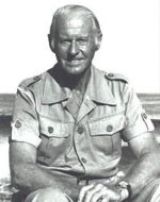
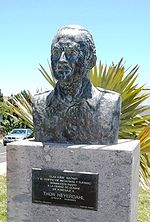
Thor Heyerdahl

Encyclopedia
Thor Heyerdahl was a Norwegian ethnographer and adventurer with a background in zoology
and geography
. He became notable for his Kon-Tiki
expedition, in which he sailed 8000 km (4,971 mi) by raft from South America
to the Tuamotu Islands.
In May 2011, the Thor Heyerdahl Archives were added to UNESCO's "Memory of the World" Register. Currently, this list includes 238 collections from all over the world. The Heyerdahl Archives span the years 1937 to 2002 and include his photographic collection, diaries, private letters, expedition plans, articles, newspaper clippings, original book and article manuscripts. The Heyerdahl Archives are administered by the Kon-Tiki Museum
and the National Library of Norway in Oslo.
in his childhood home, with a Vipera berus
as the main attraction. He studied zoology
and geography
at the University of Oslo
. At the same time, he privately studied Polynesia
n culture and history, consulting what was then the world's largest private collection of books and papers on Polynesia, owned by Bjarne Kropelien, a wealthy wine merchant in Oslo. This collection was later purchased by the University of Oslo Library from Kropelien's heirs and was attached to the Kon-Tiki Museum
research department. After seven terms and consultations with experts in Berlin
, a project was developed and sponsored by Heyerdahl's zoology professors, Kristine Bonnevie and Hjalmar Broch. He was to visit some isolated Pacific island groups and study how the local animals had found their way there.
Just before sailing together to the Marquesas Islands
in 1936, Heyerdahl married his first wife, Liv Coucheron-Torp (b. 1916), whom he had met shortly before enrolling at the university, and who had studied economics
there. Though she is conspicuously absent from many of his papers and talks, Liv participated in nearly all of Thor's journeys, with the exception of the Kon-Tiki Expedition. The couple had two sons; Thor Jr and Bjørn. The marriage ended in divorce.
In 1949 Heyerdahl married Yvonne Dedekam-Simonsen. They had three daughters: Annette, Marian and Helene Elisabeth. They were divorced in 1969. Heyerdahl blamed their separation on his being away from home and differences in their ideas for bringing up children. In his autobiography, he concluded that he should take the entire blame for their separation.
In 1991, Heyerdahl married Jacqueline Beer
(b. 1932) as his third wife. They lived in Tenerife
, Canary Islands
and were very actively involved with archaeological projects, especially in Tucume
, Peru, and Azov
until his unexpected death in 2002. He still had been hoping to undertake an archaeological project in Samoa
before he died.
Heyerdahl died on April 18, 2002, in Colla Micheri in Italy where he had gone to spend the Easter holidays with some of his closest family members. The Norwegian government gave him a state funeral in Oslo Cathedral on April 26, 2002. He is buried in the garden of the family home in Colla Micheri.
, most of the time on Fatu Hiva
, were told first in his book På Jakt efter Paradiset (Hunt for Paradise) (1938), which was published in Norway but, following the outbreak of World War II
, never translated and largely forgotten. Many years later, having achieved notability with other adventures and books on other subjects, Heyerdahl published a new account of this voyage under the title Fatu Hiva (London: Allen & Unwin
, 1974). The story of his time on Fatu Hiva and his side trip to Hivaoa and Mohotani is also related in Green Was the Earth on the Seventh Day (Random House
, 1996).
, where they constructed a pae-pae raft
from balsa
wood and other native materials, a raft that they called the Kon-Tiki
. The Kon-Tiki expedition was inspired by old reports and drawings made by the Spanish Conquistadors of Inca
rafts, and by native legends and archaeological evidence suggesting contact between South America
and Polynesia
. After a 101 day, 4300 miles (6,920.2 km) journey across the Pacific Ocean
, Kon-Tiki smashed into the reef
at Raroia
in the Tuamotu Islands on August 7, 1947.
Heyerdahl, who had nearly drowned at least twice in childhood, admits that he did not take easily to water. "There were moments during every one of my experimental raft voyages that I was momentarily deadly afraid and - like seafarers throughout the ages in similar situations - I felt that I survived through my faith in some superior invisible power. Gradually, I got familiar with the friendly partnership between the dancing ocean and its gentle playmate - the flexible, wash-through aboriginal raft ship. My companions knew I loved life and assumed I had founded my unshakable faith in my scientific theories on solid facts."
Kon-Tiki demonstrated that it was possible for a primitive raft to sail the Pacific with relative ease and safety, especially to the west (with the wind). The raft proved to be highly maneuverable, and fish congregated between the nine balsa logs in such numbers that ancient sailors could have possibly relied on fish for hydration in the absence of other sources of fresh water. Inspired by Kon-Tiki, other rafts have repeated the voyage. Heyerdahl's book about the expedition, Kon-Tiki, has been translated into over 67 languages. The documentary film of the expedition, itself entitled Kon-Tiki, won an Academy Award
in 1951.
Anthropologists continue to believe, based on linguistic
, physical, and genetic
evidence, that Polynesia was settled from west to east, migration having begun from the Asian mainland. There are controversial indications, though, of some sort of South American/Polynesian contact, most notably in the fact that the South American sweet potato
served as a dietary staple throughout much of Polynesia. Heyerdahl attempted to counter the linguistic argument with the analogy that, guessing the origin of African-Americans, he would prefer to believe that they came from Africa, judging from their skin colour, and not from England, judging from their speech.
Studies of HLA genes from "blood samples from Easter Islanders whose ancestors had not interbred with Europeans and other visitors" (collected in 1971 and 2008), led Erik Thorsby (professor of Medicine) to conclude (in 2011) that there was "evidence to support elements of Heyerdahl's hypothesis".
there was a sun-god named Con-Tici Viracocha
who was the supreme head of the mythical fair-skinned people in Peru
. The original name for Viracocha was Kon-Tiki or Illa-Tiki, which means Sun-Tiki or Fire-Tiki. Kon-Tiki was high priest and sun-king of these legendary "white men" who left enormous ruins on the shores of Lake Titicaca
. The legend continues with the mysterious bearded white men being attacked by a chief named Cari who came from the Coquimbo Valley
. They had a battle on an island in Lake Titicaca, and the fair race was massacred. However, Kon-Tiki and his closest companions managed to escape and later arrived on the Pacific coast. The legend ends with Kon-Tiki and his companions disappearing westward out to sea.
When the Spaniards came to Peru, Heyerdahl asserted, the Incas told them that the colossal monuments that stood deserted about the landscape were erected by a race of white gods who had lived there before the Incas themselves became rulers. The Incas described these "white gods" as wise, peaceful instructors who had originally come from the north in the "morning of time" and taught the Incas' primitive forefathers architecture as well as manners and customs. They were unlike other Native Americans in that they had "white skins and long beards" and were taller than the Incas. The Incas said that the "white gods" had then left as suddenly as they had come and fled westward across the Pacific. After they had left, the Incas themselves took over power in the country.
Heyerdahl said that when the Europeans first came to the Pacific islands, they were astonished that they found some of the natives to have relatively light skins and beards. There were whole families that had pale skin, hair varying in color from reddish to blonde. In contrast, most of the Polynesians had golden-brown skin, raven-black hair, and rather flat noses. Heyerdahl claimed that when Jakob Roggeveen
first discovered Easter Island
in 1722, he supposedly noticed that many of the natives were white-skinned. Heyerdahl claimed that these people could count their ancestors who were "white-skinned" right back to the time of Tiki and Hotu Matua, when they first came sailing across the sea "from a mountainous land in the east which was scorched by the sun." The ethnographic evidence for these claims is outlined in Heyerdahl's book Aku Aku: The Secret of Easter Island.
Heyerdahl proposed that Tiki's neolithic
people colonized the then-uninhabited Polynesian islands as far north as Hawaii
, as far south as New Zealand
, as far east as Easter Island, and as far west as Samoa and Tonga around 500 AD. They supposedly sailed from Peru to the Polynesian islands on pae-paes--large rafts built from balsa
logs, complete with sails and each with a small cottage. They built enormous stone statues carved in the image of human beings on Pitcairn, the Marquesas, and Easter Island that resembled those in Peru. They also built huge pyramids on Tahiti
and Samoa
with steps like those in Peru. But all over Polynesia, Heyerdahl found indications that Tiki's peaceable race had not been able to hold the islands alone for long. He found evidence that suggested that seagoing war canoes as large as Viking
ships and lashed together two and two had brought Stone Age Northwest American Indians to Polynesia around 1100 AD, and they mingled with Tiki's people. The oral history of the people of Easter Island, at least as it was documented by Heyerdahl, is completely consistent with this theory, as is the archaeological record
he examined (Heyerdahl 1958). In particular, Heyerdahl obtained a radiocarbon date of 400 AD for a charcoal fire located in the pit that was held by the people of Easter Island to have been used as an "oven" by the "Long Ears," which Heyerdahl's Rapa Nui sources, reciting oral tradition, identified as a white race which had ruled the island in the past (Heyerdahl 1958).
Heyerdahl further argued in his book American Indians in the Pacific that the current inhabitants of Polynesia migrated from an Asian source, but via an alternate route. He proposes that Polynesians traveled with the wind along the North Pacific current. These migrants then arrived in British Columbia. Heyerdahl called contemporary tribes of British Columbia, such as the Tlingit and Haida, descendants of these migrants. Heyerdahl claimed that cultural and physical similarities existed between these British Columbian tribes, Polynesians, and the Old World source. Heyerdahl's claims aside, however, there is no evidence that the Tlingit, Haida or other British Columbian tribes have an affinity with Polynesians.
Heyerdahl's theory of Polynesian origins never gained acceptance among anthropologists
. Physical and cultural evidence had long suggested that Polynesia was settled from west to east, migration having begun from the Asia
n mainland, not South America. In the late 1990s, genetic
testing found that the mitochondrial DNA
of the Polynesians is more similar to people from southeast Asia than to people from South America, showing that their ancestors most likely came from Asia. Easter Islanders are of Polynesian descent.
Anthropologist Robert Carl Suggs
included a chapter titled "The Kon-Tiki Myth" in his book on Polynesia
, concluding that "The Kon-Tiki theory is about as plausible as the tales of Atlantis
, Mu
, and 'Children of the Sun.' Like most such theories it makes exciting light reading, but as an example of scientific method it fares quite poorly."
Anthropologist and National Geographic Explorer-In-Residence Wade Davis
also criticised Heyerdahl's theory in his book The Wayfinders, which explores the history of Polynesia. Davis says that Heyerdahl "ignored the overwhelming body of linguistic, ethnographic, and ethnobotanical evidence, augmented today by genetic and archaeological data, indicating that he was patently wrong."
). The expedition's scientific staff included Arne Skjølsvold, Carlyle Smith, Edwin Ferdon, Gonzalo Figueroa and William Mulloy
. Heyerdahl and the professional archaeologists who traveled with him spent several months on Rapa Nui investigating several important archaeological sites. Highlights of the project include experiments in the carving, transport and erection of the notable moai
, as well as excavations at such prominent sites as Orongo
and Poike
. The expedition published two large volumes of scientific reports (Reports of the Norwegian Archaeological Expedition to Easter Island and the East Pacific) and Heyerdahl later added a third (The Art of Easter Island). Heyerdahl's popular book on the subject, Aku-Aku
was another international best-seller.
In "Easter Island: the Mystery Solved" (Random House, 1989), Heyerdahl offered a more detailed theory of the island's history
. Based on native testimony and archaeological research, he claimed the island was originally colonized by Hanau eepe ("Long Ears"), from South America, and that Polynesians Hanua momoko ("Short Ears") arrived only in the mid-16th century; they may have come independently or perhaps were imported as workers. According to Heyerdahl, something happened between Admiral Roggeveen's discovery of the island in 1722 and James Cook's visit in 1774; while Roggeveen encountered white, Indian, and Polynesian people living in relative harmony and prosperity, Cook encountered a much smaller population consisting mainly of Polynesians and living in privation.
Heyerdahl speculates there was an uprising of "Short Ears" against the ruling "Long Ears." The "Long Ears" dug a defensive moat on the eastern end of the island and filled it with kindling. During the uprising, Heyerdahl claimed, the "Long Ears" ignited their moat and retreated behind it, but the "Short Ears" found a way around it, came up from behind, and pushed all but two of the "Long Ears" into the fire.
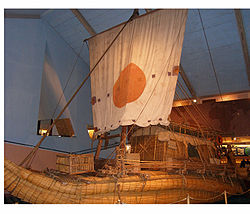 In 1969 and 1970, Heyerdahl built two boats from papyrus
and attempted to cross the Atlantic Ocean
from Morocco
in Africa. Based on drawings and models from ancient Egypt
, the first boat, named Ra (after the Egyptian Sun god
), was constructed by boat builders from Lake Chad
using papyrus reed obtained from Lake Tana
in Ethiopia
and launched into the Atlantic Ocean from the coast of Morocco. After a number of weeks, Ra took on water after its crew made modifications to the vessel that caused it to sag and break apart. The ship was abandoned and the following year, another similar vessel, Ra II, was built of totora
by Demetrio, Juan and Jose Limachi from Lake Titicaca
in Bolivia
and likewise set sail across the Atlantic from Morocco, this time with great success. The boat reached Barbados
, thus demonstrating that mariners could have dealt with trans-Atlantic voyages by sailing with the Canary Current
.
A book, The Ra Expeditions, and a film documentary Ra
(1972) were made about the voyages.
Apart from the primary aspects of the expedition, Heyerdahl deliberately selected a crew representing a great diversity in race, nationality
, religion
and political viewpoint in order to demonstrate that at least on their own little floating island, people could cooperate and live peacefully. Additionally, the expedition took samples of marine pollution
and presented their report to the United Nations
.
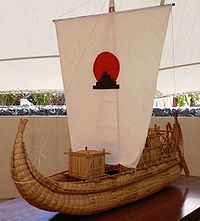 Heyerdahl built yet another reed boat
, Tigris, which was intended to demonstrate that trade and migration could have linked Mesopotamia
with the Indus Valley Civilization
in what is now modern-day Pakistan. Tigris was built in Iraq and sailed with its international crew through the Persian Gulf to Pakistan and made its way into the Red Sea. After about 5 months at sea and still remaining seaworthy, the Tigris was deliberately burnt in Djibouti
, on April 3, 1978, as a protest against the wars raging on every side in the Red Sea
and Horn of Africa
. In his Open Letter to the UN Secretary-General Kurt Waldheim
, he explained his reasons:
In the years that followed, Heyerdahl was often outspoken on issues of international peace and the environment.
The Tigris was crewed by eleven men: Thor Heyerdahl (Norway), Norman Baker
(USA),
Carlo Mauri
(Italy), Yuri Senkevich
(USSR), Germán Carrasco (Mexico),
Hans Petter Bohn (Norway), Rashad Nazar Salim (Iraq), Norris Brock (USA), Toru Suzuki (Japan), Detlef Zoltzek (Germany), Asbjørn Damhus (Denmark).
1982, 1994, 1999 and 2000. Heyerdahl had long been fascinated with the rock carvings that date back to about 10,000 B.C. at Gobustan (about 30 miles west of Baku
). He was convinced that their artistic style closely resembles the carvings found in his native Norway. The ship designs, in particular, were regarded by Heyerdahl as similar and drawn with a simple sickle–shaped lines, representing the base of the boat, with vertical lines on deck, illustrating crew or, perhaps, raised oars.
Based on this and other published documentation, Heyerdahl proposed that Azerbaijan was the site of an ancient advanced civilization. He believed natives migrated north through waterways to present-day Scandinavia using ingeniously constructed vessels made of skins that could be folded like cloth. When voyagers traveled upstream, they conveniently folded their skin boats and transported them via pack animals.
On Heyerdahl's visit to Baku in 1999, he lectured at the Academy of Sciences
about the history of ancient Nordic Kings. He spoke of a notation made by Snorri, a 13th-century historian, which reads: "Odin (a Scandinavian god who was one of the kings) came to the North with his people from a country called Aser." Heyerdahl claimed that the geographic location of Aser matched the region of contemporary Azerbaijan - "east of the Caucasus mountains and the Black Sea".
"We are no longer talking about mythology," Heyerdahl said, "but of the realities of geography and history. Azerbaijanis should be proud of their ancient culture. It is just as rich and ancient as that of China and Mesopotamia."
, colonized the Maldives
, and influenced or founded the cultures of ancient South America and Easter Island. His discoveries are detailed in his book, "The Maldive Mystery."
In 1991 he studied the Pyramids of Güímar
on Tenerife
and declared that they were not random stone heaps but pyramids. He believed that he discovered their special astronomical orientation, claiming that the ancient people who built them were most likely sun worshipers due to the alignment of the pyramids. Heyerdahl advanced a theory according to which the Canaries
had been bases of ancient shipping between America and the Mediterranean.
His last project was presented in the book Jakten på Odin
, (The Search for Odin), in which he initiated excavations in Azov
, near the Sea of Azov
at the northeast of the Black Sea
. He searched for the remains of a civilization to match the account of Snorri Sturluson
in Ynglinga saga
, where Snorri describes how a chief called Odin
led a tribe, called the Æsir
in a migration northwards through Saxland, to Fyn
in Denmark
settling in Sweden
. There, according to Snorri, he so impressed the natives with his diverse skills that they started worshiping him as a god after his death (see also House of Ynglings and Mythological kings of Sweden). Heyerdahl accepted Snorri's story as literal truth. This project generated harsh criticism and accusations of pseudo-science from historians, archaeologists and linguists in Norway, who accused Heyerdahl of selective use of sources, and a basic lack of scientific methodology in his work.
The central claims in this book are based on similarities of names in Norse mythology and geographic names in the Black Sea-region, e.g. Azov
and æsir
, Udi
and Odin
, Tyr and Turkey
. Philologists and historians reject these parallels as mere coincidences, and also anachronisms, for instance the city of Azov did not have that name until over 1000 years after Heyerdahl claims the æsir
dwellt there. The controversy surrounding the search for Odin-project was in many ways typical of the relationship between Heyerdahl and the academic community. His theories rarely won any scientific acceptance, whereas Heyerdahl himself rejected all scientific criticism and concentrated on publishing his theories in popular books aimed at the general public. In pursuit of investigating these ideas, he organized an archaeological dig at Azov, Russia - one of the last projects of his life.
Heyerdahl traveled to Azerbaijan four times (1981, 1994, 1999, 2000) and visited the Kish church. Heyerdahl's Odin theory
was rejected by historians, archaeologists, and linguists. Like many of Heyerdahl's ideas which are gaining more scientific acceptance after his death, it is likely that we have not heard the final word about Odin and Heyerdahl's theories of migration to the Scandinavia.
Heyerdahl was also an active figure in Green politics
. He was the recipient of numerous medals and awards. He also received 11 honorary doctorates
from universities in the Americas
and Europe
.
. After receiving the diagnosis he prepared for dying by refusing to eat or take medication. The Norwegian government granted Heyerdahl the honor of a state funeral
in the Oslo Cathedral
on April 26, 2002. His cremated remains lie in the garden of his family's home in Colla Micheri
.
regime. The background of this criticism is that, in February 1938, Heyerdahl, having visited the Marquesas Islands
, travelled to Berlin
, where he presented himself at Professor Hans Günther's office. Günther, a Nazi race researcher, was delighted to receive from Heyerdahl a skull
from a native of the Marquesas Islands. After the meeting, Heyerdahl sent his mother a letter, in which he described Günther as "one of the leading men of the new Reich."
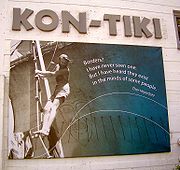
Paul Theroux, in his book "The Happy Isles of Oceania" criticizes Heyerdahl for trying to link the culture of Polynesian islands with the Peruvian culture. However, recent scientific investigation, published in 2011, which compares the DNA of some of the Polynesian islands with natives from Peru suggests that there is merit to Heyerdahl's ideas and that they cannot be dismissed.
 Asteroid 2473 Heyerdahl
is named after him, as is HNoMS Thor Heyerdahl, a Norwegian Nansen class frigate.
Heyerdahl's numerous awards and honors include the following:
Zoology
Zoology |zoölogy]]), is the branch of biology that relates to the animal kingdom, including the structure, embryology, evolution, classification, habits, and distribution of all animals, both living and extinct...
and geography
Geography
Geography is the science that studies the lands, features, inhabitants, and phenomena of Earth. A literal translation would be "to describe or write about the Earth". The first person to use the word "geography" was Eratosthenes...
. He became notable for his Kon-Tiki
Kon-Tiki
Kon-Tiki was the raft used by Norwegian explorer and writer Thor Heyerdahl in his 1947 expedition across the Pacific Ocean from South America to the Polynesian islands. It was named after the Inca sun god, Viracocha, for whom "Kon-Tiki" was said to be an old name...
expedition, in which he sailed 8000 km (4,971 mi) by raft from South America
South America
South America is a continent situated in the Western Hemisphere, mostly in the Southern Hemisphere, with a relatively small portion in the Northern Hemisphere. The continent is also considered a subcontinent of the Americas. It is bordered on the west by the Pacific Ocean and on the north and east...
to the Tuamotu Islands.
In May 2011, the Thor Heyerdahl Archives were added to UNESCO's "Memory of the World" Register. Currently, this list includes 238 collections from all over the world. The Heyerdahl Archives span the years 1937 to 2002 and include his photographic collection, diaries, private letters, expedition plans, articles, newspaper clippings, original book and article manuscripts. The Heyerdahl Archives are administered by the Kon-Tiki Museum
Kon-Tiki Museum
The Kon-Tiki Museum is a museum at the archipelago Bygdøy in Oslo, Norway. It houses vessels and maps from the Kon-Tiki expedition, as well as a library with about 8000 books. It was opened in a provisional building in 1949. In 1957, the current building—designed by architects F. S. Platou and Otto...
and the National Library of Norway in Oslo.
Heyerdahl's youth and personal life
Heyerdahl was born in Larvik, the son of master brewer Thor Heyerdahl and his wife Alison Lyng. As a young child, Heyerdahl showed a strong interest in zoology. He created a small museumMuseum
A museum is an institution that cares for a collection of artifacts and other objects of scientific, artistic, cultural, or historical importance and makes them available for public viewing through exhibits that may be permanent or temporary. Most large museums are located in major cities...
in his childhood home, with a Vipera berus
Vipera berus
Vipera berus, the common European adder or common European viper, is a venomous viper species that is extremely widespread and can be found throughout most of Western Europe and all the way to Far East Asia. Known by a host of common names including Common adder and Common viper, adders have been...
as the main attraction. He studied zoology
Zoology
Zoology |zoölogy]]), is the branch of biology that relates to the animal kingdom, including the structure, embryology, evolution, classification, habits, and distribution of all animals, both living and extinct...
and geography
Geography
Geography is the science that studies the lands, features, inhabitants, and phenomena of Earth. A literal translation would be "to describe or write about the Earth". The first person to use the word "geography" was Eratosthenes...
at the University of Oslo
University of Oslo
The University of Oslo , formerly The Royal Frederick University , is the oldest and largest university in Norway, situated in the Norwegian capital of Oslo. The university was founded in 1811 and was modelled after the recently established University of Berlin...
. At the same time, he privately studied Polynesia
Polynesia
Polynesia is a subregion of Oceania, made up of over 1,000 islands scattered over the central and southern Pacific Ocean. The indigenous people who inhabit the islands of Polynesia are termed Polynesians and they share many similar traits including language, culture and beliefs...
n culture and history, consulting what was then the world's largest private collection of books and papers on Polynesia, owned by Bjarne Kropelien, a wealthy wine merchant in Oslo. This collection was later purchased by the University of Oslo Library from Kropelien's heirs and was attached to the Kon-Tiki Museum
Kon-Tiki Museum
The Kon-Tiki Museum is a museum at the archipelago Bygdøy in Oslo, Norway. It houses vessels and maps from the Kon-Tiki expedition, as well as a library with about 8000 books. It was opened in a provisional building in 1949. In 1957, the current building—designed by architects F. S. Platou and Otto...
research department. After seven terms and consultations with experts in Berlin
Berlin
Berlin is the capital city of Germany and is one of the 16 states of Germany. With a population of 3.45 million people, Berlin is Germany's largest city. It is the second most populous city proper and the seventh most populous urban area in the European Union...
, a project was developed and sponsored by Heyerdahl's zoology professors, Kristine Bonnevie and Hjalmar Broch. He was to visit some isolated Pacific island groups and study how the local animals had found their way there.
Just before sailing together to the Marquesas Islands
Marquesas Islands
The Marquesas Islands enana and Te Fenua `Enata , both meaning "The Land of Men") are a group of volcanic islands in French Polynesia, an overseas collectivity of France in the southern Pacific Ocean. The Marquesas are located at 9° 00S, 139° 30W...
in 1936, Heyerdahl married his first wife, Liv Coucheron-Torp (b. 1916), whom he had met shortly before enrolling at the university, and who had studied economics
Economics
Economics is the social science that analyzes the production, distribution, and consumption of goods and services. The term economics comes from the Ancient Greek from + , hence "rules of the house"...
there. Though she is conspicuously absent from many of his papers and talks, Liv participated in nearly all of Thor's journeys, with the exception of the Kon-Tiki Expedition. The couple had two sons; Thor Jr and Bjørn. The marriage ended in divorce.
In 1949 Heyerdahl married Yvonne Dedekam-Simonsen. They had three daughters: Annette, Marian and Helene Elisabeth. They were divorced in 1969. Heyerdahl blamed their separation on his being away from home and differences in their ideas for bringing up children. In his autobiography, he concluded that he should take the entire blame for their separation.
In 1991, Heyerdahl married Jacqueline Beer
Jacqueline Beer
Jacqueline Vangramberg is a former Hollywood film and television actress who was also named Miss France in the 1954 Miss Universe Pageant...
(b. 1932) as his third wife. They lived in Tenerife
Tenerife
Tenerife is the largest and most populous island of the seven Canary Islands, it is also the most populated island of Spain, with a land area of 2,034.38 km² and 906,854 inhabitants, 43% of the total population of the Canary Islands. About five million tourists visit Tenerife each year, the...
, Canary Islands
Canary Islands
The Canary Islands , also known as the Canaries , is a Spanish archipelago located just off the northwest coast of mainland Africa, 100 km west of the border between Morocco and the Western Sahara. The Canaries are a Spanish autonomous community and an outermost region of the European Union...
and were very actively involved with archaeological projects, especially in Tucume
Túcume
Purgatorio is the name by which local people refer to the dozens of pre-Hispanic pyramids, enclosures and mounds found on the plain around La Raya Mountain, south of the La Leche River...
, Peru, and Azov
Azov
-External links:** *...
until his unexpected death in 2002. He still had been hoping to undertake an archaeological project in Samoa
Samoa
Samoa , officially the Independent State of Samoa, formerly known as Western Samoa is a country encompassing the western part of the Samoan Islands in the South Pacific Ocean. It became independent from New Zealand in 1962. The two main islands of Samoa are Upolu and one of the biggest islands in...
before he died.
Heyerdahl died on April 18, 2002, in Colla Micheri in Italy where he had gone to spend the Easter holidays with some of his closest family members. The Norwegian government gave him a state funeral in Oslo Cathedral on April 26, 2002. He is buried in the garden of the family home in Colla Micheri.
Fatu Hiva
The events surrounding his stay on the MarquesasMarquesas Islands
The Marquesas Islands enana and Te Fenua `Enata , both meaning "The Land of Men") are a group of volcanic islands in French Polynesia, an overseas collectivity of France in the southern Pacific Ocean. The Marquesas are located at 9° 00S, 139° 30W...
, most of the time on Fatu Hiva
Fatu Hiva
Fatu Hiva is the southernmost of the Marquesas Islands, in French Polynesia, an overseas territory of France in the Pacific Ocean...
, were told first in his book På Jakt efter Paradiset (Hunt for Paradise) (1938), which was published in Norway but, following the outbreak of World War II
World War II
World War II, or the Second World War , was a global conflict lasting from 1939 to 1945, involving most of the world's nations—including all of the great powers—eventually forming two opposing military alliances: the Allies and the Axis...
, never translated and largely forgotten. Many years later, having achieved notability with other adventures and books on other subjects, Heyerdahl published a new account of this voyage under the title Fatu Hiva (London: Allen & Unwin
Allen & Unwin
Allen & Unwin, formerly a major British publishing house, is now an independent book publisher and distributor based in Australia. The Australian directors have been the sole owners of the Allen & Unwin name since effecting a management buy out at the time the UK parent company, Unwin Hyman, was...
, 1974). The story of his time on Fatu Hiva and his side trip to Hivaoa and Mohotani is also related in Green Was the Earth on the Seventh Day (Random House
Random House
Random House, Inc. is the largest general-interest trade book publisher in the world. It has been owned since 1998 by the German private media corporation Bertelsmann and has become the umbrella brand for Bertelsmann book publishing. Random House also has a movie production arm, Random House Films,...
, 1996).
The Kon-Tiki expedition
In the Kon-Tiki Expedition, Heyerdahl and five fellow adventurers went to PeruPeru
Peru , officially the Republic of Peru , is a country in western South America. It is bordered on the north by Ecuador and Colombia, on the east by Brazil, on the southeast by Bolivia, on the south by Chile, and on the west by the Pacific Ocean....
, where they constructed a pae-pae raft
Raft
A raft is any flat structure for support or transportation over water. It is the most basic of boat design, characterized by the absence of a hull...
from balsa
Balsa
Ochroma pyramidale, commonly known as the balsa tree , is a species of flowering plant in the mallow family, Malvaceae. It is a large, fast-growing tree that can grow up to tall. It is the source of balsa wood, a very lightweight material with many uses...
wood and other native materials, a raft that they called the Kon-Tiki
Kon-Tiki
Kon-Tiki was the raft used by Norwegian explorer and writer Thor Heyerdahl in his 1947 expedition across the Pacific Ocean from South America to the Polynesian islands. It was named after the Inca sun god, Viracocha, for whom "Kon-Tiki" was said to be an old name...
. The Kon-Tiki expedition was inspired by old reports and drawings made by the Spanish Conquistadors of Inca
Inca Empire
The Inca Empire, or Inka Empire , was the largest empire in pre-Columbian America. The administrative, political and military center of the empire was located in Cusco in modern-day Peru. The Inca civilization arose from the highlands of Peru sometime in the early 13th century...
rafts, and by native legends and archaeological evidence suggesting contact between South America
South America
South America is a continent situated in the Western Hemisphere, mostly in the Southern Hemisphere, with a relatively small portion in the Northern Hemisphere. The continent is also considered a subcontinent of the Americas. It is bordered on the west by the Pacific Ocean and on the north and east...
and Polynesia
Polynesia
Polynesia is a subregion of Oceania, made up of over 1,000 islands scattered over the central and southern Pacific Ocean. The indigenous people who inhabit the islands of Polynesia are termed Polynesians and they share many similar traits including language, culture and beliefs...
. After a 101 day, 4300 miles (6,920.2 km) journey across the Pacific Ocean
Pacific Ocean
The Pacific Ocean is the largest of the Earth's oceanic divisions. It extends from the Arctic in the north to the Southern Ocean in the south, bounded by Asia and Australia in the west, and the Americas in the east.At 165.2 million square kilometres in area, this largest division of the World...
, Kon-Tiki smashed into the reef
Reef
In nautical terminology, a reef is a rock, sandbar, or other feature lying beneath the surface of the water ....
at Raroia
Raroia
Raroia, or Raro-nuku, is an atoll of the Tuamotus chain in French Polynesia, located 740 km northeast of Tahiti and 6 km southwest of Takume. Administratively it is a part of the commune of Makemo....
in the Tuamotu Islands on August 7, 1947.
Heyerdahl, who had nearly drowned at least twice in childhood, admits that he did not take easily to water. "There were moments during every one of my experimental raft voyages that I was momentarily deadly afraid and - like seafarers throughout the ages in similar situations - I felt that I survived through my faith in some superior invisible power. Gradually, I got familiar with the friendly partnership between the dancing ocean and its gentle playmate - the flexible, wash-through aboriginal raft ship. My companions knew I loved life and assumed I had founded my unshakable faith in my scientific theories on solid facts."
Kon-Tiki demonstrated that it was possible for a primitive raft to sail the Pacific with relative ease and safety, especially to the west (with the wind). The raft proved to be highly maneuverable, and fish congregated between the nine balsa logs in such numbers that ancient sailors could have possibly relied on fish for hydration in the absence of other sources of fresh water. Inspired by Kon-Tiki, other rafts have repeated the voyage. Heyerdahl's book about the expedition, Kon-Tiki, has been translated into over 67 languages. The documentary film of the expedition, itself entitled Kon-Tiki, won an Academy Award
Academy Awards
An Academy Award, also known as an Oscar, is an accolade bestowed by the American Academy of Motion Picture Arts and Sciences to recognize excellence of professionals in the film industry, including directors, actors, and writers...
in 1951.
Anthropologists continue to believe, based on linguistic
Linguistics
Linguistics is the scientific study of human language. Linguistics can be broadly broken into three categories or subfields of study: language form, language meaning, and language in context....
, physical, and genetic
Genetics
Genetics , a discipline of biology, is the science of genes, heredity, and variation in living organisms....
evidence, that Polynesia was settled from west to east, migration having begun from the Asian mainland. There are controversial indications, though, of some sort of South American/Polynesian contact, most notably in the fact that the South American sweet potato
Sweet potato
The sweet potato is a dicotyledonous plant that belongs to the family Convolvulaceae. Its large, starchy, sweet-tasting, tuberous roots are an important root vegetable. The young leaves and shoots are sometimes eaten as greens. Of the approximately 50 genera and more than 1,000 species of...
served as a dietary staple throughout much of Polynesia. Heyerdahl attempted to counter the linguistic argument with the analogy that, guessing the origin of African-Americans, he would prefer to believe that they came from Africa, judging from their skin colour, and not from England, judging from their speech.
Studies of HLA genes from "blood samples from Easter Islanders whose ancestors had not interbred with Europeans and other visitors" (collected in 1971 and 2008), led Erik Thorsby (professor of Medicine) to conclude (in 2011) that there was "evidence to support elements of Heyerdahl's hypothesis".
Heyerdahl's theory of Polynesian origins
Heyerdahl claimed that in Incan legendInca mythology
Inca mythology includes many stories and legends that are mythological and helps to explain or symbolizes Inca beliefs.All those that followed the Spanish conquest of the Inca Empire by Francisco Pizarro burned the records of the Inca culture...
there was a sun-god named Con-Tici Viracocha
Viracocha
Viracocha is the great creator god in the pre-Inca and Inca mythology in the Andes region of South America. Full name and some spelling alternatives are Apu Qun Tiqsi Wiraqutra and Con-Tici Viracocha...
who was the supreme head of the mythical fair-skinned people in Peru
Peru
Peru , officially the Republic of Peru , is a country in western South America. It is bordered on the north by Ecuador and Colombia, on the east by Brazil, on the southeast by Bolivia, on the south by Chile, and on the west by the Pacific Ocean....
. The original name for Viracocha was Kon-Tiki or Illa-Tiki, which means Sun-Tiki or Fire-Tiki. Kon-Tiki was high priest and sun-king of these legendary "white men" who left enormous ruins on the shores of Lake Titicaca
Lake Titicaca
Lake Titicaca is a lake located on the border of Peru and Bolivia. It sits 3,811 m above sea level, making it the highest commercially navigable lake in the world...
. The legend continues with the mysterious bearded white men being attacked by a chief named Cari who came from the Coquimbo Valley
Coquimbo Region
The IV Coquimbo Region is one of Chile's 15 first order administrative divisions. It is some 400 km north of the capital, Santiago.The capital and largest city is La Serena, other important cities include the seaport Coquimbo and the agricultural centre...
. They had a battle on an island in Lake Titicaca, and the fair race was massacred. However, Kon-Tiki and his closest companions managed to escape and later arrived on the Pacific coast. The legend ends with Kon-Tiki and his companions disappearing westward out to sea.
When the Spaniards came to Peru, Heyerdahl asserted, the Incas told them that the colossal monuments that stood deserted about the landscape were erected by a race of white gods who had lived there before the Incas themselves became rulers. The Incas described these "white gods" as wise, peaceful instructors who had originally come from the north in the "morning of time" and taught the Incas' primitive forefathers architecture as well as manners and customs. They were unlike other Native Americans in that they had "white skins and long beards" and were taller than the Incas. The Incas said that the "white gods" had then left as suddenly as they had come and fled westward across the Pacific. After they had left, the Incas themselves took over power in the country.
Heyerdahl said that when the Europeans first came to the Pacific islands, they were astonished that they found some of the natives to have relatively light skins and beards. There were whole families that had pale skin, hair varying in color from reddish to blonde. In contrast, most of the Polynesians had golden-brown skin, raven-black hair, and rather flat noses. Heyerdahl claimed that when Jakob Roggeveen
Jakob Roggeveen
Jacob Roggeveen was a Dutch explorer who was sent to find Terra Australis, but he instead came across Easter Island...
first discovered Easter Island
Easter Island
Easter Island is a Polynesian island in the southeastern Pacific Ocean, at the southeasternmost point of the Polynesian triangle. A special territory of Chile that was annexed in 1888, Easter Island is famous for its 887 extant monumental statues, called moai, created by the early Rapanui people...
in 1722, he supposedly noticed that many of the natives were white-skinned. Heyerdahl claimed that these people could count their ancestors who were "white-skinned" right back to the time of Tiki and Hotu Matua, when they first came sailing across the sea "from a mountainous land in the east which was scorched by the sun." The ethnographic evidence for these claims is outlined in Heyerdahl's book Aku Aku: The Secret of Easter Island.
Heyerdahl proposed that Tiki's neolithic
Neolithic
The Neolithic Age, Era, or Period, or New Stone Age, was a period in the development of human technology, beginning about 9500 BC in some parts of the Middle East, and later in other parts of the world. It is traditionally considered as the last part of the Stone Age...
people colonized the then-uninhabited Polynesian islands as far north as Hawaii
Hawaii
Hawaii is the newest of the 50 U.S. states , and is the only U.S. state made up entirely of islands. It is the northernmost island group in Polynesia, occupying most of an archipelago in the central Pacific Ocean, southwest of the continental United States, southeast of Japan, and northeast of...
, as far south as New Zealand
New Zealand
New Zealand is an island country in the south-western Pacific Ocean comprising two main landmasses and numerous smaller islands. The country is situated some east of Australia across the Tasman Sea, and roughly south of the Pacific island nations of New Caledonia, Fiji, and Tonga...
, as far east as Easter Island, and as far west as Samoa and Tonga around 500 AD. They supposedly sailed from Peru to the Polynesian islands on pae-paes--large rafts built from balsa
Balsa
Ochroma pyramidale, commonly known as the balsa tree , is a species of flowering plant in the mallow family, Malvaceae. It is a large, fast-growing tree that can grow up to tall. It is the source of balsa wood, a very lightweight material with many uses...
logs, complete with sails and each with a small cottage. They built enormous stone statues carved in the image of human beings on Pitcairn, the Marquesas, and Easter Island that resembled those in Peru. They also built huge pyramids on Tahiti
Tahiti
Tahiti is the largest island in the Windward group of French Polynesia, located in the archipelago of the Society Islands in the southern Pacific Ocean. It is the economic, cultural and political centre of French Polynesia. The island was formed from volcanic activity and is high and mountainous...
and Samoa
Samoa
Samoa , officially the Independent State of Samoa, formerly known as Western Samoa is a country encompassing the western part of the Samoan Islands in the South Pacific Ocean. It became independent from New Zealand in 1962. The two main islands of Samoa are Upolu and one of the biggest islands in...
with steps like those in Peru. But all over Polynesia, Heyerdahl found indications that Tiki's peaceable race had not been able to hold the islands alone for long. He found evidence that suggested that seagoing war canoes as large as Viking
Viking
The term Viking is customarily used to refer to the Norse explorers, warriors, merchants, and pirates who raided, traded, explored and settled in wide areas of Europe, Asia and the North Atlantic islands from the late 8th to the mid-11th century.These Norsemen used their famed longships to...
ships and lashed together two and two had brought Stone Age Northwest American Indians to Polynesia around 1100 AD, and they mingled with Tiki's people. The oral history of the people of Easter Island, at least as it was documented by Heyerdahl, is completely consistent with this theory, as is the archaeological record
Archaeological record
The archaeological record is the body of physical evidence about the past. It is one of the most basic concepts in archaeology, the academic discipline concerned with documenting and interpreting the archaeological record....
he examined (Heyerdahl 1958). In particular, Heyerdahl obtained a radiocarbon date of 400 AD for a charcoal fire located in the pit that was held by the people of Easter Island to have been used as an "oven" by the "Long Ears," which Heyerdahl's Rapa Nui sources, reciting oral tradition, identified as a white race which had ruled the island in the past (Heyerdahl 1958).
Heyerdahl further argued in his book American Indians in the Pacific that the current inhabitants of Polynesia migrated from an Asian source, but via an alternate route. He proposes that Polynesians traveled with the wind along the North Pacific current. These migrants then arrived in British Columbia. Heyerdahl called contemporary tribes of British Columbia, such as the Tlingit and Haida, descendants of these migrants. Heyerdahl claimed that cultural and physical similarities existed between these British Columbian tribes, Polynesians, and the Old World source. Heyerdahl's claims aside, however, there is no evidence that the Tlingit, Haida or other British Columbian tribes have an affinity with Polynesians.
Heyerdahl's theory of Polynesian origins never gained acceptance among anthropologists
Anthropology
Anthropology is the study of humanity. It has origins in the humanities, the natural sciences, and the social sciences. The term "anthropology" is from the Greek anthrōpos , "man", understood to mean mankind or humanity, and -logia , "discourse" or "study", and was first used in 1501 by German...
. Physical and cultural evidence had long suggested that Polynesia was settled from west to east, migration having begun from the Asia
Asia
Asia is the world's largest and most populous continent, located primarily in the eastern and northern hemispheres. It covers 8.7% of the Earth's total surface area and with approximately 3.879 billion people, it hosts 60% of the world's current human population...
n mainland, not South America. In the late 1990s, genetic
Genetics
Genetics , a discipline of biology, is the science of genes, heredity, and variation in living organisms....
testing found that the mitochondrial DNA
Mitochondrial DNA
Mitochondrial DNA is the DNA located in organelles called mitochondria, structures within eukaryotic cells that convert the chemical energy from food into a form that cells can use, adenosine triphosphate...
of the Polynesians is more similar to people from southeast Asia than to people from South America, showing that their ancestors most likely came from Asia. Easter Islanders are of Polynesian descent.
Anthropologist Robert Carl Suggs
Robert Carl Suggs
Robert Carl Suggs is an American archaeologist and anthropologist.- Work History :Robert Suggs has written a number of books including The Archaeology of New York, The Archaeology of San Francisco, Modern Discoveries in Archaeology, academic articles, and is best known for his ethnography-backed...
included a chapter titled "The Kon-Tiki Myth" in his book on Polynesia
Polynesia
Polynesia is a subregion of Oceania, made up of over 1,000 islands scattered over the central and southern Pacific Ocean. The indigenous people who inhabit the islands of Polynesia are termed Polynesians and they share many similar traits including language, culture and beliefs...
, concluding that "The Kon-Tiki theory is about as plausible as the tales of Atlantis
Atlantis
Atlantis is a legendary island first mentioned in Plato's dialogues Timaeus and Critias, written about 360 BC....
, Mu
Mu (lost continent)
Mu is the name of a hypothetical continent that allegedly existed in one of Earth's oceans, but disappeared at the dawn of human history.The concept and the name were proposed by 19th century traveler and writer Augustus Le Plongeon, who claimed that several ancient civilizations, such as those of...
, and 'Children of the Sun.' Like most such theories it makes exciting light reading, but as an example of scientific method it fares quite poorly."
Anthropologist and National Geographic Explorer-In-Residence Wade Davis
Wade Davis
Edmund Wade Davis is a Canadian anthropologist, ethnobotanist, author and photographer whose work has focused on worldwide indigenous cultures, especially in North and South America and particularly involving the traditional uses and beliefs associated with psychoactive plants...
also criticised Heyerdahl's theory in his book The Wayfinders, which explores the history of Polynesia. Davis says that Heyerdahl "ignored the overwhelming body of linguistic, ethnographic, and ethnobotanical evidence, augmented today by genetic and archaeological data, indicating that he was patently wrong."
Expedition to Rapa Nui
In 1955–1956, Heyerdahl organized the Norwegian Archaeological Expedition to Rapa Nui (Easter IslandEaster Island
Easter Island is a Polynesian island in the southeastern Pacific Ocean, at the southeasternmost point of the Polynesian triangle. A special territory of Chile that was annexed in 1888, Easter Island is famous for its 887 extant monumental statues, called moai, created by the early Rapanui people...
). The expedition's scientific staff included Arne Skjølsvold, Carlyle Smith, Edwin Ferdon, Gonzalo Figueroa and William Mulloy
William Mulloy
William Thomas Mulloy, Jr. was an American anthropologist. While his early research established him as a formidable scholar and skillful fieldwork supervisor in the province of North American Plains archaeology, he is best known for his studies of Polynesian prehistory, especially his...
. Heyerdahl and the professional archaeologists who traveled with him spent several months on Rapa Nui investigating several important archaeological sites. Highlights of the project include experiments in the carving, transport and erection of the notable moai
Moai
Moai , or mo‘ai, are monolithic human figures carved from rock on the Chilean Polynesian island of Easter Island between the years 1250 and 1500. Nearly half are still at Rano Raraku, the main moai quarry, but hundreds were transported from there and set on stone platforms called ahu around the...
, as well as excavations at such prominent sites as Orongo
Orongo
‘Orongo is a stone village and ceremonial centre at the southwestern tip of Rapa Nui . The first half of the ceremonial village's 53 stone masonry houses were investigated and restored in 1974 by American archaeologist William Mulloy...
and Poike
Poike
Poike is one of three main extinct volcanoes that form Rapa Nui . At 370 metres, it is the island's second highest peak after Terevaka.right|275 px|thumb|[[Ahu Tongariki]] with Poike in the background...
. The expedition published two large volumes of scientific reports (Reports of the Norwegian Archaeological Expedition to Easter Island and the East Pacific) and Heyerdahl later added a third (The Art of Easter Island). Heyerdahl's popular book on the subject, Aku-Aku
Aku-Aku
Aku-Aku, the Secret of Easter Island is a 1958 book by Thor Heyerdahl that described his research at Rano Raraku and Anakena on the many giant stone statues or moai found on Easter Island and the culture that created them....
was another international best-seller.
In "Easter Island: the Mystery Solved" (Random House, 1989), Heyerdahl offered a more detailed theory of the island's history
History of Easter Island
Geologically one of the youngest inhabited territories on Earth, Easter Island was, for most of its history, the most isolated. Its inhabitants, the Rapanui, have endured famines, epidemics of disease and cannibalism, civil war, slave raids, various colonial contacts, and have seen their population...
. Based on native testimony and archaeological research, he claimed the island was originally colonized by Hanau eepe ("Long Ears"), from South America, and that Polynesians Hanua momoko ("Short Ears") arrived only in the mid-16th century; they may have come independently or perhaps were imported as workers. According to Heyerdahl, something happened between Admiral Roggeveen's discovery of the island in 1722 and James Cook's visit in 1774; while Roggeveen encountered white, Indian, and Polynesian people living in relative harmony and prosperity, Cook encountered a much smaller population consisting mainly of Polynesians and living in privation.
Heyerdahl speculates there was an uprising of "Short Ears" against the ruling "Long Ears." The "Long Ears" dug a defensive moat on the eastern end of the island and filled it with kindling. During the uprising, Heyerdahl claimed, the "Long Ears" ignited their moat and retreated behind it, but the "Short Ears" found a way around it, came up from behind, and pushed all but two of the "Long Ears" into the fire.
The boats Ra and Ra II
Papyrus
Papyrus is a thick paper-like material produced from the pith of the papyrus plant, Cyperus papyrus, a wetland sedge that was once abundant in the Nile Delta of Egypt....
and attempted to cross the Atlantic Ocean
Atlantic Ocean
The Atlantic Ocean is the second-largest of the world's oceanic divisions. With a total area of about , it covers approximately 20% of the Earth's surface and about 26% of its water surface area...
from Morocco
Morocco
Morocco , officially the Kingdom of Morocco , is a country located in North Africa. It has a population of more than 32 million and an area of 710,850 km², and also primarily administers the disputed region of the Western Sahara...
in Africa. Based on drawings and models from ancient Egypt
Egypt
Egypt , officially the Arab Republic of Egypt, Arabic: , is a country mainly in North Africa, with the Sinai Peninsula forming a land bridge in Southwest Asia. Egypt is thus a transcontinental country, and a major power in Africa, the Mediterranean Basin, the Middle East and the Muslim world...
, the first boat, named Ra (after the Egyptian Sun god
Ra
Ra is the ancient Egyptian sun god. By the Fifth Dynasty he had become a major deity in ancient Egyptian religion, identified primarily with the mid-day sun...
), was constructed by boat builders from Lake Chad
Lake Chad
Lake Chad is a historically large, shallow, endorheic lake in Africa, whose size has varied over the centuries. According to the Global Resource Information Database of the United Nations Environment Programme, it shrank as much as 95% from about 1963 to 1998; yet it also states that "the 2007 ...
using papyrus reed obtained from Lake Tana
Lake Tana
Lake Tana is the source of the Blue Nile and is the largest lake in Ethiopia...
in Ethiopia
Ethiopia
Ethiopia , officially known as the Federal Democratic Republic of Ethiopia, is a country located in the Horn of Africa. It is the second-most populous nation in Africa, with over 82 million inhabitants, and the tenth-largest by area, occupying 1,100,000 km2...
and launched into the Atlantic Ocean from the coast of Morocco. After a number of weeks, Ra took on water after its crew made modifications to the vessel that caused it to sag and break apart. The ship was abandoned and the following year, another similar vessel, Ra II, was built of totora
Totora (plant)
Totora is a subspecies of the giant bulrush sedge. It is found in South America - notably on Lake Titicaca, the middle coast of Perú and on Easter Island in the Pacific Ocean...
by Demetrio, Juan and Jose Limachi from Lake Titicaca
Lake Titicaca
Lake Titicaca is a lake located on the border of Peru and Bolivia. It sits 3,811 m above sea level, making it the highest commercially navigable lake in the world...
in Bolivia
Bolivia
Bolivia officially known as Plurinational State of Bolivia , is a landlocked country in central South America. It is the poorest country in South America...
and likewise set sail across the Atlantic from Morocco, this time with great success. The boat reached Barbados
Barbados
Barbados is an island country in the Lesser Antilles. It is in length and as much as in width, amounting to . It is situated in the western area of the North Atlantic and 100 kilometres east of the Windward Islands and the Caribbean Sea; therein, it is about east of the islands of Saint...
, thus demonstrating that mariners could have dealt with trans-Atlantic voyages by sailing with the Canary Current
Canary Current
The Canary Current is a wind-driven surface current that is part of the North Atlantic Gyre. This eastern boundary current branches south from the North Atlantic Current and flows southwest about as far as Senegal where it turns west and later joins the Atlantic North Equatorial Current. The...
.
A book, The Ra Expeditions, and a film documentary Ra
Ra (film)
Ra is a 1972 documentary film directed by Lennart Ehrenborg and Thor Heyerdahl about the expeditions organised by Thor Heyerdahl in 1969 and 1970 in attempt to cross Atlantic on papyrus boats...
(1972) were made about the voyages.
Apart from the primary aspects of the expedition, Heyerdahl deliberately selected a crew representing a great diversity in race, nationality
Nationality
Nationality is membership of a nation or sovereign state, usually determined by their citizenship, but sometimes by ethnicity or place of residence, or based on their sense of national identity....
, religion
Religion
Religion is a collection of cultural systems, belief systems, and worldviews that establishes symbols that relate humanity to spirituality and, sometimes, to moral values. Many religions have narratives, symbols, traditions and sacred histories that are intended to give meaning to life or to...
and political viewpoint in order to demonstrate that at least on their own little floating island, people could cooperate and live peacefully. Additionally, the expedition took samples of marine pollution
Marine pollution
Marine pollution occurs when harmful, or potentially harmful effects, can result from the entry into the ocean of chemicals, particles, industrial, agricultural and residential waste, noise, or the spread of invasive organisms. Most sources of marine pollution are land based...
and presented their report to the United Nations
United Nations
The United Nations is an international organization whose stated aims are facilitating cooperation in international law, international security, economic development, social progress, human rights, and achievement of world peace...
.
The Tigris
Reed boat
Reed boats and rafts, along with dugout canoes and other rafts, are among the oldest known types of boats. Often used as traditional fishing boats, they are still used in a few places around the world, though they have generally been replaced with planked boats. Reed boats can be distinguished from...
, Tigris, which was intended to demonstrate that trade and migration could have linked Mesopotamia
Mesopotamia
Mesopotamia is a toponym for the area of the Tigris–Euphrates river system, largely corresponding to modern-day Iraq, northeastern Syria, southeastern Turkey and southwestern Iran.Widely considered to be the cradle of civilization, Bronze Age Mesopotamia included Sumer and the...
with the Indus Valley Civilization
Indus Valley Civilization
The Indus Valley Civilization was a Bronze Age civilization that was located in the northwestern region of the Indian subcontinent, consisting of what is now mainly modern-day Pakistan and northwest India...
in what is now modern-day Pakistan. Tigris was built in Iraq and sailed with its international crew through the Persian Gulf to Pakistan and made its way into the Red Sea. After about 5 months at sea and still remaining seaworthy, the Tigris was deliberately burnt in Djibouti
Djibouti
Djibouti , officially the Republic of Djibouti , is a country in the Horn of Africa. It is bordered by Eritrea in the north, Ethiopia in the west and south, and Somalia in the southeast. The remainder of the border is formed by the Red Sea and the Gulf of Aden at the east...
, on April 3, 1978, as a protest against the wars raging on every side in the Red Sea
Red Sea
The Red Sea is a seawater inlet of the Indian Ocean, lying between Africa and Asia. The connection to the ocean is in the south through the Bab el Mandeb strait and the Gulf of Aden. In the north, there is the Sinai Peninsula, the Gulf of Aqaba, and the Gulf of Suez...
and Horn of Africa
Horn of Africa
The Horn of Africa is a peninsula in East Africa that juts hundreds of kilometers into the Arabian Sea and lies along the southern side of the Gulf of Aden. It is the easternmost projection of the African continent...
. In his Open Letter to the UN Secretary-General Kurt Waldheim
Kurt Waldheim
Kurt Josef Waldheim was an Austrian diplomat and politician. Waldheim was the fourth Secretary-General of the United Nations from 1972 to 1981, and the ninth President of Austria, from 1986 to 1992...
, he explained his reasons:
Today we burn our proud ship... to protest against inhuman elements in the world of 1978... Now we are forced to stop at the entrance to the Red Sea. Surrounded by military airplanes and warships from the world's most civilized and developed nations, we have been denied permission by friendly governments, for reasons of security, to land anywhere, but in the tiny, and still neutral, Republic of Djibouti. Elsewhere around us, brothers and neighbors are engaged in homicide with means made available to them by those who lead humanity on our joint road into the third millennium.
To the innocent masses in all industrialized countries, we direct our appeal. We must wake up to the insane reality of our time.... We are all irresponsible, unless we demand from the responsible decision makers that modern armaments must no longer be made available to people whose former battle axes and swords our ancestors condemned.
Our planet is bigger than the reed bundles that have carried us across the seas, and yet small enough to run the same risks unless those of us still alive open our eyes and minds to the desperate need of intelligent collaboration to save ourselves and our common civilization from what we are about to convert into a sinking ship.
In the years that followed, Heyerdahl was often outspoken on issues of international peace and the environment.
The Tigris was crewed by eleven men: Thor Heyerdahl (Norway), Norman Baker
Norman Baker (explorer)
Norman Kent Baker was navigator on Thor Heyerdahl's Ra, Ra II and Tigris reed boat expeditions. He was the co-author of Thor Heyerdahl and the Reed Boat Ra, a 1974 children's book on the expeditions....
(USA),
Carlo Mauri
Carlo Mauri
Carlo Mauri was an Italian mountaineer and explorer.Mauri was born in Lecco. Among his early climbs in the Alps two stand out: the first winter ascent of the via Comici route on the northern face of Cima Grande di Lavaredo; and the first solitary ascent of the Poire of Mont Blanc.Numerous...
(Italy), Yuri Senkevich
Yuri Senkevich
Yuri Aleksandrovich Senkevich was a Soviet doctor, scientist. He is Candidate of Sciences. He became famous in the USSR and worldwide for his participation in the Ra Expedition, in which he sailed together with Thor Heyerdahl.Senkevich was born of Russian parents in Mongolia...
(USSR), Germán Carrasco (Mexico),
Hans Petter Bohn (Norway), Rashad Nazar Salim (Iraq), Norris Brock (USA), Toru Suzuki (Japan), Detlef Zoltzek (Germany), Asbjørn Damhus (Denmark).
Heyerdahl's trips to Azerbaijan
Heyerdahl made four visits to AzerbaijanAzerbaijan
Azerbaijan , officially the Republic of Azerbaijan is the largest country in the Caucasus region of Eurasia. Located at the crossroads of Western Asia and Eastern Europe, it is bounded by the Caspian Sea to the east, Russia to the north, Georgia to the northwest, Armenia to the west, and Iran to...
1982, 1994, 1999 and 2000. Heyerdahl had long been fascinated with the rock carvings that date back to about 10,000 B.C. at Gobustan (about 30 miles west of Baku
Baku
Baku , sometimes spelled as Baki or Bakou, is the capital and largest city of Azerbaijan, as well as the largest city on the Caspian Sea and of the Caucasus region. It is located on the southern shore of the Absheron Peninsula, which projects into the Caspian Sea. The city consists of two principal...
). He was convinced that their artistic style closely resembles the carvings found in his native Norway. The ship designs, in particular, were regarded by Heyerdahl as similar and drawn with a simple sickle–shaped lines, representing the base of the boat, with vertical lines on deck, illustrating crew or, perhaps, raised oars.
Based on this and other published documentation, Heyerdahl proposed that Azerbaijan was the site of an ancient advanced civilization. He believed natives migrated north through waterways to present-day Scandinavia using ingeniously constructed vessels made of skins that could be folded like cloth. When voyagers traveled upstream, they conveniently folded their skin boats and transported them via pack animals.
On Heyerdahl's visit to Baku in 1999, he lectured at the Academy of Sciences
Azerbaijan National Academy of Sciences
Azerbaijan National Academy of Sciences , located in Baku, is the main state research organization in Azerbaijan...
about the history of ancient Nordic Kings. He spoke of a notation made by Snorri, a 13th-century historian, which reads: "Odin (a Scandinavian god who was one of the kings) came to the North with his people from a country called Aser." Heyerdahl claimed that the geographic location of Aser matched the region of contemporary Azerbaijan - "east of the Caucasus mountains and the Black Sea".
"We are no longer talking about mythology," Heyerdahl said, "but of the realities of geography and history. Azerbaijanis should be proud of their ancient culture. It is just as rich and ancient as that of China and Mesopotamia."
Other projects
Heyerdahl also investigated the mounds found on the Maldive Islands in the Indian Ocean. There, he found sun-oriented foundations and courtyards, as well as statues with elongated earlobes. Hedyerdahl believed that these finds fit with his theory of a sea-faring civilization which originated in what is now Sri LankaSri Lanka
Sri Lanka, officially the Democratic Socialist Republic of Sri Lanka is a country off the southern coast of the Indian subcontinent. Known until 1972 as Ceylon , Sri Lanka is an island surrounded by the Indian Ocean, the Gulf of Mannar and the Palk Strait, and lies in the vicinity of India and the...
, colonized the Maldives
Maldives
The Maldives , , officially Republic of Maldives , also referred to as the Maldive Islands, is an island nation in the Indian Ocean formed by a double chain of twenty-six atolls oriented north-south off India's Lakshadweep islands, between Minicoy Island and...
, and influenced or founded the cultures of ancient South America and Easter Island. His discoveries are detailed in his book, "The Maldive Mystery."
In 1991 he studied the Pyramids of Güímar
Pyramids of Güímar
The Pyramids of Güímar refer to six rectangular pyramid-shaped, terraced structures, built from lava stone without the use of mortar. They are located in the district of Chacona, part of the town of Güímar on the island of Tenerife in the Canary Islands...
on Tenerife
Tenerife
Tenerife is the largest and most populous island of the seven Canary Islands, it is also the most populated island of Spain, with a land area of 2,034.38 km² and 906,854 inhabitants, 43% of the total population of the Canary Islands. About five million tourists visit Tenerife each year, the...
and declared that they were not random stone heaps but pyramids. He believed that he discovered their special astronomical orientation, claiming that the ancient people who built them were most likely sun worshipers due to the alignment of the pyramids. Heyerdahl advanced a theory according to which the Canaries
Canary Islands
The Canary Islands , also known as the Canaries , is a Spanish archipelago located just off the northwest coast of mainland Africa, 100 km west of the border between Morocco and the Western Sahara. The Canaries are a Spanish autonomous community and an outermost region of the European Union...
had been bases of ancient shipping between America and the Mediterranean.
His last project was presented in the book Jakten på Odin
Jakten på Odin
The Search for Odin is the project title of Thor Heyerdahl's last series of archaeological excavations, which took place in Azov in Russia.- Theoretical background :...
, (The Search for Odin), in which he initiated excavations in Azov
Azov
-External links:** *...
, near the Sea of Azov
Sea of Azov
The Sea of Azov , known in Classical Antiquity as Lake Maeotis, is a sea on the south of Eastern Europe. It is linked by the narrow Strait of Kerch to the Black Sea to the south and is bounded on the north by Ukraine mainland, on the east by Russia, and on the west by the Ukraine's Crimean...
at the northeast of the Black Sea
Black Sea
The Black Sea is bounded by Europe, Anatolia and the Caucasus and is ultimately connected to the Atlantic Ocean via the Mediterranean and the Aegean seas and various straits. The Bosphorus strait connects it to the Sea of Marmara, and the strait of the Dardanelles connects that sea to the Aegean...
. He searched for the remains of a civilization to match the account of Snorri Sturluson
Snorri Sturluson
Snorri Sturluson was an Icelandic historian, poet, and politician. He was twice elected lawspeaker at the Icelandic parliament, the Althing...
in Ynglinga saga
Ynglinga saga
Ynglinga saga is a legendary saga, originally written in Old Norse by the Icelandic poet Snorri Sturluson about 1225. It was first translated into English and published in 1844....
, where Snorri describes how a chief called Odin
Odin
Odin is a major god in Norse mythology and the ruler of Asgard. Homologous with the Anglo-Saxon "Wōden" and the Old High German "Wotan", the name is descended from Proto-Germanic "*Wodanaz" or "*Wōđanaz"....
led a tribe, called the Æsir
Æsir
In Old Norse, áss is the term denoting a member of the principal pantheon in Norse paganism. This pantheon includes Odin, Frigg, Thor, Baldr and Tyr. The second pantheon comprises the Vanir...
in a migration northwards through Saxland, to Fyn
FYN
Proto-oncogene tyrosine-protein kinase Fyn is an enzyme that in humans is encoded by the FYN gene.This gene is a member of the protein-tyrosine kinase oncogene family. It encodes a membrane-associated tyrosine kinase that has been implicated in the control of cell growth...
in Denmark
Denmark
Denmark is a Scandinavian country in Northern Europe. The countries of Denmark and Greenland, as well as the Faroe Islands, constitute the Kingdom of Denmark . It is the southernmost of the Nordic countries, southwest of Sweden and south of Norway, and bordered to the south by Germany. Denmark...
settling in Sweden
Sweden
Sweden , officially the Kingdom of Sweden , is a Nordic country on the Scandinavian Peninsula in Northern Europe. Sweden borders with Norway and Finland and is connected to Denmark by a bridge-tunnel across the Öresund....
. There, according to Snorri, he so impressed the natives with his diverse skills that they started worshiping him as a god after his death (see also House of Ynglings and Mythological kings of Sweden). Heyerdahl accepted Snorri's story as literal truth. This project generated harsh criticism and accusations of pseudo-science from historians, archaeologists and linguists in Norway, who accused Heyerdahl of selective use of sources, and a basic lack of scientific methodology in his work.
The central claims in this book are based on similarities of names in Norse mythology and geographic names in the Black Sea-region, e.g. Azov
Azov
-External links:** *...
and æsir
Æsir
In Old Norse, áss is the term denoting a member of the principal pantheon in Norse paganism. This pantheon includes Odin, Frigg, Thor, Baldr and Tyr. The second pantheon comprises the Vanir...
, Udi
Udi people
The Udis are one of the most ancient native peoples of the Caucasus.Currently they live in Azerbaijan, Russia, Georgia, Armenia, Kazakhstan, Ukraine and many other countries. The total number is about 10,000 people. They speak the Udi language. Among them are distributed also Azeri, Russian,...
and Odin
Odin
Odin is a major god in Norse mythology and the ruler of Asgard. Homologous with the Anglo-Saxon "Wōden" and the Old High German "Wotan", the name is descended from Proto-Germanic "*Wodanaz" or "*Wōđanaz"....
, Tyr and Turkey
Turkey
Turkey , known officially as the Republic of Turkey , is a Eurasian country located in Western Asia and in East Thrace in Southeastern Europe...
. Philologists and historians reject these parallels as mere coincidences, and also anachronisms, for instance the city of Azov did not have that name until over 1000 years after Heyerdahl claims the æsir
Æsir
In Old Norse, áss is the term denoting a member of the principal pantheon in Norse paganism. This pantheon includes Odin, Frigg, Thor, Baldr and Tyr. The second pantheon comprises the Vanir...
dwellt there. The controversy surrounding the search for Odin-project was in many ways typical of the relationship between Heyerdahl and the academic community. His theories rarely won any scientific acceptance, whereas Heyerdahl himself rejected all scientific criticism and concentrated on publishing his theories in popular books aimed at the general public. In pursuit of investigating these ideas, he organized an archaeological dig at Azov, Russia - one of the last projects of his life.
Heyerdahl traveled to Azerbaijan four times (1981, 1994, 1999, 2000) and visited the Kish church. Heyerdahl's Odin theory
Jakten på Odin
The Search for Odin is the project title of Thor Heyerdahl's last series of archaeological excavations, which took place in Azov in Russia.- Theoretical background :...
was rejected by historians, archaeologists, and linguists. Like many of Heyerdahl's ideas which are gaining more scientific acceptance after his death, it is likely that we have not heard the final word about Odin and Heyerdahl's theories of migration to the Scandinavia.
Heyerdahl was also an active figure in Green politics
Green politics
Green politics is a political ideology that aims for the creation of an ecologically sustainable society rooted in environmentalism, social liberalism, and grassroots democracy...
. He was the recipient of numerous medals and awards. He also received 11 honorary doctorates
Honorary degree
An honorary degree or a degree honoris causa is an academic degree for which a university has waived the usual requirements, such as matriculation, residence, study, and the passing of examinations...
from universities in the Americas
Americas
The Americas, or America , are lands in the Western hemisphere, also known as the New World. In English, the plural form the Americas is often used to refer to the landmasses of North America and South America with their associated islands and regions, while the singular form America is primarily...
and Europe
Europe
Europe is, by convention, one of the world's seven continents. Comprising the westernmost peninsula of Eurasia, Europe is generally 'divided' from Asia to its east by the watershed divides of the Ural and Caucasus Mountains, the Ural River, the Caspian and Black Seas, and the waterways connecting...
.
Subsequent years
In subsequent years, Heyerdahl was involved with many other expeditions and archaeological projects. He remained best known for his boat-building, and for his emphasis on cultural diffusionism. He died, aged 87, from a brain tumorBrain tumor
A brain tumor is an intracranial solid neoplasm, a tumor within the brain or the central spinal canal.Brain tumors include all tumors inside the cranium or in the central spinal canal...
. After receiving the diagnosis he prepared for dying by refusing to eat or take medication. The Norwegian government granted Heyerdahl the honor of a state funeral
State funeral
A state funeral is a public funeral ceremony, observing the strict rules of protocol, held to honor heads of state or other important people of national significance. State funerals usually include much pomp and ceremony as well as religious overtones and distinctive elements of military tradition...
in the Oslo Cathedral
Oslo Cathedral
Oslo Cathedral — formerly Our Savior's Church — is the main church for the Oslo bishopric of the Church of Norway, as well as the parish church for downtown Oslo. The present building dates from 1694-1697....
on April 26, 2002. His cremated remains lie in the garden of his family's home in Colla Micheri
Colla Micheri
Colla Micheri is a medieval village in the Liguria region of north-west Italy. It is a frazione of the comune of Andora, in the province of Savona.-Geography:The village lies directly above the seaside town of Laigueglia...
.
Criticism
Ragnar Kvam, a Norwegian historian, has criticized Heyerdahl's lack of objections to the National SocialistNazi Germany
Nazi Germany , also known as the Third Reich , but officially called German Reich from 1933 to 1943 and Greater German Reich from 26 June 1943 onward, is the name commonly used to refer to the state of Germany from 1933 to 1945, when it was a totalitarian dictatorship ruled by...
regime. The background of this criticism is that, in February 1938, Heyerdahl, having visited the Marquesas Islands
Marquesas Islands
The Marquesas Islands enana and Te Fenua `Enata , both meaning "The Land of Men") are a group of volcanic islands in French Polynesia, an overseas collectivity of France in the southern Pacific Ocean. The Marquesas are located at 9° 00S, 139° 30W...
, travelled to Berlin
Berlin
Berlin is the capital city of Germany and is one of the 16 states of Germany. With a population of 3.45 million people, Berlin is Germany's largest city. It is the second most populous city proper and the seventh most populous urban area in the European Union...
, where he presented himself at Professor Hans Günther's office. Günther, a Nazi race researcher, was delighted to receive from Heyerdahl a skull
Human skull
The human skull is a bony structure, skeleton, that is in the human head and which supports the structures of the face and forms a cavity for the brain.In humans, the adult skull is normally made up of 22 bones...
from a native of the Marquesas Islands. After the meeting, Heyerdahl sent his mother a letter, in which he described Günther as "one of the leading men of the new Reich."
Legacy
- Heyerdahl's expeditions were spectacular and caught the public imagination. Although much of his work remains unaccepted within the scientific community, Heyerdahl increased public interest in ancient history and anthropology. He also showed that long distance ocean voyages were possible with ancient designs. As such, he was a major practitioner of experimental archaeologyExperimental archaeologyExperimental archaeology employs a number of different methods, techniques, analyses, and approaches in order to generate and test hypotheses, based upon archaeological source material, like ancient structures or artifacts. It should not be confused with primitive technology which is not concerned...
. He introduced readers of all ages to the fields of archaeology and ethnology.
- In 1954 William Willis sailed alone from PeruPeruPeru , officially the Republic of Peru , is a country in western South America. It is bordered on the north by Ecuador and Colombia, on the east by Brazil, on the southeast by Bolivia, on the south by Chile, and on the west by the Pacific Ocean....
to American SamoaAmerican SamoaAmerican Samoa is an unincorporated territory of the United States located in the South Pacific Ocean, southeast of the sovereign state of Samoa...
on the small raft named "Seven Little Sisters".
- Kantuta ExpeditionsKantuta ExpeditionsThe Kantuta Expeditions were two separate expeditions on balsa rafts led by the Czech explorer and adventurer Eduard Ingris.The voyages were inspired by the Thor Heyerdahl's Kon-Tiki expeditions...
, a repeated expeditions of Kon-Tiki by Eduard IngrisEduard IngrisEduard Ingriš was a Czech-American composer, photographer, conductor and adventurer.Born in Zlonice in Bohemia , Ingriš left Czechoslovakia in 1947 for South America, living in Brazil and Peru...
.
- Thor Heyerdahl's grandson, Olav Heyerdahl, retraced his grandfather's Kon-Tiki voyage in 2006, as part of a six-member crew. The voyage, organized by Torgeir Higraff and called the Tangaroa Expedition, was intended as a tribute to Thor Heyerdahl, an effort to better understand navigation via centerboards ("quara") as well as a means to monitor the Pacific Ocean's environment.
- A book about the Tangaroa Expedition by Torgeir Higraff and published in 2007. The book has numerous photos from the Kon-Tiki voyage 60 years earlier and is illustrated with photographs by Tangaroa crew member Anders Berg (Oslo: Bazar Forlag, 2007). "Tangaroa Expedition" has also been produced as a documentary DVD in English, Norwegian, Swedish and Spanish.
- The Thor Heyerdahl Institute was first established in 2000. Thor Heyerdahl himself agreed to the founding of the institute and the institute aims to promote and continue to develop Thor Heyerdahl's ideas and principles. The institute is located in Thor Heyerdahl's birth town in Larvik, Norway.
- In LarvikLarvikis a city and municipality in Vestfold county, Norway. The administrative centre of the municipality is the city of Larvik. Larvik kommune - has about 41 364 inhabitants and covers 530 km2....
, the birthplace of Thor Heyerdahl, the municipality began a project in 2007 to attract more visitors. Since then, they have purchased and renovated Thor Heyerdahl's childhood home, arranged a yearly raft regatta in his honour at the end of summer, and begun to develop a Heyerdahl Centre.
Paul Theroux, in his book "The Happy Isles of Oceania" criticizes Heyerdahl for trying to link the culture of Polynesian islands with the Peruvian culture. However, recent scientific investigation, published in 2011, which compares the DNA of some of the Polynesian islands with natives from Peru suggests that there is merit to Heyerdahl's ideas and that they cannot be dismissed.
Decorations and honorary degrees
2473 Heyerdahl
2473 Heyerdahl is a small main belt asteroid, which was discovered byNikolai Stepanovich Chernykh in 1977. It is named after Thor Heyerdahl the Norwegian explorer....
is named after him, as is HNoMS Thor Heyerdahl, a Norwegian Nansen class frigate.
Heyerdahl's numerous awards and honors include the following:
Governmental and state honors
- Commander of the Royal Norwegian Order of St Olav (1951) and with Star, (1970), Grand Cross (1987)
- Order of excellent service, Peru (1953)
- Grand Officer of the Order of Merit of the Italian RepublicOrder of Merit of the Italian RepublicThe Order of Merit of the Italian Republic was founded as the senior order of knighthood by the second President of the Italian Republic, Luigi Einaudi in 1951...
(1968) - Knight in the Order of Saint-John of Jerusalem
- Order of Merit, Egypt (1971)
- Grand Officer of the Order of Ouissam Alaouite (Morocco; 1971)
- Officer, Order of the Sun (Peru) (1975) and Knight Grand Cross
- International Pahlavi Environment Prize, United Nations (1978)
- Order of the Golden ArkOrder of the Golden ArkThe Most Excellent Order of the Golden Ark was established by Prince Bernhard of the Netherlands in 1971 as an order of merit. Although not awarded by, it is recognized by the government of the Netherlands as a legal order. It is awarded to people for major contributions to nature conservation...
, Netherlands (1980) - Commander, American Knights of Malta (1970)
- Civitan International World Citizenship Award
- Austrian Decoration for Science and Art (2000)
- St. Hallvard's MedalMedal of St. HallvardThe Medal of St. Hallvard is the highest award of the city of Oslo. It is named after the city's patron, Saint Hallvard . The medal has been awarded since 1956.-Recipients:The following people have received the medal:...
Academic honors
- Retzius Medal, Royal Swedish Society for Anthropology and GeographySwedish Society for Anthropology and GeographyThe Swedish Society for Anthropology and Geography is a scientific learned society founded in Sweden in 1877...
(1950) - Mungo Park Medal, Royal Scottish Society for GeographyRoyal Scottish Geographical SocietyThe Royal Scottish Geographical Society is a learned society founded in 1884 and based in Perth. The Society has a membership of 2500 and aims to advance the science of geography worldwide by supporting education, research, expeditions, through its journal , its newsletter and other publications...
(1951) - Bonaparte-Wyse Gold Medal, Société de GéographieSociété de GéographieThe Société de Géographie , is the world's oldest geographical society. It was founded in 1821 . Since 1878, its headquarters has been at 184 Boulevard Saint-Germain, Paris. The entrance is marked by two gigantic caryatids representing Land and Sea...
de Paris (1951) - Bush Kent Kane Gold Medal, Geographical Society of Philadelphia (1952)
- Honorary Member, Geographical Societies of Norway (1953), Peru (1953), Brazil (1954)
- Elected Member Norwegian Academy of SciencesNorwegian Academy of Science and LettersThe Norwegian Academy of Science and Letters is a learned society based in Oslo, Norway.-History:The University of Oslo was established in 1811. The idea of a learned society in Christiania surfaced for the first time in 1841. The city of Throndhjem had no university, but had a learned...
(1958) - Fellow, New York Academy of SciencesNew York Academy of SciencesThe New York Academy of Sciences is the third oldest scientific society in the United States. An independent, non-profit organization with more than members in 140 countries, the Academy’s mission is to advance understanding of science and technology...
(1960) - Vega Gold Medal, Swedish Society for Anthropology and Geography (1962)
- Lomonosov MedalLomonosov Gold MedalThe Lomonosov Gold Medal, named after Russian scientist and polymath Mikhail Lomonosov, is awarded each year since 1959 for outstanding achievements in the natural sciences and the humanities by the USSR Academy of Sciences and later the Russian Academy of Sciences . Two medals are awarded...
, Moscow State UniversityMoscow State UniversityLomonosov Moscow State University , previously known as Lomonosov University or MSU , is the largest university in Russia. Founded in 1755, it also claims to be one of the oldest university in Russia and to have the tallest educational building in the world. Its current rector is Viktor Sadovnichiy...
(1962) - Gold Medal, Royal Geographical SocietyRoyal Geographical SocietyThe Royal Geographical Society is a British learned society founded in 1830 for the advancement of geographical sciences...
, London (1964) - Distinguished Service Award, Pacific Lutheran UniversityPacific Lutheran UniversityPacific Lutheran University is located in Parkland, a suburb of Tacoma, Washington. In September 2009, PLU had a student population of 3,582 and approximately 280 full-time faculty...
, Tacoma, WashingtonTacoma, WashingtonTacoma is a mid-sized urban port city and the county seat of Pierce County, Washington, United States. The city is on Washington's Puget Sound, southwest of Seattle, northeast of the state capital, Olympia, and northwest of Mount Rainier National Park. The population was 198,397, according to...
, USA (1966) - Member American Anthropological AssociationAmerican Anthropological AssociationThe American Anthropological Association is a professional organization of scholars and practitioners in the field of anthropology. With 11,000 members, the Arlington, Virginia based association includes archaeologists, cultural anthropologists, biological anthropologists, linguistic...
(1966) - Kiril i Metodi Award, Geographical Society, Bulgaria (1972)
- Honorary Professor, Instituto Politécnico Nacional, Mexico (1972)
- Bradford Washburn Award, Museum of Science, BostonMuseum of Science, BostonThe Museum of Science is a Boston, Massachusetts landmark, located in Science Park, a plot of land spanning the Charles River. Along with over 500 interactive exhibits, the Museum features a number of live presentations throughout the building every day, along with shows at the Charles Hayden...
, USA, (1982) - President's Medal, Pacific Lutheran UniversityPacific Lutheran UniversityPacific Lutheran University is located in Parkland, a suburb of Tacoma, Washington. In September 2009, PLU had a student population of 3,582 and approximately 280 full-time faculty...
, Tacoma, USA (1996) - Honorary Professorship, Western University, Baku, Azerbaijan (1999)
Honorary degrees
- Doctor Honoris Causa, University of OsloUniversity of OsloThe University of Oslo , formerly The Royal Frederick University , is the oldest and largest university in Norway, situated in the Norwegian capital of Oslo. The university was founded in 1811 and was modelled after the recently established University of Berlin...
, Norway (1961) - Doctor Honoris Causa, USSR Academy of ScienceRussian Academy of SciencesThe Russian Academy of Sciences consists of the national academy of Russia and a network of scientific research institutes from across the Russian Federation as well as auxiliary scientific and social units like libraries, publishers and hospitals....
(1980) - Doctor Honoris Causa, University of San Martin, Lima, Peru, (1991)
- Doctor Honoris Causa, University of HavanaUniversity of HavanaThe University of Havana or UH is a university located in the Vedado district of Havana, Cuba. Founded in 1728, the University of Havana is the oldest university in Cuba, and one of the first to be founded in the Americas...
, Cuba (1992) - Doctor Honoris Causa, University of Kiev, Ukraine (1993)
Books
- På Jakt efter Paradiset (Hunt for Paradise), 1938
- Kon-Tiki: Across the Pacific in a Raft (The Kon-Tiki Expedition: By Raft Across the South Seas),
- American Indians in the Pacific: The theory behind the Kon-Tiki Expedition, 1952
- Aku-Aku: The Secret of Easter IslandAku-AkuAku-Aku, the Secret of Easter Island is a 1958 book by Thor Heyerdahl that described his research at Rano Raraku and Anakena on the many giant stone statues or moai found on Easter Island and the culture that created them....
ISBN 0 14 00 1454 3 - Sea Routes to Polynesia
- The Ra Expeditions ISBN 014 00 3462 5
- Fatu-Hiva: Back to Nature (1974)
- Early Man and the Ocean: The Beginning of Navigation and Seaborn Civilizations
- The Tigris Expedition: In Search of Our Beginnings
- The Maldive Mystery
- Green Was the Earth on the Seventh Day: Memories and Journeys of a Lifetime
- Pyramids of Tucume: The Quest for Peru's Forgotten City
- In the Footsteps of Adam: A Memoir (the official edition is Abacus, 2001, translated by Ingrid Christophersen) ISBN 0 349 11273 8
- Ingen grenser (Theories about Odin, Norwegian only), 1999
- Jakten på Odin (Theories about Odin, Norwegian only), 2001
See also
- M/S Thor Heyerdahl, a ferry named after him (Now M/S Vana TallinnM/S Vana TallinnMS Vana Tallinn is a cruiseferry owned by the Estonian ferry company Tallink and operated on the line between Kapellskär and Paldiski...
) - List of notable brain tumor patients
- Pre-Columbian trans-oceanic contactPre-Columbian trans-oceanic contactTheories of Pre-Columbian trans-oceanic contact are those theories that propose interaction between indigenous peoples of the Americas who settled the Americas before 10,000 BC, and peoples of other continents , which occurred before the arrival of Christopher Columbus in the Caribbean in 1492.Many...
External links
- Kon-Tiki Museum
- Thor Heyerdahl in Baku Azerbaijan International, Vol. 7:3 (Autumn 1999), pp. 96–97.
- Thor Heyerdahl Biography and Bibliography
- Thor Heyerdahl expeditions
- The 'Tigris' expedition, with Heyerdahl's war protest Azerbaijan International, Vol. 11:1 (Spring 2003), pp. 20–21.
- Bjornar Storfjell's account: A reference to his last project Jakten på OdinJakten på OdinThe Search for Odin is the project title of Thor Heyerdahl's last series of archaeological excavations, which took place in Azov in Russia.- Theoretical background :...
Azerbaijan International, Vol. 10:2 (Summer 2002). - Biography on National Geographic
- Forskning.no Biography from the official Norwegian scientific webportal (in Norwegian)
- Thor Heyerdahl on Maldives Royal Family website
- Biography of Thor Heyerdahl
- Sea Routes to Polynesia Extracts from lectures by Thor Heyerdahl
- The home of Thor Heyerdahl Useful information on Thor Heyerdahl and his hometown, Larvik
- Thor Heyerdahl – Daily Telegraph obituary