


Chinese martial arts

Encyclopedia
Chinese
martial arts
, also referred to by the Mandarin Chinese term wushu and popularly as kung fu
, are a number of fighting styles
that have developed over the centuries in China
. These fighting styles are often classified according to common traits, identified as "families" (家, jiā), "sects" (派, pài) or "schools" (門, mén) of martial arts. Examples of such traits include physical exercises involving animal mimicry, or training methods inspired by Chinese philosophies, religions and legends. Styles which focus on qi
manipulation are labeled as internal (内家拳, nèijiāquán), while others concentrate on improving muscle and cardiovascular fitness and are labeled external (外家拳, wàijiāquán). Geographical association, as in northern (北拳, běiquán) and southern (南拳, nánquán), is another popular method of categorization.
into English to refer to Chinese martial arts. However, the Chinese
terms kung fu
and wushu ; Cantonese
: móuh-seuht) have distinct meanings;
the Chinese literal equivalent of "Chinese martial art" would be Zhongguo wushu .
literally means "martial art". It is formed from the two words 武術: 武 , meaning "martial" or "military
" and 術 , which translates into "discipline
", "skill
" or "method."
The term wushu has also become the name for the modern sport of wushu
, an exhibition and full-contact sport of bare-handed and weapons forms (Chinese: 套路, pinyin: tàolù), adapted and judged to a set of aesthetic criteria for points developed since 1949 in the People's Republic of China.
can also be used in contexts completely unrelated to martial arts, and refers colloquially to any individual accomplishment or skill cultivated through long and hard work. Wushu is a more precise term for general martial activities.
, hunting techniques and military training in ancient China. Hand-to-hand combat and weapon
s practice were important in training ancient Chinese soldiers.
While it is clear that various forms of martial arts have been practiced in China since antiquity, very little detail on specifics can be recovered for times predating the 16th century. By contrast, there is a variety of sources on the topic from the Qing period
(1644 to 1912).
Detailed knowledge about the state and development of Chinese martial arts becomes available from the Nanjing decade
(1928-1937), as the Central Guoshu Institute
established by the Kuomintang
regime made an effort to compile an encyclopedic survey of martial arts schools.
Since the 1950s, the People's Republic of China
has organized Chinese martial arts as an exhibition and full-contact sport under the heading of Wushu
.
(夏朝) more than 4,000 years ago. It is said the Yellow Emperor
Huangdi (legendary date of ascension 2698 BCE
) introduced the earliest fighting systems to China. The Yellow Emperor is described as a famous general who, before becoming China’s leader, wrote lengthy treatises on medicine, astrology and the martial arts. One of his main opponents was Chi You
(蚩尤) who was credited as the creator of jiao di, a forerunner to the modern art of Chinese Wrestling
.
(5th century BCE), where a hand to hand combat theory, including the integration of notions of "hard" and "soft"
techniques, is mentioned. A combat wrestling
system called juélì or jiǎolì (角力) is mentioned in the Classic of Rites
(1st century BCE). This combat system included techniques such as strikes
, throws
, joint manipulation
, and pressure point
attacks.
Jiao Di became a sport during the Qin Dynasty
(221–207 BCE). The Han History
Bibliographies record that, by the Former Han (206 BCE – 8 CE), there was a distinction between no-holds-barred weaponless fighting, which it calls shǒubó (手搏), for which "how-to" manuals had already been written, and sportive wrestling, then known as juélì (角力).
Wrestling is also documented in the Shǐ Jì, Records of the Grand Historian
, written by Sima Qian
(ca. 100 BCE).
In the Tang Dynasty
, descriptions of sword dances were immortalized in poems by Li Bai
. In the Song
and Yuan dynasties
, xiangpu contests were sponsored by the imperial courts. The modern concepts of wushu were fully developed by the Ming
and Qing
dynasties.
(庄子), a Daoist text, pertain to the psychology and practice of martial arts. Zhuangzi, its eponymous author, is believed to have lived in the 4th century BCE. The Tao Te Ching
, often credited to Lao Zi, is another Daoist text that contains principles applicable to martial arts. According to one of the classic texts of Confucianism
, Zhou Li (周禮/周礼), Archery
and chariot
eering were part of the "six arts" ' onMouseout='HidePop("91860")' href="/topics/Rite">rite
s, music
, calligraphy
and mathematics
) of the Zhou Dynasty
(1122–256 BCE). The Art of War
(孫子兵法), written during the 6th century BCE by Sun Tzu
(孫子), deals directly with military warfare but contains ideas that are used in the Chinese martial arts.
Daoist
practitioners have been practicing Tao Yin
, physical exercises similar to Qigong
that was one of the progenitors to T'ai chi ch'uan, from at least as early as 500 BCE. In 39–92 CE, "Six Chapters of Hand Fighting", were included in the Han Shu (history of the Former Han Dynasty
) written by Pan Ku
. Also, the noted physician, Hua Tuo
, composed the "Five Animals Play"—tiger, deer, monkey, bear, and bird, around 220 BCE. Daoist philosophy and their approach to health and exercise have influenced the Chinese martial arts to a certain extent. Direct reference to Daoist concepts can be found in such styles as the "Eight Immortals
" which uses fighting techniques that are attributed to the characteristics of each immortal.
style of wushu is regarded as amongst the first institutionalized Chinese martial arts. The oldest evidence of Shaolin participation in combat is a stele from 728 CE that attests to two occasions: a defense of the Shaolin Monastery from bandits around 610 CE, and their subsequent role in the defeat of Wang Shichong
at the Battle of Hulao
in 621 CE. From the 8th to the 15th centuries, there are no extant documents that provide evidence of Shaolin participation in combat.
Between the 16th and 17th centuries there are at least forty sources which provide evidence that not only did the monks of Shaolin practice martial arts, but martial practice had become such an integral element of Shaolin monastic life that the monks felt the need to justify it by creating new Buddhist lore, the earliest appearance of the frequently cited legend concerns Bodhidharma's supposed foundation of Shaolin Kung Fu
dates to this period. The origin of this legend has been traced to the Ming period
's Yijin Jing or "Muscle Change Classic", a text written in 1624 attributed to
Bodhidharma.
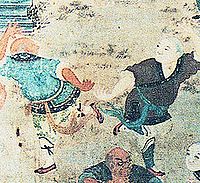 References of martial arts practice in Shaolin appear in various literary genres of the late Ming: the epitaphs of Shaolin warrior monks, martial-arts manuals, military encyclopedias, historical writings, travelogues, fiction and poetry. However these sources do not point out to any specific style originated in Shaolin. These sources, in contrast to those from the Tang period, refer to Shaolin methods of armed combat. This include a skill for which Shaolin monks had become famous—the staff
(gùn, Cantonese gwan). The Ming General Qi Jiguang
included description of Shaolin Quan Fa (Pinyin romanization: Shào Lín Quán Fǎ or Wade-Giles romanization Shao Lin Ch'üan Fa, 少 林 拳 法 "fist principles"; Japanese pronunciation: Shorin Kempo or Kenpo) and staff techniques in his book, Ji Xiao Xin Shu
(紀效新書), which can be translated as "New Book Recording Effective Techniques". When this book spread to East Asia, it had a great influence on the development of martial arts in regions such as Okinawa and Korea.
, Drunken Boxing
, Eagle Claw, Five Animals
, Hsing I, Hung Gar
, Monkey
, Bak Mei Pai
, Praying Mantis
, Fujian White Crane, Jow Ga, Wing Chun
and T'ai chi ch'uan. The increase in the popularity of those styles is a result of the dramatic changes occurring within the Chinese society.
In 1900-01, the Righteous and Harmonious Fists rose against foreign occupiers and Christian missionaries in China. This uprising is known in the West as the Boxer Rebellion
due to the martial arts and calisthenics practiced by the rebels. Though it originally opposed the Manchu
Qing Dynasty
, the Empress Dowager Cixi
gained control of the rebellion and tried to use it against the foreign powers. The failure of the rebellion led ten years later to the fall of the Qing Dynasty
and the creation of the Chinese Republic.
The present view of Chinese martial arts are strongly influenced by the events of the Republican Period
(1912–1949). In the transition period between the fall of the Qing Dynasty
as well as the turmoils of the Japanese invasion and the Chinese Civil War, Chinese martial arts became more accessible to the general public as many martial artists were encouraged to openly teach their art. At that time, some considered martial arts as a means to promote national pride and build a strong nation. As a result, many training manuals (拳谱) were published, a training academy was created, two national examinations were organized as well as demonstration teams travelled overseas, and numerous martial arts associations were formed throughout China and in various overseas Chinese communities. The Central Guoshu Academy (Zhongyang Guoshuguan, 中央國術館/中央国术馆) established by the National Government in 1928 and the Jing Wu Athletic Association (精武體育會/精武体育会) founded by Huo Yuanjia
in 1910 are examples of organizations that promoted a systematic approach for training in Chinese martial arts. A series of provincial and national competitions were organized by the Republican government starting in 1932 to promote Chinese martial arts. In 1936, at the 11th Olympic Games in Berlin, a group of Chinese martial artists demonstrated their art to an international audience for the first time.
The term Kuoshu (or Guoshu, meaning "national art"), rather than the colloquial term gongfu
was introduced by the Kuomintang in an effort to more closely associate Chinese martial arts with national pride
rather than individual accomplishment.
and the founding of the People's Republic of China
on October 1, 1949. Many well known martial artists chose to escape from the PRC's rule and migrate to Taiwan
, Hong Kong
, and other parts of the world. Those masters
started to teach within the overseas Chinese
communities but eventually they expanded their teachings to include people from other ethnic groups.
Within China, the practice of traditional martial arts was discouraged during the turbulent years of the Chinese Cultural Revolution (1969–1976). Like many other aspects of traditional Chinese life, martial arts were subjected to a radical transformation by the People's Republic of China
in order to align them with Maoist revolutionary doctrine. The PRC
promoted the committee-regulated sport of Wushu
as a replacement to independent schools of martial arts. This new competition sport was disassociated from what was seen as the potentially subversive self-defense aspects and family lineages of Chinese martial arts.
In 1958, the government established the All-China Wushu Association as an umbrella organization to regulate martial arts training. The Chinese State Commission for Physical Culture and Sports took the lead in creating standardized forms for most of the major arts. During this period, a national Wushu system that included standard forms, teaching curriculum, and instructor grading was established. Wushu was introduced at both the high school and university level. The suppression of traditional teaching was relaxed during the Era of Reconstruction (1976–1989), as Communist ideology became more accommodating to alternative viewpoints. In 1979, the State Commission for Physical Culture and Sports created a special task force to reevaluate the teaching and practice of Wushu.
In 1986, the Chinese National Research Institute of Wushu was established as the central authority for the research and administration of Wushu activities in the People's Republic of China.
Changing government policies and attitudes towards sports in general lead to the closing of the State Sports Commission (the central sports authority) in 1998. This closure is viewed as an attempt to partially de-politicize organized sports and move Chinese sport policies towards a more market
-driven approach. As a result of these changing sociological factors within China, both traditional styles and modern Wushu approaches are being promoted by the Chinese government.
Chinese martial arts are an integral element of 20th-century Chinese popular culture.
Wuxia
or "martial arts fiction" is a popular genre which emerged in the early 20th century and peaked in popularity during the 1960s to 1980s. Wuxia films were produced from the 1920s. The Kuonmintang suppressed wuxia, accusing it of promoting superstition and violent anarchy. Because of this, wuxia came to flourish in British Hong Kong
, and the genre of kung fu movie in Hong Kong action cinema
became wildly popular, coming to international attention from the 1970s.
The genre declined somewhat during the 1980s, and in the late 1980s the Hong Kong film industry underwent a drastic decline, even before Hong Kong was handed to the People's Republic in 1997.
In the wake of Crouching Tiger, Hidden Dragon
(2000), there has been somewhat of a revival of Chinese-produced wuxia films aimed at an international audience, including Hero
(2002), House of Flying Daggers
(2004) and Reign of Assassins
(2010).
 China has a long history of martial traditions that includes hundreds of different styles. Over the past two thousand years many distinctive styles have been developed, each with its own set of techniques and ideas. There are also common themes to the different styles, which are often classified by "families" (家, jiā), "sects" (派, pai) or "schools" (門, men). There are styles that mimic movements from animals and others that gather inspiration from various Chinese philosophies, myths and legends. Some styles put most of their focus into the harnessing of qi
, while others concentrate on competition.
Chinese martial arts can be split into various categories to differentiate them: For example, external (外家拳) and internal (内家拳). Chinese martial arts can also be categorized by location, as in northern (北拳) and southern (南拳) as well, referring to what part of China the styles originated from, separated by the Yangtze River
(Chang Jiang); Chinese martial arts may even be classified according to their province or city. The main perceived difference between northern and southern styles is that the northern styles tend to emphasize fast and powerful kicks, high jumps and generally fluid and rapid movement, while the southern styles focus more on strong arm and hand techniques, and stable, immovable stances and fast footwork. Examples of the northern styles include changquan
and xingyiquan
. Examples of the southern styles include Bak Mei
, Wuzuquan, Choy Li Fut
and Wing Chun
. Chinese martial arts can also be divided according to religion, imitative-styles (象形拳), and family styles such as Hung Gar
(洪家). There are distinctive differences in the training between different groups of the Chinese martial arts regardless of the type of classification. However, few experienced martial artists make a clear distinction between internal and external styles, or subscribe to the idea of northern systems being predominantly kick-based and southern systems relying more heavily on upper-body techniques. Most styles contain both hard and soft elements, regardless of their internal nomenclature. Analyzing the difference in accordance with yin and yang principles, philosophers would assert that the absence of either one would render the practitioner's skills unbalanced or deficient, as yin and yang alone are each only half of a whole. If such differences did once exist, they have since been blurred.
, including stances. Basic training may involve simple movements that are performed repeatedly; other examples of basic training are stretching, meditation, striking
, throwing
, or jumping. Without strong and flexible muscles, management of Qi or breath, and proper body mechanics, it is impossible for a student to progress in the Chinese martial arts. A common saying concerning basic training in Chinese martial arts is as follows:
Which can be translated as:
(骑马步/马步 qí mǎ bù/mǎ bù) and the bow stance are examples of stances found in many styles of Chinese martial arts.
is considered to be an important component of basic training. Meditation can be used to develop focus, mental clarity and can act as a basis for qigong
training.
or ch'i (氣/气) is encountered in a number of Chinese martial arts. Qi is variously defined as an inner energy or "life force" that is said to animate living beings; as a term for proper skeletal alignment and efficient use of musculature (sometimes also known as fa jin or jin); or as a shorthand for concepts that the martial arts student might not yet be ready to understand in full. These meanings are not necessarily mutually exclusive. The existence of qi as a measurable form of energy as discussed in traditional Chinese medicine
has no basis in the scientific understanding of physics, medicine, biology or human physiology.
There are many ideas regarding the control of one's qi energy to such an extent that it can be used for healing oneself or others: the goal of medical qigong. Some styles believe in focusing qi into a single point when attacking and aim at specific areas of the human body. Such techniques are known as dim mak
and have principles that are similar to acupressure.
drills. Weapons training (qìxiè 器械) are generally carried out after the student is proficient in the basics, forms and applications training. The basic theory for weapons training is to consider the weapon as an extension of the body. It has the same requirements for footwork and body coordination as the basics. The process of weapon training proceeds with forms, forms with partners and then applications. Most systems have training methods for each of the Eighteen Arms of Wushu
(shíbābānbīngqì 十八般兵器) in addition to specialized instruments specific to the system.
of combative techniques. Chinese martial arts techniques are ideally based on efficiency and effectiveness. Application includes non-compliant drills, such as Pushing Hands
in many internal martial arts, and sparring
, which occurs within a variety of contact levels and rule sets.
When and how applications are taught varies from style to style. Today, many styles begin to teach new students by focusing on exercises in which each student knows a prescribed range of combat and technique to be drilled; these drills are often semi-compliant, meaning one student does not offer active resistance to a technique in order to allow its demonstrative, clean execution. In more resisting drills, fewer rules are applied and students practice how to react and respond. 'Sparring' refers to the most important aspect of application training, which simulates a combat situation while including rules and regulations in order to reduce the chance of serious injury to the students.
Competitive sparring disciplines include Chinese kickboxing
Sǎnshǒu(散手) and Chinese folk wrestling
Shuāijiāo(摔跤)
, which were traditionally contested on a raised platform arena Lèitái(擂台). Lèitái represents public challenge matches that first appeared in the Song Dynasty
. The objective for those contests was to knock the opponent from a raised platform by any means necessary.
San Shou
represents the modern development of Lei Tai contests, but with rules in place to reduce the chance of serious injury. Many Chinese martial art schools teach or work within the rule sets of Sanshou, working to incorporate the movements, characteristics, and theory of their style. Chinese martial artists also compete in non-Chinese or mixed Combat sport
, including boxing, kickboxing and Mixed martial arts
.
sessions.
Today, many consider forms to be one of the most important practices in Chinese martial arts. Traditionally, they played a smaller role in training combat application, and were eclipsed by sparring, drilling and conditioning. Forms gradually build up a practitioner's flexibility, internal and external strength, speed and stamina, and teach balance and coordination. Many styles contain forms using a wide range of weapons of various length and type, utilizing one or two hands. There are also styles which focus on a certain type of weapon. Forms are meant to be both practical, usable, and applicable as well as promoting flow, meditation, flexibility, balance and coordination. Teachers are often heard to say "train your form as if you were sparring and spar as if it were a form."
There are two general types of forms in Chinese martial arts. Most common are "solo forms" which are performed by a single student. There are also "sparring" forms, which are choreographed fighting sets performed by two or more people. Sparring forms were designed both to acquaint beginning fighters with basic measures and concepts of combat, and to serve as performance pieces for the school. Sparring forms which utilize weapons are especially useful for teaching students the extension, range and technique required to manage a weapon.
In contrast, in traditional Chinese martial arts alternative terminologies for the training (練) of 'sets or forms are:
Traditional "sparring" sets, called dui da, 對打 or, dui lian, 對練, were an important part of Chinese martial arts for centuries. Dui lian (對練), literally means, to train by a pair of combatants opposing each other (the character l練, means to practice; to train; to perfect one's skill; to drill). As well, often one of these terms are also included in the name of fighting sets: 雙演, shuang yan, 'paired practice'; 掙勝, zheng sheng, 'to struggle with strength for victory'; 敵, di, ' match – the character suggests to strike an enemy; and 破, po, 'to break'.
Generally there are 21, 18, 12, 9 or 5 drills or 'exchanges/groupings' of attacks and counter attacks, in each dui lian, 對 練 set. These drills were considered only generic patterns and never meant to be considered inflexible 'tricks'. Students practiced smaller parts/exchanges, individually with opponents switching sides in a continuous flow. Basically, dui lian were not only a sophisticated and effective methods of passing on the fighting knowledge of the older generation, they were important and effective training methods. The relationship between single sets and contact sets is quite complicated in that in many cases there are skills which simply can not be developed with single sets, and, conversely, with dui lian. Unfortunately, it appears that most traditional combat oriented dui lian and their training methodology have disappeared, especially those concerning weapons. There are a number of reasons for this. In modern Chinese martial arts most of the dui lian are recent inventions designed for light props resembling weapons, with safety and drama in mind. The role of this kind of training has degenerated to the point of being useless in a practical sense, and, at best, is just performance.
By the early Song period, sets were not so much "individual isolated technique strung together" but rather were composed of techniques and counter technique groupings. It is quite clear that "sets" and "fighting (2 person) sets" have been instrumental in TCM for many hundreds of years - even before the Song Dynasty. There are images of two person weapon training in Chinese stone painting going back at least to the Eastern Han Dynasty.
According to what has been passed on by the older generations, the approximate ratio of contact sets to single sets was approximately 1:3. In other words, about 30% of the sets practiced at Shaolin were contact sets, dui lian, 對 練, and two person drill training. This is, in part, evidenced by the Qing Dynasty mural at Shaolin.
Ancient literature from the Tang and Northern Song Dynasties suggests that some sets, including those which required two or more participants, became very elaborate, "flowery", and mainly concerned with aesthetics. During this time, some martial arts systems devolved to the point that they became popular forms of martial art storytelling entertainment shows. This created an entire new category of martial arts known as Hua Fa Wuyi , 花法武藝, or "fancy patterns for developing military skill". During the Northern Song period it was noted by historians that this phenomenon had a negative influence on training in the military.
For most of its history, Shaolin martial arts was largely weapon-focused: staves were used to defend the monastery, not bare hands. Even the more recent military exploits of Shaolin during the Ming and Qing Dynasties involved weapons. According to some traditions, monks first studied basics for one year and were then taught staff fighting so that they could protect the monastery. Although wrestling has been as sport in China for centuries, weapons have been the most important part of Chinese wushu since ancient times. If one wants to talk about recent or 'modern' developments in Chinese martial arts (including Shaolin for that matter), it is the over-emphasis on bare hand fighting. During the Northern Song Dynasty (976- 997 A.D) when platform fighting known as Da Laitai (Title Fights Challenge on Platform) first appeared, these fights were with only swords and staves. Although later, when bare hand fights appeared as well, it was the weapons events that became the most famous. These open-ring competitions had regulations and were organized by government organizations; some were also organized by the public. The government competitions resulted in appointments to military posts for winners and were held in the capital as well as in the prefectures.
Many traditional Chinese martial artists, as well as practitioners of modern sport combat, have become critical of the perception that forms work is more relevant to the art than sparring and drill application, while most continue to see traditional forms practice within the traditional context—as vital to both proper combat execution, the Shaolin aesthetic as art form, as well as upholding the meditative function of the physical art form.
Another reason why techniques often appear different in forms when contrasted with sparring application is thought by some to come from the concealment of the actual functions of the techniques from outsiders.
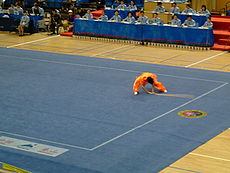
“‘Wu’ 武” is translated as ‘martial’ in English, however in terms of etymology, this word has a slightly different meaning. In Chinese, “wu 武” is made up of two parts, the first meaning “stop”(zhi 止) and the second meaning “invaders lance” (je 戈). This implies that “wu’ 武,” is a defensive use of combat. The term “wushu 武術” meaning martial arts goes back only to the beginning of the 20th century. Prior to that it meant military affairs. The earliest term found in the Han History (206BC-23AD) was "bing jiqiao" 兵技巧,military fighting techniques. During the Song period (c960) the name changed to "wuyi" 武艺,literally "martial arts". In 1928 the name was changed to "guoshu" 国术 or "national arts" when the National Martial Arts Academy was established in Nanjing. The term reverted to "wushu" 武術 under the People's Republic of China during the early 1950s.
As forms have grown in complexity and quantity over the years, and many forms alone could be practiced for a lifetime, modern styles of Chinese martial arts have developed that concentrate solely on forms, and do not practice application at all. These styles are primarily aimed at exhibition and competition, and often include more acrobatic jumps and movements added for enhanced visual effect compared to the traditional styles. Those who generally prefer to practice traditional styles, focused less on exhibition, are often referred to as traditionalists. Some traditionalists consider the competition forms of today's Chinese martial arts as too commercialized and losing much of its original values.
monks, often dealt with the study of martial arts not just as a means of self-defense or mental training, but as a system of ethics. Wude (武 德) can be translated as "martial morality" and is constructed from the words "wu" (武), which means martial, and "de" (德), which means morality. Wude (武德) deals with two aspects; "morality of deed" and "morality of mind". Morality of deed concerns social relations; morality of mind is meant to cultivate the inner harmony between the emotional mind (Xin, 心) and the wisdom mind (Hui, 慧). The ultimate goal is reaching "no extremity" (Wuji, 無 極) (closely related to the Taoist concept of wu wei
), where both wisdom and emotions are in harmony with each other.
Virtues:
Examples of well-known practitioners (武术名师) throughout history:
Martial arts
play a prominent role in the literature genre known as wuxia
(武侠小说). This type of fiction is based on Chinese concepts of chivalry, a separate martial arts society (Wulin, 武林) and a central theme involving martial arts. Wuxia stories can be traced as far back as 2nd and 3rd century BCE, becoming popular by the Tang Dynasty
and evolving into novel form by the Ming Dynasty
. This genre is still extremely popular in much of Asia
and provides a major influence for the public perception of the martial arts.
Martial arts influences can also be found in Chinese opera
of which Beijing opera
is one of the best-known examples. This popular form of drama dates back to the Tang Dynasty
and continues to be an example of Chinese culture. Some martial arts movements can be found in Chinese opera and some martial artists can be found as performers in Chinese operas.
In modern times, Chinese martial arts have spawned the genre of cinema known as the martial arts film
. The films of Bruce Lee were instrumental in the initial burst of Chinese martial arts' popularity in the West in the 1970s.
Martial artists and actors such as Jet Li
and Jackie Chan
have continued the appeal of movies of this genre. Martial arts films from China are often referred to as "kungfu movies" (功夫片), or "wire-fu" if extensive wire work is performed for special effects, and are still best known as part of the tradition of kungfu theater. (see also: wuxia, Hong Kong action cinema
).
In the west, Kung fu has become a regular action staple, and makes appearances in many films that would not generally be considered "Martial Arts" films. These films include but are not limited to The Matrix Trilogy, Kill Bill
, and The Transporter
.
Martial arts themes can also be found on television networks. A U.S.
network TV western series of the early 1970s called Kung Fu
also served to popularize the Chinese martial arts on television. With 60 episodes over a three-year span, it was one of the first North American TV shows that tried to convey the philosophy and practice in Chinese martial arts. The use of Chinese martial arts techniques can now be found in most TV action series, although the philosophy of Chinese martial arts is seldom portrayed in depth.
China
Chinese civilization may refer to:* China for more general discussion of the country.* Chinese culture* Greater China, the transnational community of ethnic Chinese.* History of China* Sinosphere, the area historically affected by Chinese culture...
martial arts
Martial arts
Martial arts are extensive systems of codified practices and traditions of combat, practiced for a variety of reasons, including self-defense, competition, physical health and fitness, as well as mental and spiritual development....
, also referred to by the Mandarin Chinese term wushu and popularly as kung fu
Kung fu (term)
Kung fu or gongfu or gung fu is a Chinese term often used in the West to refer to Chinese martial arts.Its original meaning is somewhat different, referring to one's expertise in any skill achieved through hard work and practice, not necessarily martial...
, are a number of fighting styles
Styles of Chinese martial arts
Hundreds of different styles of Chinese martial arts exist, many distinctive styles with their own sets of techniques and ideas. There are themes common which allows them to be group according to generalized "families" , "sects" , "class" , or "schools" of martial art styles...
that have developed over the centuries in China
China
Chinese civilization may refer to:* China for more general discussion of the country.* Chinese culture* Greater China, the transnational community of ethnic Chinese.* History of China* Sinosphere, the area historically affected by Chinese culture...
. These fighting styles are often classified according to common traits, identified as "families" (家, jiā), "sects" (派, pài) or "schools" (門, mén) of martial arts. Examples of such traits include physical exercises involving animal mimicry, or training methods inspired by Chinese philosophies, religions and legends. Styles which focus on qi
Qi
In traditional Chinese culture, qì is an active principle forming part of any living thing. Qi is frequently translated as life energy, lifeforce, or energy flow. Qi is the central underlying principle in traditional Chinese medicine and martial arts...
manipulation are labeled as internal (内家拳, nèijiāquán), while others concentrate on improving muscle and cardiovascular fitness and are labeled external (外家拳, wàijiāquán). Geographical association, as in northern (北拳, běiquán) and southern (南拳, nánquán), is another popular method of categorization.
Terminology
Kung-fu and wushu are terms that have been borrowedLoanword
A loanword is a word borrowed from a donor language and incorporated into a recipient language. By contrast, a calque or loan translation is a related concept where the meaning or idiom is borrowed rather than the lexical item itself. The word loanword is itself a calque of the German Lehnwort,...
into English to refer to Chinese martial arts. However, the Chinese
Chinese language
The Chinese language is a language or language family consisting of varieties which are mutually intelligible to varying degrees. Originally the indigenous languages spoken by the Han Chinese in China, it forms one of the branches of Sino-Tibetan family of languages...
terms kung fu
Kung fu (term)
Kung fu or gongfu or gung fu is a Chinese term often used in the West to refer to Chinese martial arts.Its original meaning is somewhat different, referring to one's expertise in any skill achieved through hard work and practice, not necessarily martial...
and wushu ; Cantonese
Standard Cantonese
Cantonese, or Standard Cantonese, is a language that originated in the vicinity of Canton in southern China, and is often regarded as the prestige dialect of Yue Chinese....
: móuh-seuht) have distinct meanings;
the Chinese literal equivalent of "Chinese martial art" would be Zhongguo wushu .
literally means "martial art". It is formed from the two words 武術: 武 , meaning "martial" or "military
Military
A military is an organization authorized by its greater society to use lethal force, usually including use of weapons, in defending its country by combating actual or perceived threats. The military may have additional functions of use to its greater society, such as advancing a political agenda e.g...
" and 術 , which translates into "discipline
Discipline
In its original sense, discipline is referred to systematic instruction given to disciples to train them as students in a craft or trade, or to follow a particular code of conduct or "order". Often, the phrase "to discipline" carries a negative connotation. This is because enforcement of order –...
", "skill
Skill
A skill is the learned capacity to carry out pre-determined results often with the minimum outlay of time, energy, or both. Skills can often be divided into domain-general and domain-specific skills...
" or "method."
The term wushu has also become the name for the modern sport of wushu
Wushu (sport)
The sport of wushu is both an exhibition and a full-contact sport derived from traditional Chinese martial arts. It was created in the People's Republic of China after 1949, in an attempt to nationalize the practice of traditional Chinese martial arts...
, an exhibition and full-contact sport of bare-handed and weapons forms (Chinese: 套路, pinyin: tàolù), adapted and judged to a set of aesthetic criteria for points developed since 1949 in the People's Republic of China.
The term "kung fu"
In Chinese, kung fuKung fu (term)
Kung fu or gongfu or gung fu is a Chinese term often used in the West to refer to Chinese martial arts.Its original meaning is somewhat different, referring to one's expertise in any skill achieved through hard work and practice, not necessarily martial...
can also be used in contexts completely unrelated to martial arts, and refers colloquially to any individual accomplishment or skill cultivated through long and hard work. Wushu is a more precise term for general martial activities.
History
The genesis of Chinese martial arts has been attributed to the need for self-defenseSelf-defense
Self-defense, self-defence or private defense is a countermeasure that involves defending oneself, one's property or the well-being of another from physical harm. The use of the right of self-defense as a legal justification for the use of force in times of danger is available in many...
, hunting techniques and military training in ancient China. Hand-to-hand combat and weapon
Weapon
A weapon, arm, or armament is a tool or instrument used with the aim of causing damage or harm to living beings or artificial structures or systems...
s practice were important in training ancient Chinese soldiers.
While it is clear that various forms of martial arts have been practiced in China since antiquity, very little detail on specifics can be recovered for times predating the 16th century. By contrast, there is a variety of sources on the topic from the Qing period
Qing Dynasty
The Qing Dynasty was the last dynasty of China, ruling from 1644 to 1912 with a brief, abortive restoration in 1917. It was preceded by the Ming Dynasty and followed by the Republic of China....
(1644 to 1912).
Detailed knowledge about the state and development of Chinese martial arts becomes available from the Nanjing decade
Nanjing decade
The Nanjing decade was the decade from 1927 to 1937 in the Republic of China. It began when Nationalist Generalissimo Chiang Kai-shek took the city from Zhili clique warlord Sun Chuanfang halfway through the Northern Expedition in 1927. He declared it to be the national capital despite the...
(1928-1937), as the Central Guoshu Institute
Central Guoshu Institute
The Central Guoshu Institute was established in Nanjing by the Kuomintang government of the Republic of China in 1928 for the propagation of Chinese martial arts, and was an important center of martial arts during the Nanjing decade.Guoshu "national art" was...
established by the Kuomintang
Kuomintang
The Kuomintang of China , sometimes romanized as Guomindang via the Pinyin transcription system or GMD for short, and translated as the Chinese Nationalist Party is a founding and ruling political party of the Republic of China . Its guiding ideology is the Three Principles of the People, espoused...
regime made an effort to compile an encyclopedic survey of martial arts schools.
Since the 1950s, the People's Republic of China
People's Republic of China
China , officially the People's Republic of China , is the most populous country in the world, with over 1.3 billion citizens. Located in East Asia, the country covers approximately 9.6 million square kilometres...
has organized Chinese martial arts as an exhibition and full-contact sport under the heading of Wushu
Wushu (sport)
The sport of wushu is both an exhibition and a full-contact sport derived from traditional Chinese martial arts. It was created in the People's Republic of China after 1949, in an attempt to nationalize the practice of traditional Chinese martial arts...
.
Legendary origins
According to legend, Chinese martial arts originated during the semi-mythical Xia DynastyXia Dynasty
The Xia Dynasty is the first dynasty in China to be described in ancient historical chronicles such as Bamboo Annals, Classic of History and Records of the Grand Historian. The Xia Dynasty was established by the legendary Yu the Great after Shun, the last of the Five Emperors gave his throne to him...
(夏朝) more than 4,000 years ago. It is said the Yellow Emperor
Yellow Emperor
The Yellow Emperor or Huangdi1 is a legendary Chinese sovereign and culture hero, included among the Three Sovereigns and Five Emperors. Tradition holds that he reigned from 2697–2597 or 2696–2598 BC...
Huangdi (legendary date of ascension 2698 BCE
28th century BC
The 28th century BC is a century which lasted from the year 2800 BC to 2701 BC.-Events:*c. 2800 BC – 2700 BC: Seated Harp Player, from Keros, Cyclades, is made...
) introduced the earliest fighting systems to China. The Yellow Emperor is described as a famous general who, before becoming China’s leader, wrote lengthy treatises on medicine, astrology and the martial arts. One of his main opponents was Chi You
Chi You
Chi You was a tribal leader of the ancient nine Li tribe . He is best known as the tyrant who fought against the then-future Yellow Emperor during the Three Sovereigns and Five Emperors era in Chinese mythology. For the Hmong people, Chi You was a sagacious mythical king...
(蚩尤) who was credited as the creator of jiao di, a forerunner to the modern art of Chinese Wrestling
Shuai jiao
Shuai jiao is the general Mandarin Chinese term for wrestling. As a generic name, it may be used to cover various styles of wrestling practised in China in the form of a martial arts system or a sport. The narrower term pertains to wrestling styles of the North China Plain...
.
Early history
The earliest references to Chinese martial arts are found in the Spring and Autumn AnnalsSpring and Autumn Annals
The Spring and Autumn Annals is the official chronicle of the State of Lu covering the period from 722 BCE to 481 BCE. It is the earliest surviving Chinese historical text to be arranged on annalistic principles. The text is extremely concise and, if all the commentaries are excluded, about 16,000...
(5th century BCE), where a hand to hand combat theory, including the integration of notions of "hard" and "soft"
Hard and soft (martial arts)
In martial arts, the terms hard and soft technique denote how forcefully a defender martial artist counters the force of an attack in armed and unarmed combat...
techniques, is mentioned. A combat wrestling
Wrestling
Wrestling is a form of grappling type techniques such as clinch fighting, throws and takedowns, joint locks, pins and other grappling holds. A wrestling bout is a physical competition, between two competitors or sparring partners, who attempt to gain and maintain a superior position...
system called juélì or jiǎolì (角力) is mentioned in the Classic of Rites
Classic of Rites
The Classic of Rites , also known as the Book of Rites, Book of Customs, the Record of Rites, was one of the Chinese Five Classics of the Confucian canon. It described the social forms, governmental system, and ancient/ceremonial rites of the Zhou Dynasty...
(1st century BCE). This combat system included techniques such as strikes
Strike (attack)
A strike is an attack with an inanimate object, such as a weapon, or with a part of the human body intended to cause an effect upon an opponent or to simply cause harm to an opponent. There are many different varieties of strikes...
, throws
Throw (grappling)
A throw is a martial arts term for a grappling technique that involves off-balancing or lifting an opponent, and tossing them to the ground in Japanese martial arts referred to as nage-waza, 投げ技, "throwing technique"...
, joint manipulation
Chin Na
Chin Na or Qinna is a Chinese term describing techniques used in the Chinese martial arts that control or lock an opponent's joints or muscles/tendons so he cannot move, thus neutralizing the opponent's fighting ability...
, and pressure point
Pressure point
A pressure point in the field of martial arts refers to an area on the human body that may produce significant pain or other effects when manipulated in a specific manner...
attacks.
Jiao Di became a sport during the Qin Dynasty
Qin Dynasty
The Qin Dynasty was the first imperial dynasty of China, lasting from 221 to 207 BC. The Qin state derived its name from its heartland of Qin, in modern-day Shaanxi. The strength of the Qin state was greatly increased by the legalist reforms of Shang Yang in the 4th century BC, during the Warring...
(221–207 BCE). The Han History
Book of Han
The Book of Han, Hanshu or History of the Former Han Dynasty |Fan Ye]] . Various scholars have estimated that the earliest material covered in the book dates back to between 206 and 202 BCE...
Bibliographies record that, by the Former Han (206 BCE – 8 CE), there was a distinction between no-holds-barred weaponless fighting, which it calls shǒubó (手搏), for which "how-to" manuals had already been written, and sportive wrestling, then known as juélì (角力).
Wrestling is also documented in the Shǐ Jì, Records of the Grand Historian
Records of the Grand Historian
The Records of the Grand Historian, also known in English by the Chinese name Shiji , written from 109 BC to 91 BC, was the Magnum opus of Sima Qian, in which he recounted Chinese history from the time of the Yellow Emperor until his own time...
, written by Sima Qian
Sima Qian
Sima Qian was a Prefect of the Grand Scribes of the Han Dynasty. He is regarded as the father of Chinese historiography for his highly praised work, Records of the Grand Historian , a "Jizhuanti"-style general history of China, covering more than two thousand years from the Yellow Emperor to...
(ca. 100 BCE).
In the Tang Dynasty
Tang Dynasty
The Tang Dynasty was an imperial dynasty of China preceded by the Sui Dynasty and followed by the Five Dynasties and Ten Kingdoms Period. It was founded by the Li family, who seized power during the decline and collapse of the Sui Empire...
, descriptions of sword dances were immortalized in poems by Li Bai
Li Bai
Li Bai , also known in the West by various other transliterations, especially Li Po, was a major Chinese poet of the Tang dynasty poetry period. He has been regarded as one of the greatest poets in China's Tang period, which is often called China's "golden age" of poetry. Around a thousand existing...
. In the Song
Song Dynasty
The Song Dynasty was a ruling dynasty in China between 960 and 1279; it succeeded the Five Dynasties and Ten Kingdoms Period, and was followed by the Yuan Dynasty. It was the first government in world history to issue banknotes or paper money, and the first Chinese government to establish a...
and Yuan dynasties
Yuan Dynasty
The Yuan Dynasty , or Great Yuan Empire was a ruling dynasty founded by the Mongol leader Kublai Khan, who ruled most of present-day China, all of modern Mongolia and its surrounding areas, lasting officially from 1271 to 1368. It is considered both as a division of the Mongol Empire and as an...
, xiangpu contests were sponsored by the imperial courts. The modern concepts of wushu were fully developed by the Ming
Ming Dynasty
The Ming Dynasty, also Empire of the Great Ming, was the ruling dynasty of China from 1368 to 1644, following the collapse of the Mongol-led Yuan Dynasty. The Ming, "one of the greatest eras of orderly government and social stability in human history", was the last dynasty in China ruled by ethnic...
and Qing
Qing Dynasty
The Qing Dynasty was the last dynasty of China, ruling from 1644 to 1912 with a brief, abortive restoration in 1917. It was preceded by the Ming Dynasty and followed by the Republic of China....
dynasties.
Philosophical influences
The ideas associated with Chinese martial arts changed with the evolution of Chinese society and over time acquired some philosophical bases: Passages in the ZhuangziZhuangzi
Zhuangzi was an influential Chinese philosopher who lived around the 4th century BCE during the Warring States Period, a period corresponding to the philosophical summit of Chinese thought — the Hundred Schools of Thought, and is credited with writing—in part or in whole—a work known by his name,...
(庄子), a Daoist text, pertain to the psychology and practice of martial arts. Zhuangzi, its eponymous author, is believed to have lived in the 4th century BCE. The Tao Te Ching
Tao Te Ching
The Tao Te Ching, Dao De Jing, or Daodejing , also simply referred to as the Laozi, whose authorship has been attributed to Laozi, is a Chinese classic text...
, often credited to Lao Zi, is another Daoist text that contains principles applicable to martial arts. According to one of the classic texts of Confucianism
Confucianism
Confucianism is a Chinese ethical and philosophical system developed from the teachings of the Chinese philosopher Confucius . Confucianism originated as an "ethical-sociopolitical teaching" during the Spring and Autumn Period, but later developed metaphysical and cosmological elements in the Han...
, Zhou Li (周禮/周礼), Archery
Archery
Archery is the art, practice, or skill of propelling arrows with the use of a bow, from Latin arcus. Archery has historically been used for hunting and combat; in modern times, however, its main use is that of a recreational activity...
and chariot
Chariot
The chariot is a type of horse carriage used in both peace and war as the chief vehicle of many ancient peoples. Ox carts, proto-chariots, were built by the Proto-Indo-Europeans and also built in Mesopotamia as early as 3000 BC. The original horse chariot was a fast, light, open, two wheeled...
eering were part of the "six arts" ' onMouseout='HidePop("91860")' href="/topics/Rite">rite
Rite
A rite is an established, ceremonious, usually religious act. Rites in this sense fall into three major categories:* rites of passage, generally changing an individual's social status, such as marriage, baptism, or graduation....
s, music
Music
Music is an art form whose medium is sound and silence. Its common elements are pitch , rhythm , dynamics, and the sonic qualities of timbre and texture...
, calligraphy
Calligraphy
Calligraphy is a type of visual art. It is often called the art of fancy lettering . A contemporary definition of calligraphic practice is "the art of giving form to signs in an expressive, harmonious and skillful manner"...
and mathematics
Mathematics
Mathematics is the study of quantity, space, structure, and change. Mathematicians seek out patterns and formulate new conjectures. Mathematicians resolve the truth or falsity of conjectures by mathematical proofs, which are arguments sufficient to convince other mathematicians of their validity...
) of the Zhou Dynasty
Zhou Dynasty
The Zhou Dynasty was a Chinese dynasty that followed the Shang Dynasty and preceded the Qin Dynasty. Although the Zhou Dynasty lasted longer than any other dynasty in Chinese history, the actual political and military control of China by the Ji family lasted only until 771 BC, a period known as...
(1122–256 BCE). The Art of War
The Art of War
The Art of War is an ancient Chinese military treatise that is attributed to Sun Tzu , a high ranking military general and strategist during the late Spring and Autumn period...
(孫子兵法), written during the 6th century BCE by Sun Tzu
Sun Tzu
Sun Wu , style name Changqing , better known as Sun Tzu or Sunzi , was an ancient Chinese military general, strategist and philosopher who is traditionally believed, and who is most likely, to have authored The Art of War, an influential ancient Chinese book on military strategy...
(孫子), deals directly with military warfare but contains ideas that are used in the Chinese martial arts.
Daoist
Taoism
Taoism refers to a philosophical or religious tradition in which the basic concept is to establish harmony with the Tao , which is the mechanism of everything that exists...
practitioners have been practicing Tao Yin
Tao Yin
Tao Yin is a series of breathing exercises practiced by Taoists to cultivate ch'i, the internal energy of the body according to Traditional Chinese Medicine....
, physical exercises similar to Qigong
Qigong
Qigong or chi kung is a practice of aligning breath, movement, and awareness for exercise, healing, and meditation...
that was one of the progenitors to T'ai chi ch'uan, from at least as early as 500 BCE. In 39–92 CE, "Six Chapters of Hand Fighting", were included in the Han Shu (history of the Former Han Dynasty
Han Dynasty
The Han Dynasty was the second imperial dynasty of China, preceded by the Qin Dynasty and succeeded by the Three Kingdoms . It was founded by the rebel leader Liu Bang, known posthumously as Emperor Gaozu of Han. It was briefly interrupted by the Xin Dynasty of the former regent Wang Mang...
) written by Pan Ku
Ban Gu
Ban Gu , courtesy name Mengjian , was a 1st century Chinese historian and poet best known for his part in compiling the Book of Han. He also wrote in the main poetic genre of the Han era, a kind of poetry interspersed with prose called fu. Some are anthologized by Xiao Tong in his Selections of...
. Also, the noted physician, Hua Tuo
Hua Tuo
Hua Tuo was an ancient Chinese physician who lived during the late Han Dynasty and Three Kingdoms era of Chinese history. The Records of Three Kingdoms and Book of Later Han record Hua as the first person in China to use anesthesia during surgery. He used a general anesthetic combining wine with a...
, composed the "Five Animals Play"—tiger, deer, monkey, bear, and bird, around 220 BCE. Daoist philosophy and their approach to health and exercise have influenced the Chinese martial arts to a certain extent. Direct reference to Daoist concepts can be found in such styles as the "Eight Immortals
Eight Immortals
The Eight Immortals are a group of legendary xian in Chinese mythology. Each Immortal's power can be transferred to a power tool that can give life or destroy evil. Together, these eight tools are called "Covert Eight Immortals" . Most of them are said to have been born in the Tang Dynasty or...
" which uses fighting techniques that are attributed to the characteristics of each immortal.
Shaolin and temple-based martial arts
The ShaolinShaolin kung fu
Shaolin Kung Fu refers to a collection of Chinese martial arts that claim affiliation with the Shaolin Monastery.Of the multitude styles of kung fu and wushu, only some are actually related to Shaolin...
style of wushu is regarded as amongst the first institutionalized Chinese martial arts. The oldest evidence of Shaolin participation in combat is a stele from 728 CE that attests to two occasions: a defense of the Shaolin Monastery from bandits around 610 CE, and their subsequent role in the defeat of Wang Shichong
Wang Shichong
Wang Shichong , courtesy name Xingman , was a general of the Chinese Sui Dynasty who deposed Sui's last emperor Yang Tong and briefly ruled as the emperor of a succeeding state of Zheng...
at the Battle of Hulao
Battle of Hulao
The Battle of Hulao of 28 May 621, located just east of Luoyang, was a decisive victory for Li Shimin, through which he was able to subdue two warlords, Dou Jiande and Wang Shichong. Li Shimin led a siege on the city of Luoyang, head of the self-declared emperor Wang Shichong, who solicited help...
in 621 CE. From the 8th to the 15th centuries, there are no extant documents that provide evidence of Shaolin participation in combat.
Between the 16th and 17th centuries there are at least forty sources which provide evidence that not only did the monks of Shaolin practice martial arts, but martial practice had become such an integral element of Shaolin monastic life that the monks felt the need to justify it by creating new Buddhist lore, the earliest appearance of the frequently cited legend concerns Bodhidharma's supposed foundation of Shaolin Kung Fu
Shaolin kung fu
Shaolin Kung Fu refers to a collection of Chinese martial arts that claim affiliation with the Shaolin Monastery.Of the multitude styles of kung fu and wushu, only some are actually related to Shaolin...
dates to this period. The origin of this legend has been traced to the Ming period
Ming Dynasty
The Ming Dynasty, also Empire of the Great Ming, was the ruling dynasty of China from 1368 to 1644, following the collapse of the Mongol-led Yuan Dynasty. The Ming, "one of the greatest eras of orderly government and social stability in human history", was the last dynasty in China ruled by ethnic...
's Yijin Jing or "Muscle Change Classic", a text written in 1624 attributed to
Pseudepigraphy
Pseudepigrapha are falsely attributed works, texts whose claimed authorship is unfounded; a work, simply, "whose real author attributed it to a figure of the past." The word "pseudepigrapha" is the plural of "pseudepigraphon" ; the Anglicized forms...
Bodhidharma.
Gun (staff)
The Chinese word gun refers to a long Chinese staff weapon used in Chinese martial arts. It is known as one of the four major weapons, along with the qiang , dao , and the jian , called in this group "The Grandfather of all Weapons".-Variants:There are various kinds of gun, and they include the...
(gùn, Cantonese gwan). The Ming General Qi Jiguang
Qi Jiguang
Qi Jiguang was a Chinese military general and national hero during the Ming Dynasty. He was best remembered for his courage and leadership in the fight against Japanese pirates along the east coast of China, as well as his reinforcement work on the Great Wall of China.-Early life:Qi Jiguang was...
included description of Shaolin Quan Fa (Pinyin romanization: Shào Lín Quán Fǎ or Wade-Giles romanization Shao Lin Ch'üan Fa, 少 林 拳 法 "fist principles"; Japanese pronunciation: Shorin Kempo or Kenpo) and staff techniques in his book, Ji Xiao Xin Shu
Ji Xiao Xin Shu
The book Ji Xiao Xin Shu was written by the Chinese general Qi Jiguang of the Ming Dynasty. The title can be translated as New Book Recording Effective Techniques....
(紀效新書), which can be translated as "New Book Recording Effective Techniques". When this book spread to East Asia, it had a great influence on the development of martial arts in regions such as Okinawa and Korea.
Republican period
Most fighting styles that are being practiced as traditional Chinese martial arts today reached their popularity within the 20th century. Some of these include BaguaBaguazhang
Bāguàzhǎng is one of the three main Chinese martial arts of the Wudang school, the other two being Taijiquan and Xingyiquan. It is more broadly grouped as an internal practice...
, Drunken Boxing
Zui Quan
Zui Quan is literally Drunken Fist, also known as Drunken Boxing or Drunkard's Boxing) is a concept in traditional Chinese martial arts, as well as a classification of modern Wushu forms...
, Eagle Claw, Five Animals
Five Animals (martial arts)
In the Chinese martial arts, imagery of the Five Animals —Tiger, Crane, Leopard, Snake, and Dragon—appears predominantly in Southern styles, especially those associated with Guangdong and Fujian Provinces...
, Hsing I, Hung Gar
Hung Gar
Hung Ga 洪家, Hung Kuen 洪拳, or Hung Ga Kuen 洪家拳 is a southern Chinese martial art associated with the Chinese folk hero Wong Fei Hung, who was a master of Hung Ga....
, Monkey
Monkey Kung Fu
Monkey Kung Fu, or Monkey Fist , is a Chinese martial art which utilizes ape or monkey-like movements as part of its technique.There are a number of independently developed systems of monkey kung fu...
, Bak Mei Pai
Bak Mei
Bak Mei is said to have been one of the legendary Five Elders — survivors of the destruction of the Shaolin Temple by the Qing Dynasty imperial regime — who, according to some accounts, betrayed Shaolin to the imperial government...
, Praying Mantis
Praying mantis kung fu
There are two styles of Praying Mantis Kung Fu:* Northern Praying Mantis , a self-defense technique from the northeast Chinese province of Shandong....
, Fujian White Crane, Jow Ga, Wing Chun
Wing Chun
Wing Chun , also romanised as Ving Tsun or Wing Tsun, ; ; is a concept-based Chinese martial art and form of self-defense utilizing both striking and grappling while specializing in close-range combat.The alternative characters 永春 "eternal spring" are also...
and T'ai chi ch'uan. The increase in the popularity of those styles is a result of the dramatic changes occurring within the Chinese society.
In 1900-01, the Righteous and Harmonious Fists rose against foreign occupiers and Christian missionaries in China. This uprising is known in the West as the Boxer Rebellion
Boxer Rebellion
The Boxer Rebellion, also called the Boxer Uprising by some historians or the Righteous Harmony Society Movement in northern China, was a proto-nationalist movement by the "Righteous Harmony Society" , or "Righteous Fists of Harmony" or "Society of Righteous and Harmonious Fists" , in China between...
due to the martial arts and calisthenics practiced by the rebels. Though it originally opposed the Manchu
Manchu
The Manchu people or Man are an ethnic minority of China who originated in Manchuria . During their rise in the 17th century, with the help of the Ming dynasty rebels , they came to power in China and founded the Qing Dynasty, which ruled China until the Xinhai Revolution of 1911, which...
Qing Dynasty
Qing Dynasty
The Qing Dynasty was the last dynasty of China, ruling from 1644 to 1912 with a brief, abortive restoration in 1917. It was preceded by the Ming Dynasty and followed by the Republic of China....
, the Empress Dowager Cixi
Empress Dowager Cixi
Empress Dowager Cixi1 , of the Manchu Yehenara clan, was a powerful and charismatic figure who became the de facto ruler of the Manchu Qing Dynasty in China for 47 years from 1861 to her death in 1908....
gained control of the rebellion and tried to use it against the foreign powers. The failure of the rebellion led ten years later to the fall of the Qing Dynasty
Qing Dynasty
The Qing Dynasty was the last dynasty of China, ruling from 1644 to 1912 with a brief, abortive restoration in 1917. It was preceded by the Ming Dynasty and followed by the Republic of China....
and the creation of the Chinese Republic.
The present view of Chinese martial arts are strongly influenced by the events of the Republican Period
History of the Republic of China
The History of the Republic of China begins after the Qing Dynasty in 1912, when the formation of the Republic of China put an end to over two thousand years of Imperial rule. The Qing Dynasty, also known as the Manchu Dynasty, ruled from 1644 to 1912...
(1912–1949). In the transition period between the fall of the Qing Dynasty
Qing Dynasty
The Qing Dynasty was the last dynasty of China, ruling from 1644 to 1912 with a brief, abortive restoration in 1917. It was preceded by the Ming Dynasty and followed by the Republic of China....
as well as the turmoils of the Japanese invasion and the Chinese Civil War, Chinese martial arts became more accessible to the general public as many martial artists were encouraged to openly teach their art. At that time, some considered martial arts as a means to promote national pride and build a strong nation. As a result, many training manuals (拳谱) were published, a training academy was created, two national examinations were organized as well as demonstration teams travelled overseas, and numerous martial arts associations were formed throughout China and in various overseas Chinese communities. The Central Guoshu Academy (Zhongyang Guoshuguan, 中央國術館/中央国术馆) established by the National Government in 1928 and the Jing Wu Athletic Association (精武體育會/精武体育会) founded by Huo Yuanjia
Huo Yuanjia
Huo Yuanjia was a Chinese martial artist and co-founder of Chin Woo Athletic Association, a martial arts school in Shanghai...
in 1910 are examples of organizations that promoted a systematic approach for training in Chinese martial arts. A series of provincial and national competitions were organized by the Republican government starting in 1932 to promote Chinese martial arts. In 1936, at the 11th Olympic Games in Berlin, a group of Chinese martial artists demonstrated their art to an international audience for the first time.
The term Kuoshu (or Guoshu, meaning "national art"), rather than the colloquial term gongfu
Kung fu (term)
Kung fu or gongfu or gung fu is a Chinese term often used in the West to refer to Chinese martial arts.Its original meaning is somewhat different, referring to one's expertise in any skill achieved through hard work and practice, not necessarily martial...
was introduced by the Kuomintang in an effort to more closely associate Chinese martial arts with national pride
Chinese nationalism
Chinese nationalism , sometimes synonymous with Chinese patriotism refers to cultural, historiographical, and political theories, movements and beliefs that assert the idea of a cohesive, unified Chinese people and culture in a unified country known as China...
rather than individual accomplishment.
People's Republic
Chinese martial arts experienced rapid international dissemination with the end of the Chinese Civil WarChinese Civil War
The Chinese Civil War was a civil war fought between the Kuomintang , the governing party of the Republic of China, and the Communist Party of China , for the control of China which eventually led to China's division into two Chinas, Republic of China and People's Republic of...
and the founding of the People's Republic of China
People's Republic of China
China , officially the People's Republic of China , is the most populous country in the world, with over 1.3 billion citizens. Located in East Asia, the country covers approximately 9.6 million square kilometres...
on October 1, 1949. Many well known martial artists chose to escape from the PRC's rule and migrate to Taiwan
Taiwan
Taiwan , also known, especially in the past, as Formosa , is the largest island of the same-named island group of East Asia in the western Pacific Ocean and located off the southeastern coast of mainland China. The island forms over 99% of the current territory of the Republic of China following...
, Hong Kong
Hong Kong
Hong Kong is one of two Special Administrative Regions of the People's Republic of China , the other being Macau. A city-state situated on China's south coast and enclosed by the Pearl River Delta and South China Sea, it is renowned for its expansive skyline and deep natural harbour...
, and other parts of the world. Those masters
Sifu
Shifu is the identical pronunciation of two Chinese terms for a master. The character 師 means “teacher”. The meaning of 傅 is “tutor”, and of 父, “father”. Both characters are read fu with the same tones in Cantonese and Mandarin, creating some ambiguity...
started to teach within the overseas Chinese
Overseas Chinese
Overseas Chinese are people of Chinese birth or descent who live outside the Greater China Area . People of partial Chinese ancestry living outside the Greater China Area may also consider themselves Overseas Chinese....
communities but eventually they expanded their teachings to include people from other ethnic groups.
Within China, the practice of traditional martial arts was discouraged during the turbulent years of the Chinese Cultural Revolution (1969–1976). Like many other aspects of traditional Chinese life, martial arts were subjected to a radical transformation by the People's Republic of China
People's Republic of China
China , officially the People's Republic of China , is the most populous country in the world, with over 1.3 billion citizens. Located in East Asia, the country covers approximately 9.6 million square kilometres...
in order to align them with Maoist revolutionary doctrine. The PRC
People's Republic of China
China , officially the People's Republic of China , is the most populous country in the world, with over 1.3 billion citizens. Located in East Asia, the country covers approximately 9.6 million square kilometres...
promoted the committee-regulated sport of Wushu
Wushu (sport)
The sport of wushu is both an exhibition and a full-contact sport derived from traditional Chinese martial arts. It was created in the People's Republic of China after 1949, in an attempt to nationalize the practice of traditional Chinese martial arts...
as a replacement to independent schools of martial arts. This new competition sport was disassociated from what was seen as the potentially subversive self-defense aspects and family lineages of Chinese martial arts.
In 1958, the government established the All-China Wushu Association as an umbrella organization to regulate martial arts training. The Chinese State Commission for Physical Culture and Sports took the lead in creating standardized forms for most of the major arts. During this period, a national Wushu system that included standard forms, teaching curriculum, and instructor grading was established. Wushu was introduced at both the high school and university level. The suppression of traditional teaching was relaxed during the Era of Reconstruction (1976–1989), as Communist ideology became more accommodating to alternative viewpoints. In 1979, the State Commission for Physical Culture and Sports created a special task force to reevaluate the teaching and practice of Wushu.
In 1986, the Chinese National Research Institute of Wushu was established as the central authority for the research and administration of Wushu activities in the People's Republic of China.
Changing government policies and attitudes towards sports in general lead to the closing of the State Sports Commission (the central sports authority) in 1998. This closure is viewed as an attempt to partially de-politicize organized sports and move Chinese sport policies towards a more market
Market
A market is one of many varieties of systems, institutions, procedures, social relations and infrastructures whereby parties engage in exchange. While parties may exchange goods and services by barter, most markets rely on sellers offering their goods or services in exchange for money from buyers...
-driven approach. As a result of these changing sociological factors within China, both traditional styles and modern Wushu approaches are being promoted by the Chinese government.
Chinese martial arts are an integral element of 20th-century Chinese popular culture.
Wuxia
Wuxia
Wuxia is a broad genre of Chinese fiction concerning the adventures of martial artists. Although wuxia is traditionally a form of literature, its popularity has caused it to spread to diverse art forms like Chinese opera, manhua , films, television series, and video games...
or "martial arts fiction" is a popular genre which emerged in the early 20th century and peaked in popularity during the 1960s to 1980s. Wuxia films were produced from the 1920s. The Kuonmintang suppressed wuxia, accusing it of promoting superstition and violent anarchy. Because of this, wuxia came to flourish in British Hong Kong
British Hong Kong
British Hong Kong refers to Hong Kong as a Crown colony and later, a British dependent territory under British administration from 1841 to 1997.- Colonial establishment :...
, and the genre of kung fu movie in Hong Kong action cinema
Hong Kong action cinema
Hong Kong action cinema is the principal source of the Hong Kong film industry's global fame. It combines elements from the action film, as codified by Hollywood, with Chinese storytelling and aesthetic traditions, to create a culturally distinctive form that nevertheless has a wide transcultural...
became wildly popular, coming to international attention from the 1970s.
The genre declined somewhat during the 1980s, and in the late 1980s the Hong Kong film industry underwent a drastic decline, even before Hong Kong was handed to the People's Republic in 1997.
In the wake of Crouching Tiger, Hidden Dragon
Crouching Tiger, Hidden Dragon
Crouching Tiger, Hidden Dragon is a 2000 wuxia film. An American-Chinese-Hong Kong-Taiwanese co-production, the film was directed by Ang Lee and featured an international cast of ethnic Chinese actors, including Chow Yun-Fat, Michelle Yeoh, Zhang Ziyi, and Chang Chen...
(2000), there has been somewhat of a revival of Chinese-produced wuxia films aimed at an international audience, including Hero
Hero (2002 film)
Hero is a 2002 wuxia film directed by Zhang Yimou. Starring Jet Li as the nameless protagonist, the film is based on the story of Jing Ke's assassination attempt on the King of Qin in 227 BC....
(2002), House of Flying Daggers
House of Flying Daggers
House of Flying Daggers is a 2004 wuxia film directed by Zhang Yimou. It differs from other wuxia films in that it is more of a love story than a straight martial arts film....
(2004) and Reign of Assassins
Reign of Assassins
Reign of Assassins is a 2010 wuxia film directed by Su Chao-pin and co-directed by John Woo. The film is shot in China and set during the Ming Dynasty. The film stars Michelle Yeoh, who plays an assassin who tries to return to a normal life after being counseled by a priest...
(2010).
Styles
Qi
In traditional Chinese culture, qì is an active principle forming part of any living thing. Qi is frequently translated as life energy, lifeforce, or energy flow. Qi is the central underlying principle in traditional Chinese medicine and martial arts...
, while others concentrate on competition.
Chinese martial arts can be split into various categories to differentiate them: For example, external (外家拳) and internal (内家拳). Chinese martial arts can also be categorized by location, as in northern (北拳) and southern (南拳) as well, referring to what part of China the styles originated from, separated by the Yangtze River
Yangtze River
The Yangtze, Yangzi or Cháng Jiāng is the longest river in Asia, and the third-longest in the world. It flows for from the glaciers on the Tibetan Plateau in Qinghai eastward across southwest, central and eastern China before emptying into the East China Sea at Shanghai. It is also one of the...
(Chang Jiang); Chinese martial arts may even be classified according to their province or city. The main perceived difference between northern and southern styles is that the northern styles tend to emphasize fast and powerful kicks, high jumps and generally fluid and rapid movement, while the southern styles focus more on strong arm and hand techniques, and stable, immovable stances and fast footwork. Examples of the northern styles include changquan
Changquan
Chángquán refers to a family of external martial arts styles from northern China.The forms of the Long Fist style emphasize fully extended kicks and striking techniques, and by appearance would be considered a long-range fighting system...
and xingyiquan
Xingyiquan
Xingyiquan is one of the major "internal" or Wudang styles of Chinese martial arts. The word translates approximately to "Form/Intention Boxing", or "Shape/Will Boxing", and is characterized by aggressive, seemingly linear movements and explosive power...
. Examples of the southern styles include Bak Mei
Bak Mei
Bak Mei is said to have been one of the legendary Five Elders — survivors of the destruction of the Shaolin Temple by the Qing Dynasty imperial regime — who, according to some accounts, betrayed Shaolin to the imperial government...
, Wuzuquan, Choy Li Fut
Cai li fo
Cai Li Fo or Choy Li Fut is a Chinese martial art founded in 1836 by Chan Heung . Choy Li Fut was named to honor the Buddhist monk Choy Fook who taught him Choy Gar, and Li Yau-San who taught him Li Gar, plus his uncle Chan Yuen-Wu , who taught him Fut Gar, and developed to honor the Buddha...
and Wing Chun
Wing Chun
Wing Chun , also romanised as Ving Tsun or Wing Tsun, ; ; is a concept-based Chinese martial art and form of self-defense utilizing both striking and grappling while specializing in close-range combat.The alternative characters 永春 "eternal spring" are also...
. Chinese martial arts can also be divided according to religion, imitative-styles (象形拳), and family styles such as Hung Gar
Hung Gar
Hung Ga 洪家, Hung Kuen 洪拳, or Hung Ga Kuen 洪家拳 is a southern Chinese martial art associated with the Chinese folk hero Wong Fei Hung, who was a master of Hung Ga....
(洪家). There are distinctive differences in the training between different groups of the Chinese martial arts regardless of the type of classification. However, few experienced martial artists make a clear distinction between internal and external styles, or subscribe to the idea of northern systems being predominantly kick-based and southern systems relying more heavily on upper-body techniques. Most styles contain both hard and soft elements, regardless of their internal nomenclature. Analyzing the difference in accordance with yin and yang principles, philosophers would assert that the absence of either one would render the practitioner's skills unbalanced or deficient, as yin and yang alone are each only half of a whole. If such differences did once exist, they have since been blurred.
Training
Chinese martial arts training consists of the following components: basics, forms, applications and weapons; different styles place varying emphasis on each component. In addition, philosophy, ethics and even medical practice are highly regarded by most Chinese martial arts. A complete training system should also provide insight into Chinese attitudes and culture.Basics
The Basics (基本功) are a vital part of any martial training, as a student cannot progress to the more advanced stages without them; Basics are usually made up of rudimentary techniques, conditioning exercisesPhysical exercise
Physical exercise is any bodily activity that enhances or maintains physical fitness and overall health and wellness. It is performed for various reasons including strengthening muscles and the cardiovascular system, honing athletic skills, weight loss or maintenance, as well as for the purpose of...
, including stances. Basic training may involve simple movements that are performed repeatedly; other examples of basic training are stretching, meditation, striking
Strike (attack)
A strike is an attack with an inanimate object, such as a weapon, or with a part of the human body intended to cause an effect upon an opponent or to simply cause harm to an opponent. There are many different varieties of strikes...
, throwing
Throw (grappling)
A throw is a martial arts term for a grappling technique that involves off-balancing or lifting an opponent, and tossing them to the ground in Japanese martial arts referred to as nage-waza, 投げ技, "throwing technique"...
, or jumping. Without strong and flexible muscles, management of Qi or breath, and proper body mechanics, it is impossible for a student to progress in the Chinese martial arts. A common saying concerning basic training in Chinese martial arts is as follows:
Which can be translated as:
Stances
Stances (steps or 步法) are structural postures employed in Chinese martial arts training. They represent the foundation and the form of a fighter's base. Each style has different names and variations for each stance. Stances may be differentiated by foot position, weight distribution, body alignment, etc. Stance training can be practiced statically, the goal of which is to maintain the structure of the stance through a set time period, or dynamically, in which case a series of movements is performed repeatedly. The horse-riding stanceHorse stance
The horse stance is an important posture in Asian martial arts and takes its name from the position assumed when riding a horse. It is called mǎbù in Chinese, in Japanese, kekuda or kuda-kuda in Malay, asvavadivu in Malayalam, and juchum seogi or annun seogi in Korean...
(骑马步/马步 qí mǎ bù/mǎ bù) and the bow stance are examples of stances found in many styles of Chinese martial arts.
Meditation
In many Chinese martial arts, meditationMeditation
Meditation is any form of a family of practices in which practitioners train their minds or self-induce a mode of consciousness to realize some benefit....
is considered to be an important component of basic training. Meditation can be used to develop focus, mental clarity and can act as a basis for qigong
Qigong
Qigong or chi kung is a practice of aligning breath, movement, and awareness for exercise, healing, and meditation...
training.
Use of qi
The concept of qiQi
In traditional Chinese culture, qì is an active principle forming part of any living thing. Qi is frequently translated as life energy, lifeforce, or energy flow. Qi is the central underlying principle in traditional Chinese medicine and martial arts...
or ch'i (氣/气) is encountered in a number of Chinese martial arts. Qi is variously defined as an inner energy or "life force" that is said to animate living beings; as a term for proper skeletal alignment and efficient use of musculature (sometimes also known as fa jin or jin); or as a shorthand for concepts that the martial arts student might not yet be ready to understand in full. These meanings are not necessarily mutually exclusive. The existence of qi as a measurable form of energy as discussed in traditional Chinese medicine
Traditional Chinese medicine
Traditional Chinese Medicine refers to a broad range of medicine practices sharing common theoretical concepts which have been developed in China and are based on a tradition of more than 2,000 years, including various forms of herbal medicine, acupuncture, massage , exercise , and dietary therapy...
has no basis in the scientific understanding of physics, medicine, biology or human physiology.
There are many ideas regarding the control of one's qi energy to such an extent that it can be used for healing oneself or others: the goal of medical qigong. Some styles believe in focusing qi into a single point when attacking and aim at specific areas of the human body. Such techniques are known as dim mak
Touch of Death
The Death Touch refers to any martial arts technique that can kill using seemingly less than lethal force targeted at specific areas of the body....
and have principles that are similar to acupressure.
Weapons training
Most Chinese styles also make use of training in the broad arsenal of Chinese weapons for conditioning the body as well as coordination and strategyStrategy
Strategy, a word of military origin, refers to a plan of action designed to achieve a particular goal. In military usage strategy is distinct from tactics, which are concerned with the conduct of an engagement, while strategy is concerned with how different engagements are linked...
drills. Weapons training (qìxiè 器械) are generally carried out after the student is proficient in the basics, forms and applications training. The basic theory for weapons training is to consider the weapon as an extension of the body. It has the same requirements for footwork and body coordination as the basics. The process of weapon training proceeds with forms, forms with partners and then applications. Most systems have training methods for each of the Eighteen Arms of Wushu
Eighteen Arms of Wushu
The Eighteen Arms is a list of the eighteen main weapons of Chinese martial arts. The origin of the list is unclear and there have been disputes with regards to what the eighteen weapons actually are...
(shíbābānbīngqì 十八般兵器) in addition to specialized instruments specific to the system.
Application
Application refers to the practical useAliveness (martial arts)
Aliveness, also referred to as Alive training describes martial arts training methods that are spontaneous, non-scripted, and dynamic. Alive training is performed with the intent to challenge or defeat rather than to demonstrate...
of combative techniques. Chinese martial arts techniques are ideally based on efficiency and effectiveness. Application includes non-compliant drills, such as Pushing Hands
Pushing hands
Pushing hands, , is a name for two-person training routines practiced in internal Chinese martial arts such as Baguazhang, Xingyiquan, T'ai chi ch'uan , Liuhebafa, Quan Fa, Yiquan.-Overview:...
in many internal martial arts, and sparring
Sparring
Sparring is a form of training common to many martial arts. Although the precise form varies, it is essentially relatively 'free-form' fighting, with enough rules, customs, or agreements to make injuries unlikely...
, which occurs within a variety of contact levels and rule sets.
When and how applications are taught varies from style to style. Today, many styles begin to teach new students by focusing on exercises in which each student knows a prescribed range of combat and technique to be drilled; these drills are often semi-compliant, meaning one student does not offer active resistance to a technique in order to allow its demonstrative, clean execution. In more resisting drills, fewer rules are applied and students practice how to react and respond. 'Sparring' refers to the most important aspect of application training, which simulates a combat situation while including rules and regulations in order to reduce the chance of serious injury to the students.
Competitive sparring disciplines include Chinese kickboxing
Kickboxing
Kickboxing refers to a group of martial arts and stand-up combat sports based on kicking and punching, historically developed from karate, Muay Thai and western boxing....
Sǎnshǒu(散手) and Chinese folk wrestling
Folk wrestling
A folk wrestling style is a traditional wrestling discipline which may or may not be codified as a modern sport. Most human cultures have developed their own sort of grappling style unique from other styles practiced...
Shuāijiāo(摔跤)
Shuai jiao
Shuai jiao is the general Mandarin Chinese term for wrestling. As a generic name, it may be used to cover various styles of wrestling practised in China in the form of a martial arts system or a sport. The narrower term pertains to wrestling styles of the North China Plain...
, which were traditionally contested on a raised platform arena Lèitái(擂台). Lèitái represents public challenge matches that first appeared in the Song Dynasty
Song Dynasty
The Song Dynasty was a ruling dynasty in China between 960 and 1279; it succeeded the Five Dynasties and Ten Kingdoms Period, and was followed by the Yuan Dynasty. It was the first government in world history to issue banknotes or paper money, and the first Chinese government to establish a...
. The objective for those contests was to knock the opponent from a raised platform by any means necessary.
San Shou
San shou
Sanshou or Sanda or an "unsanctioned fight" is a Chinese hand-to-hand self-defense system and combat sport. Sanshou is a martial art which was originally developed by the Chinese military based upon the intense study and practices of traditional Kung Fu and modern combat fighting techniques; it...
represents the modern development of Lei Tai contests, but with rules in place to reduce the chance of serious injury. Many Chinese martial art schools teach or work within the rule sets of Sanshou, working to incorporate the movements, characteristics, and theory of their style. Chinese martial artists also compete in non-Chinese or mixed Combat sport
Combat sport
A Combat sport, also known as a Fighting sport, is a competitive contact sport where two combatants fight against each other using certain rules of engagement , typically with the aim of simulating parts of real hand to hand combat...
, including boxing, kickboxing and Mixed martial arts
Mixed martial arts
Mixed Martial Arts is a full contact combat sport that allows the use of both striking and grappling techniques, both standing and on the ground, including boxing, wrestling, Brazilian jiu-jitsu, muay Thai, kickboxing, karate, judo and other styles. The roots of modern mixed martial arts can be...
.
Forms
Forms or taolu in Chinese are series of predetermined movements combined so they can be practiced as one linear set of movements. Forms were originally intended to preserve the lineage of a particular style branch, and were often taught to advanced students who were selected to preserve the art's lineage. Forms were designed to contain both literal, representative and exercise-oriented forms of applicable techniques which would be extracted, tested and trained by students through sparringSparring
Sparring is a form of training common to many martial arts. Although the precise form varies, it is essentially relatively 'free-form' fighting, with enough rules, customs, or agreements to make injuries unlikely...
sessions.
Today, many consider forms to be one of the most important practices in Chinese martial arts. Traditionally, they played a smaller role in training combat application, and were eclipsed by sparring, drilling and conditioning. Forms gradually build up a practitioner's flexibility, internal and external strength, speed and stamina, and teach balance and coordination. Many styles contain forms using a wide range of weapons of various length and type, utilizing one or two hands. There are also styles which focus on a certain type of weapon. Forms are meant to be both practical, usable, and applicable as well as promoting flow, meditation, flexibility, balance and coordination. Teachers are often heard to say "train your form as if you were sparring and spar as if it were a form."
There are two general types of forms in Chinese martial arts. Most common are "solo forms" which are performed by a single student. There are also "sparring" forms, which are choreographed fighting sets performed by two or more people. Sparring forms were designed both to acquaint beginning fighters with basic measures and concepts of combat, and to serve as performance pieces for the school. Sparring forms which utilize weapons are especially useful for teaching students the extension, range and technique required to manage a weapon.
Forms in Traditional Chinese Martial Arts
The term “taolu (套路)” is a shorten version of “Tao Lu Yun Dong (套路运动)”; an expression that was introduced only recently with the popularity modern wushu. This expression refers to “exercise sets” and is used in the context of athletics or sport.In contrast, in traditional Chinese martial arts alternative terminologies for the training (練) of 'sets or forms are:
- lian quan tao (練拳套)- practicing sequence of fist;
- lian quan jiao (練拳腳) - practicing fists and feet;
- lian bing qi (練兵器) - practicing weapons;
- dui da (對打) and dui lian (對練) - fighting sets.
Traditional "sparring" sets, called dui da, 對打 or, dui lian, 對練, were an important part of Chinese martial arts for centuries. Dui lian (對練), literally means, to train by a pair of combatants opposing each other (the character l練, means to practice; to train; to perfect one's skill; to drill). As well, often one of these terms are also included in the name of fighting sets: 雙演, shuang yan, 'paired practice'; 掙勝, zheng sheng, 'to struggle with strength for victory'; 敵, di, ' match – the character suggests to strike an enemy; and 破, po, 'to break'.
Generally there are 21, 18, 12, 9 or 5 drills or 'exchanges/groupings' of attacks and counter attacks, in each dui lian, 對 練 set. These drills were considered only generic patterns and never meant to be considered inflexible 'tricks'. Students practiced smaller parts/exchanges, individually with opponents switching sides in a continuous flow. Basically, dui lian were not only a sophisticated and effective methods of passing on the fighting knowledge of the older generation, they were important and effective training methods. The relationship between single sets and contact sets is quite complicated in that in many cases there are skills which simply can not be developed with single sets, and, conversely, with dui lian. Unfortunately, it appears that most traditional combat oriented dui lian and their training methodology have disappeared, especially those concerning weapons. There are a number of reasons for this. In modern Chinese martial arts most of the dui lian are recent inventions designed for light props resembling weapons, with safety and drama in mind. The role of this kind of training has degenerated to the point of being useless in a practical sense, and, at best, is just performance.
By the early Song period, sets were not so much "individual isolated technique strung together" but rather were composed of techniques and counter technique groupings. It is quite clear that "sets" and "fighting (2 person) sets" have been instrumental in TCM for many hundreds of years - even before the Song Dynasty. There are images of two person weapon training in Chinese stone painting going back at least to the Eastern Han Dynasty.
According to what has been passed on by the older generations, the approximate ratio of contact sets to single sets was approximately 1:3. In other words, about 30% of the sets practiced at Shaolin were contact sets, dui lian, 對 練, and two person drill training. This is, in part, evidenced by the Qing Dynasty mural at Shaolin.
Ancient literature from the Tang and Northern Song Dynasties suggests that some sets, including those which required two or more participants, became very elaborate, "flowery", and mainly concerned with aesthetics. During this time, some martial arts systems devolved to the point that they became popular forms of martial art storytelling entertainment shows. This created an entire new category of martial arts known as Hua Fa Wuyi , 花法武藝, or "fancy patterns for developing military skill". During the Northern Song period it was noted by historians that this phenomenon had a negative influence on training in the military.
For most of its history, Shaolin martial arts was largely weapon-focused: staves were used to defend the monastery, not bare hands. Even the more recent military exploits of Shaolin during the Ming and Qing Dynasties involved weapons. According to some traditions, monks first studied basics for one year and were then taught staff fighting so that they could protect the monastery. Although wrestling has been as sport in China for centuries, weapons have been the most important part of Chinese wushu since ancient times. If one wants to talk about recent or 'modern' developments in Chinese martial arts (including Shaolin for that matter), it is the over-emphasis on bare hand fighting. During the Northern Song Dynasty (976- 997 A.D) when platform fighting known as Da Laitai (Title Fights Challenge on Platform) first appeared, these fights were with only swords and staves. Although later, when bare hand fights appeared as well, it was the weapons events that became the most famous. These open-ring competitions had regulations and were organized by government organizations; some were also organized by the public. The government competitions resulted in appointments to military posts for winners and were held in the capital as well as in the prefectures.
Controversy
Even though forms in Chinese martial arts are intended to depict realistic martial techniques, the movements are not always identical to how techniques would be applied in combat. Many forms have been elaborated upon, on the one hand to provide better combat preparedness, and on the other hand to look more aesthetically pleasing. One manifestation of this tendency toward elaboration which goes beyond combat application is the use of lower stances and higher, stretching kicks. These two maneuvers are unrealistic in combat and are utilized in forms for exercise purposes. Many modern schools have replaced practical defense or offense movements with acrobatic feats that are more spectacular to watch, thereby gaining favor during exhibitions and competitions. This has led to criticisms by traditionalists of the endorsement of the more acrobatic, show-oriented Wushu competition. Even though appearance has always been important in many traditional forms as well, all patterns exist for their combat functionality. Historically forms were often performed for entertainment purposes long before the advent of modern Wushu as practitioners have looked for supplementary income by performing on the streets or in theaters. As documented in ancient literature during the Tang Dynasty (618–907) and the Song Dynasty (960–1279) suggest some sets, (including two + person sets: dui da, 對打 also called dui lian, 對 練) became very elaborate and 'flowery', many mainly concerned with esthetics. During this time, some martial arts systems de-evolved to the point that they became popular forms of martial art storytelling entertainment shows. This created an entire category of martial arts known as Hua Fa Wuyi , 花法武藝 - fancy patterns for developing military skill. During the Northern Song period, it was noted by historians this type of training had a negative influence on training in the military.Many traditional Chinese martial artists, as well as practitioners of modern sport combat, have become critical of the perception that forms work is more relevant to the art than sparring and drill application, while most continue to see traditional forms practice within the traditional context—as vital to both proper combat execution, the Shaolin aesthetic as art form, as well as upholding the meditative function of the physical art form.
Another reason why techniques often appear different in forms when contrasted with sparring application is thought by some to come from the concealment of the actual functions of the techniques from outsiders.
Wushu
“‘Wu’ 武” is translated as ‘martial’ in English, however in terms of etymology, this word has a slightly different meaning. In Chinese, “wu 武” is made up of two parts, the first meaning “stop”(zhi 止) and the second meaning “invaders lance” (je 戈). This implies that “wu’ 武,” is a defensive use of combat. The term “wushu 武術” meaning martial arts goes back only to the beginning of the 20th century. Prior to that it meant military affairs. The earliest term found in the Han History (206BC-23AD) was "bing jiqiao" 兵技巧,military fighting techniques. During the Song period (c960) the name changed to "wuyi" 武艺,literally "martial arts". In 1928 the name was changed to "guoshu" 国术 or "national arts" when the National Martial Arts Academy was established in Nanjing. The term reverted to "wushu" 武術 under the People's Republic of China during the early 1950s.
As forms have grown in complexity and quantity over the years, and many forms alone could be practiced for a lifetime, modern styles of Chinese martial arts have developed that concentrate solely on forms, and do not practice application at all. These styles are primarily aimed at exhibition and competition, and often include more acrobatic jumps and movements added for enhanced visual effect compared to the traditional styles. Those who generally prefer to practice traditional styles, focused less on exhibition, are often referred to as traditionalists. Some traditionalists consider the competition forms of today's Chinese martial arts as too commercialized and losing much of its original values.
"Martial Morality"
Traditional Chinese schools of martial arts, such as the famed ShaolinShaolin
The shào in "Shaolin" refers to "Mount Shaoshi", a mountain in the Songshan mountain range and lín means "forest". With sì , the name literally means "monastery/temple in the woods of Mount Shaoshi"....
monks, often dealt with the study of martial arts not just as a means of self-defense or mental training, but as a system of ethics. Wude (武 德) can be translated as "martial morality" and is constructed from the words "wu" (武), which means martial, and "de" (德), which means morality. Wude (武德) deals with two aspects; "morality of deed" and "morality of mind". Morality of deed concerns social relations; morality of mind is meant to cultivate the inner harmony between the emotional mind (Xin, 心) and the wisdom mind (Hui, 慧). The ultimate goal is reaching "no extremity" (Wuji, 無 極) (closely related to the Taoist concept of wu wei
Wu wei
Wu wei is an important concept of Taoism , that involves knowing when to act and when not to act. Another perspective to this is that "Wu Wei" means...
), where both wisdom and emotions are in harmony with each other.
Virtues:
| Concept | Yale romanization Yale Romanization The Yale romanizations are four systems created at Yale University for romanizing the four East Asian languages of Mandarin, Cantonese, Korean, and Japanese... |
Traditional Hanzi | Simplified Hanzi | Putonghua | Cantonese Standard Cantonese Cantonese, or Standard Cantonese, is a language that originated in the vicinity of Canton in southern China, and is often regarded as the prestige dialect of Yue Chinese.... |
|---|---|---|---|---|---|
| Humility Humility Humility is the quality of being modest, and respectful. Humility, in various interpretations, is widely seen as a virtue in many religious and philosophical traditions, being connected with notions of transcendent unity with the universe or the divine, and of egolessness.-Term:The term "humility"... |
Qian | 謙 | 谦 | qiān | him1 |
| Sincerity Sincerity Sincerity is the virtue of one who speaks and acts truly about his or her own feelings, thoughts, and desires.-Sincerity in Western societies:Sincerity has not been consistently regarded as a virtue in Western culture... |
Cheng | 誠 | 诚 | chéng | sing4 |
| Courtesy Courtesy Courtesy comes from old french 'courteis' is gentle politeness and courtly manners. In the Middle Ages in Europe, the behaviour expected of the gentry was compiled in courtesy books... |
Li | 禮 | 礼 | lǐ | lai5 |
| Loyalty Loyalty Loyalty is faithfulness or a devotion to a person, country, group, or cause There are many aspects to... |
Yi | 義 | 义 | yì | yi6 |
| Trust | Xin | 信 | xìn | seun3 | |
| Concept | Yale romanization Yale Romanization The Yale romanizations are four systems created at Yale University for romanizing the four East Asian languages of Mandarin, Cantonese, Korean, and Japanese... |
Hanzi | Putonghua | Cantonese Standard Cantonese Cantonese, or Standard Cantonese, is a language that originated in the vicinity of Canton in southern China, and is often regarded as the prestige dialect of Yue Chinese.... |
|---|---|---|---|---|
| Courage Courage Courage is the ability to confront fear, pain, danger, uncertainty, or intimidation... |
Yong | 勇 | yǒng | yung5 |
| Patience Patience Patience is the state of endurance under difficult circumstances, which can mean persevering in the face of delay or provocation without acting on annoyance/anger in a negative way; or exhibiting forbearance when under strain, especially when faced with longer-term difficulties. Patience is the... |
Ren | 忍 | rěn | yan2 |
| Endurance Endurance Endurance is the ability for a human or animal to exert itself and remain active for a long period of time, as well as its ability to resist, withstand, recover from, and have immunity to trauma, wounds, or fatigue. In humans, it is usually used in aerobic or anaerobic exercise... |
Heng | 恒 | héng | hang4 |
| Perseverance Perseverance Perseverance may refer to:* Perseverance , a card game* Perseverance , American fighter Brock Lesnar* Perseverance... |
Yi | 毅 | yì | ngai6 |
| Will Will (philosophy) Will, in philosophical discussions, consonant with a common English usage, refers to a property of the mind, and an attribute of acts intentionally performed. Actions made according to a person's will are called "willing" or "voluntary" and sometimes pejoratively "willful"... |
Zhi | 志 | zhì | ji3 |
Notable practitioners
- See also: Category: Chinese martial artists and Category: Wushu practitioners
Examples of well-known practitioners (武术名师) throughout history:
- Yue FeiYue FeiYue Fei , style name Pengju, was a military general of the Southern Song Dynasty. His ancestral home was in Xiaoti, Yonghe Village, Tangyin, Xiangzhou, Henan...
(1103–1142 CE) was a famous Chinese general and patriot of the Song DynastySong DynastyThe Song Dynasty was a ruling dynasty in China between 960 and 1279; it succeeded the Five Dynasties and Ten Kingdoms Period, and was followed by the Yuan Dynasty. It was the first government in world history to issue banknotes or paper money, and the first Chinese government to establish a...
. Styles such as Eagle ClawEagle ClawEagle Claw is a style of Chinese martial arts known for its gripping techniques, system of joint locks, takedowns, and pressure point strikes, which is representative of Chinese grappling known as Chin Na. The style is normally attributed to the famous patriotic Song Dynasty General Yue Fei...
and XingyiXingyiXingyi may refer to:*Xingyiquan, one of the major internal Chinese martial arts*Xingyi, Guizhou, county level city in Guizhou, China...
attribute their creation to Yue. However, there is no historical evidence to support the claim he created these styles. - Ng MuiNg MuiNg Mui is said to have been one of the legendary Five Elders — survivors of the destruction of the Shaolin Temple by the Qing Dynasty....
(late 17th century) was the legendary female founder of many Southern martial arts such as Wing Chun Kuen, Dragon styleDragon styleDragon style can refer to:*A style of the martial arts called Dragon Kung Fu*A Norwegian architectural style called "Dragon style"...
and Fujian White Crane. She is often considered one of the legendary Five EldersFive EldersIn Southern Chinese folklore, the Five Elders of Shaolin are survivors of the destruction of the Shaolin Monastery by the Qing Dynasty, variously said to have taken place in 1647, in 1674 or in 1732.-The Kung Fu Five Elders:...
who survived the destruction of the Shaolin Temple during the Qing DynastyQing DynastyThe Qing Dynasty was the last dynasty of China, ruling from 1644 to 1912 with a brief, abortive restoration in 1917. It was preceded by the Ming Dynasty and followed by the Republic of China....
. - Yang Luchan (1799–1872) was an important teacher of the internalNeijiaNèijiā is a term in Chinese martial arts, grouping those styles that practice nèijìng , usually translated as internal martial arts, occupied with spiritual, mental or qi-related aspects, as opposed to an "external" approach focused on physiological aspects...
martial art known as t'ai chi ch'uan in BeijingBeijingBeijing , also known as Peking , is the capital of the People's Republic of China and one of the most populous cities in the world, with a population of 19,612,368 as of 2010. The city is the country's political, cultural, and educational center, and home to the headquarters for most of China's...
during the second half of the 19th century. Yang is known as the founder of Yang-style t'ai chi ch'uan, as well as transmitting the art to the Wu/Hao, WuWu style tai chi chuanThe Wu family-style t'ai chi ch'uan of Wu Ch'uan-yu and Wu Chien-ch'uan is the second most popular form of t'ai chi ch'uan in the world today, after the Yang style, and fourth in terms of family seniority. This style is different from the Wu style of t'ai chi ch'uan founded by Wu Yu-hsiang...
and Sun t'ai chi families. - Ten Tigers of CantonTen Tigers of CantonThe Ten Tigers of Canton or Ten Tigers of Guangdong refer to a group of ten Chinese martial artists from Guangdong , China, who lived during the late Qing Dynasty . They were said to be the best fighters in southern China at that time...
(late 19th century) was a group of ten of the top Chinese martial arts masters in GuangdongGuangdongGuangdong is a province on the South China Sea coast of the People's Republic of China. The province was previously often written with the alternative English name Kwangtung Province...
(Canton) towards the end of the Qing DynastyQing DynastyThe Qing Dynasty was the last dynasty of China, ruling from 1644 to 1912 with a brief, abortive restoration in 1917. It was preceded by the Ming Dynasty and followed by the Republic of China....
(1644–1912). Wong Kei-Ying, Wong Fei Hung's father, was a member of this group. - Wong Fei HungWong Fei HungWong Fei-hung was a Chinese martial artist, a traditional Chinese medicine physician, acupuncturist and revolutionary who became a folk hero and the subject of numerous television series and films. He was considered an expert in the Hung Gar style of Chinese martial arts. Wong is visibly the most...
(1847–1924) was considered a Chinese folk hero during the Republican period. More than one hundred Hong Kong movies were made about his life. Sammo HungSammo HungSammo Hung is a Hong Kong actor, martial artist, film producer and director, known for his work in many martial arts films and Hong Kong action cinema...
, Jackie Chan, and Jet Li have all portrayed his character in blockbusterBlockbuster (entertainment)Blockbuster, as applied to film or theatre, denotes a very popular or successful production. The entertainment industry use was originally theatrical slang referring to a particularly successful play but is now used primarily by the film industry...
pictures. - Huo YuanjiaHuo YuanjiaHuo Yuanjia was a Chinese martial artist and co-founder of Chin Woo Athletic Association, a martial arts school in Shanghai...
(1867–1910) was the founder of Chin Woo Athletic AssociationChin Woo Athletic AssociationChin Woo Athletic Association is a Chinese martial arts association founded in Shanghai on July 7, 1910, but other sources also cite dates in 1909. It can be found spelled in many ways - Jing Mo, Ching Wu, Jing Wo, Jing Wu etc....
who was known for his highly publicized matches with foreigners. His biography was recently portrayed in the movie FearlessFearless (2006 film)Fearless, known in Chinese as Huo Yuanjia and Jet Li's Fearless in the United Kingdom and the United States, is a 2006 film directed by Ronny Yu and starring Jet Li...
(2006). - Yip ManYip ManYip Man , also spelled as Ip Man, and also known as Yip Kai-Man, was a Chinese martial artist. He had several students who later became martial arts teachers in their own right, including Bruce Lee.-Early life:...
(1893–1972) was a master of the Wing ChunWing ChunWing Chun , also romanised as Ving Tsun or Wing Tsun, ; ; is a concept-based Chinese martial art and form of self-defense utilizing both striking and grappling while specializing in close-range combat.The alternative characters 永春 "eternal spring" are also...
and the first to teach this style openly. Yip Man was the teacher of Bruce LeeBruce LeeBruce Lee was a Chinese American, Hong Kong actor, martial arts instructor, philosopher, film director, film producer, screenwriter, and founder of the Jeet Kune Do martial arts movement...
. Most major branches of Wing ChunBranches of Wing ChunThe different branches of the Chinese martial art Wing Chun can be thought of as describing both the differing traditions and interpretations of Wing Chun, and the teacher-student relationships which perpetuate them....
that exist today were developed and promoted by students of Yip Man. - Bruce LeeBruce LeeBruce Lee was a Chinese American, Hong Kong actor, martial arts instructor, philosopher, film director, film producer, screenwriter, and founder of the Jeet Kune Do martial arts movement...
(1940–1973) was a Chinese AmericanChinese AmericanChinese Americans represent Americans of Chinese descent. Chinese Americans constitute one group of overseas Chinese and also a subgroup of East Asian Americans, which is further a subgroup of Asian Americans...
martial artist and actor who was considered an important icon in the 20th century. He practiced Wing ChunWing ChunWing Chun , also romanised as Ving Tsun or Wing Tsun, ; ; is a concept-based Chinese martial art and form of self-defense utilizing both striking and grappling while specializing in close-range combat.The alternative characters 永春 "eternal spring" are also...
and made it famous. Using Wing Chun as his base and learning from the influences of other martial arts his experience exposed him to, he later developed his own martial arts philosophy which evolved into what is now known as Jeet Kune DoJeet Kune DoJeet Kune Do is a hybrid martial arts system and life philosophy founded by martial artist Bruce Lee with direct, non classical and straightforward movements. Due to the way his style works they believe in minimal movement with maximum effect and extreme speed. The system works on the use of...
. - Jackie ChanJackie ChanJackie Chan, SBS, MBE is a Hong Kong actor, action choreographer, comedian, director, producer, martial artist, screenwriter, entrepreneur, singer and stunt performer. In his movies, he is known for his acrobatic fighting style, comic timing, use of improvised weapons, and innovative stunts...
(b. 1954) is a Chinese martial artist and actor widely known for injecting physical comedy into his martial arts performances, and for performing complex stunts in many of his films. - Jet LiJet LiThe fame gained by his sports winnings led to a career as a martial arts film star, beginning in mainland China and then continuing into Hong Kong. Li acquired his screen name in 1982 in the Philippines when a publicity company thought his real name was too hard to pronounce...
(b. 1963) is the five-time sport wushuWushu (sport)The sport of wushu is both an exhibition and a full-contact sport derived from traditional Chinese martial arts. It was created in the People's Republic of China after 1949, in an attempt to nationalize the practice of traditional Chinese martial arts...
champion of China, later demonstrating his skills in cinema. - Donnie YenDonnie YenDonnie Yen is a Hong Kong actor, martial artist, film director and producer, action choreographer, and world wushu tournament medalist...
(b. 1963) is a Hong KongHong KongHong Kong is one of two Special Administrative Regions of the People's Republic of China , the other being Macau. A city-state situated on China's south coast and enclosed by the Pearl River Delta and South China Sea, it is renowned for its expansive skyline and deep natural harbour...
actor, martial artist, film director and producer, action choreographer, and world wushuWushu (sport)The sport of wushu is both an exhibition and a full-contact sport derived from traditional Chinese martial arts. It was created in the People's Republic of China after 1949, in an attempt to nationalize the practice of traditional Chinese martial arts...
tournament medalist.
Popular culture
References to the concepts and use of Chinese martial arts can be found in popular culture. Historically, the influence of Chinese martial arts can be found in books and in the performance arts specific to Asia . Recently, those influences have extended to the movies and television that targets a much wider audience. As a result, Chinese martial arts have spread beyond its ethnic roots and have a global appeal.Martial arts
Martial arts
Martial arts are extensive systems of codified practices and traditions of combat, practiced for a variety of reasons, including self-defense, competition, physical health and fitness, as well as mental and spiritual development....
play a prominent role in the literature genre known as wuxia
Wuxia
Wuxia is a broad genre of Chinese fiction concerning the adventures of martial artists. Although wuxia is traditionally a form of literature, its popularity has caused it to spread to diverse art forms like Chinese opera, manhua , films, television series, and video games...
(武侠小说). This type of fiction is based on Chinese concepts of chivalry, a separate martial arts society (Wulin, 武林) and a central theme involving martial arts. Wuxia stories can be traced as far back as 2nd and 3rd century BCE, becoming popular by the Tang Dynasty
Tang Dynasty
The Tang Dynasty was an imperial dynasty of China preceded by the Sui Dynasty and followed by the Five Dynasties and Ten Kingdoms Period. It was founded by the Li family, who seized power during the decline and collapse of the Sui Empire...
and evolving into novel form by the Ming Dynasty
Ming Dynasty
The Ming Dynasty, also Empire of the Great Ming, was the ruling dynasty of China from 1368 to 1644, following the collapse of the Mongol-led Yuan Dynasty. The Ming, "one of the greatest eras of orderly government and social stability in human history", was the last dynasty in China ruled by ethnic...
. This genre is still extremely popular in much of Asia
Asia
Asia is the world's largest and most populous continent, located primarily in the eastern and northern hemispheres. It covers 8.7% of the Earth's total surface area and with approximately 3.879 billion people, it hosts 60% of the world's current human population...
and provides a major influence for the public perception of the martial arts.
Martial arts influences can also be found in Chinese opera
Chinese opera
Chinese opera is a popular form of drama and musical theatre in China with roots going back as far as the third century CE...
of which Beijing opera
Beijing opera
Peking opera or Beijing opera is a form of traditional Chinese theatre which combines music, vocal performance, mime, dance and acrobatics. It arose in the late 18th century and became fully developed and recognized by the mid-19th century. The form was extremely popular in the Qing Dynasty court...
is one of the best-known examples. This popular form of drama dates back to the Tang Dynasty
Tang Dynasty
The Tang Dynasty was an imperial dynasty of China preceded by the Sui Dynasty and followed by the Five Dynasties and Ten Kingdoms Period. It was founded by the Li family, who seized power during the decline and collapse of the Sui Empire...
and continues to be an example of Chinese culture. Some martial arts movements can be found in Chinese opera and some martial artists can be found as performers in Chinese operas.
In modern times, Chinese martial arts have spawned the genre of cinema known as the martial arts film
Martial arts film
Martial arts film is a film genre. A sub-genre of the action film, martial arts films contain numerous fights between characters, usually as the films' primary appeal and entertainment value, and often as a method of storytelling and character expression and development. Martial arts are frequently...
. The films of Bruce Lee were instrumental in the initial burst of Chinese martial arts' popularity in the West in the 1970s.
Martial artists and actors such as Jet Li
Jet Li
The fame gained by his sports winnings led to a career as a martial arts film star, beginning in mainland China and then continuing into Hong Kong. Li acquired his screen name in 1982 in the Philippines when a publicity company thought his real name was too hard to pronounce...
and Jackie Chan
Jackie Chan
Jackie Chan, SBS, MBE is a Hong Kong actor, action choreographer, comedian, director, producer, martial artist, screenwriter, entrepreneur, singer and stunt performer. In his movies, he is known for his acrobatic fighting style, comic timing, use of improvised weapons, and innovative stunts...
have continued the appeal of movies of this genre. Martial arts films from China are often referred to as "kungfu movies" (功夫片), or "wire-fu" if extensive wire work is performed for special effects, and are still best known as part of the tradition of kungfu theater. (see also: wuxia, Hong Kong action cinema
Hong Kong action cinema
Hong Kong action cinema is the principal source of the Hong Kong film industry's global fame. It combines elements from the action film, as codified by Hollywood, with Chinese storytelling and aesthetic traditions, to create a culturally distinctive form that nevertheless has a wide transcultural...
).
In the west, Kung fu has become a regular action staple, and makes appearances in many films that would not generally be considered "Martial Arts" films. These films include but are not limited to The Matrix Trilogy, Kill Bill
Kill Bill
Kill Bill Volume 1 is a 2003 action thriller film written and directed by Quentin Tarantino. It is the first of two volumes that were theatrically released several months apart, the second volume being Kill Bill Volume 2....
, and The Transporter
The Transporter
The Transporter is a 2002 French action film directed by Louis Leterrier and Corey Yuen and written by Luc Besson, who was inspired by BMW Films' The Hire series....
.
Martial arts themes can also be found on television networks. A U.S.
United States
The United States of America is a federal constitutional republic comprising fifty states and a federal district...
network TV western series of the early 1970s called Kung Fu
Kung Fu (TV series)
Kung Fu is an American television series that starred David Carradine. It was created by Ed Spielman, directed and produced by Jerry Thorpe, and developed by Herman Miller, who was also a writer for, and co-producer of, the series...
also served to popularize the Chinese martial arts on television. With 60 episodes over a three-year span, it was one of the first North American TV shows that tried to convey the philosophy and practice in Chinese martial arts. The use of Chinese martial arts techniques can now be found in most TV action series, although the philosophy of Chinese martial arts is seldom portrayed in depth.
See also
- Eighteen Arms of WushuEighteen Arms of WushuThe Eighteen Arms is a list of the eighteen main weapons of Chinese martial arts. The origin of the list is unclear and there have been disputes with regards to what the eighteen weapons actually are...
- Hard and soft (martial arts)Hard and soft (martial arts)In martial arts, the terms hard and soft technique denote how forcefully a defender martial artist counters the force of an attack in armed and unarmed combat...
- Kung fu (disambiguation)Kung fu (disambiguation)-In Chinese martial arts:* Kung fu , a term that can be translated into "achievement through great effort"* Kung fu, as generally meaning Chinese martial arts* Black Tiger Kung Fu, a specific style* Dragon Kung Fu, a specific style...
- List of Chinese martial arts
- Wushu (term), Wushu (sport)Wushu (sport)The sport of wushu is both an exhibition and a full-contact sport derived from traditional Chinese martial arts. It was created in the People's Republic of China after 1949, in an attempt to nationalize the practice of traditional Chinese martial arts...
- KwoonKwoonA kwoon is a training hall for Chinese martial arts.According to A Chinese-English Dictionary 1978, from Foreign Language Teaching and Research Press , the word guǎn can also mean1) Accommodation for guests;2) Embassy, legation or consulate;3) shop;4) A place for...