
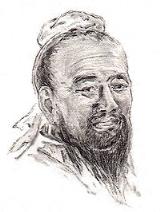
Zhuangzi was an influential
ChineseThe term Chinese people may refer to any of the following:*People with Han Chinese ethnicity ....
philosopherChinese philosophy is philosophy written in the Chinese tradition of thought. The majority of traditional Chinese philosophy originates in the Spring and Autumn and Warring States era, during a period known as the "Hundred Schools of Thought", which was characterized by significant intellectual and...
who lived around the 4th century BCE during the
Warring States PeriodThe Warring States Period , also known as the Era of Warring States, or the Warring Kingdoms period, covers the Iron Age period from about 475 BC to the reunification of China under the Qin Dynasty in 221 BC...
, a period corresponding to the philosophical summit of
ChineseChinese culture is one of the world's oldest and most complex. The area in which the culture is dominant covers a large geographical region in eastern Asia with customs and traditions varying greatly between towns, cities and provinces...
thought — the
Hundred Schools of ThoughtThe Hundred Schools of Thought were philosophers and schools that flourished from 770 to 221 BC during the Spring and Autumn period and the Warring States period , an era of great cultural and intellectual expansion in China...
, and is credited with writing—in part or in whole—a work known by his name, the
ZhuangziThe Taoist book Zhuangzi was named after its purported author Zhuangzi, the philosopher. Since 742 CE, when Emperor Xuanzong of Tang mandated honorific titles for Taoist texts, it has also been known as the Nánhuá Zhēnjīng , literally meaning "True Classic of Southern Florescence," alluding to...
. His name Zhuangzi (English "Master Zhuang", with Zi being an honorific) is sometimes spelled
Zhuang Tze,
Zhuang Zhou,
Chuang Tsu,
Chuang Tzu,
Chouang-Dsi,
Chuang Tse, or
Chuangtze.
Life
Zhuangzi is thought to have lived during the reign of
King Hui of LiangKing Hui of Wei , originally called Marquis Hui of Wei, and after 344, King Hui of Liang was the third ruler of the state of Wei during the Warring States Period, ruling from approximately 370 BC–319 BC...
and King Xuan of Qi, in the span from 370 to 301 BCE. Zhuangzi was from the Town of Meng (蒙城, Méng Chéng) in the state of
SongSòng was a state during the Eastern Zhou Spring and Autumn Period . Its capital was Shangqiu . In 701 BC, a political marriage between Lady Yong of Song and Duke Zhuang of Zheng empowered Song to manipulate the management of Zheng.- Origin :After King Wu of Zhou overthrew King Zhou of Shang,...
(now Mengcheng 蒙城,
AnhuiAnhui is a province in the People's Republic of China. Located in eastern China across the basins of the Yangtze River and the Huai River, it borders Jiangsu to the east, Zhejiang to the southeast, Jiangxi to the south, Hubei to the southwest, Henan to the northwest, and Shandong for a tiny...
).
The validity of his existence has been questioned by some, including himself (See below) and Russell Kirkland, who writes:
According to modern understandings of Chinese tradition, the text known as the Chuang-tzu was the production of a 'Taoist' thinker of ancient China named Chuang Chou/Zhuang Zhou. In reality, it was nothing of the sort. The Chuang-tzu known to us today was the production of a thinker of the third century CE named Kuo Hsiang. Though Kuo was long called merely a 'commentator,' he was in reality much more: he arranged the texts and compiled the present 33-chapter edition. Regarding the identity of the original person named Chuang Chou/Zhuangzi, there is no reliable historical data at all.
However, the existence of a biography of Zhuangzi in the
Records of the Grand HistorianThe Records of the Grand Historian, also known in English by the Chinese name Shiji , written from 109 BC to 91 BC, was the Magnum opus of Sima Qian, in which he recounted Chinese history from the time of the Yellow Emperor until his own time...
chapter 63 shows that even if not the author of the text
Zhuangzi, records of the philosopher Zhuangzi pre-date
Guo XiangGuo Xiang , is credited with the first and most important revision of the text known as the Zhuangzi which, along with the Laozi, forms the textual and philosophical basis of the Taoist school of thought...
(d. 312) by centuries. Furthermore, the
Han Shu "Yiwen zhi" (Monograph on literature) lists a text
Zhuangzi, showing that a text with this title existed no later than the early 1st century CE, again pre-dating Guo Xiang by centuries.
Writing
Zhuangzi is traditionally credited as the author of at least part of the work bearing his name, the
Zhuangzi. This work, in its current shape consisting of 33 chapters, is traditionally divided into three parts: the first, known as the "Inner Chapters", consist of the first seven chapters; the second, known as the "Outer Chapters", consist of the next 15 chapters; the last, known as the "Mixed Chapters", consist of the remaining 11 chapters. The meaning of these three names is disputed: according to Guo Xiang, the "Inner Chapters" were written by Zhuangzi, the "Outer Chapters" written by his disciples, and the "Mixed Chapters" by other hands; the other interpretation is that the names refer to the origin of the titles of the chapters—the "Inner Chapters" take their titles from phrases inside the chapter, the "Outer Chapters" from the opening words of the chapters, and the "Mixed Chapters" from a mixture of these two sources. Further study of the text does not provide a clear choice between these alternatives. On the one side, as Martin Palmer points out in the introduction to his translation, two of the three chapters
Sima QianSima Qian was a Prefect of the Grand Scribes of the Han Dynasty. He is regarded as the father of Chinese historiography for his highly praised work, Records of the Grand Historian , a "Jizhuanti"-style general history of China, covering more than two thousand years from the Yellow Emperor to...
cited in his biography of Zhuangzi, come from the "Outer Chapters" and the third from the "Mixed Chapters". "Neither of these are allowed as authentic Chuang Tzu chapters by certain purists, yet they breathe the very spirit of Chuang Tzu just as much as, for example, the famous 'butterfly passage' of chapter 2." On the other hand, chapter 33 has been often considered as intrusive, being a survey of the major movements during the "Hundred Schools of Thought" with an emphasis on the philosophy of Hui Shih. Further, A.C. Graham and other critics have subjected the text to a stylistic analysis and identified four strains of thought in the book: a) the ideas of Zhuangzi or his disciples; b) a "primitivist" strain of thinking similar to Laozi; c) a strain very strongly represented in chapters 8-11 which is attributed to the philosophy of Yang Chu; and d) a fourth strain which may be related to the philosophical school of
Huang-LaoHuang-Lao or Huanglao was the most influential Chinese school of thought in the early 2nd-century BCE Han Dynasty, and is generally interpreted as encompassing Daoism and Legalism...
.
The style of the
Zhuangzi is of little help in resolving this issue. As Martin Palmer again writes in his translation, "Trying to read Chuang Tzu sequentially is a mistake. The text is a collection, not a developing argument." Not only is
Zhuangzi a collection of sayings attributed to Zhuangzi, it also includes a number of stories, all presented haphazardly. It would be easy for another author to insert new material without disturbing the flow before the text had been stabilized centuries after Zhuangzi's death, and possibly escape detection.
Zhuangzi was renowned for his brilliant wordplay and use of parables to convey messages. His critiques of
Confucian society and historical figures are humorous and at times ironic.
Zhuangzi's philosophy
In general, Zhuangzi's
philosophyPhilosophy is the study of general and fundamental problems, such as those connected with existence, knowledge, values, reason, mind, and language. Philosophy is distinguished from other ways of addressing such problems by its critical, generally systematic approach and its reliance on rational...
is skeptical, arguing that life is limited and knowledge to be gained is unlimited. To use the limited to pursue the unlimited, he said, was foolish. Our
languageLanguage may refer either to the specifically human capacity for acquiring and using complex systems of communication, or to a specific instance of such a system of complex communication...
and
cognitionIn science, cognition refers to mental processes. These processes include attention, remembering, producing and understanding language, solving problems, and making decisions. Cognition is studied in various disciplines such as psychology, philosophy, linguistics, and computer science...
in general presuppose a
daoDao or Tao is a Chinese word meaning 'way', 'path', 'route', or sometimes more loosely, 'doctrine' or 'principle'...
to which each of us is committed by our separate past—our paths. Consequently, we should be aware that our most carefully considered conclusions might seem misguided had we experienced a different past. Zhuangzi argues that in addition to experience our natural dispositions are combined with acquired ones—including dispositions to use names of things, to approve/disapprove based on those names and to act in accordance to the embodied standards. Thinking about and choosing our next step down our dao or path is conditioned by this unique set of natural acquisitions.
Zhuangzi's thought can also be considered a precursor of
relativismRelativism is the concept that points of view have no absolute truth or validity, having only relative, subjective value according to differences in perception and consideration....
in systems of value. His relativism even leads him to doubt the basis of pragmatic arguments (that a course of action preserves our lives) since this presupposes that life is good and death bad. In the fourth section of "The Great Happiness" (至樂
zhìlè, chapter 18), Zhuangzi expresses pity to a skull he sees lying at the side of the road. Zhuangzi laments that the skull is now dead, but the skull retorts, "How do you know it's bad to be dead?"
Another example about two famous courtesans points out that there is no universally objective standard for beauty. This is taken from Chapter 2 (齊物論
qí wù lùn) "On Arranging Things", or "Discussion of Setting Things Right" or, in
Burton WatsonBurton Watson is an accomplished translator of Chinese and Japanese literature and poetry. He has received awards including the Gold Medal Award of the Translation Center at Columbia University in 1979, the PEN Translation Prize in 1981 for his translation with Hiroaki Sato of From the Country of...
's translation, "Discussion on Making All Things Equal".
Men claim that Mao [Qiang] and Lady Li were beautiful, but if fish saw them they would dive to the bottom of the stream; if birds saw them they would fly away, and if deer saw them they would break into a run. Of these four, who knows how to fix the standard of beauty in the world? (2, tr. Watson 1968:46)
However, this subjectivism is balanced by a kind of sensitive
holismHolism is the idea that all the properties of a given system cannot be determined or explained by its component parts alone...
in the famous section called "The Happiness of Fish" (魚之樂, yúzhīlè).
The traditional interpretation of this "Daoist staple", writes Chad Hansen (2003:145), is a "humorous miscommunication between a mystic and a logician".
The encounter also outlines part of the Daoist practice of observing and learning from the natural world.
The butterfly dream
Another well-known part of the book, which is also found in Chapter 2, is usually called "Zhuangzi dreamed he was a butterfly" (莊周夢蝶
Zhuāng Zhōu mèng dié). Again, the names have been changed to pinyin romanization for consistency:
Once Zhuangzi dreamt he was a butterfly, a butterfly flitting and fluttering around, happy with himself and doing as he pleased. He didn't know he was Zhuangzi. Suddenly he woke up and there he was, solid and unmistakable Zhuangzi. But he didn't know if he was Zhuangzi who had dreamt he was a butterfly, or a butterfly dreaming he was Zhuangzi. Between Zhuangzi and a butterfly there must be some distinction! This is called the Transformation of Things. (2, tr. Burton Watson 1968:49)
This hints at many questions in the
philosophy of mindPhilosophy of mind is a branch of philosophy that studies the nature of the mind, mental events, mental functions, mental properties, consciousness and their relationship to the physical body, particularly the brain. The mind-body problem, i.e...
,
philosophy of languagePhilosophy of language is the reasoned inquiry into the nature, origins, and usage of language. As a topic, the philosophy of language for analytic philosophers is concerned with four central problems: the nature of meaning, language use, language cognition, and the relationship between language...
, and
epistemology. The name of the passage has become a common
Chinese idiom, and has spread into Western languages as well. It appears, inter alia, as an illustration in
Jorge Luis BorgesJorge Francisco Isidoro Luis Borges Acevedo , known as Jorge Luis Borges , was an Argentine writer, essayist, poet and translator born in Buenos Aires. In 1914 his family moved to Switzerland where he attended school, receiving his baccalauréat from the Collège de Genève in 1918. The family...
' famous essay "
A New Refutation of TimeA New Refutation of Time is an essay by Argentinian writer Jorge Luis Borges in which he argues that the negations of idealism may be extended to time. It consists of a prologue and two articles: the first one was written in 1944 and appeared in number 115 of the review Sur; the second, written...
", and may have inspired
H. P. LovecraftHoward Phillips Lovecraft --often credited as H.P. Lovecraft — was an American author of horror, fantasy and science fiction, especially the subgenre known as weird fiction....
's 1918 short story "
Polaris"Polaris" is a short story by H. P. Lovecraft, written in 1918 and first published in the December 1920 issue of the amateur journal The Philosopher...
". It also appears in
Victor PelevinVictor Olegovich Pelevin is a Russian fiction writer. His books usually carry the outward conventions of the science fiction genre, but are used to construct involved, multi-layered postmodernist texts, fusing together elements of pop culture and esoteric philosophies...
's 1996 philosophical novel Buddha's Little Finger.
Zhuangzi's philosophy was very influential in the development of Chinese Buddhism, especially
Chán-People:* Chan Marshall, American musician better known as Cat Power* Chan , Chinese surname; Mandarin transcription of the same name is Chen ** Agnes Chan , Hong Kong singer, also famous in Japan...
(known in Japan as
ZenZen is a school of Mahāyāna Buddhism founded by the Buddhist monk Bodhidharma. The word Zen is from the Japanese pronunciation of the Chinese word Chán , which in turn is derived from the Sanskrit word dhyāna, which can be approximately translated as "meditation" or "meditative state."Zen...
).
Anarchism
Zhuangzi said the world "does not need governing; in fact it should not be governed," and, "
Good order results spontaneouslySpontaneous order, also known as "self-organization", is the spontaneous emergence of order out of seeming chaos. It is a process found in physical, biological, and social networks, as well as economics, though the term "self-organization" is more often used for physical and biological processes,...
when things are let alone."
Murray RothbardMurray Newton Rothbard was an American author and economist of the Austrian School who helped define capitalist libertarianism and popularized a form of free-market anarchism he termed "anarcho-capitalism." Rothbard wrote over twenty books and is considered a centrally important figure in the...
called him "perhaps the world's first anarchist".
Evolution
In Chapter 18, Zhuangzi also mentions life forms have an innate ability or power (hua 化) to transform and adapt to their surroundings. While his writings don't give any solid evidence or mechanism of biological evolution, such as those of Alfred Wallace and
Charles DarwinCharles Robert Darwin FRS was an English naturalist. He established that all species of life have descended over time from common ancestry, and proposed the scientific theory that this branching pattern of evolution resulted from a process that he called natural selection.He published his theory...
do, his idea about the transformation of life from simple to more complex forms could be seen as being along the same line of thought. Zhuangzi further mentioned that humans are also subject to this process as humans are a part of nature.
See also
- Laozi
Laozi was a mystic philosopher of ancient China, best known as the author of the Tao Te Ching . His association with the Tao Te Ching has led him to be traditionally considered the founder of Taoism...
- Liezi
The Liezi is a Daoist text attributed to Lie Yukou, a circa 5th century BCE Hundred Schools of Thought philosopher, but Chinese and Western scholars believe it was compiled around the 4th century CE.-Textual history:...
- Hui Shi
Hui Shi , or Huizi , was a Chinese philosopher during the Warring States Period. He was a representative of the School of Names , and is famous for ten paradoxes about the relativity of time and space, for instance, "I set off for Yue today and came there yesterday."-Works mentioning Hui Shi:The...
- Tao Te Ching
The Tao Te Ching, Dao De Jing, or Daodejing , also simply referred to as the Laozi, whose authorship has been attributed to Laozi, is a Chinese classic text...
- Dream argument
The dream argument is the postulation that the act of dreaming provides preliminary evidence that the senses we trust to distinguish reality from illusion should not be fully trusted, and therefore any state that is dependent on our senses should at the very least be carefully examined and...
- Brook Ziporyn
Brook Ziporyn is an American sinologist and philosopher, as well as the leading English language scholar of Tiantai Buddhism. His research focuses on Taoism, Confucianism, Chinese Buddhism, Chinese intellectual history, and comparative philosophy. He is also known for publishing the most recent...
External links
- Zhuangzi Bilingual Chinese-English version (James Legge
James Legge was a noted Scottish sinologist, a Scottish Congregationalist, representative of the London Missionary Society in Malacca and Hong Kong , and first professor of Chinese at Oxford University...
's translation) - Chinese Text ProjectThe Chinese Text Project is a digital library project that assembles collections of early Chinese texts. The name of the project in Chinese literally means "The Digitization Project of Chinese Philosophy Books", showing its focus on books related to Chinese philosophy...
- The Zhuangzi "Being Boundless", Complete translation of Zhuangzi by Nina Correa
- Chuang Tzu at Taoism.net, Chuang Tzu's Stories and Teachings - translations by Derek Lin
- Zhuangzi, The Internet Encyclopedia of Philosophy
- Zhuangzi, Stanford Encyclopedia of Philosophy
- The Chuang-tzu, translated by Lin Yutang
Lin Yutang was a Chinese writer and inventor. His informal but polished style in both Chinese and English made him one of the most influential writers of his generation, and his compilations and translations of classic Chinese texts into English were bestsellers in the West.-Youth:Lin was born in...
- Selection from The Zhuangzi, translated by Patricia Ebrey
- Chuang Tzu And The Butterfly
- Chuang-tzu at Taopage.org
- Zhuang Zi, chapter 1
- Zhuang Zi, chapter 2
- James Legge Complete Translation In English The Legge translation of the complete Chuang Tzu (Zhuangzi) updated