
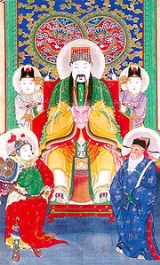
The
Jade Emperor in Chinese folk culture, is the ruler of
HeavenHeaven, the Heavens or Seven Heavens, is a common religious cosmological or metaphysical term for the physical or transcendent place from which heavenly beings originate, are enthroned or inhabit...
and all realms of existence below including that of
ManThe term man is used for an adult human male . However, man is sometimes used to refer to humanity as a whole...
and
HellIn many religious traditions, a hell is a place of suffering and punishment in the afterlife. Religions with a linear divine history often depict hells as endless. Religions with a cyclic history often depict a hell as an intermediary period between incarnations...
, according to a version of
Taoist mythologyChinese mythology is a collection of cultural history, folktales, and religions that have been passed down in oral or written tradition. These include creation myths and legends and myths concerning the founding of Chinese culture and the Chinese state...
. He is one of the most important gods of the Chinese traditional religion
pantheonA pantheon is a set of all the gods of a particular polytheistic religion or mythology.Max Weber's 1922 opus, Economy and Society discusses the link between a...
. In actual Taoism, the Jade Emperor governs all of the mortals' realm and below, but ranks below the
Three Pure OnesThe Three Pure Ones also translated as the Three Pure Pellucid Ones, the Three Pristine Ones, the Three Divine Teachers, the Three Clarities, or the Three Purities is the Taoist Trinity, the three highest Gods in the Taoist pantheon. They are regarded as pure manifestation of the Tao and the...
.
The Jade Emperor is known by many names, including Heavenly Grandfather (天公 Tiān Gōng) which is used by commoners; the Pure August Jade Emperor, August Personage of Jade (玉皇上帝
Yu Huang Shangdi or 玉皇大帝
Yu Huang Dadi); the Xuanling High Sovereign; and his rarely used, formal title,
Peace Absolving, Central August Spirit Exalted, Ancient Buddha, Most Pious and Honorable, His Highness the Jade-Emperor, Xuanling High Sovereign (太平普度皇靈中天至聖仁義古佛玉皇大天尊).
Chinese mythology
There are many stories in
Chinese mythologyChinese mythology is a collection of cultural history, folktales, and religions that have been passed down in oral or written tradition. These include creation myths and legends and myths concerning the founding of Chinese culture and the Chinese state...
involving the Jade Emperor.
Origin
It was said that the Jade Emperor was originally the crown prince of the kingdom of Pure Felicity and Majestic Heavenly Lights and Ornaments. At birth, he emitted a wondrous light that filled the entire kingdom. When he was young, he was kind, intelligent and wise. He devoted his entire childhood to helping the needy (the poor and suffering, the deserted and single, the hungry and disabled). Furthermore, he showed respect and benevolence to both men and creatures.
After his father died, he ascended the throne. He made sure that everyone in his kingdom found peace and contentment. After that, he told his ministers that he wished to cultivate
TaoDao or Tao is a Chinese word meaning 'way', 'path', 'route', or sometimes more loosely, 'doctrine' or 'principle'...
on the Bright and Fragrant Cliff.
After 1,550 kalpas, each kalpa lasting for 129,600 years, he attained Golden Immortality. After another one hundred million years of cultivation, he finally became the Jade Emperor. (Using the given figures, this period before his becoming the Jade Emperor lasted for a total of about 300,880,000 years.)
Vanquishing evil
One of the myths describes how the Jade Emperor became the monarch of all the deities in heaven. It is one of the few myths in which the Jade Emperor really shows his might.
In the beginning of time, the earth was a very difficult place to live; a much harsher place to live in than it is now. People were having tremendous difficulty coping with existence; not only did they have to deal with harsh conditions, but also with all kinds of monstrous beings. At this time, there were also not many gods or deities to protect them. Furthermore, a lot of powerful, evil demons were defying the immortals of heaven. The Jade Emperor was still at the time an ordinary immortal who roamed earth to help as many people as he could. He was, however, saddened by the fact that his powers were limited and could only ease the sufferings of humans. He decided to retreat in a mountain cave and cultivate his Tao. He passed 3,200 trials, each trial lasting about 3 million years.
Unfortunately, a powerful, evil entity—a demon of sorts, which dwelt on earth—had the ambition to conquer the immortals and gods in heaven and proclaim sovereignty over the entire universe. This evil entity also went into retreat and meditation to expand its power, though later than the Jade Emperor. He passed through 3,000 trials each trial lasting for about 3 million years too. After it passed its final trial, it felt confident that no one could defeat it anymore. It re-entered the world again, and recruited an army of demons with the purpose of attacking heaven.
The immortals, being aware of the threat, gathered themselves and prepared for war. The gods were unable to stop the powerful demon and it defeated them all.
Fortunately, the Jade Emperor finished his cultivation in the midst of this war. He was changing the land to make it more liveable for men and repelling all kinds of monstrous beasts. Suddenly, he saw an evil glow emitting from heaven and knew something was amiss. He ascended and saw that a war was going on, he saw that the demon was too powerful to be stopped by any of the gods present. He went up and challenged the demon, and a battle ensued between them. Mountains shook and rivers and seas toppled; however, the Jade Emperor stood victorious due to his deeper and wiser cultivation, not for might but for benevolence. After defeating the demon, all the other demons were scattered by the gods and immortals.
Because of his noble and benevolent deeds, the gods, immortals and humans proclaimed the Jade Emperor the supreme sovereign of all.
Creation
The world started with
無極Wuji 無極 originally meant "ultimateless; boundless; infinite" in Warring States Period Daoist classics, but came to mean the "primordial universe" prior to the Taiji 太極 "Supreme Ultimate" in Song Dynasty Neo-Confucianist cosmology...
(
wuji: nothingness) according to the Chinese creation myth, Jade Emperor was the head of the pantheon but not responsible to the creation process itself.
According to another version of creation myth, the Jade Emperor fashioned the first humans from clay, but as he left them to harden in the sun, it rained, misshaping some of the figures, thus explaining the origin of sickness and physical abnormalities (The most common alternative Chinese creation myth states that human beings were once fleas on the body of
PanguPangu was the first living being and the creator of all in Chinese mythology.- The Pangu legend:...
.)
The story above is also told as
NüwaNüwa is a goddess in ancient Chinese mythology best known for creating mankind and repairing the wall of heaven.-Primary sources:...
, who fashions men out of the mud from the Yellow River by hand. Those she made became the richer people of the earth. After getting lazy, she used a rope and swung it around. The drops that fell from the rope became the poorer humans.
In The Journey to the West
In the popular novel by Wu Chengen, the Jade Emperor is featured many times in the story.
The princess and the cowherd
In another story, popular throughout Asia and with many differing versions, the Jade Emperor has a daughter named
Zhinü ( or Chih'nü, literally: weaver girl). She is most often represented as responsible for weaving colorful clouds in the heaven. In some versions she is the Goddess Weaver, daughter of the Jade Emperor and the Celestial Queen Mother, who weaves the Silver River (known in the West as the
Milky WayThe Milky Way is the galaxy that contains the Solar System. This name derives from its appearance as a dim un-resolved "milky" glowing band arching across the night sky...
), which gives light to heaven and earth. In other versions, she is a seamstress who works for the Jade Emperor.
Every day Zhinü descended to earth with the aid of a magical robe to bathe. One day, a lowly cowherd named
Niu Lang spotted Zhinü as she bathed in a stream. Niu Lang fell instantly in love with her and stole her magic robe which she had left on the bank of the stream, leaving her unable to escape back to Heaven. When Zhinü emerged from the water, Niu Lang grabbed her and carried her back to his home.
When the Jade Emperor heard of this matter, he was furious but unable to intercede, since in the meantime his daughter had fallen in love and married the cowherd. As time passed, Zhinü grew homesick and began to miss her father. One day, she came across a box containing her magic robe which her husband had hidden. She decided to visit her father back in Heaven, but once she returned, the Jade Emperor summoned a river to flow across the sky (the
Milky WayThe Milky Way is the galaxy that contains the Solar System. This name derives from its appearance as a dim un-resolved "milky" glowing band arching across the night sky...
), which Zhinü was unable to cross to return to her husband. The Emperor took pity on the young lovers, and so once a year on the seventh day of the seventh month of the
lunar calendarA lunar calendar is a calendar that is based on cycles of the lunar phase. A common purely lunar calendar is the Islamic calendar or Hijri calendar. A feature of the Islamic calendar is that a year is always 12 months, so the months are not linked with the seasons and drift each solar year by 11 to...
, he allows them to meet on a bridge over the river.
The story refers to
constellationIn modern astronomy, a constellation is an internationally defined area of the celestial sphere. These areas are grouped around asterisms, patterns formed by prominent stars within apparent proximity to one another on Earth's night sky....
s in the night sky. Zhinü is the
starA star is a massive, luminous sphere of plasma held together by gravity. At the end of its lifetime, a star can also contain a proportion of degenerate matter. The nearest star to Earth is the Sun, which is the source of most of the energy on Earth...
VegaVega is the brightest star in the constellation Lyra, the fifth brightest star in the night sky and the second brightest star in the northern celestial hemisphere, after Arcturus...
in the constellation of
LyraLyra is a small constellation. It is one of the 48 constellations listed by the 2nd century astronomer Ptolemy, and remains one of the 88 modern constellations recognized by the International Astronomical Union. Its principal star, Vega — a corner of the Summer Triangle — is one of the brightest...
east of the Milky Way, and Niu Lang is the star
Altair in the constellation of
AquilaAquila is a stellar constellation. Its name is Latin for 'eagle' and it is commonly represented as such. In mythology, Aquila was owned by the Roman god Jupiter and performed many tasks for him....
west of the Milky Way. Under the first quarter moon (7th day) of the seventh lunar month (around August), the lighting condition in the sky causes the Milky Way to appear dimmer, hence the story that the two lovers are no longer separated in that one particular day each year.
The seventh day of the seventh month of the lunar calendar is a holiday in China called Qixi Festival, which is a day for young lovers much like
Valentine's DaySaint Valentine's Day, commonly shortened to Valentine's Day, is an annual commemoration held on February 14 celebrating love and affection between intimate companions. The day is named after one or more early Christian martyrs named Saint Valentine, and was established by Pope Gelasius I in 496...
in the West. In
JapanJapan is an island nation in East Asia. Located in the Pacific Ocean, it lies to the east of the Sea of Japan, China, North Korea, South Korea and Russia, stretching from the Sea of Okhotsk in the north to the East China Sea and Taiwan in the south...
, it is called
Tanabatais a Japanese star festival, originating from the Chinese Qixi Festival. It celebrates the meeting of the deities Orihime and Hikoboshi . According to legend, the Milky Way separates these lovers, and they are allowed to meet only once a year on the seventh day of the seventh lunar month of the...
(star day), and in
KoreaKorea ) is an East Asian geographic region that is currently divided into two separate sovereign states — North Korea and South Korea. Located on the Korean Peninsula, Korea is bordered by the People's Republic of China to the northwest, Russia to the northeast, and is separated from Japan to the...
, it is called
ChilseokChilseok is a Korean traditional festival which falls on the seventh day of the seventh month of the Korean lunisolar calendar. Chilseok is derived from the Chinese festival, Qi Xi. Chilseok is a period where the heat starts to pass away and the monsoon season begins, and the rain that falls during...
. If it rains on that day, it is said to be Zhinü crying tears of happiness in being reunited with her husband.
The zodiac
There are several stories as to how the twelve
animalAnimals are a major group of multicellular, eukaryotic organisms of the kingdom Animalia or Metazoa. Their body plan eventually becomes fixed as they develop, although some undergo a process of metamorphosis later on in their life. Most animals are motile, meaning they can move spontaneously and...
s of the
Chinese zodiacThe Shēngxiào , better known in English as the Chinese Zodiac, is a scheme that relates each year to an animal and its reputed attributes, according to a 12-year mathematical cycle...
were chosen. In one, the Jade Emperor, although having ruled Heaven and Earth justly and wisely for many years, had never had the time to actually visit the Earth personally. He grew curious as to what the creatures looked like. Thus, he asked all the animals to visit him in heaven. The cat, being the most handsome of all animals, asked his friend the rat to wake him on the day they were to go to Heaven so he wouldn't oversleep. The rat, however, was worried that he would seem ugly compared to the cat, so he didn't wake the cat. Consequently, the cat missed the meeting with the Jade Emperor and was replaced by the
pigThe Pig , is the last of the 12 animals which appear in the Chinese zodiac. The Year of the Pig is associated with the earthly branch Hai .In Chinese culture, the pig is associated with fertility and virility...
. The Jade Emperor was delighted with the animals and so decided to divide the years up amongst them. When the cat learned of what had happened, he was furious with the rat and that, according to the story, is why cats and rats are enemies to this day.
The
catThe cat is the fourth animal symbol in the 12-year cycle of the Vietnamese zodiac, taking place of the rabbit in the Chinese zodiac. Cats are 'smooth talkers', talented and ambitious, and will succeed in studies. They are in conflict with the rat. A cat person has a supple mind and patient...
however,
does have a place in the Vietnamese zodiac, replacing the rabbit.
His predecessor and successor
The Jade Emperor was originally the assistant of the Divine Master of the
Heavenly Origin, Yuanshi Tianzun. Yuanshi Tianzun is said to be the supreme beginning, the limitless and eternal creator of Heaven and Earth, who picked Yu-huang, or the Jade Emperor, as his personal successor. The Jade Emperor will eventually be succeeded by the Heavenly Master of the Dawn of Jade of the Golden Door (金闕玉晨天尊). The characters for both are stamped on the front of the arms of his throne. In two folk
automatic writingFuji is a method of "planchette writing; spirit writing; automatic writing" using a suspended sieve or tray to guide a stick which writes Chinese characters in sand or incense ashes....
texts in 1925 and 1972
Guan YuGuan Yu was a general serving under the warlord Liu Bei during the late Eastern Han Dynasty of China. He played a significant role in the civil war that led to the collapse of the Han Dynasty and the establishment of the state of Shu Han during the Three Kingdoms period, of which Liu Bei was the...
became the 18th Jade Emperor in about 1840 AD, however some have disagreed that Guan Yu has succeeded, and thus the Jade Emperor and Guan Yu are often worshiped separately. In
TientiThe Lord of Universe Church is an international religious organization based in the Republic of China which is devoted to the "T'ienti Teachings" proclaimed by the late Lee Yü-chieh. It is a splinter religion from Tiender which is closely related to Confucianism and Taoism...
teachings, the current jade emperor has 55 predecessors.
Worship and festivals
The Jade Emperor's Birthday is said to be the ninth day of the first lunar month. On this day Taoist
templeA temple is a structure reserved for religious or spiritual activities, such as prayer and sacrifice, or analogous rites. A templum constituted a sacred precinct as defined by a priest, or augur. It has the same root as the word "template," a plan in preparation of the building that was marked out...
s hold a Jade Emperor ritual (拜天公 bài tiān gōng, literally "heaven worship") at which priests and laymen prostrate themselves, burn
incenseIncense is composed of aromatic biotic materials, which release fragrant smoke when burned. The term "incense" refers to the substance itself, rather than to the odor that it produces. It is used in religious ceremonies, ritual purification, aromatherapy, meditation, for creating a mood, and for...
, and make food offerings.
Chinese New Year's Eve is also a day of worship as it is said to be the day the Jade Emperor makes his annual inspection of the deeds of
mortalHumans are the only living species in the Homo genus...
s and rewards or punishes them accordingly. On this day incense is burned in the home and offerings are made to the Jade Emperor and also to
Zao JunIn Chinese folk religion and Chinese mythology, the Kitchen God, named Zao Jun or Zao Shen , is the most important of a plethora of Chinese domestic gods that protect the hearth and family with the addition of being celebrated...
, the god of kitchen who reports to the Emperor on each family.
A temple in
Hong KongHong Kong is one of two Special Administrative Regions of the People's Republic of China , the other being Macau. A city-state situated on China's south coast and enclosed by the Pearl River Delta and South China Sea, it is renowned for its expansive skyline and deep natural harbour...
is located at
A Kung NgamA Kung Ngam is a village and an area in northeast Shau Kei Wan in the north of Hong Kong Island. It contains a fish terminal market and several temples and the Hong Kong Museum of Coastal Defence.A fire broke out in the early morning of 31 October 2005...
and is also called "Yuk Wong Po Tin" (玉皇寶殿
Yu Huang Bao Dian). In the mid 19th century, people from
HuizhouHuizhou , historically known as Waichow, is a city located in central Guangdong province of the People's Republic of China. Part of the Pearl River Delta, Huizhou borders the provincial capital of Guangzhou to the west, Shaoguan to the north, Heyuan to the northeast, Shanwei to the east, Shenzhen...
and
ChaozhouChaozhou is a city in eastern Guangdong province of the People's Republic of China. It borders Shantou to the south, Jieyang to the southwest, Meizhou to the northwest, the province of Fujian to the east, and the South China Sea to the southeast...
mined stones in the hill for the development of the central urban area. They set up a shrine to worship Yuk Wong. At the beginning of the 20th century, the shrine was developed into a small
templeA temple is a structure reserved for religious or spiritual activities, such as prayer and sacrifice, or analogous rites. A templum constituted a sacred precinct as defined by a priest, or augur. It has the same root as the word "template," a plan in preparation of the building that was marked out...
and was renovated many times. The latest renovation was in 1992.
Trivia
A crater on
SaturnSaturn is the sixth planet from the Sun and the second largest planet in the Solar System, after Jupiter. Saturn is named after the Roman god Saturn, equated to the Greek Cronus , the Babylonian Ninurta and the Hindu Shani. Saturn's astronomical symbol represents the Roman god's sickle.Saturn,...
's moon
RheaRhea is the second-largest moon of Saturn and the ninth largest moon in the Solar System. It was discovered in 1672 by Giovanni Domenico Cassini.-Name:Rhea is named after the Titan Rhea of Greek mythology, "mother of the gods"...
, discovered by
Voyager 2The Voyager 2 spacecraft is a 722-kilogram space probe launched by NASA on August 20, 1977 to study the outer Solar System and eventually interstellar space...
spacecraft, is named after him.
See also
- Chinese mythology in popular culture
Elements of Chinese mythology have appeared many times in popular culture.- Dragon turtle :*Bowser, the arch-nemesis of Mario in the Super Mario Bros. video game franchise, is a well known dragon turtle....
- Jade
Jade is an ornamental stone.The term jade is applied to two different metamorphic rocks that are made up of different silicate minerals:...
- Śakra, the Jade Emperor's Buddhist counterpart